
Dihexa / Methylene Blue / Tesofensine: Combination Evidence, Serotonin Risk and Dose References
On this page
Quick Reference Card
Attribute
What it is
Attribute
Evidence basis
Attribute
Main interaction concern
Attribute
Regulatory status
Attribute
Dose evidence
Attribute
Combination uncertainty
- Research reference
- Synergy has not been demonstrated. A fixed combo makes side-effect attribution difficult and combines two CNS-active monoamine-relevant compounds with a preclinical Dihexa narrative.
Quick dose reference
This stack has no established human blend dose. Component evidence and interaction concerns should be reviewed separately. Any dosing protocol should be reviewed with a qualified healthcare practitioner.
Oral capsule listing
Online sourced dosing details
- Reported amount
- Dihexa 5 mg; MB 50 mg; tesofensine 0.5 mg
- Frequency
- Not disclosed
- Duration
- Not disclosed
- Dose adjustment
- Not disclosed
- Reported range & limits
- The capsule listing gives component amounts only: Dihexa 5 mg, methylene blue 50 mg, tesofensine 0.5 mg. No frequency, duration, lower bound, or safe maximum is established.
Evidence and range contextReview the full source references below.
Public capsule listing amount
Included because it is the only public source with component amounts for the blend, but it lacks schedule and outcomes.
This is a composition listing only. No public source supplied a coherent frequency, duration or titration for the blend, so none was invented.
Full Dosing Reference SourcesClinical research, registered studies and online dosing sources, with their context and limitations.
No scenario should imply proven synergy for this blend; each component’s dose evidence remains separate.
NuvaMed public product listing
“Dihexa 5 mg; tesofensine 0.5 mg; methylene blue 50 mg” capsules.
- Route, schedule and duration
- Capsule listing; schedule and duration not disclosed in crawled text.
- Evidence limits
- Public commercial listing only; no human combination outcomes or interaction monitoring. [10]
Hydration Room public product listing
“Dihexa/ Tesofensine/ Methylene Blue Capsules.”
- Route, schedule and duration
- Capsule product listing; per-ingredient amounts, route schedule and duration not disclosed in crawled text.
- Evidence limits
- Named public stack listing but not a dose authority. [11]
MD Peptides public product listing
“Dihexa/ Tesofensine/ Methylene Blue Capsules.”
- Route, schedule and duration
- Capsule product listing; per-ingredient amounts, route schedule and duration not disclosed in crawled text.
- Evidence limits
- Named public stack listing but not a clinical protocol. [12]
Dihexa public dose pages
Public Dihexa pages report oral, subcutaneous or intranasal milligram schedules.
- Route, schedule and duration
- Varies by page and route.
Methylene blue official label
1 mg/kg intravenous over 5-30 minutes for acquired methemoglobinemia.
- Route, schedule and duration
- Intravenous hospital drug use, repeat dose only if needed by label.
- Evidence limits
- Official label is not a nootropic oral-capsule stack label. [4]
Methylene blue public low-dose pages
Public pages report oral 5-15 mg/day or capsule strengths such as 2.5-5 mg and 5-25 mg.
- Route, schedule and duration
- Oral capsules/drops; schedules vary.
Tesofensine clinical and public dose pages
Trial doses 0.25, 0.5 and 1.0 mg oral once daily; public pages often repeat 0.25-0.5 mg daily.
- Route, schedule and duration
- Oral once daily; trials lasted 14-24 weeks depending on study.
Expanded search found no human trial, registry, label or peer-reviewed dosing study for the three-component blend. Counted sources are specific blend listings plus component identity, safety and monotherapy-context records; component sources are not proof of synergy.
Applicable product labels and human studies carry the most weight. A registry entry does not establish study results. Animal studies, public guides and forums add context; they do not establish a safe human dose limit.
Official product and regulatory sources
- PubChem compound record: Dihexa
PubChem · 2026 · Background context
Identity record for the Dihexa component; no blend dosing.
- Retraction notice to "The Procognitive and Synaptogenic Effects of Angiotensin IV-Derived Peptides Are Dependent on Activation of the Hepatocyte Growth Factor/c-Met System" [J Pharmacol Exp Ther 351 (2014) 390-402].
PubMed-indexed literature · Abstract reviewed
Retraction notice for a Dihexa HGF/c-Met mechanism paper affects component confidence.
- Notice of Concern: McCoy AT, Benoist CC, Wright JW, Kawas LH, Bule-Ghogare JM, Zhu M, Appleyard SM, Wayman GA, and Harding JW (2013) Evaluation of Metabolically Stabilized Angiotensin IV Analogs as Procognitive/Antidementia Agents, J Pharmacol Exp Ther, 344: 141-154; DOI: https://doi.org/10.1124/jpet.112.199497.
PubMed-indexed literature · Abstract reviewed
Notice of concern for original Dihexa cognitive paper; not a dose source.
- DailyMed: current ProvayBlue label
DailyMed · 2026
Methylene-blue label provides methemoglobinemia dose and serotonergic boxed-warning context; not wellness capsule proof.
- FDA GSRS record: Tesofensine
FDA GSRS · 2026 · Background context
Identity record for tesofensine/NS-2330; no blend dose.
- Expression of concern--effect of tesofensine on bodyweight loss, body composition, and quality of life in obese patients: a randomised, double-blind, placebo-controlled trial.
Lancet (London, England) · 2013-Apr-06 · Abstract reviewed
Expression of concern for tesofensine obesity trial limits confidence in component evidence.
- Saniona January–June 2026 interim report
Saniona · 2026-08-27 · Background context
Company regulatory update indicates tesofensine status; not a blend efficacy source.
Human clinical research
- Effect of tesofensine on bodyweight loss, body composition, and quality of life in obese patients: a randomised, double-blind, placebo-controlled trial.
Lancet (London, England) · 2008-Nov-29 · Abstract reviewed
Tesofensine obesity trial provides component monotherapy dose context only.
- Fosgonimeton in mild-to-moderate Alzheimer's disease.
PubMed-indexed literature · Abstract reviewed · Background context
Fosgonimeton human Alzheimer trial is adjacent HGF pathway context, not Dihexa or blend dosing.
Animal and laboratory research
- The procognitive and synaptogenic effects of angiotensin IV-derived peptides are dependent on activation of the hepatocyte growth factor/c-met system.
PubMed-indexed literature · Abstract reviewed · Background context
Retracted Dihexa mechanism paper kept only as integrity context.
- Ramsay et al. Methylene blue and serotonin toxicity: inhibition of monoamine oxidase A
British Journal of Pharmacology · 2007
Mechanistic MAO-A inhibition source supports serotonin-toxicity concern for the MB component.
- Evaluation of metabolically stabilized angiotensin IV analogs as procognitive/antidementia agents.
PubMed-indexed literature · Abstract reviewed · Background context
Original Dihexa cognitive/synaptogenesis component study; preclinical and notice-linked.
- Development of angiotensin IV analogs as hepatocyte growth factor/Met modifiers.
PubMed-indexed literature · Abstract reviewed · Background context
Dihexa/AngIV analogue development record later affected by retraction context.
Public dosing guides and calculators
- NuvaMed all-products listing
NuvaMed · 2026
Public listing names Dihexa 5 mg, methylene blue 50 mg and tesofensine 0.5 mg capsules without schedule.
- Hydration Room product collection
Hydration Room · 2026 · Background context
Public collection names the blend but does not establish dose frequency or outcomes.
- Formula N-5550 page
PepedHub · 2026 · Background context
Public formula page names the three components; no human outcomes.
- Peptides Know How: Dihexa
Peptides Know How · 2026 · Background context
Public Dihexa dosing context kept separate from the blend row.
- Empower Pharmacy methylene blue capsule page
Empower Pharmacy · 2026 · Background context
Public low-dose oral MB capsule context; not evidence for the three-component blend.
What the combination changes
Methylene blue inhibits MAO-A and carries a serotonergic interaction warning. Tesofensine inhibits serotonin reuptake. Combining these effects raises a pharmacologic concern for serotonin toxicity, even though the risk of this exact marketed combination has not been quantified. [4][5][7]
The Doserly app can keep each component’s amount and source visible, which is crucial if a fixed capsule causes insomnia, anxiety, pulse changes, headache, nausea, mood change or blood-pressure changes.
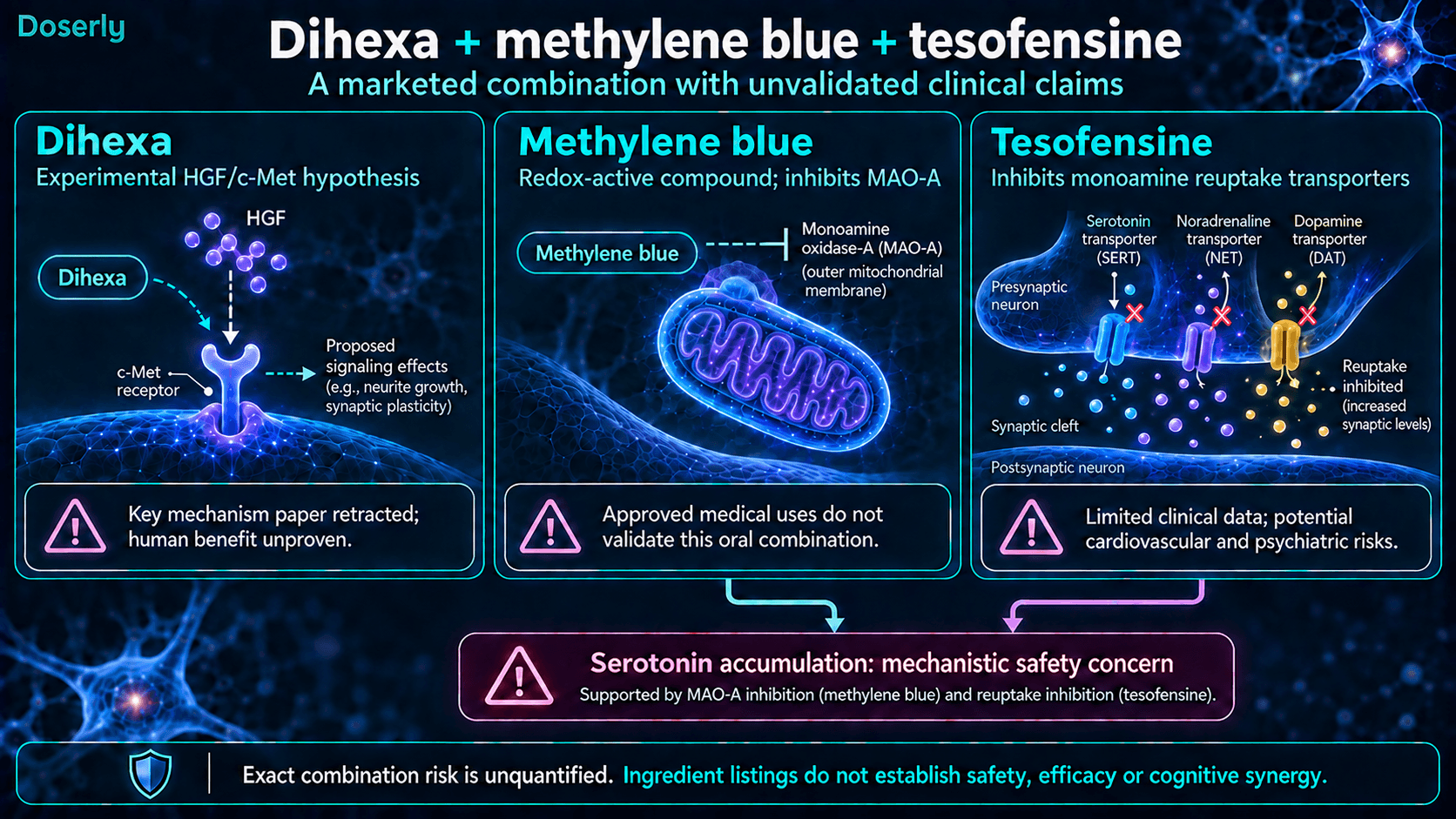
The component map does not imply synergy. Methylene-blue MAO-A inhibition and tesofensine serotonin-reuptake inhibition create a pharmacologic concern; the exact combination risk has not been quantified [2][4][5][7].
What is this stack?
This stack pairs three different narratives: Dihexa for preclinical neuroplasticity claims, methylene blue for redox/mitochondrial and methemoglobinemia pharmacology, and tesofensine for appetite and monoamine reuptake inhibition. The combination is commercially plausible, but evidence is not additive by default. A Dihexa mouse paper, a methylene-blue label and a tesofensine obesity trial do not become a trial of the fixed capsule. [1][2][4][7]
Mechanism and interaction logic
Dihexa is an angiotensin IV-derived peptidomimetic with an integrity-complicated HGF/c-Met mechanism record. Methylene blue is a redox-active phenothiazine dye with FDA-approved IV use for acquired methemoglobinemia and a boxed serotonergic warning. Tesofensine blocks dopamine, norepinephrine and serotonin reuptake. [1][2][4][6][7]
The most important overlap is methylene blue plus tesofensine. Methylene blue labels warn to avoid concomitant use with serotonergic drugs because serious or fatal serotonin syndrome has occurred, and label text describes methylene blue as a potent reversible monoamine oxidase inhibitor. Tesofensine increases serotonin tone by reuptake inhibition. That combination is a rational red flag even though the exact stack has not been quantified in a trial. [4][5][7]
Evidence review
No registered human trial, label or peer-reviewed combination study for Dihexa plus methylene blue plus tesofensine was found. Public product pages show that the stack is marketed, including one exact per-capsule listing and several name-only listings. That establishes market existence, not safety, efficacy or synergy. [10][11][12][13]
The component evidence is uneven. Dihexa’s original behavior paper is not retracted but has a notice of concern, and the HGF/c-Met mechanism paper was retracted. Methylene blue has a legitimate hospital indication but not an approved cognitive-stack indication. Tesofensine has obesity and Tesomet research but no current FDA obesity approval and ongoing Mexican regulatory review reported in August 2026. [2][3][4][5][6][7][8] [16]
Contradictions and common misreadings
The first contradiction is “three mechanisms equals synergy.” Multiple plausible mechanisms can also mean multiple overlapping adverse effects and unreadable attribution.
The second contradiction is “methylene blue is low dose, so the serotonin warning does not matter.” The official label warning is strongest for IV use, but it establishes the pharmacologic concern: MAOI activity plus serotonergic drugs. Tesofensine’s serotonergic action makes that warning relevant to the combination. [4][5]
The third contradiction is “tesofensine is approved in Mexico.” Current public sponsor communications do not support using that claim as settled. [8]
FAQ
Is there human evidence for this exact combination?
No controlled human study of Dihexa plus methylene blue plus tesofensine was found. The guide uses component evidence and public listing evidence only.
What is the main stack-specific safety issue?
The biggest stack-specific concern is serotonergic toxicity logic: methylene blue has MAOI/serotonin-syndrome label warnings, while tesofensine blocks serotonin reuptake. [4][5][7]
Does the NuvaMed capsule strength prove a protocol?
No. It is an exact public listing of per-capsule ingredient amounts, not a clinical dosing schedule, duration or monitoring plan. [10]
Why mention Dihexa retractions in a stack guide?
Because Dihexa’s contribution is often framed as neuroplasticity or cognitive enhancement, and that story depends partly on a mechanism literature affected by notices and retractions. [2][3]
References
[1] PubChem compound record: Dihexa. Identity record for Dihexa/PNB-0408.
[2] Retraction notice for the Dihexa HGF/c-Met mechanism paper (2025).
[3] Retracted 2014 HGF/c-Met mechanism paper record. Benoist et al. paper record with retraction context.
[4] DailyMed: current ProvayBlue label. Acquired methemoglobinemia and boxed serotonergic interaction warning.
[5] Ramsay et al. Methylene blue and serotonin toxicity: inhibition of monoamine oxidase A. Primary enzyme-inhibition study.
[6] FDA GSRS record: Tesofensine. Identity record for tesofensine/NS-2330.
[7] Tesofensine obesity trial. Astrup et al., Lancet, 2008.
[8] Saniona: January–June 2026 interim report, published August 27, 2026. Tesofensine remains under regulatory review.
[9] Expression of concern for the 2008 tesofensine trial. Lancet, 2013.
[10] NuvaMed all-products listing. Public listing with Dihexa 5 mg, tesofensine 0.5 mg and methylene blue 50 mg capsules.
[11] Hydration Room product collection. Public listing naming Dihexa/Tesofensine/Methylene Blue Capsules.
[12] MD Peptides product catalog. Public listing naming Dihexa/Tesofensine/Methylene Blue Capsules.
[13] Formula N-5550 page. Public formula page naming Dihexa, tesofensine and methylene blue composition without outcomes.
[14] Peptides Know How: Dihexa. Public Dihexa dose reference used for component-dose context.
[15] Empower Pharmacy methylene blue capsule page. Public low-dose oral methylene-blue capsule context.
[16] Expression of concern for the original Dihexa cognitive study (2021).