
SLU-PP-332 + 5-Amino: Component Evidence and Blend Dose References
On this page
Quick Reference Card
Attribute
Blend identity
Attribute
SLU-PP-332 evidence
Attribute
5-Amino-1MQ evidence
Attribute
Combination gap
- Research reference
- The mechanisms are different, but that does not prove additive benefit, safe stacking, or a fixed-ratio advantage.
Attribute
Public product issue
Attribute
Doserly tracking angle
- Research reference
- Records need product page, capsule label, per-component amounts, source category, timing, adverse effects, body-composition context and labs kept together.
Quick dose reference
This blend has no established combination dose. Public capsule counts do not define component exposure,. Any dosing protocol should be reviewed with a qualified healthcare practitioner.
Oral capsules; component amounts not stated
Online sourced dosing details
- Reported amount
- 1-2 capsules; components not stated
- Frequency
- Once daily
- Duration
- 4-8 weeks
- Dose adjustment
- Weeks 1-2: 1 capsule; weeks 3-8: 2 capsules
- Reported range & limits
- Selected source gives 1–2 capsules only. Public capsules list about 50.25–51 mg total, but component minimums/maximums and safe upper limits are not established.
Evidence and range contextReview the full source references below.
Research Dosing capsule count
This is the only concrete same-blend protocol found in the guide, but the source did not state SLU-PP-332 mg/mcg or 5-Amino-1MQ mg per capsule.
OmniGenix lists 51 mg total and Peplogix lists 50.25 mg total capsules, but those totals do not prove the SLU vs 5-Amino allocation.
Full Dosing Reference SourcesClinical research, registered studies and online dosing sources, with their context and limitations.
Because no checked quick source stated component allocation, this summary reports capsule count only and avoids inventing a fixed-ratio dose.
SLU-PP-332 mouse endurance/metabolic papers
Mouse experiments used intraperitoneal dosing, including 30 mg/kg for PK sampling and 50 mg/kg repeated dosing in mouse studies [1][2].
- Evidence limits
- Animal intraperitoneal evidence only; not an oral human blend protocol.
SLU-PP-332 chemical optimization
Okda et al. compared SLU-PP-332 and analogues in chemistry and assay work [3].
- Evidence limits
- Mechanistic and SAR context, not a regimen.
5-Amino-1MQ obese mouse study
20 mg/kg per injection, three times daily for 11 days by subcutaneous laboratory preparation [5].
- Evidence limits
- Animal protocol; salt and parent-compound mass differ; not a human conversion.
5-Amino-1MQ PK and aged-mouse studies
Mouse PK included 5 mg/kg intravenous, 30 mg/kg oral and 25 mg/kg subcutaneous; aged female mice used 10 mg/kg subcutaneous daily for 8 weeks [6][7].
- Evidence limits
- Route-specific animal studies; not evidence for a fixed oral blend.
FDA compounding warning on 5-amino-1-methylquinolinium iodide
No dose; FDA warning letter addressed ineligible bulk compounding under section 503B [11].
- Evidence limits
- Regulatory safety context for one ingredient, not blend efficacy.
Research Dosing exact oral blend page
4-8 week cycle; weeks 1-2 one capsule/day, weeks 3-8 two capsules/day; no per-capsule composition shown on the captured page [8].
- Evidence limits
- Named exact-blend protocol claim; missing per-component amounts prevents interpretation.
OmniGenix product catalog
Lists “SLU-PP-332 / 5 AMINO-1MQ CAPSULES” at 51 mg total [9].
- Evidence limits
- Product listing, not dosing evidence; total strength does not prove exact per-component allocation.
Peplogix product list
Lists “SLU-PP-332 / 5-Amino-1MQ Capsules – 50.25 mg” [10].
- Evidence limits
- Product listing, not clinical evidence; per-component identity and release specs require the actual label/COA.
Public component protocol pages
SLU pages commonly list oral or subcutaneous proposals; 5-Amino pages commonly list oral 50-200 mg/day ranges [4][12].
- Evidence limits
- Public protocol claims conflict with primary animal evidence and do not validate the blend.
12 SLU-PP-332 + 5-Amino sources were included. Only public blend pages provide capsule schedules, and the selected one omits component quantities; component studies are preclinical and not combination evidence.
Applicable product labels and human studies carry the most weight. A registry entry does not establish study results. Animal studies, public guides and forums add context; they do not establish a safe human dose limit.
Official product and regulatory sources
- GenoGenix LLC warning letter
FDA · 2026-01-20 · Background context
FDA warning letter supports caution for 5-amino-1-methylquinolinium iodide; no blend dosing guidance.
Animal and laboratory research
- Synthetic ERRα/β/γ Agonist Induces an ERRα-Dependent Acute Aerobic Exercise Response and Enhances Exercise Capacity.
ACS chemical biology · 2023 · Abstract reviewed · Background context
SLU component primary paper supports mouse intraperitoneal evidence, not oral blend dosing.
- A Synthetic ERR Agonist Alleviates Metabolic Syndrome.
The Journal of pharmacology and experimental therapeutics · 2024 · Abstract reviewed · Background context
SLU metabolic-syndrome mouse paper used 50 mg/kg intraperitoneal twice daily; incompatible with capsule blend amounts.
- Chemical optimization of the exercise mimetic SLU-PP-332 enables insight into estrogen-related receptor signaling.
International journal of biological macromolecules · 2026 · Abstract reviewed · Background context
SLU optimization paper informs identity and analog development only.
- An orally active estrogen receptor-related receptor agonist, SLU-PP-915, enhances aerobic exercise capacity.
The Journal of pharmacology and experimental therapeutics · 2026 · Abstract reviewed · Background context
SLU-PP-915 successor paper highlights SLU-PP-332 oral bioavailability limitations relevant to oral blend claims.
- Selective and membrane-permeable small molecule inhibitors of nicotinamide N-methyltransferase reverse high fat diet-induced obesity in mice.
Biochemical pharmacology · 2018 · Abstract reviewed · Background context
5-Amino component mouse obesity study supports NNMT-inhibitor biology only.
- Development & validation of LC-MS/MS assay for 5-amino-1-methyl quinolinium in rat plasma: Application to pharmacokinetic and oral bioavailability studies.
Journal of pharmaceutical and biomedical analysis · 2021 · Abstract reviewed · Background context
Rat 5-AMQ PK source supports route/bioavailability caution for 5-Amino component.
- Nicotinamide N-methyltransferase inhibition mitigates obesity-related metabolic dysfunction.
Diabetes, obesity & metabolism · 2024 · Abstract reviewed · Background context
DIO mouse 5A1MQ study used once-daily animal dosing and tissue PK, not blend dosing.
- Nicotinamide N-methyltransferase inhibition mimics and boosts exercise-mediated improvements in muscle function in aged mice.
Scientific reports · 2024 · Abstract reviewed · Background context
Aged-mouse muscle study adds preclinical NNMT context but no human dose.
Public dosing guides and calculators
- SLU-PP-332 + 5-Amino-1MQ oral
Research Dosing
Public blend page reports 1 capsule/day weeks 1–2 then 2 capsules/day weeks 3–8, but does not disclose per-component amounts.
- 5-Amino-1MQ dosage guide
PeptideWiki · 2026 · Background context
Component public guide reports oral 100 mg daily and 8–12 week cycles; not evidence for a fixed SLU blend.
- SLU-PP-332 peptide guide
PeptideDosingProtocols · 2026 · Background context
Component public guide separates oral and subcutaneous SLU claims and states no human-validated SLU dose exists.
Pathway visualization
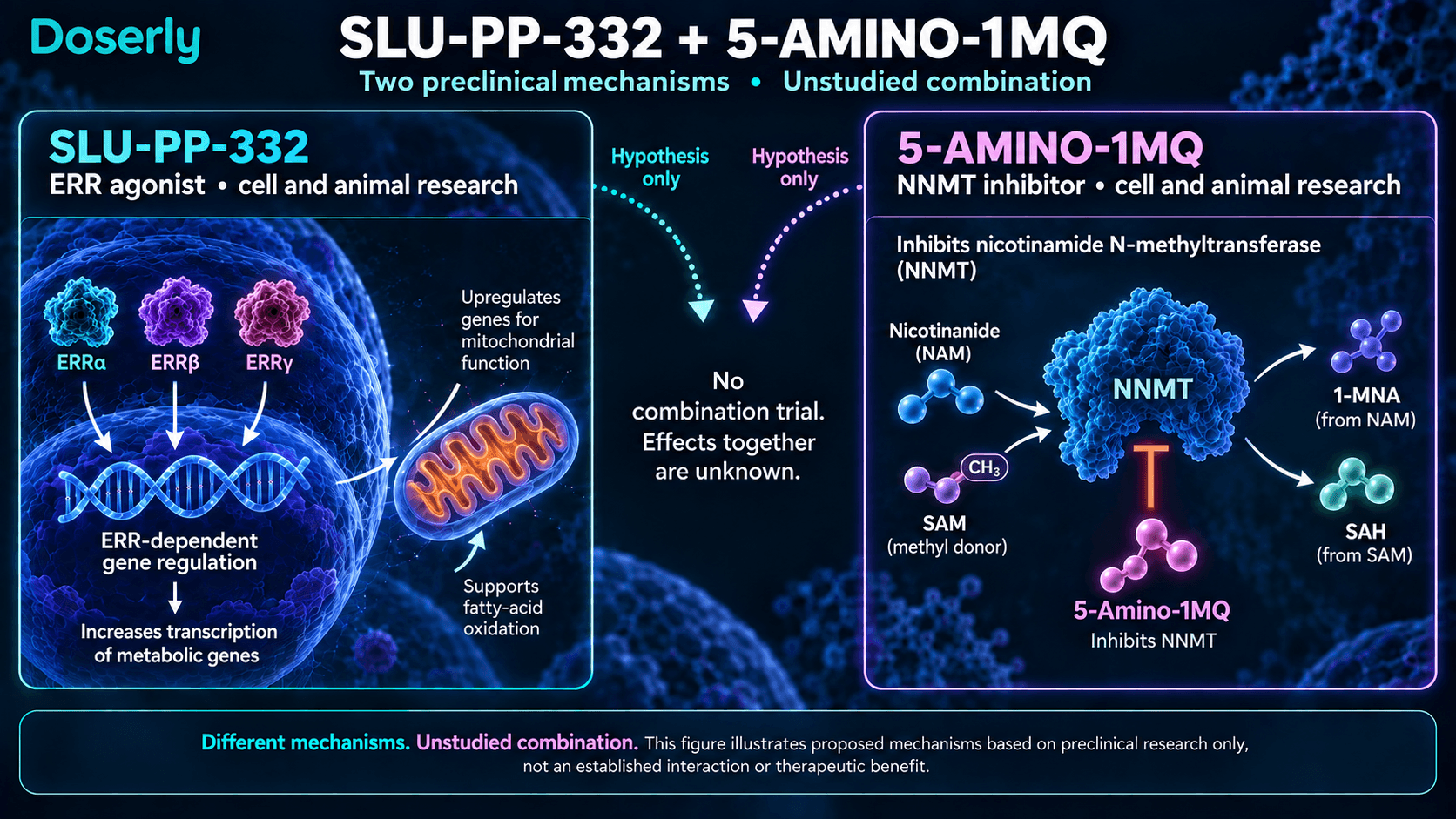
The graphic separates preclinical ERR and NNMT component mechanisms from fixed-blend evidence: mouse and cell studies support component hypotheses, while public capsule pages do not disclose a studied ratio or establish combination synergy [1][2][3][4][5][6][7][8][11].
What this blend is
SLU-PP-332 + 5-Amino-1MQ is a fixed combination concept built from two non-peptide small molecules. SLU-PP-332 targets estrogen-related receptors in preclinical work, while 5-Amino-1MQ targets nicotinamide N-methyltransferase in cell and mouse studies [1][2][3][4][5][6][7].
The blend is not a new evidence object just because both components appear on metabolic-product pages. No primary study of the exact fixed combination, capsule ratio, pharmacokinetics, tolerability or outcomes was identified during this refresh.
Component evidence, not blend evidence
The SLU-PP-332 evidence base is preclinical. Mouse studies used intraperitoneal dosing and laboratory vehicles, while public oral capsule products sit in a different route and formulation category [1][2][3][4]. The 5-Amino-1MQ evidence base is also preclinical, with mouse protocols spanning SC, oral and IV experiments [5][6][7].
Those component signals are not interchangeable with a human oral blend. A capsule that contains both compounds may be convenient, but convenience does not answer absorption, exposure, interaction, adverse-event or dose-attribution questions.
Dose interpretation problems
The exact-blend public sources create a practical ambiguity. Research Dosing lists capsules per day but not the per-capsule component amounts [8]. OmniGenix lists a 51 mg total capsule product [9]. Peplogix lists a 50.25 mg capsule product [10]. Those totals could hide very different SLU-PP-332 and 5-Amino-1MQ allocations.
Because one component is often discussed in microgram-to-milligram public claims and the other in tens of milligrams oral claims, total capsule mass is not enough. Per-component amounts and analytical documentation matter more than the blend name.
Safety and attribution
The absence of human combination data means adverse effects cannot be assigned cleanly. Weight change, energy, glucose, sleep, training output and GI symptoms could come from either component, the combination, diet, training, concurrent GLP-1 therapy, stimulants, or measurement noise.
Regulatory context also differs by component. The 5-Amino-1MQ guide notes an FDA warning letter addressing 5-amino-1-methylquinolinium iodide bulk compounding [11]. SLU-PP-332 remains a preclinical small molecule with no identified approved human indication [1][2][3][4]. A fixed blend combines those uncertainties rather than cancelling them.
What Doserly helps track
Doserly entries for this blend should preserve per-component amounts when known, total capsule amount, product source, lot/COA, schedule, co-administered metabolic agents, training and nutrition context, weight, waist, sleep, heart rate, glucose metrics, GI symptoms and any labs.
Academy discussion can compare SLU-PP-332 mouse ERR evidence, 5-Amino-1MQ NNMT evidence and public capsule claims without calling the fixed blend validated.
FAQ
Has the SLU-PP-332 + 5-Amino blend been studied directly?
No direct primary study of the exact fixed blend was identified. The evidence is component-derived.
Are these peptides?
No. Both are small molecules commonly sold through peptide catalogs [1][5].
Why are public capsule strengths hard to interpret?
Listings such as 51 mg or 50.25 mg total do not necessarily reveal the amount of each component [9][10].
Can the component mechanisms be called synergy?
No. Different mechanisms can support a hypothesis, but synergy requires combination testing.
References
[1] Billon et al. SLU-PP-332 ERR agonist mouse work.
[2] Billon et al. Synthetic ERR agonist metabolic syndrome mouse work.
[3] Okda et al. Chemical optimization of SLU-PP-332.
[4] PeptideDosingProtocols: SLU-PP-332.
[5] Neelakantan et al. 5-amino-1MQ mouse obesity study.
[6] Babula et al. 5-Amino-1MQ PK and metabolic dysfunction study.
[7] Dimet-Wiley et al. 5-Amino-1MQ aged mouse muscle function study.
[8] Research Dosing: SLU-PP-332 + 5-Amino-1MQ oral.
[9] OmniGenix peptide catalog.
[11] FDA warning letter: GenoGenix LLC.
[12] PeptideWiki: 5-Amino-1MQ dosage guide.