
In this guide
What is Papain?
Papain is a cysteine protease obtained from the latex of unripe Carica papaya. Commercial materials may also contain chymopapain, caricain and other papaya-latex proteins. Activity units, purification and residual allergenic proteins vary, so papain powder, papaya fruit and a standardized food-processing enzyme are not interchangeable. [1], [4]
Typical Papain Protocols
| Source and question | Preparation | Amount each administration | Daily total | Frequency and duration | Main interpretation |
|---|---|---|---|---|---|
| Mansfield 1985 · allergy-clinic screen · 500 patients | Papain skin testing followed by blinded oral papain/placebo challenge in five sensitized participants | Oral challenge amount not reported in abstract | Challenge total not reported in abstract | Blinded challenge schedule not reported in abstract | All five papain challenges were positive and placebo challenges negative; selected allergic population, not general incidence |
| EFSA 2026 · food-enzyme exposure assessment | Papaya-latex cysteine endopeptidase complex used in food manufacturing | Not a consumer administration | Estimated dietary exposure up to 0.409 mg TOS/kg body weight/day | Across intended food processes; not an oral supplement protocol | No safety concern under intended conditions, while dietary allergic reactions could not be excluded |
- Exact product
- Record species, form, lot and co-ingredients.
- Each administration
- Keep amount, timing and context.
- Real endpoint
- Separate biomarker, symptom and clinical outcome.
What is it commonly used for?
Papain is marketed for digestion, pain, inflammation and protein breakdown, but the direct oral efficacy literature does not support a universal supplement protocol. A blinded challenge study screened 500 allergy-clinic patients: five of 475 people with seasonal allergic disease had papain-positive skin tests, and all five reacted during oral papain challenges while placebo challenges were negative. That study documents sensitivity in a selected allergic population; it does not estimate risk in the general population or prove digestive benefit. [1], [2], [4]
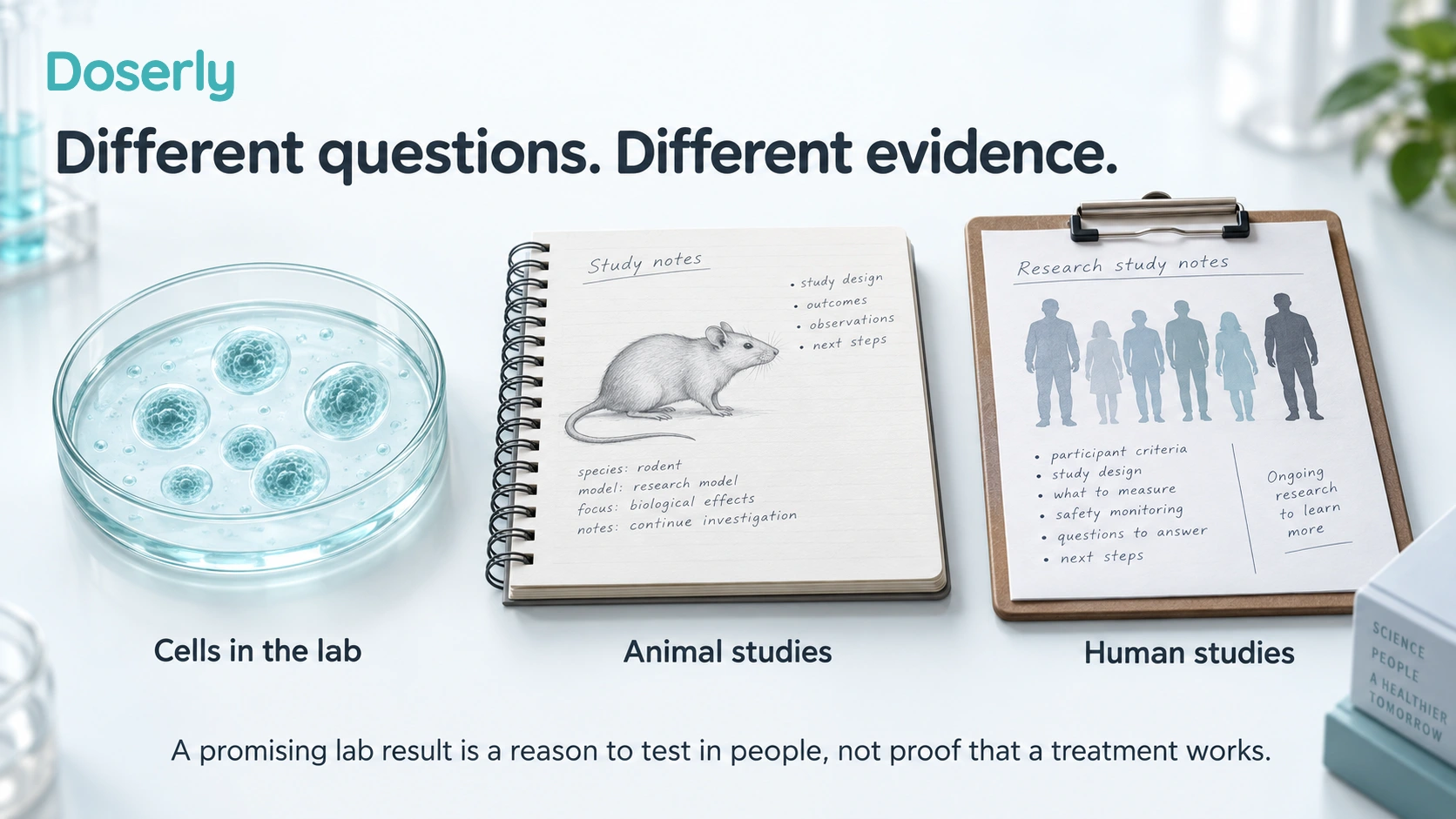
One result answers one question
How do forms and labels differ?
Labels may report milligrams, TU, PU or other activity systems that are not automatically comparable. Papaya-derived multi-enzyme blends can hide how much papain activity is present and can add bromelain or pancreatin. The 2026 EFSA opinion addressed one manufacturer’s food enzyme under intended food-processing conditions, not retail supplement efficacy or a safe challenge dose. [4], [5]
How should the product be stored?
Follow the finished product’s label, keep it dry in its original container and away from children. Discard an expired, heat-damaged, broken-seal or untraceable product.
What does human research show?
| Question | Best direct evidence | Finding | Boundary |
|---|---|---|---|
| Efficacy | Mansfield 1985 · allergy-clinic screen · 500 patients | All five papain challenges were positive and placebo challenges negative; selected allergic population, not general incidence | Specific product and population |
| Replication | Limited evidence | No universal effect established | Variable formulations |
| Universal dose? | None | Not established | Rows cannot be combined |
Keep the finished product reviewable
What are the risks and interactions?
Papain can cause IgE-mediated allergy. The blinded challenge produced oral, nasal, eye, gastrointestinal and sweating symptoms in sensitized patients. Papain and chymopapain are known food allergens, and sequence matches with food and respiratory allergens mean dietary reactions cannot be excluded. Latex or papaya allergy, atopy, asthma and prior unexplained reactions increase the need for clinical review; a home test dose cannot rule out anaphylaxis. [2], [3], [5], [6]
Use emergency care immediately for breathing difficulty, throat or tongue swelling, faintness, widespread hives, repeated vomiting or rapidly progressive symptoms.
What is the legal and regulatory status?
In the United States, it is sold as a dietary supplement; FDA does not approve it for safety and effectiveness before sale. In Canada, verify the exact product, NPN and authorized label. Legal sale does not prove efficacy or sport suitability. [6]
When should use stop?
Stop for any allergic reaction, persistent symptom worsening, unexpected laboratory result or doubt about product identity.
What should be monitored?
If papain has already been used, record exact product, lot, activity units, co-ingredients, amount and timing. Stop at itching, hives, swelling, wheeze, vomiting or systemic symptoms. Tracking must not delay epinephrine or emergency care.
What can community experience add?
Reports can reveal product taste, burning, capsule burden and suspected reactions. They cannot prove enzyme activity, rule out cross-reactivity or identify a safe challenge amount. No systematic current community sample was assembled.
How do related options compare?
| Option | Main distinction |
|---|---|
| Purified papain | Activity and residual proteins depend on processing |
| Papaya fruit | Food matrix; not equal to isolated latex enzyme |
| Multi-enzyme blend | Co-ingredients obscure dose and reaction attribution |
Common questions
Is papain proven for digestion?
No universal oral digestive protocol is supported by the direct human evidence reviewed.
What did the 1.05% study mean?
It found five confirmed cases among allergic patients with seasonal disease; it was not a population survey.
Does EFSA's conclusion mean supplements cannot cause allergy?
No. EFSA explicitly said dietary allergic reactions could not be excluded.
Is papaya fruit the same exposure?
No. Isolated latex proteases and whole fruit differ in concentration, matrix and associated proteins.
Can a small home dose test safety?
No. Sensitization and reaction severity cannot be cleared by a home challenge.
When is emergency care required?
Breathing trouble, throat or tongue swelling, faintness, widespread hives or repeated vomiting requires immediate care.
Glossary
Terms for reading the evidence.
- Endpoint
- A defined result measured in a study.
- Anaphylaxis
- A potentially life-threatening systemic allergic reaction.
- Biomarker
- A biological measure that does not guarantee clinical benefit.
- Standardization
- A measured specification for a product component.
- Cross-reactivity
- Immune recognition of related proteins from different sources.
How this guide was researched
NCBI identities, publication notices, indexed abstracts and available open methods were checked. Null outcomes, mixed products, surrogate endpoints and missing details remain visible.
Research record · checked October 9, 2026
Identity: NCBI EFetch verified PMID 4051260 and PMID 41536844 by title, first author, journal, DOI and descendant notices; no linked correction, retraction or expression of concern appeared.
Methods: the oral challenge amount was absent from the indexed abstract and remains unreported. EFSA's estimated food-process exposure is not converted into a supplement dose.
Boundary: safety cases are shown to explain risk, not as candidate dosing. No systematic current community sample was assembled.
Explore the sources
Primary human evidence and official context.
Showing 6 sources
- 01
The incidence and clinical implications of hypersensitivity to papain in an allergic population, confirmed by blinded oral challenge. ↗
Controlled blinded oral challenge
Five hundred allergy-clinic patients were screened; five seasonal-allergy patients were sensitized and all five reacted to papain but not placebo.
- 02
Safety evaluation of the food enzyme papain, a cysteine endopeptidase complex from the latex of Carica papaya L. ↗
Regulatory food-enzyme assessment
One papaya-latex enzyme complex was acceptable under intended food uses, while papain, chymopapain and sequence matches meant dietary allergy could not be excluded.
- 03
FDA enforcement action regarding unapproved topical papain drugs ↗
Official safety action
Documents serious hypersensitivity including anaphylaxis from unapproved topical papain drugs; topical reports establish hazard, not oral incidence.
- 04
Digestive Enzyme Supplementation in Gastrointestinal Diseases. ↗
Narrative clinical review
Reviews enzyme replacement and supplemental uses without establishing papain as a universal oral digestive treatment.
- 05
Proteolytic Enzymes ↗
Institutional evidence overview
Separates limited clinical evidence, product mixtures and interaction or bleeding concerns for systemic proteolytic-enzyme claims.
- 06
FDA 101: Dietary Supplements ↗
Official supplement overview
FDA does not approve dietary supplements for safety and effectiveness before sale.
No matching sources
Try a different term or show the full list.
Editorial note
This guide separates composition, biomarker, symptom and clinical outcome. It does not turn a narrow signal into a general promise.