
Plant-Based Protein: The Complete Supplement Guide
On this page
Quick Reference Card
Attribute
Common Name
- Detail
- Plant-Based Protein
Attribute
Other Names / Aliases
- Detail
- Plant protein, vegan protein powder, pea protein, soy protein, rice protein, plant protein blend
Attribute
Category
- Detail
- Protein supplement / dietary protein blend
Attribute
Primary Forms & Variants
- Detail
- Soy isolate, pea isolate, rice isolate, hemp, pumpkin seed, and blended formulas such as pea + rice. Soy and blended formulas generally have a more complete amino acid profile than many single-source powders [3][5][6].
Attribute
Typical Dose Range
- Detail
- Commonly 20 to 40 g protein per serving. Active users often aim for total daily intake around 1.2 to 2.0 g/kg/day, while the general adult RDA is 0.8 g/kg/day [1][2].
Attribute
RDA / AI / UL
- Detail
- RDA: 0.8 g/kg/day for healthy adults. No universal UL is established for protein, but needs vary by age, training load, and health status [1][2].
Attribute
Common Delivery Forms
- Detail
- Powder, ready-to-mix shake, ready-to-drink bottle, bar, meal replacement
Attribute
Best Taken With / Without Food
- Detail
- Often used post-exercise, between meals, or as part of a meal replacement. Tolerance may be better when mixed with food if the formula is high in fiber or sweeteners [1][4][7].
Attribute
Key Cofactors
- Detail
- Adequate total calories, leucine, essential amino acids, resistance training, vitamin B12, iron, and zinc in vegan diets [3][5][6]
Attribute
Storage Notes
- Detail
- Keep dry, sealed, and away from heat and moisture. Mixed shakes are best treated like other perishable foods and used promptly.
Overview
The Basics
Plant-based protein is a broad label for protein powders made from plants instead of dairy or eggs. People usually reach for it because they want a vegan option, a dairy-free option, or simply a way to hit protein targets without another meat-heavy meal.
The category is not one single ingredient. Pea, soy, rice, hemp, pumpkin seed, and mixed blends all behave a little differently. That matters because one plant protein can mix well, taste fine, and support training, while another feels gritty or leaves people underwhelmed.
Most interest comes from a practical question: can a plant protein powder do the job? The answer from the research is "sometimes, and often well enough", but the details depend on the source, the blend, and how much total protein the rest of the diet already provides [1][2][3][5][6].
The Science
Plant proteins are protein sources, not a single chemical entity. Their utility depends on digestibility, essential amino acid content, and the food matrix they come from. Soy and blended formulas tend to look better than some single-source plant proteins when the outcome is muscle protein synthesis or lean mass [3][5][6].
The reason people still use them is not just ethics or taste. Plant-based diets can meet protein needs, but they often require more attention to amino acid balance, especially for resistance-trained users, older adults, and anyone replacing a high-quality animal protein source with a lower-leucine powder [1][2][3].
Chemical & Nutritional Identity
Property
Chemical Name(s)
- Value
- Not a single compound. This is a category of protein-rich food or supplement ingredients.
Property
Molecular Formula
- Value
- Not applicable
Property
Molecular Weight
- Value
- Not applicable
Property
CAS Number
- Value
- Not applicable
Property
PubChem CID
- Value
- Not applicable
Property
Category Classification
- Value
- Protein supplement, dietary protein blend, food-derived protein isolate
Property
Established Daily Values
- Value
- Protein RDA for healthy adults: 0.8 g/kg/day. No universal UL established [1][2].
Property
Common Supplement Forms
- Value
- Soy isolate, pea isolate, rice isolate, hemp protein, and blended pea-rice formulas
Property
Bioavailability Notes
- Value
- Bioavailability varies by digestibility, amino acid profile, and food matrix. Soy and blended formulas often outperform single-source powders for anabolic use cases [3][5][6].
Property
Isomer / Stereochemistry Notes
- Value
- Not meaningfully applicable at the category level the way it is for chiral vitamins or amino acids. Individual amino acids in the blend still matter.
Plant-based protein is best understood as a delivery system for amino acids rather than a single nutrient with one fixed molecular signature. That is why source, processing, and blending matter so much more here than they do for many vitamin or mineral supplements.
Mechanism of Action
The Basics
Protein helps your body build and repair tissue. After a hard workout, your muscles need amino acids to rebuild what training just stressed. Plant protein powders are basically a concentrated way to deliver those building blocks.
The main difference between plant and animal protein is not whether the body can use it at all. The difference is how easy it is for the body to digest, how complete the amino acid mix is, and whether the powder delivers enough of the key amino acid leucine to strongly stimulate muscle protein synthesis.
The Science
Plant protein supports muscle adaptation by supplying essential amino acids for muscle protein synthesis. The most relevant signaling pathway in this context is the post-prandial rise in amino acids, especially leucine, which helps trigger the muscle-building response after resistance exercise [3][5].
The mechanistic issue is that not all plant proteins provide the same amino acid pattern. Some single-source powders are relatively low in one or more essential amino acids, while soy and blended formulas can better approximate the anabolic profile of animal protein [3][5][6].
The practical result is that two servings with the same gram weight can behave differently. A 30 g serving of one blend may stimulate muscle protein synthesis more effectively than 30 g of a different plant source if the first blend is more digestible or better balanced in leucine and other essential amino acids [5][6].
Absorption & Bioavailability
The Basics
Protein is broken down in the gut into amino acids and small peptides, then absorbed and used for repair, growth, and energy support. With plant protein, the big variable is how much of that protein is actually usable after digestion.
Some plant sources are more digestible than others, and the way the food is processed matters too. That is why a tofu-based meal, a pea-rice blend, and a coarse hemp powder do not always feel or perform the same in real life.
The Science
Bioavailability depends on both true digestibility and amino acid composition. In one study, true ileal digestibility was high for tofu, soy milk, seitan, and pea emulsion, but DIAAS values still differed because amino acid composition and the food matrix changed the overall quality score [6].
That distinction matters. High digestibility does not automatically mean a protein source is the best anabolic option. The plant source still has to provide enough of the limiting amino acids, and it still has to be absorbed in a form the body can use for the intended outcome [3][5][6].
The practical takeaway is that bioavailability for plant protein is not just about grams on the label. It is about source selection, blending, and whether the serving is large enough to deliver enough essential amino acids after digestion [3][5][6].
Doserly helps separate "the label says 30 g" from "my body is actually responding to 30 g". By logging the exact form you use and how it fits your meals, you can see whether timing, mix quality, and source choice are translating into usable results over time.
The app also tracks cofactor pairings that influence absorption. If a supplement works better alongside vitamin C, fat, or black pepper extract, Doserly reminds you to take them together and logs both. Over weeks, your personal data reveals whether those pairing strategies are translating into measurable differences in the biomarkers you're tracking.
Track injection timing, draw notes, and site rotation.
Doserly helps keep syringe-related notes, injection site history, reminders, and reconstitution context together for easier review.
Injection log
Site rotation
Injection logs support record-keeping; follow clinician instructions for administration.
Research & Clinical Evidence
Muscle Growth and Lean Mass
The Basics
The best human evidence suggests plant protein can support muscle gain, but not every plant source is equal. Soy and well-built blends perform better than some single-source powders, especially when the goal is hypertrophy or lean mass retention.
The overall pattern is encouraging rather than miraculous. Plant protein is often good enough, and sometimes very good, but some animal protein sources still have an edge when the comparison is strict and the outcome is muscle mass.
The Science
A 2024 meta-analysis of 30 RCTs found that plant protein produced slightly lower muscle mass outcomes than animal protein overall, with an SMD of -0.20. The same analysis found no significant difference for strength or physical performance, and soy did not differ meaningfully from milk protein for muscle mass [3].
That result is important because it shows the category is not all-or-nothing. The gap is modest, soy narrows it, and the bigger issue is often whether the user is comparing a complete blend against whey or a weaker single-source powder against a high-quality animal protein [3][5].
Recovery After Resistance Training
The Basics
For recovery, the community and the literature both lean toward "it depends on the formula". Better plant blends can work well, but some single-source powders still trail whey when the setting is acute post-training recovery.
The Science
A systematic review of 24 studies on plant-based proteins and resistance exercise-induced muscle damage found mixed results. Some soy or pea interventions improved soreness, recovery markers, or muscle protein synthesis, but the evidence was too heterogeneous for a clean meta-analysis [4].
The strongest positive signal in that review came from better-formulated blends. In other words, plant protein can absolutely be part of a recovery strategy, but the quality of the blend matters more than the category label alone [4][5][6].
Satiety and Appetite Control
The Basics
Plant protein can sometimes help people feel fuller, especially when it is used in a shake or meal replacement context. The effect is not universal, but some users do notice less hunger or fewer cravings.
The Science
In a randomized trial of pea protein hydrolysates, one condition reduced breakfast energy intake by about 126 kcal versus control and also lowered ghrelin and DPP-4, while gastric emptying was delayed. The result depended on the bitterness and hydrolysis level of the protein [7].
That is a useful reminder that not all protein powders affect appetite the same way. Processing, flavor, and hydrolysate profile can shape satiety biology just as much as the source itself [7].
Evidence & Effectiveness Matrix
Category
Muscle Growth
- Evidence Strength
- 7/10
- Reported Effectiveness
- 6/10
- Summary
- Human RCT meta-analysis suggests plant protein can support hypertrophy, but animal protein still edges it out overall. Community discussion is positive when the formula is soy-based or blended [3][5].
Category
Physical Performance
- Evidence Strength
- 6/10
- Reported Effectiveness
- 5/10
- Summary
- Strength and performance outcomes do not show a major difference versus animal protein in pooled data. Community discussion is mostly neutral and ties performance to total protein intake more than source [3].
Category
Recovery & Healing
- Evidence Strength
- 6/10
- Reported Effectiveness
- 5/10
- Summary
- Recovery data are mixed, with better results from optimized blends and less impressive results from weaker single-source powders. Community users mostly talk about day-to-day recovery and soreness [4][5].
Category
Digestive Comfort
- Evidence Strength
- 6/10
- Reported Effectiveness
- 6/10
- Summary
- Many users switch to plant protein after whey bloating and report better tolerance, although some formulas still cause grit, gas, or discomfort [6][7].
Category
Nausea & GI Tolerance
- Evidence Strength
- 5/10
- Reported Effectiveness
- 4/10
- Summary
- Tolerance is formula-dependent. Sweeteners, hydrolysis level, texture, and serving size can all change the GI response [4][6][7].
Category
Side Effect Burden
- Evidence Strength
- 5/10
- Reported Effectiveness
- 4/10
- Summary
- Most issues are mild, but bloating, texture fatigue, and occasional sensitivity reports are common enough to matter [4][7].
Categories scored: 6
Categories with community data: 6
Categories not scored (insufficient data): Fat Loss, Weight Management, Appetite & Satiety, Food Noise, Energy Levels, Sleep Quality, Focus & Mental Clarity, Memory & Cognition, Mood & Wellbeing, Anxiety, Stress Tolerance, Motivation & Drive, Emotional Aliveness, Emotional Regulation, Libido, Sexual Function, Joint Health, Inflammation, Pain Management, Skin Health, Hair Health, Heart Health, Blood Pressure, Heart Rate & Palpitations, Hormonal Symptoms, Temperature Regulation, Fluid Retention, Body Image, Immune Function, Bone Health, Longevity & Neuroprotection, Cravings & Impulse Control, Social Connection, Withdrawal Symptoms, Daily Functioning, Treatment Adherence, Other
Benefits & Potential Effects
The Basics
The most realistic benefit is simple: plant protein helps you hit protein targets without relying on dairy. That makes it useful for vegans, lactose-sensitive users, and anyone who wants a more flexible way to spread protein across the day.
Beyond that, plant protein can support muscle maintenance, workout recovery, and meal satiety. If the powder is blended well, it can be a practical protein tool rather than a compromise.
The Science
The research supports a few concrete benefits. First, plant protein can support lean mass and training adaptation, especially when the source is soy or a well-designed blend [3][5]. Second, recovery data suggest some plant formulas can improve soreness or muscle damage outcomes, although not as consistently as whey across all studies [4].
Satiety is another plausible benefit. Pea hydrolysate data show that some plant protein forms can reduce energy intake and alter hunger-related hormones, which is why meal-replacement users often report that a shake holds them over longer than a snack [7].
The strongest user-facing benefit is often adherence. People stay more consistent when the protein source matches their diet, their stomach, and their taste preferences. That is not flashy, but it is usually what decides whether the supplement actually gets used.
Doserly is useful here because it turns "I think this helped" into a tracked pattern. If plant protein reliably improves your post-workout recovery, fills your protein gap, or keeps you from skipping meals, that should show up in your own data rather than only in your memory.
Connect protocol changes to labs and health markers.
Doserly can keep lab results, biomarkers, symptoms, and dose history close together so follow-up conversations have better context.
Insights
Labs and trends
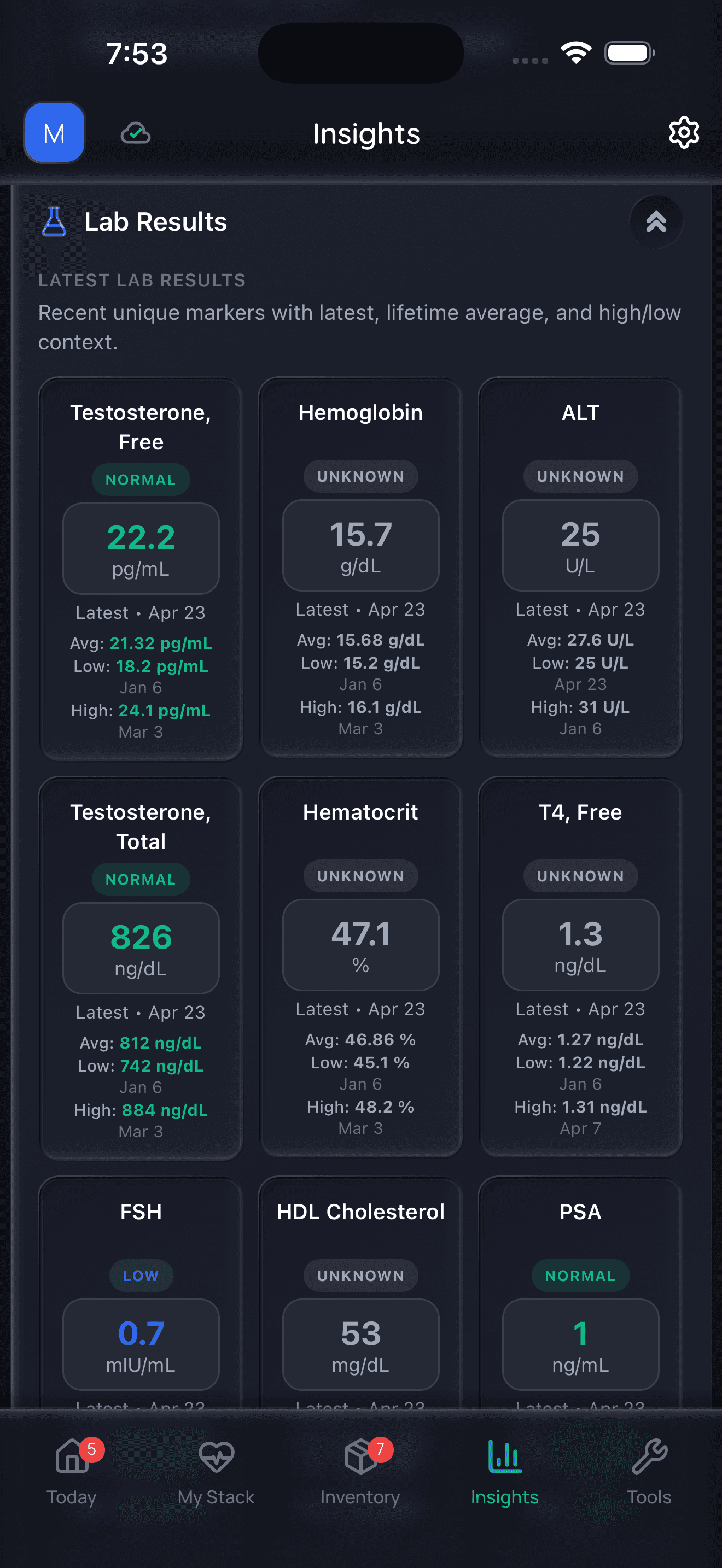
Doserly organizes data; it does not diagnose or interpret labs for you.
Side Effects & Safety
The Basics
The most common downsides are boring but real: bloating, gas, gritty texture, and flavor fatigue. Some people also react badly to sweeteners or thickeners, and a small number of users report a more general sense of feeling "off" with specific formulas.
Soy-heavy products also matter for people with soy allergy or strong soy intolerance. That is not a category-wide problem, but it is a real product-selection issue.
The Science
The clinical literature is more reassuring than the worst forum posts, but it is not perfectly clean. Review data show that tolerability varies by protein source, hydrolysis level, and blend composition [4][6]. Community threads add a consistent theme of formula-specific intolerance rather than universal intolerance.
One practical safety concern is contamination or product inconsistency. This is not unique to plant protein, but powders with poor testing or vague sourcing can create avoidable uncertainty, especially for athletes and heavy users [8][9][10][11][12][16].
Plant protein itself is not a drug and does not carry a classic side effect profile. The downside signal mostly comes from the formulation around it, not the amino acid concept itself.
Dosing & Usage Protocols
The Basics
There is no single perfect serving size for plant protein. Common scoops land around 20 to 40 g of protein per serving, but the more relevant number is the total amount of protein across the day.
For healthy adults, 0.8 g/kg/day is the baseline RDA. For active people, especially those lifting weights or trying to preserve lean mass, the literature commonly moves toward 1.2 to 2.0 g/kg/day [1][2]. Plant powders are usually a tool for closing that gap rather than a stand-alone solution.
The Science
The dose question is where context matters most. A 30 g serving of a high-quality soy or blended powder is not the same as 30 g of a lower-leucine, lower-digestibility source. The first may be enough to meaningfully stimulate muscle protein synthesis, while the second may be more useful as a partial contribution to the day [3][5][6].
Practical usage is usually straightforward. Many users seem to do best when they keep the serving consistent, choose a blend that tastes acceptable, and use it as a bridge between meals or after training rather than as a meal replacement for every situation.
The safest interpretation is not "more is always better". It is "enough to hit the daily target, enough to fit the training goal, and enough to avoid GI problems that stop consistency."
Build reminders around the routine, not just the compound.
Doserly can keep timing, skipped doses, and schedule changes organized so the plan you read about becomes easier to follow and review.
Today view
Upcoming reminders

Reminder tracking supports consistency; it does not select a protocol for you.
What to Expect
Plant protein usually does not feel dramatic on day one. The first thing people often notice is tolerance, taste, or fullness. If the formula agrees with them, that can be obvious within the first few servings.
Training-related changes take longer. Recovery and lean-mass changes are usually assessed over weeks, not days. A fair expectation is a 2 to 4 week window for consistency and tolerance, followed by a 4 to 8 week window for visible training or body-composition signals if the rest of the program is solid [3][4][5][15].
Satiety effects may show up faster, sometimes in the same meal, especially with thicker shakes or hydrolysate-style products. That does not mean the powder is doing everything, only that appetite is one of the faster endpoints to move [7].
Interactions & Compatibility
SYNERGISTIC
- l-leucine and eaas: often discussed when a plant serving is small or when the user wants to improve the essential amino acid profile.
- creatine: pairs well with resistance training goals because it supports a different mechanism than protein intake.
- whey-protein and casein-protein: useful comparison points or mixed-protein options when dairy is tolerated and the user is optimizing around convenience, satiety, or recovery.
- bcaas: sometimes paired in gym settings, although a complete protein or EAA strategy is usually the more direct match for this category.
CAUTION / AVOID
- Plain soy-heavy formulas may not fit users with soy allergy or strong soy intolerance.
- Very high-fiber or sugar-alcohol-heavy blends can worsen bloating in sensitive users.
- Powder formulas with added stimulants, herbs, or proprietary blends deserve extra label scrutiny because the non-protein ingredients may drive the side effects.
- People with kidney disease or prescribed protein limits should review total intake with a clinician before treating protein powder like a free-for-all.
How to Take / Administration Guide
The most practical use cases are boring and effective. Mix a serving into water, milk, or a plant-based milk, then use it to close a protein gap, replace a lower-protein snack, or support the post-workout window.
If the goal is comfort, smaller split servings tend to be easier than forcing one huge shake. If the goal is muscle support, a serving that delivers enough total protein and leucine is more useful than a tiny scoop that only looks impressive on the label [1][2][3][5][6].
Taste matters more than many people admit. If the first formula is gritty, chalky, or too sweet, adherence usually falls off. The best schedule is the one the user can actually repeat.
Choosing a Quality Product
Look for third-party testing first. USP Verified, NSF Certified for Sport, Informed Sport, and similar programs reduce uncertainty about contamination and label accuracy [10][11].
For plant protein specifically, quality markers include a clear amino acid profile, a meaningful protein-per-serving number, and a formula that does not hide behind proprietary blends. Soy or blended formulas often have a better amino acid balance than weak single-source powders [3][5][6].
Red flags include vague "proprietary blend" language, underdosed servings, giant sweetener loads, and flashy claims that ignore amino acid quality. If the label does not tell you what the main protein source is, that is not a premium signal.
The cleanest product usually makes it easy to answer three questions: how much protein is in a serving, what the source is, and whether a third party has verified the batch.
Storage & Handling
Keep the container sealed, dry, and away from heat. Moisture is the main enemy of powders because it can clump the product and shorten shelf life.
Once mixed, the shake behaves like other perishable drinks. If it sits around too long, taste and safety both get worse, especially if the formula includes fruit, nut milk, or other fresh ingredients.
Lifestyle & Supporting Factors
Plant protein works best inside a real diet, not as a standalone trick. Whole-food sources such as tofu, tempeh, edamame, soy milk, beans, lentils, quinoa, seitan, nuts, and seeds still matter because they help fill in the protein pattern across the day [1][2][6].
Resistance training is the biggest supporting factor for muscle gain. Protein helps provide the raw material, but the training stimulus tells the body where to put it [3][4][5].
Older adults, heavy trainers, and users on plant-forward diets often benefit from paying attention to total calories, leucine richness, iron, zinc, and vitamin B12. Those are not magical cofactors, but they are common bottlenecks when plant protein is the center of the routine [1][2].
Regulatory Status & Standards
In the United States, plant-based protein powders sold as supplements fall under DSHEA and FDA dietary supplement rules. FDA expects truthful labeling, clear Supplement Facts panels, and claims that stay within the allowed structure/function framework [8].
In Canada, natural health products can include amino-acid based products and require a licensing pathway with identifiers such as an NPN or DIN-HM when marketed as NHPs [12]. In the EU, protein-source claims are allowed only within an authorized claims framework, and the claims language is tied to muscle growth, maintenance, and normal diet contribution [13].
In Australia, the TGA distinguishes complementary medicines from prescription medicines, and product classification still matters even when the ingredient sounds benign [14]. For athletes, the most important practical point is that protein itself is not named as a prohibited substance on the WADA list, but contamination or added ingredients can still create risk [9].
Third-party certification helps reduce that risk. NSF Certified for Sport and USP Verified are useful quality signals, and GlobalDRO is the place to cross-check specific added ingredients or drug-like compounds by country [10][11][16].
Regulatory status and prohibited substance classifications change frequently. Athletes should always verify the current status of any supplement with their sport's governing body, their national anti-doping agency, and a qualified sports medicine professional before use. Third-party certification reduces but does not eliminate contamination risk.
Frequently Asked Questions
Is plant-based protein as good as whey?Based on available data, some well-formulated plant blends can come close to whey for muscle protein synthesis, but pooled human data still show a small muscle-mass advantage for animal protein overall [3][5].
Can plant protein build muscle?Yes, based on available RCT data, it can support muscle gain and lean-mass maintenance when total protein intake, training stimulus, and formula quality are adequate [3][5].
Is pea protein better than soy protein?The evidence does not support a universal winner. Soy often looks stronger in anabolic comparisons, while pea can work well when blended or fortified appropriately [3][5][6].
Does plant protein help with satiety?Some plant protein forms may help with fullness and lower intake, especially in shake or hydrolysate formats, but appetite response is formula-specific [7].
Why does plant protein sometimes bother my stomach?Community reports and the review literature both suggest that fiber load, sweeteners, hydrolysis level, and serving size can all affect tolerance [4][6][7].
How much plant protein should I take?The general adult RDA is 0.8 g/kg/day, while active users often aim higher. For specific goals, the available data commonly place daily intake in a broader 1.2 to 2.0 g/kg/day range, but the right number depends on your total diet and health context [1][2].
Should I take it after a workout?Many studies use post-exercise servings, but the bigger issue is getting enough high-quality protein across the day. Timing matters less than consistency and total intake for most users [1][3][4][5].
What should I look for on the label?Look for clear source naming, a meaningful protein-per-serving number, a full amino acid profile if available, and third-party testing when contamination risk matters [8][10][11][16].
Is soy protein safe if I have a soy allergy?No, not in the allergy sense. People with soy allergy should avoid soy-based formulas and choose another source after discussing the issue with a clinician if needed.
Can I use plant protein every day?Many users do, especially when it helps them stay consistent. The best long-term choice is the formula you can tolerate, afford, and fit into your routine.
Myth vs. Fact
Myth: All plant proteins are incomplete and useless for muscle.Fact: Plant proteins vary in quality, but soy and blended formulas can support muscle outcomes and muscle protein synthesis, especially when total intake is adequate [3][5][6].
Myth: Plant protein is always easier on the stomach than whey.Fact: Many users do tolerate it better, but some report bloating, grit, or formula-specific discomfort. Tolerance is product-dependent, not guaranteed [4][6][7].
Myth: Any 30 g serving is equivalent across all protein powders.Fact: Digestibility, leucine content, and the food matrix all change how useful a serving really is [5][6].
Myth: More protein always means more muscle.Fact: Beyond sufficient intake, gains depend on training, energy availability, and recovery. Extra protein does not override a weak training plan [1][2][3][4][5].
Myth: Third-party testing only matters for athletes.Fact: Testing matters for anyone who wants better label accuracy and less contamination risk, although the stakes are especially high for tested athletes [8][9][10][11][16].
Sources & References
Clinical Trials & RCTs
- NIH Office of Dietary Supplements. Exercise and Athletic Performance fact sheet. https://ods.od.nih.gov/pdf/factsheets/ExercisePerformance-Consumer.pdf
- National Academies Press. Protein and Amino Acids chapter in the Dietary Reference Intakes. https://nap.nationalacademies.org/read/11537/chapter/14
- PubMed. The Impact of Plant-Based Proteins on Muscle Mass and Strength Performance: A Comprehensive Review. https://pubmed.ncbi.nlm.nih.gov/39813010/
- PubMed Central. The Effect of Plant-Based Protein Ingestion on Recovery from Resistance Exercise-Induced Muscle Damage in Healthy Young Adults-A Systematic Review. https://pmc.ncbi.nlm.nih.gov/articles/PMC12348865/
- PubMed. The Muscle Protein Synthetic Response to the Ingestion of a Plant-Derived Protein Blend Does Not Differ from an Equivalent Amount of Milk Protein in Healthy Young Males. https://pubmed.ncbi.nlm.nih.gov/34881688/
- PubMed. True ileal digestibility and DIAAS of plant-based foods. https://pubmed.ncbi.nlm.nih.gov/32932087/
- PubMed. Pea protein hydrolysate and appetite / energy intake trial. https://pubmed.ncbi.nlm.nih.gov/40776629/
Systematic Reviews & Meta-Analyses
- U.S. Food and Drug Administration. Dietary Supplements. https://www.fda.gov/consumers/consumer-updates/dietary-supplements
- World Anti-Doping Agency. Prohibited List. https://www.wada-ama.org/en/prohibited-list
Government / Institutional Sources
- USP. Verified Mark. https://www.usp.org/verification-services/verified-mark
- NSF. Certified for Sport program. https://www.nsf.org/consumer-resources/articles/certified-for-sport-program
- Health Canada. Natural Health Products in Canada. https://www.canada.ca/en/health-canada/services/drugs-health-products/natural-health-products-canada.html
- EFSA / EU knowledge gateway. Dietary protein and health claims. https://knowledge4policy.ec.europa.eu/health-promotion-knowledge-gateway/dietary-protein_en
- Therapeutic Goods Administration. Complementary medicines. https://www.tga.gov.au/products/medicines/non-prescription-medicines/complementary-medicines
- ClinicalTrials.gov. Plant protein and related resistance-training / recovery trials. https://clinicaltrials.gov/study/NCT06908811
- Global DRO. Home. https://www.globaldro.com/Home