
In this guide
What does this guide compare?
Live strains, fermentable substrates and postbiotic preparations are distinct.
This collection compares products discussed around one topic. It is not a protocol to take in full. Links to individual profiles appear after the article.
| Reference point | Context |
|---|---|
| Products compared | 10 |
| Evidence scope | Ingredient, formulation, population and measured outcome |
| Complete combination | The cited studies do not automatically validate all members together |
Which products are compared?
Lactobacillus Species, Bifidobacterium Species, Saccharomyces boulardii, Bacillus coagulans, Bacillus subtilis, Soil-Based Organisms/Spore-Based Probiotics, Prebiotic Fibers (Inulin, FOS, GOS), Resistant Starch, Postbiotics (Butyrate/SCFAs), Synbiotics.
Individual profiles describe formulation, source-reported amounts, tolerability and interactions. Those details remain ingredient-specific. An amount studied alone is not automatically appropriate in a combination.
How do their roles differ?
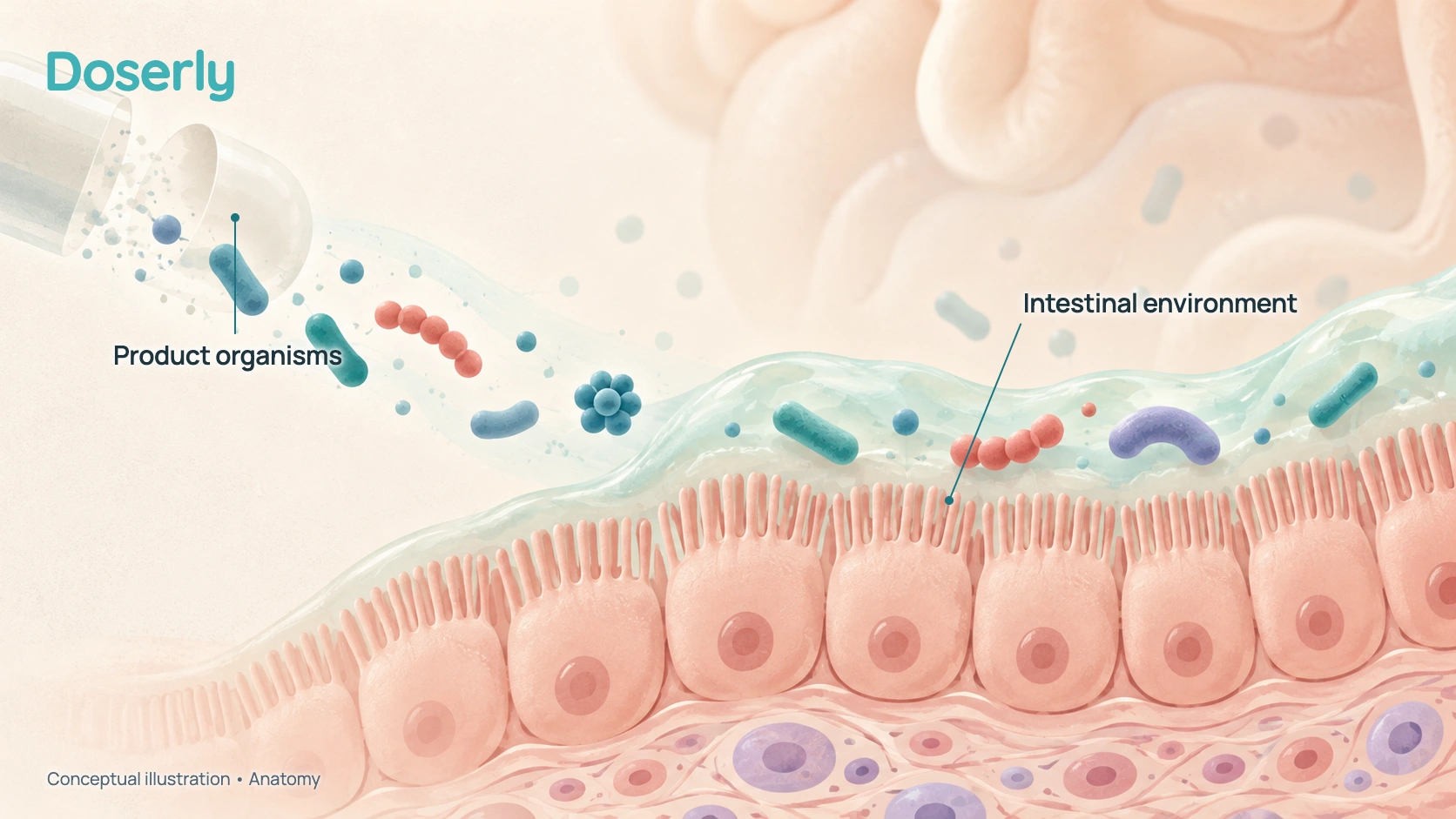
Probiotics are live microorganisms studied for a health benefit in a defined context. Prebiotic substrates feed selected microbes; postbiotics involve preparations of inanimate microorganisms or their components. Fiber fermentation and short-chain fatty acids are one mechanism, not an explanation for every product. [1]
Selected ingredient studies and their limits
These examples compare distinct preparations and outcomes. Their schedules describe research and are not a regimen to combine.
Lactobacillaceae. in 214 adults with Rome III irritable bowel syndrome, strain 299v (DSM 9843), 10 billion CFU once daily for 4 weeks, improved pain and bloating relative to placebo; 204 were analyzed. A different trial of R0052 plus R0011 during antibiotic exposure had negative primary stool-frequency and consistency outcomes; its shorter episode-duration result was post hoc. A species name or a larger CFU count cannot transfer one strain’s result to another. ICU genomic evidence also shows why safety findings in healthy adults cannot be generalized to critically ill patients. [1], [4], [5], [6]
Further product-specific comparisons
Bifidobacterium. HN019 had negative planned outcomes in the 228-person, 28-day functional-constipation trial. The 2024 trial then randomized 229 adults for 8 weeks and again found no greater improvement in complete spontaneous bowel movements than placebo. These results differ from the older 35624 IBS trial in 362 women, where the 100-million-CFU condition helped selected symptoms but lower and higher tested counts did not. More CFU did not reliably mean a larger benefit, and a constipation result is not an IBS result. [7], [8], [9]
Saccharomyces boulardii. Favorable pooled antibiotic-associated-diarrhea findings need to be read beside the 477-person hospitalized-adult trial that stopped early for futility. The 2025 C. difficile study evaluated the yeast alongside vancomycin, with similar initial cure and favorable recurrence/global-cure findings; it does not support replacing antibiotic treatment. Case series and outbreaks document fungemia concerns in vulnerable patients and around central lines. Those reports identify risk settings, not a general incidence rate. [10], [11], [12], [13], [14]
Bacillus coagulans. Unique IS2 was studied in 144 otherwise healthy adults with infrequent bowel movements, while MTCC 5856 and LBSC trials enrolled small IBS populations using different schedules. GBI-30, 6086 was studied with milk protein for amino-acid appearance in blood. These are different strains and outcomes. Neither a spore-forming label nor a protein-absorption result establishes broad digestive restoration, long-term colonization or muscle growth. [15], [16], [17], [18]
What does the research show?
Clinical findings are strain-, dose-, product- and indication-specific. A positive result for one Lactobacillaceae strain cannot validate every Lactobacillus product, a higher CFU count or a synbiotic combination. NIH ODS reports no general recommendation for or against probiotic supplementation in healthy people. Broad claims to repair the microbiome exceed this evidence. [1]
An observational association, a laboratory finding and a perceived benefit answer different questions. Randomized trials need their comparator, duration and population kept in view. An inconclusive result does not establish that an effect is impossible; it limits the claim that can be made.

Which overlaps and risks matter?
Cautions and interactions
Gas or other digestive symptoms can occur. In severely ill or immunocompromised people, bloodstream infections have been reported with some organisms; critical illness and central lines change the risk assessment. Storage instructions and viable counts through the expiration date matter more than counts at manufacture alone. [1]
A complete product list includes prescription medicines, nonprescription products and supplements. Combination formulas can conceal duplicate ingredients. Timing and spacing from a medicine should follow its labeling and pharmacist guidance; this collection does not supply a universal timetable.
Regulatory status
In the United States, FDA does not approve dietary supplements for safety and effectiveness before marketing. In Canada, a natural health product requires a product licence before sale; its NPN or DIN-HM must match the finished product. An ingredient name or inclusion in this collection does not establish that every product or claim is authorized. Authorization also does not validate the complete combination. [2], [3]
What should be recorded and how should changes be interpreted?
Doserly brings dose logs, symptoms and routine changes together. For this collection, useful observations include strain names, product changes, stool pattern, bloating, antibiotic exposure and tolerability.
- Doses and adherence: record the formulation, amount actually taken, timing and missed doses so observations have context.
- Potential benefits and tolerability: compare consistent symptoms or measurements over time alongside sleep, food and activity changes. Personal trends help evaluate the experience without proving causal efficacy.
- Product list: maintain the full product list for review with a pharmacist or clinician.
- AI monthly reports: summarize recorded doses, symptoms and trends to prepare for a discussion. Reports depend on the data entered and are not a diagnosis or an instruction to change treatment.
Explore the topic further
Common questions
Is a higher CFU count necessarily better?
No. The strain, finished product, indication and study exposure matter. A larger number does not make one organism equivalent to another or prove a better outcome. [1]
Can a positive IBS trial support every probiotic for constipation?
No. IBS, constipation and antibiotic-associated diarrhea are different outcomes, and even trials of the same strain can disagree. Keep each result with its population and comparator. [4][5][7][8]
Are live products suitable for every hospitalized patient?
No. The cited bacterial-transmission and fungemia reports show why critical illness, immune compromise and central lines need specific clinical review. Case and outbreak evidence cannot supply a universal event rate. [6][13][14]
Glossary
Terms for interpreting the comparisons.
- Formulation
- The exact preparation, including its ingredients, their forms and labeled amounts.
- Study population
- The people included in a study; their characteristics limit where its result applies.
- Comparator
- The placebo, treatment or condition used as the comparison.
- Measured outcome
- What the study evaluates, such as a symptom, laboratory result or clinical event.
- Overlap
- The same ingredient appearing in more than one product used together.
How was this guide researched?
Sources and limits
This AI-assisted educational guide compares the cited public references. Findings remain tied to the ingredients, preparations and populations studied. It is not a systematic review or independent medical peer review. Doserly develops a commercial tracking app. Illustrations explain concepts; app screens show example data. Report a correction with its source to Doserly support.
Explore the sources
The references below provide context for the claims and their limits.
Showing 18 sources
- 01
- 02
FDA — Questions and Answers on Dietary Supplements ↗
Regulatory reference
United States dietary supplement regulation.
- 03
- 04
Effectiveness of L. helveticus R0052 and L. rhamnosus R0011 for antibiotic-associated diarrhoea ↗
Randomized controlled trial
Full article reviewed; primary outcomes were negative and the shorter episode duration was post hoc.
- 05
Clinical trial: Lactobacillus plantarum 299v (DSM 9843) improves symptoms of irritable bowel syndrome. ↗
Randomized controlled trial
Full article reviewed; exact 299v strain, four-week study in India.
- 06
Genomic and epidemiological evidence of bacterial transmission from probiotic capsule to blood in ICU patients. ↗
Retrospective cohort and genomic study
Full article reviewed; ICU population and exact cohort denominators retained.
- 07
Effects of 28-day Bifidobacterium animalis subsp. lactis HN019 supplementation on colonic transit time and gastrointestinal symptoms in adults with functional constipation: A double-blind, randomized, placebo-controlled, and dose-ranging trial. ↗
Randomized dose-ranging trial
Full report reviewed; planned outcomes negative, smaller subgroup analysis post hoc.
- 08
Eight-Week Supplementation With Bifidobacterium lactis HN019 and Functional Constipation: A Randomized Clinical Trial. ↗
Randomized controlled trial
Full report reviewed; primary CSBM outcome negative.
- 09
Efficacy of an encapsulated probiotic Bifidobacterium infantis 35624 in women with irritable bowel syndrome. ↗
Randomized dose-ranging trial
Used for the strain-specific, non-linear dose result.
- 10
Saccharomyces boulardii to Prevent Antibiotic-Associated Diarrhea: A Randomized, Double-Masked, Placebo-Controlled Trial. ↗
Randomized placebo-controlled trial
Full report reviewed; stopped for futility with no AAD benefit.
- 11
Systematic review with meta-analysis: Saccharomyces boulardii in the prevention of antibiotic-associated diarrhoea. ↗
Systematic review and meta-analysis
Used for pooled AAD effect and heterogeneity context.
- 12
Efficacy and safety of Saccharomyces boulardii as adjunct therapy with Vancomycin in treating Clostridioides difficile infection: A randomized controlled trial. ↗
Randomized adjunct trial
Full report reviewed; initial cure similar, global cure and recurrence favorable.
- 13
Saccharomyces cerevisiae fungemia: an emerging infectious disease. ↗
Case series and literature review
Used to identify central-line and critical-illness patterns; not an incidence estimate.
- 14
Outbreak of Saccharomyces cerevisiae subtype boulardii fungemia in patients neighboring those treated with a probiotic preparation of the organism. ↗
ICU outbreak report
Used for cross-contamination and handling risk around central lines.
- 15
Bacillus coagulans Unique IS2 improves stool characteristics in healthy adults with infrequent bowel movements: a randomized, double-blind, placebo-controlled trial. ↗
Randomized controlled trial
Used for the 144-person protocol and both positive and null outcomes.
- 16
Bacillus coagulans MTCC 5856 supplementation in the management of diarrhea predominant Irritable Bowel Syndrome: a double blind randomized placebo controlled pilot clinical study. ↗
Randomized pilot trial
Full report reviewed; probiotic was added to a multi-drug standard-care regimen.
- 17
Efficacy and safety of Bacillus coagulans LBSC in irritable bowel syndrome: A prospective, interventional, randomized, double-blind, placebo-controlled clinical study [CONSORT Compliant]. ↗
Randomized controlled trial
Full report reviewed; 40 randomized and 38 analyzed per protocol.
- 18
Bacillus coagulans GBI-30, 6086 improves amino acid absorption from milk protein. ↗
Randomized crossover trial
Used for the milk-protein schedule and measured amino-acid outcomes.
No matching sources
Try a different term or show the full list.