
In this guide
What is vaginal estrogen therapy?
Low-dose vaginal estrogen treats menopausal genitourinary symptoms locally, such as vaginal dryness, discomfort and pain with sex. It can be used without systemic HRT, and it can be added when systemic treatment does not adequately address local symptoms. NICE recommends discussing the formulation and reviewing treatment, rather than assuming that a patch or tablet for hot flashes will solve every vaginal concern. [1]
Local treatment and systemic treatment have different purposes. A low-dose local product is not a replacement for systemic treatment of hot flashes, and it is not contraception. Conversely, a systemic estrogen prescription does not prove that all local discomfort comes from menopause. Persistent pain, burning, bleeding or urinary symptoms may need an examination or another investigation. [1], [2], [8]
The product name matters. The vaginal route includes both low-dose local products and a systemic exception: the US Femring is indicated for vasomotor symptoms as well as vulvovaginal atrophy. Do not classify every vaginal ring as local or assume every vaginal medicine has the same protection requirements. [3], [5]
How do local products compare with systemic HRT?
| Option | Main purpose | Practical questions | Important distinction |
|---|---|---|---|
| Low-dose vaginal tablet, cream, gel or pessary | Local genitourinary symptoms | Applicator, measured amount, initial versus maintenance instructions | Formulation and dose determine the actual plan |
| Low-dose local ring | Local symptoms with ongoing delivery | Insertion, removal, comfort and replacement | Estring is a checked local example |
| Systemic oral or transdermal estrogen | Systemic menopausal symptoms | Route, tolerability, schedule and uterine protection | Local therapy may still be useful |
| Systemic vaginal ring | Systemic treatment delivered vaginally | Exact product, indication and protection | Femring differs from Estring |
| Moisturizer or lubricant | Nonhormonal symptom support | Regular use versus friction reduction | May be used alone or alongside local estrogen |
This compares purposes and practical choices, not equivalent doses or a best-product ranking. Local products are not all interchangeable, and application to the vagina does not by itself establish low systemic exposure. Ask whether your named medicine is intended to be local or systemic and what its label and prescription require. [1], [2], [3], [4], [5]
Vaginal route, different treatment purposes
Read the named product before applying a local-treatment rule.
Low-dose local estrogen
Mainly genitourinary symptoms; minimal systemic absorption is not zero.
Estring example
Checked US local product for postmenopausal vulvovaginal symptoms.
Femring exception
Checked US systemic vaginal ring also treats vasomotor symptoms.
Conceptual classification, not dose equivalence or a rule that all rings are interchangeable. Sources: NICE [1], Estring [3], Femring [5].
Which symptoms are relevant, and what needs assessment?
Genitourinary syndrome of menopause, often called GSM, includes genital, sexual and urinary concerns associated with the menopausal transition. Dryness, irritation, pain with penetration, urinary burning or recurrent infections can affect daily life. The symptoms do not have to include painful sex: comfort while sitting, walking, exercising or using the bathroom is a legitimate treatment goal. [1], [2]
The same symptoms can have other causes or coexist with other conditions. The AUA/SUFU/AUGS guideline recommends a focused history, examination and assessment for coexisting problems. Infection, vulvar skin conditions, pelvic-floor difficulties and bladder conditions may need different care. A label reading “vaginal estrogen” does not establish that a new discharge, lesion or persistent burning should simply be treated with more estrogen. [2]
Explain the location and effect of the symptom in your own words. Is the discomfort inside, at the opening or on external skin? Does it occur with urination, touch, penetration or independently? Has there been bleeding, an unusual discharge or a new product? These details help the clinician choose the examination and discussion. They are not an invitation to self-diagnose from a checklist.
Unexplained postmenopausal bleeding needs assessment even if you suspect fragile tissue or an applicator caused it. Urinary symptoms with fever, flank pain or acute illness need prompt medical care; local estrogen is not treatment for an acute infection. Significant pain or an alarming change deserves review rather than waiting for a routine treatment trial to end. [2], [3], [4], [9]
Is a cream, tablet or ring better?
NICE recommends shared choice among an estrogen cream, gel, tablet, pessary or ring. The AUA/SUFU/AUGS guideline says the evidence is insufficient to recommend one hormonal therapy over another as a universal sequence. Formulation preference, access, handling and tolerability can legitimately influence the choice; a convenient product is useful when it is appropriate and can be used as prescribed. [1], [2]
A tablet may make the supplied amount straightforward, but an applicator may be uncomfortable or difficult to handle. A cream needs the exact concentration, measured quantity and intended application instructions. A ring reduces repeated applications but introduces insertion, removal and retention questions. Ask for help if disability, hand pain, mobility limitations or discomfort make the routine difficult. Do not assume every cream should be used internally and externally in the same amount. [1], [3], [4]
The underlying hormone can also differ. Some local products contain estradiol; others contain estriol. Other treatments, such as vaginal prasterone or oral ospemifene, are distinct medicines with their own evidence and precautions. Their routes, hormone-related actions and approval status should not be collapsed into a claim that all are “the same local estrogen.” [1], [2]
Supply and cost questions are practical, but need current local information. A clinician or pharmacist can check whether an alternative is available and appropriate. This guide does not promise stock, insurance coverage or an identical maintenance schedule after substitution. If the product changes, confirm both the amount and the application pattern instead of transferring the old reminder unchanged.
What does a product-specific schedule look like?
These two original-label examples explain different schedules. They are not a starting prescription or a conversion between products. Their countries, populations and revisions remain attached.
| Checked product and jurisdiction | Labeled context | Named-product instructions | Source |
|---|---|---|---|
| Vagifem 10 mcg vaginal tablet, UK | Local treatment of estrogen-deficiency vaginal atrophy in postmenopausal women | One tablet daily for two weeks initially; one tablet twice weekly for maintenance | UK SmPC revised May 23, 2024 [4] |
| Estring, US | Moderate-to-severe postmenopausal vulvar and vaginal atrophy symptoms | One vaginal system releases approximately 7.5 mcg estradiol daily for 90 days; remove and replace after that period if continued | US prescribing information revised April 2026 [3] |
An initial course and maintenance are different parts of the same named plan. A ring's daily release rate is not a daily insertion instruction, and the amount in its reservoir is not an application dose. “Twice weekly” is not automatically the right pattern for every local cream, gel or pessary. Follow the actual label and prescription. [3], [4]
The Vagifem label says not to double a forgotten dose. Estring has its own instructions if a ring comes out or causes difficulty, and continuing treatment needs reassessment. If insertion is painful or a device seems stuck, ask for help rather than forcing it. A medicine reminder should record the real instruction after it has been clarified, not reconstruct it from the numbers in this table. [3], [4]
Different products, different instructions
Original-label examples, not a prescription or conversion.
UK Vagifem 10 mcg
One tablet daily for two weeks initially; one twice weekly for maintenance.
US Estring
One system releases about 7.5 mcg daily for 90 days; remove/replace if continuing.
Before setting reminders
Confirm actual product, amount, initial/maintenance phase and handling instructions.
Country, formulation and label remain attached. A ring release rate is not a daily insertion instruction. Sources: Estring [3], Vagifem [4].
How local is local treatment, and is progesterone needed?
NICE describes low-dose vaginal estrogen as absorbed locally, with a minimal amount entering the circulation compared with systemic HRT. Minimal is not zero. The amount and pattern vary with the product and tissue context. A local medicine can be clinically useful without being identical to a systemic estrogen regimen or having absolutely no measurable systemic exposure. [1], [4]
NICE's rationale says there is no need to add systemic progestogen solely to protect the endometrium with the low-dose vaginal estrogen discussed in its local-care recommendations. The AUA/SUFU/AUGS guideline likewise does not recommend endometrial surveillance solely because a person uses local low-dose vaginal estrogen. That is different from saying bleeding can be ignored, all vaginal estrogen doses are equivalent, or long-term safety is known without limitations. [2], [7]
If you also use systemic estrogen and have a uterus, the systemic regimen still needs adequate protection. Low-dose vaginal estrogen does not substitute for the progestogen component of that regimen. Femring's systemic vaginal delivery is another reason to check the named product rather than applying a local-treatment rule to everything inserted vaginally. [5], [6]
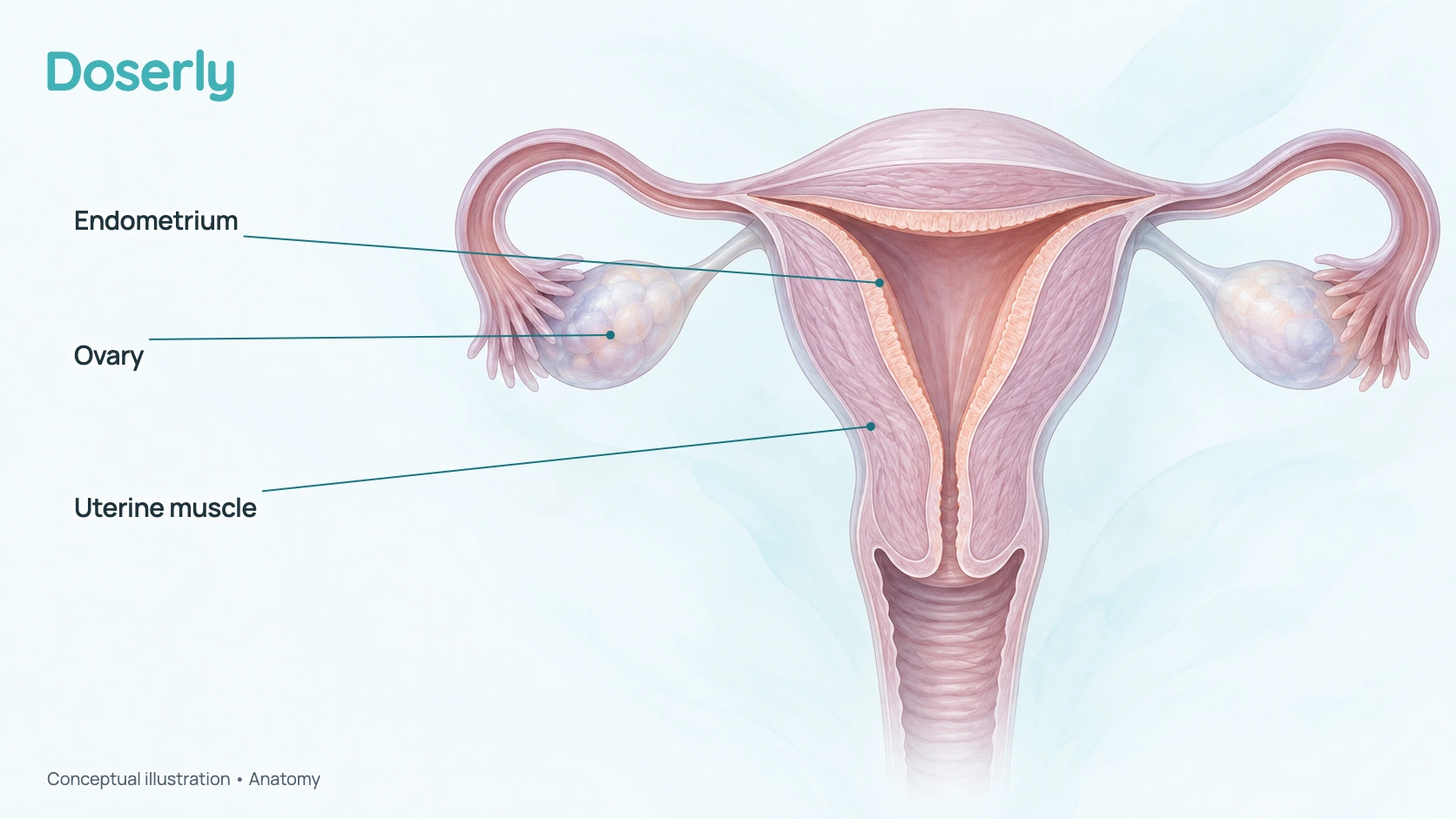
No routine ultrasound solely because of local use means that an asymptomatic person is not automatically enrolled in a screening schedule for that reason. It does not rule out investigation prompted by bleeding, other symptoms or individual history. Tell the clinician what product and amount you use, whether systemic therapy is also present and when any bleeding occurred. [2], [3], [4]
What does the evidence show about benefit?
Current NICE recommendations support vaginal estrogen for menopausal genitourinary symptoms, including when someone uses systemic HRT. The AUA/SUFU/AUGS guideline describes local low-dose vaginal estrogen as having the strongest evidence base among GSM hormonal options, while acknowledging that evidence certainty varies and many studies are short. A recommendation can be useful without guaranteeing response or ranking every formulation. [1], [2]
An important counterexample is a 2018 randomized trial of 302 postmenopausal women with moderate-to-severe vulvovaginal symptoms. Over 12 weeks, a 10 mcg vaginal estradiol tablet plus placebo gel and a moisturizer plus placebo tablet did not improve the most bothersome symptom more than dual placebo. Symptoms improved in all groups. The placebo arm included a lubricating gel, and the trial was not designed as a direct comparison of every active formulation. [10]
That result should be read alongside the wider evidence, not erased or used to declare all vaginal estrogen ineffective. Symptom definitions, trial populations, comparators and outcomes differ. Biological changes, such as vaginal pH or cell patterns, do not necessarily predict how comfortable a person feels. If a medicine is not helping your actual concern, it is reasonable to review the diagnosis and plan rather than insist that a laboratory or tissue marker proves success. [2], [10]
Avoid a guaranteed recovery date. The AUA evidence discussion notes that symptoms in some studies began improving within one to two months and continued through 12 weeks, but follow-up and outcomes were limited. That is context for setting a review, not a promise or a reason to continue through significant pain, worsening symptoms or bleeding without advice. [2]
What changes with a history of breast cancer?
This needs an individual discussion that keeps the treatment goal, cancer history and actual medicine visible. NICE recommends nonhormonal moisturizers or lubricants first for genitourinary symptoms in people with a personal history of breast cancer. Vaginal estrogen may be considered when symptoms persist despite these measures; for people receiving an aromatase inhibitor, treatment options should be identified with a breast-cancer specialist. [1]
NICE says the effect of vaginal estrogen on recurrence is unknown, and distinguishes receptor status and adjuvant treatment in its discussion. The AUA/SUFU/AUGS guideline permits consideration of local low-dose vaginal estrogen after breast cancer through multidisciplinary shared decision making. These are clinical recommendations under uncertainty, not proof that every product is licensed for that population or that recurrence risk is absent. [1], [2]
The checked Estring and Vagifem labels retain contraindications involving relevant cancer history and other conditions. NICE also explicitly notes off-label local estrogen use after breast cancer in its recommendation. A specialist recommendation therefore needs to be reconciled with labeling and documented for the individual. Do not stop an aromatase inhibitor or tamoxifen yourself to make a vaginal treatment easier to use. [1], [3], [4]
Do newer labels mean every risk has disappeared?
In February 2026, the FDA announced approved labeling changes for an initial six menopausal hormone products, including a topical vaginal estrogen category. Removing specified boxed-warning language is a regulatory change, not a finding that every product now has no precautions or that all labels changed at once. The checked April 2026 Estring information still contains contraindications and instructions to assess unusual bleeding. Read the current named-product information with the prescribing team. [3], [13]
Local discomfort, discharge or spotting can occur, and severe or persistent problems need advice. Do not use a removed box, an old package insert or a statement about minimal absorption as the sole reason to ignore a new symptom. Likewise, do not apply systemic WHI risk estimates directly to low-dose local care: formulation, exposure and purpose differ. Individual history and the actual product remain relevant. [1], [2], [3]
What about moisturizers, lubricants and urinary infections?
A moisturizer is generally used for ongoing symptom support; a lubricant reduces friction during an activity. NICE allows them alone or with vaginal estrogen. They can be useful choices even when you do not want a hormonal product, and using one is not evidence that you have failed treatment. Tolerability differs, so tell the clinician if a product causes burning or worsens symptoms. [1], [2]
Recurrent UTI prevention is a related but distinct indication. NICE's recurrent-UTI guideline considers vaginal estrogen when behavioral and personal-hygiene measures alone are ineffective or inappropriate in the relevant menopausal population. It does not recommend systemic HRT specifically to reduce recurrent UTI risk. This is a prevention discussion, not a substitute for treating a current infection or evaluating unexplained urinary symptoms. [8]
NICE recommends reviewing vaginal estrogen used for recurrent-UTI prevention within 12 months, or earlier if agreed. Its menopause guideline generally recommends treatment review at three months and then annually, with earlier review for problems. The clinical purpose determines which follow-up plan applies; do not combine these into a rule that symptoms must wait a year. [1], [8]
Review the actual concern
Benefit, tolerability and safety are separate questions.
Symptom response
What improved in comfort and daily function? What remains troublesome?
Practical plan
Can you use the named product as prescribed? Is maintenance clear?
Earlier assessment
Bleeding, marked pain, worsening symptoms or acute infection signs need advice; no waiting guarantee.
Routine menopause review differs from recurrent-UTI prevention follow-up. No routine ultrasound solely for local use does not mean ignore bleeding. Sources: NICE [1], [8], AUA [2].
Vaginal laser is not an established shortcut around these decisions. NICE does not offer it for menopausal genitourinary symptoms outside a randomized trial. The AUA guideline also says the evidence does not support energy-based treatments for routine GSM symptom care. Ask about evidence, harms and actual alternatives before accepting a promotional claim of permanent restoration. [1], [2]
What do selected public experiences show?
Checked public discussions include strong relief after local treatment, partial improvement, difficulty with applicators or messy preparations, and persistent burning despite trying several options. The contrast matters: a product that is comfortable for one person may be irritating or insufficient for another. These selected accounts are not a survey, an expected timeline or a comparison of recurrence risk. [11], [12]
Some replies suggest changing frequency, combining products or applying an unmeasured amount. Those regimens were not adopted here. Persistent burning can prompt a review of the diagnosis, product ingredients, technique and other conditions rather than automatically requiring more estrogen. The practical lesson is to describe what is happening and ask for a reassessment that takes the actual location and effect of the symptom seriously. [2]
What should I record and bring to follow-up?
Keep the medicine name, concentration, prescribed amount, intended application location and initial versus maintenance schedule. If a ring is used, record insertion and the agreed removal or replacement date. If a prescription changes, preserve the change date and clarify what happens to the previous product before updating reminders.
Pick the symptom you most want improved. A brief note might describe comfort while walking, dryness, pain with penetration or sleep interrupted by urinary discomfort. Record troublesome application effects and any bleeding separately. You do not need to attempt penetration as a test of whether treatment is working, and a symptom log cannot confirm infection or endometrial safety.
At the visit, explain what improved, what did not and what makes the routine difficult. Bring the package if units or product identity are unclear. Doserly tracks the schedule you and your clinician choose. It does not recommend doses. A tracking app supports organization; it does not decide that a symptom is GSM or replace an examination.
What questions are worth asking?
Is vaginal estrogen only for people having sex?
No. Dryness, irritation, urinary concerns and daily discomfort are valid reasons to discuss care even without sexual activity. Describe what affects your life, such as discomfort with clothing or ordinary activity, rather than defining success solely by intercourse. An examination or another assessment may be needed because these symptoms are not always caused by GSM alone. The assessment section explains the broader clinical question; treatment should address the actual diagnosis and your priorities, not assume one sexual goal or one product fits everyone. [1], [2]
Does local estrogen treat hot flashes?
Low-dose local estrogen is intended for genitourinary symptoms, rather than systemic control of hot flashes. A person can need local care, systemic treatment or both for different concerns. The systemic Femring exception is why the exact ring name matters; vaginal delivery alone does not establish local treatment. The comparison section separates these purposes. Ask which symptom each prescribed product is meant to address and how benefit will be reviewed, rather than increasing local use because an unrelated symptom remains. [1], [3], [5]
Is there absolutely no absorption into blood?
No. NICE describes minimal absorption compared with systemic HRT, not zero absorption. The product, dose and clinical context matter, so reassurance about a low-dose local preparation cannot be transferred to every vaginal medicine or a systemic ring. Product warnings and a breast-cancer history also need their own assessment. The absorption section explains the distinction; ask the clinician to reconcile the actual label with the treatment purpose rather than interpreting low exposure as a guarantee of no possible adverse effect. [1], [4]
Do I need progesterone just for low-dose local use?
Guidance does not generally require adding systemic progestogen solely for the low-dose local treatment described here. A concurrent systemic estrogen regimen, a different-dose product or a systemic vaginal ring requires separate assessment, so do not drop protection already prescribed for another purpose. Bleeding still needs appropriate attention even when no routine additional progestogen is recommended. The protection section explains these boundaries; confirm the exact products and why each component is used before changing any part of your treatment. [2], [5], [6], [7]
Is a loading course the same for every product?
No. The checked UK Vagifem 10 mcg label uses one tablet daily for two weeks, then twice weekly, while Estring has a different 90-day delivery plan. Those are product-specific label examples, not instructions for another tablet, cream or ring. Confirm the actual pack, insertion or application technique and follow-up with the pharmacist or prescriber. The product-instruction section explains why a friend’s loading course and a remembered schedule should not replace the instructions for the medicine you were actually given. [3], [4]
What if the symptoms do not improve?
Review the diagnosis, treatment goal, tolerability and actual application with the clinician. Trial evidence and public accounts include nonresponse, and persistent discomfort can have another cause or require another approach. Increasing frequency without a plan is not the default answer. Bring the product and a brief record of what improved, what did not and any irritation or bleeding. The evidence section explains why benefit is not universal; a review should decide the next useful step rather than dismissing symptoms or promising more estrogen will resolve everything. [2], [10]
Can I use it after breast cancer?
Discuss the individual cancer history and current treatment with the relevant team. NICE starts with nonhormonal options and calls for breast-specialist involvement when symptoms persist during aromatase-inhibitor treatment. Evidence about recurrence remains uncertain, and guidance must be reconciled with the product’s actual contraindications. Do not change cancer treatment yourself or assume low absorption settles the decision. The breast-cancer section explains the questions to bring, including prior options, ongoing symptoms, the proposed preparation and how the decision will be reviewed. [1], [3], [4]
Does routine ultrasound become necessary?
The AUA guideline does not recommend endometrial surveillance solely because of local low-dose estrogen use. That does not remove investigation when bleeding or another clinical concern occurs, nor apply automatically to a systemic regimen or a different product. Describe new symptoms and your actual medicines to the clinician rather than relying on the absence of routine screening as reassurance. The risk section explains why surveillance and symptom assessment are separate questions; unexpected postmenopausal bleeding still needs the appropriate clinical evaluation. [2], [9]
Glossary
Terms used in assessment and care.
- Perimenopause
- The transition toward menopause, with changing ovarian hormone patterns and possible symptoms.
- Menopause
- Usually identified after 12 months without a period when hormonal contraception does not explain the absence.
- Postmenopause
- The stage after menopause; symptoms can continue.
- Estrogen
- A hormone class that includes estradiol.
- Estradiol
- An estrogen made by the body and used in certain prescribed medicines.
- Progesterone
- A hormone and one member of the progestogen family.
- Progestogen
- A family of progesterone-like medicines; some provide uterine protection with estrogen.
- Endometrium
- The lining inside the uterus.
- Endometrial hyperplasia
- Excessive growth of the uterine lining; distinct from a cancer diagnosis.
- HRT / MHT
- Hormone replacement therapy; menopausal hormone therapy in this guide.
- Systemic treatment
- Treatment reaching the wider body through the circulation.
- Local vaginal estrogen
- A low-dose product intended mainly for genitourinary symptoms.
- Vasomotor symptoms
- Hot flashes and night sweats.
- Genitourinary syndrome of menopause
- A group of menopause-associated vaginal, sexual and urinary symptoms.
- Premature ovarian insufficiency
- Loss or disturbance of ovarian activity before age 40, requiring its own assessment.
- Hysterectomy
- Surgical removal of the uterus; the extent of surgery matters.
- Oophorectomy
- Surgical removal of one or both ovaries.
- Sequential combined HRT
- Estrogen through the cycle with progestogen on specified days.
- Continuous combined HRT
- Estrogen and progestogen supplied continuously.
- Withdrawal bleeding
- Bleeding that can follow completion of a scheduled progestogen course.
- Unscheduled bleeding
- Bleeding outside the expected pattern of the agreed treatment.
- Contraception
- A method intended to prevent pregnancy; menopausal HRT is not one.
- IUD
- Intrauterine device; type and indication determine its role.
- Observational study
- A study observing people without randomly assigning the treatment being examined.
- Dyspareunia
- Pain associated with sexual penetration or intercourse; several causes are possible.
- Vulva
- External genital structures, distinct from the internal vaginal canal.
- Vaginal moisturizer
- A nonhormonal product generally used for ongoing local symptom support.
- Lubricant
- A product used to reduce friction during an activity.
- Maintenance treatment
- The ongoing part of a named plan after an initial course, when applicable.
- Aromatase inhibitor
- A medicine reducing estrogen production, including in some breast-cancer treatments.
- Cancer recurrence
- Return of a cancer after treatment; different from developing a first cancer.
- Endometrial surveillance
- Testing intended to monitor the uterine lining, distinct from investigation of symptoms.
- Placebo comparator
- A trial comparison without the active medicine; its formulation can still affect symptoms.
- Off-label use
- Use outside a product’s authorization, requiring an individualized prescribing decision.
How was this guide researched?
Source selection and limits
Current NICE menopause recommendations and rationale anchor local-care and breast-cancer decisions. The original AUA/SUFU/AUGS 2025 statements and relevant evidence discussion supply diagnosis, surveillance and uncertainty, without reproducing its original text or tables. Current US Estring April 2026 and UK Vagifem May 2024 labels give clearly named examples; the dated November 2023 Femring label establishes the systemic exception and is not presented as a complete current-label update. NICE recurrent-UTI guidance keeps prevention distinct from acute treatment. The complete 2018 Mitchell trial provides an important non-superiority result alongside broader guideline evidence; supplements were not reviewed. Two directly accessible public discussions contribute mixed practical themes, not dosing or identifying narratives. FDA February 2026 labeling action is distinguished from risk elimination.
This is an AI-assisted Doserly editorial guide checked October 2, 2026. No independent clinician review is claimed. Doserly develops a commercial tracking app. Practical record-keeping suggestions are editorial advice, not a validated diagnostic scale or clinical-monitoring system. Material new guidance, labels or safety information trigger earlier source review.
Sources
Original source identities and access limitations; checked October 2, 2026.
Showing 13 sources
- 01
Recommendations | Menopause: identification and management | Guidance | NICE ↗
Full official guideline recommendations
Sections 1.3 diagnosis,1.5 symptoms,1.7 POI,1.8 treatment/bleeding and 1.9 review. UK guidance, not worldwide authorization.
- 02
Genitourinary Syndrome of Menopause: AUA/SUFU/AUGS Guideline (2025) ↗
Original guideline statements and relevant evidence discussion
Diagnosis, local care, formulation uncertainty, breast-cancer shared decisions, endometrial surveillance and follow-up. Short-term evidence limits retained; original table/text not reproduced.
- 03
ESTRING- estradiol system ↗
Full current original label including patient information
Local indication, 7.5 mcg/day delivery for 90 days, contraindications, bleeding assessment and product handling. No systemic-ring inference or blanket cancer permission.
- 04
Vagifem 10 micrograms vaginal tablets — Summary of Product Characteristics ↗
Full current listed original SmPC
Sections 2, 4.1–4.4 and 5.2: local indication, product-specific initial/maintenance instructions, contraindications and measurable absorption. Publication age disclosed; do not generalize schedule.
- 05
FEMRING- estradiol acetate ring ↗
Full US prescribing information
Sections 1–3 identify systemic vasomotor treatment despite the vaginal route. No approval, stock or coverage claim outside the US.
- 06
Progestogens and endometrial protection ↗
Full original guidance PDF
Key points; uterine protection, sequential/continuous contexts, vaginal limitations, IUD and compounded preparations. No separate examples assembled into a prescription.
- 07
Rationale and impact | Menopause: identification and management | Guidance | NICE ↗
Original relevant rationale
Low-dose local absorption/progestogen distinction, response and breast-cancer evidence uncertainty.
- 08
Urinary tract infection (recurrent): antimicrobial prescribing — Recommendations ↗
Full official current recommendations
Sections 1.2.1–1.2.4: vaginal estrogen prevention context and review; systemic HRT not specifically for recurrent UTI prevention. No acute-infection treatment claim.
- 09
Postmenopausal bleeding ↗
Full official patient-information page
Any unexplained bleeding after menopause should be assessed. Visible review date is older; current systemic-HRT windows/exceptions use NICE 2026/BMS 2026. No UK two-week referral promise is transferred here.
- 10
Efficacy of Vaginal Estradiol or Vaginal Moisturizer vs Placebo for Treating Postmenopausal Vulvovaginal Symptoms: A Randomized Clinical Trial ↗
Full original trial via PMC; supplemental protocol not reviewed
302 women, 12 weeks, estradiol/tablet-moisturizer versus dual placebo; no superior most-bothersome symptom result. Lubricating placebo, generalizability and lack of active head-to-head design retained.
- 11
Vaginal estrogen - give me hope! ↗
Direct public opening and accessible page 3 replies
Mixed improvement, persistent symptoms and formulation burdens. No copied frequency changes, combinations, identifying stories or private-group access.
- 12
Severe chronic vulvar/vestibular burning despite multiple topical estrogens + OTCs ↗
Direct public opening post and accessible comments
Persistent irritation/nonresponse theme; no identifying details, diagnoses or prescriptions copied.
- 13
FDA Approves Labeling Changes to Menopausal Hormone Therapy Products ↗
Full original official announcement
Initial six-product labeling change and categories; not proof every label changed or elimination of risk. Estring April label checked separately.
No matching sources
Try a different term or show the full list.