
In this guide
What is ashwagandha?
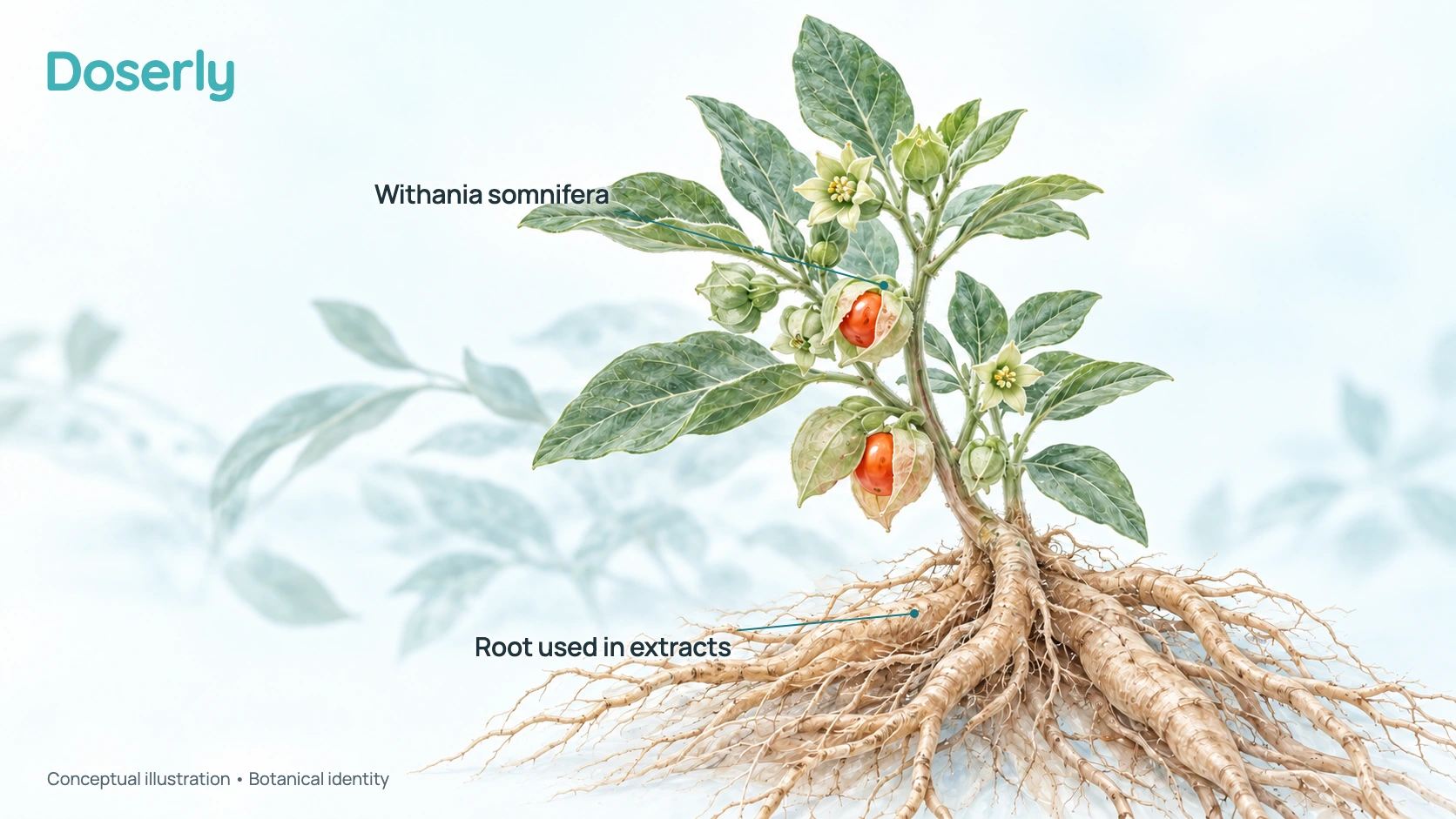
Ashwagandha is the common name for Withania somnifera, an evergreen shrub used in Ayurvedic and Unani traditions. Modern supplements usually contain powdered root, a root extract, or a root-and-leaf extract. Its best-known constituents are withanolides, but the amount and mixture of compounds vary with the plant part and extraction process. [1], [2]
The word adaptogen appears on many labels. It is a broad traditional and marketing category, not a diagnosis and not proof that a product “balances” hormones. Human studies have mainly asked narrower questions: whether one defined extract changes a stress questionnaire, sleep measure, cortisol result or other outcome over several weeks.
Food-style root powder and concentrated extracts can deliver very different amounts of plant material and withanolides. A milligram number is meaningful only when it stays attached to the same extract, plant part and standardization used in the source.
Typical Ashwagandha Protocols
| Source and population | Formulation | Amount each time | Frequency | Duration | Measured outcomes |
|---|---|---|---|---|---|
| Lopresti 2019 · 60 stressed healthy adults | Root-and-leaf extract, 35% withanolide glycosides | 240 mg | Once daily after dinner | 60 days | HAM-A, DASS-21, cortisol, DHEA-S, testosterone HAM-A and cortisol favored the extract; the DASS-21 between-group difference was not significant. |
| Chandrasekhar 2012 · 64 adults with chronic stress | High-concentration full-spectrum root extract | 300 mg | Twice daily | 60 days | Stress questionnaires and serum cortisol |
| Langade 2019 · 60 people with insomnia and anxiety | Full-spectrum root extract | 300 mg | Twice daily with milk or water | 10 weeks | Actigraphy, PSQI and HAM-A The analysis included 58 completers and used unequal 2:1 allocation. |
| Sharma 2018 · 50 adults with subclinical hypothyroidism | Root extract | 300 mg | Twice daily | 8 weeks | TSH, T3 and T4 This pilot changed thyroid laboratory values; it does not support self-treating a thyroid disorder. |
| Thanawala 2026 · 135 healthy adults with perceived stress | AshwaSR sustained-release root extract | 150 mg or 300 mg | Once daily after breakfast | 60 days | Perceived stress, sleep quality, well-being, eating behavior and serum cortisol 126 completed. Both extract groups favored placebo on several questionnaire outcomes; the manufacturers funded the trial and authors worked for the sponsors or study vendor. |
There is no RDA, AI, UL or established general dose for ashwagandha. The rows preserve complete schedules from individual sources; they are not low, medium and high steps.
- Titration
- The four trials above used fixed assigned amounts. They do not establish a start-low or step-up method.
- Breaks and cycles
- The selected trials used one continuous 8–10-week course. They did not test planned days off, cycling or repeat-course timing.
The 240 mg and 600 mg daily totals cannot be ranked by milligrams alone: the 240 mg product was a much more concentrated root-and-leaf extract. Higher extract weight does not automatically mean higher exposure to the same constituents. [3], [4]
What is ashwagandha commonly used for?
People most often look at ashwagandha for stress, sleep and anxiety. Some products also promote exercise performance, fertility, testosterone, cognition or thyroid support. The first two uses have the clearest short-term human signal, but the studies remain small and formulation-specific. NCCIH says some preparations may help stress and insomnia, while evidence for anxiety is unclear and evidence for most other promoted uses is insufficient. [2]
“Lower cortisol” is not a universal goal. Cortisol changes through the day and is essential to normal physiology. A trial result in selected stressed adults does not mean everyone should try to lower it, and it does not show that a product repairs the HPA axis.
Which form and label details matter?
Read five fields before comparing products:
- Species: the label should name Withania somnifera.
- Plant part: root-only and root-and-leaf extracts differ chemically.
- Extract amount: this is the milligram amount of the preparation, not automatically the withanolide amount.
- Standardization: a percentage should name what is measured and ideally the test method.
- Other ingredients: sedatives, stimulants or other botanicals change both interpretation and risk.
Brand names do not create a common dosing system. A concentrated 240 mg extract and a 600 mg root extract are different preparations. Claims such as “root only is balanced” or “root-and-leaf is more sedating” require direct comparisons that the reviewed trials do not provide.
What does the human evidence show?
The useful signal is narrow: several short randomized trials found that particular extracts improved at least one stress or sleep outcome. The limitations are just as consistent: small samples, short follow-up, different extracts, subjective scales and frequent manufacturer involvement.
Stress and anxiety
In 60 stressed healthy adults, 240 mg once daily for 60 days produced a larger improvement on the clinician-rated HAM-A scale and lower morning cortisol than placebo. The self-reported DASS-21 difference did not reach statistical significance. All 60 participants completed the trial; the product manufacturer supplied capsules and sponsored the work. [3]
In an earlier 64-person trial, 300 mg of root extract twice daily for 60 days improved several stress scales and cortisol relative to placebo. Mild adverse effects were comparable between groups. Its size and single-center design limit how broadly the result can be applied. [4]
A 2026 three-arm trial randomized 135 healthy adults with Perceived Stress Scale scores of 14–26 to a sustained-release root extract at 150 mg, 300 mg or placebo once daily for 60 days; 126 completed. Both extract groups favored placebo on perceived stress, sleep quality, well-being and eating-behavior scores at day 60, while serum cortisol fell significantly only in the 300 mg group. The formulation was proprietary, follow-up was short, and the manufacturers funded the study; authors were employees of the sponsors or research vendor. [9]
These trials support a possible short-term effect for their extracts. They do not establish that every ashwagandha product treats an anxiety disorder.
Sleep
In a 10-week trial, 60 people with insomnia and anxiety were assigned 2:1 to 300 mg root extract twice daily or placebo. Among 58 completers, sleep latency, efficiency and several questionnaire outcomes favored the extract. The small, unequal groups and short follow-up make this preliminary rather than definitive. [5]
Thyroid results are a caution, not a wellness claim
In 50 adults with subclinical hypothyroidism, 300 mg root extract twice daily for eight weeks lowered TSH and raised T3 and T4 relative to placebo. Four participants withdrew before the second visit. A change in thyroid hormones may be clinically important, especially for someone with thyroid disease or taking thyroid hormone; it should not be promoted as general “thyroid support.” [6]
What remains uncertain
- whether benefits last after stopping;
- whether results transfer between extracts;
- long-term safety or effectiveness;
- clinically meaningful effects on diagnosed anxiety disorders;
- effects in pregnancy, breastfeeding, children, or people with complex medical conditions.
How might it work?
Human trials measure outcomes; they do not fully establish a molecular mechanism. Some observed changes in cortisol are consistent with involvement of the stress-response system, but that does not show “HPA-axis repair.” GABA-receptor, inflammatory and antioxidant explanations largely come from cell or animal work and should remain labeled preclinical. [1], [3]
What are the risks and interactions?
Common short-term effects include stomach upset, loose stools, nausea and drowsiness. Official summaries advise avoiding ashwagandha during pregnancy and breastfeeding and flag surgery, autoimmune disease, thyroid disorders and hormone-sensitive prostate cancer as situations requiring avoidance or professional review. Potential medicine interactions include sedatives, anticonvulsants, thyroid hormone, immunosuppressants, blood-pressure medicines and diabetes medicines. [1], [2]
Liver injury
Rare liver injury is the most important stop-use signal. A 2020 series described five people who developed jaundice with nausea, lethargy, itching or abdominal discomfort after 2–12 weeks. Injury was cholestatic or mixed; four normalized within 1–5 months and one was lost to follow-up. [7]
A 2023 Indian series described eight cases tied to single-ingredient products. Cholestatic hepatitis predominated. Five people had pre-existing chronic liver disease; three developed acute-on-chronic liver failure and died. A case series cannot calculate how often this occurs, but it shows that “natural” and short trial tolerability do not rule out serious harm. [8]
Stop use and seek prompt medical assessment for yellow skin or eyes, dark urine, severe itching, unusual fatigue, persistent nausea, poor appetite or upper abdominal pain.
Thyroid and sedation
Because a human trial changed TSH, T3 and T4, people with thyroid disease or thyroid medication should discuss use and laboratory timing with a clinician. Drowsiness can also add to the effects of alcohol, sleep medicines, anxiety medicines or other sedating products. [1], [6]
Legal status in the United States and Canada
In the United States, orally used ashwagandha products are commonly sold as dietary supplements. The FDA does not approve dietary supplements for effectiveness before sale, and a supplement cannot legally be marketed as a treatment for an anxiety, sleep or thyroid disorder. [2]
In Canada, ashwagandha products sold as natural health products require a product licence and an NPN on the label. A licensed product's authorized claims and conditions belong to that product; the NPN does not mean that every promoted benefit has been proven or that the product is suitable for every person.
What should you monitor, and when should you stop?
Before starting, write down the exact product, plant part, extract amount, standardization, other ingredients and the outcome you plan to assess. If a clinician is monitoring a thyroid condition, record when laboratory tests occur relative to any change in the routine.
Stop and seek care for liver-warning symptoms, a severe allergic reaction, fainting, marked palpitations or a major change in mood or alertness. Drowsiness, vomiting or persistent diarrhea are also reasons to pause and reassess. Do not use a lack of an app alert as evidence that a medicine combination is safe.
What happens when you stop?
The selected trials did not test tapering, withdrawal or long follow-up after stopping. No evidence-based cycle or washout interval can be inferred from an 8–10-week trial. If ashwagandha was being used alongside treatment for anxiety, insomnia or thyroid disease, changes to that medical treatment need a clinician’s plan.
How should it be stored?
Follow the product label. Keep the product in its original closed container, away from moisture, heat and children. Discard it if the seal is damaged, the contents change unexpectedly, or the expiry date has passed. General storage advice cannot establish the stability of every powder or extract.
How does ashwagandha compare with other approaches?
Ashwagandha is one possible short-term adjunct, not a substitute for identifying why stress or poor sleep is happening. Cognitive behavioral therapy for insomnia, sleep scheduling, treatment of sleep apnea, psychotherapy, and review of medicines or stimulants answer different problems and have different evidence bases.
Compared with rhodiola, ginseng or holy basil, there is no single head-to-head evidence base that identifies a universally “best adaptogen.” Comparing label milligrams across plants is especially misleading because the species, plant part and measured constituents differ.
What do public communities add?
Public discussions can reveal the questions people have about sleepiness, emotional changes, timing and stopping. They cannot establish how common an effect is. Posts are self-selected, product identity is often unclear, and routines frequently change more than one thing at once. This guide therefore does not assign sentiment scores, quote a “consensus,” or use anecdotes to set a dose. A personal account can help someone decide what to record and what to ask a clinician; it cannot verify efficacy or safety.
Common questions
Does ashwagandha work immediately?
The selected trials assessed change over 8–10 weeks. They do not establish a same-day effect or the exact first day a person should notice a change. [3], [4], [5]
Is 600 mg the standard dose?
No. Six hundred milligrams per day appears in several immediate-release root-extract trials, a concentrated root-and-leaf trial used 240 mg once daily, and a proprietary sustained-release trial used 150 or 300 mg once daily. The formulation is part of the dose description. [3], [4], [5], [9]
Is more withanolide always better?
No human evidence establishes that a higher percentage is always more effective or safer. Standardization helps identify a product; it does not replace trial evidence for that exact preparation.
Can I take it with thyroid medicine?
Do not assume the combination is neutral. Ashwagandha changed TSH, T3 and T4 in a small human trial, and official summaries warn about thyroid disease and thyroid-medicine interactions. Discuss the combination and laboratory timing with the prescriber. [1], [6]
Does it raise testosterone?
Some short studies reported changes in selected male populations, but results are not a general indication to use it for hormone optimization. NCCIH describes the evidence as limited and advises avoidance in hormone-sensitive prostate cancer. [2]
Is liver injury only a concern with contaminated products?
No. Product identity is not perfect in every report, but chemical analysis in both case series supported ashwagandha exposure in available products, and the Indian series found natural plant constituents without adulteration in tested samples. The incidence remains unknown. [7], [8]
Can it be used during pregnancy or breastfeeding?
Official sources advise avoiding it during pregnancy and breastfeeding because safety is not established and pregnancy concerns have been raised. [1], [2]
Glossary
Terms used in this guide.
- Withanolides
- A family of naturally occurring steroidal lactones found in Withania somnifera. A label percentage does not describe every compound in an extract.
- HPA axis
- The hypothalamic–pituitary–adrenal signaling system involved in the body's stress response.
- Titration
- Changing an amount in planned steps. The selected ashwagandha trials used fixed assigned amounts.
- Preclinical
- Research done before or outside trials in people, such as cell, test-tube or animal studies.
- Standardized extract
- An extract manufactured to contain a declared amount or range of a measured constituent.
- Cholestatic liver injury
- Liver injury in which impaired bile flow is prominent; jaundice and itching can be marked and prolonged.
How this guide was researched
This draft uses current official summaries and direct reads of the primary human studies behind its numeric rows. Searches covered Withania somnifera, ashwagandha, stress, sleep, thyroid outcomes, liver injury, dose, extract and randomized trials. Numeric schedules remain attached to their source, plant part and formulation. We searched for contrary and harm evidence rather than treating short tolerability reports as proof of long-term safety.
Important corrections from the earlier manuscript include removing unsourced brand rankings, piperine and food bioavailability advice, invented community scores, universal mechanism claims and generic dose ranges. The evidence was refreshed on October 9, 2026.
How this guide was made
The source ledger stores the access level and exact population, formulation, amount, frequency, duration, outcomes, adverse events and limitations for each material source. Primary studies support trial-specific numbers; official sources frame regulation and safety. Draft status means scientific, French-parity, asset and rendered-page review remain separate gates.
Research method, access and remaining gaps
Primary trial and case-series records were checked through PubMed and available full text; the Langade and Sharma numeric summaries were limited to the accessible abstract. NIH ODS and NCCIH supplied current official synthesis and cautions. The source ledger records access level, formulation, amount, frequency, duration, outcomes and limitations.
Remaining gaps include long-term controlled data, independent head-to-head extract comparisons, reliable incidence estimates for liver injury, and strong evidence in pregnancy, breastfeeding or complex medical populations. No private community identity or anecdotal consensus was used.
Sources
Search the official summaries, trials and safety series used for the material claims in this guide.
Showing 9 sources
- 01
Ashwagandha: Health Professional Fact Sheet ↗
Official summary
Stress, sleep, safety, thyroid and liver-injury overview.
Full text checked October 9, 2026.
- 02
Ashwagandha: Usefulness and Safety ↗
Official summary
Evidence boundaries, common effects and medication cautions.
- 03
An investigation into the stress-relieving and pharmacological actions of an ashwagandha (Withania somnifera) extract: A randomized, double-blind, placebo-controlled study. ↗
Randomized trial
240 mg once daily for 60 days in 60 stressed healthy adults.
Full text checked; sponsored product-specific trial.
- 04
A prospective, randomized double-blind, placebo-controlled study of safety and efficacy of a high-concentration full-spectrum extract of ashwagandha root in reducing stress and anxiety in adults. ↗
Randomized trial
300 mg twice daily for 60 days in 64 adults.
- 05
Efficacy and Safety of Ashwagandha (Withania somnifera) Root Extract in Insomnia and Anxiety: A Double-blind, Randomized, Placebo-controlled Study. ↗
Randomized trial
300 mg twice daily for 10 weeks; 60 randomized, 58 completers.
Abstract-level numeric verification.
- 06
Efficacy and Safety of Ashwagandha Root Extract in Subclinical Hypothyroid Patients: A Double-Blind, Randomized Placebo-Controlled Trial. ↗
Randomized pilot
600 mg/day for 8 weeks; thyroid tests changed relative to placebo.
Abstract-level numeric verification.
- 07
Ashwagandha-induced liver injury: A case series from Iceland and the US Drug-Induced Liver Injury Network. ↗
Case series
Five cholestatic or mixed liver-injury cases.
- 08
Ashwagandha-induced liver injury-A case series from India and literature review. ↗
Case series
Eight single-ingredient cases, including serious outcomes with pre-existing liver disease.
- 09
Efficacy and safety of Ashwagandha root extract sustained-release (AshwaSR) capsules in healthy adult, stressed subjects: A randomized, double-blind, placebo-controlled, parallel-group, 3-arm clinical trial. ↗
Randomized trial
150 or 300 mg once daily for 60 days; 135 randomized and 126 completed.
Full text checked; proprietary formulation in a manufacturer-funded trial.
No matching sources
Try a different term or show the full list.