
In this guide
What is Beta-Alanine?
Beta-alanine is a non-protein-forming amino acid and the rate-limiting precursor for muscle carnosine synthesis. It is a loading ingredient, not an acute stimulant, and a rise in carnosine does not guarantee better performance in every event. The WHO indispensable-amino-acid table assigns no adult dietary requirement to this compound; it therefore supplies no supplement target. [1]
Typical Beta-Alanine Research Protocols
| Source and population | Form and amount per administration | Frequency | Total exposure | Duration or window |
|---|---|---|---|---|
| Bellinger 2016 · 17 trained cyclists | Slow-release beta-alanine 1.6 g per administration | Four times daily with meals | 6.4 g/day | 28 days |
| Ong 2025 · systematic review of 9 studies/197 trained participants | Protocols commonly used 0.8 g per administration | Several divided administrations | 4–6.4 g/day | Usually 5–8 weeks in studies with positive strength/power findings |
These rows reproduce studies. Do not average their populations, forms, frequencies or durations into one regimen.
From dietary requirement to claim
Units, mixture, timing and endpoint stay attached to their source.
Should Beta-Alanine be cycled?
No verified trial establishes a cycle. A review point can limit indefinite use, but it does not prove a physiological reset.
What happens when it is stopped?
No withdrawal syndrome is established. An acute or short study cannot predict persistence after stopping.
Which foods provide it?
Meat and fish provide carnosine and related dipeptides, while supplements provide free beta-alanine. No adult dietary beta-alanine target or supplement schedule follows from the WHO report. [1]
Which forms and label details matter?
Record immediate-release versus sustained-release beta-alanine, the amount in each administration and total daily amount. Multi-ingredient pre-workouts confound attribution and often list a blend rather than the tested standalone schedule.
How should it be stored?
Follow the finished-product label, close the container and protect it from moisture and heat. Keep the lot number and discard a product with a broken seal or unexplained change.
What is Beta-Alanine commonly used for?
Beta-alanine is used for repeated high-intensity work. Evidence is most plausible where acidosis and buffering matter, while maximal strength, sprint, time-trial and long endurance outcomes should not be treated as one category.
What does human research show?
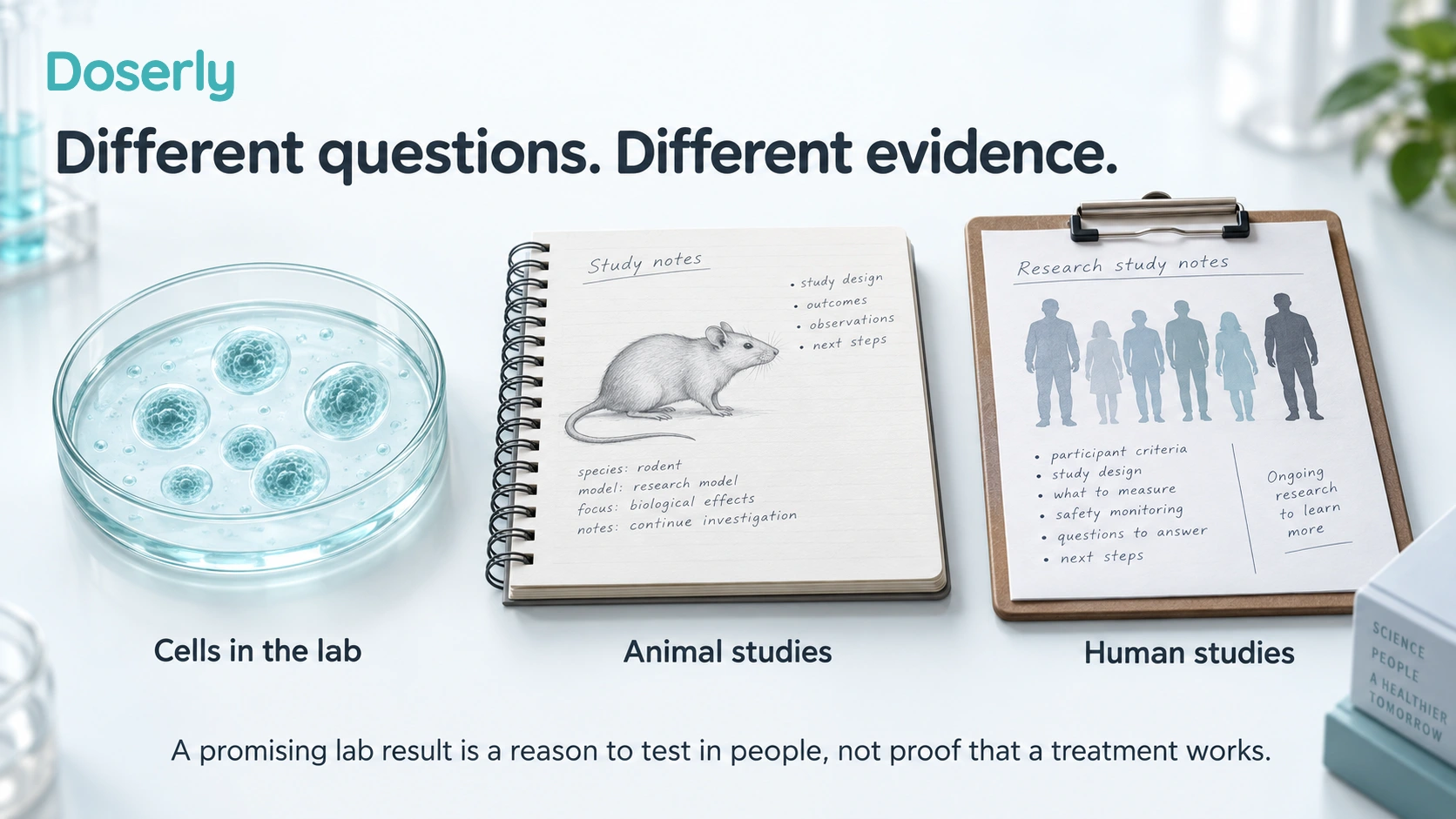
Ong's 2025 systematic review included nine studies and 197 trained participants. Results for strength and power were inconsistent, but positive studies more often used 4–6.4 g/day in divided servings over five to eight weeks and metabolically stressful training. This pattern is hypothesis-generating across heterogeneous protocols, not proof that every lifter benefits or that cumulative dose alone determines response. [2] Bellinger's 17-cyclist trial used 1.6 g slow-release beta-alanine four times daily with meals for 28 days. Time to exhaustion and 4,000 m time-trial performance improved, but the sample was very small and the result cannot be transferred to one-repetition maximum strength or long endurance events. [4] Dolan's risk assessment included 101 human and 50 animal studies. In high-quality human comparisons, paresthesia occurred in 18.6% with beta-alanine and 5.7% with placebo (OR 8.9, 95% credible interval 2.2–32.6). Typical research exposures did not reduce human muscle taurine or histidine, but long-duration safety and unusually high doses remain under-studied. [3]
How might it act?
Beta-alanine combines with histidine to form carnosine in skeletal muscle. Carnosine buffers hydrogen ions during demanding work. That mechanism fits repeated high-intensity efforts better than isolated maximal lifts or long steady exercise, but performance still depends on protocol and training context.
What are the risks and interactions?
Tingling, prickling or itching is the characteristic dose-related adverse effect. Large rapid-release administrations produce higher peaks and more symptoms; divided or sustained-release exposures can reduce them. Do not treat tingling as proof the product is working. Pregnancy, breastfeeding, childhood use, neurologic symptoms, kidney or liver disease and unusually high or long exposures need review.
Which medicines can interact?
Product-specific interaction data are limited. Have the complete formula reviewed by a pharmacist when taking medicines, especially for neurologic, psychiatric, metabolic, kidney or liver conditions. Do not invent a universal separation interval.
Regulatory status: In the United States, supplements are not routinely approved for efficacy before sale. In Canada, check the NPN or DIN-HM and licensed label conditions. [5], [6]
What should be monitored?
Record product, lot, form, amount per administration, frequency, daily total, co-ingredients, dietary context, symptoms and intended outcome. Set a review date before starting.
Stop and seek advice for an allergic reaction, persistent vomiting, unusual weakness, confusion or another severe symptom.
What do public communities report?
Public discussions often emphasize taste, timing and felt effects while omitting lot, total diet and validated outcomes. This update did not independently recrawl or quantify those posts.
How does Beta-Alanine compare?
| Option | What it supplies | Limit |
|---|---|---|
| Beta-Alanine | One defined amino acid | Does not replace complete protein |
| EAAs | All nine indispensable amino acids | Formula varies |
| BCAAs | Leucine, isoleucine and valine | Six EAAs are absent |
| Complete protein | All EAAs in a protein matrix | Portion and digestibility vary |
Common questions about Beta-Alanine
Is beta-alanine an acute pre-workout stimulant?
No. It is usually studied as a loading strategy over weeks; acute tingling is not the performance mechanism.
Which events are most relevant?
Repeated high-intensity work with substantial metabolic stress is more relevant than a single maximal lift or long steady exercise.
Why do some products cause tingling?
Rapid larger administrations create higher blood peaks. Divided or sustained-release exposures can reduce paresthesia.
Does tingling mean it is effective?
No. Paresthesia is an adverse sensory effect, not a measure of muscle carnosine or performance.
Can I count a pre-workout blend as the studied protocol?
Only if the label gives the exact beta-alanine amount. Co-ingredients and proprietary blends prevent clean attribution.
What should I track?
Record formulation, each administration, daily total, meals, training type, event duration, paresthesia, outcome and review date.
Glossary
Plain terms for interpreting the evidence.
- Indispensable amino acid
- An amino acid the diet must provide.
- Dietary requirement
- Total required intake; not a supplement dose.
- Amount per administration
- Amount consumed at one time, distinct from daily total.
- NOAEL
- Highest tested level without an observed adverse effect in one study; not automatically a UL.
- UL
- Tolerable Upper Intake Level established by an authority.
- Biomarker
- Biological measure that is not necessarily a felt or clinical benefit.
How this guide was researched
The complete WHO report, accessible primary human studies and live NCBI metadata were read on October 9, 2026. Titles, authors, journals, DOI, PMID, available PMCID and CommentsCorrections were checked. Open full text supplied methods details; an unreported frequency was not guessed. [1], [2], [3], [4], [5], [6]
How this guide was made
Research and drafting were AI-assisted. This draft awaits Doserly editorial review and independent clinical review. See the editorial policy.
Explore the sources
Sources preserve form, dose, frequency, population, duration and outcome.
Showing 6 sources
- 01
Protein and amino acid requirements in human nutrition: report of a joint WHO/FAO/UNU expert consultation ↗
Official expert report
Current primary source and identity checked; limitations are retained in the text.
Detail: Beta-alanine is not an indispensable protein-forming amino acid and has no adult requirement in WHO Table 49.
- 02
Dosing strategies for β-alanine supplementation in strength and power performance: a systematic review. ↗
Systematic strength and power review
Current primary source and identity checked; limitations are retained in the text.
Detail: Nine studies and 197 trained participants; positive findings clustered around divided 4–6.4 g/day protocols over five to eight weeks, but results were inconsistent.
- 03
A Systematic Risk Assessment and Meta-Analysis on the Use of Oral β-Alanine Supplementation. ↗
Systematic risk assessment and meta-analysis
Current primary source and identity checked; limitations are retained in the text.
Detail: 101 human and 50 animal studies; paresthesia was the main human adverse effect and was strongly peak-related.
- 04
Metabolic consequences of β-alanine supplementation during exhaustive supramaximal cycling and 4000-m time-trial performance ↗
Small randomized cycling trial
Current primary source and identity checked; limitations are retained in the text.
Detail: 17 trained cyclists; slow-release beta-alanine 1.6 g four times daily with meals for 28 days; improved selected high-intensity cycling outcomes.
- 05
Questions and Answers on Dietary Supplements ↗
U.S. regulatory overview
Current primary source and identity checked; limitations are retained in the text.
Detail: Dietary supplements are not routinely FDA-approved for efficacy before sale.
- 06
Product Licensing ↗
Canadian licensing overview
Current primary source and identity checked; limitations are retained in the text.
Detail: Canadian authorization attaches to the licensed finished product and label conditions.
No matching sources
Try a different term or show the full list.