
In this guide
What is Glucosamine?
Glucosamine sulfate and glucosamine hydrochloride are not interchangeable evidence categories. Large pragmatic trials found no overall knee-pain advantage. No U.S. RDA, AI, UL or established treatment dose exists for glucosamine. The 1,500 mg/day figure is a common study exposure, not a nutrient requirement. Official evidence summaries describe mixed results. [1]
Typical Glucosamine Protocols
| Source and population | Form and amount each time | Frequency | Total exposure | Duration or boundary |
|---|---|---|---|---|
| GAIT 2006 · 1,583 adults with symptomatic knee OA | Glucosamine hydrochloride 500 mg per administration | Three times daily | 1,500 mg/day | 24 weeks; overall pain response not better than placebo |
| GAIT extension · 662 radiographic knee-OA participants | Glucosamine hydrochloride 500 mg per administration | Three times daily | 1,500 mg/day | 24 months; no clinically important pain/function difference |
| Persiani 2005 · healthy adults | Crystalline glucosamine sulfate supplying 1,500 mg glucosamine | Once daily | 1,500 mg/day | Steady-state pharmacokinetics; not an efficacy trial |
These rows reproduce sources. Do not average them into one universal regimen.
From source to outcome
Evidence does not transfer cleanly.
Overall primary result was null.
Track pain and function.
Which forms and label details matter?
Record sulfate versus hydrochloride, crystalline or other formulation, glucosamine amount rather than salt mass when stated, shellfish or fermentation source, co-ingredients and pharmaceutical versus retail quality.
How should it be stored?
Follow the label, close the container and protect it from heat, light and moisture.
Read the label before the claim
Keep form and outcome linked.
Not a universal regimen.
Track a chosen outcome.
What is it commonly used for?
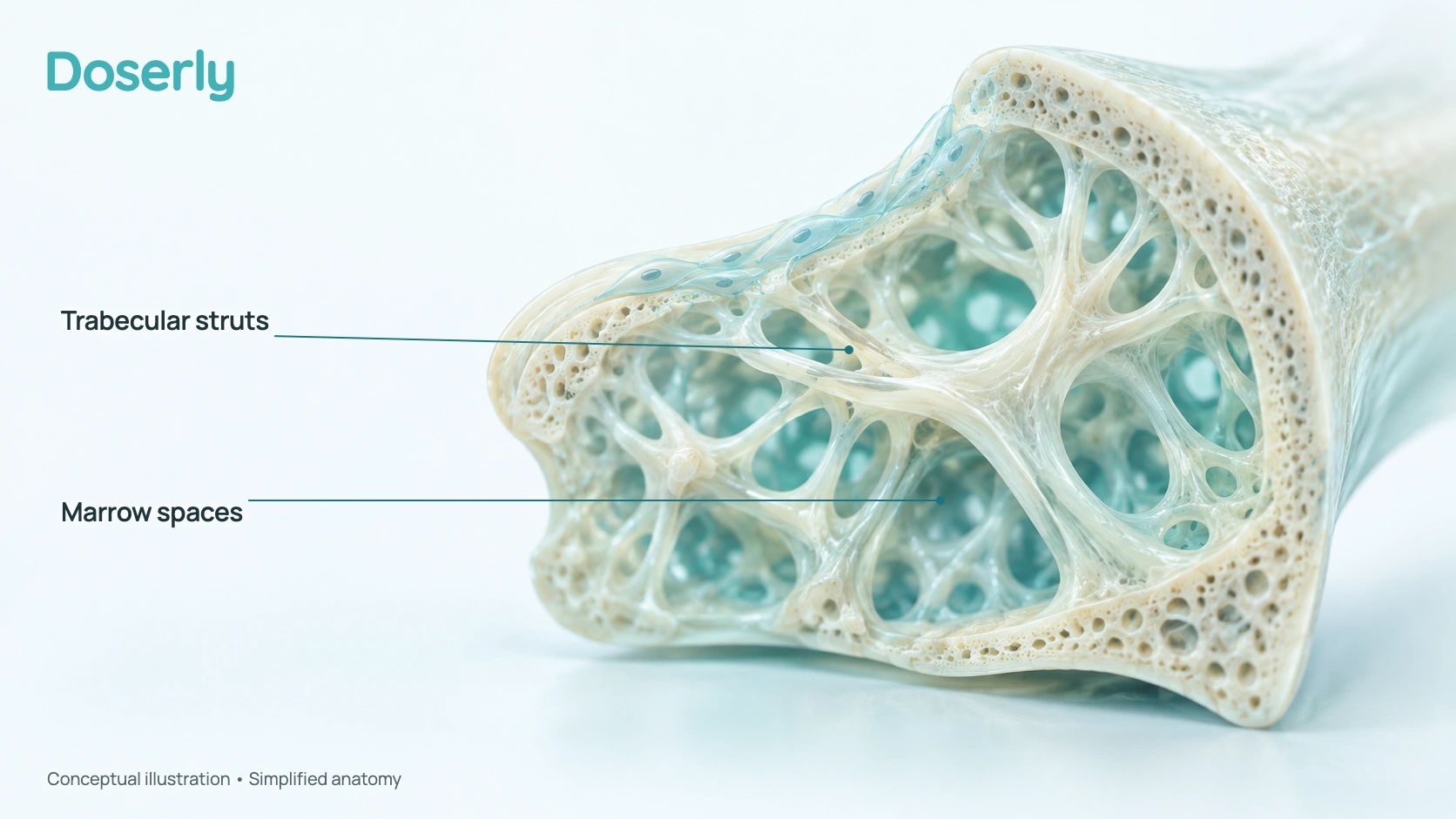
It is mainly used for knee-osteoarthritis pain and function. Evidence is mixed across forms and products; cartilage-restoration claims exceed the clinical record.
What does human research show?
GAIT randomized 1,583 people to glucosamine hydrochloride, chondroitin, their combination, celecoxib or placebo. Glucosamine alone and the combination did not significantly improve the primary 20% pain-response rate in the overall cohort; the moderate-to-severe combination subgroup was exploratory. [2] In the 662-person 24-month extension, glucosamine 500 mg three times daily did not produce a clinically important WOMAC pain or function difference versus placebo. [3] A form-specific meta-analysis found no meaningful pain effect for hydrochloride and possible longer-term function benefit for sulfate, with heterogeneity and product dependence. [4] These results support form fidelity and a time-limited outcome review, not a universal cartilage-rebuilding claim.
How might it act?
Biological plausibility does not establish a clinical outcome. The guide therefore keeps preparation, population and endpoint attached to each result.
How does it compare with related products?
| Product | Identity to preserve | Evidence boundary |
|---|---|---|
| Glucosamine | Sulfate or hydrochloride; active amount | Form-specific osteoarthritis evidence |
| Chondroitin | Chondroitin sulfate and product quality | Symptom and structure outcomes differ |
| UC-II collagen | Undenatured type II collagen | Milligram-dose proprietary trials |
| Collagen | Hydrolyzed peptides, source and grams | Peptide trials do not transfer to UC-II |
What are the risks and interactions?
GI symptoms, headache and skin reactions can occur. Review warfarin or other anticoagulation, diabetes monitoring, pregnancy, breastfeeding, shellfish allergy and upcoming surgery. Source allergy depends on the finished product; glucosamine itself is not shellfish protein.
Which medicines require review?
Have the product reviewed with medicines, before surgery, and during pregnancy or breastfeeding. No universal separation interval is established.
Regulatory status: In the United States, supplements generally lack premarket efficacy approval. In Canada, verify the finished product’s NPN or DIN-HM and licensed conditions. [5], [6]
What should be monitored?
Record product, lot, form, amount per administration, frequency, daily total, co-ingredients, meals, symptoms, medicines, chosen outcome and review date.
What happens when it is stopped?
No ingredient-specific withdrawal syndrome is established. Record the stop date, symptoms and chosen outcome; seek care for a persistent serious symptom.
Seek prompt care for a serious allergic reaction, unusual bleeding, persistent palpitations, chest pain or another severe symptom.
What do public communities report?
Public reports can suggest questions to track, but they do not verify the product, dose or causality. This update did not newly quantify a community sample.
Common questions about Glucosamine
Is sulfate better than hydrochloride?
Some analyses favor specific sulfate products, but formulation and study quality prevent a blanket conclusion.
Did GAIT show glucosamine works?
Not in the overall cohort for its primary pain-response outcome.
Does it rebuild cartilage?
No reliable clinical evidence establishes cartilage restoration.
Is 1,500 mg/day an official dose?
No. It is a common study exposure, not an RDA or universal regimen.
Can it be combined with chondroitin?
That combination was not superior overall in GAIT; review both products and total pill burden.
What should I track?
Form, amount each time, daily total, pain scale, function, rescue medicine and review date.
Glossary
Terms for reading the evidence.
- Formulation
- The chemical form, source and finished delivery system used in a study.
- Daily total
- The sum across administrations; it does not reveal amount each time.
- WOMAC
- A questionnaire for osteoarthritis pain, stiffness and physical function.
- DXA
- Dual-energy X-ray absorptiometry; some materials can alter the reading itself.
- Subgroup
- A subset analysis that usually carries more uncertainty than the primary result.
- Clinical outcome
- A change in symptoms, function or events rather than only a laboratory marker.
How this guide was researched
Accessible official sources and human reports were read on October 9, 2026. Titles, authors, journals, DOI, PMID and visible corrections were checked. An unreported frequency was not guessed.
How this guide was made
Research and drafting were AI-assisted. This draft awaits Doserly editorial review and independent clinical review. See the editorial policy.
Explore the sources
Sources preserve form, amount, frequency, population, duration and outcome.
Showing 6 sources
- 01
Glucosamine and Chondroitin for Osteoarthritis ↗
Official evidence overview
Current page or report reviewed; scope and limits retained.
Detail: Mixed evidence, safety and form context.
- 02
Glucosamine, chondroitin sulfate, and the two in combination for painful knee osteoarthritis. ↗
GAIT randomized trial
Current page or report reviewed; scope and limits retained.
Detail: 1,583 participants; exact daily amounts and overall null primary comparison.
- 03
Clinical efficacy and safety of glucosamine, chondroitin sulphate, their combination, celecoxib or placebo taken to treat osteoarthritis of the knee: 2-year results from GAIT. ↗
Two-year randomized extension
Current page or report reviewed; scope and limits retained.
Detail: 662 participants; exact three-times-daily schedule; no important pain/function difference.
- 04
Efficacies of different preparations of glucosamine for the treatment of osteoarthritis: a meta-analysis of randomised, double-blind, placebo-controlled trials. ↗
Form-specific meta-analysis
Current page or report reviewed; scope and limits retained.
Detail: Hydrochloride versus sulfate distinctions and heterogeneity.
- 05
Questions and Answers on Dietary Supplements ↗
U.S. regulatory overview
Current page or report reviewed; scope and limits retained.
Detail: Supplements generally lack efficacy preapproval.
- 06
Product Licensing ↗
Canadian licensing overview
Current page or report reviewed; scope and limits retained.
Detail: Finished natural health products require licensing and authorized labels.
No matching sources
Try a different term or show the full list.