
In this guide
What is Glycine?
Glycine is the smallest protein-forming amino acid and also participates in inhibitory neurotransmission, collagen, creatine, heme and glutathione synthesis. Those roles do not establish a sleep or longevity treatment dose. The WHO indispensable-amino-acid table does not assign this compound an adult dietary requirement, so it supplies no supplement target. [1]
Typical Glycine Research Protocols
| Source and population | Form and amount per administration | Frequency | Total exposure | Duration or window |
|---|---|---|---|---|
| Yamadera 2007 · 11 workers with unsatisfactory sleep · crossover | Free glycine 3 g once | Within 1 hour before bedtime | 3 g that night | Two consecutive study nights; repeat condition after ≥1 week |
| Bannai 2012 · 10 entered, 7 analyzed · randomized crossover | Flavoured glycine 3 g once | 30 minutes before bedtime | 3 g/night | 3 consecutive nights with time in bed reduced 25% |
These rows reproduce studies. Do not average their populations, forms, frequencies or durations into one regimen.
From dietary requirement to claim
Units, mixture, timing and endpoint stay attached to their source.
Should Glycine be cycled?
No verified trial establishes a cycle. A review point can limit indefinite use, but it does not prove a physiological reset.
What happens when it is stopped?
No withdrawal syndrome is established. An acute or short study cannot predict persistence after stopping.
Which foods provide it?
A varied diet supplies glycine through protein foods and supplies taurine mainly through animal foods, but food exposure is not interchangeable with a concentrated trial product. [1]
Which forms and label details matter?
Free glycine has no L/D label distinction because its side chain is not chiral. Do not count magnesium bisglycinate, collagen, GlyNAC or a proprietary sleep blend as an equivalent 3 g dose of free glycine unless the label reports that amount separately.
How should it be stored?
Follow the finished-product label, close the container and protect it from moisture and heat. Keep the lot number and discard a product with a broken seal or unexplained change.
What is Glycine commonly used for?
Glycine is marketed for sleep, recovery, collagen and healthy aging. The direct healthy-adult sleep studies are very small, short and linked to one manufacturer, while broader disease studies cannot establish prevention in healthy people.
What does human research show?
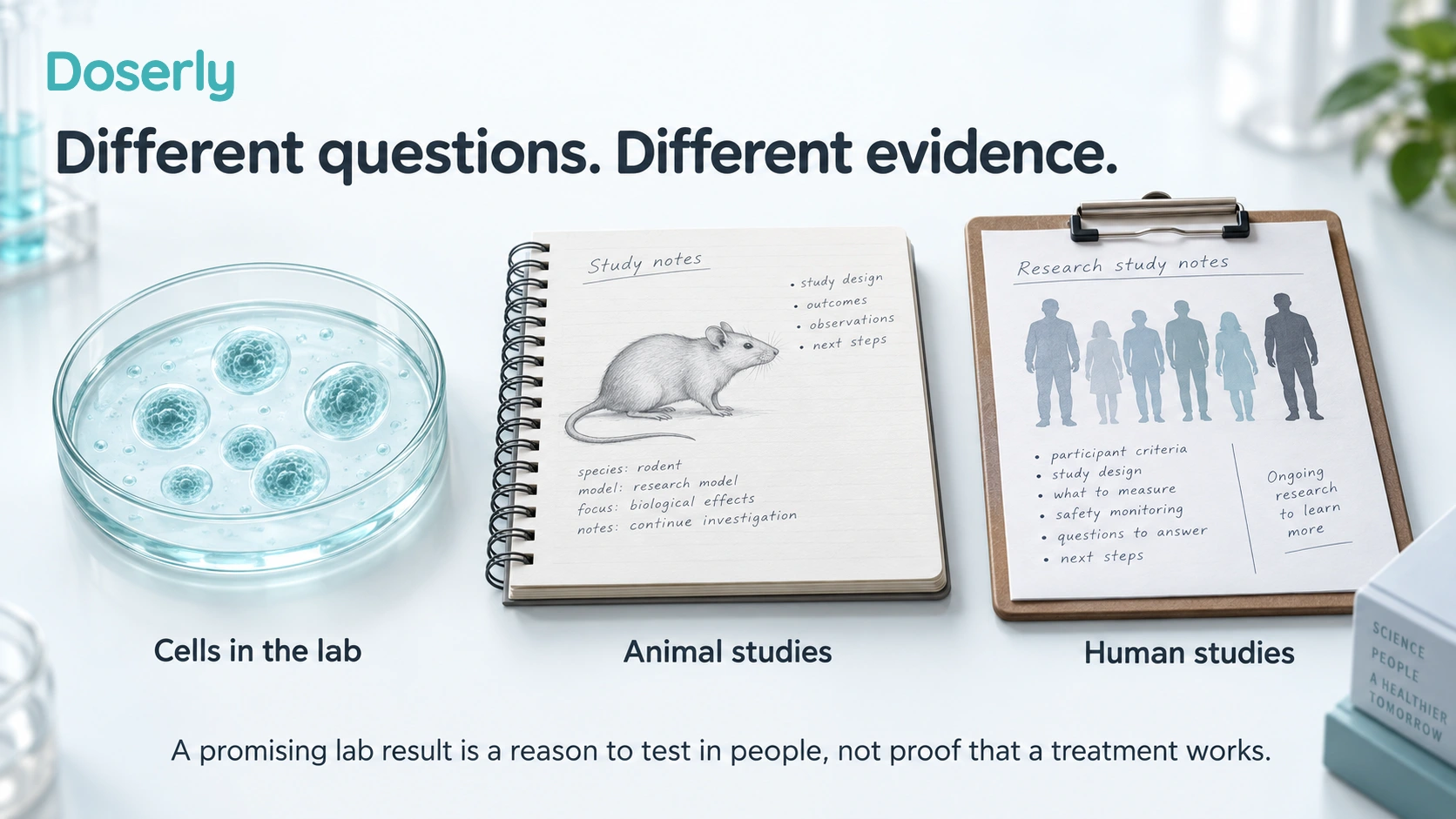
Yamadera’s single-blind crossover study enrolled 11 adults who reported unsatisfactory sleep. Three grams within one hour before bedtime improved some subjective scores, sleep efficiency and latency to slow-wave sleep, while sleep architecture was otherwise largely unchanged. [2] Bannai enrolled 10 male employees, but analyzed only seven after one dropout and two illness/medication exclusions, during three nights with time in bed reduced by 25%. Three grams 30 minutes before bed reduced fatigue on the first day and improved psychomotor-vigilance performance on days one and three, while most other computer tasks were null. [3] The 2024 systematic review found 52 healthy- or disease-population studies across many systems. Healthy-population exposure lasted no more than 14 days, and the sleep studies were small and at high risk of bias; it does not support a longevity regimen. [4]
How might it act?
Glycine can activate inhibitory glycine receptors and serve as a co-agonist at NMDA receptors. It also contributes carbon and nitrogen to several biosynthetic pathways. These mechanisms do not prove that a bedtime dose treats insomnia or that chronic supplementation slows aging.
What are the risks and interactions?
The sleep trials do not establish long-term safety, an official UL or treatment for chronic insomnia. Glycine can cause nausea or GI discomfort, and bedtime use may affect alertness. Kidney or liver disease, pregnancy, breastfeeding, childhood, sedatives and complex psychiatric treatment warrant clinician or pharmacist review.
Which medicines can interact?
Product-specific interaction data are limited. Have the complete formula reviewed by a pharmacist when taking medicines, especially for neurologic, psychiatric, metabolic, kidney or liver conditions. Do not invent a universal separation interval.
Regulatory status: In the United States, supplements are not routinely approved for efficacy before sale. In Canada, check the NPN or DIN-HM and licensed label conditions. [5], [6]
What should be monitored?
Record product, lot, form, amount per administration, frequency, daily total, co-ingredients, dietary context, symptoms and intended outcome. Set a review date before starting.
Stop and seek advice for an allergic reaction, persistent vomiting, unusual weakness, confusion or another severe symptom.
What do public communities report?
Public discussions often emphasize taste, timing and felt effects while omitting lot, total diet and validated outcomes. This update did not independently recrawl or quantify those posts.
How does Glycine compare?
Common questions about Glycine
Does glycine treat chronic insomnia?
No. The direct studies were short experiments that enrolled 10 or 11 adults; Bannai analyzed only seven and did not establish treatment of chronic insomnia.
Is 3 g an official bedtime recommendation?
No. It is the exact amount in two small experiments, not an adult dietary target or universal prescription.
Is magnesium glycinate the same as 3 g glycine?
No. A mineral salt label may report the mineral amount or salt mass. Count free glycine only when it is stated separately.
Does glycine extend human lifespan?
No human trial has shown that. The 2024 review found heterogeneous, mostly short studies and called for stronger long-term research.
What were the manufacturer links?
The small sleep program included Ajinomoto employees or authors. That does not invalidate a study, but it increases the need for independent replication.
What should I track?
Record product, free-glycine amount, bedtime interval, sleep window, awakenings, next-day alertness, GI symptoms, other sedatives and review date.
Glossary
Plain terms for interpreting the evidence.
- Indispensable amino acid
- An amino acid the diet must provide.
- Dietary requirement
- Total required intake; not a supplement dose.
- Amount per administration
- Amount consumed at one time, distinct from daily total.
- NOAEL
- Highest tested level without an observed adverse effect in one study; not automatically a UL.
- UL
- Tolerable Upper Intake Level established by an authority.
- Biomarker
- Biological measure that is not necessarily a felt or clinical benefit.
How this guide was researched
The complete WHO report, accessible primary human studies and live NCBI metadata were read on October 9, 2026. Titles, authors, journals, DOI, PMID, available PMCID and CommentsCorrections were checked. Open full text supplied methods details; an unreported frequency was not guessed. [1], [2], [3], [4], [5], [6]
How this guide was made
Research and drafting were AI-assisted. This draft awaits Doserly editorial review and independent clinical review. See the editorial policy.
Explore the sources
Sources preserve form, dose, frequency, population, duration and outcome.
Showing 6 sources
- 01
Protein and amino acid requirements in human nutrition: report of a joint WHO/FAO/UNU expert consultation ↗
Official expert report
Current primary source and identity checked; limitations are retained in the text.
Detail: Glycine is not assigned an adult indispensable-amino-acid requirement in Table 49; no supplement target or upper limit follows from that omission.
- 02
Glycine ingestion improves subjective sleep quality in human volunteers, correlating with polysomnographic changes ↗
Small single-blind crossover sleep trial
Current primary source and identity checked; limitations are retained in the text.
Detail: Eleven adults; 3 g once within one hour before bedtime on two study nights.
- 03
The effects of glycine on subjective daytime performance in partially sleep-restricted healthy volunteers. ↗
Randomized single-blind crossover study
Current primary source and identity checked; limitations are retained in the text.
Detail: Ten male employees entered and seven were analyzed; 3 g 30 minutes before bed for three sleep-restricted nights.
- 04
The effect of glycine administration on the characteristics of physiological systems in human adults: A systematic review. ↗
Systematic review
Current primary source and identity checked; limitations are retained in the text.
Detail: 52 studies across healthy and diseased adults; healthy exposures lasted at most 14 days and sleep studies were small with high risk of bias.
- 05
Questions and Answers on Dietary Supplements ↗
U.S. regulatory overview
Current primary source and identity checked; limitations are retained in the text.
Detail: Dietary supplements are not routinely FDA-approved for efficacy before sale.
- 06
Product Licensing ↗
Canadian licensing overview
Current primary source and identity checked; limitations are retained in the text.
Detail: Canadian authorization attaches to the licensed finished product and label conditions.
No matching sources
Try a different term or show the full list.