
In this guide
What is L-Serine?
L-serine is a protein-forming amino acid and precursor for phospholipids, sphingolipids, glycine and D-serine. It is not D-serine or phosphatidylserine, and a biochemical role does not prove treatment of insomnia, ALS or cognitive decline. The WHO indispensable-amino-acid table assigns no adult dietary requirement to this compound; it therefore supplies no supplement target. [1]
Typical L-Serine Research Protocols
| Source and population | Form and amount per administration | Frequency | Total exposure | Duration or window |
|---|---|---|---|---|
| Ito 2014 Study 1 · 53 enrolled, 45 analyzed with sleep dissatisfaction | L-serine powder 3 g once | 30 minutes before bedtime | 3 g/night | 4 consecutive nights, then crossover after ≥3-day washout |
| Ito 2014 Study 2 · 9 enrolled, 7 analyzed; actigraphy in 6 | L-serine powder 3 g once | 30 minutes before bedtime | 3 g/night | 2 consecutive nights, then crossover after ≥3-day washout |
| Levine 2017 phase I · 20 people with ALS | L-serine 0.5, 2.5, 7.5 or 15 g per administration | Twice daily | 1–30 g/day | 6 months |
These rows reproduce studies. Do not average their populations, forms, frequencies or durations into one regimen.
From dietary requirement to claim
Units, mixture, timing and endpoint stay attached to their source.
Should L-Serine be cycled?
No verified trial establishes a cycle. A review point can limit indefinite use, but it does not prove a physiological reset.
What happens when it is stopped?
No withdrawal syndrome is established. An acute or short study cannot predict persistence after stopping.
Which foods provide it?
Dietary protein and endogenous synthesis supply L-serine. Clinical replacement in rare serine-synthesis disorders is diagnosis-specific and cannot be converted into a retail wellness regimen. [1]
Which forms and label details matter?
Confirm that the label says L-serine. D-serine is a different stereoisomer studied in other neuropsychiatric contexts; phosphatidylserine is a phospholipid; neither can inherit an L-serine dose or result.
How should it be stored?
Follow the finished-product label, close the container and protect it from moisture and heat. Keep the lot number and discard a product with a broken seal or unexplained change.
What is L-Serine commonly used for?
L-serine is marketed for sleep and neuroprotection. The direct sleep evidence lasts only two to four nights. The small ALS phase-I study addressed tolerability without a concurrent placebo group, and a later phase-IIa study was terminated because conduct problems compromised data integrity.
What does human research show?
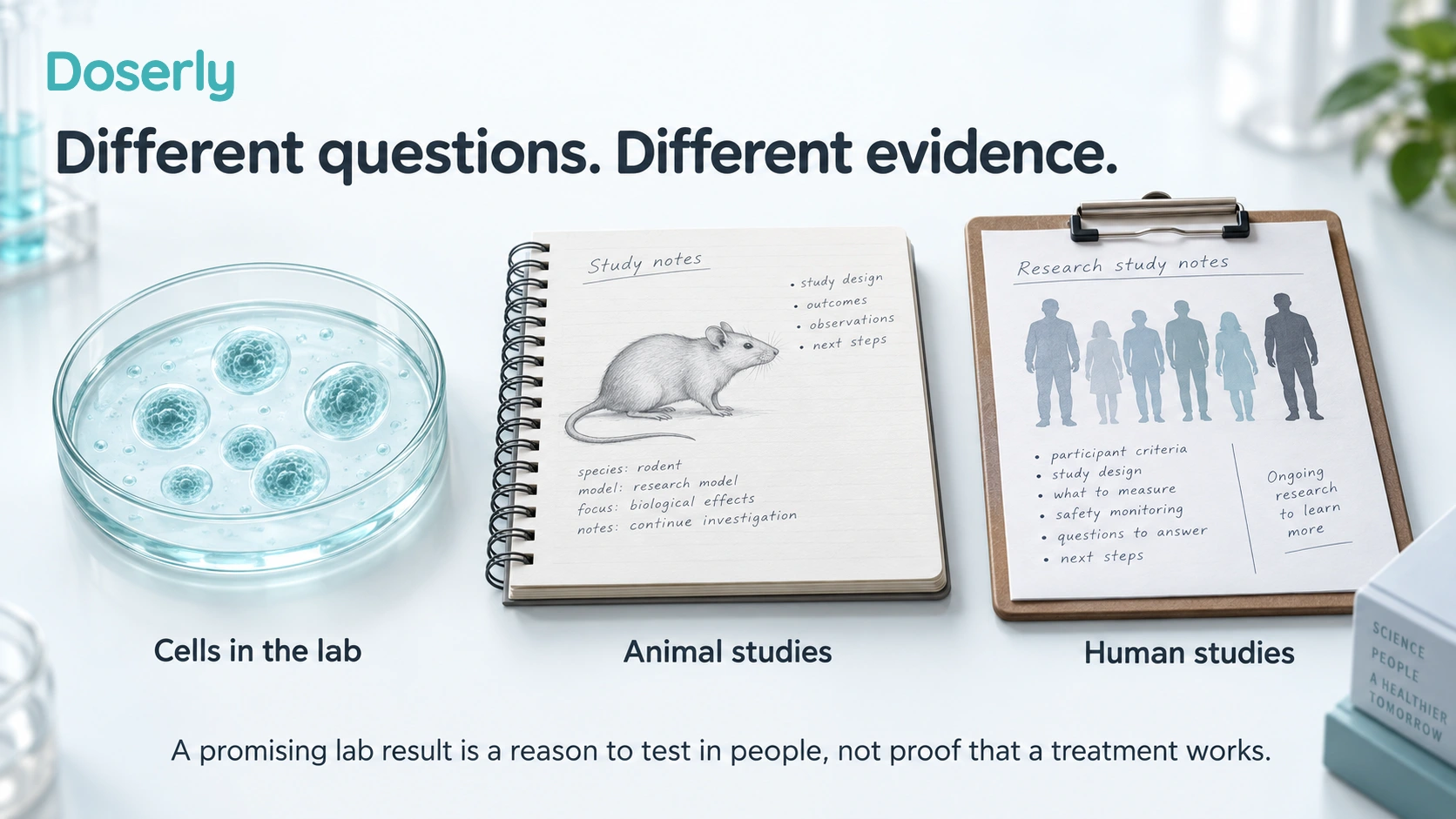
Ito reported two randomized crossover studies using one 3 g dose 30 minutes before bedtime. Study 1 analyzed 45 people over four nights per condition and found selected subjective sleep-initiation and maintenance scores improved. Study 2 analyzed seven people over two nights; subjective items improved, while actigraphy in only six people showed a nonsignificant trend for fewer awakenings. The work was conducted with employees of the product company, was extremely short and did not establish chronic insomnia treatment. [2] Levine randomized 20 people with ALS across four twice-daily dose levels from 0.5 to 15 g per administration for six months. There was no concurrent placebo group; historical controls were used for exploratory progression comparisons. One participant withdrew before treatment, two withdrew with GI problems and three died from disease progression according to investigators. The study supports only limited disease-population tolerability, not neuroprotection. [3] The later phase-IIa registry NCT03580616 was terminated by the IRB for continued noncompliance, and its collected data were deemed unreliable. It cannot rescue an ALS efficacy claim. [4]
How might it act?
L-serine contributes to proteins and to synthesis of glycine, cysteine, phospholipids and sphingolipids. D-serine formed through serine racemase participates in NMDA-receptor signaling, but L-serine supplementation is not equivalent to dosing D-serine and mechanism does not establish clinical neuroprotection.
What are the risks and interactions?
GI symptoms and appetite loss occurred in the ALS phase-I study at higher disease-population exposures. Long-term safety in healthy adults is not defined by that trial. Sleepiness, neurologic disease, pregnancy, breastfeeding, childhood use, kidney or liver disease and use of other amino-acid products require review. Do not substitute L-serine for ALS care.
Which medicines can interact?
Product-specific interaction data are limited. Have the complete formula reviewed by a pharmacist when taking medicines, especially for neurologic, psychiatric, metabolic, kidney or liver conditions. Do not invent a universal separation interval.
Regulatory status: In the United States, supplements are not routinely approved for efficacy before sale. In Canada, check the NPN or DIN-HM and licensed label conditions. [5], [6]
What should be monitored?
Record product, lot, form, amount per administration, frequency, daily total, co-ingredients, dietary context, symptoms and intended outcome. Set a review date before starting.
Stop and seek advice for an allergic reaction, persistent vomiting, unusual weakness, confusion or another severe symptom.
What do public communities report?
Public discussions often emphasize taste, timing and felt effects while omitting lot, total diet and validated outcomes. This update did not independently recrawl or quantify those posts.
How does L-Serine compare?
Common questions about L-Serine
Is L-serine the same as phosphatidylserine?
No. One is an amino acid and the other is a phospholipid; their doses and evidence cannot be exchanged.
Does 3 g before bed treat insomnia?
No. Selected subjective scores improved in studies lasting only two or four nights per condition, with objective actigraphy in six people.
Does L-serine slow ALS?
That has not been established. Phase I focused on tolerability without a concurrent placebo, and the later trial's data were deemed unreliable.
Why not use the 30 g/day ALS exposure as a wellness target?
It was the highest disease-population phase-I exposure, not an official UL or efficacy regimen, and GI withdrawals occurred.
Can rare serine-deficiency protocols guide self-use?
No. Those are diagnosed metabolic disorders treated by specialists with condition-specific monitoring.
What should I track?
Record exact compound, amount per administration, frequency, bedtime, sleep outcome, GI symptoms, neurologic context and review date.
Glossary
Plain terms for interpreting the evidence.
- Indispensable amino acid
- An amino acid the diet must provide.
- Dietary requirement
- Total required intake; not a supplement dose.
- Amount per administration
- Amount consumed at one time, distinct from daily total.
- NOAEL
- Highest tested level without an observed adverse effect in one study; not automatically a UL.
- UL
- Tolerable Upper Intake Level established by an authority.
- Biomarker
- Biological measure that is not necessarily a felt or clinical benefit.
How this guide was researched
The complete WHO report, accessible primary human studies and live NCBI metadata were read on October 9, 2026. Titles, authors, journals, DOI, PMID, available PMCID and CommentsCorrections were checked. Open full text supplied methods details; an unreported frequency was not guessed. [1], [2], [3], [4], [5], [6]
How this guide was made
Research and drafting were AI-assisted. This draft awaits Doserly editorial review and independent clinical review. See the editorial policy.
Explore the sources
Sources preserve form, dose, frequency, population, duration and outcome.
Showing 6 sources
- 01
Protein and amino acid requirements in human nutrition: report of a joint WHO/FAO/UNU expert consultation ↗
Official expert report
Current primary source and identity checked; limitations are retained in the text.
Detail: L-serine is not assigned an adult indispensable-amino-acid requirement in WHO Table 49; diagnosed serine-synthesis disorders are separate specialist contexts.
- 02
Effects of L-serine ingestion on human sleep. ↗
Two short randomized crossover sleep studies
Current primary source and identity checked; limitations are retained in the text.
Detail: One 3 g dose 30 minutes before bed; 45 analyzed over four nights and seven analyzed over two nights, with actigraphy in six.
- 03
Phase I clinical trial of safety of L-serine for ALS patients. ↗
Small randomized phase-I safety trial
Current primary source and identity checked; limitations are retained in the text.
Detail: 20 people with ALS; 0.5–15 g per administration twice daily for six months; no concurrent placebo and GI withdrawals.
- 04
Tolerability and Efficacy of L-Serine in Patients With Amyotrophic Lateral Sclerosis ↗
Terminated phase-IIa registry record
Current primary source and identity checked; limitations are retained in the text.
Detail: The IRB terminated the study for continued noncompliance; the registry states that conduct deviations compromised integrity and the collected data were deemed unreliable.
- 05
Questions and Answers on Dietary Supplements ↗
U.S. regulatory overview
Current primary source and identity checked; limitations are retained in the text.
Detail: Dietary supplements are not routinely FDA-approved for efficacy before sale.
- 06
Product Licensing ↗
Canadian licensing overview
Current primary source and identity checked; limitations are retained in the text.
Detail: Canadian authorization attaches to the licensed finished product and label conditions.
No matching sources
Try a different term or show the full list.