
In this guide
What does this guide compare?
Alpha-GPC, tyrosine, fish oil and lion’s mane are distinct research candidates, not one proven formula.
This collection compares products discussed around one topic. It is not a protocol to take in full. Links to individual profiles appear after the article.
| Reference point | Context |
|---|---|
| Products compared | 4 |
| Evidence scope | Ingredient, formulation, population and measured outcome |
| Complete combination | The cited studies do not automatically validate all members together |
Which products are compared?
| Ingredient | Evidence to keep in view | Main limit |
|---|---|---|
| Alpha-GPC | Large prescription cohort with a stroke association [1] | Observational findings do not prove harm caused by the ingredient or an effective nootropic dose |
| L-tyrosine / NALT | Formulation and the precise stress or task context | These are not automatically interchangeable; none of the trials below tests this member |
| Fish oil EPA/DHA | Randomized VITAL cognitive substudies [2] | No cognitive benefit over the studied follow-up in generally healthy older adults |
| Lion’s mane | Small acute study with null global cognition [3] | Extract, fruiting body and mycelium results cannot be merged into one dose or claim |
How do their roles differ?
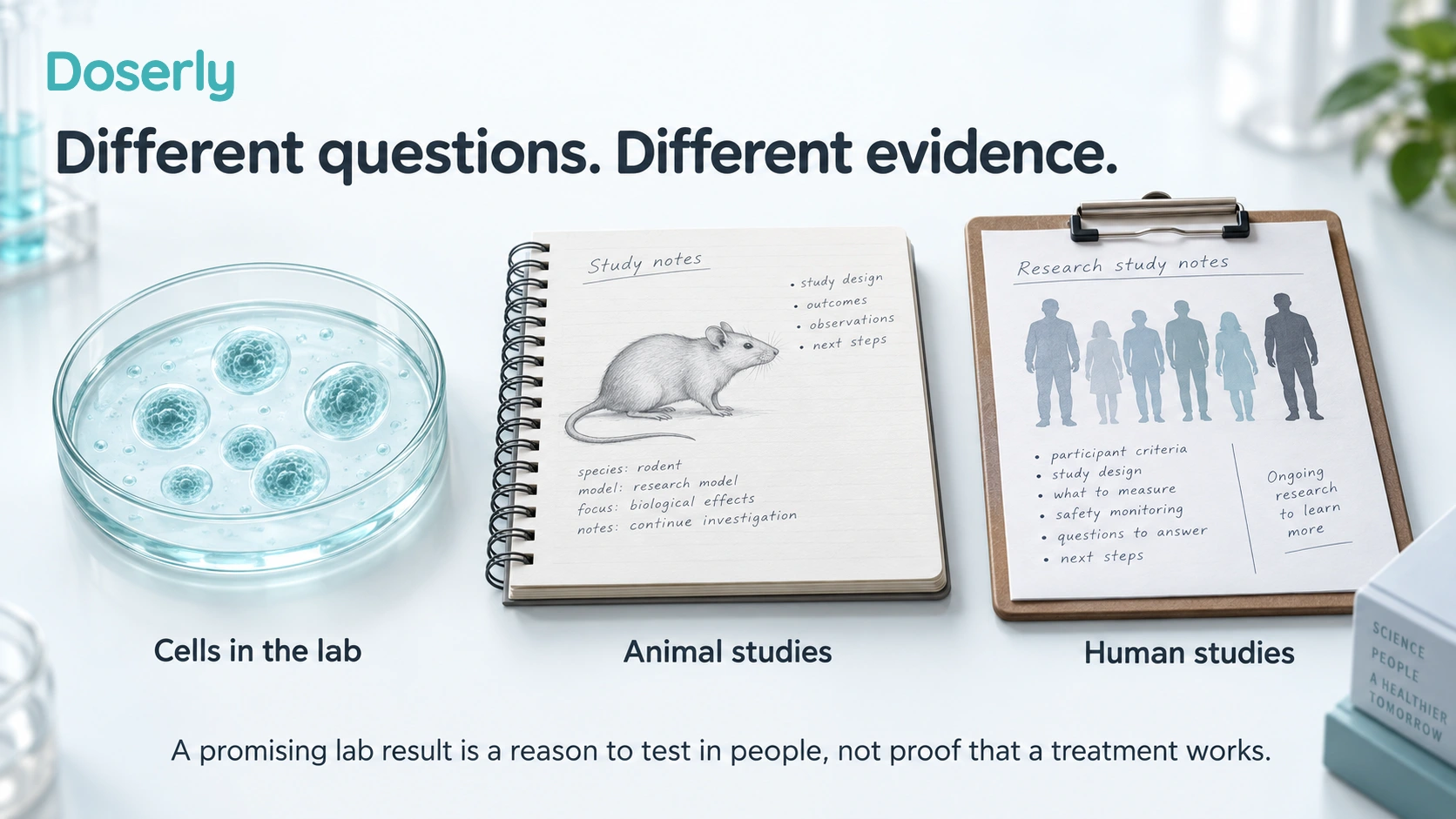
Alpha-GPC supplies a choline-related compound, tyrosine is an amino acid precursor, EPA/DHA are fatty acids, and lion’s mane preparations contain distinct fungal constituents. These biological roles do not establish a shared cognitive benefit. A trial in diagnosed disease, a healthy-adult attention task and an observational safety signal answer different questions. [1][2][3]
What does the research show?
Alpha-GPC: distinguish a safety association from a causal effect
Lee and colleagues studied Korean prescription data in 12,008,977 people aged 50 or older. In the full cohort, alpha-GPC users had an adjusted stroke hazard ratio of 1.46; in the separately matched cohort of 1,190,376 people, the corresponding estimate was 1.43 (95% CI 1.41–1.46). These are relative hazards, not percentage-point increases in an individual’s absolute risk. Matching and statistical adjustment cannot eliminate residual confounding or the reasons people received the prescription. The study is a safety signal, not proof of causation or a trial of retail cognitive stacks. [1]
Fish oil: a large randomized cognition test was negative
VITAL cognitive substudies included 3424 participants assessed by phone and 794 assessed in person, all aged at least 60. The intervention was 1 g/day of the specified marine-oil preparation containing 460 mg EPA and 380 mg DHA, compared with placebo. Over approximately 2.8 and 2.0 years respectively, the pooled difference in annual global cognitive change was −0.01 standard units (95% CI −0.02 to 0.003); it was not statistically significant. This study does not establish cognitive protection in generally healthy older adults, while other populations and longer exposure remain separate questions. [2]
Lion’s mane: one favorable task is not a global cognitive benefit
A 2025 crossover study tested a single 3 g dose of a specified fruiting-body extract in 18 healthy adults aged 18–35, with a seven-day washout and assessment 90 minutes after consumption. Global cognition and mood composites were null. One dominant-hand pegboard result favored the extract, while another task trended in the opposite direction. The small sample and multiple outcomes limit an acute focus claim. This is not evidence for all powders, mycelial products or chronic use. [3]
Which overlaps and risks matter?
Cautions and interactions
A large prescription cohort linked alpha-GPC use with stroke, but it cannot prove causation or define the risk of every retail product. Product formulations, medicines and the cause of cognitive symptoms need separate assessment. The cited studies do not validate the safety of the full combination. [1][2][3]
Regulatory status
In the United States, FDA does not approve dietary supplements for safety and effectiveness before marketing. In Canada, a natural health product requires a product licence before sale; its NPN or DIN-HM must match the finished product. An ingredient name or inclusion in this collection does not establish that every product or claim is authorized. Authorization also does not validate the complete combination. [4], [5]
What should be recorded and how should changes be interpreted?
Doserly brings dose logs, symptoms and routine changes together. For this collection, useful observations include a consistent task or functional goal, sleep, caffeine exposure, product changes and adverse effects.
- Doses and adherence: record the formulation, amount actually taken, timing and missed doses so observations have context.
- Potential benefits and tolerability: compare consistent symptoms or measurements over time alongside sleep, food and activity changes. Personal trends help evaluate the experience without proving causal efficacy.
- Product list: maintain the full product list for review with a pharmacist or clinician.
- AI monthly reports: summarize recorded doses, symptoms and trends to prepare for a discussion. Reports depend on the data entered and are not a diagnosis or an instruction to change treatment.
Explore the topic further
Common questions
Does the alpha-GPC cohort prove that it causes stroke?
No. It identifies an association after adjustment, with residual confounding still possible. The signal deserves consideration without converting it into a personal risk prediction. [1]
Does fish oil prevent cognitive decline in healthy older adults?
The cited VITAL study did not show a benefit over two to three years. Nutritional roles and observational fish-consumption associations do not override that trial result. [2]
Does the lion’s mane study establish same-day focus?
No. Its global outcomes were null; a favorable individual task in a small trial does not establish reliable overall performance. [3]
Can these findings validate the complete combination?
No cited study tested all four members together. Record the exact formulations, symptoms and changes, while keeping persistent or new cognitive symptoms separate from self-experimentation.
Glossary
Terms for interpreting the comparisons.
- Formulation
- The exact preparation, including its ingredients, their forms and labeled amounts.
- Study population
- The people included in a study; their characteristics limit where its result applies.
- Comparator
- The placebo, treatment or condition used as the comparison.
- Measured outcome
- What the study evaluates, such as a symptom, laboratory result or clinical event.
- Overlap
- The same ingredient appearing in more than one product used together.
How was this guide researched?
Sources and limits
This AI-assisted educational guide compares the cited public references. Findings remain tied to the ingredients, preparations and populations studied. It is not a systematic review or independent medical peer review. Doserly develops a commercial tracking app. Illustrations explain concepts; app screens show example data. Report a correction with its source to Doserly support.
Explore the sources
The references below provide context for the claims and their limits.
Showing 5 sources
- 01
Lee et al. — Alpha-GPC and subsequent stroke risk ↗
Primary research
Observational prescription cohort; association does not establish causation.
- 02
Marine n-3 fatty acids and cognitive change among older adults in the VITAL randomized trial. ↗
Primary research
Randomized cognitive substudies; no benefit over two to three years.
- 03
Acute effects of a standardised extract of Hericium erinaceus (Lion's Mane mushroom) on cognition and mood in healthy younger adults: a double-blind randomised placebo-controlled study. ↗
Primary research
Small crossover trial; null composite cognition and mood outcomes.
- 04
FDA — Questions and Answers on Dietary Supplements ↗
Regulatory reference
United States dietary supplement regulation.
- 05
No matching sources
Try a different term or show the full list.