
In this guide
What does this guide compare?
Glucosamine, chondroitin, MSM, undenatured collagen and fish oil do not constitute a proven cartilage-repair formula.
This collection compares products discussed around one topic. It is not a protocol to take in full. Links to individual profiles appear after the article.
| Reference point | Context |
|---|---|
| Products compared | 5 |
| Evidence scope | Ingredient, formulation, population and measured outcome |
| Complete combination | The cited studies do not automatically validate all members together |
Which products are compared?
Glucosamine, Chondroitin Sulfate, MSM (Methylsulfonylmethane), Type II Collagen (UC-II), Fish Oil (EPA/DHA).
Individual profiles describe formulation, source-reported amounts, tolerability and interactions. Those details remain ingredient-specific. An amount studied alone is not automatically appropriate in a combination.
How do their roles differ?
Cartilage constituents, inflammatory mediators and pain perception are different targets. Glucosamine or chondroitin being present in cartilage does not prove that oral supplements rebuild a damaged joint. Undenatured type II collagen differs from hydrolyzed collagen and cannot borrow its dosing or evidence. [1][2][3]
What does the research show?
What did the major formulation-specific trials find?
| Study | Population and exposure | Result and boundary |
|---|---|---|
| GAIT, 2006 | 1583 people with symptomatic knee osteoarthritis; 24 weeks. Glucosamine hydrochloride 500 mg three times daily, chondroitin sulfate 400 mg three times daily, their combination, celecoxib or placebo. | Neither supplement alone nor their combination significantly improved the primary pain response compared with placebo overall. The positive moderate-to-severe-pain subgroup was exploratory. [6] |
| Lugo, 2016 | 191 people with knee osteoarthritis; 180 days. Specified UC-II preparation, 40 mg before bedtime, versus placebo or glucosamine/chondroitin. | Overall WOMAC symptoms improved more with UC-II than placebo. The manufacturer funded the trial and two authors were employees; it does not establish cartilage regeneration or a benefit from this full collection. [7] |
The 40 mg UC-II preparation contained 1.2 mg undenatured type II collagen by the study’s assay. It is not 40 mg pure collagen, and neither amount is interchangeable with grams of hydrolyzed collagen powder. These schedules describe the studies; they are not instructions to combine their arms. [7]
The other members, MSM and fish oil, require their own product- and condition-specific evidence. A knee-osteoarthritis result does not automatically apply to tendon injury, rheumatoid arthritis or routine post-exercise soreness.
NCCIH describes inconsistent glucosamine/chondroitin trial results and differing professional guidelines, with some distinctions between prescription-grade preparations and other products. Curcumin research suggests possible symptom benefits for selected formulations, but trial limitations prevent a universal pain-relief conclusion. Neither ingredient-level result establishes structural repair or benefit from the whole collection. [1][2][3]
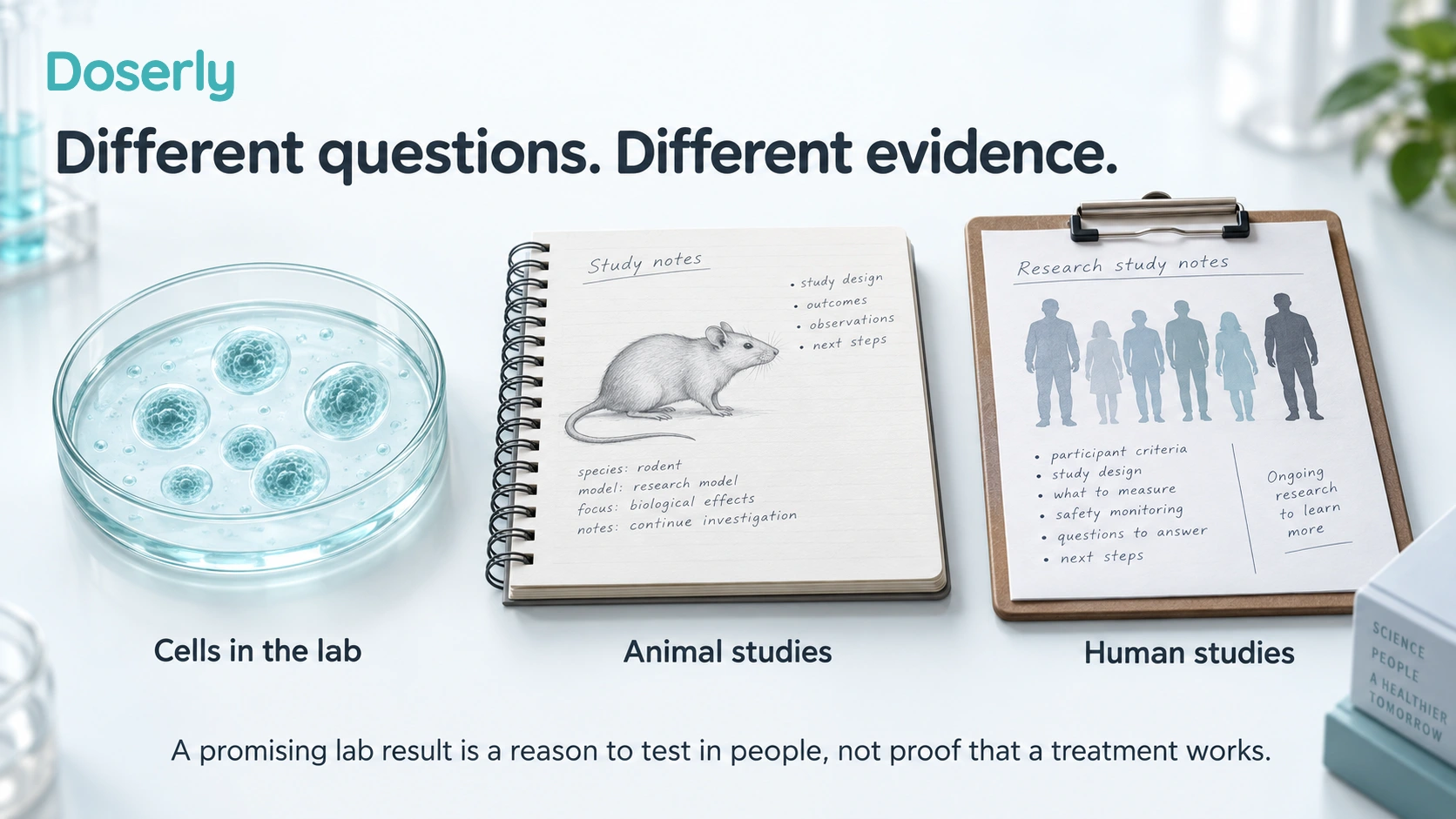
An observational association, a laboratory finding and a perceived benefit answer different questions. Randomized trials need their comparator, duration and population kept in view. An inconclusive result does not establish that an effect is impossible; it limits the claim that can be made.
Which overlaps and risks matter?
Cautions and interactions
Anticoagulants, planned procedures, allergies and digestive tolerability deserve review. Some enhanced-bioavailability turmeric products have been associated with liver injury. Less pain in a diary does not demonstrate cartilage regeneration or exclude an inflammatory joint disease. [1][2][3]
A complete product list includes prescription medicines, nonprescription products and supplements. Combination formulas can conceal duplicate ingredients. Timing and spacing from a medicine should follow its labeling and pharmacist guidance; this collection does not supply a universal timetable.
Regulatory status
In the United States, FDA does not approve dietary supplements for safety and effectiveness before marketing. In Canada, a natural health product requires a product licence before sale; its NPN or DIN-HM must match the finished product. An ingredient name or inclusion in this collection does not establish that every product or claim is authorized. Authorization also does not validate the complete combination. [4], [5]
What should be recorded and how should changes be interpreted?
Doserly brings dose logs, symptoms and routine changes together. For this collection, useful observations include pain during a consistent activity, stiffness duration, mobility, analgesic use and adverse effects.
- Doses and adherence: record the formulation, amount actually taken, timing and missed doses so observations have context.
- Potential benefits and tolerability: compare consistent symptoms or measurements over time alongside sleep, food and activity changes. Personal trends help evaluate the experience without proving causal efficacy.
- Product list: maintain the full product list for review with a pharmacist or clinician.
- AI monthly reports: summarize recorded doses, symptoms and trends to prepare for a discussion. Reports depend on the data entered and are not a diagnosis or an instruction to change treatment.
Explore the topic further
Common questions
Did GAIT show that everyone with knee osteoarthritis benefits from glucosamine and chondroitin?
No. The overall primary pain result was negative; a favorable subgroup was exploratory and does not override the full trial. [6]
Is undenatured type II collagen the same as a collagen-peptide powder?
No. UC-II is a specified preparation with a small amount of undenatured type II collagen. Its study cannot be converted into grams of hydrolyzed collagen or a claim of cartilage regrowth. [7]
Does less pain demonstrate structural repair?
No. Symptom scores and joint structure are different outcomes. The cited studies do not establish that this complete stack regenerates cartilage. [6][7]
Glossary
Terms for interpreting the comparisons.
- Formulation
- The exact preparation, including its ingredients, their forms and labeled amounts.
- Study population
- The people included in a study; their characteristics limit where its result applies.
- Comparator
- The placebo, treatment or condition used as the comparison.
- Measured outcome
- What the study evaluates, such as a symptom, laboratory result or clinical event.
- Overlap
- The same ingredient appearing in more than one product used together.
How was this guide researched?
Sources and limits
This AI-assisted educational guide compares the cited public references. Findings remain tied to the ingredients, preparations and populations studied. It is not a systematic review or independent medical peer review. Doserly develops a commercial tracking app. Illustrations explain concepts; app screens show example data. Report a correction with its source to Doserly support.
Explore the sources
The references below provide context for the claims and their limits.
Showing 7 sources
- 01
NCCIH — Glucosamine and chondroitin for osteoarthritis ↗
Public reference
Check the reported population, preparation and limitations.
- 02
- 03
NIH ODS — Omega-3 fatty acids ↗
Public reference
Check the reported population, preparation and limitations.
- 04
FDA — Questions and Answers on Dietary Supplements ↗
Regulatory reference
United States dietary supplement regulation.
- 05
- 06
GAIT — Glucosamine, chondroitin sulfate and their combination for knee osteoarthritis ↗
Randomized trial
1583 participants, 24 weeks; overall primary outcome negative for supplements; exploratory pain subgroup does not override that result.
- 07
Undenatured type II collagen for knee osteoarthritis symptoms ↗
Randomized trial
191 randomized, 180 days; specified 40 mg UC-II preparation, sponsor-funded; symptom measures, not proof of cartilage regrowth.
No matching sources
Try a different term or show the full list.