
In this guide
What is the difference between turmeric and curcumin?
Turmeric is the dried or fresh underground stem, or rhizome, of Curcuma longa, a plant in the ginger family. Curcumin is a yellow polyphenol and one of several curcuminoids that can be concentrated from the rhizome.
Those terms describe different exposures. Culinary turmeric contains a mixture of starches, oils and many plant compounds with a relatively small curcuminoid fraction. A “95% curcuminoids” extract is much more concentrated. A phospholipid, micellar, nanoparticle or piperine-enhanced product changes absorption again. Results from one cannot be assigned to all the others.
The practical question is therefore not only “how many milligrams?” It is “milligrams of what preparation, standardized to what, with which enhancer, taken how often, and studied for which outcome?”
Typical Turmeric and Curcumin Protocols
| Source and population | Formulation | Amount each time | Frequency | Duration | Question tested |
|---|---|---|---|---|---|
| Wang 2020 · 70 people with knee osteoarthritis and effusion-synovitis | Curcuma longa extract, 500 mg capsules | 500 mg | Two capsules per day; accessible registry does not state whether together or divided | 12 weeks | Pain plus MRI effusion-synovitis and cartilage composition |
| Kuptniratsaikul 2014 · 367 people with knee osteoarthritis | Curcuma domestica extract | 500 mg | Three times daily | 4 weeks | Noninferiority versus ibuprofen 1,200 mg/day This active-comparator trial had no placebo group. |
| Nakagawa 2014 · 50 people with knee osteoarthritis | Highly bioavailable curcumin (Theracurmin) | 90 mg curcumin | Twice daily | 8 weeks | Knee symptoms and NSAID use |
| Shoba 1998 · 8 healthy volunteers | Curcumin with or without piperine | 2,000 mg curcumin; comparison adds 20 mg piperine | One administration | Hours of blood sampling | Pharmacokinetics, not pain or clinical benefit This single-dose experiment does not establish a routine schedule. |
There is no RDA, AI, UL or established general treatment dose for turmeric or curcumin. Even the 180 mg and 1,500 mg daily rows cannot be ranked by milligrams because one is an enhanced curcumin formulation and the other is a different turmeric extract.
- Titration
- The selected trials assigned fixed formulations and amounts. They do not establish a step-up method.
- Breaks and cycles
- The selected trials ran continuously for 4, 8 or 12 weeks. They did not test planned days off or repeat cycles.
What are turmeric and curcumin commonly used for?
People most often use supplements for joint pain or a broad goal of reducing “inflammation.” Products also promote digestion, antioxidants, liver support, mood and metabolic health. These claims do not all have the same evidence, and a change in a blood marker does not establish a meaningful improvement in health.
NCCIH concludes that there is not enough evidence to make definitive claims for any health purpose, while noting an early positive signal for knee osteoarthritis. That wording fits the trial record: some pain measures improve, but formulations vary and structural joint outcomes have not followed the same pattern. [1], [4]
In Canada, the turmeric monograph permits specified traditional or herbal claims under defined product conditions. A permitted label claim is a regulatory category, not proof that every turmeric product works for every user. [2]
Which form and label details matter?
Keep these categories separate:
- Turmeric food or powder: the whole dried rhizome mixture; milligrams are not milligrams of curcumin.
- Turmeric extract: a concentrated preparation that should state the extraction ratio and/or curcuminoid yield.
- Curcuminoid extract: often standardized to a percentage of total curcuminoids; “curcumin” may be used loosely in marketing.
- Enhanced formulation: phospholipid, micellar, nanoparticle, lipid or another delivery system; the named technology is part of the studied product.
- Piperine combination: includes black pepper extract to change absorption and potentially the handling of medicines.
Do not compare proprietary “times more bioavailable” numbers as a league table. Studies use different doses, assays, measured metabolites and reference products. A larger concentration-time curve is not automatically a larger clinical benefit.
What does the human evidence show?
The strongest practical signal is short-term knee-pain relief with selected extracts. The evidence does not establish cartilage repair, reversal of arthritis or a general anti-inflammatory effect throughout the body.
Placebo-controlled knee trial
The 2020 Australian trial randomized 70 people with symptomatic knee osteoarthritis and imaging-confirmed effusion-synovitis to 1,000 mg/day of Curcuma longa extract or placebo for 12 weeks. Pain on a 100 mm visual scale favored the extract by 9.1 mm. MRI showed no benefit for effusion-synovitis volume, and cartilage composition did not change. Adverse events occurred in 14 of 36 extract participants and 18 of 34 placebo participants. The study was co-funded by the university and product manufacturer. [4]
This is an important boundary: pain improved modestly, while the structural and inflammatory imaging outcomes did not. It cannot support a claim that the extract repaired cartilage or treated the underlying synovitis.
Active-comparator trial
In 367 people with knee osteoarthritis, 500 mg of Curcuma domestica extract three times daily for four weeks met the investigators’ noninferiority tests against ibuprofen 1,200 mg/day for WOMAC total, pain and function; stiffness narrowly missed the threshold. Overall adverse-event counts were similar, while abdominal pain or discomfort was more frequent with ibuprofen. [5]
Noninferiority is not the same as proving identical effects, and the trial had no placebo. It does not justify replacing prescribed pain care without a clinician review.
Enhanced curcumin trial
A small eight-week placebo-controlled trial used 90 mg of a highly bioavailable curcumin formulation twice daily in 50 people with knee osteoarthritis. Some symptom measures and NSAID use favored curcumin. Its result belongs to that delivery system and does not validate the same milligram amount of ordinary turmeric powder. [8]
Absorption and piperine
In an older experiment with eight healthy volunteers, adding 20 mg piperine to a single 2 g curcumin dose increased measured blood exposure. The often-quoted “2,000%” is a relative pharmacokinetic result from this tiny, single-dose study. It does not show that piperine improves knee pain, determines an everyday dose or is safe with a person’s medicines. [6]
How might curcumin work?
Curcumin interacts with many molecular targets in cell and animal experiments, including inflammatory signaling and oxidative pathways. Broad target lists do not show which pathway matters after a specific oral product in people. Poor absorption and rapid metabolism also mean that a laboratory concentration may not occur with an ordinary oral dose.
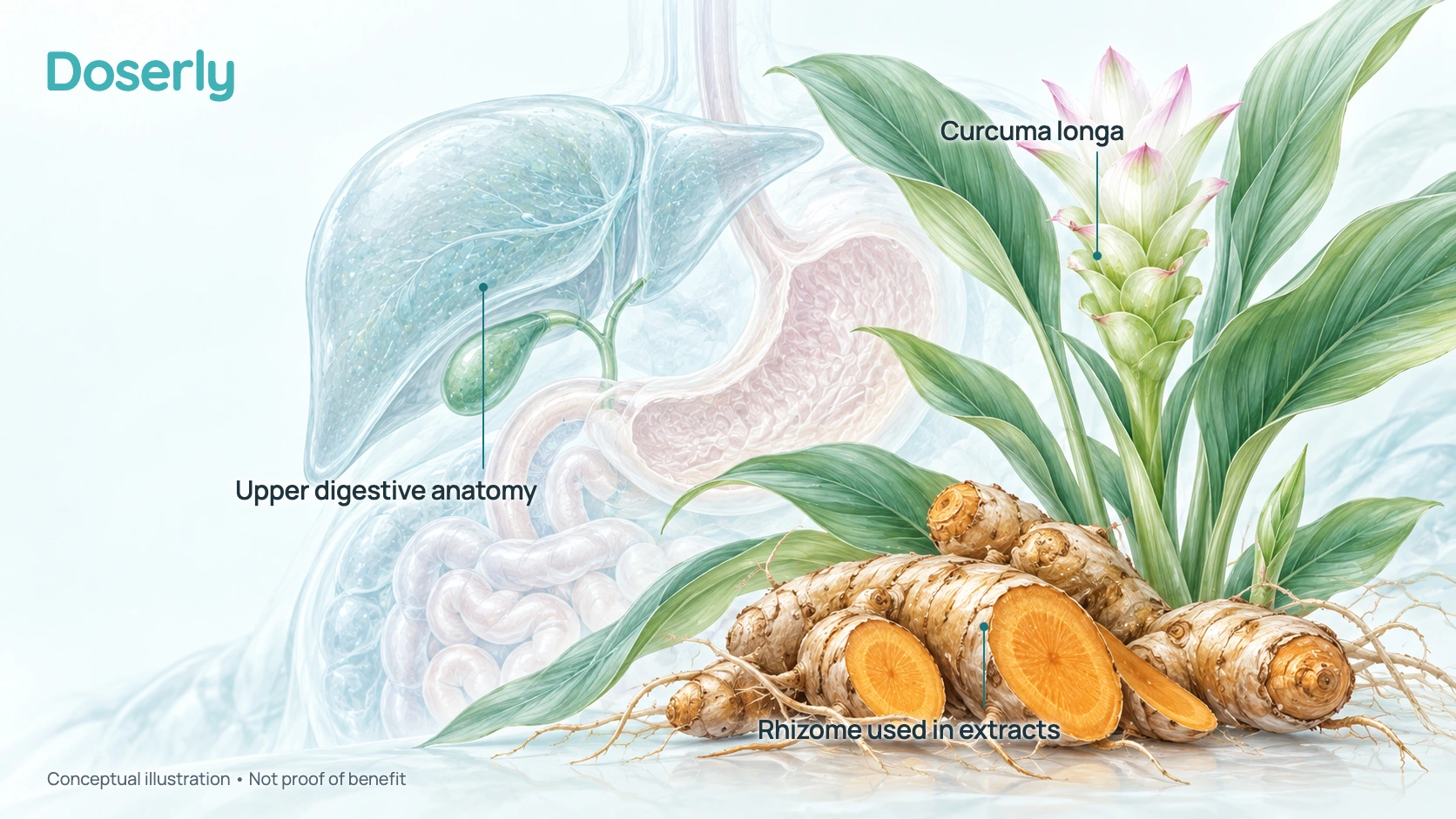
The most defensible explanation is therefore formulation-specific: the plant source determines what enters the product, the delivery system affects exposure, and a human trial is still needed to show a meaningful outcome.
What are the risks and interactions?
Common oral effects include nausea, reflux, stomach upset, diarrhea or constipation. Pregnancy use of supplemental amounts may be unsafe, and safety above food amounts while breastfeeding is unclear. People with liver or biliary disorders should consult a clinician before use. Health Canada also says people taking medicines should obtain professional advice. [1], [2], [3]
Liver injury
Health Canada’s 2025 review found a possible link between oral turmeric or curcuminoid natural health products and rare hepatotoxicity. The agency required warnings for jaundice, dark urine, nausea, vomiting and stomach pain, plus advice to stop and consult if these occur. It described the apparent risk as unpredictable and not clearly dose- or duration-dependent. [3]
The US Drug-Induced Liver Injury Network described ten high-confidence cases. Nine were hepatocellular and one mixed; five people were hospitalized and one died of acute liver failure. Median time to laboratory onset was 86 days, with a 38–429-day range. Seven available products contained turmeric on analysis and three also contained piperine. Seven of ten patients carried HLA-B*35:01, an association that may indicate susceptibility but is not a consumer screening test. [7]
Gallbladder and medicines
Turmeric has traditional choleretic and cholagogue uses, meaning it may increase bile flow or gallbladder contraction. That is why a biliary disorder is a caution, not a reason to self-treat gallstones. [2]
Piperine is intended to alter absorption and metabolism. A piperine-containing product deserves a medication review rather than the assumption that “black pepper is just food.” Evidence for specific interactions varies by medicine; the safe step is to bring the full label to a pharmacist or prescriber.
Legal status in the United States and Canada
In the United States, turmeric and curcumin capsules are generally sold as dietary supplements. The FDA does not approve them for effectiveness before sale, and they cannot legally be marketed as treatments for arthritis, liver disease or another disease.
In Canada, turmeric products sold as natural health products require a product licence and NPN. Health Canada updated the turmeric monograph in September 2025 with liver, biliary and medication warnings. Authorized conditions remain product-specific. [2], [3]
What should you monitor, and when should you stop?
Record the complete product name, extract amount, declared curcuminoids, delivery system, piperine amount and every medicine or supplement used at the same time. For joint symptoms, choose a concrete outcome such as pain during stairs, walking tolerance or rescue-medication use, rather than a vague “inflammation” score.
Stop and seek prompt medical advice for yellow skin or eyes, dark urine, persistent nausea or vomiting, unusual fatigue, loss of appetite, itching or upper abdominal pain. Severe allergy, black stools, vomiting blood or intense abdominal pain requires urgent assessment.
What happens when you stop?
The selected trials do not establish withdrawal or a taper. They also provide little follow-up after the 4–12-week treatment period, so they do not show how long pain changes last. Stopping a supplement is different from stopping an NSAID, anticoagulant or other prescribed medicine; do not change the latter without the prescriber.
How should it be stored?
Follow the product label and keep the original container closed, dry and protected from excessive heat and light. Keep it away from children. Fresh turmeric rhizome is food and has different storage needs from a capsule; a general shelf-life claim cannot be transferred between them.
How do turmeric and curcumin compare with other options?
Exercise, strength work, weight management when relevant, topical NSAIDs, oral pain medicines and injections answer different knee-osteoarthritis questions. The curcumin trials do not show cartilage repair or justify delaying assessment of a hot, swollen, injured or unstable joint.
The ibuprofen comparison suggests one extract may provide similar short-term symptom change under that trial’s noninferiority design. It does not make curcumin a risk-free NSAID replacement. Turmeric can cause GI symptoms and rare liver injury; NSAIDs have their own GI, kidney and cardiovascular risks. The right comparison depends on the person, diagnosis and medicines. [5], [7]
What do public communities add?
Public discussions often focus on whether a product “worked,” how quickly, and whether piperine caused stomach upset. They rarely verify the extract, curcuminoid amount or other treatments, and people with no effect may be less likely to post. This guide does not turn those posts into effectiveness percentages, consensus doses or a recommendation. Anecdotes can suggest useful tracking questions; they cannot establish benefit, interaction safety or incidence of liver injury.
Common questions
Are turmeric and curcumin the same thing?
No. Turmeric is the whole rhizome preparation; curcumin is one constituent within its curcuminoid fraction. Extracts and delivery systems can produce very different exposures.
Does black pepper make curcumin 20 times better?
It increased blood exposure in a single-dose study of eight volunteers, often summarized as a 20-fold or 2,000% relative change. The study did not test clinical benefit and cannot establish long-term safety or medicine compatibility. [6]
Is 1,000 mg a standard dose?
No. One placebo trial used 1,000 mg/day of a specific Curcuma longa extract, another active-comparator trial used 1,500 mg/day of another extract, and an enhanced-curcumin trial used 180 mg/day. The preparation belongs with the number. [4], [5], [8]
Can curcumin rebuild cartilage?
The 12-week MRI trial did not improve cartilage composition or effusion-synovitis, even though pain improved modestly. That result does not support a cartilage-repair claim. [4]
Is turmeric good for the liver?
Some labels and traditional monographs include liver-related claims, but oral turmeric and curcuminoid supplements also have a possible link to rare serious liver injury. Do not self-treat liver disease with them. [2], [3], [7]
Should people with gallstones avoid it?
Health Canada advises professional review for a liver or biliary disorder. Because turmeric can affect bile flow and gallbladder contraction, a person with gallstones, bile-duct disease or prior biliary symptoms should discuss the product before use. [2]
Is turmeric in food associated with the same risk?
Safety alerts concern oral medicinal or supplement products, especially concentrated or enhanced formulations. Culinary exposure is different, but food use does not prove that a high-concentration capsule is safe for a particular person. [1], [3]
Glossary
Terms used in this guide.
- Rhizome
- An underground plant stem. Turmeric preparations are made from the Curcuma longa rhizome.
- Curcuminoids
- A family of yellow polyphenols in turmeric that includes curcumin, demethoxycurcumin and bisdemethoxycurcumin.
- Bioavailability
- How much of an administered substance reaches systemic circulation in the measured form.
- Piperine
- A black-pepper constituent added to some products to increase exposure; it can also affect the handling of medicines.
- Noninferiority trial
- A study designed to test whether a new intervention is not worse than an active comparator by more than a preset margin.
- Titration
- Changing an amount in planned steps. The selected turmeric trials used fixed assigned amounts.
- Hepatocellular liver injury
- A pattern of liver injury in which liver-cell enzyme elevations predominate.
How this guide was researched
This draft uses current NCCIH and Health Canada material plus primary human trials and the DILIN liver-injury series. Searches covered Curcuma longa, turmeric, curcumin, curcuminoids, osteoarthritis, piperine, pharmacokinetics, gallbladder, liver injury, dose and formulation. Numeric schedules remain attached to their exact extract, enhancer, population and outcome.
Corrections to the earlier manuscript include removing cross-study bioavailability rankings, generic 500–2,000 mg dose advice, “piperine cofactor” language, cartilage-repair implications, invented community scores, unsourced stacking claims and universal medicine or iron-spacing rules. Evidence was refreshed on October 9, 2026.
How this guide was made
The source ledger records access level, population, exact preparation, amount, frequency, duration, comparator, outcomes, adverse events, limitations and funding where available. Trial results support only their matching formulations. Official sources set the safety and regulatory frame. Scientific, French-parity, visual and rendered-page review remain separate gates while status is draft.
Research method, access and remaining gaps
Primary records were checked through PubMed, accessible full text and the prospective trial registry. The piperine numbers were verified at abstract level, and the Wang schedule was cross-checked against ANZCTR. Health Canada supplied the September 2025 monograph and safety-review wording.
Remaining gaps include long-term comparative trials, head-to-head delivery-system studies using the same assay and outcome, incidence estimates for liver injury, and clear interaction data for individual medicines. No private community identity or anecdotal effectiveness score was used.
Sources
Search the official sources, trials and safety report behind the material claims in this guide.
Showing 8 sources
- 01
Turmeric: Usefulness and Safety ↗
Official summary
Evidence limits, common adverse effects, pregnancy and liver warnings.
- 02
Turmeric – Curcuma longa oral monograph ↗
Regulatory monograph
Authorized conditions plus liver, biliary and medicine cautions.
- 03
Summary Safety Review: turmeric, curcuminoids and hepatotoxicity ↗
Safety review
Possible link to rare liver injury and required label updates.
- 04
Effectiveness of Curcuma longa Extract for the Treatment of Symptoms and Effusion-Synovitis of Knee Osteoarthritis : A Randomized Trial. ↗
Randomized trial
1,000 mg/day for 12 weeks; pain improved modestly, MRI outcomes did not.
- 05
Efficacy and safety of Curcuma domestica extracts compared with ibuprofen in patients with knee osteoarthritis: a multicenter study. ↗
Randomized active-comparator trial
500 mg three times daily for four weeks; no placebo.
- 06
Influence of piperine on the pharmacokinetics of curcumin in animals and human volunteers. ↗
Pharmacokinetic study
Single 2 g curcumin dose with or without 20 mg piperine in eight volunteers.
Abstract-level verification; not an efficacy trial.
- 07
Liver Injury Associated with Turmeric-A Growing Problem: Ten Cases from the Drug-Induced Liver Injury Network [DILIN]. ↗
Prospective registry case series
Ten high-confidence cases; five hospitalized and one death.
- 08
Short-term effects of highly-bioavailable curcumin for treating knee osteoarthritis: a randomized, double-blind, placebo-controlled prospective study. ↗
Randomized trial
90 mg curcumin twice daily for eight weeks; formulation-specific result.
No matching sources
Try a different term or show the full list.