
In this guide
What is Bijuva?
Bijuva is a regulated US oral capsule combining estradiol and progesterone for moderate-to-severe menopausal hot flashes in a woman with a uterus. These hormones match the molecular forms of human estradiol and progesterone, often described as bioidentical. A regulated bioidentical combination is different from an individually compounded cream or capsule. Its own manufacturing, dose and clinical evidence matter. [1], [2], [5]
The progesterone is taken continuously within the fixed capsule to oppose estrogen’s stimulation of the uterine lining. This is not estrogen-only treatment, a contraceptive or a sequential prescription with a separate monthly progesterone course. The product also does not have an unrestricted approval for every symptom attributed to menopause, such as fatigue, libido changes or all causes of insomnia. [1], [2]
FDA approved revised Bijuva labeling among the first six products announced on February 12, 2026. The current full DailyMed label retrieved is revised April 2026 and is the main product source here. Label changes do not remove contraindications or make every bioidentical regimen risk-free. This guide verifies the selected US product; overseas brands and local stock require their own check. [1], [2], [4]
What does the current US label actually instruct?
| Product / country | Population / indication | Route | Amount | Schedule | Context | Source |
|---|---|---|---|---|---|---|
| Bijuva · US | Moderate/severe menopausal VMS with uterus | Oral fixed capsule | Generally start estradiol 0.5 mg + progesterone 100 mg | One capsule each evening with food, continuously | Progesterone included daily; clinical-response adjustment | Current label [1]; FDA [2] |
| Bijuva · US | Same named menopausal indication; response-guided strength decision | Oral fixed capsule | Estradiol 1 mg + progesterone 100 mg | One capsule each evening with food, continuously | Different estrogen amount; no extra cyclic course presumed | Current label [1]; FDA [2] |
Generally start with the 0.5 mg estradiol/100 mg progesterone capsule and adjust according to clinical response. Both capsule strengths contain 100 mg progesterone; the higher estrogen strength is not a direction to add arbitrary external estrogen while assuming the same protection remains adequate. Reassess the complete regimen, correct use and symptoms with the prescriber. [1], [2]
Take one capsule each evening with food. Food affects exposure to the progesterone component, so this instruction is part of the named regimen rather than optional lifestyle advice. Do not copy a separate progesterone capsule’s fasting instruction to Bijuva or transfer Bijuva’s food instruction to every progesterone brand. [1], [2]
The current label says to consider initiation in women younger than 60 or less than 10 years from menopause onset. This timing consideration is not a guarantee of eligibility or a rule that every person older than 60 must stop. It sits alongside contraindications and individualized benefit-risk review. The label also describes attempts to taper or discontinue at three-to-six-month intervals; general guidance on continued need remains a separate shared decision. [1], [2], [3]
Doserly
ORIGINAL EXPLANATORY DIAGRAM
One evening capsule, with food
Current US Bijuva instructions; both named amounts form one fixed regimen.
Usual initiation
Estradiol 0.5 mg + progesterone 100 mg, one evening capsule with food.
Response adjustment
Estradiol 1 mg + progesterone 100 mg is the other named strength; progesterone amount stays the same.
Missed capsule
Take promptly with food unless within 2 hours of the next evening dose. Do not double.
Evidence note: complete current US repository label and final FDA revised label. No compounded, vaginal, contraceptive or non-US schedule is inferred.
Verification scope
Named full labels and stated jurisdiction, checked October 2, 2026. Revisions are distinct from access dates. Local stock and reimbursement were not verified.
Which treatment goals have direct evidence?
The approved goal is reducing moderate-to-severe vasomotor symptoms. A person whose sleep improves because night sweats ease has a meaningful outcome, but it is different from proving that the medicine treats every cause of insomnia, anxiety or brain fog. Track the symptom the prescription intends to treat and separate it from unwanted effects. [1], [2], [3]
Vaginal symptoms can persist despite systemic treatment and may need their own local assessment and therapy. A favorable review about sexual comfort does not create a separate Bijuva vaginal-treatment indication. Likewise, bone-health decisions are not answered by assuming this capsule inherits every estradiol product’s osteoporosis indication. Check the actual authorized use. [1], [2], [3]
Bioidentical describes molecular identity, not certainty about long-term safety. It is reasonable to prefer a regulated product over an unverified custom mixture, but a natural-sounding label does not promise weight loss, anti-aging effects or prevention of heart disease or dementia. [1], [2], [5]
How should missed doses and daily use be handled?
The label says take a missed evening dose as soon as possible with food unless it is within two hours of the next evening dose. Keep this exact threshold instead of borrowing a contraceptive catch-up rule or another estrogen capsule’s interval. Record a missed capsule as a missed complete combination, not only missed estrogen. [1], [2]
Keep the prescribed route and capsule intact as directed. Changing to a vaginal progesterone schedule or opening a capsule for a custom topical mixture is not the tested Bijuva regimen. If you are unusually tired, dizzy or uncomfortable after taking it, discuss tolerability and the plan instead of treating every unwanted effect as proof of benefit. [1], [2], [7]
When moving from another hormone regimen, the prescriber should specify the transition and whether contraception or local treatment is still needed. A fixed-capsule prescription should not be combined with another systemic estrogen merely because the hormone names are familiar. [1], [2], [3]
What do the symptom and endometrial trials show?
The label describes a 12-week randomized placebo-controlled vasomotor substudy within a 52-week safety study. Both approved strengths reduced hot-flash frequency and severity versus placebo at the studied four- and 12-week assessments. These are group symptom outcomes, not a guaranteed day of response or proof of superiority over a patch. [1], [2]
Endometrial safety was assessed with baseline and post-baseline biopsies. After up to 12 months, hyperplasia occurred in one of 303 women in the 0.5 mg/100 mg group and one of 281 in the 1 mg/100 mg group, versus none of 92 receiving placebo. The label reports no endometrial cancers in those groups during that trial. These findings support the tested regimen; small counts and limited follow-up do not establish lifetime zero risk. Hyperplasia is also a different outcome from disordered proliferative endometrium or ordinary spotting. [1], [2]
Doserly
ORIGINAL EXPLANATORY DIAGRAM
Read the endometrial finding with its denominator
Up to 12 months in the labeled Endometrial Safety Population; hyperplasia is not cancer.
0.5 mg / 100 mg
1 hyperplasia case among 303 participants with the specified biopsy data.
1 mg / 100 mg
1 hyperplasia case among 281 participants with the specified biopsy data.
Placebo and limits
0 hyperplasia cases among 92 placebo participants. No endometrial cancer in these groups; no lifetime guarantee.
WHI safety discussion in the label concerns CEE with medroxyprogesterone acetate, not direct Bijuva-versus-patch testing. The FDA label revision does not transform that evidence into a comparative superiority claim. NICE’s current table also does not support guaranteeing that micronized progesterone removes the breast risk of every combined regimen. [1], [2], [6]
Which contraindications and warning signs remain?
The current label contraindicates unexplained genital bleeding, breast or estrogen-dependent cancer, current or past venous clots or arterial thromboembolic disease, relevant thrombophilic disorders, liver impairment/disease and serious hypersensitivity. Removing older boxed language did not remove this eligibility assessment. A regulated bioidentical molecule can still have systemic adverse effects. [1], [2], [4]
Breast tenderness, headache, nausea, vaginal bleeding or discharge and pelvic discomfort can occur. New breast changes, persistent bleeding or worsening headaches need review. Sudden chest pain, breathlessness, a painful swollen leg, weakness, speech or visual difficulty requires urgent assessment. Discuss planned surgery and immobilization with the clinical team instead of assuming continuous use is always appropriate. [1], [2]
CYP3A4-inducing or inhibiting medicines and relevant herbal products can alter exposure to one or both hormones. Estrogen can affect thyroid-binding proteins, which matters during thyroid replacement. Review all medicines and liver history; a routine laboratory panel for every user is a different question from monitoring a specific risk or interaction. [1], [2]
What should the follow-up review assess?
Check whether the intended symptoms improved, the exact capsule strength, evening food use, missed capsules and adverse effects. NICE recommends review at three months and annually thereafter, sooner when difficulties arise. The product’s three-to-six-month taper/discontinuation language is a reassessment instruction, not evidence that symptoms must disappear by then or that every long-term user is ineligible. [1], [2], [3]
Bleeding is a separate outcome from hot-flash relief. Persistent unscheduled systemic-HRT bleeding beyond six months after starting or three months after changing treatment warrants prompt assessment under NICE, earlier if heavy or concerning. Do not use the trial’s low hyperplasia count as permission to ignore a new symptom. An ultrasound or serum hormone result cannot replace appropriate assessment. [1], [2], [3]
The label states that serum estrogen concentrations do not generally predict personal therapeutic response or adverse outcomes, and progesterone concentrations do not predict protection. Follow the complete tested regimen and evaluate symptoms and clinical context rather than chase universal estrogen/progesterone blood targets. [1], [2]
How should stopping or a new regimen be planned?
NICE allows gradual reduction or immediate cessation of MHT. Bijuva changes both components together; do not assume opening capsules, separating their contents or borrowing another product’s schedule preserves the studied exposure. Symptoms may recur, and local vaginal therapy may still be useful. [1], [2], [3]
A switch should define the new estrogen product and route, uterine-protection medicine and calendar, transition and review plan. If systemic estrogen continues, do not independently drop the protection component. A compounded preparation is not simply the same capsule with a custom ratio, and a contraceptive plan remains separate where needed. Serious suspected adverse effects require prompt assessment. [1], [2], [3], [5]
How is the checked capsule stored?
The US Bijuva label specifies 20–25°C, with excursions permitted to 15–30°C. Keep the supplied container and expiry information, out of children’s reach, and ask a pharmacist about heat, moisture, damage or uncertain medicine. An allowed excursion is not ideal ongoing storage. The conditions and usable period of a pharmacy-compounded capsule cannot be borrowed from this regulated product. [1], [2], [5]
How does Bijuva compare with separate products or compounds?
A fixed capsule can simplify continuous use and keeps the studied components together. It offers fewer independent adjustment options than separate estrogen and progesterone and fixes the estrogen route as oral. A separate regimen may allow transdermal estradiol or a sequential progesterone plan under its own evidence; it is not a milligram-for-milligram recreation of Bijuva. [1], [2], [3]
Both molecularly bioidentical hormones can be available in regulated medicines without custom compounding. ACOG advises against routinely using compounded bioidentical MHT when approved products are available. Saliva-based customization and natural-sounding branding do not establish a safety advantage or reliable uterine protection. Compare the complete route, dose, calendar, risk and practicality with the clinician. [1], [2], [5], [6]
What do the freshly checked public reviews describe?
The retrieved Bijuva page includes hot-flash and perceived sleep or comfort improvement, partial or changing benefit, tiredness or irritability, bloating, spotting and decisions to stop or restart. Some entries use perimenopause labels or describe other treatment goals. Those accounts do not expand the approved population or establish that Bijuva treats every symptom mentioned. [7]
We omit names, ratings, amounts and individual timelines. Accounts about returning symptoms can inform a review question but cannot predict your response or justify unassessed bleeding. A reported serious event is not an incidence estimate; new palpitations, severe symptoms or other concerning changes belong in clinical assessment rather than reassurance from a favorable review. [1], [2], [7]
Common questions about Bijuva
Is the current usual starting capsule 1 mg/100 mg?
The checked current US label generally starts at 0.5 mg estradiol/100 mg progesterone, with response-guided adjustment. [1], [2] The other listed strength remains a possible response-guided adjustment under the complete label, not the default for everyone. Both component amounts must stay attached to the capsule and indication. A historical leaflet can describe a different available presentation. Confirm the actual supplied product. See the current named protocol. [1], [2]
Should it be taken with food?
Yes. One capsule each evening with food is the product instruction; food affects progesterone exposure. [1], [2] This is an instruction for the combined capsule, not a general rule for every separate progesterone or estrogen preparation. Keep the evening routine and actual capsule together when recording use. If taking it with food is difficult, discuss a suitable plan rather than silently change the conditions. See daily administration. [1], [2]
What is the missed-dose threshold?
Take the missed dose with food as soon as possible unless it is within two hours of the next evening dose. [1], [2] The food instruction and next-evening timing belong together. Do not borrow a different combined tablet’s missed-dose interval or take an extra capsule to create your own catch-up plan. Ask the pharmacist about an uncertain omission and keep the prescribed routine visible. See the product-specific missed-dose guidance. [1], [2]
Does bioidentical mean no breast or clot risk?
No. Molecular identity does not remove contraindications, systemic precautions or combined-regimen risk. [1], [2], [6] The label concerns the finished combined medicine, with its indication, exclusions and studied exposure. A chemically familiar hormone can still act systemically and stimulate hormone-sensitive tissues. The NICE comparison also preserves uncertainty rather than guaranteeing one progestogen eliminates breast risk. See risks and contraindications. [1], [2], [6] Discuss the complete regimen and history.
Can I add another estrogen and assume the capsule protects me?
Protection evidence belongs to the complete tested capsule. Added systemic estrogen needs its own assessment. [1], [2], [3] A fixed capsule changes both components together, and an additional product creates a different complete regimen. Ask about persistent symptoms, adherence and suitable alternatives before modifying it. Do not use a progesterone blood result as proof that any extra estrogen has adequate opposition. See the evidence boundaries. [1], [2], [3]
Did the endometrial trial prove zero lifetime cancer risk?
No. It assessed selected biopsy populations over up to 12 months; limited follow-up cannot establish lifetime safety. [1], [2] The study population, biopsies and duration are part of the result. Absence of a particular outcome during follow-up cannot show that risk remains absent with longer use or an altered regimen. New bleeding still deserves assessment under the clinical pathway. See the endometrial study details. [1], [2]
Is it contraception?
Its verified indication is menopausal vasomotor treatment, not pregnancy prevention. [1], [2], [3] The progesterone component’s uterine role does not establish contraceptive efficacy for the capsule. If pregnancy is possible, bring the current method and preferences to the clinician and discuss a separate suitable plan. Changed bleeding is not proof that ovarian activity has ended. See the verified indication. [1], [2], [3] The contraceptive decision remains separate.
Did the 2026 label changes erase every warning?
No. The revised labels retain risks and contraindications and need individualized review. [1], [2], [4] Regulatory removal of boxed wording and individual clinical eligibility are separate facts. The current label still identifies situations where the product should not be used, precautions and review needs. Check the complete revision rather than use a class headline as a guarantee. See risk and label context. [1], [2], [4] Individual assessment remains necessary.
Glossary
Definitions for interpreting the product, calendar and limitations.
- Estrogen
- A hormone class that includes estradiol, estrone and estriol.
- MHT / HRT
- Menopausal hormone therapy; hormone replacement therapy is a broader term.
- Vasomotor symptoms
- Menopausal hot flashes and night sweats.
- GSM
- Genitourinary syndrome of menopause: symptoms and tissue changes involving genital and urinary areas.
- Systemic treatment
- Medicine delivered through the circulation to act throughout the body.
- Local treatment
- Treatment directed mainly at the tissue where it is applied; some absorption can still occur.
- First-pass metabolism
- Initial liver processing after a swallowed medicine is absorbed from the gut.
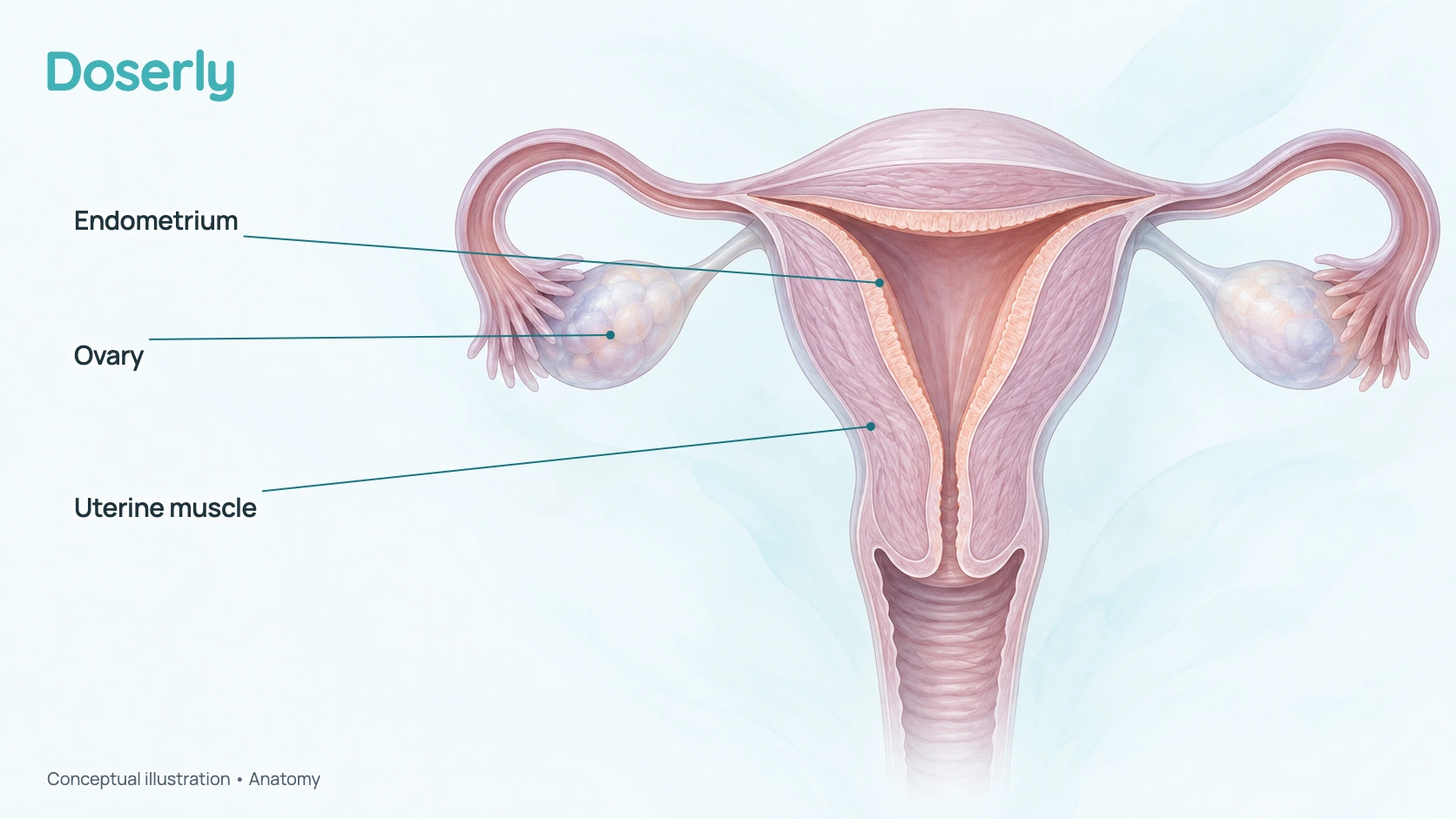
- Endometrium
- The lining inside the uterus.
- Endometrial hyperplasia
- Excess growth of uterine lining; some forms can precede cancer.
- Progestogen
- A medicine class including progesterone and synthetic progestins, used for uterine protection in systemic HRT.
- Micronized progesterone
- Progesterone processed into small particles to support absorption; route and schedule remain important.
- Continuous combined
- Estrogen and progestogen taken without planned monthly breaks.
- Sequential
- Progestogen taken during a defined part of an estrogen-treatment cycle.
- Withdrawal bleed
- A planned bleed associated with stopping the progestogen part of a sequential regimen.
- Hysterectomy
- Surgery to remove the uterus; it does not always remove the ovaries.
- VTE
- Venous thromboembolism: a clot in a vein, including leg clots and pulmonary embolism.
- Pulmonary embolism
- A clot blocking an artery in the lungs; a medical emergency.
- Absolute risk
- How often an event occurs in a specified population over a specified time.
- Relative risk
- An event rate in one group compared with another; it needs baseline risk to show practical size.
- Contraindication
- A circumstance in which a medicine should not be used according to its label.
- Compounded product
- A pharmacy-prepared medicine; approval of an ingredient does not approve the finished preparation.
- Fixed combination
- One dosage form contains both hormones; changing it changes both components.
- Estradiol
- The estrogen in these named menopause combinations.
- Micronized progesterone
- Progesterone prepared as small particles; it is not every synthetic progestin.
- Endometrial Safety Population
- Trial participants with the specified baseline and follow-up biopsy data.
How was this guide researched?
Named full labels define calendars, indications and risks. Marketing records do not prove stock; guidelines inform care without changing authorization. Public accounts remain separate from clinical evidence. Sources identify document revision and access.
How this page was made
This Doserly editorial guide was prepared with AI assistance using public sources checked October 2, 2026. No independent clinician reviewer is claimed. Doserly develops a commercial tracking app. Original figures explain concepts and do not represent trial results. The directory identifies source revisions and access limitations. January 2027 is a review target; new evidence can require an earlier check.
Sources and updates
Numbered public sources checked October 2, 2026.
Showing 7 sources
- 01
BIJUVA — prescribing information ↗
Full label
Current full repository label; lower start, food, missed dose and trial data.
- 02
BIJUVA — FDA revised prescribing information ↗
Full label
Final revised FDA text cross-checked against April repository label.
- 03
Menopause: identification and management — Recommendations ↗
Full guideline
Treatment review, bleeding, local symptoms and stopping.
- 04
FDA Approves Labeling Changes to Menopausal Hormone Therapy Products ↗
Full statement
Bijuva is among the named first six final revised-label approvals.
- 05
Compounded Bioidentical Menopausal Hormone Therapy ↗
Full consensus
Regulated bioidentical medicine is not interchangeable with custom compound.
- 06
Table 1: Combined HRT versus no HRT — effect on specific health outcomes ↗
Full guideline table
No blanket guaranteed breast-risk advantage for a progesterone type.
- 07
Bijuva User Reviews ↗
Public patient reviews
Mixed symptom, tiredness, bloating and spotting accounts; no incidence inference.
No matching sources
Try a different term or show the full list.