
In this guide
What is micronized progesterone?
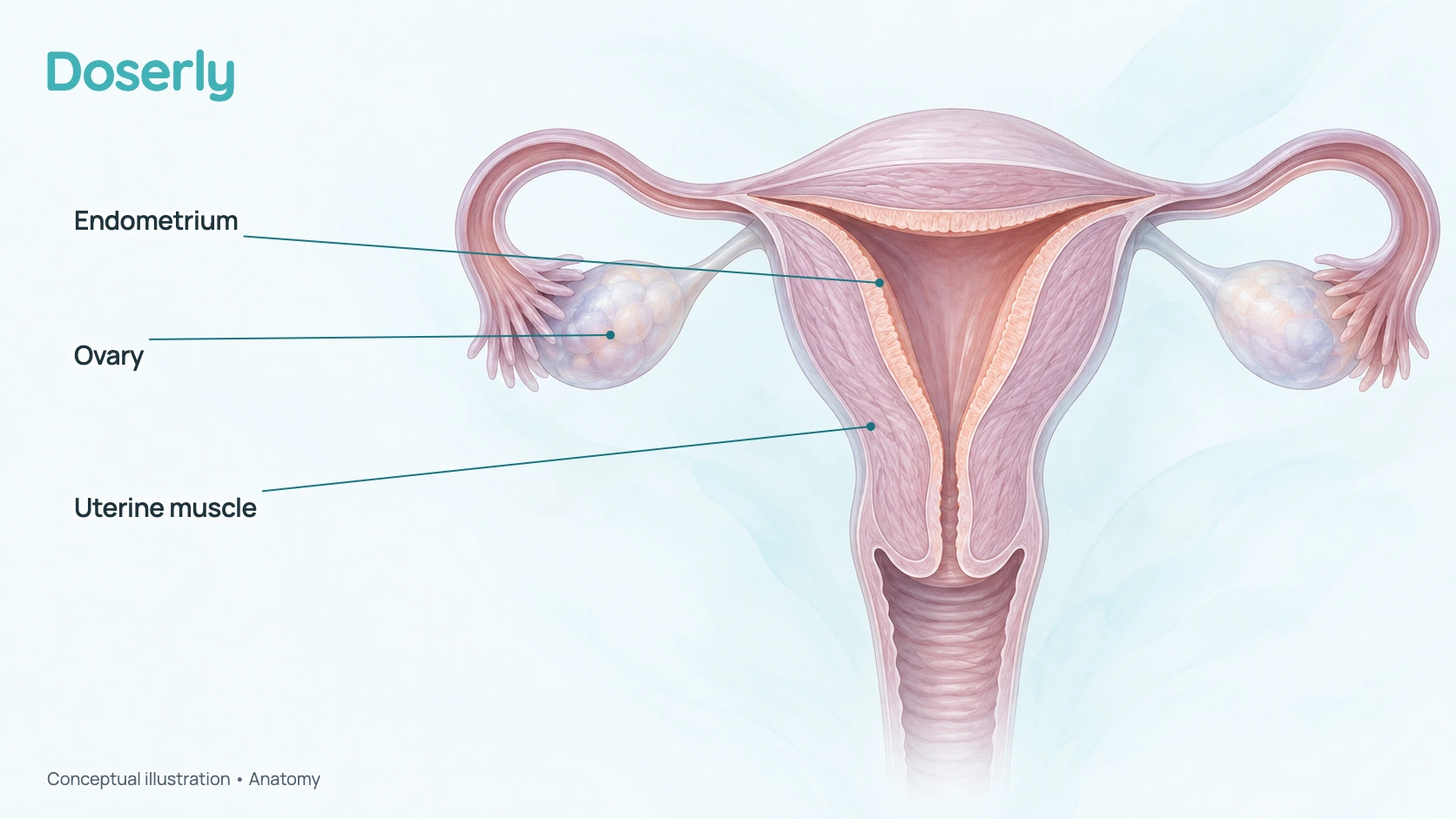
Micronized progesterone is prescription progesterone made into small particles so an oral (swallowed) capsule can be absorbed more readily. The molecule is chemically identical to the progesterone made by the ovaries. In menopausal hormone replacement therapy (HRT), its main job is to protect the endometrium, the lining inside the uterus, when systemic estrogen, which acts throughout the body, is used. [1], [2], [4]
Estrogen encourages that lining to grow. Progesterone changes how it develops, reducing the excess growth caused by estrogen alone. This is why a person can feel better on an estrogen patch yet still need a separate progesterone prescription. The two medicines do different jobs. Removing the ovaries does not remove the uterus; protection still matters when the uterus remains. [1], [4]
Progesterone belongs to the progestogen family, which also includes synthetic progestins such as medroxyprogesterone acetate. “Bioidentical” describes its molecular identity, not a guarantee of safety or a need for a compounded product. Approved micronized capsules are already bioidentical. Prometrium and Utrogestan are familiar brand names, but ingredients and authorized schedules differ between countries. [1], [2], [3], [14]
Typical Micronized Progesterone Protocols
| Product/source and population | Amount each time | Schedule and daily total | Uterine-protection context | Source type |
|---|---|---|---|---|
| US Prometrium: postmenopause with a uterus | 200 mg orally at bedtime | Once nightly for 12 consecutive days per 28-day cycle; 200 mg on treatment days | With daily conjugated estrogen tablets; this is the US labeled HRT schedule [1] | US label |
| UK Utrogestan 100 mg: postmenopause with a uterus | 200 mg orally at bedtime | Days 15–26 of each therapeutic cycle, inclusive; 200 mg on treatment days | With estrogen; withdrawal bleeding can follow [2] | UK label |
| UK Utrogestan alternative | 100 mg orally at bedtime | Days 1–25 of each therapeutic cycle; 100 mg on treatment days | With estrogen; this 25-day schedule is not uninterrupted daily dosing [2] | UK label |
| Canada Prometrium: postmenopausal estrogen treatment | 200 mg orally at bedtime | Last 14 days of estrogen treatment per cycle; 200 mg daily. Label examples: days 8–21 in a 28-day cycle, or 12–25 in a 30-day cycle | Keep the estrogen-treatment calendar attached to this row [3] | Canadian label |
| BMS: low/medium estrogen dose, average menopause-age population | 100 mg orally daily | Every day, without a scheduled progesterone break; 100 mg daily | Continuous combined guideline regimen, not the US Prometrium labeled cycle [4], [5] | UK guidance |
| BMS: sequential low/medium estrogen regimen | 200 mg orally daily | 12–14 days per month; 200 mg on treatment days | Exact dates agreed with the prescriber; month and 28-day cycle are not interchangeable [4], [5] | UK guidance |
| BMS: higher estrogen exposure, continuous regimen | 200 mg orally daily | Every day, without a scheduled progesterone break; 200 mg daily | Clinician-selected higher-dose scope; robust high-estrogen protection data are limited [4], [5], [6] | UK guidance; higher-dose scope |
| BMS: higher estrogen exposure, sequential regimen | 300 mg orally daily | 12 days per month in the May guidance example; 300 mg on treatment days | Clinician-selected higher-dose scope; robust high-estrogen protection data are limited [4], [5], [6] | UK guidance; higher-dose scope |
| Canada Prometrium: high estrogen dose, at least 1.25 mg conjugated-estrogen equivalent | 100 mg orally in the morning + 200 mg at bedtime | 300 mg daily for the last 12–14 days of estrogen treatment; morning dose 2 hours after breakfast | Product-specific split schedule; not three capsules together at bedtime [3] | Canadian label |
The recurring pattern is 200 mg on sequential treatment days or 100 mg each day in a guideline continuous regimen. The estrogen dose, product label, stage and bleeding history determine which complete schedule is used. A lower capsule strength is not automatically adequate protection for a higher estrogen dose. [1], [2], [4], [5]
Adjustment is a review of the whole regimen, not a race toward a progesterone blood-test target. The prescriber checks estrogen exposure, missed doses, sedation and bleeding before changing the amount, duration, route or progestogen. The 2026 higher-dose guidance addresses average menopause-age treatment; its estrogen equivalence table excludes premature ovarian insufficiency. [4], [5], [6], [7]
Sequential pauses are planned parts of a paired regimen. They are not optional holidays that can be extended when estrogen continues. In continuous combined treatment both components continue according to their prescriptions. “Twelve days each calendar month” can start on a different date over time from a repeating 28-day cycle. Write down the exact calendar. [1], [4]
One 100 mg capsule contains 100 mg; two contain 200 mg. A schedule's daily total applies only to that day's doses. Do not average 200 mg over off-days and use the average as the bedtime amount. These are source-described regimens; their indication and level of evidence remain attached to each row.
Where these schedules come from
Rows 1–4 come from the US, UK and Canadian labels [1], [2], [3]. Rows 5–8 come from the May 2026 protection guidance and August 2026 prescribing table, with the June FAQ explaining the uncertainty [4], [5], [6]. Row 9 preserves the Canadian high-estrogen amount, split timing and exposure days [3]. The BMS continuous 100 mg regimen is not the UK label’s 100 mg on days 1–25, and is not the US labeled 12-day cycle. We excluded low-dose vaginal regimens, compounded creams and unsupported forum dosing from this table. US secondary amenorrhea treatment, 400 mg at bedtime for 10 days, is a different indication and is discussed below [1].
Two calendars, different exposure
Illustrative 28-day window. Thick-bordered teal cells mark progesterone days; white cells mean no scheduled progesterone in this example.
Sequential, UK labeled example
200 mg at bedtime · days 15–26
- 1
- 2
- 3
- 4
- 5
- 6
- 7
- 8
- 9
- 10
- 11
- 12
- 13
- 14
- 15
- 16
- 17
- 18
- 19
- 20
- 21
- 22
- 23
- 24
- 25
- 26
- 27
- 28
12 progesterone days in this cycle
Continuous, BMS guideline regimen
100 mg daily · every day
Low/medium estrogen dose at the usual menopause age; higher exposure needs a separately selected regimen. This dose table does not cover POI.
- 1
- 2
- 3
- 4
- 5
- 6
- 7
- 8
- 9
- 10
- 11
- 12
- 13
- 14
- 15
- 16
- 17
- 18
- 19
- 20
- 21
- 22
- 23
- 24
- 25
- 26
- 27
- 28
Daily dosing continues beyond day 28; no scheduled break
Paired systemic estrogen follows its prescription. The US 12-days/28 label does not specify these same dates; UK labeled 100 mg on days 1–25 is another option. A calendar month is not a 28-day cycle. Sources: UK label [2], BMS May/August 2026 [4], [5].
What is progesterone commonly used for?
The strongest established menopausal role is endometrial protection alongside systemic estrogen in someone who has a uterus. It is not principally the estrogen substitute for vaginal dryness, and a good night's sleep does not prove that the uterus is protected. Protection depends on the right product, amount and days of exposure. [1], [4]
After a total hysterectomy, progesterone is usually unnecessary solely for endometrial protection. A history such as endometriosis or residual tissue can change the specialist plan. Low-dose local vaginal estrogen is also a different situation from systemic estrogen; not every vaginal ring is local-only. Read the exact treatment rather than deciding from the route or surgery's name alone. [4], [7]
Sleep and night sweats are other reasons people discuss progesterone. Small randomized trials support some sleep outcomes, and a postmenopausal trial found better hot-flash/night-sweat scores with progesterone alone. A larger perimenopausal trial did not establish superiority on its primary symptom score. These findings support a nuanced conversation, not a claim that everyone should replace estrogen with progesterone. [9], [10], [11]
The US label separately treats secondary amenorrhea, missing periods in someone who previously menstruated. It gives 400 mg at bedtime for 10 days. That short treatment is not an HRT protection schedule and does not establish a routine sleep dose. Fertility and pregnancy progesterone products have different indications and instructions, outside this menopausal guide. [1]
Why do the dose and calendar differ?
A sequential regimen gives progesterone on selected days, often while estrogen continues. A withdrawal bleed can follow the progesterone course. Continuous combined treatment supplies progestogen every day and aims for a bleed-free pattern, although spotting can occur during adjustment. Stage, previous periods, estrogen amount and preferences help the prescriber choose. [2], [4], [7]
The sources do not all write the same calendar. The US label specifies 12 consecutive days per 28-day cycle. The UK label specifies days 15–26 or a separate 25-day alternative. The Canadian label gives 14 days attached to its estrogen-treatment cycle. Guidelines also describe calendar-month regimens. None means “take it whenever symptoms get worse.” [1], [2], [3], [4]
Increasing estrogen can require more progestogen even without bleeding. The 2026 British guidance distinguishes low/medium from high estrogen exposure and discusses 200 mg daily continuously or 300 mg in a sequential course for the higher group. It acknowledges limited robust high-dose evidence. This is a precautionary prescribing framework, not proof that any amount of estrogen becomes safe when progesterone is increased. [4], [5], [6]
If a regimen becomes hard to tolerate, the answer is a review of the paired treatment. Changing progestogen, route or the estrogen formulation may be considered. Repeatedly skipping progesterone while keeping systemic estrogen can undermine the intended protection. HRT is also not contraception; a progesterone capsule is not the same prescription as a contraceptive progestogen-only pill. [2], [4], [7]
What happens when you stop progesterone?
A bleed after a planned sequential course can be an expected withdrawal response. Stopping progesterone alone while continuing systemic estrogen is a different situation: the lining's protection needs to be addressed. There is no universal “progesterone holiday” or taper schedule that preserves protection regardless of the estrogen regimen. [1], [2], [4]
When stopping HRT as a whole, NICE offers gradual reduction or immediate stopping. Gradual reduction can limit symptom recurrence in the short term, but the longer-term recurrence does not differ by those approaches. That recommendation is not permission to remove just the protective component from an ongoing estrogen prescription. Record the stopping date, continuing medicines and any new bleeding or symptoms; bleeding that persists after stopping still needs assessment. [2], [7], [8]
Do oral, vaginal and skin preparations behave the same way?
No. Oral progesterone passes through the digestive system and liver, which converts some of it into metabolites, substances formed as a medicine is processed. Some act on brain signaling and contribute to sleepiness. Bioavailability, the amount reaching the circulation, is affected by formulation and food. The US label reports peak blood concentrations within three hours and says absolute bioavailability is unknown. [1], [9]
The UK oral capsule instructions say bedtime and not with food; the Canadian monograph has its own timing instructions, including the split high-dose schedule. A forum suggestion to “take it with dinner” is not a universal product instruction. Keep the pharmacy directions and product leaflet together, and clarify conflicting instructions rather than changing the food relationship to increase the effect. [1], [2], [3]
Vaginal progesterone has different absorption and may be considered when oral treatment is poorly tolerated. For menopausal uterine protection this is off-label in the UK, with limited evidence for the best regimen. Using an oral capsule vaginally does not automatically give the same exposure; British guidance notes the lack of absorption-kinetic evidence for that substitution. It advises similar amounts and durations to oral treatment when that route is selected exceptionally. [4]
Low-dose vaginal treatment is not proved adequate simply because it delivers progesterone near the uterus. In an ELITE analysis, oral estradiol 1 mg daily with vaginal progesterone gel 45 mg daily for ten days each month did not fully oppose endometrial stimulation. Fertility studies of vaginal products do not settle their long-term menopausal protection. [4], [12]
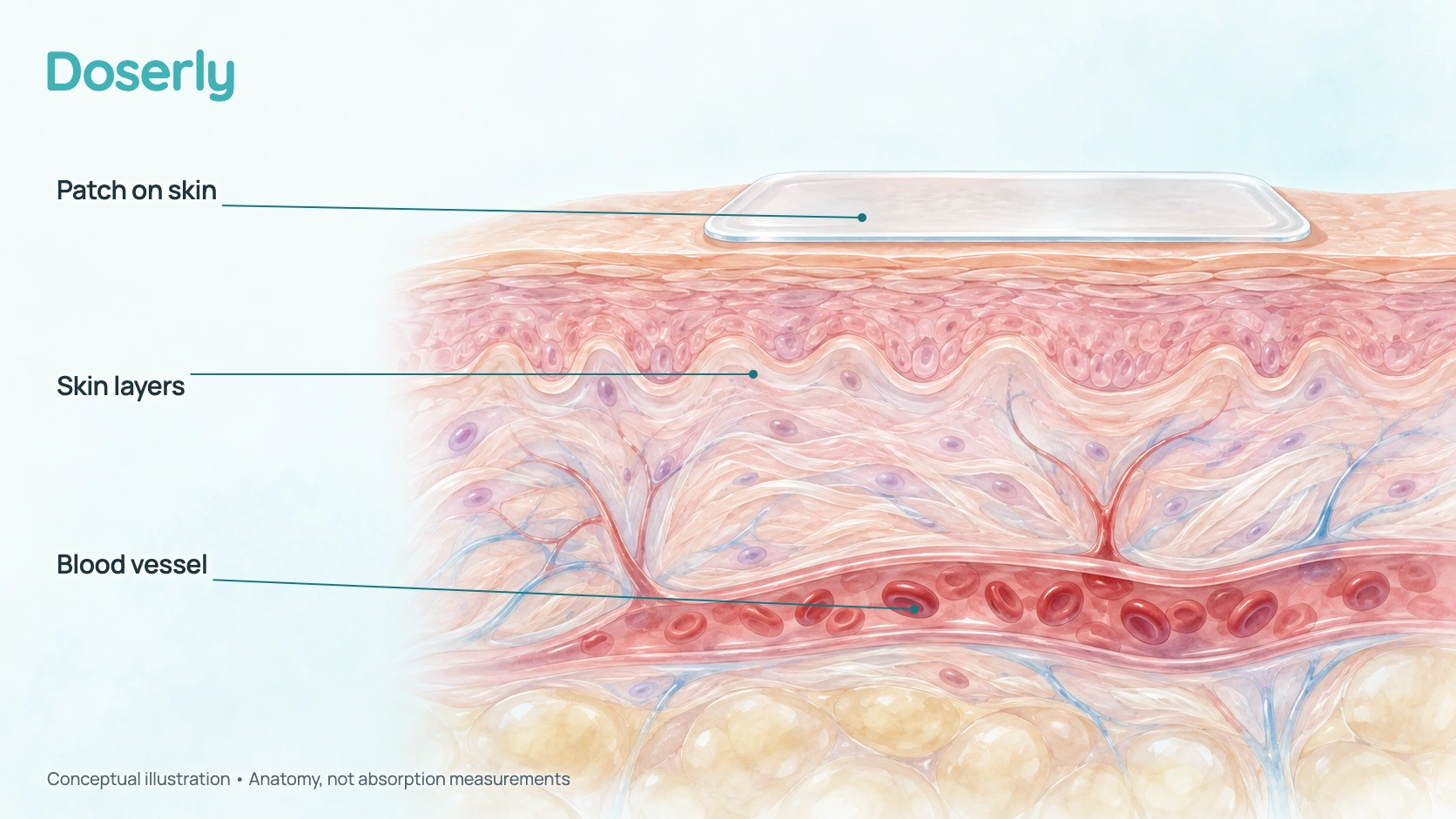
Compounded progesterone cream or gel applied to the skin is another formulation. Variable absorption and insufficient protection evidence prevent treating it as a capsule substitute. Compounding can address a genuine ingredient or formulation need, but “bioidentical” marketing cannot establish its potency or protection. [4], [14]
The route is part of the regimen
Same molecule ≠ same exposure ≠ same evidence for uterine protection.
Product labels + human trials
Swallowed capsule
Product-specific oral schedules. Amount, food, bedtime and exposure days remain important.
Off-label for UK menopausal HRT
Vaginal progesterone
Exceptional option for oral intolerance. Oral-capsule vaginal absorption and optimal regimen are poorly established. Gel 45 mg for 10 days/month was insufficient in ELITE.
Unreliable protection
Compounded skin cream
Variable absorption; no automatic equivalence to an oral capsule. Cream is not reliable uterine opposition.
ELITE: oral estradiol 1 mg/day with vaginal progesterone gel 45 mg for 10 days/month; this does not classify every vaginal preparation. Better tolerability does not confirm protection. Sources: BMS May 2026 [4], ELITE analysis [12], ACOG consensus [14].
How should capsules be stored?
US Prometrium is stored at 25°C, with permitted excursions from 15°C to 30°C, protected from excessive moisture and dispensed in a tight, light-resistant container. The UK Utrogestan label lists a three-year shelf life and no special storage precautions. That shelf life describes the authorized product, not permission to extend the expiry date printed on your pack. [1], [2]
Keep capsules in their labeled packaging, away from children, and follow the exact product's expiry and storage directions. An approved oral capsule's shelf life does not establish the beyond-use date of a compounded cream, troche or suppository. If a medicine has been exposed to unusual heat or moisture, the pharmacist can assess the product rather than relying on its appearance. [1], [2], [14]
What do we actually know from human studies?
Protecting the lining: the US label describes a randomized trial, which assigns treatment by chance, in 358 postmenopausal women with a uterus, followed for up to 36 months. The relevant groups received conjugated estrogen 0.625 mg daily with progesterone 200 mg for 12 days per 28-day cycle, estrogen alone, or an inactive placebo comparator. In the evaluable biopsy groups, hyperplasia occurred in 7 of 117 (6%), 74 of 115 (64%) and 3 of 116 (3%), respectively. This is direct evidence for that paired schedule; hyperplasia is excessive lining growth, not the same endpoint as cancer. It does not prove every progesterone route or dose prevents cancer. [1]
Sleep: a 2021 systematic review, using defined methods to select and assess studies, included nine randomized trials and 388 participants, mostly postmenopausal women. Some sleep measurements improved, but pooled results favored falling asleep sooner without clearly improving total sleep time or sleep efficiency. Estrogen co-treatment and relief of night sweats made progesterone's independent contribution harder to isolate. This is evidence of possible sleep benefit, not a guarantee or a long-term insomnia-treatment approval. [9]
Postmenopausal hot flashes: a 2012 trial randomized 133 selected healthy women to 300 mg at bedtime or placebo for 12 weeks. The adjusted symptom-score difference favored progesterone by 4.3 points. These participants were screened for cardiovascular risk and were one to ten years after their final period. A short symptom trial in that group cannot establish long-term cancer or clot safety, or supply a standard uterine-protection regimen with added estrogen. [10]
Perimenopausal symptoms: the 2023 Canadian trial randomized 189 women to 300 mg at bedtime or placebo for three months after a baseline month. Its primary vasomotor score did not differ significantly (P = 0.222). Participants perceived better sleep and fewer night sweats, but those secondary findings do not turn the primary result positive. The trial was underpowered and enrolled a selected population; the result is inconclusive rather than proof that progesterone never helps. [11]
Breast cancer comparisons: the French E3N cohort found different associations by progestogen type, including a more favorable association for estrogen plus progesterone than for estrogen with several other progestogens. Treatment was not randomly assigned, so patient selection, duration and other differences can affect the comparison. NICE concludes that evidence is insufficient to establish whether micronized progesterone changes the increase in breast-cancer risk relative to other progestogens. “No breast-cancer risk” overstates these data. [7], [13]
Hyperplasia: one specific trial outcome
Postmenopausal women with a uterus, through 36 months. Outcome: biopsy-diagnosed hyperplasia, not cancer. Denominators are evaluable groups.
Estrogen + progesterone
Conjugated estrogen 0.625 mg/day + progesterone 200 mg, 12 days/28
6%
7 of 117
Estrogen alone
Conjugated estrogen 0.625 mg/day
64%
74 of 115
Placebo
No active study hormone treatment
3%
3 of 116
358 randomized; evaluable counts shown above. Percentages are the rounded values reported in the label. This supports the tested combination, without proving cancer prevention or equivalence of other routes or doses. Source: US Prometrium label, Clinical Studies Table 3 [1].
How does it protect the uterus, and why can it make you sleepy?
Progesterone acts through progesterone receptors, proteins that receive its signal. In an estrogen-stimulated endometrium, it promotes a different, secretory pattern of development instead of continued growth alone. The effect depends on exposure over time; a comfortable mood, absent bleeding or a single blood level cannot confirm that this tissue effect is adequate. [1], [4]
After oral intake, progesterone metabolites can influence the GABA-A receptor system, part of the brain's inhibitory signaling. That helps explain why some people sleep more easily and why others feel dizzy or impaired. It does not explain every person's mood response, and sleepiness is not a test of the right dose. The bedtime instruction addresses tolerability, not a promise of refreshing sleep. [1], [9]
The Women's Health Initiative (WHI) combined trial used conjugated equine estrogen with medroxyprogesterone acetate, not micronized progesterone. KEEPS and ELITE studied particular estrogen regimens and vascular outcomes; neither establishes that a modern progesterone-containing regimen prevents heart attacks. Their timing findings do not replace product-specific protection or risk evidence. See the WHI guide for the broader history. [1], [4], [7], [12]
What are the risks and important uncertainties?
Drowsiness, dizziness, breast tenderness, headache, bloating and bleeding changes are recognized problems. Oral capsules can sometimes cause marked impairment, particularly early in treatment. Use the prescribed bedtime timing, and avoid driving or operating machinery when impaired. Severe dizziness, difficulty speaking or walking, fainting, chest pain or sudden breathlessness require prompt medical assessment rather than being treated as an ordinary adjustment. [1], [2]
Mood responses differ. Existing depression deserves review, and new severe mood deterioration should be reported promptly. Thoughts of self-harm need urgent help. Public reports of “progesterone intolerance” describe real difficulties but do not diagnose their cause or prove that changing to a smaller dose remains protective. There are treatment alternatives to discuss without abandoning the uterine-protection question. [1], [2], [4], [17]
Allergy is product-specific. US Prometrium contains peanut oil and is contraindicated with peanut allergy. UK Utrogestan and Canadian Prometrium list soya lecithin and also warn against peanut/soya allergy; the Canadian capsule lists sunflower oil. The same brand name across borders is not the same ingredient list. Check the exact manufacturer and pack with a pharmacist before dispensing a substitute. [1], [2], [3]
The US label contraindicates use with unexplained genital bleeding, known/suspected or previous breast cancer, active or previous blood clots, stroke or heart attack, and liver disease, among its listed conditions. Other countries' labels add qualifications. A family history is not automatically the same as a personal cancer history, but it belongs in the review. Pregnancy, younger ovarian insufficiency and complex cancer-treatment histories require their own clinical plans. [1], [2], [3], [7]
The February 2026 US Prometrium label no longer has the former class boxed warning, but still contains serious warnings, contraindications and WHI discussions. The Canadian July 2025 monograph retains a serious-warnings box and says Prometrium is not indicated over age 65 because evidence is limited. A US label revision does not amend a Canadian authorization, and guideline individualization is not the same as that product's licensed population. [1], [3], [15]
Interactions can change exposure. The UK label lists enzyme-inducing medicines, including some seizure medicines and rifampicin, and St John's wort; medicines that inhibit metabolism can increase exposure. The US ketoconazole discussion is based on laboratory metabolism data with uncertain clinical relevance. Bring a complete medicine and supplement list to the pharmacist rather than assuming a capsule is unaffected because it is bioidentical. [1], [2]
What should be monitored during treatment?
The important record is the full regimen: estrogen product and amount, progesterone route and days, missed doses, bleeding dates and tolerability. NICE recommends a review at three months, then annually, with earlier review for ineffective treatment, side effects or adverse events. Routine serum progesterone testing does not establish that an HRT regimen protects the endometrium. [4], [7], [8]
Tell the prescriber about bleeding rather than guessing from a blood test or increasing progesterone yourself. In its April 2026 update, NICE identifies bleeding as common in the first six months of systemic HRT or within three months of a change, and advises prompt help when unscheduled bleeding occurs beyond those periods. That is not a waiting instruction for heavy, prolonged or concerning bleeding. The British pathway incorporates individual cancer risks and can recommend earlier ultrasound or endometrial assessment. [6], [7], [8]
A planned withdrawal bleed is different from bleeding between expected courses or a new bleed after a stable bleed-free interval. Assessment checks adherence and the paired doses as well as other causes, including polyps or abnormal lining changes. An ultrasound measures thickness; a biopsy samples tissue. Neither “it stopped when I increased the capsule” nor absence of bleeding alone rules out disease. [2], [6], [8]
Keep ordinary breast and cervical screening up to date according to national guidance and individual risk. The US patient label's screening wording and NICE's nationally recommended screening approach differ; the local care team applies the appropriate plan. Record new breast changes, impairment and mood problems as well as symptom relief. Follow-up asks whether the treatment remains useful and safe enough for that individual, not whether a hormone number looks optimized. [1], [2], [7]
How do products and access differ by country?
The same name can cover different capsules and directions. This guide separates US Prometrium, UK Utrogestan and the Canadian Prometrium monograph instead of combining them into a worldwide label. Australia's ARTG also lists Prometrium 100 mg, but registration alone does not establish the current pharmacy stock, PBS conditions or an identical schedule. Elsewhere in Europe, use the national product information and local coverage rules. Checked October 2, 2026. [1], [2], [3], [18]
Ask the pharmacy to identify the exact manufacturer, capsule strength, excipients and directions on a refill or substitution. Coverage and prescription access are separate from clinical suitability. The US, UK, Canada, Australia and Europe guides explain those pathways; they do not replace the pack's current label.
What do public communities report?
Selected public discussions show both easier sleep and difficult daytime or mood effects. In a thread asking for positive progesterone experiences, contributors described bedtime oral treatment, some initially without estrogen, and reports of easier sleep or less rumination alongside neutral or unwanted effects. Subsequent estrogen addition makes it difficult to assign later changes to progesterone alone. [16]
An older Prometrium discussion includes next-day tiredness, irritability with cyclic treatment, mood deterioration and discussion of switching routes. Follow-up comments add other estrogen changes, bleeding assessments and ongoing symptoms. These are useful reminders to record what changed and when, not evidence that one route is universally better or that a reported low vaginal dose protects the uterus. [17]
These selected conversations are not a survey of everyone prescribed progesterone. Posts cannot establish response percentages, a mandatory adjustment period or long-term safety. A favorable sleep account and a harmful mood account can both be accurate experiences. Worsening is not proof that treatment is working, and severe symptoms should not be endured to reach an online “settling-in” deadline. [1], [2], [16], [17]
How does it compare with other uterine-protection options?
| Option | What it is and how it is given | Main difference |
|---|---|---|
| Micronized progesterone | Body-identical progesterone; oral capsule, with selected off-label vaginal use | Bedtime sedation and exact exposure days matter; breast-risk superiority remains uncertain |
| Medroxyprogesterone acetate | Synthetic progestin, usually oral in these regimens | Established opposition; the WHI combined trial used this molecule, not progesterone |
| Levonorgestrel IUD | A device releasing progestogen inside the uterus | The 52 mg device can provide protection; HRT duration differs from contraception duration and by country |
| Estradiol plus progesterone | A fixed oral combination product | Its own strengths, exposure and label; not interchangeable with any separate estrogen/progesterone pair |
These are different ways to supply protection, not a ranking. Tolerability, bleeding, contraception needs, estrogen exposure and local authorization can change the choice. A contraceptive pill or a lower-dose IUD is not automatically adequate opposition for prescribed estrogen. The full comparison belongs with the exact product and purpose. [4], [5]
Common questions about micronized progesterone
Is 100 mg enough if I use an estrogen patch?
It can be part of a guideline continuous regimen, but the patch alone does not answer that question. The release rate, total estrogen exposure, progesterone route and calendar matter. British guidance uses 100 mg daily with low/medium estrogen and a higher amount with high exposure, while US Prometrium has a different labeled cycle. Do not infer your complete prescription from capsule strength alone. See the source-specific table. [1], [4], [5], [6]
Can I take my oral capsule vaginally?
That is an off-label route change for UK menopausal treatment, not a routine interchangeable use. It may be considered exceptionally for oral intolerance, but oral-capsule vaginal absorption and optimal protection are not well established. A lower vaginal dose that feels easier to tolerate can still leave the lining inadequately protected. Discuss the exact product and complete regimen rather than following a forum substitution. See routes and the ELITE finding. [4], [12]
Does better sleep mean the dose is working properly?
Better sleep is an observation, not a test of uterine protection. Oral progesterone can affect brain signaling and sleep, but protection requires enough exposure for the paired estrogen regimen. Research supports some sleep outcomes without consistent improvement in every measure or every person. Record sleep, next-day alertness and dose dates separately, and keep the prescribed schedule even when sleep changes. See human studies and monitoring. [1], [4], [9]
What if I forget a dose?
Follow the instructions for your exact product and regimen, because missed-dose rules differ. The Canadian monograph has different instructions for its 200 mg bedtime and split 300 mg schedules, so a generic “double tonight” rule is inappropriate. Contact the pharmacist when uncertain, especially after several missed protection days or a refill gap. Keep the estrogen regimen visible when asking. Repeated omissions need review rather than an improvised catch-up cycle. See the calendar differences. [3], [4], [8]
Is bleeding normal while taking progesterone?
A withdrawal bleed can be expected with sequential treatment, but new or unscheduled bleeding still deserves attention. Timing, amount, previous pattern and individual risk determine the assessment. Early spotting is not the same as heavy or persistent bleeding, and a bleed after a long stable interval should not be dismissed as routine. Tell the prescriber what estrogen and progesterone were used and whether doses were missed. See monitoring. [2], [6], [7], [8]
Is micronized progesterone safer for breast cancer?
Some observational findings are more favorable, but comparative breast-cancer safety is not settled. The E3N cohort was not a randomized comparison, and NICE says evidence is insufficient to establish whether the increase differs from other progestogens. US warning changes also do not prove zero risk. Personal history, regimen, duration and the estrogen component still matter. See human evidence and current warnings. [1], [7], [13], [15]
Can I use it if I am allergic to peanuts?
US Prometrium is contraindicated with peanut allergy, and other familiar brands can also carry peanut/soya allergy restrictions. Canadian Prometrium uses sunflower oil and soya lecithin, yet its label still contraindicates peanut/soya hypersensitivity. Do not use the oil’s name alone to decide. The pharmacist should check the exact label and suitable alternatives. Check again after a manufacturer change or a pharmacy substitution. See product-specific allergy. [1], [2], [3]
Can I stop it if I do not like the side effects?
Troublesome effects are a reason to review treatment, including how uterine protection will be maintained if estrogen continues. Severe impairment or mood deterioration needs prompt help; do not wait for a forum’s adjustment deadline. A clinician may change the progestogen, route or whole regimen. Stopping all HRT and stopping just progesterone are different decisions. See stopping and risks. [1], [2], [4], [7]
Glossary
Terms used to understand the product, calendar and evidence.
- Adverse event
- An unwanted event during treatment; it is not automatically caused by the medicine.
- Amenorrhea
- Absence of menstrual periods. Secondary amenorrhea occurs after periods have previously occurred.
- Bioavailability
- The amount of an administered medicine reaching the circulation; formulation and route can change it.
- Bioidentical
- Chemically identical to a hormone the body makes; the word does not establish safety or product quality.
- Biopsy
- A tissue sample examined for abnormalities, unlike an ultrasound measurement of thickness.
- Boxed warning
- A prominent warning format used in a medicine label; removing the box does not remove every risk.
- Compounding
- Preparing a medicine to a prescription rather than supplying a standard approved finished product.
- Continuous combined HRT
- Estrogen and progestogen used continuously according to their prescriptions, without scheduled progestogen-free days.
- Contraindication
- A condition in which a particular product must not be used under its label.
- Cycle
- A repeating treatment calendar. A 28-day cycle and a calendar month have different lengths.
- Daily total
- All doses taken on one day added together, not the average across days without treatment.
- Endometrium
- The lining inside the uterus that can grow in response to estrogen.
- Estrogen
- A family of hormones including estradiol; systemic treatment and low-dose local treatment have different purposes.
- Excipient
- An ingredient other than the active medicine, such as a capsule oil or lecithin.
- First-pass metabolism
- Processing in the intestine and liver before an oral medicine reaches the wider circulation.
- Hormone replacement therapy (HRT)
- In this guide, hormone treatment for menopause-related needs; also called menopausal hormone therapy.
- Hyperplasia
- Excessive tissue growth. Endometrial hyperplasia is not the same diagnosis as endometrial cancer.
- Hysterectomy
- Surgery removing the uterus; removal of ovaries is a different procedure.
- Intrauterine device (IUD)
- A device placed inside the uterus. Protection duration in HRT can differ from contraception duration.
- Metabolite
- A substance produced as the body processes another substance. Some progesterone metabolites affect brain signaling.
- Micronization
- Making particles smaller to change their dissolution and absorption, without changing the hormone molecule.
- Milligram (mg)
- A unit of mass; a 100 mg capsule contains 100 milligrams of active progesterone.
- Observational study
- A study following treatment choices rather than randomly assigning them; confounding can affect comparisons.
- Off-label
- Use outside a product’s authorized indication, route or schedule; it can be guideline-supported without becoming labeled use.
- Oral
- Swallowed, passing through the digestive system.
- Perimenopause
- The transition toward menopause, when periods and hormone patterns can change.
- Placebo
- A comparison treatment without the tested active medicine.
- Postmenopause
- The stage after menopause; context and other hormonal treatments matter when identifying it.
- Progestogen
- The broader family of progesterone-like medicines, including progesterone and synthetic progestins.
- Randomized controlled trial
- A study assigning participants to groups by chance to make a treatment comparison.
- Sequential HRT
- A regimen giving progestogen on selected days of a repeating cycle.
- Systemic
- Reaching the wider body through the circulation, rather than being intended mainly for a local site.
- Transdermal
- Absorbed through the skin, as with an estrogen patch; evidence for progesterone cream is different.
- Vaginal
- Administered in the vagina; the route alone does not establish systemic exposure or uterine protection.
- Vasomotor symptoms
- Hot flashes and night sweats.
- Withdrawal bleeding
- Bleeding following removal of hormonal exposure, such as after a sequential progesterone course.
How this guide was researched
This guide compares current product labels with clinical guidance and selected human research. US Prometrium's February 2026 label, the UK SmPC, the Canadian July 2025 monograph and the May–August 2026 British updates supply separate schedules. Their country, route and population limits are retained instead of creating a single worldwide protocol.
The source directory contains 18 entries, including four original human studies, one systematic review and two public discussions. Some papers were reviewed through their abstracts rather than full text; the directory names that limit. Public search text supplied community examples where direct thread retrieval failed. The discussions show questions and selected experiences, not response rates or treatment authority.
The material is educational and summarizes what the reviewed sources report. It does not replace an individual prescription or clinical assessment. Use the source directory to check a regimen's origin or read a study directly; important product and guidance changes trigger another source review.
Explore the sources
Listing a source does not endorse every statement on its page. Access levels describe what was reviewed on October 2, 2026.
Showing 18 sources
- 01
PROMETRIUM (progesterone, USP) Capsules: Prescribing Information ↗
Labels and regulators
Full label reviewed, including clinical studies, contraindications, dosage and patient information.
- 02
Utrogestan 100mg Capsules: Summary of Product Characteristics ↗
Labels and regulators
Full SmPC reviewed; emc update 19 March 2025. Oral indication, days 15–26 or 1–25, food, allergy and storage.
- 03
PROMETRIUM: Product Monograph Including Patient Medication Information ↗
Labels and regulators
Sections 1–7 retrieved, including exact Canadian cycle examples, split 300 mg dosing and excipients. Canadian label limits are not US label limits.
- 04
Progestogens and endometrial protection ↗
Clinical guidance
Full guidance retrieved. Oral opposition, higher estrogen exposure, vaginal uncertainty, IUDs and compounded creams.
- 05
HRT – Practical prescribing ↗
Clinical guidance
Full four-page document retrieved; dose-table headings checked in PDF text. Average-age population; POI excluded.
- 06
Frequently Asked Questions: Management of unscheduled bleeding on hormone replacement therapy (HRT) ↗
Clinical guidance
Full FAQ retrieved. Clarifies revised tables, high-dose uncertainty and earlier bleeding investigation.
- 07
Menopause: identification and management (NG23): Recommendations ↗
Clinical guidance
Full recommendations retrieved. Diagnosis, breast-risk uncertainty, stopping and 3-month/annual review; 2026 bleeding amendments.
- 08
Management of unscheduled bleeding on hormone replacement therapy (HRT) ↗
Clinical guidance
Current recommendations page reviewed. Risk assessment, adherence and investigation pathways; not a self-triage tool.
- 09
Efficacy of Micronized Progesterone for Sleep: A Systematic Review and Meta-analysis of Randomized Controlled Trial Data ↗
Reviews
PubMed abstract reviewed. Nine trials, 388 participants; inconsistent outcomes and estrogen co-treatment limit inference.
- 10
Oral micronized progesterone for vasomotor symptoms—a placebo-controlled randomized trial in healthy postmenopausal women ↗
Human studies
Abstract reviewed. 133 randomized, 300 mg at bedtime for 12 weeks; selected healthy postmenopausal population.
- 11
Oral micronized progesterone for perimenopausal night sweats and hot flushes a Phase III Canada-wide randomized placebo-controlled 4 month trial ↗
Human studies
Full text retrieved through Exa. 189 randomized; primary vasomotor outcome not statistically significant; perceived sleep/night-sweat benefits.
- 12
Use of oral estradiol plus vaginal progesterone in healthy postmenopausal women ↗
Human studies
PubMed abstract reviewed; PMC full-text fetch blocked. ELITE subgroup: oral estradiol 1 mg with vaginal gel 45 mg for 10 days/month was insufficient opposition.
- 13
Unequal risks for breast cancer associated with different hormone replacement therapies: results from the E3N cohort study ↗
Human studies
PubMed abstract reviewed; full PMC fetch blocked. Observational association, not proof of comparative cancer safety.
- 14
Compounded Bioidentical Menopausal Hormone Therapy ↗
Clinical guidance
Consensus introduction and recommendations retrieved. Approved products preferred when available; individualized compounding reasons differ from superiority claims.
- 15
FDA Approves Labeling Changes to Menopausal Hormone Therapy Products ↗
Labels and regulators
Full announcement reviewed; Prometrium-specific warning wording checked in source 1.
- 16
Positive Progesterone (Prometrium) experiences? ↗
Public experiences
Public search text checked 2 October 2026; direct crawl unavailable. Selected comments, not a survey; no usernames retained.
- 17
Prometrium experiences? ↗
Public experiences
Public search text checked 2 October 2026; direct crawl unavailable. Older discussion and follow-ups used for questions, not dosing advice.
- 18
PROMETRIUM 100 progesterone 100 mg soft capsule blister pack (232818) ↗
Labels and regulators
Current registration page retrieved. Confirms registered product; current linked PI, subsidy and stock not certified by this record.
No matching sources
Try a different term or show the full list.
Updates and corrections
Sources checked October 2, 2026, including the February 2026 US label, Canadian July 2025 monograph and May–August 2026 British guidance. New labels, guidance or material safety findings trigger an earlier review. No independent clinician review is claimed. Report a correction through Doserly support, identifying the claim and its source.