
In this guide
What is ARA-290?
ARA-290 is a manufactured peptide, a chain of 11 amino acids, that people discuss mainly for nerve pain: burning, tingling and numbness that ordinary treatments have not fixed. It was designed from a small part of erythropoietin (EPO), the hormone that tells the body to make red blood cells, but it did not raise red blood cells in the studies that checked. [1], [2]
Amino acids are the building blocks of proteins, and a peptide is a short chain of them. ARA-290's official international name is cibinetide. Researchers also call it pHBSP, short for "pyroglutamate helix B surface peptide", because it copies the outward-facing surface of one coil of the EPO protein, called helix B. [3], [1], [4]
It is investigational: a US company, Araim Pharmaceuticals, took it into small clinical trials, mostly in people with nerve damage caused by sarcoidosis or diabetes, but it has never been approved as a medicine. It is now also sold online as a "research" peptide. [5], [6], [7]
Some websites call it a nine-amino-acid or ring-shaped (cyclic) peptide. Both are wrong: the registered chemical name lists 11 amino acids, and the developers describe a linear chain. A nine-amino-acid piece does appear in lab tests, but as a breakdown product of ARA-290 in blood. [3], [8], [9], [10]
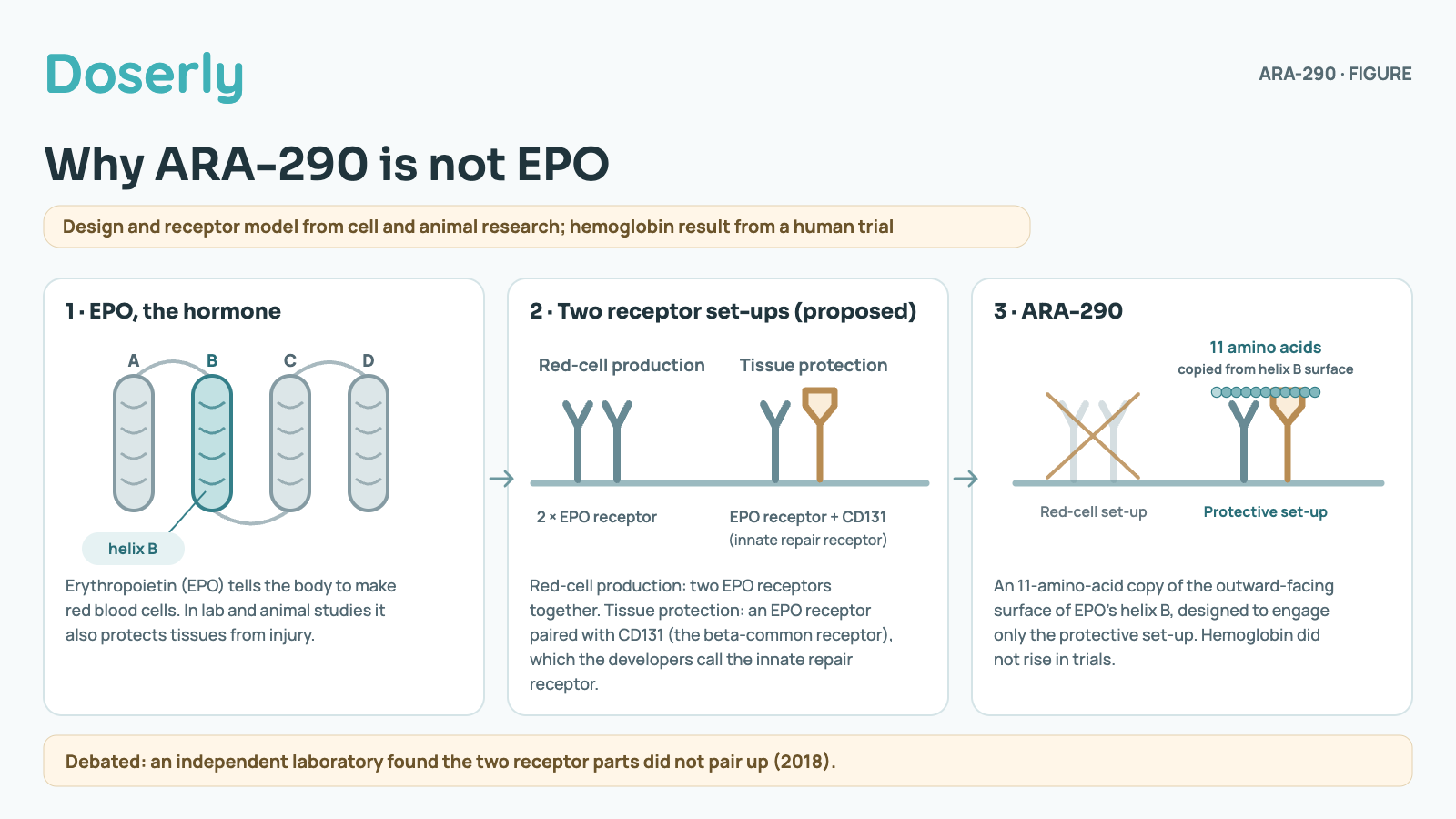
Why ARA-290 is not EPO
- 1 · EPO, the hormone
- Erythropoietin (EPO) tells the body to make red blood cells. In lab and animal studies it also protects tissues from injury.
- 2 · Two receptor set-ups (proposed)
- Red-cell production: two EPO receptors together. Tissue protection: an EPO receptor paired with CD131 (the beta-common receptor), which the developers call the innate repair receptor.
- 3 · ARA-290
- An 11-amino-acid copy of the outward-facing surface of EPO's helix B, designed to engage only the protective set-up. Hemoglobin did not rise in trials.
Debated: an independent laboratory found the two receptor parts did not pair up (2018).
Typical ARA-290 Protocols
| Example | Amount each time | Frequency | Total per day | Duration |
|---|---|---|---|---|
| Low | 2 mg | Once daily | 2 mg | 28 days Protocol-source starting option; not tested in a trial |
| Mid | 4 mg | Once daily | 4 mg | 28 days The schedule used in three placebo-controlled trials |
| High | 8 mg | Once daily | 8 mg | 28 days Highest amount tested in people; it did not beat placebo on the main measure |
The most common protocol in the reviewed sources is 4 mg once daily by subcutaneous injection for 28 days, the same schedule used in the clinical trials. [12], [8], [6], [13], [14], [15]
Read the units: ARA-290 amounts are written in milligrams (mg), not micrograms. 4 mg equals 4,000 mcg, far more than the microgram amounts used for many other peptides, so a page quoting "20 mcg" or "500 mg" has almost certainly mixed up its units. All amounts here refer to ARA-290 alone; the reviewed protocol sources describe it on its own, not in blends.
Each row is a complete schedule as published, and low, mid and high are alternatives, not steps to move through. The mid and high rows are trial schedules tested for only 28 days in small studies; the low row comes from protocol sources, not a trial. The cited references give the full details. [11], [6]
In the first trial, study staff also gave 2 mg directly into a vein (intravenous, IV) three times a week for four weeks. That is a clinic schedule, not a home one, and it is compared with injections in the route section. [2]
Where protocols differ: dose size, frequency, course length and units ↓
Where these numbers come from
The low row comes from reference [11], which lists 2 mg once daily for 28 days as its starting option, followed by 2–4 weeks off before any repeat. The mid and high rows are two arms of the largest controlled trial, which compared 1, 4 and 8 mg daily with placebo for 28 days; the 4 mg schedule was also used in two earlier placebo-controlled trials. [6], [21], [12], [8]
We compared 29 public protocol pages from 24 independent publishers (several pages copy each other, so we counted publishers, not pages). About half simply repeat the trial schedules, and two-thirds add at least one schedule nobody has tested in people, such as 2 mg lead-in weeks, three-times-weekly injections, every-other-day use and courses of 8–16 weeks. Those appear in where protocols differ, labeled as website practice. [22], [16], [23], [24]
We left some numbers out of the typical comparison: a page recommending 20 micrograms a day (probably a confusion with the trials' weight-based figures), a "500mg" maintenance dose that is almost certainly a typing error, a chart row taken from mouse experiments, and two pages that could no longer be opened for checking. [25], [26], [10]
We keep each amount with its own frequency and course length. The high row is included because it was tested, not because it worked better: in that trial it did not beat placebo, and it is the arm in which one serious psychiatric event occurred. [6], [27]
What is ARA-290 commonly used for?
People usually look into ARA-290 because of nerve pain that has not responded well to standard treatment: burning feet, pins and needles, numb patches, or shooting pain down a leg. The hope is practical: fewer bad nights, walking without pain, needing less of other medicines.
Most of the research is about one kind of nerve problem, small fiber neuropathy, but the discussions go much wider. Below are the problems people bring to ARA-290 and what has been tested for each; reports of use do not establish that it treats them.
Small fiber neuropathy and sarcoidosis
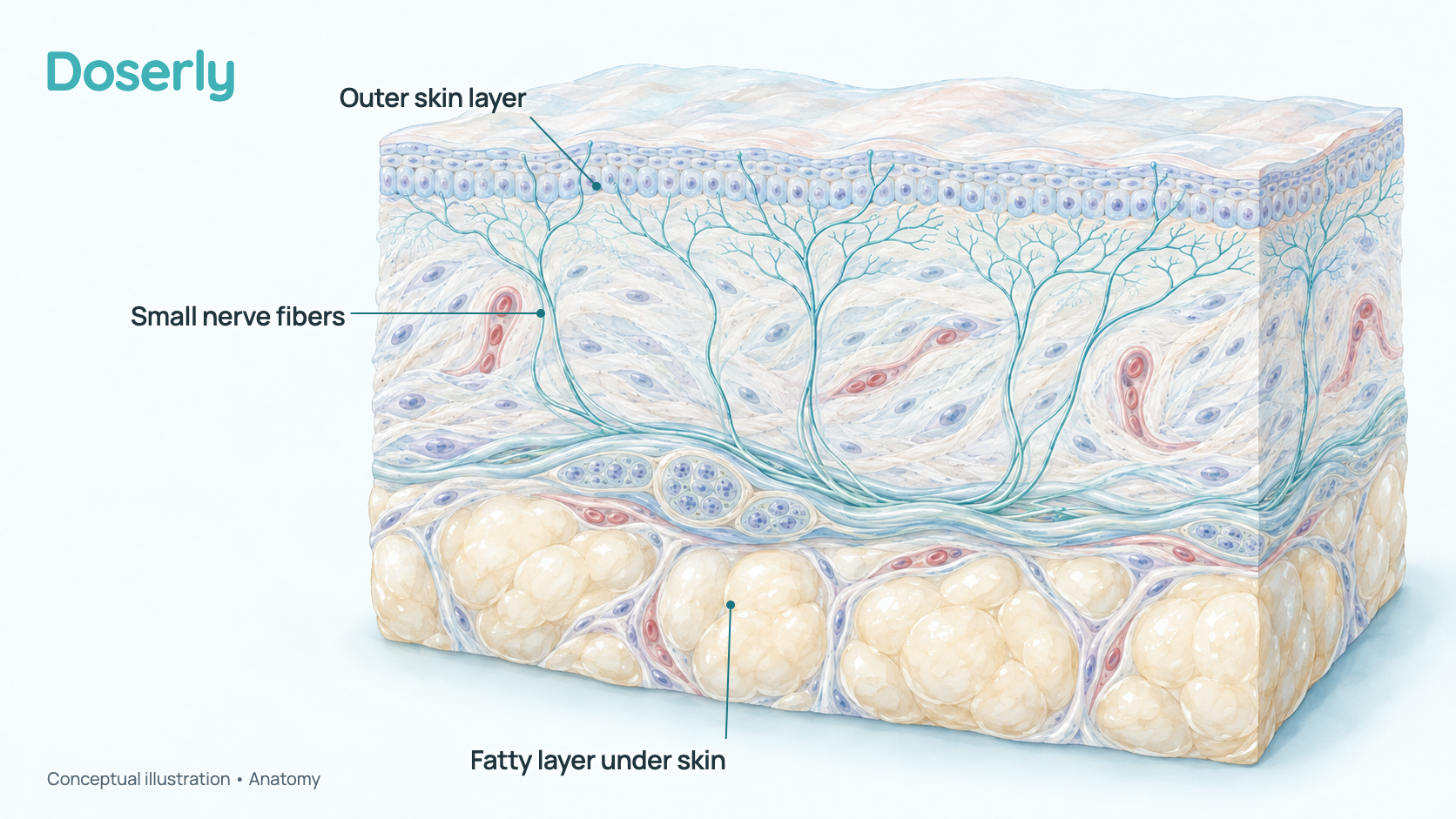
Small fiber neuropathy is damage to the thinnest nerve fibers, the ones that carry pain and temperature signals. It often causes burning, tingling or numbness, usually starting in the feet. It is common in sarcoidosis, an inflammatory disease in which small clumps of immune cells form in organs such as the lungs, skin or eyes. Three of the ARA-290 trials enrolled exactly these patients. [2], [12], [6]
The results are mixed in a way that matters. In two small trials, a questionnaire about small-fiber symptoms improved more on ARA-290 than on placebo. But standard pain scores improved just as much in the placebo groups, and in the largest trial pain improved in every group, including placebo. [2], [12], [6] The human evidence section explains each trial.
Diabetic nerve pain and blood sugar
One 28-day trial in 48 people with type 2 diabetes and painful neuropathy found a larger drop on one nerve-pain questionnaire with ARA-290 than with placebo. In the 42 people with complete blood tests, it also found a small difference in HbA1c, a blood test of average blood sugar: down 0.21 percentage points on ARA-290 versus up 0.21 on placebo a month after dosing ended. A second pain questionnaire improved by about 20% in both groups. [8]
That is one small, short trial; a registered Swedish diabetes study never posted results. [28]
Sciatica, pinched nerves and back pain
This is now one of the most common reasons people discuss ARA-290, and it has never been studied in a trial. In community education groups, some members describe relief from sciatica flares within a day or two, while others notice nothing. Nerve-root pain often flares and settles on its own, so a fast change is hard to credit to any one thing. See how people describe the time course.
Nerve injury after surgery or trauma
People also try it after nerve damage from an operation or injury. One public account described a numb patch on the shin, from a nerve injured during a vein procedure, shrinking over two months at 5 mg a day, while a compressed nerve in the same person's foot did not change. Injured nerves can recover on their own, so this cannot show what the peptide added. [29]
Diabetic eye damage
Some pages say ARA-290 helps diabetic eye disease. The one human study tested it in nine people with diabetic macular edema (fluid swelling in the center of the retina) for 12 weeks. Vision and retinal thickness did not improve, and there was no placebo group. [20]
Other uses you may come across
You may see ARA-290 described for long COVID, chronic fatigue syndrome (ME/CFS), autoimmune conditions such as lupus, Sjögren's disease or rheumatoid arthritis, kidney protection in transplantation, or mood. None has a controlled human trial showing benefit; the US orphan designations for kidney and islet transplantation are not proof that it works, and a single IV dose did not change mood in healthy volunteers. [30], [31], [32], [33]
Where do ARA-290 protocols differ?
The trials used one simple schedule. Protocol pages and community practice have stretched it in almost every direction: bigger and smaller amounts, fewer injections a week, longer courses and repeat cycles. Here is what those differences mean.
Is a higher dose stronger?
Not in the one trial that compared doses. In the largest trial, 64 people with sarcoidosis took 1, 4 or 8 mg daily, or placebo, for 28 days. Only the 4 mg group showed a clear gain over placebo in corneal nerve fiber area, the main measure. The 8 mg group did not, and one person in it had a serious psychiatric event. [6], [21]
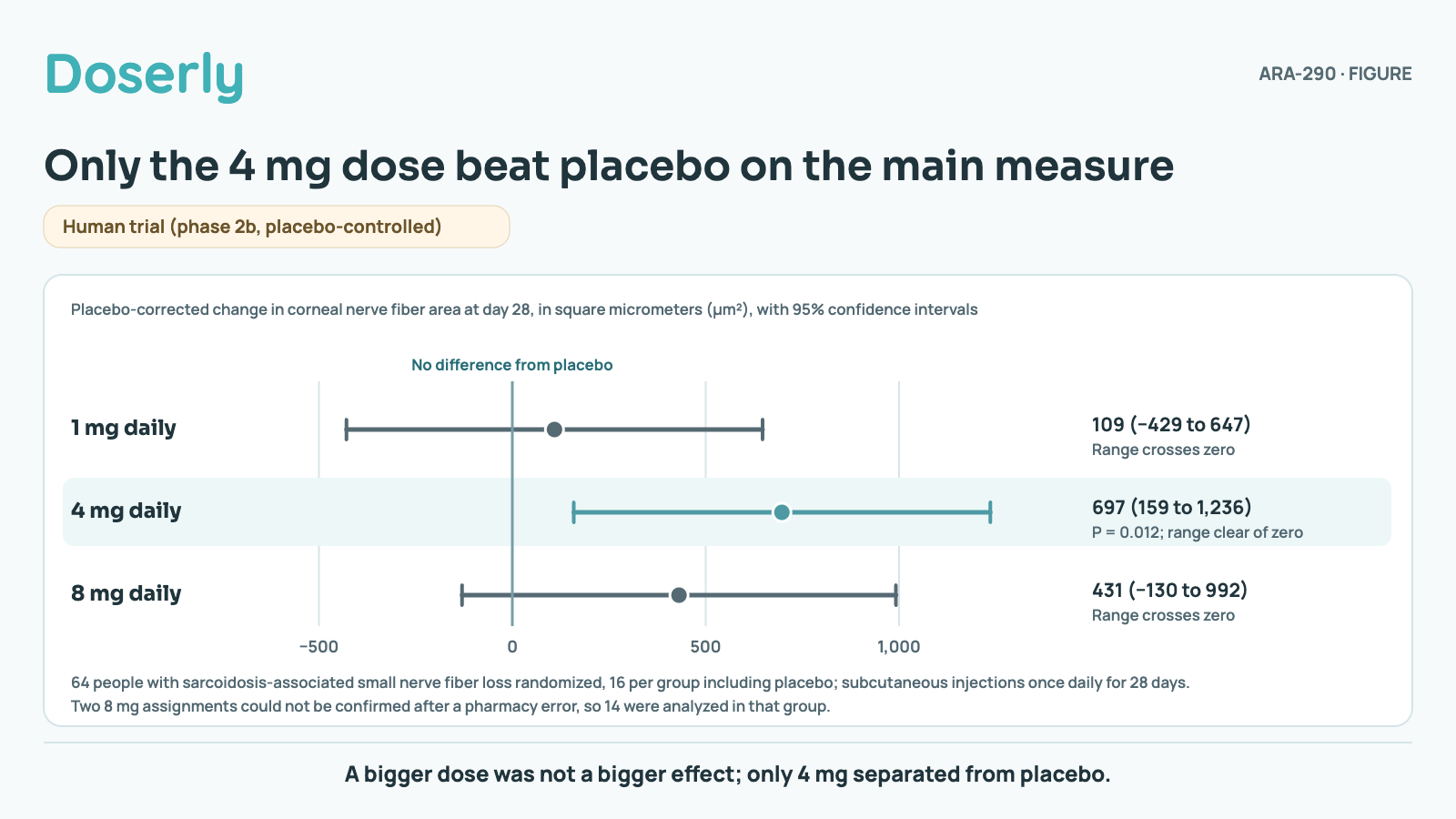
Only the 4 mg dose beat placebo on the main measure
Placebo-corrected change in corneal nerve fiber area at day 28, in square micrometers (µm²), with 95% confidence intervals
- 1 mg daily
- Estimate 109 µm² (95% range −429 to 647); range crosses zero.
- 4 mg daily
- Estimate 697 µm² (95% range 159 to 1,236); P = 0.012; range clear of zero.
- 8 mg daily
- Estimate 431 µm² (95% range −130 to 992); range crosses zero.
64 people with sarcoidosis-associated small nerve fiber loss randomized, 16 per group including placebo; subcutaneous injections once daily for 28 days. Two 8 mg assignments could not be confirmed after a pharmacy error, so 14 were analyzed in that group.
A bigger dose was not a bigger effect; only 4 mg separated from placebo.
Some protocol pages still list 8 mg a day as an upper option, and some people in community education groups have moved up to 5–6 mg a day. Others in the same groups report the reverse: pain flares at 3–4 mg that settled at 2 mg. None of this has been compared in a trial. [22], [34]
Is the number for one dose or the whole day?
The trials gave one injection of the full daily amount. Some people split 4 mg into 2 mg morning and evening. The daily total is the same, but with a substance that leaves the blood within an hour, splitting changes the exposure in ways nobody has measured. [8], [2]
Every day, three times a week or only during flares?
The subcutaneous trials injected every day. Several protocol pages instead describe 2–4 mg by subcutaneous injection three times a week, which looks like the first trial's IV schedule moved to another route; others say every other day, or every 48–72 hours. In community education groups, people with sciatica often use 2 mg for a few days only when a flare starts, and some use five days on, two off, to save money. None of these patterns has human data. [26], [23], [19], [18], [35], [2]
How long should a course last, and what about breaks?
The trials lasted 28 days; the longest human exposure was 12 weeks in nine people. Protocol pages describe 4–8, 12 or up to 16 weeks, sometimes repeated two or three times a year, and some members of community education groups use it almost continuously for more than a year. [6], [20], [24], [16], [18]
Breaks vary from 2–4 weeks to as long as the course or 8–12 weeks. The reasons differ too: one page links course length to a risk of the receptor becoming less responsive, while another says the break is for judging results, not for that. Neither idea has been tested. There are no human data beyond 12 weeks and none on repeat courses. [11], [15], [25], [20]
Where do the sources disagree most?
- Amount: from 20 micrograms a day on one page to 8 mg a day on others, a 400-fold spread. Only 1, 4 and 8 mg daily were tested as subcutaneous injections, and only 4 mg beat placebo on the main measure. The 20-microgram page credits the trials with a per-kilogram figure; in fact the first trial's fixed 2 mg IV dose worked out at about 25 micrograms per kilogram. [25], [34], [6], [2]
- Frequency: daily, three times a week, every other day, or on demand. [19], [18], [35]
- Course length: 28 days in the trials; up to 16 weeks or continuous use elsewhere. [16], [6]
- Basic facts: pages give half-lives of 2–6 hours, call it a nine-amino-acid cyclic peptide, or simply say it is "not banned" in sport. All three are wrong or oversimplified; see half-life, identity and sport rules. [36], [35], [37], [10]
How do milligrams convert to syringe units?
Syringe units measure volume, not an amount of ARA-290. On a U-100 insulin syringe, 100 units equal 1 mL, so how much ARA-290 each unit holds depends on how much liquid was added to the vial.
For example, a 16 mg vial mixed with 2 mL gives 8 mg per mL. At that strength, 2 mg is 25 units (0.25 mL) and 4 mg is 50 units (0.5 mL). The same 4 mg is a different number of units in a vial mixed differently, which is why a unit count copied from someone else can be wrong. [16] Doserly's reconstitution calculator works this out for any vial and shows each step.
Large daily amounts have practical consequences: a 10 mg vial lasts only two and a half days at 4 mg a day, and a daily unit count is risky near pens that hold other medicines. In community education groups, one person gave themselves four times their weekly dose of a GLP-1 medicine (a weight-loss or diabetes drug such as semaglutide) by dialing their ARA-290 units on the wrong pen.
Source-by-source comparison and registered study plans
Which pages repeat the trials, and which add something new?
Pages that repeat the trial schedules usually list 4 mg once daily for 28 days, sometimes alongside the 1 mg and 8 mg arms as if they were equal options. Some drop the detail that only 4 mg met the trial's main measure. [13], [38], [14]
Pages that add untested schedules include a 2 mg first week before 4 mg daily for weeks 2–8, with discussion of up to 16 weeks; 0.5–1 mg for 5–7 days, then 2–4 mg daily, or 2 mg every other day for four weeks, two or three times a year; 3 mg three times a week for eight weeks, then four weeks off; 1.32 mg a day for 30 days; and 1–4 mg on 3–7 days a week for 4–12 weeks. [16], [18], [23], [39], [24]
Inconsistent pages
Some pages contradict themselves. One lists 3–4 mg a day for four weeks, then "microdose at 500mg for maintenance". Another says 100 syringe units fill 0.5 mL, when on a U-100 syringe they fill 1 mL. A third lists a daily table and, separately, allows every-other-day use. We record these as published rather than choosing the number that fits. [26], [17], [34]
What are the registered studies planning?
These are study records, checked on September 23, 2026. No new ARA-290 trial has been registered on ClinicalTrials.gov since the eye study began in 2016.
4 mg every morning for 28 days
A Swedish study in prediabetes and type 2 diabetes planned about 24 participants, measuring glucose tolerance and insulin release.
Status unknown. Last registry update: September 2015. No results posted.
[28]4 mg daily for 12 weeks
The diabetic macular edema study. It was registered on ClinicalTrials.gov in 2024, years after it ended; its results were published in 2020.
Terminated in August 2017 because the study drug expired and no replacement was available.
[40]What happens when you stop ARA-290?
Only three trials measured results after the last dose, and the answer depends on the measure. No study looked for withdrawal effects or a rebound, and none tested a second course. [6], [12], [8]
- Nerve images drifted back. In the largest trial, the 4 mg group's gain in corneal nerve fiber area over placebo at day 28 had shrunk to a chance-level difference four weeks after the last dose; the authors wrote that it "trended back toward baseline". [6]
- Symptom scores held longer. In the 2013 sarcoidosis trial, the small-fiber symptom score was still better than on placebo 12 weeks and about nine months after the last dose. By nine months, pain interference and walking distance were back near where people started. [12]
- Blood sugar held for a month. In the diabetes trial, HbA1c and one nerve-pain questionnaire were still better than on placebo a month after dosing stopped; a second questionnaire had lost its improvement in both groups. [8]
- Nothing else was measured. The first IV trial collected no results after the last infusion, and the eye study only phoned people four weeks later to ask about side effects. [2], [20]
In rats, one short course eased nerve-pain behavior for 15 to 20 weeks, which is where the idea of a lasting effect comes from. [47], [41] Individual accounts describe both lasting relief and symptoms creeping back; see what people report.
How is ARA-290 taken, and why every day?
Only two routes have been tested in people: intravenous (IV, into a vein) in a clinic in the early trials, and subcutaneous injection (into the fatty layer under the skin) at home, into the thigh or lower belly, in the later ones. There are no human data for nasal sprays, capsules or creams, even though some sellers market a nasal version. [2], [12], [8], [37]
The 4 mg dose was not picked at random. Before the subcutaneous trials, researchers compared doses in 10 healthy volunteers and measured the total exposure above the blood level they believed was needed, a pharmacokinetic comparison. A 2 mg subcutaneous dose gave only about a third of the exposure of the 2 mg IV dose; 4 mg gave about the same as the IV dose, and 6 mg gave roughly four times more. They chose 4 mg daily. [12]
How long does ARA-290 last in the body?
A very short time. Half-life is how long it takes for the level in the blood to fall by half. After an IV dose, ARA-290's half-life is a few minutes; after a 4 mg subcutaneous injection, it is about 20 minutes, with a peak level of roughly 2 nanomoles per liter. These figures come from the developer's unpublished studies, quoted in the trial papers. Pages that give a half-life of 2–6 hours are not supported by any published data. [2], [8], [20], [36]
A half-life is not the length of an effect. ARA-290 is quickly trimmed into smaller pieces in lab blood samples, but the developers suggest that a brief exposure switches on repair processes that outlast the drug. In rats, five injections over ten days were followed by less pain behavior for up to 20 weeks; in people, the idea remains a hypothesis. [9], [2], [41]
Should ARA-290 be injected near the painful area?
No study has compared injection sites. The trial injections went into the thigh or belly, not near the painful nerves, and most people in community education groups say the site does not matter. A few educators recommend injecting near the problem; that advice has no data behind it. [12], [8]
Does body size change the dose?
The trials used the same fixed dose for everyone. The first trial excluded people with a body-mass index over 34 because the dose was not adjusted for size, and the eye-study authors suggested that a fixed 4 mg dose might give too little exposure in people with obesity. That has not been tested. [2], [20]
Does the liquid it is mixed with matter?
Possibly, but nobody has published stability data for vials sold online. The trial product was a powder that already contained a phosphate buffer, sucrose and mannitol and was mixed with plain sterile water, while most protocol pages say to mix the powder with bacteriostatic water (sterile water with a preservative). [98] In community education groups, the most common practical problem is vials that turn cloudy or gel-like after mixing, and people link burning injections to the liquid used. Nobody has established what causes those changes or whether such a solution is still usable. [8], [16], [42]
How should ARA-290 be stored, and how long does it last?
There is no approved label, and we found no published shelf-life or stability study of ARA-290. The only official storage details come from trial documents. [98], [21]
- In the trials. In the eye study, each sealed vial held 5.6 mg of ARA-290 as a powder with the buffer ingredients already in it. Mixed with 0.66 mL of sterile water, it gave a single 4 mg dose, and packs held one vial per treatment day. The pharmacy stored the drug at 2–8 °C and participants kept their packs in their home refrigerator. The largest trial required a refrigerator and a freezer at home for the study medicine. [98], [57], [21]
- Expiry was real. The eye study stopped early because its supply of the drug expired and no replacement was available. [40]
- Websites. Protocol pages usually say to keep the powder frozen (−20 °C) and the mixed solution at 2–8 °C, but give about 14 days, 3–4 weeks or 28 days for the mixed solution, and one page gives both 14 and 28. None cites a stability test of ARA-290, and two say no such study or standard exists. [22], [14], [11], [34], [99], [13], [100]
- Phosphate-buffered saline. Some sources say ARA-290 should be dissolved in phosphate-buffered saline (PBS). The human trials did not use it as the mixing liquid: the phosphate in the trial vials was part of the product, and a rat study that used PBS was a laboratory preparation. [23], [98], [41]
Because the trial product was mixed fresh for each day's dose, website figures of 14 or 28 days are not tested expiry dates. This guide does not cover mixing or injection technique; the Academy note below covers practical handling.
What do we actually know about ARA-290 in people?
More than for most peptides sold online, but not much. There are seven small human studies, most of them controlled trials, with about 230 participants in total, all run between about 2011 and 2017. None lasted longer than 12 weeks, and there has never been a large Phase 3 trial of the kind needed for approval. [2], [12], [8], [32], [33], [6], [20]

What did the human studies find?
| Study | What researchers reported | What it cannot establish |
|---|---|---|
| Sarcoidosis, IV, 2012 | 22 people; 2 mg IV three times a week for 4 weeks versus placebo. A small-fiber symptom score improved more on ARA-290 (11.5 points versus 2.9); pain and fatigue scores improved equally in both groups. | Whether nerves recovered; the nerve damage was not confirmed by skin biopsy. [2] |
| Sarcoidosis, 2013 | 38 people; 4 mg subcutaneously daily for 28 days versus placebo. The symptom score improved more on ARA-290, still months later. Corneal nerve fiber area rose 14.5% on ARA-290; skin fibers did not change significantly. Pain intensity fell about 9% in both groups. Six-minute walking distance rose 18.7 m on ARA-290 and fell 15.1 m on placebo. | Pain relief beyond placebo, or that nerve regrowth explains the symptom change. [12] |
| Type 2 diabetes, 2015 | 49 enrolled, 48 analyzed; 4 mg subcutaneously daily for 28 days versus placebo. One nerve-pain questionnaire and HbA1c (42 people with complete tests) improved more on ARA-290, as did triglycerides and the ratio of total to HDL cholesterol; a second questionnaire improved equally in both groups. | Lasting benefit; a corneal nerve gain appeared only in an after-the-fact subgroup. [8] |
| Healthy volunteers, 2015 | 36 people; one 2 mg IV dose or placebo. Mixed changes on emotion-processing tests; no effect on mood. | Any effect on depression. [32], [43] |
| Rheumatoid arthritis, 2013 | 15 people, no placebo; 2 mg IV once or three times a week for 4 weeks. Few met standard response criteria; joint counts and inflammation tests did not change meaningfully. | Benefit; a conference abstract never published in full. [33] |
| Largest trial, sarcoidosis, 2017 | 64 people; 1, 4 or 8 mg subcutaneously daily or placebo for 28 days. Only 4 mg improved corneal nerve fiber area versus placebo; a marker of regrowing skin fibers also rose at 4 mg. Pain improved in all groups, and overall skin fiber density did not beat placebo. | That a higher dose works better, or that the nerve change reduces pain. [6], [21] |
| Diabetic eye swelling, 2020 | 9 people, no placebo; 4 mg subcutaneously daily for 12 weeks. Vision and retinal thickness did not improve. Stopped early when the drug expired. | Benefit; too small and uncontrolled. [20], [40] |
These studies are not independent confirmations. Every patient trial had the developer as sponsor, drug supplier or co-author, and several came from one research group in Leiden, in the Netherlands. The dose-finding and early safety studies were never published in full; later papers cite them as unpublished data. [2], [12], [8], [6], [20]
Why did pain improve on placebo too?
Pain is strongly affected by expectation, attention and time. People join a trial when symptoms are bad, and bad spells often ease on their own. That is exactly why trials use a placebo group: in ARA-290's trials, the placebo groups also reported real improvements in pain. A treatment has to beat that improvement to show an effect of its own. [2], [12], [6]
Does a higher nerve-fiber count mean the nerves healed?
Not necessarily. Corneal confocal microscopy photographs tiny nerves in the clear front layer of the eye, and a skin biopsy counts nerve fibers in a small skin sample. Both are surrogate measures: lab or imaging results used as early signs, rather than the outcome a person cares about. In the largest trial, the cornea changed at 4 mg while overall skin fiber density did not beat placebo, and pain did not separate from placebo. A surrogate change in 28 days does not show lasting repair or less pain. [6], [21]
What would a useful improvement look like in everyday life?
For nerve pain, the outcomes that matter are concrete: sleeping through the night, walking without burning feet, needing less rescue medicine. The trials mostly measured questionnaires and nerve images over four weeks; a record of everyday outcomes over months says more than one good week.
How might ARA-290 work?
Besides making red blood cells, EPO protects many tissues from injury in laboratory and animal experiments, but as a drug it raises red blood cell counts and can increase the risk of blood clots. ARA-290 was designed to keep the protective signal without the red blood cell effect. [1], [44], [45]
Why doesn't it act like EPO?
The developers proposed that EPO uses two different receptor set-ups. A pair of EPO receptors drives red blood cell production; an EPO receptor paired with a second protein, CD131 (the beta-common receptor), was proposed to drive tissue protection. The 11-amino-acid peptide copies a surface of EPO that was thought to engage only the protective set-up. In lab and animal tests it did not stimulate red blood cell production, and in the IV trial hemoglobin was unchanged after four weeks. [46], [1], [2]
What is the "innate repair receptor"?
The innate repair receptor is the developers' name for the EPO receptor and CD131 working together. Animal studies support it: in mice bred without CD131, ARA-290 no longer eased nerve-pain behavior, and in a mouse stroke model its protective effect weakened when CD131 was switched off. But an independent laboratory in 2018 found that the outer parts of the two receptors did not pair up, with or without ARA-290. The receptor explanation is a working hypothesis, not settled biology. [47], [48], [49]
Calming inflammation around nerves
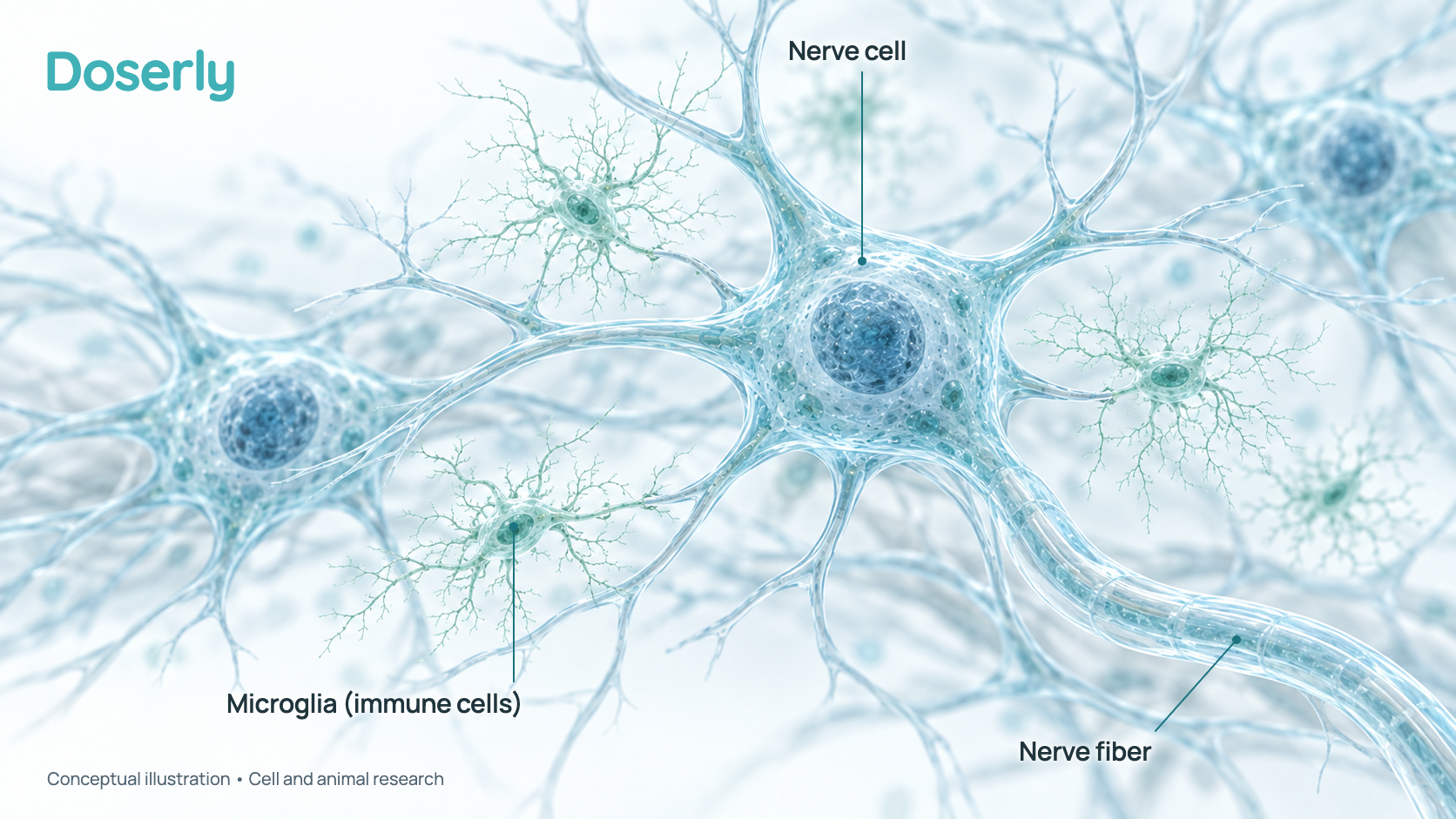
In rats with injured nerves, ARA-290 reduced sensitivity to touch and cold, a sign of nerve pain called allodynia, and reduced the activation of immune cells in the spinal cord called microglia. In a rat model of an inflamed nerve, it prevented touch sensitivity but not heat sensitivity. In mice with inflamed bowels, it reduced inflammatory signals from immune cells. These are animal findings about pain behavior and inflammation, not proof of nerve repair in people. [47], [41], [45], [50]
What didn't the animal studies show?
The animal record has limits that summaries leave out. In diabetic mice, ARA-290 reduced one kind of nerve damage but not ongoing loss of nerve cells. In rats, it protected the retina in diabetes but did not reduce abnormal blood-vessel growth in a separate eye model. In rat kidneys, an early dose reduced inflammation and injury, but later or repeated doses did not. In a mouse kidney-failure model, it improved survival without significantly reducing kidney damage. [51], [52], [53], [54]
Two laboratory papers on the same peptide have been retracted: a 2014 study on insulin resistance (retracted in 2024) and a 2012 study on kidney injury (retracted in 2026, after concerns about some of its images). Neither is used as evidence in this guide. [55], [56]
What are the risks and unanswered questions?
Is ARA-290 safe?
Nobody knows whether it is safe for long-term or repeated use. Its safety has only been studied for short periods: at most 12 weeks, in about 230 people. Most side effects in the trials were mild, but that is limited reassurance. Small studies miss uncommon problems, short studies miss slow ones, and nothing is known about repeat courses or years of use, which is how some people now take it. [6], [20], [8]
What side effects were reported in the trials?
- Headache was the clearest signal. In the largest trial it affected 8 of 46 people on ARA-290 and none of 16 on placebo; in the eye study, 4 of 9. [21], [20]
- Nausea affected 5 of 46 people on ARA-290 and none on placebo in the largest trial. [21]
- Serious adverse events occurred in 3 of 46 people on ARA-290 in the largest trial and none on placebo. One, suicidal thoughts at 8 mg, was judged possibly related in the trial paper and listed as treatment-related in the trial's results record; the two at 1 mg were recorded as unrelated. In the diabetes trial there were four serious events on ARA-290; two were judged possibly related, including worsening kidney function in a person with existing kidney problems. A fatal heart attack two weeks after the last dose, following a severe skin infection, was judged unrelated. [21], [27], [8]
- Injection-site pain was no more common than with placebo in the largest trial. [21]
- No antibodies against ARA-290 were found in the three trials that tested for them. [12], [8], [20]
Could ARA-290 affect mood?
In the largest trial, the only serious adverse event linked to treatment was suicidal thinking in a person with a history of depression who was taking 8 mg a day. After it, on advice from the FDA, it was agreed that all later ARA-290 studies should screen participants for suicidal thoughts. A single case cannot show that ARA-290 causes mood problems, and a study in healthy volunteers found no mood effect, but the signal was taken seriously. [57], [27], [32]
Does ARA-290 cause cancer, or fight it?
Nobody knows. No study has tested whether ARA-290 affects tumor growth, and no long-term animal cancer studies have been published. The question stays open because ARA-290 protects cells from dying in laboratory studies, and whether that could ever help abnormal cells survive has not been tested. Claims in community discussions that it is "anti-cancer" have no evidence behind them either. [58]
Could product quality change the risk?
Yes. ARA-290 bought online is an unapproved product, and no published study has tested the purity or contents of ARA-290 sold online. Health Canada has seized ARA-290 twice as an unauthorized injectable drug, warning of risks such as infection and contamination. In community education groups, people describe vials that would not dissolve, non-sterile laboratory saline used for mixing, and one independently tested vial that held about half its labeled amount. [59], [7], [42]
Is ARA-290 legal? Is it FDA-approved?
Checked September 23, 2026. Rules differ by country and change quickly. A "research use only" label does not make a product legal to sell for human use.
United States. ARA-290 is not an FDA-approved medicine. Its history with FDA:
- 2009–2016. FDA granted four orphan drug designations: delayed kidney-graft function after transplant (2009), nerve pain in sarcoidosis (2011), and sarcoidosis and islet transplantation (both 2016). These support development for rare diseases; they are not approvals. The developer also reported Fast Track status, which we could not confirm in a public FDA record. [30], [5], [60], [31], [61]
- 2026. FDA's list of ingredients nominated for pharmacy compounding places "Cibinetide (ARA-290)" in Category 3, "Bulk Drug Substances Nominated Without Adequate Support" (list updated May 14, 2026). It is not among the ingredients FDA is currently evaluating for compounding. [62]
Canada. Health Canada has not authorized ARA-290, and its Drug Product Database lists no product containing it. It named "ARA 290" among unauthorized injectable peptides seized from a Calgary clinic in April 2025 and from an online seller in August 2025, saying such products are illegal to sell in Canada. [63], [59], [7]
Australia. ARA-290 has no entry in the Australian Register of Therapeutic Goods and is not named in the June 2026 Poisons Standard. The TGA says peptide products regulated as therapeutic goods must generally be on that register before they can be imported, supplied or advertised, apart from limited exceptions such as a specific approval, exemption or personal importation, and that a "research use only" disclaimer does not change this. [64], [65], [66]
European Union. ARA-290 holds two EU orphan designations, for sarcoidosis (2013) and for preventing graft loss in pancreatic islet transplantation (2016), both still listed as active in September 2026. It is not authorized as a medicine; as the European Medicines Agency notes, "an orphan designation is not a marketing authorisation". [67], [68], [69]
Is ARA-290 banned in sport? Does it show up on a drug test?
There is no simple yes or no, so athletes should treat it as high risk. The World Anti-Doping Agency (WADA) named ARA-290 as a banned example in 2016, then removed the name for 2018 because research suggested it "does not meet inclusion criteria": it does not boost red blood cell production. [70], [71], [72]
The 2026 and 2027 lists do not name it, but both ban "innate repair receptor agonists", the class its developers place it in, at all times. Because WADA took ARA-290 off as an example, the class rule does not settle its status by name. A separate category bans substances not approved for human use when no other section of the list covers them. The Dutch national anti-doping authority's 2026 list still names ARA-290 among prohibited peptide hormones. Pages that simply say it is "not banned" leave all this out. Athletes should get a ruling from their anti-doping organization first. [73], [74], [6], [75], [37], [19]
Anti-doping laboratories have included ARA-290 in published urine screening methods since 2016. How long it stays detectable after use has not been published. [76], [9]
Who should be especially cautious?
These groups have no safety data in people. That is a reason for caution, not proof of harm.
- Pregnancy and breastfeeding. No human data, and we found no published animal reproductive studies.
- A history of depression or suicidal thoughts. Because of the suicidal-thinking case at 8 mg and FDA's advice to screen trial participants. [57]
- A history of cancer. Because tumor effects have never been tested; community educators disagree on this point, and neither side has data. [58]
- Kidney disease or a transplant. One diabetes-trial participant's kidney function worsened, and nobody has studied ARA-290 in people taking anti-rejection medicines. [8]
- Under 18. No studies include young people. This guide is written for adults.
- Competitive athletes. See the sport rules above.
- People taking other medicines. Interactions have not been studied; see the next question.
Has ARA-290 been tested alongside other medicines?
Not formally. The trials let people keep their usual medicines, including nerve-pain drugs and steroids, but no study has looked for interactions with blood thinners, anti-rejection drugs, diabetes medicines or anything else. "No known interactions" only means nobody has checked. [2], [8]
Some people describe cutting down or stopping gabapentin while using ARA-290. Changes to a prescribed medicine belong with the prescriber. Bring a complete list of everything you take, including peptides and supplements, to a pharmacist or doctor. [77]
What should be monitored while using ARA-290?
There is no official monitoring plan, because ARA-290 has never been approved. What exists is what the trials checked, plus one screening step added on FDA's advice. It can help you prepare questions for a clinician; it is not a personal testing plan. [67], [57]
What did the trials check?
- Blood counts. Because ARA-290 comes from EPO, the trials checked hemoglobin and blood counts during dosing (the diabetes trial also a month after), and they did not change meaningfully. People who had used EPO-type medicines in the previous two months were excluded. [2], [12], [8], [21]
- Kidneys, liver, blood sugar and fats. The main trials checked routine blood chemistry; in the diabetes trial, one participant with existing kidney problems got worse and stopped the drug. The eye study also measured kidney filtration, urine albumin (a protein), liver enzymes, HbA1c, glucose and blood fats, and recorded raised triglycerides in 5 of 9 people and raised glucose in 3, possibly because they had not fasted. [2], [12], [21], [8], [98], [20]
- Heart and blood pressure. The diabetes trial recorded vital signs at each visit and a heart tracing (ECG) around the first dose; the eye study recorded blood pressure and heart rate. No study looked specifically for blood clots, a known risk of EPO itself. [8], [98], [20]
- Antibodies. Three trials tested for antibodies against ARA-290 and found none. [12], [8], [20]
- Mood. After the suicidal-thinking case at 8 mg, the eye study used a standard screening questionnaire (the Columbia Suicide Severity Rating Scale) at the start and weeks 4, 8 and 12; no one reported suicidal thoughts. [57], [98], [20]
- Side effects over time. The largest trial collected side effects and laboratory results from the first dose through week 16, twelve weeks after the last dose. [21]
Which signals matter, and why?
| Why it matters | What studies measured or flagged | Tracking category |
|---|---|---|
| Red blood cells | Hemoglobin and blood counts; unchanged in the trials that checked | Blood work |
| Kidney function | Creatinine and urine albumin; one diabetes-trial participant with kidney disease got worse | Blood work |
| Blood sugar and fats | HbA1c, glucose, triglycerides and cholesterol | Blood work |
| Heart and circulation | Blood pressure, heart rate and an ECG around the first dose | Blood Pressure; Heart Rate & Palpitations |
| Mood | One case of suicidal thinking at 8 mg in a person with past depression, judged possibly related; a screening questionnaire in the later study | Mood & Wellbeing |
| Common side effects | Headache, nausea, injection-site pain | Side Effect Burden; Nausea & GI Tolerance |
| The problem you care about | Nerve symptoms, pain, fatigue, walking distance | Pain Management; Longevity & Neuroprotection; Energy Levels; Daily Functioning |
Treatment lasted 28 days to 12 weeks, with follow-up of up to nine months in one study. These results show what researchers chose to watch, not what one person will experience. Any testing is a conversation to have with a clinician.
What do people in public communities report?
Public forums and community education groups contain encouraging stories, no change at all, and symptoms that got worse. Most involve small fiber neuropathy, foot neuropathy, sciatica or nerve pain after surgery, and almost everyone is doing something else at the same time. [77], [78], [79]
What do the positive reports look like?
One person with small fiber neuropathy in the feet took 4 mg daily and described a "definite benefit" that took about 12 days to start. The follow-up matters: they later reported the benefit fading after about seven months and eventually preferred gabapentin. Another person with eight years of foot nerve pain said a 28-day course at 4 mg left the pain "basically gone" months later, with occasional minor flares. [77], [80], [81]
Other positive stories describe feeling returning to the feet, warmer hands and feet, or a first pain-free walk in a long time, often as part of a whole routine that included other peptides, KLOW (a four-peptide blend), diet changes or GLP-1 weight-loss medicines. [82], [83], [42], [79], [84], [85]
How fast, and how long did changes last?
Two very different time courses appear. People with sciatica or pinched nerves in community education groups often describe relief within a day or two, and one public commenter with small fiber neuropathy felt better within two hours. People with long-standing neuropathy and numbness more often describe changes after two to eight weeks, if at all. A handful of very active members account for many of the fast-relief reports. [80], [77], [86], [78]
What happens after stopping is just as mixed. Some describe benefit lasting months after a course. Others describe numbness returning once their supply ran out, relief that was "temporary", or neuropathy that "slowly crept back". In community education groups, some members stay on it almost continuously because symptoms return in breaks, which raises a fair question: lasting repair, or an effect that lasts only while it is taken? [81], [82], [80], [87]
Does everyone notice a difference?
No. Public reports of no benefit include 14 days and 60 days at 4 mg a day, four months at an unstated dose, and three months at 8 mg a day for nerve-related blood-pressure symptoms. Some people tried two separate courses without relief. [88], [78], [89], [90]
In community education groups, nonresponse shows up in particular situations: long-standing diabetic neuropathy, nerve damage linked to HIV medicines, post-polio pain, Raynaud's (fingers turning white or blue in the cold) and nerves that are squeezed or trapped. Members suggest the course was too short, the dose too low, the product faulty, or the pain was never from nerve damage in the first place. None of these explanations has been tested.
Does getting worse mean it is working?
The reports do not support that idea. One person's foot nerves "flared very painfully" as they worked up from 0.5 mg to 4 mg, and the same thing happened when they tried again. Others describe foot sensitivity that was worse after a 28-day course, symptoms getting worse from the first injections, or a new electric-shock pain in the sole. [87], [79], [91], [78]
Many people read new tingling, twitching or "zaps" as nerves waking up. That is an interpretation no study has tested; a flare can simply be a flare.
What about unwanted effects?
Public and community reports include a lumpy, painful injection site, dry mouth after injections, and pain spreading beyond the injection site. In community education groups, people also describe burning injections that they link to the mixing liquid, itchy raised welts after a large-volume injection of a dilute solution, nausea and tiredness after each dose, and trouble sleeping when they injected in the evening, which settled after switching to the morning. Individual reports cannot show how often an effect happens or whether ARA-290 caused it; the trial side effects are a better guide. [77], [92]
What do people combine it with?
ARA-290 is usually its own injection rather than part of a blend, but it is often added to other peptides: BPC-157 and TB-500 (the "Wolverine stack"), the KLOW blend, KPV or thymosin alpha-1. Some people add it to GLP-1 weight-loss medicines, whose effects on weight and blood sugar can themselves change nerve symptoms. Several educators suggest trying it alone first. No study has tested any of these combinations. [84], [78], [91], [85] See the guides to BPC-157, the Wolverine blend, KLOW and KPV.
How can you judge a nerve-pain story?
Useful questions: Was the diagnosis confirmed by a skin biopsy or nerve test? Exactly what was used, how much and for how long? What else changed: other peptides, new medicines, weight loss, physiotherapy, time off work? What happened weeks after stopping? Nerve pain naturally goes up and down, so a good week soon after starting is weak evidence on its own. [93]
These selected discussions help identify experiences and questions that research should examine. They are not a survey of everyone who has tried ARA-290, a response rate, or a substitute for controlled trials.
How does ARA-290 compare with BPC-157, TB-500 and KPV?
People in public reports often combine ARA-290 with these peptides. [84], [78], [91] The table compares what each one is and how much human evidence exists; for the other three, the schedules are protocol-website claims, not tested doses.
| Peptide | What it is | Route and schedule | Human evidence | Approval and sport status |
|---|---|---|---|---|
| ARA-290 (this guide) | Lab-made chain of 11 amino acids modeled on one surface of EPO [3] | Trials: mostly 4 mg once daily by subcutaneous injection for 28 days; IV in three early studies [6], [2], [32], [33] | Seven small published studies with about 230 people, none longer than 12 weeks [6], [20] | Not approved; WADA removed it as a named example for 2018, so its sport status is unclear [5], [67], [72], [73] |
| BPC-157 | Lab-made 15-amino-acid fragment of BPC, a protein reported in gastric juice [101] | Website claim: subcutaneous injection, 250 mcg twice a day for 4–6 weeks [102] | A few small reports without comparison groups, such as knee and bladder injections, and one placebo-controlled enema study in ulcerative colitis reported only as a meeting abstract [103], [104], [101] | Not approved; named on WADA's list [101], [73] |
| TB-500 | Lab-made seven-amino-acid fragment of thymosin beta-4, a protein the body makes [105] | Website claim: subcutaneous injection, 2–2.5 mg twice a week for 4–6 weeks [106] | None for TB-500 itself; FDA found no human exposure data. The full-length protein has been tested as eye drops [105], [107] | Not approved; named on WADA's list [73] |
| KPV | Three-amino-acid fragment (lysine, proline, valine) of α-MSH, a hormone the body makes [108] | Website claim: by mouth or subcutaneous injection, 200–500 mcg a day [109] | None; FDA found no human exposure data [108] | Not approved; not named by WADA, but its category for unapproved substances may apply [108], [73] |
The real difference is evidence. ARA-290 has the most placebo-controlled human data of the four, and even those trials were small, short and limited to specific nerve conditions. No study has compared these peptides or tested them together, so the table cannot say which works better, and the combinations people use are untested.
Common questions about ARA-290
How long does ARA-290 take to work?
There is no reliable answer. In the trials, symptom questionnaires were checked after four weeks. Public reports range from a few hours to two months, and many people notice nothing. Fast changes are mostly described for sciatica flares, which also settle on their own; neuropathy reports are slower. [12], [80], [77], [88] See what people reported over time.
Is ARA-290 the same as EPO? Will it raise my red blood cells?
No. ARA-290 is an 11-amino-acid piece modeled on one surface of EPO, designed not to stimulate red blood cell production, and hemoglobin and blood counts did not change in the trials that checked. EPO's known risk of blood clots has not been specifically studied for ARA-290, so being a different molecule does not make it risk-free. [1], [2], [8] See how it might work.
Is ARA-290 FDA-approved for sarcoidosis?
No. FDA gave it orphan designations for sarcoidosis and sarcoidosis-related nerve pain, which support development for rare diseases, but it was never approved for any use and no Phase 3 trial has been run. The last trial of it ended in 2017. [60], [5], [40] See the legal status.
Does ARA-290 help sciatica or back pain?
It has never been tested for them. Some community reports describe relief from sciatica, sometimes within days, but these back and nerve-root problems naturally flare and settle, several reporters were also using other treatments, and some people noticed nothing. The trials studied small fiber neuropathy, not nerve compression. [94], [6] See common uses.
Can ARA-290 replace gabapentin or other nerve-pain medicines?
The evidence does not show that it can. The trials added ARA-290 to people's usual medicines rather than replacing them, and they lasted only four weeks. Some public reports describe cutting down gabapentin; other people found gabapentin worked better after ARA-290's benefit faded. Changes to prescribed medicines belong with the prescriber. [2], [77], [86] See interactions.
How long does ARA-290 stay in your system?
Only briefly: its half-life is a few minutes after an IV dose and about 20 minutes after a subcutaneous injection, based on the developer's unpublished measurements. That does not tell you how long any effect lasts, or how long a drug test could detect it. [2], [8], [9] See half-life.
Is ARA-290 a pill, a nasal spray or an injection?
In people it has only been tested as an injection: IV in a clinic, or subcutaneous injections at home. There are no human data for nasal or oral versions, so an injected amount cannot be carried over to them. [2], [12] See routes.
Is it legal to buy ARA-290?
It depends where you live. It is not approved in the United States, has been seized as an unauthorized drug in Canada, and is not on Australia's register of approved therapeutic goods. A "research use only" label does not make a product legal or safe to use. [62], [7], [64] See the dated legal-status summary.
Glossary
Plain explanations of the route, dosing, research and regulatory terms used in this guide. Underlined terms in the text link here.
- Adverse event
- A harmful or unwanted medical event reported after someone used a treatment. A report alone does not prove the treatment caused it. A serious adverse event is one that leads to hospital care, lasting harm, a life-threatening situation or death, or is otherwise judged medically important.
- Allodynia
- Pain from something that should not hurt, such as a light touch or bedsheets on the feet. It is a common sign of nerve pain.
- Amino acid
- A small chemical building block. Chains of amino acids make up peptides and proteins.
- Animal study
- Research in animals such as rats or mice. It shows what a substance does in a living body, but results in people can differ.
- Cell study (in vitro)
- Research on cells grown in a dish. It gives early clues about biology, but it is far from proof of benefit in people.
- Compounding
- When a pharmacy prepares a customized medicine from individual ingredients. In the US, federal lists control which bulk ingredients pharmacies may use.
- Controlled trial
- A study that compares people who receive a treatment with a similar group who do not, often receiving a placebo instead. Randomly assigning people to each group makes the comparison fairer.
- Corneal confocal microscopy
- A painless eye scan that photographs the tiny nerve fibers in the cornea, the clear front layer of the eye. Researchers use it to track small-fiber nerve damage.
- Course and cycle
- A course is the period of repeated use, such as 28 days. A cycle is a course plus a planned break before any further use.
- Daily total
- All the amounts given in one day, added together. For example, 2 mg twice daily is a 4 mg daily total.
- Dose (amount each time)
- The amount given on one occasion. A protocol lists both the dose and how often it is given.
- ECG (electrocardiogram)
- A recording of the heart's electrical activity, taken with stickers on the chest. It shows heart rhythm and some kinds of heart strain.
- Erythropoietin (EPO)
- A hormone, made mainly by the kidneys, that tells the bone marrow to make red blood cells. Man-made versions are prescription medicines for some types of anemia and are banned in sport.
- GLP-1 medicine
- A drug that copies glucagon-like peptide-1, a gut hormone that lowers appetite and blood sugar. Semaglutide is an example; these medicines are prescribed for type 2 diabetes and weight loss.
- Half-life
- The time it takes for the measured level of a substance in the blood to fall by half. It is not the same as how long an effect lasts.
- HbA1c
- A blood test that reflects average blood sugar over the previous two to three months. It is reported as a percentage.
- Innate repair receptor
- The developers' name for a proposed pairing of the EPO receptor with a second receptor, CD131, that would trigger tissue protection without making red blood cells. Whether the two receptors really pair up is debated.
- Intravenous (IV)
- Given directly into a vein, so it enters the bloodstream immediately.
- Investigational
- Still being studied and not approved by a regulator, such as the FDA, to treat any condition.
- Lead-in
- A short starting period at a lower amount before moving to the full dose, for example 2 mg a day for a week before 4 mg a day.
- mcg and mg
- Micrograms and milligrams. 1 mg equals 1,000 mcg. ARA-290 amounts are usually written in mg.
- Microglia
- Immune cells that live in the brain and spinal cord. When activated after a nerve injury, they are thought to help keep nerve pain going.
- Neuropathic pain
- Pain caused by damage to or disease of the nerves themselves, often felt as burning, shooting, tingling or electric-shock sensations.
- Orphan drug designation
- A status regulators give to a drug being developed for a rare disease, which brings incentives such as fee reductions. It is not an approval and says nothing about whether the drug works.
- Peptide
- A short chain of amino acids. ARA-290 is a chain of 11.
- Pharmacokinetics
- How the body absorbs, moves, breaks down and removes a substance.
- Placebo
- A dummy treatment with no active ingredient, used as a comparison in studies.
- Preclinical research
- Studies done before research in people: cell studies and animal studies.
- Research use only
- A label on products sold for laboratory research. It does not mean a product is approved, tested for human use or legal to sell as a medicine.
- Withdrawal or rebound
- New symptoms after stopping a treatment, or symptoms that come back worse than before it started. Symptoms simply returning to where they were is not a rebound.
- Reconstitution (mixing)
- Dissolving a powder in a liquid so it can be injected. The liquid used and how long the mixed solution is kept can affect a product's quality.
- Retraction
- The formal withdrawal of a published paper, usually because its data or images can no longer be trusted. Retracted papers should not be used as evidence.
- Sarcoidosis
- An inflammatory disease in which small clumps of immune cells, called granulomas, form in organs such as the lungs, skin or eyes. It can also damage small nerve fibers.
- Skin biopsy (nerve fiber density)
- A small skin sample, usually from the lower leg, in which the number of small nerve fibers is counted. A low count supports a diagnosis of small fiber neuropathy.
- Small fiber neuropathy
- Damage to the thinnest nerve fibers, which carry pain and temperature signals. It often causes burning, tingling or numbness, usually starting in the feet.
- Subcutaneous (SC)
- Injected into the fatty layer just under the skin. This is how ARA-290 was given in most trials and in most protocol descriptions.
- Surrogate measure
- A lab test, scan or other measurement used in place of the outcome that matters to a person, such as nerve fiber counts instead of pain or function. A change in a surrogate does not guarantee a real-life benefit.
- Syringe units
- Markings on an insulin syringe that measure volume. On a U-100 syringe, 100 units equal 1 mL. The amount of drug per unit depends on the vial's concentration.
- Titration
- Adjusting a dose in steps, usually starting lower and increasing if needed.
- WADA
- The World Anti-Doping Agency, which publishes the list of substances banned in sport.
Supporting research: animal and cell studies
Go deeper into the experiments behind the claims.
Across this guide, the citations include 27 original scientific papers: seven human studies, 18 animal and cell papers, and two anti-doping laboratory methods papers. The library below groups the animal and cell papers, the preclinical record, by question. Most of them come from the developers or their close collaborators, and many more animal and cell papers exist, some on closely related peptides; these are a representative selection, not the whole record. Doses in these studies are animal doses per kilogram of body weight and cannot be converted into human doses.
In the route details, intraperitoneal means into the abdominal cavity.
Nerve pain · 3 papers
Did ARA-290 ease nerve pain in injured rats?
Model: Rats with a partial sciatic-nerve injury, plus mice lacking the CD131 (beta-common) receptor.
Finding: Five injections over the first ten days, then weekly doses, reduced touch and cold sensitivity for up to 15 weeks in rats. Mice without CD131 showed no effect.
Limit: A pain-behavior test in rodents is not a measure of human nerve pain, and the knockout result supports but does not prove the receptor explanation.
Study details and access
ARA290, a peptide derived from the tertiary structure of erythropoietin, produces long-term relief of neuropathic pain: an experimental study in rats and β-common receptor knockout mice.
2011 · Original abstract reviewed
Route context: Intraperitoneal injections of 30 micrograms per kilogram.
Did the dose matter, and what happened in the spinal cord?
Model: Rats with a partial sciatic-nerve injury given one of four doses on days 1, 3, 6, 8 and 10.
Finding: Touch sensitivity fell in a dose-dependent way for up to 20 weeks, together with less activation of spinal-cord immune cells (microglia).
Limit: Rat spinal-cord changes do not show the same process in people; the lowest effective animal dose does not translate to a human amount.
Study details and access
ARA 290, a peptide derived from the tertiary structure of erythropoietin, produces long-term relief of neuropathic pain coupled with suppression of the spinal microglia response.
2014 · Original abstract reviewed
Route context: Doses of 3 to 60 micrograms per kilogram on five days.
Does it work when a nerve is inflamed rather than cut?
Model: Rats with an experimentally inflamed sciatic nerve (the neuritis model).
Finding: Daily ARA-290 prevented touch sensitivity from developing but did not significantly change heat sensitivity. Both tested doses worked similarly.
Limit: A mixed result in one rat model; it does not establish benefit for inflamed human nerves.
Study details and access
The erythropoietin-derived peptide ARA290 reverses mechanical allodynia in the neuritis model.
2013 · Original abstract reviewed
Route context: Daily intraperitoneal injections of 30 or 120 micrograms per kilogram.
Diabetes, eyes and islets · 4 papers
Did it reverse diabetic nerve damage in mice?
Model: Akita mice, which develop severe diabetes, treated for seven weeks after nerve damage was established.
Finding: ARA-290 reduced swollen, damaged nerve endings by 55–74% without changing blood sugar. It did not change the ongoing loss of nerve cells.
Limit: A partial effect in one mouse model of nerves that control the gut, not the feet.
Study details and access
Effect of insulin and an erythropoietin-derived peptide (ARA290) on established neuritic dystrophy and neuronopathy in Akita (Ins2 Akita) diabetic mouse sympathetic ganglia.
2011 · Original abstract reviewed
Did it protect the retina in diabetes?
Model: Rats with long-standing diabetes, plus a separate model of abnormal blood-vessel growth in the eye.
Finding: One month of daily injections reduced stress and inflammation in the diabetic retina without changing hematocrit (the share of blood made up of red cells). It had no effect on abnormal vessel growth at any dose.
Limit: The human eye study of diabetic macular edema did not find benefit.
Study details and access
Intervention with an erythropoietin-derived peptide protects against neuroglial and vascular degeneration during diabetic retinopathy.
2011 · Original abstract reviewed
Route context: Daily injections of 10 micrograms per kilogram in the diabetes experiment.
Did it change blood sugar in diabetic rats?
Model: Goto-Kakizaki rats, a strain that develops type 2 diabetes.
Finding: Up to four weeks of daily ARA-290 lowered HbA1c by about 20% and improved insulin release from the pancreas, without changing hematocrit.
Limit: The human diabetes trial found a much smaller HbA1c difference over 28 days.
Study details and access
ARA290 Improves Insulin Release and Glucose Tolerance in Type 2 Diabetic Goto-Kakizaki Rats.
2016 · Original abstract reviewed
Why was it designated for islet transplantation?
Model: Mouse pancreatic islets in a dish and diabetic mice receiving a small islet transplant.
Finding: ARA-290 protected islets from inflammatory damage and cell death in the dish, reduced inflammatory signals from immune cells, and improved blood sugar after the transplant.
Limit: No human islet-transplant trial has been published. Blocking cell death is also the reason tumor effects deserve study.
Study details and access
A Nonhematopoietic Erythropoietin Analogue, ARA 290, Inhibits Macrophage Activation and Prevents Damage to Transplanted Islets.
2016 · Original abstract reviewed
Route context: Intraperitoneal injections of 120 micrograms per kilogram around the time of transplant.
Kidney injury · 3 papers
Did it protect kidneys after blood flow was cut off?
Model: Eight pigs with blood flow to one kidney stopped for 45 minutes.
Finding: IV ARA-290 in the hours after blood flow returned improved kidney filtration over seven days and reduced scarring.
Limit: A small animal study of a surgical injury, not a human transplant trial.
Study details and access
ARA290, a non-erythropoietic EPO derivative, attenuates renal ischemia/reperfusion injury.
2013 · Original abstract reviewed
Route context: IV injections at 0, 2, 4 and 6 hours after blood flow returned.
Does timing matter?
Model: Rats with a 30-minute interruption of kidney blood flow.
Finding: A dose one hour after blood flow returned improved kidney function and reduced inflammation. A dose at four hours, or doses at both times, did not affect inflammation or injury.
Limit: In this model, more dosing was not better, which matches the human dose-comparison result only loosely.
Study details and access
Renoprotective capacities of non-erythropoietic EPO derivative, ARA290, following renal ischemia/reperfusion injury.
2013 · Original abstract reviewed
Did it help in a model of toxin-related kidney failure?
Model: Mice with hemolytic uremic syndrome caused by a bacterial toxin.
Finding: ARA-290 improved seven-day survival and some markers of kidney stress, but did not significantly reduce kidney dysfunction or injury.
Limit: An independent group with a mixed result in one mouse model.
Study details and access
Targeting the innate repair receptor axis via erythropoietin or pyroglutamate helix B surface peptide attenuates hemolytic-uremic syndrome in mice.
2022 · Original abstract reviewed
Brain, immune system and receptor · 5 papers
What happened after a mild brain injury?
Model: 64 rats with a mild brain injury, treated early or after a delay.
Finding: Treated rats found a hidden platform in a water maze faster and had less inflammatory-cell activation. Motor tasks showed no treatment effect.
Limit: A modest memory-test difference in rats; no human brain-injury study exists.
Study details and access
Treatment of mild traumatic brain injury with an erythropoietin-mimetic peptide.
2013 · Original abstract reviewed
Route context: Intraperitoneal injections of 30 micrograms per kilogram every 12 hours for three days.
Did it prevent epilepsy after prolonged seizures?
Model: Rats after a long seizure episode (status epilepticus).
Finding: ARA-290 reduced memory problems and increased new nerve-cell formation, but did not reduce the number of animals that went on to have seizures, or how often they had them.
Limit: A negative result on the outcome that matters most in epilepsy.
Study details and access
The erythropoietin-derived peptide mimetic pHBSP affects cellular and cognitive consequences in a rat post-status epilepticus model.
2011 · Original abstract reviewed
Does it calm immune cells?
Model: Mice with chemically induced bowel inflammation, and activated immune cells (macrophages) in a dish.
Finding: ARA-290 improved weight and survival in the mice and reduced inflammatory signals. In the dish, the effect depended on CD131.
Limit: Anti-inflammatory effects in mouse colitis are not evidence for human bowel disease or nerve pain.
Study details and access
Cibinetide dampens innate immune cell functions thus ameliorating the course of experimental colitis.
2017 · Original abstract reviewed
Does the protective effect need CD131?
Model: Mice after a stroke caused by blocking a brain artery.
Finding: ARA-290 reduced nerve-cell death and inflammation, and the effect weakened when CD131 was switched off. Blood cell production did not change.
Limit: Supports the receptor hypothesis in one mouse model; stroke has not been studied in people.
Study details and access
Erythropoietin-derived peptide ARA290 mediates brain tissue protection through the β-common receptor in mice with cerebral ischemic stroke.
2024 · Original abstract reviewed
Do the two receptors actually pair up?
Model: Purified outer (extracellular) portions of the EPO receptor and CD131, and mice recovering from anemia.
Finding: An independent laboratory found the two receptor portions did not specifically pair up, with or without ARA-290, and anemia recovery in mice did not need CD131.
Limit: Isolated receptor fragments do not capture everything on a living cell membrane, so the debate is open rather than settled.
Study details and access
EPO does not promote interaction between the erythropoietin and beta-common receptors.
2018 · Original abstract reviewed
How this guide was researched
This guide is built from a thorough review of the sources cited throughout it: published scientific studies, registered clinical-trial plans and posted trial results, regulatory documents and published protocol descriptions. We also reviewed public online forums and community education groups where people describe their own experiences with ARA-290.
The guide cites 109 sources, including 27 original scientific papers. Each type of source answers a different question. Studies show what researchers measured. Protocol descriptions show how ARA-290 is typically used. Personal accounts show what individual people experienced. Every numbered citation links to its entry below, labeled by source type.
How this guide was made
Research and drafting were AI-assisted. Every cited source was checked against the original, and the guide was reviewed and edited by Doserly before publication. It has not had an independent clinical review, and Doserly does not currently have medical reviewers. Doserly makes a medication and health-tracking app and runs Doserly Academy, both of which are promoted in this guide. Read our editorial policy for how guides are researched, updated and corrected.
This guide is for educational purposes. It summarizes what the reviewed sources report so the research is easier to understand; it is not medical advice. For a deeper dive, or to check any point for yourself, go straight to the cited sources.
Explore the sources
These are the documents cited in this guide. Studies, website advice and personal accounts answer different questions. A source being listed does not mean every statement on its page is endorsed.
Showing 109 sources
- 01
Nonerythropoietic, tissue-protective peptides derived from the tertiary structure of erythropoietin ↗
Animal and cell study
Original abstract reviewed.
- 02
Safety and efficacy of ARA 290 in sarcoidosis patients with symptoms of small fiber neuropathy: a randomized, double-blind pilot study ↗
Human trial
Original full text reviewed.
- 03
International Nonproprietary Names for Pharmaceutical Substances (INN): Proposed INN List 114 (cibinetide) ↗
Regulatory source
Entry for cibinetide checked: 11-amino-acid chemical name, formula C51H84N16O21 and CAS number.
- 04
Neuroprotection with an erythropoietin mimetic peptide (pHBSP) in a model of mild traumatic brain injury complicated by hemorrhagic shock ↗
Animal study
Original abstract reviewed. Cited for the name and description of pHBSP.
- 05
Orphan designation: Treatment of neuropathic pain in patients with sarcoidosis ↗
Regulatory source
Record checked: designated; not FDA approved for the orphan indication.
- 06
Cibinetide Improves Corneal Nerve Fiber Abundance in Patients With Sarcoidosis-Associated Small Nerve Fiber Loss and Neuropathic Pain ↗
Human trial
Original abstract, posted registry results and selected full-text sections reviewed.
- 07
Unauthorized injectable peptide drugs seized and sold by Canada Peptide may pose serious health risks ↗
Regulatory source
Advisory checked; lists ARA 290 and describes risks of unauthorized injectables.
- 08
ARA 290, a nonerythropoietic peptide engineered from erythropoietin, improves metabolic control and neuropathic symptoms in patients with type 2 diabetes ↗
Human trial
Selected original full-text sections reviewed.
- 09
Characterization of in vitro generated metabolites of selected peptides <2 kDa prohibited in sports ↗
Anti-doping laboratory method
Original abstract reviewed. Main in-lab breakdown product: the nine-amino-acid fragment PyrEQLERALN.
- 10
ARA-290 Dosage Chart ↗
Dosing website
Selected original page sections reviewed. Describes ARA-290 as a nine-amino-acid cyclic peptide, which is incorrect, and mixes a mouse row into its chart.
- 11
- 12
ARA 290 improves symptoms in patients with sarcoidosis-associated small nerve fiber loss and increases corneal nerve fiber density ↗
Human trial
Selected original full-text sections reviewed (methods through pain results). A 2016 erratum corrects absolute corneal values; percentage changes are unaffected.
- 13
- 14
- 15
- 16
- 17
ARA-290: protocolo y dosis ↗
Dosing website
Selected original page sections reviewed (Spanish). Says 100 syringe units equal 0.5 mL; on a U-100 syringe they equal 1 mL.
- 18
- 19
ARA-290 (Cibinetide) — Helix B Surface Peptide ↗
Dosing website
Selected original page sections reviewed. Says ARA-290 is not listed by WADA without mentioning the innate repair receptor class.
- 20
A Phase 2 Clinical Trial on the Use of Cibinetide for the Treatment of Diabetic Macular Edema ↗
Human report
Original full text reviewed.
- 21
Study of Efficacy of ARA 290 on Corneal Nerve Fiber Density and Neuropathic Symptoms of Subjects With Sarcoidosis (NCT02039687) ↗
Study registry with results
Registry record and posted results checked, including participant flow and adverse-event tables.
- 22
ARA-290 Peptide Protocol Guide - Dosing, Reconstitution & Safety ↗
Dosing website
Selected original page sections reviewed.
- 23
- 24
ARA-290 Compounded Online ↗
Dosing website
Selected original page sections reviewed. A telehealth page offering compounded ARA-290.
- 25
ARA-290 peptide dosage chart for nerve recovery ↗
Dosing website
Selected original page sections reviewed. Its 20 microgram daily amount does not match any human trial.
- 26
ARA-290 ↗
Dosing website
Selected original page sections reviewed. Its "500mg" maintenance dose is almost certainly a unit error.
- 27
EudraCT 2013-003016-45 summary results (protocol APCP-112, the 1, 4 and 8 mg trial) ↗
Study registry with results
Posted results checked: serious adverse events by arm and causality, including suicidal ideation at 8 mg.
- 28
ARA290 in T2D (Effects of ARA 290, an Erythropoietin Analogue) in Prediabetes and Type 2 Diabetes) (NCT01933529) ↗
Study registry
Registered study plan checked. Status unknown; no results posted.
- 29
Anybody try ARA-290 peptide for nerve damage? ↗
Community account
Public thread and comments reviewed; accounts are unverified and no usernames are reproduced.
- 30
Orphan designation: Prevention of delayed graft function following renal transplant ↗
Regulatory source
Record checked: designated; not FDA approved for the orphan indication.
- 31
Orphan designation: Treatment to increase survival and improve functioning of pancreatic islets following transplantation ↗
Regulatory source
Record checked: designated; not FDA approved for the orphan indication.
- 32
Testing the antidepressant properties of the peptide ARA290 in a human neuropsychological model of drug action ↗
Human trial
Original abstract and registry record reviewed.
- 33
Safety and Efficacy of Ara290 in a 4 Weeks Phase II Open Label Trial in Patients with Active Rheumatoid Arthritis ↗
Human report
Conference abstract reviewed; no full paper found. One participant was hospitalized for observation of tingling sensations; no abnormality was found.
- 34
ARA-290 ↗
Dosing website
Selected original page sections reviewed. Lists 4 or 8 mg once daily or every other day for 4–8 weeks.
- 35
ARA-290 Stacking Guide ↗
Dosing website
Selected original page sections reviewed. Its 4–6 hour half-life is not supported by published data.
- 36
ARA-290 - Peptide Research Guide ↗
Dosing website
Selected original page sections reviewed. Its 4–6 hour half-life is not supported by published data.
- 37
ARA-290 ↗
Dosing website
Selected original page sections reviewed (Russian). Its 2–4 hour half-life and "not banned by WADA" statement are not supported.
- 38
- 39
- 40
The Use of ARA290 for the Treatment of Diabetic Macular Oedema (NCT06626971) ↗
Study registry
Record checked: registered after the study ended; terminated because the study drug expired.
- 41
- 42
ARA-290 / Cibinetide to treat SFN/POTS + modulate Innate Immune Response ↗
Community account
Public thread and comments reviewed; accounts are unverified and no usernames are reproduced.
- 43
Cognitive and Neural Effects of ARA290 (NCT02070783) ↗
Study registry
Record checked: single 2 mg IV dose versus saline in healthy volunteers; matches reference to the 2015 mood study.
- 44
ARA290, a non-erythropoietic EPO derivative, attenuates renal ischemia/reperfusion injury ↗
Animal study
Original abstract reviewed.
- 45
The erythropoietin-derived peptide ARA290 reverses mechanical allodynia in the neuritis model ↗
Animal study
Original abstract reviewed.
- 46
Erythropoietin mediates tissue protection through an erythropoietin and common beta-subunit heteroreceptor ↗
Animal and cell study
Original abstract reviewed. About EPO itself, not ARA-290.
- 47
- 48
Erythropoietin-derived peptide ARA290 mediates brain tissue protection through the β-common receptor in mice with cerebral ischemic stroke ↗
Animal study
Original abstract reviewed.
- 49
EPO does not promote interaction between the erythropoietin and beta-common receptors ↗
Cell and animal study
Original abstract reviewed. Independent laboratory.
- 50
Cibinetide dampens innate immune cell functions thus ameliorating the course of experimental colitis ↗
Animal and cell study
Original abstract reviewed.
- 51
- 52
Intervention with an erythropoietin-derived peptide protects against neuroglial and vascular degeneration during diabetic retinopathy ↗
Animal study
Original abstract reviewed.
- 53
Renoprotective capacities of non-erythropoietic EPO derivative, ARA290, following renal ischemia/reperfusion injury ↗
Animal study
Original abstract reviewed.
- 54
Targeting the innate repair receptor axis via erythropoietin or pyroglutamate helix B surface peptide attenuates hemolytic-uremic syndrome in mice ↗
Animal study
Original abstract reviewed.
- 55
Retraction: A non-erythropoietic peptide derivative of erythropoietin decreases susceptibility to diet-induced insulin resistance in mice ↗
Retraction notice
Retraction record checked. The retracted 2014 paper is not used as evidence.
- 56
Retraction Note: Delayed administration of pyroglutamate helix B surface peptide (pHBSP), a novel nonerythropoietic analog of erythropoietin, attenuates acute kidney injury ↗
Retraction notice
Retraction note checked: concerns about blots in one figure; some authors disagree with the retraction.
- 57
EudraCT 2015-001940-12 summary results (ARA 290 in diabetic macular oedema) ↗
Study registry with results
Posted results checked, including the note on FDA advice to add suicide screening.
- 58
A Nonhematopoietic Erythropoietin Analogue, ARA 290, Inhibits Macrophage Activation and Prevents Damage to Transplanted Islets ↗
Animal and cell study
Original abstract reviewed.
- 59
Unauthorized injectable peptide drugs seized from Optimum Wellness Centre in Calgary, Alberta ↗
Regulatory source
Advisory checked; lists ARA 290 among seized unauthorized products.
- 60
Orphan designation: Treatment of sarcoidosis ↗
Regulatory source
Record checked: designated; not FDA approved for the orphan indication.
- 61
Araim Pharmaceuticals Receives Orphan Drug Designation from the US FDA for ARA 290 for the Treatment of Sarcoidosis ↗
Company statement
Press release checked. Its Fast Track statement is the company's own claim.
- 62
Bulk Drug Substances Nominated for Use in Compounding Under Section 503A of the Federal Food, Drug, and Cosmetic Act ↗
Regulatory source
Full list checked: "Cibinetide (ARA-290)" appears under Category 3, Bulk Drug Substances Nominated Without Adequate Support.
- 63
Drug Product Database search: active ingredient cibinetide and ARA 290 ↗
Regulatory source
Active-ingredient searches for cibinetide and ARA 290 returned no matching products.
- 64
Australian Register of Therapeutic Goods search: cibinetide and ARA 290 ↗
Regulatory source
Searches for cibinetide and "ARA 290" returned no matching results.
- 65
Therapeutic Goods (Poisons Standard—June 2026) Instrument 2026 ↗
Regulatory source
Full instrument searched: cibinetide and ARA-290 are not named.
- 66
How we regulate therapeutic peptide products ↗
Regulatory source
Guidance page checked: peptide products regulated as therapeutic goods must be on the ARTG, and research-use-only disclaimers do not change that. It does not name ARA-290.
- 67
EU/3/13/1191: Orphan designation for the treatment of sarcoidosis ↗
Regulatory source
Page checked: active substance cibinetide; sponsorship transferred to an Irish Araim company in April 2019; "An orphan designation is not a marketing authorisation."
- 68
EU/3/16/1721: Orphan designation for the prevention of graft loss in pancreatic islet transplantation ↗
Regulatory source
Page checked: active substance cibinetide; orphan designation, not an authorization.
- 69
Community Register of orphan medicinal products: active designations ↗
Regulatory source
Register checked: EU/3/13/1191 and EU/3/16/1721 are listed as active.
- 70
The 2016 Prohibited List: International Standard ↗
Regulatory source
List checked: ARA-290 named as an example of non-erythropoietic EPO-receptor agonists under S2.
- 71
Minutes of the WADA Executive Committee Meeting, September 2017 ↗
Regulatory source
Minutes checked: ARA 290 removed because it had no effect on red blood cell production.
- 72
2018 Prohibited List: Summary of Major Modifications and Explanatory Notes ↗
Regulatory source
Document checked: "ARA290 was removed as an example in this section because current literature suggests it does not meet inclusion criteria."
- 73
2026 Prohibited List ↗
Regulatory source
Full list checked: ARA-290 not named; S2.1.5 prohibits innate repair receptor agonists at all times; S0 covers non-approved substances.
- 74
2027 Prohibited List ↗
Regulatory source
Full list checked: ARA-290 still not named; S2.1.5 innate repair receptor agonists and S0 unchanged.
- 75
Verbodenstoffenlijst 2026 (2026 list of prohibited substances) ↗
Regulatory source
Page checked (Dutch): ARA-290 is listed under S2, peptide hormones, growth factors, related substances and mimetics.
- 76
Simplifying and expanding the screening for peptides <2 kDa by direct urine injection, liquid chromatography, and ion mobility mass spectrometry ↗
Anti-doping laboratory method
Original abstract reviewed. ARA-290 is one of the peptides in the screening method.
- 77
Effectiveness of ARA-290...My Assessment ↗
Community account
Public thread and comments reviewed; accounts are unverified and no usernames are reproduced.
- 78
ARA-290, whats your experience? ↗
Community account
Public thread and comments reviewed; accounts are unverified and no usernames are reproduced.
- 79
ARA290 peptide AND Rebuilder 2407 have changed my life! ↗
Community account
Public thread and comments reviewed; accounts are unverified and no usernames are reproduced.
- 80
ARA-290 for Neuropathic Pain ↗
Community account
Public thread and comments reviewed; accounts are unverified and no usernames are reproduced.
- 81
ARA 290 ↗
Community account
Public thread and comments reviewed; accounts are unverified and no usernames are reproduced.
- 82
Do I have SFN? ARA-290 helped ↗
Community account
Public thread and comments reviewed; accounts are unverified and no usernames are reproduced.
- 83
Experience with ARA-290 / Cibinetide ↗
Community account
Public thread and comments reviewed; accounts are unverified and no usernames are reproduced.
- 84
ARA-290 and KLOW ↗
Community account
Public thread and comments reviewed; accounts are unverified and no usernames are reproduced.
- 85
Anyone tried ARA 290 ↗
Community account
Public thread and comments reviewed; accounts are unverified and no usernames are reproduced.
- 86
ara290 ↗
Community account
Public thread and comments reviewed; accounts are unverified and no usernames are reproduced.
- 87
Peptide ARA-290 ↗
Community account
Public thread and comments reviewed; accounts are unverified and no usernames are reproduced.
- 88
ARA 290 14 days in, no relief. ↗
Community account
Public thread and comments reviewed; accounts are unverified and no usernames are reproduced.
- 89
Neuropathy. Let's help each other. ↗
Community account
Public thread and comments reviewed; accounts are unverified and no usernames are reproduced.
- 90
How I'm taking my life back. ↗
Community account
Public thread and comments reviewed; accounts are unverified and no usernames are reproduced.
- 91
Ara-290 - anyone with experience with this? ↗
Community account
Public thread and comments reviewed; accounts are unverified and no usernames are reproduced.
- 92
Ara-290 ↗
Community account
Public thread and comments reviewed; accounts are unverified and no usernames are reproduced.
- 93
Anyone tried ARA 290? ↗
Community account
Public thread and comments reviewed; accounts are unverified and no usernames are reproduced.
- 94
What can anyone tell me about ARA290? ↗
Community account
Public thread and comments reviewed; accounts are unverified and no usernames are reproduced.
- 95
ARA290 Improves Insulin Release and Glucose Tolerance in Type 2 Diabetic Goto-Kakizaki Rats ↗
Animal study
Original abstract reviewed.
- 96
Treatment of mild traumatic brain injury with an erythropoietin-mimetic peptide ↗
Animal study
Original abstract reviewed.
- 97
The erythropoietin-derived peptide mimetic pHBSP affects cellular and cognitive consequences in a rat post-status epilepticus model ↗
Animal study
Original abstract reviewed.
- 98
ARA 290-DMO: A phase II clinical trial on the use of ARA 290 for the treatment of diabetic macular oedema (protocol version 4.0) ↗
Study protocol
Full protocol PDF checked: drug description (5.6 mg vials mixed with 0.66 mL sterile water for injection), storage at 2–8 °C, blood, urine and vital-sign schedule, and the suicide screening questionnaire.
- 99
ARA-290 Protocol ↗
Dosing website
Selected original page sections reviewed. Gives both a 28–30-day and an about-14-day refrigerated window for the mixed solution on the same page.
- 100
ARA-290 Compound Guide ↗
Dosing website
Selected original page sections reviewed. States that no approved-product storage standard exists.
- 101
FDA Briefing Document: BPC-157-related bulk drug substances ↗
Regulatory source
Briefing PDF checked: 15-amino-acid peptide first described from gastric juice; human literature limited to small reports. Used only for the comparison table.
- 102
BPC-157 Dosage Chart ↗
Dosing website
Selected original page sections reviewed; protocol-source claim, not a tested dose. Used only for the comparison table.
- 103
Intra-Articular Injection of BPC 157 for Multiple Types of Knee Pain ↗
Human report (BPC-157)
Original abstract reviewed: retrospective chart review with phone follow-up, no comparison group. About BPC-157, not ARA-290.
- 104
Effect of BPC-157 on Symptoms in Patients with Interstitial Cystitis: A Pilot Study ↗
Human report (BPC-157)
Original abstract reviewed: 12 women, bladder-wall injections, no comparison group. About BPC-157, not ARA-290.
- 105
FDA Briefing Document: TB-500-related bulk drug substances ↗
Regulatory source
Briefing PDF checked: synthetic N-acetylated fragment LKKTETQ (amino acids 17–23 of thymosin beta-4); FDA identified no clinical studies or human exposure data. Used only for the comparison table.
- 106
TB-500 Dosage Chart ↗
Dosing website
Selected original page sections reviewed; protocol-source claim, not a tested dose. Used only for the comparison table.
- 107
Thymosin β4 significantly improves signs and symptoms of severe dry eye in a phase 2 randomized trial ↗
Human trial (thymosin beta-4)
Original abstract reviewed: nine patients, full-length thymosin beta-4 eye drops, not TB-500 or ARA-290.
- 108
FDA Briefing Document: KPV-related bulk drug substances ↗
Regulatory source
Briefing PDF checked: lysine-proline-valine; FDA identified no clinical studies or human exposure data by any route. Used only for the comparison table.
- 109
KPV Peptide: Benefits, Dosing, Side Effects and Gut Uses ↗
Dosing website
Selected original page sections reviewed; protocol-source claim, not a tested dose. Used only for the comparison table.
No matching sources
Try a different term or show the full list.
Updates and corrections
Updated September 23, 2026. This version replaces the earlier ARA-290 guide with a full rewrite. It adds typical protocols with their sources, a study-by-study summary of the human trials including their side-effect counts, the history of ARA-290 on WADA's prohibited list (named in 2016, removed by name for 2018, with its drug class still banned), a dated legal-status summary for the United States, Canada, Australia and the European Union, two retracted laboratory papers, and a summary of community experiences. The date describes this revision, not a fresh check of every source.
Also September 23, 2026. Added what happens when you stop ARA-290, how the trial product was stored, what the trials monitored, and a comparison with BPC-157, TB-500 and KPV, each with new sources added at the end of the list. Earlier citation numbers are unchanged. Carried over from the earlier guide: the diabetes trial's blood-fat results.
Found an error or a relevant study we missed? Report a correction with the guide title, the specific passage and a supporting source if available. Please leave out personal health records. See our editorial policy for how we handle attribution, evidence limits and corrections.