
In this guide
What is thymosin alpha-1?
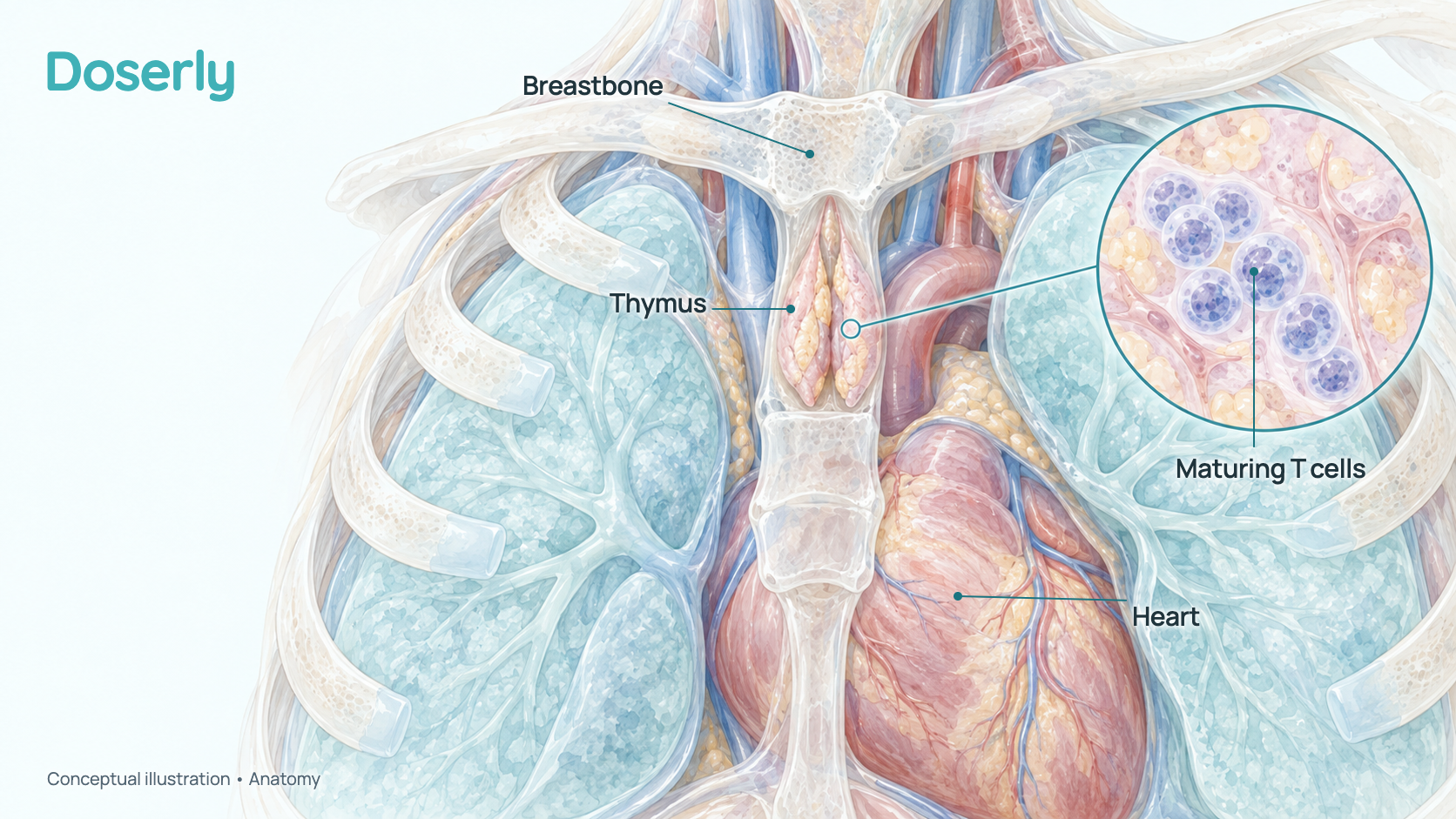
Thymosin alpha-1 (often shortened to TA1 or Tα1) is a lab-made peptide, a chain of 28 amino acids, that copies a small protein first found in the thymus, the gland where T cells mature. As a medicine it is called thymalfasin and sold as Zadaxin, a prescription injection for chronic hepatitis B. Online it is sold as a "research peptide" for immune support, frequent colds, long COVID and autoimmune conditions. [1], [2]
Researchers first purified it in 1977 from thymosin fraction 5, a crude extract of calf thymus. Today's drug is made by chemical synthesis, with an acetyl group on its first amino acid as in the natural peptide. Its effects center on the immune system, although the label says its mechanism "is not completely understood". [1], [3]
Thymosin alpha-1 is a registered medicine in some countries and investigational in others. Singapore and Indonesia license it for chronic hepatitis B (and, in Singapore, hepatitis C alongside interferon), and Italy licenses it to help the flu vaccine work in people with weakened immunity. It is not approved by the US Food and Drug Administration (FDA). The popular claim that it is "approved in over 35 countries" comes from a 2014 manufacturer report that the FDA says it cannot verify. [2], [3], [4], [1]
It is not the same as thymosin beta-4 or TB-500, a different thymus protein sold for tissue repair. See how they compare.
Typical Thymosin Alpha-1 Protocols
| Labeled use (country) | Amount each time | Frequency | Weekly total | Course |
|---|---|---|---|---|
| Chronic hepatitis B, alone or with interferon (Singapore, Indonesia) | 1.6 mg (40 mcg per kg for people under 40 kg) | Twice a week, 3–4 days apart | 3.2 mg (less under 40 kg) | 6 months (52 doses) without interruption in Indonesia; 6–12 months in Singapore |
| Chronic hepatitis C, with interferon (Singapore) | 1.6 mg (40 mcg per kg under 40 kg) | Twice a week | 3.2 mg (less under 40 kg) | 12 months |
| Add-on to flu vaccination in people with weakened immunity (Italy) | 1.6 mg (subcutaneous or intramuscular) | Twice a week | 3.2 mg | 4 weeks from the first vaccine dose, then again from week 8 to week 12 |
On every current label the adult dose is the same: 1.6 mg injected subcutaneously twice a week, 3–4 days apart. Only the course changes with the use, from two 4-week blocks around flu vaccination to 6–12 months for hepatitis. Each vial is mixed with the 1 mL of sterile water supplied, immediately before use, and it must not be injected into a vein. [3], [2], [1]
What schedules do protocol websites describe?
Outside those countries, most people use a research-grade powder bought online, not the licensed product. These schedules come from dosing websites and clinics.
| Example | Amount each time | Frequency | Weekly total | Duration |
|---|---|---|---|---|
| Low | 300 mcg in week 1, then 500 mcg | Once daily | 2.1 mg, then 3.5 mg | 8 weeks |
| Mid | 1.6 mg | Twice a week, 3–4 days apart | 3.2 mg | 8–12 weeks, then 4–6 weeks off |
| High | 1.6–3.2 mg, then twice-weekly doses (amount not restated) | Once daily for 5–7 days, then twice a week | 8–22.4 mg in the daily stretch; later weeks not stated | 5–7 days, then 4–6 weeks (described for severe infection or recovery from surgery) |
The most common schedule in the reviewed sources is the label's own: 1.6 mg by subcutaneous injection twice a week, 3–4 days apart, usually for 8–12 weeks when it is not being used for hepatitis. [8], [6], [9], [10], [11], [12], [13]
Read these cautions before the numbers. The label dose comes from trials in patients with hepatitis, sepsis, cancer and weak vaccine responses. No study has tested any of these schedules in healthy people, or for colds, allergies, long COVID or autoimmune disease. [1]
- Not with deliberate immune suppression. The label rules it out for transplant recipients and others whose immune system is being suppressed on purpose, unless the benefit clearly outweighs the risk. [2]
- Autoimmune disease. Italy's label says use in autoimmune disease must be judged case by case, and people describe flares after starting it, including one urgent-care visit after a single 0.5 mg dose. The most careful advice in community education groups is never to start during a flare. [1], [14]
- Do not stop or delay prescribed treatment to try it. That includes biologics, immunosuppressants and antibiotics; it has never been tested as a replacement for any of them. In community education groups, some people describe doing exactly this. A patient on a cancer immunotherapy developed a life-threatening immune reaction after it was added. [15]
- Children, pregnancy and breastfeeding. Italy's label says not to use it in children and rules it out in pregnancy and breastfeeding; its safety under 18 has not been established. [1], [3]
- Research vials are not the licensed product. The FDA found research and compounded thymosin alpha-1 poorly characterized and warned it may trigger immune reactions. The licensed vial holds 1.6 mg per mL; the peptide dissolves only up to about 2 mg per mL, yet research vials are often mixed several times stronger and turn cloudy. [1], [16]
- Read the units. mcg means micrograms; 1.6 mg is 1,600 mcg. A daily 500 mcg dose and a twice-weekly 1.6 mg dose are different schedules, not interchangeable amounts. On an insulin syringe, a unit measures liquid, not peptide; check any amount with the reconstitution calculator.
- Titration Changing the amount in steps
- The labels use a fixed dose, adjusted only for people under 40 kg (40 mcg per kg). [2] The one trial that compared doses found 0.8 mg and 1.6 mg twice a week worked about equally in hepatitis B. [17] Several trials started with 1.6 mg daily for 1–2 weeks before switching to twice a week. [18], [19] Websites either start low for a week (300 mcg daily, then 500 mcg) or start with a daily loading phase. [5], [7]
- Breaks and cycles
- The hepatitis B label gives 6 months without interruption and names no break; the Italian vaccine schedule leaves a 4-week gap between two courses. Websites add 8–12 weeks on and 4–8 weeks off, two or three courses a year, or seasonal courses in autumn and spring. One notes that no cycling schedule has been studied. [3], [1], [6], [12], [7], [20], [10]
Low, mid and high are alternatives, not steps to move through. The cited references give the full details.
Where protocols differ: daily or twice weekly, bursts and breaks ↓
Where these numbers come from
Label table. The rows reproduce the Singapore National Drug Formulary entry for Zadaxin (last updated 16 September 2026), the Indonesian package insert on file with the Indonesian drug regulator, and the Italian label as summarized by the FDA in its 2024 review. The Italian label allows injection into a muscle for the vaccine use; the Indonesian label rules out muscle and vein injections, and the Singapore entry rules out vein injections. [2], [3], [1]
Website table. Each row is one publisher's complete schedule: low from PeptideDosages, mid from FormBlends and high from Jay Campbell's schedule for acute immune challenges. The low row's text also appears on the same publisher's 5 mg vial page and, nearly word for word, on PeptideDosage.org and The Peptide Guide. [5], [6], [7], [21], [22], [23]
We compared 27 dosing pages from 23 publishers and checked every quoted dose against a saved copy of the page on September 24, 2026. Thirteen pages restate the label's 1.6 mg twice a week, some widening it to two or three times a week or to 0.8–1.6 mg. The "most common" sentence summarizes that group; no median is displayed because most pages give ranges or schedules, not single amounts.
We keep amount, frequency and course length together rather than taking a dose from one page and a duration from another. Pages that misstate trial doses, such as a sepsis trial described as 1.6 mg once daily when it gave 1.6 mg twice daily, or "sepsis protocols" of 10 mg daily that no verified trial used, do not define the comparison. [24], [25], [26]
Row-specific notes: the low row's page calls its 500 mcg daily dose "consistent with clinical dosing ranges"; trials used 1.6 mg per injection, never 500 mcg daily. The high row's page does not restate the twice-weekly amount after the daily stretch, so the table leaves it blank rather than assuming 1.6 mg. [5], [7]
What is thymosin alpha-1 commonly used for?
Most people who look into thymosin alpha-1 online want fewer colds and flu, a faster recovery from infections, relief from long COVID, ME/CFS (myalgic encephalomyelitis, also called chronic fatigue syndrome) or Lyme disease, fewer allergies, or calmer autoimmune disease. Compounded versions are marketed for all of these. [1], [27], [28]
Where it is licensed, it is prescribed for chronic hepatitis B. Most of its recent trials come from China, in sepsis, severe pancreatitis, liver disease and cancer. [2], [29], [30]
These two groups of uses rest on different evidence. The licensed uses come from trials in patients, and even those results are mixed. The popular uses rest on personal accounts, immune-cell measurements and animal research; none has been tested in a trial. The sections below keep them apart.
Chart listing conditions studied with thymosin alpha-1, the size of the main study for each and its result: no difference in deaths in the largest sepsis trial and no fewer pancreatic infections in the pancreatitis trial, uncertain effects in hepatitis B, melanoma and COVID-19, and a signal only in a small open-label liver-failure trial. Popular uses such as colds, allergies, long COVID and autoimmune disease have no trials.
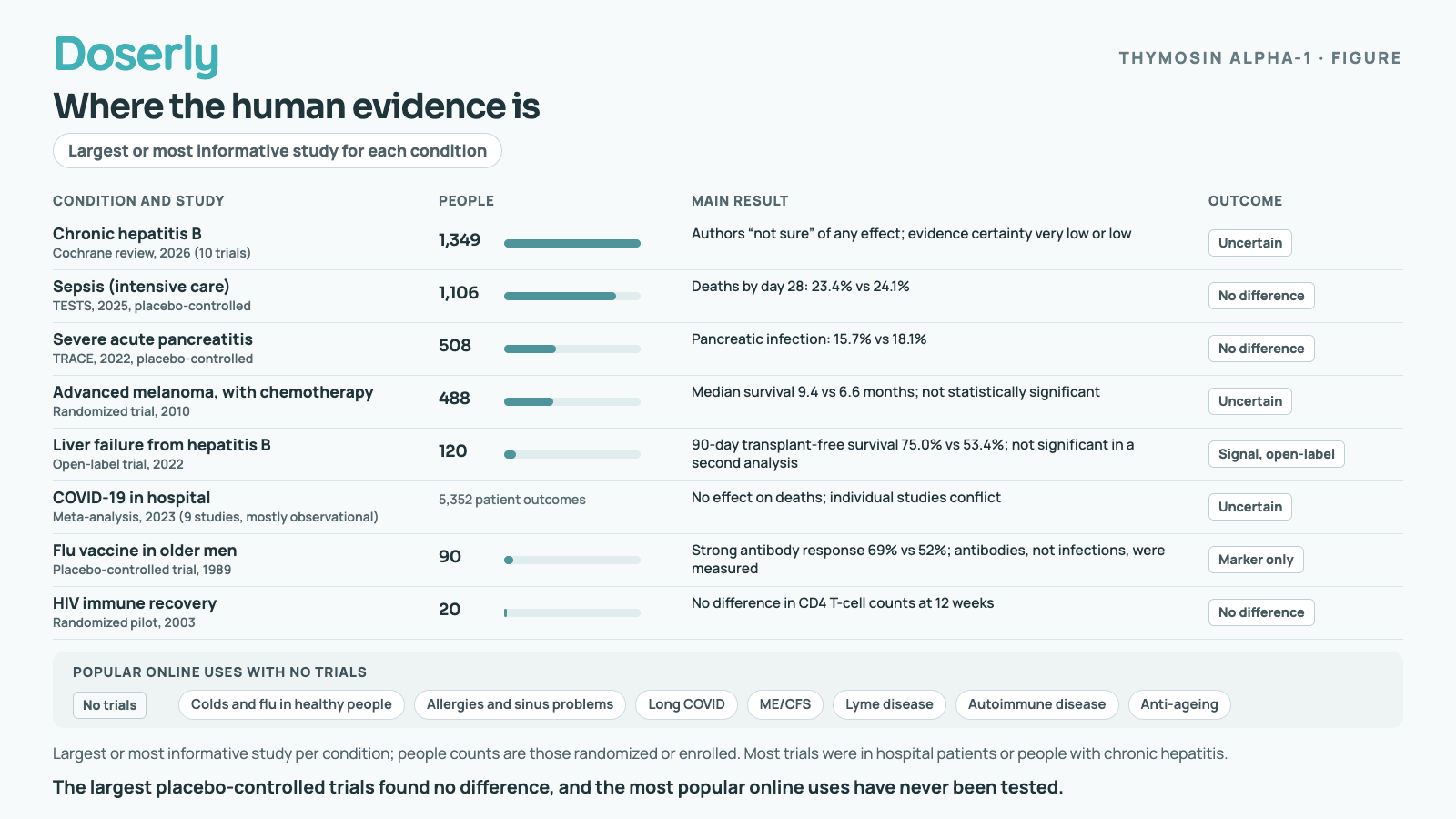
Where the human evidence is
Largest or most informative study for each condition
- Chronic hepatitis B
- StudyCochrane review, 2026 (10 trials)People1,349ResultUncertain Authors "not sure" of any effect; evidence certainty very low or low
- Sepsis (intensive care)
- StudyTESTS, 2025, placebo-controlledPeople1,106ResultNo difference Deaths by day 28: 23.4% vs 24.1%
- Severe acute pancreatitis
- StudyTRACE, 2022, placebo-controlledPeople508ResultNo difference Pancreatic infection: 15.7% vs 18.1%
- Advanced melanoma (add-on to chemotherapy)
- StudyRandomized trial, 2010People488ResultUncertain Median survival 9.4 vs 6.6 months; not statistically significant
- Liver failure from hepatitis B
- StudyOpen-label trial, 2022People120ResultSignal, open-label 90-day transplant-free survival 75.0% vs 53.4%; not significant in a second analysis
- COVID-19 in hospital
- StudyMeta-analysis, 2023 (9 studies, mostly observational)People5,352 patient outcomesResultUncertain No effect on deaths; individual studies conflict
- Flu vaccine in older men
- StudyPlacebo-controlled trial, 1989People90ResultMarker only Strong antibody response 69% vs 52%; antibodies, not infections, were measured
- HIV immune recovery
- StudyRandomized pilot, 2003People20ResultNo difference No difference in CD4 T-cell counts at 12 weeks
Popular online uses with no trials
- Colds and flu in healthy people
- Allergies and sinus problems
- Long COVID
- ME/CFS
- Lyme disease
- Autoimmune disease
- Anti-ageing
The largest placebo-controlled trials found no difference, and the most popular online uses have never been tested.
Colds, flu and "immune support"
This is the most common reason people try it, and there is no trial behind it. No study has tested whether thymosin alpha-1 prevents or shortens colds or flu in healthy people. [1]
The nearest evidence comes from vaccine studies. In a 1989 trial of 90 men aged 65–99, twice-weekly injections around a flu shot raised the share with a strong antibody response from 52% to 69%, mostly in men aged 77 and older. Antibody levels are not the same as fewer infections, and the FDA judged the vaccine studies too small and too old to show a benefit. A US trial now recruiting is testing 4.8 mg before a COVID-19 vaccine booster in older adults. [31], [1], [32]
Long COVID, ME/CFS and Lyme disease
People with these conditions are among the most active users online, and they report the widest range of outcomes, from large improvements to crashes after small doses (see what people report). No trial has tested thymosin alpha-1 in any of them. The FDA found no clinical studies in ME/CFS, and the COVID-19 studies tested the acute infection, mostly in hospital, not long COVID. [1], [33], [28], [14]
Allergies, sinus problems and histamine intolerance
Allergy relief is one of the most common positive stories online, often with allergy medicines or other peptides at the same time. It has not been studied. [27], [34], [35] Italy's label advises caution in people with atopy (a tendency to allergies such as hay fever, asthma or eczema) or past allergic reactions. [1]
Autoimmune conditions
People with lupus, psoriasis, Hashimoto's thyroiditis, rheumatoid arthritis and other autoimmune diseases use it on the idea that it "balances" the immune system. That idea has not been tested: there are no trials of thymosin alpha-1 as a treatment for autoimmune disease. [1]
One Italian study found lower blood levels of thymosin alpha-1 in 200 people with lupus, rheumatoid arthritis or psoriatic arthritis than in 120 blood donors, but a low level does not show that adding more helps. [36] Its known actions stimulate immune cells, Italy's label says autoimmune use must be judged case by case, and flares have been reported (see risks). [1], [14]
Hepatitis B and C
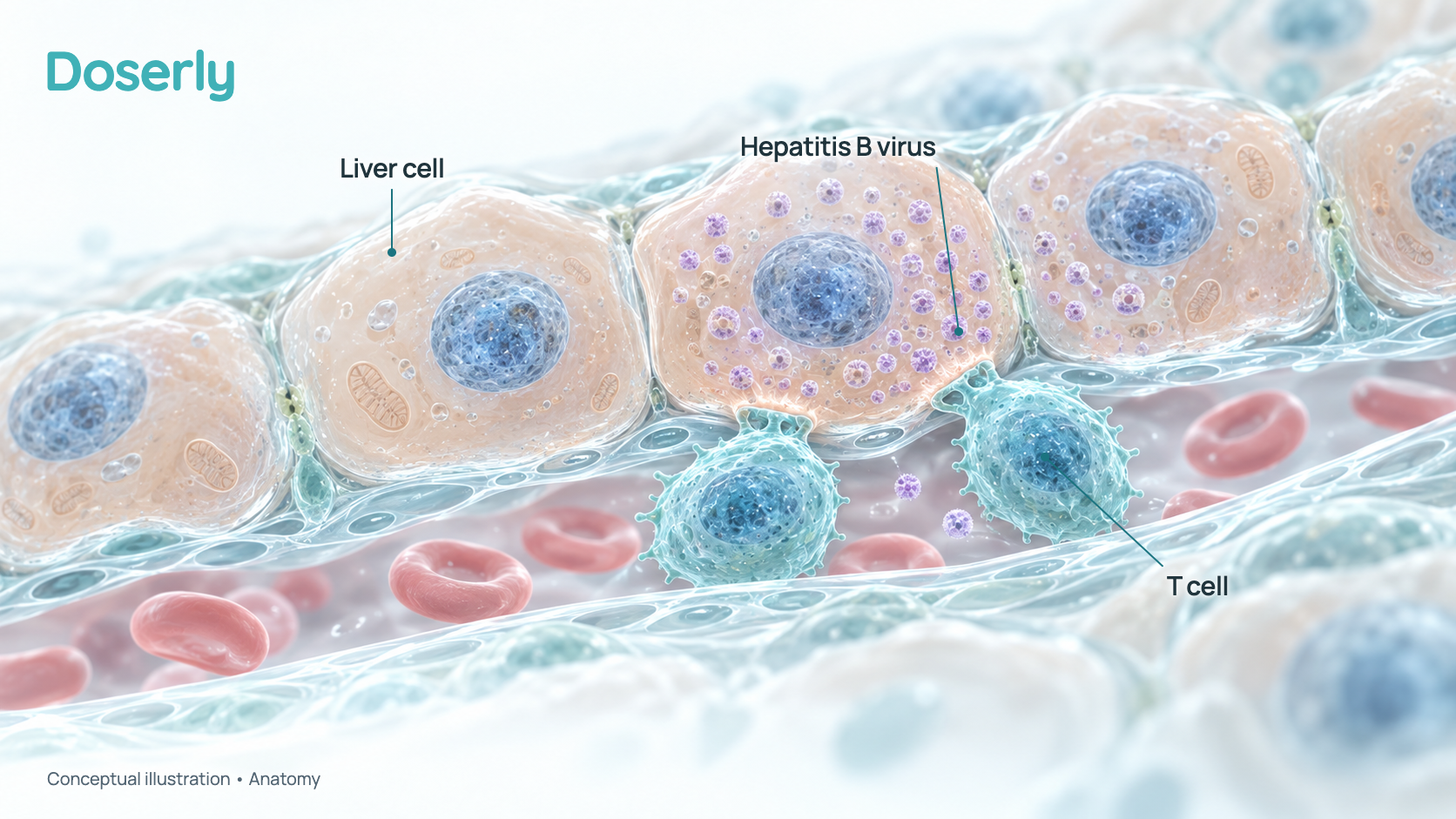
Chronic hepatitis B is the main licensed use. Trials from the 1990s and 2000s gave mixed results, and the 2026 Cochrane review of 10 trials concluded that its authors were "not sure" it helps. Hepatitis C use was always alongside interferon, a treatment that has since been replaced by antiviral tablets. [2], [37], [1] The human research section gives the details.
Sepsis and severe infections in hospital
Sepsis is a dangerous whole-body reaction to infection. Thymosin alpha-1 was tested as an add-on to intensive care, and the largest trial, 1,106 adults in 22 Chinese intensive care units, found no difference in deaths. [29] A trial in severe pancreatitis also found no benefit. [30] These were hospital treatments given alongside antibiotics, not evidence for home use during an illness.
Cancer
It has only ever been studied as an add-on to cancer treatment, never as a treatment on its own. A 488-person melanoma trial found a trend toward longer survival that fell short of statistical significance, and a Cochrane review found no clear survival effect across cancer trials. [38], [39] Recent Chinese trials test 4.8 mg per dose alongside chemotherapy and immunotherapy, without posted results. [40] One patient on a cancer immunotherapy had a life-threatening immune reaction after it was added. [15]
Other uses you may come across
Small studies have looked at flare-ups of COPD (chronic obstructive pulmonary disease), replanting knocked-out teeth, immune recovery in HIV and depression in people with an antibody deficiency, and a trial in repeated IVF implantation failure is recruiting. Hair regrowth and anti-ageing claims appear only in personal accounts and marketing. [41], [42], [19], [43], [44], [45]
Where do thymosin alpha-1 protocols differ?
Thymosin alpha-1 schedules disagree mainly on how often to inject: twice a week, as on the label, or a smaller amount every day. They also split on short daily "bursts", course length and breaks. Here is what changes between them and why it matters.
Twice a week or every day?
The label gives 1.6 mg twice a week. A second group of websites gives 300–500 mcg every day instead, reasoning that 500 mcg a day adds up to about 3.5 mg a week, which one page calls "consistent with clinical dosing ranges". The earliest dated version of this idea is a 2024 page that split the weekly amount into daily doses because thymosin alpha-1 leaves the blood quickly. [5], [46]
Equal weekly totals do not mean equal exposure. After an injection, blood levels peak at about 2 hours and are back to baseline within 24 hours, so a 1.6 mg injection and a 500 mcg injection each produce their own peak, gone by the next day. [3], [47] No study has compared daily with twice-weekly dosing, so nobody knows whether either pattern works better. One website's 1.5 mg "five days on, two days off", described as the same weekly total, is actually 7.5 mg a week, more than twice the label's 3.2 mg. [20]
Weekly calendar comparing three thymosin alpha-1 schedules: the label's 1.6 mg on two days (3.2 mg a week), 500 mcg every day (3.5 mg a week) and 1.5 mg on five days (7.5 mg a week). Each dose clears from the blood within a day. No study has compared these schedules.
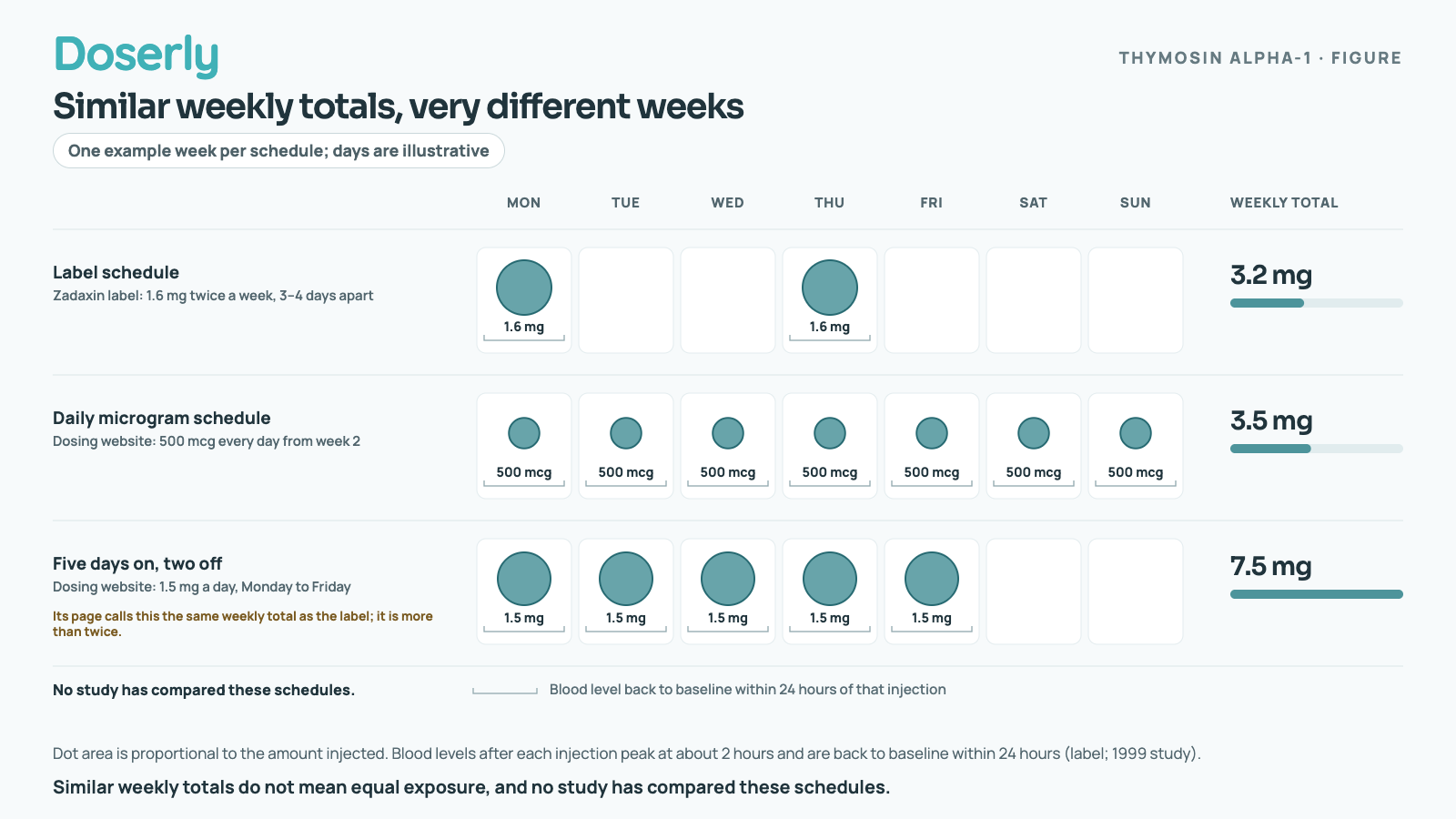
Similar weekly totals, very different weeks
One example week per schedule; days are illustrative
- Label schedule · 3.2 mg a week
- Zadaxin label: 1.6 mg twice a week, 3–4 days apart
- Daily microgram schedule · 3.5 mg a week
- Dosing website: 500 mcg every day from week 2
- Five days on, two off · 7.5 mg a week
- Dosing website: 1.5 mg a day, Monday to Friday
Its page calls this the same weekly total as the label; it is more than twice.
Similar weekly totals do not mean equal exposure, and no study has compared these schedules.
Is 1.6 mg, 1.5 mg or 1 mg the right amount?
1.6 mg is simply the content of one licensed vial. Research powders come in 5 and 10 mg vials, so many people round to 1.5 mg or 1 mg to make a vial divide evenly, and 1–1.5 mg are the amounts people report most often in public forums and community education groups. [27], [34], [48]
The one trial that compared doses, in 316 Japanese people with hepatitis B, found 0.8 mg and 1.6 mg twice a week worked about equally overall, although people with advanced liver scarring did better on 1.6 mg. [17], [1] That is the only human evidence for a lower dose, and it comes from a liver disease, not from healthy use.
Loading courses and short "bursts" when illness starts
Several trials started with daily injections: 1.6 mg a day for the first 1–2 weeks, then twice a week, in liver failure from hepatitis B, in HIV and in a small depression study. [18], [19], [43] Websites borrow this as a "loading" phase, sometimes at 3.2 mg a day. [7], [49], [50]
Many users go further and inject about 1 mg every day for up to 10 days at the first sign of a cold or flu, or when someone at home falls ill. One dosing site describes daily 1 mg courses of 10–30 days as community practice rather than trial dosing, and in community education groups this is the most repeated pattern after the twice-weekly schedule. [8], [51], [52] No study has tested it for colds, flu or sore throats, and it does not replace antibiotics for a bacterial infection. The intensive twice-daily doses in sepsis trials were given to intensive care patients alongside antibiotics, and the largest trial found no survival benefit. [29]
How long, and are breaks needed?
For hepatitis B the label says 6 months (52 doses) without interruption, and a Taiwanese trial found a 26-week course did at least as well as 52 weeks. [3], [53] Websites instead describe 8–12 weeks on and 4–8 weeks off, two or three courses a year, or seasonal courses in autumn and spring. [6], [7], [12], [20]
Community education groups disagree just as much: some teach continuous year-round use, others fixed courses stopped once an illness clears, or regular breaks meant to keep the immune system from being overstimulated. No study has tested whether breaks matter, and one dosing page says so plainly. [10]
Morning or evening?
The labels say nothing about timing. Some community education groups advise bedtime doses and others morning doses, and people describe lying awake after an evening injection; one protocol page prefers morning. [13], [54] There is no evidence either way.
What about 3.2, 4.8 or 6.4 mg?
Larger single doses come from supervised trials: 3.2 mg in HIV and in some sepsis studies, 1.6–6.4 mg added to chemotherapy in melanoma, and 4.8 mg in recent Chinese cancer trials that have not posted results. [55], [56], [38], [40] In an early cancer study, single injections into a muscle of up to about 16 mg did not reach a dose that caused serious side effects. [1] One website extends to 6.4 mg twice a week "in severe cases under medical supervision". [57] None of these doses has been tested for everyday use.
How do milligrams convert to syringe units?
Research thymosin alpha-1 is sold as a freeze-dried powder that is mixed with sterile or bacteriostatic water before use (reconstitution). On a U-100 insulin syringe, units measure volume, not drug. For example, a 10 mg vial (10,000 mcg) mixed with 5 mL holds 2,000 mcg per mL, or 20 mcg per unit, so 1.6 mg is 80 units and 500 mcg is 25 units. The same vial mixed with 2 mL, as one dosing page shows, holds 5 mg per mL, and 1.6 mg becomes 32 units. [8]
The licensed product holds 1.6 mg in 1 mL, and the FDA says the peptide dissolves only up to about 2 mg per mL, so strong mixes may not fully dissolve (see storage). [3], [1] Doserly's reconstitution calculator works out the units for any vial and shows each step.
What happens when you stop thymosin alpha-1?
No withdrawal effects or rebound have been described in the labels or trials, but no study was designed to look for them. [3], [1]
- Hepatitis B responses can arrive after stopping. On the label and in trials, more people cleared the virus in the 6–12 months after treatment than by its end, which is why the label asks for blood tests 2, 4 and 6 months after the last dose. [3], [53]
- Immune changes fade. In a five-person study of depression in people with an antibody deficiency, the immune-cell changes did not last through an 8-week break, and depression returned in the two most severe cases. [43]
- Personal accounts. Several people describe allergy or fatigue relief returning within days or weeks of stopping. A few describe benefits lasting months, and one described benefits lasting over a year after 2.5 years of use. [34], [58], [59], [60], [33] In community education groups, people describe the same split.
The breaks websites recommend are a convention; no study has tested them. [10]
Source-by-source comparison of thymosin alpha-1 dosing pages
How do the dosing pages compare?
Unit key: 1 milligram (mg) = 1,000 micrograms (mcg). One licensed vial holds 1.6 mg.
Thirteen of 27 pages restate the label: 1.6 mg twice a week, 3–4 days apart. They include Peptide Dosing Protocols, FormBlends, The Peptide Toolkit, PeptideFox, Professor Peptides, BiologicalX and both Peptide Initiative pages. [8], [6], [9], [10], [61], [11], [49], [12] Some widen it to two or three times a week (FormBlends; Swolverine at 1.0–1.5 mg) or to 0.8–1.6 mg (PeptaBase). [6], [62], [13]
A second family gives 300 mcg daily for a week, then 500 mcg daily to week 8: PeptideDosages, copied nearly word for word by PeptideDosage.org and paraphrased by The Peptide Guide. The earliest dated version of the daily idea is a 2024 Peptides.org page giving 500 mcg a day. [5], [21], [22], [23], [46]
A third adds a daily loading week: 1.6–3.2 mg a day for 5–7 days, then twice a week (Jay Campbell, Middle Way Nutrition, Peptide Initiative), up to 1.6 mg daily or 3.2 mg twice a week and 6.4 mg twice a week "in severe cases" (Peptidepedia). [7], [50], [49], [57] Others give 1.5 mg daily five days a week (PS Peptides), 1.5 mg per injection (Peptide Mind) or 1.6–3.2 mg per injection once or twice a week (Guide to Peptide). [20], [63], [64]
Which pages contain errors?
Peptide Protocol Wiki describes the ETASS sepsis trial as 1.6 mg once daily for 7 days; the trial gave 1.6 mg twice daily for 5 days, then once daily for 2. [24], [26] Beverly Hills Rejuvenation Center lists "10 mg daily" among sepsis protocols; no verified sepsis trial used it. [25] PeptideFox credits a 40.6% hepatitis B response to a meta-analysis; the figure is one arm of a 1998 Taiwanese trial. [10], [53] MyPeptideMatch gives both "1.6 mg to 3.2 mg per week" and the label's schedule, which is 3.2 mg a week. [65]
PS Peptides, Middle Way Nutrition and PeptideDosages treat daily microgram doses as equivalent to the label because the weekly totals are similar; blood measurements show each dose clears within a day, so that does not follow. [20], [50], [5], [3] Several pages, including Peptide Dosing Protocols and The Peptide Toolkit, repeat "approved in over 35 countries", a figure the FDA could not verify. [8], [9], [1]
Where do the website cycles come from?
The hepatitis B label runs 6 months without a break. The 8–12-week courses with 4–8 weeks off (FormBlends, PeptaBase, Peptide Initiative), two or three courses a year (Jay Campbell) and seasonal courses (PS Peptides) are website additions. PeptideFox notes that no cycling schedule has been studied and that trials used continuous dosing. [3], [6], [13], [12], [7], [20], [10]
How is thymosin alpha-1 taken, and how long does it last?
By subcutaneous injection. Every current label and nearly every trial used this route; the labels rule out injection into a vein, and only Italy's vaccine use allows injection into a muscle. [3], [2], [1] The FDA found compounded thymosin alpha-1 sold as nasal sprays as well as injections, but no study has measured how much of a nasal or swallowed dose reaches the blood (its bioavailability). [1]
The labels name no preferred injection site, and no study has compared sites or tested an effect at the injection site.
How long does thymosin alpha-1 last in the body?
Its half-life in the blood is about 2 hours. In healthy volunteers, levels peaked 1–2 hours after an injection and returned to baseline within 24 hours, with no build-up over 5–7 daily doses of 1.6–16 mg; 31–60% of each dose left the body in urine. [3], [47] In most volunteers, the body's own levels were too low to measure with the same test. [47]
How long an effect lasts is a different question. The twice-weekly label schedule, and hepatitis B responses that appear months after the last dose, suggest effects outlast blood levels, but no human study has measured how long an immune effect lasts after a single injection. [3], [53] This is the core of the daily versus twice-weekly disagreement.
Is research "TA1" the same as Zadaxin?
Not necessarily. Zadaxin is a finished medicine: 1.6 mg of peptide with mannitol and a phosphate buffer at pH 6.8, made to a regulator's standards. [3] Research powders are sold as the free peptide or as an acetate salt, which the FDA treats as separate substances. It judged neither well characterized and found no data on their impurities, clumping (aggregation) or bacterial toxins. [1]
Even licensed formulations differ: in a 9-person study, one of three products (Timosina) produced higher blood levels than the other two at the same dose. [47] A 2022 laboratory study found 23 related impurities in thymalfasin materials, more than half from the breakdown of its last amino acid. [66] A long-acting "pegylated" version tested in China is a different molecule. [67]
How should thymosin alpha-1 be stored, and how long does it last?
For the licensed product the answer comes from the label. For research powders and mixed vials, no shelf life for human use has been established.
- Licensed vials (Zadaxin). Keep at 2–8 °C; unopened shelf life is 3 years. Mix with the 1 mL of sterile water supplied immediately before use and use it right away. [3], [2]
- Research powder. Supplier data quoted by the FDA say the dry powder is stable for three weeks at room temperature and should be kept dry below −18 °C for long-term storage; once mixed, 2–7 days at 4 °C, or frozen with an added carrier protein. These are laboratory-supplier statements, not a drug label. [1]
- Mixed research vials. Dosing websites give anything from "use immediately" or 48 hours to 7, 14–21, 28 or 30 days, sometimes two different figures on the same page. None cites a stability test for a vial mixed with bacteriostatic water at home. [24], [22], [49], [68], [8], [9], [63]
- Cloudy or gelled vials. These are a frequent complaint, especially when a 5–10 mg vial is mixed with 0.5–1 mL of water, several times the licensed strength. Advice to fix it with acid, baking soda or buffered saline conflicts and has not been tested. Community education groups advise against injecting a solution that stays cloudy, and the FDA links clumped peptide to immune reactions. [16], [1]
Bar chart comparing thymosin alpha-1 solution strengths: the licensed vial at 1.6 mg per mL, near the peptide's reported solubility of about 2 mg per mL, against website examples of 3.3 and 5 mg per mL and research vials mixed at 5 to 10 mg per mL, where cloudy or undissolved vials are reported.
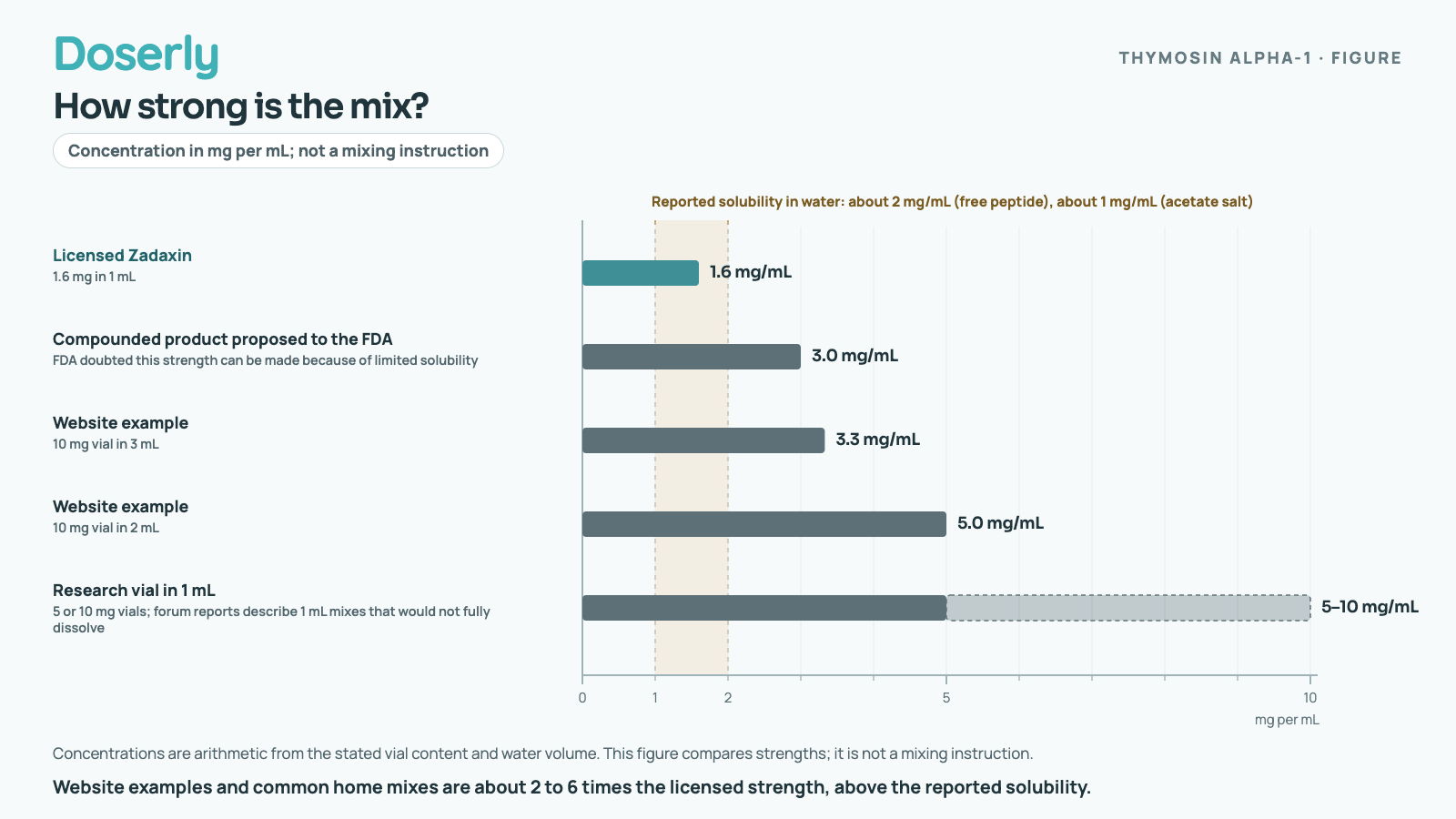
How strong is the mix?
Concentration in mg per mL; not a mixing instruction
- Licensed Zadaxin · 1.6 mg/mL
- 1.6 mg in 1 mL
- Compounded product proposed to the FDA · 3.0 mg/mL
- FDA doubted this strength can be made because of limited solubility
- Website example · 3.3 mg/mL
- 10 mg vial in 3 mL
- Website example · 5.0 mg/mL
- 10 mg vial in 2 mL
- Research vial in 1 mL · 5–10 mg/mL
- 5 or 10 mg vials; forum reports describe 1 mL mixes that would not fully dissolve
Website examples and common home mixes are about 2 to 6 times the licensed strength, above the reported solubility.
This guide does not cover mixing or injection technique; the Academy note below covers practical handling.
What do we actually know about thymosin alpha-1 in people?
More than for almost any other peptide sold online: dozens of trials in thousands of patients. But most are small, open-label (everyone knew who got the drug) or decades old, and the largest, best-designed trials found no clear benefit on the outcomes that matter most. None tested healthy people. [1], [29], [37]
Hepatitis B: what did the trials find?
| Study | What researchers reported | What it cannot establish |
|---|---|---|
| Taiwan, 1998 | 98 patients. Complete response (virus and a marker of active infection cleared) at 18 months in 40.6% after 26 weeks of 1.6 mg twice a week and 26.5% after 52 weeks, versus 9.4% untreated; the groups were similar at the end of treatment. | No placebo; the longer course did not do better. [53] |
| US phase 3, 1999 | 97 patients, placebo-controlled, 1.6 mg twice a week for 6 months: complete response 14% versus 4%, not statistically significant. | The authors said it did not confirm earlier results. [69] |
| Italy, 1996 and 2000 | 33 and 44 patients: similar to interferon in one trial, no better than no treatment in the other. | Small. [70], [71] |
| Japan, 2005 | 316 patients given 0.8 or 1.6 mg for 24 weeks: liver enzymes normal a year after treatment in 36.4% on 1.6 mg, with similar results on 0.8 mg. | No untreated comparison group. [17] |
| Cirrhosis, China, 2018 | 690 people with liver scarring on the antiviral entecavir, with or without a year of thymosin alpha-1: no difference in liver failure, liver cancer or death over about 3 years. | Open-label. [72] |
| Liver failure, China, 2022 | 120 people with hepatitis B that had flared into liver failure: 90-day survival without a transplant 75.0% versus 53.4%, and fewer new infections (32.1% versus 58.6%). | Open-label; the survival difference was not significant in a second analysis. [18] |
| Cochrane review, 2026 | 10 trials, 1,349 adults: fewer deaths in 3 trials (907 people) and fewer serious adverse events, with evidence certainty rated very low or low. | The authors say they are "not sure" of any effect. [37] |
The labels cite a pooled analysis of three trials (223 patients): 36% versus 19% responded a year after treatment. [3] A 2008 meta-analysis found it worked less well than interferon by the end of treatment but better 6 months later, the same delayed pattern. [73] Only the cirrhosis trial added it to a modern antiviral, and it found no benefit. [72]
Hepatitis C
With interferon, a 109-person US trial found more people with normal liver enzymes at the end of treatment (37.1% versus 16.2%) but few lasting responses (14.2% versus 8.1%); on its own it did not clear the virus in a 19-person pilot. [74], [75] Interferon has since been replaced by antiviral tablets, so these results say little about care today. [1]
Sepsis: what did the TESTS trial find?
| Study | What researchers reported | What it cannot establish |
|---|---|---|
| TESTS, 2025 | 1,106 adults in 22 Chinese intensive care units, 1.6 mg or placebo every 12 hours for up to 7 days: deaths by day 28 were 23.4% versus 24.1% (hazard ratio 0.97), and deaths by day 90 also did not differ. | Subgroup results pointed both ways: more deaths in people under 60, fewer in people with diabetes. [29] |
| ETASS, 2013 | 361 adults, 1.6 mg twice daily for 5 days, then daily for 2: deaths 26.0% versus 35.0%. | Single-blind; borderline, with a confidence range that included no effect. [26] |
| Reset-α, 2025 | 123 adults in India, 3.2 mg twice daily for 7 days: better organ-function scores. | Small; published in a low-barrier journal; linked to the product's supplier. [56] |
| TRACE, 2022 (pancreatitis) | 508 adults with severe acute necrotising pancreatitis: infection of the damaged pancreas in 15.7% versus 18.1%, no significant difference. | Tested infection prevention, not survival. [30] |
The TESTS result was corrected in May 2025: the hazard ratio changed from 0.99 to 0.97, and older summaries and the PubMed abstract still show the first figure. [76] A 2025 meta-analysis of 11 trials found fewer deaths overall, but not when it was limited to high-quality or multicentre trials, and judged the evidence too small to settle the question. [77]
COVID-19
The evidence conflicts. A small Wuhan study reported fewer deaths in severe cases (11% versus 30%), a study of 771 critical cases found no difference once 522 of them were matched for how ill they were, and a 2,282-person cohort found treated patients less likely to recover. [78], [79], [80] Meta-analyses disagree, and a US pilot trial in 49 hospital patients found no significant difference in recovery before it stopped for slow enrolment. [81], [82], [83] In a prevention trial in kidney dialysis patients, 5 of 91 treated and 7 of 98 untreated people caught COVID-19, too few to draw a conclusion. [84]
Vaccines, HIV and immune recovery
These studies measured immune markers rather than infections. Older men given it with the 1986 flu vaccine more often had strong antibody responses (69% versus 52%), and dialysis patients had higher antibody levels three weeks after a pandemic flu vaccine, with no sign that the effect lasted. [31], [85], [1] In HIV, 3.2 mg twice a week for 12 weeks did not raise CD4 counts (a key T-cell count) more than no treatment. A 24-week single-group study in people whose CD4 counts had stayed low found no significant rise in the count itself, although the mix of T cells changed. [55], [19] The FDA found the vaccine studies too small, too old and measured with tests that do not show protection. [1]
Cancer
Always as an add-on. In 488 people with advanced melanoma, adding it to chemotherapy gave a median survival of 9.4 versus 6.6 months, a difference that fell short of statistical significance, with no extra side effects. [38] A 2011 Cochrane review found no clear survival effect across cancer trials, and lung and liver cancer studies are mostly small, retrospective or at unclear risk of bias. [39], [86], [87] A 2025 conference abstract, a low-grade source, reported 21 people with advanced solid tumours given it alongside radiotherapy, a checkpoint inhibitor and an immune-cell growth factor: tumours shrank enough to count as a response in 23.8% and no severe (grade 3 or higher) side effects were reported. With no comparison group and three other treatments, none of this can be credited to thymosin alpha-1. [130]
What are the registered studies planning?
Checked September 24, 2026: ClinicalTrials.gov lists 66 studies under its names, and only 2 have posted results. [67] These are plans, not results.
4.8 mg on days 1 and 3 of each induction cycle
Added to chemotherapy, radiotherapy and immunotherapy for lung cancer; later stages use other intervals.
Completed June 2026 with 114 participants. No results posted.
[40]4.8 mg once or twice before a COVID-19 vaccine booster
Tests whether three 1.6 mg injections on the vaccination day, or on days 0 and 3, improve antibody responses compared with no thymosin alpha-1.
Recruiting. Primary completion estimated December 2026.
[32]Repeated implantation failure in IVF
Started in the second half of an assisted-reproduction cycle and continued to about 11 weeks of pregnancy; the dose is not disclosed. A registered plan is not evidence of safety in pregnancy.
Recruiting. 136 planned; primary completion estimated February 2027.
[44]1.6 mg twice a week for 6 months after surgery
An add-on after removal of high-risk stage II or III colorectal cancer.
Recruiting. 2,500 planned.
[88]Has thymosin alpha-1 been tested in healthy people?
No. The only healthy-volunteer studies measured blood levels after injection. [47] None of the trials above enrolled healthy adults, and claims of stronger immunity, fewer colds or slower ageing in healthy people have not been tested. [1]
What do immune-cell results actually show?
Many studies report changes in T cells, dendritic cells or immune proteins. Those are markers, not outcomes. In HIV, the share of certain T cells improved without a clear rise in counts; in sepsis, a better immune marker (mHLA-DR) in the ETASS trial did not become a survival benefit in the larger TESTS trial. [19], [26], [29] When you read a claim, ask whether it measured a marker, fewer infections, or survival.
How might thymosin alpha-1 work?
Nobody knows exactly. The label says its mechanism "is not completely understood" and is thought to center on strengthening T-cell function, based mostly on laboratory and animal work. [3] Laboratory experiments often use concentrations far above the blood levels measured after an injection, so a finding in a dish may not happen in the body. [47], [89]
What does the thymus have to do with it?
The thymus is where young T cells learn which targets to attack. In laboratory tests, thymosin alpha-1 helped T cells mature, raised immune signalling proteins such as interferon-gamma and interleukin-2, and increased the activity of natural killer cells. In animals whose immune systems had been weakened by chemotherapy, radiation or tumours, it protected against infections and bone-marrow damage. [3] Whether the same happens in a healthy adult has not been measured.
Does it switch on dendritic cells?
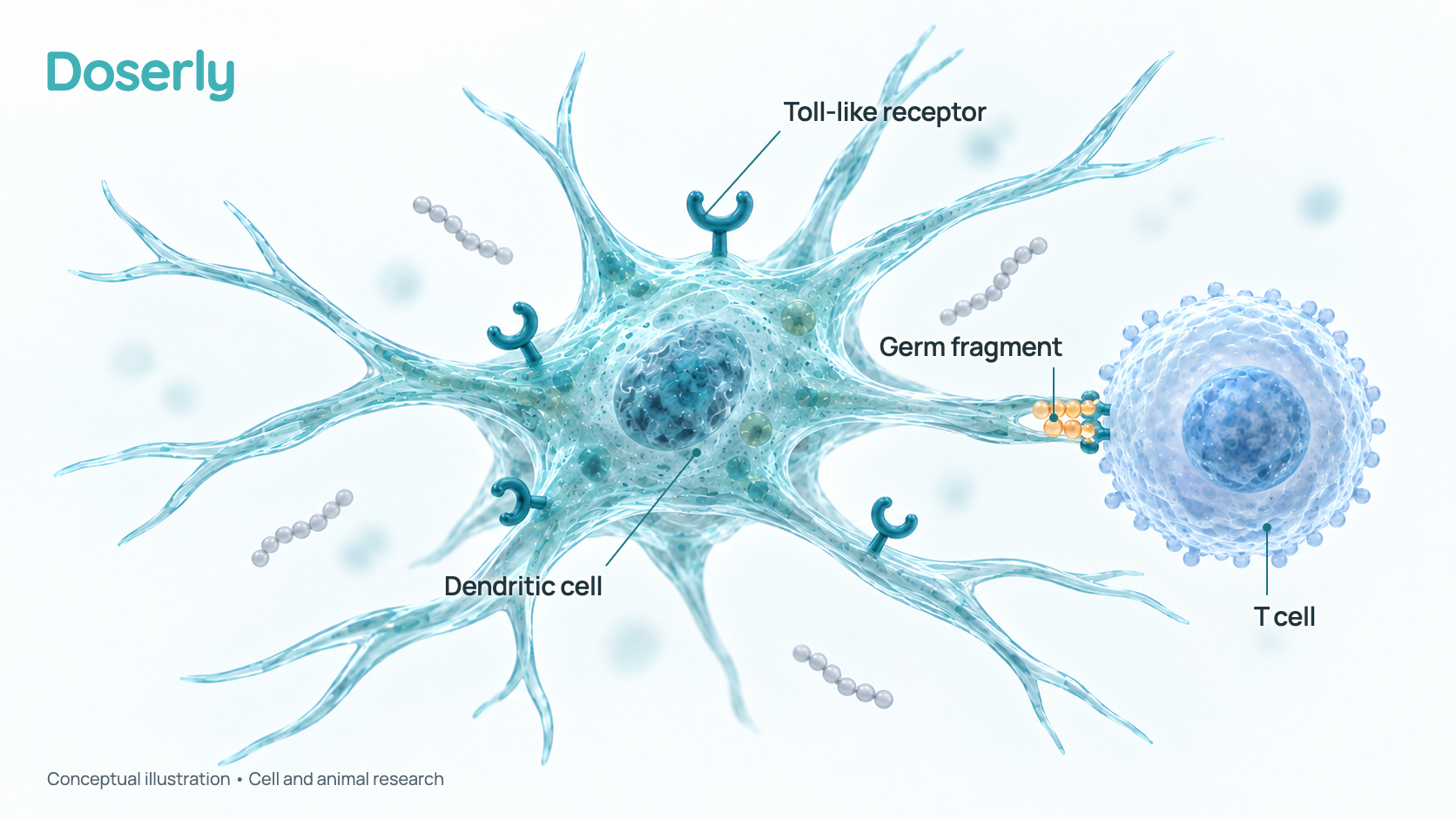
In mice and in human cells in a dish, yes. It helped dendritic cells (immune "scouts" that show T cells what to attack) mature and send signals through toll-like receptors, sensors that detect germs, and it protected mice with weakened immune systems from a fungal infection. [90], [91]
Does it "balance" the immune system?
That is a common marketing word, and the evidence is mixed rather than supportive. In human cells in a dish, it strengthened responses to virus-like signals but damped responses to bacterial signals, and in mouse cells its effect depended on which other inflammatory signals were present. [92], [93]
It raised regulatory T cells, which calm immune responses, only at a laboratory concentration hundreds to more than a thousand times higher than blood levels after an injection. [89], [47] No study shows that it calms autoimmune disease in people. [1]
Does it affect cancer growth?
In laboratory tests it did not make tumour cells grow or turn normal cells cancerous, and a 2026 mouse study suggested it helps immune cells respond after chemotherapy. [94], [95] No long-term cancer (carcinogenicity) study has been done. [3]
What else has been reported?
A 2026 single-laboratory study reported that it binds a brain receptor involved in wakefulness (the orexin receptor) and protected brain tissue after stroke in mice. This is an early, unreplicated finding. [96]
What are the risks and unanswered questions?
Is thymosin alpha-1 safe?
At the licensed dose, in patients under medical care, trials found it well tolerated; outside that setting its safety is much less known. The label reports no clinically significant reactions in more than 2,000 treated people (under 1% of events judged drug-related), and in the largest trial, side effects were as common on placebo (66.4% versus 67.6%; serious events 26.8% versus 29.3%). [3], [29]
But the trials were short courses in hospitals and liver clinics, no long-term cancer study has been done, the FDA found no published animal toxicity studies beyond the manufacturer's brief summaries, and research powders are not the licensed product. [3], [1] The often-quoted "11,000 people with no safety concerns" comes from a narrative review that argued against FDA restrictions; it names the databases it searched but not how it chose its studies. [97]
What side effects have been reported?
| Problem | What was reported | Source |
|---|---|---|
| Injection site | Local discomfort, the most common complaint; occasional redness | Label, FDA review [3], [1] |
| Rare reactions | Temporary muscle wasting, joint pain with hand swelling, and rash | Label [3] |
| Fever, fatigue, nausea | Listed with vomiting and low neutrophils (a type of white blood cell) among risks seen in trials | New Zealand regulator's summary [98] |
| Liver enzymes in hepatitis B | Temporary ALT flares in 22 of 316 patients (11 at each dose); all recovered; the label says to continue unless signs of liver failure appear | Trial, label [1], [2] |
| Thyroid | Temporary changes in thyroid-stimulating hormone in 2 patients given it with interferon | Trial [1] |
| Severe immune reactions | One fatal immune destruction of red blood cells among 6 stem-cell transplant patients; one multi-organ immune reaction with a cancer immunotherapy; the cause is unclear in both | Small study, case report [99], [15] |
| Nipple pain | In more than 10% of treated patients in a 25-person liver-cancer study | Trial [1] |
People using research products also describe flu-like crashes, joint pain, anxiety and poor sleep; those accounts are covered in what people report.
Can thymosin alpha-1 trigger an autoimmune flare?
It might, and nobody has measured how often. It stimulates immune cells, the label urges caution with other immune-modulating medicines, and Italy's label says use in autoimmune disease must be judged case by case. [3], [1] People describe flares after starting it, including severe whole-body joint pain after a single 0.5 mg dose, and severe anxiety and night sweats in someone with an autoimmune history. [14], [33]
In community education groups, first-hand reports include spreading psoriasis, worsening thyroid autoimmunity and a returning nerve-pain condition. Educators there disagree: some call it the main peptide for autoimmune disease, while the most careful course material says to avoid it in Graves' disease, active lupus, vasculitis and myasthenia gravis or during a multiple sclerosis relapse, and never to start during a flare. That material also suggests a lower start (0.8 mg twice a week) and checking the disease's antibody and inflammation tests; the only human support for a lower dose is the hepatitis B comparison of 0.8 and 1.6 mg. [17]
Can it be combined with cancer immunotherapy, biologics or transplant drugs?
This is where the clearest warnings are. The label rules it out in people whose immune system is being deliberately suppressed, such as transplant recipients, unless the benefit clearly outweighs the risk. After stem-cell transplants, the FDA raised concerns about graft failure and graft-versus-host disease. [2], [1]
A 2026 case report described a life-threatening multi-organ immune reaction in a patient given it with a checkpoint inhibitor, a type of cancer immunotherapy. [15] A 2025 conference abstract on 21 people given it with a checkpoint inhibitor, radiotherapy and an immune-cell growth factor reported no severe (grade 3 or higher) side effects; it is a small report with no comparison group, so it cannot rule out rare reactions like that one. [130] With biologics for Crohn's disease, psoriasis or rheumatoid arthritis, combinations are unstudied and the two push the immune system in opposite directions; some people online ask whether to delay their biologic to try it. [100] Changes to these medicines belong with the prescribing specialist.
Could product quality change the risk?
Yes. The FDA found research and compounded thymosin alpha-1 "not well-characterized", with no data on impurities, clumping or bacterial toxins, and warned that such products may provoke the immune system to react against the peptide itself (immunogenicity). [1], [101] Health Canada has seized unauthorized vials labelled thymosin alpha-1 from online sellers. [102], [103] Mixes stronger than the licensed 1.6 mg per mL add a further risk of undissolved or clumped peptide (see storage).
Is thymosin alpha-1 legal? Is it FDA-approved?
Checked September 24, 2026. Rules differ by country and change quickly. A "research use only" label does not make a product legal to sell or safe to use.
United States. Thymosin alpha-1 is not an FDA-approved medicine. The key steps:
- Orphan designations. It holds four US orphan designations, a status that supports development for rare diseases and is not an approval. [1]
- 2023. It was placed in Category 2, "significant safety risks", of the FDA's list of substances nominated for pharmacy compounding. [104]
- 2024 FDA review. The nomination was withdrawn, but the FDA reviewed the free peptide and its acetate salt for 12 uses anyway and recommended against adding either to the list of ingredients pharmacies may compound. [1]
- December 4, 2024. The FDA's Pharmacy Compounding Advisory Committee voted 4 yes and 17 no for each form. An advisory vote is not a final agency decision. [105]
- Now. It is not in any category of the FDA's 503A compounding list (updated May 14, 2026). The FDA's safety-risk page lists it as "nominated but withdrawn" with an immune-reaction warning, it sits in the "nominated without adequate support" group for outsourcing facilities, and no final rule has been published. [106], [101], [107], [108]
Canada. Health Canada lists no authorized product. It named "Thymosin alpha" among seized unauthorized injectable peptides in August 2025 and "Thymosin Alpha-1 10 MG" in a December 2025 seizure, and warns that injectable peptides are prescription drugs. [109], [102], [103], [110]
Australia. No thymosin alpha-1 product is on the Australian Register of Therapeutic Goods, and the Therapeutic Goods Administration fined a company in 2020 for advertising it as a COVID-19 preventive. New Zealand's regulator said in June 2025 that it was not scheduled in Australia; we could not check the current Australian schedule. [111], [98]
New Zealand. "Thymic peptide hormones and their analogues", a group New Zealand's regulator defined to include thymosin alpha-1, became prescription medicines on 19 December 2025. [112], [98]
Europe. Authorized nationally in Italy to help the flu vaccine work in people with weakened immunity. Its 2002 EU orphan designation for liver cancer is not a marketing approval. [4]
Asia. A prescription medicine in Singapore and registered in Indonesia; the FDA also lists approvals in India and Hong Kong. [2], [3], [1]
Is thymosin alpha-1 banned in sport? Does it show up on a drug test?
It is not named on the World Anti-Doping Agency's 2026 or 2027 lists, which name thymosin beta-4 and TB-500 instead. Their S0 rule bans substances with no current government approval for human use; because thymosin alpha-1 is approved in several countries, it is unclear whether S0 covers it, and we found no anti-doping ruling or athlete case naming it. Competitive athletes should check with their anti-doping organization. [113], [114]
Who should be especially cautious?
The label and Italy's label rule out or warn about the first five groups. The others have not been studied, which is a reason for caution, not proof of harm.
- Transplant recipients and anyone on medicines that deliberately suppress the immune system. Ruled out by the label unless the benefit clearly outweighs the risk. [2]
- Pregnancy, breastfeeding and trying to conceive. Italy's label rules out pregnancy and breastfeeding; the Indonesian label allows it in pregnancy only "if clearly needed". The IVF trial now recruiting is not evidence of safety. [1], [3], [44]
- Children and teenagers. Italy's label says not to use it in children, and safety under 18 has not been established. [1], [3]
- Allergies. Caution in people with atopy or past allergic reactions (Italy's label). [1]
- Autoimmune disease. Case by case on Italy's label; flares are reported. [1], [14]
- Cancer, especially with immunotherapy. Only studied as an add-on under oncologists' care. [15]
- Hepatitis B or other liver disease. Liver enzyme flares need specialist monitoring. [3]
- A serious bacterial infection. In hospital trials it was given alongside antibiotics, never instead of them. [29] In community education groups, some people describe waiting on thymosin alpha-1 before filling an antibiotic prescription.
- Several new compounds at once. Stacks make any reaction impossible to attribute.
- Drug-tested athletes, because of the unclear S0 status. [113]
Has thymosin alpha-1 been tested alongside other medicines?
Not in formal interaction studies. The label says interactions "have not been fully evaluated", advises caution with other immune-modulating drugs and says not to mix it with any other drug; some people draw it into the same syringe as other peptides anyway. [3] Trials gave it alongside interferon, hepatitis B antivirals, chemotherapy and intensive care treatment; the FDA flagged thyroid changes with interferon as a possible interaction. [1]
In rats, two weeks of injections increased the activity of liver enzymes that break down some medicines (such as CYP2E1); whether this matters in people is unknown. [115] Nothing is known about combinations with other peptides such as LL-37, KPV or thymulin. Bring a complete list of everything you take to a pharmacist or doctor.
What should be monitored while using thymosin alpha-1?
Only the hepatitis B label sets tests, and they are hepatitis tests. For other uses, what exists is a record of what trials measured and what reports flagged, which can help you prepare questions for a clinician; it is not a personal testing plan.
What does the label ask for?
For hepatitis B: liver tests (ALT, albumin and bilirubin) regularly during treatment, and hepatitis B markers (the viral proteins HBeAg and HBsAg, and HBV DNA, the virus's genetic material) plus ALT at the end of treatment and 2, 4 and 6 months later. A temporary ALT rise to more than twice the starting level can happen; the label says to continue unless signs of liver failure appear. [3], [2]
What did the studies measure?
- T cells and other immune markers. CD4 and CD8 T-cell counts and types, natural killer cells and mHLA-DR (an immune marker in sepsis) in sepsis and HIV studies. [26], [19]
- Thyroid tests in hepatitis C trials that combined it with interferon. [1]
- Blood counts and blood chemistry in the dialysis vaccine study, which found no changes linked to thymosin alpha-1. [85]
- Antibody levels in vaccine studies. [31]
One protocol page suggests periodic lymphocyte panels (counts of T cells and natural killer cells) during long courses. [7] In community education groups, the most careful approach for people with autoimmune disease checks the disease's own antibody levels and inflammation markers such as CRP before starting and again after about 12 and 24 weeks.
Which signals matter, and why?
A severe allergic reaction, signs of liver failure in someone with hepatitis B (such as yellowing skin or eyes), or a rapidly worsening flare needs urgent medical care rather than tracking. [3]
| Why it matters | What studies, labels or reports flagged | Tracking category |
|---|---|---|
| Infections | The reason most people use it; colds, flu and sore throats while taking it are common in personal accounts [116], [117] | Immune Function |
| Energy and crashes | Post-dose crashes and flu-like days, mostly in ME/CFS, long COVID and Lyme disease [33], [28] | Energy Levels; Side Effect Burden |
| Joints and inflammation | Joint pain with hand swelling (label, rare); flares in personal accounts [3], [14] | Joint Health; Inflammation |
| Skin | Rash (label); eczema or psoriasis changes in personal accounts [3], [118] | Skin Health |
| Sleep and anxiety | Poor sleep or anxiety, often after larger or evening doses [33], [54] | Sleep Quality; Anxiety |
| Gut | Nausea in trials and personal accounts [98], [33] | Nausea & GI Tolerance; Digestive Comfort |
| Heart rate | Palpitations in a few personal accounts [119], [33] | Heart Rate & Palpitations |
| Liver (hepatitis B) | ALT flares during treatment [3] | Blood work |
| Injection site | Discomfort and redness [3] | Side Effect Burden |
These come from small studies and personal accounts, so they show what has been flagged, not what a person will experience.
What do people in public communities report?
Public forums and community education groups contain grateful stories, flat disappointments and a steady stream of crashes and flares, often in the same thread. Most people use research powders rather than the licensed product, and most take other peptides or medicines too. These are selected discussions, not a survey of everyone who has tried thymosin alpha-1.
What do the positive reports look like?
The typical success story is a winter without colds, or allergies that eased. One person on 1.5 mg twice a week since January noticed that their usually severe allergies had not appeared that spring; another described 1 mg twice a week for a month ending a spouse's cold-weather allergy for about a year; a teacher credited it with staying well at work. [27], [34], [119] In community education groups, the largest group of stories describes not catching illnesses that went around the household, usually on 1–1.6 mg two or three times a week.
The longest stories come from ME/CFS forums. One person used about 450 mcg daily, later three times a week, alongside thymosin beta-4, and described going from bedbound to running a few errands a week over 2.5 years. [33] Stories of eczema clearing, fewer herpes-like infections or better joint pain usually involve other peptides or treatments at the same time. [118], [120], [121]
How fast does it work, and how long does it last?
Accounts range from feeling different within hours (clearer sinuses the day after a first injection) to judging it over months. [60] Community education groups teach that immune goals take 8–12 weeks, yet most members use it in short bursts when they feel ill. After stopping, allergy and fatigue relief often returned within days or weeks. [34], [58], [59]
Does everyone notice something?
No. "Nothing happened" is a common story: one person with recurrent herpes tried up to 1 mg a day with no fewer outbreaks, another felt little after 18 months of twice-weekly injections for Lyme disease, and an ME/CFS forum member estimated that only about 1 in 10 people in their group benefited (a second-hand estimate, not a count). [117], [48], [122]
People also catch colds, flu, strep throat and sinus infections while taking it. [116], [34] In community education groups, one person's 10 days of daily injections did not stop what was later diagnosed as strep throat, and several people still needed antibiotics.
Does feeling worse mean it is working?
Not necessarily. Many users, especially with ME/CFS, long COVID or Lyme disease, describe crashes, flu-like aches, a sore throat or night sweats after doses as small as 150–500 mcg, and some call this a "herx". [28], [14], [33] That label is an interpretation: no study has shown that feeling worse on thymosin alpha-1 predicts a benefit.
Some people who pushed through got worse, including one who needed urgent care for joint pain after a single 0.5 mg dose. [14] Many respond by dropping to 50–200 mcg; one person tolerated 100 mcg five days a week but crashed at 150 mcg. [33]
What unwanted effects come up?
The recurring complaints are fatigue or post-dose crashes, flu-like aches, joint pain, headaches, nausea, dizziness, anxiety, poor sleep and a racing heart. Less common reports include tonsil stones with every course, and dizziness with brown-tinged urine that one person linked to an unverified overseas product. [123], [33], [119], [54] In community education groups, anxiety and sleeplessness cluster at larger or evening doses, and a few people describe diarrhoea or a skin flare.
Why do so many vials turn cloudy?
Cloudy, speckled or gelled vials are one of the most common practical complaints, in public forums and community education groups alike. The fixes people swap (adding acid, adding baking soda, buffered saline or simply more water) contradict each other, and none has been tested. [16] The problems cluster in mixes several times stronger than the licensed product; see storage.
How can you judge a thymosin alpha-1 story?
Ask: Was it the licensed product or a research powder, and was the vial clear? How many milligrams, rather than "units" or "cc"; several people describe reactions they later traced to a miscalculated dose. [51] What else changed: other peptides, allergy medicines, antibiotics, the end of a pollen season? Was an infection actually avoided, or just not caught that week? Did the person post again months later? Immune stories are especially hard to judge, because colds and allergies come and go on their own.
How does thymosin alpha-1 compare with TB-500, LL-37 and KPV?
These peptides are sold side by side for immunity and recovery, and TB-500 is often confused with thymosin alpha-1 because both come from the thymus family of peptides. Only thymosin alpha-1 is a licensed medicine anywhere.
| Peptide | What it is | How it is taken | Human evidence | Approval status |
|---|---|---|---|---|
| Thymosin alpha-1 (this guide) | Lab-made copy of an acetylated 28-amino-acid peptide first purified from calf thymus [1] | Subcutaneous injection, 1.6 mg twice a week for 6–12 months in hepatitis B (label) [2] | Mixed hepatitis B trials; no fewer deaths in a 1,106-person sepsis trial [37], [29] | Prescription medicine in Singapore and Indonesia, approved in Italy; not FDA-approved; not named by WADA [2], [1], [113] |
| TB-500 | A lab-made fragment (LKKTETQ) of thymosin beta-4, a different thymus-family protein [101] | Research injections; no tested human dose [101] | None; the FDA found no human exposure data for the fragment [101] | Not approved; banned in sport; prescription-only in New Zealand and Australia [113], [98] |
| LL-37 | Lab-made copy of a 37-amino-acid germ-fighting peptide the body makes [124] | Protocol sources describe subcutaneous injection, 100–200 mcg once daily for 2–4 weeks [125] | Small trials as a wound treatment on the skin, not by injection [126] | Not approved; the FDA flags compounding safety risks [101] |
| KPV | Three amino acids (lysine, proline, valine) from alpha-MSH, a hormone the body makes [127] | Protocol sources describe subcutaneous injection, 200–500 mcg once daily [128] | None; the FDA found no human exposure data [101] | Not approved [127] |
No study has compared these peptides with each other or tested them together, so the table cannot say which works better or is safer. The popular "immune stack" pairs thymosin alpha-1 injections two or three times a week with daily LL-37, often with KPV; the combination is untested, and a stack makes any benefit or reaction impossible to attribute.
People online often ask how thymosin alpha-1 differs from thymalin and thymulin, two other thymus-derived products, and some treat them as interchangeable. Thymulin is a separate, zinc-bound thymus peptide that, New Zealand's regulator notes, does not appear to have entered clinical trials. [98], [129] Community education groups disagree on whether two thymus peptides should be combined at all.
Common questions about thymosin alpha-1
Is thymosin alpha-1 FDA-approved? Is it legal to buy?
No, it is not FDA-approved, and it is not on the list of ingredients US pharmacies may use for compounding; FDA advisers voted 17 to 4 against adding it in December 2024. It is a prescription medicine in Singapore, registered in Indonesia and approved in Italy, but those approvals cover the licensed Zadaxin product for specific uses, not research powders. [105], [106], [2] See the dated legal-status summary.
Is thymosin alpha-1 the same as TB-500 or thymosin beta-4?
No. All three names come from thymus research, but thymosin alpha-1 is a 28-amino-acid immune peptide, while thymosin beta-4 is a different protein and TB-500 is a short fragment of it, marketed for tissue repair. Only thymosin beta-4 and its derivatives, such as TB-500, are named on the anti-doping list. [1], [101], [113] See how they compare.
How long does thymosin alpha-1 take to work?
It depends on what is being measured. In hepatitis B, responses often built up over the 6–12 months after a 6-month course ended; in personal accounts, some people describe changes within days and others notice nothing after months. No study has measured how quickly it helps with colds or allergies. [53], [3], [60] See what people report.
Can thymosin alpha-1 prevent colds, flu or COVID-19?
This has not been shown. No trial has tested it for colds or flu in healthy people, vaccine studies measured antibodies rather than infections, and COVID-19 studies in hospital patients conflict, with one large cohort finding worse recovery. [1], [31], [80] See the COVID-19 evidence.
Is thymosin alpha-1 safe if you have an autoimmune disease?
Nobody knows. There are no trials in autoimmune disease, Italy's label says use must be judged case by case, and people describe flares after starting it. Do not start during a flare, and do not stop a prescribed biologic or immunosuppressant to try it. [1], [14] See the flare question.
Is 1.6 mg twice a week the right dose for everyone?
It is the only adult dose on any label, for hepatitis B and C and flu-vaccine support, and the most common schedule online. Hospital trials used 1.6 mg twice a day for a week, and the one dose comparison found 0.8 mg worked about as well in hepatitis B. No dose has been tested for general immune support. [2], [29], [17] See typical protocols.
Does a two-hour half-life mean daily dosing works better?
Not necessarily. Blood levels fall by half in about 2 hours and are gone within a day, but blood levels, immune-cell effects and clinical outcomes are different measurements, and no study has compared daily with twice-weekly dosing. [3], [47] See twice a week or every day.
Has thymosin alpha-1 been shown to reduce deaths from sepsis?
No. An earlier 361-person trial suggested fewer deaths, but the larger, placebo-controlled TESTS trial of 1,106 people found no difference (23.4% versus 24.1% by day 28). Older summaries quote an uncorrected hazard ratio of 0.99; the corrected figure is 0.97. [26], [29], [76] See the sepsis trials.
Glossary
Plain explanations of the route, dosing, immune and research terms used in this guide. Underlined terms in the text link here.
- Acetate salt
- A form of a peptide paired with acetate, common in peptide powders. The FDA treats thymosin alpha-1 acetate and the free peptide as separate substances.
- Adverse event
- A harmful or unwanted medical event reported after someone used a treatment. A report alone does not prove the treatment caused it.
- Aggregation
- Peptide molecules clumping together. Clumps can make a product weaker and, when injected, more likely to trigger an immune reaction.
- ALT (alanine aminotransferase)
- A liver enzyme measured in a blood test. It rises when liver cells are damaged or inflamed, for example when the immune system attacks hepatitis B-infected cells.
- Amino acid
- A small chemical building block. Chains of amino acids make up peptides and proteins.
- Animal study
- Research in animals such as rats or mice. It shows what a substance does in a living body, but results in people can differ.
- Atopy
- An inherited tendency to allergic conditions such as hay fever, asthma and eczema. Italy's thymosin alpha-1 label advises caution in people with atopy.
- Autoimmune disease
- A condition in which the immune system attacks the body's own tissues, such as lupus, rheumatoid arthritis, psoriasis or Hashimoto's thyroiditis.
- Bioavailability
- The share of a dose that reaches the bloodstream. It can differ greatly between routes, such as an injection, a nasal spray or a swallowed dose.
- Biologic
- A medicine made from living cells, often an antibody, that blocks a specific part of the immune system. Examples are used for Crohn's disease, psoriasis and rheumatoid arthritis.
- Cell study (in vitro)
- Research on cells grown in a dish. It gives early clues about biology, but it is far from proof of benefit in people.
- Checkpoint inhibitor
- A type of cancer immunotherapy that releases the brakes on T cells so they attack tumours. Because it already stimulates the immune system, adding another immune stimulant may raise the risk of immune side effects.
- Compounding
- When a pharmacy prepares a customized medicine from individual ingredients. In the US, federal lists control which bulk ingredients pharmacies may use.
- Controlled trial
- A study that compares people who receive a treatment with a similar group who do not, often receiving a placebo instead. Randomly assigning people to each group makes the comparison fairer.
- Course and cycle
- A course is the period of repeated use, such as 8 weeks. A cycle is a course plus a planned break before any further use.
- Dendritic cell
- An immune cell that picks up pieces of germs and shows them to T cells, telling them what to attack.
- Dose (amount each time)
- The amount given on one occasion. A protocol lists both the dose and how often it is given.
- Graft-versus-host disease
- A complication of stem-cell or bone-marrow transplants in which the donor's immune cells attack the recipient's body.
- Half-life
- The time it takes for the measured level of a substance in the blood to fall by half. It is not the same as how long an effect lasts.
- Hazard ratio
- A way of comparing how quickly an event, such as death, happens in two groups. A value of 1 means no difference; 0.97 means almost no difference.
- Herx (Herxheimer reaction)
- A temporary worsening of symptoms blamed on bacteria dying off during treatment, first described with antibiotics for syphilis. Online, the word is often used for any bad reaction, which is an interpretation, not a diagnosis.
- Immunogenicity
- The tendency of a substance to make the immune system react against it, for example by forming antibodies. Impurities and clumps in a peptide product can increase it.
- Intramuscular (IM)
- Injected into a muscle. Italy's label allows it for thymosin alpha-1's vaccine use; the Indonesian label rules it out.
- Investigational
- Still being studied and not approved by a regulator, such as the FDA, to treat any condition.
- Loading phase
- A short period of more frequent or larger doses at the start of a course, before a lower maintenance schedule. For example, 1.6 mg daily for a week, then twice a week.
- Freeze-dried (lyophilized)
- Dried by freezing and removing the water, leaving a powder. Both Zadaxin and research thymosin alpha-1 are sold this way and mixed with liquid before use.
- mcg and mg
- Micrograms and milligrams. 1 mg equals 1,000 mcg, so the 1.6 mg label dose is 1,600 mcg.
- Open-label
- A study in which participants and researchers know who is getting the treatment. It is simpler to run but more open to bias than a blinded study.
- Orphan designation
- A status regulators give to a product being developed for a rare disease, with incentives such as fee reductions. It is not an approval.
- Peptide
- A short chain of amino acids. Thymosin alpha-1 is a chain of 28.
- Pharmacokinetics
- How the body absorbs, moves, breaks down and removes a substance.
- Placebo
- A dummy treatment with no active ingredient, used as a comparison in studies.
- Preclinical research
- Studies done before research in people: cell studies and animal studies.
- Reconstitution
- Mixing a freeze-dried powder with a liquid so it can be measured. The amount of peptide in the vial and the volume of liquid added together set how much each unit holds.
- Registered medicine
- A medicine a country's regulator has approved for sale for specific uses, with an official label. Thymosin alpha-1 is registered in countries such as Singapore, Indonesia and Italy, not in the United States.
- Research use only
- A label on products sold for laboratory research. It does not mean a product is approved, tested for human use or legal to sell as a medicine.
- Sepsis
- A life-threatening reaction to infection in which the body's response damages its own organs. It is treated in hospital with antibiotics and organ support.
- Subcutaneous (SC)
- Injected into the fatty layer just under the skin. The licensed thymosin alpha-1 is given this way.
- Syringe units
- Markings on an insulin syringe that measure volume. On a U-100 syringe, 100 units equal 1 mL. The amount of drug per unit depends on the vial's concentration.
- T cell
- A white blood cell that matures in the thymus and recognizes and attacks infected or abnormal cells, or directs other immune cells. CD4 and CD8 cells are the main types.
- Thymus
- A small gland behind the breastbone where T cells mature. It is largest in childhood and shrinks with age.
- Titration
- Adjusting a dose in steps, usually starting lower and increasing if needed.
- Toll-like receptor
- A sensor on immune cells that recognizes common features of germs, such as viral genetic material or bacterial cell walls, and switches on an immune response.
- WADA
- The World Anti-Doping Agency, which publishes the list of substances banned in sport.
- Weekly total
- All the amounts given in one week, added together. For example, 1.6 mg twice a week is a 3.2 mg weekly total. Similar weekly totals can still mean very different exposure.
- Withdrawal and rebound
- Withdrawal effects are symptoms caused by stopping a substance. A rebound is a problem returning worse than before after stopping. Neither has been studied for thymosin alpha-1.
Explore more of the research
Go deeper into the cell and animal experiments behind the mechanism claims.
Across this guide, the citations include 40 original scientific papers: 30 human studies and 10 cell, animal and laboratory studies. The optional library below summarizes selected cell and animal papers by question. Laboratory concentrations are often far above blood levels after an injection, so these findings describe what the peptide can do, not what it does in a person.
Immune-cell signalling in cells and mice · 5 papers
- Dendritic cells and fungal infection. In mice, thymosin alpha-1 made dendritic cells mature and release interleukin-12 through toll-like receptor signalling (the MyD88, p38 and NF-κB pathway), and protected transplanted mice from a fungal lung infection. [90]
- Human dendritic cells. In dendritic cells grown from human blood, it increased surface markers of maturation (CD40, CD80 and MHC molecules); thymosin beta-4 and beta-10 did not. [91]
- Viral versus bacterial signals. In human dendritic cells, it strengthened responses to virus-like signals and damped responses to bacterial signals. [92]
- Depends on the setting. In mouse bone-marrow dendritic cells, it raised maturation markers without changing interleukin-12 on its own, but suppressed interleukin-12 when an inflammatory signal (TNF-alpha) was present. [93]
- Regulatory T cells. In blood cells from people with stomach cancer, 50 micrograms per mL raised regulatory T cells, a concentration far above blood levels after an injection. [89]
Cancer and chemotherapy models · 2 papers
- No growth promotion. In laboratory tests, thymosin alpha-1 did not make tumour cells grow faster or turn normal mouse cells cancerous. [94]
- After chemotherapy. In mice, and in blood samples from patients, circulating thymosin alpha-1 fell after chemotherapy; the authors report that it carries a small RNA molecule to a toll-like receptor (TLR7) in dendritic cells and restored anti-tumour immunity in mice. This is a single 2026 study. [95]
Other animal and laboratory findings · 3 papers
- Drug-processing enzymes. In rats given 150–600 micrograms per kg by subcutaneous injection daily for two weeks, the activity of the liver enzyme CYP2E1 rose, and others rose at the highest dose. Relevance to people is unknown. [115]
- Stroke and the orexin receptor. A 2026 study reported that thymosin alpha-1 binds the orexin receptor HCRTR1 and protected nerve cells in mice after stroke. It has not been replicated. [96]
- Impurities. A laboratory analysis identified 23 impurities related to the peptide in thymalfasin materials; more than half came from breakdown at its last amino acid, asparagine. [66]
How this guide was researched
This guide is built from a thorough review of the sources cited throughout it: published scientific studies, official product labels, regulatory documents, registered clinical-trial plans and published protocol descriptions. We also reviewed public online forums and community education groups where people describe their own experiences with thymosin alpha-1.
The guide cites 130 sources, including 40 original scientific papers. Each type of source answers a different question. Studies show what researchers measured. Labels show how the licensed product is meant to be used. Protocol descriptions show how thymosin alpha-1 is typically used online. Personal accounts show what individual people experienced. Every numbered citation links to its entry below, labeled by source type.
How this guide was made
Research and drafting were AI-assisted. Every cited source was checked against the original, and the guide was reviewed and edited by Doserly before publication. It has not had an independent clinical review, and Doserly does not currently have medical reviewers. Doserly makes a medication and health-tracking app and runs Doserly Academy, both of which are promoted in this guide. Read our editorial policy for how guides are researched, updated and corrected.
This guide is for educational purposes. It summarizes what the reviewed sources report so the research is easier to understand; it is not medical advice. For a deeper dive, or to check any point for yourself, go straight to the cited sources.
Explore the sources
These are the documents cited in this guide. Studies, product labels, website advice and personal accounts answer different questions. A source being listed does not mean every statement on its page is endorsed.
Showing 130 sources
- 01
FDA Evaluation of Thymosin Alpha-1 (Ta1)-Related Bulk Drug Substances (Ta1 free base and Ta1 acetate) for Inclusion on the 503A Bulks List (PCAC briefing, Dec 4 2024) ↗
Regulatory review
Official document reviewed.
- 02
ZADAXIN INJECTION [SIN07483P] - National Drug Formulary (Singapore) ↗
Official product label
Official document reviewed.
- 03
ZADAXIN Thymosin Alpha 1 Injection (thymalfasin) package insert - BPOM Indonesia registration assessment file (Reg. No. DKI0258200144A1) ↗
Official product label
Official document reviewed.
Label: 1.6 mg subcutaneously twice weekly for 6 months; store at 2–8 °C; use immediately after mixing.
- 04
EU/3/02/110: orphan designation, thymalfasin for hepatocellular carcinoma ↗
Regulatory source
Official document reviewed.
- 05
Thymosin Alpha-1 Dosage: 10 mg Vial | PeptideDosages ↗
Dosing website
Original page reviewed 24 Sep 2026. Describes practice; not clinical validation.
- 06
Thymosin Alpha-1 Dosage Guide: Complete Guide | FormBlends ↗
Dosing website
Original page reviewed 24 Sep 2026. Describes practice; not clinical validation.
- 07
Thymosin Alpha-1 Dosage Protocol: Optimal Timing ↗
Dosing website
Original page reviewed 24 Sep 2026. Describes practice; not clinical validation.
- 08
Thymosin Alpha-1 (TA1) Peptide Guide: Dosage, Reconstitution & Side Effects ↗
Dosing website
Original page reviewed 24 Sep 2026. Describes practice; not clinical validation.
- 09
Thymosin Alpha-1: 2026 Immune Dosing Guide ↗
Dosing website
Original page reviewed 24 Sep 2026. Describes practice; not clinical validation.
- 10
Thymosin Alpha-1 and Immune Regulation ↗
Dosing website
Original page reviewed 24 Sep 2026. Describes practice; not clinical validation.
- 11
Thymosin Alpha-1 Dosage Guide: Typical Range, Half-Life, Routes ↗
Dosing website
Original page reviewed 24 Sep 2026. Describes practice; not clinical validation.
- 12
Thymosin Alpha-1 Dosage, Safety & Stacks | Peptide Initiative ↗
Dosing website
Original page reviewed 24 Sep 2026. Describes practice; not clinical validation.
- 13
Thymosin Alpha-1 Protocol - Dosing & Research | PeptaBase ↗
Dosing website
Original page reviewed 24 Sep 2026. Describes practice; not clinical validation.
- 14
Thymosin Alpha 1 herx ↗
Community account
Public thread reviewed; a self-report with unverified product, dose and diagnosis.
- 15
A Case Report of a Multisystemic Immune-Related Adverse Event Caused by Sintilimab in Combination With Thymosin Alpha-1. ↗
Human report (case report)
Original abstract reviewed.
- 16
Thymosin alpha 1 not fully dissolved ↗
Community account
Public thread reviewed; a self-report with unverified product, dose and diagnosis.
- 17
The efficacy and safety of thymosin alpha-1 in Japanese patients with chronic hepatitis B; results from a randomized clinical trial. ↗
Human trial
Original abstract reviewed.
Result: 0.8 mg and 1.6 mg twice weekly gave similar results overall.
- 18
Safety and efficacy of Thymosin α1 in the treatment of hepatitis B virus-related acute-on-chronic liver failure: a randomized controlled trial. ↗
Human trial
Original abstract reviewed.
Result: 90-day transplant-free survival 75.0% vs 53.4%; not significant in competing-risk analysis.
- 19
Role of thymosin α1 in restoring immune response in immunological nonresponders living with HIV. ↗
Human report (single-group study)
Original abstract reviewed.
- 20
Thymosin Alpha-1 Dosage: Best Essential Guide 2026 ↗
Dosing website
Original page reviewed 24 Sep 2026. Describes practice; not clinical validation.
- 21
Thymosin Alpha-1 Dosage: 5 mg Vial | PeptideDosages ↗
Dosing website
Original page reviewed 24 Sep 2026. Describes practice; not clinical validation.
- 22
Thymosin Alpha-1 Dosage Chart, Schedule & Reconstitution Protocol ↗
Dosing website
Original page reviewed 24 Sep 2026. Describes practice; not clinical validation.
- 23
Thymosin Alpha‑1 Dosage And Research Protocols ↗
Dosing website
Original page reviewed 24 Sep 2026. Describes practice; not clinical validation.
- 24
Thymosin Alpha-1: Dosing Protocols, Administration, and Storage | Peptide Protocol Wiki ↗
Dosing website
Original page reviewed 24 Sep 2026. Describes practice; not clinical validation.
- 25
Thymosin Alpha-1 Dosage Guide: Immune Protocol & Reconstitution - Beverly Hills Rejuvenation Center ↗
Dosing website
Original page reviewed 24 Sep 2026. Describes practice; not clinical validation.
- 26
The efficacy of thymosin alpha 1 for severe sepsis (ETASS): a multicenter, single-blind, randomized and controlled trial. ↗
Human trial
Original abstract reviewed.
Result: 28-day deaths 26.0% vs 35.0%, relative risk 0.74 (0.54–1.02); borderline.
- 27
Using Thymosin Alpha 1 for seasonal allergies/sinus problems ↗
Community account
Public thread reviewed; a self-report with unverified product, dose and diagnosis.
- 28
ME/CFS patient- thymosin alpha- feeling worse ↗
Community account
Public thread reviewed; a self-report with unverified product, dose and diagnosis.
- 29
The efficacy and safety of thymosin α1 for sepsis (TESTS): multicentre, double blinded, randomised, placebo controlled, phase 3 trial. ↗
Human trial
Full text reviewed.
Result: 28-day deaths 23.4% vs 24.1%, hazard ratio 0.97 (0.76–1.24) after the 2025 correction; adverse events similar to placebo.
- 30
Immune enhancement in patients with predicted severe acute necrotising pancreatitis: a multicentre double-blind randomised controlled trial. ↗
Human trial
Original abstract reviewed.
Result: infected pancreatic necrosis 15.7% vs 18.1% (p=0.48).
- 31
Augmentation of influenza antibody response in elderly men by thymosin alpha one. A double-blind placebo-controlled clinical study. ↗
Human trial
Original abstract reviewed.
- 32
Thymalfasin (Thymosin Alpha 1; Ta1) as an Enhancer of Vaccine Response Among Older Adults Receiving Booster Doses of COVID-19 Vaccine ↗
Registered study record
Registry record reviewed (API record).
- 33
Thymosin Alpha 1 ↗
Community account
Public thread reviewed; a self-report with unverified product, dose and diagnosis.
- 34
Thymosin Alpha-1 ↗
Community account
Public thread reviewed; a self-report with unverified product, dose and diagnosis.
- 35
Should I start with TB-500 or Thymosin Alpha 1 first to treat histamine intolerance/CIRS? Or can the cycles overlap? ↗
Community account
Public thread reviewed; a self-report with unverified product, dose and diagnosis.
- 36
Serum thymosin α 1 levels in patients with chronic inflammatory autoimmune diseases. ↗
Human observational study
Original abstract reviewed.
- 37
Thymosin-ɑ1 for people with chronic hepatitis B. ↗
Systematic review (Cochrane)
Original abstract reviewed.
Result: 10 trials, 1,349 adults; certainty very low for all outcomes except serious adverse events (low); authors "not sure" of any effect.
- 38
Large randomized study of thymosin alpha 1, interferon alfa, or both in combination with dacarbazine in patients with metastatic melanoma. ↗
Human trial
Original abstract reviewed.
Result: median survival 9.4 vs 6.6 months, hazard ratio 0.80 (P=0.08).
- 39
Thymic peptides for treatment of cancer patients. ↗
Systematic review (Cochrane)
Original abstract reviewed.
- 40
The Impact of Thymosin α-1 on the Efficacy of Concurrent Chemoradiotherapy Followed by Immunotherpay Consolidation for Locally Advanced NSCLC ↗
Registered study record
Registry record reviewed (API record).
- 41
Thymosin Alpha 1 Plus Routine Treatment for the Acute Exacerbation of Chronic Obstructive Pulmonary Disease: A Systematic Review and Meta-Analysis. ↗
Meta-analysis
Original abstract reviewed.
- 42
Thymosin alpha 1 provides short-term and long-term benefits in the reimplantation of avulsed teeth: a double-blind randomized control pilot study. ↗
Human trial
Original abstract reviewed.
- 43
Indications for an antidepressive effect of thymosin alpha-1 in a small open-label proof of concept study in common variable immune deficiency patients with depression. ↗
Human report (open pilot study)
Original abstract reviewed.
- 44
Thymosin-α1 for Recurrent Implantation Failure ↗
Registered study record
Registry record reviewed (API record).
- 45
Peptide for alopecia: Thymosin Alpha 1 as an Alternative to JAK Inhibitors ↗
Community account
Public thread reviewed; a self-report with unverified product, dose and diagnosis.
- 46
Thymosin Alpha-1 Dosage Calculator and Chart | A-Z Guide ↗
Dosing website
Original page reviewed 24 Sep 2026. Describes practice; not clinical validation.
- 47
Pharmacokinetics of thymosin alpha1 after subcutaneous injection of three different formulations in healthy volunteers. ↗
Human pharmacology study
Original abstract reviewed.
Result: peak at 1–2 hours; half-life under 3 hours; no accumulation; exposure differed by formulation.
- 48
Thymosin alpha 1 (TA1) ↗
Community account
Public thread reviewed; a self-report with unverified product, dose and diagnosis.
- 49
Thymosin Alpha-1 Injection Dosage & Protocol | Peptide Initiative ↗
Dosing website
Original page reviewed 24 Sep 2026. Describes practice; not clinical validation.
- 50
Thymosin Alpha-1 Peptide: Benefits, Doses, Safety ↗
Dosing website
Original page reviewed 24 Sep 2026. Describes practice; not clinical validation.
- 51
Thymosin Alpha 1 ↗
Community account
Public thread reviewed; a self-report with unverified product, dose and diagnosis.
- 52
Has anybody used Thymosin Alpha 1 (Zadaxin)? ↗
Community account
Public thread reviewed; a self-report with unverified product, dose and diagnosis.
- 53
Efficacy of thymosin alpha1 in patients with chronic hepatitis B: a randomized, controlled trial. ↗
Human trial
Original abstract reviewed.
Result: complete response at 18 months 40.6% (26 weeks) and 26.5% (52 weeks) vs 9.4% untreated.
- 54
Best literature for deeply understanding Thymosin Alpha 1? ↗
Community account
Public thread reviewed; a self-report with unverified product, dose and diagnosis.
- 55
- 56
The Reset-α Study: A Double Blind, Randomized, Multi Centre, Phase III Trial ... thymosin alpha 1 in sepsis ↗
Human trial
Full text reviewed.
Limitation: small trial in a low-barrier journal, linked to the product supplier; organ-function score, not survival, was the main outcome.
- 57
Thymosin Alpha 1: The Thymus Peptide That Strengthens Immunity | Peptidepedia ↗
Dosing website
Original page reviewed 24 Sep 2026. Describes practice; not clinical validation.
- 58
Sharing advice from integrative MD consult/experiences with Thymosin Alpha 1 Peptide? ↗
Community account
Public thread reviewed; a self-report with unverified product, dose and diagnosis.
- 59
LL37 & Thymosin Alpha Review ↗
Community account
Public thread reviewed; a self-report with unverified product, dose and diagnosis.
- 60
Thymosin Alpha 1 Experiences ↗
Community account
Public thread reviewed; a self-report with unverified product, dose and diagnosis.
- 61
Thymosin Alpha-1 - Peptide Research Guide ↗
Dosing website
Original page reviewed 24 Sep 2026. Describes practice; not clinical validation.
- 62
Thymosin Alpha‑1 For Beginners: Immune Support, Dosage, and Benefits – Swolverine ↗
Dosing website
Original page reviewed 24 Sep 2026. Describes practice; not clinical validation.
- 63
Thymosin Alpha 1 Dosage Calculator, Benefits & Side Effects | Peptide Mind ↗
Dosing website
Original page reviewed 24 Sep 2026. Describes practice; not clinical validation.
- 64
Thymosin Alpha-1: Complete Guide to the Immune Modulator ↗
Dosing website
Original page reviewed 24 Sep 2026. Describes practice; not clinical validation.
- 65
Thymosin Alpha-1 Dosage: 1.6 mg Protocols, Cost & Legal ↗
Dosing website
Original page reviewed 24 Sep 2026. Describes practice; not clinical validation.
- 66
Identification and determination of structurally related peptide impurities in thymalfasin by liquid chromatography-high-resolution mass spectrometry. ↗
Laboratory analysis
Original abstract reviewed.
- 67
ClinicalTrials.gov searches for thymalfasin, thymosin alpha 1, thymosin alpha-1, Zadaxin and Tα1 ↗
Study registry search
66 unique records: 25 completed, 15 unknown, 11 recruiting, 7 not yet recruiting, 4 withdrawn, 2 active not recruiting, 1 terminated, 1 enrolling by invitation; only 2 with posted results (NCT00911443, NCT04428008); no obviously fabricated sponsor records; oncology adjunct trials increasingly use 4.8 mg per administration
- 68
How to Store Thymosin Alpha-1 Properly: Complete Storage Guide ↗
Dosing website
Original page reviewed 24 Sep 2026. Describes practice; not clinical validation.
- 69
Thymosin alpha1 treatment of chronic hepatitis B: results of a phase III multicentre, randomized, double-blind and placebo-controlled study. ↗
Human trial
Original abstract reviewed.
Result: complete response 14% vs 4% (P=0.084); did not confirm earlier efficacy.
- 70
- 71
A randomized, controlled study of thymosin-alpha1 therapy in patients with anti-HBe, HBV-DNA-positive chronic hepatitis B. ↗
Human trial
Original abstract reviewed.
- 72
Combination of entecavir with thymosin alpha-1 in HBV-related compensated cirrhosis: a prospective multicenter randomized open-label study. ↗
Human trial
Original abstract reviewed.
- 73
Comparison of the efficacy of thymosin alpha-1 and interferon alpha in the treatment of chronic hepatitis B: a meta-analysis. ↗
Meta-analysis
Original abstract reviewed.
- 74
- 75
A double-blind, placebo-controlled, pilot trial of thymosin alpha 1 for the treatment of chronic hepatitis C. ↗
Human trial
Original abstract reviewed.
- 76
Correction: The efficacy and safety of thymosin α1 for sepsis (TESTS) ↗
Correction notice
Full text reviewed.
Correction: hazard ratio 0.97 (0.76–1.24), not 0.99; 90-day 0.95, not 0.94.
- 77
Efficacy of thymosin α1 for sepsis: a systematic review and meta-analysis of randomized controlled trials. ↗
Meta-analysis
Original abstract reviewed.
Result: 11 trials; pooled OR 0.73, but high-quality trials OR 0.82 (0.65–1.03); sample judged inadequate.
- 78
Thymosin Alpha 1 Reduces the Mortality of Severe Coronavirus Disease 2019 by Restoration of Lymphocytopenia and Reversion of Exhausted T Cells. ↗
Human report
Original abstract reviewed.
- 79
The effect of thymosin α1 on mortality of critical COVID-19 patients: A multicenter retrospective study. ↗
Human report
Original abstract reviewed.
- 80
Efficacy of Thymosin Alpha 1 in the Treatment of COVID-19: A Multicenter Cohort Study. ↗
Human report
Original abstract reviewed.
- 81
The efficacy of thymosin alpha-1 therapy in moderate to critical COVID-19 patients: a systematic review, meta-analysis, and meta-regression. ↗
Meta-analysis
Original abstract reviewed.
- 82
Thymosin alpha1 use in adult COVID-19 patients: A systematic review and meta-analysis on clinical outcomes. ↗
Meta-analysis
Original abstract reviewed.
- 83
- 84
Thymosin Alpha 1 to Prevent COVID-19 Infection in Renal Dialysis Patients ↗
Registered study record
Registry record reviewed (API record).
- 85
- 86
- 87
The efficacy and safety of thymosin alpha-1 combined with lenvatinib plus sintilimab in unresectable hepatocellular carcinoma: a retrospective study. ↗
Human report
Original abstract reviewed.
- 88
Thymosin-alpha 1 for Adjuvant Treatment After Radical Resection of High-risk Stage II and III Colorectal Cancer ↗
Registered study record
Registry record reviewed (API record).
- 89
Effect of thymosin alpha-1 on subpopulations of Th1, Th2, Th17, and regulatory T cells (Tregs) in vitro. ↗
Cell study
Original abstract reviewed.
- 90
Thymosin alpha 1 activates dendritic cells for antifungal Th1 resistance through toll-like receptor signaling. ↗
Animal study
Original abstract reviewed.
- 91
Thymosin-alpha1 modulates dendritic cell differentiation and functional maturation from human peripheral blood CD14+ monocytes. ↗
Cell study
Original abstract reviewed.
- 92
Dual effect of Thymosin α 1 on human monocyte-derived dendritic cell in vitro stimulated with viral and bacterial toll-like receptor agonists. ↗
Cell study
Original abstract reviewed.
- 93
- 94
Thymosin alpha 1 does not promote growth or oncogenic transformation. ↗
Cell study
Original abstract reviewed.
- 95
Thymosin Alpha-1 Restores Chemotherapy-Induced Antitumor Immunity by Chaperoning a MicroRNA Ligand of TLR7 in Dendritic Cells. ↗
Animal study (with patient samples)
Original abstract reviewed.
- 96
Thymosin Alpha-1 Provides Direct Neuroprotection by Engaging the Orexin Receptor HCRTR1 to Suppress Neuronal Necroptosis. ↗
Animal study
Original abstract reviewed.
- 97
Comprehensive Review of the Safety and Efficacy of Thymosin Alpha 1 in Human Clinical Trials. ↗
Narrative review
Original abstract reviewed.
Limitation: advocacy review arguing against FDA restriction; no systematic search methods reported.
- 98
Classification of Unscheduled Peptides - Submission to the Medicines Classification Committee (74th meeting, item 5.7) ↗
Regulatory source
Official document reviewed.
- 99
Thymosin alpha1 to harness immunity to pathogens after haploidentical hematopoietic transplantation. ↗
Human report (small early-phase study)
Original abstract reviewed.
- 100
Thymosin Alpha-1 (TA-1) and Stelara ↗
Community account
Public thread reviewed; a self-report with unverified product, dose and diagnosis.
- 101
Certain Bulk Drug Substances for Use in Compounding that May Present Significant Safety Risks ↗
Regulatory source
Official document reviewed.
- 102
Unauthorized injectable peptide drugs seized and sold by Canada Peptide may pose serious health risks (RA-77807) ↗
Regulatory source
Official document reviewed.
- 103
Unauthorized health products sold online and seized at Rize Fitness may pose serious health risks ↗
Regulatory source
Official document reviewed.
- 104
Bulk Drug Substances Nominated for Use in Compounding Under Section 503A (categories list), Updated September 29, 2023 ↗
Regulatory source
Archived September 2023 version reviewed; the current file at this address is the 2026 update.
- 105
Final Summary Minutes, Pharmacy Compounding Advisory Committee, December 4, 2024 ↗
Regulatory meeting record
Official document reviewed.
Result: 4 yes, 17 no for thymosin alpha-1 free base and the same for the acetate salt.
- 106
Bulk Drug Substances Nominated for Use in Compounding Under Section 503A (categories list), Updated May 14, 2026 ↗
Regulatory source
Official document reviewed.
- 107
Bulk Drug Substances Nominated for Use in Compounding Under Section 503B (categories), Updated March 21, 2025 ↗
Regulatory source
Official document reviewed.
- 108
Federal Register searches for thymosin alpha-1, thymalfasin and the 503A bulks list (December 2024 onward) ↗
Regulatory database search
Only a 2024 advisory-meeting notice mentions thymosin alpha-1; no proposed or final rule found.
- 109
Health Canada Drug Product Database: searches for the brand Zadaxin and the ingredient thymalfasin ↗
Regulatory database search
No products found.
- 110
Think twice before injecting peptides bought online: unauthorized products can seriously harm you ↗
Regulatory source
Official document reviewed.
- 111
SGC Products fined $63,000 for alleged unlawful advertising on "Dr. Ageless" website in relation to COVID-19 ↗
Regulatory source
Official document reviewed.
- 112
Classification of Medicines (New Zealand Gazette notice 2025-go7397) ↗
Regulatory source
Official document reviewed.
- 113
World Anti-Doping Code International Standard Prohibited List 2026 ↗
Sport rules
Official document reviewed.
- 114
- 115
Effect of recombinant human thymosin-alpha1, an immuno-modulating peptide with 28 amino acids, on the activity of cytochrome P450s. ↗
Animal study
Original abstract reviewed.
- 116
Thymosin alpha 1 help?? ↗
Community account
Public thread reviewed; a self-report with unverified product, dose and diagnosis.
- 117
Has anyone tried or researched Thymosin Alpha 1 (peptide) for treating recurrent Herpes? ↗
Community account
Public thread reviewed; a self-report with unverified product, dose and diagnosis.
- 118
Thymosin Alpha 1 - start off dosage ↗
Community account
Public thread reviewed; a self-report with unverified product, dose and diagnosis.
- 119
Thymosin Alpha peptide for environmental allergies? ↗
Community account
Public thread reviewed; a self-report with unverified product, dose and diagnosis.
- 120
Long covid and thymosin alpha 1 ↗
Community account
Public thread reviewed; a self-report with unverified product, dose and diagnosis.
- 121
Thymosin Alpha 1 Injections ↗
Community account
Public thread reviewed; a self-report with unverified product, dose and diagnosis.
- 122
Has anyone tried thymosin alpha 1? ↗
Community account
Public thread reviewed; a self-report with unverified product, dose and diagnosis.
- 123
Thymosin Alpha 1 tonsil stones ↗
Community account
Public thread reviewed; a self-report with unverified product, dose and diagnosis.
- 124
- 125
- 126
Evaluation of LL-37 in healing of hard-to-heal venous leg ulcers: A multicentric prospective randomized placebo-controlled clinical trial ↗
Human trial
Original full text reviewed.
148 treated; complete closure 26.5%, 24.7% and 25.3% (placebo); primary endpoint not met; large-ulcer benefit post hoc. Funded by the developer.
- 127
FDA Evaluation of KPV-Related Bulk Drug Substances (KPV (Free Base) and KPV acetate) for Inclusion on the 503A Bulk Drug Substances List ↗
Regulatory review
Full briefing reviewed.
Result detail: no clinical studies or human exposure data by any route; no pharmacokinetic, toxicity, reproductive or cancer studies; molecular targets "remain unknown"; staff recommended against adding either form to the 503A list.
- 128
KPV Peptide Dosage Chart, Protocol & Reconstitution Guide (2026) ↗
Dosing website
Selected original page sections reviewed; describes practice, not a tested dose.
- 129
Difference between thymalin and thymosin alpha 1? ↗
Community account
Public thread reviewed; a self-report with unverified product, dose and diagnosis.
- 130
Radiotherapy-Boosted Thymosin Alpha-1 Based Immunotherapy: A Cutting-Edge Approach to Amplifying Immune Dynamics and Therapeutic Efficacy in Advanced Solid Tumors ↗
Conference abstract
Conference abstract reviewed on the official ASTRO 2025 meeting site; low-grade evidence. Not indexed in PubMed as of September 2026 (found through ScienceDirect). 21 patients with no comparison group, given thymosin alpha-1 with radiotherapy, a PD-1 inhibitor and GM-CSF; patients with low T-cell counts had a 7-day loading course before radiotherapy (dose not stated); those with higher counts had 1.6 mg three times a week.
No matching sources
Try a different term or show the full list.
Updates and corrections
Updated September 24, 2026. This is the first version of the guide in its new format. It replaces an earlier, shorter reference page with a full review of the product labels, human trials, regulatory status, dosing sources and community experience, and adds sections on storage, what happens when people stop, what to monitor and how thymosin alpha-1 compares with related peptides. Verified points from the earlier page were carried over, including the corrected TESTS sepsis result. Corrections: the earlier page's search description said it was "approved in over 30 countries" and "trains T-cells"; the country count cannot be verified and the label describes the mechanism as not completely understood, so both were removed. A "more than 11,000 people with no major safety signals" figure from an advocacy review is no longer used. The storage comparison was updated because one publisher changed its advice, and the range of online dosing schedules is wider than the earlier page described. The date describes this revision, not a fresh check of every source.
Updated September 27, 2026. Added a 2025 conference abstract to the cancer evidence and to combining it with cancer immunotherapy: 21 people with advanced solid tumours given thymosin alpha-1 with radiotherapy and a checkpoint inhibitor had no severe (grade 3 or higher) side effects reported. It is a small report with no comparison group and low-grade evidence. Earlier citation numbers are unchanged; the new source is number 130.
Found an error or a relevant study we missed? Report a correction with the guide title, the specific passage and a supporting source if available. Please leave out personal health records. See our editorial policy for how we handle attribution, evidence limits and corrections.