
Paraxanthine: The Complete Supplement Guide
On this page
Quick Reference Card
Attribute
Common Name
- Detail
- Paraxanthine
Attribute
Other Names / Aliases
- Detail
- 1,7-dimethylxanthine, PX
Attribute
Category
- Detail
- Methylxanthine stimulant; primary human caffeine metabolite
Attribute
Primary Forms & Variants
- Detail
- Isolated paraxanthine capsules or powders; paraxanthine-containing beverage blends; coffee-replacement products using paraxanthine instead of caffeine
Attribute
Typical Dose Range
- Detail
- 100-300 mg in published short-term human studies; 100-200 mg is the most consistently studied range for cognition and acute energy effects
Attribute
RDA / AI / UL
- Detail
- No RDA, AI, or UL established
Attribute
Common Delivery Forms
- Detail
- Capsules, powders, ready-to-drink energy beverages, coffee-style products
Attribute
Best Taken With / Without Food
- Detail
- No formal food requirement is established. Human trials often used fasting conditions, while practical users often take it in the morning or early afternoon to reduce late-day sleep disruption
Attribute
Key Cofactors
- Detail
- None established; community users commonly pair it with L-Theanine or calming stack elements when trying to smooth stimulation [9][10][11]
Attribute
Storage Notes
- Detail
- Store sealed in a cool, dry place away from heat and moisture
Overview
The Basics
Paraxanthine is the main compound your body creates after it breaks down caffeine. That makes it different from most supplements. Instead of being a vitamin, mineral, herb, or amino acid you might already know, it is a stimulant-like caffeine metabolite that is now being sold directly in capsules, drinks, and coffee alternatives [1][2].
The reason people care about it is simple. Many users want the alertness of caffeine without feeling as wired, shaky, or emotionally overcooked. Paraxanthine is being marketed as a smoother middle ground: still stimulating, but potentially shorter lasting and easier on the nerves for some people [1][6][9][11].
That promise is not made up out of thin air, but it is also not settled science. The public human evidence base is still small. A few crossover trials suggest paraxanthine may support attention, reaction time, and energy expenditure at doses around 100-300 mg, but long-term safety data and independent replication are still limited [3][4][5].
The Science
Paraxanthine (1,7-dimethylxanthine) is the predominant demethylated metabolite of caffeine in humans, accounting for roughly 70% to 80% of caffeine metabolism depending on the study framing and dosing context [1][2][6]. It belongs to the methylxanthine class alongside caffeine, theobromine, and theophylline [1][2].
Mechanistically, paraxanthine shares adenosine receptor antagonism with caffeine, which helps explain its wakefulness-promoting and psychostimulant effects. At the same time, preclinical work suggests paraxanthine may differ from caffeine in nitric oxide / cGMP signaling and in some dopaminergic effects, which could contribute to its distinct subjective feel [1][6]. Human data remain too limited to treat those mechanistic differences as clinically proven advantages, but they are relevant enough to explain why researchers continue studying it [1].
Chemical & Nutritional Identity
Property
Chemical Name
- Value
- 1,7-dimethylxanthine
Property
Common Abbreviation
- Value
- PX
Property
CAS Number
- Value
- 611-59-6
Property
Category
- Value
- Methylxanthine stimulant
Property
Parent Compound
- Value
- Caffeine
Property
Physiological Role
- Value
- Major human caffeine metabolite rather than essential nutrient
Property
Natural Occurrence
- Value
- Small amounts reported in coffee-related plant material, cacao fruit, citrus flowers, and some honey; mainly formed in vivo after caffeine metabolism [1]
Property
Typical Studied Human Dose
- Value
- 100-300 mg acute dosing in modern human trials [3][4][5]
Property
Established Dietary Reference Intakes
- Value
- None
Paraxanthine is best understood as a pharmacologically active stimulant metabolite, not a nutrient. It does not correct a deficiency state and it does not have a daily intake target comparable to caffeine guidance, magnesium intake, or amino acid requirements [1][8].
That framing matters. When people talk about paraxanthine as "better caffeine," they are really describing a direct-use stimulant compound with limited consumer-health infrastructure around it. There is no NIH ODS fact sheet in the current source set, no formal RDA or UL, and no mature public monograph ecosystem like the one established supplements usually have [8].
Mechanism of Action
The Basics
Paraxanthine works in one broad way that will feel familiar to anyone who understands caffeine: it blocks adenosine signaling. Adenosine is one of the brain's "slow down" messengers. As it builds up over the day, you feel more tired. Blocking it makes you feel more awake [1][6].
Where paraxanthine may feel different is in the texture of that stimulation. Some researchers think it does more than just mimic caffeine. It may interact with nitric oxide and cGMP signaling, which are systems involved in blood flow and neural signaling. That does not automatically mean "stronger" or "healthier," but it helps explain why users often describe it as cleaner or less edgy [1][6][9].
The Science
Paraxanthine's core stimulant pharmacology is mediated by nonselective adenosine receptor antagonism, primarily at A1 and A2A receptors, similar to caffeine [1][6]. In humans, that stimulant profile is clearly not inert: direct administration of paraxanthine increased diastolic blood pressure, plasma epinephrine, and free fatty acids in a controlled crossover study, demonstrating authentic sympathomimetic activity rather than a placebo-like effect [6].
Preclinical work discussed in the current source set suggests paraxanthine may differ from caffeine by influencing nitric oxide neurotransmission and cGMP-related phosphodiesterase signaling [1]. Those findings are mechanistically interesting because they create a plausible path for different subjective or cardiovascular effects, but they remain mostly explanatory rather than clinically definitive in humans [1][6].
Absorption & Bioavailability
The Basics
Paraxanthine appears to get in and out faster than many people expect from a "coffee alternative." One of the clearest human pharmacokinetic studies found a half-life of about 3.1 hours, which is shorter than caffeine's 4.1 hours in the same experiment [2]. That shorter runway fits the community pattern of people saying it feels smoother, lighter, or easier to use later in the day, even if it still stimulates them [2][9].
The practical takeaway is timing. Paraxanthine is not a slow-release focus aid by default. If it works for you, it is more likely to feel like an acute boost than an all-day background stimulant [2][3][4].
The Science
Direct human pharmacokinetic data remain limited but useful. In a six-subject comparison study, paraxanthine's total plasma clearance was 2.20 mL/min/kg versus 2.07 mL/min/kg for caffeine, with a half-life of 3.1 hours versus 4.1 hours for caffeine [2]. The overall distribution pattern was similar enough to support the idea that paraxanthine is not some completely novel kinetic category; it is a shorter-lived but still meaningful methylxanthine exposure [2].
Because much of the product positioning around paraxanthine centers on using it later in the day or avoiding a drawn-out caffeine tail, this shorter half-life is one of the most actionable data points in the dossier [2][9]. It does not prove that paraxanthine will never affect sleep, only that there is a plausible pharmacokinetic reason some users may tolerate it differently [2][9][11].
Understanding how your body absorbs a supplement is only useful if you can act on it. Doserly lets you log exactly when you take each form, whether it's a capsule with a meal, a sublingual tablet on an empty stomach, or a liquid taken with a cofactor, so you can see how timing and form choices affect your results over time.
The app also tracks cofactor pairings that influence absorption. If a supplement works better alongside vitamin C, fat, or black pepper extract, Doserly reminds you to take them together and logs both. Over weeks, your personal data reveals whether those pairing strategies are translating into measurable differences in the biomarkers you're tracking.
Build reminders around the routine, not just the compound.
Doserly can keep timing, skipped doses, and schedule changes organized so the plan you read about becomes easier to follow and review.
Today view
Upcoming reminders

Reminder tracking supports consistency; it does not select a protocol for you.
Research & Clinical Evidence
Cognition and Vigilance
The Basics
This is the area where paraxanthine looks most promising right now. Small human trials suggest it may improve certain measures of attention, short-term memory, and reaction time, especially at doses around 100-200 mg [3][4].
That does not mean it turns everyone into a focus machine. The studies are small, short, and sponsor-linked. Still, if there is one reason paraxanthine has gained traction, it is this mix of alertness plus a potentially calmer feel than caffeine for some users [3][4][9].
The Science
In a randomized crossover trial, 200 mg paraxanthine improved selected executive-function and memory metrics versus placebo, including fewer card-sorting errors, better sustained vigilance, and faster reaction-time performance on some Sternberg task measures [3]. A follow-up dose-response trial in 12 healthy adults found that 50 mg, 100 mg, and 200 mg each showed some acute or short-term benefit, but the most consistent pattern favored 100 mg and 200 mg [4].
These findings are encouraging but still preliminary. Both trials were small, short, and commercially linked through disclosed sponsor relationships and patent involvement [3][4]. They support a cautious claim that paraxanthine may have nootropic potential, not a strong claim of established clinical efficacy.
Energy Expenditure and Appetite
The Basics
Paraxanthine is also being positioned as an energy or fat-loss ingredient. The evidence here is more modest. One controlled trial suggests 200 mg can increase acute energy expenditure, and 300 mg may raise free fatty acids, but this is not the same thing as proven weight loss [5].
In other words, paraxanthine may increase the feeling or physiology of "being switched on," but it should not be treated like a confirmed body-composition solution [5].
The Science
A randomized crossover study in 21 adults compared placebo with 100 mg, 200 mg, and 300 mg paraxanthine. The 200 mg condition increased energy expenditure versus placebo, while 300 mg increased free fatty acids. Fat oxidation trends were directionally favorable but not uniformly robust across markers, and blood pressure did not change within the study window [5].
This positions paraxanthine as a plausible acute metabolic stimulant, but the evidence remains early-stage. The study measured short-term physiology, not long-term changes in body composition, appetite control, or clinical outcomes [5].
Human Stimulant Comparison With Caffeine
The Basics
The safest way to think about paraxanthine is not "caffeine without consequences." It is better thought of as "a different stimulant profile that may feel easier for some users." Human evidence still shows real stimulant physiology, including higher blood pressure and higher epinephrine in controlled settings [6].
That is important because the marketing story often gets ahead of the data. If you are very sensitive to stimulants, paraxanthine may still bother you. It is not a loophole around being stimulant-sensitive [6][9][11].
The Science
In a controlled crossover study, both caffeine and paraxanthine increased diastolic blood pressure, plasma epinephrine, and free fatty acids, with roughly similar sympathomimetic effects at 4 mg/kg [6]. At 2 mg/kg, caffeine appeared somewhat stronger, but paraxanthine was clearly active [6].
The mechanistic and community story therefore line up in a nuanced way: paraxanthine may be perceived as smoother by some users, but it does not eliminate core stimulant physiology [6][9][10][11].
Evidence & Effectiveness Matrix
Category
Energy Levels
- Evidence Strength
- 6/10
- Reported Effectiveness
- 7/10
- Summary
- Small human trials and community reports support a real alertness effect, usually described as smoother and shorter than caffeine [4][5][9][11].
Category
Focus & Mental Clarity
- Evidence Strength
- 6/10
- Reported Effectiveness
- 7/10
- Summary
- The strongest human signal is in attention, reaction time, and selected executive-function tasks, though the data set is still small [3][4][9].
Category
Mood & Wellbeing
- Evidence Strength
- 4/10
- Reported Effectiveness
- 6/10
- Summary
- Community users often describe a calmer or more pleasant stimulation profile, but direct human mood evidence is thin [3][9].
Category
Anxiety
- Evidence Strength
- 4/10
- Reported Effectiveness
- 6/10
- Summary
- The main community story is "less anxious than caffeine," but this is comparative and anecdotal rather than proven anxiolysis [6][9][10].
Category
Sleep Quality
- Evidence Strength
- 3/10
- Reported Effectiveness
- 5/10
- Summary
- Shorter half-life suggests a possible sleep advantage over caffeine, but users still report mixed results and timing clearly matters [2][9].
Category
Heart Rate & Palpitations
- Evidence Strength
- 4/10
- Reported Effectiveness
- 6/10
- Summary
- User reports often claim less pounding stimulation than caffeine, but controlled data still show sympathomimetic activity [6][9].
Category
Nausea & GI Tolerance
- Evidence Strength
- 3/10
- Reported Effectiveness
- 6/10
- Summary
- Community discussion suggests some users tolerate it better than coffee, though direct GI research is sparse [9][10].
Category
Side Effect Burden
- Evidence Strength
- 4/10
- Reported Effectiveness
- 6/10
- Summary
- Side effects may be lighter for some users, but not absent. Crash, jitters, and overstimulation still appear in real-world reports [6][9][11].
Category
Treatment Adherence
- Evidence Strength
- 4/10
- Reported Effectiveness
- 5/10
- Summary
- Users who respond well tend to keep using it, but price, shorter duration, and uncertainty about long-term safety reduce stickiness [9][11].
Categories scored: 9
Categories with community data: 9
Categories not scored (insufficient data): Fat Loss, Muscle Growth, Weight Management, Appetite & Satiety, Food Noise, Memory & Cognition, Stress Tolerance, Motivation & Drive, Emotional Aliveness, Emotional Regulation, Libido, Sexual Function, Joint Health, Inflammation, Pain Management, Recovery & Healing, Physical Performance, Gut Health, Digestive Comfort, Skin Health, Hair Health, Heart Health, Blood Pressure, Hormonal Symptoms, Temperature Regulation, Fluid Retention, Body Image, Immune Function, Bone Health, Longevity & Neuroprotection, Cravings & Impulse Control, Social Connection, Withdrawal Symptoms, Daily Functioning, Other
Benefits & Potential Effects
The Basics
If paraxanthine has a real niche, it is in people who want a stimulant but dislike how coffee feels. The likely benefits are practical rather than glamorous: steadier alertness, less mental friction, shorter duration, and a better chance of avoiding the "wired and annoyed" feeling some people get from caffeine [2][6][9][11].
There may also be a mild metabolism angle. One study found higher acute energy expenditure at 200 mg, which helps explain why paraxanthine is now showing up in thermogenic or pre-workout products [5].
The Science
The current human evidence supports cautious claims in three areas:
- Selected cognition and vigilance measures may improve at 100-200 mg [3][4]
- Acute energy expenditure may rise at 200 mg [5]
- Subjective tolerability may be better than caffeine for some users, though this is supported more by community data than by large formal trials [6][9][11]
The evidence does not yet justify broad claims around long-term productivity, safer daily stimulant use, improved body composition, or universal sleep friendliness. Those are still extrapolations rather than established outcomes [2][5][6].
Side Effects & Safety
The Basics
Paraxanthine is not side-effect free. It is still a stimulant-class compound. The difference is that some users experience it as less harsh than coffee, not that it has no downside at all [6][9][11].
The biggest safety issue right now is uncertainty. The short-term human studies are small, and the stronger safety document in the current source set is a rat toxicology review rather than a large independent long-term human program [1]. That means you should be more cautious than the marketing copy suggests.
People most likely to need extra caution include anyone with stimulant sensitivity, anxiety disorders, uncontrolled blood pressure, sleep instability, or a habit of stacking multiple stimulants together [5][6][9].
The Science
Human data confirm genuine sympathomimetic activity. In controlled testing, paraxanthine increased diastolic blood pressure, epinephrine, and free fatty acids, broadly paralleling caffeine at higher weight-adjusted doses [6]. That is enough to reject simplistic claims that paraxanthine has no cardiovascular or adrenergic footprint [6].
The best formal safety review in the current dossier reports favorable preclinical mutagenicity and repeat-dose toxicology findings, including a rat NOAEL of 185 mg/kg/day in a 90-day study [1]. Useful as that is, it should not be confused with proof of long-term human safety. The same review explicitly notes that human toxicity characterization remains sparse [1].
Community reports suggest a mixed real-world pattern:
- lower jitter / anxiety than caffeine for many users [9][10][11]
- little difference from caffeine for some [9]
- occasional later-day crash or overstimulation [9][11]
Knowing the possible side effects is the first step. Catching them early in your own experience is what keeps a supplement routine safe. Doserly lets you log any symptoms as they arise, tagging them with severity, timing relative to your dose, and whether they resolve on their own or persist.
The app's interaction checker cross-references everything in your stack, supplements and medications alike, flagging known interactions before they become a problem. It also monitors your total intake against established upper limits, alerting you if your combined sources of a nutrient are approaching thresholds where risk increases. Think of it as a safety net that works quietly in the background while you focus on the benefits.
Connect protocol changes to labs and health markers.
Doserly can keep lab results, biomarkers, symptoms, and dose history close together so follow-up conversations have better context.
Insights
Labs and trends
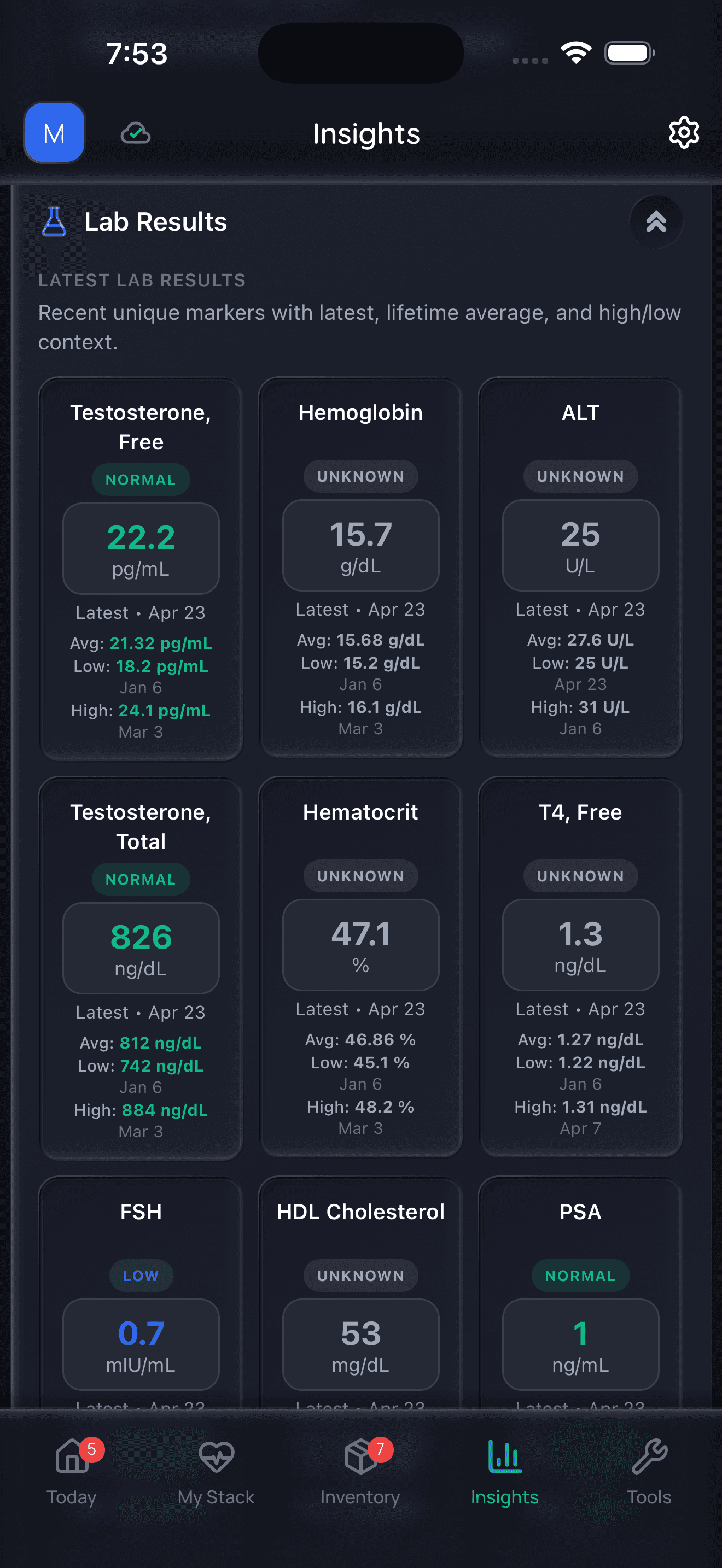
Doserly organizes data; it does not diagnose or interpret labs for you.
Dosing & Usage Protocols
The Basics
The research-backed dose range is narrower than the internet makes it sound. Most short-term human studies live between 100 mg and 300 mg, with 100-200 mg producing the most consistent cognition signal and 200 mg also showing the clearest acute energy-expenditure effect [4][5].
The practical rule is to start lower than you think you need. Because paraxanthine is still a stimulant, "just enough" is usually more useful than chasing the strongest possible buzz. If you are trying it because caffeine feels too rough, jumping straight to high-dose paraxanthine defeats the point [6][9][11].
The Science
Published short-term human dosing in the current source set includes:
Goal / Context
Exploratory cognitive testing
- Dose Range
- 50 mg
- Evidence Notes
- Some effects seen, but less consistent than 100-200 mg [4]
Goal / Context
Cognition / attention / vigilance
- Dose Range
- 100-200 mg
- Evidence Notes
- Best-supported acute range in current human trials [3][4]
Goal / Context
Acute metabolic / energy expenditure testing
- Dose Range
- 200 mg
- Evidence Notes
- Increased energy expenditure relative to placebo [5]
Goal / Context
Upper acute studied range in current human trial set
- Dose Range
- 300 mg
- Evidence Notes
- Increased free fatty acids, but not clearly a better all-purpose dose [5]
There is no established caffeine-equivalent conversion table in the current source set. Community users frequently compare 100-300 mg paraxanthine to a milder or shorter-lived caffeine effect, but those comparisons are subjective and inconsistent [9][11].
Getting the dose right matters more than most people realize. Too little may be ineffective, too much wastes money or introduces risk, and inconsistency undermines both. Doserly tracks every dose you take, across every form, giving you a clear record of what you're actually consuming versus what you planned.
The app helps you compare RDA recommendations against therapeutic ranges discussed in the research, so you can see exactly where your intake falls. If you switch forms, say from a standard capsule to a liposomal liquid, Doserly adjusts your tracking to account for different bioavailabilities. Pair that with smart reminders that keep your timing consistent, and the precision that makes a real difference in outcomes becomes effortless.
Turn symptom and safety notes into a clearer timeline.
Doserly helps you log doses, symptoms, and safety observations side by side so patterns are easier to discuss with a qualified clinician.
Pattern view
Logs and observations
Pattern visibility is informational and should be reviewed with a clinician.
What to Expect (Timeline)
First 30-60 minutes
Most users who respond notice a rising alertness effect rather than a dramatic stimulant "hit." In the formal PK literature, paraxanthine behaves like a fairly short-lived methylxanthine exposure rather than an all-day state change [2].
1-3 hours
This is the main window where attention, reaction-time, or metabolic effects are most likely to be noticeable in current human studies [3][4][5]. Community users commonly describe this period as smoother than coffee, though not always stronger [9][11].
3-6 hours
The shorter half-life becomes more obvious. Some people still feel good focus; others report the effect fading or a small crash if they expected an all-day stimulant [2][9][11].
Later the same day
If you are sensitive to stimulants, late dosing can still interfere with sleep. The better community reports usually come from morning or early-afternoon use, not from pushing it into the evening [2][9][11].
First week
The current human cognition trials included repeated daily use over 7 days without clear short-term clinical chemistry problems, but they do not tell us much about longer cycles or months-long use [4]. If you are trialing paraxanthine, the first week is mainly about answering two questions: does it actually feel different from caffeine for you, and does that difference justify the cost and uncertainty.
Interactions & Compatibility
Synergistic
- L-Theanine: The most common community pairing. Users often combine it with paraxanthine to reduce edge, calm the energy profile, or make morning focus feel smoother [10][11].
- Magnesium: Not a direct stimulant synergy, but often paired later in the day when people are trying to protect sleep or reduce overstimulation spillover.
- Taurine: Common in pre-workout and calmer-energy stacks. Community logic is to balance stimulation rather than intensify it.
Caution / Avoid
- Caffeine: Combining paraxanthine with coffee, high-caffeine pre-workouts, or multiple caffeinated beverages can erase the "smoother than caffeine" advantage and increase stimulant burden [6][9].
- Prescription stimulants: ADHD medications and other stimulants may increase the odds of jitter, blood pressure elevation, or sleep disruption.
- Green Tea Extract: Adds further methylxanthine exposure through caffeine and can complicate dosing or sleep timing.
- High-anxiety or poorly controlled hypertension states: Formal paraxanthine-specific safety data here are not mature enough to assume better tolerability.
How to Take / Administration Guide
Paraxanthine is usually most practical in the morning or early afternoon. That is where its shorter half-life becomes an advantage. It may still disrupt sleep if taken too late, but it is less likely than a long, heavily caffeinated day to drag stimulation deep into the evening [2][9][11].
Start with a low single dose, assess the first 3-6 hours honestly, and avoid stacking extra caffeine on top while you are trying to learn how you respond. If your entire reason for trying paraxanthine is that coffee makes you anxious or overamped, mixing it immediately into an already stimulant-heavy routine makes the result impossible to interpret [6][9].
You do not need a complex ritual. The basics are enough:
- take it early
- trial it without extra caffeine first
- track the onset, fade, and any crash
- stop if it feels effectively identical to caffeine for you
Choosing a Quality Product
This is a more important section for paraxanthine than for many mature supplements, because the market is young and brand narratives are doing a lot of the work.
Look for:
- a clearly stated amount of paraxanthine per serving
- full label disclosure instead of vague "energy matrix" blends
- a certificate-of-analysis or at least strong manufacturing transparency
- products that do not bury paraxanthine inside oversized stimulant stacks
- athlete-focused products that carry third-party sport certification if tested competition matters to you
Be cautious with:
- proprietary blends that make it impossible to tell how much paraxanthine you are getting
- products marketed with absolute claims such as "no crash," "no jitters," or "safe at any dose"
- fat burners or pre-workouts that combine paraxanthine with other strong stimulants and thermogenic ingredients
Because long-term human data are still limited, the safest quality strategy is not just "buy a clean product." It is also "buy a simple product."
Storage & Handling
Store paraxanthine products in a cool, dry place with the lid tightly closed. Powders and capsules should be protected from moisture and repeated heat exposure.
Ready-to-drink products should be stored according to the manufacturer's directions. If a product is positioned as a coffee replacement or canned beverage, follow its beverage-specific storage guidance rather than assuming it behaves like a dry supplement.
Lifestyle & Supporting Factors
Paraxanthine works best when it is supporting a functional routine, not compensating for a broken one. If chronic sleep loss, under-eating, dehydration, or anxiety is driving the fatigue, a smoother stimulant may still help for a few hours, but it will not solve the underlying problem [5][9].
Useful supporting habits include:
- sleeping enough that you are not relying on methylxanthines just to feel baseline
- tracking how late you dose compared with your bedtime
- monitoring blood pressure if you are stimulant-sensitive
- keeping total stimulant exposure visible instead of assuming paraxanthine "doesn't count"
For many users, the real benefit of paraxanthine is not that it is stronger than caffeine. It is that it may be easier to fit into a routine with less emotional or physical friction. That advantage disappears when the rest of the routine is chaotic.
Regulatory Status & Standards
Paraxanthine is being marketed inside dietary supplements and functional beverages, but that should not be confused with FDA approval for safety or effectiveness. FDA's own supplement ingredient directory reminds readers that dietary supplements are not pre-approved for efficacy or safety in the way drugs are, and no paraxanthine-specific consumer monograph was surfaced from the accessed FDA material [8].
There is also no established RDA, AI, or UL in the current source set. From a standards perspective, paraxanthine is a novel marketed stimulant ingredient with limited public-reference infrastructure rather than a settled mainstream nutrient [8].
Athletes need to be more conservative than general supplement users. The accessed WADA Prohibited List does not provide a paraxanthine-specific entry, but it does state that any pharmacological substance without current approval by a governmental regulatory health authority for human therapeutic use can fall under S0 Non-Approved Substances [7]. That means athlete use should be treated as uncertain, not casually assumed to be permitted. If you are subject to testing, get sport-specific guidance before using it [7].
FAQ
Is paraxanthine just caffeine by another name?
No. It is caffeine's primary human metabolite, not the same molecule. In practice it still behaves like a stimulant, but the current data suggest a somewhat shorter half-life and a potentially different subjective feel [1][2][6].
Does paraxanthine really cause less anxiety than caffeine?
Sometimes, but not reliably for everyone. That is the dominant community narrative, yet controlled human data still show real sympathomimetic effects, so you should not assume it will be anxiety-free [6][9][10][11].
What dose is best supported right now?
The best current human evidence clusters around 100-200 mg for cognition and 200 mg for acute energy expenditure. There is also a 300 mg arm in one study, but it is not clearly the best everyday dose [4][5].
Can I take it late in the day?
Maybe, but shorter half-life does not mean no sleep impact. If sleep is the reason you are exploring paraxanthine instead of caffeine, morning or early-afternoon use is the safer starting point [2][9][11].
Is paraxanthine safer than caffeine?
That is not proven in long-term humans. The current evidence supports a plausible safety advantage in preclinical work and a smoother subjective experience for some users, but the human evidence is still too limited for a strong blanket claim [1][6].
Can I stack it with L-theanine?
Yes, people commonly do. Community discussion repeatedly frames L-Theanine as a way to smooth stimulation or reduce edge, though paraxanthine-specific synergy trials are not established in the current source set [10][11].
Will it help with fat loss?
It may raise acute energy expenditure, but that is not the same as proven fat loss. Treat it as a stimulant with a small early metabolic signal, not as a body-composition shortcut [5].
Can athletes use paraxanthine safely in tested sport?
Do not assume so. The current source set supports caution because WADA's S0 language can capture non-approved pharmacological substances even when they are not individually named [7].
Myth vs. Fact
Myth: Paraxanthine has no cardiovascular effect because it is smoother than coffee.
Fact: Human data still show increased diastolic blood pressure, epinephrine, and free fatty acids. Smoother does not mean physiologically inactive [6].
Myth: If paraxanthine is a caffeine metabolite, it must automatically be harmless.
Fact: That is not how safety works. Natural metabolism does not replace dose-specific human safety data for direct-use supplementation [1][6].
Myth: More paraxanthine is always better because it causes fewer jitters.
Fact: The current evidence does not support that. The clearest human findings cluster around 100-200 mg, and real-world users still report crashes or overstimulation at higher intakes [4][5][9][11].
Myth: Paraxanthine does not affect sleep.
Fact: Some users find it easier on sleep than caffeine, but the evidence is mixed and timing still matters [2][9][11].
Myth: If it is not named on the WADA list, athletes are automatically fine.
Fact: WADA explicitly says the list is not exhaustive and S0 covers some non-approved pharmacological substances even when they are not individually named [7].
Myth: Paraxanthine is a proven fat-loss supplement.
Fact: The current human evidence shows only an acute metabolic signal, not established long-term body-composition change [5].
Sources & References
- Szlapinski SK, et al. Paraxanthine safety and comparison to caffeine. Front Toxicol. https://pmc.ncbi.nlm.nih.gov/articles/PMC9932512/
- Lelo A, et al. Comparative pharmacokinetics of caffeine and its primary demethylated metabolites paraxanthine, theobromine and theophylline in man. Br J Clin Pharmacol. https://pmc.ncbi.nlm.nih.gov/articles/PMC1401099/
- Yoo C, et al. Acute Paraxanthine Ingestion Improves Cognition and Short-Term Memory and Helps Sustain Attention in a Double-Blind, Placebo-Controlled, Crossover Trial. https://pubmed.ncbi.nlm.nih.gov/34836235/
- Jager R, et al. Dose-Response of Paraxanthine on Cognitive Function: A Double Blind, Placebo Controlled, Crossover Trial. https://pubmed.ncbi.nlm.nih.gov/34960030/
- Acute dose-response trial. A Dose-Response Study to Examine Paraxanthine's Impact on Energy Expenditure, Hunger, Appetite, and Lipolysis. https://pubmed.ncbi.nlm.nih.gov/38745415/
- Benowitz NL, et al. Sympathomimetic effects of paraxanthine and caffeine in humans. https://pubmed.ncbi.nlm.nih.gov/8529334/
- World Anti-Doping Agency. The Prohibited List. https://www.wada-ama.org/en/prohibited-list
- U.S. Food and Drug Administration. Information on Select Dietary Supplement Ingredients and Other Substances. https://www.fda.gov/food/dietary-supplements/information-select-dietary-supplement-ingredients-and-other-substances
- Doserly KB community extract. Paraxanthine — r/Nootropics Community Discussion.
community/reddit-nootropics-2026-03-25.md - Doserly KB community extract. Paraxanthine — r/decaf Community Discussion.
community/reddit-decaf-2026-03-25.md - Doserly KB community extract. Paraxanthine — r/Nutraceuticalscience Discussion.
community/reddit-nutraceuticalscience-2026-03-25.md
Related Supplement Guides
- L-Theanine: Useful comparison point for people chasing calmer focus instead of raw stimulation.
- Taurine: Often discussed in balancing stimulant-heavy routines.
- Magnesium: Relevant when stimulant use starts to interfere with evening relaxation or sleep.
- Rhodiola Rosea: Another option people explore for fatigue and focus without defaulting to more caffeine.
- Green Tea Extract: Helpful for understanding how caffeine-containing alternatives differ from direct paraxanthine use.
- Ashwagandha: A non-stimulant comparison for users whose main goal is lower stress rather than more alertness.