
In this guide
What is Pygeum?
Pygeum is a Prunus africana bark extract used for urinary symptoms. Older short trials suggest possible symptom improvement, but weak reporting and obsolete comparisons limit confidence. The best-known review included 18 trials and 1,562 men, with a mean treatment duration of only 64 days. It judged the evidence suggestive but limited by small samples, poor reporting, varied preparations and few comparisons with standard therapy. [1]
Typical Pygeum Protocols
| Source and population | Form and amount each time | Frequency | Total exposure | Duration or boundary |
|---|---|---|---|---|
| Chatelain 1999 · 235 randomized | Prunus africana extract 50 mg each time | Morning and evening | 100 mg/day | 2-month blinded comparison; no placebo |
| Chatelain open extension · 174 entered | Same extract 100 mg each time | Once in the evening | 100 mg/day | 10 months; uncontrolled extension |
| Wilt/Ishani review · 18 trials, 1,562 men | Bark extracts 75–200 mg/day | Study-specific | 75–200 mg/day | Mean 64 days; weak reporting |
These rows reproduce sources. Do not average them into one universal regimen.
From source to outcome
Mean duration 64 days.
No placebo in blind phase.
No universal regimen.
Which forms and label details matter?
Record the botanical name Prunus africana, bark extract, amount per administration, extract ratio or solvent if stated, and standardization. “African plum,” raw bark powder and a named lipid-sterol extract are not automatically equivalent.
How should it be stored?
Follow the label, close the container and protect it from heat, light and moisture.
Read the label before the claim
Keep species, part and extract together.
A daily total does not reveal the schedule.
Biomarkers do not replace clinical outcomes.
What is it commonly used for?
Pygeum is marketed for nocturia, weak stream and other lower urinary tract symptoms attributed to benign prostate enlargement. Evidence addresses symptom relief, not prevention of prostate cancer or reversal of obstruction.
What does human research show?
The 18-trial review and quantitative meta-analysis reported moderate improvements in combined symptoms, nocturia and peak flow, but most trials were small, short and poorly reported. [1][4] Chatelain randomized 235 men to 50 mg twice daily or 100 mg once daily; both schedules improved, but the blinded phase had no placebo, so equal performance does not establish efficacy. The later ten-month extension was open and uncontrolled. [2] Melo gave one tablet containing pygeum 25 mg plus nettle 300 mg twice daily to 27 men and placebo to 22 for six months; symptoms, quality of life and flow did not differ significantly. [3]
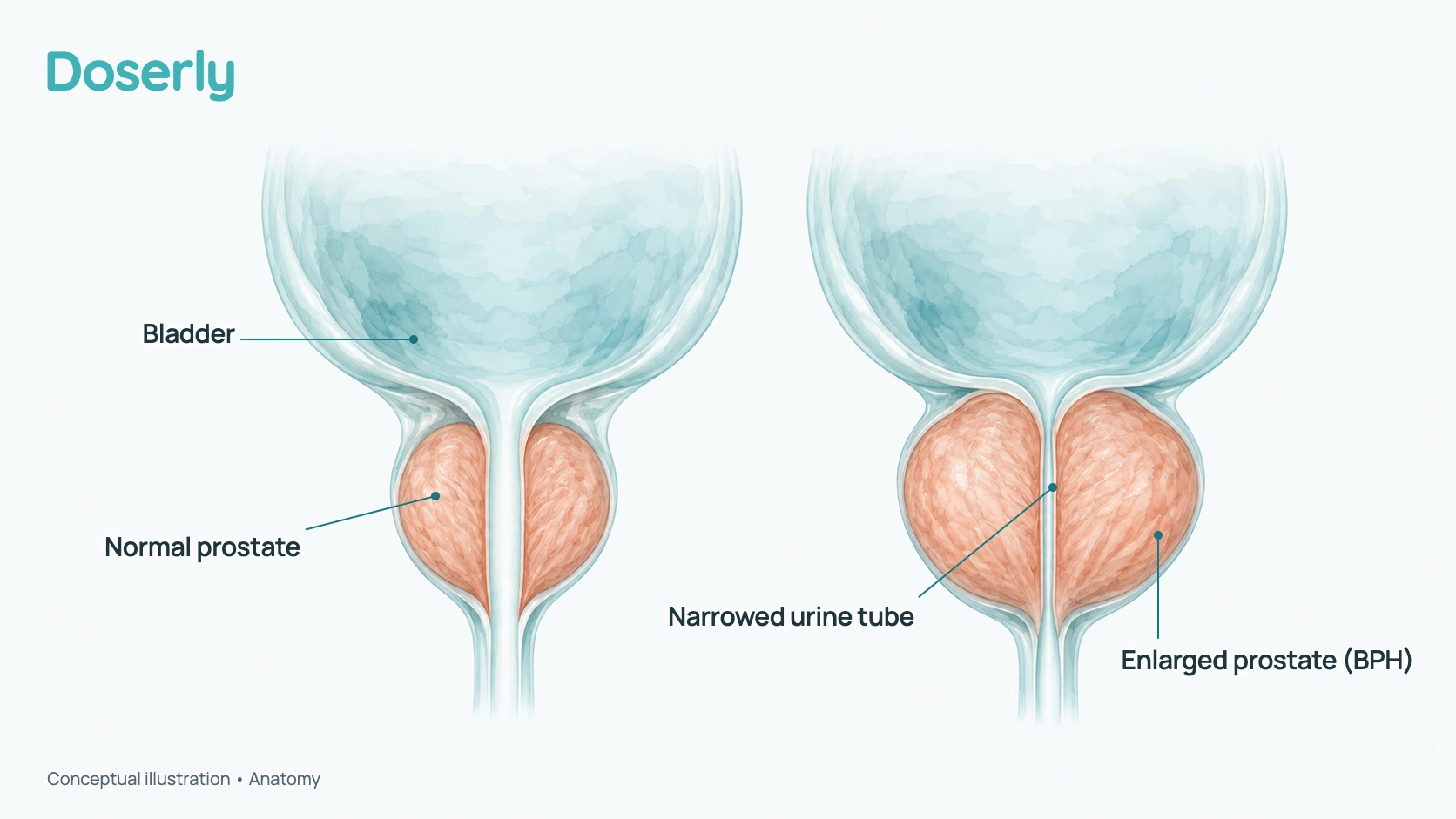
How might it act?
Bark-extract constituents have been studied for inflammatory signaling, smooth-muscle tone and prostate growth pathways. These mechanisms neither identify the active constituent nor correct the design limitations of older trials.
How does it compare with related products?
| Product | Identity to preserve | Evidence boundary |
|---|---|---|
| Saw palmetto | Species, berry extract and fatty-acid standardization | High-quality monotherapy trials are largely null |
| Pygeum | Prunus africana bark extract and extract specification | Older, short trials with weak reporting |
| Stinging nettle root | Root extract, not leaf or whole-herb products | A few trials; preparation identity often incomplete |
| Zinc | Elemental zinc and nutritional status | Nutrient context; deficiency correction is a separate question |
What are the risks and interactions?
Human safety reporting is limited and short. Gastrointestinal upset is the most plausible routine complaint, while long-term, pregnancy and breastfeeding data are inadequate. Urinary retention, fever, blood in urine, kidney symptoms or rapid progression require clinical assessment.
Which medicines require review?
Have the product reviewed with medicines, before surgery, and during pregnancy or breastfeeding. No universal separation interval is established.
Regulatory status: In the United States, supplements generally lack premarket efficacy approval. In Canada, verify the finished product’s NPN or DIN-HM and licensed conditions. [5], [6]
What should be monitored?
Record product, lot, form, amount per administration, frequency, daily total, co-ingredients, meals, symptoms, medicines, chosen outcome and review date.
What happens when it is stopped?
No ingredient-specific withdrawal syndrome is established. Record the stop date, symptoms and chosen outcome; seek care for a persistent serious symptom.
Seek prompt care for a serious allergic reaction, unusual bleeding, persistent palpitations, chest pain or another severe symptom.
What do public communities report?
Public reports can suggest questions to track, but they do not verify the product, dose or causality. This update did not newly quantify a community sample.
Common questions about Pygeum
Does pygeum improve nighttime urination?
Older pooled trials suggest a possible reduction, but short duration and weak reporting reduce certainty.
Is 50 mg twice daily better than 100 mg once daily?
Chatelain found similar changes; without placebo, the study cannot establish either schedule’s efficacy.
Can pygeum shrink an enlarged prostate?
The evidence does not establish durable reversal of prostate enlargement or obstruction.
Can pygeum–nettle results be assigned to pygeum?
No. Combination trials cannot isolate either ingredient.
Is bark powder equivalent to extract?
No. Plant part, extraction and standardization can change the product.
What should I track?
Exact extract, schedule, nocturia, urgency, stream, retention symptoms, adverse effects and review date.
Glossary
Terms for reading the evidence.
- Extract identity
- Species, plant part, solvent or ratio, and any standardization used to define a preparation.
- Amount per administration
- Amount taken at one time, distinct from daily total.
- IPSS / AUASI
- Questionnaires rating lower urinary tract symptom severity; they do not diagnose the cause.
- Qmax
- Maximum measured urinary flow rate.
- PSA
- A prostate-related blood marker; it is not a stand-alone cancer test.
- Monotherapy
- The ingredient was tested without another active intervention.
How this guide was researched
Accessible official sources and human reports were read on October 9, 2026. Titles, authors, journals, DOI, PMID and visible corrections were checked. An unreported frequency was not guessed.
How this guide was made
Research and drafting were AI-assisted. This draft awaits Doserly editorial review and independent clinical review. See the editorial policy.
Explore the sources
Sources preserve form, amount, frequency, population, duration and outcome.
Showing 6 sources
- 01
Pygeum africanum for benign prostatic hyperplasia. ↗
Systematic review
Current page or report reviewed; scope and limits retained.
Detail: 18 trials, 1,562 men; mean duration 64 days.
- 02
Comparison of once and twice daily dosage forms of Pygeum africanum extract in patients with benign prostatic hyperplasia: a randomized, double-blind study, with long-term open label extension. ↗
Randomized schedule comparison
Current page or report reviewed; scope and limits retained.
Detail: 235 randomized; 50 mg twice daily versus 100 mg once daily.
- 03
Evaluating the efficiency of a combination of Pygeum africanum and stinging nettle (Urtica dioica) extracts in treating benign prostatic hyperplasia (BPH): double-blind, randomized, placebo controlled trial. ↗
Combination trial
Current page or report reviewed; scope and limits retained.
Detail: 49 participants; one 25 mg/300 mg tablet twice daily; no significant advantage.
- 04
A meta-analysis of the efficacy of Pygeum africanum in the treatment of benign prostatic hyperplasia ↗
Meta-analysis
Current page or report reviewed; scope and limits retained.
Detail: Older short-trial evidence and methodological limitations.
- 05
Dietary Supplements ↗
Regulatory overview
Current page or report reviewed; scope and limits retained.
Detail: U.S. supplement framework.
- 06
About Natural Health Products ↗
Regulatory overview
Current page or report reviewed; scope and limits retained.
Detail: Canadian product licensing and NPN context.
No matching sources
Try a different term or show the full list.