
In this guide
What does this guide compare?
Menstrual and menopausal symptoms should not be collapsed into a single hormone-balancing claim.
This collection compares products discussed around one topic. It is not a protocol to take in full. Links to individual profiles appear after the article.
| Reference point | Context |
|---|---|
| Products compared | 6 |
| Evidence scope | Ingredient, formulation, population and measured outcome |
| Complete combination | The cited studies do not automatically validate all members together |
Which products are compared?
Maca Root, Vitex/Chasteberry, Black Cohosh, Vitamin D3 (Cholecalciferol), Magnesium, Fish Oil (EPA/DHA).
Individual profiles describe formulation, source-reported amounts, tolerability and interactions. Those details remain ingredient-specific. An amount studied alone is not automatically appropriate in a combination.
How do their roles differ?
Menstrual symptoms, menopausal vasomotor symptoms and nutritional shortfalls are different contexts. Vitex, black cohosh and maca are not interchangeable with one another or with menopausal hormone therapy. The phrase hormonal balance does not describe a measurable single treatment target. [1][2][3]
Compare studies and their targets
The studies assess different problems. None establishes general hormonal rebalancing or efficacy for all six ingredients together.
| Ingredient | Population and preparation | Interpretation |
|---|---|---|
| Vitex | Schellenberg 2001, premenstrual syndrome; 178 women randomized, 170 analyzed; Ze 440, 20 mg once daily for three cycles. [9] | Symptom response 52% versus 24% with placebo; this does not establish improved fertility or menopause treatment. |
| Black cohosh | 2023 synthesis, 22 articles and 2310 menopausal participants; preparations varied. [10] | Small standardized hot-flash effect, g = 0.315; anxiety and depression outcomes were null. |
| Black cohosh | Cochrane 2012, 16 trials and 2027 participants; three trials with 393 women contributed to hot-flash frequency. [11] | No frequency difference: 0.07 flashes/day, 95% CI −0.43 to 0.56. Reviews are not uniform; inclusion criteria and formulations differ. |
| Maca | Dording 2015, antidepressant-associated sexual dysfunction; 45 women randomized, 42 analyzed; 1.5 g twice daily for 12 weeks. [6] | No significant difference in mean changes on the two main sexual-function scales; an exploratory subgroup should not be generalized. |
| Vitamin D3, magnesium and fish oil | Nutrients or products with their own indications and outcomes. | Sharing a collection does not turn them into hormone treatment; consult the individual profiles. |
Further product-specific comparisons
Maca. The 2015 placebo-controlled trial randomized 45 women with antidepressant-associated sexual dysfunction; 42 entered the modified intention-to-treat analysis. The studied schedule was 1.5 g twice daily for 12 weeks. Mean changes on the ASEX and MGH-SFQ scales did not differ significantly between groups, either overall or within menopausal subgroups. The small remission subgroups do not establish a treatment for hormone imbalance. A separate reported testosterone elevation was an assay-interference case, not proof that maca raised circulating testosterone. Menopause evidence reviews also remain limited by few small trials. [6], [7], [8]
What does the research show?
NCCIH’s black cohosh summary reports possible improvement in some menopause symptoms in reviews of selected products, with variability between preparations and less certainty for other outcomes. Those results cannot establish fertility benefits, normalization of estrogen or efficacy of the six-ingredient collection. [1][2][3]
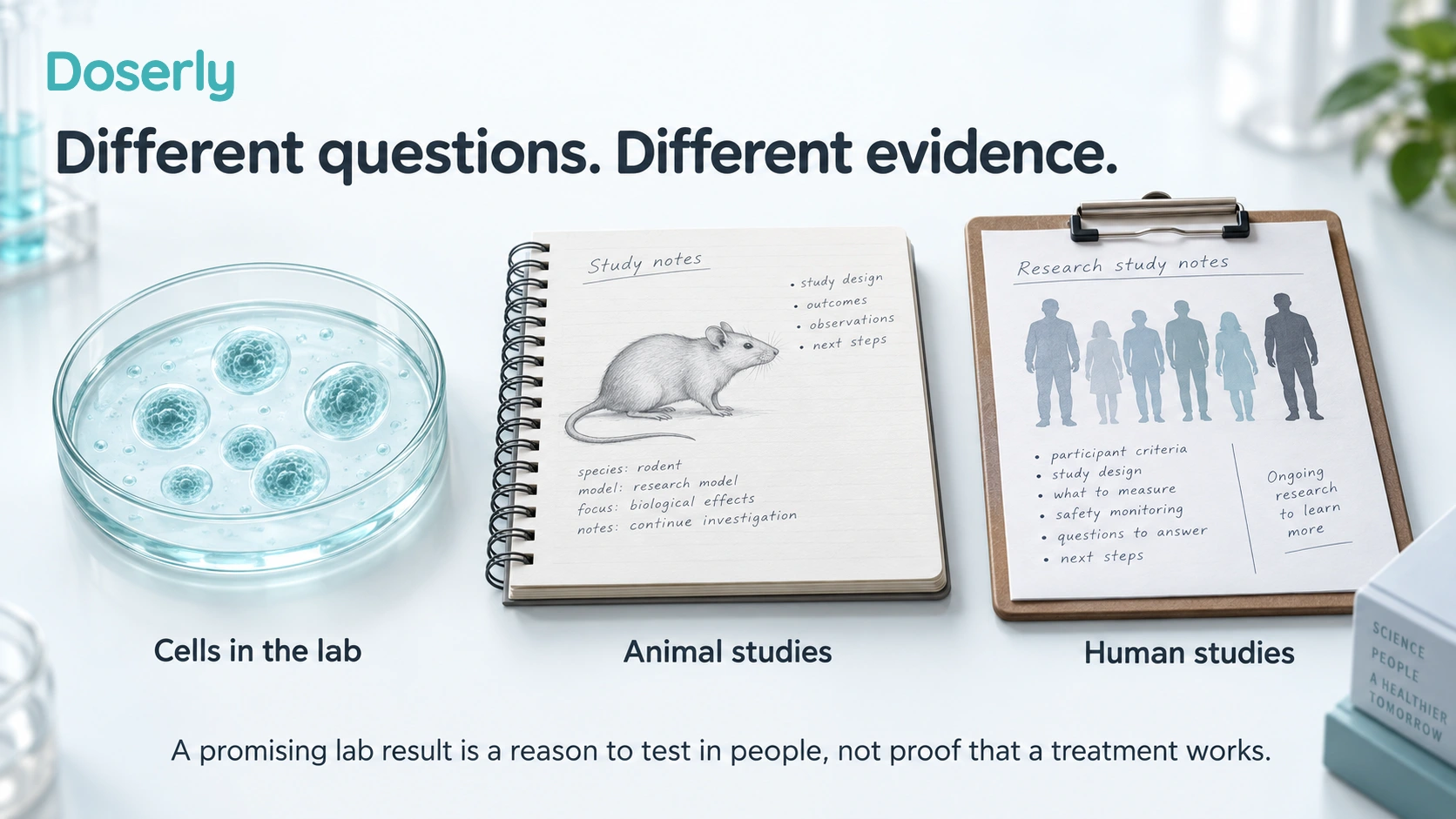
An observational association, a laboratory finding and a perceived benefit answer different questions. Randomized trials need their comparator, duration and population kept in view. An inconclusive result does not establish that an effect is impossible; it limits the claim that can be made.
Which overlaps and risks matter?
Cautions and interactions
Pregnancy, hormone-sensitive conditions, abnormal bleeding and liver-injury reports require careful consideration. New or unexplained bleeding needs clinical assessment. Changes in symptoms across a menstrual cycle or during perimenopause can occur without a supplement effect. [1][2][3]
A complete product list includes prescription medicines, nonprescription products and supplements. Combination formulas can conceal duplicate ingredients. Timing and spacing from a medicine should follow its labeling and pharmacist guidance; this collection does not supply a universal timetable.
Regulatory status
In the United States, FDA does not approve dietary supplements for safety and effectiveness before marketing. In Canada, a natural health product requires a product licence before sale; its NPN or DIN-HM must match the finished product. An ingredient name or inclusion in this collection does not establish that every product or claim is authorized. Authorization also does not validate the complete combination. [4], [5]
What should be recorded and how should changes be interpreted?
Doserly brings dose logs, symptoms and routine changes together. For this collection, useful observations include cycle dates where relevant, hot flashes, sleep, bleeding changes, medicines and adverse effects.
- Doses and adherence: record the formulation, amount actually taken, timing and missed doses so observations have context.
- Potential benefits and tolerability: compare consistent symptoms or measurements over time alongside sleep, food and activity changes. Personal trends help evaluate the experience without proving causal efficacy.
- Product list: maintain the full product list for review with a pharmacist or clinician.
- AI monthly reports: summarize recorded doses, symptoms and trends to prepare for a discussion. Reports depend on the data entered and are not a diagnosis or an instruction to change treatment.
Explore the topic further
Common questions
Is hormonal rebalancing a measured outcome?
Not as a single target in these trials. Premenstrual symptoms, hot flashes and sexual dysfunction are different outcomes in different populations. [6], [9], [10]
Does the Vitex finding mean better fertility?
No. The cited trial assessed premenstrual symptoms over three cycles, not pregnancies or live births. Its result concerns the studied Ze 440 extract. [9]
Why do black cohosh reviews differ?
They include different studies, preparations and outcomes. The 2023 synthesis reports selected favorable effects; Cochrane 2012 found no clear hot-flash frequency benefit. This heterogeneity limits a general promise for every product. [10], [11]
Can maca complicate a laboratory result?
A published case describes interference with a testosterone immunoassay. That does not demonstrate a biological testosterone increase or establish its frequency; disclosing supplements helps a clinician interpret an unexpected result. [7]
Glossary
Terms for interpreting the comparisons.
- Formulation
- The exact preparation, including its ingredients, their forms and labeled amounts.
- Study population
- The people included in a study; their characteristics limit where its result applies.
- Comparator
- The placebo, treatment or condition used as the comparison.
- Measured outcome
- What the study evaluates, such as a symptom, laboratory result or clinical event.
- Overlap
- The same ingredient appearing in more than one product used together.
How was this guide researched?
Sources and limits
This AI-assisted educational guide compares the cited public references. Findings remain tied to the ingredients, preparations and populations studied. It is not a systematic review or independent medical peer review. Doserly develops a commercial tracking app. Illustrations explain concepts; app screens show example data. Report a correction with its source to Doserly support.
Explore the sources
The references below provide context for the claims and their limits.
Showing 11 sources
- 01
- 02
NCCIH — Herb–drug interactions ↗
Public reference
Check the reported population, preparation and limitations.
- 03
- 04
FDA — Questions and Answers on Dietary Supplements ↗
Regulatory reference
United States dietary supplement regulation.
- 05
- 06
A double-blind placebo-controlled trial of maca root as treatment for antidepressant-induced sexual dysfunction in women. ↗
Randomized placebo-controlled trial
1.5 g twice daily for 12 weeks; 45 randomized and 42 in modified intent-to-treat analysis; mean ASEX and MGH-SFQ changes were not significantly different.
- 07
First case report of testosterone assay-interference in a female taking maca (Lepidium meyenii). ↗
Case report
Assay-specific false testosterone elevation resolved after stopping maca.
- 08
Maca (Lepidium meyenii) for treatment of menopausal symptoms: A systematic review. ↗
Systematic review
Few small trials and insufficient evidence for firm conclusions.
- 09
Treatment for the premenstrual syndrome with agnus castus fruit extract: prospective, randomised, placebo controlled study. ↗
Human study or synthesis
Preserve product, population and comparison limitations.
- 10
Black cohosh extracts in women with menopausal symptoms: an updated pairwise meta-analysis. ↗
Human study or synthesis
Preserve product, population and comparison limitations.
- 11
Black cohosh (Cimicifuga spp.) for menopausal symptoms. ↗
Human study or synthesis
Preserve product, population and comparison limitations.
No matching sources
Try a different term or show the full list.