
In this guide
What is vitamin D3?
Vitamin D3 is cholecalciferol, one of the two principal vitamin D forms used in foods and supplements. Vitamin D2 is ergocalciferol. Both are absorbed in the small intestine and both can prevent or treat nutritional rickets, but D3 generally raises serum 25-hydroxyvitamin D more and sustains it longer than D2. That difference does not make every D3 product clinically superior for every outcome. [1]
Vitamin D from skin, food or supplements is biologically inactive at first. The liver converts it to 25-hydroxyvitamin D, written 25(OH)D, the main blood marker of status. The kidney and some other tissues convert that to 1,25-dihydroxyvitamin D, the active hormone. The active form helps control calcium and phosphate absorption and supports bone mineralization, neuromuscular function and other cellular processes. [1]
The name on a bottle answers only the identity question. Whether supplementation is useful depends on age, intake, sun exposure, absorption, kidney and liver health, medicines, baseline status and the intended outcome.
Typical Vitamin D3 Protocols
| Purpose or source | Form and amount each time | Frequency | Total per day | Duration |
|---|---|---|---|---|
| U.S. AI, infants birth to 12 months | Vitamin D from all sources | Daily | 400 IU (10 mcg) | Ongoing reference intake |
| U.S. RDA, ages 1–70 including pregnancy and lactation | Vitamin D from all sources | Daily | 600 IU (15 mcg) | Ongoing reference intake |
| U.S. RDA, adults older than 70 | Vitamin D from all sources | Daily | 800 IU (20 mcg) | Ongoing reference intake |
| VITAL primary prevention and fracture trial | Vitamin D3, 2,000 IU (50 mcg) | Once daily | 2,000 IU (50 mcg) | Median 5.3 years |
The first three rows are nutrient reference values, not treatment schedules. The final row preserves one complete randomized trial schedule.
The RDA assumes minimal sun exposure and covers total intake. It is not an instruction to add that amount on top of food and fortified products. The adult U.S. UL is 4,000 IU (100 mcg) per day from all sources. Clinicians may use higher doses for a defined indication under supervision, but the UL does not become a self-treatment target. [1]
In VITAL, 25,871 U.S. men aged 50 or older and women aged 55 or older received 2,000 IU D3 daily or placebo. They were not selected for low vitamin D, low bone mass or osteoporosis. The schedule did not significantly reduce the primary cancer or cardiovascular outcomes, and an ancillary study found no reduction in total, nonvertebral or hip fractures. [3], [4]
Where these amounts come from
The AI, RDA and UL come from the NIH Office of Dietary Supplements, which reproduces the U.S. National Academies reference values. The 2,000 IU row is the complete VITAL schedule. [1], [3], [4]
This table does not include a deficiency-treatment regimen. The current 2024 Endocrine Society guideline is about disease prevention in people without an established treatment indication and does not set a universal replacement schedule. A diagnosed deficiency, malabsorption disorder, osteoporosis plan or other clinical indication needs its own current protocol. [2]
Does vitamin D3 need to be cycled?
No nutrition authority describes a general D3 cycle. The body stores vitamin D in fat and releases it over time. Daily intake references assume ongoing exposure, while a trial schedule ends because the trial ended. The 2024 Endocrine Society guideline prefers daily lower-dose vitamin D over non-daily higher doses for adults aged 50 and older when supplementation or treatment is indicated. [2]
What happens when vitamin D3 is stopped?
Vitamin D3 does not cause a withdrawal syndrome. Serum 25(OH)D has a circulating half-life of about 15 days, so a supplement-related increase fades gradually rather than overnight. If low intake, limited UVB exposure, malabsorption or another cause remains, status can fall again. No exact decline can be predicted from dose alone because baseline status, body size, season and ongoing intake matter. [1]
Where does vitamin D come from?
Few foods naturally contain much vitamin D. Fatty fish and fish-liver oils are among the richest sources; egg yolks, liver and some mushrooms contribute smaller or variable amounts. Fortified milk, plant beverages, cereals and other foods provide much of dietary intake in countries that use fortification. Labels may list D2 or D3. [1]
Skin makes D3 after UVB exposure, but sun is not a precise dosing system. Season, latitude, time of day, cloud, skin pigmentation, age, clothing and sunscreen change production. UV exposure also raises skin-cancer risk, so nutrient guidance does not translate into a prescribed number of unprotected sun minutes.
Does the form or product matter?
Both D2 and D3 are well absorbed. Fat in the gut enhances absorption, but some vitamin D is absorbed without dietary fat. Aging and obesity do not appear to reduce intestinal absorption, although obesity can change the relationship between intake and circulating 25(OH)D. [1]
- D3 (cholecalciferol): often derived from lanolin; some products use lichen. It generally raises and maintains 25(OH)D more than D2.
- D2 (ergocalciferol): commonly derived from fungi or yeast and can be appropriate when a plant-derived option is needed.
- Drops: useful when a small, measured volume is easier than a tablet. Concentrations vary widely, so the dropper and label must stay together.
- Combination products: calcium, vitamin K, multivitamins and cod-liver oil can add vitamin D. The total across products matters.
Check both units. One microgram equals 40 IU, so 25 mcg equals 1,000 IU. A product described as “high potency” still needs an exact per-serving amount.
Reference, trial and upper limit
Four familiar numbers have four different meanings.
Bar length compares amounts only. It does not rank benefit, effectiveness or safety for an individual.
How should vitamin D3 be stored, and how long does it last?
Follow the product label for heat, light, moisture and expiry. Keep drops with their original calibrated dispenser and out of children's reach. Do not use a liquid when the concentration or dropper is uncertain. Discard damaged, contaminated or expired products according to the label or pharmacist's advice.
What is vitamin D3 commonly used for?
Vitamin D3 is commonly used to meet age-specific intake needs, prevent or correct nutritional deficiency, and support a broader bone-health plan. It is also marketed for immunity, mood, cancer prevention and cardiovascular prevention, but those claims require their own outcome evidence. The studies below separate deficiency biology from adding D3 to generally healthy adults. [1], [2], [3], [4]
What does human research show?
Deficiency and bone biology
Vitamin D is required for normal calcium absorption and bone mineralization. Severe deficiency can cause rickets in children and osteomalacia in adults. Correcting true deficiency is different from adding more vitamin D in people whose status is already adequate. [1]
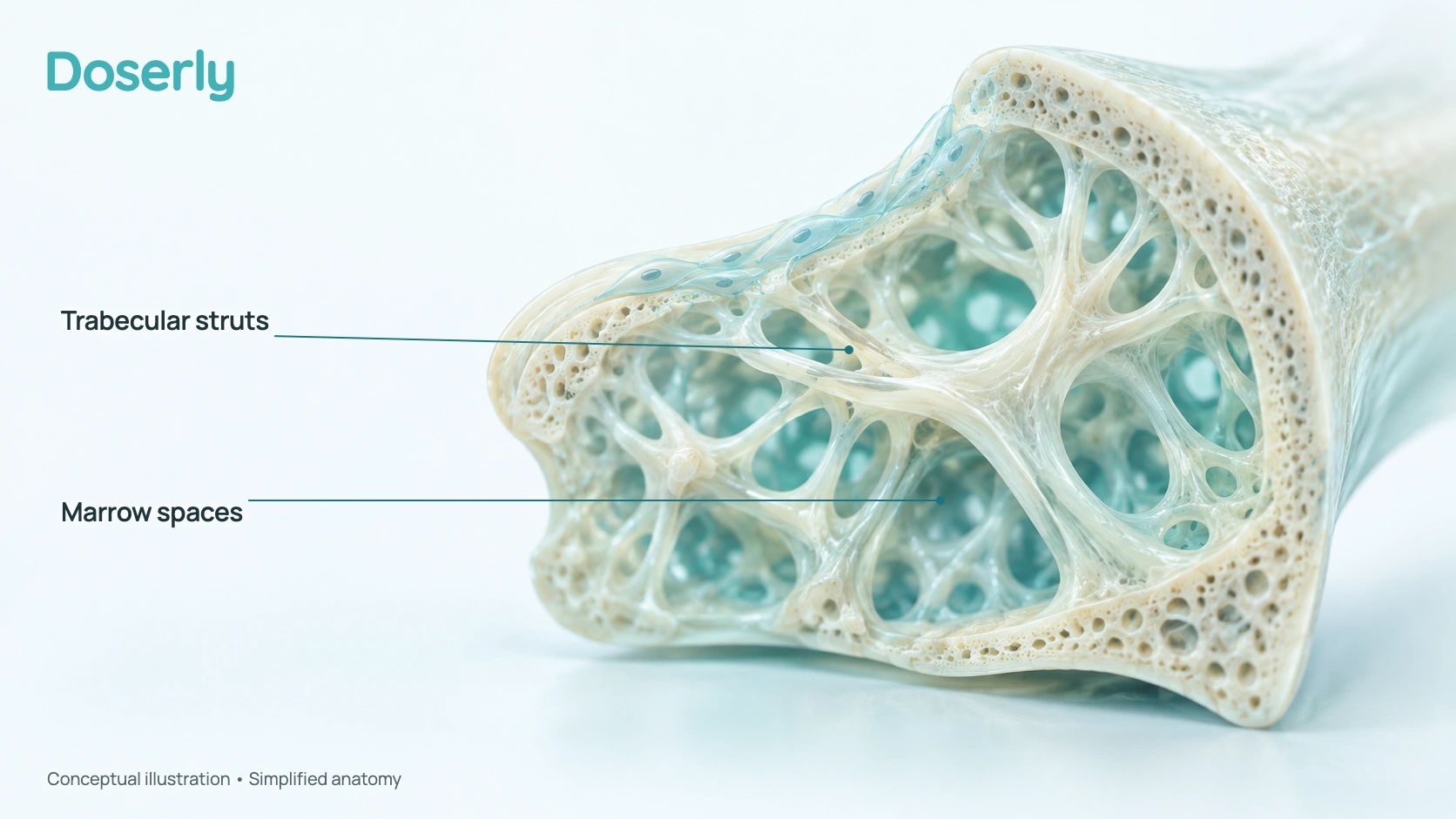
The conceptual bone artwork below shows trabecular structure only. It is not microscopy, a mineral-density scan or evidence that a supplement changed bone.
Fractures in generally healthy adults
The VITAL fracture ancillary study provides a clear boundary. Participants took 2,000 IU D3 daily or placebo for a median 5.3 years. Total fractures occurred in 769 of 12,927 people assigned D3 and 782 of 12,944 assigned placebo, hazard ratio 0.98 (95% CI 0.89–1.08). Nonvertebral fracture HR was 0.97 (0.87–1.07) and hip fracture HR 1.01 (0.70–1.47). None was statistically significant. [4]
Only 2.4% of participants with baseline blood results were below 12 ng/mL and 12.9% were below 20 ng/mL. The trial therefore answers a prevention question in mostly vitamin-D-sufficient adults. It does not show that correcting established deficiency is useless. [1], [4]
Cancer and cardiovascular disease
VITAL's primary report tested the same 2,000 IU/day schedule for invasive cancer and major cardiovascular events. Invasive cancer HR was 0.96 (95% CI 0.88–1.06), and major cardiovascular events HR 0.97 (0.85–1.12). The prespecified primary outcomes were null. Subgroup and secondary signals should not be presented as proof of broad prevention. [3]
Who may benefit from empiric supplementation?
The 2024 Endocrine Society prevention guideline suggests against supplementation above the dietary reference intake in generally healthy adults under 75 and against routine 25(OH)D testing in generally healthy populations. It suggests empiric supplementation for children and adolescents, pregnancy, adults older than 75 and adults with high-risk prediabetes, based on outcome-specific evidence. The guideline does not set one dose for those groups and does not replace treatment guidance for established indications. [2]
VITAL: 2,000 IU D3 daily
25,871 generally healthy U.S. adults · median 5.3 years
Hazard ratios near 1.0 mean similar event rates. These findings apply to the trial population, which was not selected for vitamin D deficiency.
How does vitamin D3 work?
After liver conversion to 25(OH)D and kidney conversion to active 1,25-dihydroxyvitamin D, the active hormone binds the vitamin D receptor. This changes gene transcription and increases intestinal calcium and phosphate absorption. It also participates in bone remodeling and neuromuscular and immune signaling. [1]
That mechanism establishes why deficiency harms bone. It does not prove that progressively higher intake prevents cancer, heart disease, depression or fractures once vitamin D needs are met. Biomarker improvement and clinical benefit are separate outcomes.
What are the risks and interactions?
In the United States, vitamin D3 sold as a dietary supplement does not receive FDA approval for safety or effectiveness before marketing; the company bears initial responsibility and FDA generally uses postmarket oversight. In Canada, a natural health product requires a product licence before sale and an authorized label carries an eight-digit NPN. Regulatory authorization and nutrient status do not prove every prevention claim. [5], [6]
Health Canada’s current Prescription Drug List places oral vitamin D above 62.5 mcg or 2,500 IU per dosage form, or above that amount at the largest labeled daily dose, in the prescription-drug framework. This is a Canadian product-status boundary, not a redefinition of the RDA, UL or a recommended dose. [7]
Vitamin D toxicity almost always comes from excessive supplements, not ordinary sun exposure. Excess vitamin D can produce marked hypercalcemia and hypercalciuria. Symptoms can include nausea, vomiting, weakness, confusion, loss of appetite, dehydration, excessive urination and thirst. Severe toxicity can cause kidney stones, kidney failure, soft-tissue calcification, abnormal rhythm and death. [1]
The adult UL is 4,000 IU/day from all sources. The National Academies also advised avoiding long-term serum 25(OH)D concentrations above roughly 50–60 ng/mL because observational signals at high concentrations are not clearly reassuring. A blood result is not a reason to chase the highest number. [1]
Which medicines interact with vitamin D?
- Orlistat: reduces fat absorption and can reduce vitamin D absorption. [1]
- Glucocorticoids: can reduce calcium absorption and impair vitamin D metabolism, contributing to bone loss. [1]
- Thiazide diuretics: reduce urinary calcium excretion. Combined with vitamin D, they can cause hypercalcemia, especially in older adults or people with impaired kidney function or hyperparathyroidism. [1]
- Some statins: high vitamin D intakes could theoretically compete with statins metabolized by CYP3A4, but the clinical relevance varies by drug and evidence is limited. [1]
Granulomatous diseases, some lymphomas, primary hyperparathyroidism and impaired kidney function can change calcium and vitamin D handling. These are reasons for individualized clinical review, not a universal schedule.
What should be monitored?
Serum 25(OH)D is the main status marker. The National Academies framework reproduced by ODS associates less than 12 ng/mL (30 nmol/L) with deficiency risk, 12 to less than 20 ng/mL with potential inadequacy, at least 20 ng/mL with adequacy for most people and more than 50 ng/mL with possible adverse effects. These are population reference bands, not universal treatment targets. [1]
The Endocrine Society's 2024 prevention guideline does not endorse universal sufficiency, insufficiency or deficiency thresholds and suggests against routine testing in generally healthy people. Testing is more useful when there is an established clinical indication, such as suspected osteomalacia, malabsorption, hypocalcemia or a treatment plan that requires monitoring. [1], [2]
When toxicity is possible, clinicians assess calcium, kidney function, vitamin D intake and 25(OH)D together. For personal records, keep the product form, IU and mcg per serving, frequency, start and stop dates, other sources, and the reason and date of any laboratory test.
What do public communities report?
Public discussions often compare D2 with D3, debate target blood levels and attribute changes in mood, energy or immunity to a supplement. Those posts can reveal practical questions but cannot establish causality. Sun exposure, season, baseline status, other products, illness and laboratory methods are often missing.
The earlier Doserly dossier reviewed public discussions, but this overhaul did not independently recrawl or quote them. No sentiment percentage or community consensus is carried forward. Human trials and current official guidance receive more weight.
How does vitamin D3 compare with nearby options?
| Guide | What it is | Key difference |
|---|---|---|
| Vitamin D2 | Ergocalciferol | Also active for nutritional use; D3 generally raises and maintains 25(OH)D more |
| Calcium | Essential mineral | Vitamin D supports calcium absorption, but each nutrient has its own intake limits and risks |
| Vitamin K2 | Menaquinone vitamin K forms | Bone claims remain outcome and product specific; vitamin K has a major warfarin interaction |
| Magnesium | Essential mineral | Has different reference values, laboratory limits and gastrointestinal effects |
Common questions about vitamin D3
Is 2,000 IU of vitamin D3 a standard dose?
It is a common product strength and the amount tested in VITAL, but it is above the U.S. RDA of 600 or 800 IU for adults. VITAL does not turn 2,000 IU into a universal prevention dose. [1], [3], [4]
Is 5,000 IU safe every day?
Five thousand IU is above the U.S. adult UL of 4,000 IU/day from all sources. A clinician may intentionally use more for a defined indication, but that requires a reason and appropriate follow-up rather than assuming more is better. [1]
Should vitamin D3 be taken with a fatty meal?
Fat in the gut enhances absorption, but some vitamin D is absorbed without it. Consistency and the exact total intake matter more than claiming one mandatory meal. [1]
Is D3 always better than D2?
D3 generally raises and maintains 25(OH)D more effectively, but both forms are absorbed and both can support vitamin D nutrition. Product suitability, dietary preference, schedule and clinical purpose still matter. [1]
Does vitamin D3 prevent fractures?
Not as a universal add-on in generally healthy, mostly sufficient adults. VITAL found no reduction in total, nonvertebral or hip fractures with 2,000 IU/day. Correcting established deficiency and treating osteoporosis are different questions. [4]
What blood level should everyone aim for?
There is no universally accepted optimum. ODS presents the National Academies bands, while the 2024 Endocrine Society guideline does not endorse universal thresholds for disease prevention and advises against routine testing in healthy people. [1], [2]
Can vitamin D3 be taken with vitamin K2?
They can appear in the same product, but evidence for each outcome still depends on the exact form and population. Vitamin K can seriously interact with warfarin and related anticoagulation plans. Combination marketing does not establish an ideal ratio.
Glossary
Plain explanations of the nutrition, laboratory and research terms used in this guide.
- 25-hydroxyvitamin D [25(OH)D]
- The main circulating vitamin D metabolite and the usual blood marker of vitamin D status.
- Adequate Intake (AI)
- A nutrient intake level used when evidence is not sufficient to set an RDA. Vitamin D has an AI for infants.
- Cholecalciferol
- Vitamin D3, the form made in human skin after UVB exposure and used in many supplements.
- Ergocalciferol
- Vitamin D2, a form commonly produced from fungi or yeast.
- Hazard ratio
- A comparison of event rates over time. A value near 1.0 indicates similar rates between groups.
- Hypercalcemia
- An abnormally high blood calcium concentration, the central toxicity problem with excessive vitamin D.
- Recommended Dietary Allowance (RDA)
- The average daily intake sufficient for nearly all healthy people in an age and life-stage group.
- Tolerable Upper Intake Level (UL)
- The highest chronic daily intake unlikely to pose risk for most people. It is not a target or a boundary between safe and toxic for every individual.
How this guide was researched
This draft uses the current NIH ODS vitamin D monograph, the 2024 Endocrine Society prevention guideline, the primary VITAL cancer and cardiovascular report, and the VITAL fracture ancillary report. Relevant source text was retrieved and read on October 9, 2026. Older Doserly research files were used to identify claims to recheck, not as proof that those claims were correct.
The protocol table keeps nutrient reference intakes separate from the exact VITAL schedule. It does not infer a deficiency-treatment regimen from a prevention trial or present the UL as an optimal dose.
How this guide was made
Research and drafting were AI-assisted. This manuscript is a draft for Doserly editorial review and has not been independently clinically reviewed. Doserly makes a health-tracking app and operates Doserly Academy, both promoted in the guide. Read the editorial policy for the correction and update process.
Explore the sources
These are the sources cited in this draft. Official monographs, guidance and randomized trials answer different questions.
Showing 7 sources
- 01
Vitamin D - Health Professional Fact Sheet ↗
Official nutrient monograph
Relevant full-page sections reviewed.
Detail: Metabolism, D2 and D3, absorption, 25(OH)D interpretation, AI/RDA/UL, sources, bone and chronic-disease evidence, toxicity and medicine interactions.
- 02
Vitamin D for the Prevention of Disease ↗
Clinical practice guideline
Official recommendation page and guideline identity checked.
Detail: Prevention recommendations by life stage, preference for daily lower-dose use when indicated after age 50, and advice against routine 25(OH)D testing in generally healthy populations.
- 03
Vitamin D Supplements and Prevention of Cancer and Cardiovascular Disease. ↗
Randomized controlled trial
Abstract and results reviewed.
Detail: VITAL; 25,871 adults; D3 2,000 IU daily; median 5.3 years; no significant reduction in invasive cancer or major cardiovascular events.
- 04
Supplemental Vitamin D and Incident Fractures in Midlife and Older Adults ↗
Randomized controlled trial
Full article and primary outcome table reviewed.
Detail: VITAL ancillary study; D3 2,000 IU daily; median 5.3 years; total fracture HR 0.98, nonvertebral HR 0.97 and hip HR 1.01, all nonsignificant.
- 05
Questions and Answers on Dietary Supplements ↗
Regulatory overview
Current official page reviewed.
Detail: U.S. supplements generally do not receive FDA premarket approval; firms bear initial responsibility and FDA conducts postmarket oversight.
- 06
Product Licensing ↗
Regulatory overview
Current official page reviewed.
Detail: Natural health products require a product licence before sale in Canada and authorized labels carry an NPN or DIN-HM.
- 07
Prescription Drug List ↗
Canadian ingredient/status qualifiers
Current official row and qualifier reviewed.
Detail: Oral vitamin D is prescription above 62.5 mcg or 2,500 IU per dosage form or at the largest recommended daily dose; the qualifier is separate from nutrition reference values.
No matching sources
Try a different term or show the full list.