
In this guide
What is calcium?
Calcium is an essential major mineral. Almost all of it is stored in bones and teeth, where calcium and phosphate form mineral crystals that give the skeleton rigidity. The small circulating fraction supports muscle contraction, nerve signaling, blood-vessel function and clotting. Blood calcium is tightly regulated, so a normal serum value does not show whether dietary intake is adequate or bone stores are optimal. [1]
Three numbers are often confused. An RDA is total daily intake expected to meet the needs of nearly all healthy people in a group. A supplement amount is the elemental calcium added after food is counted. A UL is the highest chronic total intake unlikely to cause harm for most people. None is automatically the right treatment amount for osteoporosis, hypocalcemia or another diagnosis.
Typical Calcium Protocols
| Purpose or source | Form and amount each time | Frequency | Total per day | Duration |
|---|---|---|---|---|
| U.S. RDA, adults 19–50 | Calcium from all sources | Daily | 1,000 mg | Ongoing reference intake |
| U.S. RDA, women 51–70 | Calcium from all sources | Daily | 1,200 mg | Ongoing reference intake |
| U.S. RDA, men 51–70 | Calcium from all sources | Daily | 1,000 mg | Ongoing reference intake |
| U.S. RDA, adults over 70 | Calcium from all sources | Daily | 1,200 mg | Ongoing reference intake |
| WHI calcium-plus-D3 trial | 500 mg elemental calcium as carbonate plus 200 IU D3 | Twice daily with meals | 1,000 mg calcium + 400 IU D3 | Mean 7.0 years |
The first four rows are nutrition references, not prescriptions to add that much calcium. Someone obtaining 800 mg from food needs a different decision from someone obtaining 300 mg. The WHI row is a trial description in 36,282 postmenopausal women aged 50–79. It combined calcium carbonate and vitamin D3 and allowed some personal supplement use; it cannot isolate calcium alone. [1], [2]
Where these amounts come from
The RDA and UL values come from the current NIH ODS professional calcium monograph. The WHI row comes from the complete trial report: 500 mg elemental calcium as carbonate plus 200 IU D3, twice daily with meals, for a mean 7.0 years. [1], [2]
We did not call the RDA a supplement dose, convert the UL into a goal, or attribute the combined WHI result to calcium alone.
Target and boundary are different
Both count calcium from food, drinks and supplements.
Age and sex determine the exact RDA; age determines the adult U.S. UL.
Does calcium need to be cycled?
No nutrition authority describes a general calcium cycle. Food intake is continuous. A clinician may change or stop a supplement when diet, laboratory findings, kidney-stone risk, bone treatment or medicines change. That is a reassessment, not a required on/off cycle.
What happens when calcium is stopped?
Calcium does not cause a withdrawal syndrome. Stopping removes that product's contribution to total intake. If food already meets the target, the change may be small; if the product was filling a large gap, intake can fall below the relevant reference. A trial benefit should not be assumed to persist beyond the studied follow-up.
Which foods provide calcium?
Milk, yogurt and cheese are concentrated sources. Fortified plant beverages, calcium-set tofu, canned sardines or salmon with bones, and low-oxalate greens such as kale and bok choy can contribute. Spinach contains calcium but oxalate sharply reduces absorption. Fortified foods differ, so labels matter. [1]
Food-first accounting prevents a common error: adding a full RDA from pills on top of an already adequate diet. Record typical servings for several days, include fortified drinks, and then compare the total with the age- and sex-specific reference.
Which calcium form should be compared?
- Calcium carbonate: about 40% elemental calcium by weight. It depends more on stomach acid for dissolution, so ODS advises taking it with food. It is also used in antacids. [1]
- Calcium citrate: about 21% elemental calcium. It is less dependent on stomach acid and can be taken with or without food, which can be useful when gastric acid is low. [1]
- Other salts: phosphate, lactate and gluconate provide different elemental percentages. More compound weight or more tablets may be needed to deliver the same elemental amount.
Absorption is highest with amounts of about 500 mg elemental calcium or less at one time. This is a graded relationship, not a hard claim that the body absorbs nothing above 500 mg. A person using more than that may be directed to divide it, but the right schedule depends on total need, product, meals and medicine timing. [1]
How should calcium be stored?
Follow the specific label for temperature, moisture and expiry. Keep tablets or chews tightly closed, away from children, and do not use a product with a broken seal, water damage, unexpected odor or changed appearance. Liquids and powders can have different after-opening instructions.
What is calcium commonly used for?
People use calcium to close an intake gap, support bone nutrition, address a clinician-identified need, or as part of a combined calcium-and-vitamin-D plan. Calcium carbonate is also used as an antacid. These uses have different products, amounts and endpoints.
Adequate calcium is necessary for bone mineralization, but necessity does not prove that adding more reduces fractures. Benefit is more plausible when intake is low or a clinical plan identifies a need. Fracture prevention in generally healthy community-dwelling adults has produced mixed results, and treatment of diagnosed osteoporosis is a broader medical plan. [1], [6]
What does human research show?
Bone density and fractures
ODS summarizes small gains in bone mineral density from increased calcium intake, but the clinical meaning is limited and fracture findings vary. Calcium alone does not reliably prevent fractures across all populations. Some combined calcium-and-vitamin-D analyses suggest benefit, especially in institutionalized older adults, while community trials are less consistent. [1]
VITAL helps define the vitamin D side of the question. In 25,871 generally healthy midlife and older adults not selected for deficiency or osteoporosis, 2,000 IU/day D3 for a median 5.3 years did not reduce total, nonvertebral or hip fractures. This does not answer whether correcting calcium or vitamin D deficiency helps; it shows why adequate-population prevention should not be inferred from biological roles. [6], [7]
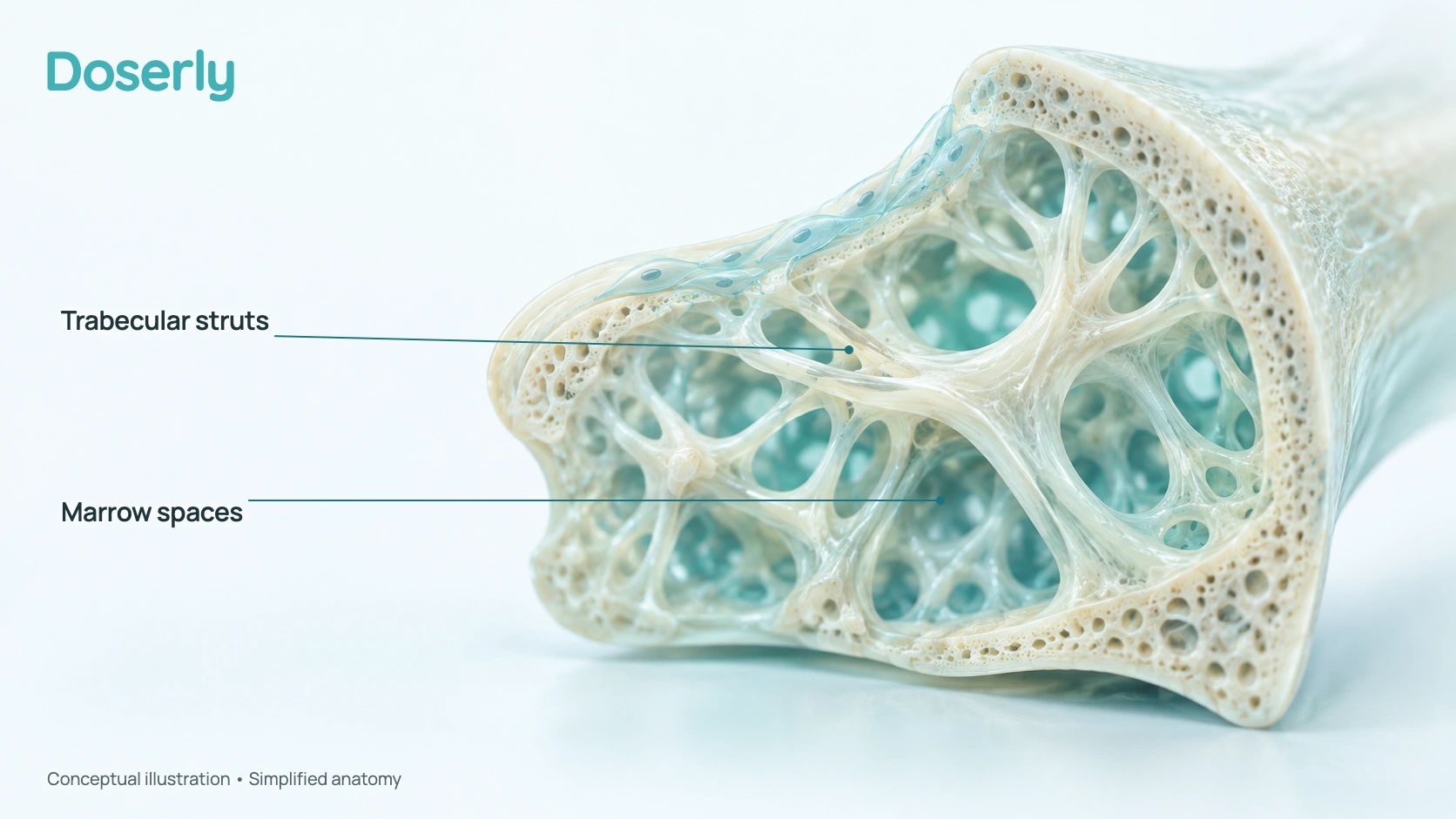
The simplified artwork below shows trabecular anatomy only. It is not microscopy, a density scan or evidence of supplement benefit.
Kidney stones: what did WHI actually test?
WHI randomized 36,282 postmenopausal women to calcium carbonate plus D3 or placebo. Over a mean seven years, self-reported clinician-diagnosed urinary stones occurred in 449 active-group and 381 placebo participants: hazard ratio 1.17 (95% CI 1.02–1.34). The schedule totaled 1,000 mg supplemental calcium and 400 IU D3 daily. [2]
That signal matters, but it is not a calcium-only causal estimate. The intervention combined two nutrients, background personal supplements were permitted, and stones were self-reported. ODS describes the broader evidence as mixed and notes that two later systematic reviews did not find an association. The responsible conclusion is individualized stone-risk assessment, not “calcium always causes stones” or “calcium never affects stones.” [1], [2]
Cardiovascular and cancer claims
Studies of supplemental calcium and cardiovascular outcomes are inconsistent. Dietary calcium, supplemental calcium, dose timing and baseline risk should not be collapsed into a single arterial-calcification claim. Calcium is also not an established general cancer-prevention supplement. [1]
How does calcium work?
Bone stores calcium mainly as hydroxyapatite with phosphate. Bone constantly remodels: cells resorb old tissue and build new matrix, while hormones and vitamin D regulate calcium movement between intestine, kidney, blood and skeleton. Outside bone, calcium ions trigger muscle contraction, nerve-terminal release and clotting reactions. [1]
These mechanisms explain why deficiency is harmful. They do not establish that higher-than-needed intake makes bone progressively stronger or “directs” calcium away from arteries. Current vitamin K evidence likewise does not establish that adding K2 routes calcium into bone and away from arteries as a proven clinical outcome. Mechanisms generate research questions; patient outcomes answer them. [3]
What are the risks and interactions?
In the United States, dietary supplements generally are not approved by FDA for safety or effectiveness before marketing. In Canada, natural health products require a product licence and an authorized label carries an NPN or DIN-HM. Product authorization does not prove fracture prevention. [4], [5]
The adult U.S. UL is 2,500 mg/day total calcium at ages 19–50 and 2,000 mg/day from age 51 onward. It covers food, drinks and supplements. Excess can cause constipation and, in susceptible settings, hypercalcemia or hypercalciuria. Kidney disease, hyperparathyroidism, granulomatous disease and some medicines change risk. [1]
Which medicines interact with calcium?
- Levothyroxine: calcium can reduce absorption. The medicine label commonly specifies separation; use the exact product instruction. [1]
- Quinolone antibiotics: calcium can chelate some agents and reduce absorption. Required intervals differ by drug. [1]
- Dolutegravir: calcium can reduce exposure when taken fasting; label instructions change when taken with food. Follow the antiretroviral plan exactly. [1]
- Lithium: calcium metabolism and parathyroid effects can become relevant during long-term treatment. Management belongs with the prescribing clinician. [1]
- Thiazide diuretics and high-dose vitamin D: both can affect calcium balance, increasing the need for individualized review.
What should be monitored?
Serum calcium is tightly regulated and does not measure dietary adequacy or bone stores. When risk is relevant, clinicians can combine diet history, kidney function, serum calcium, vitamin D status, parathyroid context, stone history and bone assessment. A normal serum calcium should not be used as proof that a supplement works or that intake is sufficient. [1]
For self-records, keep the elemental amount, salt, servings per day, food estimate, medicine timing, constipation or gastrointestinal effects, and the reason for use. These records help a clinician reconstruct exposure without claiming causation.
What do public communities report?
Public discussions often compare carbonate and citrate, constipation, tablet size and whether food alone can meet a target. These reports are useful for discovering practical questions. They cannot determine absorption, kidney-stone causality or fracture prevention because products, diets, diagnoses and co-supplements differ.
The previous Doserly dossier reviewed community material, but this overhaul did not independently recrawl or quantify it. No popularity percentage or community “consensus” is treated as evidence.
How does calcium compare with nearby options?
| Guide | What it is | Key difference |
|---|---|---|
| Vitamin D3 | Fat-soluble vitamin involved in calcium absorption | Separate RDA, UL, blood-status interpretation and toxicity profile |
| Magnesium | Essential major mineral | U.S. magnesium UL applies only to supplements and medicines; calcium UL covers total intake |
| Vitamin K2 | Menaquinone family | Bone biomarkers do not establish that K2 prevents fractures or “directs” calcium |
| Boron | Nonessential dietary element | No RDA or AI and no established fracture-prevention regimen |
Common questions about calcium
Should I take 1,000 mg as a supplement?
Not automatically. For many adults, 1,000 mg is the total-intake RDA, including food and fortified drinks. Estimate food first, then discuss whether any gap needs a product. [1]
Is citrate always better than carbonate?
No. Citrate depends less on stomach acid and can be taken without food. Carbonate supplies more elemental calcium per gram and is taken with food. Tolerance, pill burden, cost and medicines affect the choice. [1]
Does calcium cause kidney stones?
The evidence is mixed. WHI found a modestly higher stone rate with a combined calcium-carbonate-plus-D3 intervention, while later reviews summarized by ODS did not consistently confirm an association. Individual stone type, diet, fluid intake and total supplemental amount matter. [1], [2]
Can calcium prevent fractures?
Adequate intake is necessary for bone, but supplements do not uniformly prevent fractures in community-dwelling adults. Baseline deficiency, age, living setting, vitamin D and osteoporosis treatment change the answer. [1], [6]
Can calcium and iron be taken together?
Calcium can reduce iron absorption in some conditions, although long-term relevance varies. When treating iron deficiency, ask a pharmacist or clinician whether to separate them and follow the iron plan.
How much can be absorbed at once?
Fractional absorption is highest at about 500 mg elemental calcium or less per dose. Larger amounts are not completely unabsorbed, but dividing them may improve efficiency when a larger supplemental total is actually needed. [1]
Is serum calcium a calcium-status test?
It is essential for detecting abnormal blood calcium, but it does not measure dietary adequacy or bone stores because the body regulates blood concentration tightly. [1]
Glossary
Plain explanations of the nutrition, bone and research terms used in this guide.
- Elemental calcium
- The mass of calcium itself in a salt. It is the amount used to compare products and intake.
- Hydroxyapatite
- A calcium-and-phosphate mineral crystal that contributes rigidity to bone and teeth.
- Hypercalcemia
- Calcium concentration in blood above the laboratory range.
- Hypercalciuria
- Higher-than-expected calcium excretion in urine.
- Recommended Dietary Allowance (RDA)
- Average daily intake expected to meet the need of nearly all healthy people in a group; it includes all sources.
- Tolerable Upper Intake Level (UL)
- Highest chronic daily intake unlikely to pose risk for most people; it is not an efficacy target.
- Bone mineral density (BMD)
- A measured estimate of mineral content in bone. A small BMD change does not automatically equal fewer fractures.
- Hazard ratio
- A relative comparison of event rates over time. A value above 1 indicates a higher observed rate in the exposed group.
How this guide was researched
This draft uses the current NIH ODS calcium and vitamin D professional monographs, the full WHI urinary-stone trial report, the VITAL fracture trial, and current FDA and Health Canada regulatory pages. Relevant source text was retrieved and read on October 9, 2026. The older Doserly draft helped identify claims to recheck; it was not treated as evidence.
The protocol table preserves elemental amount, salt, co-intervention, frequency, meals, population and duration. It does not turn an RDA or UL into a product instruction.
How this guide was made
Research and drafting were AI-assisted. This manuscript is a draft for Doserly editorial review and has not been independently clinically reviewed. Doserly makes a health-tracking app and operates Doserly Academy, both promoted in this guide. Read the editorial policy for corrections and updates.
Explore the sources
Official nutrient reviews, regulatory pages and randomized trials answer different questions. The source notes below preserve those limits.
Showing 7 sources
- 01
Calcium - Health Professional Fact Sheet ↗
Official nutrient monograph
Current relevant full-page sections reviewed.
Detail: Identity, food sources, adult RDAs and ULs, forms, administration, bone outcomes, kidney-stone uncertainty, harms and medicine interactions.
- 02
Urinary tract stone occurrence in the Women's Health Initiative (WHI) randomized clinical trial of calcium and vitamin D supplements. ↗
Randomized trial safety analysis
Full text reviewed.
Detail: 36,282 postmenopausal women; 500 mg elemental calcium as carbonate plus 200 IU D3 twice daily with meals; mean 7.0 years; stone HR 1.17 (95% CI 1.02–1.34).
- 03
Vitamin K - Health Professional Fact Sheet ↗
Official nutrient monograph
Bone-outcome section reviewed for adjacent K2 claims.
Detail: Vitamin K has bone mechanisms, but evidence does not establish that any form broadly prevents osteoporosis or fractures.
- 04
Questions and Answers on Dietary Supplements ↗
Regulatory overview
Current official page reviewed.
Detail: U.S. dietary supplements generally do not receive FDA premarket approval; companies bear initial responsibility and FDA conducts postmarket oversight.
- 05
Product Licensing ↗
Regulatory overview
Current official page reviewed.
Detail: Natural health products require a product licence before sale in Canada and authorized labels carry an NPN or DIN-HM.
- 06
Supplemental Vitamin D and Incident Fractures in Midlife and Older Adults ↗
Randomized controlled trial
Full text and abstract reviewed.
Detail: 25,871 generally healthy adults; D3 2,000 IU/day; median 5.3 years; no reduction in total, nonvertebral or hip fractures.
- 07
Vitamin D - Health Professional Fact Sheet ↗
Official nutrient monograph
Current bone and calcium sections reviewed.
Detail: Vitamin D supports calcium absorption and mineralization; population reference intakes and deficiency treatment are distinct questions.
No matching sources
Try a different term or show the full list.