
In this guide
What is vitamin K2?
Vitamin K2 is the name for a family of menaquinones, written MK-n according to side-chain length. MK-4 and MK-7 are the forms most often seen on supplement labels. Vitamin K1, or phylloquinone, is the major dietary form used to estimate U.S. adequate intakes. All participate in activating vitamin-K-dependent proteins, but they are not interchangeable research products. [1]
Vitamin K is required for normal clotting and contributes to proteins involved in bone metabolism. That biological role does not prove the popular claim that a K2 supplement “puts calcium into bone and keeps it out of arteries.” Clinical outcomes must be measured directly.
Typical Vitamin K2 Protocols
| Purpose or source | Form and amount each time | Frequency | Total per day | Duration |
|---|---|---|---|---|
| U.S. AI, adult men 19+ | Vitamin K from all sources | Daily | 120 mcg | Ongoing reference intake |
| U.S. AI, adult women 19+ | Vitamin K from all sources | Daily | 90 mcg | Ongoing reference intake |
| Postmenopausal bone-strength trial | MK-7 180 mcg | Once daily | 180 mcg MK-7 | 3 years |
| Postmenopausal BMD trial | K1 1 mg or MK-4 45 mg; all groups also received calcium and vitamin D | Once daily | 1 mg K1 or 45 mg MK-4 | 12 months |
The AI rows are population reference intakes based mainly on phylloquinone consumption; they are not prescriptions for MK-7. The 3-year trial enrolled 244 healthy postmenopausal women. The 12-month trial enrolled 381 postmenopausal women and cannot isolate calcium or vitamin D because all groups received them. [1]
Where these amounts come from
The current NIH ODS vitamin K monograph supplies the U.S. AIs and summarizes both postmenopausal trials. We preserve the named form, amount, frequency, duration, population, co-interventions and endpoint. [1]
We did not convert the vitamin K AI into an MK-7 dose, treat 45 mg MK-4 as interchangeable with 180 mcg MK-7, or infer fracture prevention from a biomarker.
One family, different evidence
Form, amount and endpoint travel together.
These source-specific contexts are not interchangeable dosing recommendations.
Does K2 need to be cycled?
No authoritative nutrition reference defines a general K2 cycle. Trials used continuous daily schedules for a fixed study period. Starting, stopping or cycling K2 is especially unsafe to improvise during warfarin treatment because intake changes can alter anticoagulation.
What happens when K2 is stopped?
K2 does not cause a recognized withdrawal syndrome. Stopping removes that product from total vitamin K exposure. For a person taking warfarin or a similar vitamin-K antagonist, that change may alter INR and should be coordinated with the anticoagulation team rather than made silently. [1]
Which foods provide vitamin K2?
Natto is especially rich in MK-7. Other fermented foods and animal foods can provide varying menaquinones, but food-composition data for individual forms are less complete than for K1. Green leafy vegetables mainly provide K1. A label or food name therefore does not justify assuming a precise MK-7 intake. [1]
For warfarin management, consistency in overall vitamin K intake matters more than trying to eliminate every vitamin-K-containing food. The treating team can interpret diet changes alongside INR results.
Which vitamin K form should be compared?
- MK-7: a longer-chain menaquinone used in microgram-dose supplement trials. It has a longer reported half-life than K1 in a small comparison, but that does not prove superior clinical outcomes. [1]
- MK-4: a shorter-chain menaquinone used at much larger pharmacological amounts in some Japanese bone studies. A 45 mg trial amount is 45,000 mcg and cannot be mapped onto an MK-7 label. [1]
- K1 (phylloquinone): the main dietary vitamin K form and basis for U.S. AIs. It is a valid vitamin K source, but not evidence for every K2 claim.
Read the Supplement Facts line for the named form and amount per serving. “Vitamin K complex” may combine forms; add the amounts rather than relying on the front-label total alone.
How should K2 be stored?
Follow the product label for temperature, light, moisture and expiry. Keep the container closed and away from children. Discard a product with a broken seal, moisture damage or an unexpected change in odor or appearance.
What is vitamin K2 commonly used for?
People use K2 for bone health, alongside vitamin D or calcium, or because of cardiovascular claims. Vitamin K biology makes these reasonable research questions, but present evidence does not establish K2 as a general fracture-prevention treatment or as a proven way to prevent arterial calcification. [1]
A clinician may address vitamin K deficiency in malabsorption or another medical setting. That is different from self-selecting MK-7 for an otherwise healthy adult.
What does human research show?
Bone markers, density and fractures
In a 3-year trial of 244 healthy postmenopausal women, 180 mcg/day MK-7 improved selected measures of bone strength and reduced vertebral-height loss according to the ODS synthesis. Other vitamin K trials have been null, and ODS concludes that it remains unclear whether any vitamin K form reduces osteoporosis risk. [1]
In a separate 12-month trial of 381 postmenopausal women, K1 1 mg/day or MK-4 45 mg/day reduced undercarboxylated osteocalcin but did not improve lumbar-spine or proximal-femur BMD versus control. All groups received calcium and vitamin D. The biomarker moved while the measured density endpoints did not. [1]
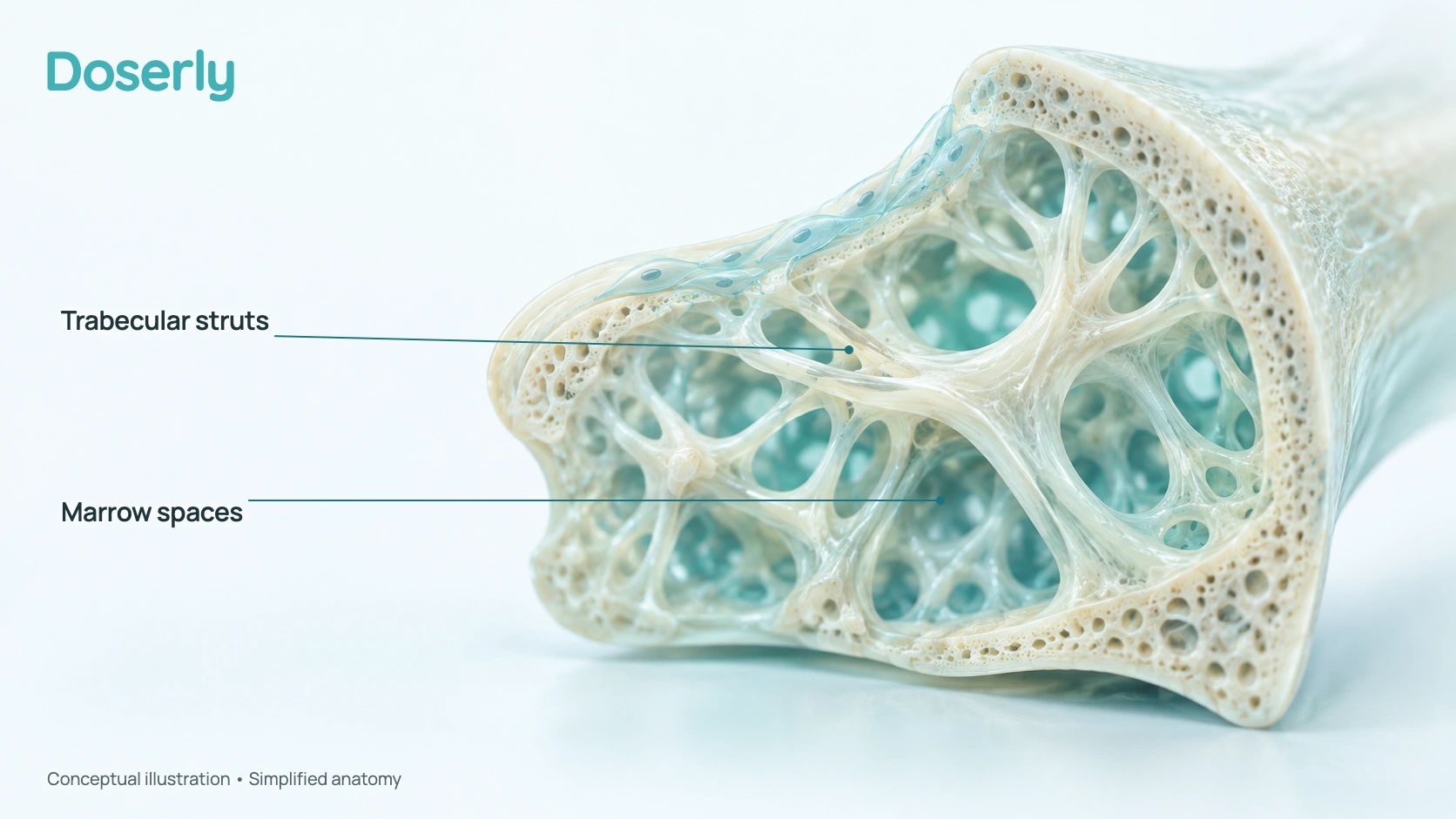
The simplified artwork below shows trabecular anatomy only. It is not microscopy, a density scan or evidence for a K2 regimen.
Cardiovascular claims
Vitamin-K-dependent proteins participate in calcification biology, but a plausible mechanism or a changed protein marker does not establish fewer heart attacks, strokes or clinical vascular events. Current evidence does not support describing K2 as a proven calcium-routing or cardiovascular-prevention supplement. [1]
How does vitamin K2 work?
Reduced vitamin K acts as a cofactor for gamma-glutamyl carboxylase. This enzyme activates vitamin-K-dependent proteins, including clotting factors and proteins such as osteocalcin and matrix Gla protein. Vitamin K is then recycled through the vitamin K epoxide cycle. Warfarin interrupts this recycling. [1]
That mechanism explains the serious drug interaction and why biomarkers respond. It does not tell us whether a given MK form, amount and population will experience a fracture or cardiovascular benefit.
What are the risks and interactions?
In the United States, dietary supplements generally are not approved by FDA for safety or effectiveness before marketing. In Canada, natural health products require a product licence and an authorized label carries an NPN or DIN-HM. Neither status proves a bone or cardiovascular outcome. [2], [3]
Health Canada’s current Prescription Drug List exempts vitamin K1 or K2 sold for external use and oral products whose maximum recommended daily dose is 0.120 mg or less. This product-status exception does not establish a bone, cardiovascular or anticoagulation regimen. [4]
The U.S. Food and Nutrition Board did not establish a UL for vitamin K because available adverse-effect data were insufficient. This is an evidence gap, not permission for unlimited dosing. Product quality, the named menaquinone, co-ingredients and medicines still matter. [1]
Which medicines interact with K2?
- Warfarin and similar vitamin-K antagonists: vitamin K can reduce anticoagulant effect. Keep intake consistent and coordinate any food or supplement change with the prescriber or anticoagulation clinic. INR monitoring may need adjustment. [1]
- Antibiotics: prolonged broad-spectrum use can affect vitamin K status through diet, absorption or gut microbial changes; clinical relevance depends on the drug and patient. [1]
- Bile-acid sequestrants and orlistat: reduced fat absorption can reduce absorption of fat-soluble vitamins, including vitamin K. [1]
What should be monitored?
For someone taking warfarin, the relevant clinical measure is the prescriber-directed INR plan, interpreted with medicine, diet and supplement changes. A K2 app entry is not a substitute for anticoagulation monitoring.
Undercarboxylated osteocalcin can respond to vitamin K, but it is not a validated self-tracking target that proves stronger bone. Bone-density assessment and fracture risk use clinical tools with their own interpretation. [1]
What do public communities report?
Public discussions often compare MK-7 with MK-4, combine K2 with D3, and describe subjective effects. These reports surface label and timing questions but cannot establish bone or cardiovascular benefit because products, diagnoses, diets and co-supplements differ.
The previous Doserly dossier reviewed community material, but this overhaul did not independently recrawl or quantify it. No popularity percentage or community consensus is treated as evidence.
How does vitamin K2 compare with nearby options?
| Guide | What it is | Key difference |
|---|---|---|
| Vitamin K1 | Phylloquinone; major dietary vitamin K form | Basis for U.S. AI estimates; not interchangeable with every K2 trial |
| Vitamin D3 | Fat-soluble vitamin involved in calcium absorption | Has separate RDA, UL and 25(OH)D status framework |
| Calcium | Essential major mineral | Total-intake RDA and UL; K2 biomarkers do not prove calcium is “directed” |
| Boron | Nonessential dietary element | No RDA or AI and no established fracture-prevention regimen |
Common questions about vitamin K2
Is 90 or 120 mcg the correct MK-7 dose?
No. Those numbers are U.S. adult AIs for total vitamin K, based mainly on phylloquinone intake. They are not established MK-7 treatment doses. [1]
Is MK-7 better than MK-4?
That is not established. They differ in kinetics, trial amounts and contexts. Longer circulation of MK-7 does not by itself establish better bone or cardiovascular outcomes. [1]
Does K2 prevent fractures?
Evidence remains unclear. Selected trials report intermediate or bone-strength findings, while others show no BMD improvement. A consistent fracture-prevention benefit has not been established. [1]
Does K2 prevent arterial calcification?
The mechanism is biologically plausible, but current evidence does not establish K2 as a general cardiovascular-prevention treatment or prove that it redirects calcium away from arteries. [1]
Can K2 be taken with warfarin?
Do not start, stop or materially change K2 without the anticoagulation clinician. Vitamin K intake changes can alter warfarin effect; consistency and INR management are essential. [1]
Why is there no vitamin K upper limit?
The U.S. board found insufficient toxicity data to set one. That does not establish unlimited safety, particularly when interacting medicines are present. [1]
Is undercarboxylated osteocalcin proof that K2 is working?
It shows a vitamin-K-responsive biochemical change, but it does not by itself prove higher bone density or fewer fractures. [1]
Glossary
Plain explanations of the vitamin K and research terms used in this guide.
- Adequate Intake (AI)
- A reference used when evidence is insufficient to establish an RDA; it describes total intake for a population group.
- Menaquinone
- A vitamin K2 compound named MK-n according to the length of its side chain.
- Phylloquinone
- Vitamin K1, the main dietary vitamin K form and basis for U.S. adequate-intake estimates.
- Gamma-carboxylation
- Vitamin-K-dependent chemical modification that activates certain clotting and bone-related proteins.
- Undercarboxylated osteocalcin
- A vitamin-K-responsive bone-protein marker; a change does not automatically mean fewer fractures.
- Bone mineral density (BMD)
- A measured estimate of mineral content in bone; it is different from a fracture outcome.
- International normalized ratio (INR)
- A standardized clotting measure used to manage warfarin and related vitamin-K antagonist therapy.
- Tolerable Upper Intake Level (UL)
- Highest chronic intake unlikely to pose risk for most people; no U.S. UL has been established for vitamin K.
How this guide was researched
This draft uses the current NIH ODS vitamin K professional monograph and current FDA and Health Canada regulatory pages. Relevant source text was retrieved and read on October 9, 2026. The ODS monograph is an official evidence synthesis; the individual K trials described here were read through its current summary rather than falsely labelled as newly read full texts.
The protocol table preserves form, amount, frequency, duration, population and co-interventions. It does not merge MK-4 and MK-7, turn the AI into an MK-7 dose, or convert a biomarker into a clinical outcome.
How this guide was made
Research and drafting were AI-assisted. This manuscript is a draft for Doserly editorial review and has not been independently clinically reviewed. Doserly makes a health-tracking app and operates Doserly Academy, both promoted in this guide. Read the editorial policy for corrections and updates.
Explore the sources
The official nutrient monograph and regulatory pages answer different questions. Source notes preserve the reviewed scope.
Showing 4 sources
- 01
Vitamin K - Health Professional Fact Sheet ↗
Official nutrient monograph
Current relevant full-page sections reviewed.
Detail: K1 and menaquinone forms, adult AIs, food sources, upper-limit status, bone outcomes, pharmacokinetic context and medication interactions. Trial details in this guide are attributed to the ODS synthesis.
- 02
Questions and Answers on Dietary Supplements ↗
Regulatory overview
Current official page reviewed.
Detail: U.S. supplements generally lack FDA premarket approval; companies bear initial responsibility and FDA conducts postmarket oversight.
- 03
Product Licensing ↗
Regulatory overview
Current official page reviewed.
Detail: Canadian natural health products require a product licence; authorized labels carry an NPN or DIN-HM.
- 04
Prescription Drug List ↗
Canadian ingredient/status qualifiers
Current official row and qualifier reviewed.
Detail: Vitamin K1/K2 is excepted when external or when an oral product has a maximum recommended daily dose of 0.120 mg or less; the exception does not establish efficacy.
No matching sources
Try a different term or show the full list.