
In this guide
What is the levonorgestrel IUD?
A levonorgestrel intrauterine system is a small prescription device placed inside the uterus by a trained clinician. Mirena contains a 52 mg reservoir of levonorgestrel, a synthetic progestogen, and releases small amounts continuously. It is often called an IUD or IUS. It contains no estrogen. [1], [2], [3]
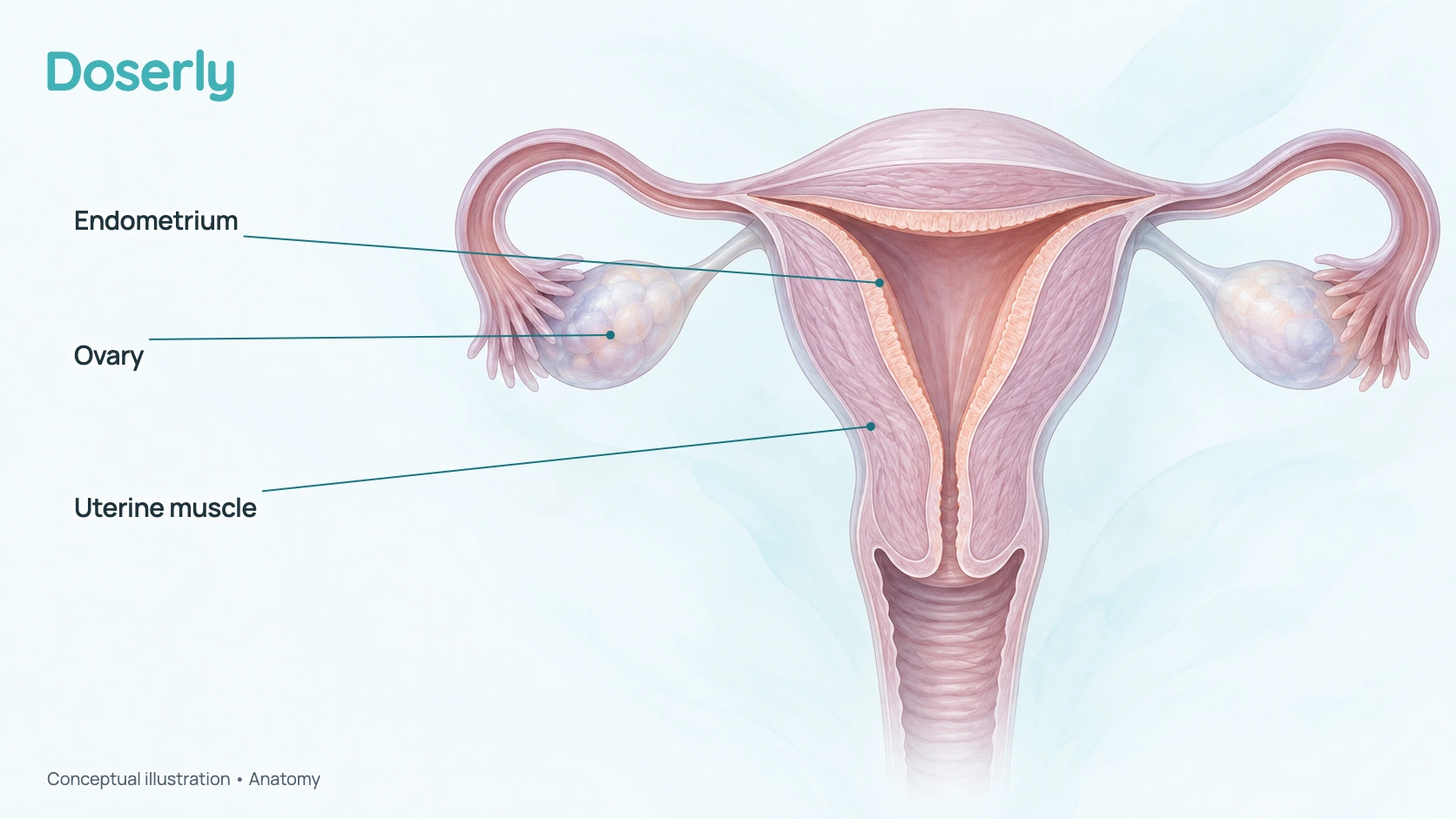
In menopausal hormone replacement therapy (HRT), an appropriate 52 mg system can provide the progestogen component that opposes systemic estrogen’s stimulation of the endometrium, the lining inside the uterus. The estrogen may still be needed separately for hot flashes or other systemic goals. The device is not an estrogen replacement, a progesterone capsule or a treatment guaranteeing better sleep. [1], [4]
The key practical distinction is duration by purpose. Eight years of contraception does not mean eight years of HRT protection. UK Mirena has a four-year HRT indication, BMS supports five-year protection, and the reviewed Australian information gives five years. US and Canadian labels do not list menopausal estrogen opposition as an authorized indication. These facts must stay attached to their country and source. [1], [2], [3], [4], [9]
Typical Levonorgestrel IUD Protocols
| Product and population | Amount each time | Schedule and total | Context and source |
|---|---|---|---|
| UK Mirena, estrogen replacement with uterus | One 52 mg intrauterine system inserted by a trained clinician | Continuous release; labeled removal/replacement no later than 4 years | Progestogen component with oral or transdermal estrogen; 52 mg is reservoir content, not daily amount [1] |
| UK BMS guidance, HRT endometrial protection | One 52 mg levonorgestrel system | Use for 5 years for HRT protection under named guidance | 5-year guidance extends UK Mirena’s 4-year HRT license; not its 8-year contraceptive license [4] |
| Australia Mirena, estrogen replacement | One 52 mg intrauterine system | Continuous release; removal after 5 years for protection | 5-year estrogen-opposition duration in current reviewed manufacturer CMI; 8 years is contraception [9], [10] |
| US/Canada Mirena, contraception context | One 52 mg intrauterine system | Up to 8 years for contraception; heavy-bleeding indication up to 5 years | These labels do not authorize HRT opposition; off-label clinician plan cannot inherit 8-year protection [2], [3] |
The ordinary pattern is one professionally inserted system with a separate estrogen regimen when needed. Its release cannot be titrated like a pill; a change involves reviewing the whole regimen or replacing/removing the device. Record the original insertion date and the named protection deadline. The UK label and five-year BMS guidance differ deliberately. Do not assume all 52 mg brands or smaller devices share identical local authorization. Initial placement checks and ongoing menopause reviews serve different purposes. [1], [3], [4], [6]
Where these schedules come from
Row 1: current UK Mirena SmPC 4.1–4.2. Row 2: BMS May 2026, intrauterine progestogen section, supports five-year HRT protection beyond the four-year UK Mirena license. Row 3: full reviewed Australian manufacturer CMI, section 4, rather than claiming a reviewed full PI. Row 4: current Canadian monograph 1/4.2 and US label 1/2.1; non-HRT context, not an HRT dose. The total 52 mg is reservoir content; release rates decline with time. [1], [2], [3], [4], [9]
What does it do, and what still needs separate treatment?
The device can address contraception, heavy menstrual bleeding and, under the relevant label or clinical plan, estrogen-related lining protection. These are distinct goals with different duration rules. A person may need both contraception during perimenopause and protection while receiving estrogen; the shorter protection deadline still matters even if pregnancy prevention remains effective. [1], [2], [3], [4]
Mirena’s local progestogen exposure strongly suppresses the lining and often reduces bleeding. A daily tablet is not required to deliver that component while a suitable, correctly placed device remains within the agreed HRT protection period. This can reduce daily-pill burden. It does not mean other medicines are never needed, or that all bleeding, pain, mood or sleep symptoms will resolve. [1], [4], [8]
The device alone does not supply systemic estrogen for hot flashes, night sweats or other estrogen-dependent treatment goals. Conversely, local vaginal symptoms may be treated separately with low-dose vaginal estrogen where appropriate. The full prescription records the device plus any systemic and vaginal medicines, rather than treating “an IUD” as a complete menopause regimen. [1], [6]
Amenorrhea, no bleeding, is a common treatment pattern but does not by itself establish menopause or prove ongoing protection. Ovulation is not consistently suppressed in every user. Contraceptive decisions therefore should not depend only on the absence of periods while the device is in place. [1], [2], [3]
Why are there four-, five- and eight-year dates?
An indication is the authorized purpose of a product. Evidence for pregnancy prevention and evidence for opposing prescribed estrogen are different. The contraceptive extension to eight years was studied in younger contraceptive users; it cannot simply extend the menopausal protection interval. Device release also declines over time, so “there is hormone left” is not proof that every indication remains adequately covered. [1], [3], [10]
The UK label says remove Mirena no later than four years when used for estrogen-replacement lining protection. BMS’s May 2026 guidance supports 52 mg levonorgestrel systems for five years of protection, based on its evidence assessment. That extra year is named guideline-supported use beyond the UK four-year Mirena license, not a corrected universal product label. [1], [4]
The Australian manufacturer CMI explicitly gives five years for protection during estrogen replacement and eight for contraception. The US and Canadian labels give contraception/heavy-bleeding indications without a menopausal opposition indication. An off-label clinician can consider evidence and local guidance, but cannot convert the eight-year contraceptive number into an established HRT duration. Ask which rule applies to your prescription and record the actual insertion date. [2], [3], [9]
Other levonorgestrel devices vary in reservoir size, labeling and evidence. Lower-content systems such as 19.5 mg or 13.5 mg products do not inherit the 52 mg system’s HRT support. Even a different 52 mg brand needs its own local prescribing context; a copper IUD supplies contraception without progestogen opposition. [4]
The purpose sets the deadline
Count from the actual insertion date. Starting estrogen later does not make an older device new.
UK HRT license
4 years
Mirena label; BMS supports 5 years beyond the UK 4-year HRT license. [1], [4]
Australian HRT
5 years
Manufacturer CMI: protection during estrogen replacement. [9]
Contraception
8 years
UK/US/Canada/Australia: contraception, not eight-year estrogen opposition. [1], [2], [3], [9]
52 mg systems and source-specific plans only. Lower-content devices do not inherit HRT evidence. US/Canadian Mirena labels do not list HRT opposition.
How are insertion, pain and placement handled?
Insertion is a procedure, not a home dosing task. A clinician checks pregnancy possibility, uterine anatomy and relevant infection or bleeding concerns before placing the device. The inserter is not used again. Ask beforehand what pain-control options are available and how prior difficult procedures or cervical narrowing affect the plan; experiences vary and a “quick procedure” does not promise little pain. [1], [3], [13]
The UK label describes a check four to twelve weeks after insertion and then annually, or earlier when indicated. The US label uses four to six weeks. These source-specific checks assess placement and clinical concerns; they do not replace the review of the full menopause regimen. If insertion is difficult or pain/bleeding is exceptional, the clinician considers perforation and may use ultrasound. [1], [3]
Threads allow placement checks and trained removal; do not pull on them. If threads cannot be felt, have changed, or the hard device is felt, arrange assessment rather than assuming it remains correctly placed. Use the advice on additional contraception until its position is checked when pregnancy prevention is relevant. If systemic estrogen is continuing, ask separately about the protection plan while device function is uncertain. [1], [2], [3], [4]
There is no daily pill reminder for the device itself, but there is a replacement deadline and a procedure follow-up. Keep reminders for those dates separate from the estrogen’s application schedule. Starting a new estrogen dose is also a reason to review whether the existing device and its age fit the intended regimen. [1], [4]
What should be recorded before and after placement?
Before insertion, the professional maintains the sterile product according to its own packaging and storage directions. The US label gives controlled room-temperature storage; a damaged or previously opened sterile pack is not used. This is not a device to take out, store and put back yourself. [1], [3]
After placement, keep the brand, reservoir content, insertion date, clinician details and purpose-specific review/replacement date. “Eight-year IUD” without its HRT purpose is an incomplete record. A replacement starts a new device’s dates; merely starting estrogen later does not reset the age of an older device. Keep the accompanying estrogen product and amount visible too. [1], [4]
If access, pain concerns or a waiting list delay replacement, contact the prescriber before the agreed protection period ends. The interim plan may involve another protection option or a change in the estrogen regimen. An online schedule cannot decide that substitution or extend the device’s protection period. [4]
What supports its HRT role, and what remains uncertain?
The UK SmPC summarizes 634 perimenopausal/postmenopausal users receiving continuous estrogen: no endometrial hyperplasia cases were reported up to four years in the cited clinical studies. This supports its labeled opposition role, but zero observed cases is not proof of zero future risk or an eight-year result. [1]
A 2001 prospective cohort started 40 postmenopausal women on a levonorgestrel system plus estrogen. Thirty-nine completed the first year; 29 remained on continuous estrogen and were assessed at five years. Endometria were suppressed at removal; 28 of the 29 biopsies were diagnostic, with one insufficient tissue sample and a thin lining on ultrasound. No hyperplasia was found in the diagnostic samples. This was a small cohort, not a large randomized cancer-prevention trial. [8]
Contraceptive extension evidence answers a separate question. The UK label reports 362 participants in the extension trial and 221 completing year eight; the Australian decision identifies women aged 18–35 in the extended-use study. Those findings should not be described as endometrial-protection follow-up in women taking estrogen. [1], [10]
In a 2024 French case-control study of meningioma requiring surgery, levonorgestrel intrauterine systems did not show an excess association. That is useful route-specific evidence, not a guarantee of no brain tumor, no breast risk or no systemic effects. It cannot rank every protection option for a particular person. NICE’s broad comparative breast-risk uncertainty and the device’s own warnings remain relevant. [3], [6], [11]
Does local delivery mean no systemic hormone?
The reservoir releases levonorgestrel inside the uterus, concentrating its effect at the lining. It inhibits lining proliferation and thickens cervical mucus. Some ovulation is suppressed, but contraception does not require every user to stop ovulating. The device is a synthetic progestogen system, not micronized progesterone delivered directly to the uterus. [1], [2], [3]
Local delivery still produces measurable levonorgestrel in blood. It is therefore inaccurate to promise no mood, breast, acne or other systemic effects. The US label describes an estimated release of about 21 micrograms/day after 24 days, about 11 at five years and seven at eight years. These are release rates, not a swallowed dose, refill quantity or instruction to add tablets according to a calculation. [3]
The total 52 mg reservoir and the microgram-per-day release are different quantities. A smaller reservoir or an older device cannot be judged by subtracting an estimated daily amount from the starting content. Evidence and the agreed indication-specific duration determine the plan. [1], [3], [4]
Two components, different quantities
Local progestogen opposition and systemic estrogen treatment serve different roles.
Device reservoir
52 mg total
One system inside the uterus; content is not an amount to take daily. [1], [3]
Continuous release
Micrograms per day
Release declines over time; local effect with measurable blood exposure. [1], [3]
Separate estrogen
Its own schedule
Product, route and amount stay visible; replacement deadline remains specific to protection. [1], [4]
No daily device-dose reminder, no mass conversion to tablets, and no calculated extension based on hormone remaining.
Which problems need prompt assessment?
Bleeding changes, pelvic discomfort, breast tenderness, acne, headache and mood effects may affect tolerability. Ovarian cysts are also listed. Early spotting can occur, but persistent, heavy or new bleeding after a stable interval needs assessment. A device should not be used to cover unexplained bleeding without evaluating its cause. [1], [2], [3], [7]
Insertion-related risks include perforation of the uterine wall, partial/complete expulsion and pelvic infection. Exceptional pain or bleeding at insertion, fever, worsening pelvic pain, abnormal discharge or feeling unwell warrants prompt help. Missing threads do not prove expulsion, but require checking. If the device is displaced or expelled, contraception and HRT protection are separate questions to resolve. [1], [3], [4]
Pregnancy with an IUD is uncommon, but a positive test or pregnancy symptoms need prompt assessment, including pregnancy location. The proportion of pregnancies that are ectopic is higher when pregnancy occurs with Mirena in place; that does not mean IUD users have the same absolute ectopic risk as untreated pregnancy. Do not interpret severe one-sided pain or fainting from a forum anecdote. [1], [3]
Current or suspected progestogen-dependent tumors, including breast cancer, unexplained bleeding, active relevant infection, certain uterine abnormalities and liver conditions are among restrictions. The paired estrogen has its own risks and contraindications. Do not assume local progestogen delivery makes systemic estrogen safe in every history. Review the exact device and whole treatment with the clinician. [1], [2], [3]
Pain is an experience to plan for and assess, not a predictable score. Some public users report straightforward insertion; others describe substantial pain or needing a different setting. Discuss options beforehand and seek review when symptoms are beyond the expected procedure recovery described by your team. [1], [13]
What should be checked when care or country changes?
Carry the insertion record and purpose-specific deadline when moving between clinicians or countries. A prescription or appointment record calling it “contraception for eight years” can miss its shorter estrogen-opposition plan. Guidelines, product licenses, reimbursement and clinic access differ; approval is not proof of a local appointment or covered replacement. [1], [2], [3], [4], [9]
The absence of periods may be useful for heavy bleeding but makes natural cycle-based menopause assessment less straightforward. Ask separately when contraception can stop, when HRT protection must be replaced and whether estrogen will continue after removal. An old device should not be left indefinitely because pregnancy prevention is no longer needed. [1], [6]
What do public users find helpful or difficult?
A 2026 public discussion asks about an older Mirena, newly added estrogen and poor tolerance of oral progesterone. The practical need is a clear explanation of device age and the complete protection plan. Replies propose doses and replacement rules, but they are not an individualized assessment or proof that a particular tablet amount fits that estrogen prescription. [12]
Another 2026 discussion includes fewer daily medicines, less heavy bleeding and acceptable device use, alongside painful insertion, ongoing sleep problems and mood questions. These selected experiences show why both procedure planning and treatment goals matter. Good bleeding control does not guarantee a good sleep response; a favorable routine is not a promise of painless replacement. [13]
The reviewed public text supplies questions, not response rates, clinical histories or authority to extend use. We retain no usernames or identifying stories. Ask about pain management, the HRT deadline, what to do if threads change and which symptoms still need separate treatment. [12], [13]
What should be monitored?
Keep the device record and complete estrogen prescription visible: brand, reservoir, insertion date, position checks, HRT protection deadline and separate contraception deadline. Record estrogen changes and any placement uncertainty or gap in the protection plan. Bleeding dates and amount, sleep, mood and effects on activities help review without proving lining protection. A pill reminder does not represent the device’s continuous release. [4], [6], [7]
NICE recommends a review three months after starting treatment, then annually, with earlier review when treatment is ineffective, unwanted effects are troublesome or an adverse event occurs. An adverse event is an unwanted event during treatment; it is not automatically caused by the medicine. Review may change the product, estrogen exposure, progestogen amount, route or calendar. It also considers whether the treatment remains useful for the person’s current goals. [6]
Unscheduled bleeding should be reported rather than interpreted from a hormone blood test. NICE’s April 2026 update says bleeding is common during the first six months of systemic HRT or within three months of a change, and recommends prompt medical help beyond those periods. That is not an instruction to wait with heavy, prolonged, persistent or concerning bleeding. The British pathway assesses risk factors, adherence and both hormone components, and can arrange earlier ultrasound or tissue assessment. [6], [7]
A planned withdrawal bleed after a sequential course differs from bleeding between expected courses, or new bleeding after a stable interval without it. Ultrasound assesses the lining’s thickness; a biopsy takes a tissue sample. Neither a comfortable mood nor bleeding stopping after a dose change rules out disease by itself. Keep routine breast and cervical screening appropriate to local guidance and personal risk, and report new breast changes. The purpose of follow-up is clinical assessment, not finding a universally “optimal” progesterone blood level. [4], [6], [7]
A device record needs insertion, placement follow-up and purpose-specific replacement dates. If expulsion or displacement is suspected, assess both contraception and estrogen opposition rather than continuing on the assumption that strings or absent bleeding prove protection. No routine progesterone blood target checks device protection. [1], [3], [4]
What happens when treatment stops?
Removing the IUD is a clinician-performed procedure. If systemic estrogen is to continue, arrange the next protection option before removal or expiry of its agreed HRT interval. Stopping contraception and stopping HRT protection are separate decisions; the continuing estrogen and pregnancy possibility determine which plans remain needed. [1], [3], [4]
The device cannot be tapered by taking fewer days or a smaller fraction. If it is poorly tolerated or safety requires removal, review a replacement protection strategy and the whole menopause regimen. Do not pull the threads or remove/reinsert it yourself. [1], [3]
When the whole HRT regimen is stopped, symptoms may recur. NICE permits gradual reduction or immediate stopping of HRT; its gradual-reduction discussion is not an IUD-removal technique. Record the actual removal and replacement/alternative dates so the team can see any protection gap. [4], [6]
How does it compare with other options?
Micronized progesterone, medroxyprogesterone acetate, norethindrone acetate, dydrogesterone and a 52 mg levonorgestrel intrauterine system are different protection options. “Progestogen” names the family; “progestin” commonly describes a synthetic member. Capsule or tablet milligrams do not measure the same potency across these molecules. The amount is interpreted with its product, estrogen exposure and treatment days. The levonorgestrel device’s HRT protection duration is separate from its contraceptive duration. [4], [5]
Tolerability matters alongside protection. Someone who feels groggy on micronized progesterone may do differently on a synthetic progestogen, while another person has the opposite experience. A fixed estrogen/progestogen product can simplify taking the intended pair, but provides less independent adjustment than separate medicines. No comparison justifies transferring one molecule’s dose to another, or assuming a contraceptive pill supplies the intended HRT opposition. [4], [5]
Breast-cancer comparisons also require care. NICE says evidence is insufficient to establish whether the increase in risk with micronized progesterone or dydrogesterone differs from other progestogens. Observational associations can inform a discussion without proving a safer drug for every person. Personal cancer history, duration, estrogen route and the exact combination remain part of the clinical review. [6]
Common questions
Do I need oral progesterone as well?
A suitable, correctly placed 52 mg system within its agreed HRT protection period can supply the progestogen component under the relevant label or guidance. An older device, another size or uncertain placement needs review. The answer is not decided by eight-year contraceptive efficacy or absent bleeding. Ask the clinician to verify the device, its insertion date and the complete estrogen prescription before adding or removing oral medication. See product schedules. [1], [4]
Can I leave it in until eight years if I start estrogen?
The HRT clock starts with insertion, not with the later estrogen prescription. UK Mirena’s HRT label gives four years and BMS supports five; reviewed Australian information gives five. Eight-year contraceptive efficacy does not establish eight-year protection against prescribed estrogen. Keep the actual insertion date visible and ask which protection deadline applies. Arrange replacement or another protection plan before that period ends; estrogen initiation does not reset an older device. See the duration distinctions. [1], [4], [9]
Can I compare its milligrams with progesterone?
No. The 52 mg figure describes a device reservoir, while oral progesterone milligrams describe a swallowed dose of another molecule. Daily device release changes over time and is measured in micrograms. Neither a reservoir calculation nor a smaller milligram number proves equivalent protection or fewer adverse effects. The clinician uses device-specific evidence, estrogen exposure and the agreed protection period. Do not calculate an oral supplement from hormone remaining in a device. See the mechanism and treatment comparisons. [3], [4]
Does no bleeding prove the lining is protected?
No. Amenorrhea can occur with Mirena, but is not a test of protection against systemic estrogen. Device age, placement and the estrogen prescription still matter. An older system cannot be kept beyond its HRT protection plan simply because periods remain absent. New, persistent or concerning bleeding also needs assessment rather than a personal dose adjustment. Keep the insertion date and complete treatment record available, and seek earlier review for displacement concerns. See monitoring. [1], [4], [6], [7]
Can I stop just the progestogen?
Removing the device ends its progestogen delivery. If systemic estrogen continues with a uterus present, arrange an alternative protection plan before removal or expiry of the agreed HRT period. Contraception may also need a separate plan. The device is removed by a professional; it cannot be tapered by pulling its threads or adjusting a daily dose. Stopping all HRT is a different decision under NICE guidance. See removal and stopping. [1], [4], [6]
How long should I wait with unwanted effects?
There is no mandatory forum adjustment deadline. Some early bleeding or discomfort can change, but severe pain, fever, unusual discharge, suspected displacement or concerning bleeding needs prompt assessment. Discuss insertion pain beforehand and use the recovery instructions provided by your team. Troublesome mood or other effects also warrant earlier review instead of waiting for an annual visit. A favorable account from another user cannot predict your tolerance. See device risks and monitoring. [1], [6], [7]
Glossary
Terms used to read the product and evidence.
- Adverse event
- An unwanted event during treatment; it is not automatically caused by the medicine.
- Amenorrhea
- Absence of menstrual periods. Secondary amenorrhea occurs after periods have previously occurred.
- Bioavailability
- The amount of an administered medicine reaching the circulation; formulation and route can change it.
- Bioidentical
- Chemically identical to a hormone the body makes; the word does not establish safety or product quality.
- Biopsy
- A tissue sample examined for abnormalities, unlike an ultrasound measurement of thickness.
- Boxed warning
- A prominent warning format used in a medicine label; removing the box does not remove every risk.
- Compounding
- Preparing a medicine to a prescription rather than supplying a standard approved finished product.
- Continuous combined HRT
- Estrogen and progestogen used continuously according to their prescriptions, without scheduled progestogen-free days.
- Contraindication
- A condition in which a particular product must not be used under its label.
- Cycle
- A repeating treatment calendar. A 28-day cycle and a calendar month have different lengths.
- Daily total
- All doses taken on one day added together, not the average across days without treatment.
- Endometrium
- The lining inside the uterus that can grow in response to estrogen.
- Estrogen
- A family of hormones including estradiol; systemic treatment and low-dose local treatment have different purposes.
- Excipient
- An ingredient other than the active medicine, such as a capsule oil or lecithin.
- First-pass metabolism
- Processing in the intestine and liver before an oral medicine reaches the wider circulation.
- Hormone replacement therapy (HRT)
- In this guide, hormone treatment for menopause-related needs; also called menopausal hormone therapy.
- Hyperplasia
- Excessive tissue growth. Endometrial hyperplasia is not the same diagnosis as endometrial cancer.
- Hysterectomy
- Surgery removing the uterus; removal of ovaries is a different procedure.
- Intrauterine device (IUD)
- A device placed inside the uterus. Protection duration in HRT can differ from contraception duration.
- Metabolite
- A substance produced as the body processes another substance. Some progesterone metabolites affect brain signaling.
- Micronization
- Making particles smaller to change their dissolution and absorption, without changing the hormone molecule.
- Milligram (mg)
- A unit of mass; a 100 mg capsule contains 100 milligrams of active progesterone.
- Observational study
- A study following treatment choices rather than randomly assigning them; confounding can affect comparisons.
- Off-label
- Use outside a product’s authorized indication, route or schedule; it can be guideline-supported without becoming labeled use.
- Oral
- Swallowed, passing through the digestive system.
- Perimenopause
- The transition toward menopause, when periods and hormone patterns can change.
- Placebo
- A comparison treatment without the tested active medicine.
- Postmenopause
- The stage after menopause; context and other hormonal treatments matter when identifying it.
- Progestogen
- The broader family of progesterone-like medicines, including progesterone and synthetic progestins.
- Randomized controlled trial
- A study assigning participants to groups by chance to make a treatment comparison.
- Sequential HRT
- A regimen giving progestogen on selected days of a repeating cycle.
- Systemic
- Reaching the wider body through the circulation, rather than being intended mainly for a local site.
- Transdermal
- Absorbed through the skin, as with an estrogen patch; evidence for progesterone cream is different.
- Vaginal
- Administered in the vagina; the route alone does not establish systemic exposure or uterine protection.
- Vasomotor symptoms
- Hot flashes and night sweats.
- Withdrawal bleeding
- Bleeding following removal of hormonal exposure, such as after a sequential progesterone course.
- Meningioma
- A tumor arising from membranes around the brain and spinal cord; often benign, but its location can have serious effects.
How this guide was researched
We compared current product information with May/August 2026 BMS guidance and NICE, then checked original human research and relevant public discussions. Each amount retains its product, route, indication and country. A listing or page update is not necessarily a prescribing-information revision.
The directory distinguishes full text, abstracts and public search excerpts. Combination results do not prove the progestogen’s independent effect. Discussions show selected experiences, not surveys, response rates or prescribing authority. Anatomy images are conceptual; data figures use the exact values from named sources.
This educational content does not replace a prescription or clinical assessment. Sources that can change require an updated check when making a new treatment decision.
Explore the sources
Checked October 2, 2026. Access level describes the material actually reviewed.
Showing 13 sources
- 01
Mirena 20 micrograms/24 hours intrauterine delivery system: Summary of Product Characteristics ↗
Labels and regulators
Full current SmPC reviewed. Sections 4.1–4.2 separate 8-year contraception, 4-year estrogen opposition and bleeding indication; 4.3–4.4 risks; 5.1–5.2 evidence and release rates.
- 02
MIRENA: Product Monograph Including Patient Medication Information ↗
Labels and regulators
Full current monograph retrieved. Indications 1 and dosage 4 distinguish 8-year contraception and 5-year idiopathic menorrhagia, without a licensed HRT-opposition indication.
- 03
MIRENA (levonorgestrel-releasing intrauterine system): Prescribing Information ↗
Labels and regulators
Full label retrieved. Indications 1.1–1.2 and dosage 2.1; no US HRT indication. Pregnancy, infection, perforation, expulsion, cysts and bleeding sections reviewed.
- 04
Progestogens and endometrial protection ↗
Clinical guidance
Full guidance retrieved. Oral opposition, higher estrogen exposure, vaginal uncertainty, IUDs and compounded creams.
- 05
HRT – Practical prescribing ↗
Clinical guidance
Full four-page document retrieved; dose-table headings checked in PDF text. Average-age population; POI excluded.
- 06
Menopause: identification and management (NG23): Recommendations ↗
Clinical guidance
Full recommendations retrieved. Diagnosis, breast-risk uncertainty, stopping and 3-month/annual review; 2026 bleeding amendments.
- 07
Management of unscheduled bleeding on hormone replacement therapy (HRT) ↗
Clinical guidance
Current recommendations page reviewed. Risk assessment, adherence and investigation pathways; not a self-triage tool.
- 08
A 5-year follow-up study on the use of a levonorgestrel intrauterine system in women receiving hormone replacement therapy ↗
Human research
Full article text returned through Exa at the PubMed URL. 40 started, 39 at 12 months, 29 estrogen-treated at five years; cohort and evaluable tissue details reviewed.
- 09
Mirena: Consumer Medicine Information ↗
Labels and regulators
Full public manufacturer CMI reviewed. It explicitly distinguishes 8-year contraception from 5-year estrogen-replacement endometrial protection. No claim that a full Australian PI was reviewed.
- 10
Mirena (levonorgestrel) intrauterine device: Australian prescription medicine decision summary ↗
Labels and regulators
Official decision text reviewed. Extension from 5 to 8 years applies to contraception and contraceptive-trial population, not automatic HRT extension.
- 11
Use of progestogens and the risk of intracranial meningioma: national case-control study ↗
Human research
Full open-access article retrieved in the progestogen review. French surgery-based study found no excess association for levonorgestrel intrauterine systems; not proof of zero risk.
- 12
Do I need oral progesterone? ↗
Public experiences
Public thread text reviewed through search. Older device, estrogen addition and progesterone intolerance prompts replacement/protection questions; replies are not dosage authority.
- 13
To Mirena or not to Mirena? ↗
Public experiences
Public thread text reviewed through search. Reduced daily-pill burden and bleeding benefit coexist with insertion pain, continued sleep symptoms and mood questions.
No matching sources
Try a different term or show the full list.
Updates and corrections
Draft researched October 2, 2026. Report a correction through Doserly support, identifying the claim and source.