
In this guide
What is nomegestrol acetate?
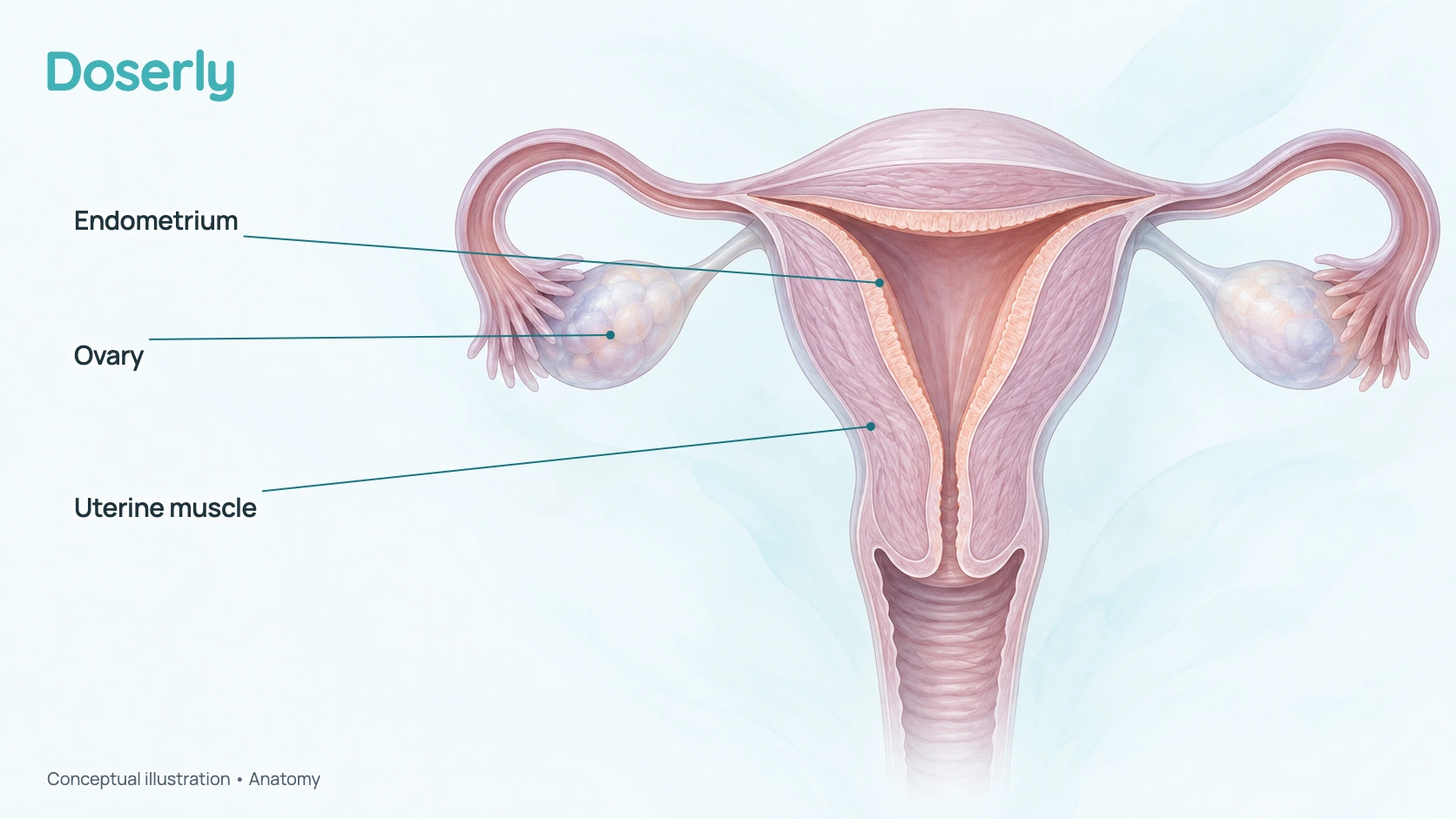
Nomegestrol acetate, often abbreviated NOMAC, is a prescription synthetic progestogen. It acts at progesterone receptors and can oppose estrogen-related growth of the endometrium, the lining inside the uterus. Some regional products have been used with estrogen in menopausal hormone replacement therapy (HRT), while other products are contraceptives or have gynecologic indications. The product and country matter. [1], [2], [10]
It is not micronized progesterone, norethindrone acetate or megestrol acetate. Similar names and a common progestogen role do not make these molecules interchangeable. “Selective” describes pharmacology, not a guarantee of harmless treatment. The exact labeled indication and current safety restrictions are more useful than a general claim of low androgenic activity. [1], [3]
This guide gives a restricted current French label example, alongside the important fact that France’s HAS assessment finds no place for nomegestrol/estrogen in postmenopausal HRT strategy. EMA’s high-dose restrictions and meningioma contraindication also remain central. This is therefore a guide to understanding and reviewing a prescription, not an endorsement to start a familiar older HRT regimen. [1], [3], [9]
Typical Nomegestrol Acetate Protocols
| Product and population | Amount each time | Schedule and total | Context and source |
|---|---|---|---|
| France Lutenyl 5 mg, menopausal artificial cycles with estrogen | One oral 5 mg tablet each treatment day | Sequential label: 12–14 days per month; estrogen schedule determines treatment | Restricted to situations where other interventions are inappropriate; HAS does not recommend its postmenopausal HRT place [1], [3], [9] |
| EU Zoely, contraceptive context only | One active oral tablet: nomegestrol 2.5 mg + estradiol 1.5 mg | 24 active tablets then 4 placebo tablets; next pack immediately | Contraceptive product, not a menopausal protection prescription or half-dose Lutenyl substitute [10] |
The current French oral sequential row is a label description, not a first-choice recommendation. It requires annual benefit/risk review, minimum effective exposure and attention to alternatives; HAS finds no postmenopausal HRT place. Label-described adjustment remains clinical, without a universal titration ladder. Calendar months and contraceptive packs differ. Follow the current product’s MRI and annual information requirements where applicable; changing estrogen does not erase the progestogen restriction. [1], [3], [9]
Where these schedules come from
Row 1: French Lutenyl 5 mg RCP 4.1–4.2, revised 22 December 2025; EMA restrictions and HAS assessment accompany it. Row 2: current EMA Zoely 4.1–4.2, explicitly a contraceptive-context comparison. The published Lutenyl 3.75 mg RCP is context only; Naemis withdrawn Irish record supplies no current protocol. No regional approval, live stock or HRT breast-risk advantage is inferred. [1], [2], [3], [9], [10], [11]
Why is an authorized indication different from a recommendation?
The current French Lutenyl 5 mg RCP still lists artificial cycles with estrogen in menopausal women, while restricting use to situations where other interventions are inappropriate. Its label supplies a sequential amount and exposure period. That is a description of the reviewed authorization, not proof that it is a preferred modern option. [1]
HAS’s July 2023 assessment addresses clinical benefit and the place in treatment strategy. It finds no place for nomegestrol with estrogen in postmenopausal HRT, considering the balance of evidence, alternatives and meningioma risk. Benefit in this indication was insufficient to justify public funding. A negative strategy/funding assessment is different from a withdrawn authorization; both facts belong in the discussion. [9]
Premenopausal bleeding and severe cyclical breast symptoms have separate assessments, restrictions and potential second-line roles. Those conclusions do not carry over to a menopausal estrogen-protection prescription. A person receiving a medicine for bleeding can have a different indication, duration and benefit/risk discussion from a person taking it with systemic estrogen. [1], [9]
Zoely contains nomegestrol and estradiol but is a combined contraceptive. Its studied population, 24-active/four-placebo pack and benefit/risk framework are not an HRT approval. A contraceptive pill cannot be relabeled as a continuous menopausal opposition product just because both ingredients are also hormones used in menopause. [10]
Three decisions to read together
An authorization does not establish a preferred treatment or remove a safety restriction.
French product label
Restricted indication
Lutenyl: menopause artificial cycles remain listed, but alternatives must be inappropriate. [1]
HAS strategy assessment
No HRT place
Postmenopausal nomegestrol/estrogen benefit insufficient for public funding; not an authorization withdrawal. [9]
EMA safety restriction
All doses: meningioma
Current/history contraindicates; 3.75–5 mg high-dose products restricted and stop permanently if diagnosed. [3]
Zoely is a contraceptive product, not a lower-dose HRT substitute. French MRI and annual attestation requirements are product-specific. [1], [10]
How should dose and cumulative exposure be read?
EMA identifies nomegestrol 3.75–5 mg products as high-dose in this safety context. “High” is molecule-specific: it does not mean that a 100 mg progesterone capsule is fifty times stronger or that a 2.5 mg contraceptive product has no risk. Low- and high-dose nomegestrol products are contraindicated in people with current or previous meningioma. [3], [10]
Cumulative exposure is the amount received over time, not the strength of one tablet. Risk rises with larger cumulative exposure and longer use in the reviewed data. The restriction to the lowest effective dose and shortest duration, when alternatives are inappropriate, is not permission to invent a half-tablet HRT regimen. Dose changes require a whole-prescription and indication review. [1], [3], [8]
The French menopause row uses 12–14 days per month in a sequential regimen. The separate premenopausal schedule of days 16–25 for ten days is not the same menopause row. Nor is a calendar month automatically a 28-day cycle. Keeping source-specific estrogen exposure and the actual progestogen days prevents an old pack example becoming an unsupported universal schedule. [1]
The published 3.75 mg Lutenyl RCP and historical Naemis records help explain older discussions, but current marketing must be verified separately. Ireland’s Naemis licence was withdrawn in November 2011 and its current official record says not marketed. We do not present that pack as a current Irish HRT option. [2], [11]
How do administration and interactions affect the plan?
The reviewed Lutenyl regimen is oral, meaning swallowed. Its evidence does not establish a vaginal tablet, cream, implant or transdermal patch schedule. An acetate ester and a similar progestogen name do not supply an absorption conversion. The estrogen route can also change the overall regimen’s risk context without erasing nomegestrol’s specific warning. [1], [3]
Use the actual product and prescribed days. A missed dose is discussed using its leaflet and pharmacist instructions; no doubled-dose or extended-course rule is invented here. Give the pharmacist the full medication and supplement list. Enzyme-inducing medicines can reduce hormone exposure, while interactions in a contraceptive combination retain their contraceptive product context. [1], [10]
Changing the product because of troublesome bleeding, mood or safety concerns requires a continuing protection plan if systemic estrogen remains and a uterus is present. Do not switch by matching another molecule’s milligrams. A fixed contraceptive combination changes both hormones and cannot be used as a single-ingredient substitute. [1], [4], [10]
What should be kept with the medication record?
The current French Lutenyl RCP gives no special storage precautions. Keep the expiry, original identification and local packaging directions; absence of a special temperature rule does not make heat, damp or an unlabeled container appropriate. The contraceptive product has its own storage and pack-order instructions. [1], [10]
The record should include why the medicine was chosen, actual strength/days, estrogen product and amount, prior exposure and the monitoring/attestation plan where required. Current safety communication should not be hidden behind an old brand name. A refill is an opportunity to confirm that alternatives and the indication have been reviewed, not simply to repeat a familiar schedule. [1], [3], [9]
What do the meningioma numbers actually describe?
A 2024 French population-based cohort included 1,060,779 women starting nomegestrol during 2007–2017. The study compared 535,115 with cumulative exposure over 150 mg in the first six months and 525,664 with exposure at or below 150 mg. Its outcome was intracranial meningioma treated with surgery or radiotherapy, not every small tumor detected on a scan. [8]
Rates were 19.3 versus 7.0 per 100,000 person-years, with an age-adjusted relative risk of 2.9 (95% confidence interval 2.4–3.7). At cumulative exposure over 6 g, the age-adjusted relative risk was 12.0 (9.9–16.0). These are observational associations and exposure-specific estimates, not a 12% chance of a tumor or a personal prediction for every HRT user. [8]
The exposed and comparison groups differed, follow-up varied, and most participants were not co-prescribed estrogen. Age and exposure matter; a cohort spanning gynecologic indications cannot be presented as a randomized menopause-only safety trial. The findings support a serious dose/duration concern without providing an individualized safe threshold. [8]
After discontinuation, association estimates decreased in the study. That does not mean every existing tumor disappears, risk becomes zero on a chosen date, or monitoring can be skipped. A diagnosed meningioma requires stopping nomegestrol-containing treatment and specialist follow-up under current recommendations. [1], [3], [8]
Older lining-protection studies and low-androgenic pharmacology do not settle rare neurologic harms or comparative breast safety. WHI used a different hormone pair; NICE’s uncertainty about progestogen breast-risk differences is not a nomegestrol endorsement. Treatment choice considers both protection and current molecule-specific risk measures. [1], [6], [9]
Nomegestrol: observed meningioma rates
Surgery/radiotherapy endpoint per 100,000 person-years. French cohort, 1,060,779 women initiating in 2007–2017; exposure and follow-up groups differ. [8]
Age-adjusted RR 2.9 (95% CI 2.4–3.7). Observational association, not a personal probability, menopause-only randomized result or safe cumulative-dose threshold.
Does receptor selectivity make it safer?
Nomegestrol is related structurally to the 19-norprogesterone class and has strong progesterone-receptor activity. It changes estrogen-stimulated endometrial development. That helps explain its clinical role, but receptor affinity is not a clinical comparison of cancer, tumor, mood or vascular outcomes. The reviewed label’s receptor-affinity figure should not become a milligram conversion to natural progesterone. [1], [2]
Meningiomas often express hormone receptors, providing biological plausibility for a hormone-related effect. The cohort’s dose-response and reports after stopping contribute evidence, but the clinically important action remains the current restriction and assessment. A reassuring mechanistic label such as nonandrogenic cannot cancel a regulator’s warning. [3], [8]
What requires review or stopping?
Current or previous meningioma is a contraindication for low- and high-dose nomegestrol products. EMA says treatment must be permanently stopped if meningioma is diagnosed. The current French Lutenyl RCP also requests specialist advice. Do not switch to another progestogen automatically without a clinician reviewing the tumor and continued hormone needs. [1], [3], [8], [10]
Possible signs include new/progressive headaches, vision, hearing, language or memory changes, loss of smell, seizures and weakness. These symptoms are not specific to meningioma, but need assessment rather than reassurance from an old forum. Severe neurologic symptoms can require urgent care. A person without symptoms may still have the required imaging plan. [1], [3]
The French product has an MRI schedule and annual information acknowledgement after the first treatment year; these are product/jurisdiction-specific requirements, not universal imaging for every HRT medicine. They are explained in monitoring. A normal scan does not remove the underlying prescribing restriction or guarantee future safety. [1]
Unexplained bleeding, untreated hyperplasia, hormone-dependent malignancies, certain clotting histories/conditions, relevant liver disease and other listed contraindications also matter. Breast tenderness, bleeding changes, headache and mood symptoms can affect tolerability. The paired estrogen retains its own contraindications and vascular/breast-risk context. [1]
Seek prompt help for suspected clots, chest pain, sudden breathlessness, severe neurologic change, jaundice or major mood deterioration. Troublesome ordinary effects deserve earlier review too. No historic successful experience establishes a current safe duration, and no online adjustment deadline requires continuing severe impairment. [1], [6]
Which older brand claims need rechecking?
Authorization, marketing and reimbursement are separate. The current French Lutenyl RCP and HAS strategy assessment should not be compressed into “approved and reimbursed for menopause.” The official Irish Naemis record is withdrawn/not marketed, and its older regimen cannot establish present availability elsewhere. A historic product name is useful to identify prior exposure, not to certify a live treatment option. [1], [9], [11]
We did not verify current US, Canadian or Australian approval of nomegestrol as a menopausal medicine. The French cohort describes historical authorization context, while a live national search is needed for a new regional access claim. Do not assume centrally authorized Zoely means every nomegestrol HRT product is licensed throughout Europe. [3], [8], [10]
What can historical public experiences tell us?
Historical public Lutenyl discussions report some improvement in heavy bleeding, continuing or recurrent bleeding in other accounts, and questions after stopping. Another public thread includes acceptable early tolerance alongside weight, cycle and contraception concerns. These selected reports are useful questions to bring to review, not a modern comparison of benefit and risk. [12], [13]
The older stories predate the current restrictions. Their doses, treatment breaks and contraceptive assumptions do not become safe HRT instructions in 2026. Reduced bleeding does not prove pregnancy prevention or remove the need to investigate a new symptom. Improvement, partial response and unwanted effects all remain visible without assigning rates. [1], [12], [13]
We checked public material only, retained no usernames or identifying histories, and found no basis for a reliable nomegestrol-specific satisfaction or adaptation estimate. This section deliberately identifies the historical access level rather than pretending recent patient evidence was abundant. Ask why this product is appropriate now, what alternatives were assessed and how current safety follow-up will occur. [12], [13]
What should be monitored?
Keep the whole prescription visible: the estrogen product and amount, this progestogen’s product and route, the actual exposure days, and any missed doses or refill gaps. A record that says only “one hormone pill” loses the distinction between estrogen-only days and combined days. Bleeding dates, amount, sleep, mood and effects on daily activity help the review. They do not prove that the lining is protected. [4], [6], [7]
NICE recommends a review three months after starting treatment, then annually, with earlier review when treatment is ineffective, unwanted effects are troublesome or an adverse event occurs. An adverse event is an unwanted event during treatment; it is not automatically caused by the medicine. Review may change the product, estrogen exposure, progestogen amount, route or calendar. It also considers whether the treatment remains useful for the person’s current goals. [6]
Unscheduled bleeding should be reported rather than interpreted from a hormone blood test. NICE’s April 2026 update says bleeding is common during the first six months of systemic HRT or within three months of a change, and recommends prompt medical help beyond those periods. That is not an instruction to wait with heavy, prolonged, persistent or concerning bleeding. The British pathway assesses risk factors, adherence and both hormone components, and can arrange earlier ultrasound or tissue assessment. [6], [7]
A planned withdrawal bleed after a sequential course differs from bleeding between expected courses, or new bleeding after a stable interval without it. Ultrasound assesses the lining’s thickness; a biopsy takes a tissue sample. Neither a comfortable mood nor bleeding stopping after a dose change rules out disease by itself. Keep routine breast and cervical screening appropriate to local guidance and personal risk, and report new breast changes. The purpose of follow-up is clinical assessment, not finding a universally “optimal” progesterone blood level. [4], [6], [7]
The current French Lutenyl 5 mg RCP also specifies brain MRI at the end of the first year if treatment continues. Prior childhood cranial radiotherapy or neurofibromatosis type 2 calls for imaging at initiation. If continuing, repeat no later than five years after the first MRI, then every two years if that scan is normal. Beyond the first treatment year, the prescriber and patient co-sign an annual information acknowledgement. These are French product requirements, not routine MRI for all progestogens or permission to continue when alternatives are appropriate. [1], [3], [9]
What happens when treatment stops?
Stopping the whole HRT regimen and stopping only its progestogen are different decisions. If systemic estrogen continues with a uterus present, a protection plan is still needed. Planned off-days in a sequential prescription are part of that plan; extending them because the capsule or tablet is troublesome is a treatment change. Contact the prescriber to review a suitable alternative instead of quietly removing one component. [4], [6]
Symptoms can return after stopping HRT. NICE allows either gradual reduction or immediate stopping; gradual reduction may limit symptom recurrence in the short term, but makes no long-term difference. There is no universal tablet-cutting schedule in this guidance. A fixed combination changes both hormones when it is reduced or stopped, while separate products can be adjusted independently under clinical supervision. A scored line does not always mean a tablet is authorized to provide equal smaller doses. [6]
New severe mood deterioration, major impairment or suspected serious adverse effects need prompt help, not completion of an online “adjustment period.” A clinician may stop or change treatment urgently while arranging continuing protection where needed. Record the last actual dose and what estrogen was continued; those details make a review more useful than a general report that “the hormones did not suit me.” [4], [6], [7]
How does it compare with other options?
Micronized progesterone, medroxyprogesterone acetate, norethindrone acetate, dydrogesterone and a 52 mg levonorgestrel intrauterine system are different protection options. “Progestogen” names the family; “progestin” commonly describes a synthetic member. Capsule or tablet milligrams do not measure the same potency across these molecules. The amount is interpreted with its product, estrogen exposure and treatment days. The levonorgestrel device’s HRT protection duration is separate from its contraceptive duration. [4], [5]
Tolerability matters alongside protection. Someone who feels groggy on micronized progesterone may do differently on a synthetic progestogen, while another person has the opposite experience. A fixed estrogen/progestogen product can simplify taking the intended pair, but provides less independent adjustment than separate medicines. No comparison justifies transferring one molecule’s dose to another, or assuming a contraceptive pill supplies the intended HRT opposition. [4], [5]
Breast-cancer comparisons also require care. NICE says evidence is insufficient to establish whether the increase in risk with micronized progesterone or dydrogesterone differs from other progestogens. Observational associations can inform a discussion without proving a safer drug for every person. Personal cancer history, duration, estrogen route and the exact combination remain part of the clinical review. [6]
Common questions
Does a 12-fold association mean a 12% chance?
No. Twelve was an age-adjusted relative-risk estimate in a high cumulative-exposure group, not a percentage of everyone taking the drug. The overall study rates were 19.3 and 7.0 events per 100,000 person-years, and the endpoint was surgery/radiotherapy for meningioma. Population, exposure and observational limits stay attached to those numbers. See evidence. [8] Keep the actual product, indication and current restriction visible. A numerical amount from one formulation does not establish the same use or safety for another. See protocols. [1]
Is Zoely a lower-dose menopause substitute?
Zoely is a fixed nomegestrol/estradiol contraceptive with 24 active and four placebo tablets. A smaller nomegestrol number does not authorize its use as a single-component HRT substitute. The combination has its own clotting and meningioma restrictions, including contraindication with current/previous meningioma. The indication and hormone pair remain important. [3], [10] Keep the actual product, indication and current restriction visible. A numerical amount from one formulation does not establish the same use or safety for another. See protocols. [1]
Can I compare its milligrams with progesterone?
No. These are different molecules and products, with different potency, metabolism and studied regimens. A smaller milligram number does not mean less protection or fewer adverse effects. Use the exact product-and-estrogen row, not a mass ratio or a forum conversion. The prescriber considers exposure days and estrogen dose as well as the amount. See protocols and comparisons. [4], [5] Keep the actual product, indication and current restriction visible. A numerical amount from one formulation does not establish the same use or safety for another. See protocols. [1]
Does no bleeding prove the lining is protected?
No. Bleeding patterns help assess a regimen, but are not a tissue-protection test. Missed exposure days, estrogen changes and the route can alter the protection question even when symptoms feel better. New or persistent unscheduled bleeding also needs assessment rather than self-adjustment. Keep the complete calendar and product information available at review. See monitoring. [4], [6], [7] Keep the actual product, indication and current restriction visible. A numerical amount from one formulation does not establish the same use or safety for another. See protocols. [1]
Can I stop just the progestogen?
If systemic estrogen continues with a uterus present, the protection plan still matters. Planned sequential off-days are different from an unplanned prolonged gap. Trouble tolerating treatment is a reason to review the product, route or entire regimen; it is not proof that protection can be dropped. Stopping all HRT may be gradual or immediate under NICE guidance. See stopping. [4], [6]
How long should I wait with unwanted effects?
There is no mandatory forum adjustment deadline. NICE recommends earlier review for troublesome effects or ineffective treatment, rather than waiting for the annual visit. Severe impairment, major mood deterioration or concerning bleeding needs prompt assessment. Some effects change with time, but improvement cannot be promised from selected posts. Record what changed and when, including the paired estrogen and actual dose days. See risks and monitoring. [6], [7]
Glossary
Terms used to read the product and evidence.
- Adverse event
- An unwanted event during treatment; it is not automatically caused by the medicine.
- Amenorrhea
- Absence of menstrual periods. Secondary amenorrhea occurs after periods have previously occurred.
- Bioavailability
- The amount of an administered medicine reaching the circulation; formulation and route can change it.
- Bioidentical
- Chemically identical to a hormone the body makes; the word does not establish safety or product quality.
- Biopsy
- A tissue sample examined for abnormalities, unlike an ultrasound measurement of thickness.
- Boxed warning
- A prominent warning format used in a medicine label; removing the box does not remove every risk.
- Compounding
- Preparing a medicine to a prescription rather than supplying a standard approved finished product.
- Continuous combined HRT
- Estrogen and progestogen used continuously according to their prescriptions, without scheduled progestogen-free days.
- Contraindication
- A condition in which a particular product must not be used under its label.
- Cycle
- A repeating treatment calendar. A 28-day cycle and a calendar month have different lengths.
- Daily total
- All doses taken on one day added together, not the average across days without treatment.
- Endometrium
- The lining inside the uterus that can grow in response to estrogen.
- Estrogen
- A family of hormones including estradiol; systemic treatment and low-dose local treatment have different purposes.
- Excipient
- An ingredient other than the active medicine, such as a capsule oil or lecithin.
- First-pass metabolism
- Processing in the intestine and liver before an oral medicine reaches the wider circulation.
- Hormone replacement therapy (HRT)
- In this guide, hormone treatment for menopause-related needs; also called menopausal hormone therapy.
- Hyperplasia
- Excessive tissue growth. Endometrial hyperplasia is not the same diagnosis as endometrial cancer.
- Hysterectomy
- Surgery removing the uterus; removal of ovaries is a different procedure.
- Intrauterine device (IUD)
- A device placed inside the uterus. Protection duration in HRT can differ from contraception duration.
- Metabolite
- A substance produced as the body processes another substance. Some progesterone metabolites affect brain signaling.
- Micronization
- Making particles smaller to change their dissolution and absorption, without changing the hormone molecule.
- Milligram (mg)
- A unit of mass; a 100 mg capsule contains 100 milligrams of active progesterone.
- Observational study
- A study following treatment choices rather than randomly assigning them; confounding can affect comparisons.
- Off-label
- Use outside a product’s authorized indication, route or schedule; it can be guideline-supported without becoming labeled use.
- Oral
- Swallowed, passing through the digestive system.
- Perimenopause
- The transition toward menopause, when periods and hormone patterns can change.
- Placebo
- A comparison treatment without the tested active medicine.
- Postmenopause
- The stage after menopause; context and other hormonal treatments matter when identifying it.
- Progestogen
- The broader family of progesterone-like medicines, including progesterone and synthetic progestins.
- Randomized controlled trial
- A study assigning participants to groups by chance to make a treatment comparison.
- Sequential HRT
- A regimen giving progestogen on selected days of a repeating cycle.
- Systemic
- Reaching the wider body through the circulation, rather than being intended mainly for a local site.
- Transdermal
- Absorbed through the skin, as with an estrogen patch; evidence for progesterone cream is different.
- Vaginal
- Administered in the vagina; the route alone does not establish systemic exposure or uterine protection.
- Vasomotor symptoms
- Hot flashes and night sweats.
- Withdrawal bleeding
- Bleeding following removal of hormonal exposure, such as after a sequential progesterone course.
- Meningioma
- A tumor arising from membranes around the brain and spinal cord; often benign, but its location can have serious effects.
How this guide was researched
We compared current product information with May/August 2026 BMS guidance and NICE, then checked original human research and relevant public discussions. Each amount retains its product, route, indication and country. A listing or page update is not necessarily a prescribing-information revision.
The directory distinguishes full text, abstracts and public search excerpts. Combination results do not prove the progestogen’s independent effect. Discussions show selected experiences, not surveys, response rates or prescribing authority. Anatomy images are conceptual; data figures use the exact values from named sources.
This educational content does not replace a prescription or clinical assessment. Sources that can change require an updated check when making a new treatment decision.
Explore the sources
Checked October 2, 2026. Access level describes the material actually reviewed.
Showing 13 sources
- 01
LUTENYL, comprimé sécable: Résumé des caractéristiques du produit ↗
Labels and regulators
Full current RCP and public record reviewed. Indications 4.1, complete sequential schedule 4.2, restrictions and MRI/annual attestation 4.3–4.4, storage 6.4.
- 02
LUTENYL 3.75 mg tablets: published French Summary of Product Characteristics ↗
Labels and regulators
Full published RCP reviewed for historical product/formulation context and 3.75 mg high-dose classification. Current marketing status not verified; not used as a current protocol row.
- 03
New measures to minimise risk of meningioma with medicines containing nomegestrol or chlormadinone ↗
Labels and regulators
Full regulator text reviewed. Nomegestrol 3.75–5 mg high-dose restriction, all-dose meningioma/history contraindication and permanent stop if diagnosed.
- 04
Progestogens and endometrial protection ↗
Clinical guidance
Full guidance retrieved. Oral opposition, higher estrogen exposure, vaginal uncertainty, IUDs and compounded creams.
- 05
HRT – Practical prescribing ↗
Clinical guidance
Full four-page document retrieved; dose-table headings checked in PDF text. Average-age population; POI excluded.
- 06
Menopause: identification and management (NG23): Recommendations ↗
Clinical guidance
Full recommendations retrieved. Diagnosis, breast-risk uncertainty, stopping and 3-month/annual review; 2026 bleeding amendments.
- 07
Management of unscheduled bleeding on hormone replacement therapy (HRT) ↗
Clinical guidance
Current recommendations page reviewed. Risk assessment, adherence and investigation pathways; not a self-triage tool.
- 08
Prolonged use of nomegestrol acetate and risk of intracranial meningioma: a population-based cohort study ↗
Human research
Full open-access paper reviewed. French SNDS cohort, 1,060,779; exposure groups, surgery/radiotherapy endpoint, rates and dose-response, observational limitations.
- 09
LUTENYL 3.75 mg and 5 mg: Transparency Committee assessment summary ↗
Labels and regulators
Full official English assessment summary reviewed. No place in postmenopausal HRT strategy; benefit insufficient for public funding in that indication. Not an authorization withdrawal.
- 10
Zoely (nomegestrol acetate/estradiol): EU Product Information ↗
Labels and regulators
Full product information retrieved. Contraceptive 2.5/1.5 mg, 24 active plus four placebo tablets; meningioma/history contraindication and warnings.
- 11
Naemis: authorised-medicines record ↗
Labels and regulators
Full official record retrieved: licence withdrawn 1 November 2011, not marketed. Not evidence of current Irish Naemis availability or a current regimen.
- 12
Lutenyl ↗
Public experiences
Public text rechecked through search. Partial bleeding benefit and difficult bleeding after stopping, without modern restriction context; historical selected experiences only.
- 13
Lutenyl – effets secondaires gênants? ↗
Public experiences
Public guest-accessible text retrieved. Acceptable early tolerance, bleeding uncertainty, body-weight concern and contraception confusion; no dose or safety authority.
No matching sources
Try a different term or show the full list.
Updates and corrections
Draft researched October 2, 2026. Report a correction through Doserly support, identifying the claim and source.