
In this guide
What is CBL-514?
CBL-514 is an experimental injection designed to reduce a stubborn pocket of subcutaneous fat (the fat just under the skin), such as on the belly, without surgery. Its active ingredients are curcumin (the natural yellow pigment of turmeric root) and resveratrol (a plant compound). It is still in clinical trials and is not approved anywhere. [1], [2], [11], [12], [4], [10]
The name is a code from its developer, Caliway Biopharmaceuticals in Taiwan. The company calls it a "first-in-class" injectable drug candidate, and the trial papers describe it as a small-molecule injection, meaning it is built from small chemical compounds rather than a protein or peptide. The European Medicines Agency's register lists its active substance as "Curcumin E100, Resveratrol", and the drug's blood-level study measured both compounds after injection. The ratio between them and the injection's other ingredients have not been published. [13], [4], [1], [2]
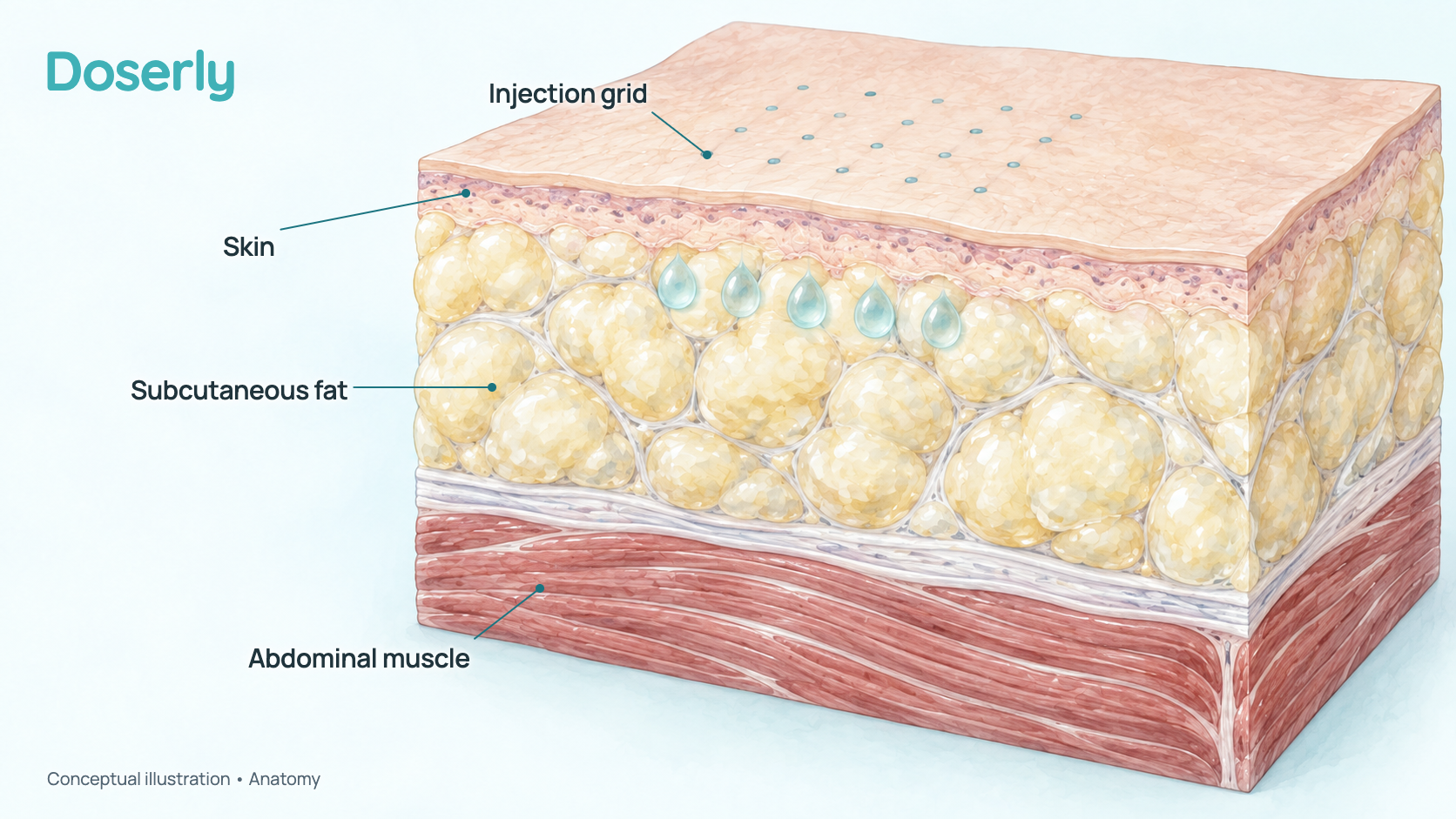
People search for it because it promises something many have been told is impossible: losing fat from one chosen spot. In trials, clinicians injected it into a marked area of belly fat, and the fat inside that area shrank over the following weeks while body weight stayed about the same. The developer also tests it for painful fatty lumps in a rare condition called Dercum disease and, in early studies, for cellulite. [5], [4], [7], [14]
| Fact | Detail |
|---|---|
| Active ingredients | Curcumin (C21H20O6, 368.4 g/mol) and resveratrol (C14H12O3, 228.24 g/mol); ratio not public [1], [2], [11], [12] |
| Type | Small-molecule injection; not a peptide and not a hormone [3], [13] |
| Other names | CBL514, CBL 514; CBL-514D is a separate formulation with the same active ingredients, used in Dercum disease trials [13], [15] |
| Developer | Caliway Biopharmaceuticals, New Taipei City, Taiwan [13] |
| How it is given | Many small subcutaneous injections into the fat layer, by a clinician [5] |
| Status | Investigational; phase 3 trials began in 2026 [6], [16] |
Is CBL-514 a peptide?
No. Several online shops sell CBL-514 as a "research peptide", but every published trial describes it as a small-molecule injection, and its active ingredients, curcumin and resveratrol, are not peptides. A peptide is a short chain of amino acids, like BPC-157 or semaglutide. CBL-514 appears in Doserly's peptide guides because it is sold and discussed alongside them. [9], [3], [4], [1]
Is it the same as taking turmeric or resveratrol supplements?
No. CBL-514 is a specific injectable formulation that is placed directly into the fat layer at a set dose for each square centimetre of skin. The developer's patents describe dissolving curcumin and resveratrol in tiny droplets made with a surfactant (a soap-like helper ingredient) so they can be injected. No study has tested whether swallowing turmeric or resveratrol capsules does anything similar to subcutaneous fat, and the trials never used them. [17], [18], [5]
Two public pages also get CBL-514's identity wrong. One says its chemical make-up is "not in the public record", and another lists "CBL-0137-514" as an alternative name. The first is out of date, since the European register and the trial registry name both ingredients, and the second name appears in no trial record, paper or regulatory register. [19], [20], [1], [2]
Typical CBL-514 Protocols
| Trial | Dose by area | Amount each session | How often | Course |
|---|---|---|---|---|
| Phase 2a (2020, 43 people) | 2.0 mg/cm² (the best of three levels tested) | 300 mg: up to 60 injections of 1 mL over 150 cm² | Every 2 weeks | Up to 4 sessions Open-label, no placebo. The lower levels, 1.2 and 1.6 mg/cm² (180 and 240 mg), removed less fat [3] |
| Phase 2 (2022–23, 76 people) | 2.0 mg/cm² | Up to 600 mg: 25–50 injections of 2.4 mL, 2.45 cm apart, over up to 300 cm² | Every 4 weeks | Up to 4 sessions Compared with saline. Sessions stopped early if too little fat remained [5] |
| Phase 2b (2023–24, 108 people) | 2 mg/cm² | Up to 600 mg: injections of 2.4 mL, up to 120 mL per session | Every 3 weeks | Up to 4 sessions Compared with saline. Most people who improved first did so after 1–2 sessions [4], [8] |
Read these cautions before the numbers. These are clinic procedures from the developer's trials, not schedules anyone has tested at home. [3], [5], [4]
- Trained clinicians gave every dose. They marked out the treatment area, numbed the skin with anaesthetic cream and ice, and placed each injection on a measured grid into the fat layer. [3], [5]
- Vials sold online are a different product form. Online shops sell 5, 10 and 20 mg vials of freeze-dried powder labelled "research peptide". A single trial session used up to 600 mg as a ready-made solution, and because the ratio of curcumin to resveratrol and the other ingredients are not public, nobody can check a vial against the real formulation. [9], [21], [5], [1]
- Side effects at the injection site are the rule, not the exception. Pain, itching, swelling, bruising and skin discoloration affected most people, severe pain affected about 1 in 5 in one trial, and hives made some people stop. [5], [4]
- It is not a weight-loss treatment. Trials required a stable weight and measured fat only inside the treated patch. [5], [4]
- People with bleeding problems were excluded, as were people taking blood thinners or supplements that slow clotting, people allergic to local anaesthetic, and anyone pregnant or breastfeeding. It has not been studied in under-18s, and the belly-fat trials excluded people with a BMI over 30–35. [22], [23], [8]
- Nothing is known beyond 12 weeks. Follow-up in the published trials ended 8–12 weeks after the last session. [3], [5], [4]
The most common protocol in the reviewed sources is 2 mg per square centimetre of belly skin, up to 600 mg per session, given by a clinician as 25–50 subcutaneous injections, for up to 4 sessions. Both placebo-controlled trials used this dose and session limit, the phase 2 trial with sessions every 4 weeks and the phase 2b trial every 3 weeks, and the phase 3 trials that began in 2026 use the same maximum volume, 120 mL in up to 50 injections, every 4 weeks for up to 4 sessions. [5], [4], [23], [6]
- Titration Changing the amount in steps
- None within a course. Every trial used a fixed dose for each square centimetre, and the session total depended on the size of the area. What changed was the number of sessions: participants moved straight to follow-up once too little fat remained to treat. Separately, in the phase 2b trial, 58.8% of people who improved on the clinician's rating first showed that improvement after one session (76.5% within two); the paper does not report how many sessions people received in total. The phase 2a trial is where the dose was chosen: it compared 1.2, 1.6 and 2.0 mg/cm², and the highest level worked best. [5], [4], [3]
Read the units: trial doses are written per square centimetre of treated skin (mg/cm²), not per day or per kilogram of body weight. The session total follows from the area: 2 mg/cm² over 300 cm² (a patch about 15 by 20 cm) is 600 mg. See how that becomes 50 injections. All amounts refer to the CBL-514 product as a whole; the split between curcumin and resveratrol is not public. [5], [1]
The three trial rows are alternatives run at different times, not steps to move through, and each row's amount, interval and course belong together. These schedules come from company-sponsored clinical trials in which clinicians gave every injection; no source describes self-injection, and the online research vials have never been tested in people.
Where the trials differ: intervals, sessions and area ↓
| Use | Amount | How often | Course | Evidence |
|---|---|---|---|---|
| Painful lipomas in Dercum disease | 10 or 15 mg per injection; the amount for each lipoma set by its size on ultrasound | 4 weeks apart | Up to 2 sessions | Published open-label trial, 12 people [7], [26] |
| Thigh cellulite | Up to 320 mg per session | About every 4 weeks | Up to 2 sessions | Registry results, 23 people [14] |
Where these numbers come from
The three belly-fat rows come from the full published reports of the phase 2a trial (Goodman and colleagues, 2022), the placebo-controlled phase 2 trial (Gold and colleagues, 2025) and the phase 2b trial (Lorenc and colleagues, 2026). Each row is checked against its ClinicalTrials.gov record, and the phase 3 maximum (120 mL in up to 50 injections, every 4 weeks, up to 4 sessions) comes from the SUPREME-01 record. [3], [5], [4], [22], [23], [8], [6]
The phase 2b paper's online text garbles one sentence on how many injections each visit used. It appears to say 25–50 injections at the first visit and fewer at later visits as the fat shrank, so the table gives only the published maximum. [4]
The Dercum row comes from the published research letter; a later placebo-controlled Dercum trial registered 1–12 mL per lipoma about every 4 weeks for up to 5 sessions, but its results are so far only in a company announcement. The cellulite row comes from results posted on ClinicalTrials.gov. [7], [27], [15], [14]
Excluded from the tables: single-session studies of up to 800 mg (a dose-finding study and a blood-level study, described in the human research section); the second phase 2b trial, whose dose per area is not stated and whose results are only in a company announcement; and all dosing websites. Five public pages about CBL-514 could be read, and none gives a human dose. [28], [2], [29], [30], [19], [21], [20], [31], [9]
What is CBL-514 commonly used for?
CBL-514 is not in general use and is not sold anywhere as an approved treatment. Outside clinical trials, the only route the developer has described is a doctor's request for expanded access for a patient with Dercum disease (announced in February 2024; its current status is not public), which does not apply to cosmetic fat reduction. It is studied for three problems, and one more use is planned. [10], [6], [32]
- A stubborn pocket of belly fat in adults who are not obese, the main programme, which has reached phase 3. [4], [6]
- Painful fatty lumps (lipomas) in Dercum disease, a rare condition with few treatment options. [7], [27]
- Cellulite on the thighs, in two small early studies. [33], [14]
- Alongside weight-loss medicines, a combination with tirzepatide that has been cleared for a trial but not yet tested in people. [34]
People with lipedema, a condition in which fat builds up painfully in the legs, have also noticed it, but no trial has included them. In September 2026 the developer said it plans to work with clinical experts to assess whether to develop CBL-514 for lipedema. [35], [15]
Stubborn belly fat
This is where most of the evidence sits. The trials enrolled adults of roughly normal weight to overweight (a BMI under 30 or 35) with a visible pocket of belly fat, and measured the fat inside the treated area with ultrasound or MRI. [5], [4]
In the placebo-controlled phase 2 trial, 69.6% of people given CBL-514 (16 of 23 still being measured) had lost at least 150 mL of fat from the treated area 8 weeks after their last session, compared with none of 16 on saline. On average, the treated area held about 216 mL less fat than on saline. In the larger phase 2b trial, about three in four people treated with CBL-514 improved by at least one grade on a clinician's 5-point photo scale, compared with about one in five on saline. [5], [4]
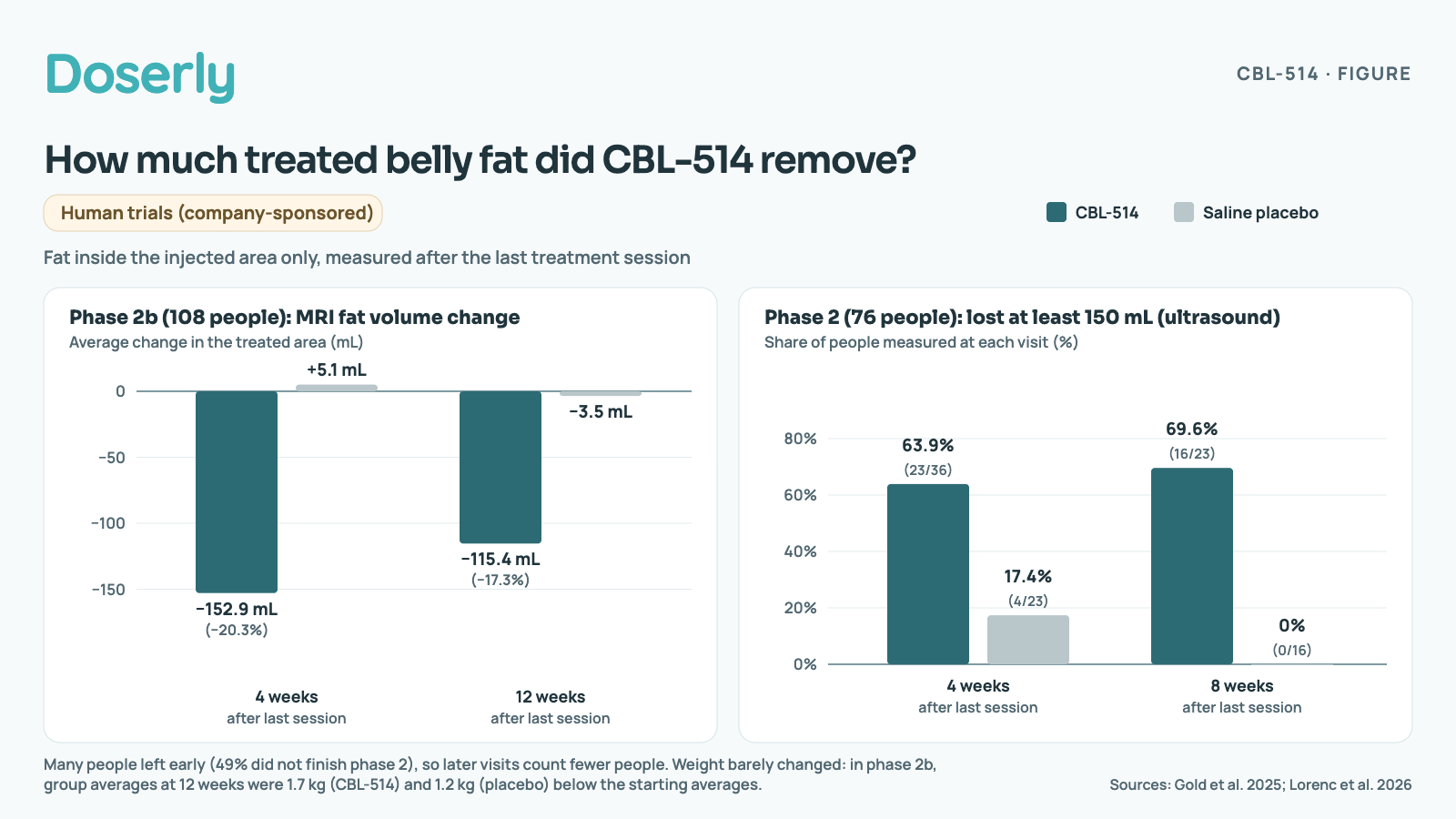
How much treated belly fat did CBL-514 remove?
Fat inside the injected belly area only, CBL-514 versus saline placebo.
- Phase 2b · MRI · 4 weeks after last session
- CBL-514 −152.9 mL (−20.3%); placebo +5.1 mL
- Phase 2b · MRI · 12 weeks after last session
- CBL-514 −115.4 mL (−17.3%); placebo −3.5 mL
- Phase 2 · lost ≥150 mL · 4 weeks after last session
- CBL-514 63.9% (23/36); placebo 17.4% (4/23)
- Phase 2 · lost ≥150 mL · 8 weeks after last session
- CBL-514 69.6% (16/23); placebo 0% (0/16)
Averages are least-squares means for everyone analysed. Many people left early (49% did not finish phase 2; in phase 2b, 22–37 people per group were measured at 12 weeks). Weight barely changed: in phase 2b, group average weights at 12 weeks were 1.7 kg (CBL-514) and 1.2 kg (placebo) below the starting averages.
Treated-area fat fell with CBL-514 and not with saline; the MRI effect was somewhat smaller at 12 weeks than at 4 weeks.
To picture the size: 150 mL is about 5 fluid ounces, and in the phase 2b trial the treated area started with about 840 mL of fat on average. So the average MRI result, about 115 mL at 12 weeks, was a clear reduction of the treated pocket, not its removal. [4] See each trial in detail.
Does CBL-514 help with weight loss?
No. It is designed to act only where it is injected, and trials required people to keep a stable weight so the fat measurements would not be muddied. In the phase 2b trial, average weight at 12 weeks was about 1.7 kg (CBL-514) and 1.2 kg (saline) below the starting averages, a similar small drift in both groups, while the treated fat shrank only with CBL-514. These are group averages of the people still measured, not measured individual changes. [4], [3], [5]
This is why CBL-514 does not contradict the familiar rule that "you can't spot-reduce fat". That rule is about exercise, diet and medicines that work through the whole body, which cannot choose where fat is lost. CBL-514 works more like the approved chin-fat injection deoxycholic acid (Kybella): it acts on the fat it touches, so it can shrink one area but does little for total body fat. [36], [5]
Painful lumps in Dercum disease
Dercum disease causes painful fatty lumps in the subcutaneous fat layer. In a small published trial, 12 adults with at least four painful lipomas had CBL-514 injected into the lumps at 10 or 15 mg per injection, in up to two sessions four weeks apart. Four weeks later, the median lipoma had shrunk by 46% on the lower dose and 59% on the higher one, some lumps disappeared completely, and median pain scores fell by 4 points from starting medians of 7 and 5. There was no placebo group. [7]
A placebo-controlled trial in 19 people finished in 2026. The company reports that pain fell by 3.1 points on CBL-514 against 1.9 points on placebo at week 20, but the full results have not been published or posted. The European Medicines Agency granted CBL-514 an orphan designation for Dercum disease in November 2024, and the company reports matching US designations from 2024. [27], [15], [1], [32], [37]
Company announcements describe the first Dercum trial with different numbers (lipoma size falling by about 51–55% and pain by 4.7 points). Those figures measure lump dimensions and averages rather than the published paper's volume medians, and a 2026 review repeats the company's version. This guide uses the paper. [38], [7], [39]
Cellulite
Two small open-label studies injected CBL-514 into thigh cellulite. In the first (12 people, one session of 40, 60 or 80 mg), the company reports that the average cellulite score fell by about 2 to 2.6 points at the highest dose, 2 and 4 weeks later. In the second (23 people, 14 of whom finished), results posted on ClinicalTrials.gov show the score improved by 1.2 points on average four weeks after the final session, and 18 of 44 treated thighs improved by at least one level. For this second study, the company reports that more than half of participants had improved by at least one level 12 weeks after treatment, a different measure and time point from the registry's. Without a placebo group, neither study can show how much was due to CBL-514. [33], [40], [14]
With tirzepatide and other weight-loss medicines
The company has begun positioning CBL-514 as a partner for GLP-1-based weight-loss medicines such as tirzepatide. It reports that in an animal study, weight regain four weeks after stopping tirzepatide was lower when CBL-514 was added (17.1% against 46.1%), but it has not published the methods or the number of animals. A combination trial in about 120 people has been cleared in the US and has not reported. [41], [42], [34]
Is it an alternative to liposuction?
Not on current evidence. The company's announcement of its phase 2 results said CBL-514 "achieved better efficacy than liposuction", but that compared its own trial figure with a historical liposuction figure measured in a different way. The published phase 2 paper also describes the fat reduction as comparable to liposuction, again without testing the two side by side. No trial has compared them. [43], [5]
Where do CBL-514 protocols differ?
The trials agree on the dose per square centimetre and differ in the interval, the area and the number of sessions. Here is what varies and why it matters.
Every 2, 3 or 4 weeks?
The first dose-finding trial treated every 2 weeks. The placebo-controlled phase 2 trial moved to every 4 weeks, the phase 2b trials used every 3 weeks, and the phase 3 trials are back to every 4 weeks. No trial has compared intervals directly, so there is no evidence that one is better. In the phase 2 trial, people whose gap between sessions stretched beyond 6 weeks were withdrawn from the study. [3], [5], [4], [6]
How many sessions?
Up to four in every belly-fat trial, but many people needed fewer. Treatment stopped once too little fat remained to inject. In the phase 2b trial, 58.8% of people who improved on the clinician's scale first showed that improvement after one session, and 76.5% within two; the paper measured when improvement first appeared, not how many sessions each person received. In the phase 2 trial, 12 of the 28 people who reached a 150 mL loss got there after a single session. [5], [4]
How big is the treated area, and how is the dose worked out?
The dose is set by area. Clinicians mark out the treatment area on the belly, spread the injections evenly across it, and give 2 mg for every square centimetre. [3], [5]
For example, the phase 2 trial treated an area of up to 300 cm² (about 15 by 20 cm). At 2 mg/cm², that is 600 mg. It was delivered as up to 50 injections of 2.4 mL, spaced 2.45 cm apart, for 120 mL in total. The registry records give the solution's strength as 5 mg in every millilitre, which matches 600 mg in 120 mL and means 12 mg in each 2.4 mL injection. The phase 2a trial arrives at the same strength by a different route: 300 mg in up to 60 injections of 1 mL each. [5], [23], [8], [3]
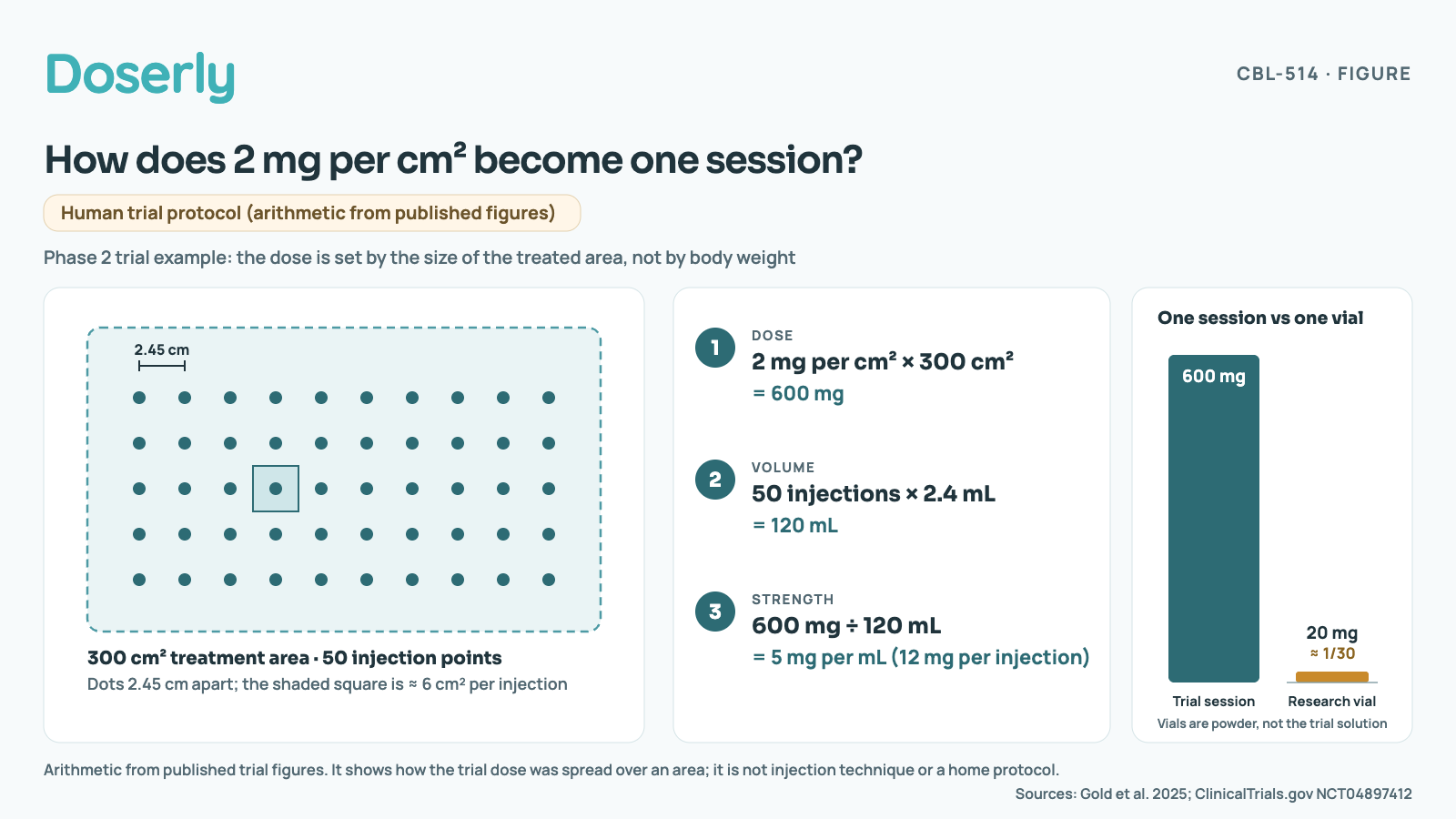
How does 2 mg per cm² become one session?
Phase 2 trial example: the dose is set by the size of the treated area.
- 300 cm² treatment area
- 50 injection points 2.45 cm apart, about 6 cm² each.
- Dose
- 2 mg per cm² × 300 cm² = 600 mg
- Volume
- 50 injections × 2.4 mL = 120 mL
- Strength
- 600 mg ÷ 120 mL = 5 mg per mL (12 mg per injection)
- One session vs one vial
- A 20 mg research vial is about 1/30 of one 600 mg trial session, and is sold as powder, not the trial solution.
Arithmetic from published trial figures; not injection technique or a home protocol.
A full trial session is 600 mg in 120 mL spread over 50 points; online vials hold a small fraction of that.
Why don't online vials match the trial doses?
Because they are a different kind of product. The trial product is a ready-made solution given in amounts of up to 120 mL, while online shops sell 5, 10 and 20 mg vials of freeze-dried (lyophilized) powder. A 20 mg vial holds about one-thirtieth of a single 600 mg trial session. One vendor's test certificate lists curcumin and resveratrol, which fits the published identity, but the certificate is the seller's own, and the real product's ratio and other ingredients are not public, so nothing can be compared. [9], [21], [5], [1]
There is also no tested way to turn powder into the trial formulation. Curcumin and resveratrol barely dissolve in water, which is why the developer's patents describe special surfactant formulations. One protocol page itself says CBL-514 is "not reconstituted by the user" and is prepared only in clinics. [17], [18], [31]
What do dosing websites say?
Very little, and some of it is wrong. Of five public pages that discuss CBL-514, none gives a human dose. [19], [21], [20], [31], [9]
- Two pages summarize the trials without a dose, but one says the ingredients are not public and the other gives the unrelated alias "CBL-0137-514" and calls the first, open-label trial "placebo-controlled", which it was not. [19], [20], [3]
- Two shops sell powder vials with no dosing information. [9], [21]
- One protocol page correctly says dosing is by area, in clinics, every 3–4 weeks for up to 4 sessions, and that it is not self-injectable. It then shows a generic mixing table for a 1 mg vial, which contradicts its own warning, and suggests use under the chin, where no trial has been run. [31]
Registered study plans
Several studies are registered and have not reported. They are plans, not results.
SUPREME-01 (NCT07140939)
320 adults with belly fat; CBL-514 or saline, up to 120 mL in up to 50 injections every 4 weeks, up to 4 sessions. Success means improving by at least two grades on both the clinician's and the participant's rating scale.
Recruiting in the US and Canada since 1 September 2026; primary completion estimated July 2027
[6], [44]SUPREME-02 (NCT07526974)
A second trial with a similar schedule in 320 adults, adding sites in Australia. Its registered main goal pairs a two-grade improvement on the participant's rating scale with a meaningful reduction in belly fat.
Not yet recruiting (planned start October 2026)
[16]CBL-0206 (NCT07608770, NCT07608757)
250 adults in Australia (the company reports that enrolment has also started in Taiwan); a placebo-controlled course, then an open second course to test re-treatment.
First stage recruiting; second stage planned for 2027
[24], [25], [44]CBL-0303 (NCT07733947)
Follows people from the phase 3 trials for 6, 9 and 12 months after their last session to check side effects and whether results last. No drug is given.
Not yet recruiting
[45]What happens when you stop CBL-514?
Within the trials, the effect held for a few months but faded somewhat. Follow-up ended 8–12 weeks after the last session, so what happens over years is unknown. [3], [5], [4]
- In the phase 2b trial, the MRI-measured reduction was 20.3% four weeks after the last session and 17.3% at 12 weeks. The authors point to dropouts as part of the reason, since the people still being measured changed over time. [4]
- In the phase 2 trial, the result held steady between 4 and 8 weeks after the last session. [5]
- In the first trial, the reduction at the best dose was 23.1% at 4 weeks and 21.9% at 8 weeks. [3]
No withdrawal or rebound effects have been described, but no study has looked for them over the long term. Whether the treated area refills if a person gains weight later is not known. The long-term follow-up and re-treatment trials are designed to answer these questions. [45], [24]
Does it matter where and how CBL-514 is injected?
Yes. Every trial injected CBL-514 directly into the tissue it was meant to act on, because the effect is local: the fat that shrinks is the fat that received the drug. How the body absorbs, moves and removes a substance is called pharmacokinetics, and for CBL-514 it has been measured only after subcutaneous injection into belly fat. [5], [2]
- Subcutaneous injection in a grid: the route of every belly-fat and cellulite trial. The injections go into the fat layer between the skin and the muscle. [3], [5], [14]
- Into a lipoma: in Dercum disease, the injections went into each painful fatty lump, with the amount set by the lump's size. [7]
- Oral (swallowed), intravenous or into a muscle: never studied. There is no swallowed form of CBL-514. [10]
Which body areas have been studied? The belly, the thighs (two cellulite studies, and a single 320 mg fat-reduction session in a dose-finding study) and lipomas. No trial has treated the chin, face, arms or other areas, even though one website suggests use under the chin. The approved chin-fat injection, deoxycholic acid, carries a warning about nerve injury near the jaw, which shows that each body area raises its own risks. [28], [14], [7], [31], [36]
How long does CBL-514 last in the body?
Only hours. In a study of 10 healthy volunteers given one 800 mg session into the belly, curcumin and resveratrol levels in the blood peaked about 7.4 hours after injection. The half-life, the time for the level to fall by half, was 3.3 hours for curcumin and 7.2 hours for resveratrol. Peak levels were about 138 ng/mL of curcumin and 80 ng/mL of resveratrol. These results are posted on ClinicalTrials.gov and have not been published in a journal. [2]
The fat reduction was measured weeks later, long after the ingredients had left the blood. That fits the developer's explanation that treated fat cells are removed rather than temporarily shrunk, but the trials did not test that link directly. [3], [2] See how it might work.
Is the product sold online the same as the trial product?
There is no way to know, and several reasons to doubt it. The trial product is a solution made by the developer; online vials are powder labelled "not for human use" or "research peptide", with no public reference to test against. The company has also publicly denied any partnership with a third-party website that claimed one. A label saying "research use only" does not mean a product has been tested for identity, sterility or safety in people. [9], [21], [46]
How should CBL-514 be stored, and how long does it last?
No storage or stability information for CBL-514 has been published, so there is no tested shelf life. The trial product was supplied to clinics as a ready-made solution, and the trial reports do not state how it was stored. Storage advice on vendor pages refers to their own powder products, and nothing links those claims to the trial formulation. [3], [5], [9], [21]
For comparison, the approved fat-dissolving injection deoxycholic acid comes as single-use vials of ready-made solution for use by a healthcare professional. That is a different drug, and its instructions do not transfer to CBL-514. [36]
What do we actually know about CBL-514 in people?
More than for most compounds in these guides, but less than it may seem. Four trials have been published in journals (239 people), several more have posted results on ClinicalTrials.gov, and the company says more than 500 people have taken part in its trials. Every trial was funded by the developer, company employees co-wrote every paper, and follow-up never went beyond 12 weeks after the last session. [3], [5], [4], [7], [15]
The first studies (2018–2021)
- Phase 1 (40 people, Australia, 2018–2019): single doses from 2 to 320 mg to check safety; the lower-dose groups compared one side of the belly with placebo. The results have not been posted or published. [47]
- Phase 2a dose-finding (43 people, Australia, 2020): three doses, every 2 weeks, up to 4 sessions, with no placebo. Measured by ultrasound four weeks after the last session, belly fat in the treated area fell by 5%, 17% and 23% on 1.2, 1.6 and 2.0 mg/cm². Among people who followed the study plan at the top dose (per-protocol), the reduction was about 120 mL (25%). Fifteen of 43 people left early, eight because of side effects, and the COVID-19 pandemic cut enrolment short. [3]
- Single-session dose study (25 people, Australia, 2020–2021): one session of 480, 640 or 800 mg into the belly, or 320 mg into the thigh. Posted results show average belly fat falling by 114–155 mL after four weeks and no clinically significant changes in heart tracings or vital signs. Four people felt faint (presyncope). [28]
The placebo-controlled phase 2 trial (76 people, 2022–2023)
Adults with a BMI under 35 and a belly skinfold of 3–8 cm were assigned two-to-one to CBL-514 or saline at five centres in the US and Australia. Participants did not know which they received, but the clinicians did (a single-blind design). CBL-514 was given at 2 mg/cm², up to 600 mg, every 4 weeks for up to 4 sessions. [5]
Eight weeks after the last session, 69.6% of the CBL-514 group still being measured had lost at least 150 mL, against none on saline, and the average difference from saline was about 216 mL. Almost half of everyone enrolled (49%) did not complete the study, most often because they dropped out, withdrew or did not keep their weight stable. Analyses limited to people who completed the protocol showed larger differences (277–312 mL), which is typical when those who respond well stay in. [5]
The blood-level study (10 people, 2022)
Healthy volunteers received one 800 mg session into the belly, the largest single dose studied, and blood levels of curcumin and resveratrol were measured over time. All 10 had injection-site reactions, and there were no serious side effects or clinically significant laboratory abnormalities. [2]
The first phase 2b trial (108 people, 2023–2024)
Adults with a BMI under 30 and moderate or severe belly fat (grade 3 or 4 on a 5-point photo scale) were assigned one-to-one to CBL-514 or saline, every 3 weeks, up to 4 sessions. Participants did not know their group, but site staff did, because CBL-514 looks different from saline; an outside laboratory read the MRI scans without knowing the groups. [4]
Twelve weeks after the last session, 76.7% of CBL-514 participants (23 of 30 still measured) had improved by at least one grade on the clinician's scale, against 18.9% on saline (7 of 37). A two-grade improvement, the main goal of the phase 3 trials, was reached by 32% (8 of 25) against none on saline. Participants' own ratings were almost the same as the clinicians'. By MRI, the treated fat fell by 152.9 mL (20.3%) at 4 weeks and 115.4 mL (17.3%) at 12 weeks, against almost no change on saline. [4]
One thing to watch when reading summaries: the paper's abstract places the 12-week grade result next to the 4-week MRI figure (−153 mL). The full paper shows the 12-week MRI figure was smaller (−115 mL). Early discontinuation was high: 43.4% on CBL-514 and 34.5% on saline. [4]
The second phase 2b trial (173 people, company-reported)
A larger trial compared CBL-514 with two other experimental formulations and saline, with participants and outcome assessors, but not necessarily the treating staff, unaware of the groups. The company reports that 54.2% on CBL-514 lost at least 20% of the treated fat by MRI, against none on saline, with an average change of −166.6 mL against +15.7 mL. The results are not in a journal or on ClinicalTrials.gov yet. [29], [30], [42]
Dercum disease and cellulite
The Dercum disease and cellulite studies are described in the uses section. The Dercum trial was open-label with 12 people and 8 weeks of follow-up; its placebo-controlled successor has only company-reported results. [7], [27], [15]
Who paid for the research?
Caliway sponsored every trial, designed them, and took part in analysing the data and writing the papers, and company employees are co-authors. That does not make the results wrong, but no independent group has tested CBL-514. A recent independent systematic review of fat-dissolving injections outside the chin area includes CBL-514 among the agents studied and notes that deoxycholic acid remains the only one approved in the US, and only for the chin. [3], [5], [4], [7], [48]
What do volume, grades and responders actually measure?
The trials used three kinds of outcome, and each answers a different question. [5], [4]
- Fat volume: the ultrasound trials estimated it by multiplying the average fat thickness at 4–5 points by the treated area, and the phase 2b trial measured it directly on MRI. It is the most objective measure, but it covers only the treated area.
- Rating grades: clinicians and participants compared the belly with a set of reference photos and gave a grade from 1 (none or minimal) to 5 (very severe). The developer designed these scales for its own trials. A one-grade change is noticeable; the phase 3 trials aim for a two-grade change.
- Responders: the share of people who crossed a set line, such as losing 150 mL or improving one grade. It is easier to understand than an average but hides how much each person changed.
Two ways of counting people also matter. An intention-to-treat analysis counts everyone who started, filling in missing measurements; a per-protocol analysis counts only people who followed the plan. With dropout this high, the second tends to look better. [5], [4]
How might CBL-514 work?
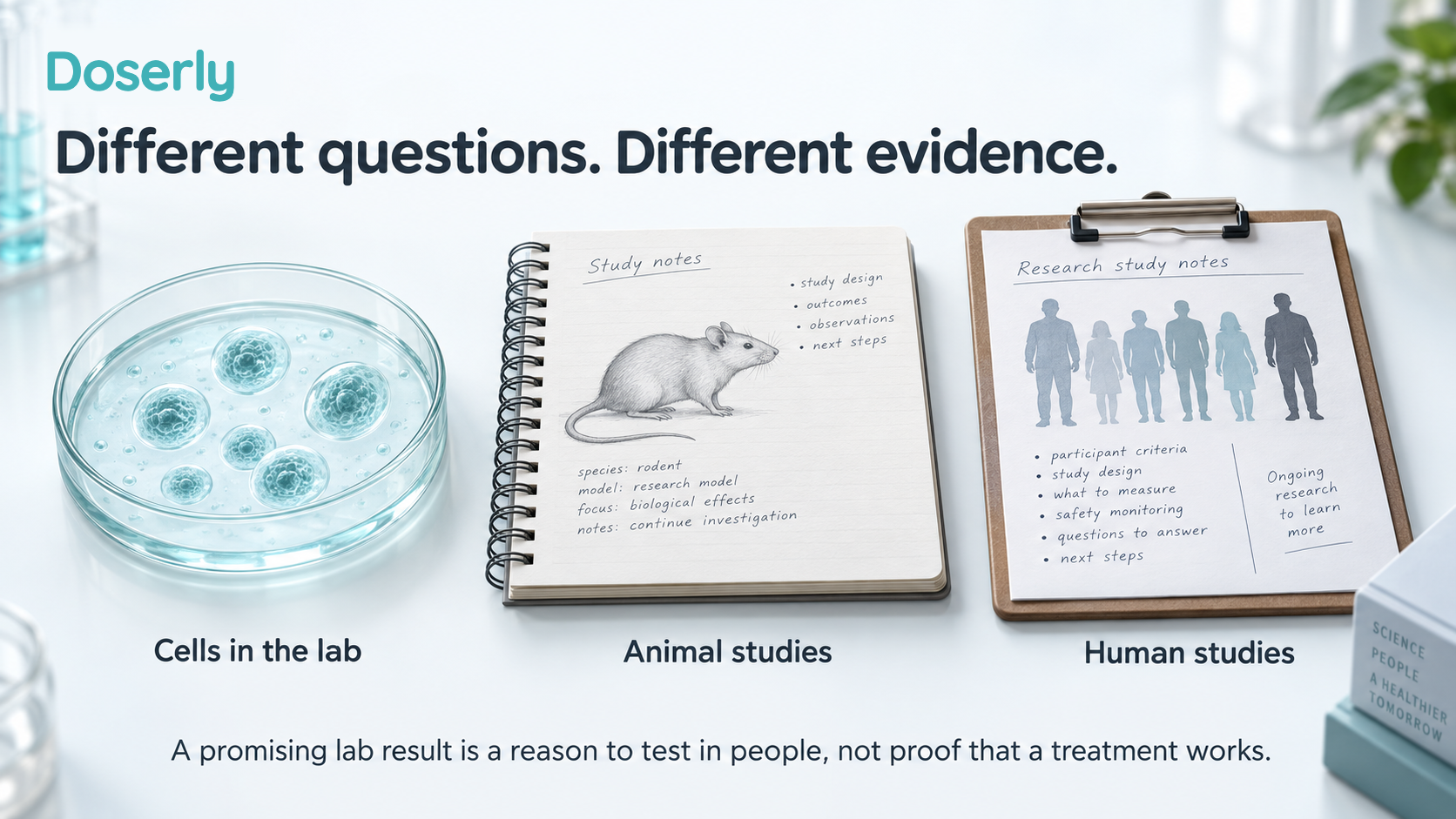
The trials show that fat in the treated area shrinks. How it happens rests on the developer's own laboratory and animal studies, which it describes in the trial papers but has not published. Treat this section as the developer's explanation, not an established fact. [3]
What does "fat-cell apoptosis" mean?
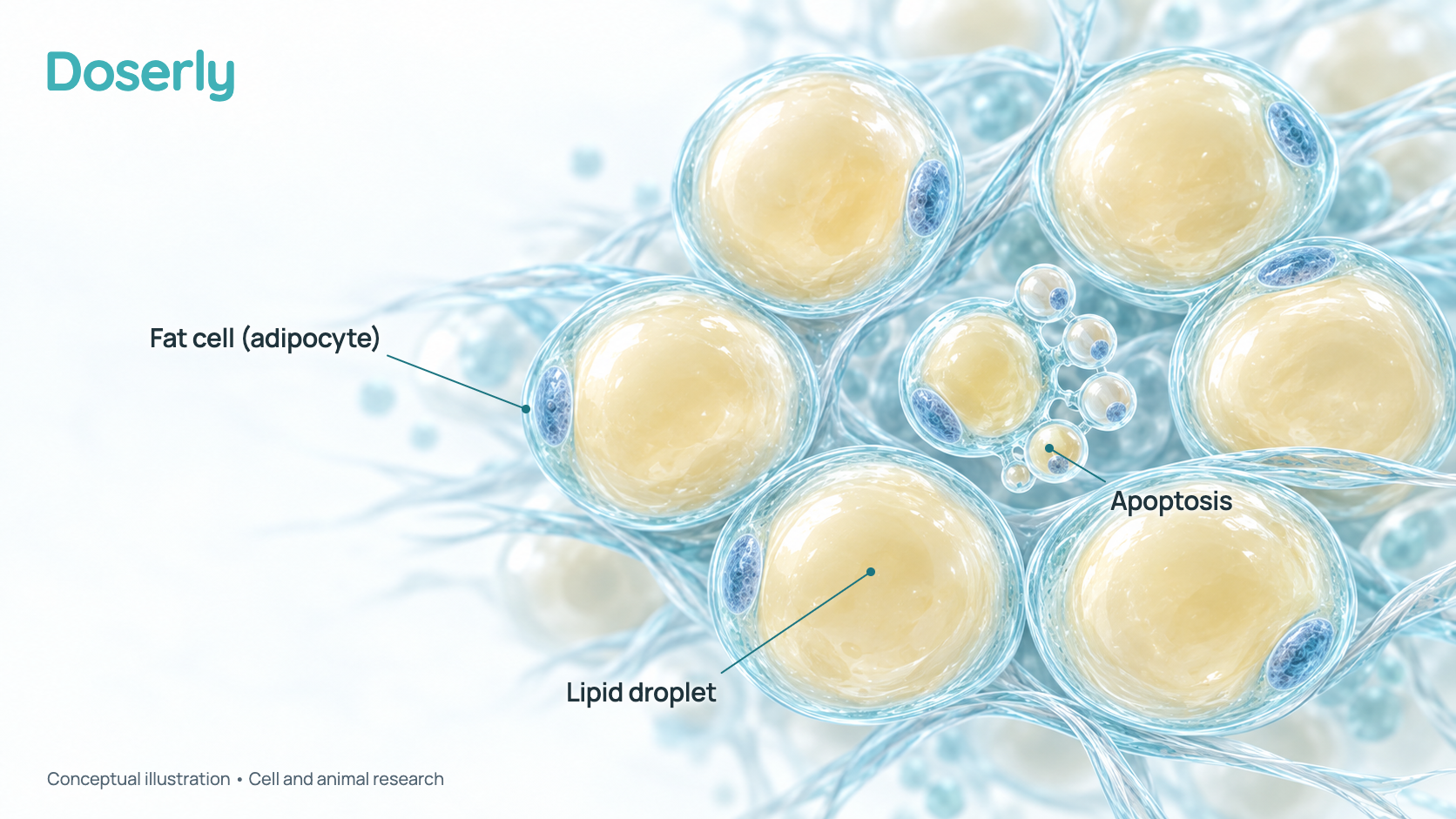
Fat is stored in fat cells, or adipocytes, each mostly filled by a single droplet of fat. Apoptosis is the body's tidy, programmed way of removing cells: the cell dismantles itself from the inside into small wrapped pieces that are cleared away. The developer says CBL-514 triggers this in fat cells where it is injected, so the treated area ends up with fewer fat cells. [3], [4]
Where does that idea come from?
From the developer's unpublished reports, as described in the first trial paper. In a mouse fat-cell line grown in a dish (3T3-L1), CBL-514 increased markers of apoptosis (activated caspase-3 and a higher Bax to Bcl-2 ratio) more than deoxycholic acid did, and the company reports that it blocks a survival enzyme called DYRK1b. In rodents, it reduced subcutaneous fat in the treated area in a dose-dependent way, and in repeated-dose safety studies in dogs and rodents, the company saw no tissue death (necrosis) around the injection sites. [3]
No peer-reviewed laboratory or animal study of CBL-514 has been published, so none of this can be checked by outside researchers. The Dercum disease paper also cites the company's internal documents for the mechanism. [3], [7]
How is that different from deoxycholic acid (Kybella)?
Deoxycholic acid, the only fat-dissolving injection approved in the US, is labelled a "cytolytic" drug: it destroys the membranes of cells in the tissue it touches, much like a detergent. Its label warns of nerve injury near the jaw and difficulty swallowing, and the first CBL-514 paper notes that skin damage, ulcers and infections are known side effects of deoxycholic acid. [36], [3]
CBL-514's developer argues that triggering apoptosis instead is gentler, and the trial papers report no necrosis or nerve injury. That is an observation from company trials of a few hundred people, not proof from a head-to-head comparison, and no trial has compared the two. [4], [3], [5]
Why curcumin and resveratrol?
Both are well known as supplements, but in CBL-514 they are used differently: as an injected formulation placed at high local concentrations in the fat. The published CBL-514 papers do not explain how each ingredient contributes, and the benefits often claimed for oral curcumin or resveratrol supplements are separate questions that the CBL-514 trials did not study. [3], [1], [2]
Does it affect deep belly fat around the organs?
Not known yet. The trials measured subcutaneous fat, the layer just under the skin, which is what the injections reach. The company has announced a conference presentation on 30 September 2026 that combines animal studies with an analysis of phase 2 data on visceral fat (the deep fat around the organs); only the company's description was available when this guide was written. [4], [34]
What are the risks and unanswered questions?
Is CBL-514 safe?
In short trials, CBL-514 caused frequent but mostly short-lived reactions where it was injected, and no deaths. One person in a cellulite study had a serious hypersensitivity (allergic-type) event with airway involvement; the registry does not say whether it was caused by CBL-514. That is not the same as being proven safe: a little over 540 people had taken part in its trials by September 2026, including those given placebo, no one has been followed for more than about 12 weeks after treatment, and it is not approved anywhere. [5], [4], [14], [15], [10]
What side effects did the trials report?
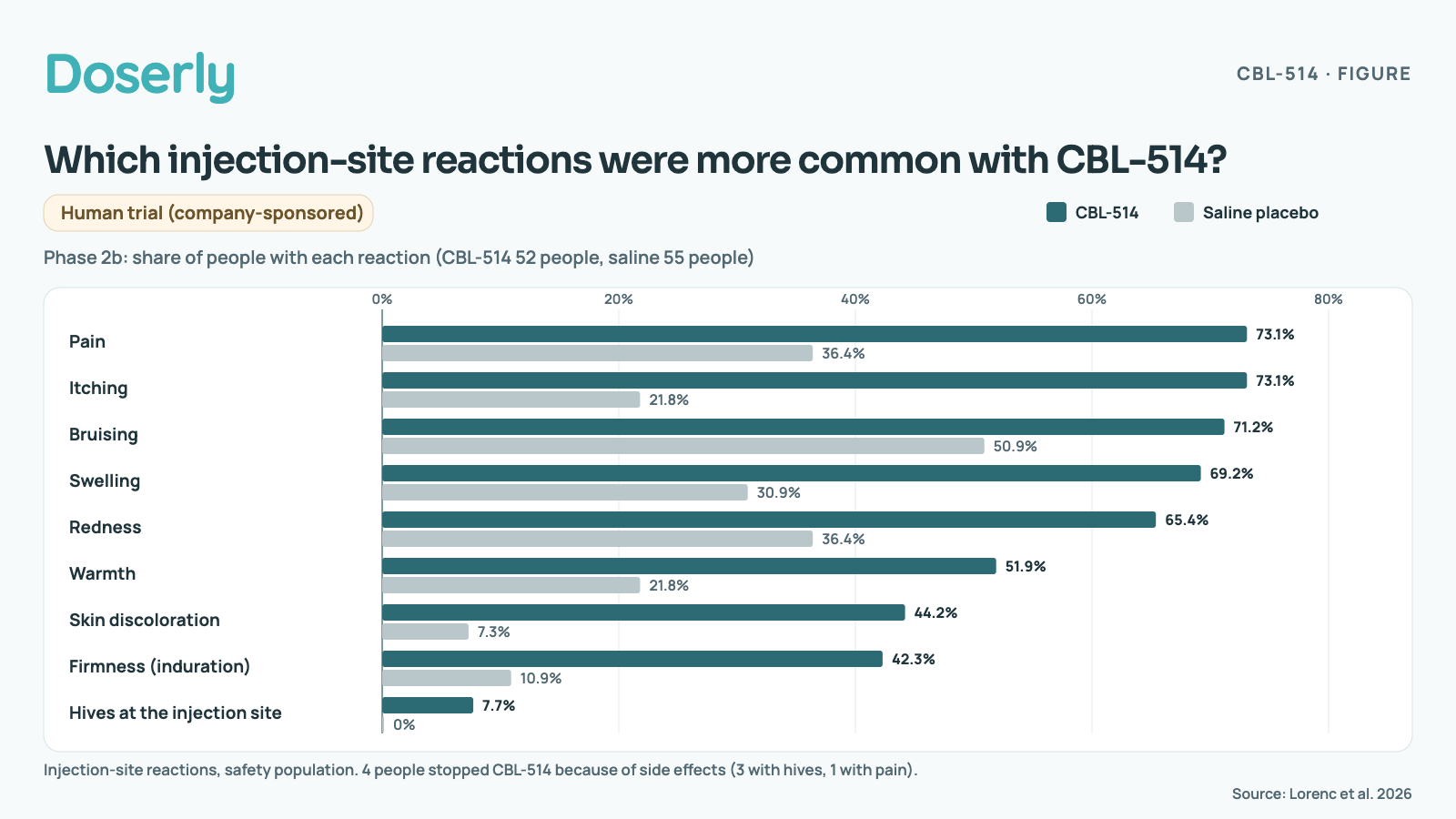
Almost everyone who received CBL-514 had at least one reaction at the injection site. In the phase 2b trial, 96% on CBL-514 had a side effect, compared with 80% on saline, whose injections also cause some reactions. [4]
Which injection-site reactions were more common with CBL-514?
Phase 2b: share of people with each reaction (CBL-514 52 people, saline 55 people).
- Pain
- CBL-514 73.1%; saline 36.4%
- Itching
- CBL-514 73.1%; saline 21.8%
- Bruising
- CBL-514 71.2%; saline 50.9%
- Swelling
- CBL-514 69.2%; saline 30.9%
- Redness
- CBL-514 65.4%; saline 36.4%
- Warmth
- CBL-514 51.9%; saline 21.8%
- Skin discoloration
- CBL-514 44.2%; saline 7.3%
- Firmness (induration)
- CBL-514 42.3%; saline 10.9%
- Hives at the injection site
- CBL-514 7.7%; saline 0%
Injection-site reactions, safety population. 4 people stopped CBL-514 because of side effects (3 with hives, 1 with pain).
Every reaction was more common with CBL-514 than with saline, and hives appeared only with CBL-514.
- Pain: 94% on CBL-514 against 65% on saline in the phase 2 trial, severe in 18% (none on saline). About 9 in 10 cases of pain cleared within a week, and most people with pain took medicine, usually over-the-counter painkillers. [5]
- Itching: 73–95% across trials. In the first trial, 20 people took antihistamines for it. [3], [5], [4]
- Swelling, redness, warmth, bruising: common in both groups and mostly more frequent with CBL-514; bruising in the phase 2 trial was the exception (78% on CBL-514 against 85% on saline). [5], [4]
- Skin discoloration and firmness (induration): 44% and 42% on CBL-514 against 7% and 11% on saline in phase 2b; 71% and 61% in phase 2. [4], [5]
- Stopping because of side effects: 8 of 43 people in the first trial (3 for pain, 1 for repeated hives, and 1 for a rash judged unrelated, among others), 2 people in the phase 2 trial for reactions judged treatment-related, and 4 in phase 2b (3 because of hives, 1 because of pain). [3], [5], [4]
- Dercum disease trial (12 people): every participant had a treatment-related side effect, mostly injection-site reactions; 4 had a severe one and 2 stopped. There were no serious side effects. [7]
Can it cause allergic reactions?
Yes, hives (urticaria) are the clearest allergic-type signal. In phase 2b, 7.7% had hives at the injection site and 3.8% had hives elsewhere on the body, and three people stopped treatment because of them, even though people with a history of hives or drug allergies had been excluded. One person in the first trial withdrew after repeated hives. [4], [8], [3]
In the second cellulite study, the registry lists two serious events, a hypersensitivity reaction and an obstructive airways disorder, both in the same participant, without stating whether they were linked to CBL-514. [14]
Does it affect cholesterol or triglycerides?
Possibly, in a few people. In the first trial, four people had mild rises in triglycerides or cholesterol that were judged possibly related, all starting from levels near or above the upper limit of normal, and the investigator could not tell whether the rises were caused by the drug. In the phase 2 trial, two people with existing high cholesterol had raised blood fats at one visit, and one of these was judged probably related. In the phase 2b trial, average cholesterol and triglyceride levels did not change compared with saline. [3], [5], [4]
What could small, short trials miss?
A few hundred people followed for a few months can reveal common side effects but not rare ones, and cannot show what happens over years. Nobody knows yet whether results last, what happens with repeat courses, how scar tissue or skin texture change after several treatments, or whether rare allergic reactions become more likely with repeated exposure. The phase 3, re-treatment and long-term follow-up trials are designed to answer some of this. [4], [6], [24], [45]
Could product quality change the risk?
Yes. The trial product is a specific formulation made to drug-manufacturing standards. Grey-market vials are sold as powders "not for human use", their contents can be checked only against the seller's own certificate, and injecting a non-sterile product into fat can cause infection. Health Canada warned in April 2026 that unauthorized injectable peptides bought online can seriously harm people; the warning does not name CBL-514, but these vials are sold the same way. [9], [21], [49]
Is CBL-514 legal? Is it FDA-approved?
Checked September 26, 2026. A "research use only" label does not make a product legal to sell or use as a medicine.
- United States. Not approved by the FDA, with no approved product or label on record. Phase 3 trials are enrolling. The company reports that, at an end-of-phase-2 meeting in 2025, the FDA agreed with its proposed use, "reduction of abdominal subcutaneous fat". It also reports Fast Track and Orphan Drug designations for Dercum disease (February and March 2024), which we could not confirm in the FDA's database. Neither designation is an approval. [10], [6], [13], [32], [37]
- Canada. Health Canada's Drug Product Database lists no CBL-514 product. The SUPREME-01 phase 3 trial includes Canadian sites. [10], [6]
- European Union. Not authorised. The European Medicines Agency granted an orphan designation for Dercum disease on 11 November 2024 (EU/3/24/2995), and its register states that a designation "does not mean the medicine is available or authorised for use". [1]
- Australia. Several trials have run or are recruiting in Australia. We tried to search the Australian Register of Therapeutic Goods on September 26, 2026, but it could not be reached, so its entry is unconfirmed; no source describes an Australian approval. [3], [24]
- China and Taiwan. The company reports an application to start trials in China in 2026, and that its CBL-0206 trial has started enrolling in Taiwan. We did not check Taiwan's regulator; no source describes an approval. [50], [44]
Is CBL-514 banned in sport?
It is not named on the World Anti-Doping Agency (WADA) list, and neither are curcumin or resveratrol. WADA's class S0 bans substances with no current approval for human use by any government health authority, including drugs still in clinical development. Whether that class applies to an experimental injection of two common supplement compounds has not been stated, so athletes subject to testing should ask their anti-doping organisation before any use. [51]
Who should be especially cautious?
The trials excluded several groups. That is a reason for caution, not guidance on safe use. [22], [23], [8], [6]
- People with bleeding or clotting problems, or taking blood thinners: excluded from every belly-fat trial, along with people taking medicines or supplements that slow clotting or platelet function. Bruising was already common. [22], [23], [8], [5]
- Pregnancy, breastfeeding or trying to conceive: excluded, and trial participants who could become pregnant had to use contraception until 90 days after the last dose. [23], [8]
- People with allergies: allergy to the product, its ingredients or local anaesthetics was an exclusion, and the phase 2b trial also excluded people with a history of hives or drug allergies. Hives still occurred. [22], [8], [4]
- Under-18s: not studied; the belly-fat trials enrolled adults aged 18–64. [22], [23], [8]
- People with obesity, or skin that hangs over the belly: the belly-fat trials enrolled people with a BMI under 30–35 and excluded a hanging belly (panniculus) or severe visceral fat. [5], [4]
- People with high cholesterol or triglycerides: the few possibly related rises in blood fats occurred in people starting from levels near or above the upper limit of normal, or with existing high cholesterol. [3], [5]
- Drug-tested athletes: status under WADA's S0 class is unclear. [51]
Has CBL-514 been tested alongside other medicines?
No formal interaction study has been published. The trials excluded blood thinners and clotting-affecting supplements, and participants used over-the-counter painkillers and antihistamines for side effects without reported problems. People taking GLP-1 medicines such as semaglutide or tirzepatide were excluded from the phase 2b and phase 3 trials. A combination with tirzepatide has been cleared for a trial but not yet tested in people. Bring a complete list of your medicines and supplements to any clinician offering a fat-reduction procedure. [23], [8], [6], [5], [3], [34]
What should be monitored while using CBL-514?
There is no official monitoring guidance, because CBL-514 is not approved. What can be described is what the trials measured. It is information to discuss with a clinician, not a personal testing plan.
The trials recorded side effects at each visit and in a participant diary, and checked vital signs, heart tracings (ECGs), physical examinations and blood and urine tests, including blood counts, blood chemistry and clotting tests. They weighed participants during the study and measured the treated fat by ultrasound or MRI. [3], [5], [4]
| Why it matters | What trials measured or flagged | Tracking category |
|---|---|---|
| Injection-site reactions | Pain, itching, swelling, bruising, discoloration and firmness in most people | Side Effect Burden; Pain Management; Skin Health |
| Allergic reactions | Hives at and away from the injection site; one hypersensitivity event | Side Effect Burden; seek urgent care for swelling of the face or trouble breathing |
| Blood fats | Mild rises in cholesterol or triglycerides in a few people | Blood work (lipid panel) |
| Bleeding and clotting | Clotting tests; people on blood thinners excluded | Blood work (clotting tests) |
| Weight stability | Body weight at each visit; unstable weight led to exclusion | Weight Management |
| Treated fat | Fat volume under the treated patch; clinician and participant photo grades | Fat Loss; Body Image |
Sources for the table: [3], [5], [4], [14], [8]
None of these checks makes an unapproved product safe. They show what is changing, which is what a clinician needs to judge a result or a reaction.
What do people in public communities report?
Almost nothing yet, because almost nobody outside the trials has used the real product. We found no public first-hand account of using CBL-514 in the Reddit archives and forums we could search. [35]
What does public discussion look like?
The one discussion we found was in a lipedema forum in November 2025. The original post described CBL-514 as a breakthrough and said it was "being performed today"; another member corrected this, pointing out that it was still in phase 2 trials. Others hoped it might help lipedema or Dercum disease, or replace surgery after losing weight on a GLP-1 medicine. Nobody reported using it. [35]
Community education groups we reviewed did not discuss CBL-514, either in their courses or in member discussions. They do discuss the general idea that you cannot choose where you lose fat, which applies to diet, exercise and whole-body medicines rather than to injections that act where they are placed (see why).
Members of those groups do talk about other "fat-dissolving" injections bought online, which are different products and have not been through CBL-514's trials. People described injecting small amounts at many points across the belly, love handles or chin, repeated every few weeks. A couple reported a visible change, at least one saw none, and others said the results faded or were hard to tell apart from swelling. Bruising, swelling, pain and lumps came up often, and the educators in these groups were sceptical of such products, warning that they can damage tissue other than fat. In 2024, Switzerland's medicines regulator, Swissmedic, warned against using Lemon Bottle, a fat-dissolving product advertised online: it is not authorised as a medicine there, and the regulator's laboratory found that samples from several sources did not match their labels, with caffeine the only substance found in one. [52] None of this shows how CBL-514 itself behaves, and none of it is a CBL-514 protocol; the trial doses are described in the protocol section.
How can you judge a before-and-after story?
As CBL-514 moves toward approval and grey-market vials circulate, stories will appear. Useful questions: Was it the trial product, given in a clinic, or an online vial? How much, over what area, and how many sessions? Did the person's weight change at the same time? Were the photos taken with the same lighting, posture and distance? And how long after treatment were they taken?
A single photo pair cannot show what caused a change. These questions help separate a measured result from a hopeful impression.
How does CBL-514 compare with Kybella, tesamorelin, tirzepatide and AOD-9604?
These are the treatments CBL-514 is most often compared with or confused with. No study has compared any of them directly with CBL-514, and their trials measured different things in different people, so the numbers cannot be ranked.
| Treatment | What it is | Route and schedule | Human evidence | Approval status |
|---|---|---|---|---|
| CBL-514 (this guide) | Curcumin and resveratrol injection that acts where it is placed [1], [2] | Subcutaneous grid into belly fat, 2 mg/cm² (up to 600 mg), every 4 weeks (phase 2) or 3 weeks (phase 2b), up to 4 sessions, in trials [5], [4] | Four published trials (239 people); phase 2b: −115 mL (−17%) of treated fat at 12 weeks versus −3.5 mL on saline [4] | Not approved; phase 3 underway [10], [6] |
| Deoxycholic acid (Kybella) | A bile-acid injection that destroys the membranes of cells it touches ("cytolytic") [36] | Subcutaneous grid under the chin, 2 mg/cm² as 0.2 mL injections 1 cm apart (up to 100 mg), at least a month apart, up to 6 sessions [36] | Two placebo-controlled trials in about 1,000 adults with chin fat [36] | FDA-approved since 2015, for chin fat only; use elsewhere is not recommended on its label [36] |
| Tesamorelin | Lab-made version of the hormone that tells the body to release growth hormone | Subcutaneous, 1.28 mg once daily (EGRIFTA WR label) [53] | Placebo-controlled trials in 806 adults with HIV: deep belly (visceral) fat fell 15.4% more than on placebo at 26 weeks; subcutaneous belly fat did not change significantly [54] | FDA-approved for excess belly fat in adults with HIV and lipodystrophy [53] |
| Tirzepatide | A weekly medicine that acts on two gut-hormone (GIP and GLP-1) receptors and reduces appetite [55] | Subcutaneous, once a week [55] | SURMOUNT-1: 20.9% weight loss at 72 weeks on 15 mg versus 3.1% on placebo [56] | FDA-approved for weight reduction (Zepbound) [55] |
| AOD-9604 | Lab-made 16-amino-acid fragment based on growth hormone, sold as a "fat-loss peptide" [57] | Trials: swallowed capsules and tablets; websites: daily injections, never tested in people [57] | In a 24-week trial of 502 adults, weight loss beyond placebo was under 1 kg [58] | Not approved [57] |
The closest relative is deoxycholic acid. Both are injected in a grid into subcutaneous fat and both use 2 mg per square centimetre, but CBL-514's sessions are much larger (up to 600 mg over the belly against 100 mg under the chin), and the two are proposed to kill fat cells in different ways. Deoxycholic acid is approved and has years of use behind it; CBL-514 has short company trials. [36], [5], [3]
Tesamorelin, tirzepatide and AOD-9604 work through the whole body, so they cannot target one patch. Tesamorelin mainly reduces deep visceral fat, tirzepatide reduces total body weight, and AOD-9604 did not produce meaningful weight loss in its large trial. CBL-514 is the reverse: it acts locally and does not change body weight. That is why the company is testing it alongside tirzepatide rather than instead of it. [54], [56], [58], [4], [34]
Common questions about CBL-514
Can I get CBL-514 at a clinic or buy it?
Not legally as an approved treatment, anywhere. The real product is given in clinical trials, and the phase 3 trials began recruiting in the US and Canada in September 2026. Outside trials, the developer has described only a doctor's request for expanded access for patients with Dercum disease, not for cosmetic use. Vials sold online as a "research peptide" are freeze-dried powder, not the trial solution, and their contents cannot be checked against the real formulation. [10], [6], [32], [9] See the legal status and why the vials differ.
Is CBL-514 the same as Kybella?
No, but they are close relatives. Both are injected in a grid into subcutaneous fat at 2 mg per square centimetre. Kybella is deoxycholic acid, which destroys cell membranes in the tissue it touches and is approved only for the chin. CBL-514 is curcumin and resveratrol, which the developer says makes fat cells dismantle themselves, and it is being tested for the belly. No trial has compared them. [36], [1], [3] See the comparison.
Does CBL-514 work for weight loss?
No. It shrinks fat in the treated area, and body weight stayed about the same in the trials, which required participants to keep their weight stable. In the phase 2b trial, group average weights at 12 weeks were a similar small amount below the starting averages on CBL-514 and saline (about 1.7 kg and 1.2 kg). [4], [5] See why it is local.
How long does it take to see results?
In the trials, fat was measured four weeks after the last session, and many people first improved after one or two sessions: in phase 2b, 58.8% of those who improved did so after the first session, and 76.5% within two. From the first session to the four-week check after a full course of four sessions takes about three to four months. [4], [5] See how many sessions.
Is the fat loss permanent?
Unknown. Follow-up in published trials ended 8–12 weeks after the last session, and the phase 2b result was somewhat smaller at 12 weeks (17.3%) than at 4 weeks (20.3%). The developer argues that treated fat cells are removed, which would suggest a lasting effect, but a long-term follow-up study has not yet started. [4], [45] See what happens after stopping.
Can I take turmeric or resveratrol instead?
There is no evidence that swallowing them does the same thing. CBL-514 is a specific injectable formulation placed directly into the fat at a set dose per square centimetre, and none of the trials tested oral curcumin or resveratrol for local fat. [1], [5], [18] See what CBL-514 is.
Does CBL-514 hurt?
Usually, yes, for a while. In the phase 2 trial, 94% had injection-site pain, which was severe in 18%, and about 9 in 10 cases cleared within a week. Clinicians used anaesthetic cream and ice, and many people took over-the-counter painkillers. Itching was also very common. [5], [3] See side effects.
When will CBL-514 be approved?
Not before phase 3 results. SUPREME-01 began recruiting in September 2026 with primary completion estimated for July 2027, and a second phase 3 trial is planned. The company would then need to apply and wait for a decision, so any approval is some way off and not guaranteed. [6], [16], [13] See registered study plans.
Glossary
Plain explanations of the route, dosing, research and regulatory terms used in this guide. Underlined terms in the text link here.
- Adipocyte (fat cell)
- A cell that stores fat, mostly filled by a single large droplet of fat. Fat tissue is made of millions of them.
- Adverse event
- A harmful or unwanted medical event reported after someone used a treatment. A report alone does not prove the treatment caused it.
- Animal study
- Research in animals such as mice or dogs. It shows what a substance does in a living body, but results in people can differ. CBL-514's animal studies are unpublished.
- Apoptosis
- A tidy, programmed form of cell death in which a cell dismantles itself from the inside into small wrapped pieces that the body clears away.
- Cell study (in vitro)
- Research on cells grown in a dish. It gives early clues about biology, but it is far from proof of benefit in people.
- Cellulite
- Dimpled, uneven skin, most often on the thighs and buttocks, where subcutaneous fat pushes against bands of connective tissue beneath the skin.
- Controlled trial
- A study that compares people who receive a treatment with a similar group who do not, often receiving a placebo instead. Randomly assigning people to each group makes the comparison fairer.
- Course and cycle
- A course is a planned series of treatments, such as up to four sessions. A cycle is a course plus a planned break before any further treatment.
- Deoxycholic acid (Kybella)
- A bile acid made into an injection that destroys fat cells. It is the only fat-dissolving injection approved in the US, and only for fat under the chin.
- Dercum disease
- A rare condition, also called adiposis dolorosa, in which painful fatty lumps (lipomas) or painful areas develop in the subcutaneous fat. It mostly affects women.
- Dose (amount each time)
- The amount given on one occasion. For CBL-514, that is the total for one treatment session, spread across many injections.
- Dose per area (mg/cm²)
- A dose set by the size of the skin area treated rather than by body weight. For example, 2 mg for each square centimetre over 300 cm² is 600 mg.
- Freeze-dried (lyophilized)
- Dried by freezing and removing the water, leaving a powder. Online CBL-514 vials are sold this way; the trial product is a ready-made solution.
- Half-life
- The time it takes for the measured level of a substance in the blood to fall by half. It is not the same as how long an effect lasts.
- Induration
- A firm, hardened patch of skin or the tissue under it, often after an injection. In the CBL-514 trials it usually settled on its own.
- Intention-to-treat and per-protocol
- Two ways of analysing a trial. Intention-to-treat counts everyone who started, filling in missing results; per-protocol counts only people who followed the plan, which often makes results look better.
- Intravenous (IV)
- Given directly into a vein, so it enters the bloodstream immediately. CBL-514 has not been given this way.
- Investigational
- Still being studied and not approved by a regulator, such as the FDA, to treat any condition.
- Lipedema
- A long-term condition in which fat builds up, often painfully, in the legs and sometimes the arms, out of proportion to the rest of the body. No CBL-514 trial has included it.
- Lipoma
- A soft, usually harmless lump of fat in the subcutaneous layer, beneath the skin. In Dercum disease, lipomas are painful.
- mg and mL
- Milligrams measure an amount of drug; millilitres measure a volume of liquid. A strength such as 5 mg per mL links the two: 2.4 mL at that strength holds 12 mg.
- Necrosis
- A fast, uncontrolled form of cell death in which the cell bursts and can damage the tissue around it.
- Oral
- Taken by mouth, as a capsule, tablet or liquid. There is no oral form of CBL-514.
- Orphan designation
- A status that regulators give to medicines being developed for rare diseases, bringing incentives such as fee reductions. It is not an approval and does not mean the medicine works.
- Peptide
- A short chain of amino acids, the building blocks of proteins. CBL-514 is not a peptide.
- Pharmacokinetics
- How the body absorbs, moves, breaks down and removes a substance, usually measured through blood levels over time.
- Placebo
- A dummy treatment with no active ingredient, used as a comparison in studies. CBL-514 trials used salt water (saline) injections.
- Preclinical research
- Studies done before research in people: cell studies and animal studies.
- Research use only
- A label on products sold for laboratory research. It does not mean a product is approved, tested for human use or legal to sell as a medicine.
- Responder
- A trial participant who crossed a result set in advance, such as losing at least 150 mL of fat. Responder rates show how many people changed, not by how much.
- Single-blind
- A trial in which the participants do not know which treatment they receive, but the staff do. It is less protected from bias than a double-blind trial.
- Small-molecule drug
- A medicine made of small chemical compounds, like most tablets, rather than a large protein or peptide.
- Subcutaneous (SC)
- Injected into the fatty layer just under the skin. For CBL-514, that fatty layer is also the target.
- Titration
- Adjusting a dose in steps, usually starting lower and increasing. The CBL-514 trials did not titrate the dose.
- Trial phases
- Stages of testing a new medicine in people: phase 1 checks safety in small groups, phase 2 tests doses and early effects, and phase 3 confirms benefits and harms in larger groups before approval.
- Trial registry
- A public database, such as ClinicalTrials.gov, where studies are recorded before they run and where results can be posted.
- Urticaria (hives)
- Raised, itchy welts on the skin, often an allergic-type reaction.
- Visceral fat
- Deep fat stored inside the belly around the organs, as opposed to the subcutaneous fat, just beneath the skin, that CBL-514 is injected into.
- WADA
- The World Anti-Doping Agency, which publishes the list of substances banned in sport. Its class S0 covers substances with no current human approval.
- Withdrawal and rebound
- Withdrawal effects are symptoms caused by stopping a substance. A rebound is a problem returning worse than before. Neither has been studied for CBL-514.
How this guide was researched
This guide is built from a thorough review of the sources cited throughout it: published clinical trials, registered trial records and posted results, regulatory and anti-doping documents, the developer's announcements and patents, and published product and protocol pages. We also reviewed public online forums and community education groups; the education groups did not discuss CBL-514, only other fat-dissolving injections.
The guide cites 58 sources, including 4 original scientific papers on CBL-514 and 2 on the treatments it is compared with. Each type of source answers a different question. Studies show what researchers measured. Protocol and product pages show how CBL-514 is described and sold. Personal accounts show what individual people experienced. Company announcements are labeled as such, because they are not peer reviewed. Every numbered citation links to its entry below, labeled by source type.
How this guide was made
Research and drafting were AI-assisted. Every cited source was checked against the original, and the guide was reviewed and edited by Doserly before publication. It has not had an independent clinical review, and Doserly does not currently have medical reviewers. Doserly makes a medication and health-tracking app and runs Doserly Academy, both of which are promoted in this guide. Read our editorial policy for how guides are researched, updated and corrected.
This guide is for educational purposes. It summarizes what the reviewed sources report so the research is easier to understand; it is not medical advice. For a deeper dive, or to check any point for yourself, go straight to the cited sources.
Explore the sources
These are the documents cited in this guide. Studies, company announcements, product pages and personal accounts answer different questions. A source being listed does not mean every statement on its page is endorsed. Every CBL-514 trial listed here was funded by the developer, and company announcements are not peer reviewed.
Showing 58 sources
- 01
EU/3/24/2995: Orphan designation for the treatment of Dercum disease (active substance: Curcumin E100, Resveratrol) ↗
Regulatory source (EU)
Page and EMA register data reviewed in full.
- 02
NCT05234736: A Study to Evaluate the Pharmacokinetic Profile of CBL-514 Injection in Healthy Volunteers ↗
Registered study (results posted)
Full registry record reviewed, including posted results.
- 03
Efficacy of a Novel Injection Lipolysis to Induce Targeted Adipocyte Apoptosis: A Randomized, Phase IIa Study of CBL-514 Injection on Abdominal Subcutaneous Fat Reduction ↗
Human trial (open-label, no placebo)
Original full text reviewed.
Result detail: 43 adults, Australia, 2020; ultrasound fat volume at 4 weeks after the last session −5%, −17% and −23% on 1.2, 1.6 and 2.0 mg/cm². Disclosure: funded by the developer (Caliway); company employees are co-authors.
- 04
Randomized Phase 2b Trial of CBL-514 Injection for Abdominal Subcutaneous Fat Reduction With Clinician- and Patient-reported Outcomes and MRI Assessment ↗
Human trial (randomized, single-blind, placebo-controlled)
Original full text reviewed.
Result detail: 108 adults; ≥1-grade clinician-rated improvement at 12 weeks 76.7% vs 18.9%; MRI −115.4 mL (−17.3%) vs −3.5 mL at 12 weeks. The abstract pairs the 12-week grade result with the 4-week MRI figure. Disclosure: funded by the developer (Caliway); company employees are co-authors.
- 05
Efficacy and Safety of CBL-514 Injection in Reducing Abdominal Subcutaneous Fat: A Randomized, Single-Blind, Placebo-Controlled Phase II Study ↗
Human trial (randomized, single-blind, placebo-controlled)
Original full text reviewed.
Result detail: 76 adults; ≥150 mL fat loss at 8 weeks in 69.6% (16/23) vs 0% (0/16) on saline; 49% did not complete. Disclosure: funded by the developer (Caliway); company employees are co-authors.
- 06
NCT07140939: A Study to Evaluate the Efficacy and Safety of CBL-514 Injection for Reducing Subcutaneous Fat ↗
Registered study plan
Full registry record reviewed.
- 07
Efficacy and safety of CBL-514 for Dercum disease lipomas: A randomized phase 2a study ↗
Human trial (randomized between two doses, open-label)
Original full text reviewed.
Result detail: 12 adults with Dercum disease, 77 lipomas; median lipoma volume −46% and −59% at 4 weeks; median pain −4.0 points. Disclosure: funded by the developer (Caliway); company employees are co-authors.
- 08
NCT05736107: A Study to Evaluate the Efficacy, Safety and Tolerability of CBL-514 Injection for Reducing Abdominal Subcutaneous Fat ↗
Registered study (published; see paper)
Full registry record reviewed.
- 09
CBL-514 — Research Peptide ↗
Product page
Page reviewed 26 Sep 2026. Describes practice or products; not clinical validation. Sells 5, 10 and 20 mg freeze-dried vials; the seller's certificate lists curcumin and trans-resveratrol. Calling the product a peptide is incorrect.
- 10
Approval and identity database checks for CBL-514: openFDA (Drugs@FDA, drug labels, enforcement), Health Canada Drug Product Database, GSRS and PubChem ↗
Regulatory database searches
No approved product, label, enforcement record or registered substance named CBL-514 was found.
- 11
PubChem CID 969516: Curcumin ↗
Reference database
Formula C21H20O6, molecular weight 368.4; described as a natural dye found in the root of Curcuma longa (turmeric).
- 12
PubChem CID 445154: Resveratrol ↗
Reference database
Formula C14H12O3, molecular weight 228.24; described as a plant polyphenol (phytoalexin).
- 13
Caliway Announces Successful EOP2 Meeting with the FDA for CBL-514 in Reduction of Abdominal Subcutaneous Fat ↗
Company announcement (not peer reviewed)
Announcement read in full. The company has a financial interest in the results.
- 14
NCT05836779: A Study to Evaluate the Efficacy and Safety of CBL-514 in Participants With EFP; Cellulite (Stage 2) ↗
Registered study (results posted)
Full registry record reviewed, including posted results.
- 15
Caliway Announces Positive Phase 2 Results of CBL-514 in Dercum's Disease, Achieving Primary Endpoint with Statistically Significant and Sustained Pain Reduction ↗
Company announcement (not peer reviewed)
Announcement read in full. The company has a financial interest in the results.
- 16
NCT07526974: A Study to Evaluate the Efficacy and Safety of CBL-514 Injection for Reducing Subcutaneous Fat ( SUPREME-02 ) ↗
Registered study plan
Full registry record reviewed.
- 17
US11318110B2: Pharmaceutical composition for reducing local fat and uses thereof ↗
Patent (developer)
Patent text reviewed. It does not name CBL-514; it describes the developer's formulations of curcumin and resveratrol.
- 18
WO2026098542A1: Pharmaceutical formulations of curcumin and/or resveratrol compounds ↗
Patent (developer)
Patent text reviewed. It does not name CBL-514; it describes the developer's formulations of curcumin and resveratrol.
- 19
CBL-514 Research: The Adipocyte-Apoptosis Injectable in Trials ↗
Protocol source
Page reviewed 26 Sep 2026. Describes practice or products; not clinical validation. Gives no dose; states the chemical identity is not public, which the EU register and trial registry contradict.
- 20
CBL-514 (Biblioteca Peptídeos Bio) ↗
Protocol source
Page reviewed 26 Sep 2026. Describes practice or products; not clinical validation. Gives no public dose; lists the unrelated alias "CBL-0137-514" and calls the open-label phase 2a trial placebo-controlled.
- 21
CBL-514 20mg ↗
Product page
Page reviewed 26 Sep 2026. Describes practice or products; not clinical validation. Sells a 20 mg freeze-dried vial; no dosing.
- 22
NCT04698642: A Study to Evaluate the Safety, Tolerability, and Preliminary Efficacy of CBL-514 Injection for Reducing Convexity or Fullness of Abdominal Subcutaneous Fat ↗
Registered study (published; see paper)
Full registry record reviewed.
- 23
NCT04897412: A Study to Evaluate the Efficacy, Safety, and Tolerability of CBL-514 Injection for Reducing Subcutaneous Fat (Stage 2) ↗
Registered study (published; see paper)
Full registry record reviewed.
- 24
NCT07608770: A Study to Evaluate the Efficacy, Safety, and Tolerability of CBL-514 Injection for Reducing Abdominal Subcutaneous Fat ↗
Registered study plan
Full registry record reviewed.
- 25
NCT07608757: A Study to Evaluate the Efficacy, Safety, and Tolerability of CBL-514 Injection for Reducing Abdominal Subcutaneous Fat ↗
Registered study plan
Full registry record reviewed.
- 26
NCT05387733: A Study to Evaluate the Efficacy and Safety of CBL-514 in Participants With Dercum's Disease Lipomas ↗
Registered study (published; see paper)
Full registry record reviewed.
- 27
NCT06303570: A Study to Evaluate the Efficacy and Safety of CBL-514 Compared to Placebo in Participants With Dercum's Disease Lipomas ↗
Registered study (completed, no results posted)
Full registry record reviewed.
- 28
NCT04575467: A Study to Evaluate the Efficacy, Safety and Tolerability of CBL-514 Injection for Reducing Subcutaneous Fat (Stage 1) ↗
Registered study (results posted)
Full registry record reviewed, including posted results.
- 29
NCT06005441: A Phase 2b Study to Evaluate the Efficacy and Safety of CBL-514 Injection for Reducing Subcutaneous Fat. ↗
Registered study (completed, no results posted)
Full registry record reviewed.
- 30
Caliway Announces CBL-514 Second Phase 2b Study Results (CBL-0205) Met Endpoints ↗
Company announcement (not peer reviewed)
Announcement read in full. The company has a financial interest in the results.
- 31
CBL-514: Protocolo de Dosagem e Reconstituição ↗
Protocol source
Page reviewed 26 Sep 2026. Describes practice or products; not clinical validation. Describes clinic-only area dosing every 3–4 weeks for up to 4 sessions and says the product is not user-reconstituted, then shows a generic 1 mg vial table and suggests use under the chin.
- 32
Caliway Received U.S. FDA Fast Track Designation for CBL-514 for the Treatment of Dercum's Disease ↗
Company announcement (not peer reviewed)
Announcement read in full. The company has a financial interest in the results.
- 33
NCT05632926: A Study to Evaluate the Efficacy and Safety of CBL-514 in Participants With EFP; Cellulite (Stage 1) ↗
Registered study (completed, no results posted)
Full registry record reviewed.
- 34
Caliway's CBL-514 Combination Therapy Cleared by U.S. FDA for Phase 2 Trial; Pivotal Phase 3 Trial SUPREME-01 Initiates Enrollment ↗
Company announcement (not peer reviewed)
Announcement read in full. The company has a financial interest in the results.
- 35
CBL 514 ↗
Community discussion
Public thread and its 9 replies reviewed from a public archive. Discussion only; no one reported using CBL-514.
- 36
KYBELLA (deoxycholic acid) injection, solution: prescribing information ↗
Label (US)
Full label reviewed: indication (chin fat only), 2 mg/cm² dosing, warnings and clinical studies.
- 37
Caliway Announced Orphan Drug Designation Granted to CBL-514 for the Treatment of Dercum's Disease ↗
Company announcement (not peer reviewed)
Announcement read in full. The company has a financial interest in the results.
- 38
The Positive Topline Results from the CBL-514 Phase 2 Study for Dercum's Disease Showed 64.5% of Painful Lipomas with Complete Clearance or Dimensions Reduction of more than 50% and Significantly Reduced Pain by 4.7 Points ↗
Company announcement (not peer reviewed)
Announcement read in full. The company has a financial interest in the results.
- 39
Dercum's Disease: A Practical Review of Existing and Novel Therapies ↗
Review
Original full text reviewed.
Quotes the company's dimension-based Dercum figures rather than the published trial's volume medians.
- 40
Caliway Announced CBL-514 Phase 2 Study for Cellulite Treatment Met All Primary and Secondary Endpoints ↗
Company announcement (not peer reviewed)
Announcement read in full. The company has a financial interest in the results.
- 41
Caliway Unveils Latest OI25 Animal Study Data for CBL-514 in Combination with GLP-1R-Based Weight-Loss Therapies at ADA 2026, Demonstrating Dual Potential to Attenuate Post-Discontinuation Weight Regain and Improve Metabolic Health ↗
Company announcement (animal study; not peer reviewed)
Announcement read in full. The company has a financial interest in the results.
- 42
Caliway Biopharmaceuticals Highlights Global Phase 3 Progress and GLP-1 Combination Strategy at 2026 Second-Half Online Investor Conference ↗
Company announcement (not peer reviewed)
Announcement read in full. The company has a financial interest in the results.
- 43
Caliway's CBL-514 Achieved Better Efficacy than Liposuction, Reducing over 300mL of Subcutaneous Fat on Average in CBL-0202 Study ↗
Company announcement (not peer reviewed)
Announcement read in full. The company has a financial interest in the results.
- 44
Caliway Targets First-in-Class FDA "2-Grade Improvement" Claim with Upgraded CBL-514 Phase 3 Trial Enrolling in August ↗
Company announcement (not peer reviewed)
Announcement read in full. The company has a financial interest in the results.
- 45
NCT07733947: A Study to Evaluate the Maintenance of Efficacy and Long-term Safety of CBL-514 Injection for Reducing Subcutaneous Fat (Stage 1) ↗
Registered study plan
Full registry record reviewed.
- 46
Clarifying False Online Information ↗
Company announcement (not peer reviewed)
Announcement read in full. The company has a financial interest in the results.
- 47
NCT04699669: A Phase 1 Study to Evaluate the Safety and Tolerability of CBL-514 Injection on Convexity or Fullness of Abdominal Subcutaneous Fat in Healthy Volunteers ↗
Registered study (completed, no results posted)
Full registry record reviewed.
- 48
A Systematic Review of Injectable Lipolytic Agents for Nonsubmental Fat Reduction ↗
Systematic review (independent)
Original abstract reviewed.
- 49
Think twice before injecting peptides bought online: unauthorized products can seriously harm you ↗
Regulatory source (Canada)
Advisory reviewed: a general warning about unauthorized injectable peptides. CBL-514 is not named.
- 50
Caliway Initiates CBL-514 Clinical Development in China to Maximize Global Licensing Value in the World's Second-Largest Aesthetics Market ↗
Company announcement (not peer reviewed)
Announcement read in full. The company has a financial interest in the results.
- 51
World Anti-Doping Code International Standard: Prohibited List 2026 ↗
Anti-doping rule
Class S0 (non-approved substances) reviewed. CBL-514, curcumin and resveratrol are not named.
- 52
Swissmedic issues warning about the illegal medicinal product "Lemon Bottle" lipolysis solution ↗
Regulatory source (Switzerland)
Warning and addendum reviewed in full: Swissmedic classifies the injectable product as an unauthorised medicine and reports that laboratory samples did not match their labels. The distributor says the original product is a cosmetic for external use only. CBL-514 is not named.
- 53
EGRIFTA WR (tesamorelin) for injection, prescribing information ↗
Label (US)
Full label reviewed for Doserly's tesamorelin guide (24 Sep 2026).
- 54
Effects of tesamorelin (TH9507), a growth hormone-releasing factor analog, in human immunodeficiency virus-infected patients with excess abdominal fat: a pooled analysis of two multicenter, double-blind placebo-controlled phase 3 trials with safety extension data ↗
Human trial (comparison context)
Original abstract reviewed for Doserly's tesamorelin guide.
- 55
ZEPBOUND (tirzepatide) injection, for subcutaneous use: prescribing information ↗
Label (US)
Full label reviewed for Doserly's tirzepatide guide (24 Sep 2026).
- 56
Tirzepatide Once Weekly for the Treatment of Obesity ↗
Human trial (comparison context)
Original abstract reviewed for Doserly's tirzepatide guide.
- 57
Evaluation of AOD-9604-related Bulk Drug Substances (AOD-9604 (free base) and AOD-9604 acetate) for Inclusion on the 503A Bulk Drug Substances List ↗
Regulatory source
Full briefing document reviewed for Doserly's AOD-9604 guide.
- 58
Metabolic's obesity drug – Phase 2B clinical trial results ↗
Company trial report (comparison context)
Original announcement reviewed for Doserly's AOD-9604 guide.
No matching sources
Try a different term or show the full list.
Updates and corrections
Published September 26, 2026. This is the first version of this guide. It had no earlier Doserly page to replace. The date describes this version, not a fresh check of every source. Results expected after this date include a conference presentation on 30 September 2026 and the phase 3 trials in 2027.
Found an error or a relevant study we missed? Report a correction with the guide title, the specific passage and a supporting source if available. Please leave out personal health records. See our editorial policy for how we handle attribution, evidence limits and corrections.