
In this guide
What is tirzepatide?
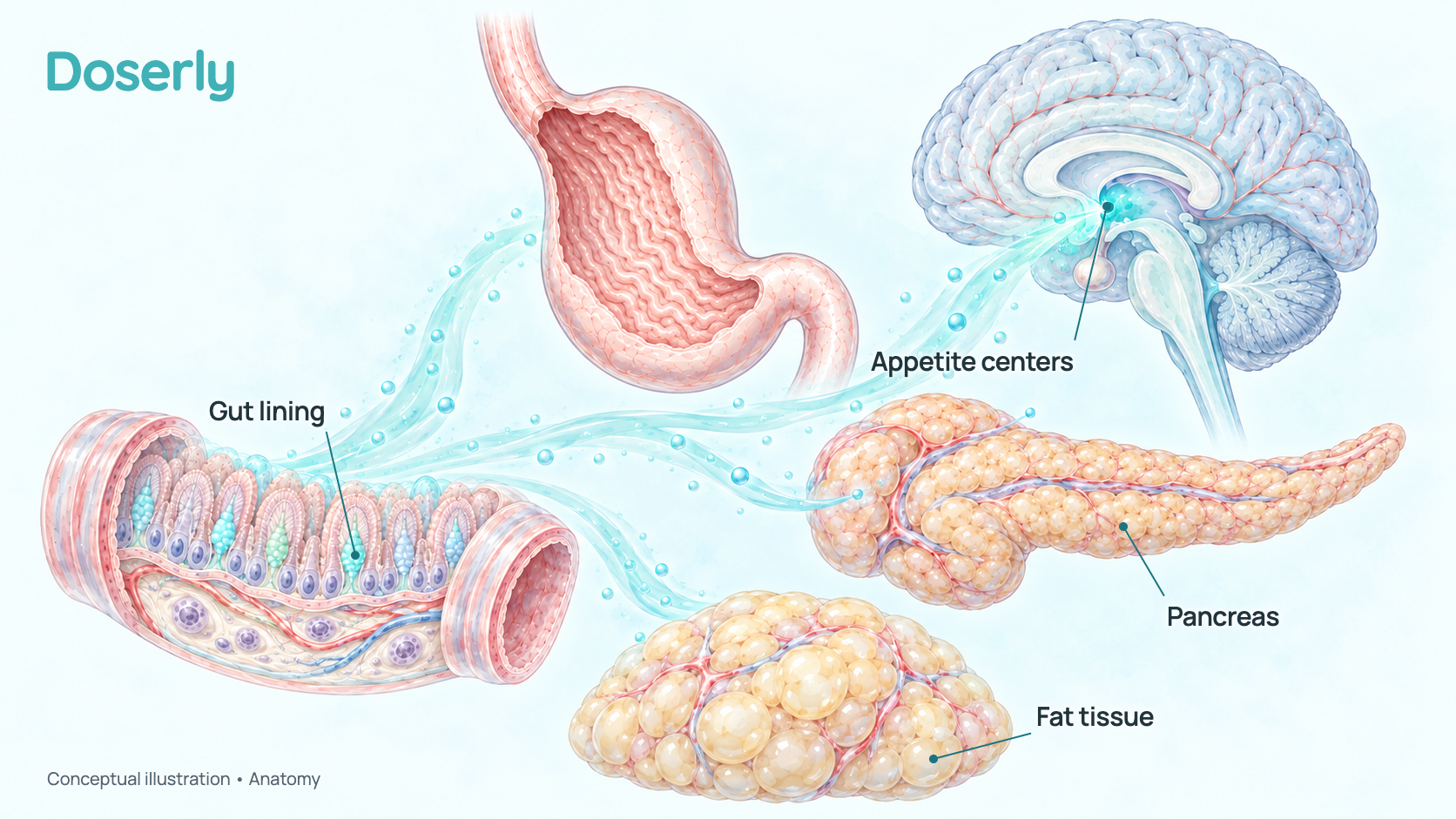
Tirzepatide is a prescription medicine that copies two hormones your gut releases after you eat, GIP and GLP-1, in a single molecule. It lowers blood sugar, makes people feel full sooner and hungry less often, and is used for type 2 diabetes, weight loss and obstructive sleep apnea. It is injected once a week. [2], [1]
GIP stands for glucose-dependent insulinotropic polypeptide and GLP-1 for glucagon-like peptide-1. Tirzepatide is a lab-made peptide, a short chain of amino acids: 39 of them, built on the GIP sequence. Two unusual amino acids (aminoisobutyric acid, or Aib, at positions 2 and 13) and a 20-carbon fatty-acid side chain change how it behaves. The side chain lets it ride on albumin, a common blood protein, which stretches its half-life to about 5 days. Because one molecule switches on both hormone receptors, it is called a dual agonist. [1], [12], [13]
Eli Lilly makes the brand-name products, which contain the same active ingredient under different names and labels:
| Brand | Form | Approved use (US) |
|---|---|---|
| Mounjaro | Weekly injection: single-dose pen or vial, or a multi-dose vial or KwikPen with four doses | Type 2 diabetes in adults and in children 10 and older; lowering the risk of heart attack, stroke and heart death in adults with type 2 diabetes at high risk |
| Zepbound | Weekly injection in the same forms | Weight loss and keeping it off in adults with obesity, or overweight plus a weight-related condition; moderate to severe obstructive sleep apnea in adults with obesity |
In the European Union and the United Kingdom, the weight-management use is licensed under the Mounjaro name. In Canada, Mounjaro comes as single-dose pens and KwikPens, and Zepbound as a KwikPen. Its development code was LY3298176. [3], [15], [16], [17], [12]
People also meet tirzepatide as compounded vials, "research" vials sold online, and drops or dissolving tablets. These are not FDA-approved products, and the FDA has warned about fake labels, dosing errors and research-labeled products sold for people. Some sellers call it "GLP-2" or "GLP-2 Tirzepatide", which is misleading: GLP-2 is a different gut hormone, and the mix-up could lead to taking the wrong product or the wrong amount. [10], [18], [19]
Typical Tirzepatide Protocols
| Product and use | Starting dose | Dose steps | Maintenance dose (each week) | Duration |
|---|---|---|---|---|
| Zepbound · weight loss and keeping it off | 2.5 mg, weeks 1–4 | 5 mg from week 5; then up by 2.5 mg if needed, each step after at least 4 weeks | 5, 10 or 15 mg | Long term 2.5 mg is a starting dose only. If a maintenance dose is not tolerated, the label says to consider a lower one |
| Zepbound · obstructive sleep apnea with obesity | 2.5 mg, weeks 1–4 | 5 mg from week 5; then up by 2.5 mg, each step after at least 4 weeks | 10 or 15 mg | Long term |
| Mounjaro · type 2 diabetes in adults, including heart-risk reduction | 2.5 mg | Up by 2.5 mg only if more blood-sugar control is needed, each step after at least 4 weeks | 2.5 to 15 mg | Long term Since August 27, 2026, the US label allows 2.5 mg as an ongoing dose. Canada, the EU and the UK still use 2.5 mg only to start |
| Mounjaro · type 2 diabetes in children 10 and older | 2.5 mg | Up by 2.5 mg only if more blood-sugar control is needed, each step after at least 4 weeks | 2.5 to 10 mg | Long term The Mounjaro KwikPen is not recommended for children to inject themselves |
The most common schedule in the labels and the reviewed dosing sources is 2.5 mg once a week for 4 weeks, then 5 mg, rising by 2.5 mg at least 4 weeks apart only if needed, to a maintenance dose of 5 to 15 mg. 15 mg a week is the maximum in every label. [1], [2], [20], [21], [22]
- Titration Raising the dose in steps
- Each step lasts at least 4 weeks, to limit stomach side effects. The ladder is a ceiling, not a timetable: the Zepbound label says to choose the maintenance dose by response and tolerance and to consider a lower one if a dose is not tolerated, and Mounjaro steps up only if more blood-sugar control is needed. The fastest route to 15 mg takes 20 weeks (2.5, 5, 7.5, 10 and 12.5 mg for 4 weeks each), which is how the SURMOUNT-1 trial reached its top dose. [1], [2], [5]
- Breaks and cycles
- Not applicable in the labels: tirzepatide is a long-term treatment with no planned breaks. In SURMOUNT-4, people switched to placebo after 36 weeks regained much of the weight they had lost within a year (see stopping). A missed dose can be taken within 4 days (96 hours); after that, skip it and take the next dose on the usual day. The injection day can move as long as doses stay at least 3 days (72 hours) apart. No label gives a schedule for restarting after a long break. [1], [2], [7]
Read the units: doses are in milligrams (mg). Single-dose pens and vials hold every strength in 0.5 mL, while the US multi-dose vial and KwikPen give four fixed doses of 0.6 mL each, so the volume differs between products even at the same dose. Syringe units only come up with vials; see how units convert. [1], [23]
Each row is a separate labeled schedule, not a step to move through. These are the labeled doses; prescribers adjust them for tolerance, response and the condition being treated.
Four cautions that apply to every schedule:
- 15 mg a week is the top labeled dose. Higher doses have no published human results, and shortening the gap between injections raises the weekly total. [1], [24]
- Not with other GLP-1 medicines. The Zepbound label says not to combine tirzepatide with other tirzepatide products or with any GLP-1 receptor agonist, such as semaglutide. [1]
- Vials are dosed in milligrams, not copied units. Compounded vials come in different strengths, and the FDA has reported dosing errors and patients told to keep vials longer than 28 days after first use. [23], [10]
- Pregnancy and the pill. Stop when pregnancy is recognized (US Zepbound) or at least 1 month before a planned pregnancy (EU, UK and Canada). Tirzepatide can make birth-control pills less reliable for 4 weeks after starting and after each dose increase. [1], [3], [25], [17]
Where schedules differ: 2.5 mg, lower doses, split doses, switching, vials and stopping ↓
Where these numbers come from
Every row comes from a current US prescribing label: Mounjaro (revised August 2026, which added the heart-risk indication and allowed 2.5 mg as an ongoing dose) and Zepbound (revised August 2026). Each row keeps the product, use, steps and maintenance dose together as the label states them. [2], [1], [4], [26]
Other regions differ. Canada, the EU and the UK still describe 2.5 mg as a starting dose only and list 5, 10 or 15 mg as maintenance doses. The UK label adds a review rule for weight management, and Canada advises caution above 5 mg in children weighing 60 kg or less. Australia's current product information was not publicly available when this guide was checked (September 2026). [27], [17], [3], [15]
Dosing websites were used as cross-checks, not as the source of any row. Of 38 pages read in full, 12 restate the labels, and several still show the pre-August 2026 Mounjaro wording or the older 2023 storage rule. Pages that convert the ladder into syringe units for compounded or "research" vials, pages with "microdose" schedules, and pages about split doses or switching did not shape the table; they are discussed in the next section. [20], [28], [29], [30], [21], [31], [32], [33], [34], [35], [22]
What is tirzepatide commonly used for?
People usually look into tirzepatide for weight loss, type 2 diabetes or obstructive sleep apnea, the uses its labels cover. In public forums, many also describe quieter "food noise", the constant background thinking about food (see what people report); in a small 6-week trial, tirzepatide reduced cravings and hunger compared with placebo. [2], [1], [36]
The uses below are approved for specific products and people. Using a product for something outside its label, or using an unapproved product, is a different situation from the trials described here.
Weight loss
Zepbound is approved for adults with obesity, or with overweight plus a weight-related health problem, alongside a reduced-calorie diet and more activity; in the EU and UK the same use sits under the Mounjaro name. In the SURMOUNT-1 trial, 2,539 adults without diabetes lost an average of 15.0%, 19.5% and 20.9% of their body weight on 5, 10 and 15 mg over 72 weeks, compared with 3.1% on placebo. About half of those on 10 mg and 57% on 15 mg lost 20% or more. Everyone in these trials, including the placebo groups, also had diet and activity counseling: about 500 fewer calories a day and at least 150 minutes of activity a week. [1], [3], [5]
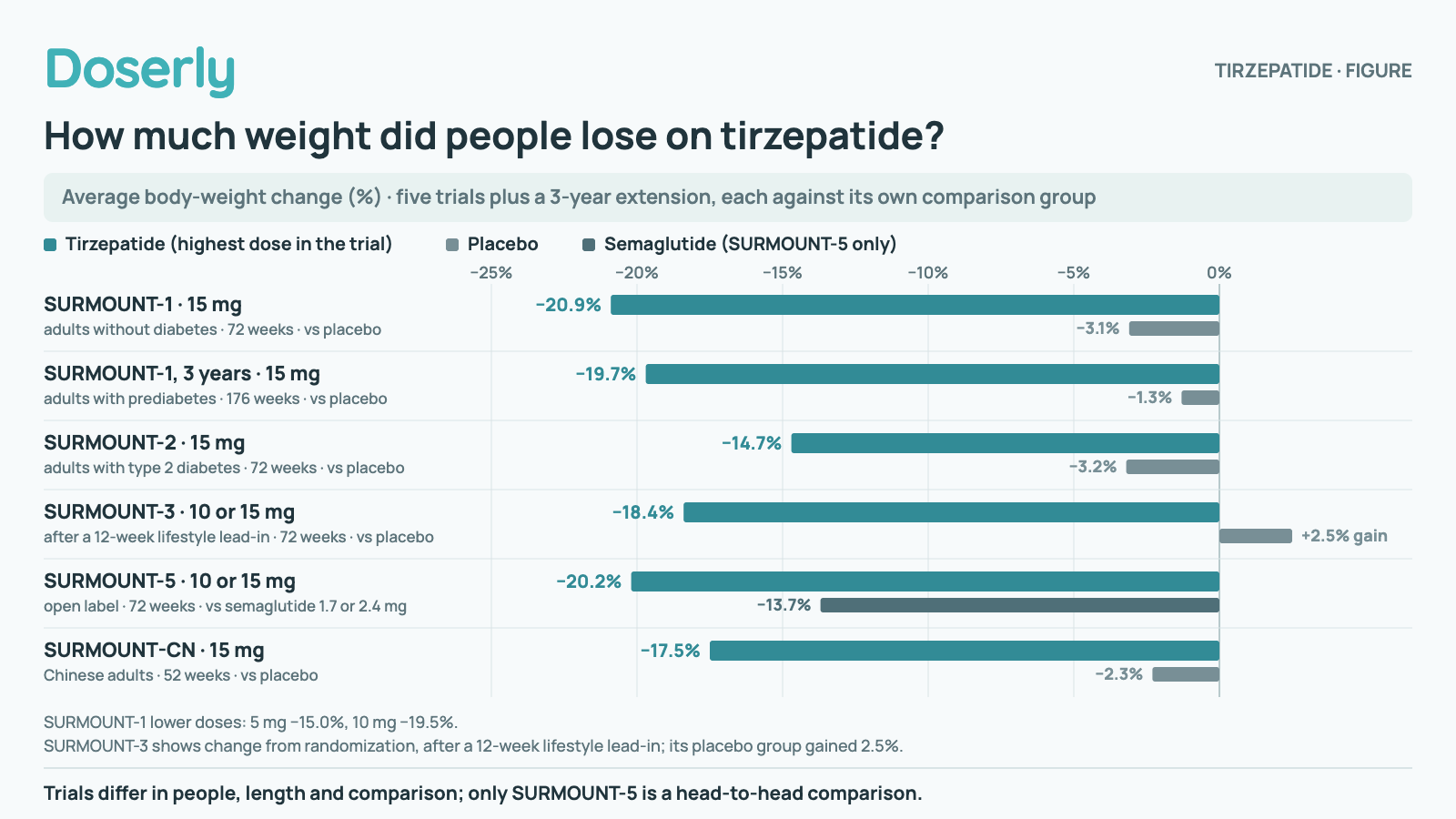
How much weight did people lose on tirzepatide?
Average change in body weight (%); each trial has its own comparison group.
- SURMOUNT-1 · 15 mg
- Adults without diabetes · 72 weeks · vs placebo. Tirzepatide −20.9%; placebo −3.1%.
- SURMOUNT-1, 3 years · 15 mg
- Adults with prediabetes · 176 weeks · vs placebo. Tirzepatide −19.7%; placebo −1.3%.
- SURMOUNT-2 · 15 mg
- Adults with type 2 diabetes · 72 weeks · vs placebo. Tirzepatide −14.7%; placebo −3.2%.
- SURMOUNT-3 · 10 or 15 mg
- After a 12-week lifestyle lead-in · 72 weeks · vs placebo. Tirzepatide −18.4%; placebo +2.5% (a gain).
- SURMOUNT-5 · 10 or 15 mg
- Open label · 72 weeks · vs semaglutide 1.7 or 2.4 mg. Tirzepatide −20.2%; semaglutide −13.7%.
- SURMOUNT-CN · 15 mg
- Chinese adults · 52 weeks · vs placebo. Tirzepatide −17.5%; placebo −2.3%.
SURMOUNT-1 lower doses: 5 mg −15.0%, 10 mg −19.5%. SURMOUNT-3 shows change after a 12-week lifestyle lead-in.
Trials differ in people, length and comparison; only SURMOUNT-5 is a head-to-head comparison.
Type 2 diabetes
Mounjaro is approved to improve blood-sugar control in adults and children 10 and older with type 2 diabetes. It lowers HbA1c, a blood test that reflects average blood sugar over about three months. In SURPASS-1, adults on no other diabetes medicine saw HbA1c fall by 1.87 to 2.07 points over 40 weeks on 5 to 15 mg, compared with almost no change on placebo, and in young people aged 10 to 17 (SURPASS-PEDS) it fell by 2.23 points over 30 weeks. Trials against other diabetes medicines are summarized below. [2], [37], [38]
Obstructive sleep apnea
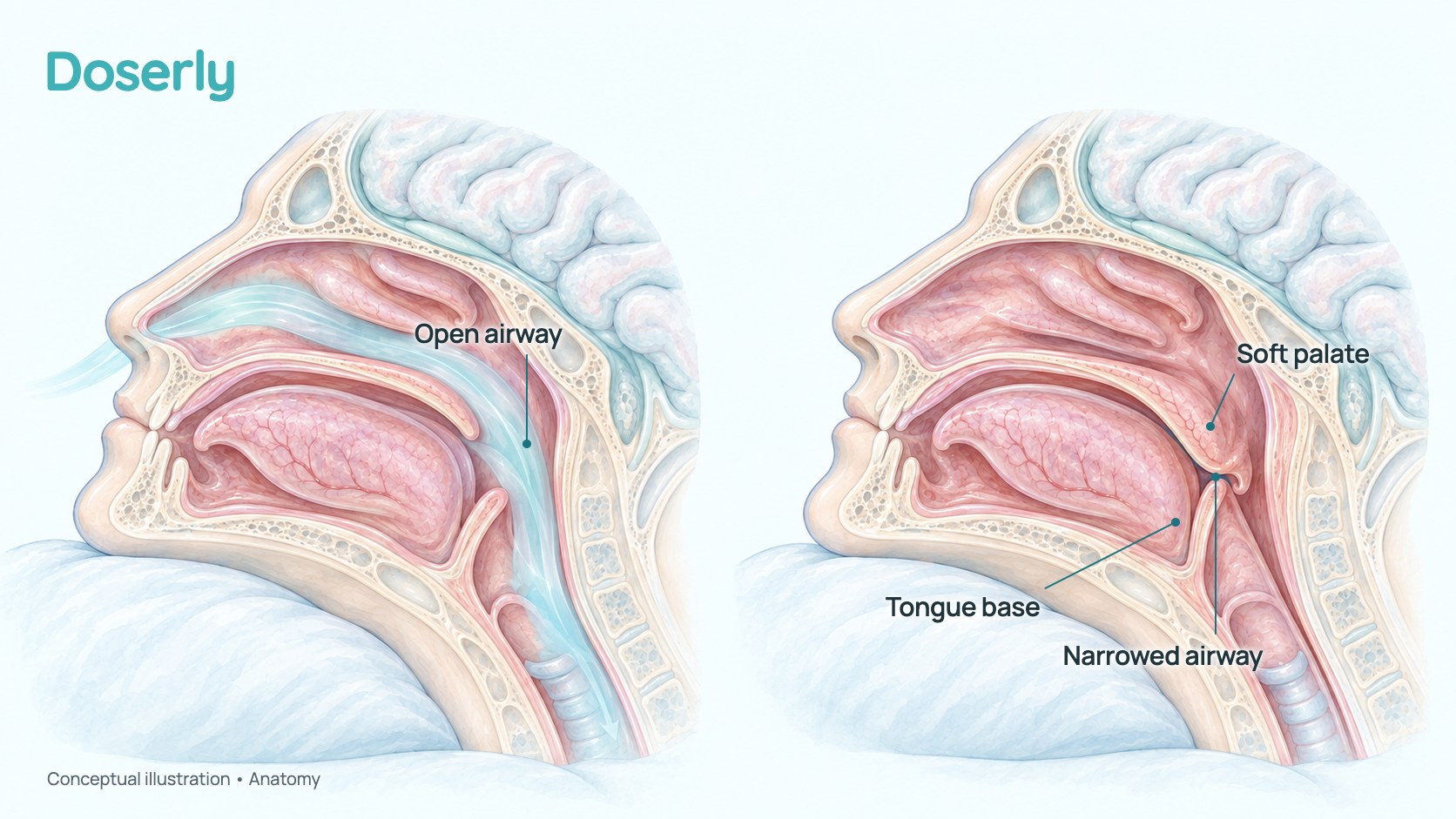
In obstructive sleep apnea, the throat repeatedly narrows or closes during sleep, so breathing stops and starts. Zepbound was approved in December 2024 for moderate to severe sleep apnea in adults with obesity. In the two SURMOUNT-OSA trials, the number of breathing pauses and shallow breaths per hour of sleep (the apnea-hypopnea index) fell by 25.3 versus 5.3 on placebo in people not using a breathing machine, and by 29.3 versus 5.5 in people using one. [39], [40], [1]
Canada's label says Zepbound is not a replacement for a breathing machine (PAP) in people who need one, and the US label notes that the trials did not test whether or when PAP can be stopped. [17], [1]
Heart and kidney risk in type 2 diabetes
In SURPASS-CVOT, about 13,300 adults with type 2 diabetes and heart or blood-vessel disease took tirzepatide or dulaglutide, an older weekly GLP-1 medicine, for about 4 years. Tirzepatide was no worse (noninferior) at preventing heart attacks, strokes and heart deaths, though not proven better, and on August 27, 2026, the FDA added lowering this risk to the US Mounjaro label. In a pre-specified exploratory analysis of the same trial, major kidney events were less common on tirzepatide (6.0% versus 7.6%). The numbers are in the research section. [2], [41], [4], [42]
Other conditions studied in trials
Trials have also tested tirzepatide in a type of heart failure with obesity, a scarring fatty-liver disease called MASH, psoriasis, polycystic ovary syndrome, type 1 diabetes and alcohol use. Some results were promising, but none of these is an approved use in the US labels. They are covered in the human research section. [43], [44], [45], [46], [47], [48]
Where do tirzepatide protocols differ?
The labeled ladder is simple. The confusion comes from the 2026 change to the 2.5 mg dose, different rules in different countries, doses below the start or above the top, split injections, switching from other drugs, compounded vials and stopping.
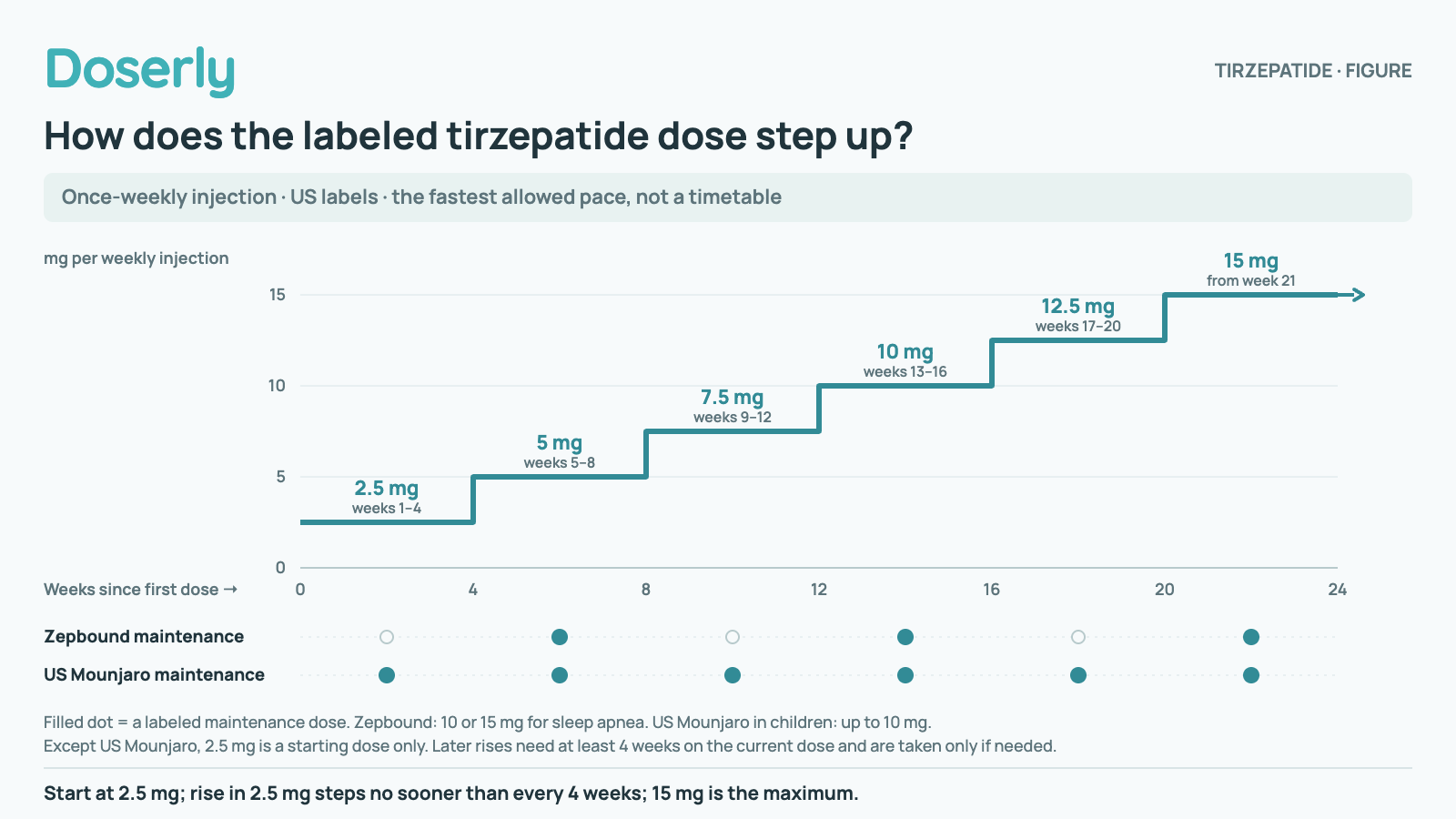
How does the labeled tirzepatide dose step up?
Official product labels; the fastest allowed pace, not a timetable.
- The ladder (all products)
- 2.5 mg in weeks 1–4, then 5 mg (US Mounjaro can stay at 2.5 mg). Further steps to 7.5, 10, 12.5 and 15 mg only if needed, each after at least 4 weeks on the dose before. 15 mg is reached at week 21 at the earliest and is the maximum.
- Zepbound maintenance
- 5, 10 or 15 mg a week; 10 or 15 mg for sleep apnea.
- US Mounjaro maintenance
- Any step from 2.5 to 15 mg; staying on 2.5 mg allowed since August 2026. Children: up to 10 mg.
- Canada, EU and UK
- 2.5 mg is a starting dose only.
Start at 2.5 mg; rise in 2.5 mg steps no sooner than every 4 weeks; 15 mg is the maximum.
Is 2.5 mg only a starting dose?
It depends on the product and the country. Until August 2026 every label treated 2.5 mg as a starting dose only. The FDA then approved a change to the US Mounjaro label so that 2.5 mg "can be used for ongoing glycemic control". The label now cites modeling that predicts about a 1.8-point drop in HbA1c at 52 weeks on 2.5 mg. [4], [2]
For weight loss, 2.5 mg is still a starting dose. The US Zepbound label says it "is not approved as a maintenance dosage", and the Canadian, EU and UK labels still move everyone to 5 mg after 4 weeks. Several popular dosing websites still carry the older Mounjaro wording. [1], [27], [3], [15], [28], [29]
How do the labels differ between countries?
| Label | Uses | 2.5 mg | Maintenance doses | Extra rules |
|---|---|---|---|---|
| US Mounjaro (Aug 2026) | Type 2 diabetes, age 10 and older; heart-risk reduction in adults | Can be continued | 2.5 to 15 mg (children up to 10 mg) | Steps only if more blood-sugar control is needed |
| US Zepbound (Aug 2026) | Weight management; sleep apnea | Start only | 5, 10 or 15 mg; sleep apnea 10 or 15 mg | Consider a lower maintenance dose if one is not tolerated |
| EU Mounjaro (Sep 2026) | Type 2 diabetes, age 10 and older; weight management | Start only | 5, 10 or 15 mg (children 5 or 10 mg) | Care when raising children under 60 kg to 10 mg |
| UK Mounjaro (Aug 2026) | Type 2 diabetes, age 10 and older; weight management | Start only | 5, 10 or 15 mg | Decide whether to continue if less than 5% of weight is lost 6 months after reaching the highest tolerated dose |
| Canada Mounjaro (Jun 2026) | Type 2 diabetes in adults and ages 10 to 17 | Start only | 5 to 15 mg (children up to 10 mg) | Caution above 5 mg in children weighing 60 kg or less |
| Canada Zepbound (Jun 2026) | Weight management; sleep apnea | Start only | 5, 10 or 15 mg; sleep apnea 10 or 15 mg | Not a replacement for a breathing machine; not to be taken daily |
[2], [1], [3], [15], [27], [17]
Australia registers Mounjaro for type 2 diabetes, weight management and sleep apnea in adults with obesity; its current dosing text was not publicly available when this guide was checked (September 2026). [49]
Does everyone need to reach 15 mg?
No. The Zepbound label lists 5 mg as a maintenance dose, and in SURMOUNT-1 the 5 mg group lost 15.0% of body weight on average over 72 weeks, compared with 20.9% on 15 mg. The label also says to consider a lower maintenance dose if a higher one is not tolerated. [1], [5]
Stepping down after weight loss has one randomized trial behind it. In SURMOUNT-MAINTAIN, people who had lost weight on their highest tolerated dose for 60 weeks either stayed on it, dropped to 5 mg or switched to placebo. From the start of the trial to week 112, they were 21.9%, 16.6% and 9.9% below their starting weight, and 8%, 25% and 67% needed rescue treatment for regaining more than half their loss. [50]
In real life, many people stay lower. In one US health-record study of 7,881 adults starting semaglutide or tirzepatide for weight (about three-quarters on semaglutide), about 8 in 10 stayed on lower maintenance doses. [51] In community education groups, the strongest agreement among educators was to hold a dose while it still works rather than stepping up on a calendar, and many members described large losses at 2.5 to 5 mg.
What about starting below 2.5 mg, or "microdosing"?
No trial supports it for weight loss. There is no agreed meaning of "microdosing" tirzepatide, and dosing websites define it as anything from 0.25 to 0.5 mg a week, to 0.5 to 2.5 mg, to the normal 2.5 mg dose taken every 10 to 14 days. [52], [53], [54]
The human data below 2.5 mg are thin. An early diabetes trial included a 1 mg weekly group, which lowered HbA1c by 1.06 points over 26 weeks; a small safety study in children aged 6 to 11 started those under 50 kg at 1.25 mg for 4 weeks. A registered commercial study of people using compounded "microdoses" has not started. A 2026 nursing commentary described microdosing as part of a shift toward unsupervised use after compounding was restricted. [55], [56], [57], [58]
In community education groups, about 18 members described starting at 0.5 to 1.5 mg or stepping up by 0.5 to 1 mg, usually out of fear of side effects; some did well, and others saw no effect for weeks. Some people get smaller amounts from a KwikPen by counting its "clicks", although the pen is made to deliver four fixed doses. One person who clicked out a 2.5 mg dose then drew the pen's leftover solution into a syringe and took about 17.5 mg by mistake. [59], [14], [60]
Once a week, or split into smaller doses?
The labels say once a week, on any day and at any time, with or without food; Canada's Zepbound label adds that it "should not be administered daily". The 5-day half-life is why a single weekly dose is enough. [1], [17], [2]
Some people split the weekly dose in two, or inject every 5 or 6 days, most often because hunger comes back by day 3 to 6, or to soften nausea after a full dose. Two dosing websites that discuss splitting both say no trial has tested it. Shortening the interval is a dose increase: 9.5 mg every 6 days is about 11 mg a week. [61], [62], [63], [64] In community education groups, about 37 threads discussed splitting or shortening the interval. Some members reported smoother hunger and fewer side effects; two members on 12.5 to 15 mg lost more slowly on split doses and went back to one weekly dose.
The injection day can change as long as doses stay at least 3 days (72 hours) apart. [1]
What about doses above 15 mg?
No published human study has tested more than 15 mg a week. Lilly has run a phase 2 trial of "investigational tirzepatide doses" in 414 people with type 2 diabetes and obesity; the registry does not disclose the doses and no results have been posted. [1], [24]
Public forums include reports of 20 to 30 mg a week, and one person described 20 to 25 mg every 2 days alongside other products. These are unverified, often involve unapproved products, and cannot show safety. The UK medicines regulator warns against raising a dose without a prescriber. [65], [66], [67]
Switching from semaglutide or another GLP-1 medicine
There is no label conversion between semaglutide and tirzepatide, because they are different drugs with different dose scales. Dosing websites contradict each other: one maps semaglutide 2 mg to tirzepatide 10 to 15 mg, another suggests starting tirzepatide at 5 mg after semaglutide, and a third says there is no direct conversion. [68], [69], [70]
The one randomized switching trial, SURPASS-SWITCH, moved adults with type 2 diabetes from lower doses of dulaglutide to tirzepatide. After 40 weeks, HbA1c fell by 1.44 points and weight by 10.5 kg, versus 0.67 points and 3.6 kg for those who stayed on dulaglutide at a higher dose. [71] In community education groups, the usual practice after semaglutide is to restart tirzepatide at 2.5 mg, and members who were started high by telehealth services often regretted it.
Can tirzepatide be combined with retatrutide, cagrilintide or semaglutide?
Not in any approved way. The Zepbound label says tirzepatide should not be combined with other tirzepatide products or any GLP-1 receptor agonist. Retatrutide is an unapproved experimental drug, and no trial has tested it together with tirzepatide; a head-to-head trial comparing the two had not reported by September 2026. [1], [72]
Online, the "tirz and reta stack" and "tirzepatide and cagrilintide stack" come up often in public forums. People report adding a small dose of one to the other to break a stall or ease late-week hunger [73], [74], and one person taking tirzepatide with survodutide, another experimental drug, described their heart feeling "jumpy". [66] In community education groups, most educators taught never to combine two GLP-1-active drugs, yet a few course lessons gave stacking instructions or blend tables, and members often combined them anyway. The only trials combining tirzepatide with another experimental weight-loss drug are run by the maker, such as tirzepatide with bimagrumab, another experimental Lilly drug; no results have been posted. [75]
Do compounded and "research" vials follow the same steps?
Many copy the label ladder but put it into vials of different strengths, then convert each dose into syringe units. Vials of 30 to 120 mg are common, which at low doses can last months, far beyond the FDA's advice to throw a compounded multi-dose vial away 28 days after first use. Research-vial pages add their own errors: one research wiki shows an amino-acid sequence that is not tirzepatide's, and another splits a weekly dose into as many as four separate 1 mL injections of a weak solution. [76], [77], [78], [79], [10], [80], [81]
In an August 2026 letter to state medical boards, the FDA reported complaints about compounded vials that held far more than a 28-day supply and patients told to keep using them past 28 days. On a starting schedule, almost 90% of a 4 mL vial would be thrown away at 28 days, and the FDA suggested labels such as "Discard vial after the 4th injection". Its worked example of volumes is in the units section below. [23]
How do milligrams convert to syringe units?
Pens do not use units. Syringe units only appear with vials drawn into an insulin syringe, and they measure volume, not drug: on a U-100 syringe, 100 units equal 1 mL. The amount of tirzepatide in each unit therefore depends on the vial's concentration. [23]
For an approved single-dose Zepbound or Mounjaro vial, the dose is the whole 0.5 mL, which is 50 units whatever the strength. For the US four-dose vial, each dose is 0.6 mL, or 60 units. The label says to use a syringe that can measure 0.5 or 0.6 mL. One person who intended 5 mg drew 5 units, about a tenth of the dose. [1], [82]
For a compounded vial at 10 mg per mL, 2.5 mg is 0.25 mL, or 25 units. At the FDA's example strength of 17 mg per mL, the same 25 units would hold about 4.25 mg, and 2.5 mg is only about 15 units. Copying a number of units from someone using a different vial can therefore change the dose a lot. [76], [23] Doserly's reconstitution calculator works out the arithmetic for any vial and shows each step.
What happens when you stop tirzepatide?
The labels describe long-term treatment, and the stopping studies show why: after treatment ends, weight usually returns. Because its half-life is about 5 days, tirzepatide takes some weeks to leave the body; the EU label asks women to stop at least 1 month before a planned pregnancy for that reason. [1], [3]
- Weight. SURMOUNT-4 was a randomized stopping trial. The 670 people who completed 36 weeks on their highest tolerated dose (10 or 15 mg) had lost 20.9% on average. Then half were switched, without knowing it, to placebo. Over the next 52 weeks, those who continued lost another 5.5%, while those on placebo regained 14.0% (measured from their week-36 weight), about half of what they had lost. Overall, the placebo group ended 9.9% below its starting weight, versus 25.3% for those who stayed on treatment. [7]
- Who regains. Among 308 people switched to placebo after losing at least 10%, 254 (82.5%) regained at least a quarter of their loss, and waist size, blood pressure, cholesterol and HbA1c worsened in step with the regain. [83]
- Diabetes risk. In adults with prediabetes followed for 3 years, 1.3% on tirzepatide developed type 2 diabetes versus 13.3% on placebo. Seventeen weeks after treatment stopped, the figures were 2.4% versus 13.7%. [84]
- Estimates across drugs. A 2026 review of weight-loss medicines found regain averaged 0.4 kg a month after stopping; for semaglutide and tirzepatide it was about 0.8 kg a month, with weight projected back to where it started about 1.5 years later. The projection goes beyond what the studies observed. [85]
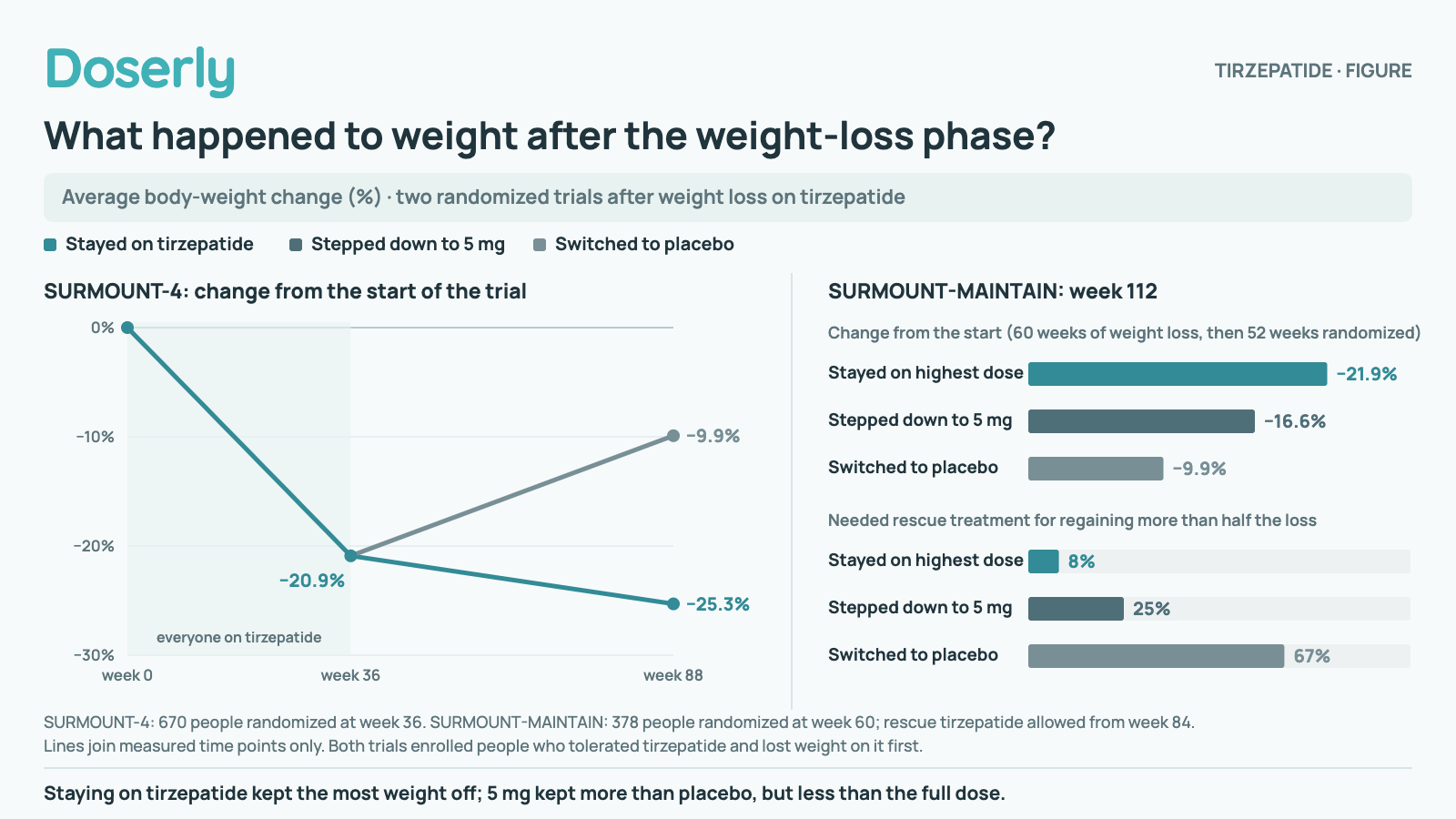
What happened to weight after the weight-loss phase?
Two randomized trials in people who had first lost weight on tirzepatide.
- SURMOUNT-4
- People who completed 36 weeks on their highest tolerated dose had lost 20.9% on average. At week 88, those who stayed on it were 25.3% below their starting weight; those switched to placebo 9.9% below (670 people randomized).
- SURMOUNT-MAINTAIN: week 112
- After 60 weeks on the highest tolerated dose: stayed on it −21.9%, stepped down to 5 mg −16.6%, switched to placebo −9.9% from the start (378 people randomized).
- SURMOUNT-MAINTAIN: rescue treatment
- Needed rescue tirzepatide for regaining more than half the loss: 8% of those who stayed on the highest dose, 25% of those on 5 mg and 67% of those on placebo.
Lines join measured time points only.
Staying on tirzepatide kept the most weight off; 5 mg kept more than placebo, but less than the full dose.
Stopping is common in real life. In a US study of 125,474 adults starting GLP-1 medicines for weight (including tirzepatide), 64.8% of those without diabetes had stopped within a year. In another US health system, the main reasons among 288 people who stopped semaglutide or tirzepatide were cost or insurance (47.6%), side effects (14.6%) and shortages (11.8%). People who stopped early were 3.6% lighter after a year, versus 11.9% for those who kept going. [86], [87], [51]
Tapering, breaks and "receptor resets." The labels give no taper schedule, and no completed trial has compared tapering with stopping all at once. A small US pilot trial called OFF-RAMP plans to compare staying on the full dose with stepping tirzepatide down every 4 weeks from 15 mg to 5 mg and then 5 mg every other week; it had not started recruiting. In a separate Lilly trial, people who switched from tirzepatide to the daily pill orforglipron kept 74.7% of their weight loss after a year, versus 49.2% on placebo; there was no group that stayed on tirzepatide. [88], [89]
In community education groups, educators disagree. Some teach step-downs of 1 to 2 mg every few weeks, or stretching the gap between doses to 10 to 14 days; others say to stay on the lowest dose that works; a few promote planned breaks to "reset" receptors, which one educator called a myth. No study shows that breaks restore the effect.
Restarting. No label gives a restart schedule after a long break; the only rule covers a dose missed by up to 4 days. In public forums, people returning after longer gaps often describe restarting at 2.5 mg. Reports vary: some say the first 2.5 mg dose "did nothing", others that the second course felt the same as the first. [1], [90], [91]
How is tirzepatide given, and how long does it last in the body?
Every approved tirzepatide product is a subcutaneous injection into the belly, the thigh or the back of the upper arm (the US labels say another person should give upper-arm injections), rotating the site each time. Canada's Zepbound label adds that it must not be injected into a muscle or a vein. [1], [2], [17]
Here is what happens after an injection (its pharmacokinetics), from the labels and human studies:
- Absorption. About 80% of the dose reaches the blood (bioavailability), with the peak 8 to 72 hours after the injection (typically about 24 hours). [1]
- Half-life. About 5 days (5 to 6 days in people with obesity). With weekly injections, levels build up and then level off (steady state) after about 4 doses. [1], [2], [13]
- In the blood. About 99% travels bound to albumin, which protects it and slows its removal. [1]
- Breakdown. The body cuts both the peptide chain and its fatty-acid side chain into small pieces, so no intact tirzepatide leaves in urine or stool; in a human tracer study, about two-thirds of the breakdown products left in urine and one-third in stool. [1], [92]
- Kidneys and liver. A single-dose study in 45 people with different levels of kidney function, including kidney failure, and another in 32 people with different levels of liver impairment found no change that needs a dose adjustment. [93], [94]
- Antibodies. About half of people in the trials made antibodies against tirzepatide (51% in diabetes trials, 64.5% in weight trials). These did not change blood levels or the effect, but allergic-type and injection-site reactions were more common in people who had them. [2], [1], [95]
Does it matter where you inject?
Not for the amount absorbed. The Zepbound label says exposure was similar whether tirzepatide was injected into the belly, the thigh or the upper arm. Rotating the site is about the skin: injection-site reactions such as redness, itching or bruising affected 6% to 8% of people in the weight trials, versus 2% on placebo. [1]
Is there a tirzepatide pill, drops or nasal spray?
No. Every approved tirzepatide product is an injection, and no pill, drop or spray form of tirzepatide is approved in the US, the EU or Canada. [1], [3], [17]
Some compounding pharmacies and clinics sell under-the-tongue (sublingual) drops and dissolving tablets. No published study has measured how much of these reaches the blood, and one seller placed the injection's 80% bioavailability next to its drops, which is not the same thing. In a 2026 review of 33 compounded semaglutide and tirzepatide products found online, the single-ingredient products were all sublingual (82%) or dissolving tablets (18%), and almost half the products mixed the drug with added ingredients. [96], [97], [98], [99]
The GLP-1 pill that is approved for weight loss, orforglipron (Foundayo), is a different, non-peptide drug with its own dose scale. See the orforglipron guide. [100]
How should tirzepatide be stored, and how long does it last?
Each product's label sets its storage rules, and they differ by product and by country, so the leaflet in your own box is the final word. In short, pens and vials start in the fridge (2–8 °C, 36–46 °F), must never be frozen, and stay in the carton away from light. [1], [2]
| Product | Before first use | Out of the fridge, or after first use |
|---|---|---|
| Single-dose pen or vial (one injection) | Fridge, 2–8 °C | US: up to 21 days in total at no more than 30 °C; since April 2026, moving it in and out of the fridge within those 21 days is allowed. EU and Canada: up to 21 days below 30 °C. Thrown away after the one injection |
| Multi-dose vial or KwikPen (four doses) | Fridge, 2–8 °C; if kept unopened at room temperature, thrown away after 30 days (US) | US: in the fridge or up to 30 °C; thrown away after 30 days at room temperature, 30 days after first use, or 4 doses, whichever comes first. EU and UK KwikPen: 30 days after first use, not above 30 °C. Canada: 30 days, and after 4 weekly doses |
| Compounded multi-dose vial (not an approved product) | As labeled by the pharmacy | FDA advice: throw away 28 days after first use even if some is left; do not use a GLP-1 injection that arrives warm |
[1], [2], [101], [3], [15], [27], [17], [10], [23]
Two rules changed recently. The original 2023 Zepbound label said a pen kept at room temperature should not go back into the fridge; a stability study approved in April 2026 (and posted by the FDA on September 1) now supports moving single-dose pens and vials between fridge and room temperature within the 21 days. Some websites still show the older rule. [102], [101], [31]
Compounded and "research" vials. No approved label covers them, so they have no tested in-use period. Seller pages claim 2 to 4 weeks after mixing (reconstitution) and advise freezing the powder, while forum users describe using mixed vials for 3 months or more, sometimes after freezing them. None of these claims has published stability testing behind it. The date printed on a compounded vial (its beyond-use date, sometimes 12 months from when it was made) is not the same as how long it can be used once the stopper has been punctured. The FDA's advice is 28 days after first use. [103], [104], [105], [106], [79], [107], [108], [10]
Only 18% of compounded products in the 2026 review stated a beyond-use date or storage conditions. [99] This guide does not cover pen technique or mixing; the Academy note below covers practical handling.
What do we actually know about tirzepatide in people?
A lot. Tirzepatide has been tested in tens of thousands of people in large randomized controlled trials, where people are assigned by chance to the medicine, a placebo or another drug. The UK label counts 15,169 adults treated in 14 completed phase 3 studies, and a search of ClinicalTrials.gov in September 2026 found 311 tirzepatide study records, 47 of them with posted results. The questions the trials answer are more specific than "does it work": how much, in whom, at which dose, for how long, and what happens after stopping. [15], [109]
How much weight do people lose in trials?
| Trial | Who and what | Average weight change | What it cannot show |
|---|---|---|---|
| SURMOUNT-1 (2022) | 2,539 adults without diabetes; 5, 10 or 15 mg weekly; 72 weeks | −15.0%, −19.5%, −20.9% vs −3.1% on placebo | Results after stopping (see stopping) [5] |
| SURMOUNT-1, 3 years (2025) | 1,032 of those adults who had prediabetes; 176 weeks | −12.3%, −18.7%, −19.7% vs −1.3% | Effects beyond 3 years [84] |
| SURMOUNT-2 (2023) | 938 adults with type 2 diabetes; 10 or 15 mg; 72 weeks | −12.8%, −14.7% vs −3.2% | Why people with diabetes lose less on average [110] |
| SURMOUNT-3 (2023) | 579 adults who first lost 5% or more with 12 weeks of intensive diet and exercise; 72 weeks | a further −18.4% vs +2.5% | Results without the intensive lead-in [111] |
| SURMOUNT-5 (2025) | 751 adults without diabetes; tirzepatide 10 or 15 mg vs semaglutide 1.7 or 2.4 mg; 72 weeks; open label | −20.2% vs −13.7% on semaglutide | A blinded comparison [6] |
| SURMOUNT-CN (2024) | 210 Chinese adults; 10 or 15 mg; 52 weeks | −13.6%, −17.5% vs −2.3% | Results beyond 1 year in this group [112] |
An average hides a wide range. In SURMOUNT-1, 85%, 89% and 91% of people on 5, 10 and 15 mg lost at least 5% of their weight, compared with 35% on placebo, so about 1 in 10 people on 10 or 15 mg, and about 1 in 7 on 5 mg, did not reach 5%. In an analysis limited to people who kept taking their doses and lost at least 5%, most had reached a plateau (less than 5% further change over 12 weeks) by week 72. The median time to that plateau ranged from about 24 weeks in people with overweight to about 36 weeks in those with the highest BMI. [1], [113]
Early losses predict more, but slow starters still respond. Among people in SURMOUNT-1 who took at least three-quarters of their doses, 18% had lost less than 5% by week 12, yet 90% of those slower starters reached 5% by week 72. [114], [115] Adults aged 65 and older lost weight and had side effects at broadly similar rates to younger adults, and people carrying genetic changes in the MC4R appetite pathway lost 18.3% versus 19.9% for others. [116], [117]
The label figures use the "treatment-regimen" approach, which counts everyone assigned to the drug, including people who stopped taking it. Some websites quote higher "efficacy estimand" numbers, such as 22.5% for SURMOUNT-1 on 15 mg, which estimate what would happen if everyone kept taking it. Both are real; they answer different questions. [1], [5], [103]
Does it lower blood sugar more than other diabetes medicines?
In the SURPASS trials, yes, against every comparator tested. Each of these trials used the label ladder to reach 5, 10 or 15 mg:
| Trial | Compared with | HbA1c change (points) | Weight change |
|---|---|---|---|
| SURPASS-1 (40 weeks) | Placebo, no other diabetes medicine | −1.87 to −2.07 vs +0.04 | −7.0 to −9.5 kg |
| SURPASS-2 (40 weeks, open label) | Semaglutide 1 mg | −2.01 to −2.30 vs −1.86 | 1.9 to 5.5 kg more than semaglutide |
| SURPASS-3 (52 weeks, open label) | Insulin degludec | −1.93 to −2.37 vs −1.34 | −7.5 to −12.9 kg vs +2.3 kg |
| SURPASS-4 (up to 104 weeks, open label) | Insulin glargine, high heart risk | −2.43 and −2.58 (10 and 15 mg) vs −1.44 at 52 weeks | Not summarized here |
| SURPASS-5 (40 weeks) | Placebo, added to insulin glargine | −2.11 to −2.40 vs −0.86 | −5.4 to −8.8 kg vs +1.6 kg |
| SURPASS-6 (52 weeks, open label) | Mealtime insulin lispro | −2.1 vs −1.1 | −9.0 kg vs +3.2 kg |
[37], [118], [119], [120], [121], [122]
Trials in Japan, China and the Asia-Pacific region showed the same direction. In SURPASS-6, low blood sugar (hypoglycemia) happened 0.4 times per person-year on tirzepatide versus 4.4 on mealtime insulin. [123], [124], [125], [126], [127], [122]
Two newer trials asked practical questions. In SURPASS-EARLY, adults within a few years of diagnosis did better over 2 years on tirzepatide than with stepped-up usual care: HbA1c fell by 1.99 versus 1.32 points, and 60.2% versus 24.0% reached a non-diabetic level (below 5.7%). In SURPASS-SWITCH, switching from dulaglutide to tirzepatide beat raising the dulaglutide dose. [128], [71]
Tirzepatide is not approved for type 1 diabetes. In a 12-week phase 2 trial in 24 adults with type 1 diabetes and obesity, weight fell by 10.3 kg versus 0.7 kg, and total insulin use by about a third; larger phase 3 trials are under way. [47], [129]
Does it lower heart attack and stroke risk?
For people with type 2 diabetes and heart disease, the answer so far is "at least as well as dulaglutide". In SURPASS-CVOT, a heart attack, stroke or heart death happened to 12.1% on tirzepatide and 13.0% on dulaglutide over about 4 years (hazard ratio 0.92). That proved tirzepatide was no worse, but the result fell just short of proving it better. The comparison drug itself lowers heart risk, and there was no placebo group. Deaths from any cause were 16% lower on tirzepatide, a finding the trial was not set up to test formally. [2], [41]
The published paper counts 801 versus 862 events, the label 803 versus 863; the small difference comes from slightly different groups of people analyzed. [41], [2]
For people with obesity but without diabetes, the answer is not yet known. SURMOUNT-MMO, a trial in 15,374 adults testing whether tirzepatide lowers deaths, heart attacks, strokes, artery-opening procedures and heart failure events, is planned to finish in 2027. [130]
Does it help sleep apnea, the liver or heart failure?
- Sleep apnea. Beyond the breathing results above, secondary analyses of SURMOUNT-OSA found that the improvement in sleep apnea itself accounted for part of the falls in inflammation, insulin resistance and blood fats, separately from weight loss. Weight fell by 17.7% and 19.6% in the two trials. [131], [1]
- Liver (MASH). In SYNERGY-NASH, a 52-week phase 2 trial in 190 adults with biopsy-confirmed MASH and moderate to advanced scarring, the liver inflammation cleared without worse scarring in 44%, 56% and 62% on 5, 10 and 15 mg, versus 10% on placebo. That is a biopsy result from a mid-stage trial, not proof of fewer liver failures, and MASH is not an approved use. [44]
- Heart failure. In SUMMIT, 731 adults with a stiff-heart type of heart failure (with preserved ejection fraction) and obesity took up to 15 mg or placebo. Heart death or worsening heart failure happened to 9.9% versus 15.3%, driven by fewer worsening-heart-failure events; heart deaths alone were few (2.2% versus 1.4%). Symptom scores improved more on tirzepatide. It is not a separate approved use. [43], [3]
- Psoriasis and PCOS. In people with psoriasis and excess weight, adding tirzepatide to the psoriasis drug ixekizumab made complete skin clearance plus at least 10% weight loss more common (27.1% versus 5.8%). In a small 16-week trial in 60 Chinese women with polycystic ovary syndrome, tirzepatide 5 mg with metformin led to more weight loss than metformin alone (10.4 versus 1.7 kg) and more return of regular periods. [45], [46]
Is the weight lost fat or muscle?
Mostly fat, but lean tissue fell too. In a body-scan substudy of 160 SURMOUNT-1 participants, fat mass fell by 33.9% and lean mass by 10.9% over 72 weeks. About three-quarters of the weight lost was fat and one-quarter lean tissue, the same split as in the placebo group, which lost much less. The US label states that tirzepatide lowers weight "with greater fat mass loss than lean mass loss". [132], [1]
Lean mass is not the same as muscle strength; it includes muscle, organs and water, and the scans did not measure strength or function. In community education groups, strength training and enough protein are the standard advice for protecting muscle during large weight loss, and some members still described losing muscle despite lifting.
Does it change alcohol use or other cravings?
It is being studied, but there is no trial result yet. The human evidence is observational: a self-report study of 153 adults with obesity found lower drinking in semaglutide or tirzepatide users; a study of 14 weight-clinic patients (5 on tirzepatide) found lower alcohol-risk scores after about 10 months; and among adults with type 2 diabetes, 7,165 people starting tirzepatide had about half the rate of new alcohol use disorder diagnoses of a matched group of 7,165 starting a DPP-4 inhibitor, an older diabetes pill. A three-person case series reports less drinking. [133], [134], [48], [135]
At least six randomized trials of tirzepatide for alcohol use disorder are registered, and none has reported. In rodents, tirzepatide reduced alcohol drinking and relapse-like drinking, and in another rodent study it reduced cocaine taking; these are animal studies, not evidence of the same effect in people. [136], [137], [138], [139], [140], [141], [142], [143]
How does tirzepatide work?
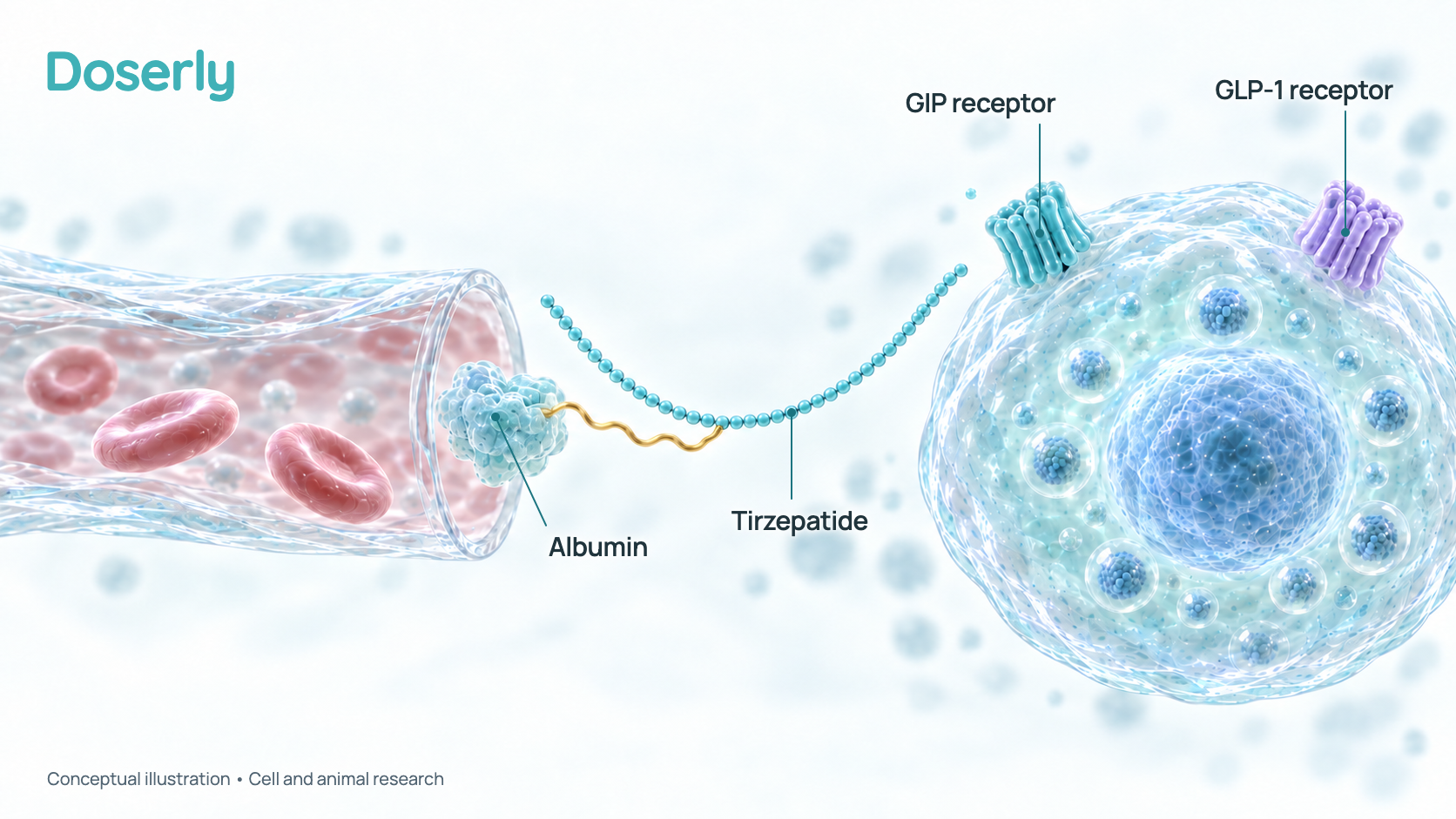
Tirzepatide binds to and switches on two receptors, the targets of the gut hormones GIP and GLP-1. Its effects in people are well measured: it lowers calorie intake, most likely by reducing appetite; it raises insulin and lowers glucagon (a hormone that raises blood sugar) mainly when blood sugar is raised; it improves how well the body responds to insulin; and it slows how fast the stomach empties, most of all after the first dose. [1]
Why copy two hormones instead of one?
Laboratory cell studies show tirzepatide is not a 50:50 mix of the two signals. At the levels reached in people, it engages the GIP receptor more than the GLP-1 receptor, a profile researchers call "imbalanced". At the GLP-1 receptor it favors one internal signal (cyclic AMP) and pulls the receptor into the cell less than natural GLP-1 does. Structural images of the drug bound to both receptors show it works the GIP receptor much like natural GIP but the GLP-1 receptor quite differently, in a way that switches the receptor off less. [144], [145]
A second lab group, using different tests, found the bias pointed toward another signal (ERK) instead, so "biased" is a fair label but its direction depends on how it is measured. Tirzepatide switched on two common human versions of the GIP receptor equally well. [146], [147]
Mouse data can understate the GIP part. In mouse pancreas cells, tirzepatide's insulin effect ran mainly through the GLP-1 receptor, but in human pancreas cells, blocking the GIP receptor consistently cut the insulin response. [148] In a human study in type 2 diabetes, 28 weeks of 15 mg improved insulin-making cell function and insulin sensitivity more than semaglutide 1 mg did. [149]
How does it reduce appetite?
In a 6-week trial in adults with overweight or obesity, people on tirzepatide ate about 525 fewer calories than on placebo at a lunch where they could eat as much as they liked, and reported fewer cravings and less hunger. In people with type 2 diabetes, tirzepatide lowered appetite and calorie intake about as much as semaglutide but reduced fat mass more; the lunch results alone did not explain the difference in weight. [36], [150]
How it does this in the brain comes from animal studies. In mice, combining GIP and GLP-1 signals quieted hunger-promoting nerve cells more than either alone. Labeled tirzepatide reached mainly a few brain areas where the protective barrier is leaky, and brainstem and amygdala nerve cells were needed for the combined effect. In rodents, it also made fatty, palatable food less attractive, an effect that disappeared without GLP-1 receptors. These are mouse and rat findings; the human pathway has not been mapped this way. [151], [152], [153]
Why might it cause less nausea than expected?
In animals, the GIP signal appears to calm nausea. Rats and shrews on tirzepatide showed fewer signs of sickness and vomiting than on a semaglutide dose that cut food intake equally, and in mice, GIP receptors on certain brain cells were needed for this anti-nausea effect. [154], [155]
Whether that matters in people is less clear. Nausea is still one of the most common side effects: in the head-to-head SURPASS-2 trial, nausea affected 17% to 22% on tirzepatide and 18% on semaglutide 1 mg, and in SURMOUNT-5 stomach and bowel side effects were the most common problems in both groups. [118], [6]
Does it slow the stomach?
Yes, but mostly at first. In a human study, stomach emptying (gastric emptying) slowed after the first dose, and the effect faded with repeated weekly doses. The label says the delay is largest after the first dose and diminishes over time. This is why tirzepatide can affect how some pills are absorbed early on, and why it carries a warning for anesthesia. [156], [1]
Does it burn more calories?
Probably not much in people. The label says tirzepatide lowers calorie intake, and a phase 1 study found no detectable effect on "metabolic adaptation", the drop in calorie burning that usually follows weight loss, although the body burned a larger share of fat for fuel. [1], [157]
In mice, tirzepatide given into the brain increased fat use beyond the effect of eating less, and brown fat (a heat-producing fat) became more active than in mice fed the same smaller amount of food. Those findings have not been shown in people. [158], [159], [160]
Why does one dose last a week?
Its 20-carbon fatty-acid side chain lets it bind to albumin in the blood, which protects it and slows its removal. That gives a half-life of about 5 days, so a weekly injection keeps levels in range. [1], [13]
What are the risks and unanswered questions?
Is tirzepatide safe?
Tirzepatide has a well-studied safety profile from large, long trials: stomach and bowel side effects are common, and serious problems such as pancreatitis and gallbladder disease are uncommon but real. Its labels list who should not take it and what to watch for, and those risks apply to the approved product used at labeled doses. Unapproved products add risks of their own. [1], [2], [10]
What are the most common side effects?
Stomach and bowel symptoms. In the weight-loss trials behind the Zepbound label, nausea affected 25% to 29% on tirzepatide (8% on placebo), diarrhea 19% to 23% (8%), constipation 11% to 17% (5%), vomiting 8% to 13% (2%), and indigestion 9% to 10% (4%). Stomach pain, injection-site reactions, tiredness, burping, reflux, hair loss and dizziness were also more common. [1]
Most were mild to moderate and happened while the dose was being raised, then eased. In those trials, 1.9% to 4.3% stopped because of stomach side effects, versus 0.5% on placebo, and 4.8% to 6.7% stopped for any side effect, versus 3.4%. In the diabetes trials behind the Mounjaro label, nausea was less common (12% to 18% versus 4%). [1], [2]
Hair loss affected 4% to 5% on tirzepatide versus 1% on placebo, and mostly women (7.1% of women versus 0.5% of men); the label links it with weight loss, and nobody stopped the drug because of it. [1]
What serious risks are on the label?
- Thyroid tumors (boxed warning). In a 2-year rat study, tirzepatide caused thyroid C-cell tumors, including cancers, at blood levels similar to those in people. Whether it does in people is unknown. It must not be used by anyone with a personal or family history of medullary thyroid cancer or the inherited condition multiple endocrine neoplasia type 2 (MEN 2). [1]
- Severe stomach and bowel problems. Severe stomach side effects affected 1.7% to 3.1% versus 1% on placebo. Blocked bowel and severe constipation have been reported since approval, and tirzepatide is not recommended with severe gastroparesis (a stomach that empties very slowly). [1], [161]
- Kidney injury from dehydration. Vomiting and diarrhea can cause fluid loss that strains the kidneys, sometimes needing dialysis in reports after approval. [1]
- Gallbladder disease. Gallbladder inflammation affected 0.7% versus 0.2% on placebo in the weight trials, and gallbladder removal 0.2% versus none; the label links these with weight loss. [1]
- Pancreatitis. Inflammation of the pancreas, occasionally severe or fatal. In the diabetes trials it was confirmed in 0.23 people per 100 years of treatment versus 0.11 on comparison drugs; in the weight trials, rates were similar to placebo (0.14 versus 0.15), but in the smaller sleep apnea trials the rate was 0.84 per 100 years on tirzepatide versus none on placebo. Severe stomach pain, sometimes spreading to the back, needs urgent care, and the drug is stopped if pancreatitis is suspected. In January 2026 the UK regulator strengthened warnings about rare severe cases across GLP-1 and dual-agonist medicines. [1], [162]
- Allergic reactions. Serious reactions such as anaphylaxis and swelling of the face or throat (angioedema) have been reported. [1]
- Low blood sugar with other diabetes medicines. In SURMOUNT-2, blood sugar below 54 mg/dL occurred in 4.2% on tirzepatide versus 1.3% on placebo, and in 10.3% of those also taking a sulfonylurea. [1]
- Diabetic eye disease. Rapid improvement in blood sugar can temporarily worsen diabetic retinopathy, so people who already have it need eye monitoring. [1], [4]
- Anesthesia and sedation. Because the stomach can hold food longer, food can be inhaled into the lungs during general anesthesia or deep sedation. The label says to tell the care team before any procedure; there is no tested rule for how long to pause the drug, and a Lilly study of this question has not reported. [1], [163]
- Heart rate and blood pressure. Resting heart rate rose by 1 to 3 beats per minute on average in the weight trials (up to 6 in a UK summary of the heart-outcome trial). Low blood pressure affected 1.6% versus 0.1% on placebo, more often in people taking blood-pressure medicines (2.2% versus 1.2%). [1], [15]
- Never share a pen. A KwikPen must never be shared, even with a new needle, because of the risk of passing on blood-borne infections. [1]
Can tirzepatide affect eyesight?
Labels disagree. A rare optic-nerve condition called NAION causes sudden, painless vision loss in one eye. Canada added it to its tirzepatide warnings in June 2026, advising urgent eye care for sudden vision loss and stopping the drug if NAION is confirmed. Australia's advisory committee concluded the evidence may support a link for semaglutide but not for tirzepatide; even so, Australia's regulator reported in July 2026 that tirzepatide's product information now lists NAION, reported after marketing in people using GLP-1-type medicines, and advises an eye examination for sudden vision loss. The US, EU and UK tirzepatide labels do not mention it. In March 2025 the FDA listed NAION as a possible safety signal for GLP-1 medicines, including Mounjaro and Zepbound, and said it was evaluating whether regulatory action was needed; the US labels had not changed by September 2026, and a possible signal is not a finding that the drug causes it. [17], [27], [164], [1], [3], [15], [165]
The studies point in different directions. A US health-record study that pooled semaglutide and tirzepatide found NAION in 0.04% versus 0.02% of comparison patients, while a study comparing tirzepatide directly with other GLP-1 medicines found a lower risk on tirzepatide. Adverse-event report databases show a signal for tirzepatide that is far weaker than for semaglutide. Anyone with sudden vision loss should get emergency eye care. [166], [167], [168], [169]
Does tirzepatide affect mood or cause suicidal thoughts?
The current evidence does not show that it causes suicidal thoughts. After reviewing 91 placebo-controlled trials in 107,910 people, the FDA found no increased risk across GLP-1 medicines and had the warning removed from the Zepbound label in February 2026. In SURMOUNT participants without major mental illness, suicidal thoughts were reported by 0.6% in both the tirzepatide and placebo groups. Canada's Zepbound label still asks for monitoring of new or worsening depression or suicidal thoughts. [170], [161], [171], [17]
Health-record studies found psychiatric outcomes similar to semaglutide overall, with slightly more anxiety and insomnia diagnoses than semaglutide in people without diabetes. [172], [173] In public forums, some people describe feeling flat or losing interest in things, sometimes at higher doses, and some say it eased after lowering the dose or stopping; any mood change is worth raising with a doctor. [174], [175], [176]
Does tirzepatide cause thyroid cancer?
It is not known. The warning comes from the rat study. A 2026 analysis of 48 placebo-controlled trials of GLP-1 and dual-agonist medicines found no clear increase in thyroid cancer (odds ratio 1.37, with a range that included no effect), consistent when looking at semaglutide and tirzepatide trials, but the trials were not designed or long enough to detect rare cancers. Older studies of GLP-1 medicines as a group disagree, and none included tirzepatide. [1], [177], [178], [179]
The label says routine calcitonin blood tests or thyroid ultrasound are of uncertain value. In a small 12-week study, calcitonin rose slightly on tirzepatide (from 2.7 to 3.2 pg/mL), with nobody above the clinical threshold. [1], [180]
Can tirzepatide cause too much weight loss or undereating?
It can. Canada's Zepbound label warns that malnutrition, sometimes severe, has been reported. Case reports describe a dangerous build-up of ketones (ketoacidosis) after an online prescription, and starvation ketosis in a 21-year-old with a low body weight who bought tirzepatide online and was later diagnosed with anorexia nervosa. Adverse-event reports also flag starvation ketoacidosis and Wernicke encephalopathy, a brain disorder from a lack of vitamin B1 (thiamine). [17], [181], [182], [183]
In public forums, some people on low doses describe eating around 800 calories a day or losing muscle, and some people using "microdoses" already have a normal body weight, which is outside every approved use. [184], [185]
Could compounded or online tirzepatide change the risk?
Yes. By May 31, 2026, the FDA had received more than 730 adverse-event reports tied to compounded tirzepatide, and it has described fraudulent labels, doses beyond the label and products sold as "research" chemicals. It has sent warning letters to sellers of research-labeled tirzepatide, including a product coded "GLP1-T", and in September 2026 to a compounding pharmacy that made tirzepatide-with-niacinamide vials in large volumes, which the FDA said were essentially copies of the approved medicine that pharmacies may not routinely make, and where inspectors found insanitary conditions for sterile products. It can also hold imported bulk tirzepatide from unlisted makers at the border. [10], [186], [18], [187], [188]
Researchers have found specific problems:
- Added ingredients. In a 2026 review, 48% of 33 compounded semaglutide and tirzepatide products mixed the drug with vitamin B12, glycine, niacinamide or other additives. Testing found a new, widespread impurity formed between tirzepatide and B12 in compounded products; what it does to people is unknown. [99], [189]
- Preparation errors. In the FDA's adverse-event database, reports involving compounded GLP-1 products were far more likely than reports on approved products to mention preparation errors or contamination. [190]
- Unlicensed suppliers. In a 2025 secret-shopper study of 75 clinics and medical spas in two US states, 56% offered compounded GLP-1 drugs with B vitamins, and 4 of 21 named suppliers were not licensed for sterile compounding. [191]
- Dosing errors. Accidental overdose is reported disproportionately often for GLP-1 medicines, including tirzepatide, in the FDA's adverse-event database, and tirzepatide reports include injections given in the wrong place. [192], [183]
Product identity and handling are other risks: in one public forum post, a person described a provider drawing doses for several people from a single vial. [193] The UK regulator says powder vials that must be mixed before injection are not authorized products and warns against buying weight-loss injections without a prescription. [25], [67]
Is tirzepatide legal? Is it FDA approved?
Checked September 27, 2026. Rules differ by country and change often.
United States. Tirzepatide is an FDA-approved prescription medicine. The key steps:
- 2022–2023. Mounjaro was approved for type 2 diabetes on May 13, 2022, and Zepbound for weight management on November 8, 2023. [8], [194], [102]
- 2024. The FDA declared the tirzepatide shortage resolved on December 19, and Zepbound was approved for sleep apnea on December 20. [9], [39]
- 2025. Pharmacies making copies under the shortage exception had to stop by February 18 (a court refused to block this on March 5), and larger outsourcing facilities by March 19. Mounjaro was approved for children 10 and older with type 2 diabetes on December 19. [9], [195]
- 2026. A multi-dose vial and the Mounjaro KwikPen were approved in January. The suicidal-thoughts warning came off the Zepbound label on February 25. In April, a change allowing single-dose pens and vials to move in and out of the fridge within their 21 days was approved. On August 12, the FDA wrote to state medical boards about compounded multi-dose vials. On August 27, Mounjaro gained its heart-risk indication and the option to stay on 2.5 mg. On September 18, the FDA warned a compounding pharmacy over tirzepatide vials with added niacinamide. Its import alert on bulk GLP-1 ingredients, which covers tirzepatide, was last republished on September 21. [196], [14], [161], [101], [23], [4], [187], [188]
- Compounded and research products. Tirzepatide is not on the FDA's list of bulk ingredients outsourcing facilities may use, and no compounded, oral or "research" tirzepatide product is FDA approved. [9], [10]
Canada. Mounjaro and Zepbound are prescription drugs. Mounjaro was approved in November 2022 and marketed from October 2023; Zepbound was first marketed in July 2025. The current product monographs date from June 2026. [16], [27], [17]
European Union. Mounjaro has been authorized since September 15, 2022, for type 2 diabetes and weight management; its product information was last updated on September 21, 2026. [197], [3]
United Kingdom. Mounjaro is a prescription medicine for type 2 diabetes and weight management. England's NICE recommends it for obesity in adults with a BMI of 35 or more and at least one weight-related condition (with lower thresholds for some ethnic groups), in a phased NHS rollout, and for some adults with type 2 diabetes. [15], [198], [199]
Australia. Mounjaro is a registered prescription medicine for type 2 diabetes, weight management and sleep apnea in adults with obesity. Pharmacies have not been allowed to compound GLP-1 medicines since October 1, 2024. [49], [200]
Elsewhere. Locally made tirzepatide products outside Lilly's network appear in trial registrations from Iran and Paraguay. [201], [202] A "research use only" label does not make any product legal or approved.
Is tirzepatide banned in sport? Does it show up on a drug test?
It is not banned. Tirzepatide is not on the World Anti-Doping Agency's 2026 Prohibited List. Markers of tirzepatide and semaglutide are on WADA's 2026 Monitoring Program, which tracks substances in and out of competition without banning them, and the 2027 program, published in September 2026, keeps both there. Monitoring means anti-doping laboratories look for it in samples to track use; it is not a ban. [11], [203], [204]
Who should be especially cautious?
- Pregnancy and planning a pregnancy. In rats and rabbits, tirzepatide reduced fetal growth and caused abnormalities, alongside weight loss in the mothers. The US Zepbound label says to stop when pregnancy is recognized; the EU, UK and Canadian labels say to stop at least 1 month before a planned pregnancy, and Canada lists pregnancy as a reason not to use it. [1], [3], [25], [17]
- Birth-control pills. Tirzepatide can make oral contraceptives less reliable for 4 weeks after starting and after each dose increase (see the question below). The US labels apply this to everyone on the pill; the UK, EU and Australian wording names women with obesity or overweight. [1], [15], [205], [49]
- Breastfeeding. Sources disagree. In 11 women given one 5 mg dose, tirzepatide was undetectable in most milk samples, and the UK label says it "could be considered" during breastfeeding. The UK medicines regulator's public guidance says GLP-1 medicines should not be taken while breastfeeding, and the US label asks prescribers to weigh benefits and risks. [1], [15], [25], [206]
- Thyroid cancer history. Medullary thyroid cancer or MEN 2 in you or your family rules it out. [1]
- Past pancreatitis, gallbladder disease or severe gastroparesis. These need extra care; the UK and Canadian labels say not to restart after confirmed pancreatitis. [1], [15], [17]
- Diabetic eye disease, kidney problems or heart conditions. Eyes and kidney function need monitoring, and Canada advises caution in heart conditions that a faster heart rate could worsen. [1], [17]
- Under 18. Mounjaro is approved from age 10 for type 2 diabetes only; Zepbound is not approved for children, and trials in teenagers with obesity are still running. [2], [1], [207]
- Low body weight or a history of eating disorders. No approved use covers people without excess weight, and the case reports above show the harm of undereating. [1], [182]
- Upcoming surgery or sedation. Tell the care team you take it. [1]
- Older adults. Adults 65 and older had broadly similar results and side effects in a pooled analysis. [116]
- Drug-tested athletes. Not banned, but monitored by WADA. [203]
- People taking other medicines; see the next question.
Can tirzepatide be taken with other medicines?
It depends on the medicine, and several interactions are known. [1]
- Insulin and sulfonylureas: higher risk of low blood sugar; labels advise considering a lower dose of these when tirzepatide starts. [1]
- Pills where small changes matter: slower stomach emptying can change how they are absorbed. The US label names warfarin; the UK label adds digoxin and advises closer monitoring when tirzepatide starts or the dose rises. One forum user on warfarin described their INR clotting test jumping to 7. [1], [15], [208]
- Birth-control pills: see above. [1]
- Blood-pressure medicines: low blood pressure was more common in people taking them, which is worth raising with a prescriber as weight falls. [1]
- Other GLP-1 medicines: not recommended with other tirzepatide products or any GLP-1 receptor agonist. [1]
Laboratory tests suggest tirzepatide has little effect on the liver enzymes and transporters behind many drug interactions. Unstudied combinations, including other peptides, are not cleared just because no interaction is listed. Bring a full list of everything you take, including supplements, to a pharmacist or doctor. [1]
What is still unknown?
- Whether tirzepatide lowers heart attacks, strokes and deaths in people with obesity but without diabetes (SURMOUNT-MMO, due to finish in 2027). [130]
- Whether doses above 15 mg are useful or safe; a Lilly trial has not reported. [24]
- The best way to step down or stop, and how to restart after a long break. [88]
- Effects in teenagers and younger children with obesity, and in pregnancy. [207], [209], [1]
- How compounded, sublingual and "research" products compare with the approved medicine. [99], [10]
What should be monitored while using tirzepatide?
Because tirzepatide is an approved medicine, its labels tell prescribers what to watch. They do not set one blood-test schedule for everyone; most checks depend on your other conditions, your other medicines and any symptoms. Use this summary to prepare questions for your prescriber; it is not a personal testing plan. [1], [2]
What do the labels ask prescribers to check?
| Why it matters | What the labels say | Tracking category |
|---|---|---|
| Blood sugar, if you have diabetes | Check blood sugar before starting and during treatment; low blood sugar is more likely with insulin or sulfonylureas, whose doses may need lowering | Blood work |
| Kidneys | Check kidney function if vomiting or diarrhea could cause dehydration, especially when starting or raising the dose | Blood work; Nausea & GI Tolerance |
| Pancreas and gallbladder | Watch for severe or lasting stomach pain, sometimes spreading to the back, and stop if pancreatitis is suspected; test for gallbladder problems if symptoms suggest them | Digestive Comfort; Side Effect Burden |
| Thyroid | Report a lump in the neck, trouble swallowing, shortness of breath or lasting hoarseness. Routine calcitonin tests or thyroid scans are of uncertain value | Other |
| Eyes | Watch for worsening diabetic eye disease in people who already have it. Canada: urgent eye exam for sudden vision loss, and stop if NAION is confirmed. Australia: eye exam for sudden vision loss | Other |
| Heart rate | Rises by a few beats per minute on average; Canada advises caution in heart conditions that a faster rate could worsen | Heart Rate & Palpitations |
| Mood | Canada's Zepbound label asks for monitoring of new or worsening depression or suicidal thoughts; the US removed its warning in 2026 | Mood & Wellbeing |
| Other medicines | Warfarin and other pills where small changes matter: closer monitoring when tirzepatide starts or the dose rises (UK names warfarin and digoxin) | Blood work |
| Nutrition | Canada warns that malnutrition, sometimes severe, has been reported | Appetite & Satiety; Weight Management |
[1], [2], [17], [27], [15], [164]
What did the trials measure?
Beyond weight, the large trials tracked waist size, HbA1c and fasting blood sugar, blood pressure, blood fats (lipids), pulse, and two pancreas enzymes, amylase and lipase. On tirzepatide, amylase rose by about 20% to 25% and lipase by 28% to 35% on average in the weight trials; the label says the meaning of these rises is unknown without other signs of pancreatitis. SURPASS-CVOT followed kidney function (eGFR, an estimate of how well the kidneys filter), a SURMOUNT-1 substudy measured fat and lean mass by body scan, and the sleep apnea trials counted breathing pauses overnight. [1], [2], [42], [132], [40]
How is the response judged?
For type 2 diabetes, the US Mounjaro label now steps the dose up only "if additional glycemic control is needed", usually judged by HbA1c. For weight loss, the UK label says to decide whether to continue if a person has not lost at least 5% of their starting weight 6 months after reaching the highest dose they tolerate, and NICE uses the same rule for NHS treatment. In SURMOUNT-1, most slower starters still reached 5% by week 72, which is why a single early weigh-in says little. [2], [15], [198], [114]
Weight is only one outcome. People often care more about blood sugar, energy, sleep, joint pain, eating patterns or walking further, and trials measure these separately. Tracking the outcomes that matter to you, alongside dose changes and side effects, makes a conversation with your prescriber more useful.
What do people in public communities report?
Public forums contain big successes, slow starts, stalls, side effects that made people stop, weight that came back and plenty of improvised dosing. The most useful posts give the product, the dose in milligrams and what happened later. Discussions in community education groups are summarized here without identifying anyone.
What do the positive reports look like?
The strongest accounts describe large changes alongside other health gains. One person with type 2 diabetes reported going from 255 to 135 lb on 15 mg over a year, with HbA1c falling from 8 to 4.5. Another described losing about 60 lb on 2.5 to 10 mg, with mild nausea and sulfur-smelling burps that settled. Others describe the "food noise" going quiet, going from constantly thinking about the next meal or snack to mostly not being interested in food. [210], [211], [212]
In community education groups, relief from constant food thoughts was the benefit members mentioned most, often the reason they stayed on tirzepatide or came back to it. About 20 members described large losses while staying at 2.5 to 5 mg.
How long do results take, and do plateaus happen?
Slowly, and yes. Several people lost nothing in the first month at 2.5 mg and began losing only at 5 mg. Others lost steadily for months and then stalled, sometimes for over a year even at 15 mg. [213], [214], [74] In community education groups, plateaus typically arrived 3 to 12 months in, and educators' first question was whether the person was eating far too little, had changed other medicines, or was in a phase of losing inches but not pounds.
Does everyone lose weight?
No. One person on the maximum dose of a compounded product described their weight bouncing between 194 and 203 lb despite never missing a week, while their food noise still fell. Another regained 15 to 20 lb while still on 15 mg, after holding a 100 lb loss for a year. A commenter's estimate that about 1 in 10 people do not respond is close to SURMOUNT-1, where 9% to 15% on the three doses did not reach 5% loss. [215], [216], [5]
In community education groups, apparent nonresponse was most often low doses, early timing, doubts about the product or very low intake; true nonresponse after months at a full dose was reported but rare.
What about unwanted effects?
Stomach and bowel symptoms dominate: reflux that for one person lasted long enough to need daily medicine, heartburn at higher doses and sulfur-smelling burps. [217], [64], [211] In community education groups, nausea for a day or two after each injection or dose step was common, constipation was a frequent reason to switch away, and a few members described vomiting after large dose jumps.
Other reports include hair shedding, often in the first year; a hospital stay for pancreatitis after a second dose; lip and tongue swelling (angioedema) at 7.5 mg; months of breakthrough bleeding; feeling flat or losing enjoyment; and an INR jump on warfarin. Several people also describe having no side effects at all. [218], [219], [220], [221], [222], [174], [208] In community education groups, members also described fatigue in the first weeks, a faster heart rate, low blood pressure in people taking blood-pressure medicines, itchy injection-site welts and trouble sleeping at some doses. These are real experiences, but a forum post cannot show whether tirzepatide caused them or how often they happen; the risks section gives the trial rates.
What happens after people stop or take a break?
Stories run from fast regain to none. One person who stopped at goal after losing 40 lb gained 5 lb in 2 weeks, with strong hunger; another gained 17 lb during a 4-week hold before surgery. Someone who lost 200 lb said they had gained 4 lb six months after stopping. [223], [224], [225] In community education groups, most stops were forced by surgery, cost or lost insurance, and most of those members described regain; cold switches from a high tirzepatide dose to a starter dose of retatrutide often brought back strong hunger and 8 to 20 lb.
Do people change the schedule?
Often, in the ways described under where protocols differ: shorter intervals, split doses, stretching doses to every 9 to 14 days at goal, and "microdoses". [63], [226], [227], [228] Low-dose experiences range from nothing at all to strong effects: one person had 3 days of nausea, vomiting, insomnia and brain fog after a first 1.19 mg dose. [229] None of these schedules has been tested in trials.
Are unit and vial mistakes common?
They come up often in posts about vials, although selected posts cannot show how common they are overall. Posts describe injecting 5 units instead of 0.5 mL, a prescriber's "15 mg" that commenters concluded probably meant 15 units, planning to add 20 mL of water to a vial that needed 2 mL, and a vial labeled with two different strengths. [82], [230], [231], [232] In community education groups, about a dozen members described unit and concentration mix-ups, and several used one large vial for months, well past the FDA's 28-day advice.
How can you judge a tirzepatide story?
Ask: Which product was it: brand, compounded or "research"? What was the dose in milligrams, not units? How long at each step? What else changed, such as diet, exercise, other medicines or menopause? Was anything else injected at the same time? What happened a year later, and after stopping?
These selected discussions show what people experience and the questions research should answer. They are not a survey of all users, a success rate or a substitute for the trials.
How does tirzepatide compare with semaglutide, retatrutide, orforglipron and CagriSema?
These are the medicines closest to tirzepatide. All of them act on GLP-1 signaling, but they differ in which other hormone signals they copy, how they are taken and how far they have got through testing. Status was checked on September 27, 2026.
| Medicine | What it is | Route and schedule | Human evidence | Approval status |
|---|---|---|---|---|
| Tirzepatide (this guide; Mounjaro, Zepbound) | One peptide that switches on the GIP and GLP-1 receptors [1] | Weekly subcutaneous injection [1] | Large trials, including a heart-outcome trial; SURMOUNT-1: 20.9% at 72 weeks on 15 mg versus 3.1% on placebo [5], [41] | Approved in the US, Canada, the EU, the UK and Australia [8], [16], [197], [15], [49] |
| Semaglutide (Ozempic, Wegovy) | Lab-made copy of GLP-1 [233] | Weekly injection or daily tablet [233] | Large trials, including heart outcomes; STEP 1: 14.9% at 68 weeks versus 2.4% on placebo [234] | Approved in the US [233] and other countries (see its guide) |
| Retatrutide | One peptide that switches on the GIP, GLP-1 and glucagon receptors [235] | Weekly injection in trials [236] | TRIUMPH-1: 28.3% at 80 weeks on 12 mg versus 2.2% on placebo, reported by the company and not yet peer reviewed [236] | Not approved anywhere; the maker plans to apply in 2027 [237], [238] |
| Orforglipron (Foundayo) | A small, non-peptide molecule that switches on the GLP-1 receptor [100] | Daily pill, with or without food [100] | ATTAIN-1: 11.1% at 72 weeks on the highest dose versus 2.1% on placebo [100] | Approved in the US (April 2026) and the UK (August 2026) [239], [240] |
| CagriSema | A fixed combination of cagrilintide (a long-acting amylin copy) with semaglutide [241] | Weekly injection in trials [241] | REDEFINE 4, against tirzepatide 15 mg: 20.2% versus 23.6% at 84 weeks counting everyone assigned (23.0% versus 25.5% if everyone had stayed on treatment); it did not show it was as good as tirzepatide (company report) [241] | Not approved; under FDA review [242] |
Most of these results come from separate trials in different people, measured at different times and sometimes analyzed differently, so the table cannot rank them. A few trials compared another medicine directly with tirzepatide. Against semaglutide, tirzepatide lowered HbA1c more in SURPASS-2 and led to more weight loss in SURMOUNT-5 (20.2% versus 13.7% at 72 weeks). Against CagriSema, tirzepatide 15 mg led to more weight loss in REDEFINE 4, while in REIMAGINE 5, in type 2 diabetes, CagriSema 1.0 mg/1.0 mg led to more weight loss than tirzepatide 5 mg at 60 weeks (12.4% versus 9.1%, company report). A trial of retatrutide against tirzepatide had not reported. [118], [6], [241], [242], [72]
The real differences are in design and stage. Tirzepatide and semaglutide are approved, with full labels, known storage rules and years of safety monitoring; retatrutide and CagriSema are still investigational, and orforglipron is a daily pill with its own trial program. Heart results from one medicine's outcome trial do not carry over to another. The labels say not to combine tirzepatide with another GLP-1 medicine. [1], [100]
Common questions about tirzepatide
How long does tirzepatide take to work?
Appetite often changes within the first weeks, but weight loss builds over months. In a 6-week trial, people ate about 525 fewer calories at a test lunch by week 3. In SURMOUNT-1, people who kept taking it and lost at least 5% reached a weight plateau after a median of about 24 to 36 weeks, depending on starting BMI, and most slower starters still reached 5% loss by week 72. [36], [113], [114] See how results build.
Is Mounjaro the same as Zepbound?
Same medicine, different labels. Both contain tirzepatide in the same strengths and pens, but in the US Mounjaro is approved for type 2 diabetes (and heart-risk reduction), while Zepbound is approved for weight management and sleep apnea. In the EU and UK, Mounjaro covers weight management too. The Zepbound label says not to use them together. [2], [1], [3] See the dose table.
What happens if I miss a dose of tirzepatide?
Take it as soon as possible if it is within 4 days (96 hours) of the missed day; if more than 4 days have passed, skip it and take the next dose on your usual day. Do not take two doses within 3 days (72 hours) of each other. The labels give no restart schedule after longer gaps. [1], [2] In public forums, people returning after several weeks off often describe restarting at 2.5 mg. [90], [91] See breaks and restarting.
How do I manage nausea on tirzepatide?
Nausea is most common while the dose is rising and usually eases; in the weight trials, most nausea, vomiting and diarrhea happened during dose escalation. The Zepbound label says to consider a lower maintenance dose if a dose is not tolerated, and there is no need to move up every 4 weeks. Vomiting or diarrhea that stops you keeping fluids down needs medical advice, because dehydration can harm the kidneys. [1] In community education groups, the most common advice was to step up more slowly or hold a dose longer, and some members said eating and drinking enough on injection day helped; these tips have not been tested in trials. See the most common side effects.
Can you switch from semaglutide to tirzepatide?
Yes, with a prescriber, but there is no milligram conversion between them because they are different drugs. In a head-to-head trial, tirzepatide led to more weight loss than semaglutide (20.2% versus 13.7% at 72 weeks), but that trial did not test switching. Dosing websites disagree on where to start, and the labels start everyone at 2.5 mg. [6], [68], [69], [1] See switching.
Is compounded tirzepatide the same as Mounjaro or Zepbound?
No. Compounded products are not FDA approved and are not checked for safety, quality or effectiveness the way brand products are. The FDA says the shortage exception ended in early 2025, and it has received more than 730 adverse-event reports tied to compounded tirzepatide. Concentrations vary, so the same number of syringe units can hold very different doses, and added vitamins or other ingredients can make measuring a dose harder. [9], [10], [23], [99] See compounded products.
Is tirzepatide the same as "GLP-2"?
No. Some "research" sellers label tirzepatide as "GLP-2" or "GLP-2 Tirzepatide", but GLP-2 is a separate gut hormone, and tirzepatide acts on the GIP and GLP-1 receptors. Mixing up the names could mean taking the wrong product or a very wrong amount. Research-labeled products are not approved medicines, and the FDA has warned sellers of research-labeled tirzepatide. [19], [1], [186] See what tirzepatide is.
Does tirzepatide stop birth-control pills from working?
It can make them less reliable for a while. Because tirzepatide slows the stomach most after the first dose, labels advise switching to a non-oral method or adding a barrier method, such as condoms, for 4 weeks after starting and for 4 weeks after each dose increase. The label says hormonal methods that are not taken by mouth, such as implants, injections, patches and hormonal IUDs, should not be affected. [1], [2] See who should be especially cautious.
Glossary
Plain explanations of the medical, dosing and research terms used in this guide. Underlined terms in the text link here.
- Adverse event
- A harmful or unwanted medical event reported after someone used a treatment. A report alone does not prove the treatment caused it.
- Apnea-hypopnea index (AHI)
- The number of times per hour of sleep that breathing stops (apnea) or becomes very shallow (hypopnea). It is the main measure of how severe sleep apnea is.
- Albumin
- The most common protein in blood plasma. Tirzepatide's fatty-acid side chain makes it bind to albumin, which protects it and makes it last longer.
- Animal study
- Research in animals such as mice, rats, pigs or monkeys. It shows what a substance does in a living body, but results in people can differ.
- Anti-drug antibodies
- Antibodies the immune system makes against a medicine. About half of people in tirzepatide trials made them; they did not change blood levels or the effect, but allergic-type and injection-site reactions were more common in people who had them.
- Beyond-use date
- The date after which a compounded preparation should not be used, set by the pharmacy that made it. It is different from how long a vial can be used once its stopper has been punctured.
- Bioavailability
- How much of a dose reaches the bloodstream in a usable form. For injected tirzepatide it is about 80%.
- BMI (body mass index)
- Weight in kilograms divided by height in meters squared. A BMI of 30 or more is classed as obesity in adults, and 27 or more with a weight-related condition qualifies for some weight-loss medicines.
- Boxed warning
- The most serious type of warning on a US drug label, printed in a box at the top. Tirzepatide's is about thyroid tumors seen in rats.
- C-cells (thyroid)
- Cells in the thyroid gland that make the hormone calcitonin. Medullary thyroid cancer starts in these cells.
- Cell study (in vitro)
- Research on cells or tissue grown in a dish. It gives early clues about biology, but it is far from proof of benefit in people.
- Compounding
- When a pharmacy prepares a customized medicine from individual ingredients. Compounded drugs are not FDA approved.
- Course and cycle
- A course is a period of repeated use. A cycle is a course plus a planned break. Tirzepatide labels describe continuous use, not cycles.
- Dose (amount each time)
- The amount given on one occasion. For weekly tirzepatide injections, the dose is also the weekly total, unless the schedule is changed.
- Dual agonist
- A single medicine that switches on two different receptors. Tirzepatide switches on the GIP and GLP-1 receptors.
- Efficacy estimand
- A way of reporting a trial that estimates the effect if everyone had kept taking the medicine as planned. Its numbers are usually larger than treatment-regimen results.
- Food noise
- An informal term for constant, intrusive thoughts about food and eating. It is not a medical diagnosis, but trials have measured related things such as cravings and hunger.
- Gastric emptying
- How quickly food leaves the stomach for the intestine. Tirzepatide slows it, most after the first dose.
- GIP (glucose-dependent insulinotropic polypeptide)
- A gut hormone released after eating that boosts insulin when blood sugar is high. Tirzepatide switches on its receptor as well as the GLP-1 receptor.
- GLP-1 (glucagon-like peptide-1)
- A hormone released by the gut after eating. It raises insulin when blood sugar is high, lowers glucagon, slows the stomach and signals fullness to the brain.
- GLP-1 receptor agonist
- A medicine that switches on the GLP-1 receptor, copying the hormone's effects. Semaglutide, liraglutide and dulaglutide are examples; tirzepatide also acts on the GIP receptor.
- Half-life
- The time it takes for the level of a substance in the blood to fall by half. For tirzepatide it is about 5 days.
- HbA1c
- A blood test that reflects average blood sugar over roughly the past three months. It is the main measure of diabetes control; below 5.7% is the non-diabetic range.
- Hypoglycemia
- Blood sugar that is too low. It can cause shakiness, sweating and confusion, and is more likely when tirzepatide is combined with insulin or sulfonylureas.
- INR (international normalized ratio)
- A blood test showing how long blood takes to clot. It is used to adjust warfarin, a blood thinner.
- Intraperitoneal
- Given into the abdominal cavity. It is a common route in animal studies; it is never used for tirzepatide in people.
- Lean mass
- Everything in the body that is not fat or bone, including muscle, organs and water. A body scan measures it; it is not the same as muscle strength.
- Maintenance dose
- The dose a person stays on after the step-up period ends. For Zepbound it is 5, 10 or 15 mg a week.
- MASH
- Metabolic dysfunction-associated steatohepatitis: fatty liver disease with inflammation and scarring, formerly called NASH.
- Microdosing
- An informal term for taking less than a standard dose. For tirzepatide it has no agreed meaning and has not been tested in trials.
- Milligram (mg)
- A thousandth of a gram. Tirzepatide doses are written in mg; 1 mg equals 1,000 micrograms (mcg).
- NAION
- Non-arteritic anterior ischemic optic neuropathy: sudden, usually painless vision loss in one eye caused by reduced blood flow to the optic nerve.
- Noninferiority
- A trial result showing a treatment is not meaningfully worse than a comparison treatment. It is not the same as proving it better (superiority).
- Obstructive sleep apnea (OSA)
- A condition in which the throat repeatedly narrows or closes during sleep, so breathing stops and starts. It is often treated with a breathing machine (PAP).
- Pancreatitis
- Inflammation of the pancreas. It causes severe upper stomach pain, often spreading to the back, and needs urgent care.
- Peptide
- A short chain of amino acids. Tirzepatide is a chain of 39 with a fatty-acid side chain attached.
- Pharmacokinetics
- How the body absorbs, moves, breaks down and removes a substance.
- Placebo
- A dummy treatment with no active ingredient, used as a comparison in studies.
- Preclinical research
- Cell and animal studies of how a substance works and what harm it might cause. Many are done before research in people, and some continue alongside human trials.
- Prescription-only medicine
- A medicine that can only be supplied with a prescription from a licensed prescriber. Tirzepatide is prescription-only in every country covered here.
- Randomized controlled trial
- A study that assigns people by chance to a treatment or a comparison, often a placebo, so the groups can be compared fairly.
- Reconstitution
- Mixing a freeze-dried powder with a liquid so it can be measured and injected. The amount of liquid sets how much drug each unit holds. Approved tirzepatide pens and vials need no mixing.
- Steady state
- The point at which levels in the blood stop building up because the amount taken matches the amount removed. With weekly tirzepatide it takes about 4 weeks.
- Subcutaneous (SC)
- Injected into the fatty layer just under the skin. Tirzepatide is injected into the belly, thigh or upper arm.
- Sublingual
- Placed under the tongue to dissolve rather than swallowed. No sublingual form of tirzepatide is approved.
- Syringe units
- Markings on an insulin syringe that measure volume. On a U-100 syringe, 100 units equal 1 mL. The amount of drug per unit depends on the vial's concentration.
- Tapering
- Lowering a dose in steps before stopping. No completed trial has tested whether tapering off tirzepatide limits weight regain.
- Titration
- Adjusting a dose in steps, usually starting low and increasing. Tirzepatide labels raise the dose in 2.5 mg steps at least 4 weeks apart.
- Treatment-regimen estimand
- A way of analyzing a trial that counts everyone assigned to a treatment, including people who stopped taking it. The US label weight figures use it.
- Type 2 diabetes
- A long-term condition in which the body does not use insulin well, so blood sugar runs too high.
- WADA
- The World Anti-Doping Agency, which publishes the list of substances banned in sport and a separate Monitoring Program of substances it tracks without banning.
Explore more of the research
Go deeper into the laboratory and animal experiments behind the mechanism claims.
Across this guide, the citations include 111 original research papers: 68 human studies and 43 cell and animal studies. The optional library below groups the cell and animal papers by question. Paper counts are not counts of independent research teams: some studies share authors or methods, and several were done by the manufacturer. Preclinical results show what happened in cells or animals; they are not proof of the same effect in people, and animal doses are never converted to human doses here.
In the route details, intraperitoneal means injected into the abdominal cavity and subcutaneous means into the fatty layer under the skin.
How it acts on its two receptors · 5 cell studies
Is tirzepatide balanced between GIP and GLP-1?
Model: Cells engineered to carry human GIP or GLP-1 receptors, plus mouse and human pancreatic islets, and structural imaging of the drug bound to each receptor.
Finding: At the levels reached in people, tirzepatide engages the GIP receptor more than the GLP-1 receptor. At the GLP-1 receptor it favors cyclic AMP signaling and pulls the receptor into the cell less than natural GLP-1. Structural images show GIP-like binding at the GIP receptor and a distinct, less desensitizing action at the GLP-1 receptor. [144], [145]
Limit: A different lab panel found bias toward ERK signaling instead, so the direction of "bias" depends on the test. [146]
Does it work on common human GIP receptor variants?
Model: Cells carrying the two common human GIP receptor versions (E354 and Q354).
Finding: Tirzepatide activated both versions equally and favored the same signal at each. [147]
Limit: Cell signaling does not show whether people with either version respond differently.
Which receptor drives its insulin effect?
Model: Mouse and human pancreatic islets treated with tirzepatide while one receptor was blocked.
Finding: In mouse islets the GLP-1 receptor dominated, but in human islets blocking the GIP receptor consistently cut the insulin response. [148]
Limit: Islets in a dish lack the nerves, blood flow and gut signals of a living body.
Appetite, nausea and the brain · 7 animal studies
Where in the brain does it act?
Model: Mice given fluorescently labeled tirzepatide; mice given radiolabeled tirzepatide into a vein; pigs scanned by PET.
Finding: Labeled tirzepatide reached mainly circumventricular areas, spots where the brain's protective barrier is leaky, and brainstem and amygdala nerve cells were needed for the combined GIP and GLP-1 effect on weight. It did not cross the barrier within 1 hour in mice and entered slowly over 6 hours, like albumin. In pigs, it occupied fewer GLP-1 receptors in the pancreas and brain than a triple-agonist comparison. [152], [243], [244]
Limit: Brain access in mice and pigs may differ from people.
How does it cut food intake?
Model: Mice with light-based recording of hunger-promoting AgRP nerve cells; mice and rats offered palatable food choices.
Finding: Combined GIP and GLP-1 signals quieted AgRP cells and food intake more than either alone. Tirzepatide shifted rodents away from palatable fat, an effect lost in mice without GLP-1 receptors. [151], [153]
Limit: Food-choice tests in rodents are not human eating behavior.
Does the GIP part reduce nausea?
Model: Rats and shrews (which can vomit) given tirzepatide or semaglutide at doses that cut food intake equally; mice lacking GIP receptors in certain brain cells.
Finding: Tirzepatide caused fewer sickness and vomiting behaviors than semaglutide. GIP receptors on GABA-releasing brain cells were needed both for the extra weight loss of dual agonism and for the anti-aversive effect. [154], [155]
Limit: In human trials, nausea was still common on tirzepatide and similar to semaglutide 1 mg. [118]
Fat tissue, muscle, insulin and energy use · 12 cell and animal studies
Does it make fat tissue burn more energy?
Model: Obese mice given tirzepatide into the brain (intracerebroventricular) or subcutaneously, with pair-fed controls that ate the same smaller amounts.
Finding: Tirzepatide given into the brain cut weight and fat beyond pair feeding by raising nerve signals to fat tissue. Brown-fat activity rose beyond the effect of eating less, with a heat-production-like pattern of amino-acid use, while lower inflammation was explained by eating less. [158], [159], [160]
Limit: In people, a phase 1 study found no effect on metabolic adaptation, only more fat burning as fuel. [157]
Does it improve insulin sensitivity beyond weight loss?
Model: Obese mice with and without GLP-1 receptors; human fat cells in a dish; normal mice given an intravenous glucose test; obese, diabetic mice without ovaries as a menopause model.
Finding: Through the GIP receptor, tirzepatide improved insulin sensitivity partly independently of weight loss, by moving more glucose into white fat. In human fat cells, GIP signaling worked with insulin to take up glucose and fat after meals. It raised insulin release and glucose uptake in normal mice, and lowered weight in the menopause model. [245], [246], [247], [248]
Limit: These are mouse and dish results; the human insulin-sensitivity gain was measured separately in a clamp study. [149]
What happened to muscle cells and to weight after stopping?
Model: Mouse and human muscle cells in a dish; obese mice treated for 14 days, then taken off drug; mice restricted in calories before treatment; mice lacking MC4R, an appetite-control gene.
Finding: In muscle cells, tirzepatide raised the cells' maximum energy output. Mice regained weight after stopping. A short calorie-restricted lead-in produced a lower weight plateau on tirzepatide and semaglutide, and in MC4R-deficient mice tirzepatide cut weight by 31.6% in 21 days, including both fat and lean mass. [249], [250], [251], [252]
Limit: None of these was repeated in people; in SURMOUNT-1, people with MC4R variants lost weight similarly to others. [117]
Did it restore insulin-making cells?
Model: Diabetic db/db mice given weight-neutral doses of tirzepatide or semaglutide for 4 weeks.
Finding: Blood sugar improved, but neither drug reversed the loss of beta-cell identity. [253]
Limit: A negative mouse result; it does not measure beta-cell function in people.
Heart, kidney, liver and pancreas models · 5 animal studies
What did disease models of the heart, kidneys and liver show?
Model: Mice with heart failure caused by an angiotensin II infusion, given tirzepatide 48 µg a day by subcutaneous injection for 14 days; diabetic db/db mice given 10 nmol/kg by intraperitoneal injection for 10 weeks; mice with scarred kidneys; diabetic mice with fatty livers.
Finding: Tirzepatide reduced deaths and preserved heart function in the heart-failure model. In kidney models it had anti-scarring effects, although retatrutide did better on kidney measures at the doses tested. In diabetic mice it cut liver fat more than semaglutide, alongside gut-microbe and bile-acid changes. [254], [255], [256], [257]
Limit: Animal disease models; human evidence comes from SUMMIT, SURPASS-CVOT and SYNERGY-NASH. [43], [42], [44]
Did it harm or protect the pancreas in rats?
Model: Rats with pancreatitis induced by the amino acid L-arginine.
Finding: Rats given tirzepatide after the injury had lower lipase, less inflammation and less tissue death. [258]
Limit: A protective effect after induced injury says nothing about the rare pancreatitis cases in people, which remain a label warning. [1]
Brain disease models, which conflict · 5 animal studies
Does it protect against Alzheimer's or Parkinson's disease in animals?
Model: Mice bred to develop Alzheimer-like plaques (5XFAD and APP/PS1), treated or given preventive treatment; diabetic rats given 1.35 mg/kg intraperitoneally once a week; rats with a toxin-induced Parkinson-like condition.
Finding: Two studies in Alzheimer-model mice found no change in plaques, brain inflammation, memory or behavior. A third found fewer plaques but no change in memory or anxiety. Diabetic rats performed better in a memory maze, and Parkinson-model rats had fewer movement problems and more dopamine. [259], [260], [261], [262], [263]
Limit: The results conflict, and nothing here supports a brain benefit in people.
Bone, cancer and chemotherapy models · 6 animal studies
Does it affect bone in mice?
Model: Diabetic db/db mice; female diabetic mice given 10 nmol/kg subcutaneously each day for 4 weeks.
Finding: One study found less bone built up, linked to changes in gut microbes. The other found shorter thigh bones but mostly unchanged bone structure. [264], [265]
Limit: The two mouse studies conflict, and neither measured fractures in people.
Did it slow tumors in cancer models?
Model: Mice with obesity-driven endometrial cancer; several mouse colon-cancer models.
Finding: Tumor growth slowed alongside large weight loss in the endometrial model, and colon tumors shrank through effects on how the tumors used glucose. [266], [267]
Limit: Mouse cancer models; tirzepatide is not a cancer treatment.
Did it protect the brain during chemotherapy?
Model: Female rats given doxorubicin or cisplatin, with or without tirzepatide 1.35 mg/kg intraperitoneally.
Finding: It did not prevent memory problems, and more rats died in the combination groups (40% versus 30% with doxorubicin; survival 70% versus 90% with cisplatin). [268], [269]
Limit: Small rat studies; the mortality differences were not the main question and may be chance.
Alcohol and drug use · 3 animal studies
Does it change drinking or drug-taking in animals?
Model: Rodents offered alcohol, including binge and relapse-like drinking tests; rats trained to recognize alcohol's effects; male rodents trained to take cocaine.
Finding: Tirzepatide reduced alcohol drinking, binge drinking and relapse-like drinking in a dose-dependent way, dulled how rats sensed alcohol, and reduced cocaine taking, motivation and cocaine-triggered dopamine release. [142], [270], [143]
Limit: Randomized human trials for alcohol use disorder are registered but have not reported. [136]
How this guide was researched
This guide is built from a thorough review of the sources cited throughout it: product labels from several countries, published clinical trials and studies, clinical-trial registry records, regulatory documents and published dosing descriptions. We also reviewed public online forums and community education groups where people describe their own experiences with tirzepatide.
The guide cites 270 sources, including 111 original research papers on people, cells or animals (68 human studies, including a few case reports, and 43 cell and animal studies), plus reviews, product-quality and adverse-event database studies, and trials of related drugs. Each type of source answers a different question. Labels and trials show what was approved and measured. Dosing descriptions show how tirzepatide is typically discussed and used. Personal accounts show what individual people experienced. Every numbered citation links to its entry below, labeled by source type. The research library above summarizes the cell and animal studies by question.
How this guide was made
Research and drafting were AI-assisted. Every cited source was checked against the original, and the guide was reviewed and edited by Doserly before publication. It has not had an independent clinical review, and Doserly does not currently have medical reviewers. Doserly makes a medication and health-tracking app and runs Doserly Academy, both of which are promoted in this guide. Read our editorial policy for how guides are researched, updated and corrected.
This guide is for educational purposes. It summarizes what the reviewed sources report so the research is easier to understand; it is not medical advice. For a deeper dive, or to check any point for yourself, go straight to the cited sources.
Explore the sources
These are the documents cited in this guide. Labels, trials, website advice and personal accounts answer different questions. A source being listed does not mean every statement on its page is endorsed.
Showing 270 sources
- 01
ZEPBOUND (tirzepatide) injection, for subcutaneous use: prescribing information ↗
Product label (US)
Full label reviewed.
Detail: Weight reduction and maintenance (5, 10 or 15 mg) and sleep apnea (10 or 15 mg); side-effect tables from the SURMOUNT trials, warnings, storage and pharmacokinetics.
- 02
MOUNJARO (tirzepatide) injection, for subcutaneous use: prescribing information ↗
Product label (US)
Full label reviewed.
Detail: Type 2 diabetes (age 10 and older) and heart-risk reduction; 2.5 mg start, 2.5 mg steps if more control is needed, 15 mg maximum (10 mg in children); side-effect tables, warnings and pharmacokinetics.
- 03
Mounjaro (tirzepatide): EPAR product information ↗
Product information (EU)
Full product information reviewed.
- 04
FDA supplement approval letter NDA 215866/S-044 and S-045 (SURPASS-CVOT MACE indication; 2.5 mg for ongoing glycemic control) ↗
Regulator document (US)
Full letter reviewed.
- 05
Tirzepatide Once Weekly for the Treatment of Obesity. ↗
Human trial
Original abstract reviewed.
Result detail: SURMOUNT-1, 2,539 adults without diabetes, 72 weeks: −15.0%, −19.5% and −20.9% on 5, 10 and 15 mg versus −3.1% on placebo.
- 06
Tirzepatide as Compared with Semaglutide for the Treatment of Obesity. ↗
Human trial
Original abstract reviewed.
Result detail: SURMOUNT-5, 751 adults, open label: −20.2% on tirzepatide versus −13.7% on semaglutide at 72 weeks.
- 07
Continued Treatment With Tirzepatide for Maintenance of Weight Reduction in Adults With Obesity: The SURMOUNT-4 Randomized Clinical Trial. ↗
Human trial
Original abstract reviewed.
Result detail: SURMOUNT-4, 670 adults randomized after a 36-week lead-in (−20.9%): weeks 36 to 88, −5.5% on tirzepatide versus +14.0% on placebo.
- 08
Drugs@FDA application records NDA 215866 (Mounjaro) and NDA 217806 (Zepbound), via openFDA drugsfda endpoint ↗
Regulator document (US)
Full page or document reviewed.
- 09
FDA clarifies policies for compounders as national GLP-1 supply begins to stabilize ↗
Regulator document (US)
Full page or document reviewed.
- 10
FDA's Concerns with Unapproved GLP-1 Drugs Used for Weight Loss ↗
Regulator document (US)
Full page or document reviewed.
- 11
World Anti-Doping Code International Standard: Prohibited List 2026 ↗
Anti-doping document
Full page or document reviewed.
- 12
Tirzepatide (UNII OYN3CCI6QE): FDA Global Substance Registration System record ↗
Identity database
Database record reviewed.
- 13
Population pharmacokinetics of the GIP/GLP receptor agonist tirzepatide. ↗
Human study (pharmacokinetics)
Original abstract reviewed.
- 14
FDA supplement approval letter NDA 215866/S-009 (Mounjaro KwikPen, 4 doses per pen) ↗
Regulator document (US)
Full letter reviewed.
- 15
Mounjaro KwikPen solution for injection in pre-filled pen: Summary of Product Characteristics ↗
Product information (UK)
Full product information reviewed.
- 16
Health Canada Drug Product Database: tirzepatide products (MOUNJARO, MOUNJARO KWIKPEN, ZEPBOUND) ↗
Regulator document (Canada)
Full page or document reviewed.
- 17
ZEPBOUND (tirzepatide injection) product monograph ↗
Product monograph (Canada)
Full monograph reviewed.
- 18
FDA Warning Letter: Prime Sciences (MARCS-CMS 721805), 31 March 2026 ↗
Regulator document (US)
Full letter reviewed.
- 19
Tirzepatide Dosage | GLP-2 Protocol ↗
Protocol source
Page reviewed; dosing text checked against a saved copy.
- 20
Zepbound (Tirzepatide) Dosage Guide for Weight Loss ↗
Protocol source
Page reviewed; dosing text checked against a saved copy.
- 21
Dosage Options, Schedules & Missed Doses | Zepbound (HCP) ↗
Protocol source
Page reviewed; dosing text checked against a saved copy.
- 22
Getting Started, Dosing & Prescribing | Mounjaro (HCP) ↗
Protocol source
Page reviewed; dosing text checked against a saved copy.
- 23
FDA letter to the Federation of State Medical Boards on labeling of compounded GLP-1 medications and handling of multi-dose vials (Office of Compounding Quality and Compliance, 12 August 2026) ↗
Regulator document (US)
Full letter reviewed (scanned PDF read page by page).
Detail: Example compounded tirzepatide at 17 mg/mL in a 4 mL vial (15 mg = 0.88 mL) versus approved products at every strength in 0.5 mL; recommends discard instructions such as "Discard vial after the 4th injection."
- 24
A Study of Investigational Tirzepatide (LY3298176) Doses in Participants With Type 2 Diabetes and Obesity ↗
Registered study plan
Full registry record reviewed on 24 Sep 2026; no results posted.
- 25
GLP-1 medicines for weight loss and diabetes: what you need to know (MHRA guidance) ↗
Regulator document (UK)
Full page or document reviewed.
- 26
FDA corrected supplement approval letter NDA 217806/S-041 (SURPASS-CVOT information added to Zepbound PI) ↗
Regulator document (US)
Full letter reviewed.
- 27
MOUNJARO / MOUNJARO KwikPen (tirzepatide injection) product monograph ↗
Product monograph (Canada)
Full monograph reviewed.
- 28
- 29
- 30
- 31
Tirzepatide Dosage Guide and Chart for Weight Loss ↗
Protocol source
Reviewed from an Internet Archive copy; the live page blocked access.
- 32
Tirzepatide Dosage Chart & Dosing Guide for Weight Loss ↗
Protocol source
Page reviewed; dosing text checked against a saved copy.
- 33
Mounjaro Dosage Guide for Weight Loss ↗
Protocol source
Page reviewed; dosing text checked against a saved copy.
- 34
Mounjaro Doses & Dosage Chart UK ↗
Protocol source
Page reviewed; dosing text checked against a saved copy.
- 35
- 36
Tirzepatide on ingestive behavior in adults with overweight or obesity: a randomized 6-week phase 1 trial. ↗
Human trial
Original abstract reviewed.
- 37
- 38
- 39
FDA supplement approval letter NDA 217806/S-013 (obstructive sleep apnea indication) ↗
Regulator document (US)
Full letter reviewed.
- 40
Tirzepatide for the Treatment of Obstructive Sleep Apnea and Obesity. ↗
Human trial
Original abstract and selected full-text sections reviewed.
Result detail: SURMOUNT-OSA, 469 adults: apnea-hypopnea index −25.3 versus −5.3 (no PAP) and −29.3 versus −5.5 (on PAP) events per hour at 52 weeks.
- 41
Cardiovascular Outcomes with Tirzepatide versus Dulaglutide in Type 2 Diabetes. ↗
Human trial
Original abstract reviewed.
Result detail: SURPASS-CVOT, 13,299 adults with type 2 diabetes and heart disease: heart attack, stroke or heart death 12.2% versus 13.1% on dulaglutide; hazard ratio 0.92 (95.3% CI 0.83 to 1.01).
- 42
A comparison of the effects of tirzepatide and dulaglutide on major kidney events in people with type 2 diabetes: pre-specified exploratory analyses of the SURPASS-CVOT trial. ↗
Human trial analysis
Original abstract reviewed.
- 43
Tirzepatide for Heart Failure with Preserved Ejection Fraction and Obesity. ↗
Human trial
Original abstract reviewed.
- 44
Tirzepatide for Metabolic Dysfunction-Associated Steatohepatitis with Liver Fibrosis. ↗
Human trial
Original abstract reviewed.
- 45
Ixekizumab With or Without Tirzepatide in Adults With Psoriasis and Overweight or Obesity: A Phase 3b Randomized Clinical Trial. ↗
Human trial
Original abstract reviewed.
- 46
- 47
Tirzepatide in Adults With Type 1 Diabetes: A Phase 2 Randomized Placebo-Controlled Clinical Trial. ↗
Human trial
Original abstract reviewed.
- 48
Relative efficacy of GLP-1 and GLP-1/GIP receptor agonists in the prevention of alcohol-use disorders using a target trial emulation approach. ↗
Observational study
Original abstract reviewed.
- 49
Updated contraception advice for Mounjaro (tirzepatide) (TGA safety update) ↗
Regulator document (Australia)
Reviewed from an Internet Archive copy; the live page could not be reached.
- 50
Tirzepatide for maintenance of bodyweight reduction in people with obesity in the USA (SURMOUNT-MAINTAIN): a multicentre, double-blind, randomised, placebo-controlled trial. ↗
Human trial
Original abstract reviewed.
Result detail: SURMOUNT-MAINTAIN, 378 randomized after 60 weeks: −21.9% (stayed on highest tolerated dose), −16.6% (reduced to 5 mg), −9.9% (placebo) from week 0 to 112.
- 51
Changes in weight and glycemic control following obesity treatment with semaglutide or tirzepatide by discontinuation status. ↗
Observational study
Original abstract reviewed.
- 52
Microdosing Tirzepatide: Chart, Schedule & Pros/Cons ↗
Protocol source
Page reviewed; dosing text checked against a saved copy.
- 53
Microdosing Tirzepatide: What You Need to Know (2026) ↗
Protocol source
Page reviewed; dosing text checked against a saved copy.
- 54
- 55
- 56
A Study of Tirzepatide (LY3298176) in Pediatric Participants With Obesity ↗
Registered study plan
Full registry record reviewed on 24 Sep 2026; results posted.
- 57
GLP-1 Medication & Behavioral Health Programs on Weight & Metabolic Outcomes: FLOURISH and THRIVE Prospective Cohort Study ↗
Registered study plan
Full registry record reviewed on 24 Sep 2026; no results posted.
- 58
The "microdosing" dilemma: Balancing patient anecdotes with clinical safety amid GLP-1 compounding restrictions. ↗
Commentary
Original abstract reviewed.
- 59
Low low low dose zep from Eli Lilly? ↗
Community account
Public thread reviewed through a public archive copy: opening post and 12 comments.
- 60
Accidentally injected 17.5mg 🫠 ↗
Community account
Public thread reviewed through a public archive copy: opening post and 12 comments.
- 61
Tirzepatide Half Dose Twice a Week: Can I Split Zepbound? ↗
Protocol source
Page reviewed; dosing text checked against a saved copy.
- 62
Can I Split My Tirzepatide Dose to Twice a Week? What the Pharmacokinetics Actually Show ↗
Protocol source
Page reviewed; dosing text checked against a saved copy.
- 63
Switch to every 6 days? ↗
Community account
Public thread reviewed through a public archive copy: opening post and 12 comments.
- 64
2.5 once or twice a week ↗
Community account
Public thread reviewed through a public archive copy: opening post and 12 comments.
- 65
Higher doses of Tirz ↗
Community account
Public thread reviewed through a public archive copy: opening post and 11 comments.
- 66
High doses of Tirz updates 60mg a week ↗
Community account
Public thread reviewed: opening post and 10 replies.
- 67
No summer shortcut for safe weight loss (MHRA press release) ↗
Regulator document (UK)
Full page or document reviewed.
- 68
Semaglutide to Tirzepatide Dose Conversion Guide (2026) ↗
Protocol source
Page reviewed; dosing text checked against a saved copy.
- 69
Semaglutide to Tirzepatide Dose Conversion Guide ↗
Protocol source
Page reviewed; dosing text checked against a saved copy.
- 70
Switching from semaglutide to tirzepatide dose conversion ↗
Protocol source
Page reviewed; dosing text checked against a saved copy.
- 71
- 72
A Study of Retatrutide (LY3437943) Compared to Tirzepatide (LY3298176) in Adults Who Have Obesity ↗
Registered study plan
Full registry record reviewed on 24 Sep 2026; no results posted.
- 73
Switching from tirzepatide to retatrutide? ↗
Community account
Public thread reviewed through a public archive copy: opening post and 12 comments.
- 74
Anyone with success breaking year + stall? ↗
Community account
Public thread reviewed through a public archive copy: opening post and 12 comments.
- 75
A Study to Investigate Weight Management With Bimagrumab (LY3985863) and Tirzepatide (LY3298176), Alone or in Combination, in Adults With Obesity or Overweight ↗
Registered study plan
Full registry record reviewed on 24 Sep 2026; no results posted.
- 76
Tirzepatide Dosage Chart: Every Dose in mg, mL, and U-100 Syringe Units ↗
Protocol source
Page reviewed; dosing text checked against a saved copy.
- 77
Tirzepatide 30mg dosage chart: complete vial guide with unit conversions ↗
Protocol source
Page reviewed; dosing text checked against a saved copy.
- 78
Tirzepatide Dosing Protocol: 30 mg Vial — Multi-Month Supply ↗
Protocol source
Page reviewed; dosing text checked against a saved copy.
- 79
T120, why such a large amount in a single vial? ↗
Community account
Public thread reviewed: opening post and 30 replies.
- 80
- 81
Tirzepatide – Benefits, Side Effects & Protocol ↗
Protocol source
Page reviewed; dosing text checked against a saved copy.
- 82
Switched from 2.5mg pen to 5mg vial - Not as effective? ↗
Community account
Public thread reviewed through a public archive copy: opening post and 12 comments.
- 83
Cardiometabolic Parameter Change by Weight Regain on Tirzepatide Withdrawal in Adults With Obesity: A Post Hoc Analysis of the SURMOUNT-4 Trial. ↗
Human trial analysis
Original abstract and selected full-text sections reviewed.
- 84
- 85
Weight regain after cessation of medication for weight management: systematic review and meta-analysis. ↗
Review and meta-analysis
Original abstract and selected full-text sections reviewed.
- 86
Discontinuation and Reinitiation of Dual-Labeled GLP-1 Receptor Agonists Among US Adults With Overweight or Obesity. ↗
Observational study
Original abstract reviewed.
- 87
Reasons for Discontinuation of Obesity Pharmacotherapy With Semaglutide or Tirzepatide in Clinical Practice. ↗
Observational study
Original abstract reviewed.
- 88
Comparing Different Medication Regimens to Maintaining Weight Loss Among Adults With Obesity Using GLP-1s ↗
Registered study plan
Full registry record reviewed on 24 Sep 2026; no results posted.
- 89
Orforglipron for maintenance of body weight reduction: the double-blind, randomized phase 3b ATTAIN-MAINTAIN trial. ↗
Human trial (switch to orforglipron)
Original abstract reviewed.
- 90
Restarting Mounjaro after 6 month break ↗
Community account
Public thread reviewed: opening post and 25 replies.
- 91
I lost 12 kg on Mounjaro, quit and gained some back, restarting now, will the appetite suppression come back? ↗
Community account
Public thread reviewed through a public archive copy: opening post and 15 comments.
- 92
Absorption, distribution, metabolism, and excretion of tirzepatide in humans, rats, and monkeys. ↗
Human study (pharmacokinetics)
Original abstract reviewed.
- 93
Effects of Renal Impairment on the Pharmacokinetics of the Dual GIP and GLP-1 Receptor Agonist Tirzepatide. ↗
Human study (pharmacokinetics)
Original abstract reviewed.
- 94
Effects of Hepatic Impairment on the Pharmacokinetics of the Dual GIP and GLP-1 Receptor Agonist Tirzepatide. ↗
Human study (pharmacokinetics)
Original abstract reviewed.
- 95
Tirzepatide Immunogenicity on Pharmacokinetics, Efficacy, and Safety: Analysis of Data From Phase 3 Studies. ↗
Human trial analysis
Original abstract reviewed.
- 96
- 97
Tirzepatide Oral Drops: Your 2026 Guide to This Option ↗
Protocol source
Page reviewed; dosing text checked against a saved copy.
- 98
Tirzepatide Oral Rapid Dissolve Sublingual Tablets ↗
Protocol source
Page reviewed; dosing text checked against a saved copy.
- 99
Compounded Semaglutide and Tirzepatide Products Use Unique Formulations but Efficacy and Safety Largely Unknown. ↗
Product review
Original abstract reviewed.
- 100
FOUNDAYO (orforglipron) tablets, for oral use ↗
Product label (US), related drug
Full label reviewed for Doserly's orforglipron guide.
Detail: A small, non-peptide GLP-1 receptor agonist taken as a daily tablet with or without food; ATTAIN-1: −11.1% at 72 weeks on 17.2 mg versus −2.1% on placebo. Not a tirzepatide result.
- 101
FDA approval letter NDA 215866/S-052 and NDA 217806/S-050 (in-use storage with temperature cycling, single-dose presentations) ↗
Regulator document (US)
Full letter reviewed.
- 102
ZEPBOUND (tirzepatide) original US prescribing information ↗
Product label (US), original
Full label reviewed.
Detail: The original rule that a pen kept at room temperature should not go back into the fridge, since replaced.
- 103
Tirzepatide Dosing Chart: 2.5-15 mg Weekly Titration, Reconstitution & Side Effects ↗
Protocol source
Page reviewed; dosing text checked against a saved copy.
- 104
Tirzepatide (30mg Vial) Dosage Chart (Mounjaro/Zepbound) ↗
Protocol source
Page reviewed; dosing text checked against a saved copy.
- 105
Do high mg's degrade over time? ↗
Community account
Public thread reviewed: opening post and 8 replies.
- 106
Question for those who use their vials beyond the 28 day rule (based on the survey there are a few of us lol) ↗
Community account
Public thread reviewed through a public archive copy: opening post and 14 comments.
- 107
- 108
Frequently Asked Questions: USP General Chapter <797> Pharmaceutical Compounding—Sterile Preparations ↗
Regulator document (US)
Full page or document reviewed.
- 109
ClinicalTrials.gov search: tirzepatide, LY3298176, Mounjaro and Zepbound ↗
Registry database
Query run by the research team: 311 unique study records, 47 with posted results.
- 110
- 111
Tirzepatide after intensive lifestyle intervention in adults with overweight or obesity: the SURMOUNT-3 phase 3 trial. ↗
Human trial
Original abstract reviewed.
- 112
Tirzepatide for Weight Reduction in Chinese Adults With Obesity: The SURMOUNT-CN Randomized Clinical Trial. ↗
Human trial
Original abstract reviewed.
- 113
Time to weight plateau with tirzepatide treatment in the SURMOUNT-1 and SURMOUNT-4 clinical trials. ↗
Human trial analysis
Original abstract reviewed.
- 114
Weight reduction over time in tirzepatide-treated participants by early weight loss response: Post hoc analysis in SURMOUNT-1. ↗
Human trial analysis
Original abstract reviewed.
- 115
Tirzepatide Efficacy and Tolerability According to Early Weight Response: A Post Hoc Analysis of the SURMOUNT-1 and SURMOUNT-2 Trials. ↗
Human trial analysis
Original abstract reviewed.
- 116
Tirzepatide for Obesity in Adults ≥ 65 Years: A Post Hoc Analysis of the SURMOUNT and SUMMIT Clinical Trials. ↗
Human trial analysis
Original abstract reviewed.
- 117
Tirzepatide leads to weight reduction in people with obesity due to MC4R deficiency. ↗
Human trial analysis
Original abstract reviewed.
- 118
Tirzepatide versus Semaglutide Once Weekly in Patients with Type 2 Diabetes. ↗
Human trial
Original abstract reviewed.
- 119
- 120
- 121
- 122
Tirzepatide vs Insulin Lispro Added to Basal Insulin in Type 2 Diabetes: The SURPASS-6 Randomized Clinical Trial. ↗
Human trial
Original abstract reviewed.
- 123
- 124
- 125
Tirzepatide versus insulin glargine as second-line or third-line therapy in type 2 diabetes in the Asia-Pacific region: the SURPASS-AP-Combo trial. ↗
Human trial
Original abstract reviewed.
- 126
- 127
- 128
Tirzepatide Versus Intensified Conventional Care After 2 Years of Treatment in Early Type 2 Diabetes : A Randomized Clinical Trial. ↗
Human trial
Original abstract reviewed.
- 129
A Study of Tirzepatide (LY3298176) Compared With Placebo in Adults With Type 1 Diabetes and Obesity or Overweight ↗
Registered study plan
Full registry record reviewed on 24 Sep 2026; no results posted.
- 130
A Study of Tirzepatide (LY3298176) on the Reduction on Morbidity and Mortality in Adults With Obesity ↗
Registered study plan
Full registry record reviewed on 24 Sep 2026; no results posted.
- 131
Tirzepatide on obstructive sleep apnea-related cardiometabolic risk: secondary outcomes of the SURMOUNT-OSA randomized trial. ↗
Human trial analysis
Original abstract reviewed.
- 132
Body composition changes during weight reduction with tirzepatide in the SURMOUNT-1 study of adults with obesity or overweight. ↗
Human trial analysis
Original abstract and selected full-text sections reviewed.
Result detail: 160-person body-scan substudy: fat mass −33.9%, lean mass −10.9%; about 75% of weight lost was fat in both groups.
- 133
Semaglutide and Tirzepatide reduce alcohol consumption in individuals with obesity. ↗
Observational study
Original abstract reviewed.
- 134
GLP-1 RA Medication Associations With Hazardous Alcohol Drinking Reductions in Patients With Overweight or Obesity: A Prospective Observational Study. ↗
Observational study
Original abstract reviewed.
- 135
Tirzepatide reduced alcohol use in three patients with alcohol-associated liver disease, type 2 diabetes, and obesity. ↗
Case report
Original abstract reviewed.
- 136
Study of Tirzepatide for Recovery and Alcohol Use Management ↗
Registered study plan
Full registry record reviewed on 24 Sep 2026; no results posted.
- 137
Tirzepatide for Alcohol Use Disorder ↗
Registered study plan
Full registry record reviewed on 24 Sep 2026; no results posted.
- 138
Tirzepatide in MetALD ↗
Registered study plan
Full registry record reviewed on 24 Sep 2026; no results posted.
- 139
Tirzepatide s Dopaminergic Effects in Alcohol Use Disorders (AUD) ↗
Registered study plan
Full registry record reviewed on 24 Sep 2026; no results posted.
- 140
Effects of Tirzepatide on Alcohol Intake in Patients Diagnosed With Schizophrenia and Alcohol Use Disorder ↗
Registered study plan
Full registry record reviewed on 24 Sep 2026; no results posted.
- 141
Tirzepatide Combined With Cognitive-Behavioural Therapy (CBT) for Adults With Alcohol Use Disorder (AUD) and Overweight/Obesity (OOB) ↗
Registered study plan
Full registry record reviewed on 24 Sep 2026; no results posted.
- 142
Tirzepatide reduces alcohol drinking and relapse-like behaviours in rodents. ↗
Animal study
Original abstract reviewed.
- 143
Tirzepatide attenuates mesolimbic cocaine-evoked dopamine levels and reduces cocaine taking, motivation and seeking behaviours in male rodents. ↗
Animal study
Original abstract reviewed.
- 144
Tirzepatide is an imbalanced and biased dual GIP and GLP-1 receptor agonist. ↗
Cell study
Original abstract reviewed.
- 145
Structural determinants of dual incretin receptor agonism by tirzepatide. ↗
Cell study
Original abstract reviewed.
- 146
Pharmacological characterization of mono-, dual- and tri-peptidic agonists at GIP and GLP-1 receptors. ↗
Cell study
Original abstract reviewed.
- 147
Tirzepatide, GIP(1-42) and GIP(1-30) display unique signaling profiles at two common GIP receptor variants, E354 and Q354. ↗
Cell study
Original abstract reviewed.
- 148
The incretin co-agonist tirzepatide requires GIPR for hormone secretion from human islets. ↗
Cell study
Original abstract reviewed.
- 149
- 150
Tirzepatide Reduces Appetite, Energy Intake, and Fat Mass in People With Type 2 Diabetes. ↗
Human trial analysis
Original abstract reviewed.
- 151
Incretin receptor agonism rapidly inhibits AgRP neurons to suppress food intake in mice. ↗
Animal study
Original abstract reviewed.
- 152
- 153
Tirzepatide suppresses palatable food intake by selectively reducing preference for fat in rodents. ↗
Animal study
Original abstract reviewed.
- 154
Hypophagia and body weight loss by tirzepatide are accompanied by fewer GI adverse events compared to semaglutide in preclinical models. ↗
Animal study
Original abstract reviewed.
- 155
Specific loss of GIPR signaling in GABAergic neurons enhances GLP-1R agonist-induced body weight loss. ↗
Animal study
Original abstract reviewed.
- 156
- 157
Tirzepatide did not impact metabolic adaptation in people with obesity, but increased fat oxidation. ↗
Human trial
Original abstract reviewed.
- 158
Tirzepatide reduces body weight by increasing fat utilization via the central nervous system-adipose tissue axis in male mice. ↗
Animal study
Original abstract reviewed.
- 159
Differential effects of the anti-obesity drug tirzepatide on adipose tissues: Brown fat as a key target. ↗
Animal study
Original abstract reviewed.
- 160
Tirzepatide induces a thermogenic-like amino acid signature in brown adipose tissue. ↗
Animal study
Original abstract reviewed.
- 161
FDA supplement approval letter NDA 217806/S-042 (intestinal obstruction; removal of suicidal ideation warning) ↗
Regulator document (US)
Full letter reviewed.
- 162
MHRA updates guidance for GLP-1 prescribers and patients (acute pancreatitis; 29 January 2026) ↗
Regulator document (UK)
Full page or document reviewed.
- 163
A Study to Evaluate the Effect of Fasting Duration and Tirzepatide Withholding on the Amount of Food and Fluid in the Stomach in Participants With Type 2 Diabetes Mellitus and Participants With Overweight or Obesity Without Type 2 Diabetes Mellitus ↗
Registered study plan
Full registry record reviewed on 24 Sep 2026; no results posted.
- 164
GLP-1 RAs and rare vision disorder (TGA safety update on NAION) ↗
Regulator document (Australia)
Reviewed from an Internet Archive copy; the live page could not be reached.
- 165
October - December 2024 | New Safety Information or Potential Signals of Serious Risks Identified by FDA (FDA Adverse Event Monitoring System) ↗
Regulator document (US)
Full page or document reviewed.
Detail: Lists GLP-1 medicines, including Mounjaro and Zepbound, for a possible signal of non-arteritic anterior ischemic optic neuropathy (NAION) with the note "FDA is evaluating the need for regulatory action" (as of March 6, 2025). A possible signal is not a conclusion that the drug causes the event, and the US labels had not changed as of September 27, 2026.
- 166
Semaglutide or Tirzepatide and Optic Nerve and Visual Pathway Disorders in Type 2 Diabetes. ↗
Observational study
Original abstract and selected full-text sections reviewed.
- 167
Ocular Outcomes with Tirzepatide versus Glucagon-like Peptide-1 Receptor Agonists in Type 2 Diabetes. ↗
Observational study
Original abstract reviewed.
- 168
Optic Ischaemic Neuropathy in Incretin-Based Therapy: A Comparative Analysis of Real-World Safety Data. ↗
Observational study
Original abstract reviewed.
- 169
Exploring the Potential Link Between Tirzepatide and Non-Arteritic Anterior Ischemic Optic Neuropathy (NAION): Evidence from FAERS and Google Trends. ↗
Observational study
Original abstract reviewed.
- 170
FDA Requests Removal of Suicidal Behavior and Ideation Warning from GLP-1 RA Medications (Drug Safety Communication) ↗
Regulator document (US)
Full page or document reviewed.
- 171
Psychiatric Safety of Tirzepatide in People With Obesity and No Known Major Psychopathology: A Post Hoc Analysis of SURMOUNT. ↗
Human trial analysis
Original abstract reviewed.
- 172
Neuropsychiatric Outcomes With Tirzepatide, Semaglutide, and Other GLP-1 Receptor Agonists. ↗
Observational study
Original abstract reviewed.
- 173
Neuropsychiatric association of tirzepatide and semaglutide in obesity with and without type 2 diabetes. ↗
Observational study
Original abstract reviewed.
- 174
Anhedonia? I think ↗
Community account
Public thread reviewed through a public archive copy: opening post and 10 comments.
- 175
Anhedonia... that blaaaaah feeling. ↗
Community account
Public thread reviewed: opening post and 30 replies.
- 176
Mounjaro, stopping then restarting. ↗
Community account
Public thread reviewed: opening post and 8 replies.
- 177
Risk for Cancer With Glucagon-Like Peptide-1 Receptor Agonists and Dual Agonists : A Systematic Review and Meta-analysis. ↗
Review and meta-analysis
Original abstract reviewed.
- 178
GLP-1 Receptor Agonists and the Risk of Thyroid Cancer ↗
Observational study (GLP-1 medicines as a group)
Original abstract reviewed.
- 179
Glucagon-like peptide 1 receptor agonist use and risk of thyroid cancer: Scandinavian cohort study ↗
Observational study (GLP-1 medicines as a group)
Original abstract reviewed.
- 180
Short-term effect of tirzepatide on serum calcitonin in adults with obesity. ↗
Observational study
Original abstract reviewed.
- 181
An Online Prescription for Hospitalisation: Euglycaemic Ketoacidosis Caused by an Online Tirzepatide Prescription. ↗
Case report
Original abstract reviewed.
- 182
- 183
Adverse Events Associated with Tirzepatide: Updated Pharmacovigilance Analysis Using FAERS (2022 Q1-2025 Q1) with an Adapted Time-to-Onset Method. ↗
Observational study
Original abstract reviewed.
- 184
Started Tirzepatide 1.5mg only on June 21st....it's amazing, but I think a bit too amazing? I have 0 appetite most days; and I'm only eating around 800 calories a day (M, 33, 5'7") and that's with forcing myself to eat a big meal. Any advice? ↗
Community account
Public thread reviewed through a public archive copy: opening post and 10 comments.
- 185
.15mg of Tirzepatide at a normal BMI ↗
Community account
Public thread reviewed through a public archive copy: opening post and 11 comments.
- 186
FDA Warning Letter: Summit Research Peptides (MARCS-CMS 695607), 10 December 2024 ↗
Regulator document (US)
Full letter reviewed.
- 187
FDA Warning Letter: Empower Clinic Services, LLC dba Empower Pharmacy (MARCS-CMS 738238), 18 September 2026 ↗
Regulator document (US)
Full letter reviewed.
Detail: Names tirzepatide/niacinamide vials (17/2 mg/mL, 4 mL; 8/2 mg/mL, 2.5 mL) that "appear to be essentially copies of FDA-approved semaglutide and tirzepatide products", and cites insanitary sterile-compounding conditions.
- 188
FDA Import Alert 66-80: Detention Without Physical Examination of GLP-1 Receptor Agonist Bulk Drug Substances ↗
Regulator document (US)
Full page or document reviewed.
- 189
A novel, widespread impurity in mass-compounded tirzepatide/B12 products: potential patient safety implications. ↗
Laboratory product test
Original abstract reviewed.
- 190
Safety analysis of compounded GLP-1 receptor agonists: a pharmacovigilance study using the FDA adverse event reporting system. ↗
Adverse-event database study
Original abstract reviewed.
- 191
Postshortage Compounded GLP-1 RA Market in 2 States With Potentially High Demand. ↗
Market survey
Original abstract reviewed.
- 192
Increased reporting of accidental overdose with glucagon-like peptide-1 receptor agonists: a population-based study. ↗
Adverse-event database study
Original abstract reviewed.
- 193
Fake mounjaro? ↗
Community account
Public thread reviewed through a public archive copy: opening post and 12 comments.
- 194
MOUNJARO (tirzepatide) original US prescribing information ↗
Product label (US), original
Full label reviewed.
- 195
FDA supplement approval letter NDA 215866/S-039 (pediatric patients 10 years and older with T2D; SURPASS-PEDS) ↗
Regulator document (US)
Full letter reviewed.
- 196
FDA supplement approval letter NDA 215866/S-041 (multiple-dose single-patient-use vial) ↗
Regulator document (US)
Full letter reviewed.
- 197
Mounjaro: EPAR overview page (European Medicines Agency) ↗
Regulator document (EU)
Full page or document reviewed.
- 198
Tirzepatide for managing overweight and obesity (NICE technology appraisal TA1026) ↗
Guideline (UK)
Full page or document reviewed.
- 199
Tirzepatide for treating type 2 diabetes (NICE technology appraisal TA924) ↗
Guideline (UK)
Full page or document reviewed.
- 200
Update on the GLP-1 RAs pharmacy compounding changes (TGA) ↗
Regulator document (Australia)
Reviewed from an Internet Archive copy; the live page could not be reached.
- 201
Spartina® (Tirzepatide) Effectiveness and Safety Evaluation ↗
Registered study plan
Full registry record reviewed on 24 Sep 2026; no results posted.
- 202
Safety and Effectiveness of Tirzepatide in Patients With Obesity at Hospital de Clínicas, Paraguay ↗
Registered study plan
Full registry record reviewed on 24 Sep 2026; no results posted.
- 203
The 2026 Monitoring Program (World Anti-Doping Agency) ↗
Anti-doping document
Full page or document reviewed.
- 204
The 2027 Monitoring Program (World Anti-Doping Agency) ↗
Anti-doping document
Full page or document reviewed.
- 205
Women on “skinny jabs” must use effective contraception, MHRA urges in latest guidance ↗
Regulator document (UK)
Full page or document reviewed.
- 206
FDA supplement approval letter NDA 215866/S-034 (lactation study I8F-MC-GPIN) ↗
Regulator document (US)
Full letter reviewed.
- 207
A Study of Tirzepatide (LY3298176) Once Weekly in Adolescent Participants Who Have Obesity or Overweight With Weight-Related Comorbidities ↗
Registered study plan
Full registry record reviewed on 24 Sep 2026; no results posted.
- 208
- 209
Efficacy, Safety, and Pharmacokinetics of Tirzepatide (LY3298176) Once Weekly Versus Placebo in Pediatric Participants 6 to Less Than 12 Years of Age Who Have Obesity (ADVANCE-SURMOUNT-KIDS) ↗
Registered study plan
Full registry record reviewed on 24 Sep 2026; no results posted.
- 210
My One Year Update ↗
Community account
Public thread reviewed through a public archive copy: opening post and 20 comments.
- 211
Personal experience with Tirzepatide (Mounjaro) ↗
Community account
Public thread reviewed: opening post and 12 replies.
- 212
What is your plan when you stop mounjaro? ↗
Community account
Public thread reviewed: opening post and 20 replies.
- 213
No weight loss on 2.5mg Mounjaro. Just started 5mg. Please tell me this is where things change ↗
Community account
Public thread reviewed through a public archive copy: opening post and 11 comments.
- 214
Hit a plateau on Mounjaro and now my doctor wants me on bupropion… anyone else? ↗
Community account
Public thread reviewed through a public archive copy: opening post and 10 comments.
- 215
Non-responder to compounded tirzepatide. Anyone else like me? ↗
Community account
Public thread reviewed through a public archive copy: opening post and 12 comments.
- 216
Max dose- gaining ↗
Community account
Public thread reviewed through a public archive copy: opening post and 12 comments.
- 217
Anyone else quit Mounjaro? ↗
Community account
Public thread reviewed through a public archive copy: opening post and 14 comments.
- 218
30 pounds down and my hair is falling out ↗
Community account
Public thread reviewed through a public archive copy: opening post and 12 comments.
- 219
Over two years in — 155lbs down! ↗
Community account
Public thread reviewed through a public archive copy: opening post and 12 comments.
- 220
I'm currently being hospitalized for pancreatitis after 2nd dose of MJ, AMA ↗
Community account
Public thread reviewed through a public archive copy: opening post and 11 comments.
- 221
2 years in, never once had bad side effects ↗
Community account
Public thread reviewed through a public archive copy: opening post and 12 comments.
- 222
Anyone else having GLP affect their period much longer than one month? ↗
Community account
Public thread reviewed through a public archive copy: opening post and 10 comments.
- 223
Reached target weight with Mounjaro and stopped, but already putting weight back on after 2 weeks ↗
Community account
Public thread reviewed: opening post and 25 replies.
- 224
Stalled on Mounjaro 15mg for months — should I stop or keep going? Feeling like I’m wasting money ↗
Community account
Public thread reviewed through a public archive copy: opening post and 20 comments.
- 225
Stopping Mounjaro ↗
Community account
Public thread reviewed through a public archive copy: opening post and 30 comments.
- 226
Came off Zepbound 6 months ago, some observations ↗
Community account
Public thread reviewed through a public archive copy: opening post and 30 comments.
- 227
- 228
Who is microdosing tirzepatide? ↗
Community account
Public thread reviewed through a public archive copy: opening post and 14 comments.
- 229
1.19mg Tirzepatide Felt Like a Full Dose. Anyone Else? ↗
Community account
Public thread reviewed through a public archive copy: opening post and 11 comments.
- 230
20mg ↗
Community account
Public thread reviewed through a public archive copy: opening post and 12 comments.
- 231
If I’ve got 30mg tirz how much bac water for 7.5mg doses? ↗
Community account
Public thread reviewed through a public archive copy: opening post and 11 comments.
- 232
- 233
WEGOVY (semaglutide) injection, for subcutaneous use; WEGOVY (semaglutide) tablets, for oral use ↗
Product label (US), related drug
Full label reviewed for Doserly's semaglutide guide.
Detail: Semaglutide is a GLP-1 receptor agonist given as a weekly injection or a daily tablet. Not a tirzepatide source.
- 234
Once-Weekly Semaglutide in Adults with Overweight or Obesity ↗
Human trial (related drug)
Original abstract and posted registry results reviewed for Doserly's semaglutide guide.
Result detail: STEP 1, 1,961 adults: −14.9% vs −2.4% at 68 weeks. Not a tirzepatide result.
- 235
LY3437943, a novel triple glucagon, GIP, and GLP-1 receptor agonist for glycemic control and weight loss: From discovery to clinical proof of concept ↗
Human study and laboratory research (related drug)
Original abstract reviewed for Doserly's retatrutide guide.
Detail: Describes retatrutide as one peptide acting on the glucagon, GIP and GLP-1 receptors. Not a tirzepatide result.
- 236
Lilly's triple agonist, retatrutide, delivered powerful weight loss in pivotal Phase 3 obesity trial ↗
Company trial report (related drug, not peer reviewed)
Full text reviewed (saved copy) for Doserly's retatrutide guide.
Result detail: TRIUMPH-1, 2,339 adults without diabetes, 80 weeks: −28.3% on 12 mg versus −2.2% on placebo (efficacy estimand). Not a tirzepatide result.
- 237
Lilly calls on online platforms, payment companies and regulators to shut down the illegal retatrutide black market ↗
Company announcement
Original release reviewed (saved copy) for Doserly's retatrutide guide.
Detail: "No medicine containing retatrutide has yet been approved for human use by any regulatory agency in the world."
- 238
Lilly's triple agonist, retatrutide, successful in two additional Phase 3 obesity trials, delivering significant improvements in weight and A1C ↗
Company trial report (related drug, not peer reviewed)
Full text reviewed (saved copy) for Doserly's retatrutide guide.
Detail: States that a US application for retatrutide is planned for the first quarter of 2027.
- 239
FDA Approves First New Molecular Entity Under National Priority Voucher Program ↗
Regulator announcement (US)
Full page reviewed for Doserly's orforglipron guide.
Detail: US approval of orforglipron (Foundayo).
- 240
UK first in Europe to authorise orforglipron for weight management and type 2 diabetes ↗
Regulator announcement (UK)
Full page reviewed for Doserly's orforglipron guide.
- 241
CagriSema demonstrated 23% weight loss in an open-label head-to-head REDEFINE 4 trial in people with obesity, the primary endpoint was not achieved ↗
Company statement (not peer reviewed)
Company announcement checked for Doserly's cagrilintide guide; topline results, not peer reviewed.
Result detail: REDEFINE 4, 809 adults with obesity, 84 weeks, open label: CagriSema 2.4/2.4 mg −20.2% versus tirzepatide 15 mg −23.6% (treatment-regimen; −23.0% versus −25.5% on-treatment); non-inferiority to tirzepatide not shown.
- 242
Novo Nordisk announces topline results from REIMAGINE 5 and REDEFINE 9 ↗
Company statement (not peer reviewed)
Company announcement checked for Doserly's cagrilintide guide; topline results, not peer reviewed.
Result detail: REIMAGINE 5 (type 2 diabetes): CagriSema 1.0/1.0 mg −12.4% versus tirzepatide 5 mg −9.1% weight change (efficacy estimand). States CagriSema remains investigational, with an FDA decision expected in late 2026.
- 243
- 244
Positron emission tomography to assess drug occupancy at peripheral and central incretin receptors. ↗
Animal study
Original abstract reviewed.
- 245
GIPR agonism mediates weight-independent insulin sensitization by tirzepatide in obese mice. ↗
Animal study
Original abstract reviewed.
- 246
Tirzepatide modulates the regulation of adipocyte nutrient metabolism through long-acting activation of the GIP receptor. ↗
Cell study
Original abstract reviewed.
- 247
The dual incretin co-agonist tirzepatide increases both insulin secretion and glucose effectiveness in model experiments in mice. ↗
Animal study
Original abstract reviewed.
- 248
- 249
Mitochondrial Adaptations in Skeletal Muscle Following Incretin-Based Therapies: In Vitro. ↗
Cell study
Original abstract reviewed.
- 250
Comparative analysis of LJ-4378 and tirzepatide in mouse models of obesity and weight regain. ↗
Animal study
Original abstract reviewed.
- 251
Lead-in calorie restriction enhances the weight-lowering efficacy of incretin hormone-based pharmacotherapies in mice. ↗
Animal study
Original abstract reviewed.
- 252
Efficacy of GLP-1 analog peptides, semaglutide, tirzepatide, and retatrutide on MC4R deficient obesity and their comparison. ↗
Animal study
Original abstract reviewed.
- 253
Effect of Weight-Neutral Treatment With Semaglutide or Tirzepatide on β-Cell Identity in db/db Mice. ↗
Animal study
Original abstract reviewed.
- 254
- 255
Comparison of the effects of Liraglutide, Tirzepatide, and Retatrutide on diabetic kidney disease in db/db mice. ↗
Animal study
Original abstract reviewed.
- 256
Comparative effects of semaglutide tirzepatide and retatrutide on renal fibrosis in UUO and aged mice. ↗
Animal study
Original abstract reviewed.
- 257
Dual GIP and GLP-1 receptor agonist tirzepatide alleviates hepatic steatosis and modulates gut microbiota and bile acid metabolism in diabetic mice. ↗
Animal study
Original abstract reviewed.
- 258
Assessing the therapeutic potential of Tirzepatide in modulating inflammatory responses and mitigating acute pancreatitis. ↗
Animal study
Original abstract reviewed.
- 259
The GLP-1 medicines semaglutide and tirzepatide do not alter disease-related pathology, behaviour or cognitive function in 5XFAD and APP/PS1 mice. ↗
Animal study
Original abstract reviewed.
- 260
Preventative semaglutide and tirzepatide treatment does not alter disease progression in the 5xFAD mouse model of Alzheimer's disease. ↗
Animal study
Original abstract reviewed.
- 261
Tirzepatide shows neuroprotective effects via regulating brain glucose metabolism in APP/PS1 mice. ↗
Animal study
Original abstract reviewed.
- 262
- 263
Dual GLP-1 and GIP Agonist Tirzepatide Exerted Neuroprotective Action in a Parkinson's Disease Rat Model. ↗
Animal study
Original abstract reviewed.
- 264
Tirzepatide, a dual GLP-1 and GIP receptor agonist, promotes bone loss in obese mice via gut microbial-related metabolites. ↗
Animal study
Original abstract reviewed.
- 265
Effects of Semaglutide and Tirzepatide on Bone Metabolism in Type 2 Diabetic Mice. ↗
Animal study
Original abstract reviewed.
- 266
Tirzepatide as an innovative treatment strategy in a pre-clinical model of obesity-driven endometrial cancer. ↗
Animal study
Original abstract reviewed.
- 267
The Novel Dual GIP and GLP-1 Receptor Agonist Tirzepatide Attenuates Colon Cancer Development by Regulating Glucose Metabolism. ↗
Animal study
Original abstract reviewed.
- 268
Ineffectiveness of tirzepatide in mitigating Doxorubicin-induced oxidative stress and cognitive deficits in a rat model. ↗
Animal study
Original abstract reviewed.
- 269
The lack of efficacy of tirzepatide in mitigating cisplatin-induced neurotoxicity and cognitive impairment in rats. ↗
Animal study
Original abstract reviewed.
- 270
Semaglutide, tirzepatide, and retatrutide attenuate the interoceptive effects of alcohol in male and female rats. ↗
Animal study
Original abstract reviewed.
No matching sources
Try a different term or show the full list.
Updates and corrections
Updated September 27, 2026. Before release, re-checked the US, EU, UK and Canadian labels, Australia's safety update, the FDA's compounding actions, three trial registrations and the CagriSema review. Added that Australia's tirzepatide product information now lists the rare optic-nerve condition NAION, reported after marketing in people using GLP-1-type medicines (the earlier wording mentioned only its advisory committee's view), that in March 2025 the FDA listed NAION as a possible signal for GLP-1 medicines including tirzepatide, the FDA's September 2026 warning letter on compounded tirzepatide, and the current date of its import alert on bulk GLP-1 ingredients.
Updated September 26, 2026. This version replaces the earlier tirzepatide guide with a full rewrite based on the current 2026 US, EU, UK and Canadian labels. It adds the labeled dose tables by product and country, the August 2026 change that lets US Mounjaro stay at 2.5 mg, the new heart-risk indication, the April 2026 storage change for single-dose pens and vials, the 2026 removal of the US suicidal-thoughts warning, Canada's new vision warning, the FDA's 2026 letter on compounded vials, trials of stopping and stepping down, what the labels ask prescribers to monitor, a comparison with related medicines and a dated legal-status summary. It corrects the earlier wording on how much more weight loss tirzepatide gave than semaglutide, on early response, and on single-dose pen storage. The date describes this revision, not a fresh check of every source.
Found an error or a relevant study we missed? Report a correction with the guide title, the specific passage and a supporting source if available. Please leave out personal health records. See our editorial policy for how we handle attribution, evidence limits and corrections.