
In this guide
What is tesamorelin?
Tesamorelin is a prescription medicine that makes the pituitary gland release more of the body's own growth hormone. In the United States it is sold as EGRIFTA to reduce excess belly fat in adults with HIV and lipodystrophy, and many people now seek it out for stubborn belly fat. [1] "Research" vials of it are widely sold online. [2], [21]
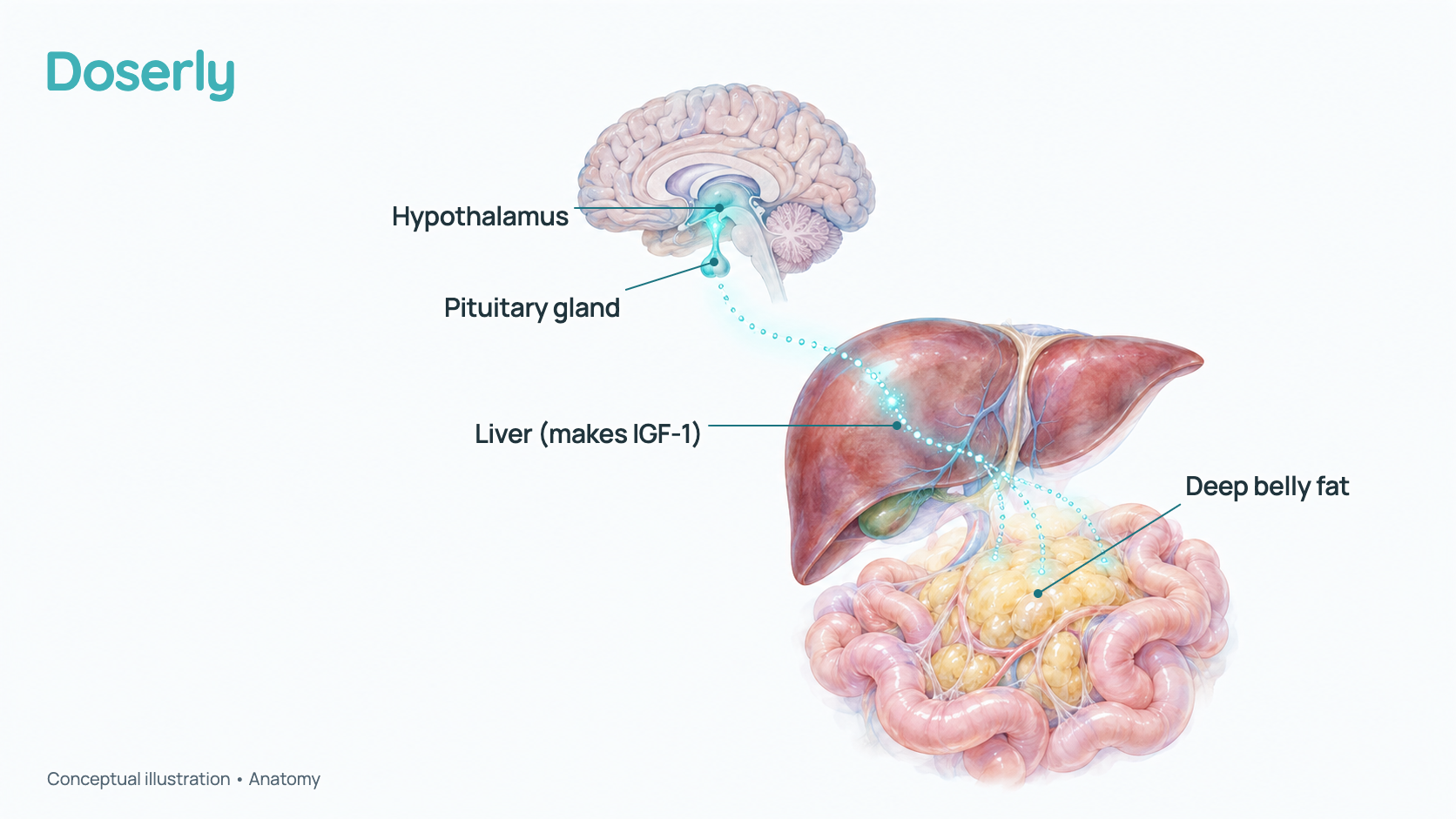
Your brain makes a hormone called GHRH (growth-hormone-releasing hormone). It travels a short distance to the pituitary gland at the base of the brain and tells it to release growth hormone in bursts, or pulses. Tesamorelin is a lab-made copy of the whole GHRH chain, all 44 amino acids, with a small fatty chain added to one end. That addition protects it from DPP-4, an enzyme in the blood that inactivates natural GHRH. [1], [3], [4]
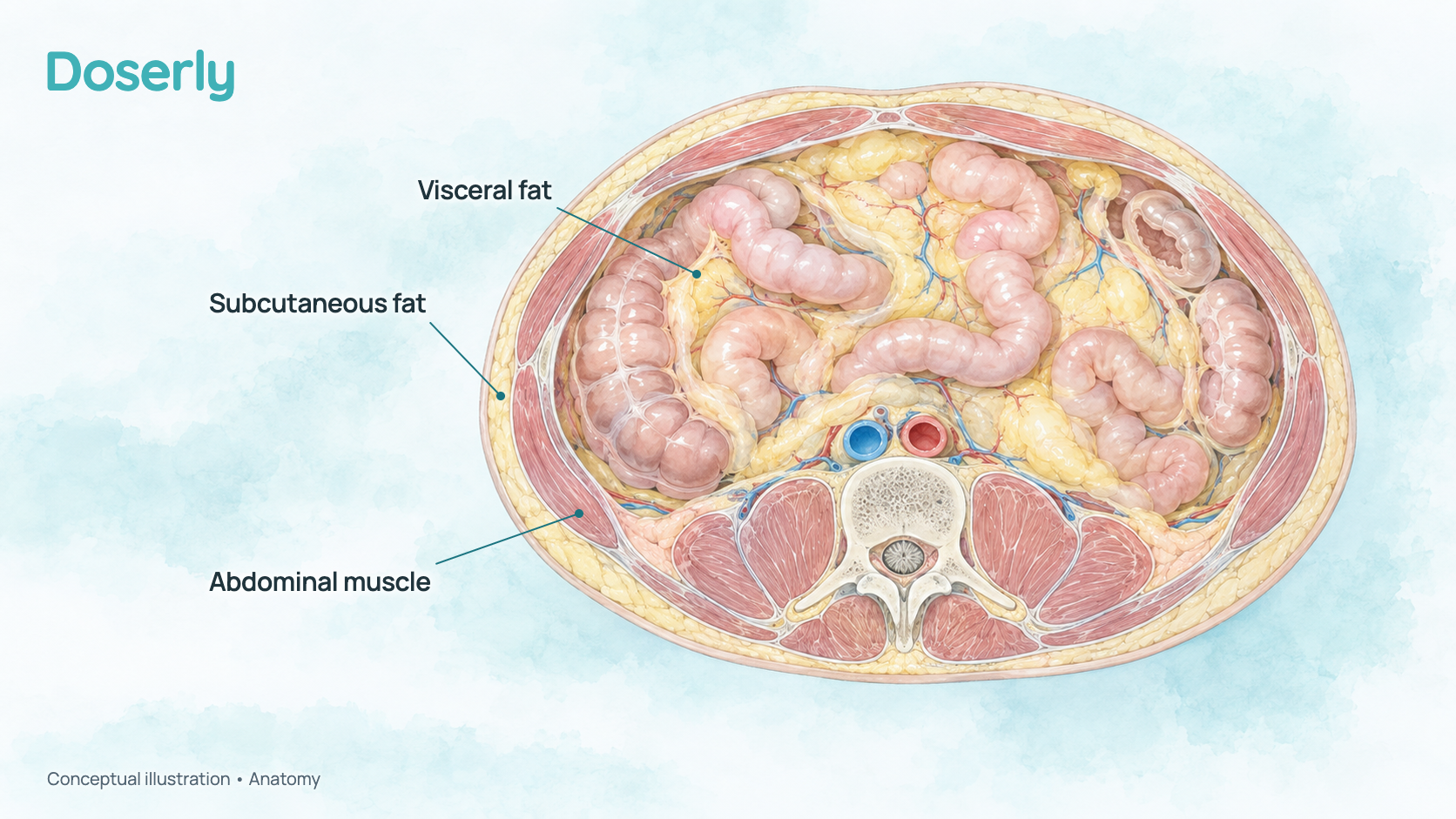
Lipodystrophy means an abnormal distribution of body fat. In the people tesamorelin was approved for, it shows up as extra fat deep inside the abdomen, packed around the organs. That deep fat is called visceral fat, and it is different from subcutaneous fat, the pinchable layer that lies directly beneath the skin. [1]
The US Food and Drug Administration (FDA) approved tesamorelin in November 2010. In research papers it also appears as TH9507, and online it is often shortened to "tesa". The label is narrow: it is approved for one use, it "has a weight neutral effect" and is not a weight-loss drug, and its long-term effect on the heart has not been established. Products sold online as "research" tesamorelin are not the approved medicine. [5], [1], [6]
Typical Tesamorelin Protocols
| Product | Amount each time | Frequency | Total per day | Duration |
|---|---|---|---|---|
| EGRIFTA WR · current product, 11.6 mg vial mixed once a week | 1.28 mg (0.16 mL) | Once daily | 1.28 mg | Ongoing; reconsider if belly fat has not fallen Launched in September 2025 and gradually replacing SV |
| EGRIFTA SV · 2 mg single vial, mixed for each dose | 1.4 mg (0.35 mL) | Once daily | 1.4 mg | Ongoing; reconsider if belly fat has not fallen WR and SV are not interchangeable milligram for milligram |
| Original EGRIFTA · 1 mg vials used in the approval trials | 2 mg (two 1 mg vials) | Once daily | 2 mg | 26–52 weeks in the trials No longer sold; gives the same blood levels as 1.28 mg of WR or 1.4 mg of SV |
The labeled dose is one subcutaneous injection into the abdomen once a day: 1.28 mg of EGRIFTA WR or 1.4 mg of EGRIFTA SV, which give the same exposure as the 2 mg used in the approval trials. Off label, the reviewed protocol sources most often give 1–2 mg once a day, usually at bedtime when they name a time, either every day or 5 days on and 2 off; courses of about 12–16 weeks are common, and some run to 26 weeks. [1], [7], [9], [10], [11], [12], [13]
- Titration Changing the dose in steps
- None on the label: EGRIFTA starts and stays at one fixed daily dose. Trials adjusted doses only for individuals. An older-adult trial cut the dose by 0.25 mg a day when side effects became troublesome, which 17% of those on tesamorelin needed, and a liver trial cut it to 0.7 mg a day if IGF-1 reached a very high level, stopping treatment if it stayed there. Off-label sources either start at 1 mg (sometimes 0.5 mg) for 1–4 weeks before moving to 2 mg, or keep 1 mg throughout. No trial has tested a step-up schedule. [1], [14], [15], [16], [17], [13]
- Breaks and cycles
- Not applicable on the label: tesamorelin is taken continuously, and in the trials belly fat came back within about 3 months of stopping. Off-label sources describe 8–16-week courses followed by 2 weeks to 2 months off; one clinic runs 3 months on and 2 months off, up to three times. No study has tested cycling or shown that breaks keep it working. [18], [1], [11], [17], [13]
Read the units: doses are in milligrams (mg); 1 mg equals 1,000 micrograms (mcg). A milligram of one product is not a milligram of another: 1.28 mg of WR, 1.4 mg of SV and 2 mg of the original product give the same blood levels, and no one has measured how a research vial compares with any of them. The amount each time and the daily or weekly total are separate columns. For vials, see how milligrams convert to syringe units. [1], [9]
The label rows are the approved doses for adults with HIV and lipodystrophy; prescribers adjust treatment using IGF-1, blood sugar and whether belly fat falls. The off-label schedules below come from clinics and protocol websites, not from clinical trials.
What schedules are used with research and compounded vials?
| Example | Amount each time | Frequency | Weekly total | Duration |
|---|---|---|---|---|
| Low | 1 mg | At bedtime, 5 days on and 2 off | 5 mg | 3 months, then 2 months off A clinic's own schedule, which the clinic says did not come from controlled trials |
| Mid | 1 mg | Once daily at bedtime | 7 mg | At least 12–16 weeks The same page says some protocols add a break every 12–16 weeks |
| High | 1 mg in week 1, then 2 mg | Once daily in the evening | 14 mg from week 2 | 12–26 weeks The page calls 2 mg the FDA-approved dose; that was the dose of the original product |
Low, mid and high are alternatives, not steps to move through, and each keeps its own source's amount, timing and course length together. Nobody has compared them in a study. The one trial that used a bedtime schedule gave 1 mg 30 minutes before bed to older adults for 20 weeks; the approval trials gave 2 mg of the original product once a day with no timing or fasting rule. [19], [14], [1]
Cautions for every schedule above. Allergic reactions, including anaphylaxis, can occur; in online reports they often followed a restart after a break, a dose increase or a new vial. [20], [55] The label says to stop and get emergency help for swelling of the face or throat, trouble breathing, a racing heart, fainting or hives over the body (see allergic reactions). [1] Trials lowered the dose when side effects became troublesome or IGF-1 ran high; one trial's rules named swelling, joint or muscle pain and tingling. [14], [15] Blood sugar should be checked before starting and during use, and IGF-1 during use. [1] The label rules it out after a previous allergic reaction to tesamorelin or its ingredients, with active cancer, a damaged pituitary and in pregnancy, and it is not for children. [1] Research vials are not the approved medicine: FDA named research tesamorelin products as unapproved drugs in five warning letters in August 2026, and their contents are not verified. [21] Check whether a number is per injection or per week, and how units convert. Tesamorelin is banned in sport at all times. [22]
Where these numbers come from
The label rows come from the current US prescribing information for EGRIFTA WR (revised March 2025) and EGRIFTA SV (revised March 2024), and from the original 2010 EGRIFTA label, whose 2 mg dose was used in both approval trials. A 2025 crossover study in 36 healthy adults found 1.28 mg of WR and 2 mg of the original product bioequivalent (the same blood levels); the SV label makes the same statement for 1.4 mg. [1], [7], [8], [9]
The off-label rows each come from one source. Low: Perfect B, a clinic that sells compounded tesamorelin programs, describes 25 units of a 10 mg vial mixed with 2.5 mL (1 mg) before bed, at least 2 hours after the last meal, 5 days on and 2 off for 3 months, then 2 months off. The same clinic's calculator page says the 5-and-2 schedule is its own convention, "not from controlled trials". Mid: Swolverine, a supplement brand, describes 1 mg a day before bed for at least 12–16 weeks. High: PeptideDosages describes 1 mg in week 1 and 2 mg a day from week 2, preferably in the evening, for 12–26 weeks. [13], [19], [12], [16]
Across 26 single-tesamorelin protocol rows, starting amounts ranged from 0.5 to 2 mg (most often 1 mg) and top amounts from 0.5 to 2 mg (most often 2 mg). Fifteen rows gave daily dosing only and nine gave 5 days on and 2 off, or 5 to 7 days a week. French-language pages repeated the same ranges. Several pages share identical tables, so matching numbers are not independent confirmations. [16], [23], [24], [10], [11], [25]
Not used for any row: blend amounts where the tesamorelin share was unclear, a pen of unknown concentration, a page's claim that 3–4 mg doses were tried in early studies (we found no such study; the only dose above 2 mg in a registry was a terminated 3 mg arm with one participant), and pages that call 2 mg the current FDA dose. Those are discussed in the next section. [26], [27], [28]
What is tesamorelin commonly used for?
Most people look into tesamorelin because of fat around the middle that will not shift: a firm, rounded belly, sometimes in someone who is otherwise lean or who has already lost weight. The hope is to shrink that deep belly fat specifically, not to lose weight in general. [1], [29]
That hope comes from a real result, but in a specific group of people. The approval trials were done in adults with HIV and lipodystrophy. Almost everything else people use it for, from belly fat alongside a weight-loss drug to sleep and "anti-aging", rests on smaller studies, community reports or no human evidence at all. The subsections below separate these.
Deep belly fat in adults with HIV
This is the approved use. In two placebo-controlled trials of 816 adults with HIV and excess belly fat, 26 weeks of daily tesamorelin reduced visceral fat, measured on CT scans (detailed cross-sectional X-ray images), by about 15% more than placebo. Waists shrank by 1 to 2 cm more, body weight did not change, and the fat returned after people stopped. [30], [1], [18] The human research section gives the study-by-study results.
Belly fat without HIV, often alongside a GLP-1 drug
This is the most common reason people discuss it online. Many are already taking a GLP-1 weight-loss drug such as semaglutide, tirzepatide or retatrutide, and add tesamorelin hoping to target the belly or protect muscle while they lose weight. [31], [32], [17]
Only one published controlled trial has measured tesamorelin's effect on visceral fat in people without HIV: 60 adults with abdominal obesity and low growth hormone output, who took 2 mg a day for a year. Visceral fat fell compared with placebo, and triglycerides and a marker of artery-wall thickness improved. [33] No trial has tested it together with any GLP-1 drug, so no one knows whether adding it changes how much fat or muscle is lost.
Fatty liver
Researchers have also tested tesamorelin for fat in the liver, with encouraging results in people with HIV (see the liver trials). It is not an approved liver treatment. [34], [15]
Muscle, recovery and "anti-aging"
Because tesamorelin raises growth hormone, it is also sold for muscle, recovery, skin and general "anti-aging". In the approval trials, lean body mass rose by about 1.2 to 1.3 kg over 26 weeks, but no trial has tested muscle building, strength, injury recovery or healthy aging as goals. [1], [35] A trial of tesamorelin with exercise for physical function in older adults with HIV is under way. [36]
Sleep
Many people report deeper sleep and vivid dreams; others report the opposite. [37], [38] No trial has tested tesamorelin for sleep as its main goal: the one registered sleep trial was withdrawn before enrolling anyone, and a 10-week pilot of 1 mg in 22 older adults that measured sleep among other things found no significant changes. [39], [41] See what people report.
Memory and thinking
One trial in older adults found better executive function (planning and focus skills), but two later trials found no clear benefit (see the details). [14], [40], [41]
Other claims you may come across
Pages and forum posts describe tesamorelin as a weight-loss peptide, a treatment for polycystic ovary syndrome (PCOS) or a cure for alcohol cravings. None of these has supporting human studies: the label calls it weight neutral, and the alcohol claim traces back to a brain-scan substudy in older adults that did not measure drinking. [1], [42], [43], [44]
Where do tesamorelin protocols differ?
The label is simple: one fixed dose, every day, for as long as it keeps working. The disagreements start when people use vials bought outside a pharmacy. Sources then differ on the dose, the number of days a week, the time of day, whether to step up and whether to take breaks. Here is what each difference means.
Is 2 mg the FDA dose?
It was, for the original product. The approval trials and the first label used 2 mg a day, given as two 1 mg vials. Later products are more concentrated: EGRIFTA SV, approved in 2018 as a single vial four times more concentrated, is dosed at 1.4 mg, and EGRIFTA WR, approved in March 2025, at 1.28 mg. Each gives the same blood levels as the old 2 mg. The milligram number changed because the product changed, not because the exposure did. [8], [45], [46], [9], [7]
So a page that calls 2 mg "the FDA dose" is repeating the trial dose, and a page that says EGRIFTA SV is 2 mg is simply wrong: the vial holds 2 mg, but the dose is 1.4 mg. None of these numbers tells you what a milligram from a research vial delivers, because that has never been measured. [16], [47], [7]
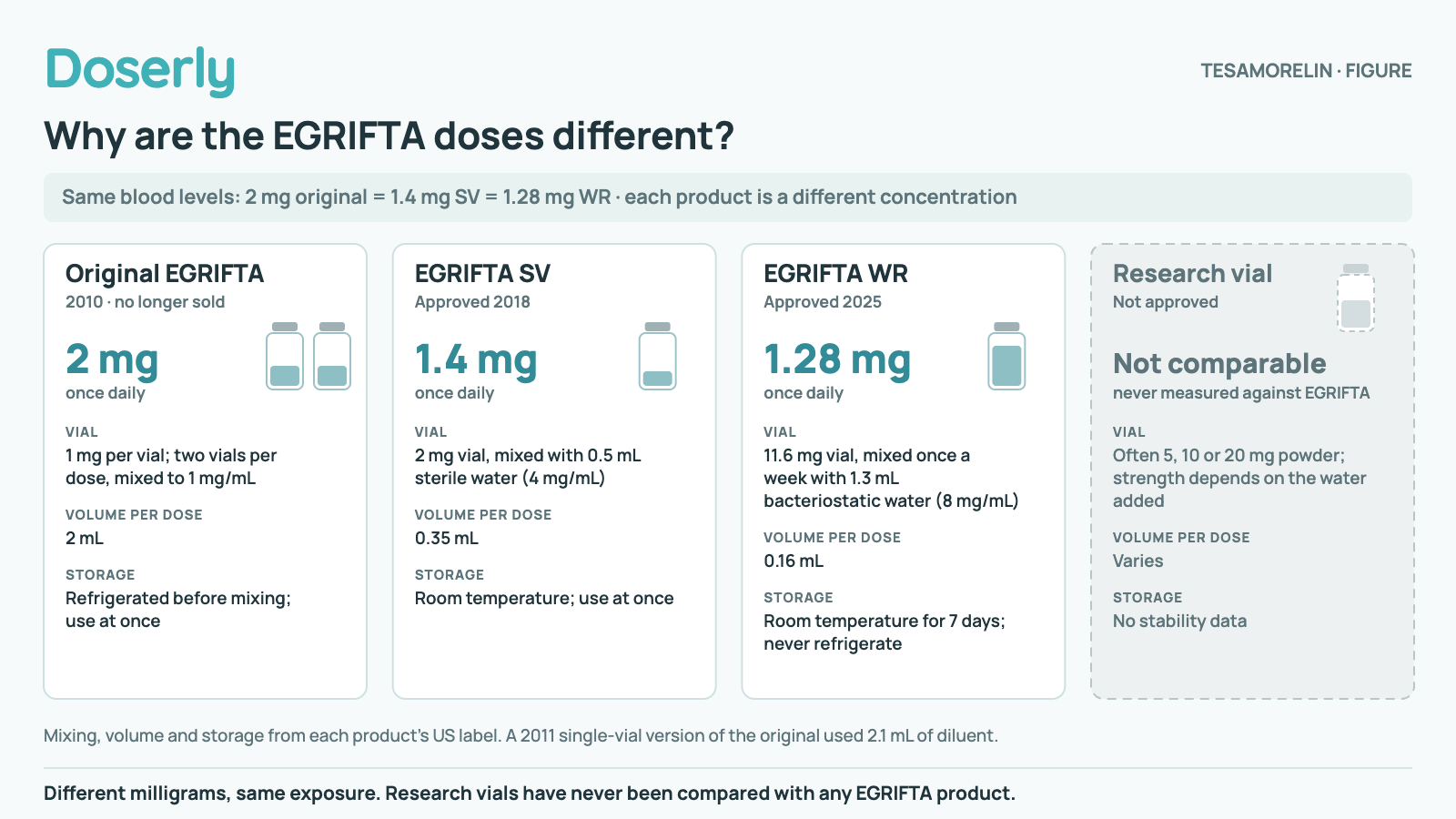
Why are the EGRIFTA doses different?
Same blood levels: 2 mg original = 1.4 mg SV = 1.28 mg WR. Each product is a different concentration.
- Original EGRIFTA · 2010 · no longer sold
- Dose 2 mg once daily. Vial: 1 mg per vial; two vials per dose, mixed to 1 mg/mL. Volume per dose: 2 mL. Storage: Refrigerated before mixing; use at once.
- EGRIFTA SV · Approved 2018
- Dose 1.4 mg once daily. Vial: 2 mg vial, mixed with 0.5 mL sterile water (4 mg/mL). Volume per dose: 0.35 mL. Storage: Room temperature; use at once.
- EGRIFTA WR · Approved 2025
- Dose 1.28 mg once daily. Vial: 11.6 mg vial, mixed once a week with 1.3 mL bacteriostatic water (8 mg/mL). Volume per dose: 0.16 mL. Storage: Room temperature for 7 days; never refrigerate.
- Research vial · Not approved
- Dose not comparable: never measured. Vial: Often 5, 10 or 20 mg powder; strength depends on the water added. Volume per dose: Varies. Storage: No stability data.
Mixing, volume and storage from each product's US label. A 2011 single-vial version of the original used 2.1 mL of diluent.
Different milligrams, same exposure. Research vials have never been compared with any EGRIFTA product.
Every day, or 5 days on and 2 off?
Every trial and every label uses daily injections, 7 days a week. Five days on and two off is a clinic and community convention, chosen mainly to save money: one calculator page notes it cuts weekly use by about 29%. The clinic whose schedule appears in the table above says plainly that no randomized study has compared it with daily dosing. [1], [19], [11]
The two patterns are not small variations of each other. At 1 mg on 5 days, the weekly total is 5 mg; at 2 mg every day it is 14 mg, nearly three times as much. Some people move to 5 days a week because side effects were worse on 7. [13], [16], [48]
Bedtime and fasting, or morning?
The approval trials had no timing or fasting rule. Protocol sources that give a time mostly say bedtime or evening, and several add at least 2 hours after the last meal, to line up with the body's own night-time growth hormone pulse, and one older-adult trial did give 1 mg 30 minutes before bed. Whether timing or fasting changes tesamorelin's results has not been tested. [1], [13], [17], [14]
In practice many people move the dose to the morning. The usual reasons are trouble sleeping after a bedtime dose and, for people on GLP-1 drugs that slow digestion, difficulty being properly fasted at night. [49], [50] One person reported that IGF-1 still rose into the 400s (ng/mL) with morning doses taken alongside ipamorelin. [38] For people on a GLP-1 drug who still dose at night, community education groups suggest waiting 3–4 hours after food.
Start at 1 mg, or go straight to the full dose?
Both approaches appear, and the label uses neither: EGRIFTA starts at its full dose. A widely copied table starts at 1 mg for one week, then moves to 2 mg a day, and three sites share the same table. Another source starts at 1 mg for 2–3 weeks, and a French-language page raises the dose every 14 days. People online describe gentler steps, such as 0.5, 0.75 and then 1 mg a week apart. [16], [23], [24], [17], [51], [52]
The trials did something different: they lowered doses for individuals who had side effects or very high IGF-1, rather than raising everyone in steps. People often report that water retention eases at a lower dose, but no study has tested a step-up plan. [14], [15], [53]
Should you cycle, or take it continuously?
Continuous use is what was studied. In the trials, people who kept taking tesamorelin for a full year kept their lower belly fat, while those switched to placebo regained it within months (see stopping). Protocol sources that recommend 8–16-week cycles say breaks keep the pituitary responsive, but no study has tested that, and the continuous 52-week data do not show the effect fading. [18], [54], [17], [11]
Breaks carry a specific risk. Several of the severe allergic reactions people describe happened on the first doses after a break (see allergic reactions). [20], [55]
What about ipamorelin, CJC-1295 and other combinations?
The most common combination is tesamorelin with ipamorelin, often called "tesa/ipa". Ipamorelin works through a different receptor (the ghrelin receptor), so the two are paired to add a second growth hormone signal. Blend pages pair about 1 mg of tesamorelin with 100–300 mcg of ipamorelin, and pre-mixed vials come in ratios such as 1:1 and the 10 mg plus 3 mg "Bimorelin" blend. No human study has tested tesamorelin with ipamorelin, and FDA named two tesamorelin and ipamorelin blends in its 2026 warning letters. [56], [57], [58], [2], [59]
With a blend, the number on the vial is the total of both peptides. A dose of "500 mcg" from a 1:1 blend holds only 250 mcg of tesamorelin. See the Doserly guides to ipamorelin and the CJC-1295 and ipamorelin blend. [57]
Combining two GHRH copies, such as tesamorelin with CJC-1295 or sermorelin, is a different matter. They act on the same receptor, and community education groups almost all advise against using two at once. Allergic reactions may also carry over between them: most people who develop antibodies to tesamorelin make some that also recognize natural GHRH, and one person described reacting to both tesamorelin and CJC-1295. [1], [60]
Many people also take tesamorelin alongside a GLP-1 drug such as semaglutide, tirzepatide or retatrutide. That combination has not been studied either. [31], [32]
How do milligrams convert to syringe units?
Branded EGRIFTA is measured in millilitres at a fixed strength, so there are no units to count: 0.16 mL of WR (8 mg per mL) is 1.28 mg. Research vials are different. They come as powder and are mixed with whatever volume the user chooses, so the syringe units on an insulin syringe measure only volume. [1]
For example, a 10 mg vial mixed with 2 mL holds 5 mg per mL, or 50 mcg per unit, so 1 mg is 20 units. The same 10 mg vial mixed with 2.5 mL holds 4 mg per mL, so 1 mg is 25 units. That is why "25 units" in one protocol and "20 units" in another can be the same dose, and why copying someone's units without their mixing volume can be wrong. Doserly's reconstitution calculator works this out for any vial and shows each step. [61], [13]
Source-by-source comparison, common errors and registered study plans
Which pages copy each other?
Many tesamorelin pages are not independent. PeptideDosages, Dosage Peptide and Peptides.ID share the same "1 mg in week 1, then 2 mg" table, and a French help page copies it too. Pages that call 2 mg "the FDA dose" are repeating the original trial dose. The bedtime, 5-days-on schedule traces to clinics, one of which says it is its own convention. Counting these pages as separate votes would overstate the agreement. [16], [23], [24], [19]
What errors turn up most often?
- Mixing and storing WR. One page says to mix the 11.6 mg WR vial with 1.45 mL and keep it in the fridge for 28 days. The label says 1.3 mL, room temperature, 7 days, and never refrigerate. [62], [1]
- SV "2 mg". The SV vial holds 2 mg, but the labeled dose is 1.4 mg. [47], [7]
- Half-life. A 32-minute figure, or 26–38 minutes given without its conditions (see half-life). [47], [61], [8]
- Side-effect rates. "Injection-site reactions in 30–51%" has no source we could find; the label reports 25% versus 14% on placebo. [17], [1]
- "The trial regimen was nightly." The approval trials gave 2 mg once a day with no bedtime rule. [17], [1]
- Invented or misdated studies. One French page cites an "AWARE" trial in the New England Journal of Medicine in 2010; no trial by that name exists, and the tesamorelin trial in that journal was published in 2007. [63], [64]
- Early results. A clinic sheet says visceral fat falls within 1–2 weeks; the trials first scanned at about 13 weeks. [65], [66]
What are the registered studies planning?
These are study records, not protocols to follow. Status was checked on September 24, 2026.
1.28 mg daily with exercise (TRIUMPH)
EGRIFTA WR or placebo, plus a home exercise program, for 24 weeks in 100 older adults with HIV who are frail or pre-frail and have excess belly fat. Measures physical function.
Recruiting. No results yet.
[36], [67]2 mg daily after a nerve injury
A trial in 36 people with peripheral nerve injuries, measuring pinch strength and recovery.
Recruiting. Last registry update: November 2025. No results posted.
[68]10-year cancer and safety follow-up
Required by FDA at approval to compare people using EGRIFTA with similar people not using it. It enrolled 391 people.
Terminated in 2018. No results posted; the maker says FDA released it from the study.
[69], [70]Diabetic eye disease trial
A placebo-controlled trial of 2 mg daily in people with HIV and diabetes, testing whether tesamorelin worsens diabetic retinopathy. It enrolled 129 people.
Terminated in 2018. No results posted.
[71], [70]Fatty liver, 2 mg daily
A 2026 record from a sponsor whose peptide trial records describe themselves as mock studies, including this one. It should not be treated as evidence of an ongoing trial.
Listed as recruiting. Last registry update: March 2026.
[72]What happens when you stop tesamorelin?
The belly fat comes back. The trials tested this directly: both approval trials randomly switched some people to placebo after 26 weeks and kept scanning them. [1], [18]
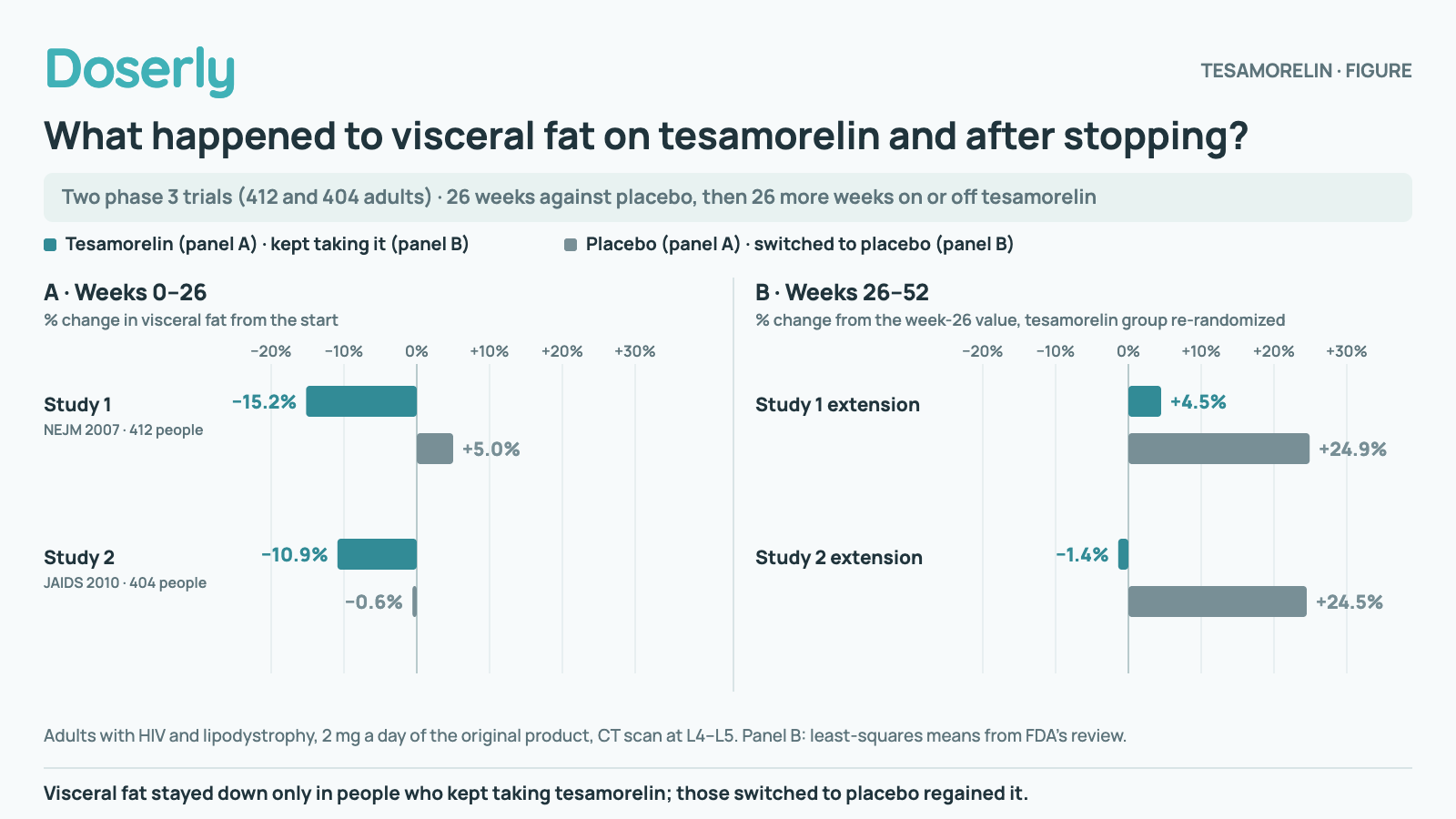
What happened to visceral fat on tesamorelin and after stopping?
Two phase 3 trials: 26 weeks against placebo, then 26 more weeks on or off tesamorelin.
- Study 1 (NEJM 2007), 412 people · weeks 0–26
- Tesamorelin −15.2%; placebo +5.0% change in visceral fat.
- Study 2 (JAIDS 2010), 404 people · weeks 0–26
- Tesamorelin −10.9%; placebo −0.6% change in visceral fat.
- Study 1 extension · weeks 26–52
- Kept taking tesamorelin +4.5%; switched to placebo +24.9% change from the week-26 value.
- Study 2 extension · weeks 26–52
- Kept taking tesamorelin −1.4%; switched to placebo +24.5% change from the week-26 value.
Adults with HIV and lipodystrophy, 2 mg a day of the original product, CT scan at L4–L5. Panel B: least-squares means from FDA's review.
Panel B values are changes from the week-26 value, not shares of the fat lost earlier.
Visceral fat stayed down only in people who kept taking tesamorelin; those switched to placebo regained it.
- Visceral fat. FDA's reviewer found it returned to close to its starting level within 13 weeks of stopping, the first scan after stopping. In FDA's analysis, between weeks 26 and 52, visceral fat rose by 24.9% and 24.5% in the two trials in people switched to placebo, while it changed little (up 4.5% in one trial and down 1.4% in the other) in those who continued. [18] Waist size also crept back in people switched to placebo. [1], [73]
- IGF-1. It fell back to its starting level: by 10 weeks after stopping in older adults, and by week 39 after stopping at week 26 in the approval trials. [14], [18]
- Blood sugar. Glucose tolerance improved after stopping: in the trial group switched to placebo, the share with normal glucose tolerance rose from 39.4% to 52.1% within 6 weeks. [18]
- Liver enzymes. In people whose visceral fat had fallen, lower liver enzymes lasted to week 52 even after switching to placebo. [75]
- Antibodies. Of people who had developed antibodies to tesamorelin, 18% still had them 6 months after stopping, which matters for anyone planning to restart. [1]
Patient groups told Canada's drug-review committee that it is a treatment that has to be taken long term. No withdrawal syndrome or rebound below the starting point was reported, though the trials did not look for one specifically. [73], [18]
People online describe the water weight leaving within days of stopping, sometimes several pounds at once. A few say joint pain or hand numbness took days to weeks to fade, and one described a lasting ache. [53], [52], [76] Noting when you stopped and what changed afterwards makes these effects easier to judge, and to discuss with a clinician before any restart.
Do different tesamorelin products behave the same way?
Tesamorelin is given only as a subcutaneous injection. There is no approved or studied tablet, nasal spray or cream, and an inhaled version was tested only in dogs. What does change is the product: how concentrated it is, what it is mixed with and who made it. [1], [77]
Very little of each injection reaches the blood intact: the label puts bioavailability at under 4%. Blood levels peak about 9 minutes after injection. People with HIV absorbed about a third more than healthy volunteers in the label's studies. [1]
The three EGRIFTA products hold the same active ingredient in different concentrations and with different added ingredients (for WR, hydroxypropyl betadex, a ring-shaped sugar molecule, and mannitol; for SV, histidine, mannitol, polysorbate 20 and sucrose). The labels say they are not interchangeable. Research vials contain tesamorelin powder of unverified purity, mixed by the user with bacteriostatic water at whatever strength they choose, and no one has measured what they deliver. Grey-market pre-filled pens also circulate, sometimes with no clear dose markings. [1], [7], [28]
Should it be injected into belly fat?
The label says to inject into the abdomen, rotating sites and avoiding scars, bruises and the navel, and the approval trials used the abdomen. That does not mean it works locally on the fat under the needle: tesamorelin acts through the pituitary gland and the bloodstream. No study has compared injection sites. [1], [74]
Some people inject into muscle or the buttocks instead. Nobody has studied whether that changes absorption or side effects, and one person's belief that injecting into the glutes caused their allergic reaction is a guess, not a finding. [20]
What does tesamorelin's short half-life mean?
Half-life is the time it takes for the level of a drug in the blood to fall by half. For tesamorelin it is minutes, and the number you see depends on how it was measured:
| Measured after | Half-life | Who |
|---|---|---|
| One dose of EGRIFTA SV (1.4 mg) | 8 minutes | Healthy adults |
| One dose of EGRIFTA WR (1.28 mg) | 11 minutes | Healthy adults |
| 14 days of the original product (2 mg) | 26 minutes | Healthy adults |
| 14 days of the original product (2 mg) | 38 minutes | Adults with HIV |
Websites often quote "26–38 minutes" or "about 30 minutes" without saying that those figures came from 2 weeks of daily dosing with a product no longer sold. [61], [47]
The short half-life does not mean the effect is short. Tesamorelin's job is to trigger the pituitary, and the growth hormone it releases then raises IGF-1, which builds up over days. In healthy men, 2 weeks of daily injections raised overnight growth hormone pulses and increased IGF-1 by 181 µg/L (the same as ng/mL). [74] That is why an IGF-1 test drawn 15 minutes after an injection cannot show whether a vial works. [78]
How should tesamorelin be stored, and how long does it last?
For the approved products, the labels are specific, and they differ from what many websites say:
| Product | Before mixing | After mixing |
|---|---|---|
| EGRIFTA WR | Room temperature, 20–25 °C, in its box to protect from light; do not freeze | Room temperature for up to 7 days; do not refrigerate or freeze; discard if cloudy or colored |
| EGRIFTA SV | Room temperature, 20–25 °C, protected from light | Use immediately; do not store, refrigerate or freeze |
| Original EGRIFTA (no longer sold) | Refrigerated, 2–8 °C | Use immediately |
These rules apply only to those products, because stability depends on the added ingredients. No published stability study covers research or compounded tesamorelin. Protocol pages say to refrigerate mixed research vials at 2–8 °C and use them within 14, 21, 28 or 30 days, and one page says outright that no stability data exist for research tesamorelin in bacteriostatic water. Some community education groups cite a single seller's purity test, which is not a published stability study. [80], [24], [62], [13]
People often report mixed research vials turning cloudy or gel-like, mostly after refrigeration. Explanations offered online range from cold temperatures to the brand of bacteriostatic water, and some people instead keep vials at room temperature by applying the WR label to them. None of these fixes has been tested, and a cloudy or discolored solution is one the WR label says to throw away. [81], [82], [1] This guide does not cover mixing or injection technique; the Academy note below covers practical handling.
What do we actually know about tesamorelin in people?
Much more than for most peptides. Tesamorelin went through a full drug-approval program, with placebo-controlled trials involving hundreds of people and a year of follow-up. The catch is who was studied: almost all of that evidence comes from adults with HIV and excess belly fat, and the main outcome was a CT measurement of visceral fat, not health events such as heart attacks. [1], [73]

What did the approval trials find?
| Study | Who and how | What researchers reported | What it cannot establish |
|---|---|---|---|
| Dose-finding trial, 2005 | 61 adults with HIV and belly fat; placebo, 1 mg or 2 mg daily for 12 weeks | IGF-1 rose 48% on 1 mg and 65% on 2 mg. Trunk fat fell 9.2% on 2 mg; visceral fat fell 15.7% on 2 mg, but that was not a significant difference from placebo. [83] | Too small and short to settle the visceral fat effect; it set up the 2 mg dose. |
| Study 1, 2007 | 412 adults with HIV, 2 of every 3 given 2 mg daily, the rest placebo, for 26 weeks | Visceral fat fell 15.2% on tesamorelin and rose 5.0% on placebo. Triglycerides (a blood fat) fell. More people on tesamorelin left the study because of side effects. [64] | Effects beyond 26 weeks, or in people without HIV. |
| Study 2, 2010 | 404 adults with HIV, same design, then 26 more weeks | Visceral fat fell 10.9% versus 0.6% on placebo; people rated their belly appearance as less distressing. The effect was about 18% at 12 months with continued use and was "rapidly lost" after switching to placebo. [84] | Health outcomes such as heart disease. |
| Both trials pooled, 2010 | 806 adults with HIV | Visceral fat fell by 24 cm² versus a rise of 2 cm² on placebo, a treatment effect of 15.4%. Subcutaneous belly fat, the layer beneath the skin, did not change significantly. IGF-1 rose by about 108 ng/mL. [30] | Whether the change lowers the risk of disease. |
Visceral fat was measured as an area on a single CT slice at the level of the lower back, which is why results appear in square centimetres. A 15% fall in that area is a real, measurable change in deep belly fat; it is not the same as losing 15% of body fat or body weight. [1]
What else changed besides belly fat?
- Body weight: nothing. Average weight changed by less than half a kilogram compared with placebo, which is why the label calls tesamorelin weight neutral. [1]
- Waist: a little. Waists shrank by about 1 to 2 cm more than on placebo. [1]
- Fat and lean tissue: a shift. Trunk fat fell by about 1 kg, and lean body mass (everything that is not fat, including muscle and water) rose by about 1.2 to 1.3 kg. In a later analysis of people whose visceral fat had responded, the trunk muscles were slightly larger and less fatty on CT scans. [1], [35]
- Blood fats: better. Triglycerides and the ratio of total to "good" HDL cholesterol improved. [30]
- Health outcomes: unknown. No trial measured heart attacks, strokes or deaths as outcomes. Canada's drug-review committee declined to recommend public funding in 2016, partly because visceral fat is only a stand-in for health risk and there was no evidence that tesamorelin lowers heart disease; it also judged the body-image and quality-of-life results inconsistent. [73], [1]
The European Medicines Agency's committee reached a similar view in 2012, doubting that the fat reduction was "clinically meaningful in terms of actual health benefits", and the company withdrew its European application. [85]
Does everyone respond?
No. The trials defined a "responder" as someone whose visceral fat fell by at least 8%, and most people on tesamorelin reached that; some did not. Responders also had better triglycerides and steadier blood sugar than non-responders. At 3 months, nothing about a person's starting characteristics predicted who would respond. [86], [75], [66] The label advises weighing whether to continue in people whose visceral fat has not fallen. [1]
What about people without HIV?
The evidence is much thinner:
- Belly fat with low growth hormone. In 60 adults with abdominal obesity and reduced growth hormone output, a year of 2 mg daily cut visceral fat by 35 cm² compared with placebo and improved triglycerides, C-reactive protein (a marker of inflammation) and the thickness of the neck artery wall, without changing blood sugar. [33]
- Type 2 diabetes. A 12-week trial of 1 mg or 2 mg in 53 people with type 2 diabetes found no change in blood sugar control or insulin response compared with placebo. [87]
- Healthy men. Two weeks of 2 mg a day in 13 healthy men raised growth hormone pulses and IGF-1 without changing insulin sensitivity. [74]
- Older adults. A 20-week trial of 1 mg at bedtime in 152 adults aged 55 to 87 improved executive function and reduced body fat by 7.4%. Side effects were reported by 68% on tesamorelin and 36% on placebo, mostly mild. [14]
No trial has tested tesamorelin in healthy people for weight loss, athletic performance or aging, or together with a GLP-1 drug.
What about liver fat?
Two trials in people with HIV measured liver fat. In the first (50 adults, 6 months), liver fat fell modestly alongside visceral fat. In the second (61 adults with HIV and fatty liver disease, 12 months), the share of fat in the liver fell by 4.1 percentage points more than on placebo (a 37% relative reduction), 35% of people on tesamorelin versus 4% on placebo reached a normal liver fat level, and scarring worsened in 10.5% versus 37.5% on liver biopsy. Inflammation scores on the biopsies did not change significantly. [88], [34]
A similar trial in people without HIV has posted results on its registry, reporting a larger fall in liver fat on tesamorelin than on placebo and no change in a scarring score. It has not been published in a journal. [15]
What about memory and thinking?
Results are mixed. The 20-week trial in older adults found better executive function. A 6-month trial in 73 people with HIV and memory or thinking problems found no clear benefit compared with usual care, although waists shrank by 2.7 cm more. A 10-week pilot of 1 mg in 22 older adults found no significant changes. [14], [40], [41]
How does tesamorelin work?
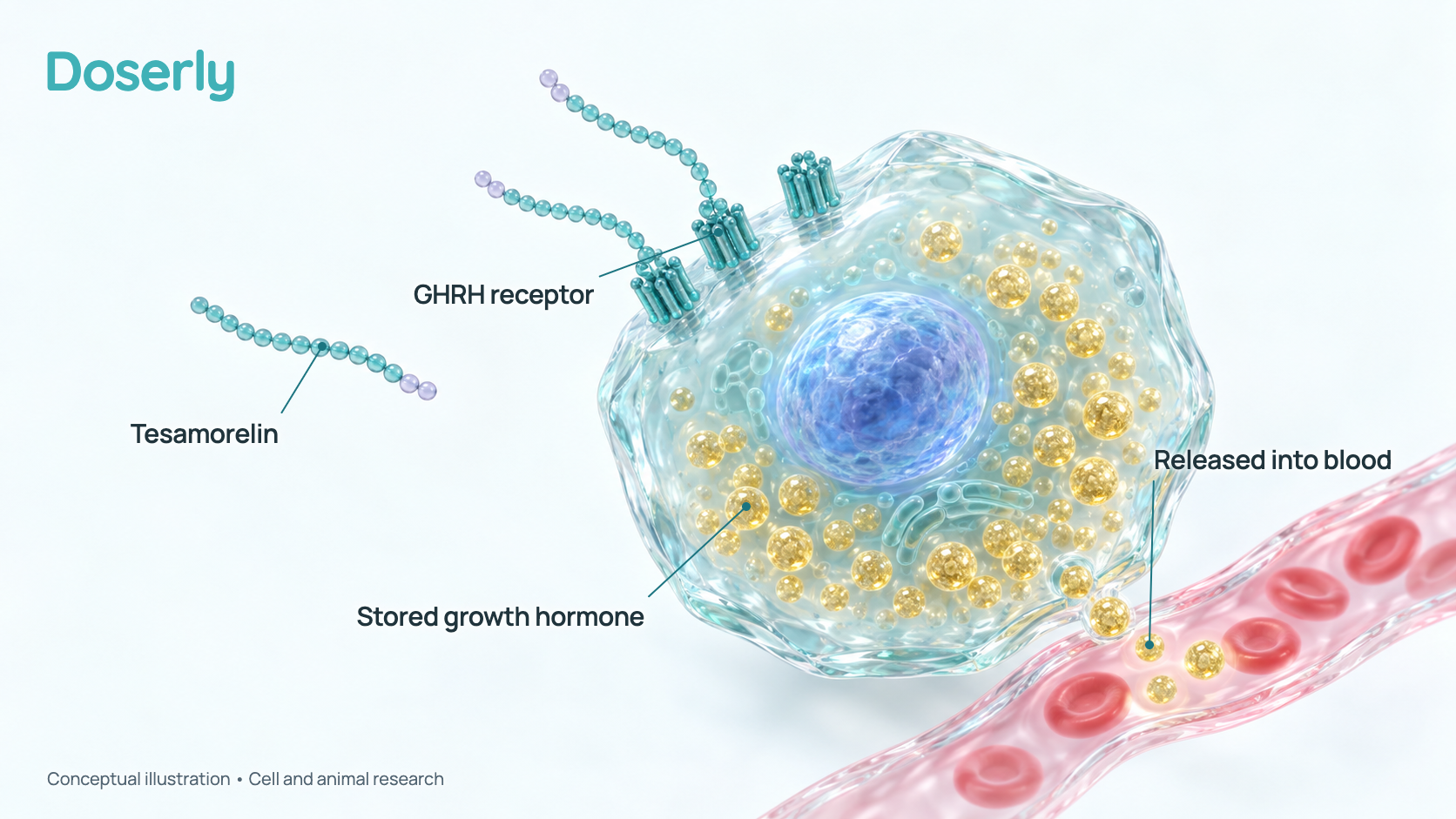
Tesamorelin works like the body's own GHRH: it switches on growth hormone release from the pituitary, and the rest of its effects follow from that growth hormone. Unlike taking growth hormone itself, it depends on the pituitary gland working normally. [1]
From a brain signal to growth hormone pulses
In laboratory tests, tesamorelin binds and activates human GHRH receptors about as potently as natural GHRH. That receptor sits on the pituitary's growth-hormone-making cells. Studies that cloned the receptor showed it is a type of cell-surface switch (a G protein-coupled receptor) that raises a messenger molecule called cAMP inside the cell when GHRH binds; those studies used natural GHRH, not tesamorelin. [1], [89], [90]
The result in people is more growth hormone, released in the body's normal pattern of pulses. In 13 healthy men, daily tesamorelin raised average overnight growth hormone, the size of each pulse and the background level between pulses. [74] Other pituitary hormones, including those that control the thyroid, the adrenal glands and fertility, did not change in a clinically significant way in the trials. [1]
Why IGF-1 matters
Growth hormone tells the liver and other tissues to make IGF-1 (insulin-like growth factor 1), which carries out many of growth hormone's effects. IGF-1 rose in every tesamorelin trial, typically by about 50% to more than double, and in the approval trials 47% of people ended up above the normal range for their age by 26 weeks. [83], [74], [30], [1]
That rise is both how tesamorelin works and why it needs monitoring. Growth hormone helps break down stored fat, but it also raises blood sugar, holds on to fluid and, through IGF-1, encourages cell growth. Those are the roots of the main side effects and of the label's cancer precautions (see risks). [1], [85]
Why does it target belly fat?
Nobody knows exactly. Visceral fat shrank in the trials while subcutaneous fat stayed about the same, and websites often explain this by saying visceral fat has more growth hormone receptors. Human studies do not support that: one found more receptor activity in deep belly fat only in lean women, not in women with obesity, and another found no difference between the two fat layers. [30], [91], [92]
Why does it need a working pituitary?
Because tesamorelin only tells the pituitary to release its own growth hormone. The label rules it out in people whose pituitary system has been damaged by surgery, a tumor, radiation or head injury, and in the approval trials people with pituitary failure were excluded. [1]
What are the risks and unanswered questions?
Is tesamorelin safe?
For its approved use, with a prescriber checking blood sugar and IGF-1, its side effects over the first year are well described; its long-term safety, and its safety in the way many people now use it, are not established. [1], [73]
The trials treated 740 adults with HIV, 543 of them in the 26-week placebo-controlled phase. More people stopped treatment early on tesamorelin than on placebo, and a 2026 pooled analysis of four trials found about twice the rate of stopping (a difference that fell just short of statistical significance). [1], [64], [93]
Three gaps matter most: long-term heart safety has not been established, the long-term safety studies FDA required were never completed (see cancer), and most people using research vials are unlike the trial participants, often without HIV, on a GLP-1 drug and using unverified products. [1], [70]
What are the most common side effects?
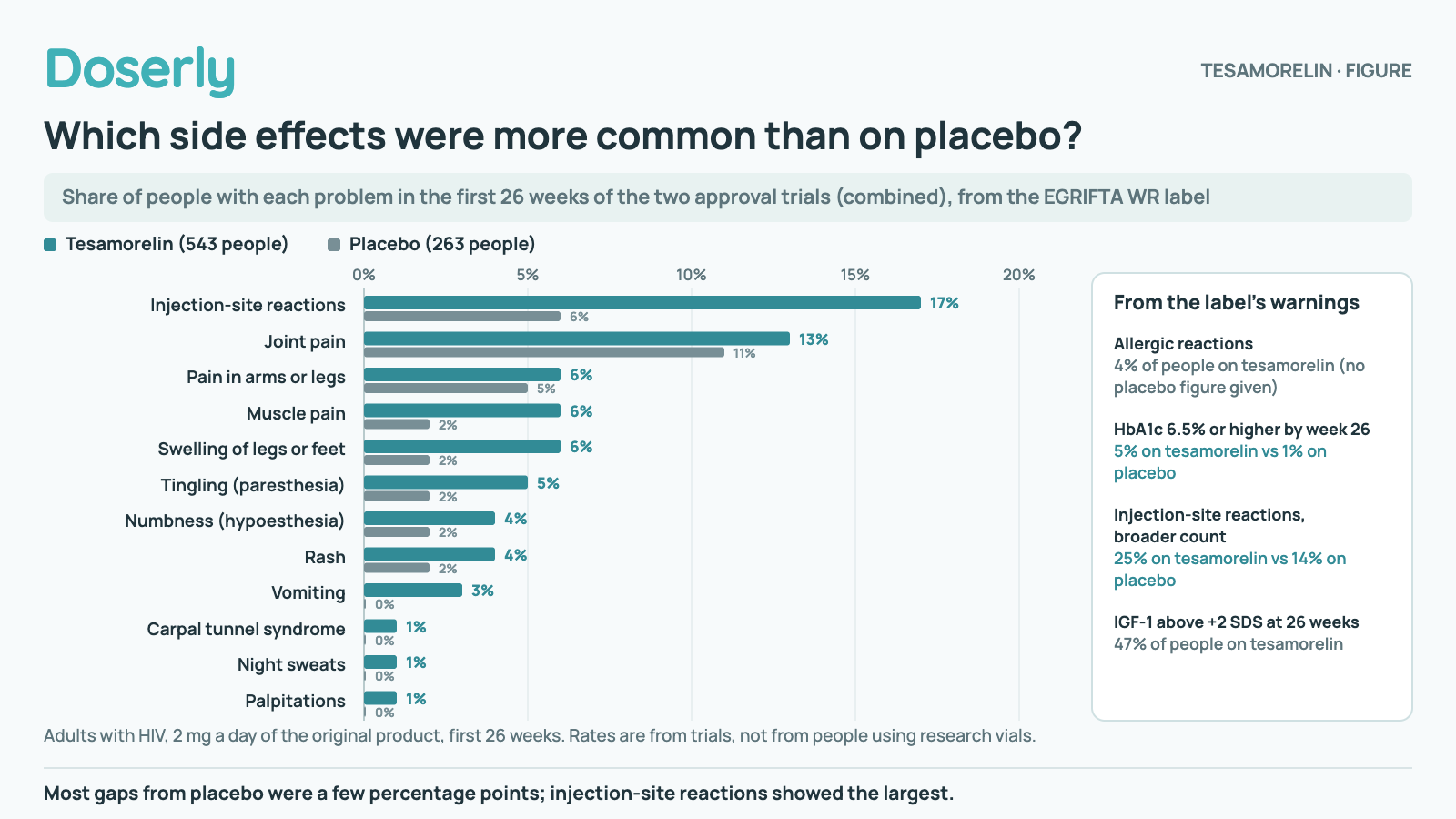
Which side effects were more common than on placebo?
Share of people with each problem in the first 26 weeks of the two approval trials combined (543 on tesamorelin, 263 on placebo).
- Injection-site reactions
- Tesamorelin 17%; placebo 6%.
- Joint pain
- Tesamorelin 13%; placebo 11%.
- Pain in arms or legs
- Tesamorelin 6%; placebo 5%.
- Muscle pain
- Tesamorelin 6%; placebo 2%.
- Swelling of legs or feet
- Tesamorelin 6%; placebo 2%.
- Tingling (paresthesia)
- Tesamorelin 5%; placebo 2%.
- Numbness (hypoesthesia)
- Tesamorelin 4%; placebo 2%.
- Rash
- Tesamorelin 4%; placebo 2%.
- Vomiting
- Tesamorelin 3%; placebo 0%.
- Carpal tunnel syndrome
- Tesamorelin 1%; placebo 0%.
- Night sweats
- Tesamorelin 1%; placebo 0%.
- Palpitations
- Tesamorelin 1%; placebo 0%.
From the label's warnings: Allergic reactions: 4% of people on tesamorelin (no placebo figure given). HbA1c 6.5% or higher by week 26: 5% on tesamorelin versus 1% on placebo. Injection-site reactions, broader count: 25% on tesamorelin versus 14% on placebo. IGF-1 above +2 SDS at 26 weeks: 47% of people on tesamorelin.
Adults with HIV, 2 mg a day of the original product, first 26 weeks. Rates are from trials, not from people using research vials.
Most gaps from placebo were a few percentage points; injection-site reactions showed the largest.
In the label's table for the first 26 weeks, the problems that occurred more often than on placebo were led by injection-site reactions (17% versus 6%), joint pain (13% versus 11%), pain in the arms or legs, muscle pain, swelling of the legs or feet (each about 6%) and tingling or numbness (4–5%). Rash, vomiting, carpal tunnel syndrome, night sweats and palpitations each affected 1–4%. [1]
The label's warnings section counts injection-site reactions more broadly and gives 25% versus 14%. The label advises rotating injection sites around the abdomen. [1] Reports to FDA's side-effect database mirror this pattern, with injection-site problems, joint pain, swelling, numbness and high blood sugar among the most common terms; these reports cannot show how often problems happen. [94]
What about allergic reactions?
Allergic reactions happened in 4% of people in the trials, as itching, redness, flushing, hives and rash. The label says to stop tesamorelin and get medical help if one is suspected. Its patient information tells people to get emergency help for a rash over the body, hives, itching, flushing, shortness of breath or trouble breathing, a fast heartbeat, swelling of the face or throat, or feeling faint. [1]
The label also explains why reactions can build up over time. Half of people on tesamorelin developed antibodies against it by 26 weeks, and 85% of those who had an allergic reaction had them. In about 60% of people with antibodies, they also recognized the body's own GHRH, and 18% of people who had antibodies were still carrying them 6 months after stopping. The antibodies did not stop tesamorelin from working. [1]
Online, allergic reactions are the serious harm people discuss most. In public threads, people describe anaphylaxis (a severe, whole-body allergic reaction), ambulance and emergency-room visits, epinephrine injections and hospital monitoring. [20], [55], [95] The same timing patterns come up again and again, in public forums and in community education groups:
- On restarting after a break, from a few days to a few months, or on the first dose of a second course. [20], [55]
- After a dose increase or a new vial, sometimes within a minute of injecting. [96], [95]
- After weeks or months of uneventful use, often preceded by itchy welts at injection sites or old injection sites flaring up all at once. [48], [95], [55]
- On the very first dose, where product contamination or another compound taken at the same time cannot be ruled out. [20]
Warning signs people describe include sudden intense itching of the palms and soles, tingling in the hands, feet or face, flushing and widespread hives. One person had taken daily antihistamines for hay fever, which hid their injection-site reactions; when they stopped the antihistamines, their next tesamorelin dose caused anaphylaxis within minutes. Others report reacting to CJC-1295 or sermorelin as well. [20], [96], [60]
These are personal reports, not rates, and product quality is unknown in most of them. But they fit the label's antibody data, and the advice is the same either way: a reaction means stopping, not taking antihistamines to keep injecting, and anyone who has reacted should discuss it with a clinician before trying tesamorelin or a related peptide again. [1], [55]
Swelling, joint pain and numb hands
The label groups these together as fluid retention caused by the rise in growth hormone: swelling, joint pain and carpal tunnel syndrome (pressure on a nerve at the wrist, causing numbness and tingling in the fingers). It says they are "either transient or resolve with discontinuation of treatment", and tells patients to call their provider about swelling, worsening joint pain or pain or numbness in the hands or wrist. [1] In an analysis of FDA's side-effect reports, tesamorelin was one of ten drugs with a strong signal for carpal tunnel syndrome; that shows it is reported unusually often, not how often it happens. [97]
In practice, early water weight is a frequent complaint and a common reason people stop. Stories range from a pound or two to more than 10 pounds in the first weeks, often worse at higher doses and easing on days off or at a lower dose. Hand numbness tends to start later, around weeks 6 to 12, and sometimes lingers for days to weeks after stopping. [53], [98], [48], [52], [99] Some people take diuretics or herbal "water pills" for the swelling; that has not been studied with tesamorelin. [53], [100]
Can tesamorelin raise blood sugar?
Yes. By 26 weeks, 5% of people on tesamorelin versus 1% on placebo had an HbA1c (a 3-month average of blood sugar) of 6.5% or more, the level used to diagnose diabetes. [1] In a 6-month trial, fasting glucose rose by about 9 mg/dL in the first 2 weeks before settling, and in the fatty-liver trial two people on tesamorelin stopped because their blood sugar worsened (one already had diabetes). [88], [34] People whose visceral fat did not respond were more likely to see their blood sugar rise. [86]
A 12-week trial in type 2 diabetes found no change in blood sugar control, and blood sugar tolerance improved after people stopped. [87], [18] The label says to check blood sugar before starting and regularly during treatment, to consider stopping in people who develop diabetes without a clear benefit, and to check the eyes regularly in people with diabetes. [1]
Does tesamorelin cause cancer?
Nobody knows. It has not been shown to cause cancer, but the studies that could have answered the question were never finished. [70], [69]
- The label's position. Growth hormone and IGF-1 are growth factors, so tesamorelin must not be used with active cancer; any past cancer should be inactive and fully treated first, and it should be stopped if a cancer comes back. [1]
- What the trials showed. In the 26-week phase, cancers were about as common on tesamorelin as on placebo (0.9% versus 1.1%), and FDA's reviewer saw no pattern that set tesamorelin apart. Canada's drug-review committee, counting differently, reported the two trials pointing in opposite directions (2.9% versus 1.5% in one and 0.4% versus 3.2% in the other). FDA's advisory committee called the risk "low, but real", and the European committee called raised IGF-1 "a major safety concern". [18], [73], [85]
- What is missing. No lifetime cancer studies in animals were done, and the 10-year safety study was stopped. [1], [69]
Some online and community education sources say that post-marketing surveillance found no cancer risk. That is not accurate: FDA released the maker from the long-term study, and no results were published. [70]
Why does IGF-1 matter for safety?
Because it can go well above normal. In the approval trials, 47% of people had IGF-1 more than 2 standard deviation scores above the normal level for their age after 26 weeks, and 36% more than 3, as early as 13 weeks; the label says the effects of long-term high IGF-1 are unknown and suggests considering stopping if it stays above 3 SDS, especially if the belly-fat response is weak. [1] Claims that tesamorelin cannot push IGF-1 too high because the body has a natural brake are contradicted by those figures. [17], [101]
Could research-market or compounded tesamorelin change the risk?
Yes. The label's safety data come from EGRIFTA. Research vials are a different product of unknown purity and strength; FDA's August 2026 warning letters called several of them unapproved drugs, and Health Canada has listed seized tesamorelin vials. No published study has tested what research tesamorelin vials actually contain. [2], [58], [102], [103]
Is tesamorelin legal? Is it FDA approved?
Checked September 24, 2026. Rules differ by country and change.
United States. Tesamorelin is an FDA-approved prescription medicine for one use: reducing excess abdominal fat in adults with HIV and lipodystrophy.
- November 2010. FDA approved EGRIFTA. [5]
- November 2018. FDA approved the single-vial EGRIFTA SV. [45]
- March 2020. Tesamorelin moved from drug to biologic regulation, along with other protein-based medicines first approved as drugs. [104]
- March 2025. FDA approved EGRIFTA WR, which became available in September 2025. [105], [106]
- August 2026. FDA sent five warning letters that name "research" tesamorelin, including two tesamorelin–ipamorelin blends, calling them unapproved new drugs. [21], [6]
Compounded tesamorelin has no clear legal pathway. FDA guidance says the pharmacy-compounding exemptions do not apply to biological products, and tesamorelin is not on FDA's lists of substances nominated for compounding. FDA has not published a statement about compounded tesamorelin specifically, so this is our reading of its documents. A "research use only" label does not make a product legal to sell or use as a medicine. [107], [108], [6]
Canada. Health Canada authorized EGRIFTA in April 2014, but both product listings have since been cancelled, so no tesamorelin product is currently marketed. Canada's drug-review body recommended against public reimbursement in 2016. Health Canada advisories list seized unauthorized tesamorelin. [79], [109], [73], [103]
European Union. Never authorized. The company withdrew its application in 2012 while the European committee's provisional opinion was negative. [85]
United Kingdom. No tesamorelin product appears in the UK medicines regulator's product database. [110]
Australia. Tesamorelin is not named in the Poisons Standard, but growth-hormone-releasing hormones as a class are prescription-only (Schedule 4) with extra possession restrictions, and no tesamorelin product is registered. Applying the class entry to tesamorelin is our reading. [111], [112]
Is tesamorelin banned in sport? Does it show up on a drug test?
Yes, it is banned. The World Anti-Doping Agency names tesamorelin among the GHRH analogues prohibited at all times, in and out of competition, on its 2026 and 2027 lists. The US Anti-Doping Agency (USADA) lists it as a non-Specified substance, a category that carries longer default bans, in a 2026 sanction announcement. [22], [113], [114]
Anti-doping laboratories have published validated methods to detect tesamorelin and related GHRH analogues in urine and blood. We found no published data on how long it stays detectable after use. [115], [116], [117]
Who should be especially cautious?
- Pregnancy. Tesamorelin is contraindicated in pregnancy; in rats it caused fluid on the brain (hydrocephaly) in offspring at about 2 to 4 times human exposure. The label says not to breastfeed while using it. [1]
- Cancer, now or in the past. Active cancer rules it out; past cancer needs careful evaluation. [1]
- Pituitary problems. People whose pituitary has been damaged by surgery, a tumor, radiation or head injury should not use it. [1]
- Diabetes or prediabetes. Blood sugar can rise, and people with diabetes need regular eye checks. [1]
- Anyone who has reacted to tesamorelin. The label rules out further use after a known allergy. Most people who form antibodies to tesamorelin make some that also recognize natural GHRH, so a reaction to a related GHRH peptide such as CJC-1295 or sermorelin is possible but has not been studied. People online describe reactions on restarting after a break. [1], [60], [20]
- Serious acute illness. Growth hormone has been linked to higher death rates in people critically ill after major surgery, trauma or respiratory failure, so the label says to consider stopping. [1]
- Under 18. It is not approved for children, and in children whose bones are still growing it could speed up growth. [1]
- Adults over 65. The label has no information on this age group. [1]
- Competitive athletes. It is banned at all times. [22]
Can tesamorelin be taken with other medicines?
Some interactions have been tested. In healthy volunteers, tesamorelin had little effect on simvastatin (a cholesterol drug) or ritonavir (an HIV drug), which are cleared by the liver enzyme CYP3A. The label still asks prescribers to watch drugs cleared by liver enzymes, because growth hormone can change how some of them are cleared, including steroids, sex hormones, seizure medicines and ciclosporin. People taking steroid replacement for adrenal insufficiency may need a higher dose. [118], [1]
Combinations with GLP-1 drugs, ipamorelin, CJC-1295, testosterone or growth hormone have not been studied, and neither have supplements. Bring a complete list of everything you take to a pharmacist or doctor. [1]
What should be monitored while using tesamorelin?
Because tesamorelin is an approved medicine, its label sets out what prescribers should check. This is what the label and the trials measured, grouped by why it matters; it can help you prepare questions for a clinician, but it is not a personal testing plan. [1]
What does the label ask prescribers to check?
- IGF-1 during treatment, considering stopping if it stays above 3 SDS, especially if the belly-fat response is weak. [1]
- Blood sugar before starting and regularly during treatment. [1]
- Eyes at regular intervals in people with diabetes, for new or worsening retinopathy (damage to the back of the eye). [1]
- Symptoms: swelling, joint pain, hand numbness, allergic reactions and injection-site reactions. [1]
- Cancer: any sign that a past cancer has returned. [1]
- Response: whether visceral fat has fallen, since the label suggests weighing whether to continue if it has not. [1]
What did the trials measure?
The approval trials scanned visceral and subcutaneous fat by CT at the start, 13, 26 and 52 weeks, and measured IGF-1, blood sugar (fasting glucose, a 2-hour glucose tolerance test and HbA1c), blood fats, CD4 counts and HIV viral load, antibodies and other pituitary hormones. [1], [18] Later trials added rules for high IGF-1: in a liver trial of the SV dose, an independent doctor cut the dose to 0.7 mg a day if IGF-1 reached 3 SDS or more, and stopped treatment if it stayed there, and offered 1 mg a day or stopping to anyone with swelling, joint or muscle pain or tingling. [15]
Websites often give IGF-1 targets in ng/mL, such as reducing the dose once IGF-1 passes 350–400 ng/mL. The label and trials use age-adjusted SDS instead, and no ng/mL cut-off appears in either. [17], [1]
| Why it matters | What the label or trials measured | Tracking category |
|---|---|---|
| Growth hormone effect and overshoot | IGF-1 (age-adjusted SDS) | Blood work |
| Blood sugar | Fasting glucose, HbA1c, glucose tolerance | Blood work |
| Belly fat response | CT scans of visceral fat; waist circumference | Fat Loss; Weight Management |
| Fluid retention | Swelling, joint pain, hand numbness | Fluid Retention; Joint Health |
| Allergic and injection-site reactions | Rash, hives, itching, site reactions | Side Effect Burden; Skin Health |
| Eyes in diabetes | Retinopathy checks | Other |
| Sleep and night-time effects (reported, not trial outcomes) | Not measured in trials | Sleep Quality; Temperature Regulation; Heart Rate & Palpitations |
What do people in public communities report?
The people discussing tesamorelin online are mostly not the people it was approved for. Most are adults without HIV using it off label for belly fat, very often alongside a GLP-1 drug such as retatrutide, tirzepatide or semaglutide, and often with ipamorelin. In the public forums reviewed, we found just one post from someone with HIV, who was using a grey-market "cycle" rather than the prescribed product. [119], [31], [32]
That matters for everything below. When someone on a GLP-1 drug loses weight, it is usually impossible to say what tesamorelin added. These are selected discussions, over-sampled for problems and detailed stories, not a survey of everyone who has tried it.
How do people actually take it?
In community education groups and public threads, 1 mg is the most common amount, 2 mg is used by people who want to match the trials, and 0.5 mg is a common starting dose and a common choice for women. Most inject at bedtime 2–3 hours after eating; people who cannot sleep, or whose GLP-1 drug slows digestion, often switch to mornings. Daily and 5-days-on schedules are both common. Most plan 12–16 weeks, but some run 6 months or more without a break, pointing out that the trials were continuous. Ipamorelin is often added, usually at a ratio of about 3 or 4 parts tesamorelin to 1 part ipamorelin. [29], [120], [49], [50]
Community educators almost all advise against using two GHRH copies at once, such as tesamorelin with CJC-1295 or sermorelin, and some people do it anyway.
What do the positive reports look like?
Positive stories are mostly about the waist. One person on 2 mg a day, split between morning and night on 5 days a week, described losing 9 inches of abdominal girth over three cycles, measured with a tape. They were also using ipamorelin and hormone therapy, and there was no scan. Another, on 2 mg 5 days a week, said they were "really seeing benefits" in visceral fat at week 16, after early bloating and joint pain. A third reported a 2-inch smaller waist at 12 weeks. [121], [122]
Sleep is the other common benefit. A person who was prescribed tesamorelin in 2020 described unusually deep, restorative sleep and vivid dreams. Others describe "the best sleep of my life" from the first night. [37], [38] In community education groups, some people on retatrutide say it helped with sleep the GLP-1 drug had disrupted.
Scans are rare. A handful of people report body scans showing less visceral fat, nearly all of them while also losing weight on a GLP-1 drug. [123], [124]
How long do changes take, and do they last?
Many people describe the first 2–3 weeks as flat or worse on the scale because of water, then a smaller waist from about week 4 to 9, and sometimes only after 3 months: "I'm on week 7 and am finally seeing results", or "it started working for me after almost 3 months". [98], [48] The trials first scanned visceral fat at 13 weeks, so they cannot confirm or rule out earlier changes; a clinic's claim that fat falls within 1–2 weeks has no trial support. [66], [65]
Few people track what happens to belly fat for months after stopping. Discussions about whether the fat stays off mostly cite the trials, which found it comes back (see stopping). [125]
Does everyone respond?
No. One person on 2 mg every day for 2.5 months said they had "literally not noticed anything". Another added tesamorelin to break a weight-loss plateau and said it did nothing except slightly improve sleep. A lean person with very little belly fat saw no change, which is not surprising, since the trials enrolled people with excess visceral fat. [121], [126], [29]
People offer many explanations for non-response: eating too close to the injection, a calorie deficit, age or menopause, and underdosed or fake vials. None of these has been tested for tesamorelin. In the trials, most people responded but some did not, and no starting characteristic predicted who would at 3 months. [86], [66]
Does water weight mean it isn't working?
Not necessarily, but it makes progress hard to judge. Early water retention can push the scale up by several pounds while the waist is unchanged, and consumer "body fat" scales can read water as fat. One woman's monthly body scans showed fat going up; others in the thread thought it was water, and the thread never resolved which it was. [53], [127]
Blood tests can mislead too. One person drew blood 15 minutes after injecting and concluded their vials were fake when IGF-1 had not changed, but IGF-1 rises over days, not minutes (see half-life). [78], [74]
What about unwanted effects?
- Water and swelling. A frequent complaint, and a common reason people stop: "I stopped tesa, I really didn't enjoy the water bloating." One person gained 9 pounds of water in 5 days, stopped, and on a later retry at half the dose gained 4 pounds overnight. [126], [98]
- Joint and muscle pain. Full-body aches in the first week at 2 mg, or joint pain from about week 4; one person could barely lift an arm by week 8. A few say some pain persisted after stopping. [52], [76]
- Hands. Tingling when holding a phone in bed, or carpal tunnel symptoms waking people at night from about week 6. [99], [98]
- Allergic reactions. Described in detail in the risks section. [20]
- Sleep, heart rate and night sweats. For some, the opposite of better sleep: "I absolutely will not sleep" after a night dose, a heart rate stuck around 80 while trying to sleep on 0.5 mg, or night sweats. One person's resting heart rate rose from the low 40s to 63 on a tesamorelin, ipamorelin and CJC-1295 blend and returned to normal after 2 days off. [50], [38], [128]
- Blood sugar. One person described a worrying insulin-resistance result (HOMA-IR, a blood-test estimate of insulin resistance) on their first tesamorelin and ipamorelin course. [129] Community education groups include similar reports of blood sugar or HbA1c rising on tesamorelin blends and falling after stopping.
- Other reports. Headaches, daytime fatigue, nausea (often alongside semaglutide), more hunger even on a GLP-1 drug and, in single reports, a change in eyesight and a chest-pain episode with a fast heart rate after the seventh dose whose cause was never established. [130], [131], [76], [128], [124], [132], [100]
These reports describe what people experienced; they cannot show how often each problem occurs or whether tesamorelin, another compound or a contaminated product caused it.
How can you judge a tesamorelin story?
Useful questions to ask: Was the person also taking a GLP-1 drug, and did its dose change? What else changed (diet, training, hormones, other peptides)? How was the result measured: a scale, a tape, a consumer body-fat scale or a medical scan? Were they past the early water weight? Did they come back later with an update? Was the product a prescription or an unverified vial?
Timing alone is not proof. One person blamed tesamorelin for a swollen foot in their first week; an X-ray showed an exercise injury. [133]
How does tesamorelin compare with sermorelin, CJC-1295 and ipamorelin?
These are the peptides most often discussed alongside tesamorelin. Sermorelin and CJC-1295 are other lab-made versions of GHRH; ipamorelin works through a different receptor and is the peptide most often combined with it. Schedules for the unapproved peptides describe protocol sources, not tested doses.
| Peptide | What it is | How it is given | Half-life | Human evidence | Approval and sport status |
|---|---|---|---|---|---|
| Tesamorelin (this guide) | The full 44-amino-acid GHRH chain plus a small fatty group [1] | Subcutaneous, 1.28 or 1.4 mg once daily on the label [1], [7] | 8–11 minutes after one dose [7], [1] | Two large placebo-controlled trials in 816 adults with HIV, plus smaller trials [30] | FDA-approved for excess belly fat in adults with HIV and lipodystrophy; banned in sport [1], [22] |
| Sermorelin | Natural GHRH's first 29 amino acids, unchanged [134] | Subcutaneous, nightly in children's trials [135] | 6–7 minutes, given into a vein [134] | Children's growth trials; small studies in older men [135], [136] | US approvals in 1990 and 1997 (Geref), discontinued in 2008 but not for safety or effectiveness reasons; banned in sport [137], [22] |
| CJC-1295 | GHRH's first 29 amino acids with four swapped, often with an albumin-binding hook (DAC) [138] | Subcutaneous; the DAC version weekly or less often in studies [139] | About 6–8 days for the DAC version [139] | Small studies in healthy adults [139] | Not approved; banned in sport [138], [22] |
| Ipamorelin | Acts on the ghrelin receptor, not the GHRH receptor [59] | Subcutaneous; 100–300 mcg alongside tesamorelin in blend protocols [56] | About 2 hours, given into a vein [140] | A dosing study in healthy men; a bowel-surgery trial that did not beat placebo [140], [141] | Not approved; banned in sport [59], [22] |
The real differences are in what has been proven and how long each lasts. Tesamorelin is the only one of the four approved in the United States today, and the only one with large placebo-controlled trials, but those trials were in one narrow group of people. CJC-1295 with DAC lasts about a week; tesamorelin and sermorelin last minutes. No study has compared these peptides with each other in people, so the table cannot say which works better; claims that one raises growth hormone "more" or that another works "just as well for less money" are untested. [30], [139], [137]
Common questions about tesamorelin
Does tesamorelin help you lose weight?
No, not in the usual sense. The label says it is not for weight loss because it "has a weight neutral effect": in the trials, body weight barely changed while deep belly fat fell and lean mass rose slightly. What people may notice is a smaller waist, by about 1 to 2 cm more than on placebo on average in the trials, not a lower number on the scale. [1] See what the trials found.
How long does tesamorelin take to work?
IGF-1 rises within 2 weeks, but the belly-fat effect takes longer. The trials first scanned visceral fat at 13 weeks, when some people already had high IGF-1, and measured the main result at 26 weeks. [74], [66], [1] People online often describe water weight in the first weeks and a smaller waist from about week 4 to 9, and some only after 3 months. [98], [48] See time course reports.
Is tesamorelin the same as Egrifta?
Tesamorelin is the drug; EGRIFTA WR and EGRIFTA SV are the approved brand-name products that contain it, and the original EGRIFTA is no longer sold. Vials sold online as tesamorelin, "tesa" or blends such as "tesa/ipa" are not EGRIFTA: they have not been approved, their contents are unverified, and no one has measured how their milligrams compare. [1], [7], [6] See why 1.28, 1.4 and 2 mg are the same dose.
Can you take tesamorelin with semaglutide or tirzepatide?
No study has tested it. Many people combine them hoping to target belly fat or protect muscle while losing weight, but whether tesamorelin changes the result is unknown. For context, in a tirzepatide trial about a quarter of the weight lost was lean mass (muscle, water and organs), the same share as in people who lost weight on placebo, and figures from a semaglutide trial suggest a somewhat larger share. [142], [143] Practical issues people raise include water retention masking progress and difficulty fasting before a bedtime dose on a drug that slows digestion. [49] See combinations and interactions.
Should tesamorelin be taken at night on an empty stomach?
The label does not say so. The approval trials gave it once a day with no timing or fasting rule. Protocol sources recommend bedtime, at least 2 hours after eating, to match the body's night-time growth hormone pulse, but that has not been tested; many people switch to mornings because of poor sleep. [1], [13], [50] See bedtime or morning.
Is tesamorelin a steroid, or the same as HGH?
Neither. It is a peptide copy of GHRH, the brain hormone that tells the pituitary to release growth hormone; it is not growth hormone itself (HGH, somatropin), and it is not a steroid. Because it works through your own pituitary, it needs a working pituitary gland and keeps growth hormone's natural pulses. It still carries the label warnings that apply to raising growth hormone, and it is banned in sport. [1], [74], [22]
What happens if you stop tesamorelin?
The deep belly fat comes back. In the trials, visceral fat returned close to its starting level within about 3 months of switching to placebo, and IGF-1 fell back to baseline. Water weight tends to drop within days. [18], [53] See what happens when you stop.
Is it legal to buy tesamorelin online?
In the United States, the legal product is EGRIFTA with a prescription. Research-labeled vials are not approved medicines, and FDA sent warning letters about them to five sellers in 2026. It is not authorized in the European Union or the United Kingdom, no product is marketed in Canada, and it is a prescription-only class in Australia. A "research use only" label does not make a product legal. [1], [21], [85], [109], [111] See the dated legal-status summary.
Glossary
Plain explanations of the route, dosing, hormone and research terms used in this guide. Underlined terms in the text link here.
- Adverse event
- A harmful or unwanted medical event reported after someone used a treatment. A report alone does not prove the treatment caused it.
- Anaphylaxis
- A severe, whole-body allergic reaction that can include swelling of the face or throat, trouble breathing, a racing heart, vomiting and fainting. It needs emergency treatment.
- Animal study
- Research in animals such as rats or dogs. It shows what a substance does in a living body, but results in people can differ.
- Antibody (anti-drug antibody)
- A protein the immune system makes to recognize something as foreign. About half of people on tesamorelin developed antibodies against it in the trials.
- Bioavailability
- How much of a dose reaches the bloodstream intact. For tesamorelin given by subcutaneous injection it is under 4%.
- Bioequivalent
- Two products that give the same levels of a drug in the blood. 1.28 mg of EGRIFTA WR is bioequivalent to 2 mg of the original EGRIFTA.
- Biologic
- A medicine made from, or copying, a large biological molecule such as a protein. In the United States tesamorelin has been regulated as a biologic since March 2020.
- Carpal tunnel syndrome
- Pressure on a nerve at the wrist that causes numbness, tingling or pain in the fingers, often at night. Fluid retention from raised growth hormone can cause it.
- Cell study (in vitro)
- Research on cells grown in a dish. It gives early clues about biology, but it is far from proof of an effect in people.
- Compounding
- When a pharmacy prepares a customized medicine from individual ingredients. US compounding exemptions do not cover biologics such as tesamorelin.
- Controlled trial
- A study that compares people who receive a treatment with a similar group who do not, often receiving a placebo instead. Randomly assigning people to each group makes the comparison fairer.
- Course and cycle
- A course is a period of repeated use, such as 12 weeks. A cycle is a course plus a planned break. The EGRIFTA label has no cycles; it is taken continuously.
- Daily total
- All the amounts given in one day, added together. For example, 1 mg in the morning and 1 mg at night is a 2 mg daily total.
- Dose (amount each time)
- The amount given on one occasion. A protocol lists both the dose and how often it is given.
- Edema
- Swelling caused by fluid building up in the body's tissues, often in the ankles, legs, hands or face.
- Executive function
- The mental skills used for planning, switching between tasks, holding information in mind and staying focused.
- Freeze-dried (lyophilized)
- Dried by freezing and removing the water, leaving a powder. Tesamorelin is supplied this way and mixed with liquid before injection.
- GHRH (growth-hormone-releasing hormone)
- A hormone made in the hypothalamus, at the base of the brain, that tells the pituitary gland to release growth hormone. Tesamorelin is a lab-made copy of it.
- GLP-1 drugs
- Weight-loss and diabetes medicines that copy the gut hormone GLP-1, such as semaglutide, tirzepatide and retatrutide. Many people online take tesamorelin alongside one.
- Growth hormone (GH)
- A hormone released by the pituitary gland in pulses, mostly during sleep. It helps break down fat, raises blood sugar and tells the liver to make IGF-1.
- Half-life
- The time it takes for the level of a substance in the blood to fall by half. It is not the same as how long an effect lasts.
- HbA1c
- A blood test that reflects average blood sugar over about 3 months. A level of 6.5% or higher is used to diagnose diabetes.
- IGF-1 (insulin-like growth factor 1)
- A growth factor made mainly by the liver when growth hormone rises. It is the main blood test used to see how strongly tesamorelin is working.
- Lipodystrophy
- An abnormal distribution of body fat. In the people tesamorelin is approved for, adults with HIV, it shows up as excess fat deep in the abdomen.
- mcg and mg
- Micrograms and milligrams. 1 mg equals 1,000 mcg. Tesamorelin doses are usually written in mg.
- Off label
- Use of a medicine for a purpose, dose or group of people not covered by its approved label.
- Pharmacokinetics
- How the body absorbs, moves, breaks down and removes a substance.
- Pituitary gland
- A pea-sized gland at the base of the brain that releases growth hormone and other hormones. Tesamorelin only works if it is functioning.
- Placebo
- A dummy treatment with no active ingredient, used as a comparison in studies.
- Reconstitution
- Mixing a freeze-dried powder with a liquid so it can be measured and injected. The amount of liquid sets how much drug each unit holds.
- Research use only
- A label on products sold for laboratory research. It does not mean a product is approved, tested for human use or legal to sell as a medicine.
- Schedule 4 (Australia)
- Australia's prescription-only medicine category. Growth-hormone-releasing hormones are listed there as a class.
- SDS (standard deviation score)
- A way of comparing a lab result with the normal range for someone's age and sex. An IGF-1 above +2 SDS is above the usual normal range.
- Subcutaneous (SC)
- Injected into the fatty layer just under the skin. Tesamorelin is given this way, into the abdomen.
- Syringe units
- Markings on an insulin syringe that measure volume. On a U-100 syringe, 100 units equal 1 mL. The amount of drug per unit depends on how the vial was mixed.
- Titration
- Adjusting a dose in steps, either up or down. The EGRIFTA label has no titration; some off-label protocols add one.
- Visceral fat (VAT)
- Fat stored deep inside the abdomen around the organs, as opposed to the pinchable subcutaneous fat that lies directly beneath the skin. Tesamorelin's trials measured it with CT scans.
- WADA
- The World Anti-Doping Agency, which publishes the list of substances banned in sport.
- Withdrawal and rebound
- Withdrawal effects are symptoms caused by stopping a substance. A rebound is a problem returning worse than before. Neither was reported after stopping tesamorelin, though neither was specifically studied.
Explore more of the research
Go deeper into the studies behind the main findings. These are mostly follow-up analyses of the same trials, so they are not independent confirmations.
More from the approval trials · 5 papers
Did inflammation markers change?
Who: 410 adults with HIV in the first approval trial.
Finding: One clotting-related marker (tPA antigen) fell more than on placebo; another (PAI-1) did not change significantly. Changes tracked with how much visceral fat was lost.
Limit: Small marker changes of unknown clinical meaning. Original abstract reviewed · 2011 [144]
Did the quality of fat change, not just the amount?
Who: 193 people whose visceral fat responded, compared with 148 on placebo.
Finding: CT scans showed denser visceral and subcutaneous fat, independent of how much fat was lost, which the authors read as healthier fat.
Limit: Responders only, and the health meaning of fat density is not established. Original abstract reviewed · 2021 [145]
Does a fat pad at the back of the neck change the result?
Who: Approval-trial participants with and without extra fat at the back of the neck, another feature of HIV-related fat changes.
Finding: Tesamorelin reduced visceral fat equally in both groups.
Limit: A later, unplanned analysis. Original abstract reviewed · 2023 [146]
Does it work in people on modern HIV medicines?
Who: 38 people in the fatty-liver trial who were taking integrase inhibitors, a newer class of HIV drug; 31 completed.
Finding: Visceral fat and liver fat fell more than on placebo, with similar rates of side effects, including high blood sugar.
Limit: A small subgroup of one trial. Original abstract reviewed · 2024 [147]
Did muscle energy use change?
Who: 39 adults with abdominal obesity and low growth hormone in the year-long non-HIV trial.
Finding: Larger IGF-1 rises went with faster recovery of a muscle energy molecule (phosphocreatine) after exercise.
Limit: An association within a substudy, not a test of strength or fitness. Original abstract reviewed · 2014 [148]
Inside the liver trial · 2 papers
What changed in liver tissue?
Who: Liver biopsies from the year-long trial in adults with HIV and fatty liver disease.
Finding: Tesamorelin increased the activity of gene sets involved in how liver cells produce energy.
Limit: Gene activity is a laboratory measure, not a clinical outcome. Original abstract reviewed · 2020 [149]
Did immune activity change?
Who: The same trial.
Finding: Blood levels of 13 proteins linked to immune activation fell, and none rose, alongside changes in liver immune pathways.
Limit: An exploratory analysis of markers, not of illness. Original abstract reviewed · 2021 [150]
How the body handles tesamorelin · 3 papers
How quickly is it cleared?
Who: 38 people with HIV and healthy volunteers given 1 or 2 mg daily for 14 days.
Finding: A population model estimated very fast clearance from the blood, about 1,060 litres an hour, consistent with its short half-life.
Limit: Modelling from small phase 1 studies. Original abstract reviewed · 2015 [151]
How does it drive growth hormone release over time?
Who: 41 people from the same phase 1 studies.
Finding: The model described tesamorelin as triggering growth hormone in bursts rather than as a steady rise.
Limit: A modelling paper. Original abstract reviewed · 2015 [152]
Are the old and new products equivalent?
Who: 36 healthy adults given one dose of each product in random order.
Finding: 1.28 mg of EGRIFTA WR and 2 mg of the original product gave equivalent blood levels. Injection-site pain was reported by 12% after WR and 19% after the original product.
Limit: A single-dose, company-run study presented as a conference abstract. Original full abstract reviewed · 2026 [9]
Animal and laboratory studies · 4 papers
What did the animal safety tests find?
Model: Rats and dogs for up to 4 months, plus short hormone studies in pigs.
Finding: Tesamorelin resisted breakdown by the enzyme DPP-4 and raised growth hormone and IGF-1. Dogs showed reversible liver, kidney and blood changes that the authors attributed to growth hormone and IGF-1 staying far above normal.
Limit: Animal findings at high exposures; they do not predict a person's risk. Original abstract reviewed · 2007 [4]
Could it be inhaled?
Model: Beagle dogs given tesamorelin into the airway or by subcutaneous injection.
Finding: It was absorbed through the lungs, with a half-life of about 39 minutes versus 26 minutes after subcutaneous injection, not a significant difference.
Limit: Never developed for people. Original abstract reviewed · 2004 [77]
What is the GHRH receptor?
Model: Rat and human pituitary receptor genes expressed in cells in the laboratory.
Finding: The receptor is a G protein-coupled receptor, found mainly in the pituitary, that raises cAMP inside the cell when natural GHRH binds.
Limit: These studies used natural GHRH, not tesamorelin. Original abstracts reviewed · 1992 and 1993 [89], [90]
How this guide was researched
This guide is built from a thorough review of the sources cited throughout it: prescribing labels, regulatory documents, published scientific studies, registered clinical-trial records and published protocol descriptions. We also reviewed public online forums and community education groups where people describe their own experiences with tesamorelin.
The guide cites 152 sources, including 46 original scientific papers. Each type of source answers a different question. Labels and trials show what was tested and approved. Protocol descriptions show how tesamorelin is typically used outside the label. Personal accounts show what individual people experienced. Every numbered citation links to its entry below, labeled by source type.
How this guide was made
Research and drafting were AI-assisted. Every cited source was checked against the original, and the guide was reviewed and edited by Doserly before publication. It has not had an independent clinical review, and Doserly does not currently have medical reviewers. Doserly makes a medication and health-tracking app and runs Doserly Academy, both of which are promoted in this guide. Read our editorial policy for how guides are researched, updated and corrected.
This guide is for educational purposes. It summarizes what the reviewed sources report so the research is easier to understand; it is not medical advice. For a deeper dive, or to check any point for yourself, go straight to the cited sources.
Explore the sources
These are the documents cited in this guide. Labels, studies, website advice and personal accounts answer different questions. A source being listed does not mean every statement on its page is endorsed.
Showing 152 sources
- 01
EGRIFTA WR (tesamorelin) for injection, prescribing information ↗
Label
Full current US prescribing information reviewed, including patient information.
- 02
- 03
Global Substance Registration System: tesamorelin and tesamorelin acetate ↗
Regulatory source
Substance records reviewed (sequence, identifiers).
- 04
Non-clinical pharmacology and safety evaluation of TH9507, a human growth hormone-releasing factor analogue. ↗
Cell / animal research
Original abstract reviewed.
- 05
EGRIFTA approval letter, NDA 022505 ↗
Regulatory source
Original letter reviewed, including the required postmarketing studies.
- 06
- 07
EGRIFTA SV (tesamorelin) for injection, prescribing information ↗
Label
Full current US prescribing information reviewed.
- 08
EGRIFTA (tesamorelin for injection), original prescribing information ↗
Label
Original label PDF reviewed (dose, storage, half-life after 14 days).
- 09
P-1230. Tesamorelin (EGRIFTA WR and EGRIFTA) Formulations: Bioequivalence in Healthy Participants (IDWeek 2025 abstract) ↗
Human trial
Original full abstract reviewed. Company-run study.
Result detail: 36 healthy adults, single doses in random order; 1.28 mg WR and 2 mg of the original product met bioequivalence criteria.
- 10
Tesamorelin Dosage Chart: Clinical Doses ↗
Dosing website
Selected original page sections reviewed; describes practice, not a tested dose.
- 11
Tesamorelin Dosage Calculator: Units, mg & Reconstitution ↗
Dosing website
Selected original page sections reviewed; describes practice, not a tested dose.
- 12
Tesamorelin For Beginners: Benefits, Dosage, and Peptide Stacking Tips ↗
Dosing website
Selected original page sections reviewed; describes practice, not a tested dose.
- 13
Tesamorelin Dosage: Units, Timing & Cycle Guide ↗
Dosing website
Selected original page sections reviewed; describes practice, not a tested dose.
- 14
Effects of growth hormone–releasing hormone on cognitive function in adults with mild cognitive impairment and healthy older adults: results of a controlled trial. ↗
Human trial
Original full text reviewed.
Result detail: 152 adults aged 55 to 87; 1 mg 30 minutes before bedtime for 20 weeks; 17% needed dose reductions for side effects.
- 15
Growth Hormone Releasing Hormone Analog to Improve Nonalcoholic Fatty Liver Disease and Associated Cardiovascular Risk ↗
Study registry
Registry record, posted results and protocol reviewed on 24 Sep 2026. No journal publication found.
- 16
Tesamorelin Dosage: 10 mg Vial ↗
Dosing website
Selected original page sections reviewed; describes practice, not a tested dose.
- 17
Tesamorelin for Visceral Fat ↗
Dosing website
Selected original page sections reviewed; describes practice, not a tested dose.
- 18
EGRIFTA (tesamorelin) NDA 22-505 medical review ↗
Regulatory source
Selected original full-text sections reviewed (stopping, deaths, cancer, advisory committee).
- 19
Tesamorelin Dosage Calculator ↗
Dosing website
Selected original page sections reviewed; describes practice, not a tested dose.
- 20
Tesamorelin Anaphylaxis ↗
Community account
Public thread and replies reviewed from an archived copy; usernames not recorded. Personal accounts, not verified.
- 21
FDA warning letters: full-text search for "tesamorelin" ↗
Regulatory source
Search export reviewed: five letters name tesamorelin, all dated 24 Aug 2026.
- 22
- 23
Tesamorelin 10mg: How to Reconstitute, Bac Water + Dosage Chart ↗
Dosing website
Selected original page sections reviewed; describes practice, not a tested dose.
- 24
Tesamorelin Research, Dosing & Protocols ↗
Dosing website
Selected original page sections reviewed; describes practice, not a tested dose.
- 25
Tesamorelin ↗
Dosing website
Selected original page sections reviewed; describes practice, not a tested dose.
- 26
Tesamorelin Dosing Guide: GHRH Analogue Research Protocols ↗
Dosing website
Selected original page sections reviewed; describes practice, not a tested dose.
- 27
A Phase 2, Multicenter, Randomized, Double-Blind, Placebo-Controlled Study to Assess the Efficacy and Safety of Two Doses of Tesamorelin in Stable Ambulatory COPD Subjects With Muscle Wasting ↗
Study registry
Registry record checked on 24 Sep 2026. Terminated for a non-safety company decision; 3 enrolled.
- 28
Need help calculating the dose on a 25mg/3mL Tesamorelin pen ↗
Community account
Public thread and replies reviewed from an archived copy; usernames not recorded. Personal accounts, not verified.
- 29
Tesamorelin best for visceral fat reduction? ↗
Community account
Public thread and replies reviewed from an archived copy; usernames not recorded. Personal accounts, not verified.
- 30
Effects of tesamorelin (TH9507), a growth hormone-releasing factor analog, in human immunodeficiency virus-infected patients with excess abdominal fat: a pooled analysis of two multicenter, double-blind placebo-controlled phase 3 trials with safety extension data. ↗
Human trial
Original abstract reviewed.
Result detail: 806 adults with HIV; treatment effect on visceral fat -15.4% at 26 weeks; subcutaneous belly fat not significantly changed.
- 31
1 month Retatrutide/Tesamorelin results ↗
Community account
Public thread and replies reviewed from an archived copy; usernames not recorded. Personal accounts, not verified.
- 32
Has anyone added Tesamorelin? ↗
Community account
Public thread and replies reviewed from an archived copy; usernames not recorded. Personal accounts, not verified.
- 33
Metabolic effects of a growth hormone-releasing factor in obese subjects with reduced growth hormone secretion: a randomized controlled trial. ↗
Human trial
Original abstract reviewed.
Result detail: 60 adults without HIV with abdominal obesity and low growth hormone; 12 months of 2 mg daily.
- 34
Effects of tesamorelin on non-alcoholic fatty liver disease in HIV: a randomised, double-blind, multicentre trial. ↗
Human trial
Original full text reviewed.
Result detail: 61 adults with HIV and fatty liver disease; fibrosis progressed in 10.5% versus 37.5%; inflammation scores unchanged.
- 35
The Growth Hormone Releasing Hormone Analogue, Tesamorelin, Decreases Muscle Fat and Increases Muscle Area in Adults with HIV. ↗
Human study
Original abstract reviewed.
- 36
Tesamorelin as an Adjunct to Exercise for Improving Physical Function in HIV ↗
Study registry
Registry record checked on 24 Sep 2026. Recruiting; no results.
- 37
Tesamorelin/Egrifta question ↗
Community account
Public thread and replies reviewed from an archived copy; usernames not recorded. Personal accounts, not verified.
- 38
Tesa has killed my sleep. ↗
Community account
Public thread and replies reviewed from an archived copy; usernames not recorded. Personal accounts, not verified.
- 39
The Impact of GHRH on Sleep Promotion and Endocrine Regulation in Service Members Who Sustained a Traumatic Brain Injury and Have Current Insomnia ↗
Study registry
Registry record checked on 24 Sep 2026. Withdrawn; no participants enrolled.
- 40
Effects of Tesamorelin on Neurocognitive Impairment in Persons With HIV and Abdominal Obesity. ↗
Human trial
Original abstract reviewed.
- 41
- 42
Growth hormone-releasing hormone effects on brain γ-aminobutyric acid levels in mild cognitive impairment and healthy aging. ↗
Human study
Original abstract reviewed.
- 43
Tesamorelin and impulse control? (Alcohol) ↗
Community account
Public thread and replies reviewed from an archived copy; usernames not recorded. Personal accounts, not verified.
- 44
Tesamorelin and ipamorelin prolactin concerns ↗
Community account
Public thread and replies reviewed from an archived copy; usernames not recorded. Personal accounts, not verified.
- 45
FDA approves novel single-vial formulation of EGRIFTA ↗
Company statement
Original release reviewed. A company statement, not an independent source.
- 46
Theratechnologies receives FDA approval for EGRIFTA WR (tesamorelin F8) ↗
Company statement
Original release reviewed. A company statement, not an independent source.
- 47
Tesamorelin Dosage Calculator ↗
Dosing website
Selected original page sections reviewed; describes practice, not a tested dose.
- 48
Tesamorelin initial results after 6 weeks ↗
Community account
Public thread and replies reviewed from an archived copy; usernames not recorded. Personal accounts, not verified.
- 49
Tesamorelin timing ↗
Community account
Public thread and replies reviewed from an archived copy; usernames not recorded. Personal accounts, not verified.
- 50
Tesamorelin side effects how long to trial ↗
Community account
Public thread and replies reviewed from an archived copy; usernames not recorded. Personal accounts, not verified.
- 51
Dosage et cycle Tésamoréline : le protocole optimal ↗
Dosing website
Selected original page sections reviewed; describes practice, not a tested dose.
- 52
Tesamorelin Side Effects ↗
Community account
Public thread and replies reviewed from an archived copy; usernames not recorded. Personal accounts, not verified.
- 53
Tesamorelin Weight Gain ↗
Community account
Public thread and replies reviewed from an archived copy; usernames not recorded. Personal accounts, not verified.
- 54
Long-term safety and effects of tesamorelin, a growth hormone-releasing factor analogue, in HIV patients with abdominal fat accumulation. ↗
Human trial
Original abstract reviewed.
- 55
Sharing my tesamoralin experience that ended with me in hospital ↗
Community account
Public thread and replies reviewed from an archived copy; usernames not recorded. Personal accounts, not verified.
- 56
Tesamorelin + Ipamorelin Blend: Dosage & Protocol ↗
Dosing website
Selected original page sections reviewed; describes practice, not a tested dose.
- 57
Tesamorelin + Ipamorelin Blend Dosage Chart Per Day & Protocol ↗
Dosing website
Selected original page sections reviewed; describes practice, not a tested dose.
- 58
- 59
Ipamorelin-Related Bulk Drug Substances ↗
Regulatory source
Selected original briefing sections reviewed (ipamorelin's receptor and mechanism). Used here only to describe a related peptide.
- 60
Allergy to cjc and tesamorelin ↗
Community account
Public thread and replies reviewed from an archived copy; usernames not recorded. Personal accounts, not verified.
- 61
Tesamorelin (Tesa) Calculator: Dosage & Reconstitution ↗
Dosing website
Selected original page sections reviewed; describes practice, not a tested dose.
- 62
Tesamorelin Peptide Guide: Benefits, Dosing & FDA Status (2026) ↗
Dosing website
Selected original page sections reviewed; describes practice, not a tested dose.
- 63
Tesamorelin : Effets, Dosage et Guide Complet 2026 ↗
Dosing website
Selected original page sections reviewed; describes practice, not a tested dose.
- 64
Metabolic effects of a growth hormone-releasing factor in patients with HIV. ↗
Human trial
Original abstract reviewed.
Result detail: 412 adults with HIV; visceral fat -15.2% versus +5.0% on placebo at 26 weeks.
- 65
Tesamorelin (25mg) Injectable Peptide Patient Information ↗
Dosing website
Selected original page sections reviewed; describes practice, not a tested dose.
- 66
Predictors of Treatment Response to Tesamorelin, a Growth Hormone-Releasing Factor Analog, in HIV-Infected Patients with Excess Abdominal Fat. ↗
Human study
Original abstract reviewed.
- 67
Tesamorelin as an Adjunct to Exercise for Improving Physical Function in HIV (TRIUMPH): a clinical trial protocol. ↗
Study protocol
Original abstract reviewed. A protocol, with no results.
- 68
Tesamorelin Therapy to Enhance Axonal Regeneration, Minimize Muscle Atrophy, and Improve Functional Outcomes Following Peripheral Nerve Injury ↗
Study registry
Registry record checked on 24 Sep 2026. Recruiting; no results.
- 69
A Phase 4, Observational, Multicenter, 10-year Prospective Cohort Safety Study Comparing Subjects With HIV-associated Abdominal Lipohypertrophy Exposed to EGRIFTA® (Tesamorelin for Injection) to a Similar Group of Subjects Not Exposed to EGRIFTA® ↗
Study registry
Registry record checked on 24 Sep 2026. Terminated; 391 enrolled; no results posted.
- 70
Theratechnologies annual information form, financial year 2019 ↗
Company statement
Selected original sections reviewed: FDA released the company from the long-term safety study and the retinopathy trial (announced 1 May 2018). No reason is given.
- 71
A Prospective, Randomized, Placebo-controlled, Double-blind Clinical Trial to Evaluate Whether EGRIFTA® (Tesamorelin for Injection), 2 mg Once Daily SC, Increases the Risk of Development or Progression of Diabetic Retinopathy When Administered to HIV-infected Subjects With Abdominal Lipohypertrophy and Concomitant Diabetes ↗
Study registry
Registry record checked on 24 Sep 2026. Terminated; 129 enrolled; no results posted.
- 72
A Randomized, Double-Blind, Placebo-Controlled Phase II Study of Tesamorelin (GHRH Analog) for Reducing Hepatic Steatosis in Adults With Metabolic Associated Steatotic Liver Disease (MASLD) ↗
Study registry
Registry record checked on 24 Sep 2026. The record describes itself as a mock study; not treated as a real trial.
- 73
CADTH Canadian Drug Expert Committee final recommendation: tesamorelin (Egrifta) ↗
Regulatory source
Original recommendation reviewed (full text).
- 74
Effects of a growth hormone-releasing hormone analog on endogenous GH pulsatility and insulin sensitivity in healthy men. ↗
Human study
Original abstract reviewed.
Result detail: 13 healthy men, 2 mg daily for 2 weeks then 2 weeks off; IGF-1 rose 181 µg/L.
- 75
Visceral fat reduction with tesamorelin is associated with improved liver enzymes in HIV. ↗
Human study
Original abstract reviewed.
- 76
Does Tesamorelin Have Bad Side Effects? ↗
Community account
Public thread and replies reviewed from an archived copy; usernames not recorded. Personal accounts, not verified.
- 77
Pulmonary delivery of TH9507, a growth hormone releasing factor analogue, in the dog. ↗
Cell / animal research
Original abstract reviewed.
- 78
Bloodwork after injecting Tesamorelin 2mg, CJC-1295 No Dac 150mcg, & Ipamorelin250mcg. Blood test taken after administration of these peptides. ↗
Community account
Public thread and replies reviewed from an archived copy; usernames not recorded. Personal accounts, not verified.
- 79
- 80
How to Reconstitute Tesamorelin: Water Volumes & Units ↗
Dosing website
Selected original page sections reviewed; describes practice, not a tested dose.
- 81
tesamorelin keeps turning cloudy and gel like ↗
Community account
Public thread and replies reviewed from an archived copy; usernames not recorded. Personal accounts, not verified.
- 82
*don’t* store tesamorelin in fridge? ↗
Community account
Public thread and replies reviewed from an archived copy; usernames not recorded. Personal accounts, not verified.
- 83
A placebo-controlled, dose-ranging study of a growth hormone releasing factor in HIV-infected patients with abdominal fat accumulation. ↗
Human trial
Original abstract reviewed.
- 84
Effects of tesamorelin, a growth hormone-releasing factor, in HIV-infected patients with abdominal fat accumulation: a randomized placebo-controlled trial with a safety extension. ↗
Human trial
Original abstract reviewed.
Result detail: 404 adults with HIV; visceral fat -10.9% versus -0.6% at 6 months; gains rapidly lost after switching to placebo.
- 85
Questions and answers on the withdrawal of the marketing authorisation application for Egrifta (tesamorelin) ↗
Regulatory source
Original document reviewed.
- 86
Reduction in visceral adiposity is associated with an improved metabolic profile in HIV-infected patients receiving tesamorelin. ↗
Human study
Original abstract reviewed.
- 87
- 88
Effect of tesamorelin on visceral fat and liver fat in HIV-infected patients with abdominal fat accumulation: a randomized clinical trial. ↗
Human trial
Original abstract reviewed.
- 89
Molecular cloning and expression of a pituitary-specific receptor for growth hormone-releasing hormone. ↗
Cell / animal research
Original abstract reviewed.
- 90
Molecular cloning and expression of a human anterior pituitary receptor for growth hormone-releasing hormone. ↗
Cell / animal research
Original abstract reviewed.
- 91
Human growth hormone receptor (GHR) expression in obesity: I. GHR mRNA expression in omental and subcutaneous adipose tissues of obese women. ↗
Human study
Original abstract reviewed. Not a tesamorelin study.
- 92
Gene expression of the GH receptor in subcutaneous and intraabdominal fat in healthy females: relationship to GH-binding protein. ↗
Human study
Original abstract reviewed. Not a tesamorelin study.
- 93
Efficacy and Safety of Tesamorelin in People Living With HIV (PLWH) With Lipodystrophy: A Systematic Review and Meta-Analysis. ↗
Review
Original abstract reviewed. Pools four trials; not an independent confirmation.
- 94
FDA Adverse Event Reporting System: reports listing tesamorelin ↗
Regulatory source
Reaction counts reviewed. Voluntary reports; they cannot show how often a problem occurs or prove cause.
- 95
Has anyone experienced this with Tesamorelin? Pretty scary reaction. ↗
Community account
Public thread and replies reviewed from an archived copy; usernames not recorded. Personal accounts, not verified.
- 96
Acute Hives New Vial of Tesamorelin ↗
Community account
Public thread and replies reviewed from an archived copy; usernames not recorded. Personal accounts, not verified.
- 97
Carpal Tunnel Syndrome Attributed to Medication Use: A Pharmacovigilance Study. ↗
Pharmacovigilance study
Original abstract reviewed. Reporting-rate signal, not an incidence.
- 98
Tesamorelin - Side effects ↗
Community account
Public thread and replies reviewed from an archived copy; usernames not recorded. Personal accounts, not verified.
- 99
Feeling like tingling on hands when I’m laying down and holding my phone could it be tesaMorelin? ↗
Community account
Public thread and replies reviewed from an archived copy; usernames not recorded. Personal accounts, not verified.
- 100
Reaction after starting Tesamorelin while on Retatrutide, ended up going to urgent care ↗
Community account
Public thread and replies reviewed from an archived copy; usernames not recorded. Personal accounts, not verified.
- 101
Igf-1 and tesamorelin ↗
Community account
Public thread and replies reviewed from an archived copy; usernames not recorded. Personal accounts, not verified.
- 102
Unauthorized health products sold online and seized at Rize Fitness may pose serious health risks ↗
Regulatory source
Original advisory reviewed.
- 103
Unauthorized injectable peptide drugs seized and sold by Canada Peptide may pose serious health risks ↗
Regulatory source
Original advisory reviewed.
- 104
List of Approved NDAs for Biological Products That Were Deemed to be BLAs on March 23, 2020 ↗
Regulatory source
Original list reviewed; tesamorelin (Egrifta) is listed.
- 105
Supplement approval letter for the EGRIFTA WR formulation (BLA 022505/S-020) ↗
Regulatory source
Original letter reviewed.
- 106
Theratechnologies announces availability of EGRIFTA WR (tesamorelin) for injection ↗
Company statement
Original release reviewed. A company statement, not an independent source.
- 107
Mixing, Diluting, or Repackaging Biological Products Outside the Scope of an Approved BLA (guidance for industry) ↗
Regulatory source
Original guidance reviewed (compounding exemptions do not cover biological products). Not specific to tesamorelin.
- 108
Bulk Drug Substances Nominated for Use in Compounding Under Section 503A of the FD&C Act (categories 1-3) ↗
Regulatory source
Original lists reviewed; tesamorelin does not appear.
- 109
Drug Product Database: EGRIFTA (two product listings) ↗
Regulatory source
Records reviewed: both product registrations cancelled (2022 and 2023).
- 110
MHRA Products database: search for tesamorelin ↗
Regulatory source
Search result reviewed: no results for tesamorelin or Egrifta.
- 111
Poisons Standard June 2026 ↗
Regulatory source
Original text reviewed (growth-hormone-releasing hormones class entry). Tesamorelin is not named; applying the class entry is our reading.
- 112
Australian Register of Therapeutic Goods: search for tesamorelin ↗
Regulatory source
Search result reviewed: no matching results.
- 113
- 114
- 115
An antibody-free, ultrafiltration-based assay for the detection of growth hormone-releasing hormones in urine at low pg/mL concentrations using nanoLC-HRMS/MS. ↗
Lab method
Original abstract reviewed (validated urine test for GHRH analogues including tesamorelin).
- 116
Probing for peptidic drugs (2-10 kDa) in doping control blood samples. ↗
Lab method
Original abstract reviewed (blood test covering tesamorelin).
- 117
Advances in the detection of growth hormone releasing hormone synthetic analogs. ↗
Lab method
Original abstract reviewed. The authors note GHRH analogues had not appeared to be found in anti-doping samples.
- 118
Impact of Tesamorelin, a Growth Hormone-Releasing Factor (GRF) Analogue, on the Pharmacokinetics of Simvastatin and Ritonavir in Healthy Volunteers. ↗
Human study
Original abstract reviewed.
- 119
GYM HELP NEEDED: Pozitive for Lipodystrophy ↗
Community account
Public thread and replies reviewed from an archived copy; usernames not recorded. Personal accounts, not verified.
- 120
Tesamoreline side effects ↗
Community account
Public thread and replies reviewed from an archived copy; usernames not recorded. Personal accounts, not verified.
- 121
What fat deposits does Tesamorelin work for? ↗
Community account
Public thread and replies reviewed from an archived copy; usernames not recorded. Personal accounts, not verified.
- 122
Anyone else not find tesamorelin effective? ↗
Community account
Public thread and replies reviewed from an archived copy; usernames not recorded. Personal accounts, not verified.
- 123
Is Tesa worth it? ↗
Community account
Public thread and replies reviewed from an archived copy; usernames not recorded. Personal accounts, not verified.
- 124
Tesamorelin - Bad Reaction ↗
Community account
Public thread and replies reviewed from an archived copy; usernames not recorded. Personal accounts, not verified.
- 125
After discontinuing Tesa were you able to keep the belly fat off? Or did you need to keep cycling it? ↗
Community account
Public thread and replies reviewed from an archived copy; usernames not recorded. Personal accounts, not verified.
- 126
Tesamorelin worth it? ↗
Community account
Public thread and replies reviewed from an archived copy; usernames not recorded. Personal accounts, not verified.
- 127
Reta/Tesa - lacking results ↗
Community account
Public thread and replies reviewed from an archived copy; usernames not recorded. Personal accounts, not verified.
- 128
Tesamorelin Side Effects ↗
Community account
Public thread and replies reviewed from an archived copy; usernames not recorded. Personal accounts, not verified.
- 129
Tesa/CJC and insulin resistance ↗
Community account
Public thread and replies reviewed from an archived copy; usernames not recorded. Personal accounts, not verified.
- 130
Headaches in the morning from Tesamorelin ↗
Community account
Public thread and replies reviewed from an archived copy; usernames not recorded. Personal accounts, not verified.
- 131
Exhausted on Tesamorelin ↗
Community account
Public thread and replies reviewed from an archived copy; usernames not recorded. Personal accounts, not verified.
- 132
What is the point of taking Tesamorelin ↗
Community account
Public thread and replies reviewed from an archived copy; usernames not recorded. Personal accounts, not verified.
- 133
Tesamorelin - side effects ↗
Community account
Public thread and replies reviewed from an archived copy; usernames not recorded. Personal accounts, not verified.
- 134
Geref 50 (sermorelin) Summary of Product Characteristics ↗
Product information
Original product information reviewed (storage and half-life of a sermorelin product).
- 135
Once daily subcutaneous growth hormone-releasing hormone therapy accelerates growth in growth hormone-deficient children during the first year of therapy ↗
Human study (sermorelin)
Original abstract reviewed. One year of bedtime GHRH(1-29) injections in 110 children.
- 136
Effects of single nightly injections of growth hormone-releasing hormone (GHRH 1-29) in healthy elderly men ↗
Human study (sermorelin)
Original abstract reviewed. Six weeks of nightly GHRH(1-29) in 11 men aged 64 to 76.
- 137
Determination That GEREF (Sermorelin Acetate) Injection, 0.5 Milligrams Base/Vial and 1.0 Milligrams Base/Vial, and GEREF (Sermorelin Acetate) Injection, 0.05 Milligrams Base/Amp, Were Not Withdrawn From Sale for Reasons of Safety or Effectiveness ↗
Regulatory source
Original notice reviewed (approval dates 1990 and 1997; discontinued 2008, not for safety or effectiveness reasons).
- 138
CJC-1295-Related Bulk Drug Substances ↗
Regulatory source
Original briefing document reviewed (full text). Used here only to describe a related peptide.
Note: FDA's pooled count of 63 exposed volunteers, 87% men, does not match the original papers (55 active participants in the dose studies plus 12 in the pulse study; 44% men in the dose studies). This guide uses the papers' figures.
- 139
Prolonged stimulation of growth hormone (GH) and insulin-like growth factor I secretion by CJC-1295, a long-acting analog of GH-releasing hormone, in healthy adults ↗
Human study
Original full text reviewed.
Result detail: Two randomized, placebo-controlled trials in healthy adults; 66 randomized, 55 given CJC-1295 with DAC; half-life 5.8–8.1 days; 44% of participants were men.
- 140
Pharmacokinetic-pharmacodynamic modeling of ipamorelin, a growth hormone releasing peptide, in human volunteers ↗
Human study (ipamorelin)
Original abstract reviewed. Ipamorelin by 15-minute infusion into a vein in healthy men; half-life about 2 hours.
- 141
Prospective, randomized, controlled, proof-of-concept study of the Ghrelin mimetic ipamorelin for the management of postoperative ileus in bowel resection patients ↗
Human study (ipamorelin)
Original abstract reviewed. Phase 2 trial in 114 patients; time to first tolerated meal did not differ significantly from placebo.
- 142
Body composition changes during weight reduction with tirzepatide in the SURMOUNT-1 study of adults with obesity or overweight. ↗
Human trial (related drug)
Original full text reviewed. A tirzepatide study, not a tesamorelin study.
- 143
Impact of Semaglutide on Body Composition in Adults With Overweight or Obesity: Exploratory Analysis of the STEP 1 Study ↗
Human trial (related drug)
Original meeting abstract reviewed. A semaglutide study, not a tesamorelin study; the lean-mass share is our arithmetic from group averages.
- 144
Effects of tesamorelin on inflammatory markers in HIV patients with excess abdominal fat: relationship with visceral adipose reduction. ↗
Human study
Original abstract reviewed.
- 145
Tesamorelin improves fat quality independent of changes in fat quantity. ↗
Human study
Original abstract reviewed.
- 146
Effect of tesamorelin in people with HIV with and without dorsocervical fat: Post hoc analysis of phase III double-blind placebo-controlled trial. ↗
Human study
Original abstract reviewed.
- 147
Efficacy and safety of tesamorelin in people with HIV on integrase inhibitors. ↗
Human study
Original abstract reviewed.
- 148
The effects of tesamorelin on phosphocreatine recovery in obese subjects with reduced GH. ↗
Human study
Original abstract reviewed.
- 149
Effects of tesamorelin on hepatic transcriptomic signatures in HIV-associated NAFLD. ↗
Human study
Original abstract reviewed.
- 150
- 151
Population pharmacokinetic analysis of tesamorelin in HIV-infected patients and healthy subjects. ↗
Human study
Original abstract reviewed.
- 152
Population pharmacokinetic and pharmacodynamic analysis of tesamorelin in HIV-infected patients and healthy subjects. ↗
Human study
Original abstract reviewed.
No matching sources
Try a different term or show the full list.
Updates and corrections
Updated September 26, 2026. This is a full rewrite of Doserly's tesamorelin guide. It adds the labeled EGRIFTA WR and SV doses alongside the original trial dose, the schedules used with research vials, a dated legal-status summary for the United States, Canada, the European Union, the United Kingdom and Australia, sections on allergic reactions, storage, monitoring, stopping and comparisons with related peptides, and 152 sources. It also corrects points from the earlier version: the non-HIV obesity trial was led by Makimura, not Stanley; EGRIFTA was approved in November 2010; EGRIFTA SV is a single-vial formulation, not a sustained-release one; the EGRIFTA WR approval announcement is dated March 25, 2025; and tesamorelin is not the only FDA-approved growth hormone secretagogue. The date describes this revision, not a fresh check of every source.
Found an error or a relevant study we missed? Report a correction with the guide title, the specific passage and a supporting source if available. Please leave out personal health records. See our editorial policy for how we handle attribution, evidence limits and corrections.