
In this guide
What is semaglutide?
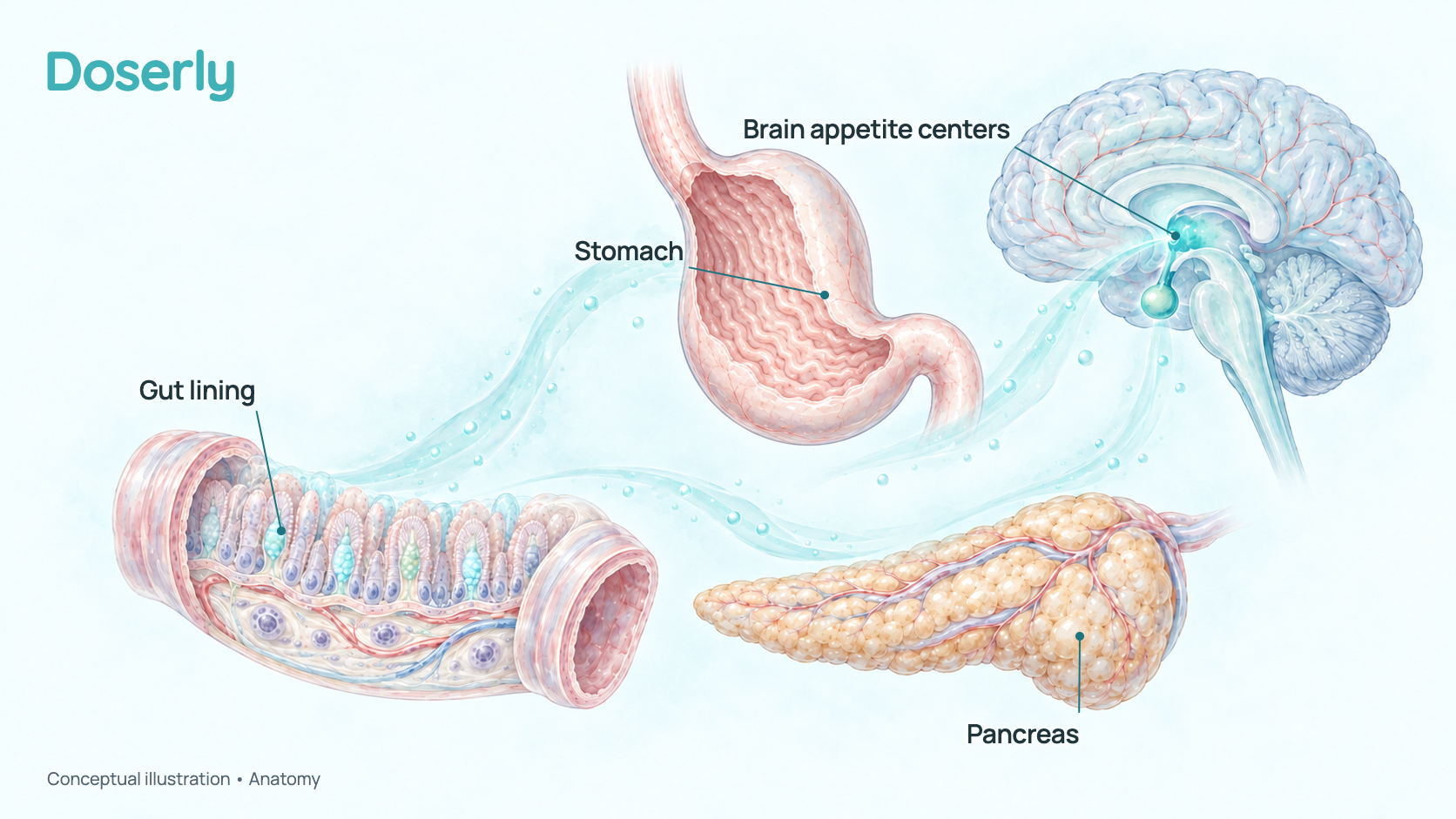
Semaglutide is a prescription medicine that copies GLP-1, a hormone your gut releases after you eat. It lowers blood sugar, makes people feel full sooner and hungry less often, and is used for type 2 diabetes, weight loss and lowering heart and kidney risk.
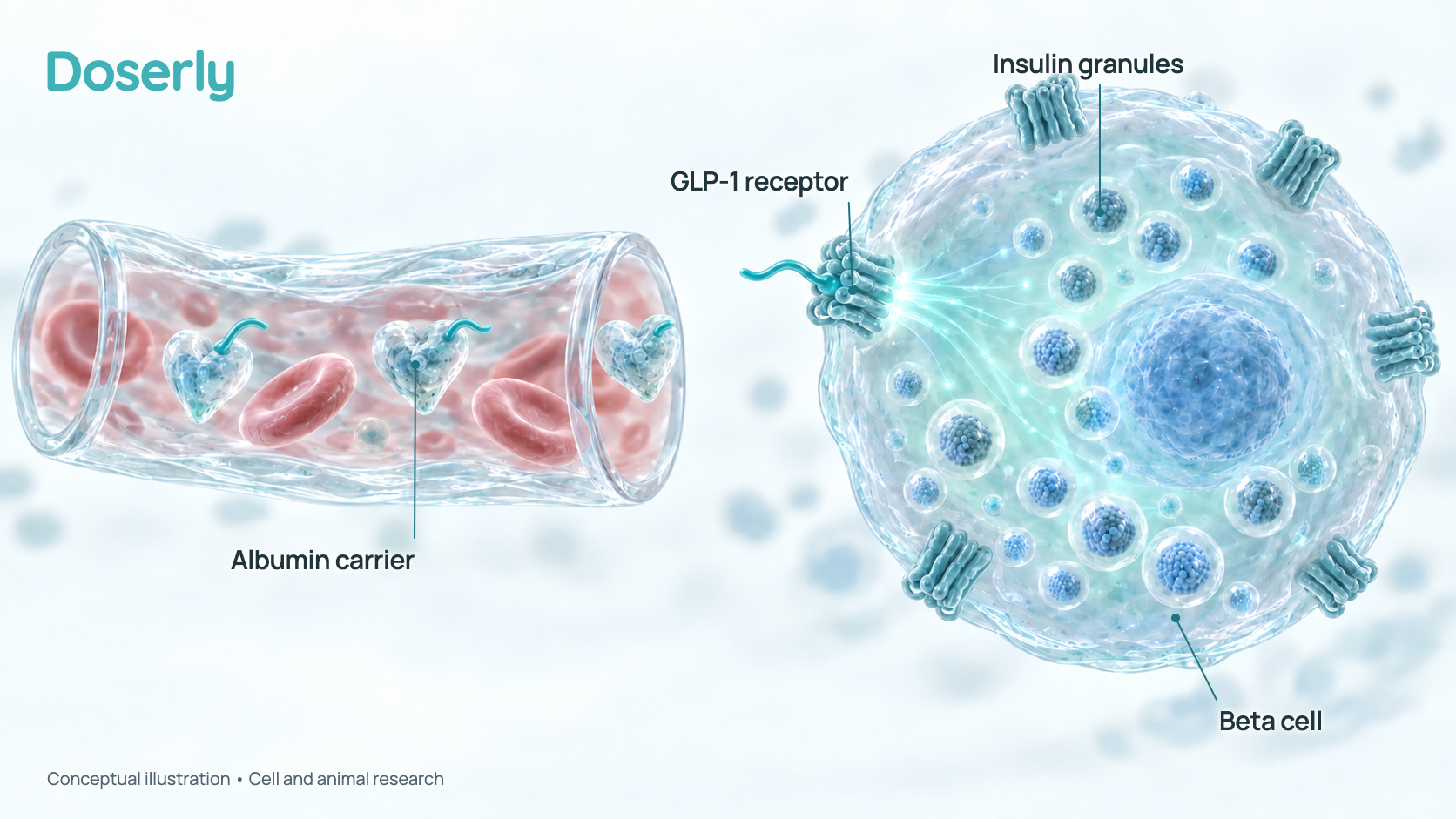
GLP-1 stands for glucagon-like peptide-1; a peptide is a short chain of amino acids. Semaglutide is a lab-made version of GLP-1 with three changes. One protects it from being broken down quickly, one makes sure only a single fatty-acid chain attaches, and that fatty-acid side chain lets it ride on albumin, a protein in the blood. Together they stretch its half-life to about a week, so one injection lasts a whole week. [1], [2]
Novo Nordisk makes the brand-name products. The same active ingredient goes by different names depending on the dose and the condition it is approved for:
| Brand | Form | Approved use (US) |
|---|---|---|
| Ozempic | Weekly injection pen | Type 2 diabetes, including lowering heart and kidney risk |
| Wegovy | Weekly injection pen | Weight loss (adults and children 12 and older), heart-risk reduction and a liver disease called MASH |
| Rybelsus and Ozempic tablets | Daily tablet | Type 2 diabetes, including heart-risk reduction in adults at high risk |
| Wegovy tablets | Daily tablet | Weight loss and heart-risk reduction in adults |
People also come across semaglutide as compounded vials, "research" vials sold online and dissolving tablets or drops. These products are not FDA approved, and their contents and absorption can differ from the real medicine. [5]
Typical Semaglutide Protocols
| Product and use | Starting dose | Dose steps | Maintenance dose (each week) | Duration |
|---|---|---|---|---|
| Wegovy · weight loss, heart-risk reduction, MASH | 0.25 mg, weeks 1–4 | 0.5 mg (weeks 5–8) → 1 mg (weeks 9–12) → 1.7 mg (weeks 13–16) | 2.4 mg from week 17 (recommended), or 1.7 mg | Long term For weight loss and heart-risk reduction, 1.7 mg or 2.4 mg can be the maintenance dose, chosen by response and tolerance. For MASH, 1.7 mg is used only if 2.4 mg is not tolerated |
| Wegovy HD · extra weight loss, adults | 0.25 mg, weeks 1–4 | 0.5 mg (weeks 5–8) → 1 mg (weeks 9–12) → 1.7 mg (weeks 13–16) → 2.4 mg for at least 4 weeks | 7.2 mg, from week 21 at the earliest | Long term US: when more weight loss is clinically needed. EU: adults whose [body mass index (BMI)](#term-bmi) was 30 or more when treatment began. Not in Canada's label |
| Ozempic · type 2 diabetes, heart risk | 0.25 mg, weeks 1–4 | 0.5 mg from week 5; then 1 mg and 2 mg if needed, each after at least 4 weeks | 0.5, 1 or 2 mg | Long term |
| Ozempic · kidney disease with type 2 diabetes | 0.25 mg, weeks 1–4 | 0.5 mg for at least 4 weeks | 1 mg | Long term |
The most common schedule in the labels and the reviewed dosing sources is the Wegovy injection ladder: 0.25 mg once a week, raised every 4 weeks through 0.5, 1 and 1.7 mg to a 2.4 mg maintenance dose from week 17. [1], [6], [7], [8]
- Titration Raising the dose in steps
- Each step lasts 4 weeks to limit stomach side effects. If a step is not tolerated, the Wegovy label says to consider waiting another 4 weeks before the next increase, and 1.7 mg is also an approved long-term dose (for MASH, only when 2.4 mg is not tolerated). Adults who have tolerated 2.4 mg for at least 4 weeks can move to 7.2 mg if more weight loss is clinically needed. Ozempic moves up to 1 mg and then 2 mg only when more blood-sugar control is needed. [1], [3]
- Breaks and cycles
- Not applicable in the labels: semaglutide is a continuous, long-term treatment with no planned breaks. In a follow-up of the STEP 1 trial, people who stopped regained, on average, about two-thirds of the weight they had lost within a year (see stopping). If a Wegovy injection is missed, take it if the next dose is more than 2 days away; otherwise skip it. After 2 or more missed weeks in a row, the label says to restart the step-up at a lower dose. Ozempic allows a missed dose within 5 days. A missed tablet is skipped, and the next one is taken the following day. [1], [3], [4], [9], [10]
Read the units: doses are in milligrams (mg). Branded pens deliver fixed doses, so there are no syringe units to count. Tablet and injection milligrams are not interchangeable: in adults without type 2 diabetes, a daily 25 mg Wegovy tablet gives average blood levels similar to a 2.4 mg weekly injection. Units only come up with vials; see how units convert. [1]
Each row is a separate labeled schedule, not a step to move through, apart from the conditional move from 2.4 mg to 7.2 mg. These are the labeled doses; prescribers adjust them for tolerance, response and the condition being treated. [1], [3]
What are the tablet doses?
Tablets have their own ladders. They are taken once a day, first thing in the morning on an empty stomach with no more than 4 ounces (about 120 mL) of plain water, at least 30 minutes before food, drink or other pills. [1], [4]
| Product and use | Starting dose (days 1–30) | Dose steps | Maintenance dose (each day) |
|---|---|---|---|
| Wegovy tablets · weight loss, heart-risk reduction | 1.5 mg | 4 mg (days 31–60) → 9 mg (days 61–90) | 25 mg from day 91 |
| Rybelsus · type 2 diabetes, heart-risk reduction | 3 mg | 7 mg (days 31–60) → 14 mg from day 61 if more blood-sugar control is needed | 7 mg or 14 mg The 3 mg starting dose is not meant to control blood sugar |
| Ozempic tablets · type 2 diabetes, heart-risk reduction | 1.5 mg | 4 mg (days 31–60) → 9 mg from day 61 if more blood-sugar control is needed | 4 mg or 9 mg Rybelsus and Ozempic tablets are not substitutable mg for mg |
Where schedules differ: 7.2 mg, lower doses, compounded vials, microdosing and stopping ↓
Where these numbers come from
Every row comes from a current US prescribing label: Wegovy injection and tablets (revised June 2026), Ozempic injection (revised May 2026), and Rybelsus and Ozempic tablets (revised January 2026). Each row keeps the product, use, steps and maintenance dose together as the label states them. [1], [3], [4]
Other regions differ. The EU label adds a condition for 7.2 mg (a starting BMI of at least 30) and says to go back to 2.4 mg if 7.2 mg brings no further benefit. The UK information allows 7.2 mg only for weight management in adults with obesity, after at least 4 weeks on 2.4 mg, and not for teenagers. Canada's Wegovy monograph stops at 2.4 mg. EU Rybelsus also includes 25 mg and 50 mg tablets that are not US strengths. [11], [12], [13], [14]
Dosing websites were used as cross-checks, not as the source of any row. Of 34 reviewed pages, 18 repeat the Wegovy injection ladder, and the mainstream drug references match the 2026 US labels. Some older pages still give 2.4 mg as Wegovy's top dose. Pages with unit-arithmetic errors, a microdose card that gave no unit, a page that no longer loads, and compounded kit charts with non-label steps (such as 1.5 mg and 2.5 mg) did not shape the table; they are discussed in the next section. Kayshild, an EU semaglutide brand for MASH, is outside this US-label table. [6], [7], [15], [16], [17], [18], [19], [20], [21]
What is semaglutide commonly used for?
Most people look into semaglutide for one of three reasons: they want to lose weight, they have type 2 diabetes, or a doctor has raised it to lower their heart or kidney risk. Many also describe a quieter "food noise," the constant background thinking about food. [1], [3], [22]
The uses below are approved for specific products and people. Using a product for something outside its label, or using an unapproved product, is a different situation from the trials described here.
Weight loss
This is the use most people search for. Wegovy injection and Wegovy tablets are approved for adults with obesity, or with overweight plus a weight-related health problem, alongside a reduced-calorie diet and more activity. Wegovy injection is also approved for children 12 and older with obesity. In the STEP 1 trial, adults on 2.4 mg a week lost an average of 14.9% of their body weight over 68 weeks, compared with 2.4% on placebo. About half lost 15% or more. In teenagers with obesity (STEP TEENS), BMI fell by 16.1% over 68 weeks, compared with a 0.6% rise on placebo. [1], [23], [24]
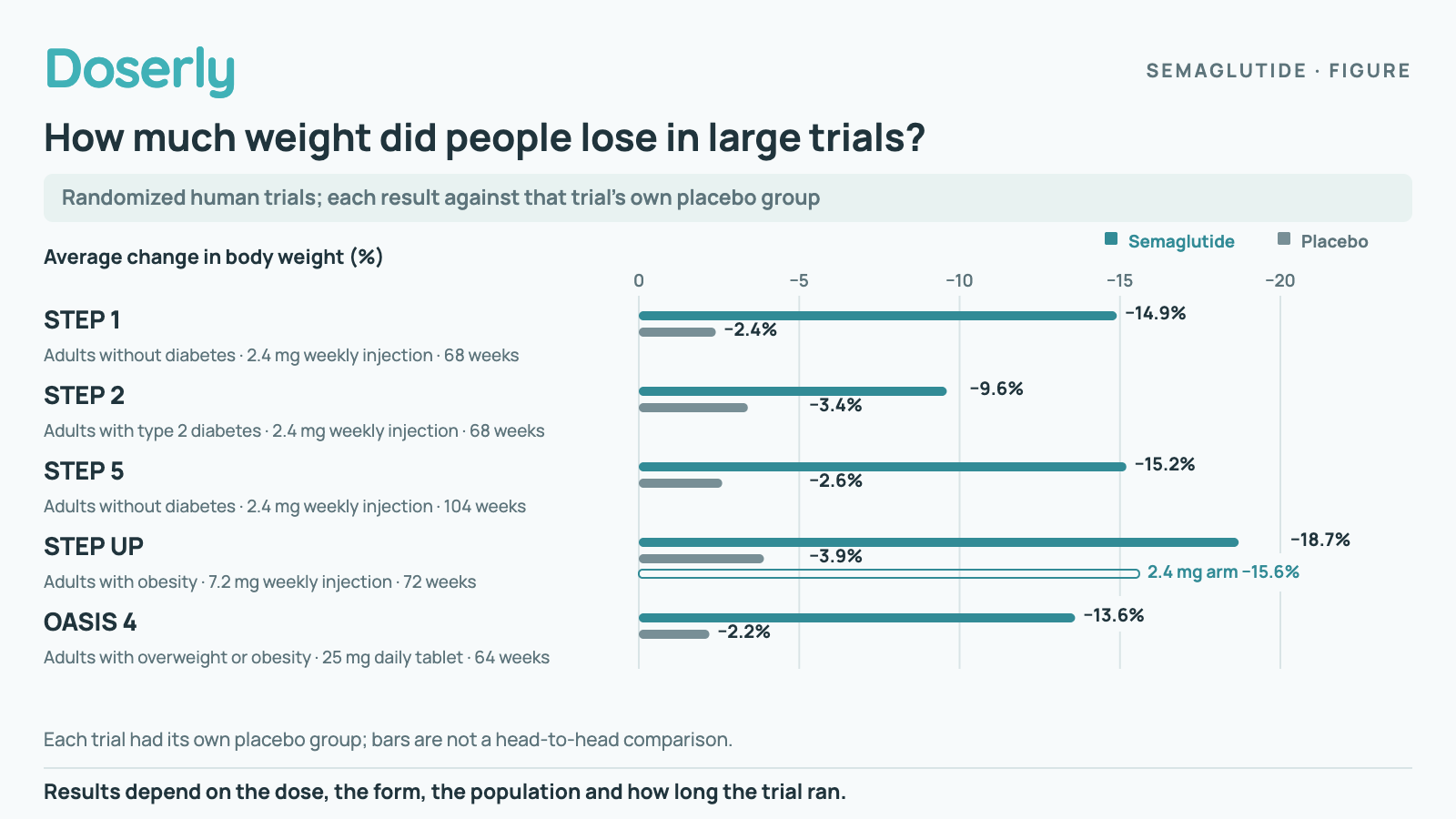
How much weight did people lose in large trials?
Average change in body weight (%).
- STEP 1
- Adults without diabetes · 2.4 mg weekly injection · 68 weeks. Semaglutide −14.9%; placebo −2.4%.
- STEP 2
- Adults with type 2 diabetes · 2.4 mg weekly injection · 68 weeks. Semaglutide −9.6%; placebo −3.4%.
- STEP 5
- Adults without diabetes · 2.4 mg weekly injection · 104 weeks. Semaglutide −15.2%; placebo −2.6%.
- STEP UP
- Adults with obesity · 7.2 mg weekly injection · 72 weeks. 7.2 mg −18.7%; 2.4 mg arm −15.6%; placebo −3.9%.
- OASIS 4
- Adults with overweight or obesity · 25 mg daily tablet · 64 weeks. Semaglutide −13.6%; placebo −2.2%.
Each trial had its own placebo group; bars are not a head-to-head comparison.
Results depend on the dose, the form, the population and how long the trial ran.
Type 2 diabetes
Ozempic, Rybelsus and Ozempic tablets are approved to improve blood-sugar control in adults with type 2 diabetes. They lower HbA1c, a blood test that reflects average blood sugar over about three months. In an early 30-week trial, weekly 0.5 mg and 1 mg injections lowered HbA1c by about 1.5 points, compared with almost no change on placebo. In adults with obesity and prediabetes (STEP 10), 81% had normal blood sugar after a year on 2.4 mg, compared with 14% on placebo. [3], [4], [25], [26]
Heart and kidney protection
Some approvals are about preventing events. Wegovy is approved to lower the risk of heart attack, stroke and heart death in adults with heart disease and excess weight. Ozempic has similar approvals for adults with type 2 diabetes and heart disease, and for slowing kidney disease in type 2 diabetes. Rybelsus and Ozempic tablets are approved to lower heart risk in adults with type 2 diabetes at high risk. [1], [3], [4], [27], [28]
A liver disease called MASH
MASH (metabolic dysfunction-associated steatohepatitis) is fatty liver disease with inflammation and scarring. Wegovy has an accelerated US approval for MASH with moderate to advanced scarring but no cirrhosis, based on liver biopsies; a longer trial is checking whether it prevents liver failure. [1], [29], [30]
Other conditions studied in trials
Trials have also tested semaglutide for heart failure symptoms, knee arthritis pain, leg-artery disease and alcohol use. Some results were positive. The large Alzheimer's disease trials found no benefit. These are covered in the human research section. [31], [32], [33], [34], [35]
Where do semaglutide protocols differ?
The labeled ladders are clear. The confusion comes from tablets versus injections, different top doses in different countries, custom schedules for vials, "microdosing" and stopping.
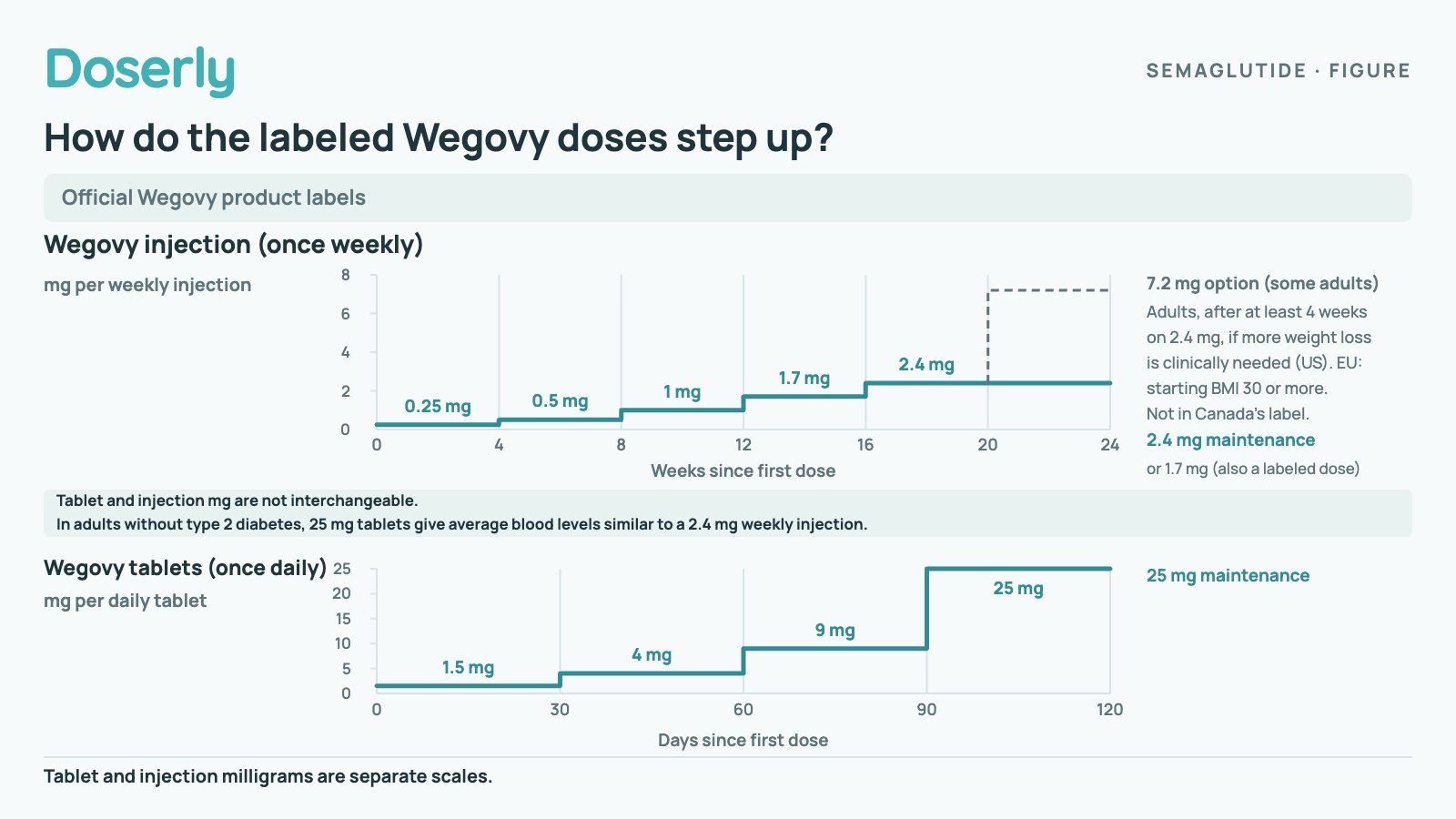
How do the labeled Wegovy doses step up?
Official Wegovy product labels.
- Wegovy injection (once weekly)
- 0.25 mg in weeks 1–4, 0.5 mg in weeks 5–8, 1 mg in weeks 9–12, 1.7 mg in weeks 13–16, then 2.4 mg from week 17. 1.7 mg is also a labeled maintenance dose.
- 7.2 mg option (some adults)
- Adults, after at least 4 weeks on 2.4 mg, if more weight loss is clinically needed (US). EU: starting BMI 30 or more. Not in Canada's label.
- Wegovy tablets (once daily)
- 1.5 mg on days 1–30, 4 mg on days 31–60, 9 mg on days 61–90, then 25 mg from day 91.
Tablet and injection mg are not interchangeable. In adults without type 2 diabetes, 25 mg tablets give average blood levels similar to a 2.4 mg weekly injection.
Tablet and injection milligrams are separate scales.
Is the number for a tablet or an injection?
A tablet dose and an injection dose cannot be compared by their milligrams. So little of a swallowed dose is absorbed that tablets contain far more semaglutide; in adults without type 2 diabetes, a daily 25 mg Wegovy tablet gives average blood levels similar to a 2.4 mg weekly injection, though levels vary more between people. In people with type 2 diabetes, average levels on the tablet were lower. [1]
Switching follows fixed label rules, not arithmetic. Someone on Wegovy 2.4 mg injections can start 25 mg tablets one week after the last injection; going the other way, the 2.4 mg injection starts the day after the last 25 mg tablet (or 1.7 mg if the tablets were not tolerated). Someone on Ozempic 0.5 mg injections can start Rybelsus 7 mg or 14 mg one week later. Even the two diabetes tablets differ: Rybelsus 7 mg matches Ozempic tablets 4 mg, and 14 mg matches 9 mg, and the label says not to switch between them in the first 30 days. [1], [4]
Why does Ozempic stop at 2 mg and Wegovy at 2.4 mg or 7.2 mg?
They are the same medicine approved for different jobs. Ozempic's doses were set in diabetes trials, where 2 mg lowered HbA1c slightly more than 1 mg (2.2 versus 1.9 points); Wegovy's were set in weight trials. [3], [36], [1]
Does everyone need to reach 2.4 mg?
No. The label allows 1.7 mg as a long-term dose. In STEP 6, in East Asian adults, 1.7 mg led to 9.6% average weight loss, compared with 13.2% for 2.4 mg and 2.1% for placebo. [1], [37]
Real-world use often stays lower. In one large US health-record study, about 8 in 10 people starting semaglutide or tirzepatide for weight were on lower maintenance doses, and average one-year weight loss was 8.7%. [38] In community education groups, a common teaching is to hold a dose while it still works rather than stepping up on a calendar.
What changes at 7.2 mg?
In the STEP UP trial, adults with obesity lost 18.7% on 7.2 mg over 72 weeks, compared with 15.6% on 2.4 mg and 3.9% on placebo. In adults with type 2 diabetes, 7.2 mg led to 13.2% average loss versus 3.9% on placebo. [39], [40]
The higher dose brings a new side effect: unusual skin sensations such as tingling, burning or skin that hurts to the touch (dysesthesia), in 22% on 7.2 mg versus 6% on 2.4 mg and 0% on placebo. Hair loss was 6%, 3% and 1%. [1]
The rules differ by country: the US allows 7.2 mg for adults when more weight loss is clinically needed, the EU also requires a starting BMI of at least 30, and Canada's current label does not include it. In the EU and UK, 7.2 mg can also be given as three 2.4 mg injections, one after another, depending on the pen. [1], [11], [41], [12], [42]
Do compounded and "research" vials follow the same steps?
Many do not. Some websites copy the Wegovy ladder onto vials; others use kit-based steps such as 1.5 mg and 2.5 mg, top out at 2.5 mg a week, or split the weekly dose in two. None are approved schedules. [43], [19], [20], [44], [45]
The product itself is the bigger difference. The FDA says the semaglutide shortage ended in February 2025, which ended the exception that let pharmacies make routine copies. A pharmacy can still compound a version that a prescriber documents is meaningfully different for a specific patient. The FDA also says the salt forms some compounders used (semaglutide sodium and semaglutide acetate) are different ingredients, and it knows of no lawful basis for using them in compounding. [46], [5]
What is "microdosing" semaglutide?
There is no agreed meaning. Some pages mean doses below the 0.25 mg start (0.05–0.2 mg a week); others sell the normal 0.25 mg start as a "microdose" or define it as a quarter of a standard dose. [47], [48], [49], [44], [50]
No completed trial has tested a microdosing schedule. As of September 23, 2026, ClinicalTrials.gov lists a few company-sponsored studies, such as an AgelessRx trial of low-dose semaglutide and a Noom study following people who use compounded semaglutide, and none has posted results. A separate university trial in people with HIV plans to compare stopping with lowering the dose to 0.5 mg weekly after stepping up to 2 mg. It calls this lower dose "microdosing", but 0.5 mg weekly is also a standard Ozempic maintenance dose on the label. [51], [52], [53], [3]
An early trial did use small amounts, 0.05–0.4 mg, but injected every day, so the weekly totals were 0.35–2.8 mg and are not microdoses. In a 2026 proposal, the FDA said the "microdosing" argument for making bulk semaglutide did not show that approved products could not be used. [54], [55]
Once a week or split into two injections?
The labels say once a week, on the same day each week, at any time of day. The one-week half-life is why a single weekly dose is enough. Some clinics and forum users split the weekly dose in two to ease side effects or end-of-week hunger. No trial has compared the two approaches. [1], [45], [56], [57]
The injection day can move. The US labels and Canada's Ozempic monograph allow a change if at least 2 days (48 hours) have passed since the last dose; the EU product information and Canada's Wegovy monograph ask for at least 3 days (72 hours). [1], [3], [58], [59], [11], [41]
How do milligrams convert to syringe units?
Branded pens do not use units. Units appear only with vials drawn into an insulin syringe, and they measure volume, not drug. On a U-100 syringe, 100 units equal 1 mL, so the amount of semaglutide in each unit depends on the vial's concentration. [60]
For example, a vial at 2.5 mg per mL holds 0.025 mg per unit, so 0.25 mg is 10 units. At 5 mg per mL, the same 0.25 mg is only 5 units. Copying a number of units from someone using a different vial can double or halve the dose. The FDA has reported overdoses of 5 to 20 times the intended amount from unit and concentration mix-ups. Doserly's reconstitution calculator works out the arithmetic for any vial and shows each step. [60], [61]
What happens when you stop semaglutide?
The labels describe long-term treatment, and the stopping studies show why: after treatment ends, weight usually returns. Semaglutide itself takes about 5 to 7 weeks to leave the body after the last dose. [1]
- Weight. Two studies followed people after stopping. STEP 4 was a randomized stopping trial: everyone took semaglutide for 20 weeks and lost about 10.6%. Then a third were switched, without knowing it, to placebo. Over the next 48 weeks, those who continued lost another 7.9%, while those switched to placebo regained 6.9%. In the STEP 1 extension, an exploratory follow-up of 327 people who stopped after 68 weeks, when the trial's lifestyle support also ended, people had regained about two-thirds of their lost weight a year later; on average they ended 5.6% below their starting weight. [10], [9]
- Blood pressure, blood sugar and other measures. In the STEP 1 extension, the improvements seen on treatment drifted back toward where they started. [9]
- Estimates across drugs. A 2026 review of GLP-1 medicines estimated that about 60% of lost weight returns within a year of stopping. Another, which analyzed semaglutide and tirzepatide together, estimated regain of about 0.8 kg a month; its forecast beyond one year is a projection, not an observation. [62], [63]
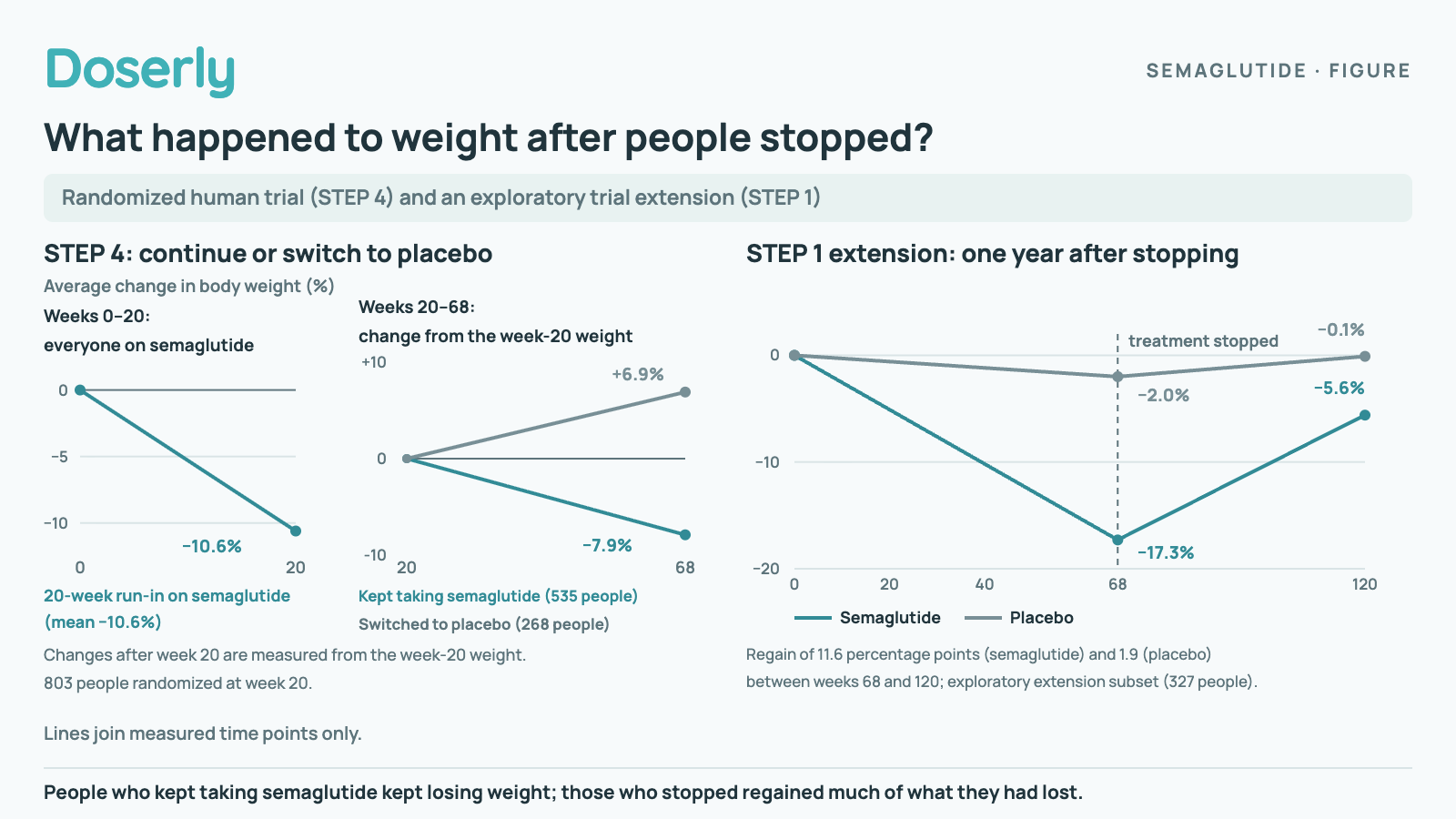
What happened to weight after people stopped?
Randomized human trial (STEP 4) and an exploratory trial extension (STEP 1).
- STEP 4: weeks 0–20
- Everyone took semaglutide for 20 weeks and lost 10.6% on average.
- STEP 4: weeks 20–68
- From the week-20 weight, people who kept taking semaglutide (535 people) lost a further 7.9%; those switched to placebo (268 people) regained 6.9%. Changes after week 20 are measured from the week-20 weight. 803 people randomized at week 20.
- STEP 1 extension: one year after stopping
- Semaglutide: 0% at week 0, −17.3% at week 68 when treatment stopped, then −5.6% at week 120. Placebo: 0%, −2.0%, then −0.1%. Regain of 11.6 percentage points (semaglutide) and 1.9 (placebo) between weeks 68 and 120; exploratory extension subset (327 people).
Lines join measured time points only.
People who kept taking semaglutide kept losing weight; those who stopped regained much of what they had lost.
Stopping is common in real life. In a Danish study of 157,822 people who started semaglutide for weight, about half had stopped within a year (a gap of 60 days or more), and about 1 in 4 of those who stopped restarted within three months. The records could not show why people stopped or what happened to their weight. [64]
Tapering, breaks and "receptor resets." The labels give no taper schedule. [1] One dosing website describes a 16-week step-down from 1.7 mg through 1, 0.5 and 0.25 mg. [65] In community education groups, educators disagree: some teach step-downs of about 4 weeks each or longer gaps between doses, some advise staying on, and a few promote breaks to "reset" GLP-1 receptors.
No completed trial has compared tapering with stopping all at once. An uncontrolled 2024 conference report, written by the company running an online weight program, estimated that people who tapered off were about 1.5% lighter 26 weeks later, with a range from 6.4% lighter to 3.3% heavier, assuming nobody restarted. A randomized trial called REST, comparing a 16-week taper with stopping, has published only its plan. No study shows that breaks restore the effect. [66], [67]
Do semaglutide tablets and injections work the same way?
They deliver the same ingredient by very different routes. A subcutaneous injection goes into the fatty layer under the skin of the belly, thigh or upper arm; 89% of the dose reaches the blood, peaking 1 to 3 days later, with similar exposure at all three sites. [1]
A tablet has a harder job, because the stomach normally breaks peptides down before they can be absorbed. The tablets contain an absorption helper called SNAC (salcaprozate sodium). Human and dog studies showed that semaglutide is absorbed in the stomach, right next to the dissolving tablet. Laboratory and animal studies suggest SNAC shields it from digestive enzymes there and briefly helps it cross the stomach lining. Even so, only about 1% to 2% of a Wegovy tablet dose reaches the blood, and a model of the earlier diabetes tablet put the figure at 0.8% under the recommended conditions. [1], [68], [69]
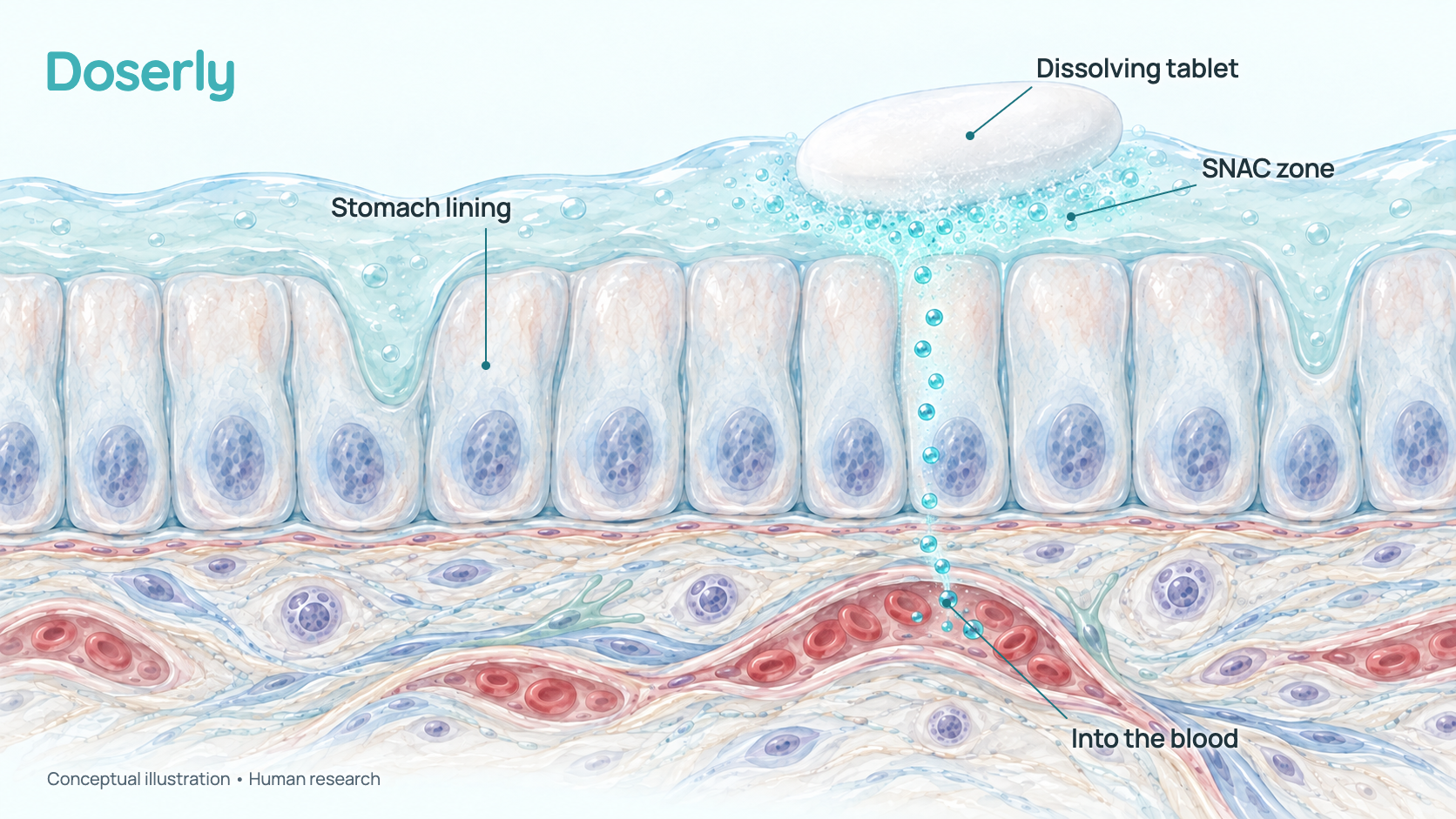
That fragile absorption is why the tablet rules are strict. In a human imaging study, blood levels were about 70% higher when a tablet was taken with 50 mL of water than with 240 mL, and absorption rises the longer a person waits before eating: hence the empty stomach, the 4-ounce limit and the 30-minute wait. [70], [1]
Are drops, troches and nasal sprays the same?
No. Sublingual (under-the-tongue) troches, drops and similar products are not approved forms of semaglutide, and no published clinical trial has measured how much of a dose reaches the blood or how it compares with approved products. One compounding list sold 1 mg troches taken every other day; one guide called injection doses "equivalent" for under-the-tongue use without any absorption data. [71], [72], [5]
How should semaglutide be stored, and how long does it last?
Each product's label sets its storage rules, and they differ by product and by country, so the leaflet in your own box is the final word. In short, pens start in the fridge and tablets stay at room temperature. [1], [3], [4]
| Product | Before first use | After first use, or once out of the fridge |
|---|---|---|
| Ozempic pen (several doses per pen) | Fridge, 2–8 °C, until the expiry date | US: up to 56 days at 15–30 °C or in the fridge. Canada: 8 weeks. EU: 6 or 8 weeks, depending on the pen |
| Single-dose pens and syringes (one injection: Wegovy pens in any strength including 7.2 mg; Wegovy and Ozempic prefilled syringes) | Fridge, 2–8 °C, in the carton | Before use, up to 28 days out of the fridge at no more than 30 °C; thrown away after the one injection |
| Wegovy FlexTouch pen (several doses per pen) | Fridge, 2–8 °C | US: up to 56 days at 15–30 °C or in the fridge. Canada: 8 weeks. EU and UK: 6 weeks |
| Tablets (Wegovy, Rybelsus, Ozempic tablets) | US: room temperature, 20–25 °C, with short spells at 15–30 °C allowed, in the original bottle to keep out moisture. EU and UK: in the original blister pack, away from moisture and light, with no set temperature | Keep each tablet in its original packaging until you take it |
[3], [58], [59], [1], [11], [41], [12], [73], [4], [14], [74]
Never freeze a pen or use one that has frozen, and keep pens away from heat and light, with the cap on or in the carton. The labels say to throw away a Wegovy pen that has been above 30 °C or out of the fridge for longer than its limit. [1], [3] Unopened 7.2 mg pens have a shelf life of 3 years in the EU and 2 years in the UK; the expiry date on the pack is what counts. [11], [12]
Compounded and "research" vials. No approved label covers them, so they have no tested storage period. The FDA has reported compounded GLP-1 products arriving warm, and in 2026 it warned against using compounded multidose vials for too long. US pharmacy standards generally cap a punctured multidose vial at 28 days, a general rule rather than a semaglutide test, and sellers' claims of 28 to 60 days after mixing (reconstitution) have no published testing behind them. Laboratory tests show semaglutide breaks down faster with heat and at some acidity levels, but they set no use-by date. [5], [75], [76], [77], [78], [79], [80]
This guide does not cover pen technique or mixing; the Academy note below covers practical handling.
What does semaglutide's one-week half-life mean?
Half-life is the time it takes for the level in the blood to fall by half. For semaglutide it is about one week, which is why one injection a week is enough. With weekly doses, levels build up and then level off (steady state) after about 4 to 5 weeks. [1], [3]
It also explains two practical things. Semaglutide stays in the body for about 5 to 7 weeks after the last dose, which is why the label says to stop at least 2 months before a planned pregnancy. And after an overdose, the label advises a long period of observation, because the drug keeps acting for days. [1]
A long half-life does not mean the effect lasts: weight tends to return after stopping. [9]
What do we actually know about semaglutide in people?
A lot. Semaglutide has been tested in tens of thousands of people in large randomized controlled trials, where people are assigned by chance to the medicine or a placebo. The trial registry ClinicalTrials.gov lists 95 phase 3 trial records involving semaglutide sponsored by its manufacturer. The questions they answer are more specific than "does it work": how much weight, in whom, at which dose, for how long, and what happens after stopping. [81], [27], [82], [35]
How much weight do people lose in trials?
| Trial | Who and what | Average weight change | What it cannot show |
|---|---|---|---|
| STEP 1 (2021) | 1,961 adults without diabetes; 2.4 mg weekly with lifestyle support; 68 weeks | −14.9% vs −2.4% on placebo | Results after stopping (see stopping) [23] |
| STEP 2 (2021) | Adults with type 2 diabetes; 2.4 mg weekly; 68 weeks | −9.6% vs −3.4% | Why people with diabetes lose less on average [83] |
| STEP 5 (2022) | Adults without diabetes; 2.4 mg weekly; 2 years | −15.2% vs −2.6% | Effects beyond 2 years [84] |
| STEP 8 (2022) | 2.4 mg weekly vs daily liraglutide 3 mg (an older GLP-1 drug); 68 weeks | −15.8% vs −6.4% | Comparison with newer drugs [85] |
| STEP UP (2025) | Adults with obesity; 7.2 mg vs 2.4 mg vs placebo; 72 weeks | −18.7% vs −15.6% vs −3.9% | Long-term safety of 7.2 mg [39] |
| OASIS 4 (2025) | Adults; 25 mg tablet daily; 64 weeks | −13.6% vs −2.2% | How tablets compare with injections directly [86] |
An average hides a wide range. In STEP 1, 86% of people on semaglutide lost at least 5% of their weight and about half lost 15% or more, while roughly 1 in 7 lost less than 5%. In the SELECT trial, which followed people for 4 years, weight loss continued for about 65 weeks and then held steady at about 10% below the starting point. [23], [87]
Most of these trials used the "treatment policy" approach, which counts everyone who was assigned to the drug, including people who stopped taking it. That makes the averages closer to real life than a count of only the people who took every dose. [23], [39]
Does it lower heart attack and stroke risk?
Yes, in the populations tested. In SELECT, 17,604 adults with heart disease and excess weight but no diabetes took 2.4 mg weekly or placebo for about 3 years. A heart attack, stroke or heart death happened to 6.5% of the semaglutide group and 8.0% of the placebo group, a 20% lower relative risk. [27], [1]
Diabetes trials point the same way: 6.6% versus 8.9% with weekly injections in SUSTAIN 6, and 12.0% versus 13.8% with daily tablets in SOUL. The label says the mechanism behind the heart benefit has not been established. [88], [82], [1]
Does it help kidneys, the liver or heart failure?
- Kidneys. In FLOW, adults with type 2 diabetes and kidney disease on 1 mg weekly had a 24% lower risk of major kidney events or heart death (331 versus 410 events). [28]
- Liver (MASH). In ESSENCE, liver inflammation cleared without worse scarring in 62.9% on 2.4 mg versus 34.3% on placebo after 72 weeks. That is a biopsy result, not yet proof of fewer liver failures. [30]
- Heart failure. In adults with a stiff-heart type of heart failure (preserved ejection fraction) and obesity, symptom and activity scores improved by 16.6 points versus 8.7 on placebo. [31]
- Knee arthritis and leg-artery disease. Knee pain scores fell by 41.7 versus 27.5 points in STEP 9; walking distance improved in STRIDE. [32], [33]
Is the weight lost fat or muscle?
Mostly fat, but lean tissue fell too. A conference abstract reported body scans from 140 STEP 1 participants, an exploratory subgroup. On semaglutide, fat mass fell by 19.3% and lean mass (everything that is not fat or bone, including muscle, organs and water) fell by 9.7% over 68 weeks. Because fat fell faster, the share of the body made up of lean mass rose by 3 percentage points. [89]
Lean mass is not the same as muscle strength. In one observational study of 106 people on 2.4 mg, handgrip strength improved over a year even though lean mass dropped early on. [90] In community education groups, strength training and enough protein are the standard advice for protecting muscle during large weight loss.
Animal studies point the same way. In obese mice, muscle size and strength fell about as much as with an equal cut in food, and recovered after the drug stopped; in obese minipigs, semaglutide kept more lean mass than dieting alone. Bone results in mice conflict; for people, see the fracture finding under label risks. The research library has the details. [91], [92]
Does it help alcohol use or Alzheimer's disease?
Alcohol use is an active research area. In a 26-week trial of 108 adults with alcohol use disorder and obesity, heavy-drinking days fell by 41.1 percentage points on semaglutide versus 26.4 on placebo, alongside talk therapy. An earlier 9-week trial in 48 adults who were not seeking treatment, using lower doses (0.25 to 1 mg a week), found less alcohol consumed in a laboratory drinking session and fewer drinks per drinking day. Semaglutide is not approved for alcohol use. [34], [93]
Alzheimer's disease is a clear negative. Two large trials, EVOKE and EVOKE+, gave semaglutide tablets (up to 14 mg a day) or placebo to 3,808 people with early Alzheimer's disease for 2 years. Memory and thinking scores declined the same in both groups. [35] Two mouse studies had reported better memory and less of the protein build-up linked to Alzheimer's in mice bred to develop it, while a third found no change in plaques or memory. The human trials are a reminder that brain benefits in animals need testing in people. [94], [95], [96]
How does semaglutide work?
Semaglutide shares 94% of its amino-acid sequence with human GLP-1 and switches on the same receptor, the GLP-1 receptor. Its effects in people are well measured: it lowers appetite and calorie intake, raises insulin and lowers glucagon (a hormone that raises blood sugar) only when blood sugar is high, and slows how fast the stomach empties. [1]
How does it reduce appetite?
In a 12-week human study, people on 1 mg weekly ate about 24% fewer calories over a day of unlimited test meals than they did on placebo. [97]
In rodents, semaglutide reached appetite areas in the brainstem and hypothalamus through a few "leaky" spots in the brain's protective barrier, rather than crossing into the whole brain. From there it changed activity in circuits that end meals. That is an animal finding about where it acts, not a measurement in people. [98]
Later mouse studies pointed to nerve cells in the area postrema, a small brainstem area that also triggers nausea, and a neighboring brainstem area. Destroying one group of cells spanning both areas largely reversed semaglutide's effects on food intake and weight, and blocking a signal inside area postrema cells stopped its weight loss. In a third mouse study, food intake still fell when the nausea-like avoidance circuit was switched off, which suggests fullness and nausea travel on partly separate paths. These are mouse findings; the human pathway has not been mapped this way. [99], [100], [101]
Does it slow the stomach?
It does, but how much that matters over time is debated. The label states that semaglutide delays stomach emptying, which is why it carries a warning for anesthesia. In one human study at 2.4 mg, an indirect drug-absorption test found no sign of slower stomach emptying at week 20 once body weight was taken into account, even though appetite and food intake were lower. The study did not measure how much of the appetite effect comes from the brain. [1], [102]
Why does one dose last a week?
A changed amino acid at position 8 stops DPP-4, the enzyme that quickly breaks down natural GLP-1, from cutting it, and the fatty-acid side chain makes more than 99% of it bind to albumin, which protects it from breakdown and from removal by the kidneys. [1], [103]
What are the risks and unanswered questions?
Is semaglutide safe?
Semaglutide has a well-studied safety profile from large, long trials: stomach and bowel side effects are common, and serious problems such as pancreatitis and gallbladder disease are uncommon but real. Its label lists who should not take it and what to watch for, and those risks apply to the approved product used at labeled doses. Unapproved products add risks of their own. [1], [104]
What are the most common side effects?
Stomach and bowel symptoms. In the weight-loss trials behind the Wegovy label, 44% of people on 2.4 mg had nausea (16% on placebo), 30% diarrhea (16%), 24% vomiting (6%) and 24% constipation (11%). Headache, tiredness, indigestion, dizziness, bloating and burping were also more common. [1]
Most of these were mild to moderate, came and went, and happened mainly while the dose was being raised. In STEP 1, 4.5% of people on semaglutide stopped because of stomach side effects, compared with 0.8% on placebo. Weight loss was similar whether or not people had these side effects. [105], [23]
What serious risks are on the label?
- Thyroid tumors (boxed warning). Semaglutide caused thyroid C-cell tumors in mice and rats. Whether it does in people is unknown. It must not be used by anyone with a personal or family history of medullary thyroid cancer or the inherited condition multiple endocrine neoplasia type 2 (MEN 2). [1]
- Pancreatitis. Inflammation of the pancreas, sometimes severe. In the weight trials it was confirmed in 4 people on Wegovy and 1 on placebo. Severe stomach pain that spreads to the back needs urgent care. [1] Monkeys given semaglutide for up to a year showed no pancreas damage under the microscope, which does not rule out rare cases in people. [106] In January 2026, the UK regulator strengthened warnings across GLP-1 medicines about rare severe and fatal cases. [107]
- Gallbladder disease. Gallstones affected 1.6% on Wegovy injections versus 0.7% on placebo, and the excess persisted after accounting for weight loss. [1]
- Kidney injury from dehydration. Vomiting and diarrhea can cause fluid loss that strains the kidneys. [1]
- Low blood sugar with other diabetes medicines. The risk rises when semaglutide is combined with insulin or sulfonylureas. [1]
- Diabetic eye disease. In people with type 2 diabetes, eye complications occurred in 3.0% versus 1.8% on placebo in SUSTAIN 6, and more often in people who already had eye disease. Fast improvements in blood sugar can temporarily worsen it. [108], [1]
- Faster heart rate, allergic reactions and anesthesia. Resting heart rate rose by 1 to 4 beats per minute on average. Serious allergic reactions have been reported. Because the stomach empties more slowly, food can be inhaled into the lungs during general anesthesia or deep sedation, so tell the care team before any procedure. [1]
- Hip and pelvis fractures. In SELECT, more hip and pelvis fractures were reported on semaglutide than on placebo in women (1% versus 0.2%) and in people aged 75 and older (2.4% versus 0.6%). [1]
Can semaglutide affect eyesight?
A rare optic-nerve condition called NAION (non-arteritic anterior ischemic optic neuropathy) causes sudden, painless vision loss in one eye. In 2025, European regulators concluded it is a very rare side effect of semaglutide, and EU product information lists it. The UK added the same very rare warning in February 2026. Australia's regulator issued a safety update in July 2026 saying the evidence may support a signal. The current US labels do not list it. [109], [11], [110], [111], [1]
The size of the risk is uncertain. Two observational studies reported higher risks. In Danish and Norwegian adults with type 2 diabetes, the risk was about 2.8 times higher. Among patients seen by eye-nerve specialists at one US hospital, it was about 4.3 times higher in people with type 2 diabetes and 7.6 times higher in people with overweight or obesity, based on small numbers of cases. Two 2026 pooled analyses of largely the same observational studies disagree: one found about 1.6 times the risk, with a range that included no increase, and rated the evidence low certainty; the other found about 2.5 times the risk and rated the evidence low to moderate certainty. Anyone with sudden vision loss should get emergency eye care. [112], [113], [114], [115]
Does semaglutide affect mood or cause suicidal thoughts?
The current evidence does not show that it causes suicidal thoughts. After reviewing 91 placebo-controlled trials with 107,910 people, the FDA found no increased risk across GLP-1 drugs and had the warning removed in January 2026; in SELECT, suicide and self-harm events were rare and equal in both groups. Some people still report feeling flat, and any mood change is worth raising with a doctor. [116], [1], [104], [117]
Does semaglutide cause thyroid cancer?
It is not known. The warning comes from rodent studies. In 2-year studies, mice and rats given semaglutide developed more thyroid C-cell tumors, including cancers; in male rats, cancers increased from blood levels below those reached in people taking Ozempic. The FDA's reviewer found that semaglutide switches on GLP-1 receptors on rat C-cells, and whether human C-cells react the same way is unknown. [118], [119]
Human studies of GLP-1 drugs as a group disagree: a French study found a higher risk of thyroid cancer, while a Scandinavian study did not. Neither was specific to semaglutide. [1], [120], [121]
Could compounded or online semaglutide change the risk?
Yes. When researchers bought semaglutide online without a prescription, only 3 of 6 orders arrived, and the samples tested were 7% to 14% pure instead of the 99% advertised; one contained bacterial toxins. The FDA had received 990 adverse-event reports for compounded semaglutide by May 2026, and it has warned about counterfeit Ozempic pens in the US supply chain. In July 2026, the UK regulator again warned against fake and illegally sold weight-loss injections, and in September 2026 the FDA updated an import alert that lets officials hold imported bulk GLP-1 ingredients without examining them. [122], [5], [123], [124], [125]
Dosing mistakes are a separate risk. A California poison-center study found that 80% of GLP-1 exposure calls were unintentional dosing errors, and most calls about compounded products involved errors in giving the dose. [126], [61]
Is semaglutide legal? Is it FDA approved?
Checked September 23, 2026. Rules differ by country and change often.
United States. Semaglutide is an FDA-approved prescription medicine. The key steps:
- 2017–2022. Ozempic injection was approved for type 2 diabetes on December 5, 2017, Rybelsus tablets on September 20, 2019, and Wegovy injection for weight management on June 4, 2021, extended to children 12 and older on December 23, 2022. [127], [128], [129], [130]
- 2024. Wegovy was approved to lower heart-attack, stroke and heart-death risk (March 8), and a new, better-absorbed tablet formulation (1.5, 4 and 9 mg) was approved in December. [131], [132]
- 2025. Ozempic gained its kidney-disease use (January 28). The FDA declared the semaglutide shortage over on February 21; pharmacies making copies under the shortage exception had to stop by April 22 or the date of a court decision (the court ruled on April 24), and outsourcing facilities by May 22. Wegovy received accelerated approval for MASH (August 15) and Wegovy tablets were approved (December 22). [133], [46], [29], [134]
- 2026. The newer tablets were renamed Ozempic tablets (January 30), the suicidal-behavior warning came off the Wegovy label (January), and Wegovy HD 7.2 mg was approved (March 19). In April, the FDA gave one generic copy of Ozempic injection tentative approval, which means it cannot be sold yet; no generic semaglutide is on sale in the US. [135], [1], [136], [137], [138]
- Salt forms and research products. The FDA says it knows of no lawful basis for compounding semaglutide sodium or acetate salts, and it has sent warning letters to sellers of "research use only" semaglutide. [5], [139], [140]
Canada. Ozempic, Rybelsus and Wegovy are prescription drugs. In April and May 2026, Health Canada approved the first generic versions of semaglutide injection, making Canada the first G7 country to do so. More have followed, including Aspen (July) and Sandoz (September). Canada's current Wegovy monograph (December 2025) stops at 2.4 mg. [58], [141], [41], [142], [143], [144], [145]
European Union. Ozempic, Rybelsus and Wegovy are authorized prescription medicines. Wegovy includes the 7.2 mg option for adults with a starting BMI of 30 or more, and a separate brand, Kayshild, has conditional approval for MASH in adults with moderate to advanced liver scarring but no cirrhosis, using weekly steps up to a 2.4 mg maintenance dose. [109], [11], [14], [21], [146]
United Kingdom. Wegovy, including 7.2 mg for adults, is a prescription medicine. The medicines regulator warns against buying weight-loss injections online without a prescription. [12], [147]
Australia. Ozempic, Wegovy and Rybelsus are registered medicines, and semaglutide is a Schedule 4 (prescription-only) medicine. Pharmacies have not been allowed to compound GLP-1 medicines since October 1, 2024. [148], [149], [150], [151], [152]
Elsewhere. Brazil registered a synthetic semaglutide pen in 2026 that it describes as a new product rather than a generic, followed by five more pens. [153], [154] In China, a drugmaker's filing dated September 8, 2026 stated that no Chinese-made semaglutide injection had been approved yet; its own application had been accepted for review. [155] A "research use only" label does not make any product legal or approved.
Is semaglutide banned in sport? Does it show up on a drug test?
It is not banned. Semaglutide is not on the World Anti-Doping Agency's 2026 Prohibited List. Markers of semaglutide are on WADA's 2026 Monitoring Program, which tracks use of substances in and out of competition without banning them. USADA gives athletes the same answer. WADA's 2027 lists, published in September 2026, keep semaglutide and tirzepatide on the Monitoring Program and off the Prohibited List. [156], [157], [158], [159], [160]
Detecting it takes a specialized laboratory test, which is how anti-doping monitoring works. Most such tests use blood; a urine test that looks for two of semaglutide's breakdown products was published in 2025. [161]
Who should be especially cautious?
- Pregnancy and breastfeeding. Stop at least 2 months before a planned pregnancy. In rats, semaglutide caused major birth defects at blood levels like those in people. Rabbit and monkey studies also found pregnancy loss or effects on the fetus, alongside marked weight loss in the mothers. Breastfeeding is not recommended with Wegovy tablets. In a human milk study, semaglutide itself was too low to measure, but the tablets' absorption helper (SNAC) or its breakdown products were present. For the injection, there are no data on human breast milk, although semaglutide does pass into rat milk. [1], [162], [163], [164]
- Thyroid cancer history. Medullary thyroid cancer or MEN 2 in you or your family rules it out. [1]
- Past pancreatitis, gallbladder disease or severe gastroparesis. These conditions need extra care, and Wegovy is not recommended with severe gastroparesis (a stomach that empties very slowly). [1]
- Diabetic eye disease or kidney problems. Eyes and kidney function need monitoring. [1]
- Under 18. Wegovy injection is approved from age 12 for obesity; Wegovy tablets are not approved for children. [1]
- Upcoming surgery or sedation. Tell the care team you take it. Guidance from US anesthesia, gastroenterology and surgery societies (2024) says most people can keep taking it, sometimes with a liquid-only diet for 24 hours beforehand; people at higher risk, such as those still stepping up the dose or with stomach symptoms, may be asked to hold a weekly dose for a week. [1], [165]
- People taking other medicines, especially insulin, sulfonylureas or thyroid medicine; see the next question.
Can semaglutide be taken with other medicines?
It depends on the medicine, and several interactions are known. [1]
- Insulin and sulfonylureas: higher risk of low blood sugar; the label advises considering a lower dose of these when semaglutide starts.
- Other pills: slower stomach emptying can change how they are absorbed. With semaglutide tablets, levothyroxine (a thyroid medicine) levels rose by 33%.
- Other GLP-1 medicines: semaglutide should not be combined with other semaglutide products or other GLP-1 receptor agonist medicines, such as liraglutide.
A combination of semaglutide with cagrilintide (CagriSema) is still being studied as a single product. Bring a full list of everything you take, including supplements, to a pharmacist or doctor. [166]
What should be monitored while using semaglutide?
Because semaglutide is an approved medicine, its labels tell prescribers what to watch. They do not set one blood-test schedule for everyone; most checks depend on your other conditions, your other medicines and any symptoms. Use this summary to prepare questions for your prescriber; it is not a personal testing plan. [1], [3], [141]
What do the labels ask prescribers to check?
| Why it matters | What the labels say | Tracking category |
|---|---|---|
| Blood sugar, if you have diabetes | Check blood sugar before starting Wegovy and during treatment; low blood sugar is more likely with insulin or sulfonylureas. Canada's diabetes labels use HbA1c now and then to judge the response | Blood work |
| Kidneys | Check kidney function if vomiting or diarrhea could cause dehydration, especially when starting or raising the dose | Blood work; Nausea & GI Tolerance |
| Heart rate | Wegovy: check resting heart rate at regular intervals and stop if it stays raised; report a racing heartbeat at rest | Heart Rate & Palpitations |
| Eyes | Watch for worsening diabetic eye disease in people who already have it. In the EU and UK, and in Canada's Ozempic and Rybelsus monographs, sudden vision loss needs an urgent eye exam, and semaglutide is stopped if NAION is confirmed. Australia's regulator also advises urgent care for sudden vision loss | Other |
| Pancreas and gallbladder | Stop if pancreatitis is suspected (severe or lasting stomach pain, sometimes spreading to the back); test for gallbladder problems if symptoms suggest gallstones | Digestive Comfort; Side Effect Burden |
| Thyroid | Report a lump in the neck, trouble swallowing, shortness of breath or lasting hoarseness. Routine calcitonin blood tests or thyroid ultrasound scans are of uncertain value | Other |
| Mood | Canada's Wegovy monograph asks for monitoring of new or worsening depression or suicidal thoughts; the US removed its warning in 2026 | Mood & Wellbeing |
| Other medicines | Warfarin: frequent INR clotting tests when semaglutide starts (EU, UK and Canada). Levothyroxine with tablets: consider thyroid blood tests (EU and Canada). Tablets in the US: closer checks for pills where small changes in absorption matter | Blood work |
[1], [3], [4], [58], [141], [14], [11], [111], [41], [59], [12]
What did the trials measure?
Beyond weight, the large trials tracked waist size, blood pressure, pulse, HbA1c, fasting blood sugar, blood fats (lipids) and C-reactive protein (CRP, a marker of inflammation). STEP 5 also tracked two pancreas enzymes (amylase and lipase) and calcitonin, a thyroid marker. SELECT and FLOW followed kidney function through eGFR (an estimate of how well the kidneys filter) and protein in the urine, and ESSENCE used liver biopsies. [23], [84], [27], [28], [30]
How is the response judged?
US diabetes standards (American Diabetes Association, 2026) advise checking an obesity medicine's benefits and safety at least monthly for 3 months, then at least every 3 months, and reconsidering it if weight loss is under about 5% after 3 months. In England, NICE guidance says to consider stopping semaglutide if less than 5% of starting weight has been lost after 6 months, and limits its use within a specialist weight service to 2 years. [167], [168]
Weight is only one outcome. People often care more about blood sugar, energy, joint pain, eating patterns or walking further, and trials measure these separately. Tracking the outcomes that matter to you, alongside dose changes and side effects, makes a conversation with your prescriber more useful.
What do people in public communities report?
Public forums contain big successes, slow progress, stalls, side effects that made people stop, and weight that came back. The most useful posts give the product, the dose in milligrams and what happened later. Discussions in community education groups are summarized here without identifying anyone.
What do the positive reports look like?
The strongest accounts describe large changes alongside other health gains. A person on 1 mg of Ozempic described losing 50 lb and coming off insulin, other diabetes pills and blood-pressure medicine, though hunger was still hard to manage. Another person with type 2 diabetes reported an 80 lb loss on up to 2 mg and an HbA1c of 5.0%. [169], [170]
Public posts describe "food noise" fading, and one person said they no longer wanted takeaway food or alcohol. [171], [172] In community education groups, members often describe "food noise" as the first thing to change; some also describe drinking less alcohol.
How long do results take, and do they last?
Slowly, and often with plateaus. One person logged every dose for 3 months while stepping from 0.25 to 1 mg and lost about 7 lb from 245 lb. Another lost 45 lb, then hit a plateau around month 8. [22], [173] In community education groups, about a dozen members described losing steadily for 6 to 24 months and then stalling, and most of them later switched to another medicine.
Does everyone lose weight?
No. Several people described months at 2.4 mg with no weight loss and no change in appetite, including one who stayed at the same weight for a year. One of them reported a sudden 5 lb drop after months of nothing, with no obvious change in routine. [174], [175], [176]
Public posts show muddying factors, such as a vial dosed in "units" of unknown strength, and in one diabetes thread weight did not move on 1 mg but blood sugar did. [177], [178] In community education groups, several members gave up after 2 to 3 months at the lowest doses, before reaching a full dose, and others had used products bought online or blends with added ingredients.
What do people report on 7.2 mg and on the tablets?
The first 7.2 mg reports are mixed: some describe appetite control and weight loss returning after months stuck at 2.4 mg, others no change or gain. Several describe skin that hurt to the touch or felt prickly, matching the label's most distinctive 7.2 mg side effect. [171], [179], [180], [181]
Tablet accounts vary. One person noticed little at 1.5 mg and fewer cravings at 4 mg; another saw no results until 9 mg; a third lost weight steadily on 4 mg. Some who switched from injections lost nothing more on tablets, or felt the effect fade within weeks. One person on 25 mg took tablets every other day for a week because of nausea and vomiting, which is not a tested schedule. [182], [183], [184], [185], [186]
What about unwanted effects?
Stomach and bowel symptoms dominate: nausea, vomiting, constipation alternating with diarrhea, reflux and tiredness. Some said nausea eased by the third week or with an anti-nausea prescription. [187], [57], [188], [189], [190] In community education groups, stomach side effects were the most common reason people stopped or switched, and sulfur-smelling burps and morning reflux came up repeatedly.
Serious reports also appear. People described hospital stays for pancreatitis, gallstones and gallbladder inflammation, and a gastroparesis diagnosis after years of treatment. Others described losing enjoyment in things while on Wegovy that returned after stopping. These are real experiences, but a forum post cannot show whether semaglutide caused them or how often they happen; the risks section gives the trial rates. [191], [192], [193], [194], [117]
What happens after people stop?
Stories run from full regain to none: one person regained all 70 lb they had lost, another about 8 lb of 116 lb, and a third kept the weight off. [195], [196], [197] In community education groups, most stops were forced by surgery, injury or lost insurance, and most of those members described regain.
Do people combine semaglutide with other drugs?
The labels say not to combine semaglutide with another GLP-1 medicine. [1] Educators in the community education groups we reviewed agree, yet a few members added small semaglutide doses to retatrutide, an experimental drug. Many switched to tirzepatide and often preferred it, but they judged it after already losing weight on semaglutide, which makes a fair comparison hard.
Are unit mix-ups common?
Yes, where vials are involved. One person injected "70 units" of a research vial without knowing the milligram dose and felt nothing. [177] In community education groups, conversion mistakes came up too: one would have halved every dose, and another, after a change of vial strength, would have meant about five times the previous dose, with nobody catching it.
How can you judge a weight-loss story?
Ask: Which product was it: brand, compounded or research? What was the dose in milligrams, not units? How long at each step? What else changed, such as diet, exercise, other medicines or menopause? What happened a year later, and after stopping?
These selected discussions show what people experience and the questions research should answer. They are not a survey of all users, a success rate or a substitute for the trials.
How does semaglutide compare with tirzepatide, retatrutide, orforglipron and CagriSema?
These are the medicines most often weighed against semaglutide. All of them act on GLP-1 signaling, but they differ in which other hormone signals they copy, how they are taken and how far they have got through testing. Status was checked on September 23, 2026.
| Medicine | What it is | Route and schedule | Human evidence | Approval status |
|---|---|---|---|---|
| Semaglutide (this guide) | Lab-made copy of GLP-1 [1] | Weekly subcutaneous injection or daily tablet [1] | Large trials, including heart and kidney outcome trials; STEP 1: 14.9% average weight loss at 68 weeks versus 2.4% on placebo [23], [27] | Approved in the US, Canada, the EU, the UK and Australia [1], [58], [11], [12], [148] |
| Tirzepatide (Mounjaro, Zepbound) | One molecule that switches on the receptors for GLP-1 and GIP (glucose-dependent insulinotropic polypeptide), another gut hormone, [198] | Weekly subcutaneous injection [198] | Large trials; SURMOUNT-1: 20.9% at 72 weeks on 15 mg versus 3.1% on placebo [199] | Approved in the US for type 2 diabetes (2022) and weight management (2023), and in the EU, Canada and Australia [200], [201], [202], [203], [204] |
| Retatrutide | One peptide that switches on the GIP, GLP-1 and glucagon receptors [205] | Weekly subcutaneous injection in trials [205] | Phase 2: 24.2% at 48 weeks on 12 mg versus 2.1% on placebo; phase 3 weight-loss results so far only in company announcements [205], [206] | Not approved anywhere; the maker plans to apply to the FDA in 2027. The FDA has warned sellers of "research use only" retatrutide [206], [207] |
| Orforglipron (Foundayo) | A small, non-peptide molecule that switches on the GLP-1 receptor [208] | Daily pill, with or without food [209] | ATTAIN-1: 11.2% at 72 weeks on the highest trial dose versus 2.1% on placebo [208] | Approved in the US for weight management (April 2026); under review in the EU [210], [211] |
| CagriSema | A fixed combination of cagrilintide, a long-acting copy of the hormone amylin, with semaglutide 2.4 mg [212] | Weekly subcutaneous injection [212] | REDEFINE 1: 20.4% at 68 weeks versus 14.9% on semaglutide alone and 3.0% on placebo [166] | Not approved; submitted to the FDA in December 2025 [212], [213] |
The weight results come from separate trials in different people, so the table cannot rank these medicines. Two trials compared a medicine directly with semaglutide: SURMOUNT-5 found more weight loss with tirzepatide (20.2% versus 13.7% at 72 weeks), and REDEFINE 1 found more with CagriSema (20.4% versus 14.9% at 68 weeks). Semaglutide's heart and kidney benefits come from its own outcome trials, and those results do not carry over to the other medicines. The labels say not to combine semaglutide with another GLP-1 medicine; CagriSema has been tested only as its own product. [214], [27], [28], [1], [166]
Common questions about semaglutide
How long does semaglutide take to work?
Weight loss builds slowly. The dose takes 16 weeks to reach 2.4 mg, and in the SELECT trial average weight kept falling for about 65 weeks before leveling off. [1], [87] Some public accounts describe appetite changing within the first weeks, but the trials cited here did not measure when people first notice a change. [182] See what people report over time.
How do I manage nausea on semaglutide?
Nausea is most common while the dose is rising, and bouts are usually short: in the trials behind Canada's Wegovy label, a typical bout of nausea lasted about 8 days, vomiting 2 days and diarrhea 3 days, while constipation lasted longer, about 47 days. If a step is hard to tolerate, the Wegovy label lets the prescriber wait another 4 weeks before the next increase, and 1.7 mg is an approved long-term dose. Vomiting or diarrhea that stops you keeping fluids down needs medical advice, because dehydration can harm the kidneys. [13], [1] In community education groups, people said smaller meals, not eating close to bedtime and holding or lowering the dose helped with reflux and sulfur-smelling burps; these tips have not been tested in trials. See the most common side effects.
Is Ozempic the same as Wegovy?
Same medicine, different products. Both contain semaglutide in a weekly pen, but Ozempic is approved for type 2 diabetes with doses up to 2 mg, while Wegovy is approved for weight loss and heart-risk reduction with doses up to 2.4 mg, or 7.2 mg for some adults. [3], [1] See the dose table.
Can you take semaglutide as a pill?
Yes. Rybelsus and Ozempic tablets are approved for type 2 diabetes, and Wegovy tablets (up to 25 mg a day) for weight loss. Tablets must be taken on an empty stomach with a little water, 30 minutes before eating. In OASIS 4, the 25 mg tablet led to 13.6% average weight loss over 64 weeks. [4], [1], [86] See tablets versus injections.
What happens if you stop taking semaglutide?
Much of the weight usually comes back. In the STEP 1 extension, the group regained about two-thirds of its lost weight within a year, though it still ended about 5.6% below where it started, and improvements in blood pressure and blood sugar faded. [9] See what happens when you stop.
Is compounded semaglutide the same as Ozempic or Wegovy?
No. Compounded products are not FDA approved and are not checked for safety, quality or effectiveness the way brand products are. The FDA says the shortage exception for routine copies ended in 2025, and it knows of no lawful basis for compounding the salt forms some pharmacies used. Concentrations vary, which is how unit-based dosing errors happen. [5], [46], [61] See product quality.
Is there a generic Ozempic or semaglutide?
Not in the US yet. In April 2026, the FDA gave one generic copy of Ozempic injection tentative approval, which means it cannot be sold yet. No generic semaglutide is on sale in the US. [137], [138] Canada approved its first generic semaglutide injections in April and May 2026, and more have followed. [142], [143], [144], [145] Compounded products and "research" vials are not generics, because they are not FDA approved. [5] See legal status by country.
Can you switch from semaglutide to tirzepatide?
Yes, with a prescriber, but there is no milligram conversion between them because they are different drugs. In a head-to-head trial, tirzepatide led to more weight loss than semaglutide (20.2% versus 13.7% at 72 weeks). [214] That trial did not test switching. In community education groups, people usually restart tirzepatide at its lowest starting dose. Read the tirzepatide guide.
Glossary
Plain explanations of the medical, dosing and research terms used in this guide. Underlined terms in the text link here.
- Adverse event
- A harmful or unwanted medical event reported after someone used a treatment. A report alone does not prove the treatment caused it.
- Albumin
- The most common protein in blood plasma. Semaglutide's fatty-acid side chain makes it bind to albumin, which protects it and makes it last longer.
- Amylin
- A hormone released with insulin after meals that helps signal fullness. Cagrilintide is a long-acting lab-made version.
- Animal study
- Research in animals such as mice, rats, pigs or monkeys. It shows what a substance does in a living body, but results in people can differ.
- Area postrema
- A small area in the brainstem where the brain's protective barrier is leaky, so it can sense substances in the blood. It is involved in nausea and in ending meals.
- Bioavailability
- How much of a dose reaches the bloodstream in a usable form. For semaglutide it is 89% by injection, about 0.4% to 1% for Rybelsus tablets and about 1% to 2% for Ozempic and Wegovy tablets.
- BMI (body mass index)
- Weight in kilograms divided by height in meters squared. A BMI of 30 or more is classed as obesity in adults.
- Boxed warning
- The most serious type of warning on a US drug label, printed in a box at the top. Semaglutide's is about thyroid tumors seen in rodents.
- C-cells (thyroid)
- Cells in the thyroid gland that make the hormone calcitonin. Medullary thyroid cancer starts in these cells.
- Cell study (in vitro)
- Research on cells or tissue grown in a dish. It gives early clues about biology, but it is far from proof of benefit in people.
- Compounding
- When a pharmacy prepares a customized medicine from individual ingredients. Compounded drugs are not FDA approved.
- Course and cycle
- A course is a period of repeated use. A cycle is a course plus a planned break. Semaglutide labels describe continuous use, not cycles.
- Dose (amount each time)
- The amount given on one occasion. For weekly semaglutide injections, the dose is also the weekly total.
- Dysesthesia
- Unusual or unpleasant skin sensations such as tingling, burning or pain from light touch. It is more common at the 7.2 mg dose.
- Gastric emptying
- How quickly food leaves the stomach for the intestine. Semaglutide slows it.
- GIP (glucose-dependent insulinotropic polypeptide)
- Another gut hormone released after eating that boosts insulin. Tirzepatide and retatrutide switch on its receptor as well as the GLP-1 receptor; semaglutide does not.
- GLP-1 (glucagon-like peptide-1)
- A hormone released by the gut after eating. It raises insulin when blood sugar is high, lowers glucagon, slows the stomach and signals fullness to the brain.
- GLP-1 receptor agonist
- A medicine that switches on the GLP-1 receptor, copying the hormone's effects. Semaglutide, liraglutide and dulaglutide are examples.
- Half-life
- The time it takes for the level of a substance in the blood to fall by half. For semaglutide it is about one week.
- HbA1c
- A blood test that reflects average blood sugar over roughly the past three months. It is the main measure of diabetes control.
- Hypoglycemia
- Blood sugar that is too low. It can cause shakiness, sweating and confusion, and is more likely when semaglutide is combined with insulin or sulfonylureas.
- INR (international normalized ratio)
- A blood test showing how long blood takes to clot. It is used to adjust warfarin, a blood thinner.
- Intraperitoneal
- Given into the abdominal cavity. It is a common route in animal studies; in people it is used only for a few specialized treatments, and never for semaglutide.
- Lean mass
- Everything in the body that is not fat or bone, including muscle, organs and water. A body scan measures it; it is not the same as muscle strength.
- Maintenance dose
- The dose a person stays on after the step-up period ends. For Wegovy injection it is usually 2.4 mg a week.
- MASH
- Metabolic dysfunction-associated steatohepatitis: fatty liver disease with inflammation and scarring, formerly called NASH.
- Microdosing
- An informal term for taking less than a standard dose. For semaglutide it has no agreed meaning and has not been tested in trials.
- Milligram (mg)
- A thousandth of a gram. Semaglutide doses are written in mg; 1 mg equals 1,000 micrograms (mcg).
- NAION
- Non-arteritic anterior ischemic optic neuropathy: sudden, usually painless vision loss in one eye caused by reduced blood flow to the optic nerve.
- Oral
- Taken by mouth and swallowed, as a tablet.
- Pancreatitis
- Inflammation of the pancreas. It causes severe upper stomach pain, often spreading to the back, and needs urgent care.
- Peptide
- A short chain of amino acids. Semaglutide is a chain of 31 with a fatty-acid side chain attached.
- Pharmacokinetics
- How the body absorbs, moves, breaks down and removes a substance.
- Placebo
- A dummy treatment with no active ingredient, used as a comparison in studies.
- Preclinical research
- Cell and animal studies of how a substance works and what harm it might cause, including the safety tests regulators require. Many are done before research in people, and some continue alongside human trials.
- Prescription-only (Schedule 4)
- A medicine that can only be supplied with a prescription. In Australia this category is called Schedule 4.
- Randomized controlled trial
- A study that assigns people by chance to a treatment or a comparison, often a placebo, so the groups can be compared fairly.
- Reconstitution
- Mixing a freeze-dried powder with a liquid so it can be measured and injected. The amount of liquid sets how much drug each unit holds. Approved semaglutide pens need no mixing.
- SNAC (salcaprozate sodium)
- An absorption helper in semaglutide tablets. Laboratory and animal studies suggest it briefly protects semaglutide in the stomach and helps it cross the stomach lining.
- Steady state
- The point at which levels in the blood stop building up because the amount taken matches the amount removed. With weekly semaglutide it takes about 4 to 5 weeks.
- Subcutaneous (SC)
- Injected into the fatty layer just under the skin. Semaglutide pens inject into the belly, thigh or upper arm.
- Sublingual
- Placed under the tongue to dissolve rather than swallowed. No sublingual form of semaglutide is approved.
- Syringe units
- Markings on an insulin syringe that measure volume. On a U-100 syringe, 100 units equal 1 mL. The amount of drug per unit depends on the vial's concentration.
- Tapering
- Lowering a dose in steps before stopping. No completed trial has tested whether tapering off semaglutide limits weight regain.
- Titration
- Adjusting a dose in steps, usually starting low and increasing. Semaglutide labels raise the dose every 4 weeks.
- Treatment policy
- A way of analyzing a trial that counts everyone assigned to a treatment, including people who stopped taking it.
- Type 2 diabetes
- A long-term condition in which the body does not use insulin well, so blood sugar runs too high.
- WADA
- The World Anti-Doping Agency, which publishes the list of substances banned in sport and a separate Monitoring Program of substances it tracks without banning.
Explore more of the research
Go deeper into the animal experiments and regulator safety reviews behind the claims.
Across this guide, the citations include 79 original research papers: 47 human studies and 32 cell and animal studies. The optional library below explores 30 of the animal papers and 6 FDA and European reviews of the manufacturer's animal safety tests, organized by question. Paper counts are not counts of independent research teams: some studies share authors, methods or funders, and several were done by the manufacturer. Preclinical results show what happened in animals; they are not proof of the same effect in people, and animal doses are never converted to human doses here.
In the route details, intraperitoneal means injected into the abdominal cavity and subcutaneous means into the fatty layer under the skin.
Animal safety tests · 1 paper, 6 regulator reviews
What did the long-term animal safety studies find?
Model: Mice and rats given semaglutide injections for up to 2 years, plus shorter studies; summarized in the FDA's reviews of the manufacturer's studies.
Finding: Thyroid C-cell tumors, both benign and cancerous, increased in mice and rats. In male rats, cancers increased from about 0.7 times the blood exposure of people on the Ozempic doses reviewed in 2017. A 13-week mouse study found C-cell overgrowth, and the reviewer found that semaglutide switches on the GLP-1 receptor on rat C-cells. [118], [119], [162]
Limit: Whether semaglutide causes these tumors in people is unknown, which is why the labels carry a boxed warning. [1]
Study details and access
NDA 209637 OZEMPIC (semaglutide): Cross Discipline Team Leader Review (2017). Selected sections of the regulator's review reviewed. Subcutaneous injection · up to 2 years (rodents), 12 months (monkeys). [118]
NDA 209637 Pharmacology/Toxicology Review (2017). Selected sections of the regulator's review reviewed. Laboratory and animal studies. [119]
NDA 215256 Pharmacology/Toxicology NDA Review and Evaluation (2021). Selected sections of the regulator's review reviewed. Subcutaneous injection · up to 2 years. [162]
Animal doses are not converted to human doses.
What did animal pregnancy studies find?
Model: Pregnant rats, rabbits and monkeys, and young rats; FDA and European reviews.
Finding: In rats, major birth defects (including heart and blood-vessel defects and short leg bones) and poorer fetal growth and survival occurred at exposures similar to those in people. Regulators linked the rat effect to GLP-1 receptors on the yolk sac, which feeds the early rat embryo. Rabbits and monkeys showed pregnancy loss or effects on the fetus, and young rats grew more slowly and matured sexually later. Semaglutide passes into rat milk. [118], [162], [164]
Limit: The European regulator said a direct effect on the fetus "cannot be excluded". Human pregnancy data are limited, and the labels advise stopping at least 2 months before a planned pregnancy. [164], [1]
Study details and access
NDA 209637 OZEMPIC (semaglutide): Cross Discipline Team Leader Review (2017). Selected sections of the regulator's review reviewed. Subcutaneous injection · up to 2 years (rodents), 12 months (monkeys). [118]
NDA 215256 Pharmacology/Toxicology NDA Review and Evaluation (2021). Selected sections of the regulator's review reviewed. Subcutaneous injection · up to 2 years. [162]
Ozempic: EPAR - Public assessment report (2017). Selected sections of the regulator's review reviewed. Subcutaneous injection. [164]
Animal doses are not converted to human doses.
Did monkeys show pancreas or heart damage?
Model: Cynomolgus monkeys given semaglutide for 13 or 52 weeks.
Finding: No increase in pancreas weight and no treatment-related pancreas damage under the microscope. [106] In the 52-week study, one high-dose female monkey developed a lasting heart-rhythm change (left bundle branch block) at about 5 times the maximum human exposure, and one high-dose male had microscopic heart-muscle damage at about 10 to 12 times that exposure. The FDA reviewer could not rule out a link to the drug for either finding. [162]
Limit: The pancreas result does not rule out rare pancreatitis in people, which remains a label warning. Two single monkeys cannot show whether a heart effect occurs in people or how often. [1], [162]
Study details and access
The human GLP-1 analogs liraglutide and semaglutide: absence of histopathological effects on the pancreas in nonhuman primates (2014). Original abstract reviewed. 13 or 52 weeks. [106]
NDA 215256 Pharmacology/Toxicology NDA Review and Evaluation (2021). Selected sections of the regulator's review reviewed. Subcutaneous injection · up to 2 years. [162]
Animal doses are not converted to human doses.
Is the tablets' absorption helper safe in animals?
Model: Animal studies of SNAC, the absorption helper in semaglutide tablets, reviewed by the FDA and the European Medicines Agency.
Finding: Very high doses of SNAC increased deaths in animals, which the FDA reviewer linked to cells using oxygen poorly and higher lactate. In a high-dose rat study, pregnancies lasted longer and more pups were stillborn or died early. SNAC concentrated in the milk of nursing animals. Two cancer studies of SNAC, in mice and rats, found no increase in tumors, and it did not damage genes in laboratory tests. [163], [215]
Limit: The FDA reviewer did not see a matching lactic-acid problem in the tablet trials. These animal results do not show whether SNAC is safe in human pregnancy. In a human milk study, SNAC or its breakdown products were present, which is why breastfeeding is not recommended with Wegovy tablets. [163], [1]
Study details and access
NDA 213051: Cross Discipline Team Leader Review (2019). Selected sections of the regulator's review reviewed. Oral SNAC in animals. [163]
Rybelsus: EPAR - Public assessment report (2020). Selected sections of the regulator's review reviewed. Oral SNAC · 6 months (mice), 2 years (rats). [215]
Animal doses are not converted to human doses.
Appetite, nausea and reward · 7 papers
Which brain cells does semaglutide need to lower weight?
Model: Lean and obese mice with specific brainstem nerve cells removed or altered.
Finding: Destroying one group of nerve cells in the area postrema and a neighboring brainstem area largely reversed semaglutide's effects on energy balance, and the weight lost was mostly fat. Blocking a messenger chemical (cAMP) inside the area postrema's GLP-1 receptor cells stopped semaglutide-driven weight loss. [99], [100]
Limit: These are mouse circuits. The human pathway has not been mapped this way.
Study details and access
Semaglutide effects on energy balance are mediated by Adcyap1+ neurons in the dorsal vagal complex (2025). Original abstract reviewed. Route not given in the abstract. [99]
Semaglutide drives weight loss through cAMP-dependent mechanisms in GLP1R-expressing hindbrain neurons (2026). Original abstract reviewed. Route not given in the abstract. [100]
Animal doses are not converted to human doses.
Are fullness and nausea the same signal?
Model: Mice with hindbrain circuits switched on or off, and mice carrying the human GLP-1 receptor.
Finding: Food intake still fell when the circuit behind nausea-like avoidance was blocked, so fullness and aversion could be separated. Mice still learned to avoid a flavor paired with semaglutide, a common animal stand-in for nausea, whether they carried the mouse or the human receptor. [101], [216]
Limit: Mice cannot report nausea; flavor avoidance is an indirect measure.
Study details and access
Dissociable hindbrain GLP1R circuits for satiety and aversion (2024). Original abstract reviewed. Subcutaneous injection · about 3 weeks in the identified experiment. [101]
Generation and characterisation of a humanised GLP-1 receptor mouse model for translational drug development (2026). Selected original full-text sections reviewed. Subcutaneous injection · single dose and 4 weeks. [216]
Animal doses are not converted to human doses.
Does it slow the stomach in animals?
Model: Normal mice and mice carrying the human GLP-1 receptor.
Finding: A single dose slowed stomach emptying in normal mice, measured indirectly by how fast a test drug reached the blood. The effect was smaller in mice with the human receptor. [216]
Limit: We found no animal study of food being inhaled into the lungs under anesthesia, the risk behind the label's procedure warning. [1]
Study details and access
Generation and characterisation of a humanised GLP-1 receptor mouse model for translational drug development (2026). Selected original full-text sections reviewed. Subcutaneous injection · single dose and 4 weeks. [216]
Animal doses are not converted to human doses.
Does semaglutide dull all rewards?
Model: Rats trained to work for food, cocaine or fentanyl.
Finding: Not simply. Rats on semaglutide for weeks ate less freely available food yet worked harder for a small food reward and its cue. Semaglutide reduced cocaine taking and seeking, and single doses prevented fentanyl seeking triggered by the drug or by stress. [217], [218], [219]
Limit: Drug-seeking tests in rats are not addiction treatment trials. The human trials in this guide tested alcohol use, not cocaine or opioids.
Study details and access
Chronic semaglutide treatment enhances the incentive motivational value of a small food reward and associated cue in male and female rats (2026). Original abstract reviewed. Repeated dosing; route not given in the abstract. [217]
Semaglutide suppresses cocaine taking, seeking, and cocaine-evoked dopamine levels in the nucleus accumbens (2025). Original abstract reviewed. Route not given in the abstract. [218]
Acute glucagon-like peptide-1 receptor agonist, semaglutide, attenuates cue-, drug-, and stress-induced fentanyl seeking in male Sprague-Dawley rats (2026). Original abstract reviewed. Single subcutaneous doses. [219]
Animal doses are not converted to human doses.
Muscle, bone and fat · 7 papers
Does semaglutide itself waste muscle?
Model: Obese mice and obese minipigs, compared with animals whose food was cut by the same amount.
Finding: In mice, muscle size and strength fell about as much as with matched food restriction and recovered after stopping. In minipigs with similar weight loss, diet-restricted animals lost 4.3 kg more lean mass than semaglutide-treated ones. In mouse muscle fibers, weight loss on semaglutide made energy production more efficient, although isolated mitochondria (the cell's power units) did not show the change. [91], [92], [220]
Repair: After a toxin injury, the regrowing muscle fibers of obese mice on semaglutide were smaller than in the other groups, a sign of weaker fiber growth. The study measured fiber size, not how fast overall strength returned. [221]
Limit: Eight minipigs per group. Mouse muscle and a toxin injury do not show what happens to muscle repair in people.
Study details and access
Semaglutide impacts skeletal muscle to a similar extent as caloric restriction in mice with diet-induced obesity (2025). Abstract text reviewed through a search index. Subcutaneous injection · 4 weeks, then 6 weeks off. [91]
Semaglutide mitigates the loss of fat-free mass and decreased energy expenditure observed after diet restriction. Insights from an obese minipig model (2026). Abstract text reviewed through a search index. 10 weeks. [92]
Semaglutide-induced weight loss improves mitochondrial energy efficiency in skeletal muscle (2025). Selected original full-text sections reviewed. Subcutaneous injection · 1 or 3 weeks. [220]
15-PGDH inhibition promotes muscle repair and strength recovery during GLP-1 receptor agonist–induced weight loss (2026). Selected original full-text sections reviewed. Intraperitoneal injection · 5 weeks. [221]
Animal doses are not converted to human doses.
What happens to bone?
Model: Obese mice, and rats with and without chronic kidney disease.
Finding: Results conflict. In one mouse study, the thigh bone was about 13% weaker after 4 weeks of semaglutide than in untreated mice; in a separate group tested 6 weeks after stopping, bone strength no longer differed. Another mouse study found no significant bone change after 6 weeks. In rats, bone remodeling (the constant rebuilding of bone) slowed slightly. [222], [223], [224]
Limit: Short animal studies with different designs. The bone study tested different mice at each time point, so it could not follow recovery in the same animal.
Study details and access
Negative effects of semaglutide on bone in obese mice (2026). Selected original full-text sections reviewed. Subcutaneous injection · 4 weeks, then 6 weeks off. [222]
Vertical sleeve gastrectomy and semaglutide have distinct effects on skeletal health and heart function in obese male mice (2025). Original abstract reviewed. 6 weeks. [223]
Semaglutide, at a dose that produces modest weight loss, induces mild suppression of bone remodeling in healthy control rats and those with chronic kidney disease (2026). Original abstract reviewed. Rising doses · 28 days. [224]
Animal doses are not converted to human doses.
Heart and blood vessels · 4 papers
Are the heart effects just from weight loss?
Model: Mice with diet-induced heart disease or a stiff-heart form of heart failure, compared with mice fed the same reduced amount of food.
Finding: Several measures of heart thickening, scarring, filling and exercise capacity improved more with semaglutide than with the matched diet. In another study, blood-flow reserve in the heart muscle and fat build-up improved where matched feeding did not. [225], [226]
Mixed: In lean and obese mice, semaglutide made heart muscle cells and the heart smaller without improving pumping or filling, so a smaller heart is not automatically a healthier one. [227]
Limit: In one study the diet-matched mice ended up losing less weight. Mouse measures are not heart attacks or deaths; the human outcome trials are in human research.
Study details and access
The Cardioprotective Effects of Semaglutide Exceed Those of Dietary Weight Loss in Mice With HFpEF (2023). Selected original full-text sections reviewed. Subcutaneous injection · about 4 weeks. [225]
Semaglutide Reverses Ectopic Lipid Accumulation, Impaired Myocardial Perfusion Reserve, and Diastolic Dysfunction in a Mouse Model of Cardiometabolic Heart Disease (2026). Selected original full-text sections reviewed. Subcutaneous injection · 28 days. [226]
Semaglutide Reduces Cardiomyocyte Size and Cardiac Mass in Lean and Obese Mice (2024). Selected original full-text sections reviewed. Intraperitoneal injection · 21 days. [227]
Animal doses are not converted to human doses.
How does it lower blood pressure?
Model: Mice lacking the GLP-1 receptor in blood-vessel muscle cells, including mice with high blood pressure.
Finding: Semaglutide lowered blood pressure only when the receptor was present in blood-vessel muscle; its weight and blood-sugar effects did not need it. [228]
Limit: How much this pathway matters in people is not established.
Study details and access
Semaglutide reduces murine blood pressure through the vascular smooth muscle GLP-1 receptor (2026). Selected original full-text sections reviewed. Intraperitoneal (single dose) and subcutaneous (2 to 5 weeks). [228]
Animal doses are not converted to human doses.
Liver and pancreas · 3 papers
Did semaglutide reverse liver scarring in mice?
Model: Obese mice with biopsy-confirmed MASH-like liver disease, and mice lacking GLP-1 receptors in specific liver cells.
Finding: In one biopsy-confirmed mouse model, semaglutide improved liver disease-activity scores, but only a comparison drug (lanifibranor) lowered the scarring stage. Another study reported less scarring with semaglutide, even in mice bred to resist its weight loss; removing GLP-1 receptors from the cells lining small liver blood vessels largely cancelled the liver benefit while weight loss continued. [229], [230]
Limit: Human liver-biopsy results are in the MASH section and human research.
Study details and access
Hepatoprotective effects of semaglutide, lanifibranor and dietary intervention in the GAN diet-induced obese and biopsy-confirmed mouse model of NASH (2022). Selected original full-text sections reviewed. Subcutaneous injection · 8 or 12 weeks. [229]
The weight-loss-independent hepatoprotective benefits of semaglutide are orchestrated by intrahepatic sinusoidal endothelial GLP-1 receptors (2026). Original abstract reviewed. Route not given in the abstract. [230]
Animal doses are not converted to human doses.
What happens to insulin-making cells?
Model: Mice made obese on a high-fat diet.
Finding: Four weeks of semaglutide increased islet-cell growth and restored islet size and the mass of insulin- and glucagon-making cells. [231]
Limit: Mouse islet structure does not show long-term protection of human insulin-making cells.
Study details and access
Pancreatic islet cells disarray, apoptosis, and proliferation in obese mice. The role of Semaglutide treatment (2022). Original abstract reviewed. 4 weeks, after 16 weeks of high-fat diet. [231]
Animal doses are not converted to human doses.
Eyes and brain disease models · 8 papers
What do animal eye studies show?
Model: Diabetic mice given semaglutide eye drops, and rats with raised eye pressure (a glaucoma model) given injections.
Finding: Eye drops reduced retinal inflammation and blood-vessel leakage without changing blood sugar. In the glaucoma model, some pressure and blood-vessel measures improved, but survival of the nerve cells that form the optic nerve did not. [232], [233]
Limit: Glaucoma is not NAION, and the rat groups had 3 to 6 animals. We found no animal study of NAION with semaglutide; the human evidence is in the risks section.
Study details and access
Effects of the Topical Administration of Semaglutide on Retinal Neuroinflammation and Vascular Leakage in Experimental Diabetes (2021). Selected original full-text sections reviewed. Eye drops once daily · 15 days. [232]
Systemic semaglutide provides a mild vasoprotective and antineuroinflammatory effect in a rat model of ocular hypertensive glaucoma (2025). Selected original full-text sections reviewed. Subcutaneous injection twice weekly · 14 days. [233]
Animal doses are not converted to human doses.
What did animal brain-disease studies find?
Model: Mice bred to develop Alzheimer-like disease; mouse and rat toxin models of Parkinson-like disease; rats after an induced stroke.
Finding: Two Alzheimer-model studies reported better memory and less amyloid and tau protein build-up, while a third, testing two mouse strains, found no change in plaques, brain inflammation or memory. Parkinson-like models showed better movement and less loss of dopamine-making nerve cells, and stroke rats had smaller brain injuries. [94], [95], [96], [234], [235], [236]
Limit: In people, the EVOKE trials found no benefit in early Alzheimer's disease. [35]
Study details and access
Semaglutide ameliorates cognition and glucose metabolism dysfunction in the 3xTg mouse model of Alzheimer's disease via the GLP-1R/SIRT1/GLUT4 pathway (2023). Original abstract reviewed. Injection on alternate days · 30 days. [94]
Semaglutide attenuates Alzheimer's disease model progression by targeting microglial NLRP3 inflammasome-mediated neuroinflammation and ferroptosis (2026). Original abstract reviewed. Route not given in the abstract. [95]
The GLP-1 medicines semaglutide and tirzepatide do not alter disease-related pathology, behaviour or cognitive function in 5XFAD and APP/PS1 mice (2024). Selected original full-text sections reviewed. Subcutaneous injection once daily, dose raised weekly. [96]
Semaglutide is Neuroprotective and Reduces α-Synuclein Levels in the Chronic MPTP Mouse Model of Parkinson's Disease (2019). Original abstract reviewed. Intraperitoneal injection every 2 days · 30 days. [234]
DA5-CH and Semaglutide Protect against Neurodegeneration and Reduce α-Synuclein Levels in the 6-OHDA Parkinson's Disease Rat Model (2022). Selected original full-text sections reviewed. Intraperitoneal injection every 2 days · 31 days. [235]
Effects and mechanisms of long-acting glucagon-like peptide-1 receptor agonist semaglutide on microglia phenotypic transformation and neuroinflammation after cerebral ischemia/reperfusion in rats (2024). Selected original full-text sections reviewed. Intraperitoneal injection every other day · outcomes at 1, 3 or 7 days. [236]
Animal doses are not converted to human doses.
How this guide was researched
This guide is built from a thorough review of the sources cited throughout it: product labels from several countries, published clinical trials and studies, clinical-trial registry records, regulatory documents and published dosing descriptions. We also reviewed public online forums and community education groups where people describe their own experiences with semaglutide.
The guide cites 236 sources, including 79 original research papers on people, cells or animals (47 human studies and 32 cell and animal studies), plus laboratory papers on stability, product quality and drug testing. Each type of source answers a different question. Labels and trials show what was approved and measured. Dosing descriptions show how semaglutide is typically discussed and used. Personal accounts show what individual people experienced. Every numbered citation links to its entry below, labeled by source type. The research library above summarizes the animal studies and regulator safety reviews by question.
How this guide was made
Research and drafting were AI-assisted. Every cited source was checked against the original, and the guide was reviewed and edited by Doserly before publication. It has not had an independent clinical review, and Doserly does not currently have medical reviewers. Doserly makes a medication and health-tracking app and runs Doserly Academy, both of which are promoted in this guide. Read our editorial policy for how guides are researched, updated and corrected.
This guide is for educational purposes. It summarizes what the reviewed sources report so the research is easier to understand; it is not medical advice. For a deeper dive, or to check any point for yourself, go straight to the cited sources.
Explore the sources
These are the documents cited in this guide. Labels, trials, website advice and personal accounts answer different questions. A source being listed does not mean every statement on its page is endorsed.
Showing 236 sources
- 01
WEGOVY (semaglutide) injection, for subcutaneous use; WEGOVY (semaglutide) tablets, for oral use ↗
Product label (US)
Full label reviewed.
Detail: Wegovy injection 0.25 → 2.4 mg weekly with a conditional 7.2 mg step; Wegovy tablets 1.5 → 25 mg daily; side-effect tables, warnings and pharmacokinetics.
- 02
International Nonproprietary Names for Pharmaceutical Substances (INN): Proposed INN List 101 ↗
WHO naming record
Original PDF entry reviewed.
Detail: Defines semaglutide's structure, including the changes at positions 8, 26 and 34.
- 03
OZEMPIC (semaglutide) injection, for subcutaneous use ↗
Product label (US)
Full label reviewed.
Detail: Ozempic injection: 0.25 → 0.5 → 1 → 2 mg weekly for type 2 diabetes; 1 mg for kidney disease.
- 04
RYBELSUS (semaglutide) tablets, for oral use; OZEMPIC (semaglutide) tablets, for oral use ↗
Product label (US)
Full label reviewed.
Detail: Rybelsus 3/7/14 mg and Ozempic tablets 1.5/4/9 mg once daily; the two tablets are not substitutable mg for mg.
- 05
FDA's Concerns with Unapproved GLP-1 Drugs Used for Weight Loss ↗
Regulator statement (US)
Original page or document reviewed.
Detail: 990 adverse-event reports for compounded semaglutide by May 31, 2026; salt forms are different active ingredients.
- 06
- 07
- 08
- 09
Weight regain and cardiometabolic effects after withdrawal of semaglutide: The STEP 1 trial extension ↗
Human trial (extension)
Original abstract reviewed.
Result detail: 327 people followed a year after stopping: regained 11.6 percentage points, ending 5.6% below baseline.
- 10
Effect of Continued Weekly Subcutaneous Semaglutide vs Placebo on Weight Loss Maintenance in Adults With Overweight or Obesity: The STEP 4 Randomized Clinical Trial ↗
Human trial
Original abstract reviewed.
Result detail: STEP 4, 803 people after a 20-week run-in: −7.9% continuing vs +6.9% switched to placebo.
- 11
Wegovy : EPAR - Product Information ↗
Product information (EU)
Selected product-information sections reviewed.
Detail: 7.2 mg for adults with a starting BMI of at least 30; NAION listed as very rare.
- 12
Wegovy 7.2 mg Solution for injection in pre-filled pen - Summary of Product Characteristics (SmPC) ↗
Product information (UK)
Selected product-information sections reviewed.
Detail: 7.2 mg for weight management in adults with obesity after at least 4 weeks on 2.4 mg; doses above 2.4 mg not recommended in adolescents.
- 13
WEGOVY — Product Monograph Including Patient Medication Information ↗
Product monograph (Canada)
Selected monograph sections reviewed.
Detail: Maximum Wegovy dose in this monograph is 2.4 mg weekly.
- 14
Rybelsus : EPAR - Product information ↗
Product information (EU)
Selected product-information sections reviewed.
Detail: EU Rybelsus includes 25 mg and 50 mg tablets, which are not US strengths.
- 15
- 16
What is the semaglutide dose for weight loss? ↗
Telehealth information page
Page checked by a verification reviewer.
Limitation: Dated June 2025; gives 2.4 mg as Wegovy's maximum, which predates the 2026 US 7.2 mg option.
- 17
GLP1-SM / Semaglutide (5 mg Vial) Dosage Protocol ↗
Dosing website
Selected original page sections reviewed.
Limitation: Its dilution arithmetic is internally inconsistent (10 mg in 0.5 mL described as 10 mg/mL).
- 18
Microdosing ↗
Microdosing program page
Page checked by a verification reviewer; the card gives no unit for 0.25.
- 19
Semaglutide for weight loss - Ozempic/Tirzepatide Near Me ↗
Compounding or telehealth page
Selected original page sections reviewed.
- 20
Westmoreland Pharmacy GLP-1 Injection Order Form ↗
Pharmacy order form
Selected original page sections reviewed.
- 21
Kayshild ↗
Regulator overview (EU)
EMA overview reviewed; the product-information PDF could not be opened, so the dose is not reported.
- 22
3 months on Ozempic: I tracked every dose, weight fluctuation, appetite change and side effect. Here’s what I wish I could have found before starting. ↗
Community account
Public thread reviewed: opening post.
- 23
Once-Weekly Semaglutide in Adults with Overweight or Obesity ↗
Human trial
Original abstract and posted registry results reviewed.
Result detail: STEP 1, 1,961 adults: −14.9% vs −2.4% at 68 weeks; 86.4% vs 31.5% lost at least 5%.
- 24
Once-Weekly Semaglutide in Adolescents with Obesity ↗
Human trial
Original abstract reviewed.
Result detail: STEP TEENS, 201 adolescents: BMI −16.1% vs +0.6% at 68 weeks; gallstones in 4% vs 0%.
- 25
Efficacy and safety of once-weekly semaglutide monotherapy versus placebo in patients with type 2 diabetes (SUSTAIN 1): a double-blind, randomised, placebo-controlled, parallel-group, multinational, multicentre phase 3a trial ↗
Human trial
Original abstract reviewed.
Result detail: SUSTAIN 1: HbA1c −1.45 (0.5 mg) and −1.55 (1 mg) vs −0.02 points at 30 weeks.
- 26
Efficacy and safety of once-weekly semaglutide 2·4 mg versus placebo in people with obesity and prediabetes (STEP 10): a randomised, double-blind, placebo-controlled, multicentre phase 3 trial ↗
Human trial
Original abstract reviewed.
Result detail: STEP 10, adults with obesity and prediabetes: 81% vs 14% reached normal blood sugar at 52 weeks.
- 27
Semaglutide and Cardiovascular Outcomes in Obesity without Diabetes ↗
Human trial
Original abstract reviewed.
Result detail: SELECT, 17,604 adults: heart attack, stroke or heart death 6.5% vs 8.0% (hazard ratio 0.80).
- 28
Effects of Semaglutide on Chronic Kidney Disease in Patients with Type 2 Diabetes ↗
Human trial
Original abstract reviewed.
Result detail: FLOW: major kidney events or heart death, 331 vs 410 events (hazard ratio 0.76).
- 29
FDA Approves Treatment for Serious Liver Disease Known as ‘MASH’ ↗
Regulator announcement (US)
Original page reviewed.
Detail: Accelerated approval of Wegovy for MASH with moderate to advanced fibrosis, 15 August 2025.
- 30
Phase 3 Trial of Semaglutide in Metabolic Dysfunction-Associated Steatohepatitis ↗
Human trial
Original abstract reviewed.
Result detail: ESSENCE interim, week 72: MASH resolved without worse scarring in 62.9% vs 34.3%.
- 31
Semaglutide in Patients with Heart Failure with Preserved Ejection Fraction and Obesity ↗
Human trial
Original abstract reviewed.
Result detail: STEP-HFpEF: symptom score +16.6 vs +8.7 points at 52 weeks.
- 32
Once-Weekly Semaglutide in Persons with Obesity and Knee Osteoarthritis ↗
Human trial
Original abstract reviewed.
Result detail: STEP 9, knee osteoarthritis: WOMAC pain −41.7 vs −27.5 points at 68 weeks.
- 33
Semaglutide and walking capacity in people with symptomatic peripheral artery disease and type 2 diabetes (STRIDE): a phase 3b, double-blind, randomised, placebo-controlled trial ↗
Human trial
Original abstract reviewed.
Result detail: STRIDE: walking-distance ratio 1.21 vs 1.08 at 52 weeks.
- 34
Once-weekly semaglutide versus placebo in patients with alcohol use disorder and comorbid obesity: a randomised, double-blind, placebo-controlled trial ↗
Human trial
Original abstract reviewed.
Result detail: 108 adults with alcohol use disorder and obesity: heavy-drinking days −41.1 vs −26.4 percentage points at 26 weeks.
- 35
Efficacy and safety of oral semaglutide 14 mg (flexible dose) in early-stage symptomatic Alzheimer's disease (evoke and evoke+): two phase 3, randomised, placebo-controlled trials ↗
Human trial
Original abstract reviewed.
Result detail: EVOKE and EVOKE+, 3,808 people with early Alzheimer's disease: no benefit on CDR-SB at 104 weeks.
- 36
Efficacy and safety of once-weekly semaglutide 2·0 mg versus 1·0 mg in patients with type 2 diabetes (SUSTAIN FORTE): a double-blind, randomised, phase 3B trial ↗
Human trial
Original abstract reviewed.
Result detail: SUSTAIN FORTE: HbA1c −2.2 points on 2 mg vs −1.9 on 1 mg.
- 37
Semaglutide once a week in adults with overweight or obesity, with or without type 2 diabetes in an east Asian population (STEP 6): a randomised, double-blind, double-dummy, placebo-controlled, phase 3a trial ↗
Human trial
Original abstract reviewed.
Result detail: STEP 6, East Asian adults: −13.2% on 2.4 mg, −9.6% on 1.7 mg, −2.1% placebo at 68 weeks.
- 38
Changes in weight and glycemic control following obesity treatment with semaglutide or tirzepatide by discontinuation status ↗
Human study (health records)
Selected original full-text sections reviewed.
Result detail: 7,881 US adults: 80.8% on low maintenance doses; average one-year weight loss 8.7%.
- 39
Once-weekly semaglutide 7·2 mg in adults with obesity (STEP UP): a randomised, controlled, phase 3b trial ↗
Human trial
Original abstract reviewed.
Result detail: STEP UP: −18.7% on 7.2 mg vs −15.6% on 2.4 mg vs −3.9% placebo at 72 weeks; dysaesthesia 22.9% on 7.2 mg.
- 40
Once-weekly semaglutide 7·2 mg in adults with obesity and type 2 diabetes (STEP UP T2D): a randomised, controlled, phase 3b trial ↗
Human trial
Original abstract reviewed.
Result detail: STEP UP T2D: −13.2% on 7.2 mg vs −3.9% placebo at 72 weeks.
- 41
Wegovy (semaglutide injection) Product Monograph ↗
Product monograph (Canada)
Original document reviewed by a verification reviewer.
Detail: Once 2.4 mg is reached, "keep using this dose. Do not increase your dose further."
- 42
PROSPECTO WEGOVY 1 MG FLEXTOUCH SOLUCION INYECTABLE EN PLUMA PRECARGADA ↗
Product leaflet (Spain)
Selected original leaflet sections reviewed.
Detail: In this presentation, the 7.2 mg dose can be given as three 2.4 mg injections.
- 43
- 44
Compounded Semaglutide Online ↗
Compounding or telehealth page
Selected original page sections reviewed.
- 45
Personalized Compounded Semaglutide Weight Loss in Ocala ↗
Compounding or telehealth page
Selected original page sections reviewed.
- 46
FDA clarifies policies for compounders as national GLP-1 supply begins to stabilize ↗
Regulator statement (US)
Original page or document reviewed.
Detail: Shortage resolved February 21, 2025; enforcement windows for compounders ended in April and May 2025.
- 47
Microdosing GLP-1s: What It Is, and Who Should Not Do It ↗
Microdosing program page
Selected original page sections reviewed.
- 48
- 49
Semaglutide Micro-Dose Program (Three Months) ↗
Microdosing program page
Selected original page sections reviewed.
- 50
Microdosing Semaglutide: Does It Work for Weight Loss? ↗
Hospital health article
Selected original page sections reviewed.
- 51
Effectiveness of Microdosed GLP-1 in Improving Health, Quality of Life, and Longevity Measures ↗
Registered study (no results posted)
Full registry record reviewed on 23 Sep 2026; enrolling by invitation.
- 52
GLP-1 Medication & Behavioral Health Programs on Weight & Metabolic Outcomes: FLOURISH and THRIVE Prospective Cohort Study ↗
Registered study (no results posted)
Full registry record reviewed on 23 Sep 2026; not yet recruiting.
- 53
Incretin Microdosing for Cardiometabolic Health in People With HIV ↗
Registered study (no results posted)
Full registry record reviewed on 23 Sep 2026; recruiting.
Detail: Steps up to 2 mg weekly for 12 weeks, then a 0.5 mg weekly maintenance arm for 48 weeks.
- 54
Efficacy and safety of semaglutide compared with liraglutide and placebo for weight loss in patients with obesity: a randomised, double-blind, placebo and active controlled, dose-ranging, phase 2 trial ↗
Human trial
Original abstract reviewed.
Result detail: Daily injections of 0.05–0.4 mg for 52 weeks: −6.0% to −13.8% vs −2.3% on placebo.
- 55
List of Bulk Drug Substances for Which There Is a Clinical Need Under Section 503B of the Federal Food, Drug, and Cosmetic Act ↗
Proposed regulatory notice (US)
Original notice reviewed by a verification reviewer.
Detail: FDA tentatively found no demonstrated clinical need for bulk semaglutide on the submitted "microdosing" rationale.
- 56
Does semaglutide stop working? ↗
Community account
Public thread reviewed: opening post and 5 comments.
- 57
- 58
OZEMPIC — Product Monograph Including Patient Medication Information ↗
Product monograph (Canada)
Selected monograph sections reviewed.
- 59
Ozempic : EPAR - Product Information ↗
Product information (EU)
Selected product-information sections reviewed by a verification reviewer.
Detail: Ozempic pens keep 6 or 8 weeks after first use, depending on the pen; frequent INR checks with warfarin; injection day can change if at least 3 days separate doses.
- 60
Compounded Semaglutide Dosage Chart: Week-by-Week Titration Guide ↗
Health information page
Selected original page sections reviewed.
- 61
FDA alerts health care providers, compounders and patients of dosing errors associated with compounded injectable semaglutide products ↗
Regulator safety alert (US)
Original page or document reviewed.
Detail: Overdoses of 5 to 20 times the intended dose from unit and concentration errors.
- 62
Trajectory of weight regain after cessation of GLP-1 receptor agonists: a systematic review and nonlinear meta-regression ↗
Meta-analysis (drug class)
Original abstract reviewed.
Result detail: About 60% of lost weight regained one year after stopping GLP-1 drugs; class-level model.
- 63
Weight regain after cessation of medication for weight management: systematic review and meta-analysis ↗
Meta-analysis
Original full text reviewed by a verification reviewer.
Result detail: 37 studies; for semaglutide and tirzepatide analyzed together (10 study arms, 1,776 people), regain of about 0.8 kg a month after stopping; follow-up ended at 52 weeks, so later estimates are projections.
- 64
Discontinuation of Semaglutide Therapy for Obesity Management ↗
Human study (registry)
Original full text reviewed by a verification reviewer.
Result detail: 157,822 Danish adults starting semaglutide for weight: 49% stopped within 12 months (60-day gap); about 1 in 4 who stopped restarted.
- 65
Semaglutide Long-Term Use and Maintenance: A Clinical Reference ↗
Dosing website
Page checked by a verification reviewer.
Limitation: Its reverse taper ladder is a website construct, not a labeled schedule.
- 66
Tapering semaglutide to the most effective dose: real-world evidence from a digital weight management programme (TAILGATE) ↗
Conference abstract (uncontrolled)
Original abstract reviewed by a verification reviewer.
Limitation: Company-authored, no comparison group; the 26-week estimate assumes no one restarted, though 46 of 353 did.
- 67
Impact of semaglutide withdrawal on cardiometabolic profile and physiology of energy balance: Recovery effects after semaglutide termination – The REST trial study protocol ↗
Published trial protocol
Original full text reviewed by a verification reviewer.
Detail: REST trial plan (NCT07294950): 98 people, dose lowered by 25% every 4 weeks versus stopping after 16 weeks; no results yet.
- 68
Transcellular stomach absorption of a derivatized glucagon-like peptide-1 receptor agonist ↗
Human and animal study
Original abstract reviewed.
Result detail: Tablet absorption occurs in the stomach next to the tablet; SNAC buffers locally against enzymes.
- 69
Clinical Pharmacokinetics of Oral Semaglutide: Analyses of Data from Clinical Pharmacology Trials ↗
Human study (pharmacokinetics)
Original abstract reviewed.
Result detail: Oral bioavailability 0.8% under recommended dosing conditions in a model of the earlier tablet.
- 70
Relationship Between Oral Semaglutide Tablet Erosion and Pharmacokinetics: A Pharmacoscintigraphic Study ↗
Human study (pharmacokinetics)
Original abstract reviewed.
Result detail: Tablets dissolved in the stomach; exposure about 70% higher with 50 mL than 240 mL of water.
- 71
- 72
Sublingual Semaglutide: Under-the-Tongue GLP-1 Guide ↗
Dosing website
Selected original page sections reviewed.
- 73
Wegovy FlexTouch solution for injection in pre-filled pen - Summary of Product Characteristics (SmPC) ↗
Product information (UK)
Selected product-information sections reviewed by a verification reviewer.
Detail: Wegovy FlexTouch pen: 6 weeks after first use, below 30 °C or in the fridge.
- 74
Wegovy 1.5 mg tablets - Summary of Product Characteristics (SmPC) ↗
Product information (UK)
Selected product-information sections reviewed by a verification reviewer.
Detail: Wegovy tablets: keep in the original blister to protect from moisture and light; no special temperature condition.
- 75
FDA Safety Advisory: Compounded GLP-1 Drugs in Multi-Dose Vials ↗
Regulator safety letter (US)
Original letter reviewed by a verification reviewer.
Detail: FDA letter to US nursing regulators on compounded GLP-1 multidose vials used beyond their intended period and on varying concentrations.
- 76
Frequently Asked Questions: USP General Chapter <797> Pharmaceutical Compounding—Sterile Preparations ↗
Pharmacy practice standard (US)
Original document reviewed by a verification reviewer.
Detail: A punctured multidose vial of a compounded sterile preparation is discarded no later than 28 days after first puncture; a general rule, not a semaglutide stability test.
- 77
Semaglutide ↗
Seller page
Page checked by a verification reviewer.
Limitation: Seller claim of up to 60 days refrigerated after mixing with its own diluent (28 days with water); no published testing.
- 78
Semaglutide ↗
Seller page
Page checked by a verification reviewer.
Limitation: Seller claim: refrigerate at 2–8 °C and use within 30 days after mixing; no published testing.
- 79
Influence of Buffering Capacity, pH, and Temperature on the Stability of Semaglutide: A Preformulation Study ↗
Laboratory stability study
Original abstract reviewed.
Result detail: Semaglutide in solution degraded more between pH 4.5 and 5.5 and with higher temperature; a preformulation study, not a product shelf life.
- 80
Thermally Stressed Solid-State Stability of Semaglutide: Understanding the Influence of Temperature on Protein Content, Secondary Structure, Phase Transition, and Chemical Degradation ↗
Laboratory stability study
Original abstract reviewed.
Result detail: Heat-stressed semaglutide powder lost structure and degraded with rising temperature (tested at 60 and 80 °C).
- 81
ClinicalTrials.gov: semaglutide studies ↗
Trial registry search
Registry census through the ClinicalTrials.gov API on 23 September 2026: 758 semaglutide records, 259 sponsored by Novo Nordisk, 95 of them phase 3.
- 82
Oral Semaglutide and Cardiovascular Outcomes in High-Risk Type 2 Diabetes ↗
Human trial
Original abstract reviewed.
Result detail: SOUL, 9,650 adults with type 2 diabetes: 12.0% vs 13.8% with 14 mg tablets.
- 83
Semaglutide 2·4 mg once a week in adults with overweight or obesity, and type 2 diabetes (STEP 2): a randomised, double-blind, double-dummy, placebo-controlled, phase 3 trial ↗
Human trial
Original abstract reviewed.
Result detail: STEP 2, adults with type 2 diabetes: −9.6% vs −3.4% at 68 weeks.
- 84
Two-year effects of semaglutide in adults with overweight or obesity: the STEP 5 trial ↗
Human trial
Selected original full-text sections reviewed.
Result detail: STEP 5: −15.2% vs −2.6% at 104 weeks.
- 85
Effect of Weekly Subcutaneous Semaglutide vs Daily Liraglutide on Body Weight in Adults With Overweight or Obesity: The STEP 8 Randomized Clinical Trial ↗
Human trial
Selected original full-text sections reviewed.
Result detail: STEP 8: −15.8% on semaglutide vs −6.4% on daily liraglutide at 68 weeks.
- 86
Oral Semaglutide at a Dose of 25 mg in Adults with Overweight or Obesity ↗
Human trial
Original abstract reviewed.
Result detail: OASIS 4: 25 mg tablet daily, −13.6% vs −2.2% at 64 weeks.
- 87
Long-term weight loss effects of semaglutide in obesity without diabetes in the SELECT trial ↗
Human trial (secondary analysis)
Original abstract reviewed.
Result detail: SELECT: −10.2% vs −1.5% at 208 weeks.
- 88
Semaglutide and Cardiovascular Outcomes in Patients with Type 2 Diabetes ↗
Human trial
Original abstract reviewed.
Result detail: SUSTAIN 6: major cardiovascular events 6.6% vs 8.9% (hazard ratio 0.74).
- 89
Impact of Semaglutide on Body Composition in Adults With Overweight or Obesity: Exploratory Analysis of the STEP 1 Study ↗
Conference abstract (STEP 1 substudy)
Original abstract reviewed.
Result detail: STEP 1 DXA substudy: fat mass −19.3%, lean mass −9.7%.
- 90
Impact of Semaglutide on fat mass, lean mass and muscle function in patients with obesity: The SEMALEAN study ↗
Human study (observational)
Original abstract reviewed.
Result detail: 106 people on 2.4 mg: handgrip strength +4.5 kg at 12 months.
- 91
Semaglutide impacts skeletal muscle to a similar extent as caloric restriction in mice with diet-induced obesity ↗
Animal study
Abstract text reviewed through a search index.
Result detail: Obese mice: muscle size and strength fell about as much as with matched food restriction and recovered after stopping.
- 92
Semaglutide mitigates the loss of fat-free mass and decreased energy expenditure observed after diet restriction. Insights from an obese minipig model ↗
Animal study
Abstract text reviewed through a search index.
Result detail: Obese minipigs, 8 per group: diet restriction lost 4.3 kg more fat-free mass than semaglutide.
- 93
Once-Weekly Semaglutide in Adults With Alcohol Use Disorder: A Randomized Clinical Trial ↗
Human trial
Original abstract reviewed by a verification reviewer.
Result detail: 48 non-treatment-seeking adults, 9 weeks (0.25 → 0.5 → 1 mg): less alcohol consumed in a laboratory session and fewer drinks per drinking day.
- 94
Semaglutide ameliorates cognition and glucose metabolism dysfunction in the 3xTg mouse model of Alzheimer's disease via the GLP-1R/SIRT1/GLUT4 pathway ↗
Animal study
Original abstract reviewed.
Result detail: Alzheimer-model mice: better learning and memory, less amyloid and tau.
- 95
Semaglutide attenuates Alzheimer's disease model progression by targeting microglial NLRP3 inflammasome-mediated neuroinflammation and ferroptosis ↗
Animal study
Original abstract reviewed.
Result detail: Alzheimer-model mice: better memory, less amyloid and tau.
- 96
The GLP-1 medicines semaglutide and tirzepatide do not alter disease-related pathology, behaviour or cognitive function in 5XFAD and APP/PS1 mice ↗
Animal study
Selected original full-text sections reviewed.
Result detail: Two Alzheimer mouse models: no change in plaques, brain inflammation or memory tests.
- 97
Effects of once-weekly semaglutide on appetite, energy intake, control of eating, food preference and body weight in subjects with obesity ↗
Human trial
Original abstract reviewed.
Result detail: 30 adults, 12 weeks of 1 mg: ad libitum energy intake 24% lower than placebo.
- 98
Semaglutide lowers body weight in rodents via distributed neural pathways ↗
Animal study
Original abstract reviewed.
Result detail: In rodents, semaglutide reached brain appetite areas through circumventricular organs without crossing the blood-brain barrier.
- 99
Semaglutide effects on energy balance are mediated by Adcyap1+ neurons in the dorsal vagal complex ↗
Animal study
Original abstract reviewed.
Result detail: Destroying Adcyap1+ nerve cells in the area postrema and nucleus of the solitary tract largely reversed semaglutide's energy-balance effects.
- 100
Semaglutide drives weight loss through cAMP-dependent mechanisms in GLP1R-expressing hindbrain neurons ↗
Animal study
Original abstract reviewed.
Result detail: Disrupting cAMP signaling in area-postrema GLP-1 receptor cells abolished semaglutide-driven weight loss.
- 101
Dissociable hindbrain GLP1R circuits for satiety and aversion ↗
Animal study
Original abstract reviewed.
Result detail: Food intake still fell when the hindbrain aversion pathway was inhibited.
- 102
The effect of semaglutide 2.4 mg once weekly on energy intake, appetite, control of eating, and gastric emptying in adults with obesity ↗
Human trial
Selected original full-text sections reviewed.
Result detail: 72 adults on 2.4 mg: no delay in gastric emptying at week 20 after adjusting for body weight (paracetamol method).
- 103
Discovery of the Once-Weekly Glucagon-Like Peptide-1 (GLP-1) Analogue Semaglutide ↗
Cell and animal research (discovery paper)
Selected original full-text sections reviewed.
Result detail: Describes the design choices behind once-weekly dosing, including albumin binding.
- 104
Safety profile of semaglutide versus placebo in the SELECT study: a randomized controlled trial ↗
Human trial (safety analysis)
Selected original full-text sections reviewed.
Result detail: SELECT: discontinuation for side effects 16.6% vs 8.2%; gallbladder disorders 2.8% vs 2.3%; suicide or self-injury 0.11% in both groups.
- 105
Gastrointestinal tolerability of once-weekly semaglutide 2.4 mg in adults with overweight or obesity, and the relationship between gastrointestinal adverse events and weight loss ↗
Pooled analysis of trials
Selected original full-text sections reviewed.
Result detail: STEP 1–3: stomach side effects mostly mild to moderate and transient; under 1 point of weight loss explained by them.
- 106
The human GLP-1 analogs liraglutide and semaglutide: absence of histopathological effects on the pancreas in nonhuman primates ↗
Animal study
Original abstract reviewed.
Result detail: Cynomolgus monkeys, 13 or 52 weeks: no pancreas weight increase or treatment-related pancreas findings.
- 107
GLP-1 receptor agonists and dual GLP-1/GIP receptor agonists: strengthened warnings on acute pancreatitis, including necrotising and fatal cases ↗
Regulator safety update (UK)
Original page reviewed by a verification reviewer.
Detail: January 2026 update strengthening warnings on rare necrotising and fatal pancreatitis across GLP-1 and GLP-1/GIP medicines.
- 108
Semaglutide, reduction in glycated haemoglobin and the risk of diabetic retinopathy ↗
Human trial (post hoc analysis)
Selected original full-text sections reviewed.
Result detail: SUSTAIN 6 diabetic eye complications 3.0% vs 1.8%.
- 109
PRAC concludes eye condition NAION is a very rare side effect of semaglutide medicines Ozempic, Rybelsus and Wegovy ↗
Regulator announcement (EU)
Original page or document reviewed.
- 110
MHRA updates guidance for semaglutide prescribers and patients ↗
Regulator safety update (UK)
Original page reviewed in QC.
- 111
GLP-1 RAs and rare vision disorder ↗
Regulator safety update (Australia)
Original document reviewed by a verification reviewer.
- 112
Risk of Nonarteritic Anterior Ischemic Optic Neuropathy in Patients Prescribed Semaglutide ↗
Human study (observational)
Selected original full-text sections reviewed.
Result detail: Single-center cohort of patients seen by neuro-ophthalmologists: NAION hazard ratio 4.28 with type 2 diabetes and 7.64 with overweight or obesity; few events.
- 113
Use of semaglutide and risk of non-arteritic anterior ischemic optic neuropathy: A Danish–Norwegian cohort study ↗
Human study (observational)
Selected original full-text sections reviewed.
Result detail: Danish and Norwegian cohorts: NAION hazard ratio 2.81.
- 114
Semaglutide and the Risk of Nonarteritic Ischemic Optic Neuropathy: A Systematic Review and Certainty of Evidence Meta-Analysis ↗
Meta-analysis
Original abstract reviewed.
Result detail: Pooled adjusted hazard ratio 1.63 (0.88 to 2.39); low-certainty evidence.
- 115
Glucagon-like Peptide-1 Receptor Agonists and Risk of Nonarteritic Anterior Ischemic Optic Neuropathy: Systematic Review and Meta-Analysis ↗
Meta-analysis
Original abstract reviewed in QC.
Result detail: Semaglutide versus non-GLP-1 medicines, pooled relative risk of NAION 2.52 (95% credible interval 1.56 to 4.72) from 5 observational studies; low-to-moderate certainty.
- 116
FDA Requests Removal of Suicidal Behavior and Ideation Warning from Glucagon-Like Peptide-1 Receptor Agonist (GLP-1 RA) Medications ↗
Regulator announcement (US)
Original page or document reviewed.
Detail: Review of 91 placebo-controlled GLP-1 trials with 107,910 people found no increased risk of suicidal thoughts or behavior.
- 117
I didn't realise how bad my anhedonia was until I stopped the drug ↗
Community account
Public thread reviewed: opening post and 12 comments.
- 118
NDA 209637 OZEMPIC (semaglutide): Cross Discipline Team Leader Review ↗
FDA review of the Ozempic application
Selected sections of the regulator's review reviewed.
Detail: Rodent thyroid C-cell tumors (male-rat cancers from 0.7x clinical exposure) and rat embryo-fetal effects via the yolk sac.
- 119
NDA 209637 Pharmacology/Toxicology Review ↗
FDA animal safety review (Ozempic)
Selected sections of the regulator's review reviewed.
Detail: Semaglutide activated the rat thyroid C-cell GLP-1 receptor.
- 120
GLP-1 Receptor Agonists and the Risk of Thyroid Cancer ↗
Human study (observational, drug class)
Original abstract reviewed.
Result detail: French study of GLP-1 drugs as a class: thyroid cancer hazard ratio 1.58. Not specific to semaglutide.
- 121
Glucagon-like peptide 1 receptor agonist use and risk of thyroid cancer: Scandinavian cohort study ↗
Human study (observational, drug class)
Original abstract reviewed.
Result detail: Scandinavian cohort of GLP-1 drugs: thyroid cancer hazard ratio 0.93. Not specific to semaglutide.
- 122
Safety and Risk Assessment of No-Prescription Online Semaglutide Purchases ↗
Product testing study
Selected original full-text sections reviewed.
Result detail: Online no-prescription purchases: 3 of 6 orders arrived; purity 7% to 14% vs 99% advertised.
- 123
FDA warns consumers not to use counterfeit Ozempic (semaglutide) found in U.S. drug supply chain ↗
Regulator safety alert (US)
Original page or document reviewed.
- 124
- 125
Import Alert 66-80: Detention Without Physical Examination of Glucagon-Like Peptide-1 (GLP-1) Receptor Agonist Bulk Drug Substances ↗
FDA import alert
Original page reviewed.
- 126
Changes in Glucagon-Like Peptide-1 Receptor Agonist (GLP-1 RA) Exposures Following Recent Demand for Weight Management: A Retrospective Review of California Poison Control System Data ↗
Human study (poison-center records)
Original abstract reviewed.
Result detail: 1,047 GLP-1 exposures in California, 2017–2023; 80% were unintentional dosing errors.
- 127
NDA 209637 approval letter: Ozempic (semaglutide) injection ↗
FDA approval letter
Original document reviewed by a verification reviewer.
- 128
NDA 213051 approval letter: Rybelsus (semaglutide) tablets ↗
FDA approval letter
Original document reviewed by a verification reviewer.
- 129
NDA 215256 approval letter: Wegovy (semaglutide) injection ↗
FDA approval letter
Original document reviewed by a verification reviewer.
- 130
NDA 215256/S-005 supplement approval letter: Wegovy for pediatric patients aged 12 years and older ↗
FDA supplement approval letter
Original document reviewed by a verification reviewer.
- 131
FDA Approves First Treatment to Reduce Risk of Serious Heart Problems Specifically in Adults with Obesity or Overweight ↗
Regulator announcement (US)
Original document reviewed by a verification reviewer.
- 132
NDA 213051/S-020 and S-021 supplement approval letter: Rybelsus formulation R2 ↗
FDA supplement approval letter
Original document reviewed by a verification reviewer.
- 133
NDA 209637/S-025 supplement approval letter: Ozempic for chronic kidney disease in type 2 diabetes ↗
FDA supplement approval letter
Original document reviewed by a verification reviewer.
- 134
NDA 218316 — NDA APPROVAL ↗
FDA approval letter
Original letter reviewed.
Detail: Wegovy tablets (NDA 218316) approved 22 December 2025.
- 135
NDA 213051/S-030 — SUPPLEMENT APPROVAL ↗
FDA supplement approval letter
Original letter reviewed.
Detail: Rybelsus formulation R2 renamed Ozempic tablets, 30 January 2026.
- 136
FDA Approves Fourth Product Under National Priority Voucher Program, Higher Dose Semaglutide ↗
Regulator announcement (US)
Original page reviewed.
Detail: FDA approval of the higher 7.2 mg Wegovy dose, 19 March 2026.
- 137
Drugs@FDA: ANDA 220314, semaglutide injection (Apotex Inc.) ↗
Drug database record (US)
Original record reviewed (FDA data, 24 Sep 2026).
Detail: Generic semaglutide injection pens (2, 4 and 8 mg per 3 mL) with tentative approval only; marketing status "None (Tentative Approval)". No final US generic approval.
- 138
Apotex Receives First U.S. FDA Tentative Approval for a Generic Version of Ozempic® (Semaglutide Injection) in Partnership with Orbicular ↗
Company announcement
Original release reviewed in QC (24 Sep 2026).
Detail: The company's announcement names Ozempic as the brand its generic semaglutide injection copies; the pen strengths on the FDA record (2, 4 and 8 mg per 3 mL) match Ozempic's pens. Final approval is still needed before it can be sold.
- 139
- 140
Summit Research Peptides - 695607 - 12/10/2024 ↗
FDA warning letter
Original page or document reviewed.
- 141
RYBELSUS — Product Monograph Including Patient Medication Information ↗
Product monograph (Canada)
Selected monograph sections reviewed.
- 142
Canada becomes the first G7 country to approve a generic version of semaglutide ↗
Regulator announcement (Canada)
Original page or document reviewed.
- 143
Canada approves second generic semaglutide, the first G7 country to do so ↗
Regulator announcement (Canada)
Original page or document reviewed.
- 144
- 145
- 146
Kayshild, INN-semaglutide — EPAR public assessment report ↗
Regulator assessment report (EU)
Original report reviewed.
Detail: Kayshild for noncirrhotic MASH with moderate to advanced scarring; pen strengths 0.25, 0.5, 1, 1.7 and 2.4 mg; 2.4 mg weekly maintenance.
- 147
MHRA urges public to avoid illegal online weight-loss medicines this New Year ↗
Regulator announcement (UK)
Original page reviewed.
- 148
OZEMPIC semaglutide (rys) 2.68 mg/mL solution for injection pre-filled pen (388180) ↗
Medicines register entry (Australia)
Original document reviewed by a verification reviewer.
- 149
Wegovy FlexTouch 2.4 mg semaglutide 3.2 mg/mL solution for injection pre-filled pen (424394) ↗
Medicines register entry (Australia)
Original document reviewed by a verification reviewer.
- 150
RYBELSUS semaglutide 7 mg tablet blister pack (346199) ↗
Medicines register entry (Australia)
Original document reviewed by a verification reviewer.
- 151
Therapeutic Goods (Poisons Standard—June 2026) Instrument 2026 ↗
Legal instrument (Australia)
Original instrument reviewed by a verification reviewer.
- 152
Update on the glucagon-like peptide-1 receptor agonists (GLP-1 RAs) pharmacy compounding changes ↗
Regulator announcement (Australia)
Original page reviewed by a verification reviewer.
- 153
Anvisa approves the first synthetic semaglutide pen for diabetes, an analog product of Ozempic ↗
Regulator announcement (Brazil)
Original page or document reviewed.
- 154
Anvisa registra cinco novas canetas de semaglutida ↗
Regulator announcement (Brazil)
Original page reviewed by a verification reviewer.
- 155
关于司美格鲁肽注射液申请生产注册获得受理的公告 (Announcement that the semaglutide injection registration application was accepted) ↗
Company stock-exchange filing (China)
Original filing reviewed (Chinese).
Detail: States that, as of 8 Sep 2026, no domestically made semaglutide injection had marketing approval in China; the company's own application was accepted for review.
- 156
World Anti-Doping Code International Standard: Prohibited List 2026 ↗
Anti-doping document
Original page or document reviewed.
Detail: Semaglutide is not named on the 2026 Prohibited List.
- 157
The 2026 Monitoring Program ↗
Anti-doping document
Original page or document reviewed.
Detail: Semaglutide and tirzepatide markers are monitored in and out of competition; monitored substances are not prohibited.
- 158
#AskUSADA – Is Ozempic prohibited in sport? ↗
Anti-doping agency answer
Original page or document reviewed.
- 159
World Anti-Doping Code International Standard: Prohibited List 2027 ↗
Anti-doping document
Original document reviewed by a verification reviewer.
Detail: In force 1 January 2027; semaglutide, tirzepatide and "GLP-1" are not named.
- 160
The 2027 Monitoring Program ↗
Anti-doping document
Original document reviewed by a verification reviewer.
Detail: Lists "GLP-1 Agonists: In and Out-of-Competition: Semaglutide and tirzepatide".
- 161
Identification of semaglutide use through detection of U6 and U7 metabolites in human urine ↗
Laboratory method paper
Original abstract reviewed in QC.
Detail: "Most current testing regimes for semaglutide rely on the use of blood samples."
- 162
NDA 215256 Pharmacology/Toxicology NDA Review and Evaluation ↗
FDA animal safety review (Wegovy)
Selected sections of the regulator's review reviewed.
Detail: Major rat fetal malformations at clinical exposure; mouse C-cell overgrowth; in monkeys, one lasting heart-rhythm change and one case of microscopic heart-muscle damage at high doses.
- 163
NDA 213051: Cross Discipline Team Leader Review ↗
FDA review of the Rybelsus application
Selected sections of the regulator's review reviewed.
Detail: High-dose SNAC raised animal deaths; no matching clinical lactic-acid signal; longer pregnancies and more stillbirths in high-dose rats; SNAC concentrated in animal milk.
- 164
Ozempic: EPAR - Public assessment report ↗
EMA assessment report (Ozempic)
Selected sections of the regulator's review reviewed.
Detail: A direct effect on the fetus "cannot be excluded"; semaglutide passes into rat milk.
- 165
Multi-society clinical practice guidance for the safe use of glucagon-like peptide-1 receptor agonists in the perioperative period ↗
Clinical practice guidance
Original article reviewed by a verification reviewer.
Detail: Most patients can continue; consider a liquid diet for at least 24 hours; if held, one week for weekly formulations.
- 166
Coadministered Cagrilintide and Semaglutide in Adults with Overweight or Obesity ↗
Human trial
Original abstract reviewed.
Result detail: REDEFINE 1, 3,417 adults, 68 weeks: −20.4% on CagriSema vs −3.0% on placebo (abstract); the semaglutide-alone arm (−14.9%) is reported in the full paper.
- 167
8. Obesity and Weight Management for the Prevention and Treatment of Diabetes: Standards of Care in Diabetes–2026 ↗
Clinical practice guideline
Full text reviewed (PMC copy) by a verification reviewer.
Detail: Assess obesity medicines at least monthly for 3 months, then at least quarterly; under about 5% loss at 3 months prompts reassessment, not automatic stopping.
- 168
Semaglutide for managing overweight and obesity: 1 Recommendations ↗
Health technology guidance (England)
Original page reviewed.
Detail: Maximum 2 years within a specialist weight management service; consider stopping if less than 5% of initial weight is lost after 6 months.
- 169
- 170
Ozempic for T2 Diabetes...shre your experience? ↗
Community account
Public thread reviewed: opening post and 1 comments.
- 171
- 172
1 year after last round of ozempic ↗
Community account
Public thread reviewed: opening post and 3 comments.
- 173
Why so many negative review on ozempic ↗
Community account
Public thread reviewed: opening post and 18 comments.
- 174
8 months on 2.4 and I never felt anything. ↗
Community account
Public thread reviewed: opening post and 8 comments.
- 175
- 176
Been on 2.4mg of Wegovy for months, wasn't working then randomly started working. What causes this? ↗
Community account
Public thread reviewed: opening post and 8 comments.
- 177
- 178
- 179
- 180
How has your switch been from 2.4 to 7.2? ↗
Community account
Public thread reviewed: opening post and 6 comments.
- 181
- 182
45 days into my Wegovy Pill and this is how it’s going. ↗
Community account
Public thread reviewed: opening post.
- 183
Wegovy Pill - extremely disappointed 😢 ↗
Community account
Public thread reviewed: opening post and 13 comments.
- 184
- 185
- 186
Trust The Process…1 Month of 25MG ↗
Community account
Public thread reviewed: opening post and 4 comments.
- 187
- 188
- 189
- 190
- 191
- 192
Had to stop due to pancreatitis ↗
Community account
Public thread reviewed: opening post and 9 comments.
- 193
Gallstones due to semaglutide ? ↗
Community account
Public thread reviewed: opening post and 6 comments.
- 194
Was on Wegovy for 3 years, recently diagnosed with gastroparesis ↗
Community account
Public thread reviewed: opening post.
- 195
- 196
2 years later.. off the shot for 6 months. Total loss 116 lbs. ↗
Community account
Public thread reviewed: opening post and 6 comments.
- 197
- 198
ZEPBOUND (tirzepatide) injection, for subcutaneous use: prescribing information ↗
Product label (US)
Original label reviewed by a verification reviewer.
Detail: Tirzepatide activates both the GIP and GLP-1 receptors; given by subcutaneous injection once weekly.
- 199
Tirzepatide Once Weekly for the Treatment of Obesity ↗
Human trial
Original abstract reviewed by a verification reviewer.
Result detail: SURMOUNT-1, 2,539 adults without diabetes, 72 weeks: −20.9% on 15 mg versus −3.1% on placebo.
- 200
Drug Trials Snapshots: MOUNJARO ↗
Regulator page (US)
Original page reviewed by a verification reviewer.
Detail: Original approval May 13, 2022, for blood-sugar control in adults with type 2 diabetes.
- 201
FDA Approves New Medication for Chronic Weight Management ↗
Regulator announcement (US)
Original page reviewed by a verification reviewer.
- 202
Mounjaro: EPAR medicine overview ↗
Regulator page (EU)
Original page reviewed by a verification reviewer.
Detail: EU-wide marketing authorisation since 15 September 2022.
- 203
Drug Product Database: MOUNJARO (DIN 02532891) ↗
Regulator database (Canada)
Original record reviewed by a verification reviewer.
Detail: Status Approved, 24 November 2022.
- 204
MOUNJARO tirzepatide 2.5 mg/0.5 mL solution for injection pre-filled pen (382625) ↗
Regulator register (Australia)
Original record reviewed by a verification reviewer.
- 205
Triple-Hormone-Receptor Agonist Retatrutide for Obesity — A Phase 2 Trial ↗
Human trial
Original abstract reviewed by a verification reviewer.
Result detail: 338 adults, once-weekly injections for 48 weeks: −24.2% on 12 mg versus −2.1% on placebo.
- 206
Lilly's triple agonist, retatrutide, successful in two additional Phase 3 obesity trials, delivering significant improvements in weight and A1C ↗
Company announcement
Original release reviewed by a verification reviewer.
Limitation: Topline results announced by the manufacturer, not yet published in a journal; FDA submission planned for early 2027.
- 207
Gram Peptides - 721806 - 03/31/2026 ↗
FDA warning letter
Original letter reviewed by a verification reviewer.
Detail: Names retatrutide sold with "Research Use Only" labeling.
- 208
Orforglipron, an Oral Small-Molecule GLP-1 Receptor Agonist for Obesity Treatment ↗
Human trial
Original abstract reviewed by a verification reviewer.
Result detail: ATTAIN-1, 3,127 people, 72 weeks: −11.2% on 36 mg (not a marketed strength) versus −2.1% on placebo.
- 209
FOUNDAYO (orforglipron) tablets, for oral use: prescribing information ↗
Product label (US)
Original label reviewed by a verification reviewer.
Detail: Taken once daily, with or without food.
- 210
FDA Approves First New Molecular Entity Under National Priority Voucher Program ↗
Regulator announcement (US)
Original page reviewed by a verification reviewer.
Detail: Foundayo (orforglipron) approved for long-term weight reduction in adults.
- 211
Draft agenda for the CHMP meeting on 14–17 September 2026 ↗
Regulator agenda (EU)
Original document reviewed by a verification reviewer.
Detail: Orforglipron listed as an initial application under review.
- 212
Novo Nordisk files for FDA approval of CagriSema, the first once-weekly combination of GLP-1 and amylin analogues for weight management ↗
Company announcement
Original page reviewed by a verification reviewer.
Detail: Once-weekly fixed-dose injection of cagrilintide 2.4 mg and semaglutide 2.4 mg submitted to the FDA.
- 213
Novo's CagriSema delivers superior weight loss versus tirzepatide in REIMAGINE 5 trial ↗
Company announcement
Original page reviewed by a verification reviewer.
Detail: Still described as investigational; FDA decision expected in the fourth quarter of 2026.
- 214
Tirzepatide as Compared with Semaglutide for the Treatment of Obesity ↗
Human trial
Original abstract reviewed.
Result detail: SURMOUNT-5, 751 adults: tirzepatide −20.2% vs semaglutide −13.7% at 72 weeks; open label.
- 215
Rybelsus: EPAR - Public assessment report ↗
EMA assessment report (Rybelsus)
Selected sections of the regulator's review reviewed.
Detail: No tumor increase in two SNAC cancer studies; SNAC not genotoxic.
- 216
Generation and characterisation of a humanised GLP-1 receptor mouse model for translational drug development ↗
Animal study
Selected original full-text sections reviewed.
Result detail: Mice: slower stomach emptying (indirect test), less marked in mice with the human receptor; flavor avoidance in both.
- 217
Chronic semaglutide treatment enhances the incentive motivational value of a small food reward and associated cue in male and female rats ↗
Animal study
Original abstract reviewed.
Result detail: Rats: worked harder for a small food reward while eating less freely available food.
- 218
Semaglutide suppresses cocaine taking, seeking, and cocaine-evoked dopamine levels in the nucleus accumbens ↗
Animal study
Original abstract reviewed.
Result detail: Rats: less cocaine taking, seeking and motivation.
- 219
Acute glucagon-like peptide-1 receptor agonist, semaglutide, attenuates cue-, drug-, and stress-induced fentanyl seeking in male Sprague-Dawley rats ↗
Animal study
Original abstract reviewed.
Result detail: Male rats, single doses: drug- and stress-triggered fentanyl seeking prevented.
- 220
Semaglutide-induced weight loss improves mitochondrial energy efficiency in skeletal muscle ↗
Animal study
Selected original full-text sections reviewed.
Result detail: Obese mice: muscle fibers produced energy more efficiently; isolated mitochondria did not show the change.
- 221
15-PGDH inhibition promotes muscle repair and strength recovery during GLP-1 receptor agonist–induced weight loss ↗
Animal study
Selected original full-text sections reviewed.
Result detail: Obese mice after a toxin muscle injury: smaller regenerating muscle fibers on semaglutide alone.
- 222
Negative effects of semaglutide on bone in obese mice ↗
Animal study
Selected original full-text sections reviewed.
Result detail: Obese mice: femur strength about 13% lower than untreated after 4 weeks; no longer different in a separate group tested 6 weeks after stopping.
- 223
Vertical sleeve gastrectomy and semaglutide have distinct effects on skeletal health and heart function in obese male mice ↗
Animal study
Original abstract reviewed.
Result detail: Obese male mice: no significant skeletal effect after 6 weeks.
- 224
Semaglutide, at a dose that produces modest weight loss, induces mild suppression of bone remodeling in healthy control rats and those with chronic kidney disease ↗
Animal study
Original abstract reviewed.
Result detail: Rats with and without kidney disease, 28 days: mild slowing of bone remodeling.
- 225
The Cardioprotective Effects of Semaglutide Exceed Those of Dietary Weight Loss in Mice With HFpEF ↗
Animal study
Selected original full-text sections reviewed.
Result detail: Aged female mice with a stiff-heart failure model: several heart measures improved beyond matched feeding.
- 226
Semaglutide Reverses Ectopic Lipid Accumulation, Impaired Myocardial Perfusion Reserve, and Diastolic Dysfunction in a Mouse Model of Cardiometabolic Heart Disease ↗
Animal study
Selected original full-text sections reviewed.
Result detail: Mice with diet-induced heart disease: heart blood-flow reserve, fat build-up and filling improved where matched feeding did not.
- 227
Semaglutide Reduces Cardiomyocyte Size and Cardiac Mass in Lean and Obese Mice ↗
Animal study
Selected original full-text sections reviewed.
Result detail: Heart cells and heart mass shrank; pumping and filling did not change.
- 228
Semaglutide reduces murine blood pressure through the vascular smooth muscle GLP-1 receptor ↗
Animal study
Selected original full-text sections reviewed.
Result detail: Blood-pressure lowering needed GLP-1 receptors in blood-vessel smooth muscle; weight and glucose effects did not.
- 229
Hepatoprotective effects of semaglutide, lanifibranor and dietary intervention in the GAN diet-induced obese and biopsy-confirmed mouse model of NASH ↗
Animal study
Selected original full-text sections reviewed.
Result detail: Mice with biopsy-confirmed MASH-like disease, 8 or 12 weeks: activity scores improved; only lanifibranor lowered the scarring stage.
- 230
The weight-loss-independent hepatoprotective benefits of semaglutide are orchestrated by intrahepatic sinusoidal endothelial GLP-1 receptors ↗
Animal study
Original abstract reviewed.
Result detail: Less liver scarring with semaglutide even in mice resistant to its weight loss; removing GLP-1 receptors from liver blood-vessel lining cells largely cancelled the liver benefit despite continued weight loss.
- 231
Pancreatic islet cells disarray, apoptosis, and proliferation in obese mice. The role of Semaglutide treatment ↗
Animal study
Original abstract reviewed.
Result detail: Obese mice: islet-cell growth, islet size and alpha- and beta-cell mass recovered.
- 232
Effects of the Topical Administration of Semaglutide on Retinal Neuroinflammation and Vascular Leakage in Experimental Diabetes ↗
Animal study
Selected original full-text sections reviewed.
Result detail: Diabetic mice, eye drops for 15 days: less retinal inflammation and vessel leakage, no blood-sugar change.
- 233
Systemic semaglutide provides a mild vasoprotective and antineuroinflammatory effect in a rat model of ocular hypertensive glaucoma ↗
Animal study
Selected original full-text sections reviewed.
Result detail: Rats with raised eye pressure, 3 to 6 per group: some vessel measures improved; retinal ganglion cell survival did not.
- 234
Semaglutide is Neuroprotective and Reduces α-Synuclein Levels in the Chronic MPTP Mouse Model of Parkinson's Disease ↗
Animal study
Original abstract reviewed.
Result detail: Toxin-induced Parkinson-like mouse model: movement and nerve-cell markers improved.
- 235
DA5-CH and Semaglutide Protect against Neurodegeneration and Reduce α-Synuclein Levels in the 6-OHDA Parkinson's Disease Rat Model ↗
Animal study
Selected original full-text sections reviewed.
Result detail: Toxin-induced Parkinson-like rat model, 10 per group: fewer abnormal rotations and less dopamine loss.
- 236
Effects and mechanisms of long-acting glucagon-like peptide-1 receptor agonist semaglutide on microglia phenotypic transformation and neuroinflammation after cerebral ischemia/reperfusion in rats ↗
Animal study
Selected original full-text sections reviewed.
Result detail: Rats after induced stroke: lower deficit scores and smaller brain injuries.
No matching sources
Try a different term or show the full list.
Updates and corrections
Updated September 23, 2026. This version replaces the earlier semaglutide guide with a full rewrite based on the current 2026 US, EU, UK and Canadian labels. It adds the Wegovy 7.2 mg dose and Wegovy tablets, the 2026 removal of the US suicidal-thoughts warning, the European NAION warning, the FDA's compounding and salt-form position, Canada's first generics, trials of stopping, storage rules by product and country, what the labels ask prescribers to monitor, a comparison with related medicines, and a dated legal-status summary. The date describes this revision, not a fresh check of every source.
Found an error or a relevant study we missed? Report a correction with the guide title, the specific passage and a supporting source if available. Please leave out personal health records. See our editorial policy for how we handle attribution, evidence limits and corrections.