
In this guide
What is retatrutide?
Retatrutide is an experimental weight-loss and diabetes drug made by Eli Lilly and given as one injection a week. It switches on three hormone receptors at once: GIP, GLP-1 and glucagon. Its trials reported unusually large average weight losses for an obesity medicine, but it is not approved anywhere yet. [2], [6], [7]
Each of the three hormones has its own job. GLP-1 (glucagon-like peptide-1) and GIP (glucose-dependent insulinotropic polypeptide) are gut hormones released after eating; they help the pancreas release insulin and signal fullness. Glucagon is a pancreas hormone that tells the liver to release stored energy. Retatrutide is a single lab-made peptide, a chain of 39 amino acids, built to act on all three receptors. "Triple agonist" describes that design; it is not a blend of three drugs. [10], [11]
Its development code is LY3437943. People online shorten the name to "reta", and sellers use labels such as "GLP-3", "GLP-3 RT" or "GLP-3 Reta". These are informal or commercial names, not separate medicines, and a label says nothing about what is actually in a vial. [12], [13], [14]
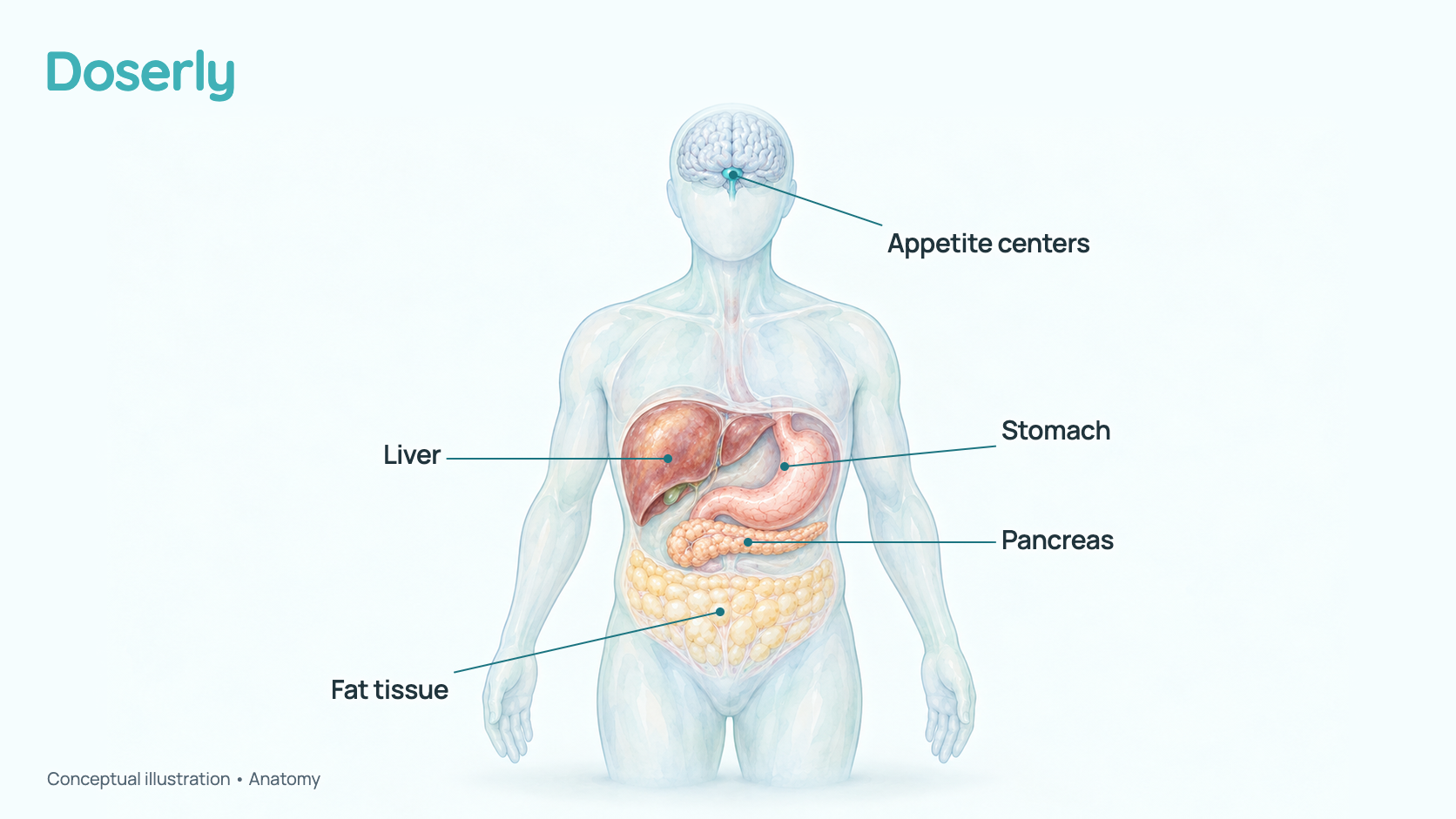
Retatrutide is discussed so widely because of its large phase 3 weight losses. TRIUMPH-1 and TRIUMPH-2 now have journal publications (see results). [137], [138]
| At a glance | |
|---|---|
| Other names | LY3437943, "reta"; sold online as "GLP-3" and similar labels |
| What it is | Triple GIP, GLP-1 and glucagon receptor agonist peptide |
| Developed for | Obesity, type 2 diabetes, knee osteoarthritis pain, sleep apnea, fatty liver, heart and kidney disease |
| How it is given in trials | Subcutaneous injection, once a week |
| Half-life | About 6 days |
| Status | Investigational everywhere; US application planned for early 2027 |
Outside trials, retatrutide is sold online as an unapproved "research use only" powder. Those vials are not the trial product. Lilly says retatrutide is "legally available only to participants in Lilly's clinical trials", and the FDA says it cannot be used in compounding. [2], [8]
Typical Retatrutide Protocols
| Example | Starting dose | Dose steps (every 4 weeks) | Weekly dose after the steps | Duration |
|---|---|---|---|---|
| Low · 4 mg · TRIUMPH-1, TRIUMPH-2 and TRANSCEND-T2D-1 4 mg groups | 2 mg for 4 weeks | 4 mg from week 5 | 4 mg | 80 weeks in TRIUMPH-1 and -2; 40 weeks in TRANSCEND-T2D-1 19.0% average weight loss at 80 weeks in TRIUMPH-1; 4.1% stopped for side effects |
| Mid · 9 mg · TRIUMPH-1 to -4 9 mg groups | 2 mg for 4 weeks | 4 mg, then 6 mg | 9 mg from week 13 | 80 weeks (68 weeks in TRIUMPH-4) 25.9% average weight loss at 80 weeks in TRIUMPH-1; 6.9% stopped for side effects |
| High · 12 mg · TRIUMPH-1 to -4 12 mg groups | 2 mg for 4 weeks | 4 mg, then 6 mg, then 9 mg | 12 mg from week 17 | 80 weeks (68 weeks in TRIUMPH-4) 28.3% average weight loss at 80 weeks in TRIUMPH-1; 11.3% stopped for side effects |
| High · 12 mg, phase 2 ladder · phase 2 obesity trial | 2 mg for 4 weeks | 4 mg, then 8 mg | 12 mg from week 13 | 48 weeks The schedule most dosing websites copy; 24.2% average weight loss at 48 weeks; 16% stopped for side effects |
The most common pattern in the trials, and in the dosing references that copy them, is 2 mg once a week to start, raised every 4 weeks to a target of 4, 9 or 12 mg once a week, and then continued without a break. [15], [2], [16], [17]
- Titration Raising the dose in steps
- Every phase 3 trial started at 2 mg and stepped up every 4 weeks through 4, 6 and 9 mg until the assigned target, so 4 mg is reached at week 5, 9 mg at week 13 and 12 mg at week 17. The phase 2 obesity trial used 2, 4, 8 and then 12 mg. When phase 2 started people at 4 mg instead of 2 mg, nausea was about twice as common (36% versus 18% on 4 mg), and phase 3 kept the 2 mg start. Doses could be lowered for side effects or if weight fell too far. [2], [3], [6], [15]
- Breaks and cycles
- Not studied. The phase 2 and phase 3 trials gave retatrutide continuously for 36 to 104 weeks with no planned breaks, and none has reported what happens after the last dose (see stopping). A trial of stopping versus continuing, TRIUMPH-6, is expected to report around 2028. No trial has published a rule for missed or late doses. [2], [18]
Read the units: doses are in milligrams (mg), and each weekly dose is also the weekly total. Trial participants injected a measured dose of the company's own product. Syringe units only come up with "research" vials that are mixed with water; see how units convert.
These are the dose groups of clinical trials, kept exactly as each trial ran them. Low, mid and high are alternatives tested in different people, not steps to climb, and no regulator has approved retatrutide at any dose. [7]
Strong cautions before reading further. Up to 18.2% of people on 12 mg stopped because of side effects in one phase 3 trial, versus 4.0% on placebo. The phase 2 trial excluded people with a resting heart rate over 100, fast heart-rhythm conditions such as atrial fibrillation, past pancreatitis, a personal or family history of medullary thyroid cancer, pregnancy and breastfeeding, and anyone under 18. Retatrutide has never been tested alongside tirzepatide, semaglutide or cagrilintide, and vials sold online have tested far from their labeled strength. [5], [6], [9]
Where schedules differ: ladders, lower starts, split doses, stacks, cycling and stopping ↓
Where these numbers come from
Every row is one trial group's complete schedule. The three TRIUMPH rows come from Lilly's descriptions of TRIUMPH-1 to -4: "Participants randomized to retatrutide initiated treatment with 2 mg once weekly and increased the dose in a step-wise approach every four weeks until reaching the target dose of 4 mg (via one step at 2 mg), 9 mg (via steps at 2 mg, 4 mg and 6 mg) or 12 mg (via steps at 2 mg, 4 mg, 6 mg and 9 mg)." The TRIUMPH design paper confirms the 4-week steps and allows dose reductions for side effects or excessive weight loss. TRANSCEND-T2D-1 used the same ladder for 40 weeks. The results in the notes are company-reported (efficacy estimand) for TRIUMPH-1, and peer reviewed for phase 2. [2], [3], [5], [15], [4]
The phase 2 row comes from the published trial and its appendix, which list the doses at weeks 0, 4, 8 and 12 as 2, 4, 8 and 12 mg for the 12 mg group; 10 of its 62 people (16%) stopped because of side effects. The phase 2 trial also tested 1 mg with no steps and 4 mg and 8 mg with a 2 mg or 4 mg start; those groups are discussed in the next section. [6]
Dosing websites were cross-checks only. Of 27 pages reviewed, most copy either the phase 2 ladder (2, 4, 8, 12 mg) or the phase 3 ladder (2, 4, 6, 9, 12 mg), and the most common starting dose they state is 2 mg a week. Pages that invent lower starts, split the weekly dose, add cycles or set their own maximum did not shape the table; they are shown separately in the next section with what is wrong or untested in each. [17], [16], [19], [20], [21], [22]
What is retatrutide commonly used for?
Most people look into retatrutide for weight loss. Lilly is also testing it for type 2 diabetes, knee arthritis pain, sleep apnea, fatty liver disease, chronic low back pain, and heart and kidney disease in people with excess weight. Online, it is also promoted for "recomposition" (losing fat while keeping muscle), cutting before competitions and low-dose "metabolic health" plans, none of which has been studied. [2], [3], [23], [24], [25], [26]
None of these is an approved use. The results below come from trials of the company's own product in adults who met strict entry rules and were monitored closely; an online vial is a different situation.
Weight loss
This is where the evidence is strongest. In the phase 2 trial, 338 adults with obesity or overweight and no diabetes took retatrutide or placebo for 48 weeks. Average weight fell by 8.7% on 1 mg, 17.1% on 4 mg, 22.8% on 8 mg and 24.2% on 12 mg, versus 2.1% on placebo. On 12 mg, 83% lost at least 15% of their weight, and weight was still falling when the trial ended. [6]
The phase 3 trials were larger and longer. TRIUMPH-1 randomly assigned 2,339 adults with obesity or overweight and a weight-related health problem, but no diabetes, to retatrutide or placebo for 80 weeks. The journal paper reports average weight losses of 17.6% on 4 mg, 23.7% on 9 mg and 25.0% on 12 mg, versus 3.9% on placebo, using the treatment-regimen analysis. [137]
Lilly’s efficacy analysis estimates what would happen if participants remained on treatment without prohibited weight-management therapies. It gives losses of 19.0%, 25.9% and 28.3%, versus 2.2%, and estimates that 45.3% of the 12 mg group lost at least 30%. These are not simply measurements in people who completed treatment; both analyses use assumptions to address missing data. [2]
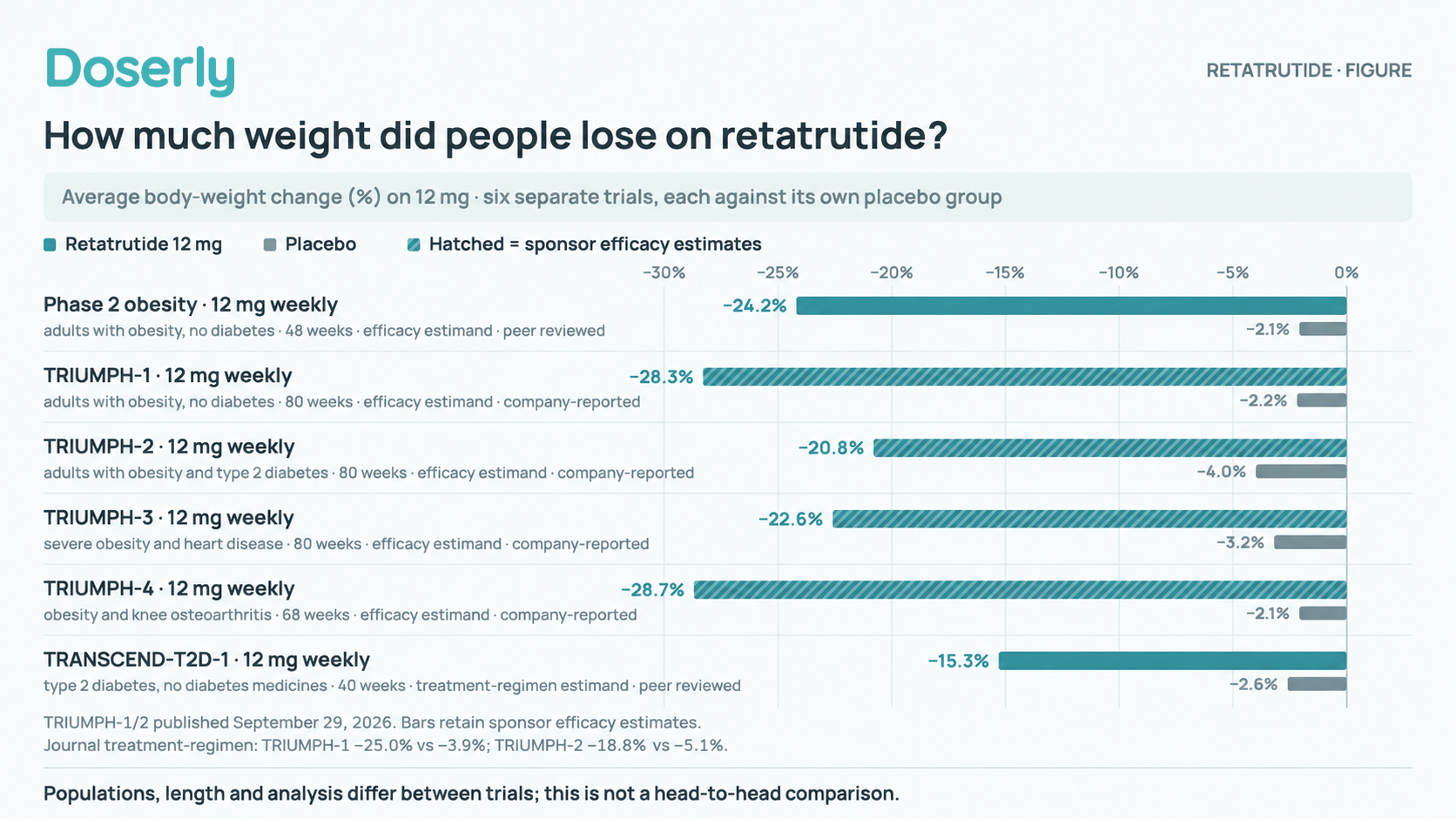
How much weight did people lose on retatrutide?
Average body-weight change (%) on 12 mg; each row has its own placebo group.
- Phase 2 obesity · 12 mg weekly
- adults with obesity, no diabetes · 48 weeks · efficacy estimand (as if everyone stayed on treatment) · peer reviewed. Retatrutide −24.2%; placebo −2.1%.
- TRIUMPH-1 · 12 mg weekly
- adults with obesity, no diabetes · 80 weeks · efficacy estimand (as if everyone stayed on treatment) · company-reported. Retatrutide −28.3%; placebo −2.2%.
- TRIUMPH-2 · 12 mg weekly
- adults with obesity and type 2 diabetes · 80 weeks · efficacy estimand (as if everyone stayed on treatment) · company-reported. Retatrutide −20.8%; placebo −4.0%.
- TRIUMPH-3 · 12 mg weekly
- severe obesity and heart disease · 80 weeks · efficacy estimand (as if everyone stayed on treatment) · company-reported. Retatrutide −22.6%; placebo −3.2%.
- TRIUMPH-4 · 12 mg weekly
- obesity and knee osteoarthritis · 68 weeks · efficacy estimand (as if everyone stayed on treatment) · company-reported. Retatrutide −28.7%; placebo −2.1%.
- TRANSCEND-T2D-1 · 12 mg weekly
- type 2 diabetes, no diabetes medicines · 40 weeks · treatment-regimen estimand (all randomized participants, regardless of adherence) · peer reviewed. Retatrutide −15.3%; placebo −2.6%.
TRIUMPH-1/2 were published on September 29, 2026. The bars retain sponsor efficacy estimates, assuming continued treatment without prohibited weight-management therapies. The journal treatment-regimen analyses include all randomized participants regardless of adherence: TRIUMPH-1 −25.0% versus −3.9% with placebo; TRIUMPH-2 −18.8% versus −5.1%, both at 12 mg. These are separate analyses, not replacements for the plotted sponsor values.
Average weight change on the highest dose in each retatrutide trial; populations, length and analysis differ, so this is not a head-to-head comparison.
Results differed by who took part. In the sponsor efficacy analyses, people with type 2 diabetes lost 20.8% on 12 mg in TRIUMPH-2, and people with severe obesity and heart disease lost 22.6% on 12 mg in TRIUMPH-3. In TRIUMPH-1’s extension, 532 participants with a starting BMI of at least 35 who had completed 80 weeks without stopping or permanently reducing their dose continued toward a maximum tolerated dose of 9 or 12 mg. Those originally assigned to 12 mg reached 30.3% average weight loss at 104 weeks in the efficacy analysis. This selected extension does not describe everyone who starts treatment or what happens after stopping. [139], [3], [2]
Type 2 diabetes
Retatrutide lowers blood sugar as well as weight. In TRANSCEND-T2D-1, 537 adults with type 2 diabetes not treated with any diabetes medicine took retatrutide or placebo for 40 weeks. HbA1c, a blood test that reflects average blood sugar over about three months, fell by 1.69, 1.86 and 1.94 points on 4, 9 and 12 mg, versus 0.81 on placebo, and weight fell by 11.5%, 13.9% and 15.3%, versus 2.6%. No severe low blood sugar was reported. [4]
In the phase 2 diabetes trial, the 12 mg group and one 8 mg group lowered HbA1c more than dulaglutide (an approved GLP-1 medicine) at 24 weeks, and in TRIUMPH-2, in people with diabetes and obesity, Lilly’s efficacy analysis reported an HbA1c fall of up to 1.6 percentage points over 80 weeks, versus 0.2 with placebo. [27], [139]
Knee arthritis pain
In TRIUMPH-4, 445 adults with obesity and painful knee osteoarthritis took 9 mg, 12 mg or placebo for 68 weeks. Pain on a standard 0-to-10 questionnaire (WOMAC) fell by 4.4 to 4.5 points on retatrutide (12 and 9 mg), from a starting average of 6.0, versus 2.4 points on placebo. In an analysis the company added afterwards, 12.0% to 14.1% of people on retatrutide were completely free of knee pain at the end, versus 4.2% on placebo. [5] The TRIUMPH-1 paper also reports a subgroup of 574 participants with knee osteoarthritis: WOMAC pain fell by 4.1 points on 12 mg versus 2.5 with placebo at 80 weeks in the intention-to-treat analysis. [137]
Sleep apnea
The TRIUMPH-1 paper includes 243 participants with obstructive sleep apnea. At 80 weeks, breathing pauses during sleep (the apnea-hypopnea index, AHI) fell by 32.1 events an hour in the 12 mg group versus 9.6 with placebo in the intention-to-treat analysis. This is a subgroup result, not evidence that everyone with sleep apnea will respond or can stop their existing treatment. [137]
Fatty liver (MASLD)
Fatty liver disease is now called MASLD (metabolic dysfunction-associated steatotic liver disease): too much fat in the liver, usually alongside excess weight or high blood sugar. In 98 people from the phase 2 obesity trial who started with at least 10% liver fat, fat measured by MRI fell by 42.9%, 57.0%, 81.4% and 82.4% on 1, 4, 8 and 12 mg after 24 weeks, versus a 0.3% rise on placebo. On 12 mg, 86% ended with normal liver fat (under 5%). [29]
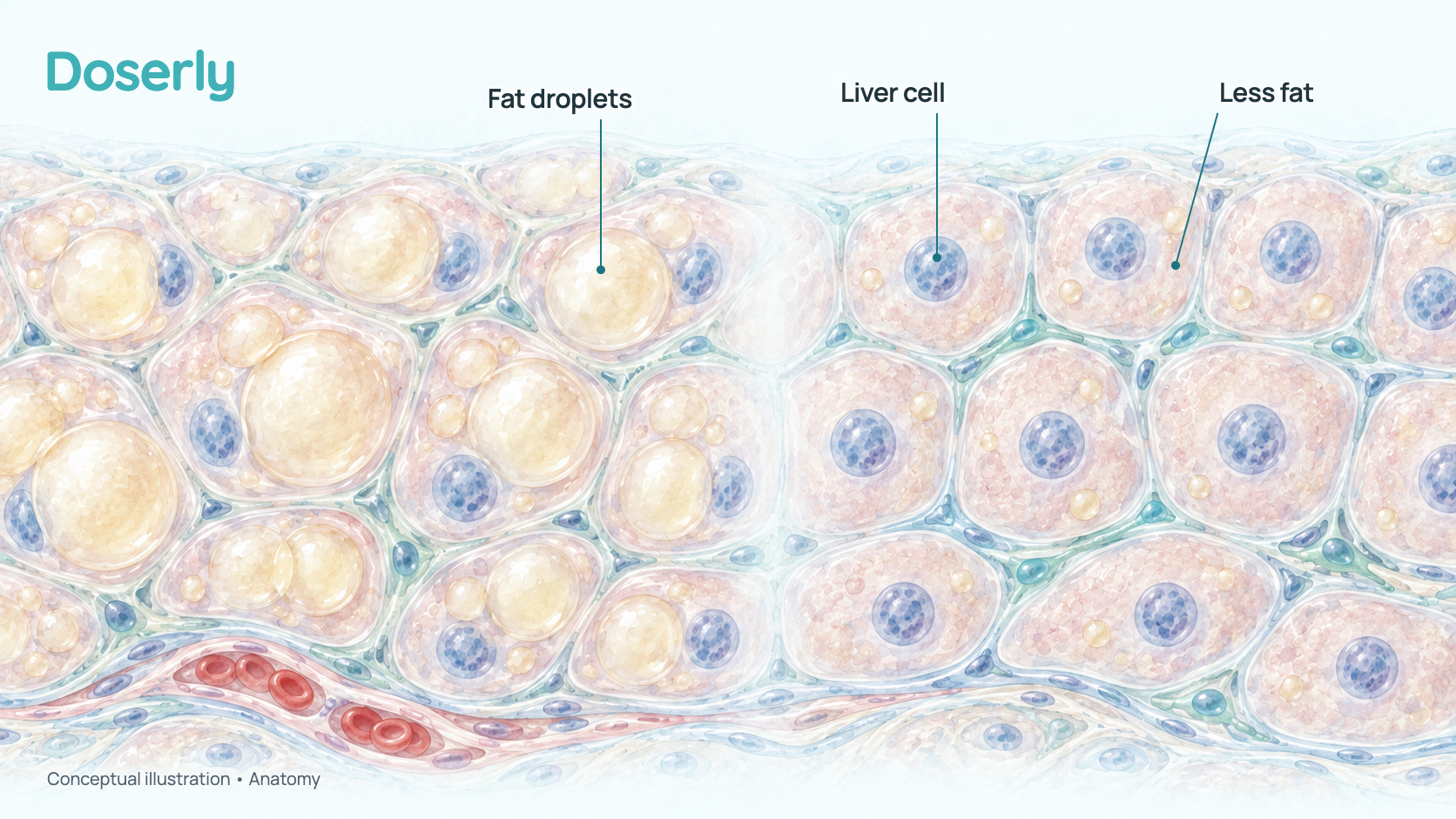
A figure of "86% less liver fat" is sometimes quoted; 86% is actually the share of people on 12 mg who reached normal liver fat, and the average fall was 82.4%. [29] Liver fat on MRI is not the same as inflammation or scarring on a biopsy, and no retatrutide biopsy trial has reported. A large phase 3 liver study, which includes retatrutide among several drugs, is recruiting. [30]
Heart, kidney and blood pressure
Retatrutide improves several heart risk markers, but it has not been shown to prevent heart attacks or strokes. In TRIUMPH-3, 1,949 adults with severe obesity and existing heart or blood-vessel disease took 9 mg, 12 mg or placebo for 80 weeks. Major heart events were uncommon in both groups (44 versus 52 of the broader type, 27 versus 23 of heart attack, stroke or heart death), and the trial was not large enough to show benefit or harm. A 10,000-person outcome trial designed to answer that question is expected to finish in 2029. [3], [24]
- Blood pressure. Systolic blood pressure fell by up to 12.3 mmHg in TRIUMPH-1 and 14.0 mmHg in TRIUMPH-4. In phase 2, the trial reported that 41% (8 mg) and 30% (12 mg) of participants stopped at least one blood pressure medicine. [28], [5], [6]
- Blood fats. Triglycerides fell by up to 41.0% and non-HDL cholesterol by 24.2% in TRIUMPH-1. A later analysis of the phase 2 trials found ApoB, a marker of the particles that carry cholesterol into artery walls, fell by up to 24.2%. [28], [31]
- Kidneys. In a later analysis of the two phase 2 trials, albumin in the urine (an early sign of kidney strain) fell by 28% to 37% on 8 or 12 mg compared with placebo, and filtration measures stayed stable or rose. A kidney trial in 146 people with chronic kidney disease has finished, with no results posted yet. [32], [33]
Studies still under way
The registered studies below had no posted results at the September 24, 2026 review. Separately, TRIUMPH-2 was published in The Lancet on September 29; it is no longer an upcoming presentation. [34], [18], [24], [35], [36], [138]
TRIUMPH-5: retatrutide versus tirzepatide (phase 3)
About 800 adults with obesity, randomly assigned to retatrutide or tirzepatide, with the main weight result at 80 weeks; the whole study lasts about 89 weeks. This is the first head-to-head comparison with an approved drug in obesity.
Active, not recruiting · main results expected November 2026 · no results posted · last update July 2026
[34]TRIUMPH-6: what happens when retatrutide is stopped (phase 3b)
About 643 adults take retatrutide for 80 weeks, then are randomly assigned to continue, switch to a different dose or switch to placebo for 36 more weeks.
Active, not recruiting · main results expected April 2028 · no results posted · last update March 2026
[18]Heart and kidney outcomes (phase 3)
About 10,000 adults with a BMI of 27 or more and heart disease, kidney disease or both, followed for about 5 years to see whether retatrutide lowers serious heart and kidney events.
Active, not recruiting · main results expected February 2029 · no results posted · last update September 2026
[24]Retatrutide versus semaglutide in type 2 diabetes (phase 3)
About 1,250 adults with type 2 diabetes on metformin, with or without an SGLT2 inhibitor (a class of diabetes pills), randomly assigned to one of two retatrutide doses or semaglutide, open label.
Active, not recruiting · primary completion estimated August 2026 · no results posted as of September 24, 2026 · last update April 2026
[35]Where do retatrutide protocols differ?
The trial schedules are simple: start at 2 mg and step up every 4 weeks. The confusion comes from two different trial ladders, much lower starts used outside trials, split doses, a debate over the top dose, switching from other drugs, stacks, cycling and stopping.
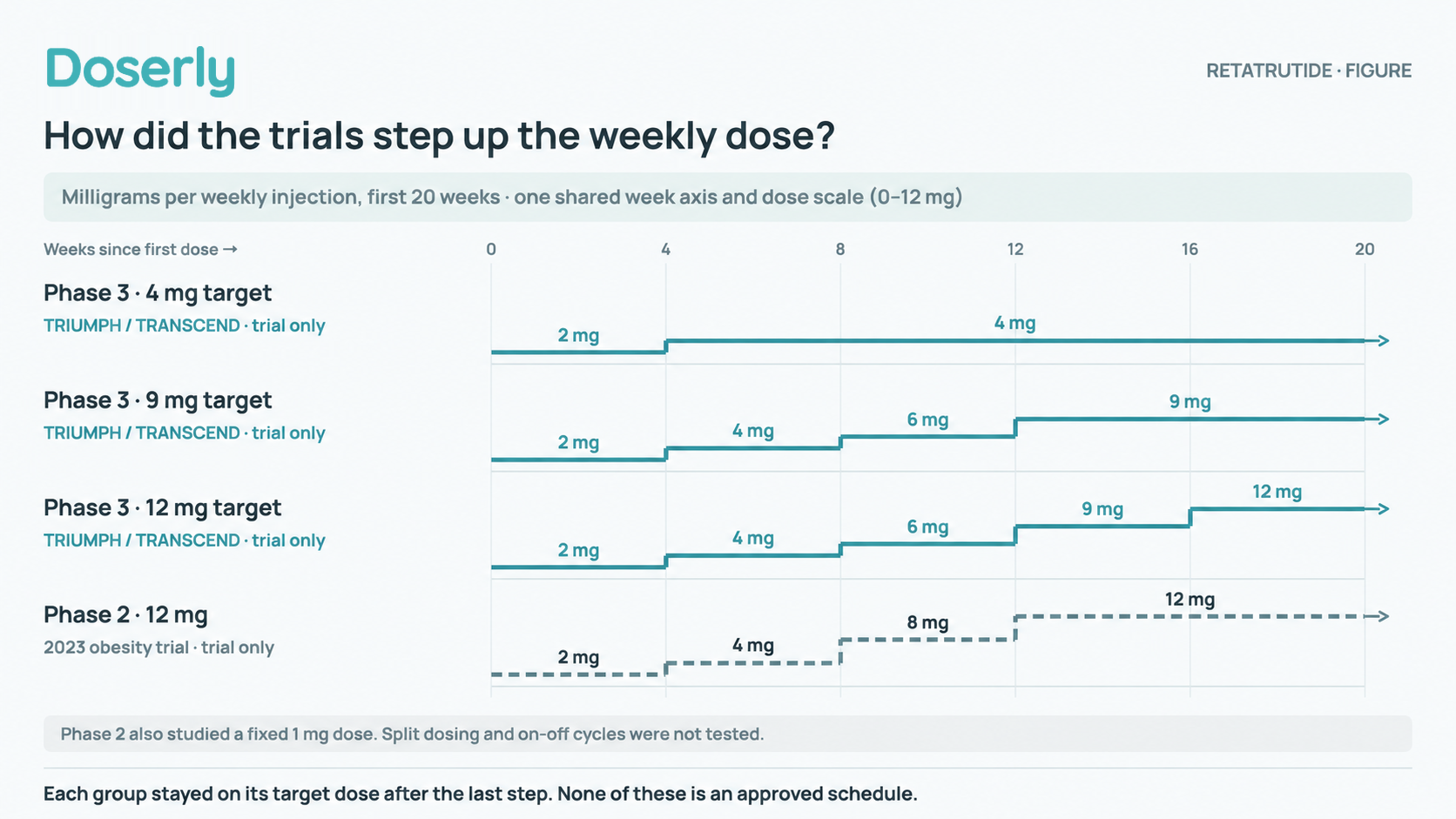
How did the trials step up the weekly dose?
Milligrams per weekly injection over the first 20 weeks; each group then stayed on its target.
- Phase 3 · 4 mg target · Trial only
- 2 mg weeks 1–4; 4 mg from week 5.
- Phase 3 · 9 mg target · Trial only
- 2 mg weeks 1–4; 4 mg weeks 5–8; 6 mg weeks 9–12; 9 mg from week 13.
- Phase 3 · 12 mg target · Trial only
- 2 mg weeks 1–4; 4 mg weeks 5–8; 6 mg weeks 9–12; 9 mg weeks 13–16; 12 mg from week 17.
- Phase 2 · 12 mg · Trial only
- 2 mg weeks 1–4; 4 mg weeks 5–8; 8 mg weeks 9–12; 12 mg from week 13.
Phase 2 also studied a fixed 1 mg dose. Split dosing and on-off cycles were not tested.
The phase 3 ladder steps 2, 4, 6, 9 and 12 mg every 4 weeks and stops at the assigned target; none of these is an approved schedule.
Phase 2 ladder or phase 3 ladder?
Both are real, and they are different. The phase 2 obesity trial reached 12 mg through 2, 4 and 8 mg, arriving at week 13. The phase 3 TRIUMPH trials added a 6 mg and a 9 mg step, arriving at 12 mg at week 17, and used 9 mg rather than 8 mg as the middle target. [6], [2]
The slower phase 3 ladder followed from what phase 2 found about starting doses. Stomach side effects "occurred primarily during dose escalation" and were "partially mitigated with a lower starting dose". On 8 mg, 60% of people who started at 4 mg had nausea, versus 17% of those who started at 2 mg. The authors wrote that further refining the ladder "may improve the side-effect profile". [6]
| Phase 2 group (48 weeks) | Nausea | Vomiting | Stopped for side effects | Weight change |
|---|---|---|---|---|
| Placebo | 11% | 1% | 0% | −2.1% |
| 4 mg, started at 2 mg | 18% | 12% | 6% | −16.3% |
| 4 mg, started at 4 mg | 36% | 12% | 9% | −17.8% |
| 8 mg, started at 2 mg | 17% | 6% | 14% | −21.7% |
| 8 mg, started at 4 mg | 60% | 26% | 6% | −23.9% |
| 12 mg, started at 2 mg | 45% | 19% | 16% | −24.2% |
Dosing websites copy one ladder or both, and a few mix them up: one calls its 0.5 mg start "the Phase 2 TRIUMPH-1 protocol", and another says the "clinical trial starting dose" was 1 mg a week. Neither matches any trial. [25], [37], [6]
Why do so many people start below 2 mg?
Because outside trials, many people choose to go slower than the trials did, not because a trial tested it. Several dosing websites offer starts of 0.1 to 1.5 mg a week, sometimes with 2-week steps or a low ceiling of 3 mg. [26], [25], [37], [38], [39] In community education groups, the most common approach members describe is starting at 0.25 to 1 mg a week, holding each dose for 3 to 5 weeks, and raising it by about 0.5 mg only when weight loss stalls or side effects settle.
What the trials can say about low doses: in phase 2, a fixed 1 mg a week (no steps) produced 8.7% average weight loss at 48 weeks, and 0.5 mg a week in the diabetes trial produced 3.2% at 36 weeks, close to placebo. No trial has tested a slow climb from 0.25 or 0.5 mg, so there is no evidence on whether it reduces side effects, and there is nothing to show it is safer. [6], [27]
| Website schedule | Starting dose | Steps | Weekly dose at the top | Duration and breaks |
|---|---|---|---|---|
| Website claims | ||||
| Six-step low start | 0.5 mg a week, weeks 1–4 | 1, 2, 4 and 8 mg, each for 4 weeks | 12 mg from week 21 | Open-ended Wrongly labels this ladder as the phase 2 TRIUMPH-1 protocol |
| Low-start weekly ladder (0.5 → 1 → 2 → 4 or 8 mg) | 0.5 mg a week, weeks 1–2 | 1 mg (weeks 3–4), 2 mg (weeks 5–8) | 4 mg "target", 8 mg "advanced" | Open-ended Wrongly states that the trial starting dose was 1 mg a week |
| 0.5 mg three times a week, 8 weeks on, 8 weeks off | 0.5 mg three times a week | None | 0.5 mg three times a week (1.5 mg a week) | 8 weeks on, then 8 weeks off A separate cycling plan on the same website as the row above; no trial has tested cycling |
| Twice-weekly split of the phase 2 ladder | 1 mg twice a week (2 mg weekly) | 2, 4, then 6 mg per injection, every 4 weeks | 6 mg twice a week (12 mg weekly) | Open-ended Says itself that no trial has studied split doses; the numbers are the weekly doses divided by two |
| Slow climb to 3 mg | 0.5 mg a week | Up by 0.5 mg every 2 weeks | 3 mg | 6 to 9 months A seller's page; the ceiling is a quarter of the top trial dose |
| 8 mg ceiling | 1 mg for 1 week | 2 mg, 4 mg and 6 mg, each for 4 weeks or more | 8 mg maximum | 6 to 12 months Also suggests stacks with cagrilintide and BPC-157 |
| Third-party "label" ladder | 2.5 mg a week | 5 and 7.5 mg, each for 4 weeks | 10 mg | Not stated From export-only listings in a US label database submitted by a trading company; not an FDA approval and not Lilly's product |
These schedules describe what websites publish, not what was tested. Many pages copy each other, so repetition is not independent support. Recurring errors include wrong trial names and starting doses, dose charts that need more than one syringe at 12 mg, and storage advice that contradicts itself on the same page. [25], [37], [17], [43]
Is 12 mg the maximum, and is higher better?
12 mg a week is the highest dose used in the multi-week trials, and the extra benefit above 8 or 9 mg is small while side effects keep rising. In phase 2, 8 mg produced 22.8% weight loss and 12 mg 24.2%. In TRIUMPH-1, 9 mg produced 25.9% and 12 mg 28.3%, while stopping for side effects rose from 6.9% to 11.3%. In TRIUMPH-4, dysesthesia (skin pain or tingling) more than doubled from 9 mg to 12 mg. [6], [2], [5]
In community education groups, several educators advise stopping at 8 mg for this reason, and most members describe settling between 2 and 6 mg a week. That is a practical choice, not a tested one: TRIUMPH-1's 4 mg group, reached with a single step, lost 19.0% on average. [2] Stated maximums on dosing websites range from 3 to 12 mg. [38], [41], [17]
Once a week, or split into smaller doses?
Every trial used one injection a week. Retatrutide's half-life of about 6 days means blood levels change fairly slowly across the week. No study has measured blood levels, side effects or weight loss with split dosing. [1], [2]
Splitting is still common outside trials. In community education groups, many members inject half the weekly amount twice a week to smooth out nausea, skin sensitivity, heart rate or late-week hunger, while a minority find appetite control weaker and go back to weekly. One website publishes split tables while stating: "No clinical trial has directly studied split-dose or sub-2mg retatrutide." [40] Another warns that splitting "would build up drug levels unpredictably". [25] Neither claim has been tested.
Is there a "4 mg threshold" for the glucagon effect?
No study shows one. A belief that the glucagon part of retatrutide only "switches on" at 4 mg or more circulates in forums and community education groups, and people use it to justify stepping up. One public account describes planning doses around this belief, before the poster acknowledged it was uncertain. [44]
The trial data point the other way. Liver fat, the effect most often linked to the glucagon part, fell steadily with dose: 42.9% on 1 mg, 57.0% on 4 mg and about 81% to 82% on 8 and 12 mg. Weight loss also rose smoothly from 1 mg upward. There is no sign of a switch at a particular dose. [29], [6] In community education groups, one educator traced the belief to a misreading of an early-trial glucagon measurement and rejected it.
Switching from tirzepatide or semaglutide
No trial has tested switching, and there is no dose conversion. The phase 2 trial excluded anyone who had taken a GLP-1 medicine or other weight-loss drug in the previous 3 months, and a TRIUMPH-1 participant describes the same 90-day washout, so the trials say nothing about moving straight from Zepbound, Mounjaro, Wegovy or Ozempic. [6], [45]
Switching is still how many people start. Public accounts describe hunger returning and early weight gain after switching from tirzepatide, weaker appetite control after switching from Ozempic and, for others, a broken plateau. [46], [47], [48] Community education groups describe the same pattern, with advice on the gap between drugs ranging from none to several weeks and educators warning that milligrams of different drugs are not interchangeable.
Taking it with tirzepatide, cagrilintide or other peptides
No combination with retatrutide has been tested in people. Approved drugs in the same family carry the opposite instruction: the prescribing summary for Zepbound (tirzepatide) says it "should not be used with other tirzepatide-containing products or any GLP-1 receptor agonist medicines". [2]
Combinations are still common online. Websites sell or describe retatrutide with cagrilintide (an amylin-type peptide) as a mid-week add-on or a pre-mixed vial, and some suggest adding BPC-157. [49], [41] The only published evidence for the retatrutide and cagrilintide pairing is in obese rats. [50] Cagrilintide itself has been tested in people mainly as CagriSema, a combination with semaglutide (see the CagriSema guide). [51]
In community education groups, many members describe adding tirzepatide or cagrilintide mid-week, even though most educators there warn against it; reported problems include hours-long palpitations, stronger nausea and pre-mixed vials of unknown dose.
Do you need breaks or cycles?
No trial has tested cycling. The trials treated people continuously for up to 104 weeks. [2] One dosing website describes an "8 weeks on, 8 weeks off" cycle, and some forum advice promotes breaks to "reset" receptors; neither has evidence behind it. [37], [52] In community education groups, people who restarted at their old dose after a break of several weeks often describe strong side effects, and the usual advice there is to restart lower and step up again.
How do milligrams convert to syringe units?
Units appear only with freeze-dried vials that are mixed with water (reconstitution) and drawn into an insulin syringe. Syringe units measure volume, not drug. On a U-100 syringe, 100 units equal 1 mL, so the amount of retatrutide in each unit depends on how much water went into the vial. [53], [17]
For example, a 10 mg vial mixed with 2 mL of water holds 5 mg per mL. A 2 mg dose is then 0.4 mL, or 40 units, and a 4 mg dose is 80 units. The same vial mixed with 1 mL holds 10 mg per mL, so 2 mg is 20 units. Reading the unit numbers for one mix while using the other doubles or halves the dose. At 5 mg per mL, 12 mg would be 2.4 mL, more than two full syringes and more than one 10 mg vial. Doserly's reconstitution calculator works out the arithmetic for any vial and shows each step. [43], [53]
Mistakes are common. Public accounts include someone who injected a whole 10 mg vial as a first dose after mixing up syringe units and milligrams, and someone who followed a seller's instructions in units without ever knowing the concentration. [54], [55] Correct arithmetic also says nothing about whether the vial contains what its label claims (see research vials).
What happens when you stop retatrutide?
Nobody knows yet for people. No trial, paper or company announcement has reported what happens to weight, blood sugar or heart rate after retatrutide is stopped. [2], [6]
- What the trials did. The phase 2 trial had only a 4-week safety follow-up with no weight results. The TRIUMPH-1 extension kept people on the drug to 104 weeks, so its 30.3% result is on treatment, not after it. [6], [2]
- The trial that will answer it. TRIUMPH-6 gives everyone retatrutide for 80 weeks, then switches some people to placebo for 36 weeks. It is expected to report in 2028. [18]
- In similar drugs (context only). Across trials of GLP-1 medicines, people regained about 60% of the weight they had lost within a year of stopping. That is a different set of drugs and cannot be used as a retatrutide estimate. [56]
- How fast it leaves the body. With a half-life of about 6 days, blood levels would be expected to halve roughly every week after the last dose. The phase 2 trial asked women who could become pregnant to use birth control for 2 months after the last injection, and men for 4 months, periods it based on five half-lives plus a safety margin. [1], [6]
In public accounts, people who stopped describe hunger returning within weeks and some weight coming back, while others stay on a low dose indefinitely. [57] In community education groups, reported maintenance doses range from 0.25 to 3 mg, most often 1 mg a week or every 10 to 14 days, and few people report what happened months after stopping.
Tapering. No trial has compared tapering with stopping all at once, and no taper schedule has been published. Whether a lower "maintenance" dose keeps weight off is one of the questions TRIUMPH-6 is designed to answer. [18]
How is retatrutide given, and how long does it last in the body?
Retatrutide has only been given by injection in people. Every multi-week trial used one subcutaneous injection a week. No pill, nasal spray or patch has been tested in people. One Lilly blood-level study (finished 2024, no results posted) also gave it into a vein (intravenous) for research purposes. [58]
The half-life is about 6 days, measured in the first multiple-dose trial, and its pharmacokinetics were "dose proportional": double the dose gave roughly double the blood level. After a single dose, weight was still lower 43 days later. This long half-life is what allows weekly dosing, and it also means each new dose adds to what is left of the last one, so blood levels take several weeks to settle after each dose change. [1], [10]
The long half-life reflects the peptide's design. Retatrutide carries a fatty acid chain (a 20-carbon diacid on a short linker) attached to its 17th amino acid, and two of its building blocks (positions 2 and 20) are Aib, an amino acid not found in natural proteins. [11], [10]
Like other drugs in this family, retatrutide slows how fast the stomach empties, which contributes to fullness and nausea. In an early study, this effect was strongest after the first doses and faded with repeated dosing. [59]
Does the injection site matter?
Lilly ran a study comparing injections into the thigh, upper arm and abdomen in people with a high BMI, and another comparing two injection devices. Both finished in 2024 with no results posted, so there is no public answer yet. [58], [60]
Studies of blood levels in people with severe kidney disease and with liver impairment have also finished without posted results. [61], [62]
How should retatrutide be stored, and how long does it last?
Not established. Retatrutide has no approved label, and no regulator, trial paper or registry record has published the storage temperature, shelf life or in-use time of the trial product, or whether it comes as a pen, a prefilled syringe or a vial. [15], [7]
Dosing websites fill the gap with numbers that have no retatrutide testing behind them: keep mixed vials in the fridge at 2–8 °C and use them within 28 or 30 days, keep unopened powder for 18 to 24 months, and, on one page, both "do not freeze" and freeze liquid portions for 3 to 6 months. [43], [63], [39], [22] One calculator site says openly that its 4- to 6-week fridge window is not a retatrutide-specific stability measurement. [26] Treat any use-by period for a mixed "research" vial as unverified.
Storage also cannot fix a product that was wrong to begin with: three Australian "10 mg" vials held 5.13 mg, 16.5 mg and 19.0 mg. [9] Sellers also offer ready-filled "pens" of uncertain preparation, and one public account describes injection-site welts that began after months on such a pen. [64]
This guide does not cover mixing or injection technique; the Academy note below covers practical handling.
What do we actually know about retatrutide in people?
A lot, for an unapproved drug. More than 5,800 people took part in the four TRIUMPH obesity trials and 537 in TRANSCEND-T2D-1, on top of 736 in the published phase 1 and phase 2 trials. TRIUMPH-1 and TRIUMPH-2 were published on September 29, 2026, joining the early trials, phase 2 trials and TRANSCEND-T2D-1. The TRIUMPH-3 and TRIUMPH-4 results cited here come from Lilly’s announcements. [2], [3], [4], [6], [27], [137], [138]
In a randomized controlled trial, people are assigned by chance to the drug or a comparison such as a placebo, so differences between the groups can be credited to the drug. Every retatrutide trial below was randomized and placebo-controlled, and all were funded by Lilly. [6], [4]
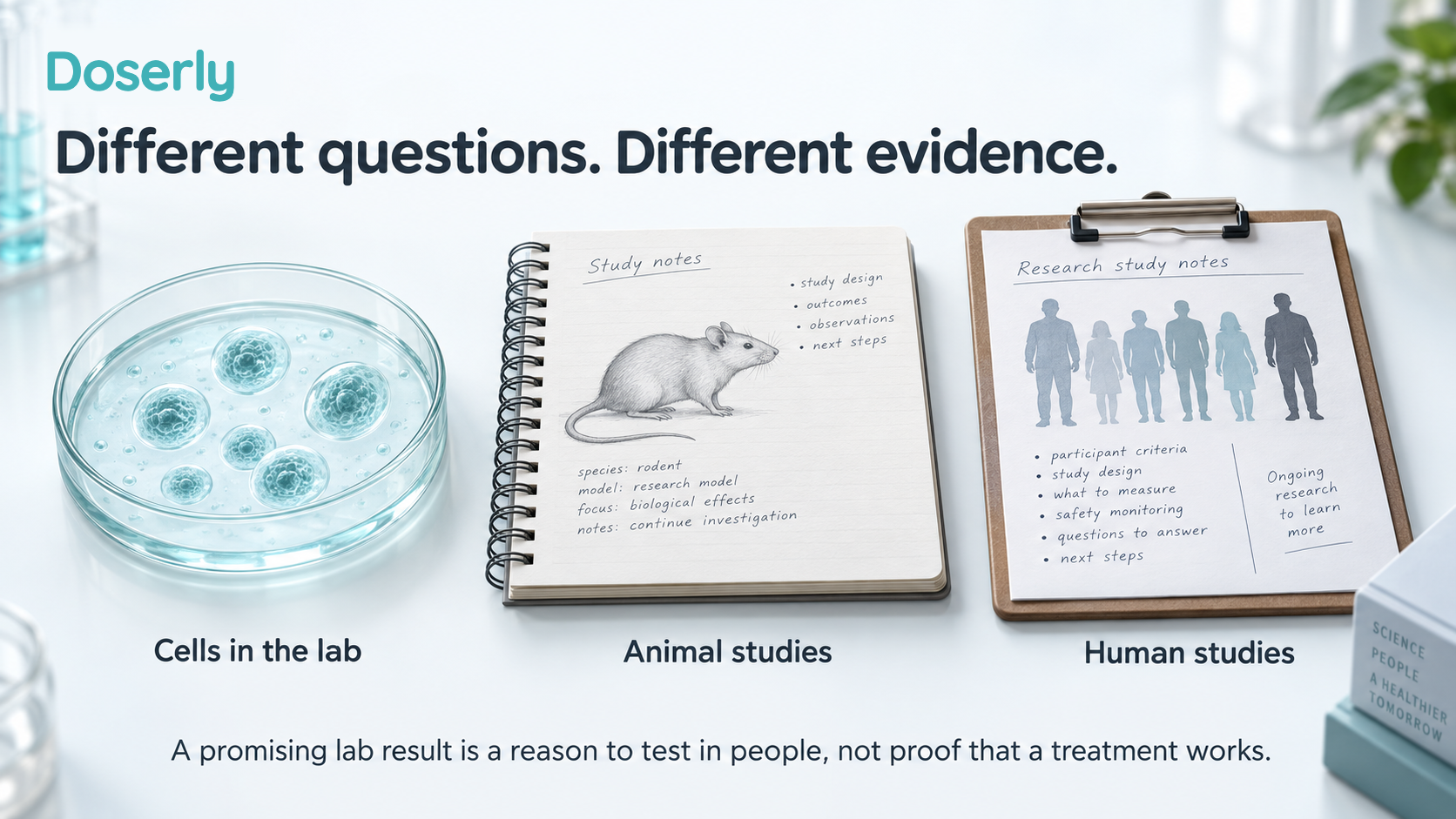
| Trial | Who and what | Main result | What it cannot show |
|---|---|---|---|
| Phase 1b (2022) | 72 adults with type 2 diabetes; up to 12 mg for 12 weeks | Half-life about 6 days; up to 8.96 kg more weight loss than placebo | Tiny groups, 12 weeks [1] |
| Phase 2 obesity (2023) | 338 adults without diabetes; 1 to 12 mg for 48 weeks | Weight −24.2% on 12 mg vs −2.1% | Mid-size, 48 weeks; no follow-up after stopping [6] |
| Phase 2 diabetes (2023) | 281 adults with type 2 diabetes; 0.5 to 12 mg vs placebo or dulaglutide, 36 weeks | HbA1c −2.02 points at 24 weeks on 12 mg; weight −16.94% at 36 weeks | Mid-size; US only [27] |
| TRANSCEND-T2D-1 (2026) | 537 adults with type 2 diabetes, no diabetes medicines; 4, 9 or 12 mg for 40 weeks | HbA1c −1.94 points vs −0.81; weight −15.3% vs −2.6% | People early in diabetes; 40 weeks [4] |
| TRIUMPH-1 (2026) | 2,339 adults with obesity or overweight, no diabetes; 4, 9 or 12 mg for 80 weeks | Weight −25.0% on 12 mg vs −3.9%; treatment-regimen analysis | Peer reviewed; selected trial population [137] |
| TRIUMPH-2 (2026) | 1,152 adults with overweight or obesity and type 2 diabetes; 80 weeks | Weight −18.8% on 12 mg vs −5.1%; treatment-regimen analysis | Peer reviewed; selected trial population [138] |
| TRIUMPH-3 (2026) | 1,949 adults with severe obesity and heart disease; 9 or 12 mg, 80 weeks | Weight −22.6% on 12 mg vs −3.2% | Company-reported; too small to judge heart events [3] |
| TRIUMPH-4 (2025) | 445 adults with obesity and knee arthritis; 9 or 12 mg, 68 weeks | Weight −28.7% on 12 mg vs −2.1%; knee pain −4.4 points on 12 mg (−4.5 on 9 mg) vs −2.4 | Company-reported [5] |
What do "efficacy" and "treatment-regimen" results mean?
They answer different questions (estimands). The efficacy estimand estimates outcomes if participants remained on treatment without prohibited weight-management therapies. The treatment-regimen estimand estimates outcomes in all randomized participants regardless of treatment adherence or use of those therapies. Both require assumptions about missing data; neither is simply a list of people who finished. On 12 mg in TRIUMPH-1, weight loss was 28.3% versus 2.2% with placebo in Lilly’s efficacy analysis, compared with 25.0% versus 3.9% in the journal’s treatment-regimen analysis. For TRIUMPH-2, the corresponding figures were 20.8% versus 4.0%, and 18.8% versus 5.1%. Keep each estimate with its own placebo comparison. [2], [137], [138], [139]
TRANSCEND-T2D-1's journal paper leads with the treatment-regimen figure (15.3% on 12 mg), while Lilly's announcement used the efficacy figure (16.8%). Both are correct; they measure different things. [4], [28] The phase 2 paper reports efficacy figures. [6]
Which phase 3 results have journal papers?
TRIUMPH-1 was published in the New England Journal of Medicine and TRIUMPH-2 in The Lancet on September 29, 2026. They add peer-reviewed phase 3 obesity evidence alongside TRANSCEND-T2D-1. This update checked the public primary abstracts, not the complete papers or supplements. The TRIUMPH-3 and TRIUMPH-4 figures used here remain attributed to Lilly’s topline announcements; this update does not independently validate their full datasets. [137], [138], [4], [3], [5]
Two details show why the registry is worth checking. Lilly's TRIUMPH-4 release lists the trial as NCT05869903, which is a different Lilly trial; TRIUMPH-4's registry number is NCT05931367. And the number of people enrolled differs slightly between Lilly's releases and the registry for TRIUMPH-1 (2,339 versus 2,335) and TRIUMPH-3 (1,949 versus 1,946). [5], [65], [66], [67] The TRIUMPH-1 registry still has no posted results tables, but it links to the September 29 journal paper; these are different forms of reporting. [66], [137]
A 2026 registry entry from an unrelated sponsor describes a "phase 2" retatrutide trial with the same internal study code as Lilly's completed phase 2 trial. The same sponsor has posted records that describe themselves as mock or fictional studies, so this entry is not counted here as a real trial. [68], [69]
Is the weight lost fat or muscle?
Mostly fat, in the one body-scan study. In 103 people with type 2 diabetes who had DXA scans (a low-dose X-ray that measures fat and lean mass) at the start and at 36 weeks, fat mass fell by 26.1% on 8 mg and 23.2% on 12 mg, versus 4.5% on placebo. The authors report that the share of weight lost as lean mass was "similar to other obesity treatments". [70]
That means retatrutide does lose some lean mass, as other weight-loss drugs do. Online claims that it "spares muscle" or "burns muscle" go further than the data: the study's published summary does not give lean mass by dose, and no retatrutide study has measured strength. In obese mice, retatrutide reduced both fat and lean mass. [70], [71]
What else changed in the trials?
- Blood sugar in people without diabetes. In phase 2, 72% of people with prediabetes on retatrutide had normal blood sugar at 48 weeks, versus 22% on placebo. [6]
- Appetite. In the phase 2 diabetes trial, people on 4 mg or more reported less hunger and overall appetite than on placebo, and less tendency to overeat on 8 and 12 mg. [72]
- Inflammation. hs-CRP, a blood marker of inflammation, fell by 54.8% in people without diabetes in a later analysis of phase 2. [31]
- Liver tests. In phase 2, average liver enzymes (ALT and AST) stayed the same or fell. [6]
These are measured changes in trial participants. They do not yet show fewer heart attacks, strokes or kidney failures; that is what the outcome trial is testing. [24]
How does retatrutide work?
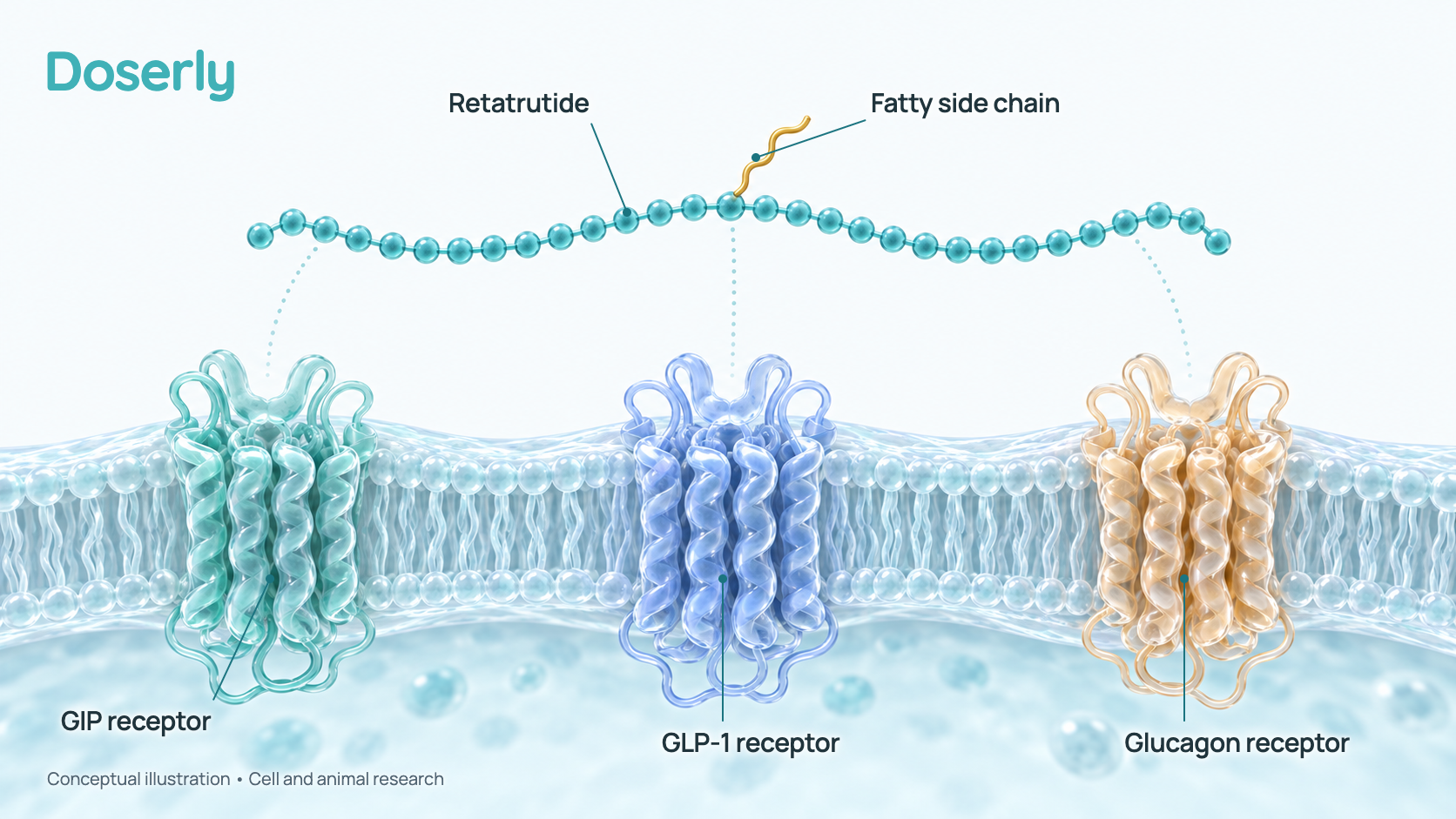
Retatrutide switches on three receptors: the GIP receptor, the GLP-1 receptor and the glucagon receptor. That is measured in cells engineered to carry each human receptor. What each receptor contributes inside a person has not been separated: human trials measure the combined result (weight, blood sugar, liver fat, heart rate), not the share from each pathway. [10], [73]
How strong is it at each receptor?
In the original laboratory tests on human receptors, retatrutide was about 8.9 times as potent as natural GIP at the GIP receptor, about 0.4 times as potent as natural GLP-1 at the GLP-1 receptor, and about a third as potent as natural glucagon at the glucagon receptor. [10]
Other ratios circulate online (for example twice GIP, half GLP-1 and a fifth of glucagon); they do not match the published human-receptor data. Either way, a potency ratio measured in a dish is not a dose level in people: it cannot tell you what happens at 2 mg versus 8 mg. [10]
What does each part do?
- GLP-1 side. Works like semaglutide: lowers appetite, slows the stomach and helps the pancreas release insulin when blood sugar is high. As with other GLP-1 drugs, it is thought to drive much of the appetite effect and the nausea. [10], [59]
- GIP side. Works with GLP-1 on insulin release, as in tirzepatide. Retatrutide is especially strong at this receptor in lab tests. [10]
- Glucagon side. Glucagon tells the liver to release stored energy and burn fat. In obese mice, adding glucagon activity increased energy use on top of the lower food intake from the other two receptors. In people, the large falls in liver fat and changes in blood fats and fat-burning markers fit this idea. [10], [29], [74]
The glucagon idea has limits. In a 2026 study in obese mice, retatrutide did not change energy use significantly, and a human study measuring calorie intake and energy use has finished without posted results. [71], [75] In human liver cells, retatrutide and glucagon both lowered a protein (ANGPTL3/8) that raises blood fats, and blocking the glucagon receptor stopped the effect, which offers one explanation for the falls in triglycerides and LDL cholesterol. [76]
Why does it raise heart rate?
Glucagon and GLP-1 can both speed up the heart. In isolated mouse heart tissue, retatrutide sped up the natural pacemaker through the glucagon receptor, and in heart muscle strips taken from patients during heart surgery, it increased the force of contraction. These are lab findings in tissue, not measurements in living people. [77], [78], [6] The human heart-rate data are in the risks section.
What did animal studies show?
About a dozen short animal and cell studies report lower weight, liver fat and kidney scarring, with some findings, such as unchanged energy use, that go against the popular story; they are summarized in the research library. No long-term animal cancer, thyroid or reproduction studies have been published. [79], [80], [71], [81]
What are the risks and unanswered questions?
Is retatrutide safe?
In trials of up to 80 weeks, its main problems were stomach and bowel side effects, skin sensitivity, a faster heart rate and, in some people, low blood pressure; serious adverse events were somewhat more common than on placebo in the largest trial, full phase 3 safety tables were not reviewed for this update and long-term risks remain uncertain. Several thousand people have taken it under close monitoring. In TRIUMPH-1, serious adverse events were reported in 7.7% to 10.5% of people on retatrutide versus 5.5% on placebo, according to Lilly’s conference presentation. That attribution is retained here; this update did not reconcile it with the full journal safety tables. [136], [137] In the smaller phase 2 obesity trial, the rate was 4% on both retatrutide and placebo, though a few serious events, such as pancreatitis and severe vomiting, were judged related to the drug. Products sold outside trials add risks of their own, including wrong doses, contamination and fakes. [6], [4], [2], [82]
What are the most common side effects?
Nausea, diarrhea, vomiting, constipation and lower appetite, generally more common on higher doses and mostly while the dose is rising. In TRANSCEND-T2D-1 they were mostly mild to moderate and "subsided over time". [6], [4]
| Trial and group | Nausea | Diarrhea | Vomiting | Constipation | Stopped for side effects |
|---|---|---|---|---|---|
| Phase 2 obesity, placebo (48 weeks) | 11% | 11% | 1% | 3% | 0% |
| Phase 2 obesity, 12 mg | 45% | 15% | 19% | 16% | 16% |
| TRIUMPH-1, placebo (80 weeks) | 14.8% | 13.5% | 4.8% | 10.9% | 4.9% |
| TRIUMPH-1, 4 mg | 28.6% | 25.2% | 10.6% | 23.8% | 4.1% |
| TRIUMPH-1, 9 mg | 38.4% | 34.1% | 22.8% | 25.9% | 6.9% |
| TRIUMPH-1, 12 mg | 42.4% | 32.0% | 25.3% | 26.1% | 11.3% |
| TRIUMPH-4, placebo (68 weeks) | 10.7% | 13.4% | 0.0% | 8.7% | 4.0% |
| TRIUMPH-4, 12 mg | 43.2% | 33.1% | 20.9% | 25.0% | 18.2% |
| TRANSCEND-T2D-1, placebo (40 weeks) | 3.7% | 4.5% | 2.2% | not reported | 0.0% |
| TRANSCEND-T2D-1, 12 mg | 26.5% | 22.8% | 17.6% | not reported | 5.1% |
Stopping for side effects varied a lot between trials. Lilly says the TRIUMPH-4 rates "included discontinuations for perceived excessive weight loss" and were lower in people with a starting BMI of 35 or more (12.1% on 12 mg). [5] Other reported effects include fatigue (10% on 12 mg in phase 2), urinary tract infections (8.4% on 12 mg versus 5.3% in TRIUMPH-1), injection-site reactions and allergic-type reactions. [6], [2]
Skin pain, tingling or sensitivity (dysesthesia)
This is the side effect most specific to retatrutide. Dysesthesia means unpleasant or painful skin sensations: skin that hurts to touch, burning, tingling, or clothes and sheets feeling painful. In the phase 3 trials it affected:
- TRIUMPH-1: 5.1%, 12.3% and 12.5% on 4, 9 and 12 mg, versus 0.9% on placebo. [2]
- TRIUMPH-4: 8.8% and 20.9% on 9 and 12 mg, versus 0.7%. [5]
- TRIUMPH-2 and -3: 4.5% to 7.3%, versus 0.7% to 1.3%. [3]
Lilly describes these events as generally mild to moderate, mostly resolving during treatment, and rarely leading people to stop. In phase 2, skin-sensitivity events affected 13% on 12 mg versus 1% on placebo; none was severe or came with visible skin changes, and 16 of 20 had resolved by the end of follow-up. [2], [5], [6] What causes it is not known.
Does retatrutide raise heart rate?
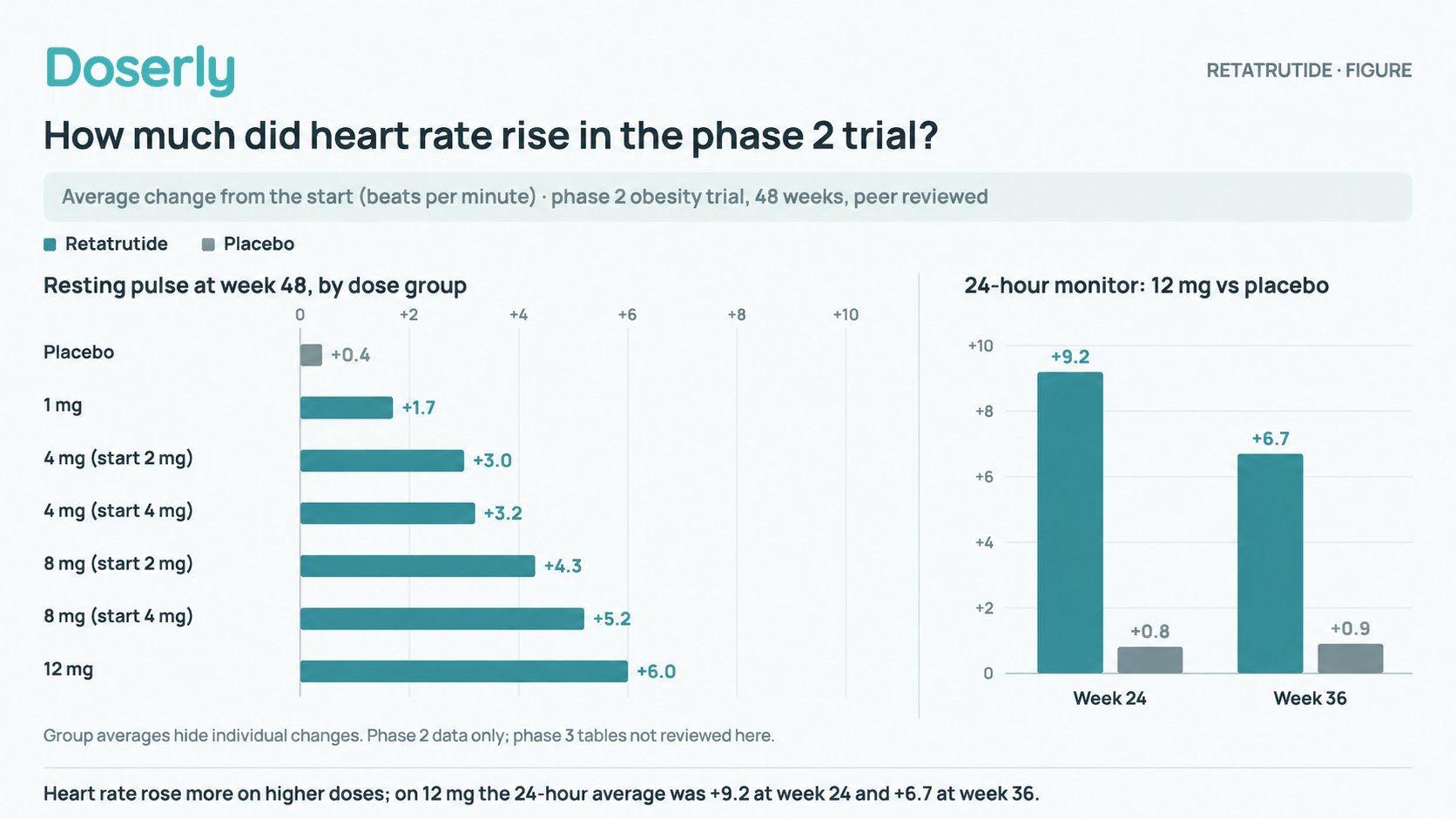
Yes, on average by a few beats per minute, more on higher doses and most in the first months. In phase 2, resting pulse at 48 weeks rose by 1.7 beats per minute on 1 mg and 6.0 on 12 mg, versus 0.4 on placebo. On 24-hour monitors, the 12 mg group's average heart rate was up 9.2 beats per minute at week 24, falling to 6.7 at week 36. The authors describe the rise as peaking at 24 weeks and declining afterwards. [6]
How much did heart rate rise in the phase 2 trial?
Average change from the start in beats per minute; phase 2 obesity trial, peer reviewed.
- Placebo · resting pulse, week 48
- +0.4 beats per minute on average.
- 1 mg · resting pulse, week 48
- +1.7 beats per minute on average.
- 4 mg (start 2 mg) · resting pulse, week 48
- +3.0 beats per minute on average.
- 4 mg (start 4 mg) · resting pulse, week 48
- +3.2 beats per minute on average.
- 8 mg (start 2 mg) · resting pulse, week 48
- +4.3 beats per minute on average.
- 8 mg (start 4 mg) · resting pulse, week 48
- +5.2 beats per minute on average.
- 12 mg · resting pulse, week 48
- +6.0 beats per minute on average.
- 24-hour monitor · week 24
- 12 mg +9.2; placebo +0.8 beats per minute on average.
- 24-hour monitor · week 36
- 12 mg +6.7; placebo +0.9 beats per minute on average.
Group averages hide individual changes. Phase 2 data only; phase 3 tables not reviewed here.
Heart rate rose more on higher doses; on 12 mg the 24-hour average was +9.2 at week 24 and +6.7 at week 36.
Heart-rhythm events were more common on the higher doses in phase 2: 11% of people on 12 mg had a heart-rhythm or conduction event (such as palpitations, a fast heart rate or extra beats), versus 3% on placebo. Across the whole trial there were 21 such events in 19 people; 20 were mild or moderate. The severe one was a prolonged QT interval (an electrical change on a heart tracing) in a woman on 12 mg whose severe vomiting, treated with the anti-nausea drug ondansetron, led to low potassium, dehydration, low blood pressure and a liver injury from poor blood flow. Everything resolved after the drug was stopped, and the investigator judged it related to retatrutide. [6] Figures such as "arrhythmias in 4–14% of users" that circulate online do not match any published trial.
Averages hide individual variation, and community reports describe larger, longer rises. The trials excluded people with a resting pulse over 100 or with frequent fast heart rhythms such as atrial fibrillation or postural orthostatic tachycardia syndrome (POTS, a fast heart rate on standing up), so there is no trial data for them. [6]
In TRIUMPH-3, in people with existing heart disease, major heart events were no more or less common than on placebo, with wide uncertainty either way. [3]
Pancreas, gallbladder and liver
- Pancreas. In phase 2, one person on the 12 mg schedule had acute pancreatitis 14 days in, while still on the 2 mg starting dose. Average blood levels of the pancreatic enzymes lipase and amylase rose by about 15% to 37% and 10% to 22% on retatrutide, mostly without symptoms. Regulators have strengthened pancreatitis warnings for approved drugs in this class. [6], [83]
- Gallbladder. Three phase 2 participants on 8 mg had gallbladder problems (one inflamed gallbladder that needed surgery, two with gallstones), versus none on placebo. Across trials of GLP-1 medicines, gallbladder and bile-duct disease is more common than on placebo. [6], [84]
- Liver. Average liver enzymes stayed the same or fell in phase 2, but 1% of people on retatrutide had a transient ALT rise to more than three times normal. [6]
The announcements and public abstracts checked for this update do not provide a complete assessment of pancreatitis, gallbladder and liver-enzyme events. The full phase 3 safety tables were not reviewed here. An event not described in these sources must not be interpreted as zero events. [2], [137], [138], [139]
Sleep, mood and energy
Phase 2 reported one case of depression or suicidal thoughts, on placebo, and none on retatrutide; the trials excluded people with recent major depression, any past suicide attempt or current suicidal thoughts. The phase 3 trials planned mood questionnaires, but their results were not verified in this update. [6], [15]
Fatigue affected 10% of people on 12 mg in phase 2, versus 4% on placebo. [6] Trouble sleeping is not listed among the common trial side effects, but it comes up often in community reports.
Low blood sugar
Low blood sugar was rare in the trials. Phase 2 obesity reported no clinically significant low blood sugar, and TRANSCEND-T2D-1 reported no severe episodes. [6], [4] The risk rises with insulin or sulfonylureas, as the labels of approved drugs in the class warn. [2] A published case describes a man with type 1 diabetes who became severely ill with vomiting, high ketones and kidney strain after using an online product sold as retatrutide during a gut infection, then had repeated low blood sugar while recovering. The authors could not say how much the product contributed. [85]
Low blood pressure
Blood pressure fell on average in the trials, which is usually welcome, but in TRIUMPH-1 low blood pressure (hypotension) was one of the most common adverse events of special interest, and it was more common in people already taking blood-pressure medicines. Lilly's presentation does not give its rate. [136]
Losing too much weight
In phase 2, 13 people on retatrutide (and 1 on placebo) saw their BMI fall to 22 or lower, and 8 had their dose reduced under the trial rules. Lilly says some TRIUMPH-4 participants stopped because of "perceived excessive weight loss". [6], [5] In community education groups, staying on a high dose after reaching a goal weight is described as a common mistake.
Thyroid
The trials excluded people with a personal or family history of medullary thyroid cancer or multiple endocrine neoplasia type 2 (MEN2, an inherited condition that raises the risk of that cancer), as approved GLP-1 medicines do. Phase 2 reported no medullary thyroid cancer or C-cell hyperplasia. [6], [15], [2] Average calcitonin rose by about 20% on 8 and 12 mg over 48 weeks but stayed within the normal range. [6] No long-term animal cancer study of retatrutide has been published. For GLP-1 medicines in general, large population studies disagree on whether thyroid cancer risk rises. [86], [87]
Are online "research" vials the same as trial retatrutide?
No. The trial product is made by Lilly for its trials. Vials sold online as "research use only" are unapproved, and what they contain is unknown:
- Wrong amounts. Three Australian vials labeled 10 mg contained 5.13 mg, 16.5 mg and 19.0 mg, from about half to nearly double the label. Sterility and bacterial toxins were not tested. [9]
- Wrong drug. Australia's regulator tested a "retatrutide" vial linked to a serious adverse event and found undeclared semaglutide and no retatrutide. A public account describes a vial sold as retatrutide that tested as tirzepatide. [88], [89]
- Liver injury. Victoria's Chief Health Officer reported six cases of acute liver injury since January 2026 in people using products labeled retatrutide, "possibly associated with a contaminant", and warned about all such products. [82]
- Other reports. The BMJ described 77 UK reports of suspected reactions to products sold as retatrutide, 59 of them serious and one a death, while noting that the circumstances are unclear and a report does not prove cause. [90]
Lilly says what is sold on the black market "is not a medicine – it is entirely unverified, unapproved and not worth the risk". [7] Dosing mistakes are a separate risk (see units).
Is retatrutide legal? Is it FDA approved?
Country overview checked September 24, 2026; US FDA status and the planned submission rechecked October 15, 2026. Rules differ by country and change often.
United States. Not FDA-approved as of October 15, 2026. The FDA states that retatrutide is not a component of an approved drug and has not been found safe and effective for any condition. Lilly continues to describe it as investigational. [8], [139]
- December 2024 onward. FDA warning letters to companies selling retatrutide as a "research" product, including products labeled "GLP-3 RT", most recently in August 2026. [91], [13]
- 2026. The FDA states that retatrutide "cannot be used in compounding under federal law" and that it has warned telehealth companies, ingredient distributors and outsourcing facilities. Its GLP-1 import alert (66-80) lets border staff hold GLP-1 drug ingredients from manufacturers that have not passed its quality checks; its "green list" of exempt firms includes a few overseas makers of ingredients described as retatrutide. That is a manufacturing check, not approval to sell retatrutide for human use. [8], [92]
- June 2026. Lilly opened a pre-approval expanded-access program for individual adults with a BMI of 35 or more and at least two serious obesity complications, whose obesity has not responded to the highest available dose of an approved weight-loss medicine and who cannot join a trial. This is not approval. [93]
- August 12, 2026. Lilly filed six lawsuits against US sellers, including a compounding pharmacy and medical spas. [7]
- First quarter of 2027. Lilly plans to submit a Biologics License Application to the FDA. That is a plan; a submission is not an approval. [139]
Retatrutide "labels" that appear in the US DailyMed database were submitted by an overseas trading company for export only; DailyMed notes that submitted labels may not have been verified by the FDA. [94], [95]
Canada. Not authorized. Health Canada's April 2026 warning about unauthorized injectable peptides names retatrutide. [96]
United Kingdom. Not authorized. The medicines regulator says retatrutide "has not been authorised for use in the UK" and that anyone selling it is doing so illegally, and it named retatrutide in its largest seizure of unlicensed weight-loss medicines in May 2026. [97], [98]
European Union. Not authorized. The European Medicines Agency agreed a plan for future studies in children in 2024, a development step, not an approval. [99], [7]
Australia. Not approved. Victoria issued its liver-toxicity alert in June 2026, the national regulator seized retatrutide among illegal peptides in August 2026 and reported a counterfeit in September 2026. [82], [100], [88]
Other countries. New Zealand's Medsafe describes it as "a potential medicine that is still being studied", and regulators in Colombia and Hong Kong have issued warnings naming it. [101], [102], [103]
A "research use only" label does not make any of these products legal to sell for human use. The FDA says such products are "of unknown quality and may be harmful". [8]
Is retatrutide banned in sport?
Athletes should treat it as banned. Retatrutide is not named on the World Anti-Doping Agency's 2026 or 2027 Prohibited Lists, but WADA's S0 category bans at all times any substance with no current approval for human therapeutic use, which describes retatrutide. It is not part of WADA's Monitoring Program, which tracks semaglutide and tirzepatide. [104], [105], [106] Tested athletes should confirm with their anti-doping organization.
Who should be especially cautious?
- Pregnancy and breastfeeding. Not studied. The phase 2 trial required birth control during the trial and for 2 months after the last dose for women (4 months for men), and excluded breastfeeding. [6]
- Under 18. Not studied; the EU children's study plan is deferred. [99]
- Excluded from the trials, so not studied: type 1 diabetes, past pancreatitis, recent gallbladder disease, a fast resting heart rate or frequent fast heart rhythms, a personal or family history of medullary thyroid cancer or MEN2, and recent major depression, suicidal thoughts or a past suicide attempt. [6], [15]
- Kidney or liver impairment. Blood-level studies are complete, but results are not public. [61], [62]
- Tested athletes and people taking other medicines. See the questions above and below.
Can retatrutide be taken with other medicines?
What has and has not been tested:
- Common medicines. Lilly has completed studies of retatrutide with midazolam, warfarin (a blood thinner) and caffeine, with metoprolol (a heart medicine), and with a combined birth-control pill. None has posted results. [107], [108], [109]
- Birth-control pills. For tirzepatide, the label says pills may work less well and suggests another method for 4 weeks after starting and after each dose increase. Whether the same applies to retatrutide has not been published. [2], [109]
- Diabetes medicines. Insulin and sulfonylureas raise the risk of low blood sugar with drugs in this family. [2]
- Other GLP-1 drugs. Never tested together with retatrutide; approved drugs in the class say not to combine them (see stacks). [2]
- Surgery and sedation. Approved drugs in this class warn that food can be breathed into the lungs during anesthesia and ask patients to tell their surgical team. The same caution is reasonable for retatrutide. [2]
Bring a full list of everything you take, including supplements and other peptides, to a pharmacist or doctor.
What is still unknown?
- Peer-reviewed phase 3 safety tables (heart rhythm, pancreas, gallbladder, liver, mood). [2], [3]
- What happens after stopping (TRIUMPH-6, around 2028) and effects on heart attacks, strokes and kidney failure (outcome trial, about 2029). [18], [24]
- Head-to-head results against tirzepatide (TRIUMPH-5, late 2026). [34]
- Drug-interaction, kidney and liver impairment and pregnancy data. [107], [61], [62]
- Split, very low or combined doses, and long-term animal cancer and reproduction studies, none of which exist.
What should be monitored while using retatrutide?
Retatrutide has no label, so no official monitoring schedule exists. The trials show what researchers thought worth measuring. Use this summary to prepare questions for a clinician; it is not a personal testing plan. [6], [15]
What did the trials measure?
| Why it matters | What the trials measured | Tracking category |
|---|---|---|
| Heart rate and rhythm | Resting pulse, 24-hour heart-rate monitoring, electrocardiograms (ECG) | Heart Rate & Palpitations; Heart Health |
| Blood pressure | Clinic and 24-hour blood pressure | Blood Pressure |
| Pancreas | Lipase and amylase blood tests; pancreatitis reviewed by an expert committee | Digestive Comfort; Other |
| Liver | ALT and AST blood tests; MRI liver fat in a subgroup | Other |
| Kidneys | Creatinine-based filtration (eGFR) and urine albumin | Other |
| Thyroid | Calcitonin (a marker linked to medullary thyroid cancer) | Other |
| Blood sugar | HbA1c, fasting glucose and insulin | Other |
| Weight and body shape | Weight, waist size, DXA body composition in a subgroup | Weight Management; Fat Loss |
| Stomach and bowel | Nausea, vomiting, diarrhea, constipation, appetite | Nausea & GI Tolerance; Appetite & Satiety |
| Skin sensations | Hyperesthesia, allodynia and related skin-sensation events | Side Effect Burden |
| Mood | Standard depression and suicide-risk questionnaires | Mood & Wellbeing |
| Immune response | Antibodies against retatrutide; allergic and injection-site reactions | Side Effect Burden |
What deserves the most attention?
Based on what the trials found, the practical watch points are:
- Heart rate. Knowing your usual resting heart rate before starting makes a change easier to judge; the phase 2 increase peaked around 24 weeks. [6]
- Skin sensations. New pain, burning or tingling of the skin, especially after a dose increase. [5]
- Stomach and fluids. Persistent vomiting or diarrhea can cause dehydration and low potassium, as in the one severe heart-tracing event in phase 2. [6]
- Pancreas and gallbladder. Approved drugs in this class tell users to get help for severe stomach pain that will not go away, sometimes spreading to the back, or upper stomach pain with fever or yellowing of the skin or eyes. [2], [6]
- Liver. Victoria's alert lists tiredness, stomach pain, itchy skin, dark urine, yellow eyes or skin and easy bruising as reasons to seek care after using products labeled retatrutide. [82]
- Blood pressure. Especially for people already taking blood-pressure medicines; low blood pressure was among the most common events of special interest in TRIUMPH-1. [136]
- Blood sugar. For anyone using insulin or other diabetes medicines. [2]
In community education groups, educators suggest broader panels, such as HbA1c, fasting insulin, lipids and ApoB, kidney markers and lipase before starting. Those are reasonable questions for a clinician, but they go beyond what the trials required.
How is the response judged?
In the trials, response meant the percentage of starting weight lost, plus HbA1c in diabetes, knee pain scores in arthritis and breathing pauses in sleep apnea. No trial set a rule for stopping when there was little response. [2], [5], [28] People care about different outcomes, such as weight, appetite, energy, lab results or how they feel, and tracking what matters to you next to dose changes and side effects makes a conversation with a clinician more useful.
What do people in public communities report?
A great deal, almost all of it from people using unapproved "research" vials of unknown strength. We reviewed 31 public threads and posts from dedicated retatrutide forums, weight-loss communities, bodybuilding forums and one long personal blog, plus discussions in community education groups, which are summarized here without identifying anyone. [45], [110], [52], [111]
These accounts show what people do and what they run into. They cannot show how well retatrutide works or how often side effects happen: the people posting are self-selected, most take other substances at the same time, and none of their vials was verified.
What do positive reports look like?
Positive reports are usually about appetite: cravings and "food noise" quieting within days, even on 0.5 to 1 mg, and steady weight loss over months. One person who completed TRIUMPH-1 on 12 mg reported going from 240 to 166 pounds over 80 weeks, with a later comment adding that the trial required a 90-day break from weight-loss drugs before enrolling. Another reported losing 25 pounds over a year on 1 mg twice a week. [45], [112] These are individual stories; the trial averages are in human research.
How long do changes take?
From days to weeks, according to the accounts. People new to GLP-1-type drugs often describe appetite changes within the first week, while people switching from tirzepatide or semaglutide often describe weeks of weaker appetite control. Plateaus of several weeks are common, and forum replies propose fixes, from waiting to stepping up, that no study has compared. [113], [46], [110], [52]
What about people who do not respond?
Some report little or no effect. The most common story is a switch from tirzepatide at a low retatrutide dose, followed by returning hunger and regained weight. [46], [47] Others blame their product: in community education groups, members describe non-response ending when they changed seller, or no heart-rate change alongside no appetite change, which they read as a sign of a weak or fake vial. Given the Australian test results, that explanation is plausible, but it cannot be checked from a post. [9]
What unwanted effects come up most?
- Stomach and bowel. Nausea, diarrhea, "sulfur burps", vomiting and constipation, often worst in the first weeks or after a step up, and sometimes bad enough to stop. [114], [115], [116]
- Skin sensations. Burning, tingling or painful skin: in one account, full-body skin pain starting days after a 1.5 mg dose that eased over weeks and came back after the next dose; in another, lasting pins-and-needles on twice-weekly dosing. [117], [118]
- Heart rate. Resting heart rates rising from the 60s to the high 80s or 90s on wearables, occasional palpitations, sometimes lasting months. [119], [120]
- Sleep and energy. Insomnia, waking in the early hours, a racing heart, worse sleep on wearables and fatigue, sometimes enough for people to stop. [44], [111], [114]
- Lab changes. Raised ALT and AST liver enzymes in some people on research vials, with no way to separate the drug, the product or something else. [121], [122]
One detailed nine-week log came from someone with a normal BMI of about 20 who started at 0.5 mg a week. They described losing 8.5% of their weight, a resting heart rate about 15 beats per minute above their usual by the end, worse sleep, and low motivation at 1.5 mg. No trial has studied people without excess weight. [111]
In community education groups, the same effects dominate, with heart rate, skin sensitivity and sleep problems described as the most troublesome. Several members describe urgent-care visits for skin pain before learning it is a known effect, and there are a few more serious reports, such as heart-rhythm episodes, suspected pancreatitis and gallbladder attacks.
Mistakes, mixed vials and mystery products
Several public accounts are about measurement rather than the drug: a whole vial injected by mistake, instructions given only in syringe units, and uncertainty about whether a vial had "gone bad" or was stronger than expected. Others post their own lab tests, reporting overfilled vials or a vial that turned out to contain tirzepatide, results that cannot be verified from a post. [54], [55], [123], [124], [89] Sellers have also relabeled products as "GLP-3 Ret" or "GLP-3 Reta", saying the contents were unchanged, which adds to the confusion. [14]
What claims circulate, and do they hold up?
| Claim seen online | What the evidence shows |
|---|---|
| "The glucagon effect only starts at 4 mg" | No threshold has been shown; liver fat and weight fall steadily from 1 mg upward [29], [6], [44] |
| "Retatrutide spares muscle" | Lean mass is lost too, in a similar proportion to other weight-loss drugs [70] |
| "Heart rate always returns to normal" | On average it peaked at 24 weeks and fell by 48 weeks, but still stayed above placebo on higher doses [6] |
| "The trials started at 0.5 or 1 mg" | The phase 2 and phase 3 trials started their stepped groups at 2 mg (or 4 mg in some phase 2 groups); no trial climbed from 0.5 mg [6], [2], [25] |
How can you judge a story about retatrutide?
Ask: Was it a trial injection or an online vial, and was the vial ever tested? What was the dose in milligrams, not units, and how fast was it raised? Was anything else taken at the same time, such as tirzepatide, cagrilintide, other peptides, testosterone or thyroid medicine? Was the result a scale reading, a lab test or a feeling? What happened months later, and after stopping?
These selected discussions show what people ask and experience, not what the drug does. They are not a survey of users, a success rate or a substitute for the trials.
How does retatrutide compare with tirzepatide, semaglutide, mazdutide and cagrilintide?
These are the drugs most often weighed against retatrutide, because they work in overlapping ways or are used alongside it. Status was checked on September 24, 2026.
| Medicine | What it is | Route and schedule | Human evidence | Approval status |
|---|---|---|---|---|
| Retatrutide (this guide) | Triple GIP, GLP-1 and glucagon receptor agonist [10] | Weekly subcutaneous injection in trials [2] | TRIUMPH-1: −25.0% at 80 weeks on 12 mg vs −3.9% on placebo, treatment-regimen analysis (NEJM) [137] | Approved nowhere; US application planned for 2027 [7], [3] |
| Tirzepatide (Zepbound, Mounjaro) | Dual GIP and GLP-1 receptor agonist [125] | Weekly subcutaneous injection [125] | SURMOUNT-1: −20.9% at 72 weeks on 15 mg vs −3.1% on placebo [126] | Approved in the US for type 2 diabetes (Mounjaro, 2022) and weight management (Zepbound) [127], [125] |
| Semaglutide (Wegovy, Ozempic) | GLP-1 receptor agonist [128] | Weekly subcutaneous injection or daily tablet [128] | STEP 1: −14.9% at 68 weeks on 2.4 mg vs −2.4% on placebo [129] | Approved in the US [128] |
| Mazdutide | Dual GLP-1 and glucagon receptor agonist [130] | Weekly subcutaneous injection [130] | GLORY-1 in Chinese adults: −14.0% at 48 weeks on 6 mg vs +0.3% on placebo [130] | Approved in China; not approved in the US [131], [8] |
| Cagrilintide | Long-acting amylin analog, mainly tested with semaglutide as CagriSema [51] | Weekly subcutaneous injection in trials [51] | REDEFINE 1: CagriSema −20.4% at 68 weeks vs −3.0% on placebo [51] | Not approved; CagriSema filed with the FDA, and the FDA says cagrilintide cannot be compounded [132], [8] |
The results come from separate trials in different people, measured at different times and sometimes with different analysis methods, so the table cannot rank these drugs. The first head-to-head trial, TRIUMPH-5 against tirzepatide, had not reported when this guide was checked, and a retatrutide versus semaglutide trial in type 2 diabetes was also still running. [34], [35]
The real differences are in design and stage. Retatrutide adds glucagon activity to tirzepatide's two receptors, which may help explain its strong effect on liver fat and its heart-rate rise, and it has a distinctive skin-sensitivity side effect. Tirzepatide and semaglutide are approved, with full labels, known storage and years of safety monitoring; retatrutide has none of those yet. [29], [6], [5]
Common questions about retatrutide
Is retatrutide FDA approved? When will it be available?
No. Retatrutide is not approved by the FDA or any other regulator. Lilly plans to submit its US application in the first quarter of 2027, after finishing its manufacturing data, and a decision would come later. Until then, the legal routes to receive it are clinical trials and Lilly's expanded-access program for individual patients with severe obesity that has not responded to approved weight-loss medicines and who cannot join a trial. The FDA says retatrutide cannot be compounded. [3], [93], [8] See legal status by country.
What dose of retatrutide has been studied?
The phase 3 trials started everyone at 2 mg once a week and raised the dose every 4 weeks to a target of 4, 9 or 12 mg, the highest dose tested for months at a time. The phase 2 trials also tested fixed doses of 1 mg (obesity) and 0.5 mg (diabetes) and a 2, 4, 8 and 12 mg ladder. Slow climbs from below 1 mg, split doses and cycles have not been studied, and no dose is approved. [2], [6], [27] See typical protocols.
How much weight do people lose on retatrutide?
In the journal’s treatment-regimen analysis of TRIUMPH-1, average weight loss ranged from 17.6% to 25.0% over 80 weeks across the 4, 9 and 12 mg groups, versus 3.9% with placebo. In TRIUMPH-2, which enrolled people with type 2 diabetes, the 12 mg result was 18.8% versus 5.1%. Sponsor efficacy estimates are higher because they answer a different question. These are group averages in selected trial populations, not a prediction for an individual. [137], [138] See human research.
Is retatrutide better than tirzepatide?
Not yet known. Retatrutide's trial averages are higher than tirzepatide's own trial results, but the trials enrolled different people at different times, so they cannot be compared directly. The first head-to-head trial, TRIUMPH-5, was still running when this guide was checked. Tirzepatide is approved, with a label and long-term safety data; retatrutide is not. [2], [126], [34] See how it compares.
Why does retatrutide make skin hurt or tingle?
Nobody knows why yet. The trials report this as dysesthesia: painful, burning or tingling skin. It is more common on higher doses, was mostly mild to moderate and usually resolved while people kept taking the drug. [2], [5] See skin sensations.
Are microdose or split-dose retatrutide protocols validated?
No. The phase 3 trials used one injection a week starting at 2 mg. Websites that publish sub-1 mg "microdose" plans or twice-weekly splits base them on arithmetic or modeling, and some say openly that no trial has tested them. The lowest fixed doses tested gave modest results: 8.7% average weight loss at 48 weeks on 1 mg a week, and close to placebo on 0.5 mg in people with diabetes. [40], [26], [6], [27] See where protocols differ.
Does a 10 mg vial mean a 10 mg weekly dose?
No. A vial label states the total amount of powder in the vial, not a dose. A 10 mg vial could hold several weeks of doses, depending on the dose, and after mixing, the dose is measured in milligrams, not in units or vials. Tested vials labeled 10 mg have held 5.13 to 19.0 mg, so the label itself may be wrong. [9], [53] See units.
Is "GLP-3" the same as retatrutide?
"GLP-3" is not a real hormone or a drug name. Sellers use "GLP-3", "GLP-3 RT" or "GLP-3 Reta" as labels for products they sell as retatrutide, and the FDA has named such products in warning letters. A label does not show what a vial contains; one tested "retatrutide" product contained semaglutide instead. [13], [14], [88]
Glossary
Plain explanations of the medical, dosing and research terms used in this guide. Underlined terms in the text link here.
- Adverse event
- A harmful or unwanted medical event reported after someone used a treatment. A report alone does not prove the treatment caused it.
- Apnea-hypopnea index (AHI)
- The number of times an hour that breathing stops or becomes very shallow during sleep. It is the main measure of sleep apnea severity.
- Amino acid
- A small chemical building block. Chains of amino acids make up peptides and proteins. Retatrutide is a chain of 39.
- Animal study
- Research in animals such as mice, rats or hamsters. It shows what a substance does in a living body, but results in people can differ.
- ApoB (apolipoprotein B)
- A protein on the particles that carry cholesterol into artery walls, such as LDL. A lower ApoB usually means fewer of these particles.
- Bioavailability
- How much of a dose reaches the bloodstream in a usable form. It depends heavily on the route. It has not been published for retatrutide.
- BMI (body mass index)
- Weight in kilograms divided by height in meters squared. A BMI of 30 or more is classed as obesity and 25 to 29.9 as overweight.
- Cell study (in vitro)
- Research on cells or tissue in a dish. It gives early clues about biology, but it is far from proof of benefit in people.
- Calcitonin
- A hormone made by C-cells in the thyroid. Blood levels are checked in trials of GLP-1-type drugs because very high levels can point to medullary thyroid cancer.
- Compounding
- When a pharmacy prepares a customized medicine from individual ingredients. In the US, the FDA says retatrutide cannot be used in compounding.
- Randomized controlled trial
- A study that assigns people by chance to a treatment or a comparison, often a placebo, so the groups can be compared fairly.
- Course and cycle
- A course is a period of repeated use. A cycle is a course plus a planned break. Retatrutide trials used continuous treatment, not cycles.
- Dose (amount each time)
- The amount given on one occasion. For weekly retatrutide injections, the dose is also the weekly total.
- DXA scan
- A low-dose X-ray scan that measures how much of the body is fat, lean tissue and bone.
- Dysesthesia
- Unpleasant or painful skin sensations, such as burning, tingling or skin that hurts to touch. It was reported more often on retatrutide than on placebo, especially at 12 mg.
- Efficacy and treatment-regimen estimands
- Two questions a trial analysis can answer. The efficacy estimand estimates outcomes if participants remained on treatment without prohibited weight-management therapies; the treatment-regimen estimand includes all randomized participants regardless of adherence or use of those therapies. Both require assumptions about missing data.
- Expanded access
- A regulated route for a doctor to request an unapproved drug for one patient with a serious condition who cannot join a trial. It is not an approval.
- FDA (US Food and Drug Administration)
- The US regulator that decides whether a medicine can be sold, sets its label and acts against unapproved products.
- GIP (glucose-dependent insulinotropic polypeptide)
- A hormone released by the gut after eating. It helps the pancreas release insulin and may affect fullness and fat storage. Tirzepatide and retatrutide both act on its receptor.
- GLP-1 (glucagon-like peptide-1)
- A hormone released by the gut after eating. It raises insulin when blood sugar is high, slows the stomach and signals fullness to the brain.
- Glucagon
- A hormone made by the pancreas that raises blood sugar by telling the liver to release stored glucose. It also increases fat burning in the liver.
- Half-life
- The time it takes for the level of a substance in the blood to fall by half. For retatrutide it is about 6 days. It is not the same as how long an effect lasts.
- HbA1c
- A blood test that reflects average blood sugar over roughly the past three months. It is the main measure of diabetes control.
- Intravenous (IV)
- Given directly into a vein, so it enters the bloodstream immediately. Retatrutide has been given this way only in one Lilly blood-level study, which has posted no results.
- Investigational
- Being tested in clinical trials but not approved by any regulator for sale or medical use. Retatrutide is investigational everywhere.
- Lean mass
- Everything in the body that is not fat, including muscle, organs and water. A scan measures it; it is not the same as muscle strength.
- Lipase and amylase
- Enzymes made by the pancreas. Blood levels are checked when pancreatitis is suspected; mild rises without symptoms are common with drugs in this family.
- Loading phase
- Starting with a higher amount for a short period, then lowering it. No retatrutide trial used one.
- MASLD
- Metabolic dysfunction-associated steatotic liver disease: excess fat in the liver linked to excess weight, high blood sugar or high blood fats. It was formerly called NAFLD.
- mcg and mg
- Micrograms and milligrams. 1 mg equals 1,000 mcg. Retatrutide doses are written in mg.
- Medullary thyroid cancer
- A rare thyroid cancer that starts in the C-cells. Approved GLP-1 medicines carry warnings about it because related drugs caused C-cell tumors in rodents.
- Peptide
- A short chain of amino acids. Retatrutide is a chain of 39 with a fatty side chain attached.
- Pharmacokinetics
- How the body absorbs, moves, breaks down and removes a substance.
- Placebo
- A dummy treatment with no active ingredient, used as a comparison in studies.
- Preclinical research
- Studies done before or alongside research in people: cell studies and animal studies.
- QT interval
- A measurement on a heart tracing (ECG) of how long the heart takes to recharge between beats. A prolonged QT can raise the risk of dangerous rhythms.
- Reconstitution
- Mixing a freeze-dried powder with a liquid so it can be measured and injected. The amount of liquid sets how much drug each unit holds.
- Research use only
- A label on products sold for laboratory research. It does not mean a product is approved, tested for human use or legal to sell as a medicine.
- Subcutaneous (SC)
- Injected into the fatty layer just under the skin. Every retatrutide trial used subcutaneous injections once a week.
- Syringe units
- Markings on an insulin syringe that measure volume. On a U-100 syringe, 100 units equal 1 mL. The amount of drug per unit depends on the vial's concentration.
- Titration
- Adjusting a dose in steps, usually starting lower and increasing. Retatrutide trials started at 2 mg and stepped up every 4 weeks.
- Topline results
- A company's first summary of a trial's main results, usually in a press release, before full peer-reviewed publication. Numbers can change in the final paper.
- Triple agonist
- A single drug that switches on three different receptors. Retatrutide switches on the GIP, GLP-1 and glucagon receptors; it is one molecule, not a mix of three drugs.
- WADA
- The World Anti-Doping Agency, which publishes the list of substances banned in sport, including a category (S0) for drugs not approved anywhere.
- Weekly total
- All the amounts given in one week, added together. For a once-weekly injection it equals the single dose; split doses must add up to it.
- Withdrawal and rebound
- Withdrawal effects are symptoms caused by stopping a substance. A rebound is a problem returning after stopping. Neither has been studied for retatrutide.
Explore more of the research
Go deeper into the laboratory and animal experiments behind the mechanism claims.
Across this guide, the citations include 29 peer-reviewed papers on retatrutide: 18 on people (15 studies, 1 case report and 2 trial-design papers) and 11 cell, tissue, structural or animal studies, plus company trial announcements, registry records and regulator documents. The optional library below groups the laboratory and animal research by question. Preclinical results show what happened in cells or animals; they are not proof of the same effect in people, and animal doses are never converted to human doses here.
Receptors and structure · 2 papers
How does retatrutide bind its three receptors?
Model: Cells engineered to carry each human receptor, obese mice, and a structural study of the receptors.
Finding: The discovery paper reports that retatrutide activates the glucagon and GLP-1 receptors about equally and the GIP receptor more strongly, and that in obese mice the glucagon activity added extra energy use on top of lower food intake. A later structural study mapped how one molecule fits all three receptors. [10], [73]
Limit: Both are company or laboratory studies; potency in a dish is not a human dose. The structural paper's abstract was not available, so only its existence and topic are cited.
Access: Discovery paper: original abstract reviewed, full text reviewed by a verification reviewer. Structural paper: citation only.
Heart tissue · 2 papers
Why might retatrutide speed up the heart?
Model: Isolated beating heart tissue from mice, and heart muscle strips removed from patients with severe coronary disease during open-heart surgery.
Finding: In mouse tissue, retatrutide sped up the natural pacemaker, and blocking the glucagon receptor stopped this; it did not increase the force of contraction. In the human strips, it increased the force of contraction from 10 nanomolar upward, an effect reduced by blocking any of its three receptors. [77], [78]
Limit: Tissue in a dish, at concentrations chosen by the researchers, from very sick hearts in the human study. The human heart-rate data are in the risks section.
Access: Original abstracts reviewed.
Liver and fat in rodents · 3 papers
What happened to liver and fat tissue in animals?
Model: Mice fed Western diets with extra fructose, diet-induced obese mice and hamsters with fatty liver, and mice fed a high-fat diet.
Finding: In a 31-day mouse model, two weeks of retatrutide lowered weight, liver enzymes and liver fat in female mice. In obese mice, it cut weight by 31% and reduced liver fat, but also reduced lean mass and did not change energy use; in hamsters it halved liver triglycerides without improving liver damage scores, and bone density was unchanged. In high-fat-fed mice, it reduced scarring-related signals in fat tissue. [80], [71], [133]
Limit: Short animal studies with doses that do not translate to people. The human liver-fat results are in common uses.
Access: Original abstracts reviewed; one read by a verification reviewer.
Genetic obesity and combinations · 2 papers
How did retatrutide compare with other drugs in animals, and what about cagrilintide?
Model: Mice lacking the MC4R appetite gene (a genetic form of obesity) treated for 21 days, and diet-induced obese rats given retatrutide with cagrilintide.
Finding: In the gene-deficient mice, weight fell by 24.1% on retatrutide, 19.7% on semaglutide and 31.6% on tirzepatide, with fat and lean mass both reduced. In obese rats, daily retatrutide plus cagrilintide reduced weight and food intake more than either drug alone. [134], [50]
Limit: A rare genetic mouse model and a rat combination study. Neither ranks the drugs in people, and no retatrutide combination has been tested in humans.
Access: Original abstracts reviewed; one read by a verification reviewer.
Kidneys · 2 papers
Did retatrutide protect the kidneys in animals?
Model: Diabetic db/db mice, mice with a blocked kidney tube or with ageing kidneys, and human kidney cells in a dish.
Finding: In diabetic mice, 10 weeks of retatrutide lowered weight and markers of kidney inflammation and scarring more than liraglutide or tirzepatide, though tirzepatide lowered blood sugar better. In the scarring and ageing models, retatrutide showed the largest effect of the three drugs tested. [79], [81]
Limit: Animal models and cells; the human kidney results are in common uses.
Access: Original abstracts reviewed.
Alcohol · 1 paper
Does retatrutide change how alcohol feels in animals?
Model: Male and female rats trained to recognize the feeling of alcohol.
Finding: A single dose of semaglutide, tirzepatide or retatrutide each weakened the rats' ability to recognize alcohol. [135]
Limit: A behavioural rat test; retatrutide has not been tested for drinking in people.
Access: Original abstract reviewed.
How this guide was researched
This guide is built from a thorough review of the sources cited throughout it: published clinical trials, company trial announcements, clinical-trial registry records, regulatory documents and published dosing descriptions. We also reviewed public online forums and community education groups where people describe their own experiences with retatrutide.
The guide cites 139 sources, including 29 peer-reviewed papers on retatrutide itself (18 on people: 15 studies, 1 case report and 2 trial-design papers; and 11 cell, tissue, structural or animal studies), plus Lilly's trial announcements and published trials of related drugs for comparison. Each type of source answers a different question. Trials show what was measured, company announcements report selected sponsor analyses that may differ from journal analyses, dosing descriptions show how retatrutide is discussed online, and personal accounts show what individual people experienced. Every numbered citation links to its entry below, labeled by source type. The research library above summarizes the laboratory and animal studies by question.
How this guide was made
Research and drafting were AI-assisted. Every cited source was checked against the original or, where the source list says so, a saved or indexed copy, and the guide was reviewed and edited by Doserly before publication. It has not had an independent clinical review, and Doserly does not currently have medical reviewers. Doserly makes a medication and health-tracking app and runs Doserly Academy, both of which are promoted in this guide. Read our editorial policy for how guides are researched, updated and corrected.
This guide is for educational purposes. It summarizes what the reviewed sources report so the research is easier to understand; it is not medical advice. For a deeper dive, or to check any point for yourself, go straight to the cited sources.
Explore the sources
These are the documents cited in this guide. Trials, company announcements, website advice and personal accounts answer different questions. A source being listed does not mean every statement on its page is endorsed.
Showing 139 sources
- 01
LY3437943, a novel triple GIP, GLP-1, and glucagon receptor agonist in people with type 2 diabetes: a phase 1b, multicentre, double-blind, placebo-controlled, randomised, multiple-ascending dose trial ↗
Human trial
Original abstract reviewed.
Result detail: 72 adults with type 2 diabetes, 12 weeks: half-life about 6 days; up to −8.96 kg versus placebo on 3/6/9/12 mg.
- 02
Lilly's triple agonist, retatrutide, delivered powerful weight loss in pivotal Phase 3 obesity trial ↗
Company trial report (not peer reviewed)
Full text reviewed (saved copy). Not peer reviewed.
Result detail: TRIUMPH-1, 2,339 adults without diabetes, 80 weeks: −19.0%, −25.9% and −28.3% versus −2.2% (efficacy estimand); dysesthesia 5.1% to 12.5% versus 0.9%. Includes the Zepbound safety summary quoted in this guide.
- 03
Lilly's triple agonist, retatrutide, successful in two additional Phase 3 obesity trials, delivering significant improvements in weight and A1C ↗
Company trial report (not peer reviewed)
Full text reviewed (saved copy). Not peer reviewed.
Result detail: TRIUMPH-2 (−20.8% on 12 mg versus −4.0%) and TRIUMPH-3 (−22.6% versus −3.2%; MACE hazard ratios 0.82 and 1.12, both uncertain); US application planned for the first quarter of 2027.
- 04
Efficacy and safety of retatrutide, a GIP, GLP-1, and glucagon receptor agonist, in people with type 2 diabetes and inadequate glycaemic control with diet and exercise (TRANSCEND-T2D-1): a double-blind, randomised, phase 3 trial ↗
Human trial (phase 3, peer reviewed)
Original abstract reviewed.
Result detail: TRANSCEND-T2D-1, 537 adults, 40 weeks: HbA1c −1.69 to −1.94 points versus −0.81; weight −11.5% to −15.3% versus −2.6% (treatment-regimen estimand).
- 05
Lilly's triple agonist, retatrutide, delivered weight loss of up to an average of 71.2 lbs along with substantial relief from osteoarthritis pain in first successful Phase 3 trial ↗
Company trial report (not peer reviewed)
Full text reviewed (saved copy). Not peer reviewed.
Result detail: TRIUMPH-4, 445 adults with knee osteoarthritis, 68 weeks: −26.4% and −28.7% versus −2.1%; dysesthesia 8.8% and 20.9% versus 0.7%; stopped for side effects 12.2% and 18.2% versus 4.0%. The release prints the wrong registry number (NCT05869903); TRIUMPH-4 is NCT05931367.
- 06
Triple-Hormone-Receptor Agonist Retatrutide for Obesity - A Phase 2 Trial ↗
Human trial
Full text and supplementary appendix reviewed (public copies saved).
Result detail: 338 adults without diabetes, 48 weeks: −8.7% (1 mg) to −24.2% (12 mg) versus −2.1%; pulse +6.0 beats per minute on 12 mg at week 48; 16% stopped for side effects on 12 mg.
- 07
Lilly calls on online platforms, payment companies and regulators to shut down the illegal retatrutide black market ↗
Company announcement
Original release reviewed (saved copy).
Detail: "No medicine containing retatrutide has yet been approved for human use by any regulatory agency in the world"; six US lawsuits filed.
- 08
FDA’s Concerns with Unapproved GLP-1 Drugs Used for Weight Loss ↗
Regulator statement (US)
Original page reviewed again on 15 Oct 2026; US retatrutide approval and compounding statements checked.
Detail: "Retatrutide and cagrilintide cannot be used in compounding under federal law."
- 09
Composition and Labelling Accuracy of Products Sold as Retatrutide in Australia ↗
Product analysis (published)
Full text reviewed.
Result detail: Three vials labeled 10 mg contained 5.13, 16.5 and 19.0 mg of retatrutide; sterility and bacterial toxins not tested.
- 10
LY3437943, a novel triple glucagon, GIP, and GLP-1 receptor agonist for glycemic control and weight loss: From discovery to clinical proof of concept ↗
Human study and laboratory research
Original abstract reviewed; full text reviewed by a verification reviewer.
Result detail: Discovery paper: receptor potency (about 8.9× GIP, 0.4× GLP-1, 0.34× glucagon versus the natural hormones), obese-mouse energy use, and a single-dose study in 45 people; weight still lower 43 days after one dose.
- 11
Recommended INN: List 90 ↗
Identity record (WHO)
Full text reviewed.
Detail: Recommended INN entry with the full chemical name: 39 amino acids, Aib at positions 2 and 20, a fatty diacid chain on lysine 17, formula C221H342N46O68.
- 12
Retatrutide ↗
Identity database
Full record reviewed.
Detail: Molecular weight 4731.34; CAS 2381089-83-2.
- 13
Warning letter: NuScience Peptides LLC (MARCS-CMS 733652), 2026-08-24 ↗
FDA warning letter
Original letter reviewed.
Detail: Names "GLP-3 RT (Retatrutide) Research Peptide".
- 14
All Suppliers - Name Change ↗
Community account
Thread reviewed, including a public archive copy of the comments.
- 15
Retatrutide for the treatment of obesity, obstructive sleep apnea and knee osteoarthritis: Rationale and design of the TRIUMPH registrational clinical trials ↗
Trial design paper
Full text reviewed by a verification reviewer.
Detail: TRIUMPH design: 2 mg start, 4-week steps to 4, 9 or 12 mg; ECG, liver, kidney, pancreas, calcitonin, antibody and mood monitoring; dose reductions allowed.
- 16
Retatrutide Protocol: Starting Dose & Titration Chart (2026) ↗
Protocol source
Page reviewed; dosing text checked against a saved copy.
- 17
Retatrutide Dosage Protocol (10 mg Vial) ↗
Protocol source
Page reviewed; dosing text checked against a saved copy.
- 18
A Study of Retatrutide (LY3437943) in the Maintenance of Weight Reduction in Individuals With Obesity ↗
Registered study plan
Full registry record reviewed on 24 Sep 2026; no results posted.
- 19
Retatrutide: The Triple-Agonist GLP-1 Drug — Trials, Results ↗
Protocol source
Page reviewed; dosing text checked against a saved copy.
- 20
Retatrutide dosage calculator ↗
Protocol source
Page reviewed; dosing text checked against a saved copy.
- 21
Retatrutide: protocolo de titulación de dosis (2 → 4 → 8 → 12 mg/semana) ↗
Protocol source
Page reviewed; dosing text checked against a saved copy.
- 22
Retatrutide Dosage Chart, Schedule & Reconstitution Protocol ↗
Protocol source
Page reviewed; dosing text checked against a saved copy.
- 23
A Study of Retatrutide (LY3437943) in Participants Who Have Obesity or Overweight and Chronic Low Back Pain ↗
Registered study plan
Full registry record reviewed on 24 Sep 2026; no results posted.
- 24
The Effect of Retatrutide Once Weekly on Cardiovascular Outcomes and Kidney Outcomes in Adults Living With Obesity (TRIUMPH-Outcomes) ↗
Registered study plan
Full registry record reviewed on 24 Sep 2026; no results posted.
- 25
Retatrutide Dosing & Dose Calculator (2026): Titration, Chart, Units, Schedule ↗
Protocol source
Page reviewed; dosing text checked against a saved copy.
- 26
Retatrutide Dosage & Reconstitution Calculator with Clinical Trial-Based Dosing Protocols ↗
Protocol source
Page reviewed; dosing text checked against a saved copy.
- 27
Retatrutide, a GIP, GLP-1 and glucagon receptor agonist, for people with type 2 diabetes: a randomised, double-blind, placebo and active-controlled, parallel-group, phase 2 trial conducted in the USA ↗
Human trial
Original abstract reviewed; full text reviewed by a verification reviewer.
Result detail: 281 adults with type 2 diabetes, 36 weeks: HbA1c −2.02 points on 12 mg at 24 weeks; weight −16.94% at 36 weeks; no severe low blood sugar.
- 28
Lilly's triple agonist, retatrutide, drove substantial improvements in weight, A1C, knee osteoarthritis pain, and obstructive sleep apnea, demonstrating its remarkable potential to treat obesity and its complications ↗
Company trial report (not peer reviewed)
Full text reviewed (saved copy). Not peer reviewed.
Result detail: TRIUMPH-1 knee-pain and sleep apnea groups and TRANSCEND-T2D-1 side effects presented at the American Diabetes Association meeting, June 2026.
- 29
Triple hormone receptor agonist retatrutide for metabolic dysfunction-associated steatotic liver disease: a randomized phase 2a trial ↗
Human trial (substudy)
Original abstract reviewed.
Result detail: 98 people with at least 10% liver fat: −42.9% to −82.4% liver fat at 24 weeks versus +0.3%; 86% on 12 mg reached normal liver fat.
- 30
A Master Protocol of Multiple Agents in Adults With Metabolic Dysfunction-Associated Steatotic Liver Disease (SYNERGY-Outcomes) ↗
Registered study plan
Full registry record reviewed on 24 Sep 2026; no results posted.
- 31
Retatrutide-Associated Improvements in Cardiovascular Risk Biomarkers in Adults With Obesity With or Without Type 2 Diabetes ↗
Human trial analysis
Original abstract reviewed.
Result detail: ApoB down up to 24.2% and hs-CRP down 54.8% in people without diabetes (phase 2).
- 32
The Effect of Retatrutide on Kidney Parameters in Participants With Type 2 Diabetes Mellitus and/or Obesity ↗
Human trial analysis
Full text reviewed.
Result detail: Post hoc analysis of both phase 2 trials: urine albumin −28.0% to −37.0% on 8–12 mg versus placebo; eGFR stable or higher.
- 33
Rationale, design and baseline characteristics of the TRANSCEND-CKD trial of retatrutide in patients with chronic kidney disease ↗
Trial design paper
Full text reviewed.
Detail: TRANSCEND-CKD design and baseline: 146 adults with chronic kidney disease randomized; no outcome results.
- 34
A Study of Retatrutide (LY3437943) Compared to Tirzepatide (LY3298176) in Adults Who Have Obesity ↗
Registered study plan
Full registry record reviewed on 24 Sep 2026; no results posted.
- 35
Effect of Retatrutide Compared With Semaglutide in Adult Participants With Type 2 Diabetes and Inadequate Glycemic Control With Metformin With or Without SGLT2 Inhibitor (TRANSCEND-T2D-2) ↗
Registered study plan
Full registry record reviewed on 24 Sep 2026; no results posted.
- 36
Lilly to present new data on Foundayo, retatrutide, and eloraTZP at EASD 2026, as it strives to change the course of cardiometabolic health ↗
Company announcement
Original release reviewed (saved copy).
Detail: Retatrutide symposium on 30 September 2026 presenting TRIUMPH-2 phase 3 results; describes retatrutide as legally available only to trial participants.
- 37
Retatrutide Dosage Chart: Doses, Units & Titration ↗
Protocol source
Page reviewed; dosing text checked against a saved copy.
- 38
- 39
- 40
Microdosing Retatrutide Chart: Week-by-Week Dose and IU Reference ↗
Protocol source
Page reviewed; dosing text checked against a saved copy.
- 41
Retatrutide Protocol Guide: The Triple-Receptor Agonist Approach to Metabolic and Body Composition Optimization ↗
Protocol source
Page reviewed; dosing text checked against a saved copy.
- 42
RETATRUTIDE LYOPHILIZED POWDER injection, powder, for solution ↗
Protocol source
Page reviewed; dosing text checked against a saved copy.
- 43
Retatrutide Research, Dosing & Protocols ↗
Protocol source
Page reviewed; dosing text checked against a saved copy.
- 44
The side affects are terrible I might have to stop it ↗
Community account
Thread reviewed, including a public archive copy of the comments.
- 45
Retatrutide clinical trial done! Now onto Zep! ↗
Community account
Thread reviewed, including a public archive copy of the comments.
- 46
Switched from Tirzepatide to Retatrutide — hunger came back hard & regained 20 lbs. Dose too low? ↗
Community account
Thread reviewed, including a public archive copy of the comments.
- 47
Switched From Ozempic to Reta… It’s not going great so far. ↗
Community account
Thread reviewed, including a public archive copy of the comments.
- 48
Switched from Mounjaro 5mg to Retatrutide 3mg and finally broke my plateau ↗
Community account
Thread reviewed, including a public archive copy of the comments.
- 49
Retatrutide + Cagrilintide Mix: Guide ↗
Protocol source
Page reviewed; dosing text checked against a saved copy.
- 50
Cagrilintide and retatrutide combination therapy enhances weight loss and metabolic outcomes in obese male rats ↗
Animal study
Original abstract reviewed by a verification reviewer.
- 51
Coadministered Cagrilintide and Semaglutide in Adults with Overweight or Obesity ↗
Human trial (related drug)
Original abstract reviewed for Doserly's semaglutide guide.
Result detail: REDEFINE 1, 3,417 adults, 68 weeks: −20.4% on CagriSema versus −3.0% on placebo. Not a retatrutide result.
- 52
should I start increasing retatrutide dosages? ↗
Community account
Thread reviewed, including a public archive copy of the comments.
- 53
Retatrutide Dosage & Reconstitution Calculator ↗
Protocol source
Page reviewed; dosing text checked against a saved copy.
- 54
Reta dosing mistake ↗
Community account
Thread reviewed, including a public archive copy of the comments.
- 55
Looking for advice from experienced Retatrutide users ↗
Community account
Thread reviewed, including a public archive copy of the comments.
- 56
Trajectory of weight regain after cessation of GLP-1 receptor agonists: a systematic review and nonlinear meta-regression ↗
Meta-analysis (related drugs)
Original abstract reviewed.
Result detail: Across GLP-1 medicine trials, about 60% of lost weight was regained one year after stopping. Not a retatrutide result.
- 57
Have you been able to maintain the weight without Reta? ↗
Community account
Thread reviewed, including a public archive copy of the comments.
- 58
Effect of Injection Site on the Relative Bioavailability of a Single Dose of LY3437943 in Healthy Participants With a High Body Mass Index ↗
Registered study plan
Full registry record reviewed on 24 Sep 2026; no results posted.
- 59
The novel GIP, GLP-1 and glucagon receptor agonist retatrutide delays gastric emptying ↗
Human trial analysis
Full text reviewed by a verification reviewer.
Detail: Slower stomach emptying after doses of 3 mg or more, strongest at first and fading with repeated doses.
- 60
A Research Study Looking at Similarity Between LY3437943 Versions for Different Injection Devices ↗
Registered study plan
Full registry record reviewed on 24 Sep 2026; no results posted.
- 61
A Study of LY3437943 in Healthy Participants and Participants With Impaired Renal Function ↗
Registered study plan
Full registry record reviewed on 24 Sep 2026; no results posted.
- 62
A Study of LY3437943 in Participants With Impaired and Normal Liver Function ↗
Registered study plan
Full registry record reviewed on 24 Sep 2026; no results posted.
- 63
Retatrutide Dosage Calculator ↗
Protocol source
Page reviewed; dosing text checked against a saved copy.
- 64
Redness at injection site ↗
Community account
Thread reviewed, including a public archive copy of the comments.
- 65
A Phase 3 Study to Investigate the Efficacy and Safety of LY3437943 Once Weekly in Participants Who Have Obesity or Overweight and Osteoarthritis of the Knee: A Randomized, Double-Blind, Placebo-Controlled Trial ↗
Registered study plan
Full registry record reviewed on 24 Sep 2026; no results posted.
- 66
A Study of Retatrutide (LY3437943) in Participants Who Have Obesity or Overweight ↗
Registered study plan
Full registry record reviewed again on 15 Oct 2026; no results tables posted, but the record links to the 29 Sep 2026 journal publication [137].
- 67
A Randomized, Double-Blind, Phase 3 Study to Investigate the Efficacy and Safety of LY3437943 Once Weekly Compared to Placebo in Participants With Severe Obesity and Established Cardiovascular Disease ↗
Registered study plan
Full registry record reviewed on 24 Sep 2026; no results posted.
- 68
Effect of LY3437943 Versus Placebo in Participants Who Have Obesity or Are Overweight ↗
Registered study (flagged)
Full registry record reviewed on 24 Sep 2026.
Limitation: Reuses the internal study code of Lilly's completed phase 2 trial; the same sponsor has posted mock or fictional records. Not counted as a real trial.
- 69
TB-500 (Thymosin Beta 4 17-23 Fragment) for Cardiovascular Biomarkers in Stable ASCVD ↗
Registered study (flagged)
Full registry record reviewed on 24 Sep 2026.
Limitation: A record from the same sponsor that describes itself as fictional; cited only to show why NCT07467447 is flagged.
- 70
Effects of retatrutide on body composition in people with type 2 diabetes: a substudy of a phase 2, double-blind, parallel-group, placebo-controlled, randomised trial ↗
Human trial (substudy)
Original abstract reviewed.
Result detail: DXA in 103 people with type 2 diabetes: fat mass −26.1% (8 mg) and −23.2% (12 mg) versus −4.5% at 36 weeks.
- 71
Retatrutide Shows Multiple Metabolic Benefits in Diet-Induced Obese MASH Mouse and Hamster Models ↗
Animal study
Original abstract reviewed by a verification reviewer.
- 72
Appetite, eating attitudes, and eating behaviours during treatment with retatrutide in adults with type 2 diabetes: Results of a phase 2 study ↗
Human trial analysis
Full text reviewed.
- 73
Structural insights into the triple agonism at GLP-1R, GIPR and GCGR manifested by retatrutide ↗
Structural study
Citation only; no abstract was available.
- 74
Retatrutide And Lipid And Metabolite Profiles In Participants With Obesity With Or Without Type 2 Diabetes ↗
Human trial analysis
Original abstract reviewed.
- 75
A Randomized, Double-Blind, Phase 1 Study to Investigate the Effect of LY3437943 Versus Placebo on Calorie Intake and Energy Expenditure in Participants With Obesity Under Calorie Restriction ↗
Registered study plan
Full registry record reviewed on 24 Sep 2026; no results posted.
- 76
Decreases in circulating ANGPTL3/8 concentrations following retatrutide treatment parallel reductions in serum lipids ↗
Human trial analysis and human liver cells
Original abstract reviewed.
- 77
Contractile effects of retatrutide in isolated mouse atrial preparations ↗
Animal tissue study
Original abstract reviewed.
- 78
Inotropic effects of retatrutide in isolated human atrial preparations ↗
Human tissue study (laboratory)
Original abstract reviewed.
- 79
Comparison of the effects of Liraglutide, Tirzepatide, and Retatrutide on diabetic kidney disease in db/db mice ↗
Animal study
Original abstract reviewed.
- 80
Retatrutide improves steatohepatitis in an accelerated mouse model of diet-induced steatohepatitis with a fructose binge ↗
Animal study
Original abstract reviewed.
- 81
Comparative effects of semaglutide tirzepatide and retatrutide on renal fibrosis in UUO and aged mice ↗
Animal and cell study
Original abstract reviewed.
- 82
Toxicity linked to unapproved peptide product labelled Retatrutide ↗
Health alert (Victoria, Australia)
Original page reviewed.
Detail: Six cases of acute liver injury since January 2026 linked to products labeled retatrutide, possibly from a contaminant.
- 83
GLP-1 receptor agonists and dual GLP-1/GIP receptor agonists: strengthened warnings on acute pancreatitis, including necrotising and fatal cases ↗
Regulator safety update (UK)
Full text reviewed.
Detail: Strengthened pancreatitis warnings for GLP-1 and dual GLP-1/GIP medicines; retatrutide is not named.
- 84
Association of Glucagon-Like Peptide-1 Receptor Agonist Use With Risk of Gallbladder and Biliary Diseases: A Systematic Review and Meta-analysis of Randomized Clinical Trials ↗
Meta-analysis (related drugs)
Original abstract reviewed.
Detail: GLP-1 receptor agonist use and gallbladder and bile-duct disease in randomized trials. Not a retatrutide result.
- 85
Online-Sourced Retatrutide Complicating Impending Diabetic Ketoacidosis in a Patient With Type 1 Diabetes and Concurrent Shigella Gastroenteritis ↗
Case report
Original abstract reviewed; product identity was not tested.
- 86
GLP-1 Receptor Agonists and the Risk of Thyroid Cancer ↗
Observational study (related drugs)
Original abstract reviewed.
Result detail: French case-control study: higher thyroid cancer risk after 1–3 years of GLP-1 medicine use. Not a retatrutide result.
- 87
Glucagon-like peptide 1 receptor agonist use and risk of thyroid cancer: Scandinavian cohort study ↗
Observational study (related drugs)
Original abstract reviewed.
Result detail: Scandinavian cohort: no increased thyroid cancer risk with GLP-1 medicines (hazard ratio 0.93). Not a retatrutide result.
- 88
TGA tests counterfeit retatrutide product following serious adverse event report ↗
Regulator safety alert (Australia)
Page reviewed by a verification reviewer; the editor's own requests timed out.
Detail: A tested "retatrutide" product contained undeclared semaglutide and no retatrutide.
- 89
This was a new one… ↗
Community account
Thread reviewed, including a public archive copy of the comments.
- 90
Retatrutide fact check: Has a man died after taking the unapproved weight loss jab? ↗
News analysis (journal)
Public preview reviewed by a verification reviewer; the rest of the article was not accessible.
Detail: 77 UK Yellow Card reports for suspected products, 59 serious and one death; the article notes the circumstances are unclear.
- 91
FDA warning letters naming products sold as retatrutide ↗
FDA warning letters
Letters reviewed from December 2024 to August 2026; this link opens one of them.
Detail: FDA warning letters to companies selling retatrutide as a research product.
- 92
- 93
Pre-approval Expanded Access of Retatrutide (LY3437943) ↗
Expanded-access record
Full registry record reviewed on 24 Sep 2026.
Detail: Individual-patient access for adults with a BMI of 35 or more despite the highest available dose of an approved weight-management therapy, at least two serious obesity complications, and no trial option.
- 94
RETATRUTIDE powder ↗
Third-party label listing (US database)
Original listing reviewed.
Detail: Submitted by a trading company; marketing category "Export only"; not an FDA approval.
- 95
- 96
Think twice before injecting peptides bought online: unauthorized products can seriously harm your health ↗
Regulator advisory (Canada)
Original page reviewed.
Detail: Lists retatrutide among unauthorized injectable peptides sold online.
- 97
No summer shortcut for safe weight loss ↗
Regulator news (UK)
Original page reviewed.
Detail: "It has not been authorised for use in the UK."
- 98
Two arrested during the MHRA’s largest ever seizure of unlicensed weight loss medicines ↗
Regulator news (UK)
Original page reviewed.
- 99
EMA decision P/0336/2024 on the agreement of a paediatric investigation plan for retatrutide ↗
Regulator decision (EU)
Original document reviewed.
Detail: Agreed paediatric investigation plan with a deferral and a waiver; not a marketing authorisation.
- 100
TGA flexes its muscle against illegal peptides and steroids ↗
Regulator news (Australia)
Original page reviewed.
- 101
Consumer advisory: Unapproved peptide products health warning ↗
Regulator advisory (New Zealand)
Original page reviewed.
- 102
- 103
- 104
- 105
- 106
2027 Monitoring Program ↗
Anti-doping monitoring program
Original document reviewed; names semaglutide and tirzepatide only.
- 107
A Drug-Drug Interaction (DDI) Study of LY3437943 in Obese Participants ↗
Registered study plan
Full registry record reviewed on 24 Sep 2026; no results posted.
- 108
To Investigate the Effect of Retatrutide (LY3437943) on Metoprolol Pharmacokinetics in Healthy Participants ↗
Registered study plan
Full registry record reviewed on 24 Sep 2026; no results posted.
- 109
A Phase 1 Study to Investigate the Effect of LY3437943 on the Pharmacokinetics of the Combined Oral Contraceptive Ethinyl Estradiol and Drospirenone in Female Participants ↗
Registered study plan
Full registry record reviewed on 24 Sep 2026; no results posted.
- 110
My ~30 week Retatrutide journey ↗
Community account
Read by a research reviewer; the forum blocked the editor's automated access. Used for themes only.
- 111
a 9-week trip on retatrutide ↗
Community account
Thread reviewed, including a public archive copy of the comments.
- 112
- 113
Reta side effects? ↗
Community account
Thread reviewed, including a public archive copy of the comments.
- 114
Bad side effects from reta — help ↗
Community account
Thread reviewed, including a public archive copy of the comments.
- 115
Horrible sides while on reta ↗
Community account
Thread reviewed, including a public archive copy of the comments.
- 116
My experience with Retatrutide so far ↗
Community account
Read by a research reviewer; the forum blocked the editor's automated access. Used for themes only.
- 117
Severe full body skin pain/hypersensitivity ↗
Community account
Thread reviewed, including a public archive copy of the comments.
- 118
Extreme Skin Sensitivity on Reta - Anyone Else? ↗
Community account
Thread reviewed, including a public archive copy of the comments.
- 119
What are some of the negative side effects you've experienced? ↗
Community account
Thread reviewed, including a public archive copy of the comments.
- 120
Has everyone experienced persistent elevated resting heart rate on Retatrutide? ↗
Community account
Thread reviewed, including a public archive copy of the comments.
- 121
AST and ALT Liver enzymes ↗
Community account
Thread reviewed, including a public archive copy of the comments.
- 122
Elevated ALT of Reta ↗
Community account
Thread reviewed, including a public archive copy of the comments.
- 123
Did I take too much or has my Reta gone bad? ↗
Community account
Thread reviewed, including a public archive copy of the comments.
- 124
I got my Reta tested ↗
Community account
Thread reviewed, including a public archive copy of the comments.
- 125
ZEPBOUND (tirzepatide) injection, for subcutaneous use: prescribing information ↗
Drug label (US)
Original label reviewed by a verification reviewer for Doserly's semaglutide guide.
Detail: Tirzepatide activates the GIP and GLP-1 receptors and is given by subcutaneous injection once weekly.
- 126
Tirzepatide Once Weekly for the Treatment of Obesity ↗
Human trial (related drug)
Original abstract reviewed by a verification reviewer for Doserly's semaglutide guide.
Result detail: SURMOUNT-1, 2,539 adults without diabetes, 72 weeks: −20.9% on 15 mg versus −3.1% on placebo. Not a retatrutide result.
- 127
Drug Trials Snapshots: MOUNJARO ↗
Regulator page (US)
Original page reviewed by a verification reviewer for Doserly's semaglutide guide.
Detail: Tirzepatide (Mounjaro) first approved on 13 May 2022.
- 128
WEGOVY (semaglutide) injection, for subcutaneous use; WEGOVY (semaglutide) tablets, for oral use ↗
Drug label (US)
Full label reviewed for Doserly's semaglutide guide.
Detail: Semaglutide is a GLP-1 receptor agonist given as a weekly injection or a daily tablet.
- 129
Once-Weekly Semaglutide in Adults with Overweight or Obesity ↗
Human trial (related drug)
Original abstract reviewed for Doserly's semaglutide guide.
Result detail: STEP 1, 1,961 adults: −14.9% versus −2.4% on placebo at 68 weeks. Not a retatrutide result.
- 130
Once-Weekly Mazdutide in Chinese Adults with Obesity or Overweight ↗
Human trial (related drug)
Full text reviewed for Doserly's mazdutide guide.
Result detail: GLORY-1, 610 Chinese adults, 48 weeks: −11.0% (4 mg) and −14.0% (6 mg) versus +0.3% on placebo. Not a retatrutide result.
- 131
Xinermei (mazdutide injection) prescribing information: chronic weight management ↗
Drug label (China)
Full Chinese label reviewed for Doserly's mazdutide guide.
Detail: Approved mazdutide product in China for chronic weight management.
- 132
Novo Nordisk files for FDA approval of CagriSema, the first once-weekly combination of GLP-1 and amylin analogues for weight management ↗
Company announcement
Original page reviewed by a verification reviewer for Doserly's semaglutide guide.
Detail: New Drug Application for CagriSema submitted to the FDA; a filing is not an approval.
- 133
Multi-omic profiling reveals Retatrutide alleviates adipose tissue fibrosis via metabolic reprogramming and tissue repair ↗
Animal study
Original abstract reviewed.
- 134
Efficacy of GLP-1 analog peptides, semaglutide, tirzepatide, and retatrutide on MC4R deficient obesity and their comparison ↗
Animal study
Original abstract reviewed.
Limitation: MC4R-deficient (genetic obesity) mice over 21 days, not a general obesity model.
- 135
Semaglutide, tirzepatide, and retatrutide attenuate the interoceptive effects of alcohol in male and female rats ↗
Animal study
Original abstract reviewed.
- 136
The First Phase 3 Obesity Study of Retatrutide, a GIP, GLP-1, and Glucagon Receptor Agonist, in People with Obesity (TRIUMPH-1) ↗
Company conference presentation (not peer reviewed)
Full text reviewed (saved copy). Not peer reviewed.
Result detail: Serious adverse events 7.7% to 10.5% on retatrutide versus 5.5% on placebo; hypotension among the most common adverse events of special interest, more common with blood-pressure medicines.
- 137
Retatrutide, a Triple Hormone Receptor Agonist, for Treatment of Obesity ↗
Randomized phase 3 trial (TRIUMPH-1)
Primary abstract reviewed through Europe PMC on 15 Oct 2026; complete paper and supplement not accessed.
Result detail: 2,339 participants, 80 weeks. Treatment-regimen weight change: −17.6%, −23.7% and −25.0% on 4, 9 and 12 mg versus −3.9% with placebo. The paper also reports knee-osteoarthritis and obstructive-sleep-apnea subgroups.
- 138
Retatrutide in adults with obesity and type 2 diabetes (TRIUMPH-2): a double-blind, parallel-group, randomised, placebo-controlled, phase 3 trial ↗
Randomized phase 3 trial (TRIUMPH-2)
Primary abstract reviewed through Europe PMC and the indexed publisher abstract on 15 Oct 2026; complete paper and supplement not accessed.
Result detail: 1,152 adults with overweight or obesity and type 2 diabetes, 80 weeks. Treatment-regimen weight change: −11.9%, −16.8% and −18.8% on 4, 9 and 12 mg versus −5.1% with placebo.
- 139
Lilly's triple agonist, retatrutide, delivered substantial weight loss and A1C reduction, underscoring its potential promise for people with obesity and type 2 diabetes ↗
Sponsor news release (not peer reviewed)
Original full release reviewed on 15 Oct 2026. Reports efficacy estimates and simultaneous Lancet publication; the release itself is not a journal paper.
Result detail: TRIUMPH-2 efficacy estimates: weight −12.7%, −19.1% and −20.8% on 4, 9 and 12 mg versus −4.0% with placebo; HbA1c −1.4, −1.6 and −1.5 percentage points versus −0.2. Retatrutide remains investigational; US BLA submission planned for Q1 2027.
No matching sources
Try a different term or show the full list.
Updates and corrections
Updated October 15, 2026. Added the September 29 TRIUMPH-1 and TRIUMPH-2 journal publications, distinguished their treatment-regimen results from sponsor efficacy estimates, and rechecked US FDA status and Lilly’s planned application. This focused update used the public primary abstracts, sponsor releases and registry records; it did not review the complete new papers or supplements or recheck every older source.
Updated September 26, 2026. This version replaces the earlier retatrutide guide with a full rewrite. It keeps the earlier page's separation of trial doses from website protocols, its warnings about vial labels, units and unverified storage claims, and its liver-fat and phase 2 results, and adds the phase 3 TRIUMPH and TRANSCEND results, the 4-week dose ladders, heart-rate, skin-sensitivity and other side-effect data, a dated legal-status summary, what the trials monitored, stopping (not yet studied), switching and stacking, community reports and a comparison with related drugs. It updates the headline weight loss from "up to 24%" (phase 2) to the phase 3 figures, notes that the TRIUMPH-4 announcement printed the wrong registry number, explains that 86% is the share of people who reached normal liver fat rather than the average fall, and states that the TRIUMPH-1 104-week result was on continued treatment. The date describes this revision, not a fresh check of every source.
Found an error or a relevant study we missed? Report a correction with the guide title, the specific passage and a supporting source if available. Please leave out personal health records. See our editorial policy for how we handle attribution, evidence limits and corrections.