
In this guide
What is cagrilintide?
Cagrilintide is an experimental weight-loss medicine, given as a once-weekly injection, that copies amylin, a hormone that helps you feel full after eating. Novo Nordisk developed it. It is not approved anywhere yet, and it is best known as one half of CagriSema.
Amylin is made by the pancreas and released together with insulin after meals, and it signals fullness to the brain. An earlier amylin drug, pramlintide, has to be injected before every meal because it is cleared quickly. Cagrilintide is a lab-made amylin analogue built to last longer: a chain of 37 amino acids closely based on human amylin, with six swapped building blocks and a fatty-acid tail that lets it work for about a week. [1], [2], [3], [4]
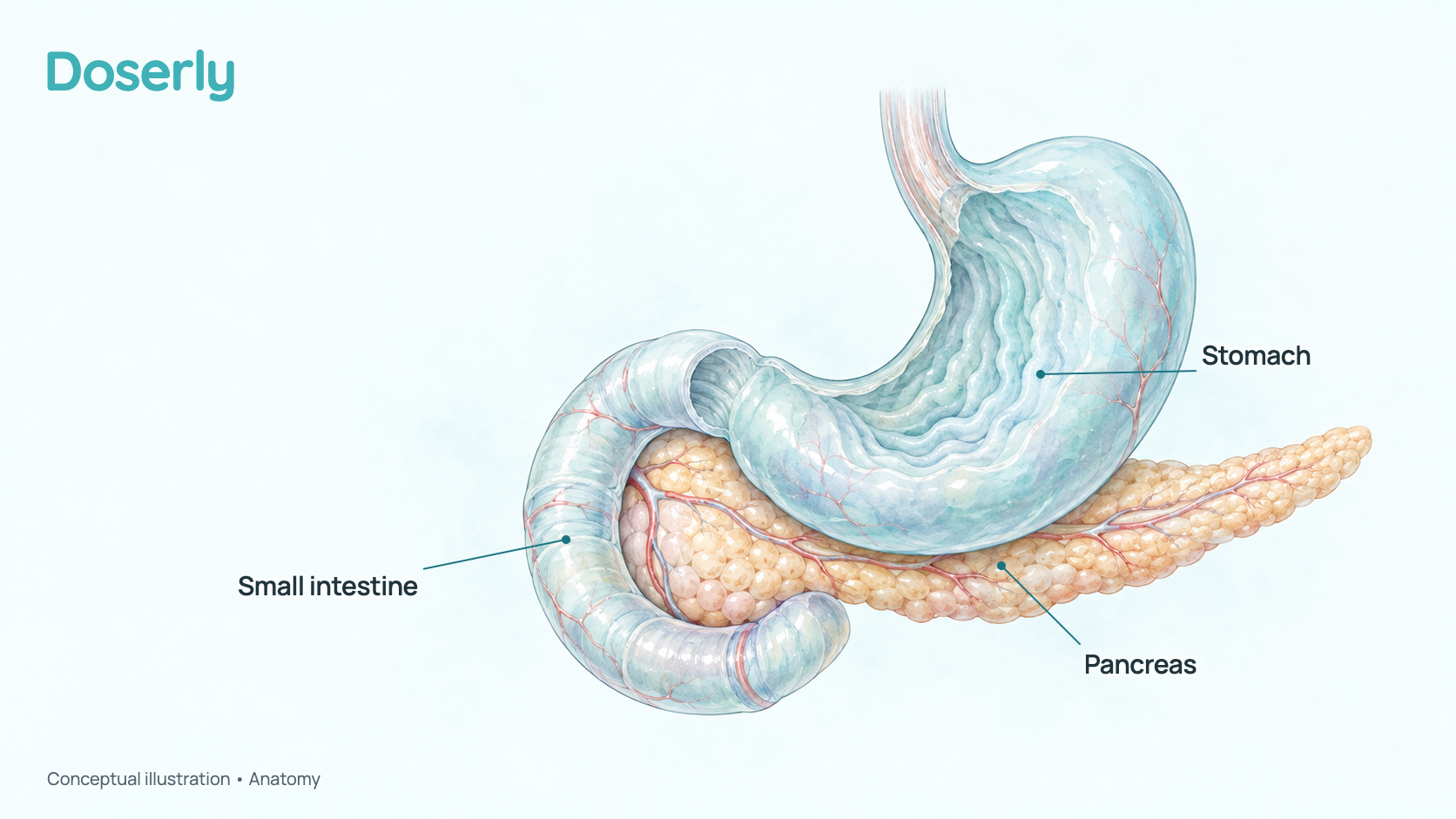
The key word is investigational: it is still being tested, and no regulator has approved it. Unlike most peptides sold online, though, it has been studied in large randomized trials in people. Novo Nordisk has asked the FDA to approve CagriSema, its combination of cagrilintide and semaglutide (the drug in Wegovy and Ozempic), and a separate trial program is testing cagrilintide on its own. You may also see its development codes, AM833 and NNC0174-0833. [5], [6], [7], [8]
Typical Cagrilintide Protocols
| Example | Amount each time | Frequency | Weekly total | Duration |
|---|---|---|---|---|
| Low | 0.3 mg | Once weekly | 0.3 mg | 26 weeks Lowest phase 2 dose, taken at 0.3 mg from the first week. Average weight change −6.0%, versus −3.0% on placebo. |
| Mid | 2.4 mg | Once weekly | 2.4 mg | 68 weeks Reached in 4-week steps: 0.25, 0.5, 1.0 and 1.7 mg, then 2.4 mg from week 17. Average weight change −11.5%, versus −3.0% on placebo. |
| High | 4.5 mg | Once weekly | 4.5 mg | 26 weeks Highest dose tested in people. Reached in 2-week steps: 0.6, 1.2 and 2.4 mg, then 4.5 mg from week 7. Average weight change −10.8%. |
The most common protocol in the reviewed sources is the trial schedule: 0.25 mg once weekly by subcutaneous injection, raised every 4 weeks through 0.5, 1.0 and 1.7 mg to a maintenance dose of 2.4 mg once weekly from week 17. Phase 3 trials used it for cagrilintide alone, and most dosing websites copy it. [9], [10], [11], [12], [13]
- Titration Raising the dose in steps
- The trial approach starts at 0.25 mg and moves up one step every 4 weeks. Investigators could delay a step or lower the dose when side effects were a problem, and 82.5% of people on cagrilintide alone were on the full 2.4 mg at week 68. The earlier dose-finding trial stepped up faster, every 2 weeks from 0.6 mg. [9], [8]
Read the units: cagrilintide amounts are written in milligrams (mg); 0.25 mg is the same as 250 mcg. Each number is the amount of cagrilintide itself. In CagriSema, "2.4/2.4 mg" means 2.4 mg of cagrilintide plus 2.4 mg of semaglutide, not 4.8 mg of cagrilintide.
Each row is a complete trial schedule: the high example is a shorter 26-week course, not a longer one at a higher dose. Low, mid and high are alternatives, not steps to move through. These are research schedules from trials of cagrilintide alone, not an approved label; the cited references give the full details. [2], [9]
Add-on schedules used with another weight-loss injection
In the online accounts and protocol pages reviewed, most people add a small amount of cagrilintide to semaglutide, tirzepatide or retatrutide, usually because hunger returns late in the week or weight loss has stalled. No human trial has tested cagrilintide with tirzepatide or retatrutide, so these schedules come from protocol websites, not studies. [14], [15], [16]
| Example | Cagrilintide each time | Frequency | Weekly cagrilintide total | Duration |
|---|---|---|---|---|
| Low | 0.25–0.5 mg | On a day opposite the weekly retatrutide injection; often used as needed rather than every week | Up to 0.5 mg | Not stated A community-reported range on one dosing website, which says it is not a validated schedule. |
| Mid | 0.25 mg to start, up to 1 mg a week | Once or twice weekly, on a different day from the other injection | 0.25–1 mg | 12–24 weeks (8–16 weeks with retatrutide) |
| High | 0.25 → 0.5 → 1.0 → 1.7 mg every 4 weeks, then 2.4 mg | Once weekly, same day as the other injection, different site | Up to 2.4 mg | Started in week 9 of the other drug; steps to week 24, then ongoing Copies the trial steps onto a tirzepatide or retatrutide schedule. |
Community education groups describe the same low pattern most often: 0.25 mg once weekly, raised to 0.5 mg only if needed, often given 3–4 days after the weekly GLP-1-type injection. In public discussions, several people report strong fullness at these small doses when they are combined with another drug. [18], [19], [20]
Where protocols differ: dose size, step speed, timing, breaks and blends ↓
Where these numbers come from
The low and high rows of the first table come from the phase 2 dose-finding trial and its posted registry results; the mid row comes from the REDEFINE 1 phase 3 trial, and the same 4-week steps appear in the registry record of a phase 2 trial in type 2 diabetes. Weight changes are the trials' reported averages. [2], [8], [9], [10]
The add-on table keeps each website's schedule whole. The low row is a community-reported range on RetaCalc, which gives no fixed frequency or duration; the mid row is Hatter Labs' combination guidance, and the high row is the staggered schedule on Peptide Dosing Protocols' tirzepatide and retatrutide stack pages, which state that no clinical trial has tested the pairing. [14], [16], [15], [17]
We did not merge the two tables, average them or build a dose ladder from anecdotes. Blend totals, unit errors, accidental overdoses and one-off extreme doses do not define the typical comparison. Several websites copy the same trial numbers, so matching pages are not counted as independent confirmation.
What is cagrilintide commonly used for?
People look into cagrilintide to lose weight, or to keep hunger under control while they do. Some are already on a GLP-1-type drug and want to quiet hunger that returns before the next weekly dose; a smaller group uses it to hold their weight after stopping another drug.
The trials show that cagrilintide alone lowers body weight more than placebo. They do not show how it performs at the low add-on doses most people use online, or alongside drugs other than semaglutide.
Weight loss on its own
This is the best-studied use. In a 26-week trial of 706 adults with overweight or obesity, average weight loss ranged from 6.0% at 0.3 mg to 10.8% at 4.5 mg, compared with 3.0% on placebo. In the 68-week REDEFINE 1 trial, the 302 people given cagrilintide 2.4 mg alone lost 11.5% on average, compared with 3.0% on placebo. [2], [9]
Averages hide a wide spread. In REDEFINE 1, about 57% of people on cagrilintide alone lost at least 10% of their weight, and about 14% lost at least 20%, if they kept taking it. [9]
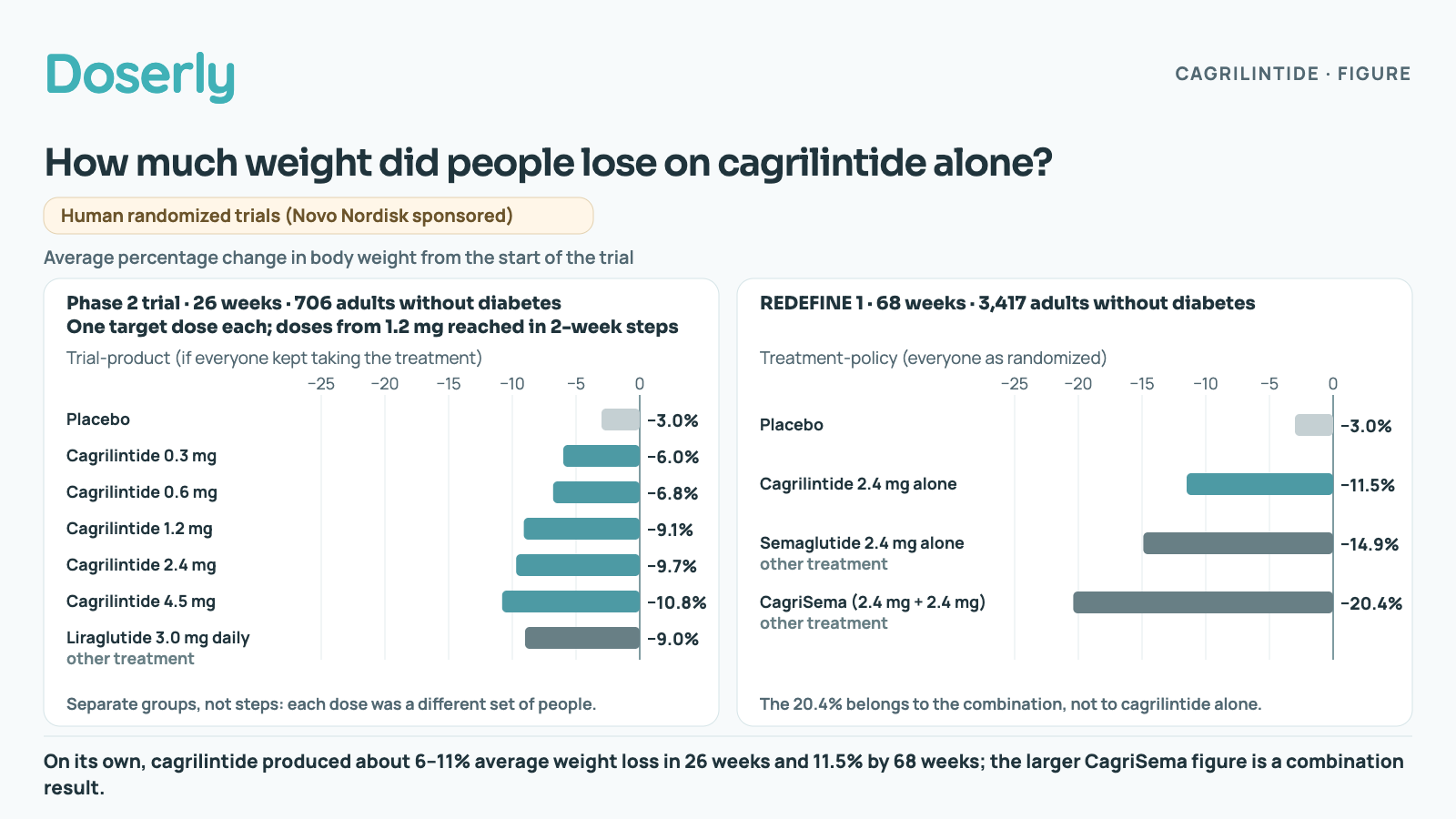
How much weight did people lose on cagrilintide alone?
Average percentage change in body weight from the start of the trial.
- Phase 2 trial · 26 weeks · 706 adults without diabetes · one target dose each; doses from 1.2 mg reached in 2-week steps
- Trial-product (if everyone kept taking the treatment).
Placebo −3.0%
Cagrilintide 0.3 mg −6.0%
Cagrilintide 0.6 mg −6.8%
Cagrilintide 1.2 mg −9.1%
Cagrilintide 2.4 mg −9.7%
Cagrilintide 4.5 mg −10.8%
Liraglutide 3.0 mg daily −9.0%
Separate groups, not steps: each dose was a different set of people. - REDEFINE 1 · 68 weeks · 3,417 adults without diabetes
- Treatment-policy (everyone as randomized).
Placebo −3.0%
Cagrilintide 2.4 mg alone −11.5%
Semaglutide 2.4 mg alone −14.9%
CagriSema (2.4 mg + 2.4 mg) −20.4%
The 20.4% belongs to the combination, not to cagrilintide alone.
On its own, cagrilintide produced about 6–11% average weight loss in 26 weeks and 11.5% by 68 weeks; the larger CagriSema figure is a combination result.
Quieting hunger and "food noise"
Many people describe cagrilintide in terms of appetite: feeling full sooner, smaller portions and fewer intrusive thoughts about food, often called food noise. That fits amylin's role as a fullness signal. The downside is that some people struggle to eat enough, especially with another drug. The experience section covers both sides. [2], [21], [18], [19], [20]
Adding it to semaglutide, tirzepatide or retatrutide
Combining cagrilintide with semaglutide is the one combination that has been properly tested. In REDEFINE 1, CagriSema (2.4 mg of each) led to 20.4% average weight loss at 68 weeks, compared with 14.9% for semaglutide alone and 11.5% for cagrilintide alone. [9]
Pairings with tirzepatide or retatrutide are another matter. They are popular online, but neither has been tested in people; the published data on the retatrutide pairing come from a 2026 study in obese rats. The CagriSema result cannot simply be transferred to these combinations, or to the much lower add-on doses people use. [22], [15]
Blood sugar in type 2 diabetes
Two trials tested cagrilintide alone in people with type 2 diabetes. Over 32 weeks, HbA1c (a measure of average blood sugar over about three months) fell by 0.9 percentage points and weight by 8.1%. Over 68 weeks in REIMAGINE 2, HbA1c fell by 0.80 points and weight by 8.4%. In both trials the fall in blood sugar was smaller than with semaglutide or CagriSema; weight loss beat semaglutide's in the small 32-week trial but not in REIMAGINE 2. [23], [24], [25]
Other uses you may come across
Claims about protecting muscle, improving heart health or curbing alcohol cravings go beyond what has been shown for cagrilintide alone. In a REDEFINE 1 analysis, systolic blood pressure (the top number) fell by 5.2 points on cagrilintide alone versus 2.8 points on placebo, a smaller drop than with CagriSema. Body scans show how much of the weight lost was fat, not whether muscle was protected, and trials of bone and muscle effects are registered but have no results yet. [26], [27], [28], [29]
Where do cagrilintide protocols differ?
Trial schedules for cagrilintide are unusually clear. The disagreements start when people use it differently: at a fraction of the dose, on top of another drug, or for a few weeks instead of more than a year.
Is 2.4 mg the real dose, or 0.25 mg?
Both, in different situations. 2.4 mg once weekly is the maintenance dose in the phase 3 trials of cagrilintide alone and in CagriSema. 0.25 mg is the first step of that schedule, and it is the dose most add-on accounts describe. [9], [14]
The trial weight losses were measured at 2.4 mg or similar doses. They do not tell you what 0.25 mg a week adds to tirzepatide or retatrutide, because no study has tested that. A low add-on dose is a different use, not a milder version of the trials.
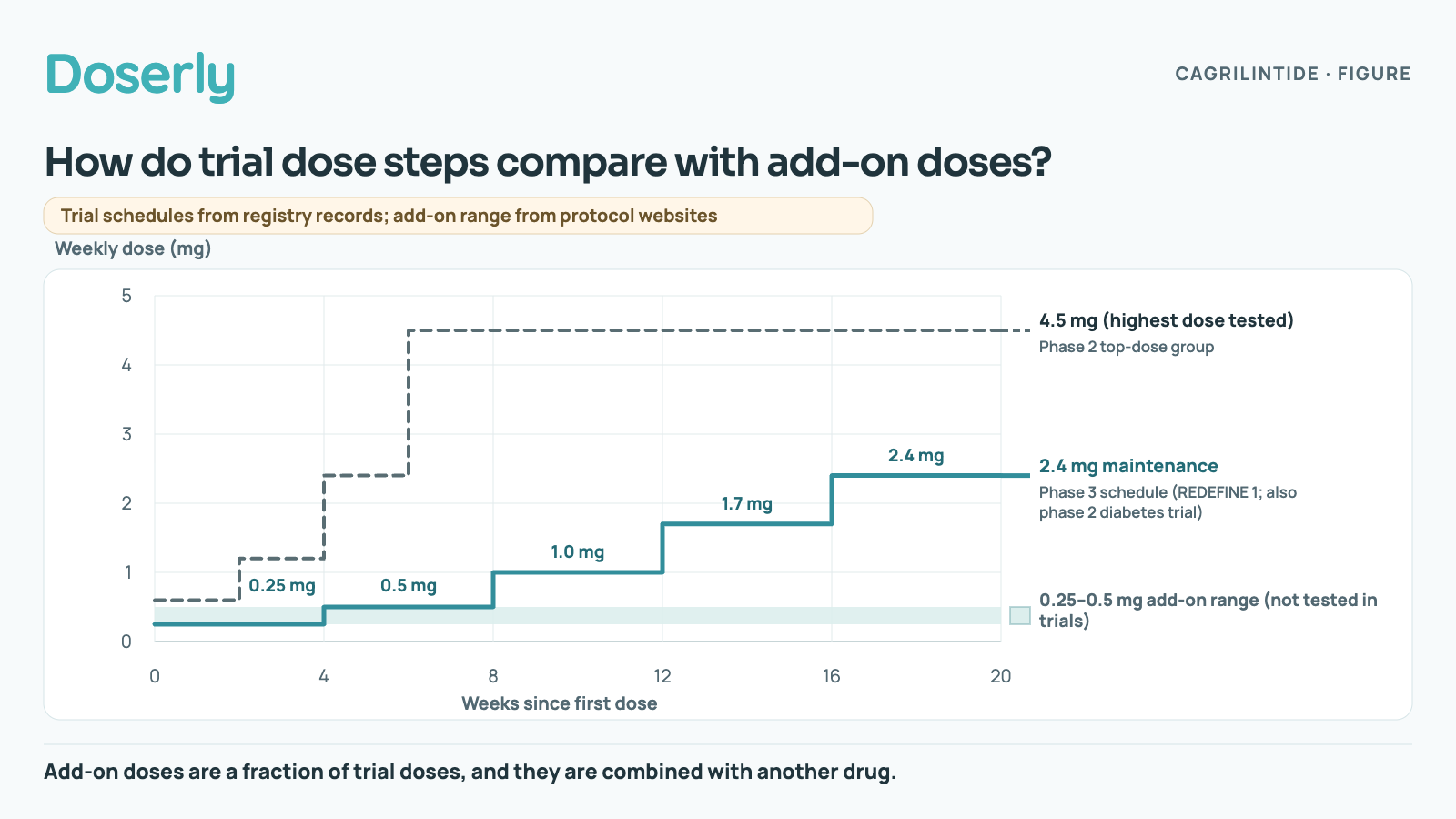
How do trial dose steps compare with add-on doses?
- Phase 3 schedule (REDEFINE 1; also phase 2 diabetes trial)
- 0.25 mg in weeks 1–4, 0.5 mg in weeks 5–8, 1.0 mg in weeks 9–12, 1.7 mg in weeks 13–16, then 2.4 mg from week 17.
- Phase 2 top-dose group
- 0.6 mg in weeks 1–2, 1.2 mg in weeks 3–4, 2.4 mg in weeks 5–6, then 4.5 mg from week 7.
- Common add-on range
- 0.25–0.5 mg a week alongside another weight-loss drug; not tested in trials.
Add-on doses are a fraction of trial doses, and they are combined with another drug.
Are the phase 2 doses a ladder to climb?
No. The 0.3, 0.6, 1.2, 2.4 and 4.5 mg doses in the phase 2 trial were separate groups: each person was assigned one target dose for the 26 weeks. People in the higher-dose groups stepped up every 2 weeks from 0.6 mg to reach it; nobody climbed through all five. Some websites list them correctly as separate regimens, while others turn them into a week-by-week escalation that the trial never used. [8], [30], [31], [32]
A few pages also stretch the highest group into a protocol, stepping from 0.6 mg to 4.5 mg every 2 weeks. That matches how the 4.5 mg group got there, but 4.5 mg was the highest dose tested, not a recommended target, and it added only about one percentage point over 2.4 mg (10.8% versus 9.7% at 26 weeks). [33], [34], [2], [9]
How fast should the dose go up?
The sources describe three speeds. The phase 3 trials stepped up every 4 weeks. The phase 2 trial stepped up every 2 weeks. Some add-on guides hold each step for "at least 2 weeks" or 2–4 weeks. [9], [8], [15]
The trial experience explains why slower steps are popular. In REDEFINE 1, where most people took CagriSema, nausea, vomiting and diarrhea were most common during the dose-raising weeks and eased afterward. Investigators were allowed to slow the climb or lower the dose, and many people on CagriSema stayed below the top dose. [9] Community education groups go further and describe starting as low as 0.1 mg and waiting 1–2 weeks before any increase.
Same day as the other injection, or midweek?
Add-on sources disagree. Some place cagrilintide on the day opposite the partner injection, to cover hunger that returns around days 4–6 of the week. Others give both on the same day at different sites, which matches how CagriSema is given. [14], [16], [15], [17], [35]
Neither timing has been compared in a study. With a half-life of about a week, cagrilintide does not clear between weekly doses; levels peak 1 to 3 days after each injection. Choosing the day mostly shifts when that peak falls in the week, and whether that changes results has not been tested. [36], [37]
Once weekly, split, or only as needed?
Trials used one injection a week. Some websites and community accounts split the weekly amount into two injections 3–4 days apart, hoping to blunt stomach upset; others use a dose only before events or on hard weeks. Splitting the same weekly total has not been shown to work better, and "as needed" use has no study behind it. [38], [16], [39], [40]
How long, and are breaks needed?
The trials ran continuously for 26 to 68 weeks, and one CagriSema trial ran for 84 weeks. Community education groups disagree sharply: some teach a short "bridge" of about 4–10 weeks, some describe 8–16 weeks on and 4–6 weeks off, and others set no limit. Protocol websites range from 8–24 weeks to ongoing use. [9], [41], [16], [15]
In the trials reviewed, planned breaks were never compared with continuous use. What is known about stopping is covered at the end of this section.
What about CagriSema and pre-mixed blends?
CagriSema contains equal amounts of both drugs, stepped up together. In trials, each drug started at 0.25 mg and rose every 4 weeks to 2.4 mg each; a lower 1.0 mg each dose has also been tested. Novo Nordisk's product is a dual-chamber pen, so the two drugs are kept apart until injection. [9], [24], [6]
Blends sold online are different products. Read their numbers carefully:
| Product label | What one dose actually contains | Why it matters |
|---|---|---|
| CagriSema-style blend, "0.5 mg" | 0.25 mg cagrilintide + 0.25 mg semaglutide | The label is the total, not the cagrilintide dose [45] |
| 5:1 retatrutide–cagrilintide blend, dose drawn to give 1 mg retatrutide | 1 mg retatrutide + 0.2 mg cagrilintide | Cagrilintide is one-sixth of the total weight [46] |
| Same 5:1 blend, dose drawn to give 6 mg retatrutide | 6 mg retatrutide + 1.2 mg cagrilintide | More than four times the usual 0.25 mg add-on start |
A fixed ratio also means you cannot change one drug without changing the other. In community education groups, members often describe first blend doses as too strong and suggest buying the two drugs separately. Read the Doserly guide to the CagriSema blend. [46], [47]
How do milligrams convert to syringe units?
Online cagrilintide usually comes as a powder that is mixed with sterile water. Syringe units on an insulin syringe measure volume, not an amount of cagrilintide, so the dose in each unit depends on how much water was added.
For example, 5 mg mixed into 2 mL gives 2.5 mg per mL, so 0.25 mg is 0.1 mL, or 10 units on a U-100 syringe. The same 0.25 mg from a 10 mg vial mixed into 2 mL is only 5 units. Doses this small leave little room for error: confusing "25 units" with "0.25 mg" can multiply a dose several times over, and community reports include accidental overdoses of this kind. Doserly's reconstitution calculator works out the arithmetic for any vial and shows each step. [15], [48], [49]
What happens when you stop cagrilintide?
The effect fades after the last dose, and some of the weight lost can come back. We found one published study that measured weight after cagrilintide alone was stopped, and it followed people for only 6 weeks. [2]
- The first weeks off treatment. In the phase 2 trial, treatment ended at week 26 and a check-up was scheduled 6 weeks later; 677 of the 706 participants attended. The authors reported "some weight regain" in the cagrilintide groups: across the five doses, the observed average weight loss was 6.1–10.8% at week 26 and 5.0–9.8% at week 32. [2], [115]
- Longer term. We found no longer-term result for cagrilintide alone. REDEFINE 1 followed everyone for 7 weeks after treatment, and its planned 97-week off-treatment extension includes only the CagriSema and placebo groups; we found no published weight results from either period. [9], [116]
- How long it stays in the body. With a half-life of about 7 to 8 days, cagrilintide takes several weeks to clear. The diabetes trial scheduled its safety visit 5 weeks after the last dose "to account for the long half-life" of the study drugs. [36], [117]
- Antibodies. People who still had antibodies to cagrilintide at the phase 2 trial's final visit could be retested up to 12 months later. We found no published results of those tests. [115]
Semaglutide, the drug combined with cagrilintide in CagriSema, has been tested directly. In STEP 4, people switched to placebo after 20 weeks regained 6.9% of their body weight over the next 48 weeks, while those who continued lost another 7.9%. In the STEP 1 extension, people had regained about two-thirds of the weight they lost within a year of stopping. These are semaglutide results; whether weight lost on an amylin drug returns the same way has not been tested. [118], [119]
In public discussions, former CagriSema trial participants describe hunger returning within weeks and regains of 10 to 30 lb in the months after their studies ended. We found no study comparing tapering down with stopping all at once, or showing that a break restores the effect. [42], [43], [105], [44]
Source-by-source comparison and registered study plans
Which websites copy which numbers?
Most cagrilintide pages reuse a small set of trial numbers rather than independent experience. Seven pages reproduce the CagriSema equal-step schedule correctly for the combination (for example The RX Index and Peptide Dossier). Five others take the cagrilintide column from that combination schedule and present it as a standalone protocol (for example DosingCalc, LA LAB, Biomogging and Peptides.org). Six pages list the phase 2 target doses; Peptide Initiative and Pure Peptide Clinic keep them as separate groups, while GLP1OneRx and Peptides Institute turn them into weekly steps. [50], [51], [11], [12], [38], [13], [30], [52], [32], [31]
Which pages contain errors?
Some mistakes are easy to spot once you know the trials. PeptidePlotter pairs a 0.16 mg cagrilintide start with the semaglutide steps, which does not match REDEFINE 1's equal steps. Peptides.ID gives a half-life of about 3–4 days, while human studies measured about 7 to 8 days. Peptides.org describes cagrilintide as a GLP-1 mimetic, but it acts on amylin and calcitonin receptors. [53], [54], [13], [36], [37]
How do add-on pages handle the missing evidence?
The add-on pages are more candid than most. RetaCalc labels its line as community-reported and says it is not a validated combination schedule, and Peptide Dosing Protocols states that no clinical trial has tested cagrilintide with retatrutide. Their schedules still differ on timing (opposite days versus the same day) and on how high to go (0.5 mg versus 2.4 mg). [14], [15], [17], [16]
What are the registered studies planning?
These are study plans without posted results when checked on September 23, 2026. Separate dose groups are not a personal titration schedule.
Cagrilintide alone for weight loss
About 300 adults with overweight or obesity, cagrilintide compared with placebo.
No results posted. Registered by Novo Nordisk; last update August 2026.
[7]Cagrilintide alone with type 2 diabetes
About 330 adults with overweight or obesity and type 2 diabetes.
No results posted. Last update September 2026.
[55]People who could not tolerate a GLP-1 drug
About 114 participants who stopped GLP-1-type treatment because of side effects receive cagrilintide.
No results posted. Last update June 2026.
[56]Cagrilintide and CagriSema in young people
About 460 children and adolescents with excess weight. Adult results cannot be assumed for this group.
No results posted. Last update August 2026.
[57]How is cagrilintide taken, and how long does it last?
Cagrilintide is taken only by subcutaneous injection (into the fatty layer under the skin), once a week. In the trials, people injected it into the stomach area, thigh or upper arm with a pen. No pill, nasal spray or cream form of cagrilintide has been tested in people. [8], [9]
The fatty-acid tail is what makes weekly dosing possible. Its developers think it works by letting cagrilintide bind loosely to albumin, a common protein in the blood, which slows its removal, although they did not measure that binding directly. Its measured half-life, the time for blood levels to fall by half, was 159–195 hours (about 7 to 8 days), and levels peaked 1 to 3 days after an injection. [4], [36], [37]
Because each dose lingers, levels build up over the first weeks of weekly use, and an extra dose takes more than a few days to wash out. Some people describe hunger returning around days 5 to 6; that is a change in felt effect, not proof the drug has left the body. [36], [35], [58]
Do kidney or liver problems change the dose?
In two small single-dose studies of people with mild to severe kidney or liver impairment, blood levels of cagrilintide were similar to those in people with normal function, and the authors concluded that no dose adjustment was needed. These were one-dose studies of 33 and 32 people, and people on dialysis were excluded, so they say little about long-term use. [37]
Is a pre-filled pen the same as a vial sold online?
No. Trial participants used a manufactured pen with a known dose; CagriSema's pen keeps the two drugs in separate chambers. Online products are usually powders sold as "research use only", with no approved label, no guaranteed content and no instructions for people. FDA has sent warning letters to online sellers of these products. [9], [59], [60]
How should cagrilintide be stored, and how long does it last?
There is no approved label with storage instructions for people to follow. Trial sites used storage directions supplied by the sponsor, and the public record shows only this much:
- The trial product. Trials used a ready-made solution (10 mg per mL) in a pen cartridge, not a powder. It was to be used only if it looked "clear and almost colourless". Its storage conditions and in-use time were printed on the trial label and in a trial manual that has not been published, and sites had to report any temperature problem to the sponsor before the product could be used. [115], [117]
- The molecule. Natural amylin tends to clump into fibrils (sticky strands), which makes it hard to turn into a medicine. The developers changed several building blocks and added the fatty-acid tail to make "a chemically and physically stable molecule". That was a design goal tested in the laboratory, not a use-by date for any product. [4], [115]
- Powder sold online. These are unverified website claims, not tested instructions. Protocol websites claim the unmixed freeze-dried powder keeps frozen at about −20 °C or in the fridge, and that mixed (reconstituted) cagrilintide keeps in the fridge at 2–8 °C for 2 to 4 weeks, most often 28 to 30 days. Several say to throw away a solution that turns cloudy or contains particles. None cites a stability test of cagrilintide itself, and the trial product was a different, ready-made solution, so how long a mixed vial stays usable is not established. [54], [12], [30], [15], [34], [33]
- Shipping. FDA notes that injectable GLP-1 medicines need refrigeration as stated in their package inserts, and it has received complaints about compounded products arriving warm. Cagrilintide products sold online have no package insert. [75]
This guide does not cover mixing or injection technique; the Academy note below points to practical handling.
What do we actually know about cagrilintide in people?
Much more than for most peptides. Cagrilintide has been tested in randomized controlled trials involving thousands of people, and more than 1,000 of them received cagrilintide on its own. The complication is that most of the headline numbers belong to CagriSema, so it pays to check which group a result comes from. [2], [9], [24]
What did the trials of cagrilintide alone find?
| Study | Who and how long | What researchers reported | What it cannot establish |
|---|---|---|---|
| Phase 2 dose-finding, 2021 | 706 adults with overweight or obesity, no diabetes; 26 weeks; 0.3–4.5 mg weekly | Weight fell 6.0–10.8% on cagrilintide versus 3.0% on placebo; 4.5 mg beat daily liraglutide 3.0 mg (10.8% vs 9.0%). | Long-term effects. Drug versus placebo was hidden, but participants knew which active drug and dose they had. [2] |
| REDEFINE 1, 2025 | 3,417 adults with overweight or obesity; 302 on cagrilintide 2.4 mg alone; 68 weeks | Cagrilintide alone: −11.5% versus −3.0% on placebo. CagriSema: −20.4%. Semaglutide alone: −14.9%. | A formal test of cagrilintide alone versus placebo; that comparison was reported but not part of the trial's planned statistical tests. [9] |
| Phase 2 in type 2 diabetes, 2023 | 92 adults; 30 on cagrilintide alone; 32 weeks | Cagrilintide alone: HbA1c −0.9 points, weight −8.1%, a larger weight loss than with semaglutide (−5.1%). | A placebo comparison; the trial compared three active treatments. [23] |
| REIMAGINE 2, 2026 | 2,713 adults with type 2 diabetes; 152 on cagrilintide 2.4 mg alone; 68 weeks | Cagrilintide alone: HbA1c −0.80 points and weight −8.4% if everyone kept taking it; −1.02 points and −7.4% counting everyone as assigned (sponsor's results summary). | A formal comparison of cagrilintide alone with placebo; the published abstract does not report that group's results. [24], [25] |
| Heart-rhythm (QT) study, 2024 | 105 healthy adults; 53 on cagrilintide up to 4.5 mg; 8 weeks | No clinically relevant change in the heart's electrical recovery time. | Heart events such as heart attacks; the study was short and small. [61] |
Why are there two numbers for the same trial?
Trials often report two versions of the same result, called estimands. The "treatment-policy" number counts everyone as randomized, including people who stopped the drug. The "trial-product" number estimates what happens if everyone keeps taking it. That is why REDEFINE 1 reports 11.5% and 11.8% for cagrilintide alone, and 20.4% and 22.7% for CagriSema. Neither is wrong; they answer slightly different questions. [9]
The bigger risk is mixing up groups. CagriSema's figures, such as 13.7% in REDEFINE 2 (people with type 2 diabetes) and 20.4% in REDEFINE 1 (both counting everyone as randomized), belong to the combination. Some cagrilintide product pages lead with them anyway, so check which group any number comes from. [9], [62], [34]
What would a useful result look like in everyday life?
A trial average is not a prediction for one person. Results ranged widely, and the trials also measured things people notice day to day: waist size, blood pressure and physical function all improved with CagriSema in REDEFINE 1. A useful result might mean steady weight change while still eating enough, or hunger that stays manageable all week. [9]
That is why it helps to track more than weight. Appetite, energy, stomach symptoms and mood can move in different directions.
What don't the trials tell us?
- The way most people use it online. No human trial has tested low add-on doses, or cagrilintide with tirzepatide or retatrutide. [15]
- What happens after stopping. For cagrilintide alone, only a 6-week check after the last dose has been reported. REDEFINE 1's off-treatment extension includes only the CagriSema and placebo groups. [2], [116]
- Use beyond 68 weeks. Longer trials, including a large heart-outcomes trial of CagriSema, are still running. [63]
- Who was studied. About two-thirds of REDEFINE 1 participants were women, most were White, and few had a BMI below 30. [9]
- Children and adolescents. A trial is registered but has no results. [57]
How does cagrilintide work?
Cagrilintide copies amylin, one of the body's "you've eaten enough" signals, but lasts far longer. Where and how it acts comes mostly from cell and animal studies; the weight loss itself is established in human trials.
Which receptors does it switch on?
In cell studies, cagrilintide activates all three amylin receptors and the calcitonin receptor. That is why it is sometimes called a non-selective or dual amylin and calcitonin receptor agonist (an agonist is a molecule that switches a receptor on). Laboratory structures of cagrilintide bound to these receptors show it binds in a similar way to natural amylin. [4], [64], [65], [66]
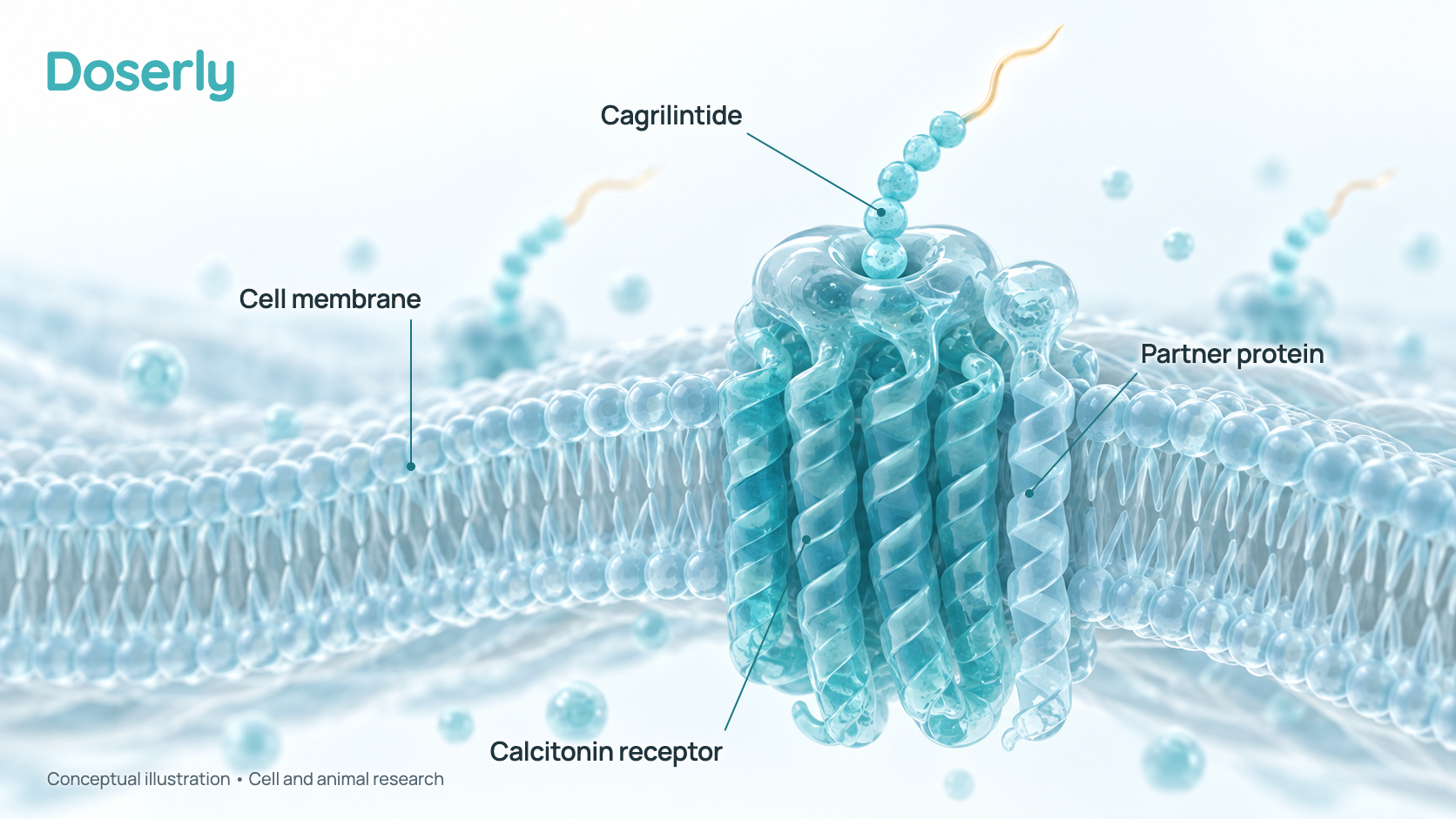
The balance between the two receptor types is an active research question. In male mice missing two of the three amylin receptors, cagrilintide caused less weight loss, which suggests the amylin receptors do much of the work. [67]
Where in the brain does it act?
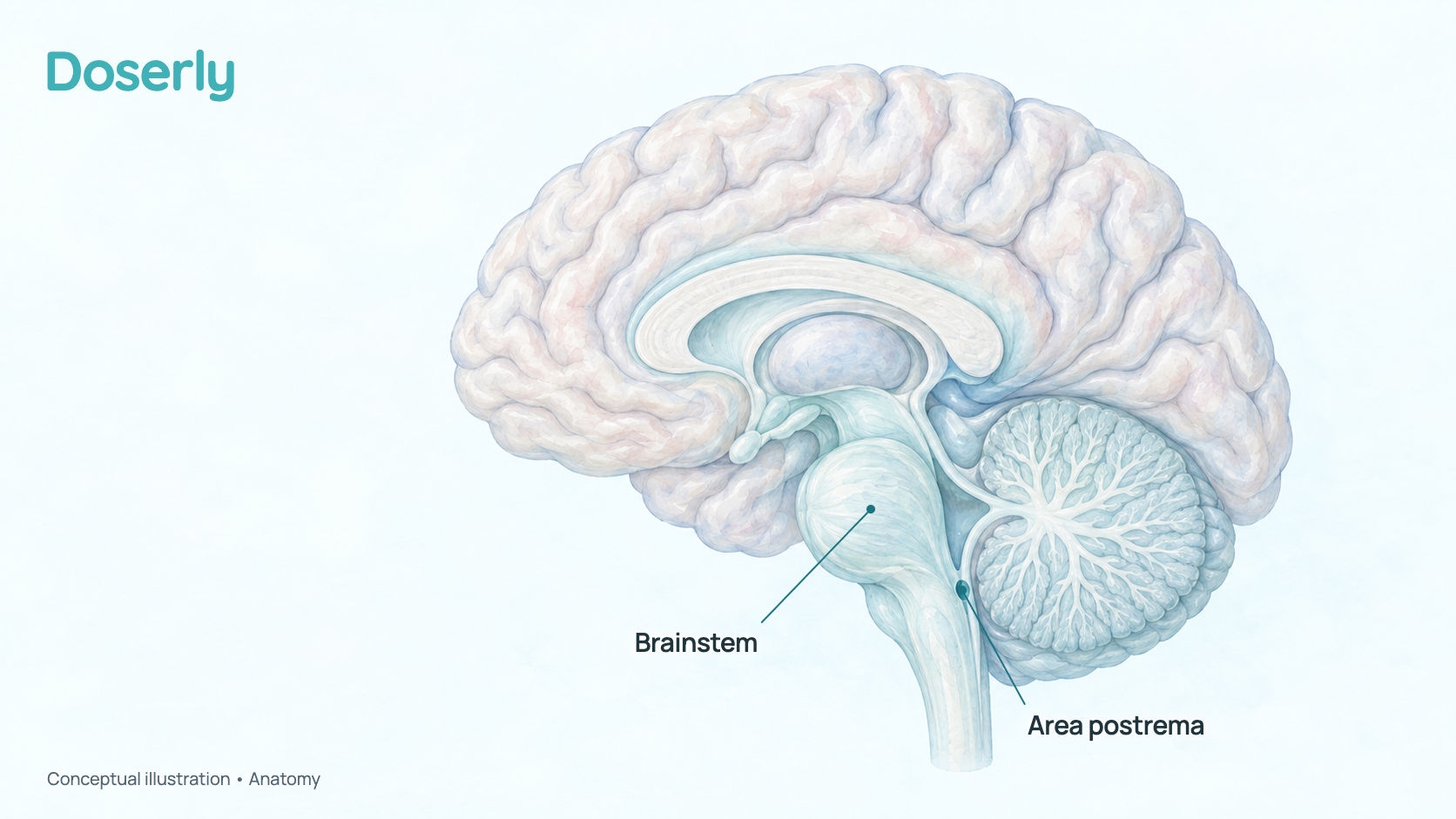
In rats and mice, cagrilintide acts on the brainstem, especially the area postrema and a nearby relay station called the nucleus of the solitary tract, which help control fullness and nausea. A 2026 study that mapped these brain cells across species found that silencing one group of brainstem cells in rats blocked cagrilintide's long-term effect on food intake and weight, but not semaglutide's. The human and monkey tissue in that study was used only to map the cells; no person received the drug. [68], [69]
Does it slow digestion?
In rats, repeated doses of cagrilintide slowed gastric emptying, the speed at which food leaves the stomach. People may differ: in a 62-person study, CagriSema cut how much people ate at a test meal by 63% but did not measurably slow gastric emptying, judged by how quickly a swallowed dose of paracetamol (acetaminophen) reached the blood. Full results for cagrilintide alone have not been published. [70], [71]
Why does it add to semaglutide?
Semaglutide acts on the GLP-1 receptor; cagrilintide acts on amylin and calcitonin receptors, partly through different brain cells. That fits the trial finding that the combination beat either drug alone, and similar extra effects appeared in rats. It is also why people try pairing cagrilintide with other GLP-1-type drugs, although pairings with tirzepatide or retatrutide have not been tested in people. [9], [72], [68], [22]
What about muscle loss?
Any large weight loss includes some lean tissue (muscle, organs and water) as well as fat. In a REDEFINE 1 body-scan subgroup, about two-thirds of the weight lost on CagriSema was fat and one-third lean mass. That result is for the combination. A 2026 conference presentation of the same subgroup reported that on cagrilintide alone, about 63% of the weight lost was fat and 37% lean soft tissue, which includes muscle but also organs and water. In rats, cagrilintide caused more lean-mass loss than a newer amylin drug at the doses tested, and a cell study found a short-lived drop in muscle-cell energy use that recovered within 5 days. A human trial of muscle effects is registered. [9], [27], [73], [74], [28]
What are the risks and unanswered questions?
Is cagrilintide safe?
It was generally tolerated in trials lasting up to 68 weeks, but it is not approved and long-term safety is not established. Those data also describe a pharmaceutical-grade product given under medical supervision, not powders bought online. [9], [24], [75]
The pattern of side effects is fairly predictable: stomach and bowel symptoms that become more common at higher doses, injection-site reactions, and fatigue at the highest doses. Rarer or slower-developing problems are harder to rule out. [2], [9]
What side effects did the trials find?
The clearest comparison comes from REDEFINE 1, where 302 people took cagrilintide 2.4 mg alone and 705 took placebo for 68 weeks. [9]
| Event | Cagrilintide alone | Placebo |
|---|---|---|
| Any adverse event | 84.1% | 82.3% |
| Stomach and bowel events | 54.0% | 39.9% |
| Nausea* | 23.8% | 13.2% |
| Constipation* | 20.9% | 12.3% |
| Diarrhea* | 15.6% | 12.9% |
| Vomiting* | 7.0% | 4.4% |
| Injection-site reactions | 16.9% | 3.0% |
| Allergic reactions | 7.6% | 5.5% |
| Gallbladder-related disorders | 2.3% | 1.0% |
| Serious adverse events | 8.9% | 6.1% |
| Stopped the drug because of side effects | 2.6% | 3.5% |
| Pancreatitis | 0 | 0 |
*From the sponsor's 2026 investor presentation; the other rows are from the published paper. [76]
In the phase 2 trial, stomach and bowel side effects affected 41–63% of people on cagrilintide versus 32% on placebo, rising with dose, and nausea affected 20–47% versus 18%. Fatigue was reported by 20 of 101 people on 4.5 mg, compared with 3 of 101 on placebo. [2], [8]
In REIMAGINE 2, in people with type 2 diabetes, the sponsor reported stomach and bowel events in 39.5% of people on cagrilintide alone versus 28.2% on placebo, and 4.6% versus 1.3% stopped treatment because of side effects. [25]
Some findings were reassuring. Mental-health questionnaires did not change meaningfully in any REDEFINE 1 group, heart rate fell slightly with cagrilintide alone (about 3 beats per minute) rather than rising, and the heart-rhythm study found no concerning changes. [9], [61]
What about antibodies to the drug?
Many people make anti-drug antibodies to cagrilintide. In the phase 2 trial, antibodies were detected at some point during 32 weeks in about half the people on lower doses and about three-quarters on 2.4 or 4.5 mg. Whether these antibodies reduce the drug's effect over time has not been clearly reported. [8], [2]
What problems do people report outside trials?
Public and community accounts describe the trial side effects plus a few that trials are too small to show clearly: severe fatigue, eating too little to meet protein or fluid needs, low mood or anxiety, immediate allergic reactions such as hives or swelling (community education groups describe a few similar cases), and dosing errors from mixing up syringe units and milligrams. The experience section describes them. These reports cannot show how often a problem happens or whether cagrilintide caused it; nearly all involve another drug and unverified products. [40], [19], [77], [78], [48]
Could product quality change the risk?
Yes. A correctly made drug and a particular vial bought online are separate questions. FDA has sent warning letters to at least three online sellers that marketed cagrilintide, calling the products unapproved new drugs despite "research" labels, and a fourth to a company that distributed cagrilintide as a bulk drug ingredient. A 2026 preprint that pooled test results for 14 peptides sold to consumers, including cagrilintide, found wide variation in purity and measurable endotoxin (a bacterial contaminant) in some samples, although it did not report cagrilintide separately. [59], [60], [79], [80], [81]
Is cagrilintide legal? Is it FDA-approved?
Checked September 23, 2026. Rules differ by country and change quickly.
United States. Cagrilintide is not an FDA-approved medicine, alone or in CagriSema.
- June 2025. FDA told state medical boards that cagrilintide does not qualify for compounding: it has no official monograph, is not part of an approved drug and is not on the lists of ingredients pharmacies may use. [82]
- December 18, 2025. Novo Nordisk submitted CagriSema to FDA for weight management. [5]
- September 2026. FDA's page on unapproved weight-loss drugs states that cagrilintide cannot be used in compounding under federal law and has not been found safe and effective for any condition. Novo Nordisk says CagriSema remains investigational, with an FDA decision expected in late 2026. [75], [6]
Canada. A submission for cagrilintide with semaglutide has been under Health Canada review since March 2026; it is not authorized for sale. In April 2026 Health Canada warned consumers about the risks of unauthorized injectable peptides bought online. [83], [84]
Australia. Cagrilintide is not on the Australian Register of Therapeutic Goods, which makes any product an unapproved therapeutic good; TGA says "research use only" disclaimers do not change that. In May 2026 TGA warned consumers about importing unapproved peptide products promoted online. Cagrilintide is not named in the June 2026 Poisons Standard. [85], [86], [87], [88]
Europe and the United Kingdom. Regulators have agreed plans for studying CagriSema in children, a routine step during development, but neither has approved it. [89], [90]
A "research use only" label does not make a product legal to sell for human use, and it does not make it safe.
Is cagrilintide banned in sport? Does it show up on a drug test?
Cagrilintide is not named on the World Anti-Doping Agency's 2026 Prohibited List or on the 2027 list that takes effect on January 1, 2027. However, WADA's category S0 bans, at all times, any drug with no current approval by a government health authority for human use, and cagrilintide has none; the 2027 list adds peptides to its examples. Tested athletes should treat it as prohibited, and should recheck if CagriSema is approved, because an approval could change how it is classified. [91], [92]
Anti-doping researchers have already mapped how cagrilintide breaks down in laboratory tests, the first step toward detection methods. How long it stays detectable after use has not been published. [93]
Does cagrilintide cause cancer or affect calcium and bones?
No cancer signal has been shown. In REDEFINE 1, confirmed cancers occurred in 0.7% of people on cagrilintide alone and 0.6% on placebo, and longer follow-up is still needed. [9]
The concern people raise is theoretical and comes from the calcitonin receptor. Calcitonin is a hormone that lowers blood calcium, and a salmon version used as a medicine for bone conditions carries a cancer warning: across 21 pooled trials, cancers were reported in 4.1% of people on it versus 2.9% on placebo, and Europe limited its long-term use in 2012. That finding is about a different drug. [94], [95]
Calcium is a related question. In a 2021 company conference abstract, single doses lowered blood calcium by 40–50% in young rats, but the effect faded with repeated dosing, was almost absent in older rats and stayed within the normal range in young dogs and rabbits. The authors wrote that clinical data showed this effect was not relevant in people, without showing those data. A trial of bone effects in people is under way. [96], [29]
Who should be especially cautious?
These groups have little or no safety data. That is a reason for caution, not proof of harm.
- Pregnancy and breastfeeding. No human data. In animal studies, cagrilintide caused major birth defects in rats and mice at exposures relevant to people, though not in rabbits, so the early trials excluded anyone who could become pregnant. [115], [117]
- People with diabetes on insulin or sulfonylureas. Cagrilintide lowers blood sugar modestly, and combining it with drugs that can cause low blood sugar needs medical oversight. [23], [3]
- A history of eating disorders or low body weight. Strong appetite suppression can make it hard to eat enough. [19]
- A history of depression or anxiety. Trial questionnaires showed no mood signal, but a few community accounts describe low mood. [9], [77]
- Upcoming surgery or procedures. Tell the surgical and anesthesia team about every weight-loss injection, including products bought online.
- Under 18. A trial in young people has no results yet. This guide is written for adults. [57]
- Competitive athletes. Covered by WADA's ban on unapproved substances. [91]
Does cagrilintide interact with other medicines?
Formal interaction data are limited. In a 20-week study, cagrilintide did not change blood levels or clearance of the semaglutide given with it. [36] Studies of cagrilintide with an oral contraceptive, and of CagriSema with atorvastatin and warfarin (a blood thinner), are registered without posted results. Poster titles at a 2026 obesity congress report no effect on the levels of those medicines, but the full data have not been published. The older amylin drug pramlintide slows stomach emptying and its label warns about timing some oral medicines, so it is worth asking about. Bring a complete list of everything you take, including other peptides, to a pharmacist or doctor. [97], [98], [99], [3]
What should be monitored while using cagrilintide?
There is no official monitoring plan, because cagrilintide is not an approved medicine and has no prescribing label. What exists is a record of what the trials checked, which shows what researchers were watching for. It can help you prepare questions for a clinician; it is not a personal testing plan. [115], [9]
What did the trials check?
- Weight and related measures. Body weight, waist size, blood pressure and pulse, blood fats (cholesterol and triglycerides), blood sugar measures such as HbA1c and fasting glucose, and C-reactive protein, a marker of inflammation. REDEFINE 1 also measured fat and lean mass with body scans (DXA) in a subgroup. [8], [120], [9]
- Safety checks. In the phase 2 trial of cagrilintide alone, these included physical examinations that covered the thyroid gland, ECGs, 24-hour blood pressure recordings, blood counts, liver and kidney tests, the pancreas enzymes amylase and lipase, calcium and phosphate, and hormones linked to calcium and fluid balance (calcitonin, parathyroid hormone, calcitriol, renin and aldosterone). Blood was tested for antibodies to the drug, and urine for protein and, where relevant, pregnancy. [115]
- Mood. Participants completed depression and suicidal-thoughts questionnaires (PHQ-9 and C-SSRS) throughout, and people with moderately severe depression symptoms or recent suicidal thoughts were not enrolled. In REDEFINE 1 the scores did not change meaningfully in any group. [115], [9]
- In people with type 2 diabetes. Trials counted low-blood-sugar episodes confirmed with a glucose meter, used continuous glucose monitors, and required an eye examination for diabetic retinopathy (diabetes-related damage to the back of the eye) before entry. [117], [10], [121]
Which signals matter, and why?
| Why it matters | What studies measured or flagged | Tracking category |
|---|---|---|
| The result you care about | Weight and waist size; 11.5% average weight loss at 68 weeks on 2.4 mg alone | Weight Management; Fat Loss; Appetite & Satiety |
| Stomach and bowel | Stomach and bowel events in 54.0% on cagrilintide alone versus 39.9% on placebo, most often while the dose was going up | Nausea & GI Tolerance; Digestive Comfort |
| Energy | Fatigue in 20 of 101 people on 4.5 mg versus 3 of 101 on placebo | Energy Levels |
| Pancreas and gallbladder | Amylase and lipase were tested; gallbladder-related disorders in 2.3% versus 1.0% on placebo; no pancreatitis in the cagrilintide-alone group | Blood work; Digestive Comfort |
| Calcium | Blood calcium fell in young rats; calcium, parathyroid hormone and calcitriol were tracked in people, and no calcium change was seen in the first human trials | Blood work; Bone Health |
| Heart and blood pressure | Heart rate fell by about 3 beats per minute; systolic blood pressure fell 5.2 points versus 2.8 on placebo; renin and aldosterone rose briefly in an early trial without a rise in blood pressure | Heart Rate & Palpitations; Blood Pressure |
| Immune reactions | Antibodies in about half to three-quarters of people; injection-site reactions in 16.9% versus 3.0% on placebo | Skin Health; Immune Function |
| Mood | No meaningful change in trial questionnaires; a few public accounts describe low mood | Mood & Wellbeing; Anxiety |
| Pregnancy | Birth defects in rats and mice, not rabbits; pregnancy tests throughout the early trials | Not applicable |
[9], [2], [8], [115], [96], [26], [77]
Anyone taking cagrilintide with semaglutide or another GLP-1 medicine is also covered by that medicine's label, which has its own checks: symptoms of pancreatitis and gallbladder disease, low blood sugar with insulin or sulfonylureas, kidney problems from dehydration, heart rate, and eye complications in people with type 2 diabetes. The older amylin drug pramlintide carries a boxed warning for severe low blood sugar when used with insulin. Which checks make sense for you is a question for a clinician. [122], [3]
What do people in public communities report?
Public discussions come from two groups: trial participants, often unsure which treatment they received, and people buying it online, who mostly add it to retatrutide or tirzepatide. Only a handful of accounts describe cagrilintide on its own, so most stories cannot separate its effect from the other drug. [100], [21]
What do the positive reports look like?
The most common positive story is about hunger. One forum member said cagrilintide "really killed my food noise" within two weeks, at a dose written as "0,25" with no unit. Another, using about 1.25 mg on its own every 7 to 10 days after earlier tirzepatide and retatrutide, said nothing takes the food noise away quite like it, without the tiredness others describe. A person on retatrutide added a dose written as ".5", again without a unit, and wrote that they had never been so full. [18], [21], [101]
Trial participants describe larger weight losses, such as 62 lb over about a year in REDEFINE 1, but they were usually blinded and could have been on semaglutide, cagrilintide, the combination or placebo. [102], [44]
How long did the effect last?
Follow-ups often change the picture. Several people describe a strong start that faded: one on retatrutide said cagrilintide was "fantastic at first" and hardly noticeable four to five months later, even at 2 mg. Others describe the effect wearing off within the week, with hunger returning around days 5 or 6. [103], [35], [104]
Stopping is a recurring theme among former trial participants, who describe hunger returning within weeks and regains of 10 to 30 lb in the months after their studies ended. [42], [43], [105]
Does everyone notice a difference?
No. Some people notice little or nothing. One forum member reported no effect on two attempts, stepping up as far as 4.5 mg with products from different sources. Others describe no change at 0.25–0.5 mg that only appeared at 1 mg, or continued "food noise" at 1 mg with retatrutide. [106], [107], [108], [109]
A disappointing response does not by itself prove a product was weak or the dose too low. Unit mistakes, product quality, eating patterns and the other drug all play a part, and the trials show a wide range of responses even with a known product. [9]
What about unwanted effects?
Fatigue is the complaint that stands out, more than nausea. Descriptions range from being "seriously tired" with brain fog after 250 mcg to "extreme fatigue" lasting a couple of months; in another account, energy came back after stopping. Stomach effects include vomiting after a first 0.5 mg dose, severe bloating and constipation. A few people describe low mood, anxiety or loss of interest. One person, who was also taking retatrutide and other peptides and had a history of similar reactions, had hives, itching and flushing after a first 0.25 mg dose and went to an emergency department. [110], [40], [103], [49], [111], [112], [77], [78]
Community education groups report the same themes, including fatigue as the most common complaint, over-suppressed appetite and a small number of immediate allergic reactions. Educators in those groups disagree about the drug itself: some discourage it for most people, some allow it only as a short bridge, and some present long-term use. The risks section covers what the trials measured.
How can you judge a weight-loss story?
Useful questions to ask: Was it cagrilintide alone, or with another drug? What dose, and was it measured in milligrams or syringe units? How long had the person been on the other drug, and did its dose change at the same time? Were they also eating much less, or exercising more? What happened after stopping?
Selected discussions help identify experiences and questions that research should examine. They are not a survey of all users, a response rate or a substitute for the controlled trials described above.
How does cagrilintide compare with semaglutide, CagriSema, petrelintide and zenagamtide?
These are the medicines most often weighed against cagrilintide. Cagrilintide and petrelintide are amylin analogues (cagrilintide also acts on the calcitonin receptor), semaglutide copies the gut hormone GLP-1 only, and CagriSema and zenagamtide act on both: CagriSema as two drugs in one pen, zenagamtide as a single molecule. Status was checked on September 23, 2026.
| Medicine | What it is | Route and schedule | Human evidence | Approval status |
|---|---|---|---|---|
| Cagrilintide (this guide) | Long-acting copy of amylin that also acts on the calcitonin receptor [4], [64] | Weekly subcutaneous injection [9] | REDEFINE 1: 11.5% average weight loss at 68 weeks on 2.4 mg, versus 3.0% on placebo [9] | Not approved; FDA says it cannot be used in compounding under US federal law [75] |
| Semaglutide (Wegovy, Ozempic) | Copy of the gut hormone GLP-1 [122] | Weekly subcutaneous injection, or a daily Wegovy tablet [122] | STEP 1: 14.9% at 68 weeks versus 2.4% on placebo [123] | FDA-approved for weight management (Wegovy) [122] |
| CagriSema | Cagrilintide 2.4 mg plus semaglutide 2.4 mg in a dual-chamber pen [9], [6] | Weekly subcutaneous injection [9] | REDEFINE 1: 20.4% at 68 weeks versus 3.0% on placebo [9] | Not approved; submitted to FDA in December 2025, with a decision expected in late 2026, and under Health Canada review since March 2026 [5], [6], [83] |
| Petrelintide | Long-acting copy of amylin from Zealand Pharma, developed with Roche [124] | Weekly subcutaneous injection [124] | Phase 2 (ZUPREME-1, company release): up to 10.7% at 42 weeks versus 1.7% on placebo, if everyone kept taking it (efficacy estimand) [125] | Not approved; phase 3 trials planned from the second half of 2026 [124] |
| Zenagamtide (formerly amycretin) | One molecule that acts on both GLP-1 and amylin receptors [126] | Weekly subcutaneous injection; a daily tablet is also in development [126] | Early multi-part trial of 125 people: 24.3% at 36 weeks in the small group taken up to 60 mg, versus 1.1% on placebo [127] | Not approved; in phase 3 development [126] |
The weight results come from separate trials in different people, and they use different ways of counting people who stopped, so the table cannot rank these medicines. Cagrilintide alone and semaglutide alone have been compared inside the same trials: in REDEFINE 1, in adults without diabetes, cagrilintide alone led to less average weight loss than semaglutide alone (11.5% versus 14.9%), while in a small 32-week trial in type 2 diabetes it led to more (8.1% versus 5.1%), and in REIMAGINE 2 it did not beat semaglutide. We found no trial comparing cagrilintide alone with petrelintide or zenagamtide. Two other amylin drugs come up in the same discussions: pramlintide (Symlin), approved in the United States since 2005 for diabetes and injected at meals alongside insulin, and eloralintide, an experimental once-weekly injection from Eli Lilly, with up to 20% average weight loss at 48 weeks versus 0.4% on placebo in a phase 2 trial. Each guide covers its own doses, risks and legal status. [9], [23], [25], [3], [128]
Common questions about cagrilintide
How long does cagrilintide take to work?
People often notice fuller-feeling meals within days, but weight loss builds over months. In separate trials, cagrilintide 2.4 mg alone produced about 9.7% average loss by 26 weeks and 11.5% by 68 weeks. Community reports of appetite changes within hours or days mostly involve another drug as well. [2], [9], [113] See how the trial schedule works.
Is cagrilintide the same as CagriSema?
No. Cagrilintide is one drug. CagriSema is Novo Nordisk's combination of cagrilintide and semaglutide in equal doses, given together once a week. CagriSema produced about 20% average weight loss in REDEFINE 1; cagrilintide alone produced about 11.5%. [9] Read the Doserly guide to the CagriSema blend and to semaglutide.
Is cagrilintide a GLP-1? Is it the same as pramlintide?
It is neither. Cagrilintide is an amylin analogue, not a GLP-1 drug like semaglutide or tirzepatide; it acts on amylin and calcitonin receptors. Pramlintide is an older, short-acting amylin analogue approved in the United States in 2005 for diabetes and injected before meals alongside insulin. Cagrilintide was designed for one injection a week instead. [64], [9], [3]
Can you take cagrilintide with retatrutide or tirzepatide?
People do, but it has not been tested in people. The only combination tested in people is CagriSema, with semaglutide. Websites describe adding 0.25–0.5 mg a week, or copying the trial steps up to 2.4 mg, and community accounts report both stronger appetite control and more fatigue and stomach upset. The retatrutide pairing has been studied only in obese rats, in a 2026 paper. [14], [15], [22], [114] See add-on schedules.
What happens when you stop cagrilintide?
Some weight is likely to come back, but for cagrilintide alone only a short follow-up exists: in the phase 2 trial, the observed average weight loss across doses went from 6.1–10.8% at the last dose to 5.0–9.8% six weeks later. No longer-term result has been published. Former CagriSema trial participants describe hunger returning within weeks and weight regain of 10 to 30 lb in the following months. [2], [42], [43], [105] See what happens when you stop.
How much weight do people lose on cagrilintide alone?
On average, 6.0–10.8% of body weight over 26 weeks in the phase 2 trial and 11.5% over 68 weeks at 2.4 mg in REDEFINE 1, compared with about 3% on placebo. In type 2 diabetes the averages were about 8%, and individual results varied widely. [2], [9], [23] See the trial results.
Is it legal to buy cagrilintide?
It is not approved anywhere, and FDA says US pharmacies cannot compound it. Products sold online as "research use only" are not approved for human use, and FDA has issued warning letters to several sellers. Rules differ by country. [75], [59] See the dated legal-status summary.
Does cagrilintide cause muscle loss?
Some lean-mass loss happens with any large weight loss. In a REDEFINE 1 subgroup on CagriSema, about one-third of the weight lost was lean mass. For cagrilintide alone, a 2026 conference presentation reported about 37% of the weight lost as lean soft tissue, which is not the same as muscle, and a registered trial is studying muscle directly. [9], [27], [28] See what about muscle loss.
Glossary
Plain explanations of the route, dosing and research terms used in this guide. Underlined terms in the text link here.
- Adverse event
- A harmful or unwanted medical event reported after someone used a treatment. A report alone does not prove the treatment caused it.
- Amino acid
- A small chemical building block. Chains of amino acids make up peptides and proteins.
- Amylin
- A hormone released by the pancreas together with insulin after meals. It helps signal fullness and slows how fast food leaves the stomach.
- Amylin analogue
- A lab-made molecule designed to act like amylin. Cagrilintide and pramlintide are examples.
- Animal study
- Research in animals such as rats or mice. It shows what a substance does in a living body, but results in people can differ.
- Anti-drug antibodies
- Antibodies the immune system makes against a medicine. Some have no noticeable effect; others can reduce how well the medicine works.
- Blend
- A product that combines cagrilintide with another drug, such as semaglutide or retatrutide. The blend's total amount is not its cagrilintide amount.
- CagriSema
- Novo Nordisk's investigational combination of cagrilintide and semaglutide in equal doses, given once weekly.
- Amylin and calcitonin receptors
- Switches on cells that respond to amylin and to calcitonin, a hormone involved in calcium balance. The three amylin receptors are built from the calcitonin receptor plus a partner protein. Cagrilintide activates all of them.
- Cell study (in vitro)
- Research on cells grown in a dish. It gives early clues about biology, but it is far from proof of benefit in people.
- Compounding
- When a pharmacy prepares a customized medicine from individual ingredients. In the US, federal rules control which bulk ingredients pharmacies may use.
- Controlled trial
- A study that compares people who receive a treatment with a similar group who do not, often receiving a placebo instead. Randomly assigning people to each group makes the comparison fairer.
- Course and cycle
- A course is the period of repeated use, such as 16 weeks. A cycle is a course plus a planned break before any further use.
- Dose (amount each time)
- The amount given on one occasion. A protocol lists both the dose and how often it is given.
- DXA scan
- Dual-energy X-ray absorptiometry, a low-dose X-ray scan that measures fat, lean mass and bone separately. Trials use it to see what kind of weight was lost.
- ECG
- Electrocardiogram, a recording of the heart's electrical activity taken with sensors on the skin. It shows heart rate and rhythm.
- Estimand
- The exact question a trial result answers. A treatment-policy result counts everyone as assigned, including people who stopped; a trial-product result estimates what happens if everyone keeps taking the drug.
- Food noise
- An informal term for frequent, intrusive thoughts about food and eating. It is not a medical measurement.
- Freeze-dried (lyophilized)
- A powder made by freezing a solution and removing the water. Peptides sold online usually come this way and must be mixed with sterile water before injection.
- Gastric emptying
- How quickly food leaves the stomach. Slower emptying can make people feel full sooner and can change how fast some tablets are absorbed.
- GLP-1 drugs
- Medicines such as semaglutide that act on the GLP-1 receptor to reduce appetite and lower blood sugar. Tirzepatide and retatrutide also act on other hormone receptors. Cagrilintide is not a GLP-1 drug.
- Half-life
- The time it takes for the measured level of a substance in the blood to fall by half. It is not the same as how long an effect lasts.
- HbA1c
- A blood test that reflects average blood sugar over roughly the previous three months. It is the main measure in diabetes trials.
- Investigational
- Still being studied and not approved by a regulator, such as the FDA, to treat any condition.
- Lean mass
- Everything in the body that is not fat, including muscle, organs, bone and water. Body scans measure it separately from fat.
- mcg and mg
- Micrograms and milligrams. 1 mg equals 1,000 mcg, so 0.25 mg is 250 mcg. Cagrilintide amounts are usually written in mg.
- New Drug Application (NDA)
- A company's formal request for FDA approval of a new medicine. Filing an application is not the same as approval.
- Peptide
- A short chain of amino acids. Cagrilintide is a chain of 37 with a fatty-acid tail attached.
- Pharmacokinetics
- How the body absorbs, moves, breaks down and removes a substance.
- Trial phases
- Stages of testing in people. Phase 1 checks safety and blood levels, phase 2 tests doses in patients, and phase 3 confirms benefits and harms in large groups before approval.
- Placebo
- A dummy treatment with no active ingredient, used as a comparison in studies.
- Preclinical research
- Studies done before research in people: cell studies and animal studies.
- Reconstitution
- Mixing a freeze-dried powder with sterile water to make an injectable solution. The amount of water sets how much drug each syringe unit holds.
- Research use only
- A label on products sold for laboratory research. It does not mean a product is approved, tested for human use or legal to sell as a medicine.
- Subcutaneous (SC)
- Injected into the fatty layer just under the skin. This is the route used in every cagrilintide trial.
- Syringe units
- Markings on an insulin syringe that measure volume. On a U-100 syringe, 100 units equal 1 mL. The amount of drug per unit depends on the vial's concentration.
- Titration and maintenance dose
- Titration means raising a dose in steps, usually to reduce side effects. The maintenance dose is the amount kept once the steps are finished, such as 2.4 mg in the cagrilintide trials.
- WADA
- The World Anti-Doping Agency, which publishes the list of substances banned in sport. Its category S0 covers drugs not approved for human use anywhere.
- Weekly total
- All the amounts given in one week, added together. For example, 0.25 mg twice weekly is a 0.5 mg weekly total.
Explore more of the research
Go deeper into the laboratory and animal experiments behind the claims. Across this guide, the citations include 25 original scientific papers: 14 reports of human studies and 11 laboratory, cell, structural or animal papers, plus company conference abstracts that are labeled as such. Paper counts are not counts of independent research teams: most cagrilintide research is sponsored or carried out by Novo Nordisk.
Receptors and structure · 4 papers
How was cagrilintide designed?
Model: Human receptor assays and rats.
Finding: Researchers modified human amylin and attached a fatty-acid side chain to make a long-acting, once-weekly candidate. In rats, a single dose reduced food intake for about two days, and the measured half-life was roughly a day.
Limit: Rat half-life differs from the 7 to 8 days measured in people.
Is it selective for one receptor?
Model: Cells engineered to carry single amylin or calcitonin receptors.
Finding: Cagrilintide (then called AM833) activated both amylin and calcitonin receptors, with its own signaling pattern compared with six other agonists.
Limit: Receptor activity in a dish does not show which receptor causes weight loss in people.
What do the receptor structures show?
Model: Purified human receptor complexes studied by cryo-electron microscopy.
Finding: Two 2025 studies resolved cagrilintide bound to amylin receptors and the calcitonin receptor, showing a binding mode similar to natural amylin that helps explain why it activates both.
Limit: Structural snapshots do not measure effects in a body.
Brain, appetite and digestion · 4 papers and abstracts
Which receptors carry the weight effect?
Model: Male high-fat-fed mice with and without two amylin receptor partner proteins.
Finding: Mice lacking the partners lost much less weight on cagrilintide, and brainstem activation was reduced.
Limit: Male mice only; human receptor balance may differ.
Which brain cells matter?
Model: Rats and mice treated with cagrilintide; untreated monkey and human brain tissue used only for mapping.
Finding: Cells in the area postrema responded quickly, while a group of cells in the nucleus of the solitary tract was needed for cagrilintide's longer-term effect on eating and weight in rats. Blocking them did not stop semaglutide's effect.
Limit: No person received the drug in this study.
Does it reach appetite centers?
Model: Rats and mice given labeled cagrilintide and semaglutide (company conference abstract).
Finding: Labeled drug appeared in brainstem and hypothalamus areas, and cagrilintide increased the activity of hypothalamic nerve cells in mouse brain slices.
Limit: A conference abstract with high tracer doses; distribution alone does not prove how it works.
Does it slow the stomach?
Model: Lean and obese rats (company conference abstract).
Finding: A single dose slightly delayed gastric emptying, and repeated doses delayed it more, in contrast with GLP-1 drugs in the same test.
Limit: Rat data from an abstract; a human study of cagrilintide alone has not been published.
Combinations and body composition · 4 papers
Why does the combination with semaglutide work better?
Model: Diet-induced obese male rats.
Finding: The combination reduced food intake and body weight more than either drug and limited the usual slowdown in energy use seen with dieting.
Limit: Rodent energy use does not translate directly to people; the combination result cannot be assigned to cagrilintide alone.
What about retatrutide?
Model: Obese male rats.
Finding: Cagrilintide with retatrutide reduced weight and food intake more than either drug alone at matched doses and improved cholesterol and insulin markers.
Limit: The opened abstract gives no doses or group sizes, and no human study of this pairing exists.
How does it compare with a newer amylin drug in rats?
Model: Lean and obese rats in a competitor company's paper.
Finding: Cagrilintide caused taste avoidance (a rat sign of feeling unwell) at lower doses than eloralintide, and more lean-mass loss at the doses tested.
Limit: Taste avoidance is an animal stand-in for nausea; doses were not matched for effect in people.
Does it affect muscle cells directly?
Model: Mouse and human muscle cells grown in a dish.
Finding: Cagrilintide briefly reduced the cells' energy use at 48 hours; the change resolved by day 5.
Limit: A cell finding cannot establish muscle loss in people.
How this guide was researched
This guide is built from a thorough review of the sources cited throughout it: published clinical trials, registered study plans, regulatory documents, laboratory and animal research, and published protocol descriptions. We also reviewed public online forums and community education groups where people describe their own experiences with cagrilintide.
The guide cites 128 sources, including 25 original scientific papers. Each type of source answers a different question. Trials show what researchers measured. Protocol descriptions show how cagrilintide is typically used outside trials. Personal accounts show what individual people experienced. Every numbered citation links to its entry below, labeled by source type.
How this guide was made
Research and drafting were AI-assisted. Every cited source was checked against the original, and the guide was reviewed and edited by Doserly before publication. It has not had an independent clinical review, and Doserly does not currently have medical reviewers. Doserly makes a medication and health-tracking app and runs Doserly Academy, both of which are promoted in this guide. Read our editorial policy for how guides are researched, updated and corrected.
This guide is for educational purposes. It summarizes what the reviewed sources report so the research is easier to understand; it is not medical advice. For a deeper dive, or to check any point for yourself, go straight to the cited sources.
Explore the sources
These are the documents cited in this guide. Trials, website advice and personal accounts answer different questions. A source being listed does not mean every statement on its page is endorsed.
Showing 128 sources
- 01
Proposed International Nonproprietary Names: List 123 ↗
Nomenclature
WHO list entry checked: chemical description, formula C194H312N54O59S2 and CAS number.
- 02
Once-weekly cagrilintide for weight management in people with overweight and obesity: a multicentre, randomised, double-blind, placebo-controlled and active-controlled, dose-finding phase 2 trial ↗
Human trial
Original abstract and the authors' accepted manuscript (full text) reviewed; per-dose values also checked against posted registry results.
Result detail: 706 adults, 26 weeks; weight change −6.0% to −10.8% across 0.3–4.5 mg versus −3.0% on placebo (trial-product estimand).
- 03
SYMLIN (pramlintide acetate) injection, for subcutaneous use: prescribing information ↗
Label
Official US label checked: approved 2005; synthetic analog of human amylin; injected before major meals; boxed warning for severe hypoglycemia with insulin; slows gastric emptying.
- 04
Development of Cagrilintide, a Long-Acting Amylin Analogue ↗
Cell and animal study
Publisher abstract and indexed sections reviewed.
Result detail: human receptor potency and rat food-intake and half-life data for the compound later named cagrilintide.
- 05
Novo Nordisk files for FDA approval of CagriSema, the first once-weekly combination of GLP-1 and amylin analogues for weight management ↗
Company statement
Company announcement checked.
Result detail: New Drug Application for CagriSema submitted to FDA on 18 December 2025. Filing is not approval.
- 06
Novo's CagriSema delivers superior weight loss versus tirzepatide in REIMAGINE 5 trial ↗
Company statement
Company announcement checked; topline results, not peer reviewed.
Result detail: REDEFINE 9 and REIMAGINE 5 used CagriSema 1.0/1.0 mg. States CagriSema remains investigational, with an FDA decision expected in late 2026.
- 07
Weight Loss in People Living With Overweight or Obesity Following Treatment With Cagrilintide ↗
Study registry
Registered study plan checked. Registration is not a result; no results posted when checked.
- 08
A Research Study Looking at How Different Doses of Cagrilintide Affect Body Weight in People With Overweight or Obesity (NCT03856047) ↗
Study registry with results
Registry record and posted results checked, including dose-escalation steps, adverse events and antibody counts.
- 09
Coadministered Cagrilintide and Semaglutide in Adults with Overweight or Obesity ↗
Human trial
Full text reviewed.
Result detail: 3,417 adults, 68 weeks. Weight change (treatment-policy): CagriSema −20.4%, semaglutide −14.9%, cagrilintide alone −11.5%, placebo −3.0%. Cagrilintide-alone comparisons were not formally tested.
- 10
Research Study to Look at How Well Cagrilintide Together With Semaglutide Works in People With Type 2 Diabetes (NCT04982575) ↗
Study registry with results
Registry record and posted results checked, including the 4-week dose steps for each group.
- 11
Cagrilintide Dosing & Reconstitution Guide (AM833) ↗
Dosing website
Selected original page sections reviewed.
- 12
Cagrilintide Protocol Guide: Dosing, Reconstitution & Safety (2026) ↗
Dosing website
Search excerpt and page sections reviewed.
- 13
Cagrilintide | Dosage Guideline ↗
Dosing website
Selected original page sections reviewed.
Limitation: describes cagrilintide as a GLP-1 mimetic.
- 14
Retatrutide and cagrilintide dosage and protocol evidence ↗
Dosing website
Selected original page sections reviewed.
Limitation: labels its cagrilintide line as community-reported, not a validated combination schedule.
- 15
Cagrilintide + Retatrutide (Reta) Peptide Stack Guide: Dosing, Reconstitution & Safety (2026) ↗
Dosing website
Selected original page sections reviewed.
Limitation: states that no clinical trial has tested cagrilintide with retatrutide.
- 16
Cagrilintide Protocol Guide: Amylin-Based Appetite Regulation and GLP-1 Stack Optimization ↗
Dosing website
Selected original page sections reviewed.
- 17
Cagrilintide + Tirzepatide Peptide Stack Guide: Ultimate Weightloss, Dosing, Reconstitution & Safety (2026) ↗
Dosing website
Selected original page sections reviewed.
- 18
Dose Chart [Cagrilintide] ↗
Public community
Public thread and selected comments reviewed. Personal accounts, not clinical outcomes.
- 19
This is great but terrible lol ↗
Public community
Public thread and selected comments reviewed. Personal accounts, not clinical outcomes.
- 20
When does a dose wear off? ↗
Public community
Public thread and selected comments reviewed. Personal accounts, not clinical outcomes.
- 21
Taking cagrilintide alone ↗
Public community
Public thread and selected comments reviewed. Personal accounts, not clinical outcomes.
- 22
Cagrilintide and retatrutide combination therapy enhances weight loss and metabolic outcomes in obese male rats ↗
Animal study
Original abstract reviewed.
- 23
Efficacy and safety of co-administered once-weekly cagrilintide 2·4 mg with once-weekly semaglutide 2·4 mg in type 2 diabetes: a multicentre, randomised, double-blind, active-controlled, phase 2 trial ↗
Human trial
Original abstract reviewed.
Result detail: 92 adults with type 2 diabetes, 32 weeks; cagrilintide alone (n=30) HbA1c −0.9 points, weight −8.1%. No placebo group.
- 24
Cagrilintide-semaglutide (CagriSema) versus semaglutide or cagrilintide in people with type 2 diabetes (REIMAGINE 2): a double-blind, randomised, controlled, phase 3 study ↗
Human trial
Original abstract reviewed.
Result detail: 2,713 adults with type 2 diabetes, 68 weeks, including 152 on cagrilintide 2.4 mg alone; adverse events in 82.2% of that group.
- 25
Novo Nordisk’s CagriSema 2.4 mg / 2.4 mg demonstrated significant reduction in HbA1c and weight across multiple studies in the REIMAGINE program presented at ADA 2026 ↗
Company statement
Company results announcement checked; not peer reviewed.
Result detail: cagrilintide 2.4 mg alone (n=152), 68 weeks: HbA1c −0.80 points and weight −8.4% (efficacy estimand); −1.02 points and −7.4% (treatment-regimen estimand). Stomach and bowel events 39.5% vs 28.2% on placebo; stopped for side effects 4.6% vs 1.3%.
- 26
CagriSema Reduces Blood Pressure in Adults With Overweight or Obesity: REDEFINE 1 ↗
Human trial (secondary analysis)
Full text reviewed.
Result detail: REDEFINE 1 blood-pressure analysis. Systolic change at 68 weeks: cagrilintide alone −5.2 mm Hg, placebo −2.8 mm Hg, CagriSema −10.9 mm Hg.
- 27
REDEFINE 1: Effect of CagriSema 2.4 mg/2.4 mg on body composition, muscle strength and physical function ↗
Conference presentation (human)
Presentation slides reviewed; not peer reviewed.
Result detail: REDEFINE 1 body-scan (DXA) subgroup. Share of weight lost as fat versus lean soft tissue: cagrilintide alone 62.9% and 37.1%; CagriSema 66.9% and 33.1%. The slides note that lean soft tissue should not be confused with skeletal muscle.
- 28
Understanding the Effect of CagriSema, Cagrilintide, and Semaglutide on Muscle Health (Role of Amylin Signature in Muscle Health) ↗
Study registry
Registered study plan checked. Registration is not a result; no results posted when checked.
- 29
The Role of the Amylin Analogue Cagrilintide in Bone Metabolism ↗
Study registry
Registered study plan checked. Registration is not a result; no results posted when checked.
- 30
- 31
Cagrilintide: Research Profile & Guide ↗
Dosing website
Selected original page sections reviewed.
Limitation: presents the phase 2 target doses as weekly escalation steps.
- 32
Cagrilintide (investigational) dosage chart ↗
Dosing website
Selected original page sections reviewed.
Limitation: presents the phase 2 target doses as 4-week escalation steps.
- 33
- 34
- 35
Reta + Cagri users: appetite suppression fading after Day 5? ↗
Public community
Public thread and selected comments reviewed. Personal accounts, not clinical outcomes.
- 36
Safety, tolerability, pharmacokinetics, and pharmacodynamics of concomitant administration of multiple doses of cagrilintide with semaglutide 2·4 mg for weight management: a randomised, controlled, phase 1b trial ↗
Human trial (CagriSema)
Original abstract reviewed.
Result detail: cagrilintide with semaglutide in six dose groups; cagrilintide half-life 159–195 hours, peak levels 24–72 hours after a dose. No cagrilintide-alone group.
- 37
Renal or Hepatic Impairment Does Not Affect Pharmacokinetics, Safety, or Tolerability of Subcutaneous Cagrilintide ↗
Human study (pharmacokinetics)
Full text reviewed.
Result detail: single doses in 33 people with kidney impairment and 32 with liver impairment; exposure similar to normal function; half-life about 180 hours.
- 38
Cagrilintide Dosage & Protocol — CagriSema Stack Guide ↗
Dosing website
Selected original page sections reviewed.
- 39
Starting research ↗
Public community
Public thread and selected comments reviewed. Personal accounts, not clinical outcomes.
- 40
Extreme Fatigue ↗
Public community
Public thread and selected comments reviewed. Personal accounts, not clinical outcomes.
- 41
CagriSema demonstrated 23% weight loss in an open-label head-to-head REDEFINE 4 trial in people with obesity, the primary endpoint was not achieved ↗
Company statement
Company announcement checked; topline results, not peer reviewed.
Result detail: REDEFINE 4, 84 weeks, open label: CagriSema did not meet non-inferiority to tirzepatide 15 mg.
- 42
Zepbound has nothing on Cagrisema ↗
Public community
Public thread and selected comments reviewed. Personal accounts, not clinical outcomes.
- 43
Give me encouragement, please. ↗
Public community
Public thread and selected comments reviewed. Personal accounts, not clinical outcomes.
- 44
CagriSema REDEFINE-1 Clinical Trial Participant Update - Week 72 ↗
Public community
Public thread and selected comments reviewed. Personal accounts, not clinical outcomes.
- 45
Cagrilintide + Semaglutide Blend (10 mg) Protocol ↗
Dosing website
Selected original page sections reviewed.
- 46
Retatrutide + Cagrilintide Dosage: Stack Protocol (2026) ↗
Dosing website
Selected original page sections reviewed.
- 47
Was on 2.5 mg of semaglutide, added 2.5 mg of cagrilintide and feel absolutely horrible (depressed) ↗
Public community
Public thread and selected comments reviewed. Personal accounts, not clinical outcomes.
- 48
Anybody take Cagri without Semi or Tirz? ↗
Public community
Public thread and selected comments reviewed. Personal accounts, not clinical outcomes.
- 49
Don’t start on .5 of cagri ↗
Public community
Public thread and selected comments reviewed. Personal accounts, not clinical outcomes.
- 50
CagriSema Dosing Schedule: The Verified 16-Week Trial Chart ↗
Dosing website
Selected original page sections reviewed.
- 51
Cagrilintide Dosage: Titration Chart & Schedule ↗
Dosing website
Selected original page sections reviewed.
- 52
- 53
CagriSema Titration (Cagrilintide + Semaglutide) ↗
Dosing website
Selected original page sections reviewed.
Limitation: pairs a 0.16 mg cagrilintide start with the semaglutide steps, which does not match the REDEFINE 1 schedule.
- 54
Cagrilintide ↗
Dosing website
Selected original page sections reviewed.
Limitation: gives a half-life of about 3–4 days; human studies measured about 7 to 8 days.
- 55
Weight Loss in People Living With Overweight or Obesity and Type 2 Diabetes Following Treatment With Cagrilintide ↗
Study registry
Registered study plan checked. Registration is not a result; no results posted when checked.
- 56
Evaluation of the Tolerability of Cagrilintide in Participants Not Tolerating GLP-1-RA Therapies Due to Gastrointestinal Adverse Events ↗
Study registry
Registered study plan checked. Registration is not a result; no results posted when checked.
- 57
A Research Study on How Well Cagrilintide and CagriSema Work in Children and Adolescents With Excess Body Weight ↗
Study registry
Registered study plan checked. Registration is not a result; no results posted when checked.
- 58
How long do side effect persists after single dose? ↗
Public community
Public thread and selected comments reviewed. Personal accounts, not clinical outcomes.
- 59
Xcel Research LLC - 694608 - 12/10/2024 ↗
FDA warning letter
Warning letter checked; it names cagrilintide among unapproved products.
- 60
Summit Research Peptides - 695607 - 12/10/2024 ↗
FDA warning letter
Warning letter checked; it names cagrilintide among unapproved products.
- 61
Cagrilintide is not associated with clinically relevant QTc prolongation: A thorough QT study in healthy participants ↗
Human trial (heart rhythm)
Full text reviewed.
Result detail: 105 healthy adults; cagrilintide escalated to 4.5 mg caused no clinically relevant QTc prolongation.
- 62
Cagrilintide–Semaglutide in Adults with Overweight or Obesity and Type 2 Diabetes ↗
Human trial (CagriSema)
Original abstract reviewed; selected full-text tables checked.
Result detail: 1,206 adults with type 2 diabetes; CagriSema −13.7% versus −3.4% on placebo. No cagrilintide-alone group.
- 63
REDEFINE 3: A Research Study to See the Effects of CagriSema in People Living With Diseases in the Heart and Blood Vessels ↗
Study registry
Registered study plan checked. Active, no results posted.
- 64
AM833 Is a Novel Agonist of Calcitonin Family G Protein-Coupled Receptors: Pharmacological Comparison with Six Selective and Nonselective Agonists ↗
Cell study
Original abstract reviewed.
- 65
Structural and dynamic features of cagrilintide binding to calcitonin and amylin receptors ↗
Structural cell study
Original abstract reviewed.
- 66
Structural and mechanistic insights into dual activation of cagrilintide in amylin and calcitonin receptors ↗
Structural cell study
Original abstract reviewed.
- 67
Cagrilintide lowers bodyweight through brain amylin receptors 1 and 3 ↗
Animal study
Full text reviewed.
Result detail: male mice lacking RAMP1 and RAMP3 lost less weight on cagrilintide.
- 68
A cross-species atlas of the dorsal vagal complex reveals neural mediators of the effects of cagrilintide on energy balance ↗
Animal study
Full text reviewed.
Result detail: human and monkey tissue was untreated and used only for mapping.
- 69
Cagrilintide and Semaglutide Target Both the Hypothalamic and Brainstem Neurons in the Rodent Brain ↗
Conference abstract (animal)
Conference abstract reviewed.
- 70
AM833 and GLP-1 Analogues Have Distinct Effects on Gastric Emptying and Glucose Tolerance in Rats ↗
Conference abstract (animal)
Conference abstract reviewed.
- 71
1969-LB: Effect of Combined Therapy with Once-Weekly Subcutaneous Cagrilintide 2.4 mg and Semaglutide 2.4 mg (CagriSema) on Energy Intake, Gastric Emptying, and Appetite in Adults with Overweight or Obesity ↗
Conference abstract (human, CagriSema)
Conference abstract reviewed.
Result detail: 62 adults; CagriSema cut test-meal energy intake by 63% versus placebo, with no gastric-emptying delay on a paracetamol test.
- 72
CagriSema drives weight loss in rats by reducing energy intake and preserving energy expenditure ↗
Animal study
Full text reviewed.
Result detail: combination results in rats; cannot be assigned to cagrilintide alone.
- 73
Eloralintide (LY3841136), a novel amylin receptor agonist for the treatment of obesity: From discovery to clinical proof of concept ↗
Animal study
Full text reviewed.
Result detail: a competitor's paper; cagrilintide used as a comparison drug in rats.
- 74
Mitochondrial Adaptations in Skeletal Muscle Following Incretin-Based Therapies: In Vitro ↗
Cell study
Original abstract reviewed.
- 75
FDA’s Concerns with Unapproved GLP-1 Drugs Used for Weight Loss ↗
Regulatory source
Official page checked (content current as of 1 Sep 2026): cagrilintide cannot be used in compounding under federal law.
- 76
Novo Nordisk Q2 2026 Investor Presentation ↗
Company statement
Investor presentation checked (slide 37 safety table for cagrilintide alone versus placebo in REDEFINE 1).
- 77
Anyone added Cagrilintide to a GLP-1 and had significant anxiety/depression or other mental health side effects? ↗
Public community
Public thread and selected comments reviewed. Personal accounts, not clinical outcomes.
- 78
Cagrilintide ↗
Public community
Public thread and selected comments reviewed. Personal accounts, not clinical outcomes.
- 79
Darmerica, LLC - 716152 - 12/08/2025 ↗
FDA warning letter
Warning letter checked; it concerns distribution of cagrilintide acetate as a bulk drug ingredient, not an online consumer product.
- 80
Prime Sciences - 721805 - 03/31/2026 ↗
FDA warning letter
Warning letter checked; it names cagrilintide among unapproved products.
- 81
Evaluation of Research Grade Peptides Marketed Directly to Consumers Reveals Extensive Variability in Purity and Measured Abundance ↗
Preprint (not peer reviewed)
Preprint full text reviewed; results pooled across 14 peptides.
- 82
FDA letter to the Federation of State Medical Boards, 2 June 2025 ↗
Regulatory source
Letter checked: cagrilintide is not eligible for compounding under sections 503A or 503B.
- 83
Drug and Health Product Submissions Under Review (SUR): New drug submissions under review ↗
Regulatory source
Official list checked: "Cagrilintide, semaglutide" under review since March 2026.
- 84
Think twice before injecting peptides bought online: unauthorized products can seriously harm you ↗
Safety advisory
Advisory checked; general warning that does not name cagrilintide.
- 85
Australian Register of Therapeutic Goods (ARTG) search: cagrilintide ↗
Regulatory source
Register searched for cagrilintide and CagriSema on 23 Sep 2026: no matching results.
- 86
How we regulate therapeutic peptide products ↗
Regulatory source
Guidance page checked: products not in the ARTG are unapproved; research-use disclaimers do not change regulation.
- 87
TGA warning on the risks of importing unapproved peptide products ↗
Safety advisory
Advisory checked; general warning that does not name cagrilintide.
- 88
Therapeutic Goods (Poisons Standard—June 2026) Instrument 2026 ↗
Regulatory source
Instrument text searched: cagrilintide is not named.
- 89
EMA/PE/0000240529 - paediatric investigation plan ↗
Regulatory source
Official page checked: paediatric investigation plan decision; not a marketing authorisation.
- 90
Decision Document on a Paediatric Investigation Plan (PIP): Cagrilintide ↗
Regulatory source
Official page checked: paediatric investigation plan; not a marketing authorisation.
- 91
The 2026 Prohibited List ↗
Regulatory source
Full list checked: cagrilintide not named; S0 covers substances without any current approval for human use.
- 92
The 2027 Prohibited List ↗
Regulatory source
Full list checked: cagrilintide not named; S0 covers substances without current approval and now lists peptides among its examples.
- 93
In vitro metabolic profiling of weight-loss-inducing amylin receptor agonists in the context of preventive doping research ↗
Laboratory method research
Original abstract reviewed; anti-doping metabolism study, not a detection window after use.
- 94
MIACALCIN (calcitonin-salmon) nasal spray, for intranasal use ↗
Label
Official label checked: malignancies in 21 pooled trials, 4.1% with calcitonin-salmon versus 2.9% with placebo. A different drug from cagrilintide.
- 95
European Medicines Agency recommends limiting long-term use of calcitonin medicines ↗
Regulatory source
Press release checked: cancer risk 0.7% to 2.4% higher with long-term calcitonin use. A different drug from cagrilintide.
- 96
AM833, a Long Acting Amylin Analogue Induces Hypocalcemia in Young Rats via a Calcitonin Receptor Mediated Mechanism ↗
Conference abstract (animal)
Conference abstract reviewed.
- 97
Research Study to Investigate the Effect of NNC0174-0833 on a Birth Control Pill in Women Who Are Not Able to Become Pregnant ↗
Study registry
Registered study plan checked. Registration is not a result; no results posted when checked.
- 98
A Study on How CagriSema Affects Levels of Atorvastatin and Warfarin in the Blood of Participants With Excess Body Weight ↗
Study registry
Registered study plan checked. Registration is not a result; no results posted when checked.
- 99
33rd European Congress on Obesity: Programme Book ↗
Conference programme
Programme listing reviewed (poster titles P01.084 and P01.085 only); quantitative results not published.
- 100
Quitting CagriSema Trial ↗
Public community
Public thread and selected comments reviewed. Personal accounts, not clinical outcomes.
- 101
If you’re thinking of stacking Cagri with Reta do it. ↗
Public community
Public thread and selected comments reviewed. Personal accounts, not clinical outcomes.
- 102
Yeah, so this sh*t works. :) [CagriSema Trial - 1 yr / details in comments] ↗
Public community
Public thread and selected comments reviewed. Personal accounts, not clinical outcomes.
- 103
Cagri almost non effective, currently at 2mg… ↗
Public community
Public thread and selected comments reviewed. Personal accounts, not clinical outcomes.
- 104
Cagri solo or cagri + tirze ↗
Public community
Public thread and selected comments reviewed. Personal accounts, not clinical outcomes.
- 105
Moving on ↗
Public community
Public thread and selected comments reviewed. Personal accounts, not clinical outcomes.
- 106
What are your experiences with Cagrilintide? ↗
Public community
Public thread and selected comments reviewed. Personal accounts, not clinical outcomes.
- 107
Has anyone had Cag work line this? ↗
Public community
Public thread and selected comments reviewed. Personal accounts, not clinical outcomes.
- 108
Still major food noise on Reta/Cag 😕 ↗
Public community
Public thread and selected comments reviewed. Personal accounts, not clinical outcomes.
- 109
When can you feel the effects ? ↗
Public community
Public thread and selected comments reviewed. Personal accounts, not clinical outcomes.
- 110
New to cag ↗
Public community
Public thread and selected comments reviewed. Personal accounts, not clinical outcomes.
- 111
Bloating ↗
Public community
Public thread and selected comments reviewed. Personal accounts, not clinical outcomes.
- 112
Retatrutide + Cagrillintide-- I HATE IT. ↗
Public community
Public thread and selected comments reviewed. Personal accounts, not clinical outcomes.
- 113
Cagrilintide ↗
Public community
Public thread and selected comments reviewed. Personal accounts, not clinical outcomes.
- 114
New to cagri ↗
Public community
Public thread and selected comments reviewed. Personal accounts, not clinical outcomes.
- 115
Protocol NN9838-4433: Investigation of safety and efficacy of NNC0174-0833 for weight management – a dose finding trial (version 2.0) ↗
Trial protocol (posted document)
Full protocol PDF reviewed (pages 11–14, 19, 25–26, 30, 33, 43–45, 68–69).
Result detail: phase 2 trial of cagrilintide alone: 10 mg/mL solution in pen cartridges; 6-week follow-up after the last dose; safety tests listed; rat and mouse birth defects, not in rabbits; people who could become pregnant excluded.
- 116
4608: REDEFINE 1 - CagriSema effect in people with obesity ↗
Research summary (UK regulator)
Official page reviewed.
Result detail: 68 weeks of treatment and 7 weeks of follow-up, then a 97-week off-treatment extension for the CagriSema and placebo groups only.
- 117
Protocol NN9838-4862: Efficacy and safety of co-administration of cagrilintide s.c. 2.4 mg and semaglutide s.c. 2.4 mg once weekly in subjects with type 2 diabetes (version 2.0) ↗
Trial protocol (posted document)
Protocol PDF reviewed; its text layer is irregular, so sections were read with spacing normalized.
Result detail: cagrilintide 10 mg/mL cartridges; safety visit 5 weeks after the last dose because of the long half-life; glucose meters and continuous glucose monitoring; eye examination before entry; people who could become pregnant excluded.
- 118
Effect of Continued Weekly Subcutaneous Semaglutide vs Placebo on Weight Loss Maintenance in Adults With Overweight or Obesity: The STEP 4 Randomized Clinical Trial ↗
Human trial (semaglutide)
Original abstract reviewed.
Result detail: after 20 weeks on semaglutide, continued treatment −7.9% versus +6.9% after switching to placebo (weeks 20 to 68). Semaglutide data, not cagrilintide.
- 119
Weight regain and cardiometabolic effects after withdrawal of semaglutide: The STEP 1 trial extension ↗
Human trial extension (semaglutide)
Original abstract reviewed.
Result detail: one year after stopping semaglutide 2.4 mg and lifestyle support, participants had regained two-thirds of their prior weight loss. Semaglutide data, not cagrilintide.
- 120
A Research Study to See How Well CagriSema Helps People With Excess Body Weight Lose Weight (REDEFINE 1) ↗
Study registry
Registry record checked, including listed outcome measures (safety to week 75).
- 121
A Research Study to See How Well CagriSema Compared to Semaglutide, Cagrilintide and Placebo Lowers Blood Sugar and Body Weight in People With Type 2 Diabetes (REIMAGINE 2) ↗
Study registry
Registry record checked, including listed outcome measures (low blood sugar episodes to week 75).
- 122
WEGOVY (semaglutide) injection, for subcutaneous use; WEGOVY (semaglutide) tablets, for oral use ↗
Label (US, semaglutide)
Full label reviewed (revised June 2026).
Result detail: weekly injection and daily 25 mg tablets; warnings include thyroid C-cell tumors, pancreatitis, gallbladder disease, low blood sugar with insulin or secretagogues, kidney injury from dehydration, diabetic retinopathy complications and heart rate increase.
- 123
Once-Weekly Semaglutide in Adults with Overweight or Obesity ↗
Human trial (semaglutide)
Original abstract reviewed.
Result detail: 1,961 adults; −14.9% with semaglutide 2.4 mg versus −2.4% with placebo at 68 weeks.
- 124
Petrelintide: an amylin analog as an alternative to GLP-1 receptor agonists for weight management ↗
Company statement
Company pipeline page reviewed.
Result detail: investigational long-acting amylin analogue for once-weekly subcutaneous use; phase 3 planned to start in the second half of 2026.
- 125
Roche announces positive Phase II results for petrelintide, an amylin analog developed for people living with overweight and obesity ↗
Company announcement
Original release reviewed. Topline results, not peer reviewed.
Result detail: ZUPREME-1 phase 2: up to 10.7% mean weight reduction at week 42 versus 1.7% with placebo (efficacy estimand).
- 126
Innovation and therapeutic focus (Annual Report 2025) ↗
Company statement
Official page reviewed.
Result detail: zenagamtide (formerly known as amycretin), a unimolecular GLP-1 and amylin receptor agonist in subcutaneous and oral forms, entering phase 3; cagrilintide entered the RENEW phase 3 programme.
- 127
Amycretin, a novel, unimolecular GLP-1 and amylin receptor agonist administered subcutaneously: results from a phase 1b/2a randomised controlled study ↗
Human trial (zenagamtide)
Original abstract reviewed.
Result detail: 125 participants; weekly subcutaneous amycretin 60 mg −24.3% versus −1.1% on placebo at week 36.
- 128
Eloralintide, a selective amylin receptor agonist for the treatment of obesity: a 48-week phase 2, multicentre, double-blind, randomised, placebo-controlled trial ↗
Human trial (eloralintide)
Original abstract reviewed.
Result detail: 263 adults; weekly eloralintide 9 mg about −20% versus −0.4% on placebo at 48 weeks.
No matching sources
Try a different term or show the full list.
Updates and corrections
Updated September 23, 2026. First version of this guide to the new Doserly standard. It replaces an earlier reference page with trial-by-trial results for cagrilintide alone, separate tables for trial and add-on schedules, a dated legal-status summary and a searchable source directory. CagriSema's FDA review is expected to conclude in late 2026; this guide will be revised when a decision is announced. Also on September 23, 2026: added sections on what happens after stopping, storage, what the trials monitored and how cagrilintide compares with related medicines; added the animal birth-defect findings to the pregnancy caution; and corrected the description of REDEFINE 1's off-treatment extension, which includes only the CagriSema and placebo groups. The date describes this revision, not a fresh check of every source.
Found an error or a relevant study we missed? Report a correction with the guide title, the specific passage and a supporting source if available. Please leave out personal health records. See our editorial policy for how we handle attribution, evidence limits and corrections.