
In this guide
What is orforglipron?
Orforglipron is a once-a-day prescription pill for weight loss, sold by Eli Lilly as Foundayo. It switches on the receptor for GLP-1, a hormone your gut releases after you eat, which lowers appetite and helps control blood sugar. Unlike earlier GLP-1 medicines such as semaglutide, it is not a peptide. [1], [2], [3]
GLP-1 stands for glucagon-like peptide-1. Every earlier GLP-1 medicine, including semaglutide (Ozempic, Wegovy) and liraglutide, is a peptide: a chain of amino acids, much like the natural hormone. Peptides are easily broken down in the gut, so most are injected, and semaglutide tablets need an absorption helper and strict fasting rules. Orforglipron is a small molecule, built from scratch in a laboratory to fit the same receptor. About three-quarters of a swallowed dose reaches the blood, and the label allows it to be taken at any time of day, with or without food. [1], [3], [4]
The molecule was discovered by the Japanese company Chugai under the code OWL833 and licensed to Lilly in 2018, which developed it as LY3502970. The US Food and Drug Administration (FDA) approved it on April 1, 2026, and the UK approved it in August 2026. [5], [6], [2], [7]
| Fact | Detail |
|---|---|
| Brand name | Foundayo (US and UK); Nexvound is a proposed name under review in Australia |
| Development codes | LY3502970 (Lilly), OWL833 (Chugai) |
| Type of medicine | Small-molecule, non-peptide GLP-1 receptor agonist |
| How it is taken | One oral tablet a day, swallowed whole, with or without food |
| Approved uses | Weight loss and keeping weight off in adults (US, UK); type 2 diabetes in adults (UK only) |
| Tablet strengths | 0.8, 2.5, 5.5, 9, 14.5 and 17.2 mg |
People also come across orforglipron as "research" capsules, powders or pills sold online, sometimes mixed with other compounds. These are not approved products, their contents have not been checked, and their milligram amounts often come from trial capsules rather than Foundayo tablets. [11], [12], [13]
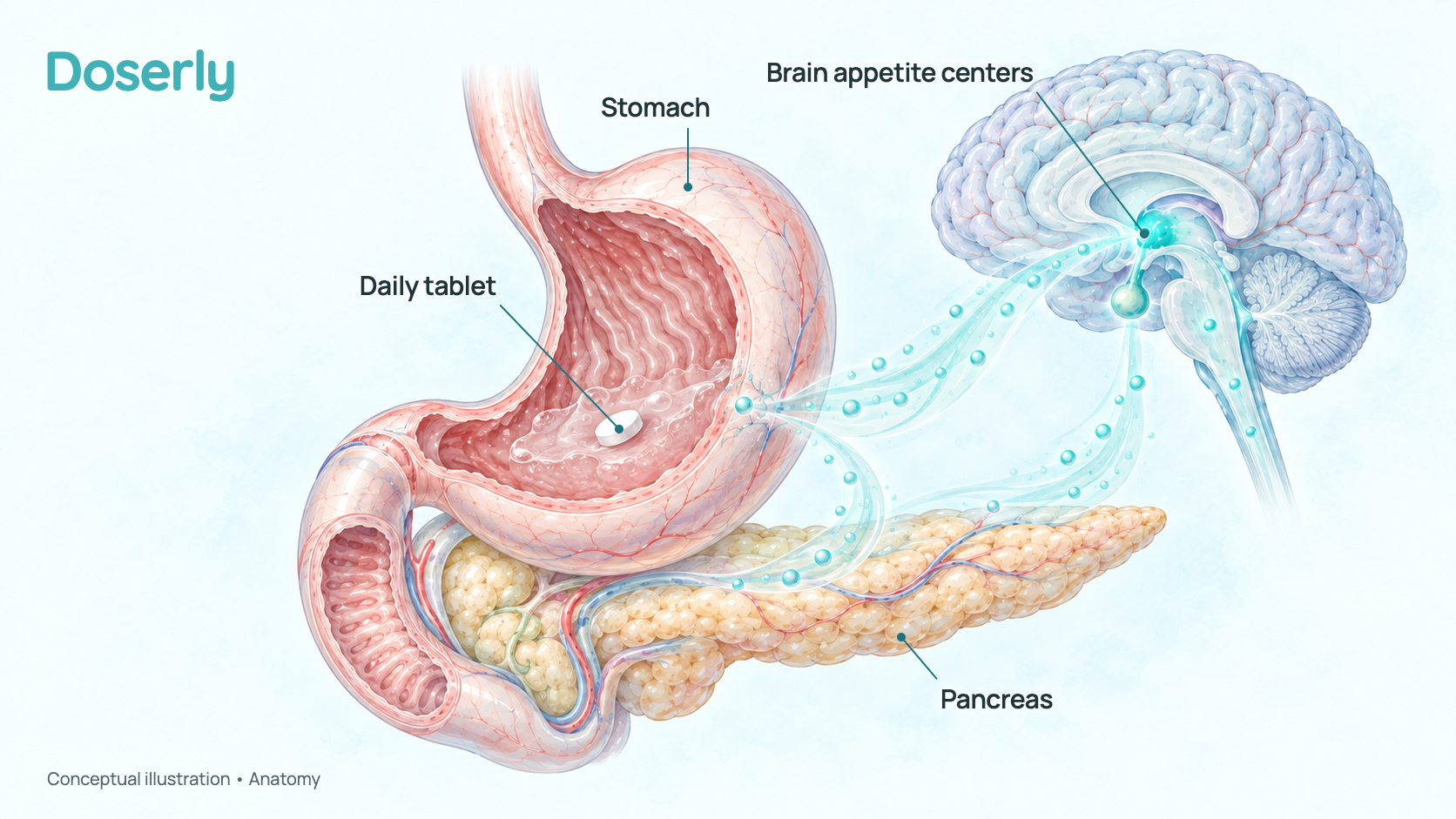
Typical Orforglipron Protocols
| Product and use | Starting dose (at least 30 days) | Dose steps | Maintenance dose (each day) | Duration |
|---|---|---|---|---|
| Foundayo · weight loss and keeping it off, adults (US and UK) | 0.8 mg | 2.5 mg (at least 30 days) → 5.5 mg; then 9, 14.5 or 17.2 mg, each after at least 30 days, if needed and tolerated | 5.5, 9, 14.5 or 17.2 mg; top dose 17.2 mg | Long term US: adults with obesity, or overweight with at least one weight-related health problem. UK: adults with a body mass index (BMI) of 30 or more, or 27 to under 30 with a weight-related health problem |
| Foundayo · type 2 diabetes, adults (UK only) | 0.8 mg | Same steps as above, guided by blood-sugar response and tolerance | 5.5, 9, 14.5 or 17.2 mg; top dose 17.2 mg | Long term Not a US use as of September 2026. With insulin or a sulfonylurea, the UK label suggests lowering those doses to avoid low blood sugar |
| Foundayo · with certain interacting medicines | 0.8 mg | Same steps | No higher than 9 mg | While the other medicine is taken US: strong CYP3A4 blockers such as the antibiotic clarithromycin; avoid ones that also block OATP1B (a liver transporter that moves drugs into liver cells), such as ritonavir. UK: also OATP1B blockers such as ciclosporin |
The most common schedule in the labels and the reviewed dosing sources is one tablet a day, starting at 0.8 mg and rising at least 30 days apart through 2.5 mg to 5.5 mg, with further 30-day steps to 9, 14.5 and 17.2 mg if more effect is needed and the side effects allow. [1], [8], [14], [15], [16], [17]
- Titration Raising the dose in steps
- The slow start is there to limit nausea, vomiting and diarrhea, which were most common while the dose was rising. Each step lasts at least 30 days; there is no maximum time on a step. The US label says to move from 2.5 mg to 5.5 mg after at least 30 days, and then to go higher only "based on treatment response and tolerability"; the UK wording says the move to 5.5 mg "can" be made. 5.5, 9, 14.5 and 17.2 mg can each be a long-term maintenance dose. [1], [8]
- Breaks and cycles
- Not applicable in the labels: orforglipron is a continuous, long-term treatment with no planned breaks. If a tablet is missed, both labels say to take it as soon as possible and never to take two in one day. The US label adds that after 7 or more missed days in a row, the dose steps restart at a lower dose to limit stomach side effects. Weight tends to return after GLP-1 medicines are stopped (see stopping). [1], [8], [18]
Read the units: doses are in milligrams (mg) per tablet, and one tablet is the whole daily dose. There are no syringe units, no mixing and no splitting: the labels say to swallow the tablet whole and never to take more than one a day, including to make up a higher dose. Trial capsule milligrams are not the same as tablet milligrams: a 36 mg trial capsule gives the same blood levels as a 17.2 mg Foundayo tablet (see the conversion table). [1], [8], [19]
Each row is a labeled schedule, not a step to move through. These are the labeled doses; prescribers move up the steps based on weight or blood-sugar response and side effects, and hold at a lower maintenance dose when that works. [1]
What do the trial doses mean in tablets?
Almost every published orforglipron study used an earlier investigational capsule form with its own milligram numbers. The capsules and the Foundayo tablets give matching amounts of drug in the blood, but the numbers on the pack are different. That is why news stories and older pages quote 6, 12 or 36 mg while pharmacies dispense 5.5, 9 or 17.2 mg. [19], [20], [8]
| Trial capsule | Matching Foundayo tablet | Where the capsule dose appears |
|---|---|---|
| 1 mg | 0.8 mg | First step in the phase 3 trials |
| 3 mg | 2.5 mg | Second step; lowest dose group in the type 2 diabetes trials |
| 6 mg | 5.5 mg | Lowest dose group in the ATTAIN weight trials |
| 12 mg | 9 mg | Middle dose group in most phase 3 trials; the switch trial's starting dose |
| 24 mg | 14.5 mg | Step on the way to 36 mg; a dose group in the phase 2 trials |
| 36 mg | 17.2 mg | Highest dose group in the phase 3 trials |
| 45 mg | None | Phase 2 trials only; no tablet equivalent |
In this guide, trial results keep the trial's own capsule dose and give the matching tablet in brackets, for example "36 mg (17.2 mg tablet)". [19]
Where schedules differ: switching from injections, missed doses, research capsules and stopping ↓
Where these numbers come from
The first table comes from the current US prescribing information for Foundayo (revised July 2026, approved as supplement S-003 on August 4, 2026) and the UK Summary of Product Characteristics (August 2026). The dose steps did not change between the original April 2026 US label and the current one. Each row keeps the use, steps and maintenance dose together as the labels state them. [1], [21], [8]
The capsule-to-tablet table comes from the FDA's review of the application, which compared blood levels of the two forms in a bioequivalence study, and from Table 2 of the UK label. The 45 mg dose was used only in phase 2 and has no tablet match. [19], [20], [8]
Dosing websites were used as cross-checks, not as the source of any row. Of 30 reviewed pages, 17 repeat the label's tablet ladder. Others copy trial capsule doses (such as a 36 mg "maintenance dose") onto Foundayo, attach vial and syringe calculators to a tablet, or describe split-pill and "research" capsule schedules with breaks. These did not shape the tables; they are discussed in the next section. [22], [23], [11], [24], [14], [15], [16]
What is orforglipron commonly used for?
Most people look into orforglipron because they want to lose weight without injections, or to keep off weight they lost on an injectable GLP-1 medicine. People with type 2 diabetes also read about it, because several large trials tested it for blood-sugar control. In community education groups, members often describe it as a convenient pill that they expect to work less strongly than the newest injections; no completed trial has compared it directly with those injections for weight loss (see the comparison). [1], [25], [26]
The uses below are approved for specific people in specific countries. Using orforglipron outside its label, or using an unapproved "research" product, is a different situation from the trials described here.
Weight loss
This is Foundayo's only US use. The label covers adults with obesity, or with overweight plus at least one weight-related health problem such as high blood pressure or sleep apnea, alongside a reduced-calorie diet and more physical activity. In ATTAIN-1, adults without diabetes lost an average of 7.4%, 8.3% and 11.1% of their body weight over 72 weeks on the 5.5, 9 and 17.2 mg tablet-equivalent doses, compared with 2.1% on placebo. On the top dose, 54.5% lost at least 10% of their weight and 18.4% lost at least 20%. [1], [27]
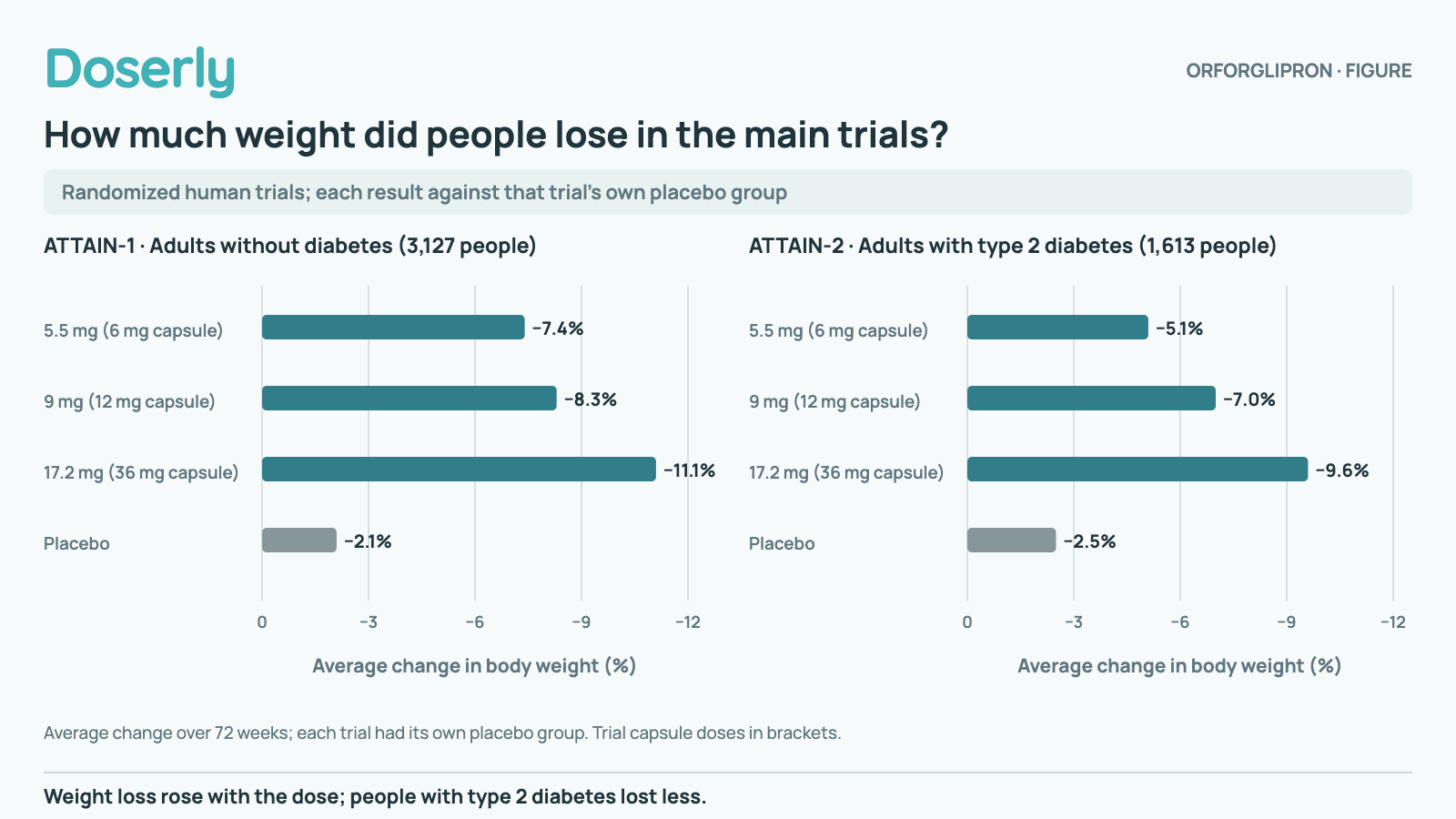
How much weight did people lose in the main trials?
Randomized human trials; each result against that trial's own placebo group
- ATTAIN-1 · Adults without diabetes (3,127 people)
- 5.5 mg −7.4%; 9 mg −8.3%; 17.2 mg −11.1%; placebo −2.1%.
- ATTAIN-2 · Adults with type 2 diabetes (1,613 people)
- 5.5 mg −5.1%; 9 mg −7.0%; 17.2 mg −9.6%; placebo −2.5%.
Average change in body weight (%).
Average change over 72 weeks; each trial had its own placebo group. Trial capsule doses in brackets.
Weight loss rose with the dose; people with type 2 diabetes lost less.
Keeping weight off after injections
Many people who lose weight on weekly injections want a simpler way to keep it off. The ATTAIN-MAINTAIN trial tested exactly that. Adults who had lost weight on tirzepatide (Zepbound) or semaglutide (Wegovy) in an earlier trial stopped their injections and were assigned by chance to daily orforglipron or placebo for a year. Among those whose weight had leveled off before switching, the orforglipron groups kept an estimated 74.7% (after tirzepatide) and 79.3% (after semaglutide) of the weight they had lost, compared with 49.2% and 37.6% on placebo. These are statistical model estimates for the group, not the result for each person. [25]
The trial had no group that simply stayed on injections, so it cannot show whether switching works as well as continuing, and it lasted only a year. People on placebo who regained enough weight could be moved to orforglipron from week 24. [25]
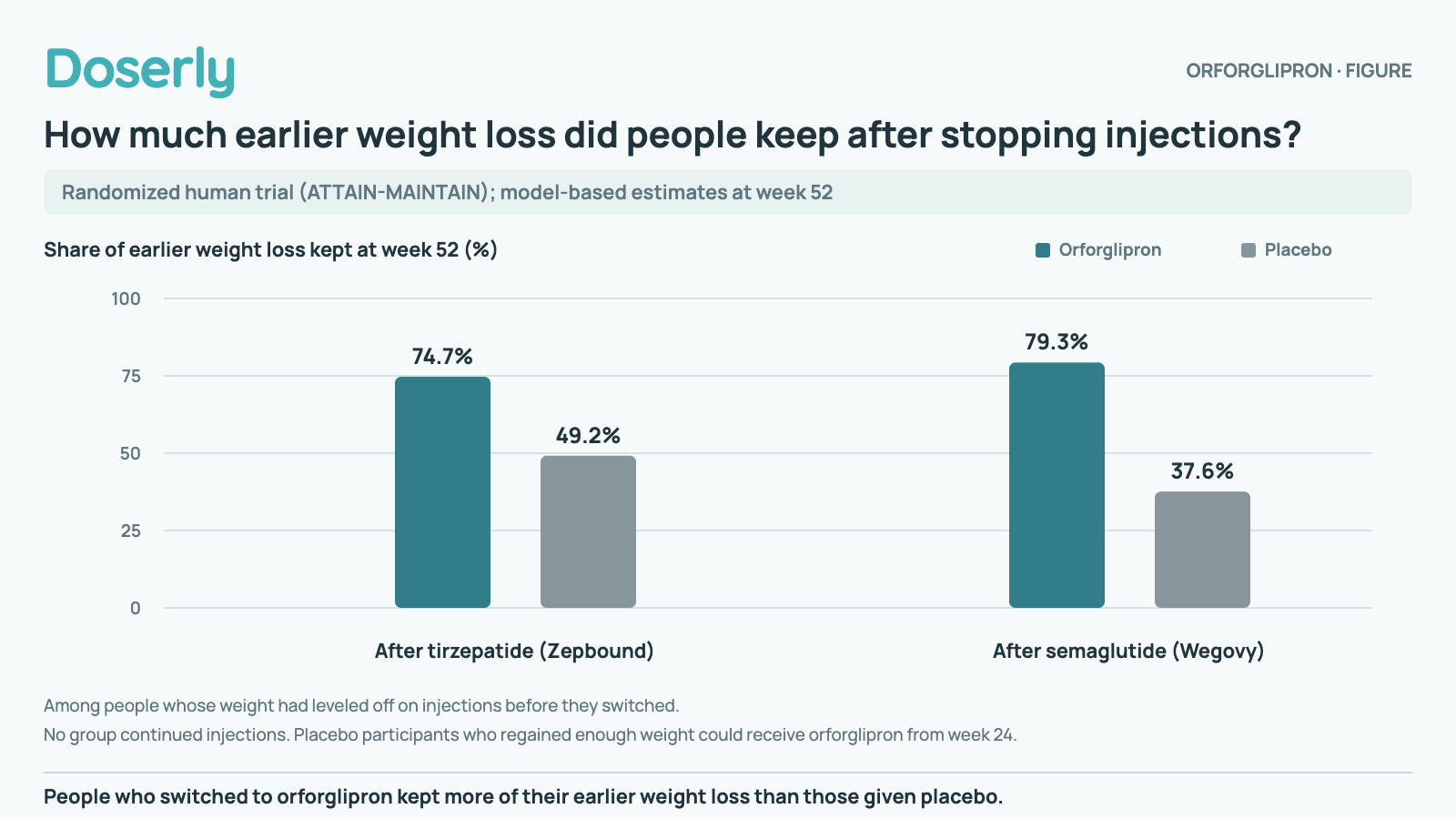
How much earlier weight loss did people keep after stopping injections?
Randomized human trial (ATTAIN-MAINTAIN); model-based estimates at week 52
- After tirzepatide (Zepbound)
- Orforglipron 74.7%; placebo 49.2%.
- After semaglutide (Wegovy)
- Orforglipron 79.3%; placebo 37.6%.
Among people whose weight had leveled off on injections before they switched.
No group continued injections. Placebo participants who regained enough weight could receive orforglipron from week 24.
People who switched to orforglipron kept more of their earlier weight loss than those given placebo.
Type 2 diabetes
In the UK, Foundayo is also approved for adults with type 2 diabetes whose blood sugar is not controlled well enough, on its own or with other diabetes medicines. In the US, it is not approved for diabetes as of September 2026, although the label notes that it lowers blood sugar. In ACHIEVE-1, adults with early type 2 diabetes saw HbA1c fall by 1.24 to 1.48 points over 40 weeks, compared with 0.41 on placebo. In ACHIEVE-3, it lowered HbA1c more than semaglutide tablets. [8], [7], [1], [26], [28]
Other conditions being studied
Lilly has registered trials of orforglipron in obstructive sleep apnea, high blood pressure, knee arthritis pain, leg-artery disease, heart disease outcomes and teenagers with obesity. Most have not reported results; see the registered studies. [29], [30], [31], [32], [33], [34]
Where do orforglipron protocols differ?
The label ladder is simple. The confusion comes from two dose scales (capsules and tablets), how to switch from an injection, different missed-dose rules by country, research products, and stopping.
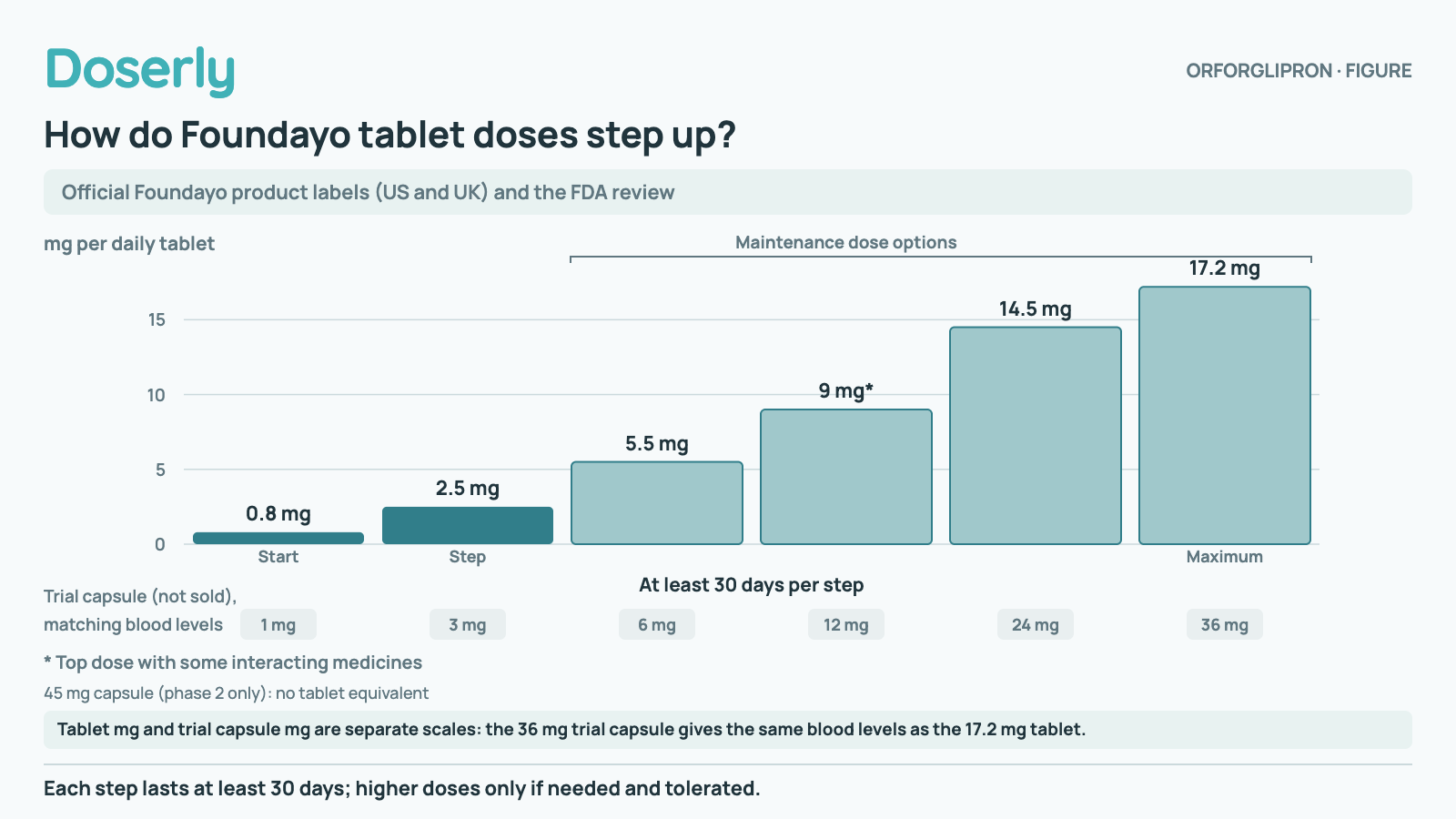
How do Foundayo tablet doses step up?
Official Foundayo product labels (US and UK) and the FDA review
- 0.8 mg tablet
- Start, at least 30 days · trial capsule 1 mg
- 2.5 mg tablet
- Step, at least 30 days · trial capsule 3 mg
- 5.5 mg tablet
- Maintenance option, at least 30 days · trial capsule 6 mg
- 9 mg tablet
- Maintenance option, at least 30 days; top dose with some interacting medicines · trial capsule 12 mg
- 14.5 mg tablet
- Maintenance option, at least 30 days · trial capsule 24 mg
- 17.2 mg tablet
- Maximum maintenance option, at least 30 days · trial capsule 36 mg
45 mg capsule (phase 2 only): no tablet equivalent
Tablet mg and trial capsule mg are separate scales: the 36 mg trial capsule gives the same blood levels as the 17.2 mg tablet.
Each step lasts at least 30 days; higher doses only if needed and tolerated.
Is 36 mg the same as 17.2 mg?
Matched in blood levels, not in milligrams. A 36 mg trial capsule and a 17.2 mg Foundayo tablet give matching blood levels, and the UK label states that the two forms "are not substitutable on a mg-per-mg basis". The same applies down the scale: 12 mg matches 9 mg, and 6 mg matches 5.5 mg. There is no 36 mg Foundayo tablet. [19], [8]
The mix-up shows up widely. One dosing page lists "36 mg once daily at maintenance" under FDA-approved Foundayo, and another pairs a "12–36 mg" trial range with a vial calculator. In community education groups, one course table starts at the 0.8 mg tablet but gives 36 mg, a capsule dose, as the top of the range. Taking the trial number at face value with tablets would mean about double the top approved dose, and it cannot be done anyway without taking several tablets a day, which the labels forbid. [22], [23], [8]
Does everyone need to reach 17.2 mg?
No. 5.5, 9 and 14.5 mg are all labeled maintenance doses, and the label allows a person to stay on the dose that works and is tolerated. In ATTAIN-1, 59.6% of people on 5.5 mg lost at least 5% of their weight, compared with 71.5% on 17.2 mg and 26.8% on placebo. [1]
The doses matter more in type 2 diabetes. In the FDA's review of ATTAIN-2, the lowest dose's extra weight loss over placebo (about 2.6%) was judged not clinically significant, and the middle dose's (about 4.5%) borderline, while the top dose gave about 7.1%. That is the agency's view of one trial, not a rule for every person. [19], [1], [35]
How do people switch from an injection?
The labels give no switching instructions: every new Foundayo user starts at 0.8 mg. [1], [8]
The switch trial did it differently. In ATTAIN-MAINTAIN, people started orforglipron within 14 days of their last injection at a 12 mg capsule (the 9 mg tablet's match) and moved up every 4 weeks toward 36 mg (17.2 mg tablet) or the highest dose they tolerated. That is a research protocol for people already used to GLP-1 side effects, not an approved schedule. Some clinic pages now describe it to patients. [25], [36]
In public forums and community education groups, people who switched straight to the lowest tablet strengths often described hunger returning and small gains at first (see what people report). The starting doses are there to limit side effects, not to match an injection. [37], [38], [39], [40]
What if a tablet is missed?
The rules differ slightly by country. Both labels say to take a missed tablet as soon as possible and never to take two tablets in one day. The US label adds that after 7 or more missed days in a row, the dose steps start again from a lower dose; the patient guide says to call the prescriber about how to restart. [1], [8]
Because orforglipron's half-life is 29 to 49 hours, blood levels roughly halve within one to two days of a missed tablet. One person who tried a claimed research pill described hunger returning when a dose was taken about four hours late; they later softened the claim in the comments, and the product was never tested. [1], [41]
Do "research" capsules and pills follow the same steps?
No. Research products are sold in their own strengths, often 6 mg capsules or pills, and websites give their own schedules: [11], [12], [24], [42]
- A split-pill ladder: a quarter of a 6 mg pill (1.5 mg) in week 1 and half a pill in week 2, then whole pills rising by 6 mg every 4 weeks to six pills (36 mg) a day, followed by a break as long as the course. [11]
- A combination pill: 6 mg of orforglipron with 250 mcg of SLU-PP-332, every other day in week 1, then daily, then two pills a day from week 11. This mix has its own guide. [12]
- A compounded capsule: a pharmacy page describing 1–3 mg a day to start, increased every 4–8 weeks, with a 12 mg capsule as a possible maintenance strength. [24]
- A "typical" 2 mg: one page averages early trial doses into a "typical" 1–3 mg a day. [42]
In community education groups, members most often described grey-market 6 mg capsules taken five to seven times a week, sometimes as a "bridge" between courses of injectable drugs. None of these schedules has been tested, and none matches the approved tablets, which must not be split. Even if genuine, a 6 mg capsule would match a 5.5 mg tablet, far above the 0.8 mg starting dose. The contents of these products are unverified; see product quality. [1], [19]
Can you cut, crush or "microdose" the tablets?
The labels say no: swallow each tablet whole and do not break, crush or chew it. Foundayo comes in six strengths so that lower doses do not require cutting. No study has tested split tablets or doses below 0.8 mg. [1], [8], [17]
What happens when you stop orforglipron?
The labels describe long-term treatment, and there is no published study of what happens to weight after people stop orforglipron itself. The main trials followed people for only 2 weeks after the last dose, to check safety. With a half-life of 29 to 49 hours, most of the drug is gone within a week or two of the last tablet; the UK label asks women to stop at least 3 weeks before a planned pregnancy for this reason. [1], [8], [19]
- What the switch trial shows about stopping injections. In ATTAIN-MAINTAIN, the placebo groups had in effect stopped GLP-1 treatment: over a year, those whose weight had leveled off before switching kept an estimated 37.6% to 49.2% of the weight they had lost, versus 74.7% to 79.3% on orforglipron. [25]
- What happens across GLP-1 medicines. A 2026 review of stopping studies, all of injectable medicines, estimated that about 60% of lost weight returns within a year, leveling off near 75%. It cannot say exactly how orforglipron behaves. [18]
- Blood sugar. No study has reported what happens to HbA1c after stopping orforglipron.
- A planned test. In two high-blood-pressure trials, people who have taken orforglipron for 48 weeks will be reassigned by chance to continue or switch to placebo for 12 weeks. The planned stopping outcome is blood pressure, not weight. [43]
Tapering, breaks and "receptor resets." The labels give no taper schedule, and no study has compared tapering with stopping at once. Some research-product pages build in long breaks between courses. In community education groups, several members described taking orforglipron during planned breaks from injectable drugs; educators there pointed out that a break on a drug acting on the same receptor does not "reset" it. No study shows that breaks restore the effect. [1], [11], [25]
Why can orforglipron be a pill with no fasting rules?
Because it is a small molecule, not a peptide. Foundayo is taken orally (swallowed), once a day, at any time, with or without food or water; it is not made as an injection, and the US label says it is "only for oral use". [1], [8]
Peptide GLP-1 drugs struggle in the gut. Only about 1% to 2% of a Wegovy semaglutide tablet reaches the blood, even with its absorption helper, so those tablets must be taken on an empty stomach with a little water and a 30-minute wait. Orforglipron was designed to be absorbed like an ordinary pill: its absolute bioavailability was 77% after a 0.8 mg dose in the label's analysis, and 79% after a 1 mg capsule in a separate tracer study. [4], [1], [44]
Food makes little difference. With a meal, total exposure fell by 19% and peak levels by 26% in a study of an investigational tablet, which the FDA judged not clinically relevant; an earlier capsule study found similar drops of 18% to 24%. Stomach-acid reducers such as esomeprazole had no effect on it. [1], [45]
Lilly describes Foundayo as the only GLP-1 pill for weight loss that can be taken any time of day without food or water restrictions. In community education groups, some lessons still repeat the peptide rule of taking an oral GLP-1 on an empty stomach, or say high doses are needed because stomach acid destroys it; neither applies to orforglipron. [6], [1]
What does a 29- to 49-hour half-life mean?
Half-life is the time it takes for the level in the blood to fall by half. For orforglipron it is about 29 to 49 hours, so a daily tablet keeps levels fairly even, and they level off (steady state) after about a week. Levels peak 4 to 8 hours after each tablet. Half-life is one part of a drug's pharmacokinetics: how the body absorbs, moves, breaks down and removes it. [1]
The shorter half-life compared with weekly injections has two practical sides. A missed tablet matters sooner than a late weekly injection, and the drug also clears sooner after stopping or after an overdose; the label advises observation "considering the half-life". [1]
How does the body clear it?
The liver breaks orforglipron down, mainly through an enzyme called CYP3A4, and the breakdown products leave in the stool: 87% of a test dose came out in feces and less than 1% in urine. That explains two label rules. [1], [44]
- Kidneys: kidney disease, even needing dialysis, did not change blood levels, so no dose change is needed. [1]
- Liver: moderate liver disease raised total exposure 1.7-fold and severe liver disease 4.6-fold. It is not recommended with severe liver impairment. [1], [8]
- Other medicines: anything that blocks or speeds up CYP3A4 changes orforglipron levels (see interactions). [1]
How should orforglipron be stored, and how long does it last?
The label for the pack in your hand is the final word, because storage rules differ by country and pack, and the US wording changed in 2026. [1], [21], [8]
| Pack | Temperature | Light and moisture | Shelf life |
|---|---|---|---|
| US bottles (30 tablets, with a desiccant and child-resistant cap), current label from July 2026 | Room temperature, 20–25 °C (68–77 °F); short spells at 15–30 °C (59–86 °F) allowed | Keep in the bottle with its desiccant. The original April 2026 label also said the tablets are light-sensitive and should stay in the bottle and carton; the July 2026 revision removed that sentence | The expiry date on the pack |
| UK blister packs (30 or 90 tablets) | No special temperature conditions | Light-sensitive: store in the original package to protect from light | 2 years |
The removal of the US light warning does not show that light has no effect on every pack; it is the current wording for the US bottle, which already keeps light out. Keeping tablets in their original container until you take them follows both labels. [1], [8]
Research capsules and powders. No approved label covers them, so they have no tested storage period. One dosing page applies a generic storage framework for freeze-dried peptides, which does not fit a tablet or a small molecule. [46]
What do we actually know about orforglipron in people?
Quite a lot for a new medicine. Orforglipron has been tested in large randomized controlled trials, where people are assigned by chance to the medicine or a comparison. As of September 24, 2026, ClinicalTrials.gov lists 52 orforglipron studies, 50 of them sponsored by Lilly, and 27 with posted results. A pooled safety analysis of the phase 3 program covered 11,220 people. The questions the trials answer are specific: how much weight or blood sugar changes, in whom, at which dose, and against what comparison. [47], [48]
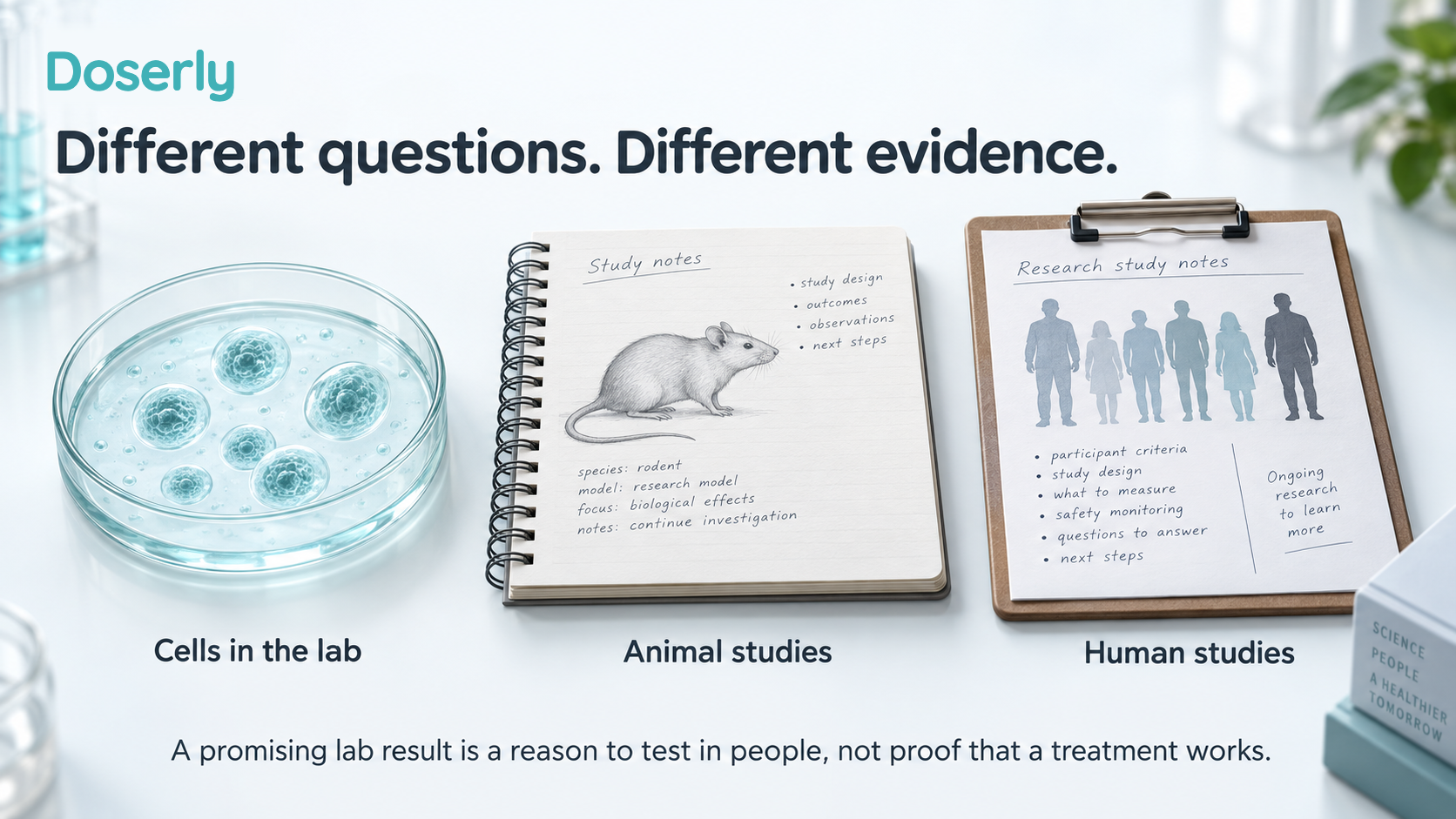
How much weight do people lose in trials?
| Trial | Who and what | Average weight change | What it cannot show |
|---|---|---|---|
| ATTAIN-1 (2025) | 3,127 adults with obesity or overweight, no diabetes; 6, 12 or 36 mg capsules (5.5, 9, 17.2 mg tablets); 72 weeks | −7.4%, −8.3%, −11.1% vs −2.1% on placebo | Results after stopping [1], [27] |
| ATTAIN-2 (2025) | 1,613 adults with overweight or obesity and type 2 diabetes; same doses; 72 weeks | −5.1%, −7.0%, −9.6% vs −2.5% | Why people with diabetes lose less on average [1], [35] |
| ATTAIN-J (results posted 2026) | 238 Japanese adults with obesity or overweight; 6, 12 or 36 mg; 72 weeks | −5.9%, −8.7%, −7.9% vs −0.6% | Results are registry postings, not yet a journal paper [49] |
| Phase 2 (2023) | 272 adults with obesity or overweight, no diabetes; 12 to 45 mg; 36 weeks | −9.4% to −14.7% across dose groups vs −2.3% | Long-term effects; small groups [50] |
| ATTAIN-MAINTAIN (2026) | 376 adults who had lost weight on tirzepatide or semaglutide injections; 52 weeks | Kept an estimated 74.7% to 79.3% of prior loss vs 37.6% to 49.2% on placebo (model estimates, people whose weight had leveled off) | How it compares with staying on injections [25] |
An average hides a wide range. In ATTAIN-1, 71.5% of people on the top dose lost at least 5% of their weight and 35.9% lost at least 15%, while about 3 in 10 lost less than 5%. Average loss was lower at every dose in ATTAIN-2, the trial in people with type 2 diabetes; because the two were separate trials, the reason is not isolated. In a later analysis of adults aged 65 and older in ATTAIN-1, average loss on the top dose was 13.0%. [1], [51]
Why do some sources say placebo lost 0.9%? Trials can be analyzed in two ways. The "treatment regimen" approach counts everyone assigned to a group, including people who stopped taking the tablets; it is the main result in the label and the journal, and gives −11.1% or −11.2% on the top dose versus −2.1% on placebo. The "efficacy estimand" counts only what happened while people kept taking their assigned treatment: in the FDA's review, −12.35% on the top dose versus −0.87% on placebo. Both are correct; the numbers just cannot be mixed. The label also rounds some values slightly differently from the journal (for example −7.4% versus −7.5% on the lowest dose). [1], [27], [19]
What happens to blood sugar in type 2 diabetes?
HbA1c, a blood test that reflects average blood sugar over about three months, fell in every diabetes trial:
| Trial | Who and comparison | HbA1c change (points) | Weight change |
|---|---|---|---|
| ACHIEVE-1 (2025) | 559 adults with type 2 diabetes treated with diet and exercise only; vs placebo; 40 weeks | −1.24 to −1.48 vs −0.41 | −4.5% to −7.6% vs −1.7% [26] |
| ACHIEVE-2 (2026) | 962 adults on metformin; vs dapagliflozin (a diabetes pill that makes the kidneys remove more sugar); 40 weeks | −1.23 to −1.56 vs −0.81 | −5.7% and −6.8% (12 and 36 mg) vs −2.4% [52] |
| ACHIEVE-3 (2026) | On metformin; vs semaglutide tablets 7 or 14 mg; 52 weeks; 1,698 adults | −1.71 and −1.91 vs −1.23 and −1.47 | −6.7% and −9.2% vs −3.7% and −5.3% [28], [8] |
| ACHIEVE-5 (2026) | On insulin glargine; vs placebo; 40 weeks | −1.58 to −1.88 vs −0.79 | −2.6% to −5.4% vs +0.2% [53] |
| ATTAIN-2 (2025) | Overweight or obesity with diabetes; vs placebo; 72 weeks | −1.2 to −1.7 vs −0.4 | See the weight table [1] |
| Phase 2 (2023) | 383 adults with type 2 diabetes; vs placebo and weekly dulaglutide injections; 26 weeks; doses up to 45 mg | Up to −2.10 vs −0.43 (placebo) and −1.10 (dulaglutide) | Up to −10.1 kg vs −2.2 kg and −3.9 kg [54] |
Added to insulin in ACHIEVE-5, orforglipron did not increase clinically significant low blood sugar: 12.9% to 19.0% of people on orforglipron had it, versus 20.7% on placebo, though 3 people on orforglipron had a severe episode. [53], [8]
In ACHIEVE-3, the only completed head-to-head trial against another GLP-1 pill, both orforglipron doses lowered HbA1c more than both semaglutide doses. Stomach and bowel side effects were more common with orforglipron (59% and 58%) than with semaglutide tablets (37% and 45%), and more people stopped because of side effects (9% and 10% versus 4% and 5%). This reverses a claim, repeated on some pages, that orforglipron causes about half the stomach side effects of oral semaglutide. The trial was open-label (everyone knew which drug they took) and used diabetes doses of semaglutide, not the 25 mg weight-loss tablet. [28]
Does it help blood pressure, cholesterol and the heart?
The weight trials measured several heart-risk factors. On the top dose in ATTAIN-1, over 72 weeks: [1]
- Waist: −10.0 cm versus −3.1 cm on placebo.
- Systolic blood pressure (the top number): −6.4 versus −1.4 mmHg.
- Triglycerides (a blood fat): −20.0% versus −4.0%; non-HDL cholesterol −7.7% versus −2.0%; HDL ("good") cholesterol +4.5% versus −1.0%.
- Pulse: +4.6 versus +0.6 beats per minute (see heart rate).
Fewer outcomes are known. ACHIEVE-4, which compared orforglipron with insulin glargine in 2,749 adults with type 2 diabetes and heart risk, met its preset non-inferiority goal for heart attacks, strokes and related events: it ruled out a large increase compared with insulin (hazard ratio 0.84, with a range from 0.59 to 1.20, inside the preset limit of 1.8). Because that range runs from about 40% fewer to 20% more events, it does not show a heart benefit and does not rule out a small increase. The result comes from a company announcement, with a full presentation scheduled for October 2026; it is not yet a journal paper. A larger heart-outcomes trial against placebo, in about 7,140 people, is under way. [55], [56], [33]
Is the weight lost fat or muscle?
Mostly fat, but lean tissue fell too. In a body-scan substudy of ATTAIN-1 (171 people scanned with DXA), fat mass fell by 13.8% on orforglipron across doses and 1.7% on placebo over 72 weeks, while lean mass (muscle, organs and water) fell by 4.5% versus rising 0.3%. On the top dose, fat fell 20.0% and lean mass 6.6%. The FDA reviewer noted that fat loss was about three times the lean loss, similar to other weight-loss treatments, and saw no sign of excessive muscle loss; falls were reported in 1% of people on orforglipron and 0.7% on placebo. [19], [1]
Lean mass is not the same as strength, and no orforglipron study has measured strength. In community education groups, educators stress protein and strength training during large weight loss, especially for older adults and athletes.
Which studies are still under way?
Sleep apnea (ATTAIN-OSA)
Two placebo-controlled studies in 712 adults with moderate to severe obstructive sleep apnea and obesity or overweight, with and without breathing machines, over 52 weeks.
Design and baseline paper published 2026; no results yet
[29], [57]High blood pressure (ATTAIN-Hypertension)
Two studies in adults with high blood pressure and obesity or overweight, run under one master protocol. After 48 weeks, people on orforglipron are reassigned by chance to keep taking it or switch to placebo for 12 weeks, the only planned test of stopping orforglipron found; its stopping outcome is blood pressure.
Active, not recruiting; no results posted
[30], [43], [58]Heart outcomes
Orforglipron versus placebo in about 7,140 adults aged 50 or older with heart or blood-vessel disease or chronic kidney disease, counting heart attacks, strokes and heart deaths over about 5 years.
Recruiting; no results posted
[33]Knee arthritis and leg-artery disease
Two 72-week studies in about 800 adults with obesity or overweight and painful knee osteoarthritis, measuring pain, function and walking distance; and a trial in adults with peripheral artery disease.
Recruiting; no results posted
[31], [32]Teenagers and children
A 72-week placebo-controlled trial in about 150 adolescents aged 12 to 17 with obesity or overweight, and a trial comparing orforglipron with dulaglutide in about 170 young people aged 10 to 17 with type 2 diabetes.
Recruiting or about to start; no results
[34], [59]How does orforglipron work?
Orforglipron switches on the GLP-1 receptor, the same receptor as the natural hormone and as semaglutide. Its effects in people are measured: it reduces food intake, most likely by lowering appetite; it raises insulin only when blood sugar is high and lowers fasting glucagon (a hormone that raises blood sugar); and it slows how fast the stomach empties. [1], [8]
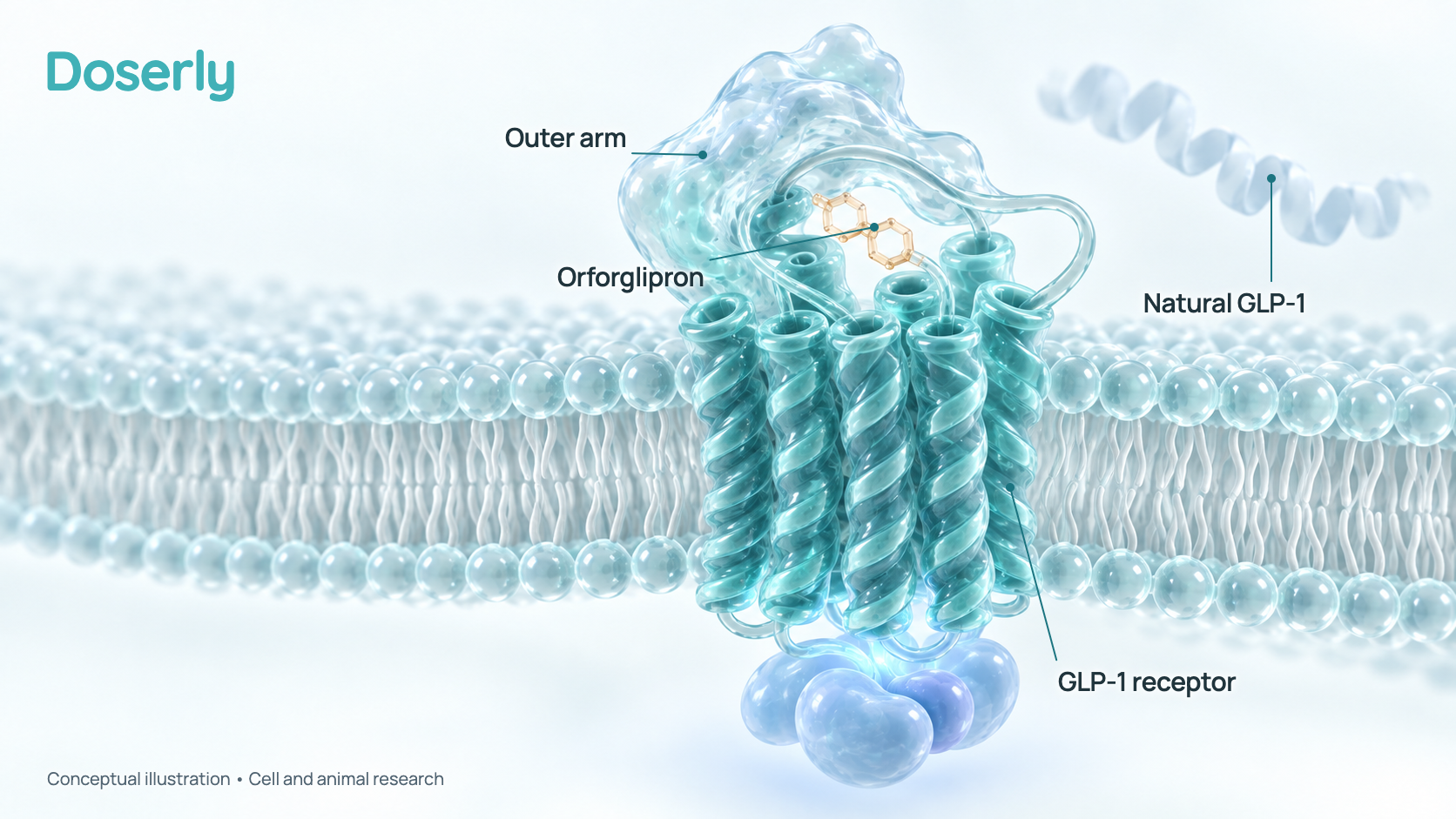
How does a small molecule switch on a peptide receptor?
In a 2020 laboratory study, researchers took a high-resolution picture of orforglipron (then LY3502970) bound to the human GLP-1 receptor. It sat in a pocket in the upper part of the receptor, held by the receptor's outer arm (the extracellular domain), one of its outer loops and four of its seven helices. That grip creates a slightly different receptor shape from the one the natural hormone creates. [3]
Two consequences follow in laboratory tests. Orforglipron is a partial agonist: it switches the receptor on less fully than GLP-1, yet only a small share of receptors needs to be occupied for a full effect on blood sugar in mice with the human receptor. It is also "biased": it triggers the receptor's main signaling route (through G proteins) while barely recruiting beta-arrestin, a protein that helps pull receptors inside the cell. Whether this bias changes anything for patients is not known. The FDA also describes it as a partial agonist. [3], [60], [2]
Why were most animal studies done in special mice and monkeys?
The grip depends on one amino acid in the receptor's outer arm that primates have and rodents lack. Orforglipron does nothing at normal rat and mouse GLP-1 receptors, so researchers used mice and rats engineered to carry the human-type receptor, and monkeys. In those animals, oral doses lowered blood sugar, raised insulin and reduced food intake, with effects comparable to an injected GLP-1 drug (exenatide). In rats engineered this way, orforglipron by mouth kept weight down after injected semaglutide was stopped. [3], [60], [61], [1]
This also explains the rodent safety data. Orforglipron caused no tumors in a 2-year rat study or a 26-week mouse study, but because it cannot act on rodent receptors, those studies cannot answer the thyroid question raised by other GLP-1 drugs (see thyroid risk). [1]
How does it reduce appetite?
GLP-1 receptors sit in brain areas that regulate appetite. In animal studies, orforglipron reached and activated nerve cells in those areas. In a 2026 study of a brain reward circuit, oral orforglipron reduced high-fat food intake and body weight in mice engineered so their receptor responds to it. How much of the effect in people comes from the brain versus the stomach has not been measured directly. [1], [62]
Does it slow the stomach?
Yes, mostly at first. The label states that the delay in stomach emptying is largest after the first dose and fades with continued use. In one test, the first 0.8 mg dose lowered the peak level of acetaminophen (a marker of how quickly a pill leaves the stomach) by 28%; the effect was smaller after repeated doses of 17.2 mg. This slowing is why the label warns about anesthesia and about birth-control pills. [1]
Other laboratory findings
Small numbers of preclinical (laboratory and animal) studies have looked at other effects: less aortic aneurysm damage in mice with the human-type receptor, and protective, anti-inflammatory effects in laboratory cell experiments. In rats, very little of the drug crossed into the brain (a brain-to-blood ratio of 0.0078), though rats cannot show its effects there. In type 2 diabetes, an analysis of the phase 2 trial found markers of insulin-making cell function and insulin sensitivity improved. None of these findings is a proven benefit in people. [63], [64], [65]
What are the risks and unanswered questions?
Is orforglipron safe?
Orforglipron has a safety profile similar to other GLP-1 medicines in large trials: stomach and bowel side effects are common, and serious problems such as pancreatitis and gallbladder disease are uncommon but real. The label lists who should not take it and what to watch for, and those findings apply to the approved tablets at labeled doses. It is new, so rare side effects that only appear after millions of prescriptions are not yet known, and unapproved products carry risks of their own. [1], [27], [35]
What are the most common side effects?
Stomach and bowel symptoms. In the two main weight trials, people on the 5.5, 9 and 17.2 mg tablet-equivalent doses reported: [1]
| Side effect | 5.5 mg | 9 mg | 17.2 mg | Placebo |
|---|---|---|---|---|
| Nausea | 26% | 34% | 35% | 10% |
| Constipation | 20% | 27% | 24% | 9% |
| Diarrhea | 21% | 23% | 25% | 11% |
| Vomiting | 13% | 21% | 24% | 4% |
| Indigestion | 12% | 16% | 13% | 4% |
| Stomach pain | 13% | 14% | 14% | 7% |
| Headache | 8% | 9% | 9% | 7% |
| Tiredness | 6% | 7% | 9% | 4% |
| Hair loss | 4% | 4% | 5% | 2% |
Burping, bloating, reflux and wind were also more common. Trials record these as adverse events, whether or not the drug caused them. Of the people who had stomach or bowel side effects, 60% called them mild, 36% moderate and 4% severe, and they were most frequent while the dose was rising. Overall, 6% to 10% of people stopped because of side effects, compared with 3% on placebo, mostly for stomach reasons. [1] In a year-long open-label safety study in Japanese adults with type 2 diabetes, 5%, 8% and 14% stopped because of side effects on the 3, 12 and 36 mg capsules. [66]
What serious risks are on the label?
- Thyroid tumors (US boxed warning). Other GLP-1 drugs caused thyroid C-cell tumors in rats and mice. The US label carries the same boxed warning and rules out use in anyone with a personal or family history of medullary thyroid cancer or the inherited condition MEN 2 (see thyroid risk). [1]
- Pancreatitis. Inflammation of the pancreas, sometimes severe. In the weight trials it was confirmed in 6 people on orforglipron and 1 on placebo (0.14 versus 0.04 people per 100 years of treatment). Severe stomach pain that may spread to the back needs urgent care, and the tablets are stopped. The UK label says it has not been studied in people who have had pancreatitis. [1], [8]
- Severe stomach and bowel reactions. About 3% had severe reactions, versus 1% on placebo. It is not recommended with severe gastroparesis (a stomach that empties very slowly). [1]
- Kidney injury from dehydration. Reported in 0.2% versus 0.05%, mostly after vomiting or diarrhea. [1]
- Gallbladder disease. Gallstones in 1% versus 0.7%, and gallbladder inflammation in 0.4% versus 0.3%, linked to weight loss. [1]
- Low blood sugar (hypoglycemia). In ATTAIN-2, in adults with type 2 diabetes, 2% on orforglipron had low blood sugar versus 0.2% on placebo, and one person on orforglipron had a severe episode. The risk is higher with a sulfonylurea (7% versus 0.5% of those not taking one) or insulin, and low blood sugar has also been reported in people without diabetes. [1]
- Faster heart rate and low blood pressure. Resting heart rate rose by 4 to 5 beats per minute on average; a fast heart rate was reported in 3% versus 0.9%. Low blood pressure affected 2% versus 0.5%, and 4% of those also on blood-pressure medicines. [1]
- Allergic reactions. In the weight trials, allergic (hypersensitivity) reactions of any severity occurred in 0.5% of people on orforglipron versus 0.3% on placebo; this count includes anaphylaxis (a severe, whole-body allergic reaction), whose separate rate the label does not give. Signs of a serious reaction, such as swelling of the face, lips or throat, or trouble breathing, mean stopping the tablets and getting medical help promptly. Anyone who has had a serious allergic reaction to orforglipron or the tablet's other ingredients should not take it. [1], [8]
- Diabetic eye disease and anesthesia. Rapid improvement in blood sugar can temporarily worsen diabetic eye disease. Because the stomach empties more slowly, food could be inhaled into the lungs under general anesthesia or deep sedation, so tell the care team before any procedure. [1]
Blood tests also change: pancreas enzymes (amylase and lipase) rose on average by 16% to 31%, which does not by itself mean pancreatitis. Skin sensations such as tingling or burning (dysesthesia) affected 1% on the top dose. [1]
Is orforglipron hard on the liver?
The liver question matters because Pfizer stopped developing two other small-molecule GLP-1 pills: lotiglipron in 2023, citing drug-interaction data and raised liver enzymes, and danuglipron in 2025, after one participant had a possible drug-caused liver injury that resolved when the drug was stopped. [67], [68] Orforglipron is broken down by the liver, so regulators looked closely. In a pooled analysis of the phase 3 program covering 11,220 people, a pattern of liver-enzyme and bilirubin rises that can signal serious drug-caused liver injury occurred in 6 people on orforglipron and 6 on comparison treatments (about 0.1% each), and none was judged to be caused by orforglipron. Rare liver injury cannot be ruled out until far more people have taken it. [48]
Does orforglipron cause thyroid cancer?
It is not known, and the reason differs from other GLP-1 drugs. For semaglutide and similar drugs, the warning comes from thyroid tumors seen in rats and mice. Orforglipron does not act on rat or mouse GLP-1 receptors, and it caused no tumors in a 2-year rat study or a 26-week study in mice bred to show cancer risk quickly. That result cannot clear it, because the rodents could not respond to it. The US label keeps the class-wide boxed warning and says the human relevance of these rodent tumors has not been determined. [1]
The UK label handles this differently: its only contraindication is allergy to the ingredients, with no thyroid-cancer contraindication. Human studies of GLP-1 drugs as a group disagree: a French study found a higher risk of thyroid cancer, while a Scandinavian study did not. Neither included orforglipron. Routine calcitonin blood tests or thyroid scans are of uncertain value, according to the US label; a lump in the neck, hoarseness, trouble swallowing or shortness of breath should be reported. [8], [69], [70], [1]
Can orforglipron affect eyesight or mood?
Eyesight. The UK label lists NAION, a rare sudden loss of vision in one eye from reduced blood flow to the optic nerve, among events reported with GLP-1 medicines after approval. It is a class entry; a link with orforglipron itself has not been shown, and the US label does not list it. Sudden vision loss needs emergency eye care. [8], [1]
Mood. The US Foundayo label has no warning about suicidal thoughts. In January 2026 the FDA asked for that warning to be removed from GLP-1 medicines after a review of 91 placebo-controlled trials found no increased risk. Any mood change is still worth raising with a doctor. [1], [71]
Could "research" orforglipron change the risk?
Yes. Capsules, powders and pills sold online as "research" orforglipron are not Foundayo, and their identity, strength and purity have not been independently tested. Some are sold in combinations, such as with SLU-PP-332, or with added vitamin B6. [11], [12], [24]
In September 2026, the FDA updated an import alert that lets officials hold imported bulk GLP-1 ingredients without examining them, and added orforglipron to it; only manufacturers on the FDA's "Green List" are exempt. In community education groups, members most often described buying grey-market 6 mg capsules, while educators drew a clear line between these and the approved tablets. Dose errors are a further risk: if a 6 mg capsule contains what it claims and behaves like the trial capsule, it matches the 5.5 mg tablet, about seven times the 0.8 mg starting dose. [13], [19]
Is orforglipron legal? Is it FDA approved?
Checked September 24, 2026. Rules differ by country and change often. A "research use only" label does not make any product legal or approved.
United States. Foundayo is an FDA-approved prescription medicine for weight reduction and keeping weight off in adults. The key steps:
- 2018. Chugai licensed the compound (OWL833) to Lilly. [5]
- January 20, 2026. The FDA received Lilly's application. [72]
- April 1, 2026. The FDA approved Foundayo, the first new molecular entity approved under its National Priority Voucher pilot program, 50 days after filing. The FDA decided no special risk program (REMS) was needed. [2], [72], [73]
- August 4, 2026. A label update (S-003) was approved; it removed the light-sensitivity storage wording. [1], [21]
- September 21, 2026. The FDA added orforglipron to its import alert on bulk GLP-1 ingredients. [13]
Foundayo is not approved in the US for type 2 diabetes. It is not on the FDA's current or resolved drug-shortage lists, and the FDA has published no compounding decision specific to orforglipron; for semaglutide and tirzepatide, shortages were what allowed pharmacies to make routine copies. [74], [75], [76]
Foundayo can be bought for self-pay through LillyDirect, where a partner pharmacy handles the order. In September 2026 the page showed prices starting at $149 a month for 0.8 and 2.5 mg, $199 for 5.5 mg and $299 for 9, 14.5 and 17.2 mg; the 2.5 and 5.5 mg prices are temporary reductions through December 31, 2026, and the $299 price for 14.5 and 17.2 mg requires a refill within 45 days. Lilly also describes a savings offer as low as $25 a month for some people with commercial insurance, and access for eligible Medicare Part D patients at $50 a month from July 2026 through December 2027. Prices and programs can change. [77], [78]
United Kingdom. On August 10, 2026, the MHRA authorised Foundayo for weight management and for type 2 diabetes in adults, the first approval in Europe. It is prescription-only and was not yet available on the NHS, pending an evaluation by NICE. [7], [8]
European Union. Under review. At its September 14–17, 2026 meeting, the European Medicines Agency's medicines committee listed orforglipron at the "list of outstanding issues" stage, with Lilly asking for more time to respond; it was not among the medicines recommended for approval. [79], [80]
Canada. Under review. Health Canada lists orforglipron calcium as a new active substance whose submission has been under review since January 2026; no approval had been issued. [81]
Australia. Under evaluation by the Therapeutic Goods Administration (TGA) since January 2026, under the proposed name Nexvound, for weight management and type 2 diabetes; not yet on the register of approved medicines. Pharmacies in Australia may not compound GLP-1 medicines. [9], [82]
Japan and elsewhere. Chugai reported in April 2026 that orforglipron was under regulatory review in more than 40 countries, including Japan; no Japanese approval had been announced. Switzerland's regulator received a complete application in January 2026. In India, an expert committee recommended permission to import and market the tablets in May 2026, which is not yet a final approval. In China, Lilly filed for type 2 diabetes and obesity in late 2025, according to a local government report. No approval outside the US and UK was found. [83], [84], [85], [86]
Is orforglipron banned in sport?
It is not banned. Orforglipron is not named on the World Anti-Doping Agency's 2026 or 2027 Prohibited Lists, or on its Monitoring Programs, which track semaglutide and tirzepatide without banning them. The US Anti-Doping Agency's athlete guidance on GLP-1 medicines lists Foundayo and says these medicines are not prohibited in sport. Rules can change each year, so athletes should check the current list. [87], [88], [89], [90], [91]
Who should be especially cautious?
- Pregnancy and breastfeeding. Weight loss offers no benefit in pregnancy. The US label says to stop when pregnancy is recognized; the UK label says not to use it in pregnancy and to stop at least 3 weeks before a planned pregnancy. In a small rabbit study, very high exposures (14 times the human level) caused malformations in 2 fetuses; the main rabbit study and a monkey study found no effects, though the monkeys could not be given high doses. It passed into rat milk, and neither label recommends breastfeeding. A pregnancy registry is planned. [1], [8]
- Birth-control pills. Because orforglipron slows the stomach, both labels advise switching to a non-oral method or adding a barrier method for 30 days after starting and for 30 days after each dose increase. Patches, rings, implants and injections are not affected. [1], [8]
- Thyroid cancer history. Medullary thyroid cancer or MEN 2 in you or your family rules it out in the US. [1]
- Past allergic reaction to it. In the US, a previous serious allergic reaction to orforglipron or any ingredient in the tablets rules it out; the UK label rules it out after any allergy to them. Take extra care with a history of anaphylaxis or facial swelling from another GLP-1 medicine. [1], [8]
- Past pancreatitis, gallbladder disease or bowel disease. These need extra care; it is not recommended with severe gastroparesis. In community education groups, one member decided against it because of diverticulitis and a removed gallbladder, a good example of a question to raise with a prescriber. [1], [8]
- Liver disease. Not recommended with severe liver impairment. [1]
- Very severe heart failure. The UK label does not recommend it for people with the most severe stage of heart failure (NYHA class IV, symptoms even at rest), because no one in that group has been studied. [8]
- Under 18. Not approved for children or teenagers; trials in these ages are under way. [1], [34]
- Older adults. In the main trials, 13% of people on orforglipron were 65 or older, and no overall differences in safety or effect were seen. [1], [51]
- Upcoming surgery or sedation. Tell the care team, because of the risk of food in the stomach under anesthesia. [1]
- Drug-tested athletes. Not prohibited (see sport). [89]
- People taking other medicines; see the next question.
Can orforglipron be taken with other medicines?
Several interactions are known, because orforglipron is cleared by the liver enzyme CYP3A4 and slows the stomach. [1], [8]
- Strong CYP3A4 blockers (for example clarithromycin, which raised orforglipron levels 3.5-fold): top dose 9 mg. Avoid blockers that also block the OATP1B transporter (which carries drugs into liver cells), such as ritonavir. In the UK, OATP1B blockers such as ciclosporin (2.6-fold) also cap the dose at 9 mg. [1], [8], [92]
- Strong CYP3A4 boosters (for example carbamazepine, which cut levels by 82%): avoid. With moderate boosters, the prescriber watches whether it still works. [1]
- Statins: keep simvastatin at 20 mg a day or less (its active form rose 2- to 2.5-fold); the UK label advises halving the simvastatin dose and caution with rosuvastatin above 20 mg. [1], [8]
- Oral topotecan (a cancer medicine taken by mouth): the UK label asks for careful monitoring for side effects when it is taken with orforglipron, so the combination is one for the cancer care team to review. [8]
- Insulin and sulfonylureas: higher risk of low blood sugar; the prescriber may lower their dose at the start. [1]
- Birth-control pills and other pills: see above. Acid-reducing medicines such as esomeprazole do not interact. [1]
- Other GLP-1 medicines: the US label says using it with another GLP-1 receptor agonist is not recommended. [1]
In community education groups, a few members discussed adding orforglipron to retatrutide, an experimental injectable drug, for appetite; there are no data on this, and it goes against the label. Bring a full list of everything you take, including supplements, to a pharmacist or doctor. [1]
What is still unknown?
- Long-term outcomes. No completed trial has shown fewer heart attacks, strokes or deaths; ACHIEVE-4's non-inferiority result is not yet in a journal. [55]
- What happens after stopping orforglipron itself. [1]
- Rare harms, including liver injury, that only large-scale use can reveal. [48]
- Children, pregnancy and people with past pancreatitis, who were not studied or were excluded. [1], [8]
- Research products, whose contents are unknown. [13]
What should be monitored while using orforglipron?
Because orforglipron is an approved medicine, its labels tell prescribers what to watch. They do not set one blood-test schedule for everyone; most checks depend on your other conditions, your other medicines and any symptoms. Use this summary to prepare questions for your prescriber; it is not a personal testing plan. [1], [8]
What do the labels ask prescribers to check?
| Why it matters | What the labels say | Tracking category |
|---|---|---|
| Blood sugar, if you have diabetes | Check blood sugar before starting and during treatment; low blood sugar is more likely with insulin or sulfonylureas, whose doses may need lowering | Blood work |
| Kidneys | Check kidney function if vomiting or diarrhea could cause dehydration, especially when starting or raising the dose | Blood work; Nausea & GI Tolerance |
| Pancreas and gallbladder | Stop if pancreatitis is suspected (severe or lasting stomach pain, sometimes spreading to the back); test for gallbladder problems if symptoms suggest them | Digestive Comfort; Side Effect Burden |
| Eyes | Monitor people with a history of diabetic eye disease; in the UK, sudden vision loss is reported as a possible class effect | Other |
| Thyroid | Report a lump in the neck, hoarseness, trouble swallowing or shortness of breath. Routine calcitonin tests and thyroid scans are of uncertain value | Other |
| Allergic reactions | Stop the tablets and get medical help promptly for signs of a serious allergic reaction | Side Effect Burden |
| Other medicines | Effectiveness with moderate CYP3A4 boosters; birth-control backup for 30 days after each dose increase; simvastatin dose; in the UK, side effects of oral topotecan | Other |
What else is worth discussing during care?
These effects were seen in the trials or are described in the labels, but the labels do not set a specific check for them. They are reasonable things to track and raise with a prescriber.
| Why it matters | What was seen | Tracking category |
|---|---|---|
| Heart rate and blood pressure | Resting heart rate rose 4 to 5 beats per minute on average; low blood pressure was more common in people on blood-pressure medicines | Heart Rate & Palpitations; Blood Pressure |
| Weight, appetite and hair | Response guides each step up; hair loss was more common in women (7% versus 0.9% of men) and was linked to weight loss | Weight Management; Appetite & Satiety; Hair Health |
What did the trials measure?
Beyond weight, the main trials tracked waist size, blood pressure, pulse, HbA1c, blood fats (total, LDL, HDL and non-HDL cholesterol and triglycerides), liver enzymes, pancreas enzymes and calcitonin, a thyroid marker; a subgroup had body-composition scans. These research measurements are not all standing clinical requirements. [1], [19], [48]
How is the response judged?
The label ties each step up to "treatment response and tolerability" but sets no target. US diabetes standards (American Diabetes Association, 2026) advise checking an obesity medicine's benefits and safety at least monthly for 3 months, then at least every 3 months, and reassessing the plan if weight loss is under about 5% after 3 months. [1], [93]
Weight is only one outcome. People often care more about blood sugar, blood pressure, eating patterns or how far they can walk, and trials measure these separately. Tracking what matters to you, alongside dose changes and side effects, makes a conversation with your prescriber more useful.
What do people in public communities report?
Foundayo has been on sale only since April 2026, so public accounts are new and short, mostly one to four months. They include steady losses, stalls, side effects, disappointing switches from injections and research-product experiments. Discussions in community education groups are summarized here without identifying anyone.
What do the positive reports look like?
The clearest positive accounts give weights and tablet strengths. One person reported going from 205 to 191 lb in 60 days (30 days each at 0.8 and 2.5 mg), with less hunger and "food noise", while also exercising more as hip pain eased. Another reported 242 to 213 lb in a little over 3 months on 0.8 then 2.5 mg, following a clinic's diet advice. A third reported 194 to 164 lb and had just moved up to 5.5 mg. [94], [95], [96]
Some people did well without moving up. One stayed at 0.8 mg and reported 155 to 142 lb by the end of month 3, alongside strength training; another reported a postpartum drop from 154 to 133 lb over 4 months on up to 5.5 mg. [97], [98]
How long do results take?
Accounts describe appetite changing within the first days or weeks and weight falling gradually over months. One person described more hunger toward the end of a 30-day step, before the next increase. One trial participant described early loss, then about 6 months without further change and some return of food noise, without knowing whether they were on the drug or placebo. [96], [99], [100]
What happens when people switch from injections?
This is the most common disappointment. People moving from tirzepatide or semaglutide described more hunger, cravings returning and small gains, especially at 0.8 or 2.5 mg: one gained 4 lb in a month and went back to tirzepatide; another gained 10 lb in the first two months, then held steady. One person on 17.2 mg after Zepbound reported headaches, nausea and an 8 lb gain over about 3.5 weeks, and planned to switch back. Others kept their weight, and one said appetite control felt steadier on 9 mg. One person who went the other way, from Foundayo to Mounjaro, said they felt better within days. [40], [39], [101], [102], [103]
In community education groups, members generally saw orforglipron as weaker than the injectable drugs but as their preferred pill option, a view that no head-to-head obesity trial has tested. The few disappointed accounts reviewed there all followed a switch from a stronger injectable drug, apparently at low starting strengths. The ATTAIN-MAINTAIN trial started switchers at a higher dose (see switching). [25]
Does everyone lose weight?
No. One person who moved from Wegovy injections described no reduction in appetite or food noise on Foundayo and regained about 5 lb during the early steps. Another saw neither loss nor gain over 12 days on 0.8 mg after Zepbound. A clinical-trial participant described no appetite or weight change, but may have been on placebo. [38], [37], [104]
What about unwanted effects?
Nausea, reflux, bloating, constipation and tiredness come up most, usually early or after a step up. One first-time user started at 2.5 mg, skipping the 0.8 mg step, and described stomach pain, nausea and fullness on day 2. Another stopped after nausea, heartburn, flu-like symptoms and lightheadedness during exertion, one episode of which happened in the heat. [94], [105], [97], [106], [107]
These are individual reports. A forum post cannot show whether orforglipron caused a symptom or how often it happens; the risks section gives the trial rates.
What about research products?
A small number of public posts describe claimed research pills or capsules, often from one enthusiastic poster who linked to a seller, reporting appetite suppression within hours or days. One person cut claimed 6 mg grey-market tablets into halves and quarters, first reported fewer cravings, then edited the comment to say the lower amounts had not worked or had stopped working. None of these products was tested. [108], [109], [99]
How can you judge a weight-loss story?
Ask: Was it Foundayo or a research product? Which tablet strength, and for how long at each step? Was the person switching from an injection? What else changed, such as diet, exercise, pregnancy or other medicines? What happened a few months later?
These selected discussions show what people experience and the questions research should answer. They are not a survey of all users, a success rate or a substitute for the trials.
How does orforglipron compare with semaglutide, tirzepatide and retatrutide?
These are the medicines most often weighed against orforglipron. All of them act on GLP-1 signaling, but they differ in what they are made of, how they are taken and how far they have got through testing. Status was checked on September 24, 2026.
| Medicine | What it is | Route and schedule | Human evidence | Approval status |
|---|---|---|---|---|
| Orforglipron (this guide; Foundayo) | Small, non-peptide molecule that switches on the GLP-1 receptor [1] | Daily tablet, any time, with or without food [1] | Large trials; ATTAIN-1: 11.1% average weight loss at 72 weeks on 17.2 mg versus 2.1% on placebo [1] | Approved in the US (April 2026) and UK (August 2026); under review in the EU and elsewhere [2], [7], [79] |
| Semaglutide (Wegovy, Ozempic, Rybelsus) | Lab-made copy of the GLP-1 peptide [4] | Weekly subcutaneous injection (into the fatty layer under the skin), or a daily tablet on an empty stomach [4] | Large trials, including heart outcome trials; OASIS 4 (25 mg tablet): 13.6% at 64 weeks versus 2.2% on placebo [110] | Approved in the US and many other countries [4] |
| Tirzepatide (Mounjaro, Zepbound) | One peptide that switches on the receptors for GLP-1 and GIP, another gut hormone [111] | Weekly subcutaneous injection [111] | Large trials; SURMOUNT-1: 20.9% at 72 weeks on 15 mg versus 3.1% on placebo [112] | Approved in the US for type 2 diabetes (2022) and weight management (2023), and in the EU and other countries [113], [114], [115] |
| Retatrutide | One peptide that switches on the GIP, GLP-1 and glucagon receptors [116] | Weekly subcutaneous injection in trials [116] | Phase 2: 24.2% at 48 weeks on 12 mg versus 2.1% on placebo; phase 3 results so far only in company announcements [116], [117] | Not approved anywhere; the maker plans to apply to the FDA in early 2027 [117] |
The weight results come from separate trials in different people, so the table cannot rank these medicines. The one direct comparison, ACHIEVE-3, used diabetes doses: orforglipron lowered HbA1c and weight more than semaglutide tablets, with more stomach side effects. A 2026 statistical comparison across separate obesity trials estimated that the 25 mg semaglutide tablet produced about 3.2 percentage points more weight loss than the 36 mg orforglipron capsule (17.2 mg tablet); such indirect comparisons cannot remove all differences between trials. Semaglutide's heart and kidney benefits come from its own outcome trials, and those results do not carry over to orforglipron. [28], [118]
Common questions about orforglipron
How long does orforglipron take to work?
Weight loss builds over months. It takes at least 60 days to reach 5.5 mg and at least 5 months to reach 17.2 mg, and the main trials measured their results at 72 weeks. [1] Some people describe appetite changing within the first days or weeks, but the trials did not measure when people first notice a change. [94], [96] See what people report.
Is orforglipron the same as oral semaglutide or the Wegovy pill?
No. Semaglutide tablets (Rybelsus, Ozempic tablets and Wegovy tablets) contain a peptide that needs an absorption helper and must be taken on an empty stomach. Orforglipron is a different, non-peptide molecule that can be taken with or without food. In ACHIEVE-3, it lowered HbA1c more than semaglutide tablets at diabetes doses but caused more stomach side effects. [4], [1], [28] See the comparison.
Why do some sites say 36 mg when the top Foundayo dose is 17.2 mg?
Because 36 mg is a trial capsule dose. The trials used capsules on a different milligram scale, and a 36 mg capsule gives the same blood levels as a 17.2 mg tablet. There is no 36 mg tablet, and the labels say never to take more than one tablet a day. [19], [8] See the conversion table.
Can you switch from Zepbound or Wegovy to Foundayo?
Yes, with a prescriber, but there is no milligram conversion between a weekly injection and a daily tablet. The label starts everyone at 0.8 mg. In the ATTAIN-MAINTAIN trial, people switched within 14 days of their last injection to a 12 mg capsule (9 mg tablet), and those whose weight had leveled off kept an estimated 75% to 79% of their weight loss on average, while forum reports from people starting at 0.8 mg often describe hunger returning at first. [1], [25], [37] See switching.
Do you have to take Foundayo on an empty stomach?
No. It can be taken once a day at any time, with or without food or water; a meal lowered blood levels only slightly. Swallow the tablet whole. [1], [8] See why it can be a pill.
What if I miss a dose of Foundayo?
Take it as soon as you remember, but never two tablets in one day. Under the US label, after 7 or more missed days in a row, the dose steps restart at a lower dose, so contact your prescriber. [1], [8] See missed doses.
How much does Foundayo cost?
In the US, LillyDirect listed self-pay prices of $149 to $299 a month depending on the strength, with conditions, and as little as $25 a month for some commercially insured people; insurance coverage varies. Prices change, so check current offers. [77] In the UK, it is not yet available on the NHS. [7]
Are "research" orforglipron capsules the same as Foundayo?
No. They are not approved, their contents have not been independently checked, and their strengths (often 6 mg capsules) do not match Foundayo tablets. The FDA now lets officials hold imported bulk orforglipron from unlisted makers. [11], [13] See research products.
Glossary
Plain explanations of the medical, dosing and research terms used in this guide. Underlined terms in the text link here.
- Adverse event
- A harmful or unwanted medical event reported after someone used a treatment. A report alone does not prove the treatment caused it.
- Animal study
- Research in animals such as mice, rats, rabbits or monkeys. It shows what a substance does in a living body, but results in people can differ. Orforglipron does not act on normal rat and mouse GLP-1 receptors, so many of its animal studies used engineered animals or monkeys.
- Bioavailability
- How much of a dose reaches the bloodstream in a usable form. For orforglipron tablets it is about 77%; for semaglutide tablets it is about 1% to 2%.
- Bioequivalence
- When two forms of a medicine give matching levels in the blood. Orforglipron trial capsules and Foundayo tablets were matched this way, which is why a 36 mg capsule is matched to a 17.2 mg tablet. The milligrams are not interchangeable, so people follow the product and dose they are prescribed.
- BMI (body mass index)
- Weight in kilograms divided by height in meters squared. A BMI of 30 or more is classed as obesity in adults, and 27 to under 30 as overweight in the Foundayo labels.
- Boxed warning
- The most serious type of warning on a US drug label, printed in a box at the top. Foundayo's is about thyroid tumors seen in rodents with other GLP-1 drugs.
- C-cells (thyroid)
- Cells in the thyroid gland that make the hormone calcitonin. Medullary thyroid cancer starts in these cells.
- Cell study (in vitro)
- Research on cells or tissue grown in a dish. It gives early clues about biology, but it is far from proof of benefit in people.
- Compounding
- When a pharmacy prepares a customized medicine from individual ingredients. Compounded drugs are not FDA approved.
- Randomized controlled trial
- A study that assigns people by chance to a treatment or a comparison, often a placebo, so the groups can be compared fairly.
- Course and cycle
- A course is a period of repeated use. A cycle is a course plus a planned break. The Foundayo labels describe continuous use, not cycles.
- CYP3A4
- A liver and gut enzyme that breaks down many medicines, including orforglipron. Drugs that block it raise orforglipron levels; drugs that speed it up lower them.
- Dose (amount each time)
- The amount taken on one occasion. For Foundayo, one tablet is the whole daily dose.
- DXA scan
- Dual-energy X-ray absorptiometry: a low-dose X-ray scan that measures fat, lean tissue and bone. It was used in a substudy of ATTAIN-1.
- Dysesthesia
- Unusual or unpleasant skin sensations such as tingling, burning or pain from light touch.
- Efficacy estimand
- A way of analyzing a trial that estimates the effect if everyone had kept taking their assigned treatment. It usually shows a bigger effect than the treatment-regimen result.
- Gastroparesis
- A condition in which the stomach empties very slowly without a blockage. Foundayo is not recommended when it is severe.
- GIP (glucose-dependent insulinotropic polypeptide)
- Another gut hormone released after eating that boosts insulin. Tirzepatide and retatrutide switch on its receptor; orforglipron does not.
- GLP-1 (glucagon-like peptide-1)
- A hormone released by the gut after eating. It raises insulin when blood sugar is high, lowers glucagon, slows the stomach and signals fullness to the brain.
- GLP-1 receptor agonist
- A medicine that switches on the GLP-1 receptor, copying the hormone's effects. Semaglutide and liraglutide are peptide examples; orforglipron is a non-peptide one.
- Half-life
- The time it takes for the level of a substance in the blood to fall by half. For orforglipron it is about 29 to 49 hours.
- Hazard ratio
- A comparison of how often an event happens over time in two groups. A value of 1 means no difference, and a value below 1 is an estimate of fewer events in the first group. If the range around it includes 1, the study has not shown a real difference either way.
- HbA1c
- A blood test that reflects average blood sugar over roughly the past three months. It is the main measure of diabetes control.
- Hypoglycemia
- Blood sugar that is too low. It can cause shakiness, sweating and confusion, and is more likely when a GLP-1 medicine is combined with insulin or sulfonylureas.
- Investigational
- Still being tested and not approved for the use or form in question. Orforglipron capsules used in trials are investigational; Foundayo tablets are approved in the US and UK.
- Lean mass
- Everything in the body that is not fat or bone, including muscle, organs and water. A body scan measures it; it is not the same as muscle strength.
- Maintenance dose
- The dose a person stays on after the step-up period ends. For Foundayo it can be 5.5, 9, 14.5 or 17.2 mg a day.
- Milligram (mg)
- A thousandth of a gram. Orforglipron doses are written in mg; 1 mg equals 1,000 micrograms (mcg).
- NAION
- Non-arteritic anterior ischemic optic neuropathy: sudden, usually painless vision loss in one eye caused by reduced blood flow to the optic nerve.
- Non-inferiority trial
- A trial designed to show that a treatment is not worse than a comparison by more than a set margin. Passing it does not show the treatment is better.
- OATP1B
- A pair of transporter proteins in the liver that carry many medicines, including orforglipron, from the blood into liver cells. Drugs that block them, such as ritonavir or ciclosporin, can raise orforglipron levels.
- Oral
- Taken by mouth and swallowed, as a tablet.
- Pancreatitis
- Inflammation of the pancreas. It causes severe upper stomach pain, often spreading to the back, and needs urgent care.
- Partial agonist
- A drug that switches a receptor on, but less fully than the natural signal. Orforglipron is a partial agonist of the GLP-1 receptor in laboratory tests.
- Peptide
- A short chain of amino acids. GLP-1 and semaglutide are peptides; orforglipron is not.
- Pharmacokinetics
- How the body absorbs, moves, breaks down and removes a substance.
- Placebo
- A dummy treatment with no active ingredient, used as a comparison in studies.
- Preclinical research
- Cell and animal studies of how a substance works and what harm it might cause, including the safety tests regulators require.
- Small molecule
- A drug made of a relatively small chemical structure, usually built by chemical synthesis. Small molecules are often absorbed well from the gut, unlike most peptides.
- Steady state
- The point at which levels in the blood stop building up because the amount taken matches the amount removed. With daily orforglipron it takes about a week.
- Subcutaneous (SC)
- Injected into the fatty layer just under the skin. Semaglutide, tirzepatide and retatrutide injections use this route; orforglipron is not injected.
- Tapering
- Lowering a dose in steps before stopping. No study has tested whether tapering off orforglipron limits weight regain.
- Titration
- Adjusting a dose in steps, usually starting low and increasing. Foundayo steps up at least 30 days apart.
- Treatment regimen estimand
- A way of analyzing a trial that counts everyone assigned to a treatment, including people who stopped taking it. It is the main result in the orforglipron labels and journals.
- Type 2 diabetes
- A long-term condition in which the body does not use insulin well, so blood sugar runs too high.
- WADA
- The World Anti-Doping Agency, which publishes the list of substances banned in sport and a separate Monitoring Program of substances it tracks without banning.
How this guide was researched
This guide is built from a thorough review of the sources cited throughout it: product labels from the US and UK, the FDA's review of the application, published clinical trials and studies, clinical-trial registry records, regulatory documents and published dosing descriptions. We also reviewed public online forums and community education groups where people describe their own experiences with orforglipron.
The guide cites 118 sources, including 28 original research papers on people, cells or animals (22 human studies and 6 cell and animal studies). Only a handful of animal studies exist, because orforglipron does not act on normal rat and mouse receptors. Each type of source answers a different question. Labels and trials show what was approved and measured. Dosing descriptions show how orforglipron is typically discussed and used. Personal accounts show what individual people experienced. Every numbered citation links to its entry below, labeled by source type.
How this guide was made
Research and drafting were AI-assisted. Every cited source was checked against the original, and the guide was reviewed and edited by Doserly before publication. It has not had an independent clinical review, and Doserly does not currently have medical reviewers. Doserly makes a medication and health-tracking app and runs Doserly Academy, both of which are promoted in this guide. Read our editorial policy for how guides are researched, updated and corrected.
This guide is for educational purposes. It summarizes what the reviewed sources report so the research is easier to understand; it is not medical advice. For a deeper dive, or to check any point for yourself, go straight to the cited sources.
Explore the sources
These are the documents cited in this guide. Labels, trials, website advice and personal accounts answer different questions. A source being listed does not mean every statement on its page is endorsed.
Showing 118 sources
- 01
FOUNDAYO (orforglipron) tablets, for oral use ↗
Product label (US)
Full label reviewed.
Detail: 0.8 → 2.5 → 5.5 mg once daily, then 9, 14.5 or 17.2 mg, each step after at least 30 days; side-effect tables, warnings, interactions, pharmacokinetics and trial results.
- 02
FDA Approves First New Molecular Entity Under National Priority Voucher Program ↗
Regulator announcement (US)
Full page reviewed.
Detail: First new molecular entity approved under the National Priority Voucher pilot, 50 days after filing; describes a partial agonist pill that need not be taken on an empty stomach.
- 03
Structural basis for GLP-1 receptor activation by LY3502970, an orally active nonpeptide agonist ↗
Cell, structural and animal study
Full text reviewed by a verification reviewer; abstract reviewed.
Result detail: Structure of LY3502970 bound to the human GLP-1 receptor; partial, G-protein-biased agonist; species selectivity from primate Trp33; oral activity in humanized mice and monkeys.
- 04
WEGOVY (semaglutide) injection, for subcutaneous use; WEGOVY (semaglutide) tablets, for oral use ↗
Product label (US)
Full label reviewed. Entry shared with Doserly's semaglutide guide.
Detail: Wegovy injection 0.25 → 2.4 mg weekly with a conditional 7.2 mg step; Wegovy tablets 1.5 → 25 mg daily; side-effect tables, warnings and pharmacokinetics.
- 05
Chugai and Lilly Enter into a License Agreement for Oral GLP-1 Agonist, OWL833 ↗
Company announcement
Full page reviewed.
- 06
Lilly's Announcement Regarding Oral GLP-1 Foundayo (Orforglipron) ↗
Company announcement
Full page reviewed.
Detail: Foundayo was discovered by Chugai and is exclusively licensed to Lilly; links Lilly's release describing it as the only GLP-1 pill for weight loss that can be taken any time of day without food or water restrictions.
- 07
UK first in Europe to authorise orforglipron for weight management and type 2 diabetes ↗
Regulator announcement (UK)
Full page reviewed.
Detail: Authorised for weight management and type 2 diabetes; not yet available on the NHS pending NICE evaluation.
- 08
Foundayo 9 mg film-coated tablets: Summary of Product Characteristics ↗
Product label (UK)
Full product information reviewed.
Detail: Weight management and type 2 diabetes; same dose steps; 9 mg cap with strong CYP3A4 or OATP1B inhibitors; stop 3 weeks before a planned pregnancy; light-sensitive blister packs; NAION listed as a class event.
- 09
TBA (Eli Lilly Australia Pty Ltd): prescription medicine under evaluation ↗
Regulator listing (Australia)
Original page reviewed by a verification reviewer.
Detail: Proposed NEXVOUND (orforglipron calcium) for weight management and type 2 diabetes, under evaluation.
- 10
Chugai development pipeline (as of July 24, 2026) ↗
Company document
Original document reviewed by a verification reviewer.
Detail: Lists LY3502970/OWL833 (orforglipron).
- 11
- 12
SLU-PP-332 + ORFORGLIPRON ↗
Protocol source
Original page reviewed; describes practice, not a tested dose.
- 13
Import Alert 66-80: Detention Without Physical Examination of Glucagon-Like Peptide-1 (GLP-1) Receptor Agonist Bulk Drug Substances ↗
FDA import alert
Full page reviewed.
Detail: The September 2026 revision adds an orforglipron product code and lists orforglipron ingredient makers on the Green List.
- 14
Foundayo: Everything You Need to Know About This Weight Loss Pill ↗
Drug information article
Original page reviewed; describes practice, not a tested dose.
- 15
Foundayo Dosage Schedule Explained ↗
Pharmacy guide
Original page reviewed; describes practice, not a tested dose.
- 16
Orforglipron dosage chart: all six strengths ↗
Protocol source
Original page reviewed; describes practice, not a tested dose.
- 17
Can You Split Foundayo Pills? ↗
Drug information article
Original page reviewed; describes practice, not a tested dose.
- 18
Trajectory of weight regain after cessation of GLP-1 receptor agonists: a systematic review and nonlinear meta-regression ↗
Meta-analysis (drug class)
Original abstract reviewed; entry shared with Doserly's semaglutide guide research.
Result detail: About 60% of lost weight regained one year after stopping GLP-1 drugs, leveling off near 75%; injectable drugs only.
- 19
NDA 220934 Multidisciplinary Review and Evaluation: FOUNDAYO (orforglipron) ↗
FDA review
Selected sections of the regulator's review reviewed.
Detail: Capsule-to-tablet equivalence (1/3/6/12/24/36 mg capsules = 0.8/2.5/5.5/9/14.5/17.2 mg tablets), efficacy-estimand results, the ATTAIN-1 body-composition substudy and nonclinical findings.
- 20
Pharmacokinetic Bioequivalence of Orforglipron Tablets and Capsules in Healthy Participants With Obesity or Overweight ↗
Human study (pharmacokinetics)
Original abstract reviewed.
Result detail: Tablets and capsules gave equivalent blood levels at matched strengths.
- 21
FOUNDAYO (orforglipron) tablets, for oral use: original prescribing information ↗
Product label (US, superseded)
Full label reviewed.
Detail: Same dose steps; its storage section said the tablets are light-sensitive and should be kept in the original bottle and carton, wording removed in the July 2026 revision.
- 22
Oral GLP-1 Weight-Loss Medications ↗
Protocol source
Original page reviewed; describes practice, not a tested dose.
- 23
Orforglipron dosing calculator ↗
Protocol source
Original page reviewed; describes practice, not a tested dose.
- 24
Orforglipron + B6 12mg ↗
Compounding pharmacy page
Original page reviewed; describes practice, not a tested dose.
- 25
Orforglipron for maintenance of body weight reduction: the double-blind, randomized phase 3b ATTAIN-MAINTAIN trial ↗
Human trial
Full text reviewed.
Result detail: ATTAIN-MAINTAIN, 376 adults after tirzepatide or semaglutide injections, 52 weeks: people whose weight had leveled off kept 74.7% and 79.3% of their loss on orforglipron versus 49.2% and 37.6% on placebo. No continued-injection group.
- 26
Orforglipron, an Oral Small-Molecule GLP-1 Receptor Agonist, in Early Type 2 Diabetes ↗
Human trial
Original abstract reviewed.
Result detail: ACHIEVE-1, 559 adults, 40 weeks: HbA1c −1.24 to −1.48 points versus −0.41 on placebo.
- 27
Orforglipron, an Oral Small-Molecule GLP-1 Receptor Agonist for Obesity Treatment ↗
Human trial
Original abstract reviewed; trial results also checked in the US label.
Result detail: ATTAIN-1, 3,127 adults without diabetes, 72 weeks: −7.5%, −8.4% and −11.2% on 6, 12 and 36 mg capsules versus −2.1% on placebo; 5.3% to 10.3% stopped for side effects versus 2.7%.
- 28
Efficacy and safety of once-daily oral orforglipron compared with oral semaglutide in adults with type 2 diabetes (ACHIEVE-3): a multinational, multicentre, non-inferiority, open-label, randomised, phase 3 trial ↗
Human trial
Original abstract reviewed.
Result detail: ACHIEVE-3, 1,698 adults, 52 weeks, open label: HbA1c −1.71 and −1.91 (12 and 36 mg) versus −1.23 and −1.47 on semaglutide tablets 7 and 14 mg; stomach and bowel side effects 59% and 58% versus 37% and 45%.
- 29
- 30
A Master Protocol for Orforglipron (LY3502970) in Participants With Hypertension and Obesity or Overweight: ATTAIN-Hypertension Screening ↗
Registered study
Registry record reviewed (retrieved 24 Sep 2026).
- 31
A Study of Orforglipron (LY3502970) in Participants With Obesity or Overweight and Osteoarthritis Pain ↗
Registered study
Registry record reviewed (retrieved 24 Sep 2026).
- 32
Efficacy and Safety of Orforglipron in Participants With Peripheral Artery Disease ↗
Registered study
Registry record reviewed (retrieved 24 Sep 2026).
- 33
A Study of Orforglipron (LY3502970) on Cardiovascular Outcomes in Adults With Atherosclerotic Cardiovascular Disease ↗
Registered study
Registry record reviewed (retrieved 24 Sep 2026).
- 34
A Study of Orforglipron (LY3502970) in Adolescent Participants With Obesity, or Overweight With Weight-Related Comorbidities ↗
Registered study
Registry record reviewed (retrieved 24 Sep 2026).
- 35
Orforglipron, an oral small-molecule GLP-1 receptor agonist, for the treatment of obesity in people with type 2 diabetes (ATTAIN-2): a phase 3, double-blind, randomised, multicentre, placebo-controlled trial ↗
Human trial
Original abstract reviewed.
Result detail: ATTAIN-2, 1,613 adults with type 2 diabetes, 72 weeks: −5.1%, −7.0% and −9.6% versus −2.5% on placebo.
- 36
Switching From Mounjaro to Foundayo ↗
Clinic guide
Original page reviewed; describes practice, not a tested dose.
- 37
Switched from Zepbound to Foundayo ↗
Community account
Public thread and its available comments read; usernames removed.
- 38
Frustrated on Foundayo ↗
Community account
Public thread and its available comments read; usernames removed.
- 39
Has anyone switched from Foundayo back to the shot? ↗
Community account
Public thread and its available comments read; usernames removed.
- 40
- 41
The one problem with orforglipron nobody warned me about ↗
Community account
Public thread and its available comments read; usernames removed.
- 42
Orforglipron: Dosing, Evidence & Vendor Prices ↗
Protocol source
Original page reviewed; describes practice, not a tested dose.
- 43
A Master Protocol Study of Orforglipron (LY3502970) in Participants With Hypertension and Obesity or Overweight ↗
Registered study
Registry record reviewed (retrieved 24 Sep 2026).
Detail: Includes a 12-week randomized withdrawal from week 48 to week 60, measuring office systolic blood pressure.
- 44
Disposition and Absolute Bioavailability of Orally Administered Orforglipron in Healthy Participants ↗
Human study (pharmacokinetics)
Original abstract reviewed.
Result detail: Absolute bioavailability 79.1% after a 1 mg capsule; 87% of a radiolabeled dose recovered in feces and 0.2% in urine.
- 45
Effect of Food Consumption on the Pharmacokinetics, Safety, and Tolerability of Once-Daily Orally Administered Orforglipron (LY3502970), a Non-peptide GLP-1 Receptor Agonist ↗
Human study (pharmacokinetics)
Original abstract reviewed.
Result detail: Food lowered exposure by about 18% to 24% with investigational capsules.
- 46
Orforglipron: Mechanism, Dosing & Research ↗
Protocol source
Original page reviewed; describes practice, not a tested dose.
- 47
ClinicalTrials.gov search for orforglipron and LY3502970 ↗
Registry search
Registry records retrieved through the ClinicalTrials.gov API on 24 Sep 2026.
Detail: 52 orforglipron studies after removing 2 unrelated records; 50 sponsored by Eli Lilly; 27 with posted results; 27 phase 3.
- 48
Hepatic Safety of Orforglipron in Adults With Obesity or Overweight and/or Type 2 Diabetes: A Pooled Analysis of the Orforglipron Phase 3 Clinical Trials ↗
Human trial analysis (pooled safety)
Original abstract reviewed.
Result detail: 11,220 participants: liver-enzyme plus bilirubin rises in 6 on orforglipron and 6 on comparators; none adjudicated as orforglipron-caused liver injury.
- 49
A Study of Once-Daily Oral Orforglipron (LY3502970) in Japanese Adult Participants With Obesity or Overweight (ATTAIN-J) ↗
Registered study with posted results
Registry record reviewed (retrieved 24 Sep 2026).
Result detail: ATTAIN-J, 72 weeks: −5.90%, −8.69% and −7.93% on 6, 12 and 36 mg versus −0.63% on placebo (results posted 20 Jul 2026).
- 50
Daily Oral GLP-1 Receptor Agonist Orforglipron for Adults with Obesity ↗
Human trial
Original abstract reviewed.
Result detail: Phase 2, 272 adults, 36 weeks: −9.4% to −14.7% across dose groups versus −2.3% on placebo.
- 51
Orforglipron for obesity treatment in older patients ≥65 years with or without type 2 diabetes: A post hoc subgroup analysis of the ATTAIN-1 and ATTAIN-2 trials ↗
Human trial analysis (age subgroup)
Original abstract reviewed.
Result detail: Adults 65 and older in ATTAIN-1: −7.9%, −11.3% and −13.0% versus −1.6% on placebo.
- 52
Orforglipron compared with dapagliflozin in adults with type 2 diabetes and inadequate glycaemic control with metformin (ACHIEVE-2): a multicentre, randomised, non-inferiority, open-label, phase 3 trial ↗
Human trial
Original abstract reviewed; weight and safety tables checked in the full article by a verification reviewer.
Result detail: ACHIEVE-2, 962 adults on metformin, 40 weeks, open label: HbA1c −1.23 to −1.56 versus −0.81 on dapagliflozin; weight −5.7% and −6.8% (12 and 36 mg) versus −2.4%; 9% to 12% stopped for side effects versus 1%.
- 53
Orforglipron Added to Titrated Insulin Glargine in Type 2 Diabetes: The ACHIEVE-5 Randomized Clinical Trial ↗
Human trial
Original abstract reviewed by a verification reviewer.
Result detail: ACHIEVE-5, 546 adults on insulin glargine, 40 weeks: HbA1c −1.58 to −1.88 versus −0.79 on placebo; weight −2.6% to −5.4% versus +0.2%.
- 54
Efficacy and safety of oral orforglipron in patients with type 2 diabetes: a multicentre, randomised, dose-response, phase 2 study ↗
Human trial
Original abstract reviewed by a verification reviewer.
Result detail: Phase 2, 383 adults with type 2 diabetes, 26 weeks: HbA1c up to −2.10 points versus −0.43 on placebo and −1.10 on dulaglutide.
- 55
ACHIEVE-4, the longest Phase 3 study of Lilly's Foundayo (orforglipron) to date, reaffirmed its cardiovascular and overall safety profile ↗
Company announcement (trial results)
Original release reviewed by a verification reviewer.
Limitation: Topline results from the manufacturer; not peer reviewed. 2,749 adults; heart-event hazard ratio 0.84 (95% CI 0.59 to 1.20) versus insulin glargine.
- 56
Lilly to present new data on Foundayo, retatrutide, and eloraTZP at EASD 2026 ↗
Company announcement
Original release reviewed by a verification reviewer.
Detail: Lists a Foundayo (orforglipron) symposium at EASD on October 1, 2026, including ACHIEVE-4.
- 57
A Master Protocol for Orforglipron in Participants With Obstructive Sleep Apnea and Obesity or Overweight ↗
Registered study
Registry record reviewed (retrieved 24 Sep 2026).
- 58
A Master Protocol Study of Orforglipron (LY3502970) in Participants With Hypertension and Obesity or Overweight ↗
Registered study
Registry record reviewed (retrieved 24 Sep 2026).
- 59
A Study of Orforglipron (LY3502970) Compared With Dulaglutide in Pediatric Participants With Type 2 Diabetes ↗
Registered study
Registry record reviewed (retrieved 24 Sep 2026).
- 60
The pharmacological basis for nonpeptide agonism of the GLP-1 receptor by orforglipron ↗
Cell and animal study
Original abstract reviewed.
Result detail: Affinity about 1 nM at the human receptor; low intrinsic efficacy and negligible beta-arrestin recruitment; weight loss in rats engineered with a human-type receptor residue.
- 61
Generation and characterisation of a humanised GLP-1 receptor mouse model for translational drug development ↗
Animal study
Full text reviewed by a verification reviewer.
Result detail: A mouse model carrying the human GLP-1 receptor for testing non-peptide drugs such as orforglipron.
- 62
A brain reward circuit inhibited by next-generation weight-loss drugs in mice ↗
Animal study
Full text reviewed by a verification reviewer.
Result detail: Oral orforglipron reduced high-fat food intake and body weight in mice with a human-type receptor residue.
- 63
Orforglipron alleviates aortic aneurysm and dissection via inhibiting WNT5A noncanonical signaling ↗
Animal and cell study
Original abstract reviewed by a verification reviewer.
Result detail: Humanized-receptor mice given oral orforglipron for 28 days had less aortic aneurysm and dissection damage.
- 64
Orforglipron, a Small-Molecule Glucagon-like Peptide-1 Receptor Agonist (GLP-1RA), Has Neuroprotective and Anti-Inflammatory Effects ↗
Cell study
Original abstract reviewed by a verification reviewer.
Result detail: Protective and anti-inflammatory effects in cell experiments; low brain uptake in rats (brain-to-plasma ratio 0.0078).
- 65
Orforglipron, an oral non-peptide glucagon-like peptide-1 receptor agonist, improves markers of β-cell function and insulin sensitivity in type 2 diabetes ↗
Human trial analysis (biomarkers)
Original abstract reviewed.
- 66
Long-term safety of oral orforglipron in Japanese participants with type 2 diabetes (ACHIEVE-J): a multicentre, randomised, open-label, parallel-group phase 3 trial ↗
Human trial (open label, no placebo)
Original abstract reviewed by a verification reviewer.
Result detail: ACHIEVE-J, 401 Japanese adults, 52 weeks: 5%, 8% and 14% stopped for side effects on 3, 12 and 36 mg.
- 67
Pfizer Provides Update on GLP-1-RA Clinical Development Program for Adults with Obesity and Type 2 Diabetes Mellitus ↗
Company announcement (comparator drug)
Original release reviewed by a verification reviewer.
Detail: Lotiglipron development ended, based on drug-interaction pharmacokinetic data and raised liver enzymes (transaminases) in phase 1 and phase 2 studies.
- 68
Pfizer Provides Update on Oral GLP-1 Receptor Agonist Danuglipron ↗
Company announcement (comparator drug)
Original release reviewed by a verification reviewer.
Detail: Danuglipron development ended; one asymptomatic participant had potential drug-induced liver injury that resolved after stopping.
- 69
GLP-1 Receptor Agonists and the Risk of Thyroid Cancer ↗
Human observational study (drug class)
Original abstract reviewed; entry shared with Doserly's semaglutide guide research.
- 70
Glucagon-like peptide 1 receptor agonist use and risk of thyroid cancer: Scandinavian cohort study ↗
Human observational study (drug class)
Original abstract reviewed; entry shared with Doserly's semaglutide guide research.
- 71
FDA Requests Removal of Suicidal Behavior and Ideation Warning from Glucagon-Like Peptide-1 Receptor Agonist (GLP-1 RA) Medications ↗
Regulator announcement (US)
Full page reviewed; entry shared with Doserly's semaglutide guide research.
- 72
NDA 220934 approval letter: FOUNDAYO (orforglipron) tablets ↗
FDA approval letter
Full letter reviewed.
Detail: Application received January 20, 2026; approved indication and postmarketing requirements.
- 73
NDA 220934 Risk Evaluation and Mitigation Strategy (REMS) review: orforglipron ↗
FDA review
Full review reviewed.
Detail: Concludes a REMS is not necessary.
- 74
FDA Drug Shortages: Current and Resolved Drug Shortages and Discontinuations Reported to FDA ↗
Regulator database (US)
Database searched by a verification reviewer: no orforglipron or Foundayo entry.
- 75
503B Bulk Drug Substances List ↗
Regulator list (US)
Page reviewed by a verification reviewer: no orforglipron entry; FDA's 503A bulk-substance pages also name no orforglipron decision.
- 76
FDA clarifies policies for compounders as national GLP-1 supply begins to stabilize ↗
Regulator statement (US)
Full page reviewed; entry shared with Doserly's semaglutide guide research.
- 77
Authentic Foundayo (orforglipron) Shipped to You ↗
Company page (pricing)
Full page reviewed.
Detail: Self-pay $149 (0.8 and 2.5 mg), $199 (5.5 mg) and $299 (9, 14.5 and 17.2 mg) a month with conditions; savings as low as $25 a month for some commercially insured people.
- 78
What Medicare Part D patients need to know about accessing Foundayo (orforglipron) and Zepbound (tirzepatide) for weight management ↗
Company announcement
Original page reviewed by a verification reviewer.
Detail: Eligible Medicare Part D patients meeting program criteria may access Foundayo for $50 a month under the Medicare GLP-1 Bridge, July 1, 2026 to December 31, 2027.
- 79
Draft CHMP agenda, 14-17 September 2026 ↗
Regulator agenda (EU)
Original document reviewed by a verification reviewer.
Detail: Orforglipron (EMEA/H/C/006632): list of outstanding issues; request for a clock-stop extension.
- 80
Meeting highlights from the Committee for Medicinal Products for Human Use (CHMP) 14-17 September 2026 ↗
Regulator announcement (EU)
Original page reviewed by a verification reviewer.
Detail: Twelve medicines recommended for approval; orforglipron is not among them.
- 81
Drug and Health Product Submissions Under Review (SUR): New drug submissions under review ↗
Regulator list (Canada)
Original page reviewed by a verification reviewer.
Detail: Lists orforglipron calcium (Eli Lilly Canada), a new active substance in drugs used in diabetes, under review since January 2026.
- 82
Update on the glucagon-like peptide-1 receptor agonists (GLP-1 RAs) pharmacy compounding changes ↗
Regulator announcement (Australia)
Page reviewed by a verification reviewer; entry shared with Doserly's semaglutide guide research.
- 83
Chugai Announces 2026 1st Quarter Results ↗
Company announcement
Full page reviewed.
Detail: Foundayo is under regulatory review in more than 40 countries, including Japan and the European Union.
- 84
Swissmedic Journal 01/2026 ↗
Regulator journal (Switzerland)
Original document reviewed by a verification reviewer.
Detail: Records receipt of a complete marketing-authorisation application for orforglipron on January 21, 2026.
- 85
Recommendations of the Subject Expert Committee (Endocrinology and Metabolism), meeting of 20 May 2026 ↗
Regulator committee record (India)
Original document reviewed by a verification reviewer.
Detail: Recommends permission to import and market orforglipron tablets, with conditions; a recommendation, not a final approval.
- 86
新合作 跨国药企加码投资北京亦庄 (New cooperation: multinational drugmakers step up investment in Beijing Yizhuang) ↗
Government-published news report (China)
Original page reviewed by a verification reviewer; secondary report, not a regulator decision.
Detail: States that Lilly China filed marketing applications for orforglipron for type 2 diabetes and obesity with China's drug regulator at the end of 2025.
- 87
The 2026 Prohibited List ↗
Anti-doping list
Original document reviewed by a verification reviewer: orforglipron not named.
- 88
The 2026 Monitoring Program ↗
Anti-doping document
Original document reviewed by a verification reviewer.
Detail: Monitors semaglutide and tirzepatide; orforglipron not named.
- 89
World Anti-Doping Code International Standard: Prohibited List 2027 ↗
Anti-doping list
Full text reviewed: orforglipron and other GLP-1 medicines not named.
- 90
The 2027 Monitoring Program ↗
Anti-doping document
Full text reviewed.
Detail: Lists semaglutide and tirzepatide under GLP-1 agonists; orforglipron not named.
- 91
Weight Loss Drugs: What athletes need to know about GLP-1s ↗
Anti-doping guidance
Full page reviewed (accessed 24 Sep 2026).
Detail: Lists Foundayo (orforglipron) among FDA-approved GLP-1 medicines and states that GLP-1 medicines are not prohibited in sport and need no Therapeutic Use Exemption; WADA is monitoring their use.
- 92
Clinical Characterization of Enzyme and Transporter Precipitants to Evaluate Drug-Drug Interactions for Orforglipron, a Small Molecule Glucagon-Like Peptide-1 Receptor Agonist ↗
Human study (drug interactions)
Original abstract reviewed; interaction ratios checked in the US label.
- 93
8. Obesity and Weight Management for the Prevention and Treatment of Diabetes: Standards of Care in Diabetes–2026 ↗
Clinical practice guideline
Full text reviewed (PMC copy) by a verification reviewer. Entry shared with Doserly's semaglutide guide.
Detail: Assess obesity medicines at least monthly for 3 months, then at least quarterly; under about 5% loss at 3 months prompts reassessment, not automatic stopping.
- 94
60 days on Foundyo update. ↗
Community account
Public thread and its available comments read; usernames removed.
- 95
Foundayo success story. 29lbs lost in a little over 3 months and falling. ↗
Community account
Public thread and its available comments read; usernames removed.
- 96
- 97
- 98
Lost 20 pounds in 4 months! ↗
Community account
Public thread and its available comments read; usernames removed.
- 99
Is it possible to lose weight on starting dose (0.8 mg)? ↗
Community account
Public thread and its available comments read; usernames removed.
- 100
About to finish study…now what? ↗
Community account
Public thread and its available comments read; usernames removed.
- 101
Experience switching to Foundayo? ↗
Community account
Public thread and its available comments read; usernames removed.
- 102
My experience switching from Zepbound to Foundayo ↗
Community account
Public thread and its available comments read; usernames removed.
- 103
My experience switching from Foundayo to Mounjaro ↗
Community account
Public thread and its available comments read; usernames removed.
- 104
What Is Orforglipron? Inside a CU Anschutz Clinical Trial for a New Oral GLP-1 Weight-Loss Drug ↗
Community account
Public page read; names removed.
- 105
~3 months on Foundayo, my first GLP1 ↗
Community account
Public thread and its available comments read; usernames removed.
- 106
Day 2 on the pill and stomach is in quite a bit of pain ↗
Community account
Public thread and its available comments read; usernames removed.
- 107
Officially stopping Foundayo ↗
Community account
Public thread and its available comments read; usernames removed.
- 108
Testing the new orforglipron pill day 1 log ↗
Community account
Public thread and its available comments read; usernames removed.
- 109
Tried the orforglipron capsules ↗
Community account
Public thread and its available comments read; usernames removed.
- 110
Oral Semaglutide at a Dose of 25 mg in Adults with Overweight or Obesity ↗
Human trial
Original abstract reviewed. Entry shared with Doserly's semaglutide guide.
Result detail: OASIS 4: 25 mg tablet daily, −13.6% vs −2.2% at 64 weeks.
- 111
ZEPBOUND (tirzepatide) injection, for subcutaneous use: prescribing information ↗
Product label (US)
Original label reviewed by a verification reviewer. Entry shared with Doserly's semaglutide guide.
Detail: Tirzepatide activates both the GIP and GLP-1 receptors; given by subcutaneous injection once weekly.
- 112
Tirzepatide Once Weekly for the Treatment of Obesity ↗
Human trial
Original abstract reviewed by a verification reviewer. Entry shared with Doserly's semaglutide guide.
Result detail: SURMOUNT-1, 2,539 adults without diabetes, 72 weeks: −20.9% on 15 mg versus −3.1% on placebo.
- 113
Drug Trials Snapshots: MOUNJARO ↗
Regulator page (US)
Original page reviewed by a verification reviewer. Entry shared with Doserly's semaglutide guide.
Detail: Original approval May 13, 2022, for blood-sugar control in adults with type 2 diabetes.
- 114
FDA Approves New Medication for Chronic Weight Management ↗
Regulator announcement (US)
Original page reviewed by a verification reviewer. Entry shared with Doserly's semaglutide guide.
- 115
Mounjaro: EPAR medicine overview ↗
Regulator page (EU)
Original page reviewed by a verification reviewer. Entry shared with Doserly's semaglutide guide.
Detail: EU-wide marketing authorisation since 15 September 2022.
- 116
Triple-Hormone-Receptor Agonist Retatrutide for Obesity — A Phase 2 Trial ↗
Human trial
Original abstract reviewed by a verification reviewer. Entry shared with Doserly's semaglutide guide.
Result detail: 338 adults, once-weekly injections for 48 weeks: −24.2% on 12 mg versus −2.1% on placebo.
- 117
Lilly's triple agonist, retatrutide, successful in two additional Phase 3 obesity trials, delivering significant improvements in weight and A1C ↗
Company announcement
Original release reviewed by a verification reviewer. Entry shared with Doserly's semaglutide guide.
Limitation: Topline results announced by the manufacturer, not yet published in a journal; FDA submission planned for early 2027.
- 118
Oral Semaglutide 25 mg Versus Orforglipron 36 mg in Obesity: A Population-Adjusted Indirect Treatment Comparison ↗
Indirect comparison (modeling)
Original abstract reviewed.
Limitation: Compares separate trials statistically; not a head-to-head trial.
No matching sources
Try a different term or show the full list.
Updates and corrections
Updated September 24, 2026. This version replaces the earlier orforglipron guide with a full rewrite based on the current US label (revised July 2026) and the new UK label. It adds the capsule-to-tablet dose table, the UK approval for weight and type 2 diabetes, the US removal of the light-sensitivity storage wording, country-by-country missed-dose and interaction rules, the ACHIEVE-2, ACHIEVE-4 and ACHIEVE-5 results, the ATTAIN-MAINTAIN switch trial, body-composition data, the September 2026 FDA import alert, what the labels ask prescribers to monitor, a comparison with related medicines and a dated legal-status summary. It corrects an earlier statement that orforglipron causes about half the stomach side effects of oral semaglutide; the head-to-head ACHIEVE-3 trial found more. The date describes this revision, not a fresh check of every source.
Found an error or a relevant study we missed? Report a correction with the guide title, the specific passage and a supporting source if available. Please leave out personal health records. See our editorial policy for how we handle attribution, evidence limits and corrections.