
SLU-PP-332 + BAM15: Research Guide
On this page
Quick Reference Card
Attribute
Also Known As
- Detail
- SLU-PP-332 + BAM15, SLU/BAM15 metabolic research blend
Attribute
Component Identity
Attribute
Proposed Blend Rationale
- Detail
- Pair ERR-driven transcriptional metabolic programming language with mitochondrial uncoupling language.
Attribute
Published Human Blend Evidence
- Detail
- None found. No combined human trial, human pharmacokinetic study, or validated human combined protocol was identified.
Attribute
Published Component Evidence
Attribute
Key Fixed-Ratio Limit
- Detail
- A listed amount such as 250 mcg + 50 mcg means component A plus component B, not 250 mcg of each or 50 mcg of each. Total active mass is the sum before excipients.
Attribute
Main Safety Concern
- Detail
- Combining two metabolic-intensity mechanisms can obscure which component is driving any observed effect or safety signal.
Quick dose reference
This blend has no established human combination dose. Public product ratios vary, and long-term safety is not well understood. Any dosing protocol should be reviewed with a qualified healthcare practitioner.
Oral tablets
Online sourced dosing details
- Reported amount
- SLU 250 mcg + BAM15 50 mcg
- Frequency
- Not stated
- Duration
- Not stated
- Dose adjustment
- No validated titration
- Reported range & limits
- Selected product lists SLU 250 mcg + BAM15 50 mcg. Other products use very different ratios; no human minimum effective dose or safe upper limit is established.
Evidence and range contextReview the full source references below.
Nexus/Disguised Alpha ratio
This is one specific public product ratio. It is not clinical evidence and the pages checked did not validate frequency or course length.
Pure Peptides Canada lists a very different product family: BAM15 25-35 mg + SLU 100-250 mcg. That disagreement is why a single blend dose range would be misleading.
Full Dosing Reference SourcesClinical research, registered studies and online dosing sources, with their context and limitations.
Public products differ sharply in component ratio; this row selects one exact ratio instead of averaging products.
Additional sources cited in the summary
SLU-PP-332 mouse studies
Billon et al. report 50 mg/kg intraperitoneal dosing in mice, including twice-daily schedules in exercise and metabolic-syndrome models.
- Route / formulation
- Intraperitoneal small-molecule dosing in mice.
- Limits
- Component-only animal evidence. It does not establish an oral tablet amount, human amount, or blend schedule.
BAM15 mouse studies
Alexopoulos et al. report 0.1% w/w BAM15 in western diet, 0.05/0.10/0.15% w/w prevention diets, and 10/50/100 mg/kg oral-gavage experiments. Axelrod et al. report 0.1% w/w high-fat diet, about 85 mg/kg/day intake, and acute 0.1/0.5/1 mg/kg intraperitoneal injections.
- Route / formulation
- Oral diet admixture, oral gavage, or intraperitoneal mouse dosing depending on study.
- Limits
- Component-only animal evidence. Mouse diet and gavage exposures are not human blend instructions.
Nexus Laboratory oral-tablet catalog, inspected September 2026
Catalog lists an SLU-PP-332 + BAM15 blend as 250 mcg + 50 mcg tablets.
- Route / formulation
- Oral tablet-format research product.
- Limits
- Catalog record only. The listed total active mass is 300 mcg per tablet before excipients; it is not 250 mcg of both components.
- Source links
- [9]
Disguised Alpha product page, inspected September 2026
Product page lists SLU-PP-332: 250 mcg and BAM15: 50 mcg in a cGMP finished research blend.
- Route / formulation
- Encapsulated or finished research-blend product page.
- Limits
- Product-page report only. The fixed 5:1 component ratio prevents independent adjustment and does not validate combined human use.
- Source links
- [10]
Pure Peptides Canada product page, inspected September 2026
Product page lists two 60-tablet strength combinations: 25 mg BAM15 + 100 mcg SLU-PP-332, and 35 mg BAM15 + 250 mcg SLU-PP-332.
- Route / formulation
- Tablet-format research product.
- Limits
- Product-page report only. These totals are dominated by BAM15 mass and are different ratios from 250 mcg + 50 mcg products.
- Source links
- [11]
14 SLU-PP-332 + BAM15 sources were included. Public product pages define conflicting component ratios; component evidence is preclinical and no human combined PK, toxicity or protocol was found.
Applicable product labels and human studies carry the most weight. A registry entry does not establish study results. Animal studies, public guides and forums add context; they do not establish a safe human dose limit.
Official product and regulatory sources
- 2026 prohibited list
World Anti-Doping Agency · 2025-09 · Background context
WADA context is relevant because BAM15 is a mitochondrial uncoupler/metabolic modulator; no therapeutic dose.
Published evidence reviews
- BAM15 as a mitochondrial uncoupler: a promising therapeutic agent for diverse diseases.
Frontiers in endocrinology · 2023 · Abstract reviewed · Background context
BAM15 review supports uncoupler-class caution and lack of human dosing.
Clinical reference resources
- SLU-PP-332, CID 5338394
PubChem · Background context
PubChem supports SLU component identity only.
- BAM15, CID 565708
PubChem · Background context
PubChem supports BAM15 component identity only.
Animal and laboratory research
- Synthetic ERRα/β/γ Agonist Induces an ERRα-Dependent Acute Aerobic Exercise Response and Enhances Exercise Capacity.
ACS chemical biology · 2023 · Abstract reviewed · Background context
SLU mouse exercise paper supports component mechanism, not blend dosing.
- A Synthetic ERR Agonist Alleviates Metabolic Syndrome.
The Journal of pharmacology and experimental therapeutics · 2024 · Abstract reviewed · Background context
SLU metabolic mouse study used intraperitoneal 50 mg/kg twice daily and is incompatible with oral microgram blend claims.
- Chemical optimization of the exercise mimetic SLU-PP-332 enables insight into estrogen-related receptor signaling.
International journal of biological macromolecules · 2026 · Abstract reviewed · Background context
SLU SAR paper informs component identity and analog development only.
- Identification of a novel mitochondrial uncoupler that does not depolarize the plasma membrane.
Molecular metabolism · 2014 · Abstract reviewed · Background context
BAM15 discovery paper supports uncoupler identity; not a blend dose.
- Mitochondrial uncoupler BAM15 reverses diet-induced obesity and insulin resistance in mice.
Nature communications · 2020 · Abstract reviewed · Background context
BAM15 mouse obesity paper provides component preclinical evidence only.
- BAM15-mediated mitochondrial uncoupling protects against obesity and improves glycemic control.
EMBO molecular medicine · 2020 · Abstract reviewed · Background context
BAM15 mouse glycemic-control paper is preclinical component evidence.
Public dosing guides and calculators
- SLU-PP-332 & BAM15
Disguised Alpha
Product page lists SLU-PP-332 250 mcg + BAM15 50 mcg oral blend; no frequency/duration protocol.
- BAMSLU blend
Pure Peptides Canada · Background context
Product page reports materially different BAM15/SLU ratios, illustrating why blend names do not define amount.
- BAM15: dosage, cost, and what it is for
Peptide Decoding · 2026-08-14 · Background context
BAM15 component public guide reports oral 50–300 mg/day claims, far from the selected blend’s 50 mcg product amount.
- SLU-PP-332 peptide guide
PeptideDosingProtocols · 2026 · Background context
SLU component public guide reports 50 mg oral tablet patterns and smaller subcutaneous claims, not the selected fixed blend ratio.
Overview
The SLU-PP-332 + BAM15 blend is a marketed research combination built from two separate metabolic stories. SLU-PP-332 is presented in the literature as a synthetic pan-ERR agonist that can trigger exercise-like transcriptional programs in mouse skeletal muscle [2][3]. BAM15 is presented as a mitochondrial protonophore that can lower mitochondrial coupling efficiency and alter energy expenditure in mouse models [5][6][7].
That combination can sound coherent, but the blend has not been validated as its own pharmacology package. The available evidence supports component-level mechanisms in animal or cell models. It does not support a combined human protocol, a combined human safety margin, or a product-class assumption that all fixed-ratio SLU/BAM15 blends mean the same thing.
The most practical reading is simple: a blend record is a product format, not a clinical evidence tier. It tells the reader that two compounds were packaged together at a stated ratio. It does not prove the ratio is optimal, safe, or clinically meaningful.
Component Identity
Component
SLU-PP-332
- What it is
- Small-molecule agonist of estrogen-related receptors ERRα, ERRβ, and ERRγ. PubChem lists CID 5338394, formula C18H14N2O2, and molecular weight about 290.3 g/mol [1].
- Evidence anchor
- Billon et al. identified SLU-PP-332 as a synthetic ERR pan-agonist with strongest potency at ERRα and mouse exercise/metabolic effects [2][3].
- Why it matters in a blend
- It supplies the ERR and exercise-mimetic narrative, but published dosing is mouse-centered and largely intraperitoneal.
Component
BAM15
- What it is
- Small-molecule mitochondrial protonophore/uncoupler. PubChem lists CID 565708, formula C16H10F2N6O, and molecular weight about 340.29 g/mol [4].
- Evidence anchor
- Kenwood et al. introduced BAM15 as a mitochondrial uncoupler chemical tool; later mouse studies tested diet and gavage contexts [5][6][7].
- Why it matters in a blend
- It supplies the uncoupling and energy-dissipation narrative, while also raising mitochondrial and thermogenesis safety questions.
Neither compound is a peptide in the ordinary biochemical sense, even though both may appear in peptide-market catalogs.
Mechanism
SLU-PP-332 acts through the estrogen-related receptor family, especially ERRα in the published exercise-response work [2]. ERRs are nuclear receptors involved in oxidative metabolism and mitochondrial gene programs. They are distinct from estrogen receptors, but that distinction does not prove endocrine safety in humans.
BAM15 works through mitochondrial uncoupling. It dissipates the proton gradient across the inner mitochondrial membrane, which can increase fuel oxidation and heat/energy dissipation in preclinical models [5][6][7]. This mechanism is pharmacologically sensitive because excessive uncoupling can narrow the gap between an experimental metabolic effect and a safety problem.
Putting the two together is mechanistically plausible as a research idea: one component changes transcriptional metabolic programming, and the other changes mitochondrial coupling efficiency. The problem is that plausibility is not the same as a tested combined exposure. A fixed tablet or capsule cannot reveal whether an observed effect comes from ERR agonism, uncoupling, both together, or an uncontrolled interaction between them.
Pathway Visualization Image
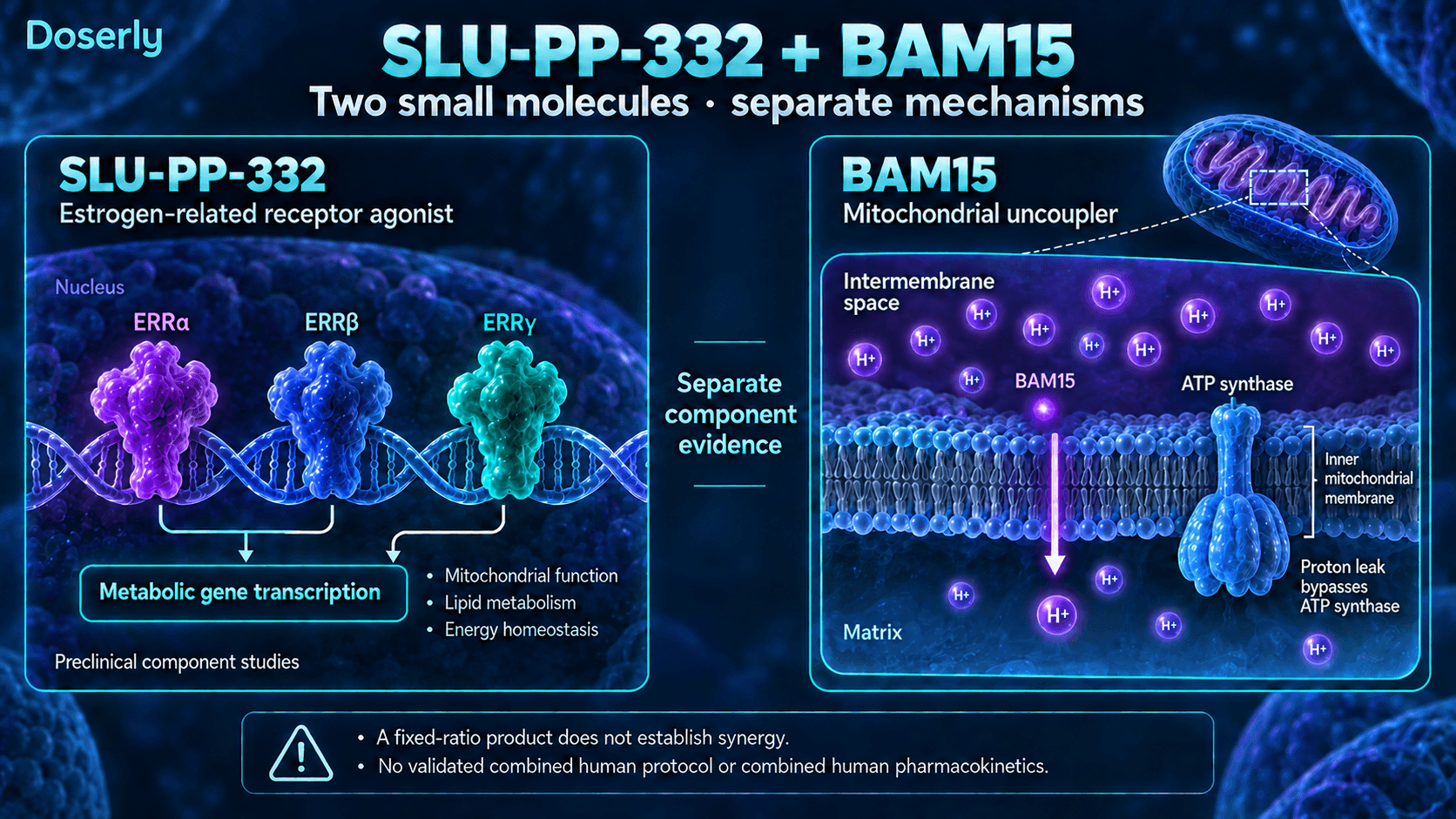
Caption: This refreshed graphic treats the blend as a fixed-ratio product format, not a tested synergy: component mechanisms are preclinical and no combined human pharmacokinetics, trial, safety margin or validated protocol was found [2][3][5][6][7][8][9][10][11].
Evidence And Pharmacokinetic Limits
SLU-PP-332 has no published human pharmacokinetic profile in the evidence reviewed here. Billon et al. used it as an in vivo chemical tool in mice and reported mouse dosing contexts, including 50 mg/kg intraperitoneal use [2][3]. Those studies support target biology and mouse outcomes, not human dose selection.
BAM15 has stronger mouse PK detail than SLU-PP-332. Alexopoulos et al. reported about 67% oral bioavailability and a 1.7-hour mouse half-life in their BAM15 work, while diet admixture maintained mouse exposures used in obesity experiments [6]. Axelrod et al. reported dietary exposure of about 85 mg/kg/day in a high-fat-diet mouse model and acute intraperitoneal injection experiments [7]. Those measurements are still component-only animal data.
No source found in this refresh reported combined SLU-PP-332+BAM15 human PK, combined dose escalation, combined toxicity, or a clinical endpoint. That absence matters because the two components would need separate absorption, distribution, metabolism, toxicity, and interaction assessment before a fixed ratio could be interpreted as anything more than a product format.
Fixed-Ratio Interpretation
The most common blend misunderstanding is treating the label as if each component has the same amount. It usually does not. A 250 mcg + 50 mcg listing means 250 mcg of one component plus 50 mcg of the other component. The combined active mass is 300 mcg before excipients, and the ratio is 5:1.
Other pages use very different ratios. Pure Peptides Canada lists 25 mg BAM15 + 100 mcg SLU-PP-332 and 35 mg BAM15 + 250 mcg SLU-PP-332 tablet options [11]. Those are not small variations on the same product logic. They put far more mass on the BAM15 side than a 250 mcg + 50 mcg page does.
That is why a blend should not be discussed as though it has a single category dose. The blend name alone does not identify the component amounts, route/formulation, or ratio.
Safety Considerations
The blend inherits uncertainty from both components and adds interpretation problems of its own.
For SLU-PP-332, the main limit is translation. Mouse ERR agonism and exercise-mimetic findings do not prove human cardiometabolic benefit, endocrine safety, cancer-biology neutrality, or long-term tissue safety.
For BAM15, the main limit is mitochondrial uncoupling. BAM15 was designed as a more controllable uncoupler than older high-risk agents, but the reviewed evidence remains preclinical for metabolic use [5][6][7]. Human safety cannot be inferred from mouse body-composition outcomes.
For the fixed blend, the main limit is attribution. If adverse effects, heat intolerance, fatigue, appetite change, glucose changes, or performance changes occurred in an uncontrolled setting, the blend format would make it hard to identify which component, ratio, product quality issue, or interaction mattered.
Regulatory And Sports Context
No approved human therapeutic use or prescribing label was found for the SLU-PP-332+BAM15 blend in this refresh. Catalog pages describe research-use products rather than approved drugs [9][10][11].
For athletes, BAM15 deserves special attention. The 2026 WADA material identifies BAM15 by chemical name as an S4 metabolic-modulator example and notes supplement-market concern [8]. SLU-PP-332 was not identified by name in the same refreshed component review, but absence from an example list should not be read as permission for competitive sport.
Practical Evidence Reading
A useful assessment starts by separating four questions:
- What is SLU-PP-332 doing in the primary literature?
- What is BAM15 doing in the primary literature?
- What exact amounts and ratio does a product page list?
- Has that exact combination been tested in humans?
For this blend, the fourth answer is no. The first two answers are animal and cell evidence. The third answer varies by product page. Those facts make the blend unsuitable for claims that rely on a validated human combined protocol.
FAQ
Is there a validated human SLU-PP-332 + BAM15 protocol?
No. No combined human trial, human PK study, or validated human dosing protocol was found.
Does 250 mcg + 50 mcg mean each compound is present at both amounts?
No. It means one listed component amount plus the other listed component amount. In a 250 mcg + 50 mcg product, the active total is 300 mcg before excipients, and the components are present at different amounts.
Are all SLU-PP-332 + BAM15 blends equivalent?
No. Product pages inspected in this refresh list different component amounts and ratios, including 250 mcg + 50 mcg and much larger BAM15-dominant tablet strengths [9][10][11].
Does component evidence prove the blend works better than either compound alone?
No. The reviewed evidence supports separate component mechanisms in preclinical settings. It does not show that combining them improves outcomes or safety in humans.
Is BAM15 regulated in sport?
BAM15 is named in 2026 WADA-related material as an S4 metabolic-modulator example [8]. Competitive athletes should treat this as a serious compliance signal.
Sources & References
[1] PubChem. SLU-PP-332, CID 5338394. https://pubchem.ncbi.nlm.nih.gov/compound/5338394
[2] Billon C, Sitaula S, Banerjee S, et al. Synthetic ERRα/β/γ agonist induces an ERRα-dependent acute aerobic exercise response and enhances exercise capacity. ACS Chemical Biology. 2023;18(4):756-771. https://pubmed.ncbi.nlm.nih.gov/36988910/
[3] Billon C, Schoepke E, Avdagic A, et al. A synthetic ERR agonist alleviates metabolic syndrome. Journal of Pharmacology and Experimental Therapeutics. 2024;388(2):232-240. https://pubmed.ncbi.nlm.nih.gov/37739806/
[4] PubChem. BAM15, CID 565708. https://pubchem.ncbi.nlm.nih.gov/compound/565708
[5] Kenwood BM, Weaver JL, Bajwa A, et al. Identification of a novel mitochondrial uncoupler that does not depolarize the plasma membrane. Molecular Metabolism. 2014;3(2):114-123. https://pubmed.ncbi.nlm.nih.gov/24634817/
[6] Alexopoulos SJ, Chen SY, Brandon AE, et al. Mitochondrial uncoupler BAM15 reverses diet-induced obesity and insulin resistance in mice. Nature Communications. 2020;11:2397. https://www.nature.com/articles/s41467-020-16298-2
[7] Axelrod CL, King WT, Davuluri G, et al. BAM15-mediated mitochondrial uncoupling protects against obesity and improves glycemic control. EMBO Molecular Medicine. 2020;12:e12088. https://pubmed.ncbi.nlm.nih.gov/32519812/
[8] World Anti-Doping Agency. 2026 Prohibited List and explanatory materials. https://www.wada-ama.org/sites/default/files/2025-09/2026list_en_final_clean_september_2025.pdf
[9] Nexus Laboratory. Oral Tablets catalog, SLU-PP-332 + BAM15 blend listing, inspected September 12, 2026. https://nexuslaboratory.org/shop/category/oral-tablets
[10] Disguised Alpha. SLU-PP-332 & BAM15 product page, inspected September 12, 2026. https://disguisedalpha.com/product/slu-pp-332-bam15/
[11] Pure Peptides Canada. Bam + slu Blend product page, inspected September 12, 2026. https://purepeptidescanada.com/product/bamslu-blend/