
In this guide
What is 5-Amino-1MQ?
5-Amino-1MQ is a lab-made chemical that blocks an enzyme called NNMT. People take it as capsules or injections hoping to lose fat, break a weight-loss plateau or feel more energetic, but it has only been studied in cells and animals.
It is a small molecule, a single compact chemical, rather than a peptide (a chain of amino acids). Vendors often list it next to peptides, which is where much of the confusion starts. The name describes its structure: a two-ring core called quinolinium, with a methyl group at position 1 and an amino group at position 5. It is sold as one of two salt forms, the iodide or the chloride, which matters for how much active compound a milligram contains. [1], [2], [3]
Its target, NNMT (nicotinamide N-methyltransferase), is an enzyme found at high levels in the fat and liver of obese mice. In obese mice, blocking it with 5-Amino-1MQ reduced body fat without changing how much the animals ate. [5], [23], [29]
The key word is investigational. No published study has given 5-Amino-1MQ to people and no human trial is registered. It is not approved as a medicine or accepted as a supplement ingredient in the countries checked for this guide (the United States, Canada and Australia). [6], [7], [43], [44], [45], [46]
Typical 5-Amino-1MQ Protocols
| Example | Amount each time | Frequency | Total per day | Duration |
|---|---|---|---|---|
| Low | 50 mg in weeks 1–2, then 100 mg | Once daily, morning | 50 mg, then 100 mg | 8 weeks, then 4 weeks off Described as a first cycle |
| Mid | 100 mg | Once daily, morning | 100 mg | 12 weeks, then 4 weeks off Described as the standard cycle |
| High | 150 mg, or 100 mg + 50 mg | Once daily, or morning and midday | 150 mg | 12 weeks, then 4 weeks off Described only after lower amounts were tolerated |
The most common oral protocol in the reviewed sources is 50–150 mg a day, taken as 50 mg capsules in the morning, for 8–12 weeks followed by about 4 weeks off. [8], [9], [10], [11]
- Titration Changing the amount in steps
- The usual approach starts at 50 mg a day for 1–2 weeks, then moves to 100 mg. The 150 mg example, sometimes split as 100 mg in the morning and 50 mg at midday, is described only after the lower amounts were tolerated. Capsule labels themselves usually say one 50 mg capsule a day, and one says not to exceed two. [8], [9], [10], [12]
- Breaks and cycles
- Sources describe about 4 weeks off after an 8–12-week course. Others give 4–8 weeks off, and one adds a limit of three cycles a year. The sources themselves describe cycling as a precaution, not something that has been tested. [8], [9], [13]
- Monitoring
- Some sources pair the higher rows with liver blood tests (ALT and AST, two liver enzymes) at the start and around week 6, and fasting glucose and cholesterol at the start and end. These checks are the sources' own precautions; in mice, liver enzymes were normal or lower. See what to monitor. [8], [9], [23]
Read the units: these amounts are milligrams (mg). Injected amounts are sometimes written in micrograms (mcg), and 1 mg equals 1,000 mcg. A capsule label rarely says whether "50 mg" means 50 mg of the salt or of the active compound, and the two differ (see salt forms).
Each row is a complete schedule as published, so its amount and duration belong together. Low, mid and high are alternatives, not steps to move through. These schedules come from protocol websites and product labels, not from any study in people; the cited references give the full details. [6], [8]
What about injections?
| Scale | Amount each time | Frequency | Total per day | Duration |
|---|---|---|---|---|
| Microgram scale | 150 mcg in weeks 1–2, then 300 mcg | Once daily, morning | 150 mcg, then 300 mcg | 8 weeks, then 4 weeks off Clinic protocol page [14] |
| Milligram scale, lower | 2.5 mg | Once daily, morning | 2.5 mg | 4 weeks, then reassess Dosing website [13] |
| Milligram scale, standard | 5 mg | Once daily, morning | 5 mg | 8–12 weeks, then 4 weeks off Dosing website [13] |
Injected amounts are far less settled than oral ones. Most milligram-scale pages start at 2.5 mg a day for two days, then use 5 mg a day or 2.5 mg twice a day, and one telehealth service describes 1 mg a day for 8–12 weeks. Microgram-scale pages use 150–500 mcg a day. [14], [15], [16], [17], [18]
In community education groups, injected amounts ranged from well under 1 mg to 50 mg or more a day, and during 2026 some educators' guidance moved up to 5–50 mg a day, based on scaling up mouse doses. These are reported practices, not tested doses.
None of these amounts, from 150 mcg to 50 mg, comes from a human study: no study has given 5-Amino-1MQ to people, and no human trial is registered. [6]
Where protocols differ: dose scales, timing, breaks and units ↓
Where these numbers come from
The three oral rows come from reference 8, which publishes complete beginner, standard and advanced cycles with their amounts, timing and breaks. References 9, 10 and 11 cross-check the recurring 50–150 mg daily range and 8–12-week courses, and reference 12 is a capsule label giving one 50 mg capsule a day. Reference 8 also lists 200 mg a day, split as 100 mg twice, without a complete cycle, so it is not shown as a row. Across 18 explicitly stated oral amounts on 9 pages, the median single dose was 50 mg; copied pages count separately, so this figure reflects repetition across the web, not independent agreement.
The injection rows come from references 13 and 14, each a complete schedule from one publisher. The 2.5 mg then 5 mg pattern appears almost word for word on several dosing sites, with the same vial and syringe tables, so it is one repeated pattern rather than several independent confirmations. [15], [16]
Excluded from the typical comparison: a page listing 2.5–10 mg by mouth, which looks like an injected amount applied to capsules; a page applying oral amounts of 50–100 mg to injections; a supplier schedule of 12.5–25 mg every other day relayed by a calculator site; and figures of 140–350 mg a day produced by converting mouse doses with a formula. None was tested in people. [18], [19], [20], [21], [73]
What is 5-Amino-1MQ commonly used for?
Most people look into 5-Amino-1MQ for stubborn body fat, a weight-loss plateau or low energy; a smaller group is interested in muscle and aging. The appeal is a different route to fat loss: GLP-1 medicines such as semaglutide and tirzepatide mainly reduce appetite, while 5-Amino-1MQ is promoted as changing how fat cells use energy.
That idea comes from mouse and cell studies. No study has tested whether it helps people lose fat, feel more energetic or keep muscle. [5], [22], [23]
Fat loss and weight-loss plateaus
This is the main use. People often add it to a GLP-1 medicine, or to the investigational drug retatrutide, when weight loss has stalled. That makes results hard to read, because the other medicine, diet changes and other compounds are all still working. [53], [59], [68]
The mouse research is more modest than the marketing. Only two of the three obesity experiments produced net weight loss: an 11-day study in obese mice, and a study where the drug was given together with a switch to a lower-calorie diet. When obese mice stayed on a high-fat diet for a month, the effective dose prevented most of their weight gain rather than making them lose weight. [5], [22], [23]
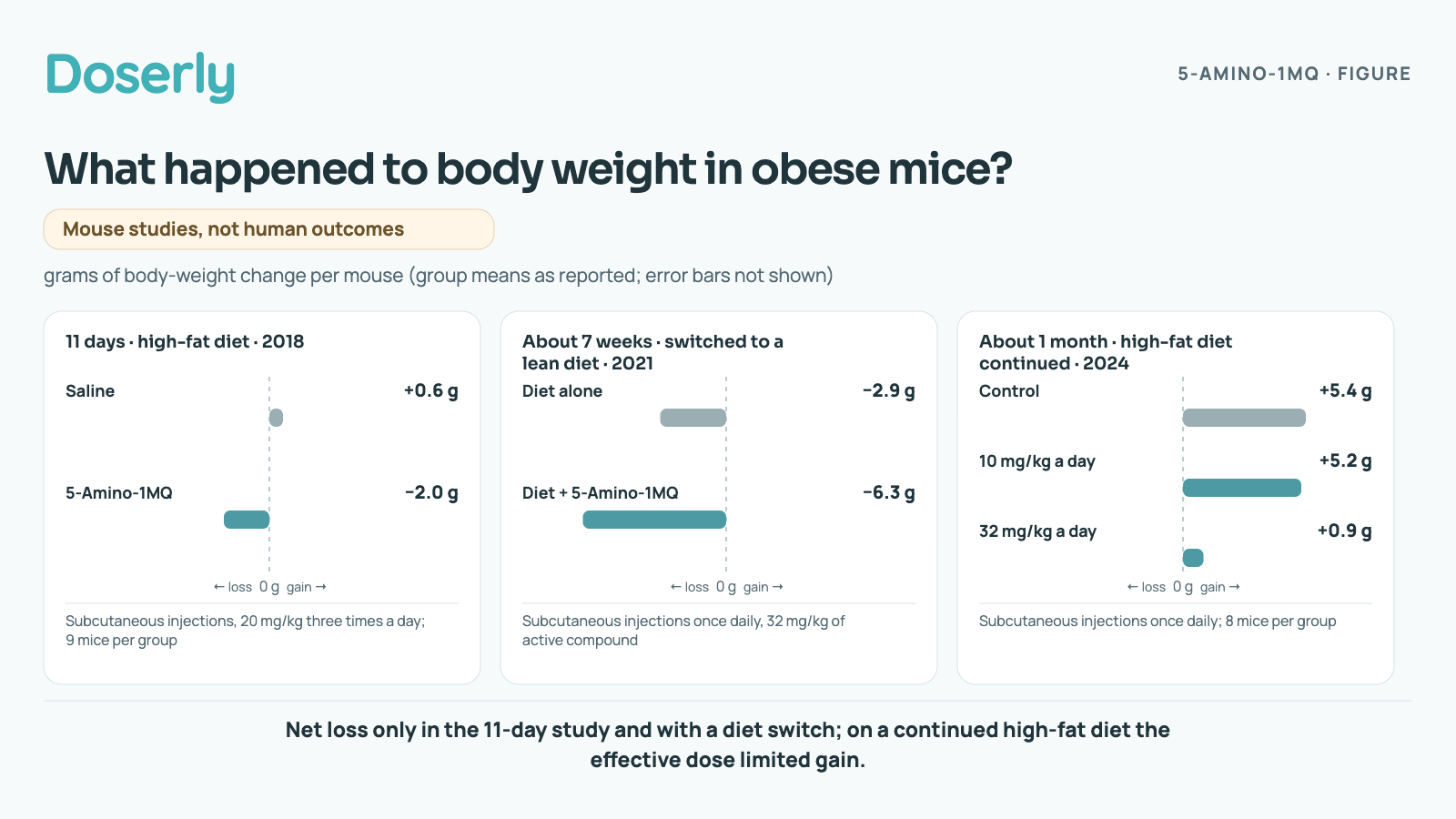
What happened to body weight in obese mice?
- 11 days · high-fat diet · 2018
- Saline +0.6 g; 5-Amino-1MQ −2.0 g. Subcutaneous injections, 20 mg/kg three times a day; 9 mice per group. Units: grams of body-weight change per mouse (group means as reported; error bars not shown).
- About 7 weeks · switched to a lean diet · 2021
- Diet alone −2.9 g; Diet + 5-Amino-1MQ −6.3 g. Subcutaneous injections once daily, 32 mg/kg of active compound.
- About 1 month · high-fat diet continued · 2024
- Control +5.4 g; 10 mg/kg a day +5.2 g; 32 mg/kg a day +0.9 g. Subcutaneous injections once daily; 8 mice per group.
Net loss only in the 11-day study and with a diet switch; on a continued high-fat diet the effective dose limited gain.
Energy and exercise
Energy is the effect people report most often, usually described as steady and without a "crash", sometimes with more sweating or better workouts. These are impressions without measurements, many people report no change at all, and there is no human research on energy. [55], [61], [71], [72]
Muscle and aging
Interest here comes from two mouse studies. In 24-month-old mice with an injured calf muscle, treatment increased the number of active muscle stem cells and made the regrown muscle fibers larger. In 22-month-old female mice, eight weeks of daily injections raised grip strength, and adding exercise on a running wheel with added resistance raised it further. Other strength measures did not improve. These are the only reasons 5-Amino-1MQ is discussed for sarcopenia (age-related muscle loss). [25], [26]
NAD+ and "longevity"
Many pages say 5-Amino-1MQ "boosts NAD+", a molecule cells use to turn food into energy. The laboratory results are mixed. In the fat cells of the original study, NAD+ rose only modestly (about 1.2 to 1.6 times), and the rise was statistically clear at just one of the tested concentrations. Later mouse studies found higher NAD+ in some tissues but not in others. It is a proposed mechanism, not a measured benefit in people. [5], [25], [27]
Other uses you may come across
Protocol templates also list it for insulin resistance, fatty liver and polycystic ovary syndrome (PCOS). Apart from mouse liver findings, there is no research on these uses. Cancer and fibrosis researchers also use it as a laboratory tool to switch NNMT off in cells and mice; that is not evidence for consumer use. [23], [32], [36]
See why there is no human evidence or explore the supporting mouse and cell research.
Where do 5-Amino-1MQ protocols differ?
The oral range is fairly consistent across sources. Almost everything else varies: the scale of injected doses, splitting, how to start, course length and breaks.
Why do injected amounts differ so much?
Injected schedules fall into separate camps that do not agree on scale. Microgram pages use 150–500 mcg a day, milligram pages 2.5–5 mg, and one page 50–100 mg, close to capsule amounts. The lowest and highest differ more than 600-fold. [13], [14], [18], [19]
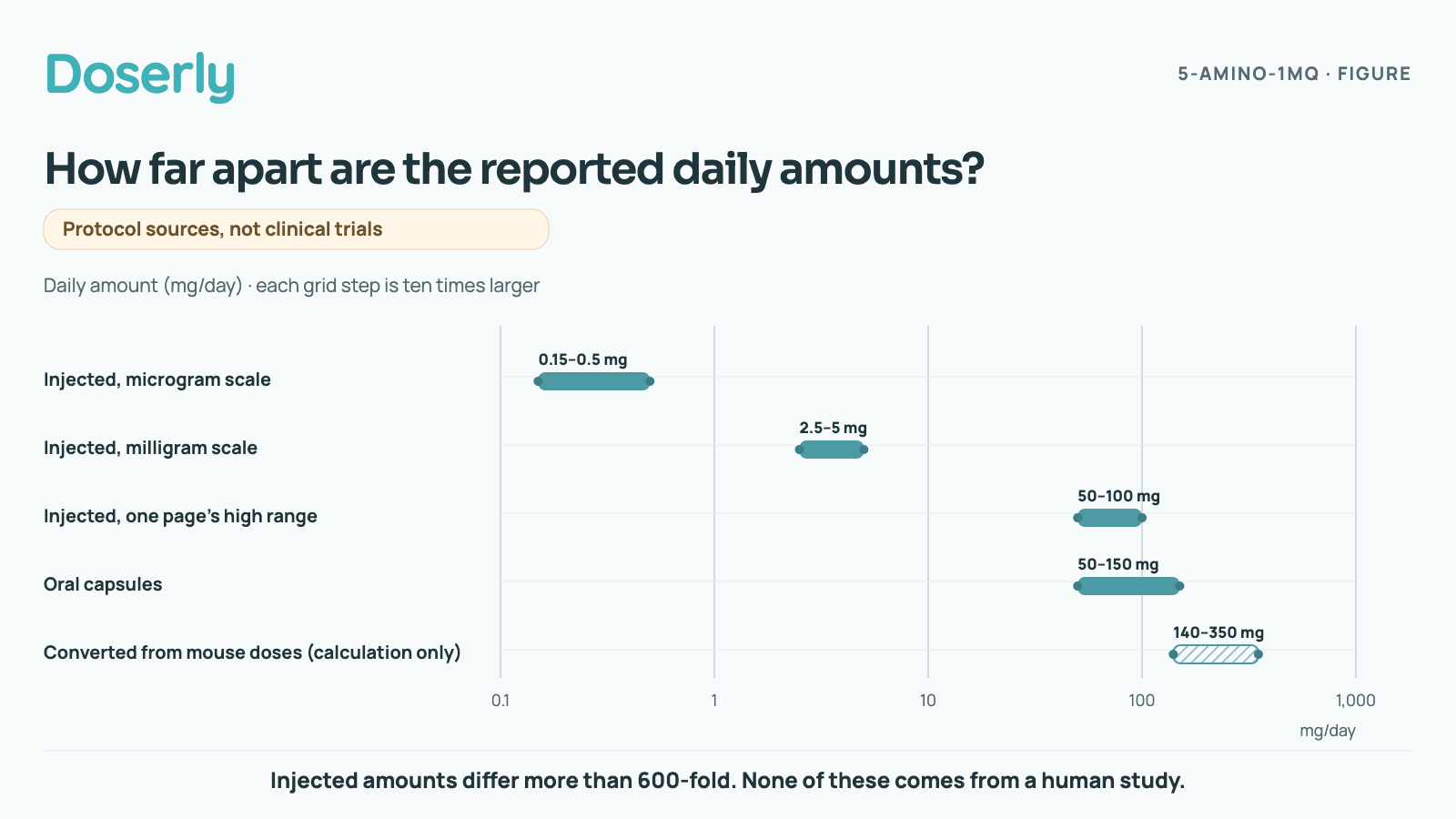
How far apart are the reported daily amounts?
- Injected, microgram scale
- 0.15–0.5 mg a day.
- Injected, milligram scale
- 2.5–5 mg a day.
- Injected, one page's high range
- 50–100 mg a day.
- Oral capsules
- 50–150 mg a day.
- Converted from mouse doses (calculation only)
- 140–350 mg a day. Calculation only; not a used or tested dose.
Injected amounts differ more than 600-fold. None of these comes from a human study.
None cites a human dose-finding study. The milligram camp mostly repeats one table built around a 50 mg vial, and the microgram camp gives no stated origin. A larger number is not a more "effective" dose, and a smaller one is not a proven safer one. [13], [14], [15], [16]
Is the number for one dose or the whole day?
100 mg in the morning plus 50 mg at midday is 150 mg for the day. Likewise, 2.5 mg twice a day is a 5 mg daily total, the same as 5 mg once. Read each number as either per dose or per day before comparing it with another. [8], [15]
Once a day or twice?
Both appear. Pages that recommend twice-daily injections usually cite a half-life of about 4–7 hours, but those figures come from rats. A page recommending once-daily injections cites a half-life of about 13 hours, measured in mice. Neither tells us how long 5-Amino-1MQ lasts in a person. [13], [15], [23], [28]
Do sources start low?
Most do, from different starting points: 50 mg by mouth for 1–2 weeks before 100 mg; 2.5 mg injected for two days before 5 mg; or 150 mcg, then 300 mcg, then 500 mcg split in two for weeks 9–12. A calculator site relays a forum schedule of 250 mcg, then 500 mcg, then 1 mg. These are separate examples, and no source shows that a higher amount works if a lower one did nothing. [8], [14], [15], [20]
How many weeks, and are breaks needed?
Most schedules run 8–12 weeks, then 4 or 4–8 weeks off; one clinic page also lists 6 on and 3 off, or 12 on and 6 off. A telehealth service leaves cycling to the prescriber because no long-term human data anchor a fixed cycle. [9], [14], [17]
Reasons given for breaks, such as preventing "tolerance", have not been tested for this compound, and one dosing site says the usual convention comes from community practice rather than any study. The honest reason for a limit is that nobody has been observed taking it for longer. [13]
Why do some sites give 140–350 mg a day?
Those numbers come from converting mouse doses into a human equivalent dose with a body-surface formula, or from multiplying a mouse's milligrams per kilogram by a person's weight. [18], [21] That arithmetic has two problems. First, the original mouse paper reports its dose two ways: 20 mg/kg three times a day (60 mg/kg a day of the salt), or about 34 mg/kg a day of the active compound once the salt's weight is set aside. Pages that start from 60 get a much bigger number. Second, the official FDA method for this conversion is a step in choosing a cautious first dose for a supervised trial in healthy volunteers, and it then divides the result by a safety factor of 10. No such trial has been run, so a converted number is a calculation, not a tested dose. [5], [51]
Do capsule and injection amounts convert?
No established conversion exists. Oral pages use 50–150 mg a day and injection pages mostly 2.5–5 mg, but that gap reflects convention, not measured absorption in people. The animal absorption figures disagree with each other, as the route section explains. [8], [13], [23], [28]
Are single pages consistent?
Not always. One page's summary says 10 weeks on and 6 off while its detail says 8–12 on and 4–8 off. Another shows 50–150 mcg under a 50–150 mg oral protocol. A third says the compound must be injected because digestive enzymes break it down, an argument about peptides that does not apply to a small molecule. Summaries of the research slip too: one page says the original mouse study used intraperitoneal injections when it used subcutaneous ones, and another credits the aged-mouse muscle study with about 50 mg/kg when it used 10 mg/kg. Check the units and the per-dose or per-day label on every number. [9], [10], [19], [8], [5], [26]
How do milligrams convert to syringe units?
On an insulin syringe, units measure volume: a U-100 syringe holds 100 units per millilitre. How much 5-Amino-1MQ each unit holds depends on how much liquid was added to the vial.
For example, a 50 mg vial mixed with 2 mL of liquid gives 25 mg per mL, so each unit holds 0.25 mg and 5 mg is 20 units. The same 50 mg vial mixed with 4 mL makes 5 mg equal 40 units. A 10 mg vial mixed with 2 mL makes 5 mg equal 100 units, a full 1 mL syringe. Copying someone else's number of units can therefore double or quintuple the dose. Mixing up mcg and mg is a thousand-fold error. Doserly's reconstitution calculator works this out for any vial and shows each step. [13], [15], [16]
What happens when you stop 5-Amino-1MQ?
Nobody knows, because it has not been studied. No study has given it to people, and every mouse study ended while the animals were still being treated, so there are no data on weight regain, rebound effects or withdrawal after stopping. [5], [22], [23], [25], [26], [27]
Websites fill the gap with predictions. One says benefits last a week or two after the last dose and that animal studies found no fat regain after stopping, although no animal study looked. Another says plainly that no washout or rebound study has been published, and expects the enzyme to work normally again once the compound clears, so it describes any fat loss as not self-sustaining. [9], [13]
Public reports are few. One person who had taken capsules for three weeks said their first two workouts after stopping felt much harder. Another, also taking tirzepatide, said their weight held steady during a two-week break. A third stopped injections because of severe cramps and later tried again without problems. In community education groups, some members say they notice the energy most on days they miss a dose, and a few describe nausea from one capsule brand that went away when they stopped. [53], [81], [62]
Many people take 5-Amino-1MQ alongside a GLP-1 medicine, and stopping those medicines has been studied: in a follow-up of 327 people from a large semaglutide trial, who stopped both the medicine and the trial's lifestyle program, people regained about two-thirds of the weight they had lost within a year. A weight change after stopping a combination therefore cannot be pinned on 5-Amino-1MQ. [82]
Do capsules and injections of 5-Amino-1MQ behave the same way?
A capsule has to be absorbed through the gut and pass through the liver before any of it reaches the blood. A subcutaneous injection starts in the fatty layer beneath the skin and is absorbed from there. The share of a dose that reaches the blood is called bioavailability.
For 5-Amino-1MQ, the two animal measurements disagree sharply. In rats, 38.4% of an oral dose reached the blood. In mice, only 3.5% did, which the researchers put down to poor absorption from the gut and heavy breakdown in the liver. A later paper from the same group chose injections because oral absorption was poor in mice, "a phenomenon that does not occur in rats". Nobody has measured it in people. [23], [24], [28]
The mouse fat-loss and muscle studies all used injections, and no study in any species has tested whether capsules produce the effects seen in mice. [5], [22], [23], [26], [27]
How long does it last in the body?
Half-life is the time it takes for the level in the blood to fall by half. It is not how long an effect lasts.
| Species and route | Half-life reported | Source |
|---|---|---|
| Rat, into a vein | About 3.8 hours | [28] |
| Rat, by mouth | About 6.9 hours | [28] |
| Mouse, subcutaneous | About 13 hours | [23] |
| Old mice, subcutaneous | About 7 hours | [26] |
| Mouse, by mouth | About 14.8 hours | [23] |
Several dosing websites present the rat figures (38.4% absorption and a 6.9-hour half-life) as if they described people. They do not. There are no human pharmacokinetic data of any kind. [15], [28]
Does the salt form matter?
Yes. 5-Amino-1MQ is a positively charged molecule, so it is always sold paired with a negatively charged partner, usually iodide or chloride. The partner adds weight without adding active compound. [1], [2], [3]
| In 100 mg of... | Active 5-Amino-1MQ | Partner |
|---|---|---|
| Iodide salt | About 56 mg | About 44 mg iodide |
| Chloride salt | About 82 mg | About 18 mg chloride |
Calculated from the molecular weights: 159.21 g/mol for the active part, 286.11 for the iodide salt and 194.66 for the chloride salt. [1], [2], [3]
So 100 mg of the iodide salt delivers about a third less active compound than 100 mg of the chloride. Research papers usually state which salt they used. In a September 2026 check of six product pages, three named a salt form and only one said that its 50 mg meant the weight of the salt. One page named the chloride salt but gave the chemical registry (CAS) number that belongs to the iodide, so even a stated salt form can be wrong. [2], [77] The FDA warning letter named the iodide salt, and US bulk-ingredient listings include both. [7], [28], [52], [74]
The iodide content is a safety question of its own. Iodide is a form of iodine. If a 50 mg capsule is the iodide salt, it contains about 22 mg of iodide. The adult tolerable upper intake level for iodine set by US health authorities is 1,100 mcg (1.1 mg) a day, so one such capsule would supply about 20 times that limit, and 150 mg a day about 60 times. Too much iodine can cause goiter, an underactive or overactive thyroid and thyroid inflammation, and people with autoimmune thyroid disease can react to smaller excesses. Nobody has measured how much iodine people absorb from these products, and no source discusses it, but the arithmetic is a strong reason to know which salt a product contains. [2], [50]
Is this an allergy concern? Not in the usual sense. Iodine itself is not an allergen: it is too small to set off an allergic reaction, and shellfish allergies are caused by shellfish proteins, not iodine. The known concern with the iodide salt is the amount of iodine and its effect on the thyroid. [78]
What about pre-mixed liquids and nasal sprays?
Some products come as ready-made liquids, sometimes combined with NAD+, and a few people use nasal sprays. There are no data on either. Public reports link the strongest injection burning to concentrated liquids, such as 40 or 100 mg per mL. [64], [65]
How should 5-Amino-1MQ be stored, and how long does it last?
How long the capsules and vials sold online stay usable has not been tested, so a mixed vial has no established use-by date. We found no published shelf-life or in-use stability study of the capsules or injectable products sold online. What is known comes from laboratories. [28]
- The solid held up in a short heat test. A 2021 research paper reported that the chloride salt stayed physically and chemically stable for at least two weeks at 25 °C and at 40 °C in humid air, and that it dissolves easily in water (more than 100 mg per mL). Chemical suppliers that sell the iodide salt for laboratory research list storage in a freezer at −20 °C. [28], [79], [80]
- Research solutions were made fresh every week. In the mouse studies, researchers dissolved it in sterile salt water (saline) each week, and two groups filtered it and kept it in the fridge at 4 °C between doses. That is how the laboratories worked, not a tested use-by period. [22], [23], [26]
Dosing websites give their own advice: unmixed powder at room temperature or in a freezer, a mixed vial in the fridge (2–8 °C) used within 28 days, 30 days or 4–6 weeks, and capsules at room temperature, dry and out of sunlight, for 12 months or more. These figures mostly repeat peptide conventions or vendor guidance, as two of the pages say themselves, and none cites a stability test of 5-Amino-1MQ. [8], [9], [13], [14], [15], [16]
One person reported crystal-like particles in a mixed solution kept in the fridge overnight, which disappeared once the syringe was back at room temperature; nobody tested what they were. [70]
What do we actually know about 5-Amino-1MQ in people?
Nothing directly. No published study has given 5-Amino-1MQ to people, we found no published case report describing someone who took it, and no human trial has been registered. A September 2026 search of ClinicalTrials.gov for the compound's names returned zero studies. [6]
Claims of "human data" online trace back to other things: rat and mouse measurements presented as human, allometric calculations, or studies of a different compound. One comparison page's "human studies" section, for example, is about AOD-9604, an unrelated peptide. [15], [19], [21]
Is anyone testing NNMT blockers in people?
Yes, but not 5-Amino-1MQ. AstraZeneca is running a first-in-human trial of AZD4248, a different NNMT blocker, in healthy volunteers and in people with chronic kidney disease and type 2 diabetes. It is a registered study plan that is still recruiting, with no results posted. Whatever it finds will describe AZD4248, not the compound sold online. [31]
A 2026 review of the field noted that earlier NNMT blockers had limited success even in animals, because of weak action on the enzyme, poor absorption and unknown safety. It is a reminder that a promising target does not make every compound that hits it useful. [30]
Who did the mouse research?
Most of the fat-loss and muscle studies come from one university research group whose members founded or work for a company developing NNMT blockers, as the papers disclose. That does not make the findings wrong, but independent repetition matters, and so far it is limited to a few studies, mostly in other diseases. [22], [23], [26], [27]
What would a useful result look like?
If you are trying to judge whether anything is changing, a single number on a scale is a weak guide. Waist measurement, body composition, energy through the day, sleep and hunger are separate outcomes, and a GLP-1 medicine, diet change or new training plan can move all of them. The mouse studies themselves measured fat mass separately from body weight for this reason. [5], [22]
How might 5-Amino-1MQ work?
NNMT is an enzyme that attaches a methyl group (a small carbon tag) to nicotinamide, a form of vitamin B3. To do that, it uses up SAM, the body's main methyl donor, and it turns nicotinamide into a waste product called 1-MNA instead of leaving it available to make NAD+. [29]
Researchers became interested when they found NNMT levels were raised in the fat and liver of obese, diabetic mice. When they reduced NNMT genetically in those tissues, the mice gained less weight on a fattening diet because their cells burned more energy. That was not 5-Amino-1MQ; it was a genetic technique, but it gave the idea for a drug. [29]
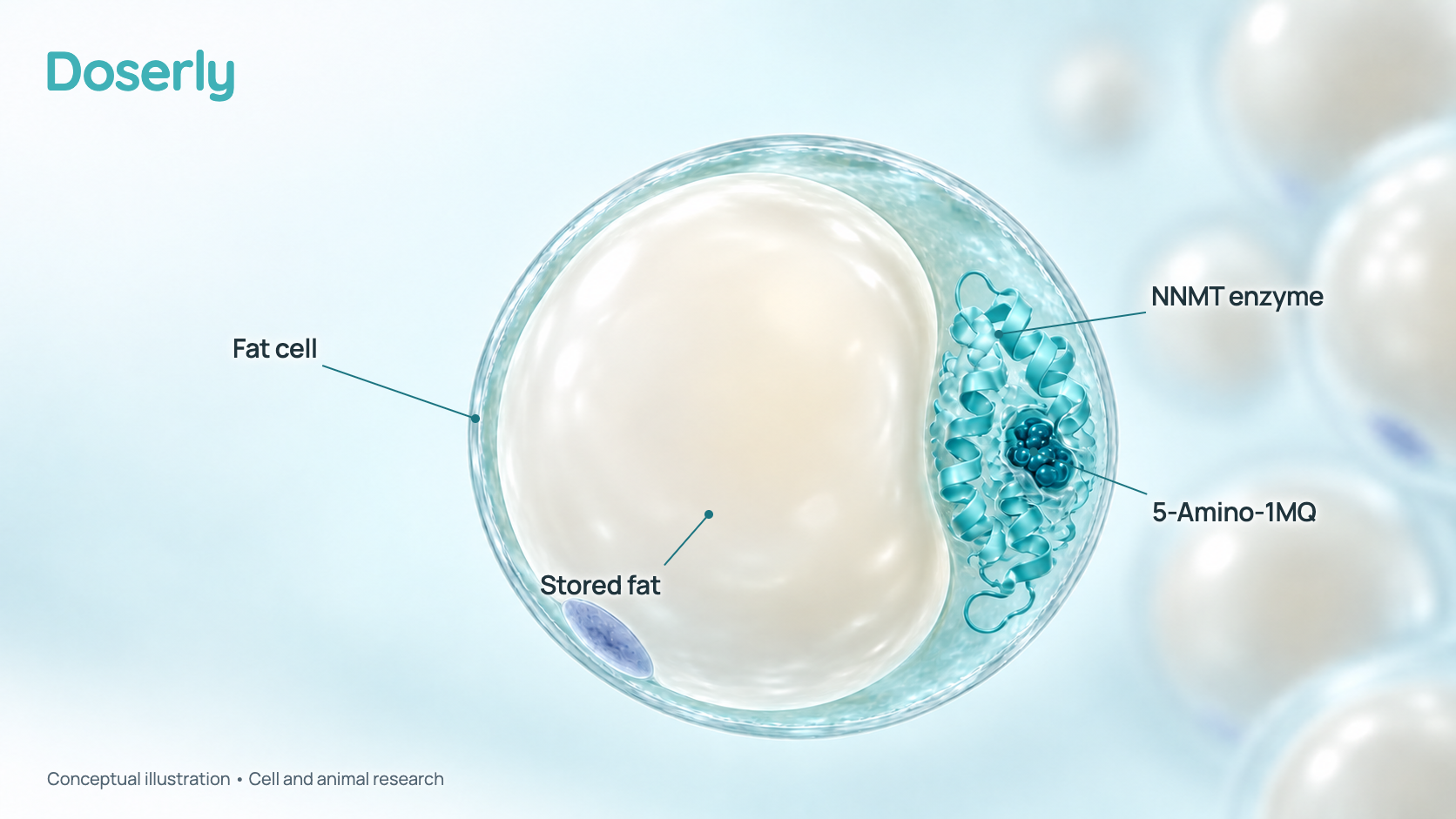
What does 5-Amino-1MQ do to the enzyme?
In enzyme tests it blocked NNMT at low concentrations (half the enzyme's activity was blocked at 1.2 micromolar). In fat cells grown in a dish, it got inside the cells, lowered their 1-MNA and cut the amount of new fat they made by about half or more at higher concentrations. [4], [5]
It did not block several related enzymes in the same tests. A wider screen found one notable exception: it blocked 67.4% of the activity of MAO-A, an enzyme that breaks down mood chemicals such as serotonin, at a laboratory concentration. What that means in a person is unknown. [5], [23]
Is it an appetite suppressant?
The mouse studies suggest not. Treated mice ate about the same amount as untreated mice while gaining less fat. The proposed explanation is that fat cells burn more energy, not that the animals ate less. That is the main contrast with GLP-1 medicines, and the reason people combine the two. [5], [23]
Does it work the same way in every tissue?
No. Blocking NNMT looked helpful in fat, liver and aged muscle in mice, but in human blood-vessel lining cells it made them more vulnerable to chemical stress, and in a study of pregnant mice a local dose reduced embryo implantation. NNMT seems to protect some tissues, so switching it off everywhere is not automatically good. [38], [39]
What are the risks and unanswered questions?
Is 5-Amino-1MQ safe?
Its safety in people is unknown, because it has never been studied in people. Everything known comes from short mouse studies and laboratory tests, which can miss rare, slow or human-specific harms.
Those studies found few obvious problems. Mice given 10–34 mg/kg a day for up to eight weeks showed no visible illness, and liver enzyme tests were normal or even lower. But the most detailed study also found that the higher dose cut white blood cells, with lymphocytes down 31% and monocytes down 50% after about a month. Nobody knows what that means for people. [5], [22], [23], [26]
What has not been done matters as much. No standard safety tests were found: no tests for DNA damage, heart rhythm effects, long-term toxicity, cancer or effects on reproduction across a pregnancy. A 2026 review of the field describes the safety of NNMT blockers as largely unknown. [30]
What problems have people reported?
Self-reports describe poor sleep, jitteriness or a racing heart, stomach upset, injection-site burning and, less often, hives, dizziness with low blood pressure or a low blood-sugar reading, usually alongside other compounds. In community education groups, members also describe increased hunger, a few cases of facial swelling and near-fainting episodes. None of this establishes cause or frequency, and we found no published regulator count of adverse-event reports. [54], [60], [61], [62], [66], [68] The community section gives the details.
Could product quality change the risk?
Yes. We found no regulator testing of the capsules and vials on the market, and no independent testing large enough to show how products in general compare with their labels. Identity problems do occur: it is widely sold as a "peptide", and two of the four US bulk-ingredient listings under a 5-Amino-1MQ name give a different chemical, 5-methylquinoline, as the active ingredient. Mixed solutions can also form crystals when chilled. The salt form is often not stated, which changes both the dose and the iodide content. [52], [70]
Screening tests can mislead as well. In July 2026 a public investigation reported that a 5-Amino-1MQ liquid gave presumptive positive results on fentanyl screening strips at two laboratories. Targeted laboratory testing then found no fentanyl, and the strip reaction was reproduced with other 5-Amino-1MQ products, pointing to the compound itself interfering with the strips. [75], [76]
In community education groups, members also describe wet-looking or discolored vial contents, powders of an unexpected color and underfilled vials.
Is 5-Amino-1MQ legal? Is it FDA-approved?
Checked September 23, 2026. Rules differ by country and change quickly.
United States. 5-Amino-1MQ is not an FDA-approved drug. In a warning letter dated January 20, 2026, the FDA told a registered 503B outsourcing facility (a pharmacy that makes compounded medicines in bulk) that products made with 5-amino-1-methylquinolinium iodide did not qualify for the compounding exemptions, because the substance is not on the list of ingredients such facilities may use. We found no record of the FDA accepting it as a new dietary supplement ingredient, even though capsules are sold, some labeled "not for human consumption" while giving a daily dose. [7], [12], [43]
Canada. Searches of Health Canada's drug and licensed natural health product databases returned no authorized product containing it. [44], [45]
Australia. No product containing it is on the Australian Register of Therapeutic Goods. Medicines generally need an entry on this register before they can be supplied in Australia, apart from specific exemptions. [46]
A "research use only" label does not make a product legal to sell for human use.
Is 5-Amino-1MQ banned in sport? Does it show up on a drug test?
It is not named on the World Anti-Doping Agency's 2026 or 2027 lists, but category S0 bans at all times any pharmacological substance that is not covered elsewhere on the list and is not approved for human therapeutic use. 5-Amino-1MQ appears to fit that description, so athletes should treat it as prohibited. The US Anti-Doping Agency (USADA) warns that products sold as research chemicals can contain unapproved performance-enhancing drugs. [47], [48], [49]
Researchers have published a laboratory method that measures 5-Amino-1MQ in rat blood and urine, so the right test can detect it. No anti-doping method or detection window for people has been published. [28]
Does 5-Amino-1MQ cause cancer?
Nobody knows, because no long-term cancer studies exist. In cancer research it slowed tumor growth in several mouse models, but that says nothing about long-term use in healthy people and is not evidence that it prevents or treats cancer. [32], [33], [34]
Who should be especially cautious?
These groups have no safety data in people. That is a reason for caution, not proof of harm.
- Pregnancy, trying to conceive and breastfeeding. A local dose reduced embryo implantation in pregnant mice, and no reproductive safety studies exist. [39]
- Thyroid conditions. The iodide salt can contain far more iodine than the upper limit, and people with autoimmune thyroid disease can react to smaller excesses of iodine. [2], [50]
- People taking glucose-lowering medicines. Insulin, sulfonylureas and GLP-1 medicines already lower blood sugar, and some users on these medicines describe low-blood-sugar-like episodes. [60]
- People taking antidepressants or other drugs that affect serotonin. The laboratory MAO-A finding makes an interaction possible in theory. [23]
- Under 18. No studies include young people. This guide is written for adults.
- Competitive athletes. See the sport rules above. [47]
Has 5-Amino-1MQ been tested alongside other medicines?
No. There are no human interaction data. The theoretical concerns are the MAO-A finding, relevant to antidepressants and other serotonin-affecting drugs, and a possible large iodine intake, which can add to the effect of antithyroid medicines such as methimazole. The usual combinations, often with a GLP-1 medicine, have not been studied either. Bring a complete list of everything you take to a pharmacist or doctor. [23], [50]
What should be monitored while using 5-Amino-1MQ?
There is no official monitoring guidance, because no regulator has approved 5-Amino-1MQ for use in people or issued monitoring guidance for it. What can be described is what the mouse studies measured and which checks follow from the concerns in this guide. It is information to discuss with a clinician, not a personal testing plan. [7], [23]
| What to track | Why it matters for 5-Amino-1MQ | Evidence |
|---|---|---|
| Weight management and fat loss: body weight, waist, body fat | This is the outcome people use it for. The mouse studies measured fat and lean mass with body scans, because weight alone hides what changed. | Animal studies [22], [23] |
| Energy levels and appetite | Energy is the change people report most; in community education groups, some members also describe more hunger. A log over weeks separates a pattern from a good or bad day. | Community accounts [55], [71] |
| Blood sugar: fasting glucose and HbA1c (a blood test of average blood sugar over about three months) | In obese mice, the higher dose kept insulin from rising; routine non-fasting blood sugar did not change, but blood sugar after a dose of sugar by mouth was lower. People taking insulin or a sulfonylurea already have a higher risk of low blood sugar on a GLP-1 medicine, and some users describe low readings. | Animal study, drug label, community account [23], [85], [60] |
| Liver enzymes: ALT and AST | Mouse liver tests were normal or lower. Some protocol pages suggest checks at the start, around week 6 and at the end of a course. | Animal studies, protocol source [22], [23], [8] |
| Complete blood count (white blood cells) | At the higher mouse dose, lymphocytes fell by 31% and monocytes by 50%, two kinds of white blood cell. | Animal study [23] |
| Thyroid function: a TSH (thyroid-stimulating hormone) blood test | The iodide salt can contain many times the upper limit for iodine, and excess iodine can affect the thyroid. A thyroid specialists' society advises against iodine supplements above 500 mcg a day, and a TSH (thyroid-stimulating hormone) blood test is the usual first check of thyroid function. | Class-based consideration [50], [83], [84] |
| Sleep quality, heart rate and palpitations, blood pressure, anxiety, nausea and stomach tolerance | These are the unwanted effects repeated most often in public reports. | Community accounts [54], [60], [61], [62], [66], [67] |
In community education groups, educators suggest a blood panel before starting and repeat tests every few months, most often HbA1c and a metabolic panel (a routine chemistry test that covers blood sugar, kidney and liver markers), plus weekly average weight and waist measurements.
None of these checks makes an untested compound safe. They show what is changing, which is what a clinician needs to judge whether to continue.
What do people in public communities report?
Public discussions include people who felt more energetic, people who noticed nothing, and people who stopped because of side effects. Nearly everyone describing a result was also taking something else, most often a GLP-1 medicine.
What do the positive reports look like?
The most common is energy. One person who started at 0.5 mg, stepped up to 1 mg and then used 5 mg by injection described more energy and less afternoon fatigue. Another described steady energy and faster fat loss at 2.5 to 5 mg a day, alongside retatrutide and other compounds, and could not separate the effects. [71], [53]
Weight-loss reports usually involve a plateau. Someone on tirzepatide, SS-31 and other peptides described renewed weight loss after adding 5 mg injections. A person taking 100 mg in the morning and 50 mg in the afternoon reported losing about 8 lb over six weeks with an unchanged diet, but also anxiety and two weeks of insomnia. [68], [54]
How long did those changes last?
Several accounts describe an effect that faded. One person described less hunger and more energy for the first two weeks, then a return to baseline; each dose increase brought a brief return of the feeling before weight loss stalled. Another noticed less effect around week six of an oral course. In community education groups, members also describe strong first weeks that wear off, which fits either adaptation or a placebo-like boost from starting something new. [59], [60]
Does everyone notice a difference?
No. One person taking capsules started at 50 mg a day, moved up to 100 mg and then 150 mg for the rest of a roughly one-month course, changed their diet and trained consistently, and weighed 245 lb at both ends. Another used 1 mg injections for 11 weeks and could not identify any effect, and a third felt nothing at 25 mg injected for three weeks. In community education groups, reports of no effect at any dose or by any route are common. [56], [58], [57]
Capsules or injections: which do people prefer?
Opinions run both ways. In public threads, some people felt nothing from capsules and planned to try injections, while others felt nothing from 5 mg injections. [68], [72] In community education groups, preference also runs in both directions, and some members find one brand of capsule works when another does not, which points as much to product differences as to route.
Does a higher dose feel stronger?
Not reliably. One person had trouble sleeping at 2.5 mg a day by injection and slept normally two days after cutting to 1.25 mg. Someone else took 1 mL of a 100 mg per mL liquid, described an intense burning injection and did not sleep that day. In community education groups, higher injected amounts are linked with overstimulation, hunger and shakiness, while some people feel no more at 50 mg than at 5 mg. [63], [65]
What about unwanted effects?
Sleep problems, anxiety and jitteriness are the most repeated. Stomach effects range from nausea and cramps after a 500 mcg injection to gastritis on both capsules and injections. One person reported a resting heart rate of 95–100 or more while also taking retatrutide. Another, who had injected 25 mg together with NAD+, BPC-157 and KPV, reported dizziness, cold sweat and a blood pressure of 77/56. Someone on tirzepatide recorded a fasting blood sugar of 52 mg/dL after adding 5-Amino-1MQ. [54], [61], [62], [66], [67], [60]
With several compounds in most routines, these reports cannot show that 5-Amino-1MQ caused them or how often they happen.
How can you judge a fat-loss story?
Useful questions to ask: What else changed, including a GLP-1 medicine, diet or training? Was the change measured (waist, scans) or felt? Over how long? What happened weeks later? One detailed journal reported early weight loss but also a rise in cholesterol, while the same person was taking tesofensine, thyroid hormones and other supplements and following a large calorie deficit. Another person's body-fat scans were three months apart, with 5-Amino-1MQ covering only part of that time. [69], [55]
These selected discussions show what people try and what they notice. They are not a survey of all users, a response rate or a substitute for controlled trials.
How does 5-Amino-1MQ compare with SLU-PP-332, BAM15, AOD-9604 and semaglutide?
These are the compounds 5-Amino-1MQ is most often weighed against or combined with for fat loss. No study has compared any of them directly with 5-Amino-1MQ, so the table compares what each one is and what is known in people.
| Compound | What it is | How it is taken | Human evidence | Approval status |
|---|---|---|---|---|
| 5-Amino-1MQ | Small molecule that blocks the enzyme NNMT | Sold as daily capsules or injections; the mouse studies used daily injections | None | Not approved in the US, Canada or Australia; covered by WADA's ban on unapproved substances [6], [7], [44], [46], [47] |
| SLU-PP-332 | Small molecule that switches on estrogen-related receptors, proteins that help control energy use in muscle; it is not an estrogen | Studied in mice as injections into the abdomen twice a day | No trials found on ClinicalTrials.gov | Not FDA-approved; covered by WADA's ban on unapproved substances, and named on the list from January 2027 [47], [48], [87], [90], [92] |
| BAM15 | Small molecule that makes mitochondria, the cell's power plants, burn fuel less efficiently (a mitochondrial uncoupler) | Studied in mice mixed into food | No trials found on ClinicalTrials.gov | Not FDA-approved; named on WADA's 2026 banned list [47], [88], [91], [93] |
| AOD-9604 | Modified 16-amino-acid fragment of human growth hormone | Offered for compounding as injections, capsules or creams; the trials used swallowed doses or doses into a vein | Human trials; in the largest (502 adults, 24 weeks), weight loss did not differ from placebo | Not FDA-approved; named on WADA's banned list [47], [89] |
| Semaglutide | GLP-1 medicine that copies a gut hormone and reduces appetite | Once-weekly subcutaneous injection, or a daily tablet | Large randomized trials; in STEP 1, the weekly injection gave 14.9% average weight loss at 68 weeks, compared with 2.4% on placebo | Approved prescription medicine (Wegovy) for weight management [85], [86] |
The real difference is the evidence. 5-Amino-1MQ, SLU-PP-332 and BAM15 each act on a different target, and all three are still at the animal-research stage, with no human results. AOD-9604 reached human trials for weight loss and did not beat placebo. Semaglutide is the only one of the five with proven weight loss in people, and it carries its own well-described side effects and label warnings. See each guide for doses, risks and legal details.
Common questions about 5-Amino-1MQ
Is 5-Amino-1MQ a peptide?
No. It is a small molecule with no amino-acid chain, and its active part weighs about 159 g/mol, far less than a peptide. It is sold by peptide vendors, which is why the label sticks. Peptide reasoning such as "stomach enzymes destroy it, so it must be injected" does not apply, although how well it is absorbed by mouth in people is still unknown. [1], [4] See what it is.
How long does 5-Amino-1MQ take to work?
There is no established timeline. Reports range from energy within days to changes after several weeks, effects that fade after a couple of weeks, and nothing at all. The mouse effects appeared over 11 days to several weeks of daily injections, which does not translate into human time. [5], [23], [59] See what people reported over time.
Does 5-Amino-1MQ work without a calorie deficit?
In mice, not as a weight-loss tool. Obese mice kept on a high-fat diet gained much less weight on the effective dose but did not lose weight over a month. The largest fat loss came when the drug was combined with a switch to a lower-calorie diet, where treated mice lost about twice as much weight and far more fat than mice on the diet alone. There is no human data either way. [22], [23] See the mouse results.
Can you take 5-Amino-1MQ with a GLP-1 like tirzepatide or retatrutide?
Many people do, but the combination has never been studied. The two are thought to act differently, one on appetite and one on fat-cell energy use, which is why they are combined. That is also why combination reports cannot show what 5-Amino-1MQ added, and people on glucose-lowering medicines describe some low-blood-sugar-like episodes. [5], [60], [68] Read the Doserly guides to tirzepatide and retatrutide.
Should 5-Amino-1MQ be stacked with NAD+, MOTS-c or SLU-PP-332?
These pairings are common and untested. Because 5-Amino-1MQ is promoted as sparing NAD+, some protocol pages call adding NAD+ complementary, while some educators in community education groups call it redundant; no study has compared them. SLU-PP-332 is also sold premixed with 5-Amino-1MQ, and a blend's total strength is not the amount of each ingredient. [8] Read the Doserly guides to NAD+, MOTS-c and the SLU-PP-332 + 5-Amino blend.
Is "5-Amino" the same thing as 5-Amino-1MQ?
Usually, but not always. "5-Amino" is common shorthand, and in community education groups some products sold as "pre-mixed 5-Amino" turned out to be multi-ingredient lipotropic injections, blends of nutrients such as methionine, inositol and choline. Check the full ingredient list and the amount of each ingredient. See the Doserly guide to Lipo-C blends.
Is it legal to buy 5-Amino-1MQ?
It depends on where you live, and in the places checked it is not approved. It has no drug approval in the United States, no authorized product in Canada and no entry on Australia's register of therapeutic goods, and the FDA has warned a bulk compounding facility that it is not an allowed ingredient. A "research use only" label does not make a product legal or safe to use. [7], [44], [46] See the dated legal-status summary.
Glossary
Plain explanations of the route, dosing and research terms used in this guide. Underlined terms in the text link here.
- Adverse event
- A harmful or unwanted medical event reported after someone used a treatment. A report alone does not prove the treatment caused it.
- Animal study
- Research in animals such as rats or mice. It shows what a substance does in a living body, but results in people can differ.
- Bioavailability
- How much of a dose reaches the bloodstream in a usable form. For 5-Amino-1MQ taken by mouth it was 38.4% in rats and 3.5% in mice, and it has not been measured in people.
- Blend
- A product that combines 5-Amino-1MQ with another compound, such as SLU-PP-332 or NAD+. The blend's total amount is not its 5-Amino-1MQ amount.
- Cell study (in vitro)
- Research on cells grown in a dish. It gives early clues about biology, but it is far from proof of benefit in people.
- Compounding
- When a pharmacy prepares a customized medicine from individual ingredients. In the US, federal lists control which bulk ingredients pharmacies may use.
- Controlled trial
- A study that compares people who receive a treatment with a similar group who do not, often receiving a placebo instead. None has been done for 5-Amino-1MQ.
- Course and cycle
- A course is the period of repeated use, such as eight weeks. A cycle is a course plus a planned break before any further use.
- Daily total
- All the amounts given in one day, added together. For example, 100 mg in the morning plus 50 mg at midday is a 150 mg daily total.
- Dose (amount each time)
- The amount given on one occasion. A protocol lists both the dose and how often it is given.
- GLP-1 medicine
- Short for glucagon-like peptide-1 medicine: a class of weight-loss and diabetes drugs, such as semaglutide and tirzepatide, that mainly work by reducing appetite and slowing digestion. Retatrutide is an investigational drug in a related class.
- Half-life
- The time it takes for the measured level of a substance in the blood to fall by half. It is not the same as how long an effect lasts.
- Human equivalent dose
- A number calculated from an animal dose with a body-surface formula. Regulators use it as a step toward a cautious first dose in a trial; it is not a tested human dose.
- Intraperitoneal
- Injected into the abdominal cavity, a common route in animal studies but not one people use.
- Investigational
- Still being studied and not approved by a regulator, such as the FDA, to treat any condition.
- Iodide
- The form of iodine found in salts. The iodide salt of 5-Amino-1MQ is about 44% iodide by weight.
- MAO-A
- Monoamine oxidase A, an enzyme that breaks down serotonin and related chemicals. Some antidepressants block it on purpose.
- mcg and mg
- Micrograms and milligrams. 1 mg equals 1,000 mcg. Oral 5-Amino-1MQ amounts are written in mg; injected amounts appear in both.
- NAD+
- Nicotinamide adenine dinucleotide, a molecule cells need to turn food into energy. Levels tend to fall with age.
- NNMT
- Nicotinamide N-methyltransferase, an enzyme that tags nicotinamide (a form of vitamin B3) with a methyl group. It is especially active in fat and liver tissue.
- Oral
- Taken by mouth, as a capsule, tablet or liquid.
- Outsourcing facility (503B)
- A US compounding pharmacy registered with the FDA to make compounded medicines in bulk. It may only use bulk ingredients on an FDA list or in shortage.
- Peptide
- A short chain of amino acids. 5-Amino-1MQ is not a peptide, although it is often sold alongside them.
- Pharmacokinetics
- How the body absorbs, moves, breaks down and removes a substance.
- Placebo
- A dummy treatment with no active ingredient, used as a comparison in studies.
- Preclinical research
- Studies done before research in people: cell studies and animal studies.
- Registered study plan
- A trial described in a public registry such as ClinicalTrials.gov before or while it runs. Registration is not a result.
- Research use only
- A label on products sold for laboratory research. It does not mean a product is approved, tested for human use or legal to sell as a medicine.
- Salt form
- The pairing of a charged drug molecule with a partner, such as iodide or chloride. The partner adds weight, so equal milligrams of different salts contain different amounts of active compound.
- SAM (S-adenosylmethionine)
- The body's main methyl donor, used to attach small carbon tags to many molecules, including DNA and nicotinamide.
- Small molecule
- A compact chemical compound, like most tablet medicines, as opposed to a peptide or protein made of linked amino acids.
- Subcutaneous (SC)
- Injected into the fatty layer just under the skin. This is the route of the mouse fat-loss studies and most injected protocols.
- Syringe units
- Markings on an insulin syringe that measure volume. On a U-100 syringe, 100 units equal 1 mL. The amount of drug per unit depends on the vial's concentration.
- Titration
- Adjusting a dose in steps, usually starting lower and increasing if needed.
- Tolerable upper intake level
- The highest daily intake of a nutrient that is unlikely to cause harm for most people. For iodine in adults, US health authorities set it at 1,100 mcg a day.
- WADA
- The World Anti-Doping Agency, which publishes the list of substances banned in sport.
Explore more of the research
Go deeper into the experiments behind the claims.
Across this guide, the citations include 21 original scientific papers on 5-Amino-1MQ or its target, all preclinical (in cells or animals). The optional library below groups them by question. Paper counts are not counts of independent research teams: several share authors or even the same mice. Registry records, reviews, websites and personal accounts are counted separately.
In the route details, subcutaneous means into the fatty layer beneath the skin, and intraperitoneal means into the abdominal cavity.
Obesity and metabolism · 5 papers
Did it reverse obesity in the first mouse study?
Model: Male obese mice on a high-fat diet, 9 per group, plus fat cells grown in a dish.
Finding: Over 11 days of injections, treated mice lost 2.0 g (about 5% of body weight) while saline-treated mice gained 0.6 g. White fat mass was about 35% lower, fat cells were more than 30% smaller and total cholesterol fell. Food intake did not differ.
Limit: Very short, males only, and the dose was chosen after testing in two mice.
Study details and access
Selective and membrane-permeable small molecule inhibitors of nicotinamide N-methyltransferase reverse high fat diet-induced obesity in mice.
2018 · Original full text reviewed
Route context: Subcutaneous injection, 20 mg/kg three times a day (about 34 mg/kg a day of the active compound).
What happened when the drug was paired with a diet change?
Model: Obese male mice switched from a Western-style diet to a lean diet, about 7 weeks.
Finding: Diet plus drug: about 6.3 g lost and fat mass down about 29%. Diet alone: about 2.9 g lost and fat mass down about 3%. Treated mice reached a body composition similar to mice that had always eaten the lean diet, and fatty liver improved.
Limit: The diet change and the drug started together, so the result shows what the drug added to dieting, not what it does alone.
Study details and access
Combined nicotinamide N-methyltransferase inhibition and reduced-calorie diet normalizes body composition and enhances metabolic benefits in obese mice.
2021 · Original full text reviewed
Route context: Injection once daily, 32 mg/kg of active compound given as the chloride salt. The companion paper on the same mice (reference 24) states that the route was subcutaneous.
Did the diet-switch mice have different gut bacteria?
Model: The same mice as the diet-switch study.
Finding: Diet plus drug produced a distinct mix of gut bacteria compared with diet alone.
Limit: A second analysis of the same animals, not an independent repeat.
Study details and access
Reduced calorie diet combined with NNMT inhibition establishes a distinct microbiome in DIO mice.
2022 · Original full text reviewed
Route context: Subcutaneous injection once daily.
What happened on a continued high-fat diet?
Model: Obese male mice kept on a high-fat diet, 8 per group, about a month.
Finding: Controls gained about 5.4 g and the lower dose (10 mg/kg a day) about 5.2 g, no different. The higher dose (32 mg/kg a day) gained only about 0.9 g, with less fat gain, lower insulin, and better liver fat and liver enzyme results. Food intake did not change.
Limit: Only the higher dose worked, it limited gain rather than causing loss, and it lowered white blood cells.
Study details and access
Nicotinamide N-methyltransferase inhibition mitigates obesity-related metabolic dysfunction.
2024 · Original full text reviewed
Route context: Subcutaneous injection once daily. The same paper measured pharmacokinetics in mice after 5 mg/kg into a vein, 30 mg/kg by mouth, and 25 mg/kg subcutaneously as one dose or once daily for 5 days.
Where did the idea come from?
Model: Obese and diabetic mice with NNMT reduced genetically in fat and liver.
Finding: Reducing NNMT protected against diet-induced obesity by increasing the energy cells burned.
Limit: A genetic technique, not 5-Amino-1MQ or any drug.
Study details and access
Nicotinamide N-methyltransferase knockdown protects against diet-induced obesity.
2014 · Original abstract reviewed
Route context: Antisense treatment that lowers NNMT production; no 5-Amino-1MQ.
Muscle and aging · 3 papers
Did it help old muscle repair itself?
Model: 24-month-old male mice with a chemically injured calf muscle, 10–13 per group.
Finding: At 5 and 10 mg/kg twice a day for 14 days, active muscle stem cells rose by about 60% and 75%. At the higher dose, regrown fibers were larger and the injured muscle produced 67% more force relative to body weight.
Limit: Force relative to muscle size did not differ, and this was an injury model, not ordinary aging.
Study details and access
Small molecule nicotinamide N-methyltransferase inhibitor activates senescent muscle stem cells and improves regenerative capacity of aged skeletal muscle.
2019 · Original full text reviewed
Route context: Subcutaneous injection twice daily, 7 days before and 7 days after injury.
Did it make old mice stronger?
Model: 22-month-old female mice, sedentary or with weighted wheel running, 7–10 per group, 8 weeks.
Finding: Grip strength was about 40% higher in treated sedentary mice than untreated sedentary mice, and about 60% higher when treatment was combined with exercise.
Limit: Peak calf-muscle force did not improve, and total work in a fatigue test was lower in treated mice.
Study details and access
Nicotinamide N-methyltransferase inhibition mimics and boosts exercise-mediated improvements in muscle function in aged mice.
2024 · Original full text reviewed
Route context: Subcutaneous injection once daily, 10 mg/kg.
Has an independent team tested muscle?
Model: Chemically aged young male mice and 19-month-old female mice, 5 per group in the older cohort.
Finding: Lean mass fell 4.3% in treated old mice versus 7.5% in controls, and one muscle-contraction measure was about twice as strong. Muscle NAD+ rose in the chemically aged mice.
Limit: Other force measures and fat mass did not improve, groups were small and the compound was identified by catalog number.
Study details and access
Identification of nicotinamide N-methyltransferase as a promising therapeutic target for sarcopenia.
2024 · Original full text reviewed
Route context: Intraperitoneal injection, 5–20 mg/kg a day for 5 weeks.
Absorption and potency · 2 papers
How much is absorbed by mouth in rats?
Model: Male rats given one dose into a vein and one by mouth.
Finding: About 38.4% of the oral dose reached the blood, with half-lives of about 3.8 hours (vein) and 6.9 hours (mouth).
Limit: Rat values; mice absorbed far less, and there are no human data.
Study details and access
Development & validation of LC–MS/MS assay for 5-amino-1-methyl quinolinium in rat plasma: Application to pharmacokinetic and oral bioavailability studies.
2021 · Original abstract and author manuscript reviewed
Route context: 10 mg/kg into a vein and 100 mg/kg by mouth, chloride salt.
How strongly does it block NNMT?
Model: Purified enzyme tests across a family of related compounds.
Finding: 5-Amino-1MQ blocked half of NNMT's activity at 1.2 micromolar, one of the more potent members of its family.
Limit: An enzyme test, not a measure of what concentration a person would reach. An often-repeated figure of about 30 nanomolar does not appear in the original paper.
Study details and access
Structure-Activity Relationship for Small Molecule Inhibitors of Nicotinamide N-Methyltransferase.
2017 · Original full text reviewed
Route context: Laboratory enzyme assay.
Safety signals · 2 papers
Can blocking NNMT harm blood vessels?
Model: Human blood-vessel lining cells grown in a dish, exposed to a chemical that causes oxidative stress.
Finding: Blocking NNMT with 5-Amino-1MQ or another inhibitor, or silencing it genetically, made the cells less able to survive the stress.
Limit: A dish experiment; it does not show harm to blood vessels in a living person.
Study details and access
Nicotinamide N-methyltransferase in endothelium protects against oxidant stress-induced endothelial injury.
2021 · Original abstract reviewed
Route context: Added to cell-culture medium.
Could it affect pregnancy?
Model: Pregnant mice given an NNMT blocker directly into the womb early in pregnancy.
Finding: Fewer embryos implanted than in untreated mice.
Limit: An unusual local route and a single dose; the compound was identified by catalog number; not a standard reproductive safety study.
Study details and access
Insufficient NNMT promotes autophagy and disrupts progesterone signaling in endometrial stromal cells in recurrent implantation failure by modulating the H3K9me3-ALDH1A3 pathway.
2025 · Original full text reviewed
Route context: 1 mg per mouse into the uterine horn.
Other research uses · 9 papers
Independent laboratories use 5-Amino-1MQ as a tool to switch NNMT off. These studies ask whether NNMT drives a disease; they do not test a consumer product.
Cancer
- Ovarian cancer (mice): treatment reduced tumor burden by targeting the supporting tissue around tumors. [32]
- Bladder cancer (mice): less tumor growth and fewer tumor-supporting immune cells. [33]
- Kidney cancer (mice): smaller tumors and fewer lung metastases at higher doses. [34]
- Cervical cancer cells (dish): slowed growth only at very high concentrations (300–500 micromolar). [40]
- Bone and skin cancer cells (dish): reduced survival at 100 micromolar. [42]
Heart, pancreas, kidney and eye
- Heart (mice): in a genetic heart-disease model, three days of treatment raised heart NAD+ and improved pumping, but not heart rate or the underlying defect. [35]
- Pancreas (mice): less scarring in chronic pancreatitis. [36]
- Kidney (cells and mice): less cell aging and scarring in early chronic kidney disease models. [37]
- Eye (cells): lower inflammatory signals in tissue cells from people with thyroid eye disease. [41]
Limit for all of these: most used intraperitoneal injection or cell culture, several identified the compound by catalog number, and none measured outcomes in people.
How this guide was researched
This guide is built from a thorough review of the sources cited throughout it: published scientific studies, trial registries, regulatory documents, chemical databases and published protocol descriptions. We also reviewed public online forums and community education groups where people describe their own experiences with 5-Amino-1MQ.
The guide cites 93 sources, including 25 original scientific papers. Each type of source answers a different question. Studies show what researchers measured. Protocol descriptions show how 5-Amino-1MQ is typically used. Personal accounts show what individual people experienced. Every numbered citation links to its entry below, labeled by source type.
How this guide was made
Research and drafting were AI-assisted. Every cited source was checked against the original, and the guide was reviewed and edited by Doserly before publication. It has not had an independent clinical review, and Doserly does not currently have medical reviewers. Doserly makes a medication and health-tracking app and runs Doserly Academy, both of which are promoted in this guide. Read our editorial policy for how guides are researched, updated and corrected.
This guide is for educational purposes. It summarizes what the reviewed sources report so the research is easier to understand; it is not medical advice. For a deeper dive, or to check any point for yourself, go straight to the cited sources.
Explore the sources
These are the documents cited in this guide. Studies, website advice and personal accounts answer different questions. A source being listed does not mean every statement on its page is endorsed. No human studies of 5-Amino-1MQ exist; the two human trials listed are semaglutide trials, filed under context.
Showing 93 sources
- 01
5-Amino-1-methylquinolinium (compound record, CID 950107) ↗
Chemical database
Record checked: the active cation, C10H11N2+, 159.21 g/mol.
- 02
5-Amino-1-methylquinolinium iodide (compound record, CID 66522933) ↗
Chemical database
Record checked: the iodide salt, C10H11IN2, 286.11 g/mol.
- 03
5-Amino-1-methylquinolinium chloride (compound record, CID 176507677) ↗
Chemical database
Record checked: the chloride salt, C10H11ClN2, 194.66 g/mol.
- 04
Structure-Activity Relationship for Small Molecule Inhibitors of Nicotinamide N-Methyltransferase ↗
Cell / animal research
Original full text reviewed (author-hosted copy).
Result detail: compound 1k (5-Amino-1MQ) blocked NNMT with an IC50 of 1.2 µM. No figure of about 30 nM appears in the paper.
- 05
Selective and membrane-permeable small molecule inhibitors of nicotinamide N-methyltransferase reverse high fat diet-induced obesity in mice ↗
Cell / animal research
Original full text reviewed.
Result detail: 11-day mouse study; about 5% weight loss versus a small gain on saline, with unchanged food intake.
- 06
ClinicalTrials.gov search for 5-Amino-1MQ and related names ↗
Study registry search
Zero registered studies for 5-amino-1MQ, 5-amino-1-methylquinolinium, 5A1MQ or methylquinolinium.
- 07
GenoGenix LLC - 718739 - 01/20/2026 ↗
Regulatory source
Full letter reviewed; names 5-amino-1-methylquinolinium iodide as not eligible for 503B compounding.
- 08
5-Amino-1MQ Dosage Guide: Protocols & Safety ↗
Dosing website
Selected original page sections reviewed (dose table and cycle table).
- 09
5-Amino-1MQ ↗
Dosing website
Selected original page sections reviewed. Its summary (10 weeks on, 6 off) and detail (8–12 on, 4–8 off) differ.
- 10
5-Amino-1MQ ↗
Dosing website
Selected original page sections reviewed. Some cards show mcg under an mg oral protocol.
- 11
5-Amino-1MQ Dosage Guide: Oral Protocol, Cycling & Fat-Loss Research ↗
Dosing website
Selected original page sections reviewed.
- 12
5-Amino 1-MQ (50mg x 60 Capsules) ↗
Product label
Page reviewed: one capsule a day, not to exceed two, alongside a research-only, not-for-human-consumption statement.
- 13
5-Amino-1MQ Dosage Chart – Dosing & Schedule Guide (2026) ↗
Dosing website
Selected original page sections reviewed, including its statement that the cycling convention is not derived from any study.
- 14
5-Amino-1MQ Dosage: Clinical Protocol, Benefits & Administration ↗
Dosing website
Selected original page sections reviewed.
- 15
5-Amino-1MQ Dosage: 50 mg Vial ↗
Dosing website
Selected original page sections reviewed. Its 3.8–6.9-hour half-life comes from rats.
- 16
- 17
5-Amino-1MQ (NNMT Inhibitor) Protocol Guide ↗
Telehealth protocol page
Selected original page sections reviewed.
- 18
5-Amino-1MQ Reconstitution Calculator ↗
Dosing website
Selected original page sections reviewed; includes a figure of about 350 mg a day converted from mouse doses.
- 19
5-Amino-1MQ vs AOD-9604: Peptides for Weight Loss Compared ↗
Dosing website
Selected original page sections reviewed. Applies oral-scale amounts to injections; its human-study section concerns AOD-9604.
- 20
5-Amino-1MQ dosage and protocol evidence ↗
Dosing website
Selected original page sections reviewed; relays forum and supplier schedules and states there is no validated human protocol.
- 21
5-Amino-1MQ: NNMT Inhibitor Research Overview ↗
Dosing website
Selected original page sections reviewed; shows an allometric 140–210 mg daily calculation and states there are no human studies.
- 22
Combined nicotinamide N-methyltransferase inhibition and reduced-calorie diet normalizes body composition and enhances metabolic benefits in obese mice ↗
Cell / animal research
Original full text reviewed.
Disclosure: authors report ties to a company developing NNMT inhibitors.
- 23
Nicotinamide N-methyltransferase inhibition mitigates obesity-related metabolic dysfunction ↗
Cell / animal research
Original full text reviewed.
Result detail: the higher dose limited weight gain on a high-fat diet, lowered lymphocytes by 31% and monocytes by 50%, and a laboratory screen found 67.4% MAO-A inhibition.
- 24
Reduced calorie diet combined with NNMT inhibition establishes a distinct microbiome in DIO mice ↗
Cell / animal research
Original full text reviewed. Same mice as reference 22.
- 25
Small molecule nicotinamide N-methyltransferase inhibitor activates senescent muscle stem cells and improves regenerative capacity of aged skeletal muscle ↗
Cell / animal research
Original full text reviewed.
- 26
Nicotinamide N-methyltransferase inhibition mimics and boosts exercise-mediated improvements in muscle function in aged mice ↗
Cell / animal research
Original full text reviewed.
Result detail: grip strength improved; peak calf-muscle torque did not.
- 27
Identification of nicotinamide N-methyltransferase as a promising therapeutic target for sarcopenia ↗
Cell / animal research
Original full text reviewed. Independent group; compound identified by catalog number.
- 28
Development & validation of LC–MS/MS assay for 5-amino-1-methyl quinolinium in rat plasma: Application to pharmacokinetic and oral bioavailability studies ↗
Cell / animal research
Original abstract and author-hosted manuscript reviewed.
Result detail: oral bioavailability 38.4% in rats, chloride salt. Rat values, not human.
- 29
Nicotinamide N-methyltransferase knockdown protects against diet-induced obesity ↗
Cell / animal research
Original abstract reviewed. Genetic knockdown in mice, not 5-Amino-1MQ.
- 30
Emerging opportunities for nicotinamide N-methyltransferase (NNMT) inhibitor clinical translation ↗
Review
Original abstract reviewed.
- 31
A Study to Investigate Safety, Tolerability, Pharmacokinetics, and Pharmacodynamics of AZD4248 in Healthy Participants and Participants With Chronic Kidney Disease and Type 2 Diabetes (NCT07024823) ↗
Study registry
Registry record checked: Phase 1, recruiting, started June 2025, about 124 participants planned. A different NNMT inhibitor, not 5-Amino-1MQ. No results posted.
- 32
Proteomics reveals NNMT as a master metabolic regulator of cancer-associated fibroblasts ↗
Cell / animal research
Original full text reviewed.
- 33
NAD+ metabolism enzyme NNMT in cancer-associated fibroblasts drives tumor progression and resistance to immunotherapy by modulating macrophages in urothelial bladder cancer ↗
Cell / animal research
Original full text reviewed.
- 34
Nicotinamide N-Methyltransferase Epigenetically Activates Fibronectin 1 Through H3K9me3 Remodeling in Clear Cell Renal Cell Carcinoma ↗
Cell / animal research
Original full text reviewed. Compound identified by catalog number.
- 35
Control of NAD+ homeostasis by autophagic flux modulates mitochondrial and cardiac function ↗
Cell / animal research
Original full text reviewed.
- 36
Nicotinamide N-Methyltransferase Inhibition Mitigates Cerulein-Induced Pancreatic Fibrosis via Galectin-3-Mediated Regulation of Stellate Cell Activation and Macrophage M2 Polarization in Mice ↗
Cell / animal research
Original full text reviewed.
- 37
NNMT inhibition counteracts tubular senescence and fibrosis in early stages of chronic kidney disease ↗
Cell / animal research
Original abstract reviewed.
- 38
Nicotinamide N-methyltransferase in endothelium protects against oxidant stress-induced endothelial injury ↗
Cell / animal research
Original abstract reviewed.
- 39
Insufficient NNMT promotes autophagy and disrupts progesterone signaling in endometrial stromal cells in recurrent implantation failure by modulating the H3K9me3-ALDH1A3 pathway ↗
Cell / animal research
Original full text reviewed. Compound identified by catalog number; local uterine dosing.
- 40
Small molecule inhibitor of nicotinamide N-methyltransferase shows anti-proliferative activity in HeLa cells ↗
Cell / animal research
Original full text reviewed.
- 41
Nicotinamide N-Methyltransferase in the Inflammatory Pathogenesis of Graves' Orbitopathy ↗
Cell / animal research
Original full text reviewed.
- 42
Small Molecule Inhibitors of Nicotinamide N-Methyltransferase Enzyme for the Treatment of Osteosarcoma and Merkel Cell Carcinoma: Potential for the Development of a Targeted Therapeutic Strategy ↗
Cell / animal research
Original full text reviewed.
- 43
75-Day Premarket Notifications for New Dietary Ingredients (list, 1995 to present) ↗
Regulatory source
List searched for the compound's names and CAS number; no notification found.
- 44
- 45
Licensed Natural Health Products Database search ↗
Regulatory source
Ingredient search returned no licensed products.
- 46
- 47
2026 Prohibited List ↗
Regulatory source
List checked: 5-Amino-1MQ and NNMT inhibitors are not named; S0 covers non-approved substances.
- 48
- 49
Research Chemicals Put Athletes at Risk ↗
Regulatory source
Athlete guidance checked; does not name 5-Amino-1MQ.
- 50
Iodine: Fact Sheet for Health Professionals ↗
Government health reference
Upper-limit table, excess-intake and medication-interaction sections checked.
- 51
Guidance for Industry: Estimating the Maximum Safe Starting Dose in Initial Clinical Trials for Therapeutics in Adult Healthy Volunteers ↗
Regulatory source
Introduction, conversion table and safety-factor section checked.
- 52
NDC Directory records matching 5-amino-1-methylquinolinium ↗
Regulatory source
Four bulk-ingredient listings, which are not approvals; one names the iodide, one the chloride and two name 5-methylquinoline as the active ingredient.
- 53
Update: 5-Amino injections with reta ↗
Community account
Post and comments reviewed; taken with retatrutide and other compounds.
- 54
Has anyone tried 5-Amino-1MQ , any results out there ? ↗
Community account
Post and comments reviewed.
- 55
- 56
- 57
- 58
Review: 5-Amino-1MQ Injections ↗
Community account
Comments reviewed; the opening post repeats another thread.
- 59
Has anyone combined Reta with 5 amino 1mq? ↗
Community account
Post, comments and later follow-up reviewed; one dose was written without a unit.
- 60
- 61
- 62
- 63
- 64
- 65
People dose 5-Amino-1MQ way to low for it to have any possible effect ↗
Community account
Thread reviewed.
- 66
- 67
- 68
- 69
Peptide Journal ↗
Community account
Post and weekly updates reviewed; many other compounds and medicines at the same time.
- 70
- 71
- 72
- 73
5-Amino-1MQ Rechner: Dosis berechnen ↗
Dosing website
Selected original page sections reviewed; lists 2.5–10 mg a day by mouth.
- 74
5-Amino-1MQ — 50mg | NNMT Inhibitor (NAD+ Axis) ↗
Product page
Page reviewed: states 50 mg per vial “as iodide salt”.
- 75
Fentanyl in a 5-Amino-1MQ liquid, or a Precursor Setting Off the Strips? ↗
Independent report
Full post reviewed; reports presumptive positive screening results while confirmation was pending.
- 76
Thanks for the Credit, But You Forgot the Part Where the Fentanyl Tests Were False Positives ↗
Independent report
Full post reviewed; reports that targeted laboratory testing found no fentanyl. The underlying laboratory reports were not independently checked.
- 77
5-Amino-1MQ (Chloride) 50mg (10 Vials/kit) ↗
Product page
Page reviewed: names the chloride salt (194.66 g/mol) but lists CAS 42464-96-0, which PubChem assigns to the iodide salt.
- 78
Shellfish Allergy is not a Shell Game ↗
Professional society page
Page checked: states that iodine is not an allergen and that shellfish allergy is caused by muscle proteins (tropomyosin).
- 79
5-Amino-1-methylquinolinium iodide ≥98% (HPLC), SML2832 ↗
Chemical supplier
Product page checked by a verification reviewer: iodide salt, faint red to dark brown powder, storage temperature −20 °C. Laboratory reagent, not a consumer product.
- 80
NNMTi (5-Amino-1-methylquinolinium iodide), catalog 6900 ↗
Chemical supplier
Product page checked by a verification reviewer: iodide salt, “Store at -20°C”. Laboratory reagent, not a consumer product.
- 81
Is 5 amino 1mq actually worth it? ↗
Community account
Thread reviewed; one commenter on 50 mg capsules, also taking tirzepatide and other supplements, describes weight holding steady during a two-week break.
- 82
Weight regain and cardiometabolic effects after withdrawal of semaglutide: The STEP 1 trial extension ↗
Human trial (semaglutide)
Original abstract reviewed. About semaglutide, not 5-Amino-1MQ.
Result detail: one year after stopping semaglutide, participants regained 11.6 of the 17.3 percentage points they had lost (about two-thirds).
- 83
American Thyroid Association (ATA) Issues Statement On The Potential Risks Of Excess Iodine Ingestion And Exposure ↗
Professional society statement
Page reviewed: advises against iodine and kelp supplements containing more than 500 mcg of iodine a day.
- 84
Thyroid Function Tests ↗
Professional society page
Page checked by a verification reviewer: TSH measured in a blood sample is the usual first test of thyroid function.
- 85
WEGOVY (semaglutide) injection, for subcutaneous use; WEGOVY (semaglutide) tablets, for oral use: Prescribing Information ↗
Label
Selected label sections reviewed (Highlights, sections 1, 2 and 5.4): weekly 2.4 mg injection or daily tablet; low blood sugar risk rises when combined with insulin or an insulin secretagogue such as a sulfonylurea.
- 86
Once-Weekly Semaglutide in Adults with Overweight or Obesity (STEP 1) ↗
Human trial (semaglutide)
Original abstract reviewed. About semaglutide, not 5-Amino-1MQ.
Result detail: 1,961 adults; average weight change at 68 weeks was −14.9% with semaglutide 2.4 mg weekly versus −2.4% with placebo.
- 87
A Synthetic ERR Agonist Alleviates Metabolic Syndrome ↗
Animal study (SLU-PP-332)
Original abstract reviewed; dosing checked in the full text by a verification reviewer. About SLU-PP-332, not 5-Amino-1MQ.
Result detail: in obese mice given 50 mg/kg into the abdomen twice daily for 28 days, it reduced fat gain and improved insulin sensitivity.
- 88
Mitochondrial uncoupler BAM15 reverses diet-induced obesity and insulin resistance in mice ↗
Animal study (BAM15)
Original full text reviewed by a verification reviewer. About BAM15, not 5-Amino-1MQ.
Result detail: obese mice given food containing 0.1% BAM15 for five weeks had 15% lower body weight than controls, almost all from fat.
- 89
FDA Briefing Document: Pharmacy Compounding Advisory Committee meeting, AOD-9604-related bulk drug substances ↗
Regulatory review
Selected sections reviewed by a verification reviewer: a modified 16-amino-acid growth-hormone fragment; in the 24-week trial (502 randomized) weight loss did not differ significantly from placebo; not part of any FDA-approved drug.
- 90
- 91
ClinicalTrials.gov search for BAM15 ↗
Registry search
Search result: 1 record, a bamlanivimab (COVID-19 antibody) trial matched by name; no BAM15 study.
- 92
Drugs@FDA search for SLU-PP-332 ↗
Regulatory database search
Search result: no approved drug product with this active ingredient.
- 93
Drugs@FDA search for BAM15 ↗
Regulatory database search
Search result: no approved drug product with this active ingredient.
No matching sources
Try a different term or show the full list.
Updates and corrections
Published September 23, 2026. This is the first version of this guide in the current format. It replaces an earlier Doserly page and corrects several points found in that page and elsewhere online: rat absorption and half-life figures presented as human values, an enzyme potency of about 30 nM that does not appear in the original research, a description of 5-Amino-1MQ as a peptide, and a study of a different NNMT inhibitor cited as 5-Amino-1MQ evidence. The date describes this revision, not a fresh check of every source.
Found an error or a relevant study we missed? Report a correction with the guide title, the specific passage and a supporting source if available. Please leave out personal health records. See our editorial policy for how we handle attribution, evidence limits and corrections.