
In this guide
What is SS-31?
SS-31 is a small lab-made peptide, a chain of just four amino acids, designed to travel into mitochondria, the parts of cells that turn food into usable energy. Its medicine name is elamipretide, and it is sold as the prescription medicine Forzinity for Barth syndrome, a rare inherited disease. [1], [19]
The name comes from the Szeto-Schiller ("SS") series of peptides developed by the researchers Hazel Szeto and Peter Schiller. In trial records and papers it also appears as MTP-131 and Bendavia. Its chain is D-Arg-Dmt-Lys-Phe-NH2: arginine in an unusual mirror-image form, a modified tyrosine called dimethyltyrosine (Dmt), lysine and phenylalanine. Its chemical registry (CAS) number is 736992-21-5; another number that circulates online, 153931-84-9, is not a valid CAS number. [20], [21], [19], [1]
SS-31 has two very different lives. As Forzinity, it received FDA accelerated approval in September 2025 to improve muscle strength in people with Barth syndrome who weigh at least 30 kg, the first medicine for that disease. As "SS-31", the same molecule is sold online in powder vials labeled "for research", and people use it for energy, fatigue, healthy aging and eyesight. Those vials are not approved, and FDA treats them as unapproved new drugs. [1], [2], [3], [22]
| Product | What it is | Form and route | Approved use |
|---|---|---|---|
| Forzinity (elamipretide), US | Prescription medicine | Ready-made 80 mg/mL solution, subcutaneous injection | Muscle strength in Barth syndrome, 30 kg and over |
| Research-vial "SS-31" | Unapproved product | Freeze-dried powder (often 10–50 mg) mixed with liquid and injected | None |
| Nasal sprays and eye drops | Unapproved products; eye drops tested in trials | Sprays of about 83–156 mcg each; a 1% eye drop in a small trial | None |
The approval does not carry over to research vials. Approval covers one specific manufactured product; research vials have not been reviewed by any regulator for identity, purity or strength. [3], [22]
Typical SS-31 Protocols
| Who it is for | Amount each time | How often | Total per day | Course |
|---|---|---|---|---|
| Barth syndrome, adults and children weighing at least 30 kg | 40 mg (0.5 mL) | Once daily, at the same time each day | 40 mg | Ongoing Missed dose: skip it and take the next one as usual; do not take two |
| Barth syndrome, adults with severe kidney impairment (eGFR below 30, not on dialysis) | 20 mg (0.25 mL) | Once daily | 20 mg | Ongoing No dose has been set for dialysis, children with kidney impairment or anyone under 30 kg |
The only approved dose is 40 mg once a day by subcutaneous injection, for people with Barth syndrome who weigh at least 30 kg. No regulator has approved SS-31 for energy, aging, eyesight or any other use. [1], [2]
What amounts do dosing sources describe for research vials?
Most people searching for an SS-31 dose are using a powder vial bought online, not Forzinity. These rows are the three complete schedules one seller of research peptides publishes, from its lowest band to its highest.
| Example | Amount each time | Frequency | Total per day | Duration |
|---|---|---|---|---|
| Low | 0.5–1 mg | Once daily | 0.5–1 mg | 8–12 weeks, with 1–2 week pauses The source's continuous "microdose" band |
| Mid | 1–5 mg | Once daily | 1–5 mg | 4–8 weeks, then 2–4 weeks off The source's standard band |
| High | 5–10 mg | Once daily | 5–10 mg | 6–12 weeks, then 4 weeks off Matches the most common range on other pages |
The most common pattern in the reviewed dosing sources is 5–10 mg once a day by subcutaneous injection, for about 4–8 weeks and sometimes up to 12, usually followed by a break. [4], [27], [5], [6], [28], [7] Community education groups more often teach lower amounts, 1.25–5 mg a day, or a short course of 4 mg a day until one 50 mg vial is used up, which takes about 12–13 days.
What amounts were used in human studies?
These are the amounts researchers gave to specific groups of patients under medical supervision. They show what has actually been tested, not a wellness schedule.
| Study | Amount each time | Frequency | Total per day | Duration |
|---|---|---|---|---|
| Used in studies | ||||
| Barth syndrome, TAZPOWER (placebo-controlled crossover, 12 people) | 40 mg | Once daily | 40 mg | 12 weeks per period, then open-label for up to 192 weeks Main goals missed; strength gains came later, without a comparison group |
| Mitochondrial muscle disease, MMPOWER-3 (218 people) | 40 mg | Once daily | 40 mg | 24 weeks Main goals missed |
| Heart failure, PROGRESS-HF (71 people) | 4 mg or 40 mg | Once daily | 4 or 40 mg | 28 days Neither amount changed the main heart measurement |
| Dry macular degeneration, ReCLAIM-2 (176 people) | 40 mg | Once daily | 40 mg | 48 weeks Main goals missed |
| Mitochondrial disease, NuPOWER (102 people) | 60 mg | Once daily | 60 mg | 48 weeks Completed in 2024; no efficacy results published |
| Healthy volunteers, phase 1 | 6, 20 or 40 mg | Once daily | 6–40 mg | 7 days Blood levels and tolerability only |
Hospital studies also gave elamipretide into a vein (intravenous, IV) at rates of 0.005–0.25 mg per kilogram of body weight per hour for one to four hours, and one small trial used a 1% eye drop. Some dosing pages repeat those infusion rates, but they are a different unit and route and cannot be converted into an injected milligram dose; Forzinity is not approved for use in a vein. [30], [31], [32], [25], [33], [1]
- Titration Changing the amount in steps
- The label uses a fixed 40 mg dose from the first day; the only change is 20 mg for severe kidney impairment. [1] Dosing pages that step up start low: one gives 5 mg a day for two weeks, then 10 mg to week 8, with an optional ladder to 15 mg and then 20 mg a day split into two injections; another gives 2 mg for two weeks, then 4 mg to week 12. [28], [34] Some people start with a 0.5–1 mg test dose, and some community education groups raise the amount one vial at a time. [35]
- Breaks and cycles
- In the trials and on the label, SS-31 is taken every day with no planned breaks; people in the Barth extension took it daily for up to 192 weeks. [1], [36] Dosing pages add breaks: 2–4 weeks off after 4–8 weeks, 4 weeks off after 6–12 weeks, or no more than 12 weeks without a 4–8 week break. [26], [37] No study has compared continuous use with breaks.
Read the units: amounts are milligrams (mg) of SS-31 per injection (the dose), and with once-daily schedules that is also the daily total. 1 mg equals 1,000 micrograms (mcg), and a few low-dose pages write 500 mcg for 0.5 mg. Forzinity is a ready-made liquid of 80 mg per millilitre (mL), so 40 mg is 0.5 mL. Research vials are a freeze-dried powder, often 10, 30 or 50 mg, that has to be mixed with liquid first, so the volume that holds a given dose depends on how the vial was mixed. [1], [28], [38] See how milligrams convert to syringe units.
Low, mid and high are alternatives, not steps to move through. Only the label rows are an approved treatment, and only for Barth syndrome. The research-vial schedules come from dosing sources rather than clinical trials, and no trial has tested any amount below 40 mg for energy, aging or eyesight; the one lower amount compared with placebo, 4 mg a day in heart failure, did no better. The cited references give the full details. [11]
Cautions for every schedule above. Most people in the trials had injection-site reactions, and the label warns of serious allergic reactions that can start minutes to months after the first dose. Swelling of the face, lips or throat, trouble breathing, widespread hives or fainting needs emergency care, and after a serious reaction the label says not to take it again. [1] Research vials are not Forzinity: FDA has called them unapproved new drugs, and their identity, purity and strength are unverified. [3], [22] Kidney disease raises blood levels, which is why the label halves the dose; no low-dose schedule has been tested in people with kidney disease. [1] It has not been studied in pregnancy, during breastfeeding or in anyone under 30 kg, and Forzinity contains benzyl alcohol, which can be dangerous to newborns. [1] SS-31 is not a replacement for prescribed treatment of a heart, kidney, eye or mitochondrial condition. Read the risks section.
Where protocols differ: dose size, titration, breaks, stacks and stopping ↓
Where these numbers come from
Label table. Both rows come from the current FORZINITY prescribing information on DailyMed (label version published December 2025; prescribing information revised September 2025), which we read in full. [1]
Research-vial table. All three rows are the complete "Biohacker", "Standard" and "Therapeutic" schedules published by Peptide Power EU, a seller of research peptides, kept whole with their durations and breaks. Cross-checks for the recurring 5–10 mg a day: the GenOracle doctor sheet (5–10 mg once daily from a 10 mg vial), Peptides Institute, Refine by Tulsi (5–10 mg daily, 4–8 week cycle), Healthi Life (5–10 mg daily for 2–3 months, then a pause), PeptideDosage.org ("typical dose 5–10 mg once daily") and Professor Peptides. We logged 42 pages, compared the 46 dosing statements on 39 of them and grouped them into 10 families that copy each other; the 5–10 mg daily family is the largest outside the label. Only three pages state a single daily amount for wellness use (6, 5 and 2 mg), so no meaningful middle value can be given. [26], [4], [27], [5], [6], [28], [7], [39], [40], [41]
Study table. The rows are the published schedules of TAZPOWER, MMPOWER-3, PROGRESS-HF and ReCLAIM-2, the NuPOWER registry record and the healthy-volunteer study summarized in FDA's review. [9], [10], [11], [12], [29], [8]
Left out. A page's claim that research protocols "commonly evaluate 30 to 80 mg/day" (no trial used 80 mg a day for weeks); a page presenting 4 mg as the "standard dose from human clinical trials" (4 mg was the lower arm of a failed 28-day heart-failure trial); a practitioner quote of 20–60 mg two or three times a week with no source; IV rates in mg per kg per hour; and nasal-spray amounts per spray. [28], [34], [42], [33], [23], [24]
What is SS-31 commonly used for?
People come to SS-31 from two directions. Some have a diagnosed disease that damages mitochondria, such as Barth syndrome or a genetic mitochondrial muscle disease, and meet it as a prescription medicine or a trial drug. Many more buy research vials hoping for more energy, less fatigue, healthier aging or sharper eyesight.
The two groups rest on very different evidence. Elamipretide has been tested in placebo-controlled trials in several diseases, and those trials are where the approval came from. The wellness uses lean on animal studies and on the idea that "better mitochondria" should mean more energy in anyone. No trial has tested that idea in healthy people taking research-vial doses. [8], [10], [32]
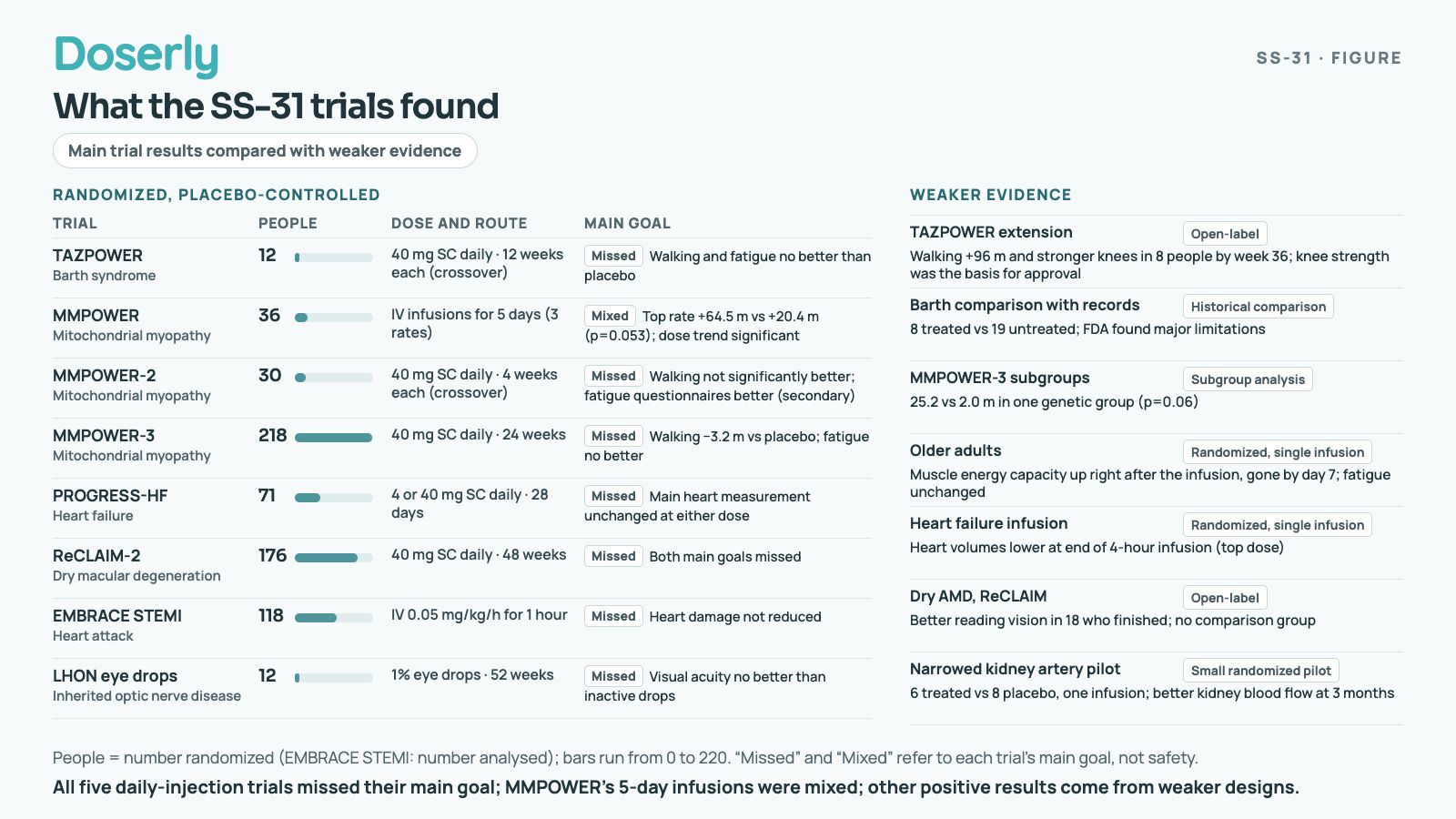
Chart listing eight randomized SS-31 trials: seven missed their main goals and one short infusion trial (MMPOWER) had a mixed result; separately, the open-label, subgroup and small single-infusion studies that reported encouraging results.
What the SS-31 trials found
Main trial results compared with weaker evidence
Randomized, placebo-controlled
- TAZPOWER · Barth syndrome
- People12Dose40 mg SC daily, 12 weeks each (crossover)Main goalMissed Walking and fatigue no better than placebo
- MMPOWER · Mitochondrial myopathy
- People36DoseIV infusions for 5 days (3 rates)Main goalMixed Top rate +64.5 m vs +20.4 m (p=0.053); dose trend significant
- MMPOWER-2 · Mitochondrial myopathy
- People30Dose40 mg SC daily, 4 weeks each (crossover)Main goalMissed Walking not significantly better; fatigue questionnaires better (secondary)
- MMPOWER-3 · Mitochondrial myopathy
- People218Dose40 mg SC daily, 24 weeksMain goalMissed Walking −3.2 m vs placebo; fatigue no better
- PROGRESS-HF · Heart failure
- People71Dose4 or 40 mg SC daily, 28 daysMain goalMissed Main heart measurement unchanged at either dose
- ReCLAIM-2 · Dry macular degeneration
- People176Dose40 mg SC daily, 48 weeksMain goalMissed Both main goals missed
- EMBRACE STEMI · Heart attack
- People118 analysedDoseIV 0.05 mg/kg/h for 1 hourMain goalMissed Heart damage not reduced
- LHON eye drops · Inherited optic nerve disease
- People12Dose1% drops, 52 weeksMain goalMissed Visual acuity no better than inactive drops
Weaker evidence
- TAZPOWER extension
- DesignOpen-labelResultWalking +96 m and stronger knees in 8 people by week 36; knee strength was the basis for approval
- Barth comparison with records
- DesignHistorical comparisonResult8 treated vs 19 untreated; FDA found major limitations
- MMPOWER-3 subgroups
- DesignSubgroup analysisResult25.2 vs 2.0 m in one genetic group (p=0.06)
- Older adults
- DesignRandomized, single infusionResultMuscle energy capacity up right after the infusion, gone by day 7; fatigue unchanged
- Heart failure infusion
- DesignRandomized, single infusionResultHeart volumes lower at end of 4-hour infusion (top dose)
- Dry AMD, ReCLAIM
- DesignOpen-labelResultBetter reading vision in 18 who finished; no comparison group
- Narrowed kidney artery pilot
- DesignSmall randomized pilotResult6 treated vs 8 placebo, one infusion; better kidney blood flow at 3 months
All five daily-injection trials missed their main goal; MMPOWER’s 5-day infusions were mixed; other positive results come from weaker designs.
Barth syndrome, the approved use
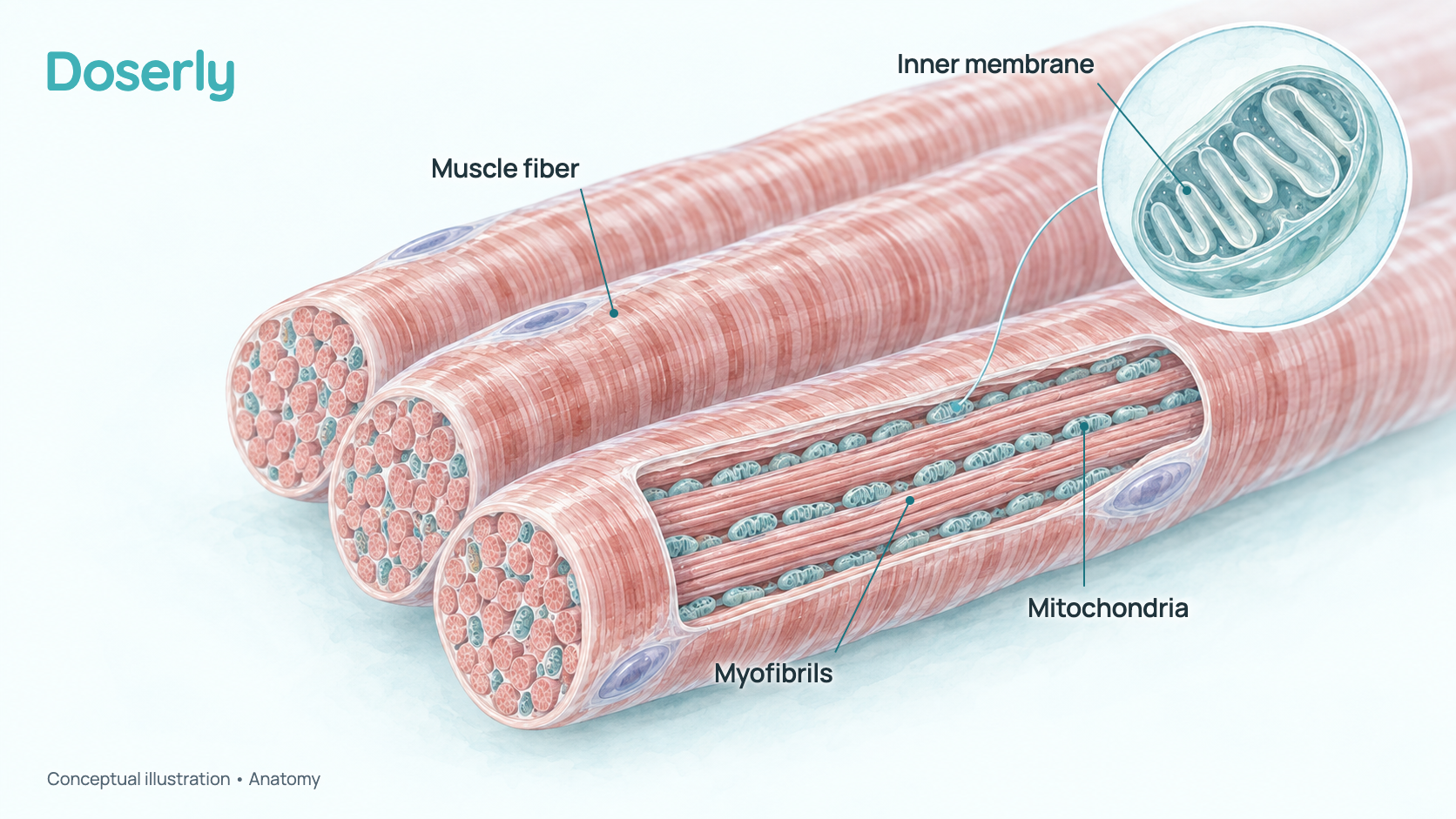
Barth syndrome is a rare inherited disease, passed down on the X chromosome, that mainly affects boys and men. A faulty gene called TAFAZZIN stops cells from properly finishing, or remodeling, cardiolipin, a fat that the inner membrane of mitochondria needs. The result is weak heart and skeletal muscle and tiring easily. FDA estimated that about 150 people in the United States have it. [43], [1], [8]
Forzinity is approved "to improve muscle strength" in this disease, based on knee-extensor strength (the muscles that straighten the leg) measured in an open-label extension of a 12-person trial. Knee strength is an intermediate endpoint: a measurement expected to predict a real benefit, not the benefit itself, and a confirmatory trial is due to report by March 2030. By April 2026 the company reported that 33 patients had started Forzinity. [1], [44], [13], [45], [46] Why FDA approved it after the main trial missed.
Energy, fatigue and "mitochondrial support"
This is by far the most common reason people buy research vials. The hope is simple: if tired cells make energy poorly, a molecule that helps mitochondria should make a person feel less tired. People discuss it for everyday energy, fatigue during weight loss on GLP-1 medicines, chronic fatigue syndrome (ME/CFS) and long COVID. [47], [48], [49], [50]
The trials that measured fatigue do not back that up: in the 218-person MMPOWER-3 trial, fatigue improved no more than on placebo, and no trial has tested SS-31 in ME/CFS or long COVID. [10] See what the fatigue trials found and what people report.
Healthy aging and "longevity"
Much of the longevity interest comes from studies in old mice. One injection restored old mice's muscle energy production to young levels within an hour, eight weeks of treatment improved treadmill endurance and heart relaxation, and ten months of treatment improved some measures of healthy aging, differently in males and females. [51], [52], [53], [54]
Those are real findings in mice, not evidence that SS-31 slows aging in people. Some mouse results were negative: it did not prevent age-related shrinking of muscle fibers, and it did not change markers of biological age. The only human "aging" data are the single infusion above; a small trial in healthy older adults is registered with no results. [55], [56], [32], [57]
Eyes: dry macular degeneration and vision
Researchers have tested it for dry age-related macular degeneration, a common cause of vision loss in older adults. A small open-label study looked encouraging, but the randomized ReCLAIM-2 trial (176 people, 48 weeks) missed both of its main goals; a larger phase 3 trial, ReNEW, is expected to report after August 2027. People online also describe sharper near vision after research-vial use. Those reports are unmeasured, and near vision can shift for many reasons. [58], [12], [59], [60]
Heart and kidneys
Early human research focused on heart attacks and heart failure. SS-31 reduced heart-attack damage in rats, sheep and isolated guinea-pig hearts, but in people it did not: a trial during emergency heart-attack treatment and a 28-day heart-failure trial at 4 mg or 40 mg a day both missed their goals. For kidneys, animal studies reported protection, and a 14-person pilot during kidney-artery stenting found better kidney blood flow after three months; it has not been repeated. [61], [62], [63], [11], [64], [65]
Mitochondrial muscle disease
Primary mitochondrial myopathy is a group of genetic diseases in which faulty mitochondria weaken muscles. Early trials looked promising, but the 218-person MMPOWER-3 trial missed its main goals. A follow-up trial in a genetic subgroup (NuPOWER, 60 mg a day) finished in 2024 without published efficacy results. [30], [10], [66], [29]
Where do SS-31 protocols differ?
For most peptides, dosing pages disagree around a middle ground. For SS-31 there is a gap: the main dose tested for months in people is 40 mg a day, while most online schedules use 1–10 mg. Sources also disagree about stepping up, taking breaks, time of day and what to combine it with. Here is what those differences mean when reading a protocol.
Why is the label dose so much higher than website doses?
The 40 mg dose comes from trials; the lower amounts come from vial arithmetic, cost and untested reasoning. Most multi-week trials used 40 mg a day, one used 60 mg, and 40 mg is the dose FDA approved. [1], [10], [12], [29] Online, 5–10 mg is convenient because a 10 mg vial mixed with 1 mL of water makes 5–10 mg exactly 50–100 marks on an insulin syringe. Some pages borrow 4 mg from the lower arm of the PROGRESS-HF heart-failure trial, which did no better than placebo, and one page presents 6 mg as a "healthy-adult anchor" because a 7-day safety study used it. [4], [34], [11], [39], [8]
Community education groups often describe the trial dose as more than necessary and justify lower amounts as cost-effective, and some claim a low dose is enough to "saturate" the membrane. No study has compared low amounts with 40 mg, so none of these explanations has been tested. A lower amount is not proven safer either: nobody has studied it long term in people.
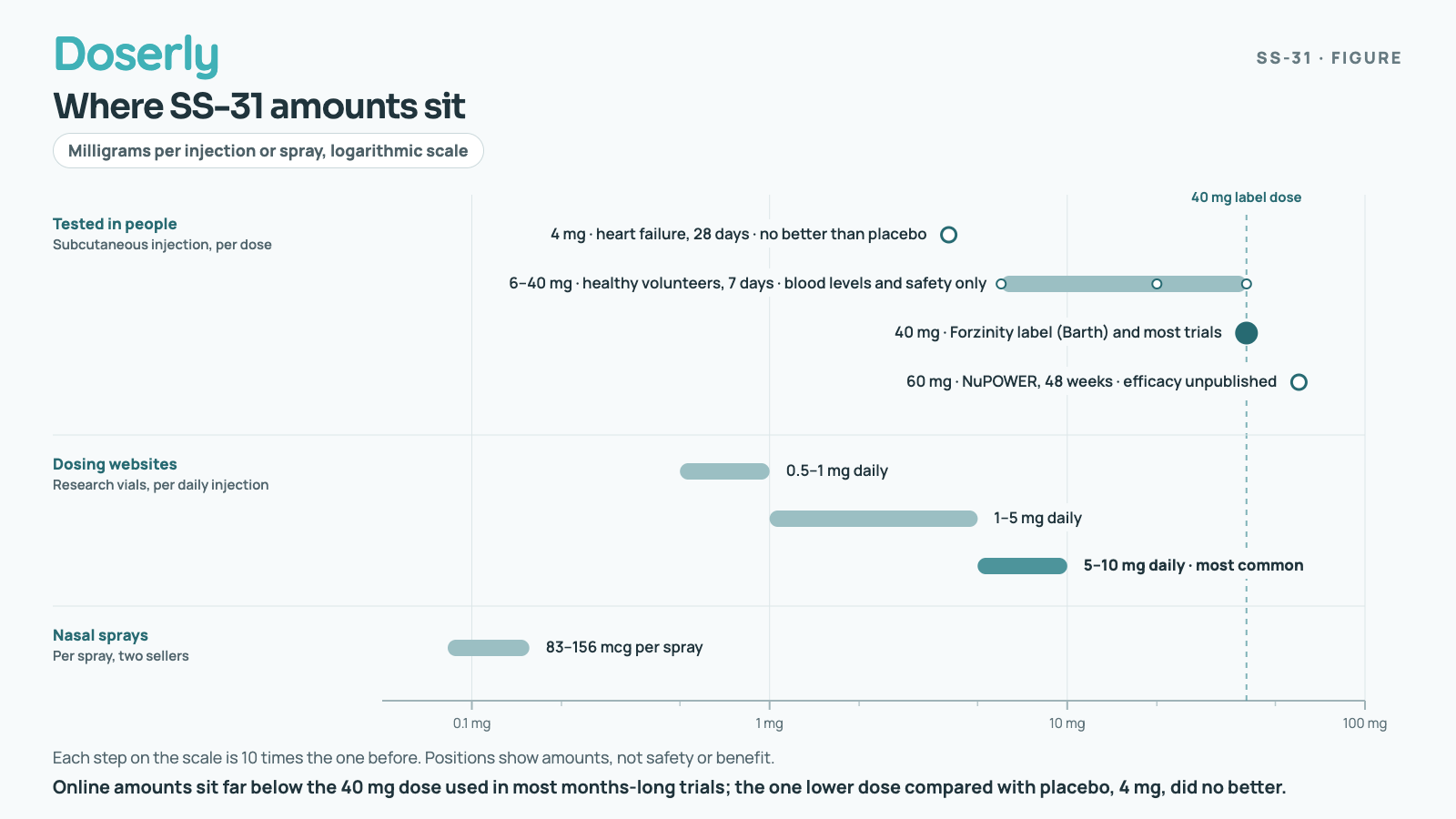
Chart on a logarithmic milligram scale showing research-vial website amounts of 0.5 to 10 mg and nasal sprays under 0.2 mg per spray, far below the 40 mg daily dose used on the label and in most trials; a 4 mg dose tested in heart failure did no better than placebo.
Where SS-31 amounts sit
Milligrams per injection or spray, logarithmic scale
Tested in people (subcutaneous)
- 4 mg
- heart failure, 28 days · no better than placebo
- 6–40 mg
- healthy volunteers, 7 days · blood levels and safety only
- 40 mg
- Forzinity label (Barth) and most trials
- 60 mg
- NuPOWER, 48 weeks · efficacy unpublished
Dosing websites (research vials)
- 0.5–1 mg daily
- Low schedule on one dosing site
- 1–5 mg daily
- Mid schedule on the same dosing site
- 5–10 mg daily
- most common
Nasal sprays
- 83–156 mcg per spray
Online amounts sit far below the 40 mg dose used in most months-long trials; the one lower dose compared with placebo, 4 mg, did no better.
Once daily, five days a week or twice a week?
The label and the injection trials use one injection every day. [1], [10] Dosing pages vary: some use five days a week, one drops to three days a week later in its plan, one clinic handout gives 5 mg twice a week, and one page moves from daily to two or three times a week after eight weeks. [37], [67], [68], [39]
The short half-life matters here: levels fall by half every 3–4 hours, so little is left in the blood by the next day. Whether that matters for any benefit is unknown. In old mice, twice-weekly injections for eight months kept some benefits of continuous treatment but not others; that has not been tested in people. [8], [69]
Do sources start low, or start at the target dose?
The label starts at the full dose. [1] Dosing pages that titrate start at 1–5 mg and climb: one goes 5 mg to 10 mg, with an optional 15–20 mg; another 2 mg to 4 mg; another 1 mg, 2 mg, 3 mg, then 4 mg over 12 weeks while cutting from five to three injection days a week. [28], [34], [67] Some people begin with a 0.5–1 mg test dose, and in community education groups some members raise the amount one vial at a time toward 10, 25 or even 40 mg. [35]
These are different strategies, not pieces of one protocol. No study has shown that moving to a higher step helps when a lower one did not.
How long is a course, and are breaks needed?
In the trials, people took it every day for 4 to 48 weeks, and in the Barth extension for up to 192 weeks, with no planned breaks. [70], [12], [36] Dosing pages usually describe 4–12 weeks followed by 2–8 weeks off. [26], [37], [6], [34] Community education groups go both ways: short courses of about two weeks repeated two to four times a year, 8–12 weeks on and 4–6 weeks off, or continuous use.
Breaks are often explained as "resetting receptors". SS-31 does not appear to work through a hormone-style receptor that wears out with use, and no study has tested whether breaks change anything. A break is a source convention, not a proven requirement. [20], [71]
Morning or night?
The label says to inject at the same time each day but does not name a time. [1] Dosing pages mostly say morning. [37], [34], [39] In public forums, some people move the dose to bedtime to sleep through early tiredness, while others report trouble sleeping if they take it after midday. No study has compared timings. [72], [73], [74]
What is the SS-31 and MOTS-c "mitochondrial stack"?
SS-31 is often sold and discussed as part of a "mitochondrial stack" or "mito stack" with MOTS-c, a different lab-made peptide, and NAD+, a coenzyme cells use to make energy. The usual story is "repair the engine first, then build more of it": SS-31 first, MOTS-c from the second week. [47], [75] Here are three stacks as their sources publish them.
| Stack (source) | SS-31 each time | Other components | How often | Duration |
|---|---|---|---|---|
| "Mitochondrial Peptide Stack" [47] | 6 mg | MOTS-c 5–10 mg two or three times a week from week 2; NAD+ 100–200 mg into a muscle two or three times a week | SS-31 daily to week 8, then daily or two or three times a week | 8–12 weeks or longer |
| "Stacked Protocol (SS-31 + MOTS-c)" [26] | 3–5 mg | MOTS-c 5 mg | Daily | 4–6 weeks, then 4 weeks off |
| "MOTS-c/NAD+ prep" [37] | 5 mg | Then a MOTS-c or NAD+ course | Five times a week | 2 weeks before the other course |
No study has tested any of these combinations in people, and the order "SS-31 first" has never been compared with any other order. [75] Adding compounds also makes it impossible to tell which one caused a benefit or a side effect. For tested athletes, MOTS-c is named on the World Anti-Doping Agency's prohibited list. [18] Forzinity's label says not to mix it with other medicines in the same syringe. [1] Read the Doserly guides to MOTS-c and NAD+.
Do nasal sprays, eye drops or capsules work the same way?
Nobody has shown that they do. Nasal sprays list 83 or 156 mcg of SS-31 per spray, roughly 1–3% of a 5–10 mg injection, and one seller's own figures for bottle content and tested strength do not agree. No study has measured how much SS-31 reaches the blood through the nose. [23], [24] Eye drops were tested in a small trial for an inherited eye disease and missed their main goal. Capsules were tried in two early company studies that never published results. [25], [76], [77] Compare the routes.
How do milligrams convert to syringe units?
Many people meet "units" on an insulin syringe. A U-100 syringe holds 100 units per millilitre, so units measure volume, not an amount of SS-31. How much SS-31 each unit holds depends on how much liquid was added to the vial.
For example, a 10 mg vial mixed with 1 mL gives 10 mg per mL, or 0.1 mg per unit, so 5 mg is 50 units. The same 10 mg vial mixed with 2 mL gives 0.05 mg per unit, so the same 5 mg is 100 units. [28], [78] That is why a number of units copied from someone else's post can be twice or half the intended amount; several community accounts give units without saying how the vial was mixed. It also shows how large the trial dose is: 40 mg from a 10 mg per mL mix would be 4 mL, four full syringes. Doserly's reconstitution calculator works this out for any vial and shows each step.
Source-by-source comparison and registered study plans
Which pages copy which?
The 42 dosing pages we logged fall into 10 families. The largest outside the label is 5–10 mg once daily, found on a doctor sheet for a 10 mg vial (GenOracle, in a folder dated 2022), research-peptide profile pages and clinic menus in Chicago and Bangkok. A second family steps up by week: PeptideDosage.org gives 5 mg for weeks 1–2 and 10 mg for weeks 3–8, with a second chart reaching 15 mg split into two injections in weeks 5–8 and an optional 20 mg in weeks 9–12; The Peptide Guide and PeptideDosages.com repeat the same ladder. [4], [27], [5], [6], [28], [79], [80]
Other families: PeptideFox's own 6 mg daily plan; low community tiers of 0.1–5 mg on calculator and wiki pages; MyPeptideMatch's 2 mg then 4 mg, borrowed from the heart-failure trial; stack sheets with MOTS-c and NAD+; a clinic handout giving 5 mg twice a week for three months; and nasal sprays. Peptide Schedule offers "beginner" 4 mg, "moderate" 10 mg and "aggressive" 40 mg daily levels that it calls extrapolated, and says community users run 2–10 mg a day. [39], [81], [78], [34], [47], [68], [23], [82]
Where pages contradict themselves or the trials
PeptideDosage.org's charts stop at 20 mg a day, yet its answers section says research protocols "commonly evaluate 30 to 80 mg/day"; no trial used 80 mg a day for weeks, and NuPOWER's 60 mg was the highest multi-week dose. MyPeptideMatch calls 4 mg the "standard dose from human clinical trials" and says a heart-failure trial of 40 mg for 5 days improved heart function; neither matches the published trials. Guide to Peptide gives 20–40 mg a day alongside disease doses that do not match the original studies. [28], [34], [33], [11]
What are the registered studies planning?
These are study plans. Status and dates were checked on September 24, 2026; registry update dates describe the records, not completed trials.
ReNEW: 40 mg once daily for 96 weeks in dry macular degeneration
313 people enrolled, randomly assigned to elamipretide or placebo.
Active, not recruiting. Main results estimated August 2027. No results posted.
[59]4TAZPower: Barth syndrome, placebo-controlled
The trial FDA requires to confirm the accelerated approval, in about 48 patients aged 5 and over, using the 80 mg/mL product.
Recruiting since July 2026. Main results estimated September 2029.
[83], [13]NuPOWER: 60 mg once daily for 48 weeks in mitochondrial disease
102 people with mitochondrial disease caused by nuclear gene changes. The company has said only that results support further study in one subgroup.
Completed December 2024. No results posted or published.
[29], [84]SHAPE: daily injections in healthy older adults
A 30-person single-group study of safety and physical function at a US university. No dose is listed.
Recruiting on the record, but its estimated completion date (April 2026) has passed and the record was last updated in December 2025.
[57]Friedreich ataxia: 20–30 mg or 40–60 mg daily for 52 weeks
A 20-person study at a children's hospital, testing two dose ranges.
Completed 2024. Results posted on the registry; no journal paper found.
[85]What happens when you stop SS-31?
No study has looked specifically for withdrawal effects or a rebound after stopping. The trials that paused treatment did not report any, but they were not designed to find them. [9], [70]
- Effects faded quickly in the trials. In MMPOWER-2, people with mitochondrial muscle disease reported less fatigue during four weeks on elamipretide than on placebo, a secondary measure, but their scores were back to where they started two weeks after stopping. In older adults, the rise in muscle energy capacity after one infusion was gone a week later. [70], [32]
- Blood changes reverse. The label says rises in eosinophils return to normal after stopping, or after 6–12 months of continued use. [1]
- Some animal effects lasted longer. In old mice, improved vision lasted at least three months after daily treatment ended. That has not been seen in people. [86]
- Community accounts point both ways. One person taking 2 mg a day for heart palpitations said the symptoms came back during breaks; others describe an early lift that wore off, or no change at all. [73], [87], [88] Some community education materials claim most of the benefit is kept for months after stopping; no study supports that.
The trials also show what stopping looks like for other reasons: in the 48-week eye trial, 29% of people on elamipretide left the study early, compared with 14% on placebo, most often by choice or because of side effects such as injection-site reactions. [12]
Does the way SS-31 is given change what it does?
Yes. Forzinity is approved only as a subcutaneous injection (into the fatty layer under the skin) of the abdomen or outer thigh, and the label states that it is not approved for use in a vein. Hospital studies gave elamipretide intravenously (IV, into a vein) as a slow infusion, one small trial used eye drops, and sellers also offer nasal sprays. These are different exposures, not interchangeable versions of the same dose. [1], [32], [25], [23]
How the body absorbs, moves and clears a drug is called its pharmacokinetics, and for this molecule subcutaneous injection works well. About 92% of an injected dose reaches the bloodstream (bioavailability), blood levels peak 30 minutes to an hour later, and the thigh and abdomen give the same exposure. Levels rise in step with the dose across 2 to 80 mg a day, and they barely build up with daily use. [1]
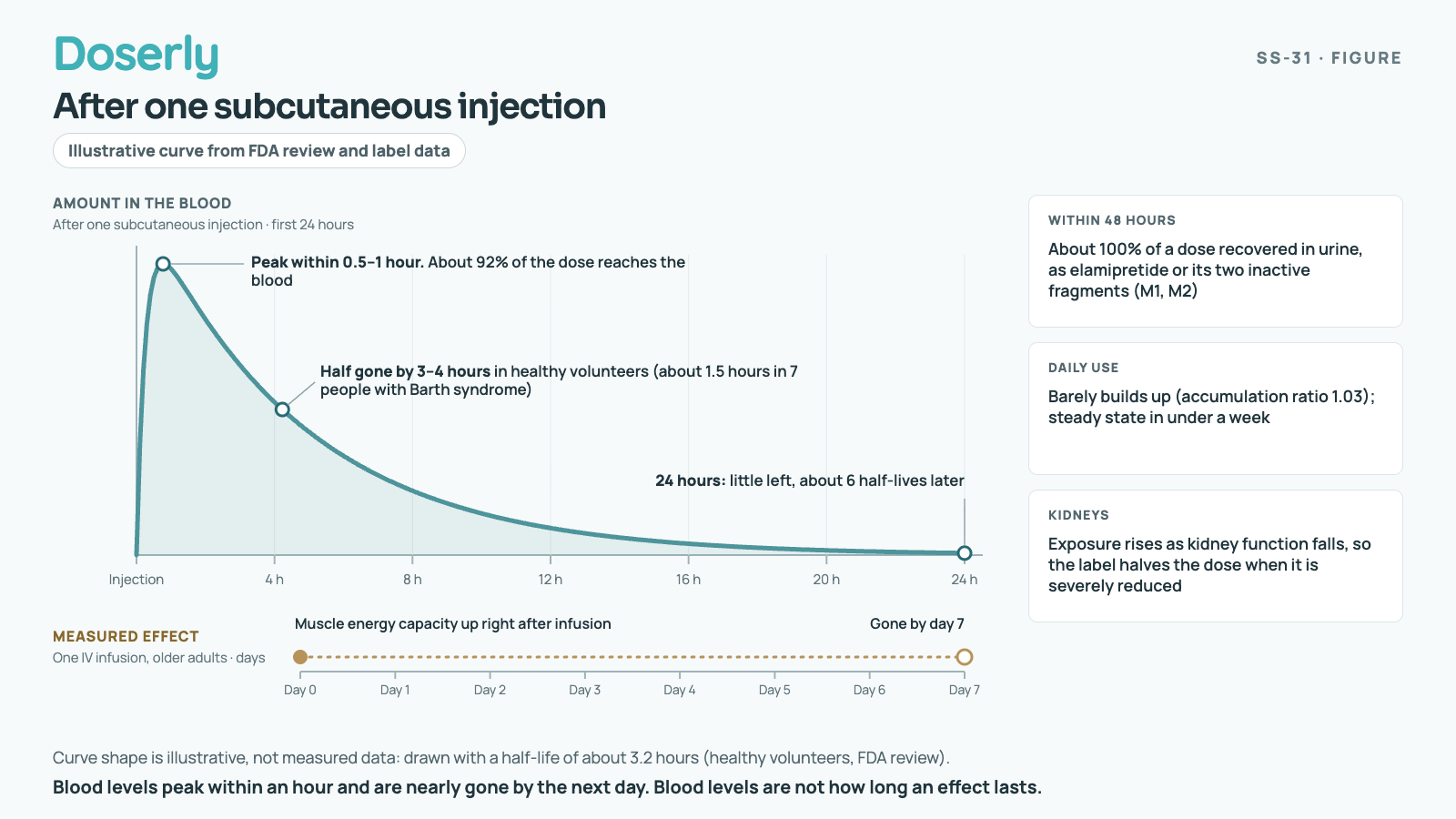
Timeline of one subcutaneous elamipretide injection: peak blood level within an hour, level halved every 3 to 4 hours, little left by the next day and nearly all cleared in urine within 48 hours.
After one subcutaneous injection
Illustrative curve from FDA review and label data
- 0.5–1 h
- Peak blood level; about 92% of the dose reaches the blood
- 3–4 h
- Half-life in healthy volunteers (3.16 h single 40 mg dose; 2.8 h after 7 daily doses); about 1.5 h in 7 people with Barth syndrome
- Within 48 h
- About 100% of a dose recovered in urine as elamipretide, M1 or M2
- Daily use
- Minimal build-up (accumulation ratio 1.03); steady state in under a week
- Day 7
- Rise in muscle energy capacity after one IV infusion gone
- Kidneys
- Exposure rises as kidney function falls, so the label halves the dose when it is severely reduced
Blood levels peak within an hour and are nearly gone by the next day. Blood levels are not how long an effect lasts.
Swallowing it is a different story. Researchers describe SS-31 as not absorbed when taken by mouth (oral), and the company's two early studies of capsules never published results. [69], [76], [77]
Kidneys matter for everyone who uses it. The body breaks SS-31 down into two inactive fragments, and nearly all of a dose leaves in the urine within 48 hours. In people with reduced kidney function, exposure rose by 39%, 75% and 125% as kidney function fell, and the breakdown fragments rose far more. That is why the label halves the dose when kidney function is severely reduced. [1]
How long does SS-31 last in the body?
Half-life is the time it takes for the level in the blood to fall by half. For elamipretide it is about 3–4 hours in healthy volunteers: 3.16 hours after a single 40 mg injection, and 2.8 hours after a week of daily doses. In the seven people with Barth syndrome who were measured, it was shorter, about 1.5 hours. [8]
The US label itself gives no half-life; these figures come from FDA's review of the application. Websites give other numbers, such as "about 2 hours" or "4 hours", without a published source. [1], [28], [82]
A short half-life does not mean a short effect, and it does not mean a long one either. In people, the one measured effect that was tracked over time, a rise in muscle energy capacity after a single infusion, was present right after the infusion and gone a week later. [32] Mouse studies that found longer-lasting changes used weeks of treatment. [86]
Is research "SS-31" the same as Forzinity?
It is the same molecule, but not the same product. Forzinity is elamipretide hydrochloride, a ready-made solution of 80 mg/mL with benzyl alcohol as a preservative. [1], [14] During development the company also used an acetate salt, and FDA found that the two gave similar blood levels. [8] Research vials are usually sold as a freeze-dried powder, and no regulator checks what is actually inside them. [28], [3]
That gap is not theoretical. FDA warning letters in August 2026 called research-market SS-31 an unapproved new drug and rejected "research use only" labeling, and a December 2025 letter listed elamipretide acetate among ingredients pharmacies may not use for compounding. [3], [22], [89] Community education groups discuss batch tests that failed identity or purity checks and products renamed with other code names after enforcement letters.
Does the injection site matter?
The label directs injections into the abdomen, at least 2 inches (about 5 cm) from the navel, or the outer thigh, rotating sites daily and avoiding skin that is tender, bruised, red or hard. Both sites give the same exposure. [1]
Because injection-site reactions are so common, a small company study in 10 healthy volunteers tested ways to reduce them. A steroid cream (mometasone) reduced swelling and itching, and an antihistamine taken beforehand (diphenhydramine) reduced hardness at the injection site but made half the participants sleepy. Ice reduced pain but also lowered the amount of drug reaching the blood. [90] Some community members inject into muscle (intramuscular) or the buttock, or ask about doing so, to avoid lumps or painful injections; that route has not been studied, and Forzinity is labeled for subcutaneous use only. [91], [1]
How should SS-31 be stored, and how long does it last?
Storage instructions exist only for Forzinity, the licensed solution. No one has published a stability study of research-vial SS-31, powder or mixed (reconstituted). [1]
- Forzinity, unopened. Keep in the refrigerator at 2–8 °C (36–46 °F). Do not freeze. [1]
- Forzinity, after the first dose. The opened vial can go back in the refrigerator or stay at room temperature (20–25 °C, 68–77 °F). Throw it away 8 days after first opening, even if some is left. Let the vial sit at room temperature for at least 10 minutes before injecting. [1]
- Research-vial powder. Dosing pages say to keep the dry powder frozen at −20 °C for long-term storage; one says a sealed vial is fine at 2–8 °C for up to six months. These are claims, not tested expiry dates. [28], [82]
- Research vials after mixing. Pages disagree: use within 2–3 weeks, within 4 weeks, or within 14 days, and one page gives both 14 and 28 days. Community education groups often say 30–45 days, some longer. None of these figures comes from a published test. [82], [28], [34]
Forzinity's 8-day limit applies to a preserved commercial solution; no comparable limit has been tested for a home-mixed vial, so the longer figures on websites are guesses. This guide does not cover mixing or injection technique; the Academy note below covers practical handling.
What do we actually know about SS-31 in people?
SS-31 has more human research than most peptides sold online: more than a dozen published studies, several of them randomized and placebo-controlled, most funded by the company that developed it. The pattern across them is consistent. When elamipretide was compared directly with placebo over weeks or months, it missed the trial's main goal every time. The encouraging results come from a 5-day infusion trial with a mixed result, open-label extensions without a comparison group, subgroup analyses done after the fact and single infusions measured over hours. [9], [10], [11], [12], [8]
That distinction matters. A person who feels or walks better after starting a treatment is having a real experience. Working out why is a separate task: symptoms change over time, people try harder when they expect to improve, and practice alone can raise test scores. Controlled trials exist to separate those effects from the treatment itself.

What did the human studies find?
| Study | What researchers reported | What it cannot establish |
|---|---|---|
| Barth syndrome, TAZPOWER, 2021 | 12 males aged 12 to 35 took 40 mg a day or placebo for 12 weeks each, in random order. Walking distance and fatigue were no better on elamipretide. In the open-label extension, the 8 people who reached week 36 walked about 96 m further and had stronger knees. [9] | Whether the later gains came from the drug or from practice, expectation or natural change; there was no comparison group. |
| Barth extension to 168 weeks, 2024 | 8 of 10 people reached week 168, walking 96 m further than at the start of the extension; median knee strength rose 63 newtons, against +4 on the drug and −5 on placebo in the randomized weeks. [36], [1] | The same limit: no comparison group. |
| Barth, comparison with historical records, 2022 | 8 treated people walked 79.7 m further at 64 weeks than 19 untreated people from records. [92] | FDA found major limitations in how the groups were chosen and measured. [8] |
| Mitochondrial myopathy, MMPOWER, 2018 | 36 adults received IV infusions for 5 days. The top dose walked 64.5 m further, against 20.4 m on placebo, narrowly missing statistical significance. [30] | Whether daily injections work. |
| Mitochondrial myopathy, MMPOWER-2, 2020 | 30 adults took 40 mg a day or placebo for 4 weeks each. Walking distance did not significantly improve; fatigue questionnaires, a secondary measure, were better. 80% of participants had injection-site reactions while taking elamipretide. [70] | Whether the fatigue result would hold up. It did not (next row). |
| Mitochondrial myopathy, MMPOWER-3, 2023 | 218 adults took 40 mg a day or placebo for 24 weeks. Walking distance (−3.2 m against placebo) and fatigue did not improve. [10] | The definitive test in this disease, and it was negative. |
| MMPOWER-3 subgroups, 2024 | People with certain gene changes that affect copying of mitochondrial DNA walked 25.2 m further, against 2.0 m on placebo, narrowly missing significance. [66] | An analysis done afterward to generate ideas; the follow-up trial is unpublished. |
| Heart attack (EMBRACE STEMI), 2016 | IV elamipretide during emergency artery opening did not reduce heart damage in 118 people analysed. [63] | Any benefit for heart attacks. |
| Heart failure, single infusion, 2017 | In 36 people, the highest infusion rate reduced heart volumes by the end of a 4-hour infusion. [31] | Whether the change lasts or helps. |
| Heart failure, PROGRESS-HF, 2020 | 71 people took 4 mg, 40 mg or placebo daily for 28 days. The main heart measurement did not change at either dose. [11] | Any benefit for heart failure, or any effect of 4 mg a day. |
| Narrowed kidney artery, 2017 | 14 people (6 treated, 8 placebo) had IV elamipretide or placebo during stenting. Kidney blood flow and function were better after 3 months in the treated group. [65] | Whether this holds in a larger trial. |
| Dry macular degeneration, ReCLAIM, 2022 | 21 people took 40 mg a day for 24 weeks without a comparison group; the 18 who finished read better in normal and dim light. [58] | Whether it beats placebo; the next trial found it did not. |
| Dry macular degeneration, ReCLAIM-2, 2025 | 176 people (117 on elamipretide, 59 on placebo) for 48 weeks. Both main goals, vision in dim light and growth of damaged areas, were missed; a retinal layer measure looked better. 29% on elamipretide left early, against 14% on placebo. [12] | Any proven vision benefit. |
| Inherited optic nerve disease (LHON), eye drops, 2024 | 12 people used 1% drops for 52 weeks; visual acuity was no better in treated eyes than in eyes given an inactive drop. [25] | Any benefit of the drops. |
| Older adults, single infusion, 2021 | 39 people aged 60–85 received a 2-hour IV infusion or placebo. A lab measure of muscle energy capacity rose right after the infusion and was gone a week later; muscle fatigue did not change. [32] | That SS-31 gives lasting energy. |
Children with Barth syndrome have also been treated outside trials through expanded access, the program that lets doctors request an unapproved drug for a serious illness. Case reports describe a newborn and a 5-year-old whose heart function improved while they were also receiving full heart-failure treatment, and case series report quality-of-life gains in other rare mitochondrial diseases. These reports cannot separate the drug from other care. [93], [94], [95], [96]
Why did FDA approve it if the main trial missed?
FDA used accelerated approval, a pathway for serious diseases with few treatment options that allows approval based on a measurement expected to predict benefit, with a later trial required to confirm it. The measurement was knee-extensor strength in the open-label extension. [1], [13]
The path was not smooth, and FDA's own documents show real disagreement:
- 2021–2024. The company first applied in 2021; FDA refused to file it, and it was resubmitted in 2024. [8]
- October 2024. An FDA advisory committee voted 10 to 6 that the evidence showed effectiveness. A committee vote is advice, not a decision. [97], [8]
- May 2025. FDA rejected the application, citing a manufacturing-site problem and saying effectiveness had not been shown for standard approval. [8]
- September 19, 2025. After resubmission, FDA granted accelerated approval. FDA's clinical and statistical reviewers still recommended against it; the official who signed the decision accepted more uncertainty for a disease affecting about 150 people in the United States. [8], [2]
The approval requires a randomized, placebo-controlled trial in patients aged 5 and over, with a final report due by March 2030. That trial, 4TAZPower, began recruiting in July 2026. FDA also required two cancer studies in animals and a study of interaction with the diabetes medicine metformin. [13], [45], [83]
Does SS-31 help fatigue in people?
Not in the trials that tested it properly. Fatigue was a main goal in the Barth trial and in MMPOWER-3, and neither found an improvement over placebo. The one positive fatigue result, in the smaller and shorter MMPOWER-2 trial, disappeared two weeks after treatment stopped and was not repeated in MMPOWER-3. In older adults, a single infusion did not change how quickly muscles tired. [9], [10], [70], [32]
The trials also did not list fatigue among the common side effects. The label's side-effect table lists only injection-site reactions, and fatigue does not appear in the adverse-event tables of the Barth trial or ReCLAIM-2 (which listed events seen in at least 5% of people). [1], [9], [12] That contrasts with community reports, where early tiredness is the most common complaint; the experience section discusses why.
Does feeling more energetic mean mitochondria improved?
Not necessarily. The studies measured three different kinds of outcome, and a change in one does not establish a change in the others:
- How people feel: fatigue questionnaires and symptom scores.
- What people can do: how far someone walks in six minutes, knee strength, visual acuity.
- What happens inside cells: muscle energy capacity measured by a special MRI scan, or the balance of cardiolipin forms in blood cells.
The older-adult study shows why this matters: the inside-the-cell measure rose, while muscle fatigue did not change. Barth syndrome shows it the other way: FDA found that elamipretide did not meaningfully change the abnormal cardiolipin balance that defines the disease, even though strength improved in the extension. [32], [8]
How might SS-31 work?
Mitochondria have two membranes. The inner one is folded into ridges called cristae, and that is where the chain of proteins that makes most of a cell's energy sits. A fat called cardiolipin is found mainly in this inner membrane and helps hold the folds and the energy chain in shape. [98], [99]
SS-31 was designed to get there. Its four building blocks alternate between positively charged and ring-shaped ones, a design that lets it pass into cells and reach mitochondria. In cell experiments and isolated mitochondria, peptides of this family built up in the inner membrane at about 1,000 times their concentration outside. [21], [71] What it does once it arrives is still being worked out.
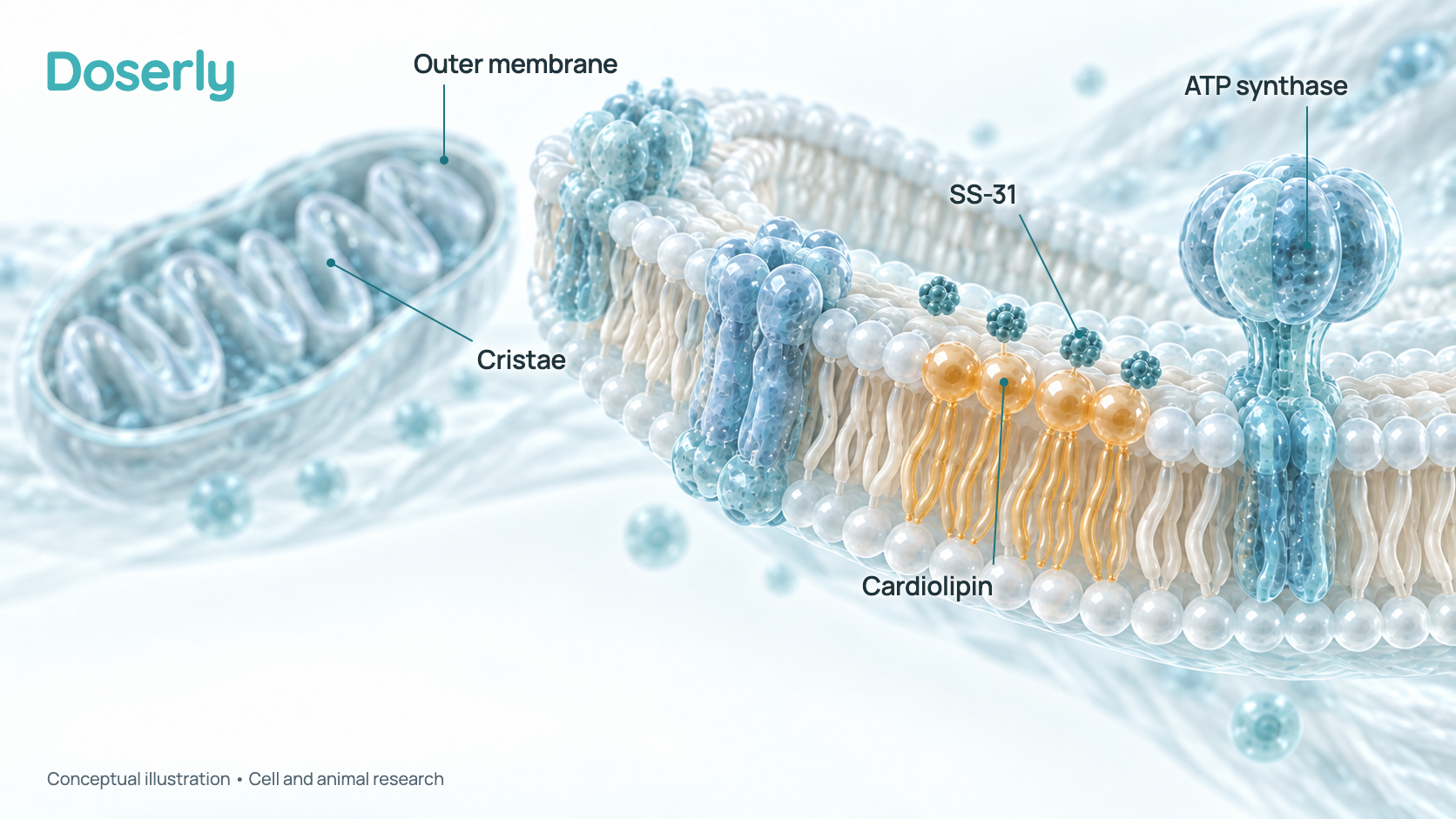
The cardiolipin idea
The best-known explanation comes from the lab that developed it. In test-tube and rat experiments, SS-31 bound tightly to cardiolipin, protected the cristae during a loss of blood flow to the kidney, and stopped a harmful reaction in which cytochrome c, a protein of the energy chain, starts damaging cardiolipin instead of carrying electrons. In isolated mitochondria it restored electron flow and oxygen use. [98], [99] The Forzinity label describes it as a mitochondrial cardiolipin binder. [1]
Newer findings broaden the picture
Later work by other groups suggests cardiolipin is only part of the story:
- Membrane charge. SS-31 settles into membranes in proportion to how negatively charged they are, not only where cardiolipin is, and changes the electrical charge at the membrane surface. Researchers now think that change may be a key part of how it works. [20], [71]
- Protein partners. Chemical cross-linking in mitochondria found SS-31 touching proteins of the energy chain and ATP synthase, the machine that makes the cell's energy currency, and a transporter (ANT) that swaps used and fresh energy molecules. In old mouse muscle, it made that transporter work better. [100], [101]
- A required protein. A 2024 genetic screen in human kidney cells found that SS-31's protective effect depended on an inner-membrane protein called phospholipid scramblase 3. [102]
- Not a simple antioxidant. Early papers called the SS peptides antioxidants. A later study found that SS-31 showed no ability to neutralize reactive oxygen molecules in cell-free tests, even though it lowered them in isolated heart mitochondria, which points to an indirect effect. [21], [103]
These are cell and animal findings, part of the preclinical research. They explain why researchers expected benefits; they do not show that the same things happen in a person taking a research vial.
Does SS-31 fix cardiolipin?
Sources disagree, and the disagreement is worth knowing. The company's report of the Barth extension says the abnormal balance of cardiolipin forms improved and tracked clinical outcomes. [36] FDA's review reached a different conclusion: elamipretide did not meaningfully change that abnormal balance in Barth syndrome. [8] In mice lacking the Barth gene, SS-31 improved how mitochondria used oxygen without changing the cardiolipin balance, and in a 2026 study of another inherited mitochondrial disease, mouse endurance improved while cardiolipin content and makeup stayed the same. [43], [104]
The most careful reading: SS-31 binds cardiolipin-rich membranes, but binding is not the same as increasing or repairing cardiolipin. Any benefit seems to come from how the membrane and its proteins work, not from more cardiolipin.
Why do injections cause skin reactions?
This part is better understood. Lab and animal studies show that SS-31 and its breakdown fragments trigger mast cells, immune cells in the skin, to release histamine, and suggest this happens through a receptor called MRGPRX2 (Mrgprb2 in mice). In dogs, blood histamine rose within 5–15 minutes of a dose and was back to normal by 30 minutes, and total antibody levels (IgG and IgE) did not change. That explains the redness, itching and welts that most people get, and why the label suggests steroid creams and antihistamines for mild reactions. A skin reaction tells you about mast cells, not about whether the drug is helping. [8], [90], [1]
What do the animal studies show, and what don't they?
In animals, SS-31 has been reported to protect the heart, kidneys, muscles, eyes and brain in many injury and aging models. [51], [61], [64], [105], [106], [107] The research library below groups 39 of these papers by question, including the negative ones: in rats with a common form of heart failure, better mitochondrial measurements did not improve heart function, and in mice it did not stop muscle loss after spinal cord injury or with age. [108], [109], [55]
The gap between those animal results and the negative human trials is the central fact about SS-31. So far, protecting mitochondria in animals after an artificial injury has not translated into better function or less fatigue for people with long-term illnesses in its trials.
What are the risks and unanswered questions?
Is SS-31 safe?
As an approved medicine used as labeled, elamipretide's main risks are known: injection-site reactions in most people, occasional serious allergic reactions, and a rise in one type of white blood cell. Research vials are a different question, because their contents are unverified and low-dose, long-term self-use has never been studied. [1], [3]
The safety record is larger than for most peptides. FDA's review drew on placebo-controlled trials in Barth syndrome, mitochondrial muscle disease and macular degeneration, an extension in which 10 people took it for an average of about two and a half years, and an expanded-access program that treated 171 seriously ill people, 20 of whom died during the program; none of those deaths was judged to be caused by the drug. [8] In the largest trial, MMPOWER-3, serious adverse events happened in 4.6% of people on elamipretide and 2.8% on placebo, none judged to be caused by the drug, and 7.3% stopped because of side effects, against 1.8% on placebo. [10]
"Studied in trials" still has limits. The trials used a pharmaceutical-grade product in selected patients, mostly for months rather than years, and almost none included healthy people taking it for energy. Long-term animal cancer studies were not finished at approval.
What side effects have been reported?
Injection-site reactions are the defining side effect. In the 12-week Barth trial, every person on elamipretide had one, compared with 8 of 12 on placebo:
| Reaction at the injection site | Elamipretide (12 people) | Placebo (12 people) |
|---|---|---|
| Redness | 100% | 25% |
| Pain | 75% | 42% |
| Hardness (induration) | 67% | 17% |
| Itching | 67% | 17% |
| Bruising | 25% | 0% |
| Hives at the site | 25% | 0% |
The larger trials show the same pattern. In the 48-week eye trial, 39% of people on elamipretide had itching, 19% redness and 11% a lump at the injection site, none of which occurred on placebo, and 28% had injection-site pain, against 10% on placebo. Injection-site reactions were the most common reason for stopping treatment. At 60 mg a day in NuPOWER, 51% had redness and 45% itching. Most reactions were mild to moderate and settled on their own. [12], [8]
A rise in eosinophils. Eosinophils are white blood cells involved in allergy. The label says their counts often rose in studies lasting 30 days or more, peaked around day 90 and returned to normal after 6–12 months of continued use or after stopping, without causing symptoms. In the eye trial, 6% had a raised count, against none on placebo. [1], [12]
Other effects. In the Barth trial, headache, dizziness and nausea were no more common than on placebo; in its open-label extension, 4 of 10 people reported dizziness at some point, with no comparison group. [9] Blood pressure and heart rate were similar to placebo in the larger trials; in the Barth trial, the top blood-pressure number rose more on elamipretide in the first treatment period but not the second. A heart-rhythm test (the QT interval) showed no clinically significant change even at three times the usual peak level. [8], [1] One person in an early eye study withdrew after a temporary problem with vision. [58] The label notes that an overdose would most likely cause histamine effects such as low blood pressure and feeling faint. [1]
Fatigue, the most common complaint in online accounts, does not appear among the side effects in the label or in the trial tables we checked. [1], [9], [12]
Can SS-31 cause a serious allergic reaction?
Yes, although serious reactions have been uncommon in the trials. The label warns of serious allergic reactions that needed emergency treatment, including rashes, raised skin bumps, eczema-like skin inflammation and coughing, starting anywhere from minutes to months after the first dose. Anyone who has had a serious reaction should not take it again. [1]
FDA's review describes the cases behind that warning. A 20-year-old woman developed a cough and a raised rash 15 minutes after an injection on day 28; paramedics treated her with adrenaline for suspected anaphylaxis, and FDA classified it as a serious allergic reaction. One Barth extension participant stopped because of whole-body reactions, and a man with mitochondrial myopathy developed eczema-like skin inflammation about two months after starting. [8]
Public forum and community education group discussions include several sudden whole-body episodes after injections of research-vial SS-31: hives, a racing heart, trouble breathing and near-fainting. Most happened when other new products were started at the same time, so the cause could not be determined. [48], [110], [111] Swelling of the face, lips or throat, trouble breathing, widespread hives or fainting after an injection needs emergency care.
Could product quality change the risk?
Yes. Everything in the trials and on the label describes a pharmaceutical product. A research vial is only as reliable as the unknown lab that made it, and FDA's August 2026 warning letters treat these products as unapproved new drugs. [3], [22] An injected product made without pharmaceutical controls can contain the wrong substance, the wrong amount or contaminants, and a reaction may come from any of them rather than from SS-31 itself. Community education groups discuss batch tests that failed identity or purity checks and a mixed solution that turned cloudy because of a contaminated diluent.
Is SS-31 legal? Is it FDA-approved?
Checked September 24, 2026. Rules differ by country and change quickly.
United States. Elamipretide is FDA-approved only as Forzinity, a prescription medicine for Barth syndrome. The recent steps:
- September 19, 2025. FDA granted accelerated approval to Forzinity (NDA 215244), with priority review and orphan-drug status. [14], [2], [13]
- December 8, 2025. An FDA warning letter to a supplier of drug ingredients listed "elamipretide (SS-31) acetate" among ingredients that are not eligible for pharmacy compounding. Elamipretide is not in any of FDA's three categories of ingredients nominated for compounding (May 2026 list). [89], [112]
- August 24, 2026. FDA warning letters to two online sellers called their SS-31 products unapproved new drugs and rejected "research use only" labeling as a defense. [3], [22]
Europe. Elamipretide has no marketing authorization in the European Union. It holds an EU orphan designation for Barth syndrome (2021), which supports development but is not an approval. [15]
United Kingdom. A December 2024 horizon-scanning briefing from the UK's National Institute for Health and Care Research found no UK marketing authorization. The company reported in 2026 that a site for its confirmatory Barth trial had opened in Bristol. [16], [46]
Canada. No elamipretide product appears in Health Canada's Drug Product Database. [17]
Australia. Elamipretide has no entry in the June 2026 Poisons Standard, Australia's list of scheduled medicines and poisons. Having no entry does not make a product approved. [113]
A "research use only" label does not make it legal to sell SS-31 for people to inject. [3]
Is SS-31 banned in sport?
It is not named on the World Anti-Doping Agency's (WADA) 2026 or 2027 prohibited lists. WADA's catch-all category for non-approved substances covers only substances with no current government approval for human use, and elamipretide has had FDA approval since 2025. [18], [114] Two cautions for tested athletes: MOTS-c, which is often stacked with SS-31, is banned at all times by name, and a research vial's contents are unverified. Check with your anti-doping organization before using any peptide. [18]
Does SS-31 cause cancer?
There are no human data either way, and no animal cancer study results have been published. The label states that carcinogenicity studies (long-term animal studies designed to detect cancer risk) had not been done; as conditions of approval, FDA required a 26-week study in mice, with its report due in February 2026, and a 2-year study in rats, with its report due in January 2030. Standard laboratory tests for damage to genes were negative. [1], [13]
Who should be especially cautious?
These groups have little or no safety data in people. That is a reason for caution, not proof of harm.
- Pregnancy and breastfeeding. Barth syndrome rarely affects women, so there are no human data. Rat and rabbit studies found no harm to offspring at the doses tested, and rat fertility was unaffected. [1]
- Newborns and anyone under 30 kg. Forzinity contains benzyl alcohol, which can cause serious and even fatal reactions in newborns, and no dose has been established below 30 kg. Outside a Barth syndrome prescription, use in anyone under 18 has not been studied. This guide is written for adults. [1]
- Kidney disease. Blood levels rise as kidney function falls; the label halves the dose when kidney function is severely reduced, and dialysis has not been studied. [1]
- A previous allergic reaction. A serious reaction to elamipretide or its ingredients rules out further use. [1]
- Inherited disorders of fat burning. In mice with a defect in how mitochondria burn fat, high injected doses killed most of the animals (all three given 100 mg/kg into the abdomen died within minutes, and daily 25 mg/kg injections for 8 weeks killed about two-thirds), while a low steady dose from a pump was tolerated and helped. How this applies to people is unknown. [104]
- Heart, kidney, eye or mitochondrial disease. These are the conditions people most hope to help, and the trials in them were negative. SS-31 is not a replacement for prescribed treatment. [10], [11], [12]
- Competitive athletes. See the sport rules above. [18]
- People taking other medicines. See the next question.
Has SS-31 been tested alongside other medicines?
Only a little. In lab tests, elamipretide did not block or speed up the main liver enzymes that break down many drugs. It does block MATE1, a kidney transporter that helps clear the diabetes medicine metformin, and FDA required a study of that combination; we found no published results. IV elamipretide did not change the effects of aspirin, clopidogrel or heparin (medicines that reduce blood clotting). [1], [13]
No study has tested SS-31 with MOTS-c, NAD+, GLP-1 weight-loss medicines, stimulants or other peptides, even though those combinations are common online. [47], [75] The label says not to mix Forzinity with other medicines in the same syringe. Bring a complete list of everything you take to a pharmacist or doctor. [1]
What should be monitored while using SS-31?
Forzinity's label sets out what prescribers watch for, and the trials show what researchers measured. That record can help you prepare questions for a clinician; it is not a personal testing plan, and nobody has worked out a monitoring plan for research-vial use. [1]
What does the label ask for?
- Signs of an allergic reaction, from minutes to months after starting: rash, raised bumps, eczema-like skin changes, cough or breathing symptoms. A serious reaction means stopping for good. [1]
- The injection sites, rotating daily and avoiding skin that is tender, bruised, red or hard. [1]
- Kidney function, because it sets the dose: 20 mg instead of 40 mg when the estimated filtration rate (eGFR) falls below 30. [1]
- Eosinophil counts are described in the label's side-effect section: they often rise in treatment lasting 30 days or more and settle within 6–12 months. The label does not schedule routine blood counts. [1]
What did the trials measure?
The trials tracked function and symptoms that matter to patients: how far people walked in six minutes, knee strength measured with a handheld device, sit-to-stand speed, fatigue questionnaires, heart scans, and vision tests in the eye trials. They also recorded blood pressure, heart rate, heart-rhythm tests and routine blood tests. [9], [10], [12], [8] The older-adult study measured muscle energy capacity with a special MRI scan, which is not available as a routine test. [32]
Which signals matter, and why?
| Why it matters | What the label or trials measured or flagged | Tracking category |
|---|---|---|
| Allergic reactions | Rash, raised bumps, eczema-like skin changes, cough; minutes to months after starting | Side Effect Burden; Skin Health |
| Injection-site reactions | Redness, itching, pain, hardness, lumps, bruising | Side Effect Burden |
| Allergy-related blood cells | Eosinophil count; often raised in studies of 30 days or more, peaking near day 90 | Blood work |
| Kidney function | eGFR, which decides the labeled dose; exposure rises as kidney function falls | Blood work |
| Heart and circulation | Blood pressure, heart rate and heart-rhythm tests; similar to placebo in the larger trials | Blood Pressure; Heart Rate & Palpitations |
| The outcome you care about | Walking distance, strength, fatigue, vision | Energy Levels; Physical Performance; Daily Functioning |
| Sleep and mood, often discussed online | Not listed among side effects in the trial tables we checked | Sleep Quality; Mood & Wellbeing |
Eosinophil counts and kidney function are part of routine blood tests, but whether and when to check them is a decision for a clinician who knows the rest of your health. Community accounts rarely mention either test; for anyone using SS-31 outside a prescription, that is a gap worth raising.
What do people in public communities report?
Public discussions of SS-31 contain enthusiastic accounts, no change at all, and people who stopped because they felt worse. Two facts shape all of them. Nobody in the public threads or community education groups we reviewed was using prescription Forzinity; every account involves a research vial of unverified content. And most people were taking several other things at the same time, most often MOTS-c, NAD+ or a GLP-1 weight-loss medicine. [115], [50], [116], [117]
What do the positive reports look like?
The most common positive description is steady, "clean" energy without the jittery feel of a stimulant. [115], [118] Community education groups add fewer afternoon slumps and a general sense of wellbeing. Some accounts are more specific. A 67-year-old taking 2 mg a day for skipped heartbeats said it worked well and that the symptoms returned during breaks. Someone taking 2 mg a day for 28 days described much better endurance for physical work from about the second week. A person with a biopsy-confirmed mitochondrial DNA deletion, one of the diseases SS-31 was tested in, took 30 mg a day and said it helped, but only mildly. [73], [117], [72]
The fullest public account comes from a person with severe chronic fatigue syndrome (ME/CFS) who tried amounts from 0.5 mg up to 30 mg over about four months. They described a lasting improvement in thinking while remaining mostly bedbound, but at 30 mg they slept 14–16 hours a day for days after each injection, and they later added several other treatments. [48] One story can hold benefit and harm at the same time.
How long did changes take, and did they last?
Timelines vary widely. Some people noticed something within hours or days; one person over 60 on 10 mg a day said it took a few months to feel improvements. Others describe a rough first week followed by feeling better in the second. [117], [35], [119] Community education groups teach a specific timeline: tiredness on days 2–3, then energy that "returns and stays". That pattern was set out by one educator and is repeated by members, which makes it hard to tell expectation from experience.
Lasting effects are harder to find. One person said a morning dose wore off by the afternoon and left them more tired than before. Another, who stopped after eight weeks, noticed only a subtle difference in how they woke up. [87], [115] The accounts cannot give an average time to benefit: they involve different products, amounts, conditions and combinations, and the people who post are not a representative sample of everyone who has tried SS-31.
Does early tiredness mean it is working?
The accounts do not show that. Tiredness in the first days or weeks is the most common complaint about SS-31 online: "hit by a truck" in the first week, exhaustion three hours after a first morning dose, or several hours of fatigue after a 1 mg dose. [119], [120], [121] For some it passed after about a week; others stopped. [119], [122]
Community education groups disagree about what it means. Some lessons call it "repair" or "detox" and advise pushing through. One lesson rejects that explanation and lists more ordinary causes: eating too little, low blood sugar, poor sleep, overtraining, a bad or contaminated product, or coincidence. The trial record supports caution about the "repair" story: fatigue is not listed among the side effects in the label or in the trial tables we checked, and in the trials fatigue scores either improved slightly or did not change. [1], [70], [10] Sleepiness can also be dangerous; community education groups include a near miss while driving.
Does everyone notice a difference?
No, and nonresponse is common. People describe nothing after 10 mg a day for 30 days, nothing on 5 mg a day for two months, and nothing after separate courses at 4 mg and 40 mg a day. One person given 20 mg twice a week by their doctor said they felt nothing at all. [115], [117], [123], [120]
Explanations offered for nonresponse include "your mitochondria are already fine", "it needs months to build up", missing vitamins and too low a dose. Some may be true for some people, but none can be checked, and each can explain away any result. A lack of effect may simply mean the compound does not help that person's problem, or that the vial did not contain what its label said.
What about unwanted effects?
Injection-site reactions come up most after tiredness: small red, itchy bumps like mosquito bites, deep itching, and lumps that last a few days. [35], [72], [122] Community education groups describe larger reactions too, including lumps several inches across that lasted a week. These match the label's list of injection-site redness, hardness and lumps. [1]
Other reported problems include trouble sleeping when the dose was taken late in the day, anxiety for a few hours after a higher dose, low mood and low motivation, headache and brief trouble taking a deep breath after injecting, bloodshot eyes, swollen lymph nodes, and loss of appetite. [73], [124], [35], [72], [111], [125], [118], [116] Community education groups add blurred near vision, a racing heart and ankle swelling. These deserve attention as reported experiences, but they cannot show how often an effect happens or whether SS-31, another product, a contaminant or something else caused it. The risks section covers what the trials and label found.
How can you judge an SS-31 story?
Useful questions to ask:
- What was in the vial? Was it tested, and by whom? Research vials are not Forzinity.
- How much, really? A dose in milligrams, not "units", and how the vial was mixed.
- What else changed? New peptides, a GLP-1 medicine, diet, training or sleep.
- What was measured? A feeling, a test result, or a clinician's examination?
- What happened later? Follow-up comments often change the story.
Also consider who is doing the posting. In one community education group, a single member's widely followed 40 mg self-experiment pushed many others toward higher amounts, and enthusiastic posters tend to post more than people who quietly stopped. These selected discussions help identify questions research should examine. They are not a survey of all users, a response rate or a substitute for controlled trials.
How does SS-31 compare with MOTS-c, NAD+ and methylene blue?
These are the compounds most often stacked or sold alongside SS-31 as "mitochondrial" support. The table compares what each one is and how much has been tested in people; schedules do not carry over from one compound to another.
| Compound | What it is | How it is taken | Human evidence | Approval and sport status |
|---|---|---|---|---|
| SS-31 (elamipretide, this guide) | A 4-amino-acid peptide that binds the inner membrane of mitochondria [1] | Subcutaneous injection; label 40 mg once daily, dosing sources 5–10 mg daily [1], [5] | Several placebo-controlled trials, all missing their main goals; approved on knee strength in Barth syndrome [10], [8] | FDA accelerated approval for Barth syndrome only; not named on WADA's list [2], [18] |
| MOTS-c | A 16-amino-acid peptide made from a gene in mitochondrial DNA [126] | Subcutaneous injection on dosing sites, such as 5–10 mg two or three times a week [47] | FDA found no published studies in which MOTS-c was given to people [126] | Not approved; banned in sport by name [126], [18] |
| NAD+ | A coenzyme, a helper molecule cells use to make energy, not a peptide [127] | Injections and IV drips; the trial below gave 10 mg a day into a vein for 7 days [47], [127] | One randomized trial of 180 people with heart failure: heart pumping was slightly better at one month [127] | Not approved; FDA lists it as under evaluation for pharmacy compounding [112] |
| Methylene blue | A lab-made blue dye and hospital medicine, a small molecule rather than a peptide [128] | IV hospital treatment, 1 mg per kg of body weight; its guide covers wellness drops and capsules [128] | Established for methemoglobinemia, a blood condition it is approved to treat [128], [129] | Injection FDA-approved since 2016; boxed warning for serotonin syndrome with serotonergic drugs, such as some antidepressants, and opioids [129], [128] |
The real differences are in identity and evidence, not in proven results for energy or aging. SS-31 is the only one of the peptides with an approved medicine and a record of large placebo-controlled trials, and those trials were negative outside one rare disease. MOTS-c has never been tested in people, NAD+ has small trials in specific diseases, and methylene blue works through a different chemistry with serious drug interactions. No study has compared these compounds with each other or tested them together. [10], [126], [127], [128], [75]
Common questions about SS-31
Is SS-31 FDA-approved?
Only as Forzinity, a prescription medicine approved in September 2025 to improve muscle strength in people with Barth syndrome who weigh at least 30 kg. The approval is an accelerated one that still needs a confirmatory trial. It does not cover research vials sold as "SS-31", which FDA treats as unapproved new drugs, or any use for energy, aging or eyesight. [1], [2], [3] See the dated legal-status summary.
Is SS-31 the same as elamipretide and Forzinity?
The molecule is the same: SS-31 is the research name for elamipretide, and Forzinity is the approved product. The products differ: Forzinity is an 80 mg/mL pharmaceutical solution, while research vials are powders of unverified identity, purity and strength. [19], [1], [3] See whether research SS-31 is the same as Forzinity.
How long does SS-31 take to work?
There is no dependable timeline. In the Barth extension, knee strength rose over the first 12–24 weeks of open-label treatment, while the one short-term human measurement, muscle energy capacity after an infusion, rose within hours and was gone a week later. [1], [32] Community accounts range from a few days to several months, or no change at all, and many describe feeling more tired at first. [117], [119], [115] See what people reported over time.
Is 5–10 mg an established dose for fatigue?
No. It is the most common range on dosing websites, and it fits a 10 mg vial neatly. The multi-week dose with published fatigue results is 40 mg a day, and in the 218-person MMPOWER-3 trial it did not improve fatigue more than placebo. No trial has tested 5–10 mg. [4], [10] See why the label dose is so much higher.
Can SS-31 help chronic fatigue syndrome (ME/CFS) or long COVID?
That has not been tested. No registered trial has studied SS-31 in ME/CFS or long COVID, and in the closest trial, of people with genetic mitochondrial muscle disease, fatigue did not improve more than on placebo. Public accounts from people with these conditions include improvement, no change and worsening, often alongside other treatments. [10], [48], [49], [122] See what the human studies found.
Can SS-31 improve eyesight?
It has not been shown to. The 176-person ReCLAIM-2 trial in dry macular degeneration missed both of its main goals, and a small trial of eye drops in an inherited optic nerve disease did too. A larger phase 3 trial, ReNEW, is expected to report after August 2027. Online reports of sharper near vision are unmeasured. [12], [25], [59] See the eye research.
Does cardiolipin binding mean SS-31 increases cardiolipin?
No. Binding to cardiolipin-rich membranes is not the same as making more cardiolipin or repairing it. FDA's review found that elamipretide did not meaningfully change the abnormal cardiolipin balance in Barth syndrome, and in two mouse studies function improved while cardiolipin itself did not change. [8], [43], [104] See how it might work.
Can SS-31 be taken with MOTS-c?
People often combine them, but the combination has never been tested in people, and neither has the popular rule of starting SS-31 before MOTS-c. Adding compounds makes it harder to tell what caused a benefit or a side effect, and MOTS-c is banned in sport. [75], [18] See the mitochondrial stack and the MOTS-c guide.
Glossary
Plain explanations of the route, dosing and research terms used in this guide. Underlined terms in the text link here.
- Accelerated approval
- An FDA pathway for serious diseases with few treatments. A medicine can be approved based on a measurement expected to predict a real benefit, and the company must run a confirmatory trial. Forzinity was approved this way.
- Adverse event
- A harmful or unwanted medical event reported after someone used a treatment. A report alone does not prove the treatment caused it.
- Amino acid
- A small chemical building block. Chains of amino acids make up peptides and proteins.
- Animal study
- Research in animals such as mice or rats. It shows what a substance does in a living body, but results in people can differ.
- Bioavailability
- How much of a dose reaches the bloodstream. For elamipretide given by subcutaneous injection, it is about 92%.
- Cardiolipin
- A fat found mainly in the inner membrane of mitochondria, where it helps shape the membrane's folds and hold the energy-making proteins together. SS-31 binds to it.
- Cell study (in vitro)
- Research on cells grown in a dish. It gives early clues about biology, but it is far from proof of benefit in people.
- Compounding
- When a pharmacy prepares a customized medicine from individual ingredients. In the US, federal rules control which bulk ingredients pharmacies may use.
- Controlled trial
- A study that compares people who receive a treatment with a similar group who do not, often receiving a placebo instead. Randomly assigning people to each group makes the comparison fairer.
- Course and cycle
- A course is the period of repeated use, such as eight weeks. A cycle is a course plus a planned break before any further use.
- Crossover trial
- A study in which each participant receives both treatments being compared, one after the other, so each person acts as their own comparison.
- Daily total
- All the amounts taken in one day, added together. For example, 7.5 mg twice daily is a 15 mg daily total.
- Dose (amount each time)
- The amount given on one occasion. A protocol lists both the dose and how often it is given.
- eGFR (estimated glomerular filtration rate)
- A number calculated from a blood test that estimates how well the kidneys filter blood. Forzinity's dose is halved when it falls below 30.
- Eosinophils
- White blood cells involved in allergy and some infections. Their count often rises for a few months during elamipretide treatment, usually without symptoms.
- Expanded access
- A program that lets doctors request an unapproved drug for a patient with a serious illness who cannot join a trial. Results are not controlled comparisons.
- Freeze-dried (lyophilized)
- Dried by freezing and removing the water, leaving a powder. Research-vial SS-31 is sold this way and mixed with liquid before injection. Forzinity is a ready-made liquid.
- Half-life
- The time it takes for the level of a substance in the blood to fall by half. For elamipretide it is about 3–4 hours. It is not the same as how long an effect lasts.
- Intermediate endpoint
- A measurement, such as muscle strength, that is expected to predict a real benefit to patients but is not that benefit itself. Accelerated approvals rest on these.
- Intramuscular (IM)
- Injected into a muscle. Forzinity is not labeled for this route.
- Intravenous (IV)
- Given directly into a vein, so it enters the bloodstream immediately. Elamipretide was given this way in some hospital studies, but Forzinity is not approved for it.
- Mast cell
- An immune cell in the skin and other tissues that releases histamine. SS-31 triggers mast cells, which explains most injection-site redness and itching.
- mcg and mg
- Micrograms and milligrams. 1 mg equals 1,000 mcg. SS-31 amounts are usually written in mg; nasal sprays list mcg per spray.
- Mitochondria
- Small structures inside cells that turn food and oxygen into usable energy. Each has an outer and a folded inner membrane.
- Open-label
- A study in which everyone knows they are receiving the real treatment. Without a placebo group, expectation, practice and natural change can look like a treatment effect.
- Oral
- Taken by mouth and swallowed. SS-31 is not absorbed well this way.
- Orphan designation
- A status that regulators give to a drug being developed for a rare disease, with incentives for the company. It is not an approval.
- Peptide
- A short chain of amino acids. SS-31 is a chain of four.
- Pharmacokinetics
- How the body absorbs, moves, breaks down and removes a substance.
- Placebo
- A dummy treatment with no active ingredient, used as a comparison in studies.
- Preclinical research
- Studies done before research in people: cell studies and animal studies.
- Reconstitution
- Mixing a freeze-dried powder with a liquid so it can be measured and injected. The amount of liquid sets how much peptide each unit holds.
- Research use only
- A label on products sold for laboratory research. It does not mean a product is approved, tested for human use or legal to sell as a medicine.
- Subcutaneous (SC)
- Injected into the fatty layer just under the skin. This is how Forzinity and research-vial SS-31 are given.
- Syringe units
- Markings on an insulin syringe that measure volume. On a U-100 syringe, 100 units equal 1 mL. The amount of drug per unit depends on how the vial was mixed.
- Titration
- Adjusting a dose in steps, usually starting lower and increasing if needed.
- WADA
- The World Anti-Doping Agency, which publishes the list of substances banned in sport.
- Withdrawal and rebound
- Withdrawal effects are symptoms caused by stopping a substance. A rebound is a problem returning worse than before after stopping. Neither has been studied for SS-31.
Explore more of the research
Go deeper into the cell and animal experiments behind the claims.
Across this guide, the citations include 67 original scientific papers: 21 human studies and case reports and 46 cell and animal studies. The optional library below summarizes 39 of the cell and animal papers, grouped by the question they address. Official labels, regulatory documents, registry records, reviews, websites and personal accounts are counted separately.
In the route details, "injection into the abdominal cavity" (intraperitoneal) is a route used in animals, not people. Many of these experiments come from a small number of research groups, several linked to the drug's developers, so paper counts are not counts of independent confirmations.
Aging muscle, heart, kidney and eyes in old mice · 12 papers
How fast can it change old muscle?
Model: Young (5 months) and old (27 months) mice.
Finding: One injection of 3 mg/kg restored old mice's muscle energy production to young levels within an hour, and 8 days of treatment improved running endurance. Young muscle did not change.
Limit: A mouse energy measure, not human fatigue.
Study details and access
Mitochondrial-targeted peptide rapidly improves mitochondrial energetics and skeletal muscle performance in aged mice.
2013 · Original abstract reviewed.
Route context: Injection into the abdominal cavity.
Does 8 weeks of treatment help old muscle?
Model: Old female mice treated for 8 weeks.
Finding: It reversed age-related loss of muscle energy capacity, restored the balance of oxidation in muscle proteins and improved treadmill endurance.
Limit: Mice; muscle protein levels themselves did not rise.
Study details and access
Improving mitochondrial function with SS-31 reverses age-related redox stress and improves exercise tolerance in aged mice.
2019 · Original abstract reviewed.
Route context: 3 mg/kg a day.
Can it reverse heart stiffening with age?
Model: Old mice treated for 8 weeks.
Finding: It substantially reversed the heart's reduced ability to relax, with less proton leak and fewer damaging oxygen molecules in heart cells.
Limit: Mouse heart measures; the related human heart-failure trials were negative.
Study details and access
Late-life restoration of mitochondrial function reverses cardiac dysfunction in old mice.
2020 · Original abstract reviewed.
Route context: 8-week treatment.
What happens inside old heart cells?
Model: Aging mice and rats.
Finding: SS-31 reduced excess proton leak in old heart mitochondria, apparently by binding the ANT transporter and ATP synthase, and reversed diastolic dysfunction.
Limit: Animal mechanism study.
Study details and access
Reduction of elevated proton leak rejuvenates mitochondria in the aged cardiomyocyte.
2020 · Original abstract reviewed.
Route context: Given to old animals.
Does it help old muscle use energy molecules?
Model: Old mouse muscle and heart.
Finding: It made the ANT transporter take up ADP more readily, raised energy production and improved muscle force and heart pumping.
Limit: Mechanism study in mice.
Study details and access
The mitochondrially targeted peptide elamipretide (SS-31) improves ADP sensitivity in aged mitochondria by increasing uptake through the adenine nucleotide translocator (ANT).
2023 · Original abstract reviewed.
Route context: Treatment of old mice.
Does 10 months of treatment improve healthy aging?
Model: Mice from 18 months of age, on normal or high-fat, high-sugar diets.
Finding: Physical performance improved in males, memory and body composition in females, and heart relaxation in both.
Limit: Effects differed by sex; lifespan was not the question.
Study details and access
Long-term treatment with Elamipretide enhances healthy aging phenotypes in mice.
2022 · Original abstract reviewed.
Route context: 3 mg/kg by subcutaneous injection, 5 days a week for 10 months.
Do twice-weekly injections work as well as continuous treatment?
Model: Old female mice treated for 8 months.
Finding: Twice-weekly injections preserved exercise tolerance and heart size, with modest effects on heart relaxation and muscle force.
Limit: Kidney benefits seen with continuous treatment did not appear.
Study details and access
Intermittent treatment with elamipretide preserves exercise tolerance in aged female mice.
2023 · Original abstract reviewed.
Route context: Twice-weekly injections.
Does it make old mice less frail?
Model: Old mice treated for 8 weeks.
Finding: Frailty increased less and heart strain and muscle fatigue resistance improved.
Limit: There were no significant changes in gene activity or DNA markers of biological age.
Study details and access
The Mitochondria-Targeted Peptide Therapeutic Elamipretide Improves Cardiac and Skeletal Muscle Function During Aging Without Detectable Changes in Tissue Epigenetic or Transcriptomic Age.
2025 · Original abstract reviewed.
Route context: 8 weeks of treatment.
Does it prevent muscle shrinking with age?
Model: Old mice.
Finding: It improved some measures of oxidative damage and mitochondrial clean-up.
Limit: It did not prevent age-related muscle fiber shrinking or weakness: a negative result.
Study details and access
Mitochondrial ROS regulate oxidative damage and mitophagy but not age-related muscle fiber atrophy.
2016 · Original abstract reviewed.
Route context: Treatment of old mice.
Does it help aging kidneys?
Model: 24-month-old mice treated for 8 weeks.
Finding: Kidney filter structure and signs of cell aging improved.
Limit: Structure, not measured kidney function in people.
Study details and access
The mitochondrial-targeted peptide, SS-31, improves glomerular architecture in mice of advanced age.
2017 · Original abstract reviewed.
Route context: 8 weeks of treatment.
Can it restore vision in old mice?
Model: Mice followed from 18 to 34 months of age.
Finding: Daily treatment slowed or reversed the age-related loss of sharp vision; the gain lasted at least 3 months after stopping.
Limit: A mouse vision test; the human eye trials missed their main goals.
Study details and access
Treatment of age-related visual impairment with a peptide acting on mitochondria.
2022 · Original abstract reviewed.
Route context: Daily application in old mice.
Does it prevent small brain bleeds?
Model: Old mice with high blood pressure.
Finding: Treatment did not significantly reduce small brain bleeds: a negative result.
Limit: The paper's main contribution was a new counting method.
Study details and access
Aging, mitochondrial dysfunction, and cerebral microhemorrhages: a preclinical evaluation of SS-31 (elamipretide) and development of a high-throughput machine learning-driven imaging pipeline for cerebromicrovascular protection therapeutic screening.
2025 · Original abstract reviewed.
Route context: Treatment of old mice.
Heart injury and heart failure · 8 papers
Does it shrink heart-attack damage in rats?
Model: Rats with a blocked heart artery for 60 minutes, then reopened.
Finding: Damaged area fell to 53.9% of the area at risk, against 59.9% in untreated rats.
Limit: A modest effect in a planned rat injury; the human heart-attack trial was negative.
Study details and access
Potent mitochondria-targeted peptides reduce myocardial infarction in rats.
2007 · Original abstract reviewed.
Route context: 3 mg/kg into the abdominal cavity before and during the injury.
Does it work across species?
Model: Sheep, guinea pig hearts and rabbits after blocked blood flow.
Finding: Damage fell by 15% in sheep and 38–42% in isolated guinea pig hearts.
Limit: Pumping recovery did not improve in any model.
Study details and access
Reduction of ischemia/reperfusion injury with bendavia, a mitochondria-targeting cytoprotective Peptide.
2012 · Original abstract reviewed.
Route context: Given after blood flow returned.
Does timing matter?
Model: Rabbits after blocked blood flow.
Finding: Starting 20 minutes before blood flow returned cut damage by about half; starting 10 minutes after gave no protection. It showed no direct ability to neutralize oxygen radicals in cell-free tests.
Limit: A narrow timing window that is hard to meet in real heart attacks.
Study details and access
Reduction of early reperfusion injury with the mitochondria-targeting peptide bendavia.
2014 · Original abstract reviewed.
Route context: 0.05 mg/kg per hour into a vein.
Does long-term treatment help failing dog hearts?
Model: Dogs with heart failure caused by tiny blockages, 7 per group.
Finding: After 3 months, pumping (ejection fraction) rose from 30% to 36% on treatment and fell slightly on saline.
Limit: A small animal model; the human heart-failure trial was negative.
Study details and access
Chronic Therapy With Elamipretide (MTP-131), a Novel Mitochondria-Targeting Peptide, Improves Left Ventricular and Mitochondrial Function in Dogs With Advanced Heart Failure.
2016 · Original abstract reviewed.
Route context: 0.5 mg/kg by subcutaneous injection once daily.
What about the most common form of heart failure?
Model: Obese rats with heart failure with preserved pumping, treated for 12 weeks.
Finding: Mitochondrial respiration improved modestly, but heart stiffness did not improve and pumping slightly worsened.
Limit: A negative result for heart function.
Study details and access
Mitochondrial Targeting by Elamipretide Improves Myocardial Bioenergetics Without Translating into Functional Benefits in HFpEF.
2026 · Original abstract reviewed.
Route context: 12 weeks of treatment.
Does it help leg muscles in that heart failure model?
Model: The same kind of rats, 12 per group.
Finding: Whole-muscle strength rose about 8–11% and single-fiber strength improved.
Limit: Muscle, not heart, and in rats.
Study details and access
Targeting Mitochondrial Dysfunction With Elamipretide (SS-31) Improves Skeletal Muscle Performance in a HFpEF Rat Model.
2026 · Original abstract reviewed.
Route context: 12 weeks of treatment.
Does it protect the heart from high blood pressure damage?
Model: Mice given angiotensin II for 4 weeks, and a genetic heart-failure model.
Finding: It reduced heart damage from angiotensin, although blood pressure stayed high.
Limit: Mouse models.
Study details and access
Mitochondrial targeted antioxidant Peptide ameliorates hypertensive cardiomyopathy.
2011 · Original abstract reviewed.
Route context: Continuous treatment.
Does it act on failing human heart tissue?
Model: Heart tissue removed from children and adults at transplant, tested in the lab.
Finding: Oxygen use and the activity of energy-chain complexes improved in failing tissue.
Limit: Tissue in a dish, not treated patients.
Study details and access
Elamipretide Improves Mitochondrial Function in the Failing Human Heart.
2019 · Original abstract reviewed.
Route context: Added to tissue in the lab.
Kidneys · 3 papers
Does it protect kidneys when blood flow stops?
Model: Rats with a temporary block of kidney blood flow.
Finding: Energy recovered faster, fewer kidney cells died and kidney function was preserved.
Limit: A planned rat injury.
Study details and access
Mitochondria-targeted peptide accelerates ATP recovery and reduces ischemic kidney injury.
2011 · Original abstract reviewed.
Route context: Given around the injury.
Does it help kidneys with a narrowed artery?
Model: Pigs with a narrowed kidney artery for 10 weeks, treated for the last 4.
Finding: Blood flow and filtration in the affected kidney improved, with less scarring.
Limit: A pig model; the human stenting pilot had 14 people.
Study details and access
Mitochondrial protection restores renal function in swine atherosclerotic renovascular disease.
2014 · Original abstract reviewed.
Route context: 0.1 mg/kg by subcutaneous injection, 5 days a week.
Does it prevent kidney damage from a high-fat diet?
Model: Mice on a high-fat diet for 28 weeks.
Finding: It preserved kidney cell structure and prevented kidney filter damage.
Limit: It had no effect on weight gain, insulin resistance or blood sugar.
Study details and access
Protection of mitochondria prevents high-fat diet-induced glomerulopathy and proximal tubular injury.
2016 · Original abstract reviewed.
Route context: Treatment during the diet.
Muscle wasting and fatigue · 5 papers
Does it prevent diaphragm weakness on a ventilator?
Model: Rats on mechanical ventilation.
Finding: It protected the diaphragm from the weakness and wasting ventilation causes.
Limit: A rat intensive-care model.
Study details and access
Mitochondria-targeted antioxidants protect against mechanical ventilation-induced diaphragm weakness.
2011 · Original abstract reviewed.
Route context: Given during ventilation.
Can it prevent weakness after sepsis?
Model: Older mice that survived a severe abdominal infection.
Finding: Treatment protected mitochondria and prevented long-term muscle weakness.
Limit: Mouse model.
Study details and access
Post-sepsis chronic muscle weakness can be prevented by pharmacological protection of mitochondria.
2024 · Original abstract reviewed.
Route context: Given after sepsis.
Does it speed recovery from muscle fatigue?
Model: Single mouse muscle fibers tired out in the lab.
Finding: It did not improve force recovery after fatigue: a negative result.
Limit: Isolated fibers, not a whole animal.
Study details and access
Antioxidant treatments do not improve force recovery after fatiguing stimulation of mouse skeletal muscle fibres.
2015 · Original abstract reviewed.
Route context: Added to the lab solution.
Does it prevent muscle loss after spinal cord injury?
Model: Young male mice, 7 days after a spinal cord injury.
Finding: It did not preserve body or leg muscle mass or muscle respiration: a negative result.
Limit: Short follow-up.
Study details and access
SS-31 does not prevent or reduce muscle atrophy 7 days after a 65 kdyne contusion spinal cord injury in young male mice.
2022 · Original abstract reviewed.
Route context: 5 mg/kg a day.
What about a milder spinal cord injury?
Model: Mice followed for 14 days.
Finding: There was no clear protective effect on muscle.
Limit: The injury itself caused little muscle loss.
Study details and access
A 50 kdyne contusion spinal cord injury with or without the drug SS-31 was not associated with major changes in muscle mass or gene expression 14 d after injury in young male mice.
2021 · Original abstract reviewed.
Route context: 5 mg/kg a day for 14 days.
Brain, nerves and eyes · 5 papers
Does it help in a mouse model of ALS?
Model: Mice carrying a human ALS gene change.
Finding: Daily injections from 30 days of age improved survival and movement.
Limit: One mouse model; no human ALS trial was found.
Study details and access
Cell-permeable peptide antioxidants as a novel therapeutic approach in a mouse model of amyotrophic lateral sclerosis.
2006 · Original abstract reviewed.
Route context: 5 mg/kg into the abdominal cavity daily.
Does it protect dopamine nerve cells?
Model: Mice given a toxin that causes Parkinson's-like damage.
Finding: It protected dopamine nerve cells in a dose-dependent way.
Limit: A toxin model, not Parkinson's disease in people.
Study details and access
Mitochondria targeted peptides protect against 1-methyl-4-phenyl-1,2,3,6-tetrahydropyridine neurotoxicity.
2009 · Original abstract reviewed.
Route context: Injections around the toxin.
Does it help after a head injury?
Model: Mice with a weight-drop brain injury.
Finding: One dose 30 minutes after injury reduced brain swelling, cell death and neurological problems at 24 hours.
Limit: Very short follow-up.
Study details and access
SS-31 Provides Neuroprotection by Reversing Mitochondrial Dysfunction after Traumatic Brain Injury.
2018 · Original abstract reviewed.
Route context: 5 mg/kg into the abdominal cavity.
Does it help in Friedreich ataxia?
Model: Two mouse models and patient-derived cells.
Finding: One month of treatment improved movement and raised levels of frataxin, the missing protein.
Limit: Mouse findings; the human study's results are posted but not published.
Study details and access
SS-31 efficacy in a mouse model of Friedreich ataxia by upregulation of frataxin expression.
2021 · Original abstract reviewed.
Route context: 1 mg/kg into the abdominal cavity daily.
Can it reverse vision loss in diabetes?
Model: Mouse models of diabetes.
Finding: Treatment reversed the decline in visual function, by injection or eye drops.
Limit: Blood sugar and weight did not improve.
Study details and access
A mitochondrial therapeutic reverses visual decline in mouse models of diabetes.
2015 · Original abstract reviewed.
Route context: Injection or eye drops.
Metabolism and inherited mitochondrial disease models · 6 papers
Does it protect insulin sensitivity on a high-fat diet?
Model: Rats on a high-fat diet.
Finding: Lowering mitochondrial hydrogen peroxide preserved insulin sensitivity.
Limit: A rat diet model.
Study details and access
Mitochondrial H2O2 emission and cellular redox state link excess fat intake to insulin resistance in both rodents and humans.
2009 · Original abstract reviewed.
Route context: Treatment during the diet.
Does it help fatty liver disease?
Model: Aged female mice on a high-fat, high-fructose diet for 16 weeks.
Finding: It improved liver mitochondrial proteins and overall liver health measures.
Limit: Mouse model.
Study details and access
Targeting Mitochondria in MASLD: Comparative Evaluation of MitoQ and SS-31 (Elamipretide) in Aged Female Mice under Nutritional Stress.
2026 · Original abstract reviewed.
Route context: 3 mg/kg a day into the abdominal cavity.
Does it fix cardiolipin in a Barth syndrome model?
Model: Mice with the Barth gene switched down.
Finding: Heart mitochondria used oxygen better, but the abnormal cardiolipin balance did not change.
Limit: Supports a membrane-function effect rather than cardiolipin repair.
Study details and access
Beneficial effects of SS-31 peptide on cardiac mitochondrial dysfunction in tafazzin knockdown mice.
2022 · Original abstract reviewed.
Route context: Treatment of the mice.
What does it change in Barth-like cells?
Model: Human cells engineered to lack tafazzin, the Barth protein.
Finding: It corrected some of the energy-chain abnormalities in these cells.
Limit: Cells in a dish.
Study details and access
Diverse mitochondrial abnormalities in a new cellular model of TAFFAZZIN deficiency are remediated by cardiolipin-interacting small molecules.
2021 · Original abstract reviewed.
Route context: Added to the cells.
Can it fix misshapen mitochondria in heart cells from children?
Model: Heart cells grown from stem cells of two children with a related disease (DCMA).
Finding: Fragmented, misshapen mitochondria returned to normal after 24 hours with SS-31.
Limit: Two patients' cells in a dish.
Study details and access
Reversible Mitochondrial Fragmentation in iPSC-Derived Cardiomyocytes From Children With DCMA, a Mitochondrial Cardiomyopathy.
2020 · Original abstract reviewed.
Route context: Added to the cells for 24 hours.
Can the dose be too high?
Model: Mice with a defect in mitochondrial fat burning (trifunctional protein deficiency) and patient cells.
Finding: High injected doses were lethal: 100 mg/kg killed all 3 mice within minutes, and 25 mg/kg a day by subcutaneous injection for 8 weeks killed about two-thirds. A low steady dose from a pump improved endurance without changing cardiolipin. One patient cell line was harmed at higher concentrations.
Limit: A rare disease model; how it applies to people is unknown.
Study details and access
Elamipretide Improves Mitochondrial Function in Mitochondrial Trifunctional Protein-Deficient Mice and Human Fibroblasts.
2026 · Selected original full-text sections reviewed.
Route context: Injections, then a small implanted pump.
How this guide was researched
This guide is built from a thorough review of the sources cited throughout it: the official medicine label, FDA's review of the application, published scientific studies, registered clinical trials, regulatory documents and published protocol descriptions. We also reviewed public online forums and community education groups where people describe their own experiences with SS-31.
The guide cites 148 sources, including 67 original scientific papers. Each type of source answers a different question. The label and FDA's review show how the approved medicine is used and what regulators concluded. Studies show what researchers measured. Protocol descriptions show how research-vial SS-31 is typically used. Personal accounts show what individual people experienced. Every numbered citation links to its entry below, labeled by source type.
How this guide was made
Research and drafting were AI-assisted. Every cited source was checked against the original, and the guide was reviewed and edited by Doserly before publication. It has not had an independent clinical review, and Doserly does not currently have medical reviewers. Doserly makes a medication and health-tracking app and runs Doserly Academy, both of which are promoted in this guide. Read our editorial policy for how guides are researched, updated and corrected.
This guide is for educational purposes. It summarizes what the reviewed sources report so the research is easier to understand; it is not medical advice. For a deeper dive, or to check any point for yourself, go straight to the cited sources.
Explore the sources
These are the documents cited in this guide. Labels, studies, website advice and personal accounts answer different questions. A source being listed does not mean every statement on its page is endorsed.
Showing 148 sources
- 01
FORZINITY (elamipretide) injection, for subcutaneous use: prescribing information and instructions for use ↗
Official label
Official label reviewed in full.
- 02
FDA grants accelerated approval to first treatment for Barth syndrome ↗
Regulatory source
Original announcement reviewed.
- 03
Warning Letter: TXP Innovations LLC dba Tex Peptides (MARCS-CMS 735067) ↗
Regulatory source
Original warning letter reviewed.
- 04
SS-31-Doctor-Sheet ↗
Dosing website
Selected page sections reviewed; protocol-source claim, not a tested dose.
- 05
Peptide Therapy in Chicago ↗
Dosing website
Selected page sections reviewed; protocol-source claim, not a tested dose.
- 06
Peptide Clinic Bangkok ↗
Dosing website
Selected page sections reviewed; protocol-source claim, not a tested dose.
- 07
SS-31 (Elamipretide) - Peptide Research Guide ↗
Dosing website
Selected page sections reviewed; protocol-source claim, not a tested dose.
- 08
Integrated Review: NDA 215244, FORZINITY (elamipretide) ↗
Regulatory source
Selected sections of the FDA review read in the original: regulatory history, clinical pharmacology, safety and nonclinical findings.
- 09
A phase 2/3 randomized clinical trial followed by an open-label extension to evaluate the effectiveness of elamipretide in Barth syndrome, a genetic disorder of mitochondrial cardiolipin metabolism. ↗
Human study
Selected original full-text sections reviewed.
- 10
Efficacy and Safety of Elamipretide in Individuals With Primary Mitochondrial Myopathy: The MMPOWER-3 Randomized Clinical Trial. ↗
Human study
Selected original full-text sections reviewed.
- 11
Effects of Elamipretide on Left Ventricular Function in Patients With Heart Failure With Reduced Ejection Fraction: The PROGRESS-HF Phase 2 Trial. ↗
Human study
Original abstract reviewed.
- 12
ReCLAIM-2: A Randomized Phase II Clinical Trial Evaluating Elamipretide in Age-related Macular Degeneration, Geographic Atrophy Growth, Visual Function, and Ellipsoid Zone Preservation. ↗
Human study
Selected original full-text sections reviewed.
- 13
Approval letter: NDA 215244, FORZINITY (elamipretide), accelerated approval and postmarketing requirements ↗
Regulatory source
Original letter reviewed.
- 14
- 15
EU/3/21/2430: orphan designation for the treatment of Barth syndrome (elamipretide) ↗
Regulatory source
Official register entry reviewed.
- 16
Elamipretide for Barth syndrome: Health Technology Briefing (ID 21632) ↗
Regulatory source
Original briefing reviewed.
- 17
Drug Product Database: search for active ingredient elamipretide ↗
Regulatory source
Database search reviewed; no products found.
- 18
World Anti-Doping Code International Standard: Prohibited List 2026 ↗
Regulatory source
Official list reviewed; elamipretide is not named.
- 19
Global Substance Registration System: ELAMIPRETIDE (UNII 87GWG91S09) and ELAMIPRETIDE HYDROCHLORIDE (UNII E40WZ3BK2D) ↗
Identity database
Official substance records reviewed.
- 20
The mitochondria-targeted peptide SS-31 binds lipid bilayers and modulates surface electrostatics as a key component of its mechanism of action. ↗
Cell study
Original abstract reviewed.
- 21
- 22
Warning Letter: Royal Peptides LLC (MARCS-CMS 734884) ↗
Regulatory source
Original warning letter reviewed.
- 23
SS-31 Nasal Spray ↗
Dosing website
Selected page sections reviewed; protocol-source claim, not a tested dose.
- 24
- 25
Elamipretide Topical Ophthalmic Solution for the Treatment of Subjects with Leber Hereditary Optic Neuropathy: A Randomized Trial. ↗
Human study
Original abstract reviewed.
- 26
Energy - Advanced - Advanced Mitochondrial Energy Research ↗
Dosing website
Selected page sections reviewed; protocol-source claim, not a tested dose.
- 27
SS-31: Research Profile & Guide ↗
Dosing website
Selected page sections reviewed; protocol-source claim, not a tested dose.
- 28
SS-31 Dosage Chart, Schedule & Reconstitution Protocol ↗
Dosing website
Selected page sections reviewed; protocol-source claim, not a tested dose.
- 29
Study to Evaluate Efficacy and Safety of Elamipretide in Subjects With Primary Mitochondrial Disease From Nuclear DNA Mutations (nPMD) ↗
Registered study
Registry record reviewed (checked 24 Sep 2026).
- 30
Randomized dose-escalation trial of elamipretide in adults with primary mitochondrial myopathy. ↗
Human study
Selected original full-text sections reviewed.
- 31
Novel Mitochondria-Targeting Peptide in Heart Failure Treatment: A Randomized, Placebo-Controlled Trial of Elamipretide. ↗
Human study
Original abstract reviewed.
- 32
In vivo mitochondrial ATP production is improved in older adult skeletal muscle after a single dose of elamipretide in a randomized trial. ↗
Human study
Selected original full-text sections reviewed.
- 33
- 34
SS-31 (Elamipretide) Dosing Protocol: 10 mg Vial ↗
Dosing website
Selected page sections reviewed; protocol-source claim, not a tested dose.
- 35
If I had a bad reaction to Mots-C, would I likely have one to ss-31? ↗
Community account
Public thread reviewed; usernames and identifying details omitted.
- 36
Long-term efficacy and safety of elamipretide in patients with Barth syndrome: 168-week open-label extension results of TAZPOWER. ↗
Human study
Original abstract reviewed.
- 37
SS-31 Protocol - Dosing & Research ↗
Dosing website
Selected page sections reviewed; protocol-source claim, not a tested dose.
- 38
SS-31 Dosage Chart: 5mg, 10mg, 50mg Vials ↗
Dosing website
Selected page sections reviewed; protocol-source claim, not a tested dose.
- 39
SS-31 Peptide Dosage, Protocol, and Clinical Evidence Guide ↗
Dosing website
Selected page sections reviewed; protocol-source claim, not a tested dose.
- 40
SS-31 Dosing Guide ↗
Dosing website
Page text reviewed by a research assistant; not re-checked against the live page.
- 41
Semax: SS-31: Mots-C ↗
Dosing website
Selected page sections reviewed; protocol-source claim, not a tested dose.
- 42
Was Ärztinnen und Ärzte zu SS-31 sagen ↗
Dosing website
Selected page sections reviewed; protocol-source claim, not a tested dose.
- 43
Beneficial effects of SS-31 peptide on cardiac mitochondrial dysfunction in tafazzin knockdown mice. ↗
Animal study
Original abstract reviewed.
- 44
- 45
Ongoing accelerated approvals: non-malignant hematological, neurological and other disorder indications (FORZINITY entry) ↗
Regulatory source
Original page reviewed.
- 46
Stealth BioTherapeutics Provides Commercial Launch Update and Pipeline Progress Across Mitochondrial Disease Portfolio ↗
Company statement
Company press release reviewed.
- 47
SS-31 + MOTS-c Protocol: Mito Peptide Stack with NAD+ ↗
Dosing website
Selected page sections reviewed; protocol-source claim, not a tested dose.
- 48
My Experience Treating my ME/CFS with mitochondrial peptide SS-31 ↗
Community account
Public thread reviewed; usernames and identifying details omitted.
- 49
SS-31 Disappointing for Fatigue : Options? ↗
Community account
Public thread reviewed; usernames and identifying details omitted.
- 50
SS-31 before Mots-c a must for fatigue? ↗
Community account
Public thread reviewed; usernames and identifying details omitted.
- 51
Mitochondrial-targeted peptide rapidly improves mitochondrial energetics and skeletal muscle performance in aged mice. ↗
Animal study
Original abstract reviewed.
- 52
Improving mitochondrial function with SS-31 reverses age-related redox stress and improves exercise tolerance in aged mice. ↗
Animal study
Original abstract reviewed.
- 53
Late-life restoration of mitochondrial function reverses cardiac dysfunction in old mice. ↗
Animal study
Original abstract reviewed.
- 54
Long-term treatment with Elamipretide enhances healthy aging phenotypes in mice. ↗
Animal study
Original abstract reviewed.
- 55
Mitochondrial ROS regulate oxidative damage and mitophagy but not age-related muscle fiber atrophy. ↗
Animal study
Original abstract reviewed.
- 56
- 57
Study of Healthy Aging and Physical Function With Elamipretide ↗
Registered study
Registry record reviewed (checked 24 Sep 2026).
- 58
Phase 1 Clinical Trial of Elamipretide in Intermediate Age-Related Macular Degeneration and High-Risk Drusen: ReCLAIM High-Risk Drusen Study. ↗
Human study
Selected original full-text sections reviewed.
- 59
ReNEW:Phase 3 Study of Efficacy, Safety & Pharmacokinetics of Subcutaneous Injections of Elamipretide in Subjects With Dry Age-Related Macular Degeneration (Dry AMD) ↗
Registered study
Registry record reviewed (checked 24 Sep 2026).
- 60
SS31 is changing my eyesight ↗
Community account
Public thread reviewed by a research assistant; details not re-checked; usernames omitted.
- 61
Potent mitochondria-targeted peptides reduce myocardial infarction in rats. ↗
Animal study
Original abstract reviewed.
- 62
Reduction of ischemia/reperfusion injury with bendavia, a mitochondria-targeting cytoprotective Peptide. ↗
Animal study
Original abstract reviewed.
- 63
- 64
Mitochondria-targeted peptide accelerates ATP recovery and reduces ischemic kidney injury. ↗
Animal study
Original abstract reviewed.
- 65
- 66
Genotype-specific effects of elamipretide in patients with primary mitochondrial myopathy: a post hoc analysis of the MMPOWER-3 trial. ↗
Human study
Original abstract reviewed.
- 67
SS-31 - Research Dosing ↗
Dosing website
Selected page sections reviewed; protocol-source claim, not a tested dose.
- 68
SS31 (40mg) Injectable Peptide Patient Information ↗
Dosing website
Selected page sections reviewed; protocol-source claim, not a tested dose.
- 69
Intermittent treatment with elamipretide preserves exercise tolerance in aged female mice. ↗
Animal study
Original abstract reviewed.
- 70
A randomized crossover trial of elamipretide in adults with primary mitochondrial myopathy. ↗
Human study
Selected original full-text sections reviewed.
- 71
Structure-activity relationships of mitochondria-targeted tetrapeptide pharmacological compounds. ↗
Cell study
Original abstract reviewed.
- 72
SS-31 wrecked my dopamine and motivation for two days straight. Am I wrong to write this peptide off completely? ↗
Community account
Public thread reviewed; usernames and identifying details omitted.
- 73
- 74
SS-31 Elamipretide best time to take? ↗
Community account
Public thread reviewed; usernames and identifying details omitted.
- 75
The Mitochondrial Triple Stack: MOTS-c + SS-31 + NAD+ — What's Actually Tested vs. What's Taught ↗
Dosing website
Selected page sections reviewed; protocol-source claim, not a tested dose.
- 76
A Phase 1 Study Examining the Pharmacokinetics and Tolerability of a Single Oral Dose of Bendavia (MTP-131) ↗
Registered study
Registry record reviewed (checked 24 Sep 2026).
- 77
Safety and Pharmacokinetic (PK) Study of Oral Bendavia Administered for 7 Days ↗
Registered study
Registry record reviewed (checked 24 Sep 2026).
- 78
SS-31 Reconstitution Calculator: Water & Syringe Math ↗
Dosing website
Selected page sections reviewed; protocol-source claim, not a tested dose.
- 79
SS-31 (MS-31) Dosage and Research Protocol – 10mg ↗
Dosing website
Selected page sections reviewed; protocol-source claim, not a tested dose.
- 80
SS-31 (30 mg Vial) Dosage Protocol ↗
Dosing website
Selected page sections reviewed; protocol-source claim, not a tested dose.
- 81
SS-31 Dosing Calculator ↗
Dosing website
Selected page sections reviewed; protocol-source claim, not a tested dose.
- 82
SS-31 (Elamipretide) Dosage Calculator ↗
Dosing website
Selected page sections reviewed; protocol-source claim, not a tested dose.
- 83
Clinical Trial in Patients With Barth Syndrome- 4TAZPower ↗
Registered study
Registry record reviewed (checked 24 Sep 2026).
- 84
Stealth BioTherapeutics to Present Updates on Elamipretide in Barth Syndrome and POLG Disease at Euromit 2026 ↗
Company statement
Company press release reviewed; not independently reported results.
- 85
FRDA Investigator Initiated Study (IIS) With Elamipretide ↗
Registered study
Registry record reviewed (checked 24 Sep 2026).
- 86
Treatment of age-related visual impairment with a peptide acting on mitochondria. ↗
Animal study
Original abstract reviewed.
- 87
Anyone run NAD+ or SS-31 that is willing to give me a pointer ? ↗
Community account
Public thread reviewed; usernames and identifying details omitted.
- 88
- 89
Warning Letter: Darmerica, LLC (MARCS-CMS 716152) ↗
Regulatory source
Original warning letter reviewed.
- 90
Interventions with Potential to Mitigate Injection Site Reactions Following Subcutaneous Elamipretide Administration: A Phase 1, Crossover Study ↗
Human study (healthy volunteers, company-sponsored)
Original abstract reviewed.
- 91
High dose SS31 IM? ↗
Community account
Public thread reviewed; usernames and identifying details omitted.
- 92
Natural history comparison study to assess the efficacy of elamipretide in patients with Barth syndrome. ↗
Human study
Original abstract reviewed.
- 93
Expanded-access use of elamipretide in a newborn with Barth syndrome: a case report. ↗
Human report
Original abstract reviewed.
- 94
Elamipretide in pediatric Barth syndrome: from heart failure to school return. ↗
Human report
Original abstract reviewed.
- 95
Use of Elamipretide in patients assigned treatment in the compassionate use program: Case series in pediatric patients with rare orphan diseases. ↗
Human report
Original abstract reviewed.
- 96
- 97
October 10, 2024: Meeting of the Cardiovascular and Renal Drugs Advisory Committee ↗
Regulatory source
Meeting page and minutes reviewed.
- 98
The mitochondrial-targeted compound SS-31 re-energizes ischemic mitochondria by interacting with cardiolipin. ↗
Animal study
Original abstract reviewed.
- 99
- 100
- 101
- 102
Genome-Wide CRISPR Screen Identifies Phospholipid Scramblase 3 as the Biological Target of Mitoprotective Drug SS-31. ↗
Animal study
Original abstract reviewed.
- 103
Reduction of early reperfusion injury with the mitochondria-targeting peptide bendavia. ↗
Animal study
Original abstract reviewed.
- 104
Elamipretide Improves Mitochondrial Function in Mitochondrial Trifunctional Protein-Deficient Mice and Human Fibroblasts. ↗
Animal study
Selected original full-text sections reviewed.
- 105
Mitochondria-targeted antioxidants protect against mechanical ventilation-induced diaphragm weakness. ↗
Animal study
Original abstract reviewed.
- 106
Mitochondria targeted peptides protect against 1-methyl-4-phenyl-1,2,3,6-tetrahydropyridine neurotoxicity. ↗
Animal study
Original abstract reviewed.
- 107
A mitochondrial therapeutic reverses visual decline in mouse models of diabetes. ↗
Animal study
Original abstract reviewed.
- 108
Mitochondrial Targeting by Elamipretide Improves Myocardial Bioenergetics Without Translating into Functional Benefits in HFpEF. ↗
Animal study
Original abstract reviewed.
- 109
SS-31 does not prevent or reduce muscle atrophy 7 days after a 65 kdyne contusion spinal cord injury in young male mice. ↗
Animal study
Original abstract reviewed.
- 110
Anyone have undesirable effects on SS-31? ↗
Community account
Public thread reviewed; usernames and identifying details omitted.
- 111
SS 31 side effects ↗
Community account
Public thread reviewed; usernames and identifying details omitted.
- 112
Bulk Drug Substances Nominated for Use in Compounding Under Section 503A of the Federal Food, Drug, and Cosmetic Act ↗
Regulatory source
Official list reviewed (May 2026 version); elamipretide is not listed.
- 113
Therapeutic Goods (Poisons Standard, June 2026) Instrument 2026 (F2026L00633) ↗
Regulatory source
Official instrument reviewed; no entry for elamipretide.
- 114
World Anti-Doping Code International Standard: Prohibited List 2027 ↗
Regulatory source
Official list reviewed; elamipretide is not named.
- 115
- 116
SS-31 before MOTS-c vs. taking them together: looking for protocols / experiences ↗
Community account
Public thread reviewed; usernames and identifying details omitted.
- 117
It's ss31 worth it ?...how many mg and for how long ↗
Community account
Public thread reviewed; usernames and identifying details omitted.
- 118
Looking for experiences with SS-31, MOTS-C, DSIP& Epitalon. ↗
Community account
Public thread reviewed; usernames and identifying details omitted.
- 119
Low energy on SS-31. ↗
Community account
Public thread reviewed; usernames and identifying details omitted.
- 120
SS31 not working ↗
Community account
Public thread reviewed; usernames and identifying details omitted.
- 121
Fatigue on SS-31 ↗
Community account
Public thread reviewed; usernames and identifying details omitted.
- 122
Opinions on SS-31 vs MOTS-C ↗
Community account
Public thread reviewed; usernames and identifying details omitted.
- 123
SS-31 NEED SIMPLE ANSWERS ↗
Community account
Public thread reviewed; usernames and identifying details omitted.
- 124
Ss-31 good/bad ? ↗
Community account
Public thread reviewed; usernames and identifying details omitted.
- 125
SS-31 & Weird Bloodshot Eyes - Anyone Else? ↗
Community account
Public thread reviewed; usernames and identifying details omitted.
- 126
FDA Evaluation of MOTS-c-Related Bulk Drug Substances (MOTS-c (free base) and MOTS-c acetate) for Inclusion on the 503A Bulk Drug Substances List ↗
Regulatory source (MOTS-c)
Original briefing reviewed (identity, human-use and safety sections): a 16-amino-acid peptide; no published studies in which MOTS-c was used in people.
- 127
Effect of Nicotinamide Adenine Dinucleotide on Heart Failure Caused by Ischemic Cardiomyopathy: A Randomized, Placebo-Controlled Trial. ↗
Human trial (NAD+)
Original abstract reviewed: 180 adults; IV NAD+ 10 mg a day for 7 days; main outcome heart pumping at one month.
- 128
PROVAYBLUE (methylene blue) injection, for intravenous use: prescribing information ↗
Official label (methylene blue)
Official label reviewed: indication, dose and boxed warning.
- 129
- 130
Reduction of elevated proton leak rejuvenates mitochondria in the aged cardiomyocyte. ↗
Animal study
Original abstract reviewed.
- 131
The mitochondrial-targeted peptide, SS-31, improves glomerular architecture in mice of advanced age. ↗
Animal study
Original abstract reviewed.
- 132
- 133
- 134
Targeting Mitochondrial Dysfunction With Elamipretide (SS-31) Improves Skeletal Muscle Performance in a HFpEF Rat Model. ↗
Animal study
Original abstract reviewed.
- 135
Mitochondrial targeted antioxidant Peptide ameliorates hypertensive cardiomyopathy. ↗
Animal study
Original abstract reviewed.
- 136
Elamipretide Improves Mitochondrial Function in the Failing Human Heart. ↗
Cell study
Original abstract reviewed.
- 137
Mitochondrial protection restores renal function in swine atherosclerotic renovascular disease. ↗
Animal study
Original abstract reviewed.
- 138
Protection of mitochondria prevents high-fat diet-induced glomerulopathy and proximal tubular injury. ↗
Animal study
Original abstract reviewed.
- 139
Post-sepsis chronic muscle weakness can be prevented by pharmacological protection of mitochondria. ↗
Animal study
Original abstract reviewed.
- 140
Antioxidant treatments do not improve force recovery after fatiguing stimulation of mouse skeletal muscle fibres. ↗
Cell study
Original abstract reviewed.
- 141
- 142
Cell-permeable peptide antioxidants as a novel therapeutic approach in a mouse model of amyotrophic lateral sclerosis. ↗
Animal study
Original abstract reviewed.
- 143
SS-31 Provides Neuroprotection by Reversing Mitochondrial Dysfunction after Traumatic Brain Injury. ↗
Animal study
Original abstract reviewed.
- 144
SS-31 efficacy in a mouse model of Friedreich ataxia by upregulation of frataxin expression. ↗
Animal study
Original abstract reviewed.
- 145
Mitochondrial H2O2 emission and cellular redox state link excess fat intake to insulin resistance in both rodents and humans. ↗
Animal study
Original abstract reviewed.
- 146
Targeting Mitochondria in MASLD: Comparative Evaluation of MitoQ and SS-31 (Elamipretide) in Aged Female Mice under Nutritional Stress. ↗
Animal study
Original abstract reviewed.
- 147
Diverse mitochondrial abnormalities in a new cellular model of TAFFAZZIN deficiency are remediated by cardiolipin-interacting small molecules. ↗
Cell study
Original abstract reviewed.
- 148
Reversible Mitochondrial Fragmentation in iPSC-Derived Cardiomyocytes From Children With DCMA, a Mitochondrial Cardiomyopathy. ↗
Cell study
Original abstract reviewed.
No matching sources
Try a different term or show the full list.
Updates and corrections
Updated September 24, 2026. This version replaces the earlier Doserly SS-31 page. It adds the Forzinity label dose alongside separate tables for research-vial schedules and the amounts used in human studies; a trial-by-trial summary including the negative randomized results; how and why FDA granted accelerated approval; side-effect rates, the allergic-reaction warning and eosinophil changes; the half-life from FDA's review; storage, stopping, monitoring and comparison sections; a dated legal-status summary for the United States, Europe, the United Kingdom, Canada and Australia; and answers to common questions. It also adds the correct chemical registry (CAS) number, 736992-21-5, because an invalid number circulates online, and corrects two points from the earlier page: an opened Forzinity vial may also be kept at room temperature until the 8-day discard date, and two papers the earlier page listed alongside the human evidence are animal and laboratory studies. The date describes this revision, not a fresh check of every source.
Found an error or a relevant study we missed? Report a correction with the guide title, the specific passage and a supporting source if available. Please leave out personal health records. See our editorial policy for how we handle attribution, evidence limits and corrections.