
In this guide
What is humanin?
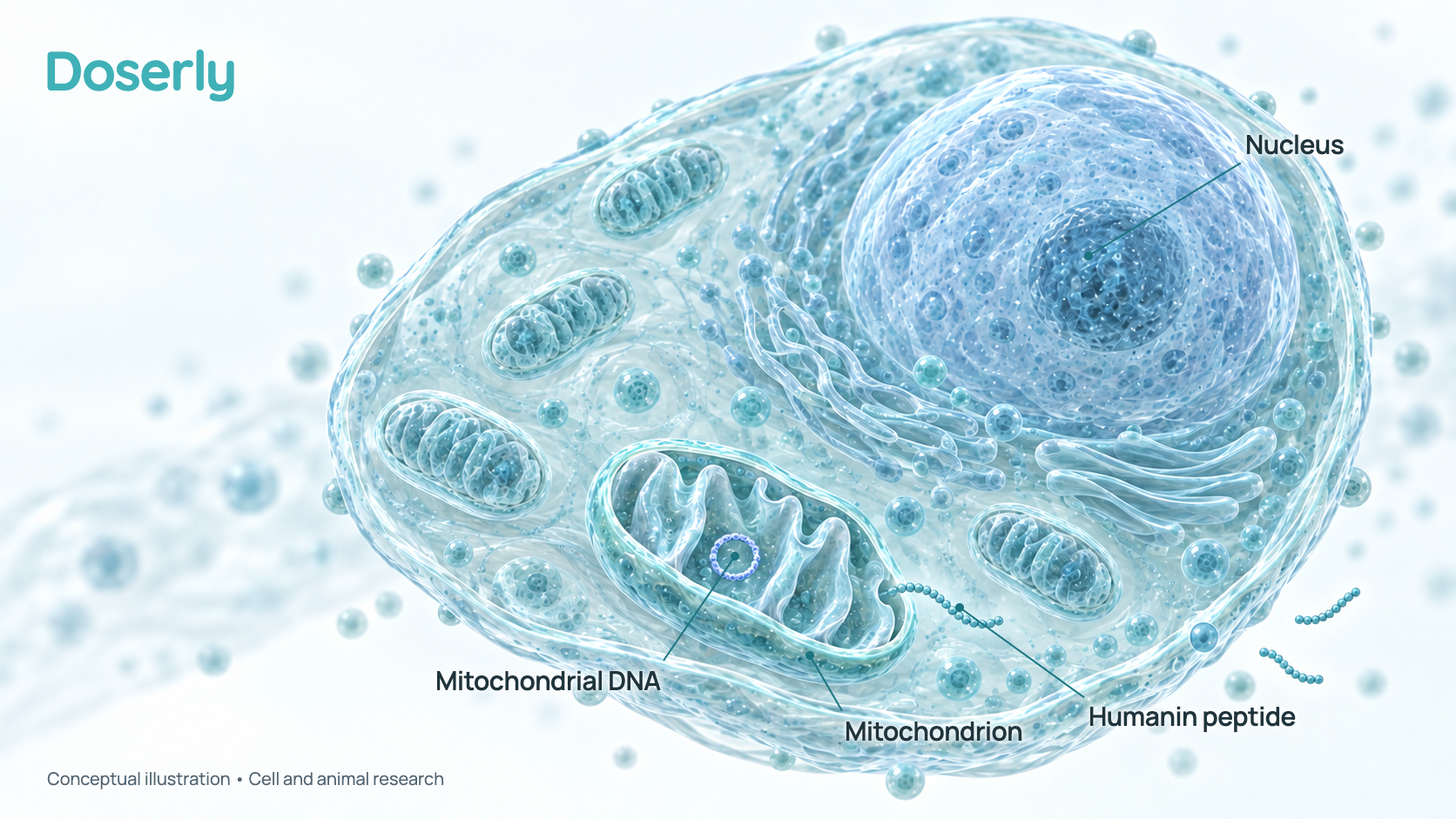
Humanin is a small peptide, a chain of 24 amino acids, that the human body makes from a gene in its mitochondria, the tiny structures that produce most of a cell's energy. In cell and animal studies it helps stressed cells avoid a built-in self-destruct program called apoptosis. People buy lab-made humanin hoping for healthier aging, energy and brain protection. It is not approved as a medicine anywhere, and no study has ever given it to people. [1], [2], [3]
Researchers first described it in 2001 after finding its gene in brain tissue from a person with Alzheimer disease, in a search for anything that could stop nerve cells dying from Alzheimer-related damage. Two other teams found it separately in 2003, one because it grabbed a cell-death protein called BAX and one because it bound a growth-factor partner called IGFBP-3. [4], [5], [6]
Its gene sits inside a larger mitochondrial gene called MT-RNR2, which makes part of the mitochondria's protein-building machinery. That made humanin the first known mitochondrial-derived peptide, a family that now includes MOTS-c and several “small humanin-like peptides”. There are also 13 humanin-like genes in the cell's main DNA, which make similar but not identical peptides. [1], [7], [8]
Humanin and HNG are different molecules. HNG (also written S14G-humanin or “humanin-G”) is a lab-made analogue in which the 14th amino acid, serine, is replaced by glycine. That single swap made it hundreds to about a thousand times more potent in some cell tests. Most of the animal research quoted on websites used HNG, and products and dosing pages often mix the two up. [9], [10], [11]
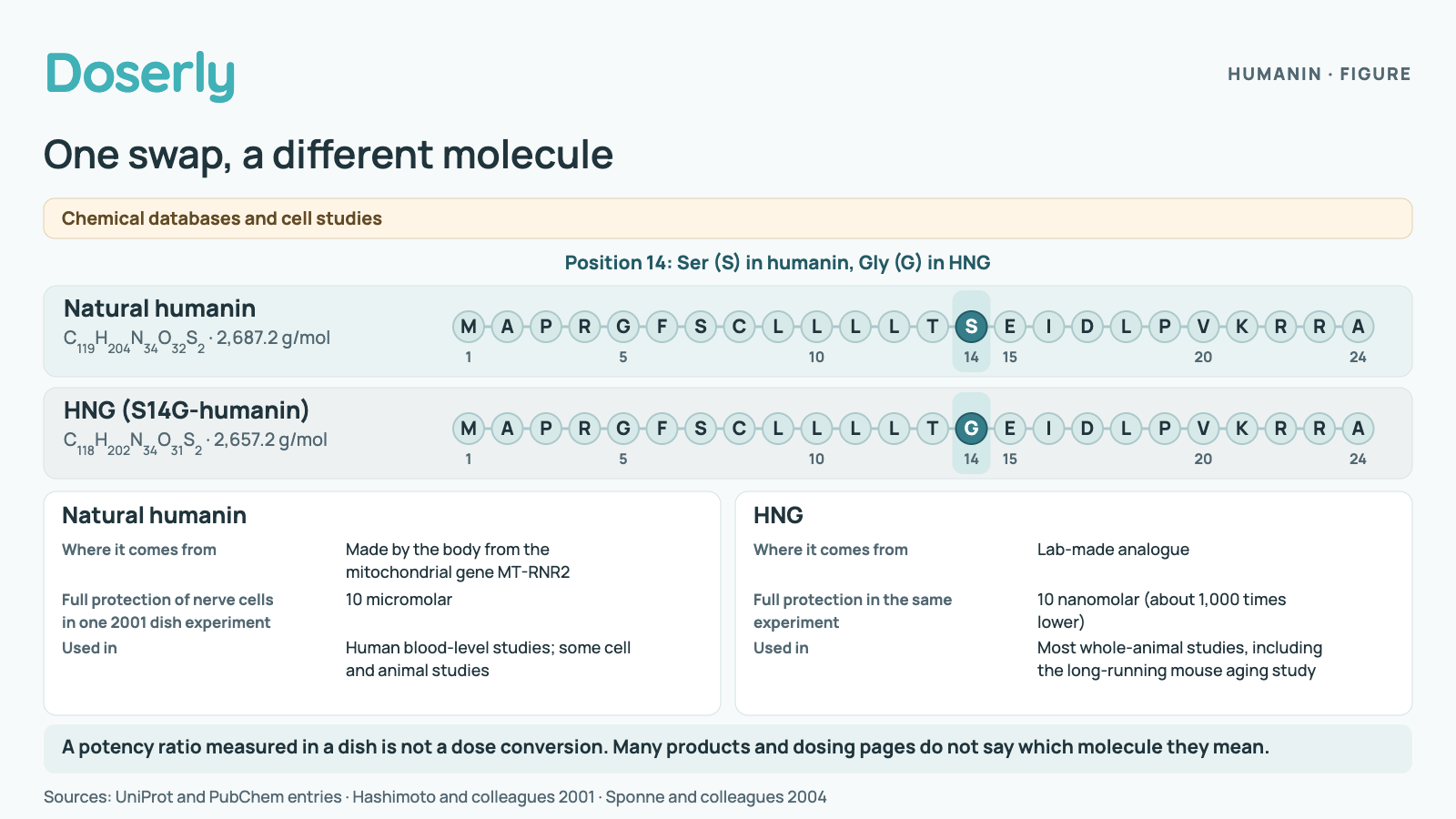
One swap, a different molecule
Chemical databases and cell studies
Natural humanin
C119H204N34O32S2 · 2,687.2 g/mol
HNG (S14G-humanin)
C118H202N34O31S2 · 2,657.2 g/mol
Position 14: Ser (S) in humanin, Gly (G) in HNG
Natural humanin
- Where it comes from
- Made by the body from the mitochondrial gene MT-RNR2
- Full protection of nerve cells in one 2001 dish experiment
- 10 micromolar
- Used in
- Human blood-level studies; some cell and animal studies
HNG
- Where it comes from
- Lab-made analogue
- Full protection in the same experiment
- 10 nanomolar (about 1,000 times lower)
- Used in
- Most whole-animal studies, including the long-running mouse aging study
A potency ratio measured in a dish is not a dose conversion. Many products and dosing pages do not say which molecule they mean.
Humanin is sold as a freeze-dried powder, usually in 5 or 10 mg vials labelled “for research use only”, to be mixed with water and injected. The natural peptide weighs 2,687 g/mol (formula C119H204N34O32S2); HNG weighs 2,657 g/mol. Many products do not say which of the two is inside. [12], [9], [13], [14], [15]
Typical Humanin Protocols
| Example | Amount each time | Frequency | Total per day | Weekly total | Duration |
|---|---|---|---|---|---|
| Low | 500 mcg | Once daily | 500 mcg | 3.5 mg | 20–30 days Its source also lists 1 mg once daily as a separate option [16] |
| Mid | 1–3 mg | 2–3 times a week | 1–3 mg on injection days | 2–9 mg | 4–8 weeks, then a break Kept separate from its source's HNG amounts, which are far lower [17] |
| High | 5 mg | 3 times a week | 5 mg on injection days | 15 mg | 10 weeks, then 5 weeks off The “aggressive” level of its source, which says its amounts are extrapolated from HNG animal and cell studies [18], [19] |
The most common protocol in the reviewed sources is about 1 mg per subcutaneous injection, given anywhere from once a day to two or three times a week, for 4–12 weeks, followed by a break. Among the pages that give a single amount for natural humanin, the middle value is 1 mg, and most ranges start at 1 mg and top out at 3–5 mg. Daily injections are more common than two or three a week, by about 17 publishers to 10. [18], [17], [13], [20], [21], [22]
- Titration Changing the amount in steps
- Most pages keep one amount for the whole course. A few start lower: one gives 1 mg every other day for two weeks, then 1 mg three times a week; another steps from 500 mcg to 1 mg to 2 mg a day over four weeks. One clinic page suggests raising the amount only after 6–8 weeks with no effect. [19], [22], [23]
- Breaks and cycles
- Pages describe 4–12 weeks of use, then a break of about 4–8 weeks: for example 10 weeks on and 5 off, or 12 weeks on and 4–8 off. Others describe running it continuously. No study has tested either approach. [18], [21], [23], [24]
- Timing
- Most pages give no reason to prefer a time of day; the ones that do usually say morning. In community education groups, one member moved the dose to the morning after waking at night with evening doses. See timing. [16]
Read the units: mcg means micrograms; 1 mg equals 1,000 mcg. The dose is the amount each time, the daily total is everything injected in one day, and the weekly total is everything in a week: 500 mcg every day adds up to 3.5 mg a week, while 5 mg three times a week adds up to 15 mg. These amounts are for natural humanin; pages give HNG amounts that are up to 1,000 times smaller, so the two can never share a row. [16], [18], [20]
Each row is a complete schedule from one source, so its amount and duration belong together. Low, mid and high are alternatives, not steps to move through. These schedules come from protocol websites rather than clinical trials, and several of those pages say they extrapolated their amounts from mouse studies of HNG; the cited references give the full details. [18], [25]
Before relying on any row: no amount of humanin has been tested for safety in people. In mice with an aggressive breast cancer, natural humanin made tumors grow faster and respond less to chemotherapy, so anyone with cancer, a history of cancer or a pre-cancer diagnosis has the strongest reason to stay away from it. Humanin analogues lowered blood sugar in rats, which matters for anyone taking metformin, insulin or other diabetes medicines; do not stop or change a prescribed medicine to make room for it. Products are unregulated: one tested vial labelled 10 mg held 8.22 mg, and a wrong amount in the vial or the syringe changes every dose, so check the math with the reconstitution calculator. Two serious illnesses after injections that included humanin have been reported; neither was shown to be caused by it, but both show how badly unregulated injections can go. It has not been studied in pregnancy, breastfeeding or anyone under 18, and anti-doping rules ban it at all times. See the full risks. [3], [26], [27], [15], [28], [29], [2], [30]
What amounts do websites give for HNG?
| Website schedule | Amount each time | Frequency | Total per day | Weekly total | Duration |
|---|---|---|---|---|---|
| Microgram range | 5–10 mcg | Once daily | 5–10 mcg | 35–70 mcg | Not stated Listed as the “standard” HNG level, with 1–5 mcg to start [20] |
| Low milligram range | 100–500 mcg | 2–3 times a week | 100–500 mcg on injection days | 0.2–1.5 mg | 4–8 weeks, then a break The same page gives 1–3 mg for natural humanin [17] |
| Milligram range | 500 mcg for a week, then 1–2 mg | Once daily | 0.5–2 mg | 3.5–14 mg | 8–12 weeks, then 4–8 weeks off Presented as an HNG protocol [31] |
These HNG amounts differ from each other by up to 1,000 times (5 mcg to 5 mg), and the top of the range is as large as the natural-humanin amounts above, even though HNG is the more potent molecule in cell tests. Community education groups contain only one HNG schedule, 300 mcg every morning for 4–8 weeks and then 4 weeks off, with no source and nobody reporting having used it. Why the HNG numbers disagree. [20], [17], [31], [32]
In community education groups, the amounts members actually inject cluster at 1 mg, taken daily for months, five days on and two off for about 8 weeks, or in 10-day blocks rotated with MOTS-c and SS-31; one member used 500 mcg a day for 15 days. Educators disagree by about 20 times: one course teaches 500 mcg three times a week for 8–12 weeks, another in the same group teaches 2–5 mg two or three times a week, and a third teaches 250 mcg to 1 mg five to seven times a week for no more than 4 weeks, then 4–8 weeks off.
Where protocols differ: HNG, amounts, frequency, breaks and stacks ↓
Where these numbers come from
The low row comes from Peptides.ID (reference [16]), which lists a “Standard Research” amount of 500 mcg once daily by subcutaneous injection with a cycle length of 20–30 days, and a separate 1 mg daily row. The mid row comes from Longeva (reference [17]), whose table gives “Native humanin (SC) 1–3 mg, 2–3x per week” and “Cycle length 4–8 weeks, then off”, with HNG listed separately at 100–500 mcg. The high row is the “Aggressive” level of Peptide Schedule's tier table (references [18], [19]): 5 mg three times a week, within its stated cycle of 10 weeks on and 5 weeks off. That page labels all its amounts as “extrapolated from humanin analog (HNG) animal and in vitro studies”.
The recurring 1 mg pattern is cross-checked by Peptide Tables (1–4 mg two or three times a week), PeptideWiki (1 mg once daily to start), PeakedLabs (1–3 mg two or three times a week for 8–12 weeks) and OptimalDosages (500 mcg to 2 mg daily) (references [13], [20], [21], [22]). We compared 32 public dosing pages from about 26 independent publishers; one per publisher, the middle single amount for natural humanin is 1 mg (five publishers: 0.5, 1, 1, 2 and 2 mg). Many pages copy each other or do not say whether they mean humanin or HNG, so these are not 26 independent opinions.
Excluded from the typical comparison: pages that mix humanin and HNG amounts in one range; blends and stack schedules (covered under stacks below); a nasal amount (covered under other routes); a 2–10 mg a day range that its own page treats as an unverified provider claim; animal doses in mg per kg, which cannot be converted to a human dose; Doserly's own earlier guide; and one page we could not open ourselves. [33], [34], [35]
What is humanin commonly used for?
People usually look into humanin for healthier aging and longevity, for energy, and to protect the brain and memory. Websites also link it to blood sugar and heart health, and animal research adds eyesight and fertility. Most often it is taken as one part of a “mitochondrial stack” with MOTS-c and SS-31. [36], [37], [24]
The subsections below describe that interest and the evidence behind it. They do not establish that humanin treats or prevents any condition, and no study has tested any of these uses in people.
Longevity and healthy aging
This is the biggest reason people try it. The idea comes from two findings. Adult children of people who lived to 100 had higher humanin in their blood than people of the same age without that family history (18 people compared with 19). In rats and mice, humanin levels in the blood fell with age. [2], [27], [38]
What people often miss is the main mouse experiment. Female mice given HNG twice a week from late middle age for 14 months had less body fat and, in related reports from the same group of mice, better memory tests and less scarring of the heart. But they did not live longer. The authors wrote plainly that HNG “did not increase lifespan”. How humanin might work. [2], [39], [40]
Energy and “mitochondrial support”
Because humanin comes from mitochondria, it is sold as an energy peptide. No study has measured energy or fatigue in people taking it. In community education groups and public forums, people who describe more energy were almost always also taking SS-31 and MOTS-c, and several heavy users say humanin on its own did nothing noticeable. What people report. [41], [42]
Brain health and memory
Humanin was discovered as an Alzheimer “rescue factor” in nerve cells grown in a dish, and HNG or related analogues protected the brain in many mouse and rat models of Alzheimer disease, stroke and injury, usually injected directly into the brain or given through the nose. In people, blood humanin did not tell Alzheimer disease apart from milder memory problems in a 2025 study, and no study has tested humanin for memory in anyone. [4], [43], [44], [45]
Blood sugar and metabolism
In rats, humanin given into the brain improved how well the body responded to insulin, and a more potent analogue cut blood sugar in diabetic rats by nearly half within hours. In people, humanin levels tend to be lower in type 2 diabetes and in raised fasting blood sugar, which is an association, not evidence that adding more helps. Blood sugar is also a safety question. [27], [46], [47]
Heart, eyes, fertility and other uses
Animal studies report less heart damage after a blocked artery, protection of eye cells in models of macular degeneration, and protection of eggs and sperm-making cells during chemotherapy, mostly with HNG. Each of these is a lab or animal finding. In one large-animal test, HNG shrank heart damage in pigs after 60 minutes without blood flow, but the benefit vanished when the blockage lasted 75 minutes. [48], [49], [50], [51]
Where do humanin protocols differ?
Humanin protocols disagree more than most, because nobody has a human dose to anchor them. The biggest questions are which molecule a page means, how much, how often and for how long.
Is the dose for humanin or HNG?
Check this first. HNG protected nerve cells in a dish at about 1,000 times lower concentration than natural humanin in one 2001 experiment (10 nanomolar versus 10 micromolar), and about 500 times lower in a 2004 prion-model study. Websites turn this into dose advice in opposite ways: some give HNG at 5–10 mcg, others at 0.5–5 mg, the same as natural humanin. A concentration ratio in a dish says nothing reliable about how much of either to inject. [11], [10], [20], [32], [31]
It is often unclear which one a vial contains. One dosing page warns that “most vendors sell HNG”; a member of a community education group who checked supplier paperwork concluded the opposite, that the 10 mg vials sold as humanin are the natural peptide. Health Canada has seized a product labelled “Humanin HNG”. [19], [52]
How much per injection?
Most amounts for humanin (natural, or not specified) on websites run from 100 mcg to 5 mg per injection, with one outlier of up to 10 mg a day. The low end appears on a few clinic and vendor pages (100–500 mcg, or 200–300 mcg a day), the middle at 1–2 mg and the top at 3–5 mg. [53], [54], [20], [36], [33]
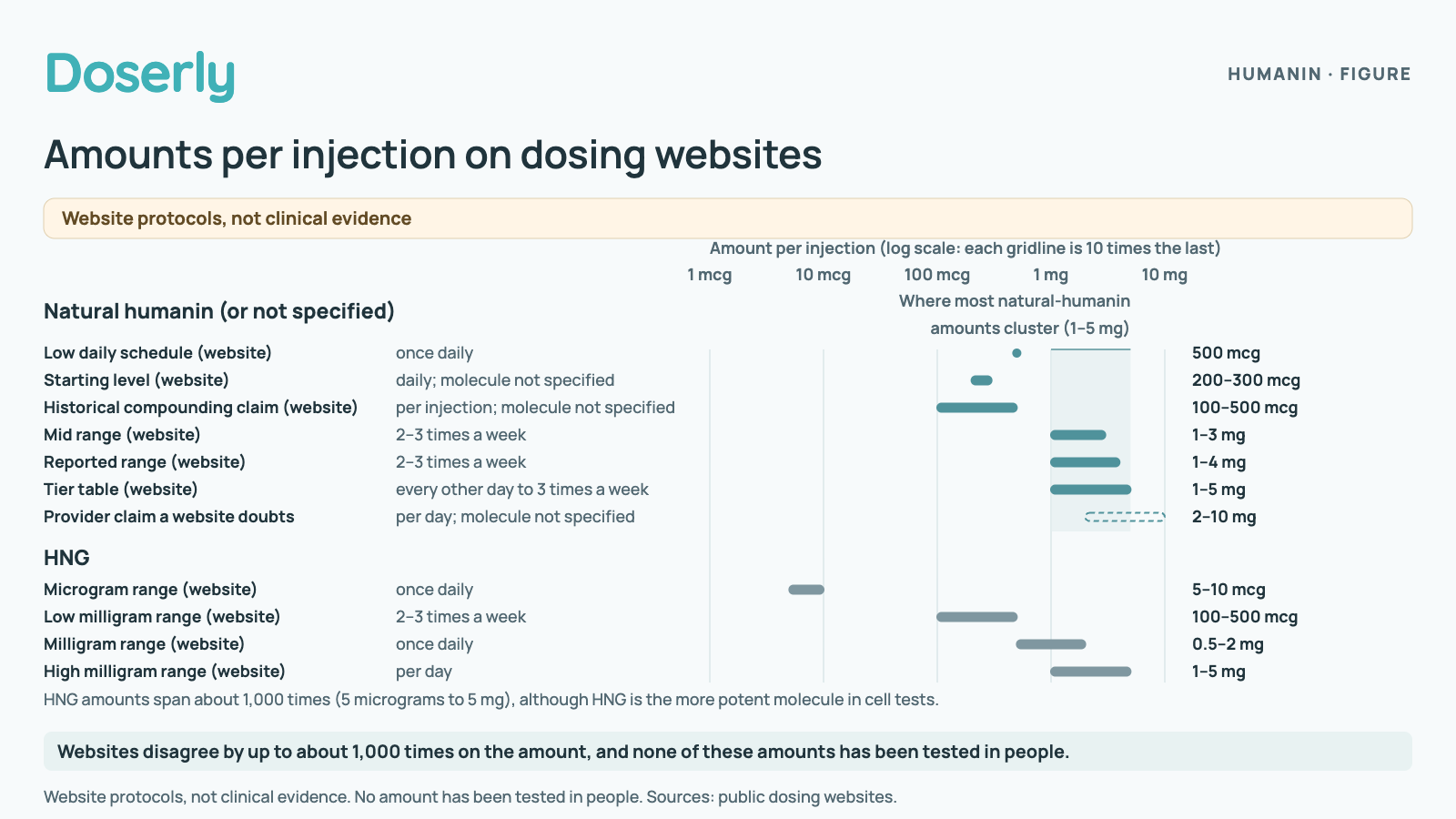
Amounts per injection on dosing websites
Website protocols, not clinical evidence
Amount per injection (log scale: each gridline is 10 times the last)
Natural humanin (or not specified)
1 mcg10 mcg100 mcg1 mg10 mg
Shaded: where most natural-humanin amounts cluster (1–5 mg)
- Low daily schedule (website)
- 500 mcg · once daily
- Starting level (website)
- 200–300 mcg · daily; molecule not specified
- Historical compounding claim (website)
- 100–500 mcg · per injection; molecule not specified
- Mid range (website)
- 1–3 mg · 2–3 times a week
- Reported range (website)
- 1–4 mg · 2–3 times a week
- Tier table (website)
- 1–5 mg · every other day to 3 times a week
- Provider claim a website doubts
- 2–10 mg · per day; molecule not specified
HNG
1 mcg10 mcg100 mcg1 mg10 mg
- Microgram range (website)
- 5–10 mcg · once daily
- Low milligram range (website)
- 100–500 mcg · 2–3 times a week
- Milligram range (website)
- 0.5–2 mg · once daily
- High milligram range (website)
- 1–5 mg · per day
HNG amounts span about 1,000 times (5 micrograms to 5 mg), although HNG is the more potent molecule in cell tests.
Websites disagree by up to about 1,000 times on the amount, and none of these amounts has been tested in people.
Where do the numbers come from? Several pages say theirs were “extrapolated” from HNG studies in mice and cells, and several cite the long-running mouse study, which used 4 mg per kilogram of body weight injected into the belly cavity (intraperitoneal). Animal doses per kilogram cannot be converted into a safe human amount. One page presents a mouse study as “clinical research”, and another claims human tolerability data that do not exist. [18], [25], [2], [34], [21]
Every day or a few times a week?
About 17 publishers describe daily injections and about 10 describe two or three a week; a few give every other day or both options. The only published timing data come from rodents, where HNG cleared from the blood of mice within hours, which some pages use to argue for daily injections. No study has compared schedules. [20], [17], [18], [55]
In community education groups, members' actual practice leans toward daily or five-days-on, two-off injections, while educators' schedules run from twice a week to every day.
How long, and what about breaks?
Course lengths on websites include 10–15 days repeated a few times a year, 20–30 days, 4–8 weeks, 8–12 weeks and 10 weeks, followed by breaks of 4–8 weeks; some describe continuous use. [56], [16], [17], [21], [18], [37]
Community education groups disagree in the same way. One course caps a cycle at 4 weeks on, then 4–8 weeks off, citing limited human data; another says there is no established cycling and treats humanin as a continuous longevity baseline. Members run anything from 15 days to several months without a break.
Morning or evening?
No study has compared timing. The few pages that mention it suggest the morning or consistent daily timing; one clinic page adds that some practitioners give bedtime doses for memory goals, and calls the reasoning for any timing theoretical. In community education groups, one member who injected in the evening woke repeatedly at night in the first days and settled after moving the dose to the morning, while one member planned evening doses. [16], [23]
Other routes: nasal sprays and pills
One website gives 1–3 mg of natural humanin through the nose (intranasal) and says absorption this way is poorly understood. In mice, natural humanin given into the nose was detected in the brain, and HNG given the same way improved memory measures in an Alzheimer model. No study has tested humanin taken by mouth. [20], [57], [43]
What about stacks and blends?
Humanin is rarely used alone. The most common partners are MOTS-c and SS-31, then NAD+, Epitalon, GHK-Cu and 5-Amino-1MQ. Stack pages give each compound its own amount, for example humanin 2–4 mg a day alongside MOTS-c 5–10 mg three times a week and SS-31 0.25–1 mg a day, or humanin 1–2 mg three times a week in a five-compound “longevity stack”. [58], [24], [59]
In community education groups, members describe pre-mixed vials of MOTS-c and humanin at 5 mg each, and replies doubted that humanin stays stable in a blend; no one has tested it. A blend's total weight is not its humanin amount. A common sequence in those groups is a course of FOXO4-DRI, then SS-31, then humanin and MOTS-c. Humanin blocks cell death and FOXO4-DRI is sold to trigger it in old cells, so members ask whether the two cancel out; there are no data either way.
No combination has been studied in people. The two 2026 papers titled “humanin and MOTS-c” tested each peptide in separate groups of mice or cells, not together. [60], [61]
How do milligrams convert to syringe units?
Pages often give amounts as units on a U-100 insulin syringe, which holds 100 units per millilitre. Units measure volume, so how much humanin each unit holds depends on how much water went into the vial.
For example, a 10 mg vial mixed with 2 mL of water holds 5 mg per mL. Then 500 mcg is 0.1 mL (10 units), 1 mg is 0.2 mL (20 units), and 5 mg is 1 mL (100 units), a full 1 mL syringe. The same amount in units changes completely if the vial holds 5 mg instead of 10 mg, or if a product contains less peptide than its label says. Doserly's reconstitution calculator works out units for any vial and shows each step. [13], [22], [15]
Source-by-source comparison
Natural humanin by subcutaneous injection
Unit key: 1 milligram (mg) = 1,000 micrograms (mcg).
Peptide Schedule gives three levels, 1 mg every other day, 3 mg three times a week and 5 mg three times a week, in cycles of 10 weeks on and 5 weeks off, and a goal protocol of 1 mg every other day for two weeks, then 1 mg three times a week. Peptide Tables gives 1–4 mg two or three times a week, with a 2 mg example. Longeva gives 1–3 mg two or three times a week for 4–8 weeks. PeakedLabs gives 1–3 mg two or three times a week for 8–12 weeks, then 4–6 weeks off, and also 0.5–1 mg daily. PeptideWiki starts at 1 mg once daily for 1–2 weeks, then 2–3 mg daily, with 5 mg as a higher level. Peptides.ID gives 500 mcg once daily for 20–30 days. OptimalDosages steps from 500 mcg to 1 mg to 2 mg a day over four weeks. [18], [19], [13], [17], [21], [20], [16], [22]
Pages that do not separate humanin from HNG
Professor Peptides and The Peptide Toolkit give 1–5 mg daily or several times a week. PepGuide gives 1–5 mg two or three times a week for 8–12 weeks. Peptides Institute gives 1–4 mg one to three times a week for 4–12 weeks. TrimRX gives 250 mcg to 1 mg daily and, separately, 2–5 mg two or three times a week. Peptisciences gives 200–300 mcg daily for 4–6 weeks as a starting level. Peptide Protocols gives 500 mcg to 1 mg once or twice daily for 10–15 days, plus a 25–50 mcg daily low dose it describes as anecdotal. PepperCalc gives 0.5 mg twice a week for four weeks, then 1–2 mg two or three times a week. Peptide Dosing Protocols describes about 1 mg three times a week. PeptideWiki.pro gives 1–5 mg a day or 1 mg three times a week. A Spanish-language page gives 100 mcg every morning. HealthRX describes 100–500 mcg per injection as historical compounding practice. PeptideJournal reports 2–10 mg a day as a provider claim it treats skeptically. [36], [62], [63], [64], [23], [54], [56], [65], [25], [66], [67], [53], [33]
HNG
PeptideWiki gives 5–10 mcg a day (1–5 mcg to start, 10–20 mcg higher). Longeva gives 100–500 mcg two or three times a week. The Peptide Catalog gives 500 mcg daily for a week, then 1–2 mg daily for 8–12 weeks. GLPbase gives 1–5 mg a day and Peptides Guide 1–4 mg a day for 4–8 weeks, then 4 weeks off. Peptide Protocol Wiki lists only mouse doses and does not convert them. [20], [17], [31], [32], [68], [34]
Errors we found
Pages present a 30-minute half-life as if it were measured in people; it comes from mice given HNG. One page claims human tolerability data from an early trial; no such trial exists. Several describe natural humanin as 21 amino acids without explaining that 21 is only a predicted form. One page lists a mouse Alzheimer study as “clinical research”, and one advertises 21–30 days of fridge storage after mixing, which no stability data support. [36], [25], [21], [34], [18]
What happens when you stop humanin?
Nobody knows. No study in people or animals has looked at what happens after humanin is stopped, and there are no reports of withdrawal effects or a rebound.
- Blood levels. In rodents, blood levels of injected HNG halved in about 30 minutes in mice and in more than 4 hours in rats, where some was still measurable a day later. How long any effect lasts after the last dose has not been measured. Whether injections change how much humanin the body makes for itself has not been studied. [55]
- Cancer cells in the lab. In tumor cells taken from people with a brain cancer (glioblastoma) and grown in the lab, repeated humanin or HNG made some samples grow faster, and that growth boost “returned to control levels” after the peptide was withdrawn. [69]
- Personal accounts. One person on a longevity forum reported swollen bags under the eyes the morning after a single injection of a product sold as humanin, given at the same time as Epitalon. Two months after stopping they had not gone, and more than a year later they were “somewhat reduced, but not gone away”. [70], [71]
In community education groups, the only member who gave a detailed account said their loose stools lasted the whole course and were slow to settle afterwards. Several members expect no noticeable change on stopping, because they noticed none while taking it.
Does injected humanin behave like the humanin your body makes?
Nobody has measured this in people. There is no human pharmacokinetic study, so the bioavailability of a subcutaneous injection (how much reaches the blood) and how long it stays there are unknown. The only data come from one 2013 study in rodents, which used HNG and a related analogue called HNGF6A, not natural humanin, and injected them into the belly cavity. [55]
In that study, the injected peptide showed up in the blood and the liver of rats but was undetectable in the brain and heart. HNG also lowered the growth-related hormone IGF-1 in mice by 23% after a single dose. Whether a subcutaneous injection of natural humanin in a person does any of this is unknown. [55]
There is a second complication. The body makes humanin inside cells, where some of it works on the cell's own mitochondria, and it also releases humanin into the blood. An injection only adds to the blood, and blood tests for humanin cannot reliably tell natural humanin apart from its relatives. [5], [72]
How long does humanin last in the body?
Nobody knows how long it lasts in people. In mice, HNG injected into the belly cavity had a half-life of “approximately 30 minutes”; in rats it was “greater than 4 hours”, and HNGF6A lasted longer than HNG. The “30-minute half-life” printed on dosing pages is the mouse HNG figure presented as if it were human. [55], [36], [25]
Does the form matter: natural, HNG, 21 or 24 amino acids?
Yes, in three ways:
- Natural humanin or HNG. They are different molecules with different potency in cell tests, and a product label may not say which it is. [10], [11]
- 21 or 24 amino acids. Mitochondria read their genes with a slightly different genetic code. Read that way, the humanin gene would give a 21-amino-acid peptide; read by the machinery in the main body of the cell, it gives 24. Which form circulates in people is still unresolved. The peptides sold and studied are the 24-amino-acid version, so pages calling it “21 amino acids” are describing a predicted form. [1], [73]
- Salt form. Laboratory humanin is often sold as a trifluoroacetate (TFA) salt, left over from how peptides are purified, so the weight of powder in a vial is not all peptide. [74], [9]
How should humanin be stored, and how long does it last?
There is no approved product label and no stability study of humanin mixed for injection. What exists are statements from suppliers of laboratory-grade peptide, which say their products are not for human use, plus two chemistry studies:
- Powder, before mixing. Laboratory suppliers say to keep the freeze-dried (lyophilized) powder frozen at about −20 °C (−4 °F), where they give shelf lives of 3 years to at least 4 years. One supplier allows 0–5 °C (32–41 °F) for up to 6 months. [74], [75], [76]
- After mixing (reconstitution). The only supplier figure for dissolved humanin comes from one maker of a research humanin peptide, which dissolves it first in a laboratory solvent: up to 5 days in the fridge at 4 °C (39 °F), or up to 3 months frozen at −20 °C. Other suppliers give times only for laboratory stock solutions kept at −80 °C or −20 °C, which do not apply to a vial kept in a fridge. [76], [75], [77]
- What the chemistry shows. HNG dissolved in plain lab water broke down fast: only 11% was still intact after 28 days at 4 °C, as the peptide oxidized and paired up into dimers. Natural humanin clumps into fibers (aggregation) in slightly alkaline conditions and in common phosphate or Tris buffers. [78], [79]
- Protocol websites say to refrigerate after mixing and use it within 4 weeks, or within 21–30 days. None cites a stability test, and the supplier and chemistry data above point to a much shorter window. [13], [18]
Mixing problems are common enough to show up online: one person described a humanin vial that turned “mad foamy” after adding water and would not settle. Careful storage cannot tell you what is in a vial or whether it was made correctly (see product quality). [14]
What do we actually know about humanin in people?
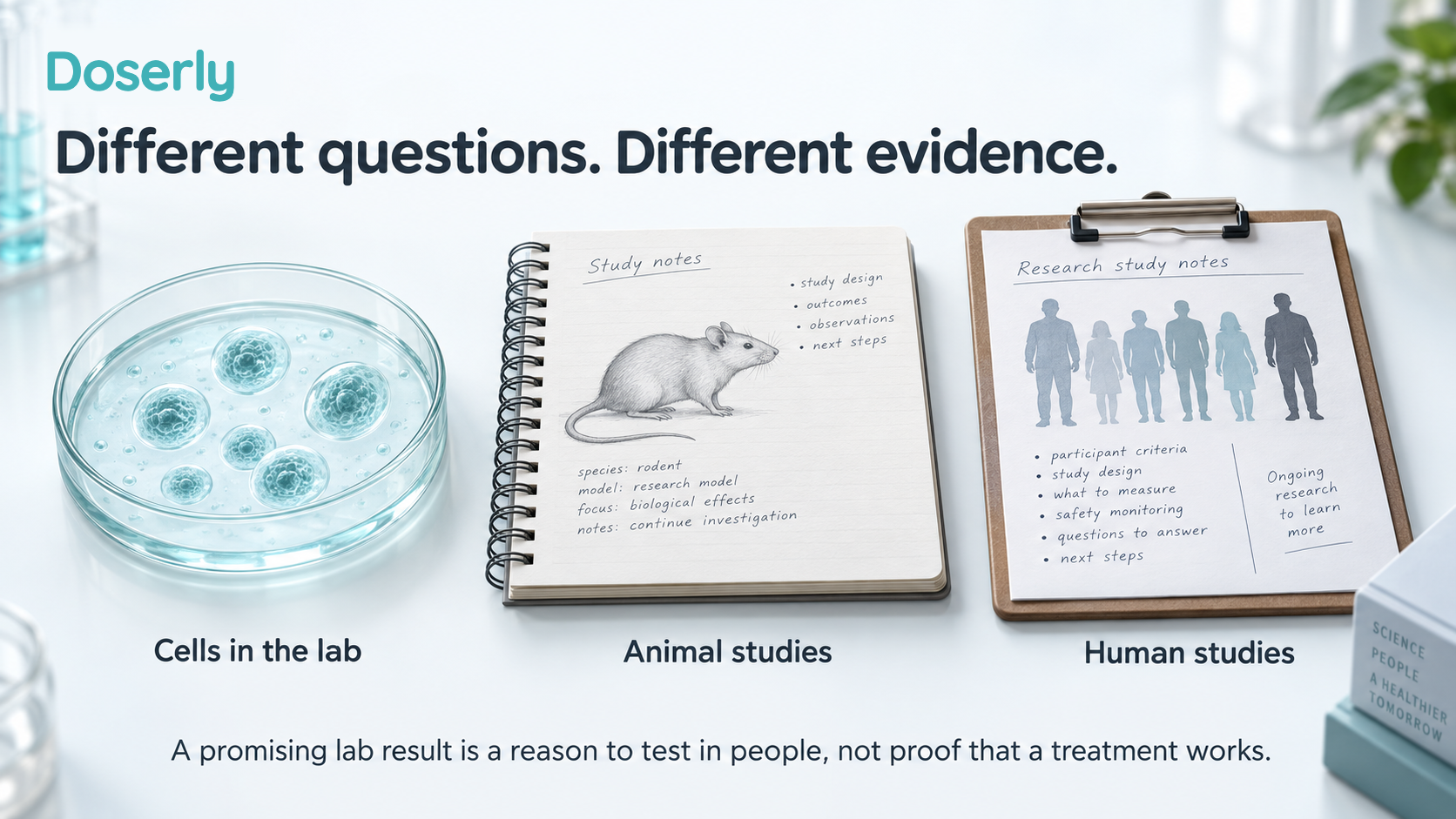
No one has ever been given humanin or any of its analogues in a published or registered study. Every human study measures the humanin people already make, in blood, muscle or other fluids, and looks for links with age, disease or exercise. [3], [2]
Has anyone tested humanin as a treatment?
No. ClinicalTrials.gov lists seven studies that mention humanin, and none gives it to anyone: they measure humanin levels around heart surgery, kidney injury, fertility treatment, cerebral palsy, anesthesia and exercise. The one company that took a humanin-family peptide into people, CohBar, tested CB4211, which is based on MOTS-c, not humanin. [3], [80], [81], [82], [83]
What do blood-level studies show?
These are observational studies: they compare people's own levels and cannot show cause and effect.
| Topic | People studied | What was found | What it cannot tell you |
|---|---|---|---|
| Family longevity | 18 adult children of people who lived past 100, and 19 people of similar age | Higher humanin in the centenarians' children | Whether higher levels cause longer life; centenarians themselves were not the group measured [2] |
| Heart | 40 people having coronary tests | Lower humanin (1.3 versus 2.2 ng/mL) when the lining of the heart's arteries worked poorly | Whether low humanin causes artery problems [84] |
| Blood sugar | 23 people with raised fasting blood sugar and 58 without; separately, 225 people including 124 with type 2 diabetes | Lower in both groups with raised sugar. The first study's summary swaps its own numbers; its data table shows 124.3 versus 204.8 pg/mL | Whether low levels come before or after the sugar problem [47], [46] |
| Growth hormone | 11 children with growth hormone deficiency | About 20% lower after 4 weeks of prescribed growth hormone | Effects in adults; two authors held shares in a humanin company although the paper declared no conflicts [38] |
| Exercise | Men with raised blood sugar after 12 weeks of weight training; 10 people per group after one endurance session | Muscle humanin rose 35% while blood levels did not change; blood levels rose after endurance exercise | Whether the rise matters for health [85], [86] |
| Pregnancy | 37 women with preeclampsia and 34 without; 84 with gestational diabetes and 73 without | Higher in preeclampsia (422 versus 319 pg/mL); lower in gestational diabetes | Whether humanin plays a role in either condition [87], [88] |
| Fertility | 179 women having IVF (fluid around the egg); 40 women with PCOS and 40 without (blood and muscle) | Higher fluid levels went with better odds of pregnancy; blood levels were lower in PCOS | Any effect of taking humanin on fertility [89], [90] |
| Lungs | 165 people with COPD and 49 without | Higher in COPD, and high levels went with a higher risk of flare-ups | Whether humanin helps or harms the lungs [91] |
| Cancer | 75 women with breast cancer and 70 without; a prostate study | Higher in breast cancer; the prostate study's results and discussion contradict each other | Whether tumors make humanin or respond to it [92], [93] |
| Other | Dialysis (94), children with septic shock (140), Alzheimer disease | No consistent direction: in dialysis, both very low and very high levels went with more deaths and heart events; in septic shock, a link with organ failure faded after adjustment; in Alzheimer disease, blood levels did not tell it apart from milder memory problems | Any treatment effect [94], [95], [45] |
Does humanin go up or down with age?
The evidence disagrees. Humanin fell with age in rats and mice, and two human studies, one from 2009 and a 2019 study of 225 people, found lower levels in older people. But a 2019 study found blood humanin higher in old age and highest in people over 100, and a 2021 study of 569 people found higher levels with age in healthy people. [27], [38], [46], [96], [97]
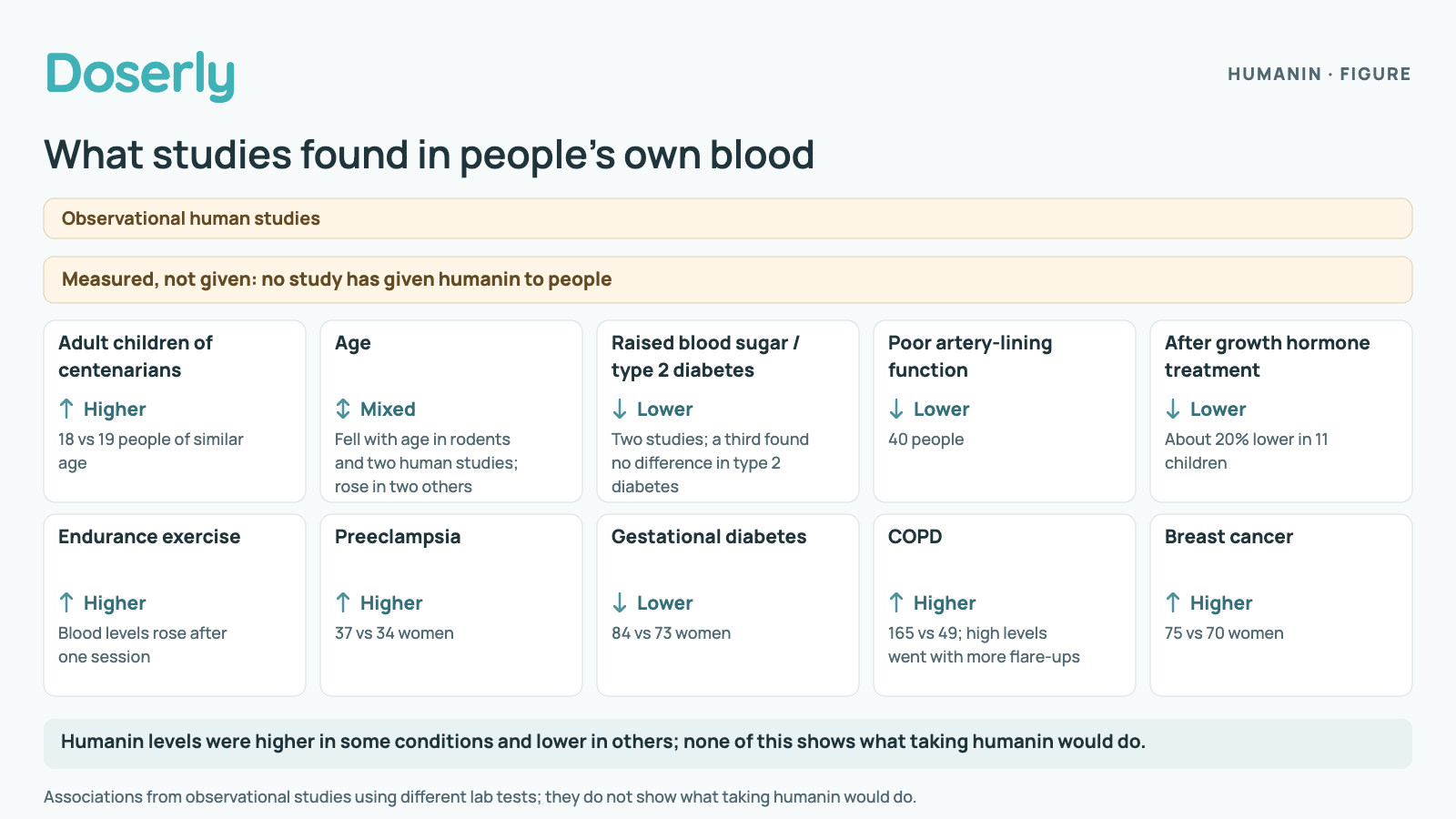
What studies found in people's own blood
Observational human studies
- Adult children of centenariansHigher18 vs 19 people of similar age
- AgeMixedFell with age in rodents and two human studies; rose in two others
- Raised blood sugar / type 2 diabetesLowerTwo studies; a third found no difference in type 2 diabetes
- Poor artery-lining functionLower40 people
- After growth hormone treatmentLowerAbout 20% lower in 11 children
- Endurance exerciseHigherBlood levels rose after one session
- PreeclampsiaHigher37 vs 34 women
- Gestational diabetesLower84 vs 73 women
- COPDHigher165 vs 49; high levels went with more flare-ups
- Breast cancerHigher75 vs 70 women
Humanin levels were higher in some conditions and lower in others; none of this shows what taking humanin would do.
Why do these numbers disagree?
Studies of the same condition can also disagree: unlike the two blood-sugar studies in the table, a 2021 study of 569 people found no difference in type 2 diabetes. [96]
Part of the reason is the lab tests (immunoassays). Published average levels range from about 124 pg/mL to about 2,200 pg/mL depending on the study, the test kit and the group, and researchers caution that the antibodies in these kits may also pick up the 13 humanin-like peptides. That is why there is no accepted “normal range” for humanin. [47], [84], [72], [7]
What do these measurements mean?
A level measured in the blood shows how much of the body's own humanin a test detected at one moment. It does not show that raising it would help. The same pattern can mean different things: higher levels in COPD flare-ups or cancer might reflect a body responding to stress rather than protection. The only way to know whether taking humanin helps anyone would be a controlled trial that gives it to people and compares them with a placebo group, and none has been done. [91], [92]
How might humanin work?
Everything in this section comes from cell studies and animal studies (preclinical research). Many experiments used HNG or other analogues rather than natural humanin, and no study has looked at how humanin works in people.
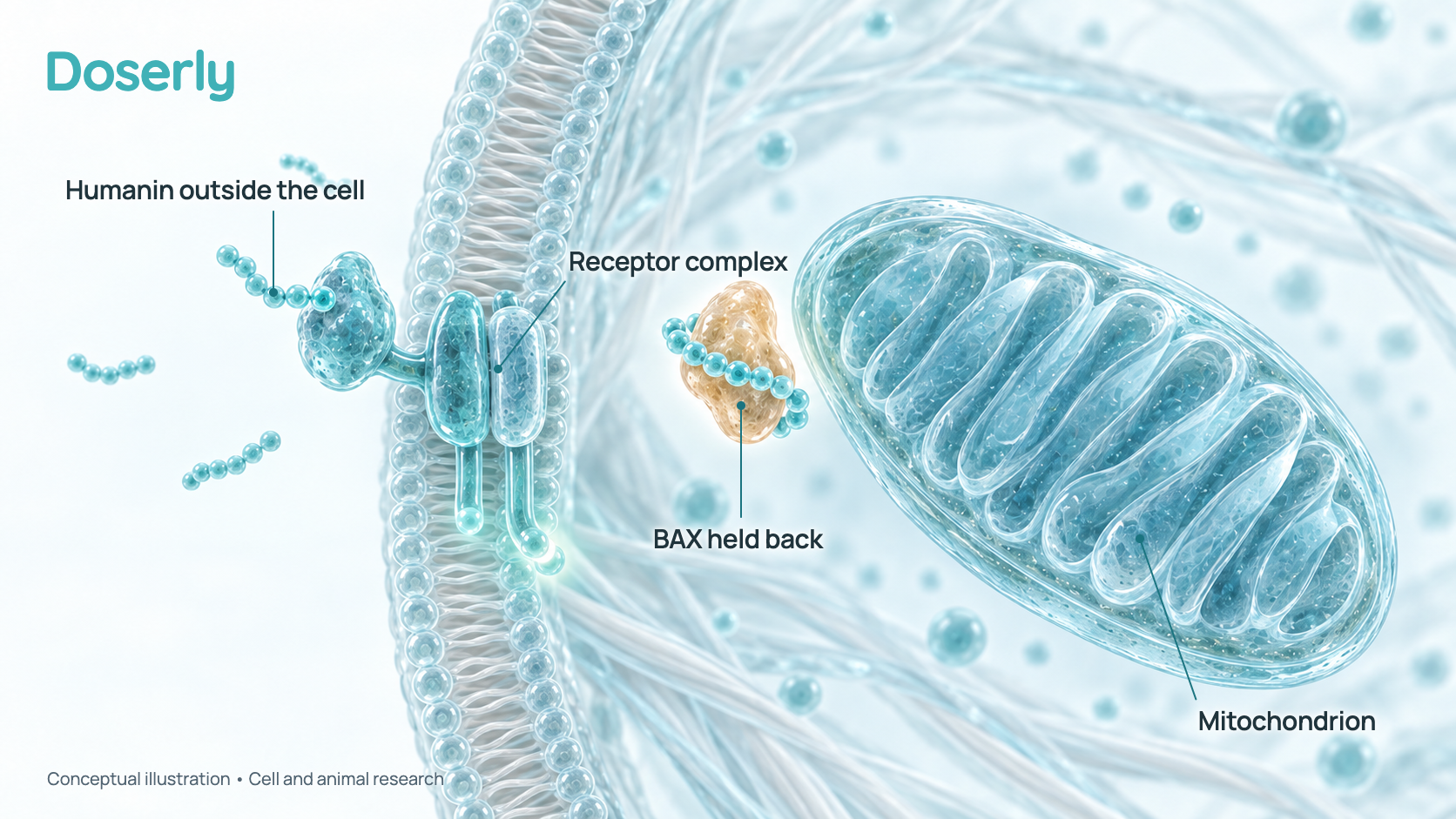
Blocking cell death from the inside
In 2003, researchers found that humanin binds BAX, a protein that normally moves to the mitochondria and punches holes in them to start apoptosis. Humanin kept BAX from moving, and later work showed it can also bind related cell-death proteins and lock BAX into inactive fibers in a test tube. [5], [98], [8]
Signals from outside the cell
Released humanin can also act on cells from the outside. It binds a three-part receptor on nerve cells (CNTFR, WSX-1 and gp130), which switches on a survival signal called STAT3, and it activates a second receptor, FPRL1 (also called FPR2). These findings come from cells in a dish. [99], [100], [101]
Growth hormone and IGF-1
Humanin binds IGFBP-3, a protein that carries the growth-related hormone IGF-1 in the blood. The two systems seem to push against each other: HNG lowered IGF-1 in mice, and in the other direction, growth hormone or IGF-1 lowered humanin in mice and in children treated with growth hormone. Mice engineered to make extra humanin were about 10% smaller, and their litters were 46.5% smaller. This matters for anyone also using growth hormone or peptides that raise it. [6], [55], [38], [2]
Insulin and blood sugar
In rats, humanin infused into the brain improved how well the body responded to insulin, through signals from the hypothalamus. Natural humanin injected into a vein at the tested dose did not, while the more potent analogue HNGF6A did, and a single dose of HNGF6A lowered blood sugar by nearly 50% in diabetic rats. Natural humanin also delayed diabetes in mice prone to it. [27], [102]
What did the aging studies in mice find?
- Lifespan: female mice given HNG at 4 mg per kg twice a week from 18 months old for 14 months did not live longer than untreated mice. [2]
- Health measures in the same mice: less weight gain and belly fat without eating less, lower IGF-1, better memory tests at 24 months, and less scarring in the heart. These come from one group of mice reported in three papers, not three separate experiments. [2], [39], [40]
- Worms: tiny roundworms engineered to make extra humanin lived slightly longer, about 19.0 days on average versus 17.7, and in a later study 27 days versus 24. [2], [103]
A 2023 review states that humanin extended lifespan in mice. The mouse study it relies on says it did not, so this guide follows the original study. [104], [2]
What are the risks and unanswered questions?
Is humanin safe?
Its safety in people is unknown. No one has been given humanin in a study, so there are no data on side effects, safe amounts, blood levels or immune reactions (immunogenicity). Animal studies used different molecules, routes and doses, and were not designed as safety studies. [3], [55]
Three concerns stand out: an unresolved cancer question from animal studies, a possible drop in blood sugar in people on diabetes medicines, and the quality of products sold for “research”.
What problems have actually been reported?
Adverse-event reports. FDA's adverse-event database (FAERS) holds one report that names humanin: a US physician reported in 2024 a botulism-like illness, with weakness, blurred vision, facial and wider paralysis and breathing failure needing hospital care. The report lists humanin at 5 mg by subcutaneous injection, used for about five days in late August 2024, and is marked life-threatening. It gives no toxin test, no product testing and no outcome, and FAERS reports cannot show that a product caused an illness. [28], [105]
A case in Nevada. At an anti-aging festival in Las Vegas in July 2025, a pharmacist injected a woman with humanin together with vitamin B-12 and two products labelled ACE-31 and CJC; she had a severe reaction, was intubated by paramedics and taken to hospital, and later recovered. The state pharmacy board fined those involved, but investigators could not test the injections and could not tell whether contamination or a reaction to the peptides explained the illness. [29], [106]
Neither case shows that humanin caused the illness. Health agencies have reported similar paralysis after injections of fake or mishandled botulinum toxin in the same period, and whether that explains either case cannot be assessed from the public records. Both do show that injecting unregulated products can go badly wrong. [107], [108]
Personal accounts. Public forum posts describe swollen bags under the eyes after one injection given with Epitalon, a self-described allergy, trouble sleeping after a small dose, and anxiety after accidentally injecting about 9.5 mg. In community education groups, one member taking humanin 1 mg five days a week alongside metformin, growth hormone and a MOTS-c blend described night waking with evening doses, loose stools for the whole course and repeated low blood sugar, down to 53 mg/dL after a workout; the lows stopped after they dropped the MOTS-c blend and then metformin. None of these was investigated, and most involved other compounds. [70], [109], [110], [111]
Could humanin help cancer cells survive?
This is the central open question. Humanin works by stopping cells from self-destructing, and destroying damaged cells is one of the body's defenses against cancer.
- Evidence of harm, in animals and cells. In mice with an aggressive (triple-negative) breast cancer, natural humanin injected every other day made tumors grow faster, spread more to the lungs and respond less to chemotherapy. In glioblastoma, a brain cancer, humanin made cancer cells harder to kill with chemotherapy and helped them invade in a mouse model; an analogue did the same with another chemotherapy drug, and humanin protected pituitary tumor cells from dying. [26], [69], [112], [113], [114]
- Evidence the other way, in animals. In other mouse cancer models, HNG protected healthy sperm-making cells and white blood cells from chemotherapy without weakening its effect on tumors, and it did not significantly speed up neuroblastoma tumors. [51], [115], [116]
- In people: breast cancer patients had higher humanin in their blood than women without cancer, and triple-negative breast tumor samples contained more humanin than healthy breast tissue. These are associations, not effects of taking it. [92], [26]
The result may depend on the molecule, the cancer and the dose, and none of it has been tested in people. In community education groups, a cancer caution is rare in lessons, and one member used humanin for eight weeks while dealing with a pre-cancer diagnosis, the kind of situation this concern is about.
Could product quality change the risk?
Yes. Humanin is sold as unregulated “research” powder, and no official quality standard exists. In one public lab test of a vial labelled 10 mg, purity was 98.5% but it held only 8.22 mg; sterility and bacterial toxins were not tested, and the public report does not say whether its identity check told humanin apart from HNG. [15]
People buying it describe vials that foam and difficulty finding any product that “tests well”. In community education groups, members also describe powder that looks like glitter instead of a solid cake, pool money for independent testing, and note that most sellers publish no test results. Health Canada has seized humanin products as unauthorized injectable drugs. [14], [117], [52], [118]
Is humanin legal? Is it FDA-approved?
Checked September 23, 2026. Rules differ by country and change quickly. A “research use only” label does not make a product legal to sell or safe to use.
United States. Humanin is not an FDA-approved drug or part of one, and there is no public sign that it has reached the investigational stage: no company has registered or published a human study of it. It has an FDA substance identifier, which is a naming code, not an approval. It is not on either of FDA's lists of bulk ingredients nominated for pharmacy compounding (the May 14, 2026 list for pharmacies and the March 2025 list for outsourcing facilities), was not among the peptides on the July 23–24, 2026 advisory-committee agenda, and is not on FDA's list of ingredients flagged for significant safety risks. Not being listed is not permission: pharmacies generally cannot compound with a bulk ingredient that is not on an approved list, part of an approved drug or covered by an official monograph. [119], [120], [121], [122], [123]
Canada. Humanin is not authorized. Health Canada named humanin products in two 2025 seizure notices: “Humanin HNG without Mannitol” (April 2025) and “Humanine” (August 2025). [52], [118]
Australia. Humanin is not a named entry in the June 2026 Poisons Standard, and we found no approval for it. The TGA warned in May 2026 about the risks of importing unapproved peptide products. [124], [125]
New Zealand. A June 2025 proposal to make all mitochondrial-derived peptides, “including humanin, MOTS-c and SHLP peptides”, prescription medicines was deferred in July 2025, and we found no later decision. [126], [127]
United Kingdom and European Union. We found no authorization and no humanin-specific action by UK or EU medicine regulators in our searches.
Is humanin banned in sport?
Tested athletes should treat it as banned. Humanin is not named on the World Anti-Doping Agency's 2026 list or the 2027 list that takes effect on January 1, 2027, but category S0 bans at all times any substance with no government approval for human use, and the 2027 list adds “peptides” to its examples. WADA notes that a peptide “not specifically named” may still be prohibited. MOTS-c, its best-known relative, is named separately. [30], [128], [129]
Who should be especially cautious?
These groups have no safety data in people. That is a reason for caution, not proof of harm.
- Anyone with cancer, a history of cancer or a pre-cancer diagnosis. Because of the tumor results in animals and cells above. [26], [69]
- People taking diabetes medicines such as metformin, insulin or other glucose-lowering drugs. Humanin analogues lowered blood sugar in rats, and one community account describes repeated lows. [27]
- People using growth hormone or peptides that raise it, because humanin and IGF-1 push against each other in animal and child studies. [38], [55]
- Pregnancy, breastfeeding or trying to conceive. Never studied in people; mice engineered to make extra humanin had smaller litters. [2]
- Children and teenagers. No study included anyone under 18 as a recipient, and this guide is written for adults.
- Competitive athletes. See the anti-doping section above.
- People taking other medicines. Interactions have not been studied; see the next question.
Has humanin been tested alongside other medicines?
Not in any study designed to look for interactions. The possible overlaps come from animal and cell research: blood sugar with diabetes medicines, the growth hormone and IGF-1 system, chemotherapy (protective for healthy cells in some mouse models, protective for cancer cells in others) and blood clotting, since HNG reduced platelet activity in mice without prolonging bleeding. Nothing is known about combining it with MOTS-c, SS-31, FOXO4-DRI or other peptides it is usually stacked with. Bring a complete list of everything you take to a pharmacist or doctor. [27], [38], [51], [26], [130]
What should be monitored while using humanin?
No regulator has written a monitoring plan for humanin, because no approved product exists. Below is what animal studies measured, and the reasons behind the concerns above. It can help you prepare questions for a clinician; it is not a personal testing plan.
What did studies measure?
- Blood sugar. An analogue lowered glucose in diabetic rats, and natural humanin improved glucose tolerance and delayed diabetes in mice prone to it. [27], [102]
- IGF-1. HNG lowered IGF-1 in mice, both after one dose and over months. [55], [2]
- Body weight and fat. Long-term HNG reduced weight and belly fat in older mice without changing how much they ate, and reduced weight gain and liver fat in mice on a high-fat diet. [2], [131]
- Blood counts. HNG protected white blood cells during chemotherapy in mice. [51], [115]
- Not measured in people: no study has recorded side effects, blood tests or organ function in anyone taking humanin. [3]
Which measures matter, and why?
| Why it matters | What studies or reports found | Tracking category |
|---|---|---|
| Low blood sugar, especially with diabetes medicines | Lower glucose in rats and mice; one community account of lows to 53 mg/dL with metformin and a MOTS-c blend [27] | Energy Levels (for shakiness or unusual tiredness); glucose readings as a custom measure |
| Growth hormone and IGF-1 | HNG lowered IGF-1 in mice; growth hormone lowered humanin in children [55], [38] | Not trackable at home; a blood test a clinician can order |
| Sleep | Night waking with evening doses in one community account; one public report of poor sleep after a dose [110] | Sleep Quality |
| Digestion | Loose stools for a whole course in one community account | Nausea & GI Tolerance |
| Weight | Weight and belly fat fell in mice given HNG [2] | Weight Management |
| Cancer risk | Tumor growth in some animal and cell models; no human data [26] | Not trackable at home; relevant to anyone with a cancer history |
| Injection and product problems | Swelling, a self-described allergy and illness after unregulated injections [70], [28] | Side Effect Burden |
Can a blood test show my humanin level?
Not in a useful way. We found no routine clinical lab test for humanin, published results differ more than tenfold between studies, there is no accepted normal range, and a test after injections would measure whatever the antibodies detect, not necessarily intact humanin. [72], [47]
What do people in public communities report?
Humanin is discussed far more than it is used. Most public threads are about whether to try it, where to buy it and how to stack it; only about 20 posts describe using it, and almost all of those people took it with other peptides. These selected discussions are not a survey of all users. [132], [133]
What do the positive reports look like?
Most are short. One person with symptoms they linked to Lyme disease said that after the second 2 mg injection, given every other day, “I started sleeping a solid 8 hours”. Another person said a small dose of about 50 mcg “helped tremendously with energy production”, though they had trouble sleeping that night, and later said humanin worked better for them than MOTS-c. One person said HNG at about 2 mg a day was “VERY anxiolytic” (calming); another felt less anxious on 500 mcg and raised placebo as a possible explanation. [134], [110], [135], [136], [137]
People with chronic fatigue or long COVID describe small gains, such as standing for 20 minutes instead of 10 on good days, after adding NAD+ and a MOTS-c and humanin combination, but none can separate humanin from the rest. [138], [139]
Does everyone notice a difference?
No, and nonresponse is the most common outcome. Accounts include “didn't notice any difference” after 5 mg doses, “No perceptible effects in the short or medium term”, and “triald 2-5mg daily for 10days and didnt notice anything”. One person who first noticed nothing at 5 mg later reported better sleep, but was also taking Epitalon at bedtime. [134], [42], [140]
In community education groups, six people say humanin on its own did nothing they could notice, including an educator. Members who describe clean, steady energy were taking it inside SS-31 and MOTS-c stacks, and one heavy user credits the combination, not humanin.
How long does it take to notice anything?
There is no reliable answer. Reported changes range from the first night to the second dose, and many people noticed nothing in 10 days to 8 weeks. Educators in community education groups tell members to expect no immediate effect and to judge it over 8–12 weeks, which also makes any change hard to attribute. [134], [140]
What about unwanted effects?
Public accounts describe persistent swollen bags under the eyes after one injection given with Epitalon, a self-described allergy confirmed with “different distributers”, a sleepless night, and anxiety after an accidental 9.5 mg injection. One person found 2.5 mg of HNG “too strong”. See reported problems. [70], [109], [110], [111], [141]
In community education groups, the one detailed account describes night waking with evening doses, loose stools for eight weeks and repeated low blood sugar while also on metformin and a MOTS-c blend. Shorter courses were described as uneventful.
What do community education groups teach?
Educators mostly present humanin as an optional, expensive add-on to SS-31 and MOTS-c for energy and longevity, and often the first compound to drop. Their doses differ by about 20 times, and some lessons repeat errors: calling humanin 21 amino acids, filing it as a “bioregulator” or a senolytic (it is neither), quoting the mouse half-life as human, saying human trials are under way (there are none) and citing the centenarian study as if it measured centenarians (it measured their children). Some groups are commercial, with seller links beside the protocols.
Members' behavior is shaped more by scarcity and price than by results: kits cost roughly $170–300 per 10 mg, stock runs out, and many plan courses that never start. The most carefully designed plan, a low daily dose for 12 weeks with monthly blood tests, had not started when we reviewed it.
How can you judge a humanin story?
Ask: Was it humanin or HNG, and was the product tested? What else was in the stack, such as SS-31, MOTS-c, NAD+, growth hormone or a GLP-1 medicine? Was anything measured, such as sleep, blood sugar or a lab test, the same way before and after? What happened after stopping? One public account of better weight, blood sugar and blood pressure came from someone also taking SS-31, MOTS-c and other peptides plus retatrutide, which they credited for most of the weight loss. Selected stories cannot replace a controlled study. [142]
How does humanin compare with MOTS-c, SS-31, NAD+ and Epitalon?
Humanin is usually discussed, and often stacked, with other compounds sold for “mitochondrial” health or longevity. The table compares what each one is and how much has been tested in people. The schedules are the ones each compound's own sources describe and cannot be carried over to humanin.
| Compound | What it is | How it is taken | How often | Human evidence | Approval status |
|---|---|---|---|---|---|
| Humanin (this guide) | A 24-amino-acid peptide made from a gene in mitochondrial DNA [1] | Websites: subcutaneous injection [17] | Websites: daily to 2–3 times a week for 4–12 weeks [18], [16] | None given to people; studies only measure natural levels [3] | Not approved anywhere we checked; not named by WADA but covered by its ban on unapproved substances [120], [128] |
| MOTS-c | A 16-amino-acid peptide from a different mitochondrial gene [143] | Injection in animal studies; natural MOTS-c has no human schedule [144] | Mice: 0.5 mg per kg a day into the belly cavity for 8 weeks. A company's MOTS-c-based drug, CB4211, was tested at 25 mg once daily by subcutaneous injection for 4 weeks in 20 people with fatty liver [144], [145] | FDA found no published human studies of MOTS-c itself [144] | Not approved; on FDA's July 2026 advisory-committee agenda with no final decision posted; named on WADA's list [122], [30] |
| SS-31 (elamipretide) | A 4-amino-acid peptide that binds cardiolipin, a fat in the inner membrane of mitochondria [146] | Subcutaneous injection [146] | Label: 40 mg once daily, for people with Barth syndrome weighing at least 30 kg (20 mg for adults with severe kidney impairment) [146] | Controlled trials: the 12-person Barth study and larger trials in mitochondrial muscle disease (218 people) and macular degeneration (176) missed their main goals [147], [148], [149] | FDA accelerated approval on September 19, 2025, for Barth syndrome only (brand name Forzinity) [146] |
| NAD+ | A coenzyme that cells use to make energy, not a peptide [150] | Into a vein (intravenous) in the trial below [150] | 10 mg a day for 7 days in people with heart failure [150] | One randomized trial of 180 people: heart pumping, the main outcome, was slightly better at one month (45.4% versus 42.4%); fewer heart events over six months (14.6% versus 24.7%) could have been chance [150] | FDA lists it as “under evaluation” for pharmacy compounding, which is not an approval [120] |
| Epitalon | A 4-amino-acid peptide (Ala-Glu-Asp-Gly) from a Russian aging-research program [151] | Under the tongue in the 20-day study FDA described; websites describe injections [151] | 0.5 mg a day under the tongue for 20 days [151] | FDA found three small human studies, mostly from one research network; the 20-day study reported no safety data [151] | Not approved; reviewed by FDA's advisory committee in July 2026 with no final FDA decision [122] |
The real differences are in how much has been tested. SS-31 is the only one with an approved medicine, for one rare disease, and several of its larger trials were negative. NAD+ has small randomized trials in specific diseases. MOTS-c and Epitalon have little or no human data, and humanin has none. No study has compared humanin with any of them in people; the few direct comparisons were in mice or cells and tested HNG, not natural humanin. For tested athletes, MOTS-c is banned by name, while humanin falls under the general ban on unapproved substances. [152], [153], [60], [30]
Common questions about humanin
Is humanin the same as HNG?
No. HNG is a lab-made version with one amino acid changed (glycine instead of serine at position 14), and it was hundreds to about a thousand times more potent in some cell tests. Most animal studies used HNG, websites often confuse the two, and some products do not say which they contain. The potency ratio comes from concentrations in a dish and does not convert one dose into the other. [9], [10], [11] See where protocols differ.
Has humanin been tested in people?
Not as a treatment. No published or registered study has given humanin or any analogue to a person. The seven studies on ClinicalTrials.gov that mention humanin all measure the body's own levels, around surgery, kidney injury, fertility treatment, exercise and other conditions. The only company to test a humanin-family drug in people used one based on MOTS-c. Every human dose on the internet is therefore a guess. [3], [83] See the human research.
Does humanin make you live longer?
There is no evidence that it does in people or mammals. In the key mouse study, HNG twice a week for 14 months improved some health measures but “did not increase lifespan”. Roundworms engineered to make extra humanin lived slightly longer. In people, adult children of centenarians had higher levels than others their age, which is an association, not proof that raising humanin extends life. [2], [103] See the aging studies.
How long does humanin take to work?
There is no reliable answer, because no study has measured any effect in people. Some forum users describe better sleep or energy within the first few doses; many notice nothing after 10 days to 8 weeks, and several say it did nothing on its own. Educators in community education groups tell members to expect no immediate effect. Longevity effects, if any, would not be something a person could feel. [134], [140] See what people report.
Can humanin be taken with MOTS-c and SS-31?
That combination is the most common way people use it, but it has never been studied. Stack pages give each compound its own amount and schedule, and the two 2026 studies titled “humanin and MOTS-c” tested them separately in mice and cells. Using several peptides at once also makes it impossible to tell which one caused a benefit or a side effect. [58], [24], [60], [61] See stacks and blends.
Is humanin a senolytic or a bioregulator?
Neither. A senolytic kills worn-out (senescent) cells; humanin does roughly the opposite, helping stressed cells survive, and in a cell study neither HNG nor MOTS-c killed senescent cells. Bioregulators are very short peptides from a Russian research program, such as Epitalon; humanin is a mitochondrial-derived peptide discovered in a different line of research. [152], [5], [1] See what humanin is.
Does humanin lower blood sugar?
In animals, yes: a humanin analogue cut blood sugar by nearly half in diabetic rats, and natural humanin delayed diabetes in mice prone to it. In people, lower natural levels go with raised blood sugar, but nobody has tested what taking humanin does. One community account describes repeated low readings in someone also taking metformin and a MOTS-c blend, which is why people on diabetes medicines should be cautious. [27], [102], [47] See monitoring.
Is it legal to buy humanin?
It depends on the country, but it is not an approved medicine anywhere we checked. In the US it is not an FDA-approved drug and is not on the lists of ingredients pharmacies may compound with. Health Canada has seized humanin products, and New Zealand considered making this peptide family prescription-only. A “research use only” label does not make a product legal or safe. [120], [52], [126] See the dated legal-status summary.
Glossary
Plain explanations of the route, dosing and research terms used in this guide. Underlined terms in the text link here.
- Accelerated approval
- An FDA pathway that approves a medicine for a serious condition based on an early measure that is expected to predict benefit, on condition that later studies confirm it.
- Adverse event
- A harmful or unwanted medical event reported after someone used a treatment. A report alone does not prove the treatment caused it.
- Aggregation
- Peptide molecules clumping together, sometimes into fibers. Clumps can make a product weaker and, when injected, more likely to trigger an immune reaction.
- Amino acid
- A small chemical building block. Chains of amino acids make up peptides and proteins.
- Analogue
- A lab-made variant of a molecule with a small change to its structure, such as one swapped amino acid. HNG is an analogue of humanin.
- Animal study
- Research in animals such as rats or mice. It shows what a substance does in a living body, but results in people can differ.
- Apoptosis
- A built-in program that makes a damaged or unneeded cell dismantle itself. It protects the body, for example by removing cells that could become cancerous.
- BAX
- A protein that starts apoptosis by moving to the mitochondria and making them leak. Humanin binds BAX and holds it back in cell studies.
- Bioavailability
- How much of a dose reaches the bloodstream in a usable form. It depends heavily on the route. For humanin it has not been measured in people by any route.
- Bioregulator
- The name a Russian research group uses for very short peptides, such as Epitalon, that it believes act on particular tissues. Humanin is not one.
- Cell study (in vitro)
- Research on cells grown in a dish. It gives early clues about biology, but it is far from proof of benefit in people.
- Compounding
- When a pharmacy prepares a customized medicine from individual ingredients. In the US, federal lists control which bulk ingredients pharmacies may use.
- Controlled trial
- A study that compares people who receive a treatment with a similar group who do not, often receiving a placebo instead. Randomly assigning people to each group makes the comparison fairer.
- Course and cycle
- A course is the period of repeated use, such as 8 weeks. A cycle is a course plus a planned break before any further use.
- Daily total
- All the amounts given in one day, added together. For example, 500 mcg twice daily is a 1 mg daily total.
- Dose (amount each time)
- The amount given on one occasion. A protocol lists both the dose and how often it is given.
- FAERS
- The FDA Adverse Event Reporting System, a database of voluntary reports of problems after using a drug or product. Reports can be incomplete and cannot show cause and effect on their own.
- Half-life
- The time it takes for the measured level of a substance in the blood to fall by half. It is not the same as how long an effect lasts. For humanin it has been measured only in rodents given analogues.
- IGF-1 (insulin-like growth factor 1)
- A hormone made mainly in the liver in response to growth hormone. It drives growth and is often measured to check growth hormone activity.
- IGFBP-3
- The main protein that carries IGF-1 in the blood. Humanin binds it in cell studies.
- Immunogenicity
- The ability of a product to provoke an immune response, such as antibodies or an allergic reaction. Impurities and clumps can make injected peptides more immunogenic.
- Immunoassay (ELISA)
- A lab test that uses antibodies to detect a substance. Humanin test kits differ from each other and may also detect related peptides.
- Intranasal
- Sprayed or dripped into the nose. How much humanin is absorbed this way has not been measured in people.
- Intraperitoneal (IP)
- Injected into the belly cavity, the space around the abdominal organs. It is a common route in mouse and rat studies and is not used for people taking peptides.
- Intravenous (IV)
- Given directly into a vein, by injection or drip.
- Investigational
- Still being studied and not approved by a regulator, such as the FDA, to treat any condition. No human study of humanin has been registered or published.
- Freeze-dried (lyophilized)
- Dried by freezing and removing the water, leaving a powder. Humanin is sold this way and mixed with liquid before injection.
- mcg and mg
- Micrograms and milligrams. 1 mg equals 1,000 mcg. Humanin website amounts are usually in mg; some HNG amounts are in mcg.
- Mitochondrial-derived peptide
- A small peptide made from a gene in mitochondrial DNA. Humanin was the first one found; MOTS-c and the small humanin-like peptides are others.
- Mitochondria
- Tiny structures inside cells that produce most of the cell's energy. They carry a small circle of their own DNA.
- Observational study
- A study that measures things in people without giving them a treatment, such as comparing blood levels between groups. It can show links but not cause and effect.
- Oxidation and dimers
- Two ways a peptide breaks down in solution: reacting with oxygen (oxidation), or two peptide molecules joining together (a dimer). Either can change how the peptide behaves.
- Peptide
- A short chain of amino acids. Humanin is a chain of 24.
- Pharmacokinetics
- How the body absorbs, moves, breaks down and removes a substance. For humanin, only rodent data with analogues exist.
- Placebo
- A dummy treatment with no active ingredient, used as a comparison in studies.
- Preclinical research
- Studies done before research in people: cell studies, tissue studies and animal studies.
- Reconstitution
- Mixing a freeze-dried powder with a liquid so it can be measured and injected. The amount of liquid sets how much peptide each unit holds.
- Research use only
- A label on products sold for laboratory research. It does not mean a product is approved, tested for human use or legal to sell as a medicine.
- Senolytic
- A substance that selectively kills senescent cells, old cells that have stopped dividing. Humanin is not one; it helps cells survive.
- Subcutaneous (SC)
- Injected into the fatty layer just under the skin. This is the route most humanin protocol descriptions use, though no human study has tested it.
- Syringe units
- Markings on an insulin syringe that measure volume. On a U-100 syringe, 100 units equal 1 mL. The amount of peptide per unit depends on the vial's concentration.
- Titration
- Adjusting a dose in steps, usually starting lower and increasing if needed.
- WADA
- The World Anti-Doping Agency, which publishes the list of substances banned in sport.
- Weekly total
- All the amounts given in one week, added together. For example, 1 mg three times a week is a 3 mg weekly total.
- Withdrawal and rebound
- Withdrawal effects are symptoms caused by stopping a substance. A rebound is a problem returning worse than before after stopping. Neither has been studied for humanin.
Explore more of the research
Go deeper into the experiments behind the claims.
Across this guide, the citations include 91 original scientific papers: observational studies in people, and cell, animal and chemistry studies of humanin and its analogues. The library below groups the preclinical experiments by question. Many of these studies used HNG or other analogues, and several come from the same few research groups, so paper counts are not counts of independent confirmations.
In the route details, intraperitoneal means into the belly cavity and intracerebroventricular means into the fluid-filled spaces of the brain.
Brain and nerve cells
How was humanin discovered?
Model: Nerve cells in a dish exposed to Alzheimer-related genes and amyloid, screened against genes from an Alzheimer brain.
Finding: A gene for a small peptide, named humanin, protected the cells; later work mapped which amino acids matter and found HNG far more potent.
Limit: Cells in a dish.
Does it protect against other toxins?
Model: Rat brain cells exposed to a prion protein fragment; human brain blood-vessel muscle cells exposed to amyloid.
Finding: Natural humanin at 10 micromolar protected against the prion fragment, with HNG about 500 times more potent; humanin also protected the blood-vessel cells.
Limit: Cells in a dish.
Does it help memory in animal models?
Model: Mice with drug-induced memory problems, and mice engineered to develop Alzheimer-like changes.
Finding: HNG injected into the brain prevented a maze deficit; HNG given through the nose reduced amyloid and improved some memory measures in male mice.
Limit: Brain or nasal delivery of an analogue; mouse models.
Does it limit damage after a stroke or brain injury?
Model: Mice with blocked brain blood flow; mice with brain injury given another humanin derivative.
Finding: HNG reduced stroke damage, and a derivative reduced injury and brain swelling.
Limit: Analogues; acute injury models.
What about Parkinson disease?
Model: A 2023 mouse model given natural humanin through the nose at 0.1 or 5 mg per kg.
Finding: Labelled humanin was detected in the brain, with protective effects on nerve cells.
Limit: Mouse model; delivery method not used by people buying vials.
Does the brain make its own humanin?
Model: Rodent hippocampal nerve-cell cultures with support cells (astrocytes); mice carrying a rare humanin variant.
Finding: Astrocytes released humanin that prevented synapse loss; a natural variant (P3S) linked to longevity in people with the APOE4 gene reduced brain amyloid more than standard humanin in mice.
Limit: Cell and mouse models; the variant finding is an association in people.
What about the super-potent derivative colivelin?
Model: Nerve cells in a dish and mouse models.
Finding: Colivelin, a fused derivative, worked at femtomolar concentrations in cells, about 100 million times below natural humanin.
Limit: A different molecule; in recent studies it is mostly a lab tool to switch on STAT3.
Heart, blood vessels, kidneys and lungs
Does it limit heart damage after a heart attack?
Model: Mice with a blocked coronary artery, given HNG into the belly cavity at 0.04–2 mg per kg; pigs given HNG 2 mg per kg into a vein.
Finding: Heart damage fell with higher doses in mice. In pigs, damage was 41% smaller after 60 minutes of blockage, but the benefit disappeared when the blockage lasted 75 minutes.
Limit: Analogue; given around the time of injury, not as a long-term supplement.
Does it protect heart mitochondria?
Model: Mitochondria isolated from rat hearts and exposed to hydrogen peroxide.
Finding: HNG limited mitochondrial damage.
Limit: Isolated mitochondria, not a living heart.
Does it affect blood vessels and clotting?
Model: Mice prone to clogged arteries given HNGF6A; human artery-lining cells exposed to fatty acids; platelets.
Finding: Smaller artery plaques and better vessel function in mice; natural humanin at high concentrations calmed an inflammation switch (NLRP3) in cells; HNG reduced platelet activation and clotting in mice without prolonging bleeding.
Limit: Mostly analogues; cell concentrations far above anything measured in blood.
What about the heart's rhythm?
Model: A 2026 mouse model of atrial fibrillation, with HNG and MOTS-c in separate groups.
Finding: Each peptide reduced scarring and made the rhythm problem harder to trigger.
Limit: Mouse model; the peptides were not given together.
Does it protect the kidneys?
Model: Rats with blocked kidney blood flow given HNG 2 mg per kg into a vein; mice with diabetic kidney disease.
Finding: Oxidative and cell-death markers improved in rats, but the standard kidney-function blood tests (urea and creatinine) did not; high-dose HNG cut protein in the urine by about half in diabetic mice.
Limit: Mixed results; analogues.
What about sepsis and the lungs?
Model: Mice with sepsis-related lung injury given HNG; blood humanin measured in patients with sepsis.
Finding: HNG pretreatment protected lung blood vessels in mice; in patients, humanin rose on the first day of sepsis and then fell.
Limit: Pretreatment in mice; the patient data are levels, not treatment.
Metabolism, muscle and aging
Does it change insulin action?
Model: Rats studied with a glucose clamp; diabetic ZDF rats.
Finding: Humanin given into the brain, and HNGF6A given into a vein, improved insulin action; natural humanin into a vein at the tested dose did not. HNGF6A lowered blood sugar by nearly 50% in diabetic rats.
Limit: Acute experiments in rats.
Does it prevent diabetes or change insulin release?
Model: Diabetes-prone NOD mice given natural humanin for 20 weeks; insulin-secreting cells and mice given HNGF6A.
Finding: Diabetes was delayed or prevented in NOD mice, and HNGF6A increased glucose-triggered insulin release.
Limit: Mouse models of type 1 diabetes and cell work.
Does it affect fat and weight?
Model: Mice on a high-fat diet given HNG; obese mice comparing HNG with another mitochondrial peptide, SHLP2.
Finding: Less weight gain, belly fat and liver fat with HNG; HNG and SHLP2 changed blood metabolites in overlapping ways.
Limit: Analogues in mice; the comparison ran for three days.
What about diabetes complications?
Model: 2026 studies in diabetic mice given natural humanin at 4 mg per kg a day into the belly cavity for 15 days.
Finding: Better hormone balance and fewer markers of heart and testicle damage.
Limit: Short studies; markers rather than outcomes.
Does it protect muscle?
Model: Human muscle cells in a dish exposed to a steroid; old mice given HNG; worms engineered to make extra humanin.
Finding: HNG preserved muscle-cell size in the dish; in mice and worms, humanin switched on the cell's recycling system (autophagy), and worms lived about 3 days longer.
Limit: Cells, mice and worms; the mouse arm used the same long-running cohort as the lifespan study.
Did aging mice live longer?
Model: 18-month-old female mice given HNG 4 mg per kg into the belly cavity twice a week for 14 months.
Finding: No longer lifespan. Less weight gain and belly fat, lower IGF-1, better memory tests, and less heart scarring.
Limit: One cohort, female mice only, one analogue and one dose.
What do its relatives do?
Model: Rats and cells given small humanin-like peptides (SHLP2 and SHLP3).
Finding: SHLP2 improved insulin action in rats; SHLP3 did not.
Limit: Different peptides from humanin.
Eyes, bones, fertility and chemotherapy side effects
Does it protect the retina?
Model: Human retinal pigment cells in a dish; cell models of macular degeneration; rats with inherited retinal degeneration given HNG at 0.4 or 4 mg per kg twice a week; a 2026 model of amyloid damage to retinal cells.
Finding: Less oxidative stress and cell death in the dishes; gene changes with limited effects on retinal function in the rats; better clearance of damaged mitochondria and preserved retinal function in the 2026 model.
Limit: Cell and rodent models; no eye study in people.
Does it protect bone growth?
Model: Young rodents and bone-growth tissue treated with steroids or cancer drugs; a 2026 mouse model of Duchenne muscular dystrophy.
Finding: HNG reduced the growth slowdown caused by the drugs and improved some bone outcomes in the Duchenne model.
Limit: Animal and tissue models.
Does it protect fertility cells during chemotherapy?
Model: Male rodents exposed to testicular stressors, including chemotherapy drugs; female mice given cyclophosphamide, a chemotherapy drug that damages the ovaries.
Finding: Humanin and HNG reduced sperm-cell death and white-cell loss without weakening the chemotherapy against tumors in those models; HNG improved ovarian function and litters after cyclophosphamide.
Limit: Rodent models; no fertility data in people.
[178], [179], [51], [115], [50]
What about hormone-related reproduction?
Model: Rats given an antidepressant (paroxetine) that disrupts reproduction, then natural humanin at 1 mg per kg a day by continuous subcutaneous infusion.
Finding: Reproductive hormone and fertility measures improved.
Limit: One rat study.
Does it protect hearing cells?
Model: Inner-ear tissue exposed to the antibiotic gentamicin.
Finding: Humanin and MOTS-c each preserved hair cells.
Limit: Tissue in a dish.
Cancer and cell survival
Does it make breast tumors grow?
Model: Mice with triple-negative breast tumors given natural humanin, 10 micrograms per mouse into the belly cavity every other day for six doses, with or without chemotherapy.
Finding: Fewer tumor cells died, tumors grew faster, lung spread increased and chemotherapy worked less well.
Limit: One mouse model.
Does it protect brain-tumor cells?
Model: Glioblastoma cells, including tumor cells taken from patients, and a mouse model with tumors in the brain.
Finding: Humanin and its analogues made the cells more resistant to chemotherapy and more invasive; one effect reversed after the peptide was withdrawn.
Limit: Cells and mice; nanomolar to micromolar concentrations.
What about other tumor cells?
Model: Rat pituitary tumor cells exposed to an inflammatory signal.
Finding: Humanin blocked their self-destruction through several survival pathways.
Limit: Cells in a dish.
Did any studies find no harm to cancer treatment?
Model: Mice with melanoma or other tumors given chemotherapy plus HNG; mice with neuroblastoma.
Finding: HNG protected healthy cells without weakening chemotherapy, and did not significantly speed neuroblastoma growth.
Limit: Different analogue and models from the studies that found harm.
Chemistry, stability and papers we did not use
Is humanin stable in solution?
Model: Lab studies of humanin and HNG in water and buffers.
Finding: HNG in plain water was 11% intact after 28 days at 4 °C; natural humanin clumped into fibers above pH 7 and in phosphate or Tris buffers, and changed shape depending on concentration and membranes.
Limit: Lab conditions, not a vial prepared for injection.
How does it hold back BAX?
Model: Purified proteins in a test tube.
Finding: Humanin changed BAX's shape and trapped it in fibers, preventing it from damaging mitochondria.
Limit: Test-tube proteins.
Which papers were set aside?
Three papers on HNG and colivelin in Alzheimer models have been retracted by their journals. They are listed so readers know they were checked, and nothing in this guide relies on them.
How this guide was researched
This guide is built from a thorough review of the sources cited throughout it: published scientific studies, trial-registry records, regulatory documents, an FDA adverse-event report, supplier product information and published protocol descriptions. We also reviewed public online forums and community education groups where people describe their own experiences with humanin.
The guide cites 185 sources, including 91 original scientific papers. Each type of source answers a different question. Studies show what researchers measured. Protocol descriptions show how humanin is typically used. Personal accounts show what individual people experienced. Every numbered citation links to its entry below, labeled by source type.
How this guide was made
Research and drafting were AI-assisted. Every cited source was checked against the original, and the guide was reviewed and edited by Doserly before publication. It has not had an independent clinical review, and Doserly does not currently have medical reviewers. Doserly makes a medication and health-tracking app and runs Doserly Academy, both of which are promoted in this guide. Read our editorial policy for how guides are researched, updated and corrected.
This guide is for educational purposes. It summarizes what the reviewed sources report so the research is easier to understand; it is not medical advice. For a deeper dive, or to check any point for yourself, go straight to the cited sources.
Explore the sources
These are the documents cited in this guide. Studies, regulator documents, supplier information, website advice and personal accounts answer different questions. A source being listed does not mean every statement on its page is endorsed.
Showing 185 sources
- 01
- 02
The mitochondrial derived peptide humanin is a regulator of lifespan and healthspan. ↗
Human and animal study
Full text reviewed.
Offspring of centenarians had higher measured humanin than controls. HNG twice weekly improved some health measures in mice but did not extend mouse lifespan.
- 03
ClinicalTrials.gov search results for humanin ↗
Registry search
Record checked.
The listed studies measure endogenous humanin or test other interventions. None of their intervention fields lists administered humanin or an analogue.
- 04
- 05
Humanin peptide suppresses apoptosis by interfering with Bax activation. ↗
Cell study
Abstract reviewed.
- 06
- 07
Evidence for potential functionality of nuclearly-encoded humanin isoforms. ↗
Genetic analysis study
Abstract reviewed.
- 08
- 09
- 10
Humanin rescues cortical neurons from prion-peptide-induced apoptosis. ↗
Cell study
Abstract reviewed.
- 11
- 12
- 13
- 14
My peptide bubbles wont go away! Help! ↗
Community thread
Archived copy of the public thread reviewed.
- 15
ruo.bio Humanin lab test, January 2026 (Janoshik Labs, shop-provided sample) ↗
Independent lab test
Full text reviewed.
One shop-submitted vial measured 8.22 mg against a 10 mg label and 98.5% HPLC purity. Sterility and endotoxin were not tested, and the public report does not say whether its identity analysis told humanin apart from HNG.
- 16
Humanin ↗
Protocol website
Full text reviewed.
The cited reviews and preclinical papers do not support its 500 mcg or 1 mg daily amounts in people.
- 17
Humanin: dosing in studies (preclinical) ↗
Protocol website
Full text reviewed.
The page separates native humanin and HNG amounts, but attaches no specific study to either human schedule.
- 18
Humanin Dosage Calculator ↗
Protocol website
Full text reviewed.
The calculator says human half-life is unknown but also displays a 30-minute headline drawn from animal context. Its dose tiers have no administered-human study.
- 19
- 20
- 21
Humanin Peptide: What the Evidence Shows for Neuroprotection and Longevity (2026 Guide) ↗
Protocol website
Full text reviewed.
- 22
- 23
- 24
The Ultimate Longevity Stack: Epithalon, MOTS-c, SS-31, Humanin & NAD+ ↗
Protocol website
Full text reviewed.
- 25
- 26
Humanin Promotes Tumor Progression in Experimental Triple Negative Breast Cancer. ↗
Animal study
Full text reviewed.
Native humanin increased tumor progression and lung metastasis measures in one triple-negative breast cancer mouse experiment.
- 27
- 28
openFDA drug/event report 24318227 ↗
Adverse-event report
Record checked.
One report lists humanin 5 mg subcutaneously with botulism-like illness and hospitalization. Product identity and causation were not established.
- 29
Citation & Fine: Case No. 25-289-A-O ↗
Regulator
Full text reviewed.
A multi-product injection including humanin preceded serious illness in one person. The citation gives no humanin dose or causal finding.
- 30
- 31
- 32
- 33
- 34
- 35
Humanin - Research, Dosing & Protocols ↗
Protocol website
Page could not be opened directly; not used for protocol rows.
- 36
- 37
Humanin Complete Guide: Benefits, Dosing, Side Effects & Research ↗
Protocol website
Full text reviewed.
- 38
IGF-I regulates the age-dependent signaling peptide humanin. ↗
Human and animal study
Full text reviewed.
Growth hormone lowered measured humanin. The paper declared no conflicts, while two authors consulted for and held stock in CohBar.
- 39
Humanin Prevents Age-Related Cognitive Decline in Mice and is Associated with Improved Cognitive Age in Humans. ↗
Animal study
Full text reviewed.
- 40
Chronic treatment with the mitochondrial peptide humanin prevents age-related myocardial fibrosis in mice. ↗
Animal study
Abstract reviewed.
- 41
Mitochondrial health - looking for suggestions ↗
Community thread
Archived copy of the public thread reviewed.
- 42
- 43
A humanin derivative reduces amyloid beta accumulation and ameliorates memory deficit in triple transgenic mice. ↗
Animal study
Full text reviewed.
- 44
- 45
Insights into the Biomarker Potential of Humanin and Mots-c Expression and Telomere Length in Alzheimer's Disease. ↗
Human observational study
Abstract reviewed.
- 46
Mitochondrial-Derived Peptides Are Down Regulated in Diabetes Subjects. ↗
Human observational study
Full text reviewed.
- 47
Humanin: a mitochondrial signaling peptide as a biomarker for impaired fasting glucose-related oxidative stress. ↗
Human observational study
Full text reviewed.
Table 2 shows lower humanin with impaired fasting glucose, 124.3 versus 204.8 pg/mL in controls. The abstract swaps the group numbers.
- 48
Efficacy of a Novel Mitochondrial-Derived Peptide in a Porcine Model of Myocardial Ischemia/Reperfusion Injury. ↗
Animal study
Full text reviewed.
- 49
- 50
- 51
- 52
Unauthorized injectable peptide drugs seized from Optimum Wellness Centre ↗
Regulator
Full text reviewed.
Health Canada listed a humanin-labelled product among unauthorized injectables seized in April 2025. The notice does not verify peptide identity.
- 53
Humanin: What the Research Actually Shows About This Mitochondrial Peptide ↗
Protocol website
Full text reviewed.
- 54
- 55
Pharmacokinetics and tissue distribution of humanin and its analogues in male rodents. ↗
Pharmacokinetic study in rodents
Full text reviewed.
Mouse HNG blood levels halved in about 30 minutes; rat signal persisted for more than four hours. Neither result gives a human half-life.
- 56
Humanin: Benefits, Dosage, Side Effects & Mitochondrial Protocol ↗
Protocol website
Full text reviewed.
- 57
- 58
- 59
Anti-Aging Peptide Stack Guide: Epitalon, GHK-Cu, SS-31, MOTS-c & Humanin Protocol ↗
Protocol website
Full text reviewed.
- 60
Humanin and MOTS-c Attenuate Atrial Fibrillation by Suppressing Fibrosis and Mitochondrial Dysfunction. ↗
Animal study
Full text reviewed.
- 61
- 62
- 63
- 64
- 65
- 66
- 67
- 68
- 69
- 70
- 71
- 72
Expression Profile of Mouse Gm20594, Nuclear-Encoded Humanin-Like Gene. ↗
Mouse gene-expression study
Full text reviewed.
This paper profiles a mouse humanin-like gene and cautions about antibody cross-reactivity. It does not compare humanin blood-test kits.
- 73
Evidence of natural selection in the mitochondrial-derived peptides humanin and SHLP6. ↗
Genetic analysis study
Full text reviewed.
- 74
Humanin (human) (trifluoroacetate salt), Cayman Chemical item 24150 product insert ↗
Supplier product information
Full text reviewed.
- 75
- 76
Humanin (Nuclear-Encoded) (HN-N) (Human), Phoenix Pharmaceuticals product page ↗
Supplier product information
Full text reviewed.
Supplier storage information for research material says rehydrated native humanin lasts up to five days at 4 °C. It is not validated for injection.
- 77
- 78
Stability Determination of Intact Humanin-G with Characterizations of Oxidation and Dimerization Patterns. ↗
Chemistry study
Full text reviewed.
HNG oxidized and dimerized in solution. About 95% remained intact only in the tested protective formulation; this is not an injection-use shelf life.
- 79
Humanin variants aggregate to produce different fibril morphologies. ↗
Chemistry study
Full text reviewed.
- 80
Humanin Isoforms in Cardiac Muscle and Blood Plasma and Major Complications After Cardiac Operation ↗
Registry record
Record checked.
- 81
Humanin's Value for Early Diagnosis and Short-term Prognosis in Patients With AKI After Heart Transplantation ↗
Registry record
Record checked.
- 82
- 83
- 84
Circulating humanin levels are associated with preserved coronary endothelial function. ↗
Human observational study
Abstract reviewed.
- 85
Humanin skeletal muscle protein levels increase after resistance training in men with impaired glucose metabolism. ↗
Human exercise study
Abstract reviewed.
- 86
Acute endurance exercise stimulates circulating levels of mitochondrial-derived peptides in humans. ↗
Human exercise study
Abstract reviewed.
- 87
Serum humanin concentrations in women with pre-eclampsia compared to women with uncomplicated pregnancies. ↗
Human observational study
Abstract reviewed.
- 88
Comparison of serum concentrations of humanin in women with and without gestational diabetes mellitus. ↗
Human observational study
Abstract reviewed.
- 89
Follicular fluid humanin concentration is related to ovarian reserve markers and clinical pregnancy after IVF-ICSI: a pilot study. ↗
Human observational study
Abstract reviewed.
- 90
Assessment of mitochondrial peptide humanin in women with polycystic ovary syndrome: serum and skeletal muscle profile. ↗
Human observational study
Abstract reviewed.
- 91
Associations between serum mitokine levels and outcomes in stable COPD: an observational prospective study. ↗
Human observational study
Full text reviewed.
- 92
Diagnostic potential of serum humanin in breast cancer among the Egyptian population. ↗
Human observational study
Abstract reviewed.
- 93
Diagnostic relevance of Humanin, GAS5 and miR-21/miR-103 in prostate disease risk stratification. ↗
Human observational study
Full text reviewed.
- 94
Unbalanced circulating Humanin levels and cardiovascular risk in chronic hemodialysis patients: a pilot, prospective study. ↗
Human observational study
Abstract reviewed.
- 95
SERUM HUMANIN IN PEDIATRIC SEPTIC SHOCK-ASSOCIATED MULTIPLE-ORGAN DYSFUNCTION SYNDROME. ↗
Human observational study
Abstract reviewed.
- 96
Disease-specific plasma levels of mitokines FGF21, GDF15, and Humanin in type II diabetes and Alzheimer's disease in comparison with healthy aging. ↗
Human observational study
Abstract reviewed.
- 97
Human Aging and Longevity Are Characterized by High Levels of Mitokines. ↗
Human observational study
Abstract reviewed.
- 98
- 99
- 100
- 101
UniProtKB P26992 Ciliary neurotrophic factor receptor subunit alpha ↗
Protein database
Record checked.
- 102
The neurosurvival factor Humanin inhibits beta-cell apoptosis via signal transducer and activator of transcription 3 activation and delays and ameliorates diabetes in nonobese diabetic mice. ↗
Animal study
Abstract or index record reviewed; full text not accessed.
- 103
Humanin-induced autophagy plays important roles in skeletal muscle function and lifespan extension. ↗
Animal study
Full text reviewed.
- 104
- 105
Understanding CDER’s Postmarket Safety Surveillance Programs and Public Data ↗
Regulator
Full text reviewed.
- 106
Nevada Issues Fines for Peptide Injections at RAADFest, Where Two Women Fell Ill ↗
News report
Full text reviewed.
- 107
Harmful Reactions Linked to Counterfeit "Botox" or Mishandled Botulinum Toxin Injections ↗
Regulator
Full text reviewed.
- 108
- 109
- 110
- 111
Diving Deep into Humanin: The Mitochondrial Peptide for Cytoprotection and Age-Related Decline ↗
Community thread
Public thread reviewed.
- 112
Humanin activates integrin αV-TGFβ axis and leads to glioblastoma progression. ↗
Animal study
Abstract reviewed.
- 113
Mitochondrial Peptide Humanin Facilitates Chemoresistance in Glioblastoma Cells. ↗
Cell study
Abstract reviewed.
- 114
- 115
- 116
Humanin Treatment Protects Against Venetoclax-Induced Bone Growth Retardation in Ex Vivo Cultured Rat Bones. ↗
Animal study
Abstract reviewed.
- 117
- 118
Unauthorized injectable peptide drugs seized and sold by Canada Peptide ↗
Regulator
Full text reviewed.
Health Canada named Humanine among unauthorized injectable products in August 2025. The notice does not establish whether the product was native humanin or HNG.
- 119
- 120
Bulk Drug Substances Nominated for Use in Compounding Under Section 503A ↗
Regulator
Full text reviewed.
- 121
Bulk Drug Substances Nominated for Use in Compounding Under Section 503B (categories) ↗
Regulator
Full text reviewed.
- 122
July 23–24, 2026 Meeting of the Pharmacy Compounding Advisory Committee ↗
Regulator
Full text reviewed.
- 123
Certain Bulk Drug Substances for Use in Compounding that May Present Significant Safety Risks ↗
Regulator
Full text reviewed.
- 124
- 125
- 126
Medsafe MCC 74th meeting agenda item 5.7: Peptides classification proposal ↗
Regulator
Full text reviewed.
- 127
Minutes of the 74th Medicines Classification Committee meeting, 23 July 2025 ↗
Regulator
Full text reviewed.
- 128
World Anti-Doping Code International Standard: Prohibited List 2027 ↗
Regulator
Full text reviewed.
Humanin is not named. The S0 class covers unapproved substances, and the 2027 list adds peptides as examples. It takes effect on 1 January 2027.
- 129
2027 Prohibited List: Summary of Major Modifications and Explanatory Notes ↗
Regulator
Full text reviewed.
- 130
- 131
Central effects of humanin on hepatic triglyceride secretion. ↗
Animal study
Abstract or index record reviewed; full text not accessed.
- 132
Is humanin good to stack with ss-31 & mots-c? ↗
Community thread
Archived copy of the public thread reviewed.
- 133
- 134
- 135
- 136
- 137
- 138
Thread on ME/CFS treatments mentioning MOTS-c and humanin ↗
Community thread
Indexed excerpt of the public thread reviewed.
- 139
- 140
Two Molecules (SS-31 & NMN) Targeting Mitochondria Synergistically Improve Aged Heart Function ↗
Community thread
Public thread reviewed.
- 141
Humanin Prevents Age-Related Cognitive Decline in Mice and is Associated with Improved Cognitive Age in Humans ↗
Community thread
Archived copy of the public thread reviewed.
- 142
- 143
The mitochondrial-derived peptide MOTS-c promotes metabolic homeostasis and reduces obesity and insulin resistance. ↗
Animal study
Abstract reviewed.
- 144
- 145
CohBar Reports Positive Topline Results from CB4211 Phase 1a/1b Clinical Study ↗
Company statement (SEC filing)
Full text reviewed.
- 146
FORZINITY (elamipretide) injection, US prescribing information ↗
Prescribing label
Full text reviewed.
Elamipretide has accelerated US approval for Barth syndrome muscle strength in patients weighing at least 30 kg. Its approved dose cannot be transferred to humanin.
- 147
- 148
Efficacy and Safety of Elamipretide in Individuals With Primary Mitochondrial Myopathy: The MMPOWER-3 Randomized Clinical Trial. ↗
Randomized human trial
Abstract reviewed.
- 149
- 150
Effect of Nicotinamide Adenine Dinucleotide on Heart Failure Caused by Ischemic Cardiomyopathy: A Randomized, Placebo-Controlled Trial. ↗
Randomized human trial
Abstract reviewed.
- 151
- 152
Mitochondrial peptides modulate mitochondrial function during cellular senescence. ↗
Cell study
Full text reviewed.
- 153
Metabolomic profile of diet-induced obesity mice in response to humanin and small humanin-like peptide 2 treatment. ↗
Animal study
Full text reviewed.
- 154
Humanin rescues human cerebrovascular smooth muscle cells from Abeta-induced toxicity. ↗
Cell study
Abstract reviewed.
- 155
A humanin derivative, S14G-HN, prevents amyloid-beta-induced memory impairment in mice. ↗
Animal study
Abstract reviewed.
- 156
- 157
Humanin, a Mitochondrial-Derived Peptide Released by Astrocytes, Prevents Synapse Loss in Hippocampal Neurons. ↗
Cell study
Abstract reviewed.
- 158
Humanin variant P3S is associated with longevity in APOE4 carriers and resists APOE4-induced brain pathology. ↗
Animal study
Abstract reviewed.
- 159
Development of a femtomolar-acting humanin derivative named colivelin by attaching activity-dependent neurotrophic factor to its N terminus: characterization of colivelin-mediated neuroprotection against Alzheimer's disease-relevant insults in vitro and in vivo. ↗
Animal study
Abstract or index record reviewed; full text not accessed.
- 160
Acute humanin therapy attenuates myocardial ischemia and reperfusion injury in mice. ↗
Animal study
Abstract or index record reviewed; full text not accessed.
- 161
- 162
- 163
Humanin Ameliorates Free Fatty Acid-Induced Endothelial Inflammation by Suppressing the NLRP3 Inflammasome. ↗
Cell study
Abstract reviewed.
- 164
S14G-humanin attenuates renal ischaemia-reperfusion injury, potentially through activation of STAT3 and ERK1/2 signalling pathways in rats. ↗
Animal study
Abstract or index record reviewed; full text not accessed.
- 165
S14G-humanin (HNG) ameliorates diabetic nephropathy tubular injury by inhibiting Z-DNA/ZBP1-mediated necroptosis. ↗
Animal study
Abstract reviewed.
- 166
Humanin-G protects septic ARDS by mediating mitochondrial function in lung vascular endothelial cells. ↗
Animal study
Abstract reviewed.
- 167
Potent humanin analog increases glucose-stimulated insulin secretion through enhanced metabolism in the β cell. ↗
Animal study
Abstract or index record reviewed; full text not accessed.
- 168
- 169
Repeated Humanin Treatment Attenuates Oxidative Stress, Inflammation, and Apoptosis in Diabetic Cardiac Tissue. ↗
Animal study
Abstract reviewed.
- 170
Humanin ameliorates diabetes-induced testicular damage in a streptozotocin-induced mouse model. ↗
Animal study
Abstract reviewed.
- 171
- 172
- 173
Neuroprotective effect of intraperitoneal Humanin-G in retinal degeneration of Royal College of Surgeons rats. ↗
Animal study
Abstract reviewed.
- 174
Humanin Mitigates Aβ-Induced Retinal Pigment Epithelium Injury via AMPK-Beclin1-Dependent Mitophagy. ↗
Animal study
Abstract reviewed.
- 175
Humanin is a novel regulator of Hedgehog signaling and prevents glucocorticoid-induced bone growth impairment. ↗
Animal study
Full text reviewed.
- 176
Protective role of humanin on bortezomib-induced bone growth impairment in anticancer treatment. ↗
Animal study
Abstract reviewed.
- 177
Humanin improves bone health in a glucocorticoid-treated mouse model of Duchenne muscular dystrophy. ↗
Animal study
Abstract reviewed.
- 178
- 179
The effects of humanin and its analogues on male germ cell apoptosis induced by chemotherapeutic drugs. ↗
Animal study
Abstract reviewed.
- 180
Humanin peptide ameliorates reproductive dysfunction and restores neuroendocrine mechanisms in SSRI-treated male rats. ↗
Animal study
Abstract reviewed.
- 181
Exogenous humanin and MOTS-c function as protective agents against gentamicin-induced hair cell damage. ↗
Cell study
Abstract reviewed.
- 182
Structure changes of natively disordered Humanin in the presence of lipid. ↗
Chemistry study
Abstract reviewed.
- 183
Protective Effects of Colivelin Against Alzheimer's Disease in a PDAPP Mouse Model. ↗
Retracted paper
Retracted; listed for transparency and not used as evidence.
- 184
S14G-humanin inhibits Aβ1-42 fibril formation, disaggregates preformed fibrils, and protects against Aβ-induced cytotoxicity in vitro. ↗
Retracted paper
Retracted; listed for transparency and not used as evidence.
- 185
S14G-Humanin ameliorates Abeta25-35-induced behavioral deficits by reducing neuroinflammatory responses and apoptosis in mice. ↗
Retracted paper
Retracted; listed for transparency and not used as evidence.
No matching sources
Try a different term or show the full list.
Updates and corrections
Updated September 24, 2026. This is a full rewrite of Doserly's humanin guide. It adds the website protocols with their sources and the separate HNG amounts; a section on what the blood-level studies in people do and do not show, including a study whose summary swaps its own numbers; the mouse study's finding that HNG did not extend lifespan, which the earlier version left out; the animal cancer findings; an FDA adverse-event report and a Nevada case; storage, stopping, monitoring and comparison sections; a dated legal-status summary; and a searchable source list. It corrects three citations in the earlier version: the prion study's first author is Sponne (not Guo), the 2018 cognition study's first author is Yen (not Muzumdar), and the 2020 cardiovascular review's first author is Rochette (not Oh). The date describes this revision, not a fresh check of every source.
Found an error or a relevant study we missed? Report a correction with the guide title, the specific passage and a supporting source if available. Please leave out personal health records. See our editorial policy for how we handle attribution, evidence limits and corrections.