
In this guide
What is Epitalon?
Epitalon, also spelled Epithalon, is a very short lab-made peptide: a chain of just four amino acids, alanine, glutamic acid, aspartic acid and glycine (Ala-Glu-Asp-Gly, or AEDG). People take it hoping to sleep better and to slow aging. No regulator we checked has approved it as a medicine, and most of it is sold as injectable “research” powder. [1], [2]
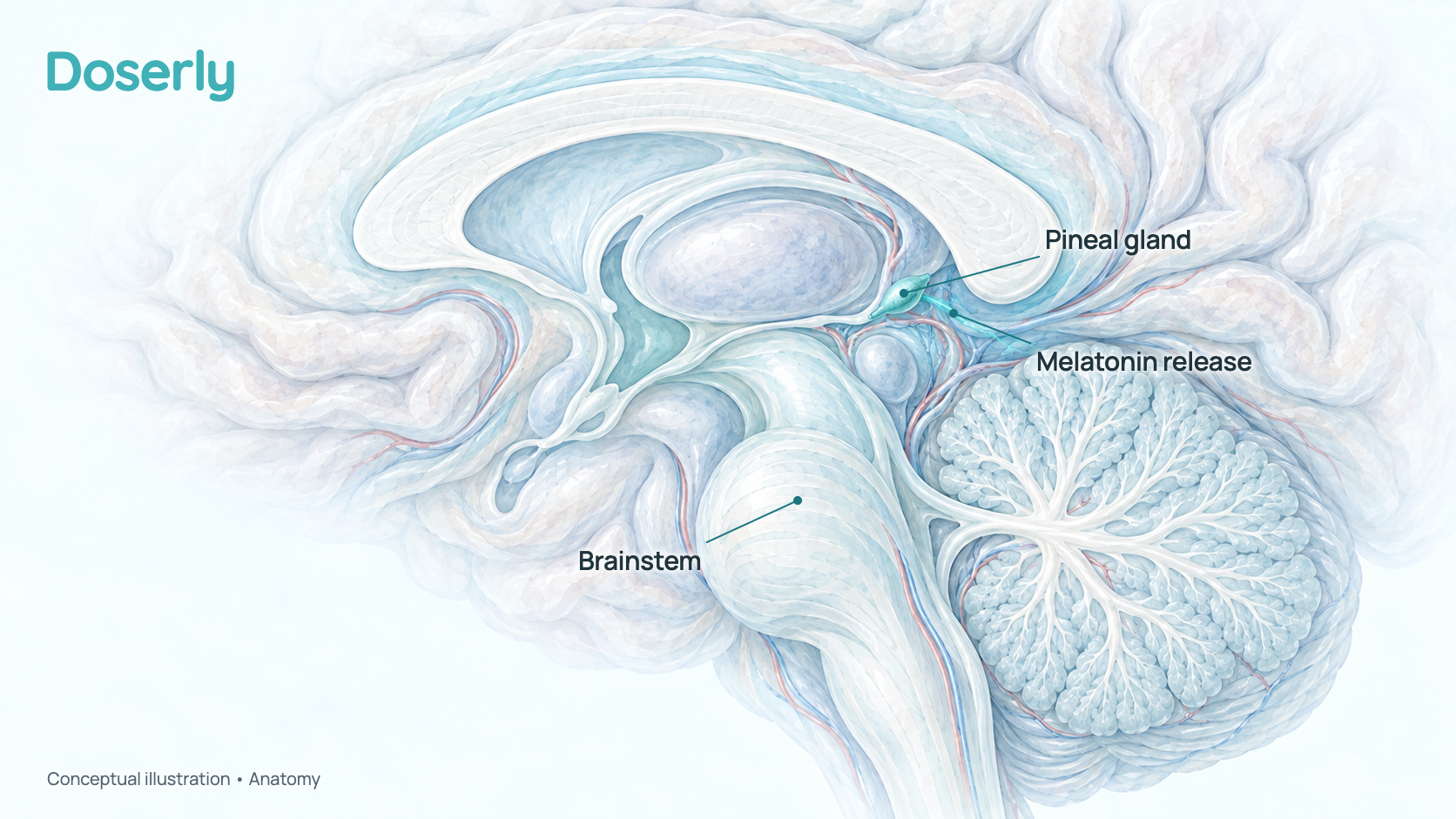
It comes from a Russian research program led by Vladimir Khavinson at the St Petersburg Institute of Bioregulation and Gerontology, which calls these short peptides bioregulators. Epitalon was designed from the amino-acid makeup of epithalamin, an extract of the pineal glands of young cattle. The pineal gland is a small gland deep in the brain that releases the sleep hormone melatonin at night. [3], [4]
Epitalon and epithalamin are not the same thing. Epithalamin is a mixture of many peptides; Epitalon is one small molecule. FDA treats them as different substances, and most of the striking human results people quote, such as older adults living longer, come from epithalamin. The developers later reported finding the AEDG chain inside their extract, which does not make the two interchangeable. [1], [5], [6]
Epitalon comes as a free base (390.35 g/mol) or an acetate salt (450.40 g/mol), usually in vials of 10, 20 or 50 mg. Nasal sprays, under-the-tongue sprays and capsules are also sold. [1], [7], [8], [9], [10]
Epitalon is a lab-made chain of four amino acids, Ala-Glu-Asp-Gly, weighing 390.35 g/mol. Published human studies used 10 mcg a day into a muscle, 100 mcg to 0.5 mg a day under the tongue, or 5 mcg per eye beside the eye, for 10–20 days, and measured melatonin markers and vision. It is sold as 10–50 mg vials, sprays and capsules. Epithalamin is an extract of calf pineal glands containing many peptides; in the 2007 comparison it was given as 10 mg into a muscle every third day, five times, and it is the product used in long-term mortality studies of older people. FDA treats the two as different substances. The popular 5–10 mg injection matches the extract's amount, not the doses tested for Epitalon.
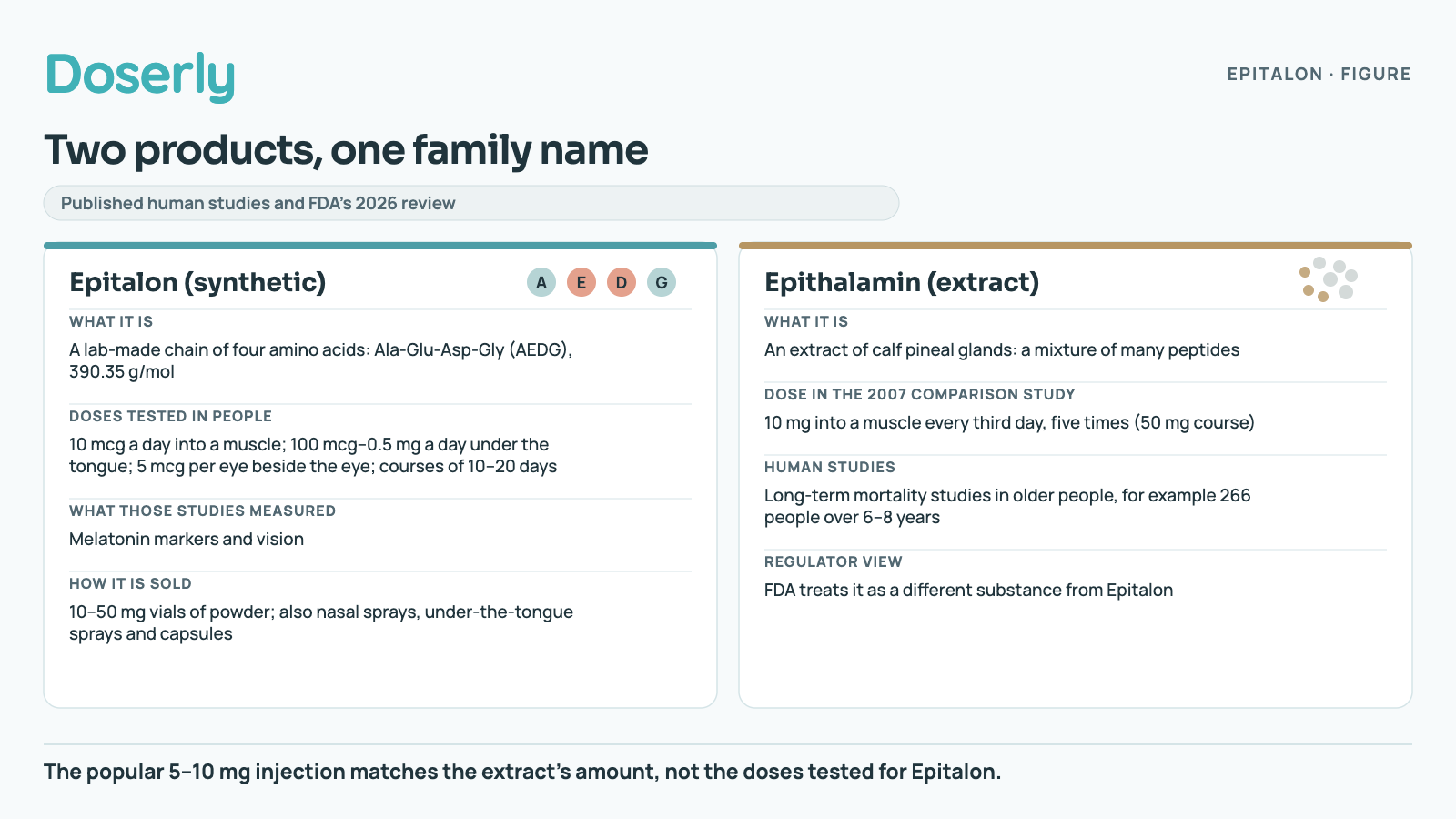
Two products, one family name
Published human studies and FDA's 2026 review
- Epitalon (synthetic)
- What it is: A lab-made chain of four amino acids: Ala-Glu-Asp-Gly (AEDG), 390.35 g/molDoses tested in people: 10 mcg a day into a muscle; 100 mcg–0.5 mg a day under the tongue; 5 mcg per eye beside the eye; courses of 10–20 daysWhat those studies measured: Melatonin markers and visionHow it is sold: 10–50 mg vials of powder; also nasal sprays, under-the-tongue sprays and capsules
- Epithalamin (extract)
- What it is: An extract of calf pineal glands: a mixture of many peptidesDose in the 2007 comparison study: 10 mg into a muscle every third day, five times (50 mg course)Human studies: Long-term mortality studies in older people, for example 266 people over 6–8 yearsRegulator view: FDA treats it as a different substance from Epitalon
The popular 5–10 mg injection matches the extract's amount, not the doses tested for Epitalon.
Typical Epitalon Protocols
| Example | Amount each time | Frequency | Total per day | Duration |
|---|---|---|---|---|
| Low | 100–500 mcg | Once daily | 100–500 mcg | 10 days, then 20 days off Microgram schedule; its source keeps it separate from the milligram schedules [11] |
| Mid | 5 mg (5,000 mcg) | Once daily | 5 mg | 20 days, repeated after 4–6 months Typically two courses a year [12] |
| High | 10 mg (10,000 mcg) | Once daily | 10 mg | 10 days, 2–3 times a year Called the “standard” level by its source [13] |
The most common protocol in the reviewed sources is 5–10 mg once a day by subcutaneous injection for 10–20 days, repeated after 4–6 months, or about two or three courses a year at most. Of 29 injection pages we compared, at least 25 name 5 mg, 10 mg or both as the daily amount. [12], [13], [14], [15], [16], [7]
- Titration Changing the amount in steps
- Most sources use one fixed amount for the whole course, and the microgram and milligram schedules are separate families, not steps. One clinic page describes starting a first course at 5 mg a day for 10 days and raising the amount in later courses based on tolerance. Nasal-spray sellers give two-, three- and four-spray levels. [11], [17], [8]
- Breaks and cycles
- A 10–20-day course, then 4–6 months off; pages describe two or three courses a year. Sources say not to use it continuously. The microgram schedule instead repeats 10 days on and 20 days off. [12], [13], [8], [11]
- Timing
- Most pages advise the evening or bedtime, to line up with melatonin's night rhythm. The injection study in people gave it at 10 a.m., and some users sleep worse after evening doses. See timing. [12], [18]
Read the units: mcg means micrograms; 1 mg equals 1,000 mcg. So the mid row's 5 mg is 5,000 mcg, and the high row's 10 mg is 1,000 times the 10 mcg a day injected into a muscle in the 2007 study in older adults. A “course total” is the daily total times the number of days: 5 mg for 20 days and 10 mg for 10 days both add up to 100 mg. [16], [18]
Each row is a complete schedule from one source, so its amount and duration belong together. Low, mid and high are alternatives, not steps to move through. These schedules come from protocol websites rather than clinical trials, and no study has given people milligram amounts by subcutaneous injection; the cited references give the full details.
Cautions for every schedule above:
- Untested amounts. No study has given people these milligram amounts, the longest published human course lasted 20 days, and no study describes how side effects were checked. Safety in people is not established. [19], [18], [20], [21]
- Cancer history. FDA raises a theoretical concern that, by switching on telomerase, long-term use could let cells escape their normal limit on dividing and become cancerous, and an independent 2025 study found Epitalon lengthened telomeres in breast-cancer cells. People with a history of cancer, or a higher risk of it, should be especially cautious. [1], [22]
- Sleep can get worse. Worse sleep, including early waking, is the most common complaint in public accounts. Some people report sleeping better after moving the dose to the morning; others say it did not help (see timing). [23], [24]
- Pregnancy, breastfeeding and under-18s. None of these groups has been studied in people; in the one rabbit study, labeled Epitalon reached fetal organs. [25]
- Prescribed treatment. Do not stop or replace prescribed sleep medicines, hormone therapy or cancer treatment to try Epitalon. FDA found no study of it in people with insomnia, and no study has looked for interactions with other medicines. [1]
- Product and unit errors. FDA judged both forms poorly characterized and could not rule out immune reactions to impurities and clumps, a risk its safety list flags for Epitalon. Milligrams and micrograms differ 1,000-fold, so check every amount with the reconstitution calculator. [1], [26]
Full risks, legal status and who should be cautious ↓
What doses were tested in people?
| Study | Amount each time | Frequency | Total per day | Duration |
|---|---|---|---|---|
| Older adults, 2007 (intramuscular, into a muscle) | 10 mcg | Once daily at 10 a.m. | 10 mcg | 10 days (0.1 mg in all) 15 people; night melatonin rose in the 12 whose pineal function was low [18] |
| Shift workers, 2018 study (sublingual, under the tongue) | 100 mcg in 1 mL of salt water | Once daily | 100 mcg | 10 days Clinicians aged 40–59, with a placebo group [21] |
| Night-shift women, 2021 report (sublingual spray) | 3 sprays | Twice daily, morning and early afternoon | 0.5 mg (as stated) | 20 days 40 randomly split between the spray and a salt-water placebo; the amount per spray is not given [20] |
| Retinitis pigmentosa, 2002 (parabulbar, beside the eyeball) | 5 mcg per eye | Once daily | 10 mcg (both eyes) | 10 days About 116 treated, compared with 46 on usual care; not randomized [19] |
The website amounts and the study amounts are far apart. The 5–10 mg figures match the dose of epithalamin, the pineal extract: in the one study that tested both, epithalamin was given as 10 mg into a muscle every third day, five times, while Epitalon was given as 10 mcg a day. The usual 5–10 mg is 500 to 1,000 times that Epitalon dose. [18], [27]
The developer's patents add further series: 10 mcg into a muscle daily for 10 days in small groups without a comparison, and, in a retinal patent, 10-day courses of 100 mcg and 1 mg a day into a muscle in people with eye disease, compared with patients on usual treatment. That 1 mg course is the largest amount of synthetic Epitalon we found reported in people, still 5 to 10 times below the usual website amount. [3], [28]
Each step on this scale is ten times the one before. Human studies of Epitalon used 5 mcg per eye beside the eye, 10 mcg a day into a muscle, 100 mcg a day under the tongue and 0.5 mg a day as an under-the-tongue spray; a retinal patent describes 100 mcg and 1 mg a day into a muscle. Website protocols describe 100–500 mcg a day, 5 mg a day and 10 mg a day by subcutaneous injection. The 5–10 mg amounts sit next to epithalamin, the extract, given as 10 mg per injection every third day. No human study has tested subcutaneous milligram amounts.
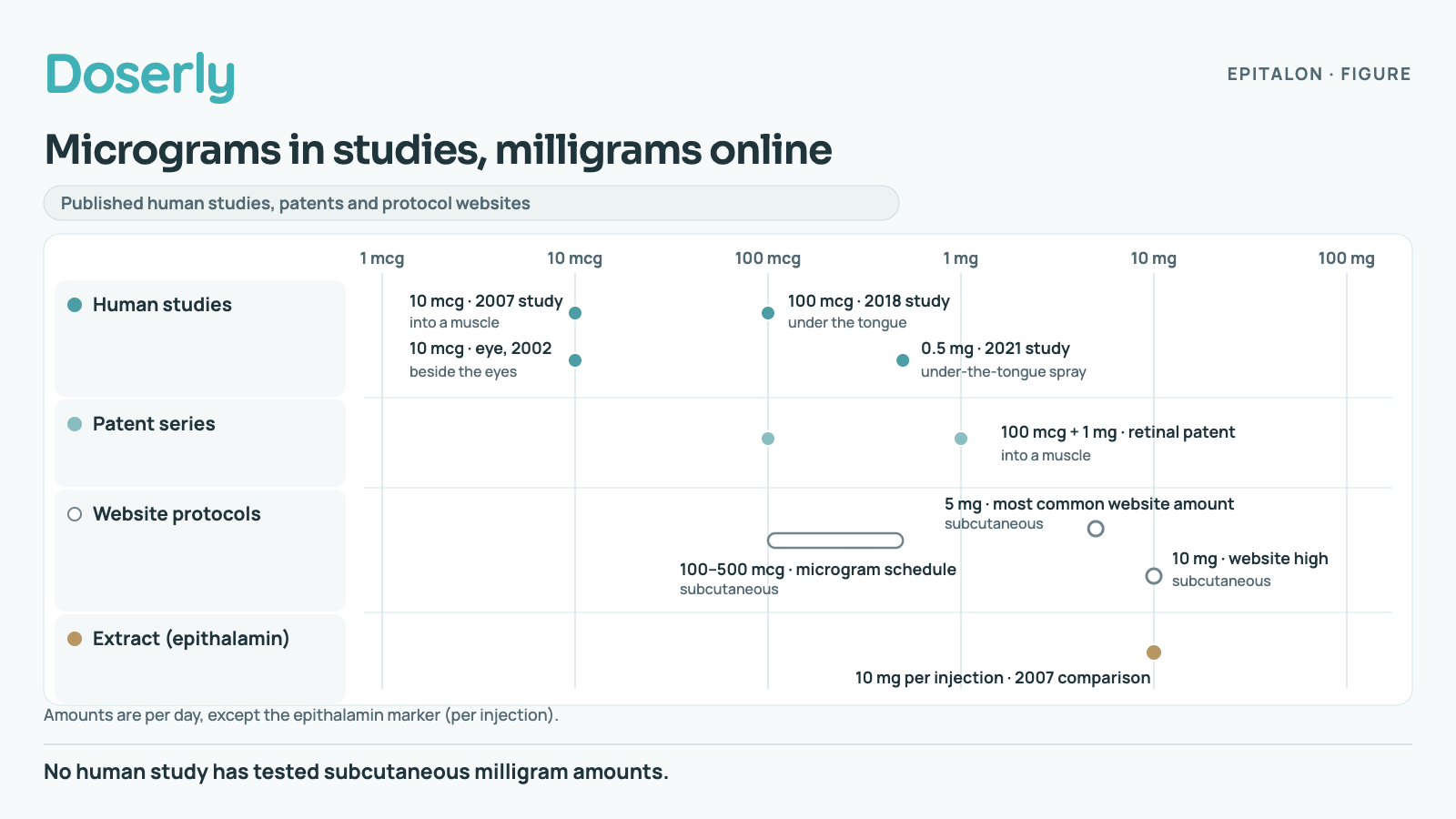
Micrograms in studies, milligrams online
Published human studies, patents and protocol websites
1 mcg → 100 mg · equal spacing means 10×
- 5 mcg per eye (10 mcg a day, both eyes)
- Beside the eye (parabulbar) · Human study · Eye study, 2002
- 10 mcg a day
- Into a muscle · Human study · Older adults, 2007; patent series
- 100 mcg a day
- Under the tongue · Human study · Shift workers, 2018 study
- 100–500 mcg a day
- Subcutaneous · Website protocol · Microgram schedule
- 100 mcg and 1 mg a day
- Into a muscle · Patent series · Retinal patent, eye disease
- 0.5 mg a day (as stated)
- Under-the-tongue spray · Human study · Night-shift women, 2021
- 5 mg a day
- Subcutaneous · Website protocol · Most common website amount
- 10 mg a day
- Subcutaneous · Website protocol · Website high
- 10 mg per injection, every third day
- Into a muscle · Extract (epithalamin) · Epithalamin, 2007 comparison
Amounts are per day except the epithalamin marker, which is per injection.
No human study has tested subcutaneous milligram amounts.
In community education groups, educators mostly teach 5–10 mg a day by subcutaneous injection for 10–20 days, once or twice a year and never continuously, usually in the evening. One group standardizes on 2–5 mg a night, and another teaches starting at 1 mg and stepping up only if nothing is noticed. Members often use less than the lessons suggest: 1–3 mg a night is at least as common as 5 mg, and a growing group uses 100–500 mcg after learning that the milligram doses came from the extract.
Where protocols differ: extract doses, micrograms, course length and timing ↓
Where these numbers come from
The low row comes from Research Protocols (reference [11]), which lists a “microgram protocol” of 100–500 mcg once daily on days 1–10 and nothing on days 11–30, and says it should not be mixed with its milligram rows. The mid row comes from PeptideDosages (reference [12]): 5,000 mcg (5 mg) once daily for 20 days, then 4–6 months off, typically two cycles a year. The high row is the “standard” level on PeptideWiki (reference [13]): 10 mg a day for 10 days, two or three times a year.
The recurring 5–10 mg, 10–20-day pattern is cross-checked by PeptideCalcHub, Peptides Guide, PeptiTools and Peptide Tables (references [14], [15], [16], [7]). Across the 34 dosing pages we audited, at least 25 of the 29 injection pages name 5 mg and/or 10 mg a day; among the 11 pages that state one single injection amount, the middle value is 5 mg. Many pages share numbers, so they are not 25 independent opinions.
The study rows come from the full texts of the 2007 injection study, the 2021 and 2024 under-the-tongue studies and the 2002 eye study (references [18], [20], [21], [19]). The 2021 report says 1 mL of spray solution “corresponded to a daily intake of the peptide at a dosage of 0.5 mg” but does not give the volume of one spray.
Excluded from the typical comparison: blends with other peptides; a Russian-language page giving 10–20 mg a day into a muscle; the extract schedule of 10 mg every third day presented as an Epitalon protocol; an intravenous option offered without any human data; nasal, under-the-tongue and capsule products, which are covered separately below; and pages whose own arithmetic does not work, such as a 20 mg vial said to cover two 10-day courses at 10 mg a day. [29], [30], [31], [32]
What is Epitalon commonly used for?
People usually look into Epitalon for sleep, for “anti-aging”, and less often for an eye disease. Websites also promote it for skin, immunity, energy, mood and memory. FDA's 2026 review lists many of these website claims, from slowing aging to preventing cancer and dementia. [1]
The subsections below describe that interest and the evidence behind it. They do not establish that Epitalon treats or prevents any condition.
Sleep and the body clock
This is the use people talk about most, and the only one where many say they notice something. Small Russian studies found that Epitalon raised melatonin, or its breakdown product in urine, in people whose levels were low for their age: older adults given injections, and middle-aged shift workers given it under the tongue. None of these studies measured sleep itself. [18], [33], [21]
FDA's 2026 review found no study in people with insomnia and no animal study of sleep. Public accounts are split: many describe falling asleep faster, and a sizable minority sleep worse. What people report. [1]
Telomeres and aging
The anti-aging claims rest on telomeres, protective caps on the ends of chromosomes that shorten each time a cell divides. In cells grown in a dish, Epitalon switched on telomerase, the enzyme that rebuilds them, and lengthened telomeres. [34], [22]
No study has measured telomeres, biological age or lifespan in people taking Epitalon. The human studies in which older people lived longer used epithalamin, the extract, and in animals Epitalon's effects on lifespan were small and inconsistent. How it might work. [1], [5], [35]
Eye disease
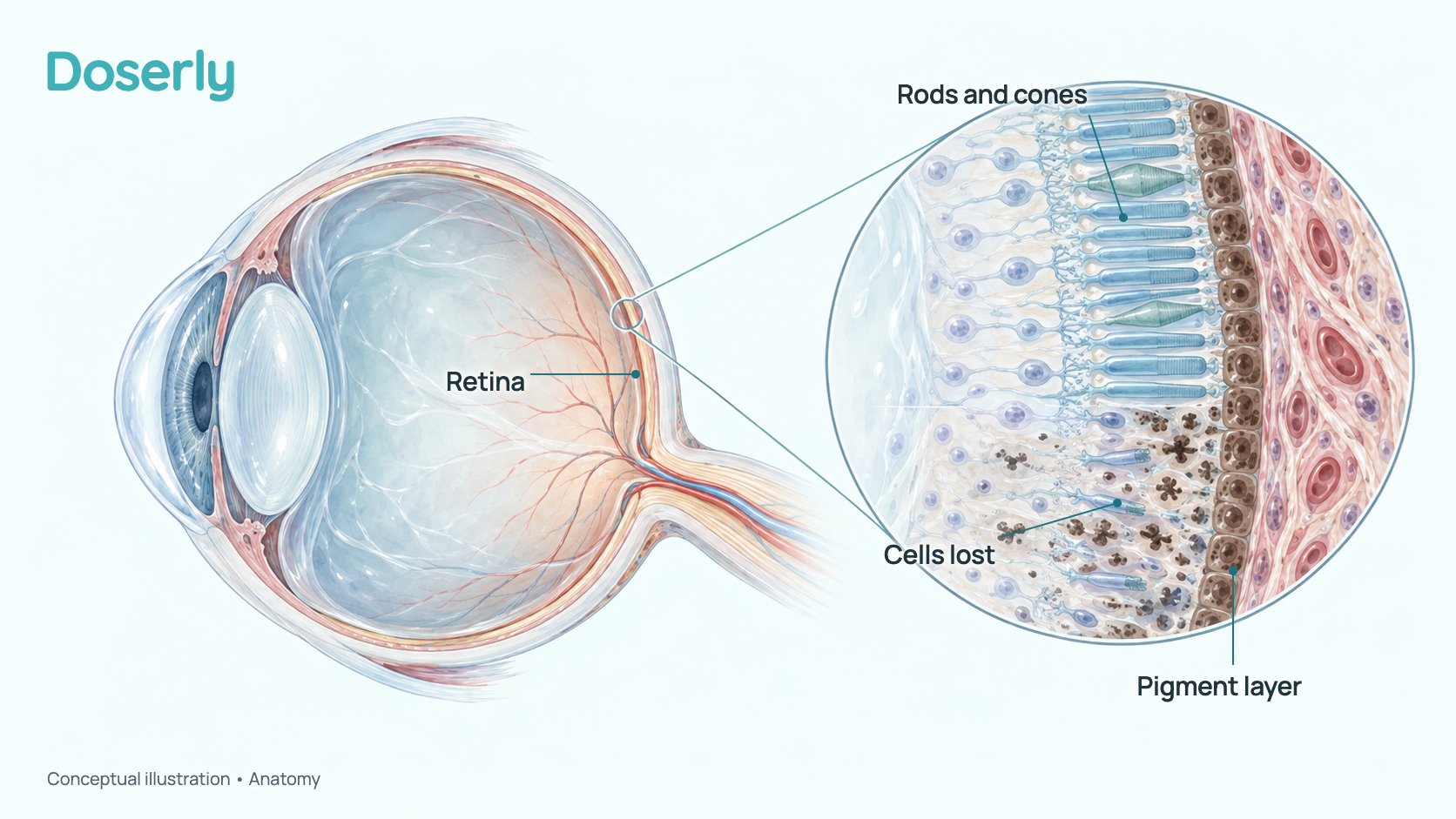
The largest human study is in retinitis pigmentosa, an inherited disease in which the light-sensing cells of the retina slowly die. In 2002 the developers reported a positive effect on a combined judgment of vision and retinal tests in most of about 116 treated people, compared with 46 patients on usual care, without random assignment. In 2010 FDA gave Epitalon orphan-drug designation for this disease; the designation was withdrawn in 2016 and no product was approved. [19], [36], [1]
That study used 5 mcg injected beside each eye. Some websites apply their usual 5–10 mg subcutaneous injection to “eye health”, which is a different route and a far larger amount. [13]
Other uses you may come across
Claims that Epitalon improves memory, focus, skin, hair, immunity or energy, or that it prevents cancer, have not been tested in people. A research foundation review found no human studies on memory or brain protection, and the cancer claims come from animal experiments, while FDA raises the opposite concern. [37], [1]
Where do Epitalon protocols differ?
The daily amount is easy to state. The disagreements start with where that amount came from, whether it should be milligrams at all, and when to take it.
Is the dose from Epitalon or from epithalamin?
Check this first. In the 2007 study that tested both, epithalamin was given as 10 mg into a muscle every third day, five times (50 mg in all), while Epitalon was given as 10 mcg a day for 10 days (0.1 mg in all). One popular page presents that extract schedule as the “Original Khavinson” Epitalon protocol. A 1990 Soviet instruction for epithalamin, available as an unofficial online copy, gives 5–10 mg into a muscle daily for 5–10 days, repeated after 3–6 months, which closely matches today's website pattern, and a 2026 hypothesis paper argues that the whole 5–10 mg habit was carried over from the extract. [18], [30], [38], [27]
Several pages also credit Epitalon with the extract's mortality results, such as a 1.6-fold drop in deaths among older adults. Those studies used epithalamin, sometimes with a thymus extract, not Epitalon. [39], [40], [5]
Milligrams or micrograms?
A growing number of sources describe microgram schedules: 100–500 mcg a day for 10 days, then 20 days off, or 300 mcg a day on one clinic's dosing chart. The developer's patent claims amounts of 0.01–100 mcg per kilogram of body weight, and the 2026 hypothesis paper suggests testing 100–300 mcg a day, a figure it scaled up from a mouse dose rather than tested. [11], [41], [3], [27]
At the other end, one Russian-language page gives 10–20 mg a day into a muscle. One page claims doses “up to 50 mg per day” were tested with no added benefit; we found no such study. [29], [30]
Ten days or twenty, and how often?
Two course lengths dominate: 10 days, often at 10 mg, and 20 days, often at 5 mg. Both add up to 100 mg, and one guide treats them as interchangeable. Repeats every 4–6 months are the most common advice, some pages say two or three times a year, and 10-days-on, 20-days-off schedules repeat monthly. [16], [12], [13], [11], [42]
Protocol pages insist the courses should be short. In community education groups, many members run it longer: 45–60-day courses, 12 weeks straight, or small nightly doses for years. No study has compared course lengths, and none has tested continuous use.
Evening or morning?
Most pages say evening or bedtime, reasoning that Epitalon works through melatonin, which rises at night. The studies in people did not do this: the injections were given at 10 a.m., and the 2021 spray study gave doses in the morning and early afternoon. [12], [8], [18], [20]
Timing matters to some users. One person injecting 3 mg at 6 p.m. reported poor sleep and a higher resting heart rate, then better sleep after switching to 1 mg in the morning; others found that moving the dose earlier did not help. [24], [43], [23] In community education groups, moving the dose to the afternoon or morning is the change members most often describe after Epitalon-related insomnia. No study has compared timing.
Nasal sprays, under-the-tongue sprays and capsules
These products use different amounts and cannot be compared with injections:
- Intranasal sprays: one Russian seller's spray delivers 200 mcg per spray, 1–3 sprays a day, up to 5; another seller's spray delivers 625 mcg per spray, two to four sprays once a day for 10–20 days. [44], [8]
- Under-the-tongue spray: the spray used in the 2021 study is sold as a food supplement, labeled 5 pumps a day. Pages linking it to that study give 0.5 mg a day for 20 days. [9], [45], [46]
- Oral capsules: one seller lists 3 mg capsules, one each weekday morning, every second week. [10]
Only the under-the-tongue route has been studied in people, and those studies measured melatonin markers, not benefits. [20], [21]
What about stacks and blends?
Epitalon is rarely taken alone. One protocol site lists an Epitalon and Thymosin Alpha-1 blend (10 mg of each per vial) dosed at 1 mg of each daily for 20 days, then 500 mcg of each twice a week; the blend's total weight is not its Epitalon amount. Another lists NAD+, MOTS-c and SS-31 as common partners. [39], [30]
In community education groups, Epitalon is often paired with Pinealon in the morning or DSIP at night, sometimes mixed in the same syringe, with no data on whether they mix safely. None of these combinations has been studied.
See the Doserly guides to NAD+, MOTS-c and SS-31.
How do milligrams convert to syringe units?
Injection pages often give amounts as units on a U-100 insulin syringe, which holds 100 units per millilitre. Units measure volume, so how much Epitalon each unit holds depends on how much water went into the vial.
For example, a 10 mg vial mixed with 2 mL of water holds 5 mg per mL, so a 5 mg dose is 1 mL, or 100 units: a full 1 mL syringe. FDA notes that Epitalon free base dissolves poorly in water and that even 3 mg per mL may not be achievable, so a 5 mg per mL mix of the free base may not fully dissolve. A cloudy vial alone cannot show what is in it or why. [7], [12], [1]
Page arithmetic also goes wrong: one page says a 20 mg vial covers two 10-day courses at 10 mg a day, which would need 200 mg. Doserly's reconstitution calculator works out units for any vial and shows each step. [32]
Source-by-source comparison
Subcutaneous injection pages
Unit key: 1 milligram (mg) = 1,000 micrograms (mcg).
PeptideDosages gives 5,000 mcg (5 mg) once daily for 20 days, 4–6 months off, typically twice a year, preferably in the evening; Peptides.ID gives the same 5 mg, 20-day course and a separate Epitalon and Thymosin Alpha-1 blend (1 mg of each daily for 20 days, then 500 mcg of each twice weekly). PeptideWiki gives a “conservative” 5 mg for 10 days twice a year and a “standard” 10 mg for 10 days two or three times a year. Everything Peptide gives 5 mg a day for 20 days or 10 mg a day for 10 days. PeptiTools calls 10 mg a day for 10 days “the single most cited version” and 5 mg for 20 days an equally common alternative. [12], [39], [13], [47], [16]
PeptideCalcHub, PepRecon, Peptides Guide, Pep-Tidy, FormBlends and Peptide Tables describe 5–10 mg a day for 10–20 days, once or twice a year. HealthRX describes starting at 5 mg for 10 days and increasing in later courses. PeptidEdge adds an intravenous option and 10 mg a day as 2 mL split injections. [14], [48], [15], [49], [50], [7], [17], [31]
Peptide Protocol Wiki's calculator defaults to 1 mg once daily and also lists 5–10 mg for 10–20 days. PeptaBase lists 2 mg nightly, a “Russian protocol” of 10 mg a day for 10 days, and a 1 mg, 10-days-on, 20-days-off cycle. Research Protocols gives the 100–500 mcg microgram protocol alongside a 5 mg “classic” one. An older clinic dosing chart lists 0.1 mL of a 3,000 mcg per mL injection daily, which is 300 mcg. Biomogging gives 0.1–0.25 mg as its low level. [51], [42], [11], [41], [52]
PeptideFox lists named “practitioner” protocols, including 10 mg into a muscle every third day to 50 mg (the epithalamin schedule) and 10 mg by subcutaneous injection three times a week for three weeks. Guide to Peptide lists similar regimens plus 1 mg nightly for sleep. A Russian-language page gives 10–20 mg a day into a muscle. Peptides Media describes community courses of 5–10 mg a day for 10–20 days, repeated once or twice a year, and lists the 2007 injection study's 0.01 mg a day separately. [30], [53], [29], [54]
Other routes
Nanopep's under-the-tongue spray is labeled 5 pumps a day; Vialog and Promise tie 0.5 mg a day for 20 days to the 2021 study. ST BIO's nasal spray gives 200 mcg per spray, 1–3 a day and up to 5; Akira Biotech's gives 625 mcg per spray, 2–4 sprays once a day. Lumina Life Science lists 3 mg capsules on weekdays every second week and, for injection, 0.5 mL of a 5 mg per mL solution daily for 10 days. [9], [45], [46], [44], [8], [10]
Errors we found
Several pages attribute epithalamin's mortality results to Epitalon. One slide presentation labels a different chain (Ala-Glu-Asp-Arg, the sequence of Cardiogen) as Epitalon. Half-lives of 5 minutes, about 30 minutes and 2–4 hours are printed without any measurement. One page marks Epitalon as allowed in sport, and one describes the 2021 spray study as once daily. [39], [40], [55], [52], [56], [57]
What happens when you stop Epitalon?
This has barely been studied. No study checked for withdrawal effects or a rebound in sleep problems, and most followed people only until the end of the course.
- Melatonin markers. In the 2024 under-the-tongue study, the rise in the urine melatonin marker was measured five days after the 10-day course ended. No later measurement was reported. [21]
- Eye disease. The developer's retinal patent reports that, in 56 people aged 48–79 with age-related macular degeneration, improvement held for six months in 79.4% of treated patients and for a year or more in 20.6%; 39.6% of a comparison group on usual treatment improved. These are the inventors' own, non-randomized data. [28]
- Animal studies. The lifespan experiments gave Epitalon on repeating schedules for life, such as five days every month in mice, so they never tested stopping. [35]
- Personal accounts. Public reports go both ways. Some people say better sleep lasted weeks or months after a course; others say it faded within about three weeks or during breaks; one person slept worse for a time after stopping. [58], [59], [60], [61], [62] Read the accounts.
Lessons in community education groups often claim the effects last for months between courses. That idea is used to justify short courses, but it has not been measured.
Do injections, sprays and capsules of Epitalon behave the same way?
Nobody has measured this. Bioavailability, how much of a dose reaches the blood, is unknown for every route, and no study has measured Epitalon's levels in the blood of people or animals (pharmacokinetics). FDA found only one study of where it goes in the body: fluorescent-labeled Epitalon injected into a vein of pregnant rabbits showed up in the mothers' and fetuses' organs within an hour, but the study could not prove the signal was the peptide itself. [1], [25]
The human studies used three routes: into a muscle, under the tongue and beside the eye. Websites mostly describe subcutaneous injection, which has never been studied in people. In rats, Epitalon dripped into the nose changed nerve-cell firing in the brain's outer layer within minutes, which says nothing about a person's dose. A 2023 computer model from the developer's group predicted that it could fit gut transporters for small peptides; that is a prediction, not a measured absorption. [63], [64]
How long does Epitalon last in the body?
Nobody knows. No study has measured its half-life in any species. Websites print figures of 5 minutes, about 30 minutes and 2–4 hours, and none cites a measurement. [1], [27], [52], [56], [40]
Does the form matter: free base, acetate or “N-acetyl”?
FDA treats the free base and the acetate salt as different active ingredients and judged neither well characterized. By weight, 10 mg of the acetate contains less peptide than 10 mg of the free base, because the acetate part adds weight. Versions sold as “N-acetyl” or “amidated” Epitalon are chemically different molecules, and our searches found no published studies of them. [1]
How should Epitalon be stored, and how long does it last?
No one has published a stability study of Epitalon, and there is no approved product label. What exists are supplier statements, which FDA passed on without testing them:
- Powder, before mixing. One supplier says freeze-dried (lyophilized) Epitalon free base is stable for 3 weeks at room temperature but should be stored dry below −18 °C (about 0 °F), because moisture shortens its life. An acetate supplier says to keep it sealed at 2–8 °C (36–46 °F). [1]
- After mixing. The free-base supplier says the mixed (reconstituted) solution should be stable for 2–7 days at 4 °C (39 °F). [1]
- Protocol websites give longer and conflicting times: use within 14 days, typically within 4 weeks, or 6 weeks in the fridge, and more than 3 years for frozen powder. One page now simply says to follow the product's use-by instructions. None cites a stability test. [56], [7], [30], [12]
FDA notes that peptides like Epitalon are very sensitive to heat, acidity and how they are made, which can make them clump (aggregation) or break down. Health Canada warns that unauthorized peptides may be improperly made or stored and may contain too much, too little or none of the active ingredient, so careful storage cannot tell you what is in a vial (see product quality). [1], [65]
What do we actually know about Epitalon in people?
A handful of small human studies exist, all from the developer's own research network. None tested the subcutaneous milligram doses sold online, and none measured sleep, telomeres, lifespan or cancer. ClinicalTrials.gov lists no Epitalon study under any of its names. [66], [1]
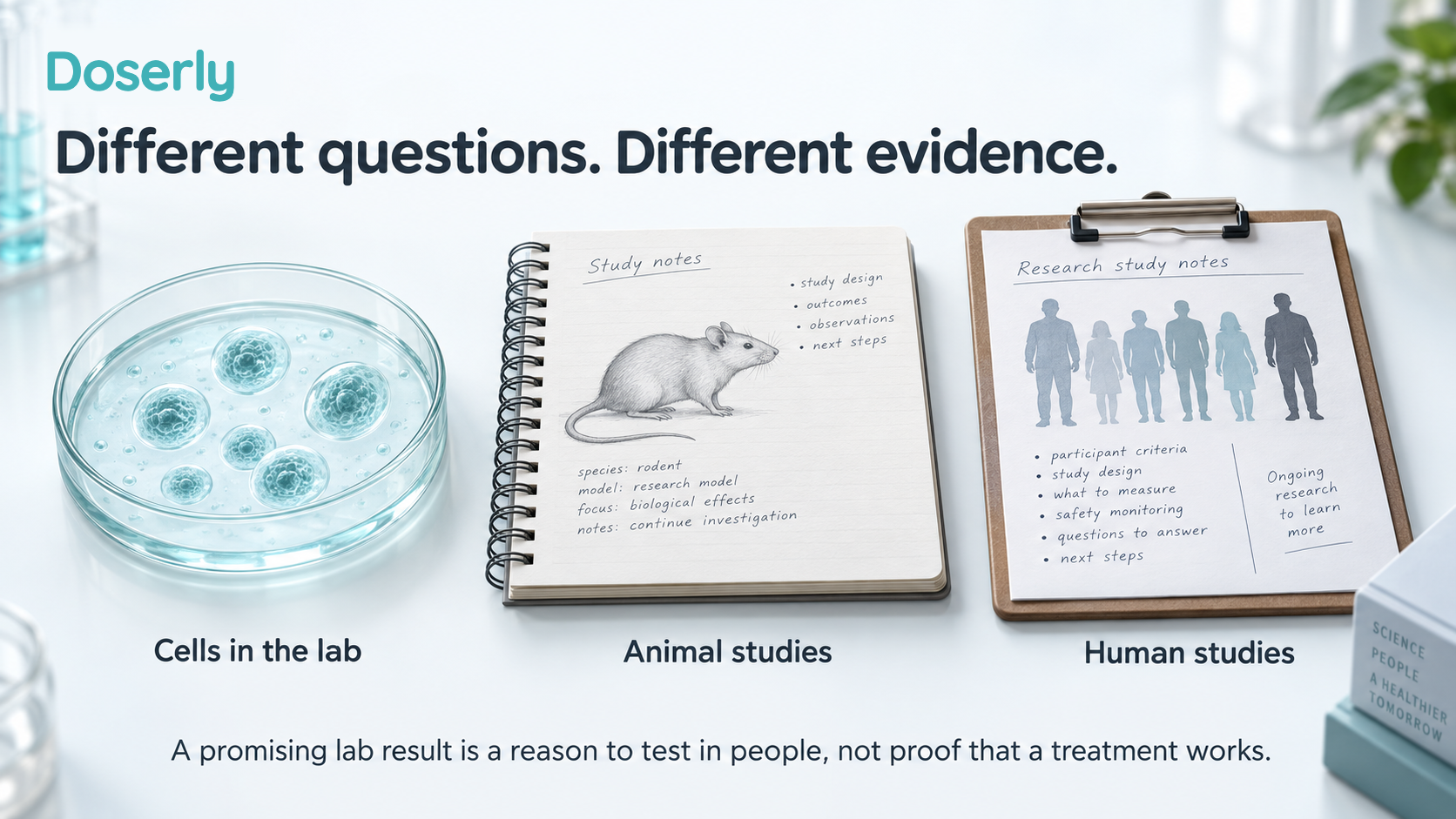
What did the human studies find?
| Study | What researchers reported | What it cannot establish |
|---|---|---|
| Retinitis pigmentosa, 2002 | About 116 patients aged 18–72 treated, 46 on usual care. The authors report a positive effect in 90% of treated patients, a combined judgment of sight, visual field and retinal tests, versus improvement in 31.5% of controls. | A fair comparison: no random assignment, and hiding who was treated is not described. Side-effect checks not described. [19] |
| Older adults, 2007 | Older adults were randomly split into Epitalon (15), epithalamin (15) and salt water (10). In the 12 Epitalon recipients with low pineal function, melatonin in the blood at 3 a.m. rose from 20 to 49 pg/mL; it did not change in the salt-water group or in Epitalon recipients with normal function. | Whether sleep or health changed: neither was measured. Blinding is not described. [18] |
| Night-shift women, 2020–2021 | 40 night-shift women aged 40–59 with a low urine melatonin marker were randomly split between a salt-water spray and an Epitalon spray. The marker rose 1.7-fold on Epitalon, and some body-clock (circadian) genes in blood cells changed. | Any effect on sleep or health. Blinding and how side effects were checked are not described. [20], [33] |
| Shift-working clinicians, 2018 study (published 2024) | 60 clinicians aged 40–59; those with a low melatonin marker received a placebo, Epitalon under the tongue or a pineal extract. Five days after the course, the marker was 1.7 times its starting level and 1.6 times the placebo group's. On a questionnaire, 89% on Epitalon reported feeling better versus 25% on placebo. | Group sizes and the questionnaire method are not given. No sleep measure. [21] |
| Patent case series | Examples in the developer's patents: 10 mcg into a muscle daily for 10 days in 14 people with age-related conditions and 11 people with asthma, and several eye-disease series at 10 mcg to 1 mg a day, compared with patients on usual treatment. | Anything firm: not randomized, not peer reviewed, and the US patent series had no comparison group. [3], [28] |
FDA's 2026 review counted three human studies and noted that the 2007 study was published only in Russian. Its full text gives the injection dose, the numbers and the results above. [1], [18]
What about the studies where older people lived longer?
Those used epithalamin, the cattle pineal extract, not Epitalon. In one, 266 older people were followed for six to eight years, and death rates were 1.6–1.8 times lower with epithalamin courses. A 12-year study in older heart patients reported 28% lower death rates, and a 15-year follow-up compared 39 treated with 40 untreated patients. All three come from the developer's research network. [5], [67], [68]
Those results cannot be transferred to Epitalon: the extract contains many peptides and was sometimes combined with a thymus extract. FDA's review makes the same distinction. [1]
What do these measurements mean?
A higher level of melatonin or of its urine breakdown product, 6-sulfatoxymelatonin, shows the pineal gland released more hormone. It does not show that anyone slept longer or better, felt more rested, or aged more slowly. FDA made this point directly: the effect of the melatonin changes is unclear without a measure of clinical outcomes, and low melatonin has not consistently been linked to insomnia in older adults. [1]
A convincing test, a randomized controlled trial, would randomly assign people with a defined sleep problem to Epitalon or an identical dummy, measure sleep in a sleep lab or with validated questionnaires, record side effects systematically and follow people after the course. None of the published studies did all of these. Explore the evidence behind each claim.
How might Epitalon work?
The developers' idea is that very short peptides act as signals that help switch particular genes on or off. The experiments below test pieces of that idea. Most are preclinical: cell studies in a dish and animal studies, and almost all come from one research network in St Petersburg.
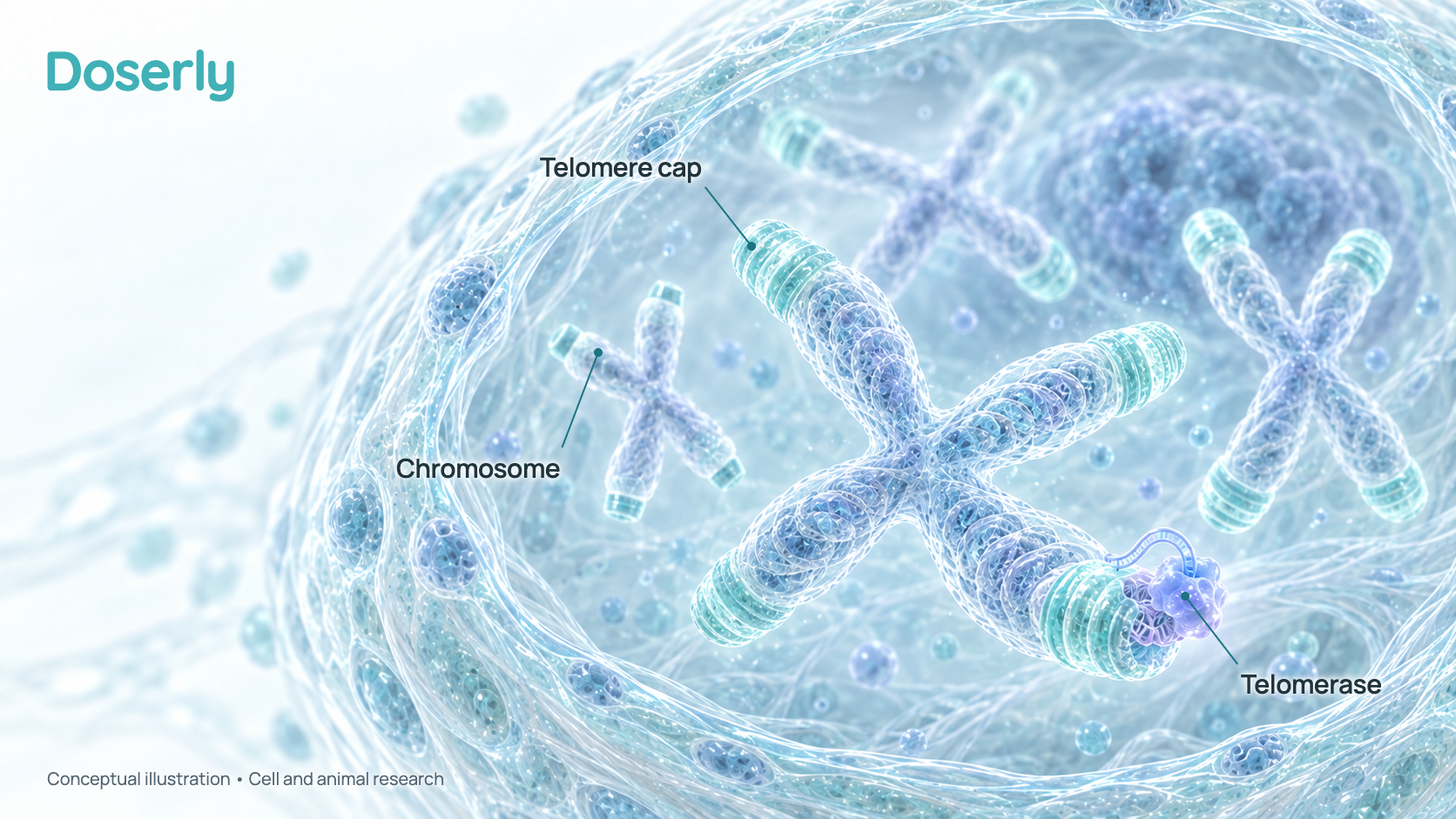
Telomeres and telomerase in cells
In 2003 the developers reported that Epitalon switched on telomerase and lengthened telomeres in human fetal fibroblasts grown in a dish, and in 2004 that treated cells divided at least 10 more times than untreated ones and were still dividing when the report ended. In blood cells from 11 donors, telomeres got longer in cells from five donors and shorter in two. [34], [69], [70]
The first telomere study by an independent team, at Brunel University London in 2025, found that 1 mcg per mL for three weeks lengthened telomeres in normal human fibroblasts and breast cells through telomerase. In two breast-cancer cell lines, telomeres also lengthened after four days, but through ALT, a backup route that cancer cells use. The paper was later corrected to replace three figures. [22], [71]
Melatonin and the pineal gland
In old rhesus monkeys, Epitalon raised evening melatonin and restored the daily rhythm of cortisol, a stress hormone. In pineal cells in a dish, it increased an enzyme that makes melatonin. But when rat pineal glands were kept alive in a flow chamber and exposed to Epitalon directly, melatonin release did not change, in young or old glands. FDA concluded that how Epitalon raises melatonin in the body remains unknown. [72], [73], [74], [1]
Genes, DNA and “antioxidant” effects
Test-tube and cell work reports that Epitalon enters cell nuclei, interacts with DNA and loosens tightly packed chromatin in blood cells from older people. One lab test found no direct antioxidant activity. None of this shows Epitalon changing genes in a living person. [75], [76], [77]
What did the animal lifespan studies find?
Less than the marketing suggests:
- Female mice (SHR strain): 1 mcg by subcutaneous injection five days a month for life did not change average lifespan or total tumor numbers; the longest-lived 10% lived 13.3% longer and leukemia was six times less common. [35]
- Female mice (CBA strain): average lifespan rose 5.3%. [78]
- Rats: average lifespan did not change in females kept under standard light, or in males, though some tumors were less common. [79], [80]
- Fruit flies: lifespan rose 11–16%. [81]
The 52% and 27% “lifespan” figures quoted online come from a 1998 epithalamin study and describe how fast death rates rose with age, not extra lifespan. [82], [53]
What are the risks and unanswered questions?
Is Epitalon safe?
Its safety in people has not been established. Two of the human studies say no side effects were seen and the others do not mention them; none describes how side effects were looked for, and the longest course lasted 20 days. A developer patent reports 1 mg a day into a muscle for 10 days, but no study has given people the 5–10 mg subcutaneous injections sold online. [19], [18], [20], [21], [28]
FDA found no standard toxicity, reproductive or long-term cancer (carcinogenicity) studies. The developer's patent says mice and rats showed no toxic effects, but these are the inventors' own data. FDA's adverse-event database had no reports for Epitalon up to December 2025; because reporting is voluntary, that is not evidence of safety. [1], [3]
What problems have actually been reported?
In public forums, the most common complaint is worse sleep: trouble falling asleep, early waking, or nights of almost no sleep, sometimes with a higher resting heart rate. Other reports include vivid dreams, stinging, lumps or welts at injection sites, grogginess, anxiety, headaches and, in one case, emotional blunting. [23], [24], [83], [84], [85], [59], [86], [60], [87]
Community education groups show the same pattern: roughly 35–40 members describe worse sleep, about 10 grogginess, about 8 headaches and a few injection-site burning. A small cluster describes night sweats with anxiety or an adrenaline-like surge. About eight people describe vials that turned cloudy, gelled or would not dissolve. None of these reports was formally investigated.
Does Epitalon cause cancer, or prevent it?
Nobody knows, and the evidence points both ways. FDA's concern is theoretical but specific: Epitalon switches on telomerase, and long telomeres are associated with a higher risk of cancer, so continuous use could, in theory, help cells avoid the normal limit on dividing. The independent 2025 study found that Epitalon lengthened telomeres in breast-cancer cells as well as normal cells. [1], [22]
The developers' animal studies mostly found fewer or smaller tumors, for example in mice prone to breast cancer, but some found no effect, including on chemically induced bladder cancer and on tumor rates in fast-aging mice. These studies used low doses on intermittent schedules, mostly in female mice. FDA calculated that in one lifelong mouse study, the dosing days added up to at most 22 weeks, so these studies cannot show what longer or higher use would do. [88], [89], [90], [1]
In community education groups, some members with a history of melanoma or advanced cancer were encouraged to use Epitalon without any caution being raised.
Could product quality change the risk?
Yes. FDA judged both forms poorly characterized: nomination paperwork lacked tests for impurities, clumps, bacterial toxins and microbes. Clumps and peptide impurities can make an injected product more likely to trigger an immune reaction (immunogenicity), and FDA's safety list flags Epitalon for this risk. [1], [26]
A 2015 laboratory analysis identified Epitalon in two illegal pharmaceutical preparations, and one clinical slide deck labels a different peptide's chain as Epitalon. No independent testing of Epitalon vials has been published that we could find. [91], [55]
Is Epitalon legal? Is it FDA-approved?
Checked September 23, 2026. Rules differ by country and change quickly. A “research use only” label does not make a product legal to sell or safe to use.
United States. Epitalon is not an FDA-approved drug or part of one. The timeline so far:
- 2010: FDA granted orphan-drug designation for retinitis pigmentosa; it was withdrawn in 2016 without an approval. [36], [1]
- November 2018: a first nomination asked FDA to add it to a list of bulk ingredients for compounding. [1], [92]
- April 2020: FDA sent a warning letter to a Kentucky pharmacy that had compounded products containing Epitalon among other peptides. The letter said Epitalon had not been nominated for the list pharmacies use. [93]
- December 2020: a pharmacy network nominated it for that pharmacy list. Both nominations were later withdrawn, and FDA's safety page lists Epitalon among withdrawn nominations, with a warning about immune reactions. [94], [1], [26]
- May 2026: FDA reviewed both forms on its own initiative for use in insomnia, as the subcutaneous injections at 10 mg per mL or 3,000 mcg per mL proposed in the nominations, and concluded that the evidence weighed against listing them. [1]
- July 24, 2026: FDA's advisory committee voted 7 yes, 4 no and 1 abstention, for each form, to recommend adding it to the list. The vote is advice; FDA makes the final decision. [95], [96]
- September 2026: Epitalon was still not on the list in federal regulations, and no proposed rule had been published. Because it is not listed, has no official monograph and is not part of an approved drug, it does not meet the usual conditions for pharmacies to compound it from bulk ingredients. [97], [98], [95]
September 2010: FDA granted Epitalon orphan-drug designation for retinitis pigmentosa. January 2016: the orphan designation was withdrawn and no product was approved. November 2018: a first nomination asked FDA to add it to a compounding bulk list. April 2020: FDA sent a warning letter to a pharmacy that had compounded products containing Epitalon among other peptides. December 2020: a pharmacy network nominated it for the pharmacy-compounding list; both nominations were later withdrawn. May 2026: FDA's own review for insomnia concluded the evidence weighed against listing. July 24, 2026: FDA's advisory committee voted 7 yes, 4 no and 1 abstention, for both the free base and the acetate, to recommend listing. September 2026: Epitalon was not on the list and no proposed rule had been published; FDA's decision was pending.
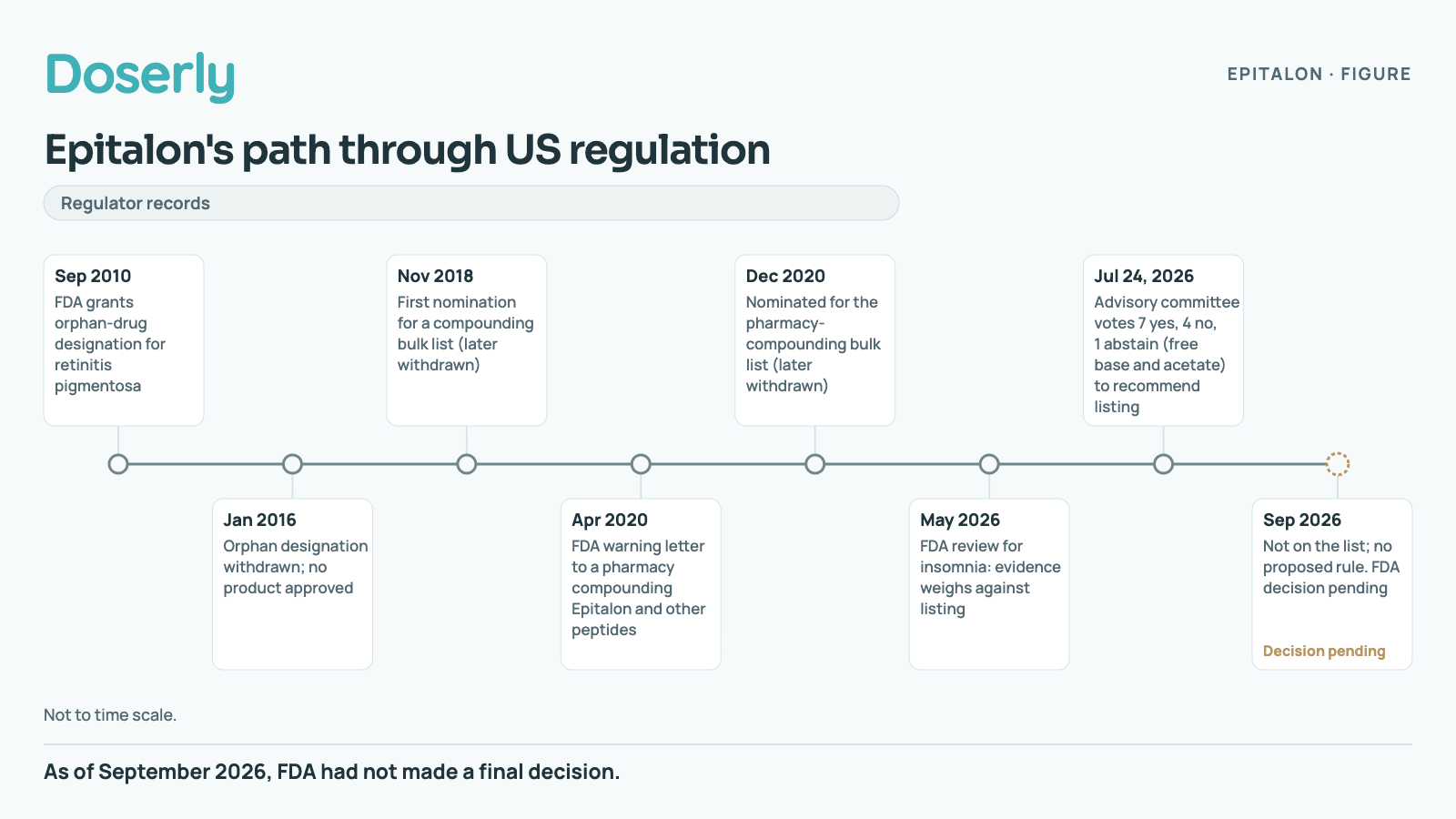
Epitalon's path through US regulation
Regulator records
Not to time scale.
- Sep 2010
- FDA grants orphan-drug designation for retinitis pigmentosa
- Jan 2016
- Orphan designation withdrawn; no product approved
- Nov 2018
- First nomination for a compounding bulk list (later withdrawn)
- Apr 2020
- FDA warning letter to a pharmacy compounding Epitalon and other peptides
- Dec 2020
- Nominated for the pharmacy-compounding bulk list (later withdrawn)
- May 2026
- FDA review for insomnia: evidence weighs against listing
- Jul 24, 2026
- Advisory committee votes 7 yes, 4 no, 1 abstain (free base and acetate) to recommend listing
- Sep 2026
- Not on the list; no proposed rule. FDA decision pending
As of September 2026, FDA had not made a final decision.
Canada. Health Canada names Epitalon among unauthorized injectable peptide drugs it has seized, and says most injectable peptides are regulated as prescription drugs in Canada. Advisories from April 2025 and December 2025 name Epitalon seized from a Calgary wellness clinic and an injectable “Epithalon 10MG” product seized at a Vancouver gym and sold online. Its April 2026 warning says products labeled “For Research Use Only – Not for Human Consumption” are not legal or exempt because of that label. [99], [100], [101], [65]
Australia. Epitalon is not approved in Australia. It is not named in the June 2026 Poisons Standard, and we found no entry for it on the Australian Register of Therapeutic Goods. The TGA's May 2026 warning says personal importation of unapproved peptides is permitted only if the goods are clearly and accurately labelled, and its April 2026 notice adds that importers must meet the scheme's other conditions, including a prescription when required. [102], [103], [104], [105]
United Kingdom. A search of UK government sites, which include the medicines regulator (MHRA), found no authorization or statement for Epitalon or Epithalon. [106]
Russia. Epithalamin, the extract, was approved for medical use in the USSR in 1990, according to an unofficial copy of the order. We found no Russian medicine registration for synthetic Epitalon; the spray from the 2021 study is marketed as a food supplement. [38], [9]
Is Epitalon banned in sport? Does it show up on a drug test?
Epitalon is not named on the World Anti-Doping Agency's 2026 list or on the 2027 list that takes effect on January 1, 2027. Category S0 bans at all times any pharmacological substance that no other section covers and that has “no current approval by any governmental regulatory health authority for human therapeutic use”, and the 2027 list names “peptides” among its examples. WADA has not ruled on Epitalon specifically, so tested athletes should assume S0 can apply. One website marks it “allowed”, which the list does not support. [107], [108], [56]
No published anti-doping test for Epitalon was found, and how long it could be detected is unknown.
Who should be especially cautious?
These groups have no safety data in people. That is a reason for caution, not proof of harm.
- A history of cancer, or a higher risk of it. Because of the telomerase concern FDA describes and the cancer-cell result above. [1], [22]
- Pregnancy and breastfeeding. Never studied in people; in the one rabbit study, labeled Epitalon reached fetal organs. [25]
- Sleep disorders, or medicines that affect sleep. Worse sleep is the most common complaint in public accounts, and no study included people with insomnia. [23], [24], [1]
- Kidney problems. One study in old rats found kidney filtration 21% lower after Epitalon, alongside less protein in the urine; what that means for people is unknown. [109]
- Children and teenagers. No study included anyone under 18, and this guide is written for adults. [19], [28]
- Competitive athletes. See the anti-doping section above.
- People taking other medicines. Interactions have not been studied; see the next question.
Has Epitalon been tested alongside other medicines?
Not in any study designed to look for interactions. In the developer's patents, Epitalon was given alongside asthma medicines, including steroid inhalers and tablets, and alongside tuberculosis treatment, without checking for interactions. Nothing is known about combining it with sleep medicines, melatonin, hormone therapy, GLP-1 medicines (used for diabetes and weight loss), cancer treatment or other peptides. People in public forums often take it with several other compounds at once, which makes any effect, good or bad, hard to pin on Epitalon. Bring a complete list of everything you take to a pharmacist or doctor. [3], [28], [1], [110]
What should be monitored while using Epitalon?
No regulator has written a monitoring plan for Epitalon, because no approved product exists. Below is what the studies measured and the concerns FDA raised. It can help you prepare questions for a clinician; it is not a personal testing plan.
What did the human studies check?
- Melatonin. Blood melatonin at night in the 2007 injection study, and a urine breakdown product of melatonin, collected overnight, in the under-the-tongue studies. [18], [21]
- Body-clock genes. Activity of several clock genes in blood cells in the 2021 spray study. [20]
- Vision. Sharpness of sight, visual field and the retina's electrical response (an electroretinogram) in the eye studies. [19]
- Blood antioxidant markers. In the patent's case series, an antioxidant enzyme (superoxide dismutase) rose and products of fat oxidation fell. [3]
- Not reported. No study published routine blood counts, liver or kidney tests, or a systematic record of side effects. None measured sleep. [1]
What did the animal studies flag?
In old rats, kidney filtration fell 21% while protein in the urine dropped; the authors reported no kidney damage. Mouse studies counted chromosome damage in bone marrow and found less of it, and lifespan studies counted tumors. FDA considers these studies too limited in dose, sex and duration to judge safety. [109], [111], [1]
Which measures matter, and why?
| Why it matters | What studies measured or reported | Tracking category |
|---|---|---|
| Sleep, the main reason people try it and the most common complaint | Not measured in any study; public accounts describe both better and worse sleep [1], [23] | Sleep Quality |
| Daytime effects | Grogginess, fatigue and anxiety in some public accounts [87], [112] | Energy Levels; Anxiety |
| Heart rate at night | One account of a higher resting heart rate and lower heart-rate variability with evening doses [24] | Heart Rate & Palpitations |
| Cancer risk | Theoretical concern from telomerase; no long-term study [1] | Not trackable at home; relevant to anyone with a cancer history |
| Injection problems | Pain, redness, lumps and welts in public accounts; Health Canada warns of infections and allergic reactions [85], [65] | Side Effect Burden |
Health Canada advises anyone who has used an unauthorized injectable peptide and feels unwell or has concerns to contact a healthcare professional, such as a doctor, nurse practitioner or pharmacist. [65]
If you track sleep, keep the method the same before, during and after a course; wearables estimate sleep stages differently. How to judge a sleep story.
What do people in public communities report?
Most public accounts are about sleep and come from Reddit users injecting vials, often alongside other peptides, sleep aids or hormone therapy; a few, on longevity forums, report telomere tests. These selected discussions are not a survey of all users. [60], [113]
What do the positive reports look like?
One person with insomnia took 10 mg a day for 10 days and described falling asleep between 10 p.m. and midnight, waking earlier and having more energy, with no side effects. Another, who worked up from 1 mg to 3 mg over 20 days, said sleep improved markedly and stopped taking sleeping pills after the first week. [114], [60]
Others were more modest: sleeping until 5 a.m. instead of 3 a.m. on 5 mg a night, or returning to a midnight-to-8 a.m. pattern on 2 mg in the evenings while quitting caffeine. Vivid dreams often come with these reports. [110], [112], [23], [115]
How long did those changes last?
Accounts differ. One blogger who took 1 mg in the mornings for three 10-day courses over three months reported better sleep scores during courses that faded during breaks, and no change in wrinkles, hair, vision or telomeres. Another said the improvement in sleep wore off, and a third that benefit faded after about three weeks. Others said better sleep lasted months after a short course, including one person who was also taking a prescription sleep medicine. [61], [43], [60], [58], [59]
Does everyone notice a difference?
No. People describe feeling little or nothing after 10 mg a day for 10 days, after 5 mg a night for more than 20 days, and after slowly raising the dose from 250 mcg to 1 mg over 17 nights. One person says a first course helped sleep and a second did not. [43], [110], [58], [60]
Can Epitalon make sleep worse?
Yes, for some people. In one thread titled “Epitalon wrecked sleep”, one person slept not at all on two nights after 500 mcg, and another stopped after nine nights of alternating sleepless and good nights. Someone with a circadian rhythm disorder felt drowsy soon after each dose but did not fall asleep sooner, and their sleep schedule drifted later while using it. [23], [116]
Higher doses were not the only trigger: reports of insomnia range from 100 mcg to 10 mg. Some people fixed it by dosing earlier, sometimes at a lower amount, and others stopped. [62], [84], [24], [23]
What about unwanted effects?
Beyond sleep, public accounts describe lumps or welts at injection sites, grogginess on waking, daytime fatigue with very long sleep, anxiety and headaches, each in a few people and usually alongside other compounds. See reported problems. [85], [59], [87], [86], [60]
What about telomere tests?
A few people report consumer telomere or “biological age” tests. One person who took five 10-day courses at 10 mg a day, using Epitalon and two chemically modified versions, reported a much longer result on a cheek-swab test but felt “exactly the same”, and never posted the promised retest. Another had a younger-than-expected result but could not credit Epitalon for it. None of these tests had a proper comparison. [117], [118], [119]
What do community education groups teach?
Educators in community education groups mostly teach Epitalon as a short-course sleep and longevity peptide. Some lessons call it the most studied bioregulator and credit it with the extract's mortality results; others in the same groups rate the evidence as weak or unsupported. One group teaches stopping after two measured courses with no change, or at once for a new lump or changing mole.
Members' experiences match the public picture: better sleep and vivid dreams are the most common reports, around 40 people noticed nothing, and a substantial minority slept worse. Many were also taking other peptides, sleep supplements, hormone therapy or GLP-1 medicines. Claims that sleep can get worse before it improves have no supporting evidence.
How can you judge a sleep story?
Ask: How was sleep measured, and the same way before and after? What else changed, such as DSIP, melatonin, magnesium, a new hormone dose or a GLP-1 medicine? Was it the first night or the whole course? What happened a month after stopping?
One account shows why: a person's insomnia eased after Epitalon had done little, once they started sleep coaching; another credited better sleep to a new breathing machine combined with Epitalon. These selected discussions are not a substitute for controlled studies. [58], [87]
How does Epitalon compare with epithalamin, Pinealon, DSIP and melatonin?
Epitalon is often discussed alongside its parent extract, a sister peptide from the same program, another “sleep peptide” and melatonin itself. The table compares what each one is and how much human evidence exists.
| Compound | What it is | How it is taken | How often | Human evidence | Approval status |
|---|---|---|---|---|---|
| Epitalon (this guide) | Four amino acids (Ala-Glu-Asp-Gly) made in a lab, modeled on a pineal extract [1] | Websites: subcutaneous injection; studies: into a muscle, under the tongue or beside the eye [12], [18] | Websites: once daily for 10–20 days, repeated after 4–6 months; studies: once or twice daily for 10–20 days [12], [20] | Four small studies from one research network; none measured sleep [19], [18] | Not approved; FDA advisers voted 7 to 4 in July 2026 to add it to the pharmacy compounding list, and FDA had not decided [95], [97] |
| Epithalamin (no Doserly guide) | An extract of calf pineal glands containing many peptides [1] | Injection into a muscle [18] | 10 mg every third day, five times, in the 2007 study; the 1990 Soviet instruction gives 5–10 mg daily for 5–10 days [18], [38] | Long-term studies in older people from the same network reporting lower death rates [5], [67] | Approved in the USSR in 1990 (unofficial copy of the order); current status not confirmed [38] |
| Pinealon | Three amino acids (Glu-Asp-Arg) from the same research program [120] | Capsules by mouth in the published reports; injectable vials are also sold [121], [100] | One report: a 100 mcg capsule twice a day for two weeks [121] | Small occupational reports without clear comparison groups [121] | Not approved; Health Canada lists injectable Pinealon among seized unauthorized drugs [100] |
| DSIP (emideltide) | A nine-amino-acid peptide first found in rabbit blood during experiments on sleep [122] | Into a vein in the human studies [123] | 25 nmol per kg before bed, for one to four nights [123], [124] | Small sleep studies: an early report was positive, and later placebo-controlled sleep-lab studies found little benefit [124], [125] | Not approved; FDA's advisory committee voted 6 yes and 7 no in July 2026 on adding it to the pharmacy compounding list [122], [95] |
| Melatonin | The hormone the pineal gland makes at night [126] | By mouth [127] | Prescription tablet in Europe: 2 mg once daily, 1–2 hours before bed, for up to 13 weeks [127] | Many placebo-controlled trials: across 19 trials (1,683 people), sleep came about 7 minutes sooner and lasted about 8 minutes longer; a US guideline advises against it for chronic insomnia [128], [129] | Dietary supplement in the US; prescription medicine in the EU for people aged 55 and over [126], [127] |
The real differences are in how much has been tested. Melatonin has been tested in many placebo-controlled trials, with modest effects. DSIP had small placebo-controlled sleep studies with weak results. Epitalon, epithalamin and Pinealon come from the same research group and rest mostly on small studies without random assignment. Only the 2007 study compared Epitalon with epithalamin, and it measured blood melatonin, not sleep or health. No study has compared Epitalon with Pinealon, DSIP or melatonin.
Common questions about Epitalon
Is Epitalon the same as epithalamin?
No. Epithalamin is an extract of cattle pineal glands containing many peptides; Epitalon is one lab-made chain of four amino acids modeled on it. FDA treats them as different substances. The mortality studies in older people and the 10 mg injection schedule belong to epithalamin. [1], [18] See what the human studies found.
Does Epitalon lengthen telomeres in people?
That has not been shown. Telomeres lengthened in cells in a dish, including in an independent 2025 study that also saw it in cancer cells, but no study has measured telomeres in people taking Epitalon. Consumer telomere tests reported online have no proper comparison. [34], [22], [117] See how it might work.
Can Epitalon help with insomnia?
There is no good evidence either way. Small studies found higher melatonin markers in people with low levels, but none measured sleep, and FDA found no study in people with insomnia. Public accounts include both better and worse sleep, and there are approved insomnia treatments with proven effects. [18], [1] See what people report.
Should Epitalon be taken at night or in the morning?
No study has compared timing. Most websites say evening, but the human studies gave it in the morning or early afternoon, and some people who slept worse after evening doses improved when they moved the dose earlier. [12], [18], [20], [24] See evening or morning.
How long does Epitalon take to work?
There is no reliable answer. People who report sleep changes describe anything from the first night to the second or third week, and many notice nothing. Anti-aging effects, if there are any, are not something a person could feel, and no study has tested them in people. [114], [59], [43] See what people report over time.
Is Epitalon a pill, a spray or an injection?
All three are sold. Most sellers offer vials of powder for subcutaneous injection; there are also nasal sprays, an under-the-tongue spray and capsules. Only injections into a muscle or beside the eye, and doses under the tongue, have been studied in people, and never at the usual website amounts. [7], [9], [10], [18] See routes and forms.
Does Epitalon improve memory or focus?
There is no evidence that it does. A research foundation review found no human studies on memory or brain protection, and we found none since. The brain-cell findings come from cells in a dish and rats. [37], [130], [63] See other uses.
Is it legal to buy Epitalon?
It depends on the country. It is not an FDA-approved drug, and US pharmacies generally cannot compound it from bulk ingredients unless FDA adds it to its list, which it had not done as of September 2026. Health Canada lists it among unauthorized peptide drugs. A “research use only” label does not make a product legal or safe anywhere. [1], [97], [65] See the dated legal-status summary.
Glossary
Plain explanations of the route, dosing and research terms used in this guide. Underlined terms in the text link here.
- 6-sulfatoxymelatonin
- The main breakdown product of melatonin, measured in urine collected overnight. More of it means the body made more melatonin; it is not a measure of sleep.
- Adverse event
- A harmful or unwanted medical event reported after someone used a treatment. A report alone does not prove the treatment caused it.
- Advisory committee
- A panel of outside experts that votes on questions FDA puts to it. Its votes are advice; FDA makes the final decision and is not bound by them.
- Aggregation
- Peptide molecules clumping together. Clumps can make a product weaker and, when injected, more likely to trigger an immune reaction.
- ALT (alternative lengthening of telomeres)
- A backup way of rebuilding telomeres, without telomerase, that some cancer cells use to keep dividing.
- Amino acid
- A small chemical building block. Chains of amino acids make up peptides and proteins.
- Animal study
- Research in animals such as rats or mice. It shows what a substance does in a living body, but results in people can differ.
- Bioavailability
- How much of a dose reaches the bloodstream in a usable form. It depends heavily on the route. For Epitalon it has not been measured by any route.
- Bioregulator
- The name a Russian research group uses for very short peptides it believes act on particular tissues. It is a research and marketing label, not a regulatory category.
- Carcinogenicity study
- A long-term animal study designed to detect whether a substance can cause cancer. None has been published for Epitalon.
- Cell study (in vitro)
- Research on cells grown in a dish. It gives early clues about biology, but it is far from proof of benefit in people.
- Circadian rhythm
- The body's roughly 24-hour internal clock, which times sleep, hormones such as melatonin and cortisol, and many other processes.
- Compounding
- When a pharmacy prepares a customized medicine from individual ingredients. In the US, federal lists control which bulk ingredients pharmacies may use.
- Controlled trial
- A study that compares people who receive a treatment with a similar group who do not, often receiving a placebo instead. Randomly assigning people to each group makes the comparison fairer.
- Course and cycle
- A course is the period of repeated use, such as 10 days. A cycle is a course plus a planned break before any further use.
- Daily total
- All the amounts given in one day, added together. For example, 2.5 mg twice daily is a 5 mg daily total.
- Dose (amount each time)
- The amount given on one occasion. A protocol lists both the dose and how often it is given.
- Electroretinogram (ERG)
- A test that records the retina's electrical response to light, using sensors on or near the eye.
- Epithalamin
- An extract of calf pineal glands containing many peptides, developed in Russia before Epitalon. Epitalon was modeled on it, but FDA treats them as different substances.
- Fibroblast
- A cell that builds and maintains connective tissue, mainly by making collagen. Fibroblasts are often used in lab studies of cell aging.
- Freeze-dried (lyophilized)
- Dried by freezing and removing the water, leaving a powder. Most Epitalon is sold this way and mixed with liquid before injection.
- Half-life
- The time it takes for the measured level of a substance in the blood to fall by half. It is not the same as how long an effect lasts. It has not been measured for Epitalon.
- Immunogenicity
- The ability of a product to provoke an immune response, such as antibodies or an allergic reaction. Impurities and clumps can make injected peptides more immunogenic.
- Intramuscular (IM)
- Injected into a muscle.
- Intranasal
- Sprayed or dripped into the nose. How much Epitalon is absorbed this way has not been measured.
- Investigational
- Still being studied and not approved by a regulator, such as the FDA, to treat any condition.
- mcg and mg
- Micrograms and milligrams. 1 mg equals 1,000 mcg. Epitalon website amounts are usually in mg; the human studies used mcg.
- Melatonin
- A hormone released by the pineal gland, mainly at night, that helps time sleep and the body clock. It is also sold as a supplement.
- Oral
- Taken by mouth, as a capsule, tablet or liquid.
- Orphan-drug designation
- A status FDA can give a product being developed for a rare disease. It offers development incentives; it is not an approval.
- Parabulbar injection
- An injection into the tissue beside the eyeball, used by eye specialists to deliver medicine close to the eye.
- Peptide
- A short chain of amino acids. Epitalon is a chain of four, called a tetrapeptide.
- Pharmacokinetics
- How the body absorbs, moves, breaks down and removes a substance. No such data exist for Epitalon.
- Pineal gland
- A small gland deep in the brain that releases melatonin, mostly at night. It shrinks and calcifies with age in many people.
- Placebo
- A dummy treatment with no active ingredient, used as a comparison in studies.
- Preclinical research
- Studies done before research in people: cell studies, tissue studies and animal studies.
- Reconstitution
- Mixing a freeze-dried powder with a liquid so it can be measured and injected. The amount of liquid sets how much peptide each unit holds.
- Research use only
- A label on products sold for laboratory research. It does not mean a product is approved, tested for human use or legal to sell as a medicine.
- Retinitis pigmentosa
- A group of inherited eye diseases in which the retina's light-sensing cells slowly die, narrowing vision and causing night blindness.
- Subcutaneous (SC)
- Injected into the fatty layer just under the skin. This is the route most Epitalon protocol descriptions use, though no human study has tested it.
- Sublingual
- Placed under the tongue to dissolve or be absorbed. Two small Epitalon studies used this route.
- Syringe units
- Markings on an insulin syringe that measure volume. On a U-100 syringe, 100 units equal 1 mL. The amount of drug per unit depends on the vial's concentration.
- Telomerase
- An enzyme that rebuilds telomeres. Most adult cells make little of it; many cancer cells make a lot.
- Telomere
- A protective cap of repeated DNA at each end of a chromosome. Telomeres shorten as cells divide, and very short telomeres stop cells dividing.
- Titration
- Adjusting a dose in steps, usually starting lower and increasing if needed.
- WADA
- The World Anti-Doping Agency, which publishes the list of substances banned in sport.
- Withdrawal and rebound
- Withdrawal effects are symptoms caused by stopping a substance. A rebound is a problem returning worse than before after stopping. Neither has been studied for Epitalon.
Explore more of the research
Go deeper into the experiments behind the claims.
Across this guide, the citations include 39 original scientific papers on synthetic Epitalon: a few small human studies and many cell, tissue, animal and laboratory studies. Four more concern epithalamin, the extract, and are cited to keep the two apart, and five concern the compounds in the comparison table. The developer's patents are counted separately. The library below explores 33 of these papers, grouped by question. Paper counts are not counts of independent research teams: almost all come from one research network.
In the route details, subcutaneous means into the fatty layer under the skin and intramuscular means into a muscle.
Telomeres and cell lifespan · 4 papers
Does it switch on telomerase?
Model: Human fetal fibroblasts grown in a dish, which normally make no telomerase.
Finding: Epitalon increased telomerase activity and lengthened telomeres.
Limit: Cells in a dish; the abstract does not give the concentration.
Do treated cells divide longer?
Model: The same kind of human fetal fibroblasts, grown until they stopped dividing.
Finding: Untreated cells stopped at passage 34; treated cells reached passage 44, about 10 more divisions.
Limit: Cells in a dish; one research group.
Does it work the same in every donor's cells?
Model: Blood cells (lymphocytes) from 5 young and 6 middle-aged men, stimulated to divide in a dish.
Finding: Telomeres changed significantly in cells from 7 of 11 donors: longer in 5, shorter in 2.
Limit: Human-derived cells in a dish are not human participants.
What did an independent team find?
Model: Normal human fibroblasts and breast epithelial cells, and two breast-cancer cell lines, at Brunel University London.
Finding: Normal cells lengthened telomeres through telomerase after three weeks at 1 mcg/mL. Cancer cells lengthened telomeres after four days through ALT, a route that does not use telomerase.
Limit: 2D cell culture with peptide bought from a vendor; three figures were later replaced in a correction.
Melatonin and the pineal gland · 4 papers
Does it change melatonin in old monkeys?
Model: Young and old female rhesus monkeys given Epitalon injections.
Finding: Evening melatonin rose and the daily cortisol rhythm normalized in old monkeys.
Limit: Small animal studies from the developer's network; doses differ between reports.
Does it act on pineal cells directly?
Model: Rat pineal cells (pinealocytes) grown in a dish.
Finding: An enzyme that helps make melatonin, and melatonin in the culture fluid, increased.
Limit: Cells in a dish.
What happened in whole pineal glands?
Model: Pineal glands from young and old rats kept alive in a flow chamber (perifusion).
Finding: Epitalon did not change melatonin release, with or without a stimulating drug.
Limit: Tissue outside the body; a negative result that suggests any effect in the body is indirect.
Lifespan and tumors in animals · 12 papers (1 on epithalamin)
Did mice live longer?
Model: Female SHR mice given 1 mcg by subcutaneous injection five days a month from age 3 months; female CBA mice given 0.1 mcg on the same pattern from age 6 months.
Finding: SHR mice: average lifespan unchanged, longest-lived 10% lived 13.3% longer, leukemia less common. CBA mice: average lifespan 5.3% longer.
Limit: Female mice only; one low dose, a few days a month.
Did rats live longer?
Model: Female and male rats kept under standard, natural or constant light.
Finding: Average lifespan did not change under standard light in females, or in males; some tumors were less common, and results varied with light conditions.
Limit: Light conditions changed the results; one research group.
Did flies live longer?
Model: Fruit flies fed Epitalon.
Finding: Lifespan rose 11–16%, with no clear dose effect.
Limit: Insects; says little about people.
Did it slow breast tumors in cancer-prone mice?
Model: HER-2/neu transgenic mice, which develop breast tumors.
Finding: Fewer multiple tumors, smaller maximum tumor size and longer average lifespan.
Limit: One of the related abstracts prints the dose as 1 mg rather than 1 mcg; unresolved.
Did it prevent other tumors?
Model: Rats given chemicals that cause colon or bladder cancer; fast-aging SAMP-1 mice; female C3H/He mice.
Finding: Fewer colon tumors per rat with some schedules and fewer malignant tumors in C3H/He mice, but no effect on bladder cancer or on tumor rates in SAMP-1 mice.
Limit: Mixed results from short, intermittent dosing.
Where do the 52% and 27% figures come from?
Model: Fruit flies, mice and rats given epithalamin, the pineal extract.
Finding: The rate at which death risk rose with age fell 52% in flies and rats and 27% in one mouse strain, and did not change in SHR mice.
Limit: Epithalamin, not Epitalon; a change in the rate of aging, not extra lifespan.
Eyes, kidneys, nerves and other tissues · 7 papers
Did it protect the retina in rats?
Model: Campbell rats, which inherit a retinal degeneration.
Finding: Retinal structure and function were better preserved than in untreated rats.
Limit: Animal model; eye studies in people used injections beside the eye.
Does it help retinal cells heal in a dish?
Model: Human retinal pigment cells (ARPE-19) exposed to high sugar, a model of diabetic eye damage.
Finding: Wound closure improved and markers of oxidative stress and scarring fell.
Limit: Cells in a dish.
Does it change developing nerve cells?
Model: Human stem cells from gum tissue, grown in a dish.
Finding: Genetic activity of four markers of nerve-cell development rose 1.6–1.8 times.
Limit: Cells in a dish; not evidence of memory or brain benefits.
What happens in the brain after a nasal dose?
Model: Rats given Epitalon into the nose.
Finding: Nerve-cell firing in the brain's outer layer rose 2–2.5 times, peaking within minutes.
Limit: Shows activity, not benefit; no human data.
What happened to old rats' kidneys?
Model: Old rats given Epitalon.
Finding: Kidney filtration fell 21% and urine protein fell about threefold; the authors reported no kidney damage.
Limit: A mixed result with unclear meaning for people.
Other cells
Model: Aging mouse egg cells and human immune cells (THP-1) in a dish.
Finding: Less oxidative damage in egg cells, and lower inflammatory signals in stimulated immune cells.
Limit: Cells in a dish; the egg-cell study came from a team outside the developer's network.
DNA, chromatin and lab tests · 6 papers
Does it reach DNA?
Model: Fluorescent-labeled peptides in human cancer-derived cells (HeLa) and DNA in a test tube.
Finding: Epitalon entered the nucleus and bound some DNA sequences.
Limit: Binding is not gene control in a living person.
Does it change chromatin in older people's cells?
Model: Blood cells from older donors, treated in a dish.
Finding: Tightly packed chromatin loosened and some genes became more active.
Limit: Human-derived cells in a dish, not treated people.
Is it an antioxidant?
Model: Lab tests of antioxidant activity.
Finding: A direct lab test found no antioxidant activity of its own.
Limit: Does not rule out indirect effects in cells or animals; older fly studies are left out because their peptide may have been a different chain.
Does it damage chromosomes?
Model: Bone-marrow cells from mice given Epitalon.
Finding: Chromosome damage was 18–30% lower than in untreated mice.
Limit: Fixed low doses; FDA considers these studies too limited to judge genetic safety.
Could it be absorbed from the gut?
Model: Computer models of gut transporter proteins and 26 short peptides.
Finding: Epitalon was predicted to fit some transporters.
Limit: A prediction; no absorption was measured.
Where does it go in the body?
Model: Pregnant rabbits given fluorescent-labeled Epitalon into a vein.
Finding: The label appeared in the mothers' and fetuses' organs within an hour.
Limit: The study could not show the signal was the peptide itself.
How this guide was researched
This guide is built from a thorough review of the sources cited throughout it: published scientific studies, patents, trial-registry searches, regulatory documents, an advisory-committee recording and published protocol descriptions. We also reviewed public online forums and community education groups where people describe their own experiences with Epitalon.
The guide cites 138 sources, including 48 original scientific papers. Each type of source answers a different question. Studies show what researchers measured. Protocol descriptions show how Epitalon is typically used. Personal accounts show what individual people experienced. Every numbered citation links to its entry below, labeled by source type.
How this guide was made
Research and drafting were AI-assisted. Every cited source was checked against the original, and the guide was reviewed and edited by Doserly before publication. It has not had an independent clinical review, and Doserly does not currently have medical reviewers. Doserly makes a medication and health-tracking app and runs Doserly Academy, both of which are promoted in this guide. Read our editorial policy for how guides are researched, updated and corrected.
This guide is for educational purposes. It summarizes what the reviewed sources report so the research is easier to understand; it is not medical advice. For a deeper dive, or to check any point for yourself, go straight to the cited sources.
Explore the sources
These are the documents cited in this guide. Studies, patents, regulator documents, website advice and personal accounts answer different questions. A source being listed does not mean every statement on its page is endorsed.
Showing 138 sources
- 01
FDA Evaluation of Epitalon-Related Bulk Drug Substances: Epitalon (Free Base) and Epitalon Acetate (Pharmacy Compounding Advisory Committee briefing document) ↗
Regulator
Full document reviewed.
Key points: Epitalon and epithalamin are different substances; both forms not well characterized; limited water solubility; supplier storage statements only; no pharmacokinetic, acute-toxicity or 2-year cancer studies; theoretical cancer concern from telomerase; three human studies found, none in insomnia; FDA proposed not adding either form to the 503A list.
- 02
Epitalon (compound summary, CID 219042) ↗
Chemical database
Record checked: C14H22N4O9, 390.35 g/mol; synonyms include Epithalon, Epithalone and Ala-Glu-Asp-Gly.
- 03
Tetrapeptide revealing geroprotective effect, pharmacological substance on its basis, and the method of its application (US6727227B1) ↗
Patent (case series and animal data)
Full text of the US patent reviewed.
Result detail: Claims Ala-Glu-Asp-Gly at 0.01–100 mcg per kg of body weight at least once a day for 10–40 days. Two uncontrolled human series (14 people with age-related conditions; 11 with asthma) received 10 mcg into a muscle daily for 10 days. Inventor data, not peer reviewed.
- 04
Overview of Epitalon-Highly Bioactive Pineal Tetrapeptide with Promising Properties ↗
Review
Full text reviewed. A review of earlier studies, not an independent confirmation.
- 05
Peptides of pineal gland and thymus prolong human life ↗
Human study (epithalamin, not Epitalon)
Original abstract reviewed.
Limitation: 266 older people over 6–8 years given epithalamin and/or a thymus extract; death rates 1.6–1.8 times lower with epithalamin. A different product from Epitalon.
- 06
Identification of Peptide AEDG in the Polypeptide Complex of the Pineal Gland ↗
Laboratory analysis
Original abstract reviewed.
- 07
Epithalon reconstitution calculator and dosage chart ↗
Protocol source
Page checked; 5–10 mg daily for 10–20 days, 1–2 cycles a year; reconstituted “typically used within 4 weeks”.
- 08
- 09
EPITALON Oral Spray for Human Use ↗
Product page
Page checked; sold as a food supplement; 5 pumps a day under the tongue.
- 10
- 11
Epitalon Protocol ↗
Protocol source
Page checked; microgram protocol 100–500 mcg on days 1–10, off days 11–30.
- 12
Epitalon Dosage Chart – Epithalon Protocol ↗
Protocol source
Page checked; 5 mg once daily for 20 days, 4–6 months off; reconstituted: refrigerate and follow product use-by instructions.
- 13
Epitalon Dosage Guide: Longevity Protocols ↗
Protocol source
Page checked; conservative 5 mg for 10 days twice a year, standard 10 mg for 10 days 2–3 times a year.
- 14
- 15
- 16
- 17
Epitalon Adult (30 to 49) Dosing: Protocols, Cycle Length, and Clinical Evidence ↗
Protocol source
Page checked.
- 18
[Normalizing effect of the pineal gland peptides on the daily melatonin rhythm in old monkeys and elderly people] ↗
Human study (randomized, small)
Full Russian text reviewed.
Result detail: Epitalon 10 mcg into a muscle daily at 10 a.m. for 10 days (15 people) versus epithalamin 10 mg every third day, five times (15) and salt water (10). In 12 Epitalon recipients with low pineal function, 3 a.m. blood melatonin rose from 20 to 49 pg/mL. Sleep not measured; blinding not described.
- 19
Pineal-regulating tetrapeptide epitalon improves eye retina condition in retinitis pigmentosa ↗
Human study (not randomized)
Full text reviewed.
Limitation: About 116 patients on 5 mcg per eye daily for 10 days versus 46 on usual care; not randomized; the 90% figure is the authors' combined judgment; side-effect checking not described. (A different PubMed number, 12195243, is sometimes cited for this study; it is an unrelated case report.)
- 20
AEDG Peptide Regulates the Expression of Circadian Genes Clock, Cry2, Csnk1e in Human Immune Cells ↗
Human study (randomized, small)
Full text reviewed.
Limitation: 40 night-shift women aged 40–59 with low melatonin output randomly split between a salt-water spray and an Epitalon spray, 3 sprays twice daily for 20 days; spray volume, blinding and side-effect checks not described; sleep not measured.
- 21
Реверсия биологического возраста путем коррекции циркадных ритмов (Reversal of biological age by correction of circadian rhythms) ↗
Human study (with placebo)
Full Russian text reviewed.
Limitation: 60 shift-working doctors and nurses aged 40–59; those with low melatonin output received placebo, Epitalon 100 mcg under the tongue daily for 10 days, or a pineal extract; group sizes and questionnaire method not given; sleep not measured.
- 22
Epitalon increases telomere length in human cell lines through telomerase upregulation or ALT activity ↗
Cell study (independent team)
Full text reviewed.
Result detail: Normal fibroblasts and breast epithelial cells: telomeres lengthened through telomerase at 1 mcg/mL over three weeks. Breast-cancer lines 21NT and BT474: telomeres lengthened through ALT at 0.2–1 mcg/mL over four days (at 0.1 mcg/mL, 21NT telomeres shortened). Peptide bought from a UK vendor; the authors note the limits of 2D cell culture.
- 23
Epitalon wrecked sleep ↗
Community account
Post and relevant comments read. Personal accounts, not clinical outcomes.
- 24
Epitalon injected at 6pm: really poor sleep, increased RHR, respiratory rate and HRV down ↗
Community account
Post and relevant comments read. Personal accounts, not clinical outcomes.
- 25
Fluorescent microscopic study of epithalon binding in maternal and fetal rabbit tissues in health and under conditions of placental insufficiency ↗
Animal study (rabbits)
Original abstract reviewed.
- 26
Certain Bulk Drug Substances for Use in Compounding that May Present Significant Safety Risks ↗
Regulator
Page checked: Epitalon listed among nominated-but-withdrawn substances, with a warning about possible immune reactions from aggregation and impurities.
- 27
The microgram hypothesis: a translational dosing error in Epitalon peptide research and its implications for human aging application ↗
Hypothesis paper (mini review)
Full text reviewed. Argues the 5–10 mg habit came from epithalamin dosing; its 100–300 mcg a day suggestion is scaled from a mouse dose, not tested in people.
- 28
Tetrapeptide stimulating the retinal function and the method of its application (WO2002090380A1) ↗
Patent (case series)
Full text reviewed (Google Patents).
Result detail: Eye-disease series with usual-care comparison groups: 10 mcg beside the eye or into a muscle daily for 10 days (for example 32 people with retinitis pigmentosa versus 25), 100 mcg into a muscle daily for 10 days (52 versus 18) and 1 mg into a muscle daily for 10 days alongside tuberculosis treatment (39 versus 20). In a macular-degeneration series, improvement held for 6 months in 79.4% and a year or more in 20.6%. Not randomized; inventor data.
- 29
Эпиталон: инструкция по применению, курс и дозировка пептида (Epitalon: instructions, course and dosage) ↗
Protocol source
Page checked (Russian); 10–20 mg a day into a muscle.
- 30
Epitalon and Biological Aging ↗
Protocol source
Page checked; presents the epithalamin schedule as the “Original Khavinson” protocol; storage times not sourced.
- 31
Epitalon / Epithalon (10 mg Vial) Dosage Protocol ↗
Protocol source
Page checked; offers an intravenous route without human data.
- 32
Epithalon Dosing Protocol: 20 mg Vial ↗
Protocol source
Page checked; its vial arithmetic does not add up.
- 33
[AEDG peptide regulates human circadian rhythms genes expression during pineal gland accelerated aging.] ↗
Human study
Original abstract reviewed: urinary 6-sulfatoxymelatonin rose 1.7 times.
- 34
Epithalon peptide induces telomerase activity and telomere elongation in human somatic cells ↗
Cell study
Original abstract reviewed.
- 35
Effect of Epitalon on biomarkers of aging, life span and spontaneous tumor incidence in female Swiss-derived SHR mice ↗
Animal study (mice)
Original abstract reviewed.
Result detail: 1 mcg per mouse by subcutaneous injection five days a month from age 3 months: mean lifespan and total tumor incidence unchanged; longest-lived 10% +13.3%; leukemia 6 times less common.
- 36
Orphan Drug Designations and Approvals: Epitalon ↗
Regulator
Record checked: designated 2 Sep 2010 for retinitis pigmentosa (sponsor BioDiem Ltd); status designated, withdrawn or revoked; not approved. FDA's 2026 briefing gives the withdrawal date as 6 Jan 2016.
- 37
Cognitive Vitality Report: Epithalamin/Epithalon ↗
Review
Full text reviewed: “No human studies regarding effects on cognition or neuroprotection”; notes that the studies it discusses come from one research group.
- 38
Приказ Минздрава СССР от 19.06.90 N 250 о разрешении к медицинскому применению (USSR Ministry of Health order no. 250 of 19 June 1990, permitting medical use; includes the epithalamin instruction) ↗
Regulator (historical, unofficial copy)
Transcription checked (Russian): epithalamin, registration certificate 90/250/6, 10 mg vials; “5–10 mg into a muscle daily for 5–10 days”, repeat course after 3–6 months. Not checked against an official copy.
- 39
Epithalon (Epitalon) Research, Dosing & Protocols ↗
Protocol source
Page checked; also lists an Epitalon and Thymosin Alpha-1 blend; attributes extract mortality results to Epitalon.
- 40
Epithalon ↗
Product page
Page checked; half-life and absorption figures without a source; two citation links lead to unrelated papers.
- 41
Unique Product Dosing Chart ↗
Protocol source
PDF checked; 0.1 mL of a 3,000 mcg per mL injection daily.
- 42
- 43
Epithalon experience ↗
Community account
Post and relevant comments read. Personal accounts, not clinical outcomes.
- 44
- 45
- 46
- 47
- 48
- 49
- 50
- 51
- 52
Epitalon Dosage & Protocol: Telomeres, Sleep & Longevity ↗
Protocol source
Page checked; states a 5-minute plasma half-life without a measurement.
- 53
Epithalon ↗
Protocol source
Page checked; retells epithalamin's mortality-rate figures as Epitalon results.
- 54
Epitalon Evidence Summary ↗
Protocol source
Page checked; describes community courses of 5–10 mg a day for 10–20 days, repeated once or twice a year, and gives the 2007 study as 0.01 mg a day into a muscle for 10 days.
- 55
Epitalon / Pinealon (conference presentation) ↗
Protocol source
PDF checked; labels the Ala-Glu-Asp-Arg chain as Epitalon.
- 56
Epithalon: Wirkung, Dosierung & Studien ↗
Protocol source
Page checked; prints a half-life of about 30 minutes and marks it allowed in sport, neither sourced.
- 57
Epithalon Dosage Chart: Doses, Units & Course Length (2026) ↗
Protocol source
Page checked; describes the 2021 spray study as once daily.
- 58
Epitalon for insomnia ↗
Community account
Post and relevant comments read. Personal accounts, not clinical outcomes.
- 59
Epithalon experience? ↗
Community account
Post and relevant comments read. Personal accounts, not clinical outcomes.
- 60
Epitalon - snake oil or legit ↗
Community account
Post and relevant comments read. Personal accounts, not clinical outcomes.
- 61
My Epithalon Results After 3 Months (With Numbers) ↗
Community account (blog)
Post and relevant comments read. Personal accounts, not clinical outcomes.
- 62
Epithalon anyone? ↗
Community account
Post and relevant comments read. Personal accounts, not clinical outcomes.
- 63
Effects of intranasal administration of epitalon on neuron activity in the rat neocortex ↗
Animal study (rats)
Original abstract reviewed.
- 64
Feasibility of Transport of 26 Biologically Active Ultrashort Peptides via LAT and PEPT Family Transporters ↗
Computer modelling
Full text reviewed: predicted fit only; no absorption measured.
- 65
Think twice before injecting peptides bought online: unauthorized products can seriously harm you ↗
Regulator
Checked 23 Sep 2026: Epitalon named among seized examples; research-use-only labeling does not make products legal.
- 66
ClinicalTrials.gov searches for epitalon, epithalon, epitalone, epithalone, epithalamin and AEDG ↗
Registry search
Searched directly: no records for any name; “Ala-Glu-Asp-Gly” matched only unrelated amino-acid nutrition trials.
- 67
Geroprotective effect of epithalamine (pineal gland peptide preparation) in elderly subjects with accelerated aging ↗
Human study (epithalamin, not Epitalon)
Original abstract reviewed.
Limitation: 12-year study of epithalamin courses in older heart patients; 28% lower mortality. A different product from Epitalon.
- 68
Peptide geroprotector from the pituitary gland inhibits rapid aging of elderly people: results of 15-year follow-up ↗
Human study (epithalamin, not Epitalon)
Original abstract reviewed.
Limitation: 39 patients on epithalamin versus 40 controls. A different product from Epitalon.
- 69
Peptide promotes overcoming of the division limit in human somatic cell ↗
Cell study
Original abstract reviewed.
Result detail: Untreated fetal fibroblasts stopped dividing at passage 34; treated cells reached passage 44.
- 70
Effect of Peptide AEDG on Telomere Length and Mitotic Index of PHA-Stimulated Human Blood Lymphocytes ↗
Cell study (human donor cells)
Original abstract reviewed.
Result detail: Of 11 donors, telomeres lengthened significantly in cells from 5 and shortened in 2. Human cells in a dish are not human participants.
- 71
Correction: Epitalon increases telomere length in human cell lines through telomerase upregulation or ALT activity ↗
Correction notice
Full text reviewed: replaces Figures 1–3; not a new experiment.
- 72
Synthetic tetrapeptide epitalon restores disturbed neuroendocrine regulation in senescent monkeys ↗
Animal study (monkeys)
Original abstract reviewed.
- 73
Molecular cellular mechanisms of peptide regulation of melatonin synthesis in pinealocyte culture ↗
Cell study
Original abstract reviewed.
- 74
Effect of a synthetic pineal tetrapeptide (Ala-Glu-Asp-GLy) on melatonin secretion by the pineal gland of young and old rats ↗
Tissue study (rat pineal glands)
Original abstract reviewed.
Result detail: Perifused rat pineal glands showed no change in melatonin release at 10⁻⁴ to 10⁻⁶ M, with or without stimulation, in young or old rats. Paris-led, with Khavinson and Anisimov as co-authors.
- 75
Penetration of short fluorescence-labeled peptides into the nucleus in HeLa cells and in vitro specific interaction of the peptides with deoxyribooligonucleotides and DNA ↗
Cell and test-tube study
Original abstract reviewed.
- 76
Effects of short peptides on lymphocyte chromatin in senile subjects ↗
Cell study (human donor cells)
Original abstract reviewed.
- 77
[Biological activity of regulatory peptides in model experiments in vitro] ↗
Laboratory study
Original abstract reviewed.
- 78
Effect of synthetic thymic and pineal peptides on biomarkers of ageing, survival and spontaneous tumour incidence in female CBA mice ↗
Animal study (mice)
Original abstract reviewed.
- 79
Effect of Ala-Glu-Asp-Gly peptide on life span and development of spontaneous tumors in female rats exposed to different illumination regimes ↗
Animal study (rats)
Original abstract reviewed.
- 80
Geroprotective effect of ala-glu-asp-gly peptide in male rats exposed to different illumination regimens ↗
Animal study (rats)
Original abstract reviewed.
- 81
Effect of epitalon on the lifespan increase in Drosophila melanogaster ↗
Animal study (fruit flies)
Original abstract reviewed.
- 82
Pineal peptide preparation epithalamin increases the lifespan of fruit flies, mice and rats ↗
Animal study (epithalamin, not Epitalon)
Original full text reviewed.
Result detail: With epithalamin, the rate at which death risk rose with age fell 52% in fruit flies and rats and 27% in C3H/Sn mice, and did not change in SHR mice. These are not lifespan gains, and the product is the extract.
- 83
Epitalon causing insomnia/unlimited energy? ↗
Community account
Post and relevant comments read. Personal accounts, not clinical outcomes.
- 84
Epithalon kicked my ass at high doses...now what ↗
Community account
Post and relevant comments read. Personal accounts, not clinical outcomes.
- 85
Peptides you will never take again ? ↗
Community account
Post and relevant comments read. Personal accounts, not clinical outcomes.
- 86
Epitalon ↗
Community account
Post and relevant comments read. Personal accounts, not clinical outcomes.
- 87
Epitalon a waste ↗
Community account
Post and relevant comments read. Personal accounts, not clinical outcomes.
- 88
Inhibitory effect of the peptide epitalon on the development of spontaneous mammary tumors in HER-2/neu transgenic mice ↗
Animal study (mice)
Original abstract reviewed.
Limitation: One related abstract prints the dose as 1 mg per mouse where sibling reports say 1 mcg; unresolved.
- 89
[Effect of vilon and epithalone on induction and growth of induced bladder neoplasms in rats] ↗
Animal study (rats)
Original abstract reviewed.
- 90
[Effect of epitalon and melatonin on life span and spontaneous carcinogenesis in senescence accelerated mice (SAM)] ↗
Animal study (mice)
Original abstract reviewed.
- 91
Identification of the small research tetra peptide Epitalon, assumed to be a potential treatment for cancer, old age and Retinitis Pigmentosa in two illegal pharmaceutical preparations ↗
Product analysis
PubMed record and title checked; full text not reviewed.
- 92
Nomination from LDT Health Solutions, Inc. (FDA-2018-N-2973-0002) ↗
Regulator (docket record)
Record checked through the Regulations.gov API: nomination received 16 Nov 2018, posted 28 Nov 2018; FDA's 2026 briefing names it as one of two withdrawn Epitalon nominations.
- 93
Warning Letter: Tailor Made Compounding LLC (MARCS-CMS 594743) ↗
Regulator
Letter checked: a Kentucky pharmacy compounded products using Epitalon among other peptides. The letter says Epitalon had not been nominated for the 503A list; the pharmacy-list nomination FDA described in 2026 was received in December 2020.
- 94
Nomination from Wells Pharmacy Network (FDA-2015-N-3534-0286) ↗
Regulator (docket record)
Record checked through the Regulations.gov API: nomination received and posted 17 Dec 2020 in the 503A bulks docket; FDA's 2026 briefing names it as one of two withdrawn Epitalon nominations.
- 95
Pharmacy Compounding Advisory Committee, July 24, 2026 (official FDA livestream recording) ↗
Regulator (meeting recording)
Voting segments reviewed from the recording's captions: 7 yes, 4 no, 1 abstention for Epitalon free base, and the same for Epitalon acetate; 6 yes, 7 no, 1 abstention for each form of emideltide (DSIP). Not certified minutes.
- 96
July 23–24, 2026: Meeting of the Pharmacy Compounding Advisory Committee ↗
Regulator
Page checked: Epitalon discussed on July 24; committee advice is not binding on FDA; no minutes linked at the time of checking.
- 97
21 CFR 216.23: Bulk drug substances that can be used to compound drug products in accordance with section 503A ↗
Regulation
Checked: six substances listed; Epitalon not among them.
- 98
Federal Register search: “epitalon” ↗
Regulator search
One result, the April 16, 2026 notice of the advisory-committee meeting; no proposed or final rule on Epitalon.
- 99
Unauthorized injectable peptide drugs seized from Optimum Wellness Centre in Calgary, Alberta may pose serious health risks ↗
Regulator
Checked 24 Sep 2026: Epitalon is listed among the unauthorized injectable peptide drugs seized from the clinic; the advisory says most injectable peptides are regulated as prescription drugs in Canada.
- 100
Unauthorized injectable peptide drugs seized and sold by Canada Peptide may pose serious health risks ↗
Regulator
Checked 23 Sep 2026: Epitalon is named among unauthorized injectable peptide drugs.
- 101
Unauthorized health products sold online and seized at Rize Fitness may pose serious health risks ↗
Regulator
Checked 24 Sep 2026: lists an injectable “Epithalon 10MG” product among items seized at a Vancouver gym and sold online.
- 102
Therapeutic Goods (Poisons Standard—June 2026) Instrument 2026 ↗
Regulator
Instrument text searched 23 Sep 2026: Epitalon, Epithalon, epithalamin and Ala-Glu-Asp-Gly are not named.
- 103
Australian Register of Therapeutic Goods (ARTG) search: epitalon, epithalon, epithalamin ↗
Regulator search
Search results page: no matching results for any of the three names.
- 104
TGA warning on the risks of importing unapproved peptide products ↗
Regulator
Page checked (archived copy, July 2026): personal importation of unapproved peptide products is permitted only if the goods are clearly and accurately labelled. Does not name Epitalon.
- 105
Understanding your responsibilities when importing, compounding and supplying unapproved peptide products ↗
Regulator
Page checked (archived copy, July 2026): importers must meet all other conditions of the Personal Importation Scheme, including a prescription when required. Does not name Epitalon.
- 106
GOV.UK search: “epitalon” and “epithalon” ↗
Regulator search
Search API returned no results for either name.
- 107
- 108
The 2027 Prohibited List ↗
Regulator
Full text checked; Epitalon not named; S0 examples include peptides.
- 109
[The influence of peptides on the morphofunctional state of old rats kidneys.] ↗
Animal study (rats)
Original abstract reviewed.
Result detail: In old rats, kidney filtration fell 21% and urine protein fell about threefold; the authors report no kidney damage.
- 110
Epithalon: 20+ days, felt almost nothing, running it again in the fall ↗
Community account
Post and relevant comments read. Personal accounts, not clinical outcomes.
- 111
Effect of epithalon on the incidence of chromosome aberrations in senescence-accelerated mice ↗
Animal study (mice)
Original abstract reviewed.
- 112
Epitalon helped me with early-waking insomnia from caffeine withdrawal ↗
Community account
Post and relevant comments read. Personal accounts, not clinical outcomes.
- 113
Epitalon (Split from Astragalus thread) ↗
Community account
Post and relevant comments read. Personal accounts, not clinical outcomes.
- 114
EPITALON Fixed my insomnia! ↗
Community account
Post and relevant comments read. Personal accounts, not clinical outcomes.
- 115
Epithalon Experience ↗
Community account
Post and relevant comments read. Personal accounts, not clinical outcomes.
- 116
Has anyone tried Epitalon? ↗
Community account
Post and relevant comments read. Personal accounts, not clinical outcomes.
- 117
My Experience With Epitalon ↗
Community account
Post and relevant comments read. Personal accounts, not clinical outcomes.
- 118
My telomeres are 20 years younger ↗
Community account (blog)
Post and relevant comments read. Personal accounts, not clinical outcomes.
- 119
Telomere Length Progress Report ↗
Community account
Post and relevant comments read. Personal accounts, not clinical outcomes.
- 120
Pinealon increases cell viability by suppression of free radical levels and activating proliferative processes ↗
Cell study (Pinealon)
Original abstract reviewed (comparison section): identifies Pinealon as the tripeptide Glu-Asp-Arg.
- 121
[Analysis of some parameters of biological age and adaptation possibilities of workers of locomotive brigades] (Russian) ↗
Human report (Pinealon)
Original abstract reviewed (comparison section): railway workers took one 100 mcg Pinealon capsule twice a day for two weeks; group size and comparison not given in the abstract.
- 122
FDA Evaluation of Emideltide-Related Bulk Drug Substances (Pharmacy Compounding Advisory Committee briefing document) ↗
Regulator (DSIP)
Document checked (comparison section): emideltide is a nonapeptide (Trp-Ala-Gly-Gly-Asp-Ala-Ser-Gly-Glu) first isolated from rabbit blood in sleep research; not part of any FDA-approved drug.
- 123
The influence of synthetic DSIP (delta-sleep-inducing-peptide) on disturbed human sleep ↗
Human study (DSIP)
Original abstract reviewed (comparison section): 6 people with chronic insomnia given 25 nmol/kg into a vein; longer, better sleep reported.
- 124
Study of delta sleep-inducing peptide efficacy in improving sleep on short-term administration to chronic insomniacs ↗
Human trial (DSIP)
Original abstract reviewed (comparison section): double-blind crossover with placebo over four nights, 25 nmol/kg into a vein; improvement “of little clinical significance”.
- 125
Effects of delta sleep-inducing peptide on sleep of chronic insomniac patients. A double-blind study ↗
Human trial (DSIP)
Original abstract reviewed (comparison section): 16 people with chronic insomnia; weak effects, “not likely to be of major therapeutic benefit”.
- 126
Melatonin: What You Need To Know ↗
Health agency information (melatonin)
Page checked (comparison section): in the United States, melatonin is considered a dietary supplement.
- 127
Circadin (melatonin) 2 mg prolonged-release tablets: EPAR summary ↗
Regulator (melatonin)
Page checked (comparison section): short-term treatment of primary insomnia in people aged 55 or over; prescription only; one tablet 1–2 hours before bedtime for up to 13 weeks.
- 128
Meta-analysis: melatonin for the treatment of primary sleep disorders ↗
Meta-analysis (melatonin)
Original abstract reviewed (comparison section): 19 placebo-controlled studies, 1,683 people; sleep onset 7.06 minutes sooner, total sleep 8.25 minutes longer.
- 129
Clinical Practice Guideline for the Pharmacologic Treatment of Chronic Insomnia in Adults ↗
Guideline
Original abstract reviewed (comparison section): suggests clinicians not use melatonin for sleep-onset or sleep-maintenance insomnia in adults (weak recommendation).
- 130
- 131
Regulatory effect of Epithalon on production of melatonin and cortisol in old monkeys ↗
Animal study (monkeys)
Original abstract reviewed.
- 132
Epithalon decelerates aging and suppresses development of breast adenocarcinomas in transgenic her-2/neu mice ↗
Animal study (mice)
Original abstract reviewed.
- 133
Inhibitory effect of peptide Epitalon on colon carcinogenesis induced by 1,2-dimethylhydrazine in rats ↗
Animal study (rats)
Original abstract reviewed.
- 134
Effect of the synthetic pineal peptide epitalon on spontaneous carcinogenesis in female C3H/He mice ↗
Animal study (mice)
Original abstract reviewed.
- 135
Retinoprotective effect of Epithalon in campbell rats of various ages ↗
Animal study (rats)
Original abstract reviewed.
- 136
The Antioxidant Tetrapeptide Epitalon Enhances Delayed Wound Healing in an in Vitro Model of Diabetic Retinopathy ↗
Cell study
Full text reviewed.
- 137
Epitalon protects against post-ovulatory aging-related damage of mouse oocytes in vitro ↗
Cell study (independent team)
Full text reviewed.
- 138
Peptides Regulating Proliferative Activity and Inflammatory Pathways in the Monocyte/Macrophage THP-1 Cell Line ↗
Cell study
Full text reviewed.
No matching sources
Try a different term or show the full list.
Updates and corrections
Updated September 24, 2026. This is a full rewrite of Doserly's Epitalon guide. It separates synthetic Epitalon from epithalamin, the pineal extract behind the mortality studies and the 10 mg dose; adds the published human studies with their doses, including the 2007 injection study, two under-the-tongue studies and the developer's patents; adds the July 2026 advisory-committee votes, a dated legal-status summary, storage, stopping, monitoring, comparison and safety sections, and a searchable source list. It corrects the earlier version's citation for the 2002 eye study (PubMed 12195243 is an unrelated case report; the study is 12195242) and the journal of the 2026 “microgram hypothesis” paper, and no longer describes the eye study as the only human dose. The date describes this revision, not a fresh check of every source.
Found an error or a relevant study we missed? Report a correction with the guide title, the specific passage and a supporting source if available. Please leave out personal health records. See our editorial policy for how we handle attribution, evidence limits and corrections.