
In this guide
What is boron?
Boron is a naturally occurring element found in plant foods, water and supplements. It is present in human tissues and may influence mineral and inflammatory pathways, but no biochemical function has been established as necessary for human health. U.S. authorities therefore have not set an RDA, AI, EAR or Daily Value. [1]
This makes label interpretation unusually important. A common product amount is not a nutritional requirement. A safe-range estimate is not an effective regimen. An upper limit is not a target. A small biomarker study does not establish fewer fractures, better cognition or a durable hormone effect.
Typical Boron Protocols
| Purpose or source | Form and amount each time | Frequency | Total per day | Duration |
|---|---|---|---|---|
| Common U.S. supplement label range | Various boron salts providing elemental boron | Per labelled serving | 0.15–6 mg | Product-specific |
| WHO acceptable safe intake range | Boron from all sources | Daily | 1–13 mg | Safety estimate; not a regimen |
| U.S. UL, adults 19+ | Boron from all sources | Daily | 20 mg | Chronic safety boundary |
| Bone-related biomarker study | 3 mg elemental boron; salt not established in the ODS summary | Once daily | 3 mg | 10 months |
The product range describes what is sold, not what works. The WHO range describes acceptable exposure, not a recommended target. The UL describes chronic total intake. The research row describes 28 young women and reported changes in selected mineral and inflammatory markers without measuring a fracture benefit. [1]
Where these amounts come from
The current NIH ODS boron monograph supplies the absence of reference intake, common product range, WHO safe-range context, U.S. UL and the small 10-month study summary. [1]
We did not call 1–13 mg a recommended intake, present 20 mg as a goal, or turn the 3 mg biomarker study into a bone-health protocol. The specific boron salt in that study is not established in the ODS summary and is labelled accordingly.
Four numbers, four meanings
None is an established general effective dose.
Market practice, safety estimates and research schedules answer different questions.
Does boron need to be cycled?
No authoritative nutrition source defines a general boron cycle. The available 10-month study used daily exposure, but its biomarkers do not establish a clinical regimen. Cycling cannot supply the missing evidence for benefits or remove the need to count total intake.
What happens when boron is stopped?
Boron does not have a recognized supplement withdrawal syndrome. Stopping removes the product from total exposure. Claims that hormone, cognition or bone effects reliably persist after stopping have not been established.
Which foods provide boron?
Fruit and fruit juice, potatoes, legumes, nuts, coffee and wine can contribute boron. Estimated U.S. adult intake is roughly 0.87–1.35 mg/day, but food databases remain incomplete and no Daily Value exists. Soil and water affect amounts. [1]
A varied plant-rich diet can contain boron without implying a need to supplement. The absence of an RDA also means a low food estimate cannot be labelled “deficient” by comparing it with a product serving.
Which boron form should be compared?
Supplement labels may list boron citrate, glycinate, aspartate, calcium fructoborate or blends. Compare the elemental boron per serving, not the full compound or complex weight. ODS reports no evidence that absorption differs materially among common supplement forms. [1]
Boric acid is a different exposure context and can be toxic in large amounts. A poisoning exposure, household product and ordinary nutritional label should never be treated as interchangeable because they contain the word boron.
How should boron be stored?
Follow the label for temperature, moisture and expiry. Keep the container closed and away from children. Boron-containing household products should remain separate from supplements. Contact poison services for a suspected accidental ingestion rather than waiting for symptoms.
What is boron commonly used for?
People use boron for bone health, testosterone, inflammation, cognition or osteoarthritis. ODS concludes that the evidence is too limited to determine boron's effects on these health outcomes. Small studies of biomarkers or short-term hormone measurements do not establish durable clinical benefit. [1]
Because no essential function or requirement is established, “replacing a deficiency” is not an evidence-based general rationale unless a clinician is managing an unusual exposure or research context.
What does human research show?
Bone-related evidence
ODS summarizes a 10-month study in 28 young women given 3 mg/day. It reported changes in serum phosphorus and magnesium and reductions in some inflammatory markers. It did not establish higher bone mineral density or fewer fractures, and the specific supplement salt is not stated in the current ODS summary. [1]
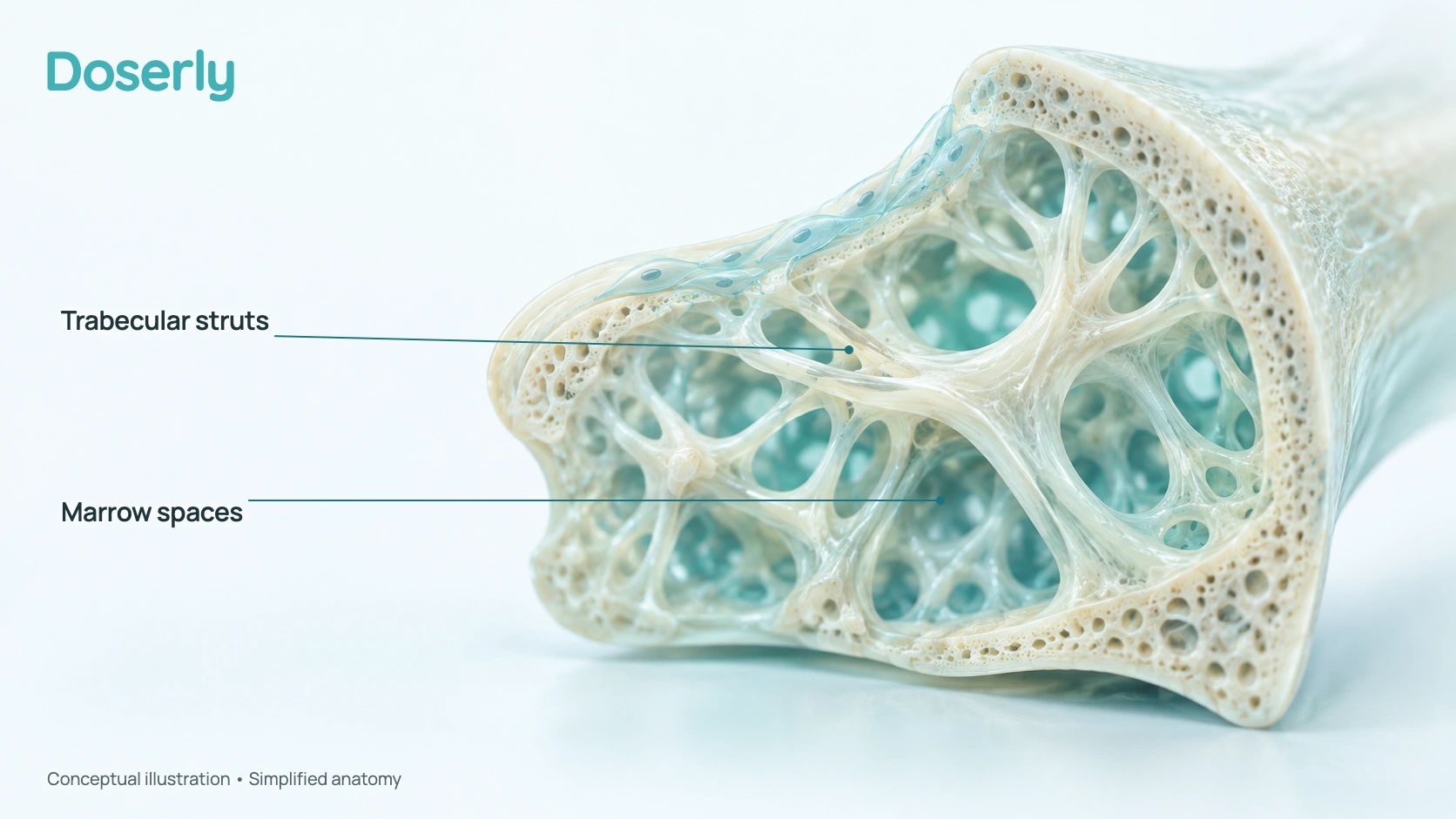
The simplified artwork below shows trabecular anatomy only. It is not microscopy, a density scan or evidence that a boron regimen improves bone.
Hormone, inflammation and cognition claims
Some small studies report short-term changes in steroid hormones or inflammatory markers under restricted diets or specific exposures. Sample sizes, durations and endpoints are insufficient to establish a testosterone-enhancing, cognitive or anti-inflammatory treatment. A laboratory change should not be advertised as a meaningful symptom or disease outcome. [1]
How might boron work?
Boron may interact with mineral metabolism, cell membranes, inflammatory signalling and steroid-hormone pathways. Human boron compounds are rapidly converted largely to boric acid and absorbed, then excreted mainly in urine. [1]
These observations explain why researchers measure mineral and hormone biomarkers. They do not identify an essential human function, a deficiency threshold or an effective regimen.
What are the risks and interactions?
In the United States, dietary supplements generally are not approved by FDA for safety or effectiveness before marketing. In Canada, natural health products require a product licence and an authorized label carries an NPN or DIN-HM. Neither framework establishes that boron improves bone or hormones. [2], [3]
The adult U.S. UL is 20 mg/day total boron, including pregnancy and lactation. Large exposures can cause nausea, vomiting, diarrhea, rash, headache, convulsions and other toxicity. Children have lower age-specific ULs. [1]
Which medicines interact with boron?
ODS reports no known clinically relevant medication interactions, but interaction research is limited. “None known” does not mean “proven none.” Kidney impairment, pregnancy, accidental boric-acid exposure and multi-ingredient products warrant extra review.
For medicines with narrow safety margins or for an upcoming procedure, provide the full product label to the pharmacist or clinician rather than reporting only “boron.”
What should be monitored?
There is no routine validated boron-status test or target for the general population. Mineral, inflammatory or hormone biomarkers from research should not be turned into self-monitoring targets. [1]
Useful records include elemental boron per serving, salt or complex, servings per day, start and stop dates, reason for use, co-ingredients and any gastrointestinal, skin or neurological symptoms.
What do public communities report?
Public discussions often frame boron as a testosterone booster or compare 3 mg with higher servings. These reports can identify questions about products and symptoms, but cannot establish hormone, cognition or bone outcomes because diets, co-supplements, laboratory timing and selection differ.
The previous Doserly dossier reviewed community material, but this overhaul did not independently recrawl or quantify it. No popularity percentage or community consensus is treated as evidence.
How does boron compare with nearby options?
| Guide | What it is | Key difference |
|---|---|---|
| Calcium | Essential major mineral | Has age- and sex-specific total-intake RDAs and adult ULs |
| Vitamin D3 | Essential fat-soluble vitamin | Has RDA, UL and 25(OH)D status framework |
| Vitamin K2 | Menaquinone family | Vitamin K has an AI and a serious warfarin interaction |
| Magnesium | Essential major mineral | Has an RDA; U.S. adult UL applies only to supplements and medicines |
Common questions about boron
Is 1–13 mg/day the recommended range?
No. It is a WHO acceptable safe intake estimate cited by ODS, not an RDA, AI or effective regimen. [1]
Is 3 mg/day a proven bone dose?
No. A small 10-month study used 3 mg/day in 28 young women and measured biomarkers. It did not establish higher BMD or fewer fractures. [1]
Does boron raise testosterone?
Small short-term studies have reported hormone changes, but evidence is insufficient to establish a durable, clinically meaningful testosterone benefit. [1]
Is boron essential?
Not under current U.S. nutrition definitions. No necessary biochemical function or deficiency syndrome has been established in humans, so no RDA or AI exists. [1]
Which boron form absorbs best?
ODS reports no evidence of materially different absorption among common supplement forms. Compare elemental boron, co-ingredients and product quality. [1]
Is 20 mg a useful target?
No. It is the adult U.S. UL for total intake: a chronic safety boundary, not a goal or trial-supported dose. [1]
Can boron be tested in blood?
Boron can be measured in research or exposure settings, but no routine validated status target exists for general supplement use. [1]
Glossary
Plain explanations of the boron, nutrition and research terms used in this guide.
- Essential nutrient
- A substance required for normal function that the body cannot make in sufficient amount; boron is not currently classified as essential for humans.
- Elemental boron
- The mass of boron itself, separate from the total weight of its citrate, glycinate or other compound.
- Recommended Dietary Allowance (RDA)
- Average intake expected to meet the needs of nearly all healthy people in a group; none is established for boron.
- Adequate Intake (AI)
- Reference used when evidence is insufficient to set an RDA; none is established for boron.
- Tolerable Upper Intake Level (UL)
- Highest chronic total intake unlikely to pose risk for most people; the U.S. adult boron UL is 20 mg/day.
- Biomarker
- A measured biological signal that may change without proving a clinical benefit.
- Bone mineral density (BMD)
- A measured estimate of mineral content in bone; the small boron study described here did not establish a BMD benefit.
How this guide was researched
This draft uses the current NIH ODS boron professional monograph and current FDA and Health Canada regulatory pages. Relevant source text was retrieved and read on October 9, 2026. The ODS monograph is an official evidence synthesis; the small biomarker study is described through that current synthesis rather than falsely labelled as a newly read full text.
The protocol table keeps product servings, the WHO safe-range estimate, the U.S. UL and the research schedule in separate rows. It states when the source summary does not establish the supplement salt.
How this guide was made
Research and drafting were AI-assisted. This manuscript is a draft for Doserly editorial review and has not been independently clinically reviewed. Doserly makes a health-tracking app and operates Doserly Academy, both promoted in this guide. Read the editorial policy for corrections and updates.
Explore the sources
The official nutrient monograph and regulatory pages answer different questions. Source notes preserve the reviewed scope.
Showing 3 sources
- 01
Boron - Health Professional Fact Sheet ↗
Official nutrient monograph
Current relevant full-page sections reviewed.
Detail: Essentiality, food exposure, lack of reference intake, label forms and amounts, WHO safe-range context, small human studies, adult UL, toxicity and interaction status.
- 02
Questions and Answers on Dietary Supplements ↗
Regulatory overview
Current official page reviewed.
Detail: U.S. supplements generally lack FDA premarket approval; companies bear initial responsibility and FDA conducts postmarket oversight.
- 03
Product Licensing ↗
Regulatory overview
Current official page reviewed.
Detail: Canadian natural health products require a product licence; authorized labels carry an NPN or DIN-HM.
No matching sources
Try a different term or show the full list.