
In this guide
What is Fadogia agrestis?
Fadogia agrestis is marketed for testosterone and libido, but this current review located no controlled human efficacy or safety trial. The available studies are animal experiments with concerning tissue signals. No nutritional requirement, established human regimen or verified human benefit was found. Rat milligrams per kilogram must not be converted into a self-treatment dose.
Typical Fadogia agrestis Protocols
| Source and population | Form and amount each time | Frequency | Total exposure | Duration or boundary |
|---|---|---|---|---|
| Yakubu 2005 · male rats | Aqueous stem extract 18, 50 or 100 mg/kg | Oral; once every 24 hours | Animal exposure only | 1, 3 or 5 days; sexual-behaviour and testosterone outcomes |
| Yakubu 2008 · male rats | Aqueous stem extract 18, 50 or 100 mg/kg | Oral once daily | Animal exposure only | 28 days + 10-day recovery; adverse testicular indices |
| Yakubu 2009 · male rats | Aqueous stem extract 18, 50 or 100 mg/kg | Oral once daily | Animal exposure only | 28 days; liver/kidney membrane-integrity signals |
These rows reproduce sources. Do not average them into one universal regimen.
From source to outcome
No established regimen.
Do not convert to human dose.
Human risk unknown.
Which forms and label details matter?
The animal papers studied an aqueous stem extract of Fadogia agrestis. A retail capsule that omits species authentication, stem identity, extraction and contaminant testing cannot be treated as the same preparation.
How should it be stored?
Follow the label, close the container and protect it from heat, light and moisture.
Read the label before the claim
Keep species, part and extract together.
A daily total does not reveal the schedule.
Biomarkers do not replace clinical outcomes.
What is it commonly used for?
Marketing focuses on testosterone, libido, fertility and athletic performance. The located evidence does not establish any of these outcomes in humans.
What does human research show?
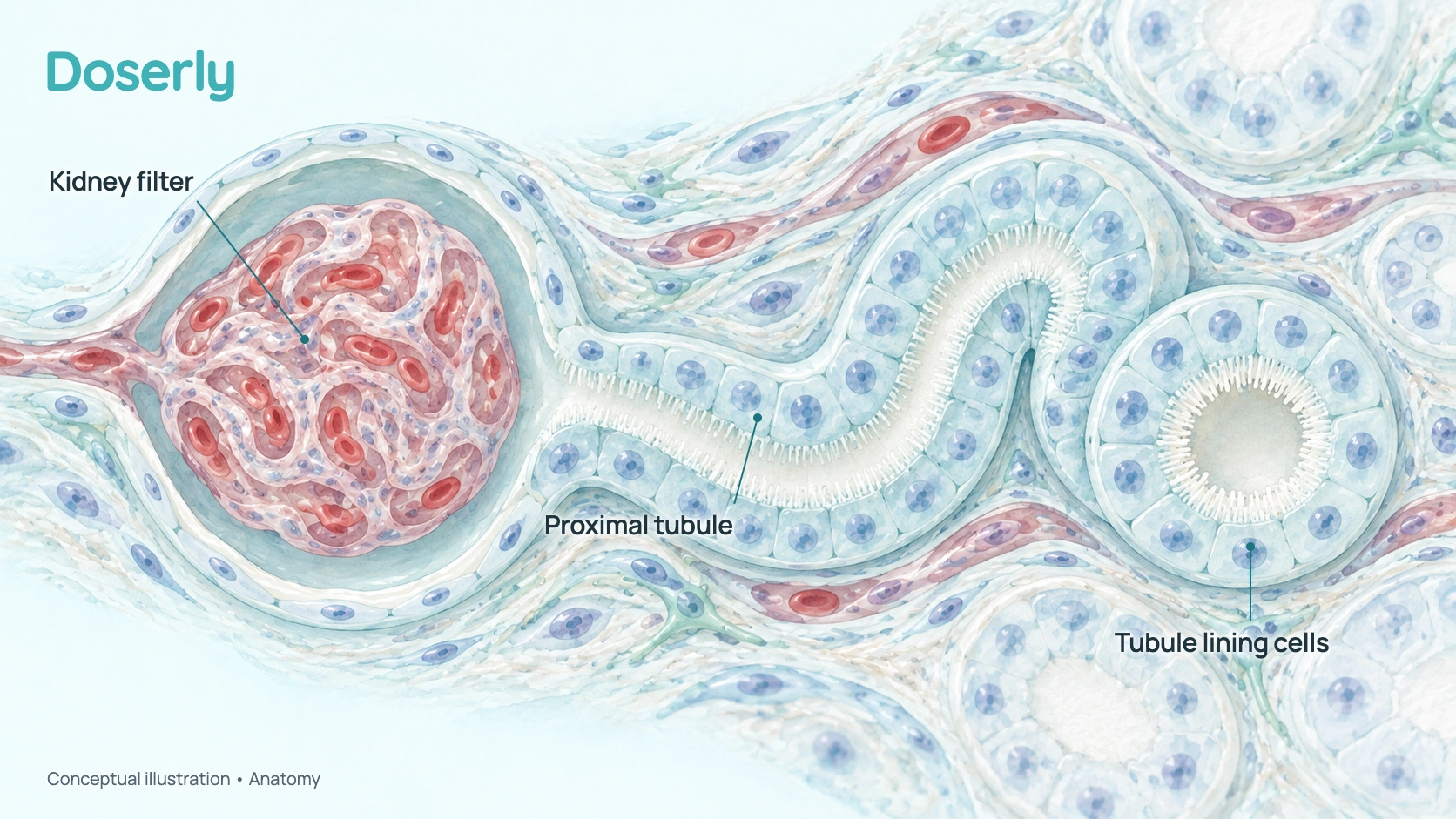
A short rat experiment reported increased testosterone and sexual-behaviour measures after 18–100 mg/kg aqueous stem extract, but it does not show a human benefit. [1] A 28-day rat study at the same levels found adverse changes in testicular function indices at all tested exposures; some indices recovered mainly at 18 mg/kg after ten days, which is not proof of human safety. [2] A separate 28-day rat study reported liver- and kidney-related membrane-enzyme and oxidative-stress changes. [3] These are toxicology signals, not a quantified human risk estimate.
How might it act?
Proposed androgenic activity comes from animal hormone and behaviour observations; the active constituents, human bioavailability, target engagement and dose-response remain unestablished.
How does it compare with related products?
| Product | Identity to preserve | Evidence boundary |
|---|---|---|
| Fadogia agrestis | Species, stem, aqueous extract | Animal evidence only in this review |
| Tongkat ali | Eurycoma species, root extract, markers | Different botanical and human evidence |
| Pine pollen | Pinus species, powder or tincture | Tiny uncontrolled human pilot |
| Zinc | Elemental zinc and deficiency status | Essential nutrient; different clinical question |
What are the risks and interactions?
Human safety is unknown. Animal studies raise testicular, liver and kidney concerns, and product identity or contamination may add uncertainty. Avoid inferring that a lack of human case reports means safety. Pregnancy, breastfeeding, fertility treatment, hormone-sensitive conditions, liver or kidney disease and concurrent medicines require clinician review.
Which medicines require review?
No reliable human interaction trials establish safe combinations. Review hormone-active drugs, fertility treatment, liver- or kidney-active medicines and multi-ingredient performance stacks before use.
Regulatory status: In the United States, supplements generally lack premarket efficacy approval. In Canada, verify the finished product’s NPN or DIN-HM and licensed conditions. [4], [5]
What should be monitored?
Record product, lot, form, amount per administration, frequency, daily total, co-ingredients, meals, symptoms, medicines, chosen outcome and review date.
What happens when it is stopped?
No ingredient-specific withdrawal syndrome is established. Record the stop date, symptoms and chosen outcome; seek care for a persistent serious symptom.
Seek prompt care for a serious allergic reaction, unusual bleeding, persistent palpitations, chest pain or another severe symptom.
What do public communities report?
Public reports can suggest questions to track, but they do not verify the product, dose or causality. This update did not newly quantify a community sample.
Common questions about Fadogia agrestis
Does Fadogia raise testosterone in men?
No controlled human efficacy trial was verified; the claim is extrapolated from rats.
What human dose is supported?
None. Animal mg/kg exposures cannot be converted into a self-treatment schedule.
Did the animal studies show toxicity?
They showed adverse testicular indices and liver/kidney membrane-related signals; human risk is unknown.
Did the lowest rat exposure prove safety?
No. Partial recovery in animals is not evidence of human safety.
Is cycling protective?
No human evidence establishes a protective cycle or washout interval.
What should I record if exposure has already occurred?
Product, lot, species/part, extract, each amount, schedule, co-ingredients, symptoms, medicines and clinician review.
Glossary
Terms for reading the evidence.
- Extract identity
- Species, plant part, solvent or ratio, and any standardization used to define a preparation.
- Amount per administration
- Amount taken at one time, distinct from daily total.
- IPSS / AUASI
- Questionnaires rating lower urinary tract symptom severity; they do not diagnose the cause.
- Qmax
- Maximum measured urinary flow rate.
- PSA
- A prostate-related blood marker; it is not a stand-alone cancer test.
- Monotherapy
- The ingredient was tested without another active intervention.
How this guide was researched
Accessible official sources and human reports were read on October 9, 2026. Titles, authors, journals, DOI, PMID and visible corrections were checked. An unreported frequency was not guessed.
How this guide was made
Research and drafting were AI-assisted. This draft awaits Doserly editorial review and independent clinical review. See the editorial policy.
Explore the sources
Sources preserve form, amount, frequency, population, duration and outcome.
Showing 5 sources
- 01
Aphrodisiac potentials of the aqueous extract of Fadogia agrestis (Schweinf. Ex Hiern) stem in male albino rats. ↗
Animal study
Current page or report reviewed; scope and limits retained.
Detail: 18, 50 and 100 mg/kg; no human inference.
- 02
Effects of oral administration of aqueous extract of Fadogia agrestis (Schweinf. Ex Hiern) stem on some testicular function indices of male rats. ↗
Animal toxicology
Current page or report reviewed; scope and limits retained.
Detail: 28-day testicular-function findings and recovery phase.
- 03
Mode of cellular toxicity of aqueous extract of Fadogia agrestis (Schweinf. Ex Hiern) stem in male rat liver and kidney. ↗
Animal toxicology
Current page or report reviewed; scope and limits retained.
Detail: 28-day liver and kidney membrane-integrity signals.
- 04
Dietary Supplements ↗
Regulatory overview
Current page or report reviewed; scope and limits retained.
Detail: U.S. supplement framework.
- 05
Product Licensing ↗
Regulatory overview
Current page or report reviewed; scope and limits retained.
Detail: Canadian licensing context.
No matching sources
Try a different term or show the full list.