
In this guide
What is a senolytic?
Senolytics are experimental agents intended to preferentially eliminate senescent cells: stressed or damaged cells that have stopped dividing but remain metabolically active. Some senescent cells release inflammatory and tissue-remodelling factors called the senescence-associated secretory phenotype, or SASP. Senescence also has useful roles in wound healing, development and tumour suppression, so “remove all senescent cells” is not a sound clinical goal.
Fisetin and quercetin are plant flavonoids sold as supplements. Dasatinib is a prescription tyrosine-kinase inhibitor used in oncology. Online “senolytic stacks” often combine fisetin with quercetin, but the best-known human senolytic studies used dasatinib plus quercetin. The initials look similar; the intervention, monitoring and risk are not. [1]–[5]
No trial shows that an OTC senolytic stack extends human lifespan, reverses biological age or prevents age-related disease. A change in a tissue marker is target-engagement evidence, not proof of feeling better, functioning better or living longer.
Typical Senolytic Research Protocols
| Study and population | Intervention | Amount each administration | Daily total | Frequency and duration | Main interpretation |
|---|---|---|---|---|---|
| Hickson 2019/2020 · 11 adults with diabetic kidney disease | Prescription dasatinib + quercetin | D 100 mg once; Q 500 mg twice | D 100 mg/day; Q 1,000 mg/day | Three consecutive days; biopsy 11 days later | Uncontrolled target-engagement pilot; corrigendum narrowed several marker conclusions |
| Nambiar 2023 · 12 adults with IPF | Prescription dasatinib + quercetin phytosome | Daily components reported; within-day administration count not reported | D 100 mg/day; Q 1,250 mg/day | Once-daily schedule described at regimen level for three consecutive days/week over three weeks | All doses completed; more non-serious adverse events and no functional benefit |
| Farr 2024 · 60 postmenopausal women | Prescription dasatinib + quercetin phytosome | D 100 mg once; Q 250 mg four times | D 100 mg/day; Q 1,000 mg/day | D for two days and Q for three days every 28 days; five sessions over 20 weeks | Primary CTx result null; early P1NP signal not sustained at week 20 |
The schedules differ because they are experimental protocols for different populations and endpoints. They do not define a dose ladder. The full Nambiar methods describe D and Q as self-administered daily on treatment days but do not support inventing an unreported within-day split. Farr used four separate quercetin administrations. Hickson used 500 mg twice daily. [2]–[4]
- Compound identity
- Record fisetin, ordinary quercetin, quercetin phytosome and prescription dasatinib separately.
- Evidence layer
- Label cell, animal, target-engagement and clinical-outcome evidence rather than collapsing them into one score.
- Correction status
- Use the Hickson corrigendum's raw-data reanalysis, not the superseded transformed findings.
What are senolytics commonly used for?
Longevity and “cell clearing”
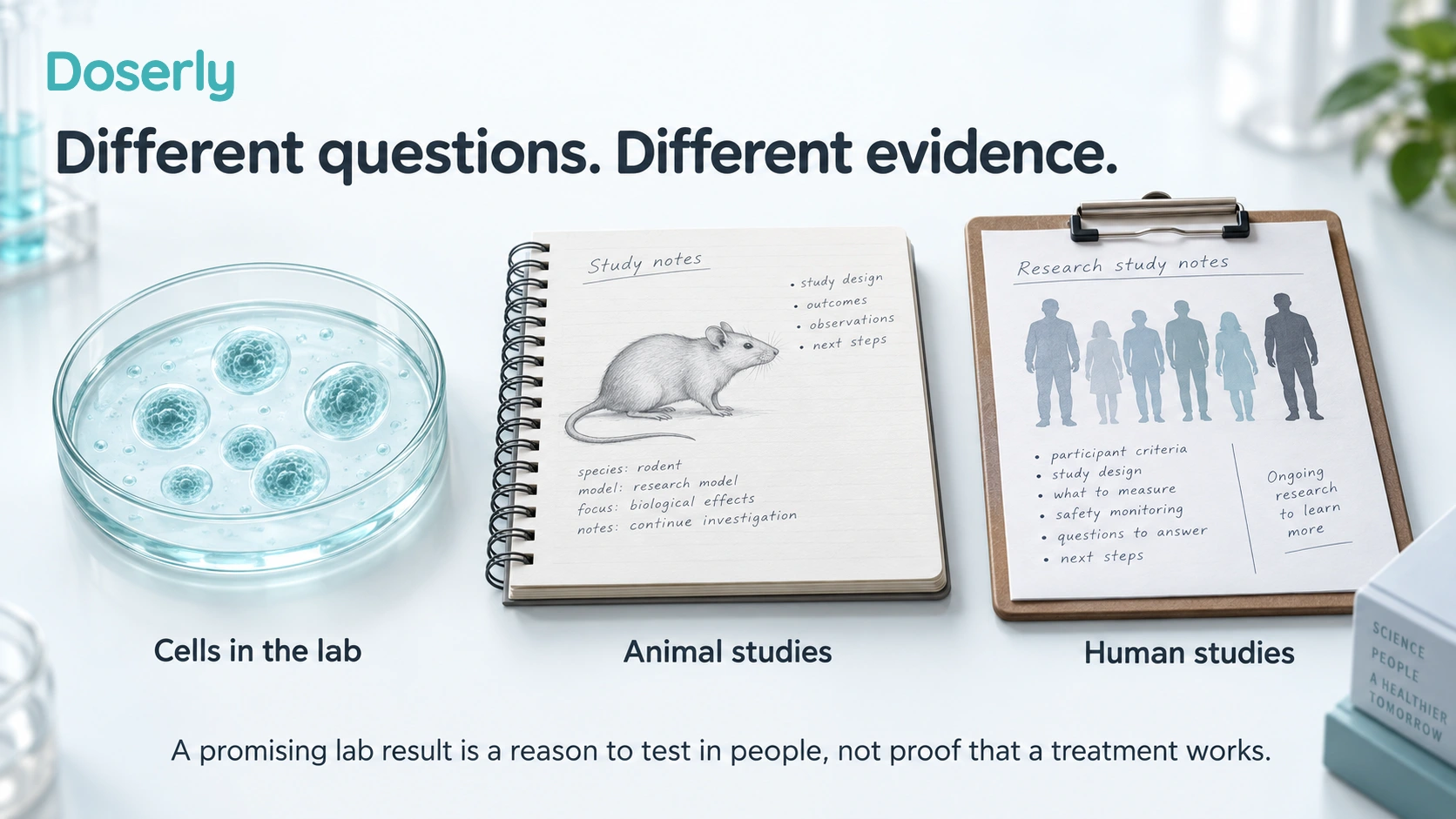
Fisetin extended median and maximum lifespan in old mice in a preclinical study. The paper also detected fisetin metabolites in human plasma, but that human component did not test whether fisetin cleared senescent cells or improved health. Mouse results do not create a human cycle, and no human trial has measured lifespan benefit from fisetin, quercetin or an OTC F+Q stack. [1]
Target engagement
The uncontrolled diabetic-kidney-disease pilot found changes after a three-day D+Q course. Its corrigendum matters: raw-data reanalysis supported decreased adipose p16-positive cells, macrophages, crown-like structures and grouped adipose measures. Individual adipose p21, SA-βgal in the original nine, progenitor proliferation and skin senescence markers were not significant. Composite circulating SASP factors fell. With 11 participants and no concurrent control, this remains preliminary target-engagement evidence. [2]
Function, lung disease and bone metabolism
In the 12-person IPF pilot, every planned dose was completed, but D+Q caused more non-serious adverse events and did not improve pulmonary, frailty or physical-performance measures. In 60 postmenopausal women, the primary bone-resorption marker was null at 20 weeks; an early bone-formation marker signal was not sustained. These studies test feasibility and biomarkers, not healthy-aging benefit. [3], [4]
Evidence transfer
F + Q and D + Q cannot borrow each other's results
How do forms and labels differ?
Fisetin and quercetin labels may state an isolated flavonoid, plant source, particle system, phospholipid complex or proprietary blend. Enhanced exposure is not proof of enhanced senolysis. A 2025 meta-analysis found that quercetin formulation changed bioavailability, but it did not establish a clinical senolytic threshold. [6]
Dasatinib is not a supplement form. It is a prescription antineoplastic drug with labelled contraindications, warnings, interactions and monitoring requirements. Replacing it with fisetin creates a different combination rather than a safer version of the same studied treatment.
How should products be stored?
Follow the finished supplement label for temperature, moisture and expiry; keep the original container and lot number. Do not combine products into an unlabelled “cycle” container. Prescription dasatinib should be stored and handled exactly as directed by the dispensing pharmacy, including any precautions for other household members.
What does the human evidence show?
| Question | Best direct evidence | Finding | Boundary |
|---|---|---|---|
| Does fisetin act as a senotherapeutic? | Cell and mouse experiments | Preclinical activity | Does not establish a human regimen |
| Does D+Q change human target markers? | 11-person uncontrolled pilot plus corrigendum | Selected adipose/composite changes | Corrected skin and several individual results null |
| Does D+Q improve IPF function? | 12-person randomized feasibility pilot | No measured improvement | Very small, short and drug-based |
| Does intermittent D+Q improve bone turnover? | 60-person trial | Primary marker null at week 20 | Early secondary signal not sustained |
| Does OTC F+Q extend healthy human life? | No direct controlled trial | Not established | No validated dose or outcome evidence |
Human trial map
Target signals sit beside null clinical outcomes
The evidence does not establish an anti-aging treatment. It supports continued monitored research into compound-specific, cell-specific effects and appropriate clinical endpoints. [1]–[7]
What are the risks and interactions?
Fisetin supplement safety data are limited, especially for high-dose intermittent stacks. Quercetin commonly causes GI symptoms or headache in some studies, and the 2018 safety review found limited long-term high-dose human data. Concentrated products may interact with medicines through absorption, metabolism or additive effects; theoretical interaction lists do not substitute for a pharmacist review. [5], [7]
Dasatinib has a different risk class. Its prescribing information includes clinically important risks such as myelosuppression, bleeding, fluid retention, cardiovascular effects, pulmonary arterial hypertension and drug interactions. A short intermittent research course is still prescription exposure. Do not obtain or use it as a longevity supplement.
Pregnancy, breastfeeding, childhood use, cancer treatment, bleeding disorders, immune suppression, liver or kidney disease and planned surgery warrant clinician review before concentrated flavonoid use. Seek urgent care for breathing difficulty, chest pain, fainting, unusual bleeding, severe weakness, fever or rapidly worsening symptoms.
What is the legal and regulatory status?
In the United States, fisetin and quercetin products sold as dietary supplements are regulated as supplements; FDA does not approve them to clear senescent cells, prevent age-related disease or extend life. Dasatinib is an approved prescription drug for specific cancers, not an approved aging treatment. [8], [9]
In Canada, verify a natural health product's NPN or DIN-HM in Health Canada's database. Prescription dasatinib remains a drug, and a supplement authorization does not validate a senolytic claim or combination. [10]
What happens when you stop?
No human trial defines withdrawal, persistence or an evidence-based taper for an OTC F+Q stack. Stopping a supplement does not trigger a proven “senescent-cell rebound.” Prescription dasatinib should be started, interrupted or stopped only under the responsible clinician's plan.
What should you monitor?
Record the exact compounds, formulation, amount at each administration, daily total, cycle dates, medicines, new symptoms and the outcome chosen before starting. Ordinary wellness scores or commercial “biological age” tests cannot confirm senolysis.
Clinical-trial monitoring for D+Q reflects its drug risks and study population; it is not a home checklist. A clinician may consider blood counts, liver or kidney measures, bleeding, fluid retention or other assessments based on the medicine and person.
What does community experience add?
Public reports reveal confusion between F+Q and D+Q, enthusiasm for intermittent “hit-and-run” schedules and adverse experiences that may prompt care. They cannot verify cell clearance, product identity or lifespan effects. No systematic current community sample was assembled, so this guide reports no consensus cycle, brand or responder rate.
How do senolytic options compare?
| Option | Practical distinction | Evidence boundary |
|---|---|---|
| Fisetin supplement | Candidate supported mainly by cell and mouse work | No validated human senolytic protocol |
| Quercetin supplement | Flavonoid with formulation-dependent exposure | Bioavailability is not proof of senolysis |
| OTC F+Q stack | Marketed supplement combination | No controlled human senolytic outcome trial |
| Prescription D+Q | Oncology drug plus quercetin in monitored studies | Small mixed trials; drug-level risks |
| Lifestyle and medical risk care | Targets measured function and established disease risks | Does not claim to clear senescent cells |
Common questions
Is fisetin a proven human senolytic?
No. It has compelling preclinical results, but no controlled human trial establishes cell clearance, clinical benefit or a validated cycle. [1], [5]
Is fisetin plus quercetin the same as D+Q?
No. D+Q means prescription dasatinib plus quercetin. Replacing dasatinib with fisetin creates a different, unvalidated intervention.
Did the kidney study prove senescent cells were cleared?
It provided preliminary target-engagement evidence in adipose tissue. The linked corrigendum confirmed selected and grouped adipose findings but withdrew the claim of statistically significant skin-marker reduction. It was small, uncontrolled and not a clinical-benefit trial. [2]
Did D+Q improve lung function?
No improvement in pulmonary, frailty or physical-performance measures was found in the 12-person randomized IPF pilot. [3]
Do senolytics extend human life?
There is no direct evidence that fisetin, quercetin, F+Q or D+Q extends human lifespan.
Is an intermittent schedule safer?
Intermittent exposure may reduce duration, but it does not erase drug or supplement risks. Safety depends on the compound, person, medicines and monitoring.
Can a biological-age test show that a stack worked?
No consumer test has been validated to prove senescent-cell clearance or a clinical benefit from an OTC stack.
Glossary
Plain explanations of senolytic research terms.
- Senescent cell
- A cell in a durable non-dividing state that can have helpful or harmful tissue effects depending on context.
- Senolytic
- An experimental agent intended to preferentially eliminate certain senescent cells.
- Senomorphic
- An agent intended to modify senescent-cell signalling without necessarily killing the cell.
- SASP
- Senescence-associated secretory phenotype: molecules released by some senescent cells.
- Target engagement
- Evidence that an intervention affected its proposed biological target; it is not automatically a patient benefit.
- Corrigendum
- A published correction that can change which findings remain statistically supported.
How this guide was researched
Seven PubMed identities and their linked correction/comment records were checked through NCBI EFetch. Full PMC methods were used for all three human D+Q studies. The Hickson corrigendum and supplementary reanalysis were read in full. Compound, formulation, amount per administration, daily total, schedule, endpoint and correction status were extracted separately.
Research record · checked October 9, 2026
Identity verification: PMID 30279143 is the fisetin preclinical report; PMID 31542391 the diabetic-kidney-disease pilot; PMID 36857968 the randomized IPF pilot; PMID 38956196 the bone trial; PMID 39384074 the fisetin review; PMID 40037045 the quercetin bioavailability meta-analysis; PMID 29127724 the quercetin safety review.
Correction review: PMID 31542391 links to corrigendum PMID 31982828. Its supplementary raw-data reanalysis preserves selected adipose and composite findings but not the original skin-marker conclusion or several individual marker results.
Full-method review: PMC reports established the twice-daily quercetin schedule in Hickson, regimen-level daily administration in Nambiar and four-times-daily quercetin in Farr.
Transfer boundary: fisetin mouse outcomes, prescription D+Q human trials and OTC F+Q remain separate.
Safety boundary: no prescription schedule is presented as consumer instruction.
Explore the sources
Primary trials, correction records, reviews and official regulatory material.
Showing 10 sources
- 01
Fisetin is a senotherapeutic that extends health and lifespan. ↗
Cell, mouse and human-metabolite study
Supports preclinical fisetin interest; does not establish human senolytic efficacy or dosing.
- 02
Corrigendum to 'Senolytics decrease senescent cells in humans: Preliminary report from a clinical trial of Dasatinib plus Quercetin in individuals with diabetic kidney disease' EBioMedicine 47 (2019) 446-456. ↗
Published correction and raw-data reanalysis
Selected adipose and composite findings remained; skin and several individual findings were not significant.
- 03
Senolytics dasatinib and quercetin in idiopathic pulmonary fibrosis: results of a phase I, single-blind, single-center, randomized, placebo-controlled pilot trial on feasibility and tolerability. ↗
Randomized phase I feasibility trial
Twelve participants; more non-serious adverse events and no functional improvement.
- 04
Effects of intermittent senolytic therapy on bone metabolism in postmenopausal women: a phase 2 randomized controlled trial. ↗
Intermittent D+Q trial
Primary CTx result null at week 20; early P1NP signal was not sustained.
- 05
Fisetin as a senotherapeutic agent: Evidence and perspectives for age-related diseases. ↗
Translational review
Summarizes preclinical rationale and limited human evidence.
- 06
Improving quercetin bioavailability: A systematic review and meta-analysis of human intervention studies. ↗
Systematic review and meta-analysis
Formulation changes exposure; exposure does not establish senolysis.
- 07
Safety Aspects of the Use of Quercetin as a Dietary Supplement. ↗
Safety review
Highlights short study durations and limited long-term high-dose evidence.
- 08
Dietary Supplements ↗
Official supplement overview
Explains the U.S. dietary-supplement framework and enforcement role.
- 09
Dasatinib prescribing information ↗
Official drug record
Prescription indications, safety information and approved labelling.
- 10
Licensed Natural Health Products Database ↗
Official product database
Used to verify NPN or DIN-HM authorization for a finished Canadian product.
No matching sources
Try a different term or show the full list.
Editorial note
This guide keeps supplement combinations, prescription drug trials, preclinical mechanisms, corrected biomarkers and clinical outcomes separate. It does not convert research schedules into a longevity protocol.