
Fisetin: The Complete Supplement Guide
On this page
Quick Reference Card
Attribute
Common Name
- Detail
- Fisetin
Attribute
Other Names / Aliases
- Detail
- 3,3',4',7-tetrahydroxyflavone
Attribute
Category
- Detail
- Flavonol polyphenol / longevity-oriented supplement
Attribute
Primary Forms & Variants
- Detail
- Standard fisetin capsules, powder, phytosome or lipid-delivery fisetin, stack formulas marketed as senolytics
Attribute
Typical Dose Range
- Detail
- Human clinical literature is limited. One clinical trial used 100 mg/day for 7 weeks, while senolytic research culture often discusses intermittent gram-level pulse protocols
Attribute
RDA / AI / UL
- Detail
- No RDA, AI, or UL established
Attribute
Common Delivery Forms
- Detail
- Capsule, powder, softgel, blend formulas
Attribute
Best Taken With / Without Food
- Detail
- Commonly discussed with meals or fat-containing meals because fisetin is poorly water soluble
Attribute
Key Cofactors
- Detail
- No essential cofactors established; common stack partners include Quercetin, Resveratrol, NMN, and Nicotinamide Riboside
Attribute
Storage Notes
- Detail
- Store in a cool, dry place away from heat, moisture, and strong light. Enhanced-delivery products may have brand-specific handling notes
Overview
The Basics
Fisetin is a plant compound found naturally in foods such as strawberries, apples, onions, and persimmons. In the supplement world, it gets attention for a very specific reason: some researchers think it may help clear or quiet senescent cells, which are older stressed cells that stop dividing but keep releasing inflammatory signals.
That idea has made fisetin popular in longevity circles. People often describe it as a "senolytic" supplement and use it in short, high-dose pulses rather than as a routine daily vitamin. The problem is that the internet reputation is running ahead of the human evidence. Most of the strongest fisetin data still come from animal work, tissue experiments, and theory-heavy geroscience discussions rather than large, finished human anti-aging trials [2][4][6].
The practical reader takeaway is straightforward. Fisetin is interesting, but it is still an early-stage longevity supplement. If someone is looking for a clearly established daily-health supplement with settled dosing and broad human outcome data, fisetin does not fit that description yet.
The Science
Fisetin is a flavonol polyphenol with the chemical identity 2-(3,4-dihydroxyphenyl)-3,7-dihydroxychromen-4-one and molecular formula C15H10O6 [1]. Its translational appeal comes mainly from senotherapeutic research suggesting that fisetin can reduce senescence markers, inflammatory signaling, and age-linked dysfunction in preclinical systems [2].
The modern interest spike followed a 2018 paper showing that fisetin was the most potent senolytic among several flavonoids tested in senescent murine and human fibroblast systems, with additional benefit signals in aged mice and human adipose tissue explants [2]. Later reviews position fisetin as promising but emphasize the same limitations repeatedly: poor oral bioavailability, uncertain human pharmacokinetics, thin long-term safety data, and the lack of large human clinical-outcome trials [3][4].
Chemical & Nutritional Identity
Property
Chemical Name
- Value
- 2-(3,4-dihydroxyphenyl)-3,7-dihydroxychromen-4-one
Property
Common Name
- Value
- Fisetin
Property
Molecular Formula
- Value
- C15H10O6
Property
Molecular Weight
- Value
- 286.24 g/mol
Property
PubChem CID
- Value
- 5281614
Property
CAS Number
- Value
- Commonly listed as 528-48-3 in compound registries
Property
Category
- Value
- Flavonol polyphenol
Property
Nutrient Status
- Value
- Not an essential nutrient; no RDA, AI, or UL
Property
Common Forms
- Value
- Standard fisetin powder or capsule, enhanced-delivery forms marketed as liposomal or phytosome products
Fisetin is best understood as a polyphenolic phytochemical rather than a vitamin or mineral. That distinction matters because the usual nutrition-reference framework, including deficiency states and daily intake targets, does not apply cleanly here [1].
Mechanism of Action
The Basics
The simplest way to think about fisetin is as a stress-response compound. Researchers are interested in it because it seems to interact with inflammatory signaling, oxidative stress pathways, and the biology of senescent cells. In plain language, the hope is that fisetin may help reduce some of the noisy, damaging cellular behavior that builds up with aging.
That does not mean fisetin has been proven to "clean out old cells" in a clinically reliable way in humans. What it means is that laboratory and animal work support the idea enough to justify human research [2][4][6].
The Science
Fisetin's mechanistic interest centers on antioxidant signaling, inflammatory pathway modulation, and senotherapeutic activity. Reviews describe effects involving oxidative-stress response networks, inflammatory mediators, and pathways relevant to neuroprotection and cellular senescence [3][4]. The 2018 senotherapeutic study is especially important because it showed senolytic activity in selected senescent murine and human cell systems, plus reductions in senescence markers in aged mice and human adipose tissue explants [2].
The mechanistic case is stronger than the clinical one. Fisetin has enough biological plausibility to be clinically interesting, but the evidence still does not justify treating its senolytic reputation as a settled human fact [2][4].
Pathway
Fisetin is best understood as a flavonol with a stress-modulating and senotherapeutic research profile rather than as a classic nutrient pathway supplement. After oral intake, the main bottlenecks are formulation and absorption, because poor solubility may limit how much intact compound reaches circulation [1][3].
From there, the research interest shifts toward downstream effects on oxidative stress, inflammatory signaling, and senescence-related biology rather than one single nutrient-deficiency pathway [2][3][4]. The pathway story is therefore indirect: delivery limits exposure, exposure shapes biologic activity, and biologic activity remains more convincing in preclinical systems than in completed human outcome trials.
Absorption & Bioavailability
The Basics
Fisetin has a major practical weakness: it is not very easy for the body to absorb. This is why so many products market enhanced-delivery forms. The basic issue is simple. Fisetin does not dissolve well in water, so standard oral products may not deliver especially consistent blood exposure [1][3].
This is one of the biggest reasons the supplement is hard to judge. If a person takes a product and notices nothing, that may reflect the biology, the dose, the formulation, or all three at once.
The Science
The 2022 review on fisetin's biopharmaceutical properties explicitly emphasizes poor water solubility, bioavailability limitations, and chemical stability challenges as major barriers to translation [3]. Enhanced-delivery strategies are discussed because formulation may materially change exposure, but the human data comparing commercial product types remain thin [3][4].
That means form matters, but the literature still does not offer a neat answer about which over-the-counter delivery system is best in actual users. This is more a formulation problem than a settled ranking problem.
Research & Clinical Evidence
The Basics
The research story around fisetin is a classic longevity pattern. Animal and lab data create excitement first, then human work starts later and moves much more slowly. That is exactly what happened here.
The strongest enthusiasm comes from senolytic and aging papers, not from broad human supplement trials [2][4][6]. The clearest finished human study in this dossier is a small randomized colorectal cancer trial where 100 mg/day fisetin lowered IL-8 and some inflammatory markers over seven weeks, but that is a narrow medical context and not a general anti-aging result [5].
The Science
Fisetin's clinical-evidence profile is mixed and still early. The foundational senotherapeutic paper is preclinical and ex vivo, not a definitive human trial [2]. A 2021 geroscience paper shows fisetin had moved into multiple human-trial settings, but that paper is best read as evidence of translational interest, not proof of efficacy [6]. The 2024 review is similarly encouraging but cautious, repeatedly noting that human safety, efficacy, and dose optimization remain unresolved [4].
The strongest direct human efficacy signal in this dossier comes from the 2018 colorectal cancer RCT. There, 100 mg/day fisetin reduced IL-8 and some inflammatory markers during chemotherapy, which supports biologic activity in humans without proving broad anti-aging or wellness benefits [5].
Evidence & Effectiveness Matrix
Category
Longevity & Neuroprotection
- Evidence Strength
- 5/10
- Reported Effectiveness
- 5/10
- Summary
- Mechanistic and animal interest is strong, but completed human anti-aging outcome data remain limited.
Category
Energy Levels
- Evidence Strength
- 3/10
- Reported Effectiveness
- 4/10
- Summary
- Human evidence is thin and community reports are stack-confounded.
Category
Focus & Mental Clarity
- Evidence Strength
- 2/10
- Reported Effectiveness
- 3/10
- Summary
- Little human evidence supports cognition claims, and the clearest community report in this run is negative.
Category
Joint Health
- Evidence Strength
- 2/10
- Reported Effectiveness
- 4/10
- Summary
- Anecdotal reports cut both ways and the KB does not support strong joint-health claims.
Category
Side Effect Burden
- Evidence Strength
- 4/10
- Reported Effectiveness
- 4/10
- Summary
- Major toxicity signals are not dominant in this dossier, but tolerability is inconsistent and dose culture is messy.
Category
Treatment Adherence
- Evidence Strength
- 3/10
- Reported Effectiveness
- 4/10
- Summary
- Real-world adherence depends more on senolytic belief and pulse-protocol tolerance than on obvious daily benefits.
Category
Daily Functioning
- Evidence Strength
- 2/10
- Reported Effectiveness
- 3/10
- Summary
- The small community dataset leans mixed-negative because of fatigue and brain-fog anecdotes.
Benefits & Potential Effects
The Basics
The main reason people buy fisetin is not because they can feel an immediate effect. They buy it because they hope it is doing something deeper, usually related to inflammation, healthy aging, or senolytic biology.
That makes fisetin different from supplements where people expect a fast change. With fisetin, the typical story is either "I think this may be helping over time" or "I cannot tell if anything is happening." That uncertainty is not a bug in the guide. It is part of the honest evidence picture [2][4].
The Science
Potential benefits are best described as biologically plausible, early-stage, and context dependent. Preclinical work supports interest in senescence reduction, inflammatory signaling, oxidative-stress modulation, and neuroprotection-related pathways [2][3][4]. The human colorectal-cancer trial supports some anti-inflammatory activity, but it does not justify sweeping wellness or lifespan claims [5].
Some readers may find that frustrating, but it is also the cleanest way to read the literature. Fisetin is not evidence-free. It is evidence-uneven.
When you're taking multiple supplements, it's hard to know which one is doing the heavy lifting. The benefits described above may overlap with effects from other items in your stack, lifestyle changes, or seasonal variation. Doserly helps you untangle that by keeping everything in one place, with timestamps, doses, and outcomes logged together.
Over time, this builds something more valuable than any product review: your personal evidence record. You can see exactly when you started this supplement, what else was in your routine at the time, and how your tracked health markers responded. That clarity makes the difference between guessing and knowing, whether you're talking to a healthcare provider or simply deciding if it's worth reordering.
Connect protocol changes to labs and health markers.
Doserly can keep lab results, biomarkers, symptoms, and dose history close together so follow-up conversations have better context.
Insights
Labs and trends
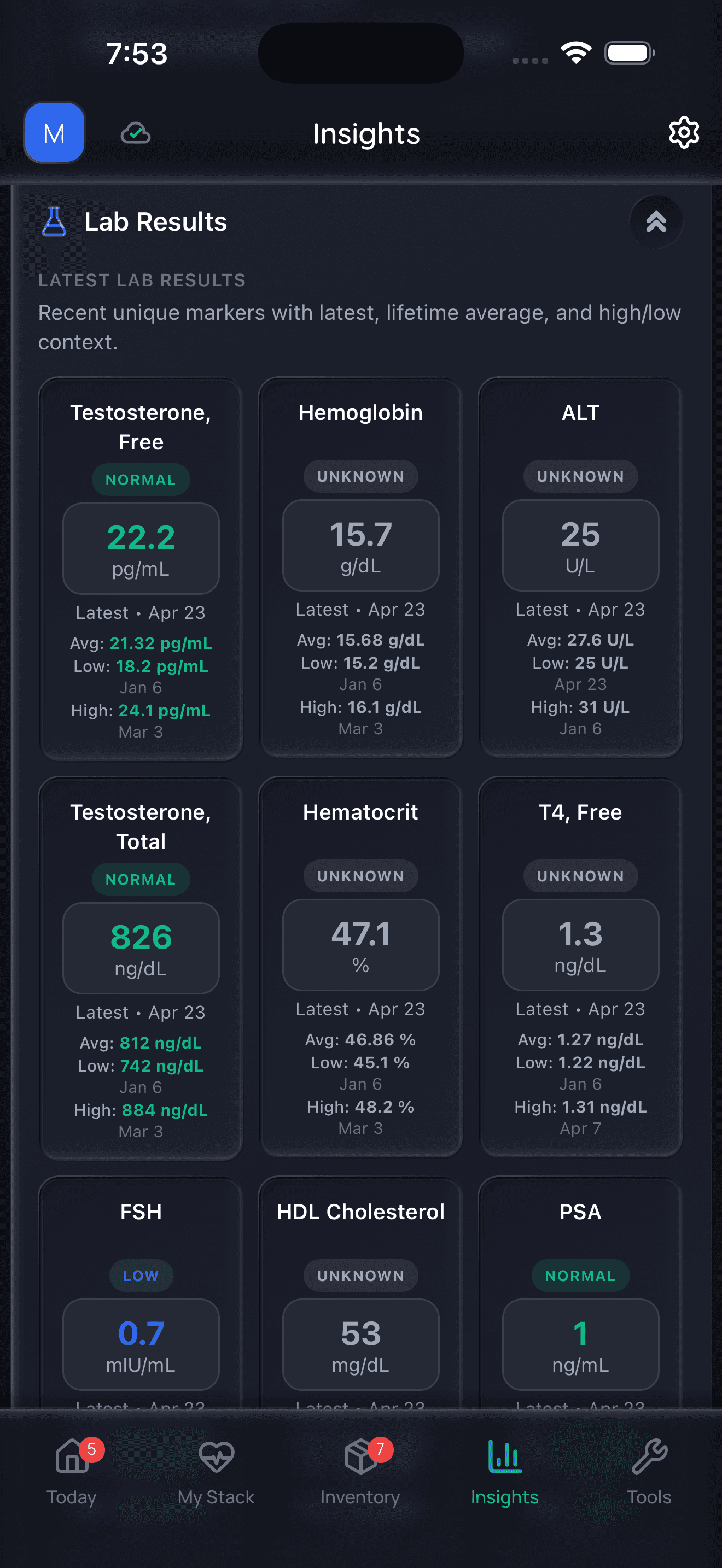
Doserly organizes data; it does not diagnose or interpret labs for you.
Side Effects & Safety
The Basics
The fisetin safety story is not one of obvious daily toxicity, but it is also not settled enough to call carefree. The bigger issues are uncertainty, online dose escalation, and the fact that people often combine fisetin with other longevity compounds.
Community reports in this run mention fatigue, brain fog, and pain flare-ups after high-dose pulse use. Those are not proof that fisetin is broadly unsafe, but they are enough to justify caution and better monitoring.
The Science
Short-term clinical exposure exists, but long-term safety in healthy adults remains limited [4][5][6]. The most grounded approach is to separate three different safety questions:
- Is fisetin a known high-toxicity supplement at ordinary doses? Current sources do not suggest that.
- Is the human safety database complete enough for confident anti-aging self-experimentation? No [4][6].
- Do real-world users sometimes tolerate fisetin poorly, especially in pulse protocols? Yes, based on community reporting.
The risk conversation is therefore less about one dramatic red flag and more about incomplete human data plus protocol drift.
Managing side effect risks across a multi-supplement stack can feel overwhelming, especially when interactions between supplements, medications, and foods add layers of complexity. Doserly brings all of that into a single safety view so nothing falls through the cracks.
Rather than researching every possible interaction yourself, the app checks your full stack automatically and flags supplement-drug and supplement-supplement interactions that warrant attention. If you do experience something unexpected, logging it takes seconds, and over time the app helps you spot patterns: whether symptoms correlate with specific doses, timing, or combinations. One place for the safety picture that matters most when your stack grows beyond a few bottles.
Capture changes while they are still fresh.
Log symptoms, energy, sleep, mood, and other observations alongside protocol events so patterns do not live only in memory.
Trend view
Symptom timeline
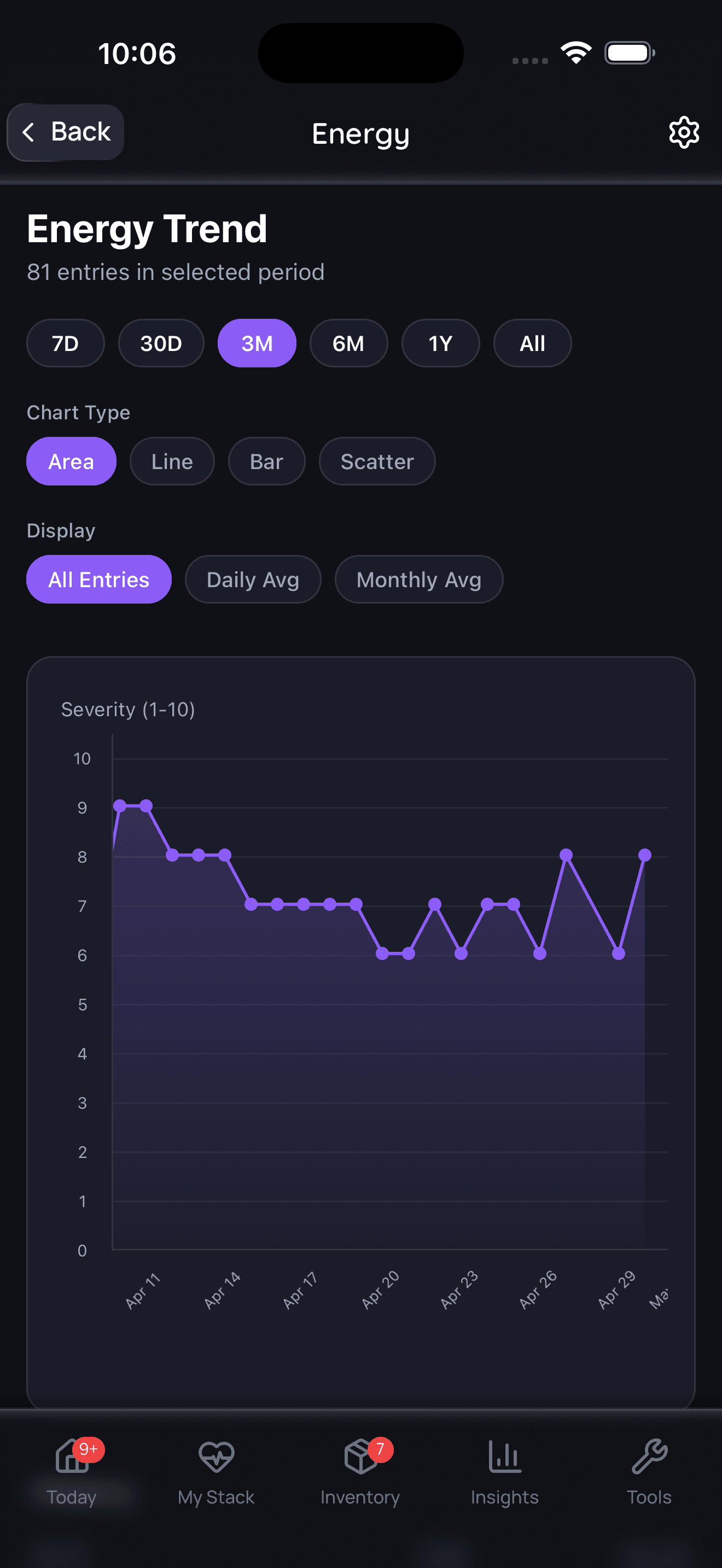
Symptom tracking is informational and should be interpreted with a qualified clinician.
Dosing & Usage Protocols
The Basics
Fisetin dosing is one of the messiest parts of the category. The human trial in this dossier used 100 mg/day for seven weeks in colorectal cancer patients [5]. Online senolytic discussions often talk about much higher short pulse protocols. These are not the same context, and they should not be treated as interchangeable.
That is why fisetin dosing conversations feel confusing. Some sources are discussing clinical anti-inflammatory use in a defined population. Others are discussing speculative senolytic theory in self-experimenters.
The Science
The cleanest way to present fisetin dosing is as a set of incompatible contexts rather than a single number. A low daily clinical dose exists in one cancer-support study [5]. Senolytic trial culture uses a different frame, often based on intermittent administration and fundamental-aging hypotheses rather than daily wellness use [6]. Review literature acknowledges that human dose optimization remains unsettled [4].
When your stack includes several supplements, each with its own dose, form, and timing requirements, the logistics alone can derail consistency. Doserly consolidates all of it into one protocol view, so every dose across your entire routine is accounted for without spreadsheets or guesswork.
The app also tracks cumulative intake for nutrients that appear in multiple products. If your multivitamin, standalone supplement, and fortified protein shake all contain the same nutrient, Doserly adds them up and shows you the total alongside recommended and upper limits. Managing a thoughtful supplement protocol shouldn't require a degree in nutrition science. The app handles the complexity so you can focus on staying consistent.
Track injection timing, draw notes, and site rotation.
Doserly helps keep syringe-related notes, injection site history, reminders, and reconstitution context together for easier review.
Injection log
Site rotation
Injection logs support record-keeping; follow clinician instructions for administration.
What to Expect (Timeline)
Fisetin is not a supplement with a clear consumer timeline. Most of the meaningful claims are long-horizon or theory-driven, while short-term user reports are often too subjective to interpret cleanly.
- Days 1-3: People using pulse protocols may notice nothing, vague fatigue, or mild side effects rather than obvious benefits.
- Weeks 1-8: In a defined clinical setting, anti-inflammatory marker changes have been reported, but this does not automatically translate into obvious felt improvements in healthy users [5].
- Longer horizons: Most community hopes relate to aging biology, which is exactly where the evidence is thinnest and the expectations are easiest to overstate [2][4][6].
Interactions & Compatibility
SYNERGISTIC
- Quercetin: Often paired in senolytic conversations and in the Senolytics stack concept.
- Resveratrol: Commonly grouped with fisetin in longevity-oriented stacks.
- NMN and Nicotinamide Riboside: Frequently co-used in anti-aging routines, though evidence for the stack is not standardized.
CAUTION / AVOID
- Multi-compound longevity stacks: Attribution gets weak very quickly when fisetin is layered with several experimental or semi-experimental compounds.
- Cancer-care settings: The existence of cancer-trial data does not make fisetin a general-purpose adjunct outside clinical supervision.
- Athletic settings: "Not clearly prohibited" is not the same as contamination-safe. Product quality still matters [8].
How to Take / Administration Guide
Most fisetin products are sold as standard capsules or powders, while premium products emphasize enhanced-delivery systems. The practical administration question is less about fancy protocol complexity and more about product form, consistency, and whether the intended use is routine daily supplementation or intermittent senolytic-style experimentation.
Because fisetin is poorly water soluble, fat-containing meals or delivery systems are often discussed as potentially helpful for exposure [3]. Beyond that, the literature is not strong enough to claim a single superior over-the-counter protocol for everyone.
Choosing a Quality Product
Quality matters here because fisetin is often sold into a hype-heavy longevity market.
- Look for third-party testing or athlete-focused certification if contamination risk matters.
- Be careful with products that market vague "senolytic" claims without explaining dose, form, or testing.
- Prefer products that clearly label the amount of fisetin and the delivery form.
- Be extra cautious with blend formulas that hide ingredient quantities under proprietary labels.
Storage & Handling
Current sources support only general supplement-storage guidance.
- Keep fisetin in a cool, dry place away from heat, moisture, and strong light.
- Follow brand-specific storage notes for enhanced-delivery products.
Lifestyle & Supporting Factors
Fisetin is best understood as part of a broader healthy-aging conversation, not as a replacement for basic lifestyle work. Sleep, physical activity, diet quality, and cardiometabolic health still matter more than any single longevity supplement.
Because fisetin is present in foods such as strawberries, apples, onions, and persimmons, dietary pattern still matters even if supplemental exposures are much higher than food intake [1]. For readers interested in longevity, the more defensible strategy is usually to treat fisetin as a speculative adjunct rather than the centerpiece of the plan.
Regulatory Status & Standards
- United States: Fisetin products are sold as dietary supplements, which means they are regulated as food rather than as approved drugs [7].
- Athlete status: USADA directs athletes to the current WADA list and warns that supplement contamination remains a real risk even when the ingredient itself is not a standard prohibited substance [8].
- Clinical trials: Fisetin has clear translational interest and has appeared in human clinical-trial settings, especially geroscience-oriented work [6].
FAQ
Is fisetin a proven senolytic in humans?
No. It is a promising senolytic candidate, but the human evidence base is still early and incomplete [2][4][6].
Is fisetin the same as quercetin?
No. They are both flavonoids and are often discussed together, but they are distinct compounds with different evidence bases and commercial positioning [2][3].
What dose do people use?
Based on available sources, the literature does not support a single universal fisetin dose. Human trial dosing and senolytic internet protocols reflect different contexts [4][5][6].
Why do so many fisetin products emphasize liposomal or phytosome delivery?
Because fisetin has poor water solubility and limited bioavailability, so formulation is a major selling point [3].
Does fisetin clearly improve energy?
Current sources do not support that as a reliable outcome. Community reports are mixed and often confounded by stacks.
Can fisetin help with inflammation?
It may have anti-inflammatory activity based on mechanistic work and one small human trial, but the evidence is not broad enough to treat as a general anti-inflammatory solution [5].
Is fisetin safe for athletes?
The better answer is that contamination risk still matters. Athletes should verify status and use high-quality, tested products rather than assuming any supplement is safe by default [8].
Why do some people use pulse protocols?
Because senolytic theory often uses intermittent dosing logic rather than standard daily supplementation. That theory is one reason fisetin is interesting, but it does not make the protocol settled or universally appropriate [2][4][6].
Myth vs. Fact
Myth
Fisetin is already proven to slow aging in humans.
- Fact
- The strongest fisetin evidence is still preclinical or early phase human work, not definitive human anti-aging trials [2][4][6].
Myth
More fisetin is automatically better because senolytics are pulsed.
- Fact
- Dose framing is unresolved, and internet pulse protocols should not be treated as proven clinical guidance [4][5][6].
Myth
Fisetin is just another antioxidant berry supplement.
- Fact
- It is a flavonol, but the main supplement interest comes from senolytic and geroscience research rather than ordinary antioxidant marketing [2][3].
Myth
If an ingredient is not clearly banned, athletes do not need to worry.
- Fact
- Athlete risk often comes from contamination and label quality, not only the named ingredient [8].
Myth
Community enthusiasm proves fisetin works.
- Fact
- Community reports are mixed, heavily self-selected, and strongly confounded by stacks and experimental protocols.
Sources & References
- PubChem. Fisetin compound record. https://pubchem.ncbi.nlm.nih.gov/compound/Fisetin
- Yousefzadeh MJ, et al. Fisetin is a senotherapeutic that extends health and lifespan. EBioMedicine. 2018. https://pubmed.ncbi.nlm.nih.gov/30279143/
- Elsallabi O, et al. Fisetin as a Senotherapeutic Agent: Biopharmaceutical Properties and Crosstalk between Cell Senescence and Neuroprotection. Molecules. 2022. https://pubmed.ncbi.nlm.nih.gov/35164003/
- Review on fisetin in age-related disease and senotherapeutic translation. Mechanisms of Ageing and Development. 2024. https://pubmed.ncbi.nlm.nih.gov/39384074/
- Randomized colorectal-cancer clinical trial evaluating fisetin and inflammatory markers. Food and Function. 2018. https://pubmed.ncbi.nlm.nih.gov/29541713/
- Verdoorn BP, et al. Fisetin for COVID-19 in skilled nursing facilities: Senolytic trials in the COVID era. J Am Geriatr Soc. 2021. https://pubmed.ncbi.nlm.nih.gov/34375437/
- FDA. Dietary Supplements. https://www.fda.gov/consumers/consumer-updates/dietary-supplements
- USADA. Prohibited List and athlete supplement risk guidance. https://www.usada.org/athletes/substances/prohibited-list