
In this guide
What does this guide compare?
Research-context compounds should not be mistaken for routine nutritional supplements.
This collection compares products discussed around one topic. It is not a protocol to take in full. Links to individual profiles appear after the article.
| Reference point | Context |
|---|---|
| Products compared | 10 |
| Evidence scope | Ingredient, formulation, population and measured outcome |
| Complete combination | The cited studies do not automatically validate all members together |
Which products are compared?
Piracetam, Aniracetam, Oxiracetam, Phenylpiracetam, Noopept, Modafinil/Adrafinil, Phenibut, Sunifiram, Methylene Blue, Paraxanthine.
Individual profiles describe formulation, source-reported amounts, tolerability and interactions. Those details remain ingredient-specific. An amount studied alone is not automatically appropriate in a combination.
How do their roles differ?
Nootropic is a marketing or use-context label, not a pharmacological class. This collection includes experimental compounds and medicines with different nervous-system targets. Findings for nutrients, caffeine or a prescribed medicine do not establish efficacy for racetams, phenibut or other research compounds. [1][2][3]

What does the research show?
The FDA states that phenibut does not meet the U.S. statutory definition of a dietary ingredient. Inclusion in a supplement library is therefore informational and does not establish lawful supplement status. Research uncertainty should be explicit rather than converted into a cognitive-enhancement score or a default regimen. [1][2][3]
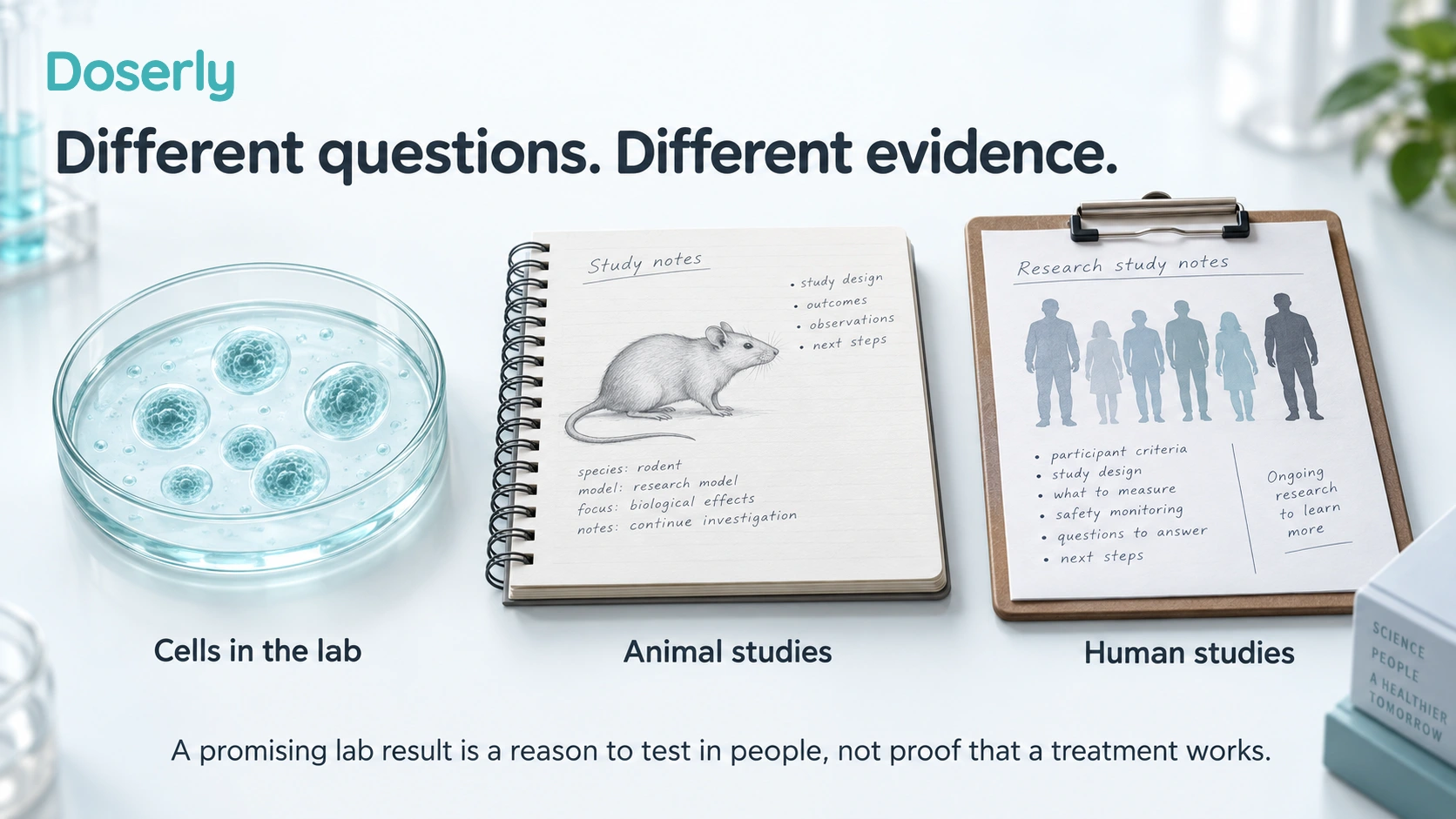
An observational association, a laboratory finding and a perceived benefit answer different questions. Randomized trials need their comparator, duration and population kept in view. An inconclusive result does not establish that an effect is impossible; it limits the claim that can be made.
Which regulatory categories are being compared?
This navigation category includes substances with materially different status. The label “nootropic” supplies no common approval, safety standard or indication.
Modafinil is a U.S. prescription, Schedule IV drug. Its label covers excessive sleepiness associated with narcolepsy, obstructive sleep apnea and shift work disorder in adults. That is different from approval for general memory enhancement, and it does not transfer to adrafinil. The label includes serious-rash, psychiatric and cardiovascular warnings, plus an interaction that can reduce steroidal-contraceptive effectiveness. These are prescribing matters, not ordinary supplement-label comparisons. [7]
Other marketed nootropics require substance-specific review. FDA’s 2019 Peak Nootropics warning letter addressed products including adrafinil, aniracetam, Noopept, oxiracetam, phenylpiracetam and piracetam as unapproved new drugs for the claims made. This dated enforcement action is not an approval or a survey of every current product. The separate FDA phenibut ingredient page directly states that phenibut does not qualify as a dietary ingredient. Neither online availability nor this library listing establishes lawful dietary-supplement status. [6], [1]
Which overlaps and risks matter?
Cautions and interactions
Dependence, sedation and medicine interactions are materially different concerns from a nutritional shortfall. Unknown long-term safety is not evidence of safety. Product availability online does not establish quality, approval, or suitability for cognitive symptoms. [1][2][3]
A complete product list includes prescription medicines, nonprescription products and supplements. Combination formulas can conceal duplicate ingredients. Timing and spacing from a medicine should follow its labeling and pharmacist guidance; this collection does not supply a universal timetable.
Regulatory status
In the United States, FDA does not approve dietary supplements for safety and effectiveness before marketing. In Canada, a natural health product requires a product licence before sale; its NPN or DIN-HM must match the finished product. An ingredient name or inclusion in this collection does not establish that every product or claim is authorized. Authorization also does not validate the complete combination. [4], [5]
What should be recorded and how should changes be interpreted?
Doserly brings dose logs, symptoms and routine changes together. For this collection, useful observations include exposure history, alertness, sleep, adverse effects and the complete medication list for professional review.
- Doses and adherence: record the formulation, amount actually taken, timing and missed doses so observations have context.
- Potential benefits and tolerability: compare consistent symptoms or measurements over time alongside sleep, food and activity changes. Personal trends help evaluate the experience without proving causal efficacy.
- Product list: maintain the full product list for review with a pharmacist or clinician.
- AI monthly reports: summarize recorded doses, symptoms and trends to prepare for a discussion. Reports depend on the data entered and are not a diagnosis or an instruction to change treatment.
Explore the topic further
Common questions
Does inclusion in this directory mean the product is a lawful dietary supplement?
No. This category includes ingredients and drugs with different regulatory situations. FDA specifically does not recognize phenibut as a dietary ingredient; prescription modafinil has a separate drug label. [1][7]
Is adrafinil interchangeable with prescription modafinil?
No. A related pharmacology does not establish the same product quality, authorized uses or safety. The cited FDA warning concerns an identified marketer and claims; it does not create a general safe-use protocol. [6][7]
Can a phenibut routine be stopped according to a generic supplement schedule?
Dependence and withdrawal need individual medical assessment. This directory does not provide a self-directed withdrawal schedule or a substitution regimen. [8]
Glossary
Terms for interpreting the comparisons.
- Formulation
- The exact preparation, including its ingredients, their forms and labeled amounts.
- Study population
- The people included in a study; their characteristics limit where its result applies.
- Comparator
- The placebo, treatment or condition used as the comparison.
- Measured outcome
- What the study evaluates, such as a symptom, laboratory result or clinical event.
- Overlap
- The same ingredient appearing in more than one product used together.
How was this guide researched?
Sources and limits
This AI-assisted educational guide compares the cited public references. Findings remain tied to the ingredients, preparations and populations studied. It is not a systematic review or independent medical peer review. Doserly develops a commercial tracking app. Illustrations explain concepts; app screens show example data. Report a correction with its source to Doserly support.
Explore the sources
The references below provide context for the claims and their limits.
Showing 8 sources
- 01
FDA — Phenibut in dietary supplements ↗
Public reference
Check the reported population, preparation and limitations.
- 02
NCCIH — Weight loss, bodybuilding and sexual enhancement ↗
Public reference
Check the reported population, preparation and limitations.
- 03
NCCIH — Herb–drug interactions ↗
Public reference
Check the reported population, preparation and limitations.
- 04
FDA — Questions and Answers on Dietary Supplements ↗
Regulatory reference
United States dietary supplement regulation.
- 05
- 06
Peak Nootropics LLC aka Advanced Nootropics: Warning Letter 557887 ↗
Regulatory source
Dated enforcement action for named products and marketing claims.
- 07
PROVIGIL (modafinil): Prescribing information ↗
Regulatory source
Prescription status, indications, warnings and interactions; selected sections read.
- 08
Phenibut exposures reported to poison centers — United States, 2009–2019 ↗
Poison-center surveillance
Reported exposure harms; does not establish the incidence among all users.
No matching sources
Try a different term or show the full list.