
In this guide
What is TRT blood work?
TRT blood work is the set of blood tests used to confirm low testosterone before treatment and to check the dose and its safety afterwards. Before starting, guidelines require symptoms plus at least two low morning testosterone tests, and US product labels require two morning tests below the normal range on separate days. On treatment, the core tests are testosterone, to see whether the dose lands in range, and hematocrit, the share of blood made up of red cells, which testosterone raises. Men of prostate-screening age also have PSA checked. [1], [2], [3], [4]
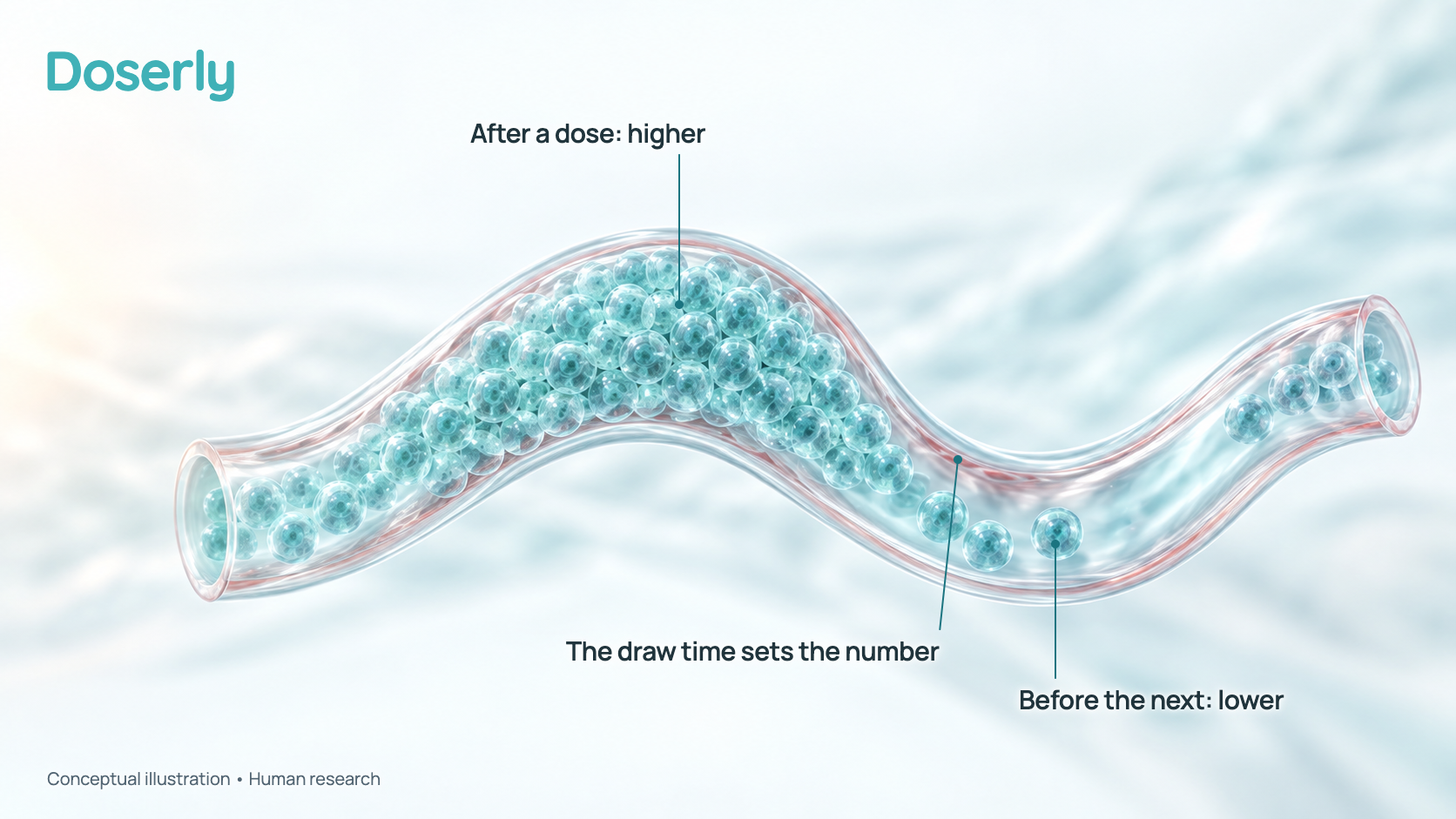
A testosterone result only means something once you know when it was drawn. On injections, the level climbs for a few days after a dose and then falls until the next one, so a sample taken the day after an injection can read far higher than one taken just before the next. Gels, capsules, pellets and long-acting injections each follow their own pattern, and their labels give specific draw times. [14], [15], [16]
This guide covers the timing, targets, units and monitoring schedule. Hematocrit thresholds have their own guide, hematocrit on TRT, as do PSA and the prostate, estradiol and how low testosterone is diagnosed.
TRT blood work: the key numbers
This table shows the testosterone target, the draw timing and the testing schedule in every major clinical guideline. The numbers are what each document says, checked in September 2026.
| Guideline (version, year) | Testosterone target | When to draw: injections | When to draw: gels | How often |
|---|---|---|---|---|
| AUA, American Urological Association (2018, validity confirmed 2024) | 450–600 ng/dL (15.6–20.8 nmol/L) | After 3–4 cycles; historically mid-cycle (no data on the best time) | 2–4 weeks after starting | Every 6–12 months once stable |
| Endocrine Society (2018) | Middle of normal: adjust if above 600 or below 350 ng/dL (about 20.8 or 12.1 nmol/L) | Midway between injections | 2–8 hours after application, after at least 1 week | 3–6 months after starting, 12 months, then yearly |
| EAU, European Association of Urology (2026) | Normal range; the Testosterone Trials range, 280–873 ng/dL (9.6–30 nmol/L), is one approach | By product; long-acting undecanoate at the trough, above 12 and below 18 nmol/L | 2–4 hours after application | 3, 6 and 12 months, then yearly |
| BSSM, British Society for Sexual Medicine (2023) | 15–30 nmol/L (433–865 ng/dL) | Trough, just before the next injection | 2–4 hours after application, avoiding skin contamination | 3 and 6–12 months, then yearly |
| CUA, Canadian Urological Association (2021) | 14–17 nmol/L (404–490 ng/dL) | Mid-cycle | Not stated | Before starting, at 3 and 6 months, then yearly |
| ICSM, International Consultation on Sexual Medicine (2024) | Middle of the normal range | Mid-cycle for short-acting injections | Not stated | Not stated |
| Society for Endocrinology, UK (2022) | Gels: middle of normal. Injections: a trough at the lower end of normal | Trough; long-acting undecanoate before the 3rd injection, then every 3–5 injections | About 2–6 hours after application, away from the gel site | By product |
| VA, US Department of Veterans Affairs (January 2026) | Within the lab's limits; adjust above 900 ng/dL | Midway (day 3–4 on weekly dosing) | 2–8 hours after application, after at least 1 week | 3–6 and 12 months |
| ESA, Endocrine Society of Australia (2016) | Trough in the lower part of normal; long-acting undecanoate 10–15 nmol/L | Trough | Trough | Blood count at 3 months, then yearly |
[1], [2], [4], [5], [17], [18], [19], [6], [7]
Most bodies aim for the middle of the normal range, but they draw blood at different points, midway between injections or at the trough, and their target numbers differ. A result has to be read against its draw timing and the rule your prescriber follows. [2], [6], [5], [7], [1]
US labs usually report testosterone in ng/dL, and most other countries use nmol/L. To convert, multiply nmol/L by 28.84: 15 nmol/L is 433 ng/dL. The Endocrine Society's lower limit of normal, 264 ng/dL, is 9.2 nmol/L. [20], [2] The testosterone unit converter does the arithmetic, and the units table below covers the other tests.
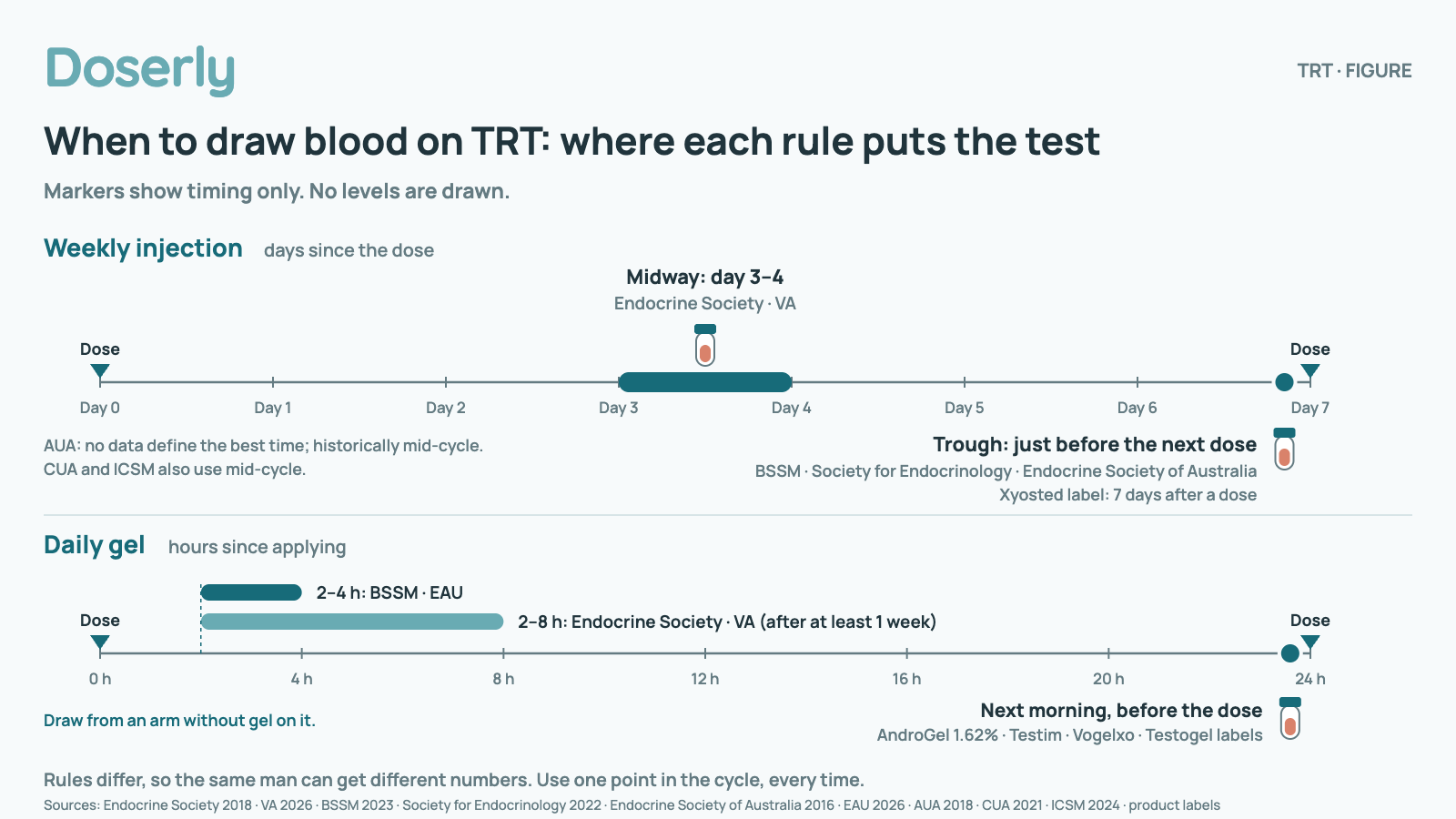
When to draw blood on TRT: where each rule puts the test
Markers show timing only. No levels are drawn.
Weekly injection
- Midway: day 3–4
Endocrine Society · VA
- Trough: just before the next dose
BSSM · Society for Endocrinology · Endocrine Society of Australia · Xyosted label (7 days after a dose)
AUA: no data define the best time; historically mid-cycle. CUA and ICSM also use mid-cycle.
Daily gel
- 2–4 hours after applying
BSSM · EAU
- 2–8 hours after applying
Endocrine Society · VA (after at least 1 week)
- Next morning, before the dose
AndroGel 1.62% · Testim · Vogelxo · Testogel labels
Draw from an arm without gel on it.
Rules differ, so the same man can get different numbers. Use one point in the cycle, every time.
Why do guidelines disagree on injection timing?
Because we found no trial comparing the two approaches. The AUA says plainly that "no data exist on the optimal timing of the blood draw within a cycle". [1]
Each timing answers a different question. A mid-interval level estimates the average across the cycle, which is how the Endocrine Society and the VA judge the dose. A trough shows whether the level falls too low before the next injection; for the BSSM, "the trough levels which assess the duration of effect of the formulation is all that is required". [2], [6], [5] The Endocrine Society of Australia calls sampling "without regard to the timing of the most recent dose" uninformative. [7]
Whichever timing your prescriber uses, two results can only be compared when they are drawn at the same point in the cycle and, as the AUA recommends, at the same lab with the same method. [1]
When do product labels say to draw blood?
Labels give their own timing, and for the product you use, the label's timing and range are the ones it was approved with. All values checked September 2026.
| Product (form) | When the label says to draw | Range the label adjusts the dose to |
|---|---|---|
| Testosterone cypionate (Depo-Testosterone and generics, US) | None given; dose adjusted to response | Not given |
| Xyosted (weekly subcutaneous enanthate) | Trough, 7 days after a dose, after 6 weeks | 350 to under 650 ng/dL; 25 mg up if below 350, 25 mg down if 650 or more |
| AndroGel 1.62% (US gel) | Morning, before that day's dose, about 14 and 28 days after starting or a change | 350–750 ng/dL |
| Testim, Vogelxo (US 1% gels) | Morning, before that day's dose (Testim at about 14 days) | Increase if below normal |
| Testosterone 2% solution (US, underarm) | 2–8 hours after applying, at least 14 days after a change | 300–1,050 ng/dL |
| Testogel (UK 16.2 mg/g; Australia 1%) | Morning, before that day's application, once steady (Australia: from day 3) | Not a single band |
| Testavan (UK and Australia) | 2–4 hours after dosing, at about days 14 and 35 | Up if below 17.3 nmol/L (500 ng/dL), down if above 36.4 nmol/L (1,050 ng/dL) |
| Tostran 2% (UK) | 2 hours after applying, at about day 14 | Keep the dose at 5.0–15.0 µg/L (500–1,500 ng/dL) |
| Jatenzo (oral undecanoate) | 6 hours after the morning dose, at least 7 days after a change, in a plain serum tube left to clot for 30 minutes | 425–970 ng/dL |
| Kyzatrex (oral undecanoate) | 3–5 hours after the morning dose, 7 days after a change | 460–971 ng/dL |
| Tlando (oral undecanoate) | 8–9 hours after the morning dose, at 3–4 weeks | Continue if 300–1,080 ng/dL; otherwise stop |
| Natesto (nasal gel) | US: from one month. Canada: 20 minutes to 2 hours after the morning dose | US: stop if consistently above 1,050; another option if consistently below 300 ng/dL |
| Nebido (long-acting undecanoate injection, UK) | At the end of an injection interval | The lower third of the normal range |
[21], [3], [16], [22], [23], [24], [25], [26], [27], [28], [29], [30], [31], [32], [33], [34]
Aveed and Testopel pellets give no draw time (see when to get blood drawn). [35], [36] Two traps: the AUA's table still lists 6 hours for Tlando, but the current label says 8–9 hours, so follow the label; and Tostran's band is in µg/L, the same as ng/mL, so 5.0 µg/L is 500 ng/dL. [1], [31], [28]
How do the units work?
| Test | Units you may see | How to convert |
|---|---|---|
| Total testosterone | ng/dL (US), nmol/L, ng/mL or µg/L | nmol/L × 28.84 = ng/dL; ng/dL × 0.0347 = nmol/L; 1 ng/mL = 1 µg/L = 100 ng/dL |
| Free testosterone | pg/mL, pmol/L, ng/dL or nmol/L | pg/mL × 3.467 = pmol/L; 225 pmol/L = 0.225 nmol/L |
| Estradiol | pg/mL or pmol/L | pg/mL × 3.671 = pmol/L |
| SHBG | nmol/L | No conversion needed |
| LH and FSH | IU/L or mIU/mL | The same number |
| Hematocrit | % or L/L | 54% = 0.54 L/L |
| Hemoglobin | g/dL or g/L | g/dL × 10 = g/L |
| PSA | ng/mL or µg/L | The same number |
[20], [37], [2], [5], [38], [39], [40]
Where these numbers come from
Each guideline row comes from that body's current document: the AUA testosterone deficiency guideline (published 2018, validity confirmed 2024), the Endocrine Society guideline (2018), the EAU guidelines on sexual and reproductive health (2026 edition), the BSSM guidelines (2023), the CUA guideline (2021), the ICSM 2024 recommendations (published 2025), the Society for Endocrinology guideline (2022), the VA clinical recommendations (January 2026) and the Endocrine Society of Australia position statement (2016). [1], [2], [4], [5], [17], [18], [19], [6], [7]
The label rows come from the current US prescribing information on DailyMed, the UK summaries of product characteristics, the Australian product information and the Canadian Natesto monograph, with revision dates in the source directory. [3], [16], [28], [26], [33]
Conversions use the molecular weights of testosterone (288.42) and estradiol (272.38). The Endocrine Society prints its 600 and 350 ng/dL lines as 24.5 and 14.1 nmol/L; with the standard factor they are about 20.8 and 12.1 nmol/L, which is what this guide uses. The EAU's own recommendation text says 3, 6 and 12 months for testosterone, while its summary table omits the 6-month test; the table above follows the recommendation. [20], [37], [2], [4]
Not used: peak and trough figures for weekly intramuscular injections (such as 900–1,200 and 400–600 ng/dL) that circulate online without a traceable source, a universal "recheck 4–6 weeks after any dose change" rule that no label or guideline states, and a claim that the AUA recommends trough testing.
Why does the timing of a blood test change the result?
Because testosterone levels move. After each injection or application they rise and then fall, and before treatment they follow a daily rhythm and dip after meals. All of these patterns were measured in people. [14], [8], [9]
What happens to testosterone between injections?
It peaks within a few days and then drifts down until the next dose. In 11 men with low testosterone, a 200 mg intramuscular (into a muscle) injection of testosterone cypionate roughly tripled testosterone, with the peak on days 2–5, and levels were back to where they started by days 13–14. Estradiol rose and fell with it. [14] After a single 125 mg enanthate injection in 9 men, testosterone averaged 762 ng/dL on day 1 and had fallen below the starting level by day 14. [15] Injections every 2 weeks produced above-normal testosterone and estradiol for several days after each dose in a trial against a skin patch. [41]
Smaller, more frequent doses flatten the curve without removing it. With 100 mg of subcutaneous (into the fatty layer under the skin) enanthate once a week, testosterone averaged 895 ng/dL, peaked at 1,346 ng/dL and fell to 568 ng/dL before the next dose. [42] On the Xyosted autoinjector, the level peaks about 12 hours after each weekly dose and settles into a steady weekly pattern by week 6. [3]
Levels also take several doses to settle into a repeating pattern (steady state), which is why the AUA checks injections no earlier than 3–4 cycles after starting and the Xyosted label waits 6 weeks. [1], [3] The testosterone level visualizer shows how the injection interval changes the size of the peaks and troughs.
Why do gels, capsules and long-acting injections have their own rules?
Because each releases testosterone differently.
- Gels. About 10% of the testosterone in a gel is absorbed through the skin. [43], [22], [44] Levels reach a steady pattern within 2–3 days on AndroGel 1% and about 2 days on the 1.62% gel, but about 14 days on the 2% underarm solution. [43], [45], [24] They also vary a lot within and between days. In a trial of 47 men aged 65 or older (27 on testosterone gel, 20 on placebo gel), a single sample 2 hours after application was a poor guide to the average on another day, and only 6 of the 27 gel users (22.2%) had a 24-hour average of 500–800 ng/dL. [46] Where you apply it matters as well: the 1.62% gel gave 30–40% lower exposure on the abdomen than on the upper arms and shoulders, and its label now says not to use the abdomen. [45], [16]
- Gel on the draw site. Gel left on the skin where the needle goes in can make a result falsely high. At one medical center, 48 of 578 gel users had at least one result above 1,000 ng/dL, and for 7 of them the records strongly supported contamination of the draw site. The EAU warns about the same problem. [10], [4]
- Oral capsules. Oral testosterone undecanoate is absorbed with dietary fat through the lymph system, bypassing a first pass through the liver; taken without food, Tlando's peak level fell by about 65%. [31] Each brand has its own draw time (see the label table), and Jatenzo also names the tube: plain serum, left to clot for 30 minutes. [29]
- Long-acting undecanoate injections. Aveed peaks a median of 7 days after an injection (range 4–42 days) and reaches steady state with the third injection at week 14. [35] Most bodies judge these injections by the trough before the next one; the AUA instead checks halfway between the first two 10-week injections. [2], [4], [19], [34], [1]
The medication guides, such as testosterone gel and oral testosterone, cover each form in full.
Why does a diagnosis need morning, repeated tests?
Because untreated testosterone swings through the day and from day to day, and a single low reading is often normal on repeat.
- Time of day. In men aged 30–40, testosterone at 4 pm was 20–25% lower than at 8 am; at 70 the gap was about 10%. Of 66 men followed, 17 had a low afternoon reading but a normal value at all three morning visits. [8] In a smaller study, every man's testosterone fell by at least 43% from its daily peak, around 7 am, to its lowest point. [47] The EAU treats 10 am as the latest acceptable morning sample. [4]
- Food. A sugar drink lowered testosterone by 25% on average, and it was still low 2 hours later; 10 of 66 men with normal starting levels dipped below 9.7 nmol/L. [48] A 550-calorie meal lowered it by about 30% for 1–2 hours. [9] In a study using mass spectrometry, 56% of healthy men given a mixed meal briefly fell below 300 ng/dL. [49]
- Day to day. Two samples from the same man commonly differ by more than 18–28% (a range covering several hormones), and the Endocrine Society notes that 30% of men with a first low result are normal on repeat. [50], [2]
Guidelines disagree on fasting: the Endocrine Society, the EAU and the VA ask for a fasting sample, the BSSM says "ideally fasting" but calls insistence "unreasonable" for some patients, and the AUA does not insist because the evidence "is particularly weak". [2], [4], [6], [5], [1]
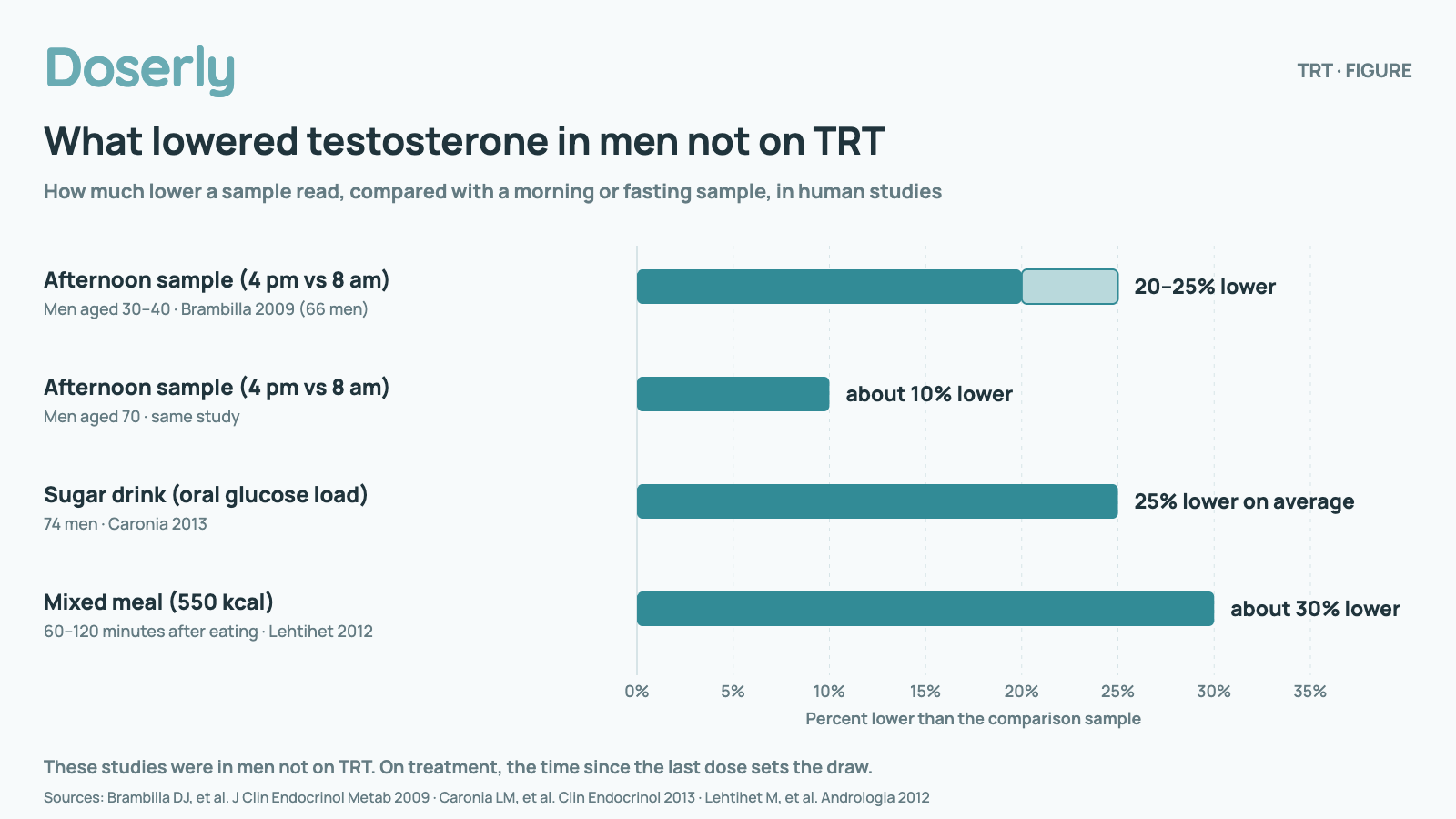
What lowered testosterone in men not on TRT
How much lower a sample read, compared with a morning or fasting sample, in human studies.
Bars run from 0% to 35% lower; the paler end shows a range.
- Afternoon sample (4 pm vs 8 am)
- 20–25% lower · Men aged 30–40 · Brambilla 2009 (66 men)
- Afternoon sample (4 pm vs 8 am)
- about 10% lower · Men aged 70 · same study
- Sugar drink (oral glucose load)
- 25% lower on average · 74 men · Caronia 2013
- Mixed meal (550 kcal)
- about 30% lower · 60–120 minutes after eating · Lehtihet 2012
These studies were in men not on TRT. On treatment, the time since the last dose sets the draw.
What are total testosterone, free testosterone and SHBG?
Most testosterone in the blood travels attached to proteins. About 44% is bound tightly to SHBG (sex hormone-binding globulin), about 50% loosely to albumin, and about 2% circulates free. Total testosterone measures all of it; free testosterone measures only the unbound part, which, along with the loosely bound part, tissues can use most easily. [1]
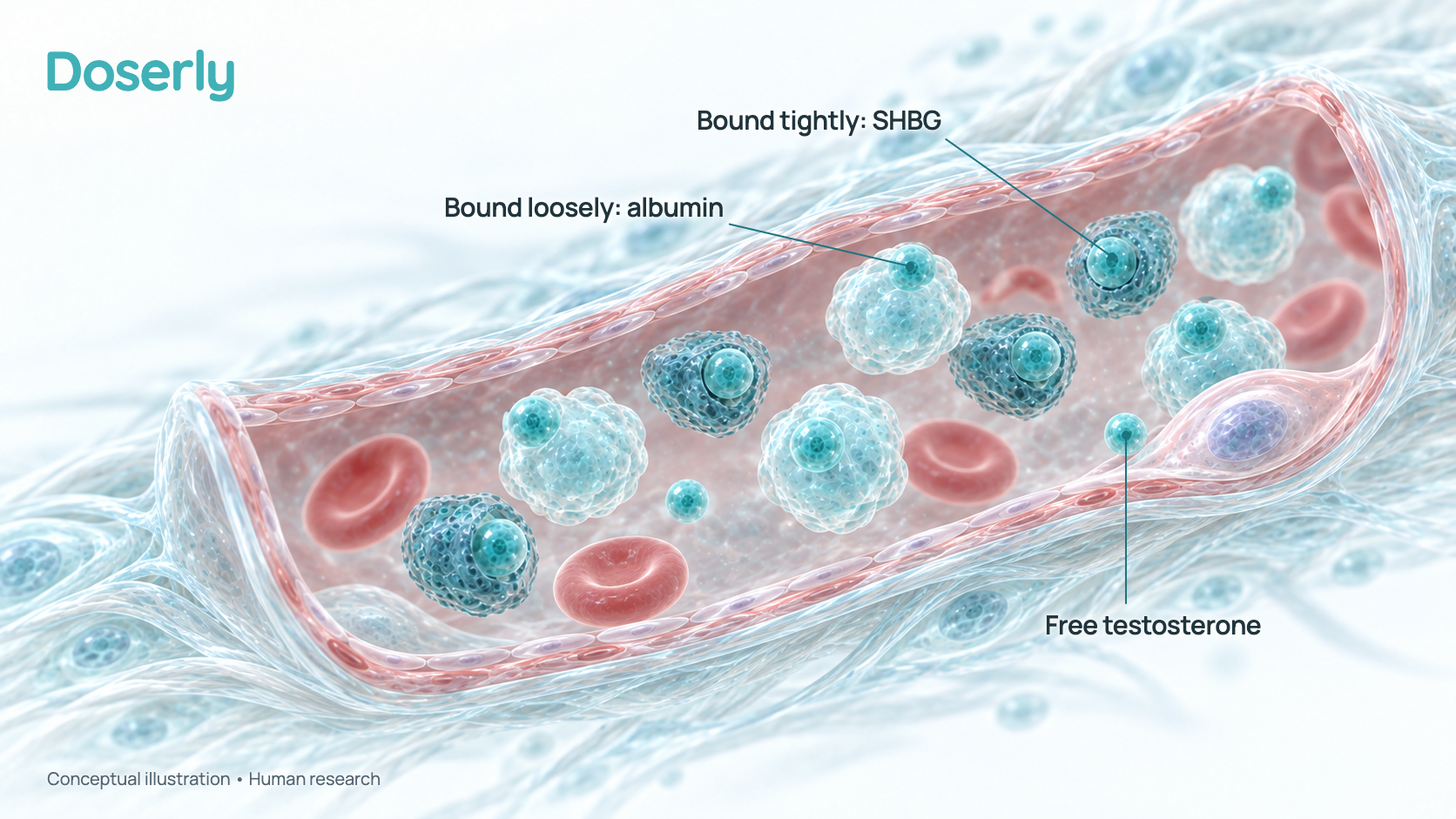
SHBG shifts with health, weight and medicines, so the same total testosterone can mean different free levels. It rises with age (by about 1.3% a year in men over 70), during rapid weight loss (from 27.6 to 48.1 nmol/L on a very-low-calorie diet, then back to 32.6 during weight maintenance), with an overactive thyroid and with liver cirrhosis, and with the epilepsy medicines carbamazepine and phenytoin. [51], [52], [53], [54], [55] The VA advises measuring free testosterone in conditions that change SHBG, including obesity, diabetes, thyroid and liver disease, and use of glucocorticoids, androgens or estrogens. [6]
On treatment, injected testosterone lowered SHBG in small older studies, while in the Testosterone Trials the gel did not change SHBG but raised the free share of testosterone. [56], [57] The free testosterone calculator estimates free testosterone from total testosterone, SHBG and albumin.
What does the research show about testosterone tests?
Labs and methods disagree more than most people expect, "normal" ranges depend on which men a lab measured, and some common tests, such as direct free testosterone and standard estradiol tests in men, are unreliable. Accuracy programs and the right choice of test reduce these problems. [2], [58], [59]
How much do labs and methods differ?
A lot, especially at low levels. When 1,133 laboratories using 14 different methods measured the same sample from one man with low testosterone, their results ranged from 45 to 365 ng/dL (1.6 to 12.7 nmol/L). [2]
Most labs use an immunoassay, a test that detects a hormone with antibodies. In 122 men, two common immunoassays averaged about 90 ng/dL low and 99 ng/dL high against mass spectrometry (LC-MS/MS), the reference method, with the worst agreement below 100 ng/dL; in another study, ten immunoassays averaged 12% low in men. [60], [61] Modern standardized platform immunoassays do better: the EAU says they "demonstrate a good correlation" with LC-MS/MS. [4]
The US Centers for Disease Control and Prevention (CDC) runs a Hormone Standardization Program (HoSt). A CDC-certified testosterone method must stay within ±6.4% of the CDC reference method on average, and a certified estradiol method within ±12.5% (or ±2.5 pg/mL at 20 pg/mL or below). The certified methods are listed publicly. [62], [63] The Endocrine Society's July 2026 statement asks for CDC-certified tests, and the AUA asks clinicians to use the same lab with the same method for serial tests. [64], [1]
Where do "normal ranges" come from?
From the men a lab or study measured, so they vary. Four large studies of 9,054 men, matched to the CDC reference method, gave 264–916 ng/dL (9.2–31.8 nmol/L) for healthy, non-obese men aged 19–39, with a middle value of 531 ng/dL. [65], [2] An earlier single-study range from the Framingham Heart Study put the lower limit at 348 ng/dL. [66] Labs set their own ranges, and some are far wider (see what people report).
That is why guidelines decide on their own numbers rather than the lab's printed range. The AUA uses absolute values, and the BSSM says to "base decisions on therapy on published action levels rather than laboratory reference ranges". [1], [5]
Which free testosterone test can you trust?
It depends on the method, which the report should name.
- Direct (analog) free testosterone is cheap but unreliable. Its results tracked total testosterone almost perfectly (a correlation of 0.97), so it adds little and can misclassify men with low SHBG. The Endocrine Society, the EAU and the BSSM all say not to use it. [58], [2], [4], [5]
- Calculated free testosterone comes from total testosterone, SHBG and albumin. The BSSM recommends the Vermeulen equation; against the reference method it ran about 19% high on average but was the most robust of the equations tested, while another equation ran about twice as high. [5], [67] The Endocrine Society of Australia does not recommend calculated free testosterone for treatment decisions. [68]
- Equilibrium dialysis is the reference method. One standardized dialysis method gives a normal range of 66–309 pg/mL in adult men and 120–368 pg/mL at ages 19–39, and that range applies only to that method. [38]
Is the estradiol test accurate in men?
Often not with a standard test. In 101 healthy men over 40, five direct estradiol immunoassays all read high, by 6% to 74%, and two could detect estradiol in only 53% and 72% of samples. [59] The Endocrine Society says the low estradiol levels found in men are too low to measure accurately with routine methods. [69] Mass spectrometry, the reference method in that study, is more accurate at the low levels found in men, so it is worth asking which method your lab's estradiol test uses. The estrogen on TRT guide covers when estradiol matters.
Can biotin supplements distort hormone results?
Yes, on some lab machines. The FDA warns that biotin, often found in dietary supplements, can cause wrong results that may go undetected. [70] In 6 healthy adults taking 10 mg a day for a week, 9 of 23 tests that use biotin in their chemistry (39%) gave distorted results; testosterone and estradiol were not among the tests studied. [11] On affected thyroid tests, the effect lasted about 8 hours after 5 mg a day and 1–2 days after 10 mg a day. [71] The Endocrine Society names biotin as a cause of variable testosterone results and advises stopping it for at least 72 hours before LH and FSH tests. [2] We found no study of how long to stop biotin before a testosterone or estradiol test, so tell the lab and your prescriber if you take it. See the biotin guide.
Do men on TRT actually get these tests?
Many do not. In 63,534 US men starting testosterone in 2010–2012, 40% had the two tests guidelines ask for beforehand and 46% had a follow-up testosterone test after starting. [72] In 61,474 insured men aged 40 or older, 52.4% had a testosterone test and 43.3% a PSA test in the year after starting. [73] In one US health system, only 49% had a follow-up testosterone test within 6 months. [74]
Is TRT safe without regular blood tests?
No guideline treats it that way. Every guideline reviewed here calls for repeat testosterone and hematocrit checks, and PSA checks in men of screening age, and US labels call for periodic hematocrit checks, because the problems they look for, such as a hematocrit above the guideline line or a rising PSA, are found on blood tests rather than by how you feel. [1], [2], [16], [4]
The tests watch testosterone itself, to keep the dose on target; hematocrit, which testosterone raises and most guidelines act on at 54% (see the hematocrit guide); and PSA, which rose about 0.15 ng/mL more on testosterone than on placebo by 12 months in the TRAVERSE trial, with a similar average (0.154 ng/mL) across 15 trials. TRAVERSE excluded men whose PSA was above 3.0 ng/mL, and high-grade prostate cancer was found in 5 of 2,596 men on testosterone and 3 of 2,602 on placebo. [1], [2], [75], [76]
TRAVERSE, the largest trial of testosterone and heart safety, is the context for any discussion of heart and kidney results. Among the 5,198 men who took study gel, heart attack, stroke or cardiovascular death occurred in 7.0% on testosterone gel (182 of 2,596 men) and 7.3% on placebo (190 of 2,602), a hazard ratio of 0.96 that met the trial's test for being no worse than placebo (noninferiority). Some problems were more common on testosterone in the same two groups: atrial fibrillation 3.5% vs 2.4%, acute kidney injury 2.3% vs 1.5%, and pulmonary embolism 0.9% vs 0.5%. Its limits matter: it tested only a daily gel, men used it for an average of 21.7 months, about 61% stopped their study gel early, and it enrolled men at high heart risk. [77], [78], [75] The TRT and heart health guide covers it in full.
Who should be especially cautious with their test results?
- Men on testosterone gel. Draw blood from an arm where no gel was applied, since gel on the draw site can read falsely high; finger-prick home tests are unreliable for gel users. [10], [79]
- Men who take biotin, which can distort some hormone tests (see biotin). [70]
- Men taking finasteride or dutasteride, which roughly halve PSA (see the next question). [80], [81]
- Men on warfarin, insulin or other diabetes medicines, whose blood-thinning or blood-sugar results can change on testosterone. [3], [21]
- Men whose SHBG may be unusual (thyroid or liver disease, obesity, diabetes, rapid weight loss), for whom total testosterone alone can mislead. [6], [52]
- Night-shift workers, whom the EAU asks to be tested after an adequate sleep when low testosterone is being diagnosed. [4]
- Very muscular men, whose creatinine-based kidney results may not match other kidney markers (see kidney tests). [82]
- Drug-tested athletes. Testosterone is prohibited in sport at all times. [13]
- Under-18s. Testosterone treatment and its monitoring in teenagers belong only in specialist care.
- Women. This guide is written for men. Testosterone for women uses different doses, products and targets; see testosterone therapy for women.
Which medicines and supplements change blood test results?
- Biotin. See can biotin distort results? [11]
- Finasteride and dutasteride (for hair loss or an enlarged prostate) lower PSA by about half. Their labels say to double an isolated PSA value for comparison once a man has taken finasteride for 6 months or dutasteride for 3 months, and any confirmed rise from the lowest value needs checking. [80], [81]
- Warfarin. Androgens can strengthen its effect, and the labels advise more frequent INR (clotting) tests. [3], [21]
- Insulin and other diabetes medicines. Testosterone may lower blood sugar and insulin needs, so glucose results and diabetes medicines are worth reviewing with your clinician. In 5 small trials of 351 men with type 2 diabetes, it lowered HbA1c by 0.87 percentage points on average, but TRAVERSE found no improvement in blood sugar control in men with diabetes, and the Endocrine Society recommends against using testosterone to improve blood sugar control. [21], [83], [84], [2]
- Thyroid tests. Androgens lower thyroxine-binding globulin, so total T4 can fall while free thyroid hormone levels stay the same. [3]
- Medicines that change SHBG, such as carbamazepine, phenytoin, glucocorticoids and estrogens, change how total testosterone reads. [55], [6]
- Opioids. The Endocrine Society advises against testing for low testosterone during short-term use of medicines such as opioids. [2]
- SGLT2 inhibitors for diabetes raise hematocrit on their own; see the hematocrit guide.
Bring a full list of what you take, including supplements, to the lab and your prescriber. Checked September 2026.
Is testosterone legal, and is it allowed in sport?
Checked September 2026. Rules differ by country and change often.
- United States. Testosterone and its esters are Schedule III controlled substances, prescription only. In June 2026, the FDA requested changes to testosterone labels (the age-related limitation and the prostate cancer contraindication); these are requested, not yet in the labels. [12], [85]
- United Kingdom. Testosterone is a Class C controlled drug. [86]
- Canada. Testosterone is a Schedule IV controlled substance. [87]
- Australia. Testosterone is a Schedule 4 prescription-only medicine. [88]
- Sport. The World Anti-Doping Agency (WADA) prohibits testosterone at all times, and its 2027 list, published in September 2026, keeps the ban. [13], [89]
What do guidelines say to do with the results?
Adjust the dose or schedule when testosterone is outside the target, act on hematocrit and PSA at set lines, and test estradiol, LH and FSH only in specific situations. This section describes the choices clinicians weigh; it is not a personal plan.
| Test | What guidelines do with the result | Full detail |
|---|---|---|
| Testosterone | Endocrine Society: change the dose or interval outside 350–600 ng/dL at mid-interval. VA: adjust above 900 ng/dL. Labels: the product's band | TRT dosage |
| Hematocrit | Most act at 54%; the VA adjusts above 51%, the Society for Endocrinology acts above 50% and the CUA at 55% | Hematocrit on TRT |
| PSA | Confirm a rise by repeating it; refer if it rises more than 1.4 ng/mL in the first year or is confirmed above 4.0 ng/mL (Endocrine Society, VA, EAA) | TRT and the prostate |
| Estradiol | AUA: test with breast symptoms or when taking an aromatase inhibitor; optional otherwise; no target | Estrogen on TRT |
| LH and FSH | Not routine on treatment (AUA); see the question below | TRT and fertility |
| Prolactin | AUA: not recommended on treatment unless it is being treated | Low testosterone |
| Lipids and blood sugar | Labels: check lipids periodically. EAU: at baseline, 12 months, then yearly. BSSM: not required for safety | TRT and heart health |
| Rectal exam (DRE) | EAU and CUA: before starting and yearly; BSSM: at the start only; Society for Endocrinology: no routine prostate screening just because a man is on testosterone | TRT and the prostate |
| Bone density | Endocrine Society: after 1–2 years in men with osteoporosis | TRT side effects |
[2], [6], [3], [1], [19], [17], [5], [7], [30], [4]
What happens if testosterone is too high or too low?
First, check the timing (see why timing matters and why a result is high). If the timing was right, prescribers change the dose or interval at the lines in the table, such as a 25 mg step for Xyosted. [2], [6], [3] The TRT dosage guide covers how those changes are made, and the TRT dose calculator turns a new dose into milliliters and syringe units.
When does PSA lead to a referral?
When it rises faster than set limits, confirmed on a repeat test. The Endocrine Society, the VA and the EAA refer men if PSA rises more than 1.4 ng/mL within the first 12 months or is confirmed above 4.0 ng/mL. [2], [6], [90] The BSSM uses the 6-month PSA as the new baseline, and the AUA measures PSA before treatment in men over 40, then follows usual screening decisions. [5], [1] The prostate guide covers what happens next.
Should estradiol be tested on TRT?
Not routinely, according to the AUA: it tests estradiol on treatment for breast symptoms or when a man takes an aromatase inhibitor, and sets no target; before treatment, it refers men whose estradiol stays above 40 pg/mL. [1] Because standard tests read high in men, the method matters too (see the estradiol test). The estrogen on TRT guide covers the rest.
Are LH and FSH useful once you are on TRT?
Usually not, because outside testosterone switches them off in most men, but not all. In one trial, LH fell below normal in 31% of men on injections every 2 weeks and in none on a patch, and about half of men with primary hypogonadism (low testosterone from the testicles themselves) reached a normal LH on either. [41] In a single-arm study of Natesto nasal gel, 60 men enrolled and 33 were checked at 6 months; LH stayed normal in 72.7% of men checked (24 of 33). [91] The AUA does not recommend FSH once treatment is under way; the Endocrine Society of Australia notes that a persistently high LH in primary hypogonadism can mean the dose is too low or doses are being missed. [1], [7]
How should you prepare for a TRT blood test?
When should I get blood drawn on TRT?
At the point your prescriber's rule or your product's label names, the same point every time, with the time of your last dose written down. By form:
- Injections: midway between doses or at the trough, by guideline; Xyosted at the trough after 6 weeks. [2], [5], [3]
- Gels and oral capsules: at the time the label names (see the label table), and for gels from an arm without gel on it. [16], [29], [10]
- Long-acting undecanoate injections: the end of the interval for most bodies. Pellets: the AUA checks 2–4 weeks after insertion and again at 10–12 weeks, the Endocrine Society at the end of the interval. [2], [34], [1]
A trough means the sample is taken just before a dose that is due. Delaying or skipping the dose to fit the lab visit makes the gap longer than usual, so the result reflects a longer interval than you normally have. [3], [14]
Do I need to fast for a testosterone test on TRT?
For the diagnosis, most guidelines ask for a fasting morning sample, because food and the afternoon lower untreated testosterone (see diagnosis tests). [2], [4] On treatment, the draw is set by the dose schedule, and we found no study of fasting in men already on TRT. Oral testosterone is different: it is taken with food, and the label draw time counts from that morning dose. [31] A lipid panel usually does not need fasting; a European consensus recommends non-fasting samples unless non-fasting triglycerides are above 5 mmol/L (440 mg/dL). [92]
Why is my testosterone so high on TRT?
Check four things before assuming the dose is too high.
- Timing. A sample taken within a day or two of an injection sits near the peak: after a 200 mg cypionate injection, testosterone roughly tripled within 2–5 days. [14], [15]
- Gel on the skin where blood was drawn. [10]
- The amount injected. Volume mix-ups happen. At 200 mg/mL, 100 mg is 0.5 mL, which is 50 units on a U-100 insulin syringe; drawing 0.33 mL when 0.13 mL was intended is about two and a half times the dose. The TRT dose calculator shows the volume and syringe units for any dose and concentration.
- The units and the lab. 10.46 ng/mL is 1,046 ng/dL, and a µg/L result is also 100 times smaller in number than ng/dL. Results from different labs or methods are not directly comparable. [20], [28], [2]
If the timing, site, amount and units all check out, a result above the target is a reason to review the dose with your prescriber (what guidelines do).
Why is my testosterone low on TRT?
The same checks in reverse: a sample drawn late or after a delayed dose, gel on the abdomen (30–40% lower exposure with the 1.62% gel), capsules taken without food, or missed doses. [14], [45], [31] Gel levels also vary from day to day, so one low sample may not reflect the average. [46] Some labels set a floor: Xyosted adds 25 mg below 350 ng/dL, Natesto suggests another option if levels stay below 300 ng/dL, and Tlando is stopped outside 300–1,080 ng/dL. [3], [32], [31]
How long after a dose change should I retest?
It depends on the product. Labels say 7 days for Jatenzo and Kyzatrex, about 14 and 28 days for AndroGel 1.62%, at least 14 days for the 2% solution, about day 14 for Testim and Tostran, about days 14 and 35 for Testavan, and a trough after 6 weeks for Xyosted, the point its trials used. [29], [30], [16], [24], [22], [28], [27], [3], [93] For cypionate and enanthate vials, the AUA waits 3–4 injection cycles after starting. [1] We found no study of how long a new injection dose takes to settle; the AUA's 3–4 cycles after starting is the nearest published rule.
Can I order my own blood work, and are home tests accurate?
In many places, yes, depending on local rules (checked September 2026). Results from a different lab or method may not match your prescriber's, and not every home test is reviewed by the FDA. [94], [1] Finger-prick dried blood spots tracked lab results reasonably well in men on long-acting undecanoate injections (a correlation of 0.87) but read far too high in men on gel. [79] An upper-arm device that collects blood from tiny vessels in the skin agreed well with a vein sample in a small anti-doping study. [95] We found no study of how often home tests misclassify men on TRT. Bring the result, its units and its lab to your prescriber.
Does exercise before a blood test change the results?
For some tests, yes. One hard weightlifting session raised the liver enzymes AST and ALT for at least 7 days in 15 men not used to it, while other liver tests stayed normal. [96] A long bike ride raised PSA by 9.5% on average in men aged 50 and over. [97] Dehydration raises hematocrit. [98] Telling the lab and your prescriber about recent hard training helps them read the result.
How should I prepare for a PSA test?
Study authors suggest 48 hours without ejaculation and 24–48 hours without long bike rides. After ejaculation, PSA rose in 87% of men and was back to baseline in 97% by 48 hours; in another study, 40% were still raised at 24 hours. [99], [100], [97] A routine rectal exam does not meaningfully change PSA, but a urinary infection with fever can raise it for weeks: in one study, it fell by a quarter or more within 3 months in 47 of 50 men. [101], [102] If you take finasteride or dutasteride, see medicines that change results.
Do liver and kidney results change on TRT?
Liver tests usually do not, on modern forms. In 7 men on 100 mg of enanthate a week for 10 weeks, liver enzymes and creatinine did not change significantly; long-term gel use caused no clinically significant changes in blood chemistry; and oral testosterone undecanoate was not linked with liver toxicity in its phase 3 trials. [103], [104], [105] Old oral methyltestosterone is different: its label warns of liver damage, and the AUA advises against prescribing it. [106], [1]
Kidney results are harder to read. Creatinine, the usual kidney marker, comes from muscle, and in 227 athletic men on TRT it often disagreed with cystatin C, a second kidney marker less tied to muscle. [82] In 21 transgender men starting testosterone, directly measured kidney filtration did not change over 3 months, although that is a different group from men with low testosterone. [107] In TRAVERSE, acute kidney injury occurred in 2.3% of 2,596 men on testosterone and 1.5% of 2,602 on placebo (see TRAVERSE). [78] We found no study in men with low testosterone comparing a creatinine rise with measured kidney function.
Do cholesterol results change on TRT?
Slightly. In 29 trials of 1,083 middle-aged men, testosterone lowered total cholesterol by 0.23 mmol/L on average, did not change LDL, and lowered HDL only in trials where the men started with higher testosterone. [108] A later review of 16 trials also found a small fall in HDL. [109] The Xyosted and Kyzatrex labels say to check lipids periodically. [3], [30]
Does TRT change thyroid test results?
It can change total T4 but not the active hormone. Androgens lower thyroxine-binding globulin, the protein that carries thyroid hormone, so total T4 may fall while free thyroid hormone levels stay the same. [3]
What do people on TRT report about their blood tests?
Public forums are full of men trying to make sense of a single surprising result. The threads below are recent public Reddit discussions, read with their replies; they show what people experience and the questions they face, not how often anything happens.
Why do results surprise people?
Usually the timing. One man on daily injections found that months of high results had all been drawn about 9 hours after his evening dose, and moved his injection to the morning. [110] Another had blood drawn less than 24 hours after an injection, after a week of skipped doses, and got 42.0 nmol/L (about 1,200 ng/dL). [111] A third noted that his 1,225 ng/dL came 36 hours after a twice-weekly dose, not at a true trough. [112]
Timing cuts both ways. One man was told not to inject the day before his labs, which stretched his usual gap to 4–5 days. [113] A trough can still be high: after years on one weekly injection, one poster's day-7 sample read 1,106 ng/dL. [114] When another reported 1,046 ng/dL on 50 mg a week, one of the first replies asked exactly when in his schedule the sample had been taken. [115]
What mistakes do people find through their labs?
Some find a dosing error. One man with a pre-injection result of 65.6 nmol/L discovered he had been drawing 0.33 mL per injection instead of the 0.13 mL he intended. [116] Others find that labs disagree: one man's lab reported 590 ng/dL while a clinic test the same day read 845, and his hematocrit of 54.2% was inside that lab's printed range of 42–56%, above the line most guidelines act on. [117] Some stop treatment to get new baseline tests: one man stopped his gel for a month because his coverage required two new low results, and measured 33 ng/dL. [118]
What happens with free testosterone, SHBG and "normal" ranges?
One man's direct (analog) free testosterone was flagged low at 5.4 pg/mL beside a total of 793 ng/dL and an SHBG of 66.8 nmol/L after large weight loss; a reply calculated it from the same results instead. [119] Another, not on TRT, saw SHBG fall from 75 to 63 nmol/L after stopping caffeine and a brief boron trial, but could not tell which change mattered. [120]
Before treatment, timing and variation show up too. One man's afternoon sample read 227 ng/dL against 314–396 ng/dL on four fasted 8 am tests. [121] Another's fasted morning results went from 987 to 329 to 535 ng/dL over seven months while his fatigue stayed the same. [122] A third was told a 282 ng/dL result was normal against his lab's range of 123–814 ng/dL, and replies questioned the range. [123]
What about estradiol, PSA and other markers?
One man stopped an 8 mg daily biotin supplement 3 days before his labs, and a reply asked whether his estradiol came from an immunoassay or mass spectrometry. [124] Another said a sensitive estradiol test cost about four times his whole panel and asked whether his creatinine of 1.35 mg/dL reflected muscle or his kidney stones; after a higher dose raised his testosterone without changing his symptoms, several replies suggested checking for sleep apnea. [125] One man's PSA went from 1.69 to 1.98 to 2.60 ng/mL over five months while his testosterone ran above the lab range, and replies flagged it. [126] And one man with raised AST and ALT pointed to a heavy workout and some alcohol the night before. [127]
How can you judge a lab story?
Ask: How long after the last dose was the sample drawn, and was the dose on time? Same lab and method as last time? For gel users, which arm? What units? How was free testosterone measured? Were biotin, hard exercise, illness or new medicines in the picture? And what did the next test show?
These selected discussions show the questions people face. They are not a survey of all men on TRT or a substitute for the studies above.
What should you track?
Testosterone and hematocrit at the points your guideline or label names, PSA if you are of screening age, and enough context around each result to compare it with the next. Use this summary to prepare questions for your prescriber; it is not a personal testing plan. [2], [4], [1]
| What to record | Why it matters | Tracking category |
|---|---|---|
| Time of your last dose and of the draw | Peak and trough read very differently | Blood work |
| Dose, form, schedule and recent changes | Labels retest a set time after a change | Blood work |
| The lab and method (immunoassay or mass spectrometry; how free testosterone was measured) | The AUA asks for the same lab and method each time | Blood work |
| Testosterone (plus SHBG and free testosterone if measured) | Compared with the target your prescriber uses | Blood work |
| Hematocrit and hemoglobin | Testosterone raises them; most guidelines act at 54% | Blood work |
| PSA, and what happened in the 48 hours before | Ejaculation, cycling and infection can raise it | Blood work |
| Blood pressure | In a trial in men taking opioids, systolic pressure rose 6.2 mm Hg on testosterone and fell 7.0 on placebo, tracking the hematocrit rise | Blood Pressure |
| Symptoms (energy, libido, sleep) | Numbers are read against how you feel | Energy Levels, Libido, Sleep Quality |
| Supplements and medicines, especially biotin, finasteride or dutasteride | They can change results | Other |
[14], [16], [1], [2], [99], [128], [11], [80]
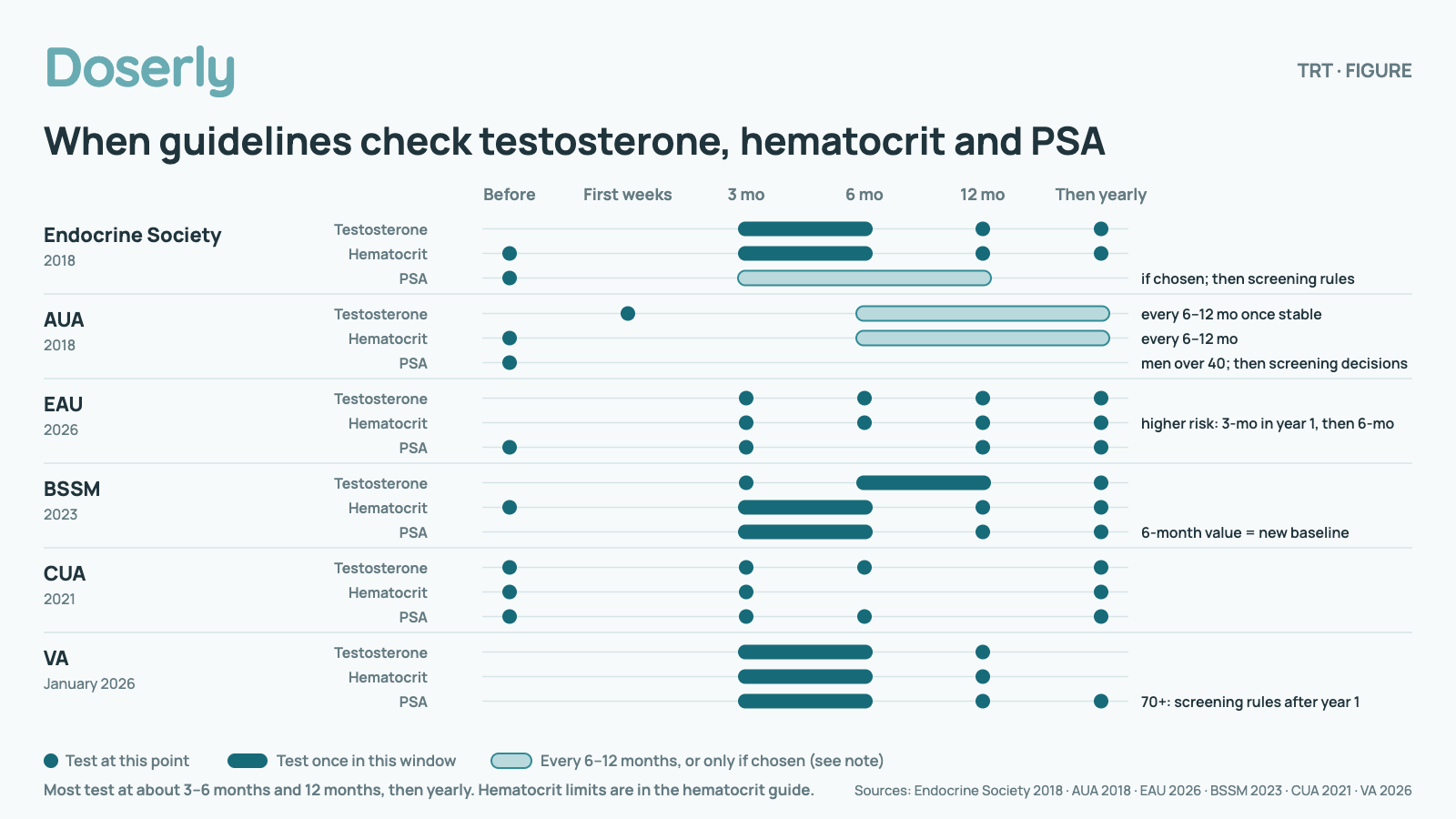
When guidelines check testosterone, hematocrit and PSA
- Testosterone
- 3–6 mo, 12 mo, then yearly
- Hematocrit
- Before, 3–6 mo, 12 mo, then yearly
- PSA
- Men 55–69 (40–69 at higher risk) who choose monitoring: before and at 3–12 mo, then screening rules
- Testosterone
- First check 2–4 weeks after starting a gel, or after 3–4 injection cycles; then every 6–12 mo
- Hematocrit
- Before, then every 6–12 mo
- PSA
- Before starting, in men over 40; then screening decisions
- Testosterone
- 3, 6 and 12 mo, then yearly
- Hematocrit
- 3, 6 and 12 mo, then yearly; men at higher risk every 3 mo in year one, then at least every 6 mo
- PSA
- Before, 3 and 12 mo, then yearly
- Testosterone
- 3 mo and 6–12 mo, then yearly
- Hematocrit
- Before, 3–6 mo, 12 mo, then yearly
- PSA
- 3–6 mo and 12 mo, then yearly; the 6-month value becomes the new baseline
- Testosterone
- Before, 3 and 6 mo, then yearly
- Hematocrit
- Before, 3 mo, then yearly
- PSA
- Before, 3 and 6 mo, then yearly
- Testosterone
- 3–6 mo and 12 mo
- Hematocrit
- 3–6 mo and 12 mo
- PSA
- 3–6 mo and 12 mo, then yearly; men 70 and older follow standard screening guidance after year one
Most test at about 3–6 months and 12 months, then yearly. Hematocrit limits are in the hematocrit guide.
A single result is one point on a line. A series drawn at the same point in the dosing cycle, at the same lab, says far more than any one number. The testosterone unit converter helps when results come in different units, and the hematocrit guide covers red-cell results in detail.
Common questions about TRT blood work
How often do you need blood work on TRT?
Most guidelines test testosterone and hematocrit about 3–6 months after starting, again at 12 months, then yearly. The EAU adds a 6-month test and more frequent checks for men at higher hematocrit risk, the AUA tests every 6–12 months once stable, and some labels check hematocrit every 3 months at first. [2], [4], [1], [3] A dose change brings an extra test at the time the label names. See the key numbers.
What is the most important blood test on TRT?
Testosterone and hematocrit together. Every guideline checks both: testosterone to judge the dose, and hematocrit because testosterone raises red blood cells and most guidelines act at 54%. PSA joins them for men of screening age. Other tests, such as estradiol, LH and FSH, are for specific situations. [2], [1], [5] See what guidelines do.
Is a hematocrit of 52% a concern on TRT?
It is below the line most guidelines act on (54%), but above the VA's 51% dose-adjustment line and the Society for Endocrinology's 50%. It is a reason to check the testosterone level, hydration and the trend with your prescriber. [6], [19], [98] The hematocrit guide covers it in full.
Why did my PSA go up after starting TRT?
A small rise is expected: in TRAVERSE, PSA rose about 0.15 ng/mL more on testosterone than on placebo by 12 months. Ejaculation, long bike rides and urinary infections can also raise one result. Guidelines confirm a rise by repeating the test and refer men whose PSA rises more than 1.4 ng/mL in the first year. [75], [99], [2] See when PSA leads to a referral.
Why does my doctor only test total testosterone?
Because total testosterone is the main test in every guideline, and free testosterone is mainly needed when SHBG may be unusual or total testosterone is borderline. Free testosterone also depends heavily on the method: direct tests are unreliable, and calculated values vary with the equation used. [2], [6], [58], [67] See which free testosterone test to trust.
Does drinking water change blood test results?
It can change hematocrit, not testosterone. Dehydration raises hematocrit because the liquid part of the blood shrinks, so being well hydrated gives a fairer reading. We found no study showing that hydration changes testosterone results. [98] See the hematocrit guide.
Can you stop blood tests once your dose is stable?
No guideline stops them. They move to yearly testing of testosterone and hematocrit once stable, with PSA by screening rules, and the AUA keeps testing every 6–12 months. [2], [4], [1]
Glossary
Plain explanations of the medical, lab and research terms used in this guide. Underlined terms in the text link here.
- Albumin
- The most common protein in blood plasma. It carries about half of all testosterone, loosely, so tissues can take it up easily.
- Aromatase inhibitor
- A medicine, such as anastrozole, that blocks the enzyme that turns testosterone into estradiol.
- Biotin
- A B vitamin found in many dietary supplements. At high doses it can distort lab tests that use biotin in their chemistry.
- CDC-certified test
- A lab method that passed the US Centers for Disease Control and Prevention's Hormone Standardization Program (HoSt): for testosterone, results within ±6.4% of the CDC reference method on average.
- Clinical guideline
- Recommendations written by a medical society or health system, based on its review of the evidence and expert judgment. Different guidelines can reach different conclusions.
- DRE (digital rectal exam)
- A quick physical check of the prostate by a clinician's gloved finger. Some guidelines do it before and during TRT; others rely on PSA.
- Equilibrium dialysis
- The reference method for measuring free testosterone. It separates free hormone from bound hormone through a membrane before measuring it.
- Estradiol
- The main form of estrogen. In men it is made mostly from testosterone, so it rises when testosterone rises.
- Free testosterone
- The small share of testosterone, about 2%, not attached to a carrier protein. Equilibrium dialysis measures it directly and is the reference method; quick "direct" (analog) immunoassays are unreliable; it can also be calculated from total testosterone, SHBG and albumin.
- Hazard ratio
- A measure comparing how often an event happens over time in two groups. A hazard ratio of 1 means no difference; 0.96 means about 4% lower in the first group.
- Hematocrit
- The share of the blood made up of red blood cells. Testosterone raises it, and most guidelines act when it reaches about 54%.
- Hemoglobin
- The iron-containing protein inside red blood cells that carries oxygen. It is measured in grams per deciliter (g/dL) or grams per liter (g/L): 18.0 g/dL equals 180 g/L.
- Immunoassay
- A lab test that detects a hormone using antibodies. It is fast and widely used, but less accurate than mass spectrometry at low levels.
- Intramuscular (IM)
- Injected into a muscle. Most testosterone cypionate and enanthate is given this way.
- Product label (prescribing information)
- The official document approved by a medicines regulator for a product, describing its approved uses, doses, warnings and monitoring. In the UK it is called the summary of product characteristics.
- Mass spectrometry (LC-MS/MS)
- A lab method that separates and weighs molecules. It is the reference method for testosterone and is more accurate than immunoassays at the low estradiol levels found in men.
- LH and FSH
- Luteinizing hormone and follicle-stimulating hormone, pituitary signals that tell the testicles to make testosterone and sperm. Outside testosterone usually switches them off.
- Mid-interval level
- A blood test taken halfway between two injections, such as day 3–4 of a weekly schedule. Several guidelines use it to judge the dose.
- Peak level
- The highest level of a medicine in the blood after a dose. For a 200 mg cypionate injection it came on days 2–5.
- Primary hypogonadism
- Low testosterone because the testicles themselves do not work well, even though the pituitary sends plenty of LH and FSH.
- PSA (prostate-specific antigen)
- A blood test for a protein made by the prostate. It rises slightly on testosterone and is used to decide whether prostate checks are needed.
- Reference range
- The range a lab prints beside a result, based on the people it measured. Guidelines often act on their own numbers, called action levels, instead.
- SHBG (sex hormone-binding globulin)
- A blood protein that carries testosterone tightly. Testosterone bound to it is not immediately available to tissues, so SHBG affects how much free testosterone there is.
- Steady state
- The point, after several doses, when blood levels follow the same pattern from one dose to the next. Tests before it can mislead.
- Subcutaneous (SC)
- Injected into the fatty layer just under the skin. Xyosted is given this way, and some prescribers use this route for other testosterone injections.
- Total testosterone
- All the testosterone in a blood sample, both bound to proteins and free. It is the main test in every guideline.
- Trough level
- The lowest level of a medicine in the blood, measured just before the next dose. Some guidelines judge injections by it.
- TRT (testosterone replacement therapy)
- Prescribed testosterone, by injection, gel or other forms, for men with low testosterone. It switches off the brain's LH and FSH signals.
- WADA
- The World Anti-Doping Agency, which publishes the list of substances banned in sport. Testosterone is prohibited at all times.
How this guide was researched
This guide is built from a thorough review of the sources cited throughout it: clinical guidelines and position statements from 10 medical bodies, product labels from several countries, published studies of lab methods, timing and food effects, and regulatory documents. We also reviewed public online forums where men on TRT describe their own blood test results.
The guide cites 128 sources, including 53 original studies in people, 13 clinical guidelines and position statements, 22 product labels, and 18 public community discussions. Each type of source answers a different question. Guidelines and labels show what clinicians are told to do. Studies show what was measured. Personal accounts show what individual people experienced. Every numbered citation links to its entry below, labeled by source type.
How this guide was made
Research and drafting were AI-assisted. Every cited source was checked against the original, and the guide was reviewed and edited by Doserly before publication. It has not had an independent clinical review, and Doserly does not currently have medical reviewers. Doserly makes a medication and health-tracking app and runs Doserly Academy, both of which are promoted in this guide. Read our editorial policy for how guides are researched, updated and corrected.
This guide is for educational purposes. It summarizes what the reviewed sources report so the research is easier to understand; it is not medical advice. For a deeper dive, or to check any point for yourself, go straight to the cited sources.
Explore the sources
These are the documents cited in this guide. Guidelines, labels, studies, regulator pages and personal accounts answer different questions. A source being listed does not mean every statement on its page is endorsed.
Showing 128 sources
- 01
Evaluation and Management of Testosterone Deficiency: AUA Guideline ↗
Clinical guideline (US)
Full guideline reviewed.
Detail: Diagnose on two early-morning tests (fasting not insisted on); target 450–600 ng/dL; first check 2–4 weeks on gels or after 3–4 injection cycles, historically mid-cycle though 'no data exist' on the best time; testosterone and hematocrit every 6–12 months; same lab and method for serial tests; decide on absolute values, not the lab range; estradiol with breast symptoms or on an aromatase inhibitor; FSH and prolactin not routine on treatment.
- 02
Testosterone Therapy in Men With Hypogonadism: An Endocrine Society Clinical Practice Guideline ↗
Clinical guideline
Full guideline reviewed.
Detail: Two fasting morning tests; 30% of low first results normal on repeat; 1,133 labs measured one sample at 45–365 ng/dL; harmonized range 264–916 ng/dL; injections midway between doses, adjust above 600 or below 350 ng/dL; gels 2–8 hours after application; monitor at 3–6 months, 12 months, then yearly; no analog free testosterone; stop biotin 72 hours before LH and FSH tests; PSA referral rules.
- 03
Xyosted (testosterone enanthate) subcutaneous autoinjector 50, 75, 100 mg/0.5 mL prescribing information ↗
Product label (US)
Full label reviewed.
Detail: Trough 7 days after a dose after 6 weeks, kept at 350 to under 650 ng/dL; peak about 12 hours after dosing, steady state by week 6; monitor PSA and lipids; more frequent INR with warfarin; androgens lower thyroxine-binding globulin.
- 04
EAU Guidelines on Sexual and Reproductive Health, Chapter 3: Male Hypogonadism (2026 edition) ↗
Clinical guideline (Europe)
Full guideline chapter reviewed.
Detail: Fasting morning sample by 10:00 (night-shift workers after sleep); non-fasting can underestimate by more than 30%; platform immunoassays correlate well with mass spectrometry; gels 2–4 hours after application, watch for gel on the draw site; testosterone and hematocrit at 3, 6 and 12 months, then yearly; DRE at baseline and at least yearly.
- 05
The British Society for Sexual Medicine Guidelines on Male Adult Testosterone Deficiency, with Statements for Practice ↗
Clinical guideline (UK)
Full text reviewed.
Detail: Target 15–30 nmol/L; injections judged on the trough; gels 2–4 hours after application; 'ideally fasting' but insistence unreasonable for some; calculated (Vermeulen) free testosterone, not analog assays; decide on action levels, not lab ranges; PSA referral for a rise above 1.4 ng/mL in a year or 0.4 ng/mL a year over 2 years.
- 06
Evaluation for and Management of Males with Low Testosterone: Recommendations for Use (January 2026) ↗
Clinical recommendations (US)
Full document reviewed.
Detail: Injections tested midway (day 3–4 on weekly dosing); gels 2–8 hours after application; adjust if testosterone is outside lab limits or above 900 ng/dL or hematocrit above 51%; testosterone, hematocrit and PSA at 3–6 and 12 months; lists the conditions that change SHBG.
- 07
Endocrine Society of Australia position statement on male hypogonadism (part 2): treatment and therapeutic considerations ↗
Position statement (Australia)
Full text reviewed.
Detail: Part 2: trough sampling for injectable and transdermal products; random sampling 'uninformative'; long-acting undecanoate trough 10–15 nmol/L; persistently high LH in primary hypogonadism can mean under-treatment.
- 08
The effect of diurnal variation on clinical measurement of serum testosterone and other sex hormone levels in men ↗
Human study
Original abstract reviewed.
Detail: Afternoon testosterone is 20-25% lower than at 8 am in men 30-40 and about 10% lower at 70; 17 men low after noon were normal at all three morning visits.
- 09
S-testosterone decrease after a mixed meal in healthy men independent of SHBG and gonadotrophin levels ↗
Human study
Original abstract reviewed.
Detail: A 550-kcal meal lowered testosterone about 30% at 60-120 minutes.
- 10
Falsely elevated serum testosterone measurements resulting from testosterone topical gel contamination of the venipuncture site: Case Series and retrospective review ↗
Case series and records review
Original abstract reviewed.
Detail: Gel on the skin where blood is drawn can make results falsely read above 1,000 ng/dL.
- 11
Association of Biotin Ingestion With Performance of Hormone and Nonhormone Assays in Healthy Adults ↗
Human study
Original abstract reviewed.
Detail: Biotin 10 mg/day distorted 39% of biotin-based assays (falsely high in competitive assays); testosterone and estradiol were not among the tests studied.
- 12
21 CFR 1308.13(f) Schedule III: anabolic steroids ↗
Regulation (US)
Official text reviewed.
Detail: Lists anabolic steroids, including testosterone and its esters, in Schedule III.
- 13
World Anti-Doping Code International Standard: Prohibited List 2026 ↗
Anti-doping list
Full list reviewed.
Detail: Testosterone is prohibited at all times (S1.1).
- 14
Hormone kinetics after intramuscular testosterone cypionate ↗
Human study
Original abstract reviewed.
Detail: After 200 mg cypionate, T peaked on days 2-5 and was back to baseline by days 13-14; estradiol tripled on days 2-7; LH suppressed.
- 15
Hormone profiles after intramuscular injection of testosterone enanthate in patients with hypogonadism ↗
Human study
Original abstract reviewed.
Detail: After one 125 mg enanthate injection, T was 762 ng/dL on day 1 and below baseline by day 14; LH and FSH fell from day 5; estradiol 1.7x on day 1.
- 16
AndroGel 1.62% (testosterone gel) pump and packets prescribing information ↗
Product label (US)
Full label reviewed.
Detail: Pre-dose morning level at about 14 and 28 days after starting or a change, kept at 350–750 ng/dL; do not apply to the abdomen; check hematocrit before, at 3–6 months and yearly.
- 17
Canadian Urological Association guideline on testosterone deficiency in men: Evidence-based Q&A ↗
Clinical guideline (Canada)
Full text reviewed.
Detail: Target 14–17 nmol/L measured mid-cycle; testosterone and PSA at baseline, 3 and 6 months and yearly; hematocrit at baseline, 3 months and yearly; DRE at baseline and yearly; acts on hematocrit at 55%.
- 18
Male hypogonadism: recommendations from the Fifth International Consultation on Sexual Medicine (ICSM 2024) ↗
Consensus recommendations
Full text reviewed.
Detail: Target the middle of the normal range; short-acting injections monitored mid-cycle.
- 19
Society for Endocrinology guidelines for testosterone replacement therapy in male hypogonadism ↗
Clinical guideline (UK)
Full text reviewed.
Detail: Gel sampled about 2–6 hours after application away from the gel site; injections adjusted on the trough aiming for the lower end of normal; hematocrit above 0.50 prompts adjustment; no mandatory prostate screening because of TRT.
- 20
Testosterone (PubChem compound record, CID 6013) ↗
Chemical database
Official record reviewed.
Detail: Molecular weight 288.4 g/mol, the basis of the conversions nmol/L × 28.84 = ng/dL and pg/mL × 3.467 = pmol/L.
- 21
Depo-Testosterone (testosterone cypionate) 100 and 200 mg/mL prescribing information ↗
Product label (US)
Relevant label sections reviewed.
Detail: Confirm diagnosis on two morning tests; dose adjusted to response, with no draw time; check hemoglobin and hematocrit periodically; androgens may increase sensitivity to oral anticoagulants and lower insulin needs.
- 22
Testim (testosterone gel) 1%, 50 mg tube prescribing information ↗
Product label (US)
Relevant label sections reviewed.
Detail: About 10% absorbed over 24 hours; morning pre-dose level at about 14 days.
- 23
Vogelxo (testosterone gel) 1% tube, packet and pump prescribing information ↗
Product label (US)
Relevant label sections reviewed.
Detail: Increase the dose if the morning pre-dose level is below normal.
- 24
Testosterone topical solution USP 30 mg/1.5 mL actuation (generic of Axiron, Lupin) prescribing information ↗
Product label (US)
Relevant label sections reviewed.
Detail: Draw 2–8 hours after applying, at least 14 days after a change; 300–1,050 ng/dL; steady state by about 14 days.
- 25
Testogel 16.2 mg/g gel (pump) SmPC ↗
Product information (UK)
Relevant SmPC sections reviewed.
Detail: Titrate on the morning pre-application level once at steady state; prostate and breast checks at least yearly.
- 26
Testogel 1% gel (50 mg sachet and pump; PI shared) Australian PI ↗
Product information (Australia)
Relevant PI sections reviewed.
Detail: Morning pre-application level from day 3; one week is reasonable.
- 27
Testavan 20 mg/g transdermal gel SmPC ↗
Product information (UK)
Relevant SmPC sections reviewed.
Detail: Draw 2–4 hours after dosing at about days 14 and 35; up if below 17.3 nmol/L, down if above 36.4 nmol/L.
- 28
Tostran 20 mg/g transdermal gel (2%) SmPC ↗
Product information (UK)
Relevant SmPC sections reviewed.
Detail: Draw 2 hours after application at about day 14; keep the dose if 5.0–15.0 µg/L (500–1,500 ng/dL).
- 29
Jatenzo (testosterone undecanoate) oral capsules 158, 198, 237 mg prescribing information ↗
Product label (US)
Full label reviewed.
Detail: Draw 6 hours after the morning dose, at least 7 days after a change, in plain serum tubes clotted 30 minutes; 425–970 ng/dL.
- 30
Kyzatrex (testosterone undecanoate) oral capsules 50, 100, 150, 200 mg prescribing information ↗
Product label (US)
Full label reviewed.
Detail: Draw 3–5 hours after the morning dose, 7 days after a change; 460–971 ng/dL; monitor lipids periodically.
- 31
Tlando (testosterone undecanoate) oral capsules 112.5 mg prescribing information ↗
Product label (US)
Full label reviewed.
Detail: Draw 8–9 hours after the morning dose at 3–4 weeks; continue if 300–1,080 ng/dL; taken with food, since fasting cut the peak level by about 65%.
- 32
Natesto (testosterone) nasal gel 5.5 mg per actuation prescribing information ↗
Product label (US)
Relevant label sections reviewed.
Detail: Check testosterone from one month; stop if consistently above 1,050 ng/dL; consider another option if consistently below 300 ng/dL.
- 33
Natesto (testosterone nasal gel 4.5%) product monograph ↗
Product monograph (Canada)
Relevant monograph sections reviewed.
Detail: Draw 20 minutes to 2 hours after the morning dose; move to three times daily if below 300 ng/dL.
- 34
Nebido 1000 mg/4 ml solution for injection (testosterone undecanoate) SmPC ↗
Product information (UK)
Relevant SmPC sections reviewed.
Detail: Measure testosterone at the end of an injection interval, aiming for the lower third of the normal range.
- 35
Aveed (testosterone undecanoate) 750 mg/3 mL intramuscular injection prescribing information ↗
Product label (US)
Full label reviewed.
Detail: Peak a median of 7 days after injection; steady state with the third injection at week 14; no titration.
- 36
Testopel (testosterone pellets) 75 mg prescribing information ↗
Product label (US)
Relevant label sections reviewed.
Detail: 150–450 mg every 3–6 months; no draw time given.
- 37
Estradiol (PubChem compound record, CID 5757) ↗
Chemical database
Official record reviewed.
Detail: Molecular weight 272.4 g/mol, the basis of the conversion pg/mL × 3.671 = pmol/L.
- 38
Reference intervals for free testosterone in adult men measured using a standardized equilibrium dialysis procedure ↗
Human study
Original abstract reviewed.
Detail: Dialysis-based free T normal range 66-309 pg/mL (all ages), 120-368 pg/mL at 19-39; method-specific.
- 39
Identification of late-onset hypogonadism in middle-aged and elderly men ↗
Human study
Original abstract reviewed.
Detail: EMAS symptom-linked cut-offs: total T <11 nmol/L plus free T <220 pmol/L with three sexual symptoms.
- 40
Hemoglobin (MedlinePlus Medical Encyclopedia) ↗
Health reference (US)
Official page reviewed.
Detail: Hemoglobin units: g/dL x 10 = g/L. Shared with trt-hematocrit g-022.
- 41
Pharmacokinetics, efficacy, and safety of a permeation-enhanced testosterone transdermal system in comparison with bi-weekly injections of testosterone enanthate ↗
Human trial
Original abstract reviewed.
Detail: Every-2-week injections produced several days of above-normal T and estradiol; LH subnormal in 31% on injections vs 0% on patch; LH normalized in about half of men with primary hypogonadism on either.
- 42
Pharmacokinetic Profile of Subcutaneous Testosterone Enanthate Delivered via a Novel, Prefilled Single-Use Autoinjector: A Phase II Study ↗
Human study
Original full text reviewed.
Detail: Weekly subcutaneous enanthate 100 mg: average 895, peak 1,346 and trough 568 ng/dL.
- 43
AndroGel 1% (testosterone gel) pump and packets prescribing information ↗
Product label (US)
Relevant label sections reviewed.
Detail: About 10% of the applied dose absorbed; steady state by the second or third day.
- 44
Long-term pharmacokinetics of transdermal testosterone gel in hypogonadal men ↗
Human trial
Original abstract reviewed.
Detail: Gel raised DHT 3.6-4.6-fold (small rise in DHT/T ratio); about 9-14% of applied T absorbed; steady state 48-72 h; LH/FSH suppressed in proportion to T.
- 45
Pharmacokinetics and relative bioavailability of absorbed testosterone after administration of a 1.62% testosterone gel to different application sites in men with hypogonadism ↗
Human study
Original abstract reviewed.
Detail: 1.62% gel: abdomen gave 30-40% lower exposure than arms/shoulders; steady state after 2 days.
- 46
Serum Testosterone Level Variability in T Gel-Treated Older Hypogonadal Men: Treatment Monitoring Implications ↗
Human study
Original abstract reviewed.
Detail: A single 2-hour post-gel value was a poor guide to the next day's average; only 22.2% had a 24-h average within 500-800 ng/dL, 81.5% within 300-1000.
- 47
Diurnal rhythms of serum total, free and bioavailable testosterone and of SHBG in middle-aged men compared with those in young men ↗
Human study
Original abstract reviewed.
Detail: Every man had at least a 43% peak-to-low fall in total testosterone over 24 hours; peak around 07:00-07:30.
- 48
Abrupt decrease in serum testosterone levels after an oral glucose load in men: implications for screening for hypogonadism ↗
Human study
Original abstract reviewed.
Detail: A glucose drink cut testosterone 25% on average and it stayed low at 120 min; 10 of 66 men with normal baseline T dropped below 9.7 nmol/L.
- 49
Oral glucose load and mixed meal feeding lowers testosterone levels in healthy eugonadal men ↗
Human study
Original abstract reviewed.
Detail: Glucose lowered T by about 100 ng/dL and a mixed meal by about 123 ng/dL at the low point; 56% dipped below 300 ng/dL after a meal.
- 50
Intraindividual variation in levels of serum testosterone and other reproductive and adrenal hormones in men ↗
Human study
Original abstract reviewed.
Detail: Two samples from the same man commonly differ by 18-28%; one sample is not enough, more than three rarely needed.
- 51
Temporal Trend in Androgen Status and Androgen-Sensitive Outcomes in Older Men ↗
Human study
Original abstract reviewed.
Detail: In men over 70, SHBG rose 1.3% a year while total T fell 2.6% a year.
- 52
Changes in sex hormone-binding globulin and testosterone during weight loss and weight maintenance in abdominally obese men with the metabolic syndrome ↗
Human study
Original abstract reviewed.
Detail: Weight loss raised SHBG sharply; free T rose and stayed higher.
- 53
Primary thyroid dysfunction and changes in the gonadal axis and SHBG in adult men: a prospective cohort study ↗
Human study
Original abstract reviewed.
Detail: Thyroid problems move SHBG (and so total T) without changing free T much.
- 54
Unchanged androgen-binding properties of sex hormone-binding globulin in male patients with liver cirrhosis ↗
Human study
Original abstract reviewed.
Detail: Cirrhosis raises SHBG and lowers free T while total T looks normal.
- 55
Carbamazepine, phenytoin, sex hormones, and sexual function in men with epilepsy ↗
Human study
Original abstract reviewed.
Detail: Example medicines that raise SHBG: carbamazepine and phenytoin.
- 56
Sex hormone-binding globulin changes with androgen replacement ↗
Human study
Original abstract reviewed.
Detail: Injected testosterone lowered SHBG in small groups.
- 57
Modulation of circulating free testosterone fraction by testosterone, dihydrotestosterone, and estradiol during testosterone replacement therapy ↗
Human study
Original abstract reviewed.
Detail: In the T Trials (gel), SHBG did not change but percent free T rose.
- 58
The analog free testosterone assay: are the results in men clinically useful? ↗
Human study
Original abstract reviewed.
Detail: Direct (analog) free T just tracks total T and SHBG, so it can misclassify men with low SHBG.
- 59
Performance of direct estradiol immunoassays with human male serum samples ↗
Human study
Original abstract reviewed.
Detail: Standard estradiol immunoassays read 6-74% high in men vs mass spectrometry.
- 60
Measurement of total serum testosterone in adult men: comparison of current laboratory methods versus liquid chromatography-tandem mass spectrometry ↗
Human study
Original abstract reviewed.
Detail: Immunoassays ran up to about 90-100 ng/dL low or high vs mass spectrometry; over 60% of samples within ±20%; worst below 100 ng/dL.
- 61
Testosterone measured by 10 immunoassays and by isotope-dilution gas chromatography-mass spectrometry in sera from 116 men, women, and children ↗
Human study
Original abstract reviewed.
Detail: In men, immunoassays averaged 12% below mass spectrometry.
- 62
CDC Hormone Standardization Program (HoSt): improving performance, current analytical performance criteria ↗
Standardization program (US)
Official page reviewed.
Detail: CDC certifies a testosterone method if its mean bias is within ±6.4%; estradiol within ±12.5% (or ±2.5 pg/mL at 20 pg/mL or below).
- 63
CDC HoSt: Hormones Certified Assays and Participants ↗
Standardization program (US)
Official page reviewed.
Detail: Public list of certified testosterone and estradiol methods; certification is for one year, then quarterly.
- 64
Statement on Testosterone Replacement Therapy (Endocrine Society press statement, 16 July 2026) ↗
Position statement
Full statement reviewed.
Detail: Two early-morning fasting tests, a common threshold near 300 ng/dL, and CDC-certified assays.
- 65
Harmonized Reference Ranges for Circulating Testosterone Levels in Men of Four Cohort Studies in the United States and Europe ↗
Human study
Original full text reviewed.
Detail: Harmonized normal range 264-916 ng/dL in healthy nonobese men 19-39; model-based median about 481 ng/dL at 40-49 and 476-477 ng/dL from 50 to 99.
- 66
Reference ranges for testosterone in men generated using LC-MS/MS in a community-based sample of healthy nonobese young men in the Framingham Heart Study ↗
Human study
Original abstract reviewed.
Detail: An earlier single-cohort LC-MS/MS range put the 2.5th percentile at 348 ng/dL; shows how ranges shift with cohort and calibration.
- 67
Reassessing Free-Testosterone Calculation by LC-MS/MS Direct Equilibrium Dialysis ↗
Human study
Original abstract reviewed.
Detail: Calculated free T depends on the equation: Vermeulen runs about 19% high but is the most robust; another runs about 2x high.
- 68
Endocrine Society of Australia position statement on male hypogonadism (part 1): assessment and indications for testosterone therapy ↗
Position statement (Australia)
Full text reviewed.
Detail: Part 1: morning testosterone with LH and FSH, mass spectrometry preferred, calculated free testosterone not recommended for decisions.
- 69
Challenges to the measurement of estradiol: an Endocrine Society position statement ↗
Position statement
Original abstract reviewed.
Detail: Low estradiol levels (as in men) are hard to measure accurately with routine methods.
- 70
Biotin Interference with Troponin Lab Tests - Assays Subject to Biotin Interference ↗
Regulator safety page (US)
Official page reviewed.
Detail: FDA warns biotin supplements can cause undetected wrong lab results; 2017 safety communication, later updated.
- 71
Assessment of biotin interference in thyroid function tests ↗
Human study
Original abstract reviewed.
Detail: Biotin interference lasted about 8 hours after 5 mg/day and 1-2 days after 10 mg/day on affected thyroid platforms; not tested for testosterone.
- 72
Use of Hormone Testing for the Diagnosis and Evaluation of Male Hypogonadism and Monitoring of Testosterone Therapy ↗
Human study (records)
Original abstract reviewed.
Detail: Before starting: 71% one T test, 40% two, 12% LH/FSH; within 6 months after: 46% had a follow-up T.
- 73
Screening and monitoring in men prescribed testosterone therapy in the U.S., 2001-2010 ↗
Human study (records)
Original abstract reviewed.
Detail: Year before: 73.4% T test, 60.7% PSA; year after: 52.4% T, 43.3% PSA; 19.5% of tested men had normal T per ES.
- 74
Characteristics of Men Undergoing Testosterone Replacement Therapy and Adherence to Follow-up Recommendations in Metropolitan Multicenter Health Care System ↗
Human study (records)
Original abstract reviewed.
Detail: Within 6 months, 49% had a follow-up T and 40% had liver tests and/or a blood count.
- 75
Prostate Safety Events During Testosterone Replacement Therapy in Men With Hypogonadism: A Randomized Clinical Trial ↗
Human trial
Original full text reviewed.
Detail: TRAVERSE prostate study: PSA about 0.15 ng/mL higher on testosterone than placebo at 12 months.
- 76
The effect of testosterone replacement therapy on prostate-specific antigen (PSA) levels in men being treated for hypogonadism: a systematic review and meta-analysis ↗
Systematic review
Original abstract reviewed.
Detail: TRT raised PSA by about 0.15 ng/mL on average (0.27 with IM); elevated-PSA rates similar to controls.
- 77
Cardiovascular Safety of Testosterone-Replacement Therapy ↗
Human trial
Original abstract reviewed.
Detail: TRAVERSE: heart attack, stroke or cardiovascular death in 7.0% on testosterone gel vs 7.3% on placebo (hazard ratio 0.96); mean treatment 21.7 months.
- 78
KYZATREX (testosterone undecanoate) capsules, prescribing information, section 5 and 6.1 (TRAVERSE class text) ↗
Product label (US)
Full label reviewed.
Detail: TRAVERSE: atrial fibrillation 3.5% vs 2.4%, acute kidney injury 2.3% vs 1.5%, pulmonary embolism 0.9% vs 0.5%; about 61% stopped their study gel.
- 79
From venipuncture to self-sampling dried blood spots: a shift in monitoring testosterone levels ↗
Human study
Original abstract reviewed.
Detail: Finger-prick dried-spot testosterone tracked serum well for undecanoate injection users (r=0.87, slope 0.54) but was unusable for gel users because of skin contamination.
- 80
Finasteride tablets USP 5 mg prescribing information (DailyMed label) ↗
Product label (US)
Relevant label sections reviewed.
Detail: Finasteride lowers PSA about 50%; double an isolated value after 6 months; any confirmed rise from the lowest value needs evaluation.
- 81
Dutasteride capsules 0.5 mg prescribing information (DailyMed label) ↗
Product label (US)
Relevant label sections reviewed.
Detail: Dutasteride lowers PSA about 50%; double an isolated value after 3 months.
- 82
Creatinine and Cystatin C: A Measure of Renal Function in Men With Testosterone-Induced Muscle Hypertrophy ↗
Human study
Original abstract reviewed.
Detail: In muscular men on TRT, creatinine and cystatin C often disagreed; cystatin C varied less with body size.
- 83
Metabolic effects of testosterone replacement therapy on hypogonadal men with type 2 diabetes mellitus: a systematic review and meta-analysis of randomized controlled trials ↗
Systematic review
Original abstract reviewed.
Detail: In men with type 2 diabetes, TRT lowered glucose, HbA1c and triglycerides in small trials (context for labels' insulin warning).
- 84
Effect of Testosterone on Progression From Prediabetes to Diabetes in Men With Hypogonadism: A Substudy of the TRAVERSE Randomized Clinical Trial ↗
Human trial
Original abstract reviewed.
Detail: TRAVERSE diabetes substudy (1,175 men with prediabetes, 3,880 with diabetes): progression to diabetes did not differ significantly (for example 7.8% vs 10.7% at 12 months; overall P = 0.49), and glucose and HbA1c changes were similar in both groups.
- 85
HHS Announces Requested Updates to Testosterone Therapy Product Labels ↗
Government announcement (US)
Official page reviewed.
Detail: Announced that the FDA is requesting testosterone label changes; requested, not yet in labels (checked September 2026).
- 86
Misuse of Drugs Act 1971, Schedule 2 Part III (Class C drugs) ↗
Law (UK)
Official text reviewed.
Detail: Lists testosterone as a Class C drug.
- 87
Controlled Drugs and Substances Act (S.C. 1996, c. 19): ss. 4, 6 and Schedule IV ↗
Law (Canada)
Official text reviewed.
Detail: Lists testosterone among anabolic steroids in Schedule IV of the Controlled Drugs and Substances Act.
- 88
Therapeutic Goods (Poisons Standard—June 2026) Instrument 2026 (F2026L00633) ↗
Regulation (Australia)
Official text reviewed.
Detail: Poisons Standard: testosterone is a Schedule 4 prescription-only medicine.
- 89
World Anti-Doping Code International Standard: Prohibited List 2027 (and explanatory note) ↗
Anti-doping list
Full list reviewed.
Detail: Keeps testosterone prohibited at all times.
- 90
European Academy of Andrology (EAA) guidelines on investigation, treatment and monitoring of functional hypogonadism in males (endorsed by the European Society of Endocrinology) ↗
Clinical guideline (Europe)
Full text reviewed.
Detail: Fasting morning tests on two days; review at 3 and 12 months then at least yearly; hematocrit at 3–6 months then yearly; PSA referral for a rise above 1.4 ng/mL in 12 months or confirmed above 4 ng/mL.
- 91
Effect of Natesto on Reproductive Hormones, Semen Parameters and Hypogonadal Symptoms: A Single Center, Open Label, Single Arm Trial ↗
Human study
Original abstract reviewed.
Detail: Natesto for 6 months: LH stayed normal in 72.7% of men.
- 92
Fasting Is Not Routinely Required for Determination of a Lipid Profile: EAS/EFLM Joint Consensus Statement ↗
Consensus statement
Original abstract reviewed.
Detail: Lipid panels generally do not need fasting; HDL is not affected by eating.
- 93
A 52-Week Study of Dose Adjusted Subcutaneous Testosterone Enanthate in Oil Self-Administered via Disposable Auto-Injector ↗
Human study
Original abstract reviewed.
Detail: Xyosted trials judged the dose on a week-6 trough.
- 94
Direct-to-Consumer Tests ↗
Regulator consumer page (US)
Official page reviewed.
Detail: Home tests vary in the evidence behind them; not all are FDA-reviewed.
- 95
Is blood blood? Comparing quantitation of endogenous steroids and luteinizing hormone in concurrently collected venous serum and Tasso+ SST capillary serum samples ↗
Human study
Original abstract reviewed.
Detail: Capillary serum from an upper-arm device agreed well with venous serum for testosterone (anti-doping setting; no numeric bias in abstract).
- 96
Muscular exercise can cause highly pathological liver function tests in healthy men ↗
Human study
Original abstract reviewed.
Detail: One hard weightlifting session raised AST and ALT for at least a week (with CK), while GGT, ALP and bilirubin stayed normal.
- 97
Long distance bicycle riding causes prostate-specific antigen to increase in men aged 50 years and over ↗
Human study
Original abstract reviewed.
Detail: Long rides raised PSA 9.5% right after; authors suggest 24-48 h without cycling or ejaculation before a test.
- 98
Hematocrit (MedlinePlus Medical Encyclopedia) ↗
Health reference (US)
Official page reviewed.
Detail: Normal male hematocrit 37-48% (labs vary); dehydration and smoking can raise it. Shared with trt-hematocrit g-021.
- 99
Ejaculation increases the serum prostate-specific antigen concentration ↗
Human study
Original abstract reviewed.
Detail: PSA rose after ejaculation in 87%; 97% back to baseline by 48 h; authors advise 48 h abstinence.
- 100
Effect of ejaculation on serum total and free prostate-specific antigen concentrations ↗
Human study
Original abstract reviewed.
Detail: Total PSA stayed raised at 24 h in 40% of men after ejaculation.
- 101
The effect of digital rectal examination on prostate-specific antigen levels ↗
Human study
Original abstract reviewed.
Detail: A routine rectal exam does not meaningfully change PSA.
- 102
Frequency and clinical significance of prostatic involvement in men with febrile urinary tract infection ↗
Human study
Original abstract reviewed.
Detail: A urinary infection with fever can raise PSA; it fell by a quarter or more within 3 months in 94%.
- 103
Testosterone replacement increases fat-free mass and muscle size in hypogonadal men ↗
Human study
Original abstract reviewed.
Detail: At 100 mg/week IM enanthate for 10 weeks, liver enzymes and creatinine did not change significantly.
- 104
Long-term testosterone gel (AndroGel) treatment maintains beneficial effects on sexual function and mood, lean and fat mass, and bone mineral density in hypogonadal men ↗
Human study
Original abstract reviewed.
Detail: Long-term gel: no significant biochemistry changes; estradiol/T ratio doubled; LH and FSH suppressed.
- 105
A new oral testosterone undecanoate therapy comes of age for the treatment of hypogonadal men ↗
Review
Original abstract reviewed.
Detail: Modern oral undecanoate (Jatenzo) showed no liver toxicity signal over 365 days.
- 106
Methyltestosterone capsules 10 mg (ANI) prescribing information ↗
Product label (US)
Relevant label sections reviewed.
Detail: Warns of cholestatic hepatitis, jaundice and peliosis hepatis with this older oral androgen.
- 107
Unveiling mechanisms underlying kidney function changes during sex hormone therapy ↗
Human study
Original abstract reviewed.
Detail: Measured GFR did not change over 3 months of testosterone in transgender men, although estimated GFR is known to fall; not men with hypogonadism.
- 108
Effects of testosterone on body composition, bone metabolism and serum lipid profile in middle-aged men: a meta-analysis ↗
Systematic review
Original abstract reviewed.
Detail: Total cholesterol fell slightly, LDL unchanged; HDL fell only in trials with higher baseline T, and dose/type explained the variation.
- 109
Efficacy of testosterone replacement therapy for treating metabolic disturbances in late-onset hypogonadism: a systematic review and meta-analysis ↗
Systematic review
Original abstract reviewed.
Detail: HDL fell slightly on TRT (units not given in abstract; do not convert).
- 110
Looking for opinions on my TRT+ bloods / injection frequency / E2 ↗
Community account
Public thread reviewed: opening post and 3 comments.
Detail: Months of results were drawn about 9 hours after an evening daily injection; the poster moved his injection to the morning so the next draw would fall about 20 hours after a dose.
- 111
Blood work after 6 weeks ↗
Community account
Public thread reviewed: opening post and 9 comments.
Detail: A draw taken less than 24 hours after an injection, after a week of skipped doses, read 42.0 nmol/L (about 1,200 ng/dL); the poster planned to retest at the trough.
- 112
High SHBG + low libido — my labs before TRT, on 100 mg/week and after increasing to 135–140 mg/week. What should I do next? ↗
Community account
Public thread reviewed: opening post and 25 comments.
Detail: Labs 36 hours after an injection on a twice-weekly schedule (not a trough) read 1,225 ng/dL; the poster noted the timing himself.
- 113
Super sad about my 4 month test results. WTF is wrong with me? ↗
Community account
Public thread reviewed: opening post and 97 comments.
Detail: Told not to inject the day before labs, the poster drew blood 4–5 days after a twice-weekly dose; replies focused on his low water intake and a hematocrit he found high.
- 114
I think testosterone is keeping me on edge 24/7 and causing headaches, insomnia, and brain fog. I show you my labs. ↗
Community account
Public thread reviewed: opening post and 28 comments.
Detail: On one weekly injection for years, a day-7 trough still read 1,106 ng/dL, with estradiol 67 pg/mL and hematocrit 50.7%; the poster asked how high the days after injection must run.
- 115
6 months on TRT. Total libido crash. 50mg/week puts me at 1046 ng/dL. 1 month on Caber with NO change. ↗
Community account
Public thread reviewed: opening post and 53 comments.
Detail: Reported 1,046 ng/dL at trough on 50 mg a week with high prolactin and no estradiol result; replies asked exactly when in the schedule the sample was drawn.
- 116
Am I a super responder to TRT? 99 mg/week put me at 65.6 nmol/L total T after only 3 weeks ↗
Community account
Public thread reviewed: opening post and 42 comments.
Detail: A pre-injection result of 65.6 nmol/L led the poster to find he had been drawing 0.33 mL per injection instead of the intended 0.13 mL.
- 117
Thoughts on blood work? ↗
Community account
Public thread reviewed: opening post (no substantive replies).
Detail: A lab reported 590 ng/dL while a clinic test the same day read 845; hematocrit 54.2% was inside that lab's 42–56% range.
- 118
Recent labs: VERY low test ↗
Community account
Public thread reviewed: opening post and 6 comments.
Detail: After about 10 years on gel, the poster stopped for a month because his coverage needed two new low results: testosterone 33 ng/dL, hematocrit 43.7% (54.1% on treatment months earlier).
- 119
Seeking to understand...High SHBG, low free T, normal total T... Recently lost ~ 90 lbs. 35 y/o. ↗
Community account
Public thread reviewed: opening post and 18 comments.
Detail: A direct (analog) free testosterone test was flagged low at 5.4 pg/mL beside a total of 793 ng/dL and SHBG of 66.8 nmol/L after large weight loss; a reply calculated free testosterone from the same results instead.
- 120
HIGH SHBG. Doctor said don't worry but I'm having issues ↗
Community account
Public thread reviewed: opening post and 20 comments.
Detail: Not on TRT: SHBG went from 75 to 63 nmol/L eight weeks after stopping caffeine and a brief boron trial; the poster said stress changes made the cause hard to tell.
- 121
27 Male, Labs and wanting opinions ↗
Community account
Public thread reviewed: opening post and 4 comments.
Detail: Untreated: 227 ng/dL at 2:30 pm, against 314–396 ng/dL on four fasted 8 am tests.
- 122
TRT yes or no / 42M, chronic fatigue. Need help making sense of my bloodwork and finding a solution. ↗
Community account
Public thread reviewed: opening post and 4 comments.
Detail: Untreated, fasted morning results of 987, 329 and 535 ng/dL over seven months, with fatigue unchanged throughout.
- 123
Is 282 ng/dl in range at 24? ↗
Community account
Public thread reviewed: opening post and 31 comments.
Detail: A 7:45 am result of 282 ng/dL was marked normal against the lab's 123–814 ng/dL range; replies questioned the range.
- 124
8 Weeks “TRT” - E2 at 80 pg/mL - Zinc to Nudge it down slightly? ↗
Community account
Public thread reviewed: opening post and 9 comments.
Detail: The poster stopped an 8 mg daily biotin supplement 3 days before labs; a reply asked whether his estradiol result came from an immunoassay or mass spectrometry.
- 125
31M, 5 months daily TRT, total T 1099 but still feel like garbage. Raise dose or am I chasing the wrong thing? ↗
Community account
Public thread reviewed: opening post and 21 comments.
Detail: Higher testosterone on a higher dose did not change his symptoms; a sensitive estradiol test cost about four times his whole panel; creatinine 1.35 mg/dL with kidney stones; replies pointed to sleep apnea.
- 126
UPDATE : Libido worse after one year on TRT. New Labs, possible lead on answers ↗
Community account
Public thread reviewed: opening post and 49 comments.
Detail: PSA 1.69, 1.98 and 2.60 ng/mL over five months while testosterone ran above the lab range and ferritin was 14; replies flagged the rising PSA.
- 127
Any Advice Before 6 Mth Follow-up? ... 41 T and 1100 Free T ↗
Community account
Public thread reviewed: opening post and 34 comments.
Detail: Drawn 3 days after the last of three weekly injections (the longest gap): total testosterone 40.9 nmol/L; AST 42 and ALT 48 after a heavy workout and some alcohol the night before.
- 128
Blood pressure responses to testosterone therapy are amplified by hematocrit levels in opioid-induced androgen deficiency: a double-blind, randomized, placebo-controlled trial ↗
Human trial
Original abstract reviewed.
Detail: In men with opioid-related low T, office systolic BP rose on TRT vs placebo, linked to hematocrit rise.
No matching sources
Try a different term or show the full list.
Updates and corrections
Published September 28, 2026. This guide replaces the earlier TRT blood work guide. It corrects several of the earlier guide's statements: guidelines do not agree on when to draw blood on injections (the AUA does not recommend trough testing; the Endocrine Society and the VA test midway between injections, while UK and Australian bodies use the trough); oral testosterone capsules each have their own draw time (Jatenzo 6 hours, Kyzatrex 3–5 hours and Tlando 8–9 hours after the morning dose), not 6 hours for all; no label or guideline sets a universal recheck 4–6 weeks after any dose change; finasteride and dutasteride lower PSA by about half, not modestly; and a hard weightlifting session can raise the liver enzymes AST and ALT for at least 7 days, not only 1–2 days. Unsourced peak and trough ranges for injections were removed. The date describes this version, not a fresh check of every source.
Found an error or a relevant study we missed? Report a correction with the guide title, the specific passage and a supporting source if available. Please leave out personal health records. See our editorial policy for how we handle attribution, evidence limits and corrections.