
In this guide
What is low testosterone?
Low testosterone, called male hypogonadism by doctors, is when the testes make too little testosterone and it causes symptoms. It is diagnosed only when symptoms or signs come together with blood levels that are clearly low on at least two separate early-morning tests. The cause lies either in the testes or in the brain's signal to them. [1], [2], [5]
Testosterone is the main male sex hormone. It drives sex drive and erections, supports sperm production, and helps maintain muscle, bone, body hair and red blood cells, which is why a shortage can show up in so many different ways. [1]
How does the body make testosterone?
It works like a relay. The hypothalamus, at the base of the brain, sends a signal called GnRH to the pituitary gland just below it. The pituitary answers with two hormones: LH, which tells the Leydig cells in the testes to make testosterone, and FSH, which, together with the high testosterone level inside the testes, drives sperm production. When testosterone in the blood rises, the brain turns its signals down, like a thermostat. [13], [1]
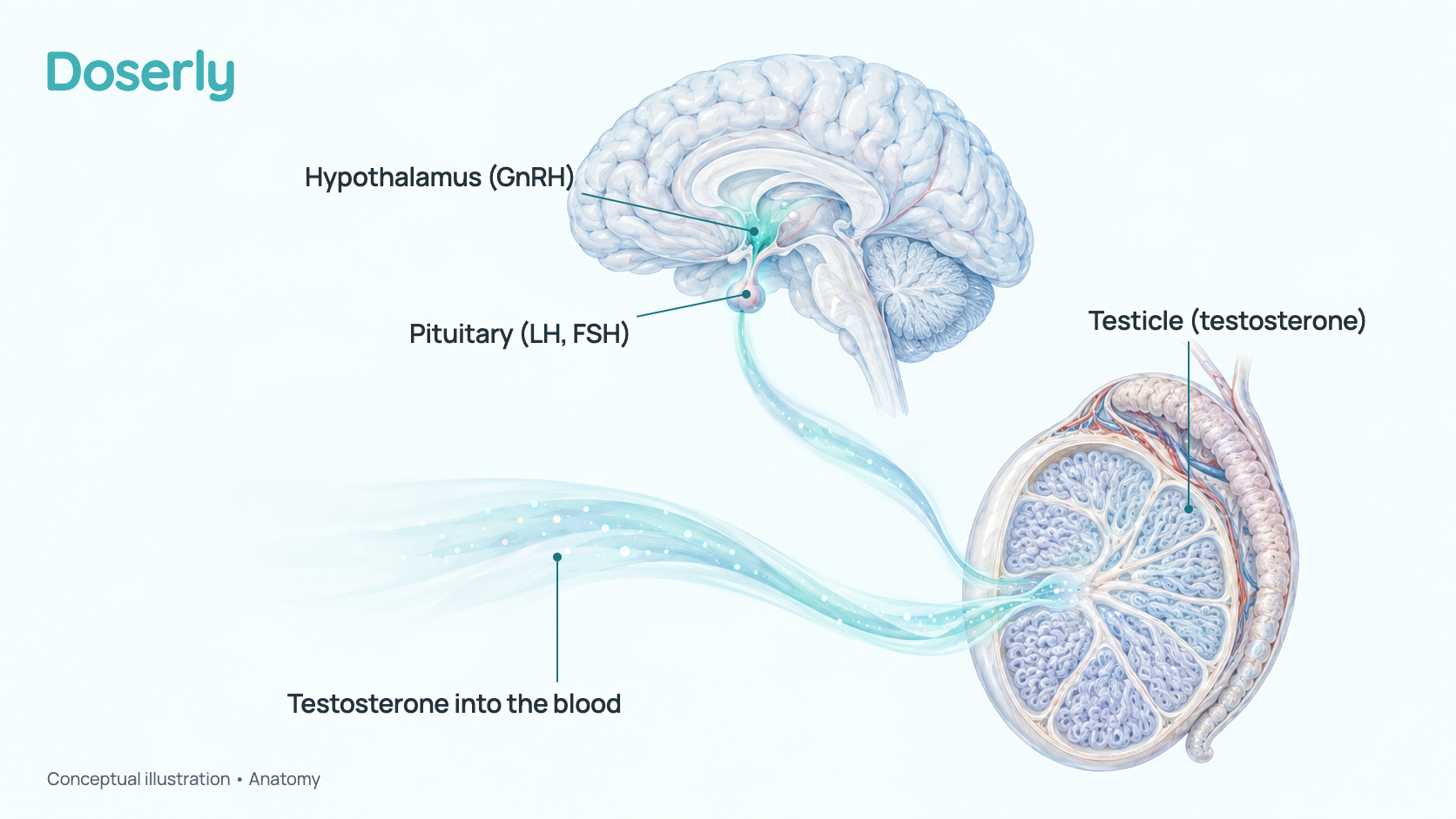
That chain explains the two main types:
- Primary hypogonadism. The testes themselves are damaged, so testosterone is low even though the pituitary is sending plenty of LH and FSH. Blood tests show low testosterone with high LH and FSH. [1], [5]
- Secondary hypogonadism. The testes are fine, but the hypothalamus or pituitary sends too little signal. Testosterone is low and LH and FSH are low or "inappropriately normal", meaning not raised the way they should be when testosterone is low. [1], [5]
Doctors also sort causes into organic (disease or damage, usually permanent) and functional (something that suppresses the system and may reverse, such as obesity, opioid painkillers or serious illness). A functional cause can sometimes be fixed without testosterone. [1], [14]
In the European Male Ageing Study (EMAS) of 3,369 men aged 40–79, 11.8% had the secondary kind and 2.0% the primary kind; another 9.5% had normal testosterone with a high LH (compensated hypogonadism), a pattern whose meaning is still unclear. [8], [15]
Where is testosterone in the blood?
Most testosterone in the blood is attached to proteins. In classic measurements, 43–45% was bound tightly to SHBG (sex hormone-binding globulin), 53–55% loosely to albumin, and about 2% floated free (free testosterone); the Endocrine Society puts the free share at 2–4%. Free and albumin-bound testosterone together are called bioavailable testosterone, the part tissues can use easily. A standard blood test measures total testosterone, all of it together. [16], [1]
How is low testosterone diagnosed?
With three things together: symptoms or signs of testosterone deficiency, a total testosterone level below the guideline cut-off on at least two separate early-morning tests (most guidelines also ask for fasting), and further tests to find the type and the cause. US product labels ask for the same two-morning confirmation before treatment starts. [1], [2], [5], [3]
What are the symptoms of low testosterone?
The Endocrine Society sorts symptoms and signs by how strongly they point to low testosterone:
| How strongly it points to low testosterone | Symptoms and signs |
|---|---|
| Specific | Incomplete or delayed sexual development; loss of armpit and pubic hair; very small testes (under 6 mL) |
| Suggestive | Lower sex drive and sexual activity; fewer spontaneous erections or erectile dysfunction; breast discomfort or breast growth (gynecomastia); body proportions suggesting delayed puberty; infertility or a low sperm count; loss of height, a fracture from a minor fall, or low bone density; hot flushes and sweats |
| Nonspecific | Low energy, motivation and self-confidence; low mood; poor concentration and memory; poor sleep or sleepiness; mild unexplained anemia; less muscle bulk and strength; more body fat |
Sexual symptoms are the most telling. In EMAS, only low sexual desire, fewer morning erections and erectile dysfunction were linked with low testosterone as a group, and the European Association of Urology (EAU) calls sexual symptoms the most specific. Tiredness, poor sleep, low mood and weight gain have many causes, which is why symptoms alone are not diagnostic. [7], [5], [4]
Erectile dysfunction and low testosterone overlap, but not always. The EAU puts coexisting low testosterone at about 30% of men with erectile dysfunction, and the answer depends on the line drawn: among 2,794 such men at one center, 23% were under 300 ng/dL and 47% under 400. [5], [17]
Who should get their testosterone checked?
Men with symptoms, and some groups at higher risk. Guidelines disagree on whether men at risk but without symptoms should be tested.
- No routine screening. The Endocrine Society (2018 and its 2026 statement) advises against screening men in the general population, and the EAU tests only men with symptoms. [1], [4], [5]
- High-risk groups. The Endocrine Society suggests testing men with pituitary disease, men taking opioids or steroid (glucocorticoid) medicines, men coming off anabolic steroids, and men with HIV-related weight loss, infertility, osteoporosis, low sex drive or erectile dysfunction. [1]
- The American Urological Association (AUA) goes further. It suggests testing even without symptoms in men with unexplained anemia, bone loss, diabetes, past chemotherapy or testicular radiation, HIV/AIDS, long-term opioid or corticosteroid use, infertility or pituitary disease. So a man with diabetes may be tested at a routine visit under the AUA approach, but only once symptoms appear under the others. [2]
Symptom questionnaires do not diagnose it. The ADAM questionnaire caught 88% of men with low testosterone but also flagged 4 in 10 men with normal levels, and the AUA, the Endocrine Society and the EAU advise against using questionnaires for diagnosis. [18], [2], [1], [5]
What testosterone level counts as low?
This table shows the line in every major clinical guideline, plus the Australian subsidy rule and the US labels, checked September 2026. Every body also requires symptoms or signs.
| Guideline (version, year) | Threshold | How measured | Action at this level |
|---|---|---|---|
| AUA, American Urological Association (2018, validity reconfirmed 2024) | Below 300 ng/dL (about 10.4 nmol/L) | Two early-morning total testosterone tests on separate days, ideally same lab and method | Measure LH; prolactin if LH is low or low-normal; pituitary MRI if under 150 ng/dL with low or low-normal LH |
| Endocrine Society (2018 guideline) | 264 ng/dL (9.2 nmol/L) for CDC-certified assays; otherwise the lab's own range | Fasting morning test on two separate mornings; free testosterone if SHBG is altered or the result is borderline | LH and FSH to find the type; prolactin and iron tests if secondary |
| Endocrine Society (statement, 16 July 2026) | A common clinical threshold near 300 ng/dL | At least two early-morning fasting tests with a CDC-certified assay, at any age | Rule out reversible causes first; weight loss first when obesity (BMI over 27) is the only cause |
| VA, US Department of Veterans Affairs (January 2026) | 264 ng/dL (9.2 nmol/L) for CDC-certified assays | Fasting early-morning (6–10 am) total testosterone on at least two occasions; an abnormal immunoassay result is confirmed by LC-MS/MS | Refer to an endocrinologist if under 150 ng/dL with low or normal LH and FSH |
| EAU, European Association of Urology (2026) | 12 nmol/L (about 350 ng/dL); calculated free testosterone 220 pmol/L when SHBG is altered | Fasting test between 07:00 and 10:00, repeated at least twice when under 12 nmol/L | LH, FSH and prolactin; pituitary MRI in selected secondary cases, including under 6 nmol/L |
| ICSM, International Consultation on Sexual Medicine (2024) | 12 nmol/L (about 350 ng/dL) | Fasting morning test between 07:00 and 11:00, repeated at least twice | Diagnose with symptoms |
| BSSM, British Society for Sexual Medicine (2023) | Under 12 nmol/L total or 225 pmol/L free usually needs treatment | Two separate samples between 8 and 11 am | 8–14 nmol/L with symptoms may justify a trial of at least 6 months |
| Society for Endocrinology, UK (2022) | No single line: symptoms more likely under 8 nmol/L, or under 11 nmol/L with calculated free testosterone under 220 pmol/L | Morning fasting samples, repeated | Benefit shown mainly below 8 nmol/L (about 230 ng/dL); little evidence above 12 nmol/L |
| CUA, Canadian Urological Association (2021) | Under 10 nmol/L (about 290 ng/dL) | Morning draw, 7–11 am | A reasonable diagnostic line with symptoms (weak recommendation) |
| EAA, European Academy of Andrology (2020) | No fixed line; free testosterone when total is about 8–12 nmol/L | Fasting morning test (before 11 am) on two different days | Lifestyle change and weight loss first in overweight men |
| ESA, Endocrine Society of Australia (2016) | No single number | With LH and FSH between 08:00 and 10:00; at least two tests unless one is clearly diagnostic | Rests on a proven disorder of the testes or pituitary |
| Australia's PBS (subsidy rule, not a guideline; checked September 2026) | Under 6 nmol/L, or 6–15 nmol/L with a high LH, for men 40 and older without a known testicular or pituitary disorder | At least two morning samples on different days | Specialist involvement needed for the subsidy |
| US product labels (checked September 2026) | Below the lab's normal range | Morning serum testosterone on at least two separate days | Confirm before starting |
[2], [1], [4], [19], [5], [20], [6], [21], [22], [14], [23], [24], [3]
Nearly every body wants symptoms plus at least two low morning tests (the Australian position statement accepts one clearly diagnostic result). North American bodies land at about 264–300 ng/dL, most European bodies at 12 nmol/L (about 350 ng/dL), the Canadian Urological Association at 10 nmol/L, and the UK Society for Endocrinology uses bands rather than one line. [2], [1], [5], [22], [21]
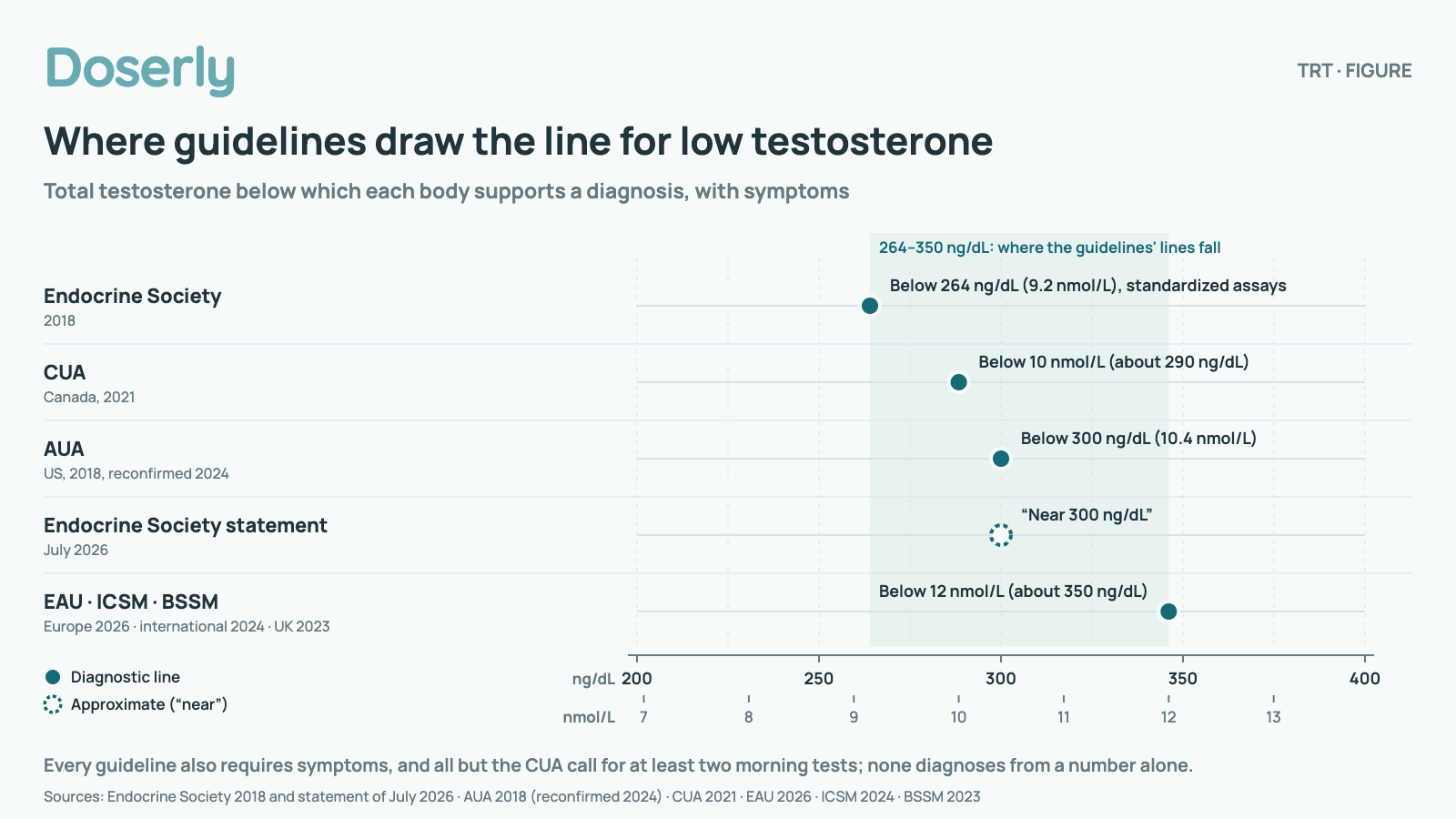
Where guidelines draw the line for low testosterone
Total testosterone below which each body supports a diagnosis, with symptoms.
Each line runs from 200 ng/dL (7 nmol/L, left) to 400 ng/dL (14 nmol/L, right); the shaded part is 264–350 ng/dL, where the guidelines' lines fall. A dashed circle means an approximate line.
- Endocrine Society (2018)
- Below 264 ng/dL (9.2 nmol/L), standardized assays
- CUA (Canada, 2021)
- Below 10 nmol/L (about 290 ng/dL)
- AUA (US, 2018, reconfirmed 2024)
- Below 300 ng/dL (10.4 nmol/L)
- Endocrine Society statement (July 2026)
- “Near 300 ng/dL”
- EAU · ICSM · BSSM (Europe 2026 · international 2024 · UK 2023)
- Below 12 nmol/L (about 350 ng/dL)
Every guideline also requires symptoms, and all but the CUA call for at least two morning tests; none diagnoses from a number alone.
Why do guidelines disagree on the number?
Because labs used to measure testosterone very differently, and because the bodies chose their lines by different methods.
- Lab differences. When 1,133 laboratories measured the same sample from one man, results ranged from 45 to 365 ng/dL. That is why the Endocrine Society ties its line to assays certified by the US Centers for Disease Control and Prevention (CDC). [1]
- Healthy ranges. The 264 ng/dL line is the bottom 2.5% of healthy, non-obese men aged 19–39, measured on one calibrated scale. [25], [1]
- Treatment benefit. European bodies put the line where trials found benefit: the EAU says testosterone therapy is ineffective above 12 nmol/L and helps most below 8 nmol/L. [5], [21]
Between about 8 and 12 nmol/L (230–350 ng/dL) is a grey zone, where the BSSM accepts a trial of treatment and the European Academy of Andrology (EAA) asks for a free testosterone test. [6], [14]
Units. US labs report ng/dL and most other countries nmol/L; 1 nmol/L equals 28.84 ng/dL, so 12 nmol/L is about 346 ng/dL. The testosterone unit converter does the arithmetic.
What is a normal testosterone level for your age?
In men without obesity, the median total testosterone is about 530 ng/dL at 19–39 and about 480 ng/dL from 40 on. The bottom of the range falls with age; the top stays about the same. These figures come from four US and European studies (9,054 men in all, 6,933 of them without obesity) measured on one calibrated scale. [25]
| Age | Low end (2.5th percentile) | Median (middle value) | High end (97.5th percentile) |
|---|---|---|---|
| 19–39 | 267 ng/dL (9.3 nmol/L) | 531 ng/dL (18.4 nmol/L) | 929 ng/dL |
| 40–49 | 235 ng/dL (8.1 nmol/L) | 481 ng/dL (16.7 nmol/L) | 929 ng/dL |
| 50–59 | 219 ng/dL (7.6 nmol/L) | 477 ng/dL (16.5 nmol/L) | 929 ng/dL |
| 60–69 | 218 ng/dL (7.6 nmol/L) | 477 ng/dL (16.5 nmol/L) | 929 ng/dL |
| 70–79 | 218 ng/dL (7.6 nmol/L) | 477 ng/dL (16.5 nmol/L) | 926 ng/dL |
| 80–99 | 157 ng/dL (5.4 nmol/L) | 476 ng/dL (16.5 nmol/L) | 913 ng/dL |
Including men with obesity, the medians are lower at every age (507 ng/dL at 19–39, 446 ng/dL from 50). For healthy young men aged 19–39, the range covering the middle 95% was 264–916 ng/dL, the range the Endocrine Society adopted. [25], [1]
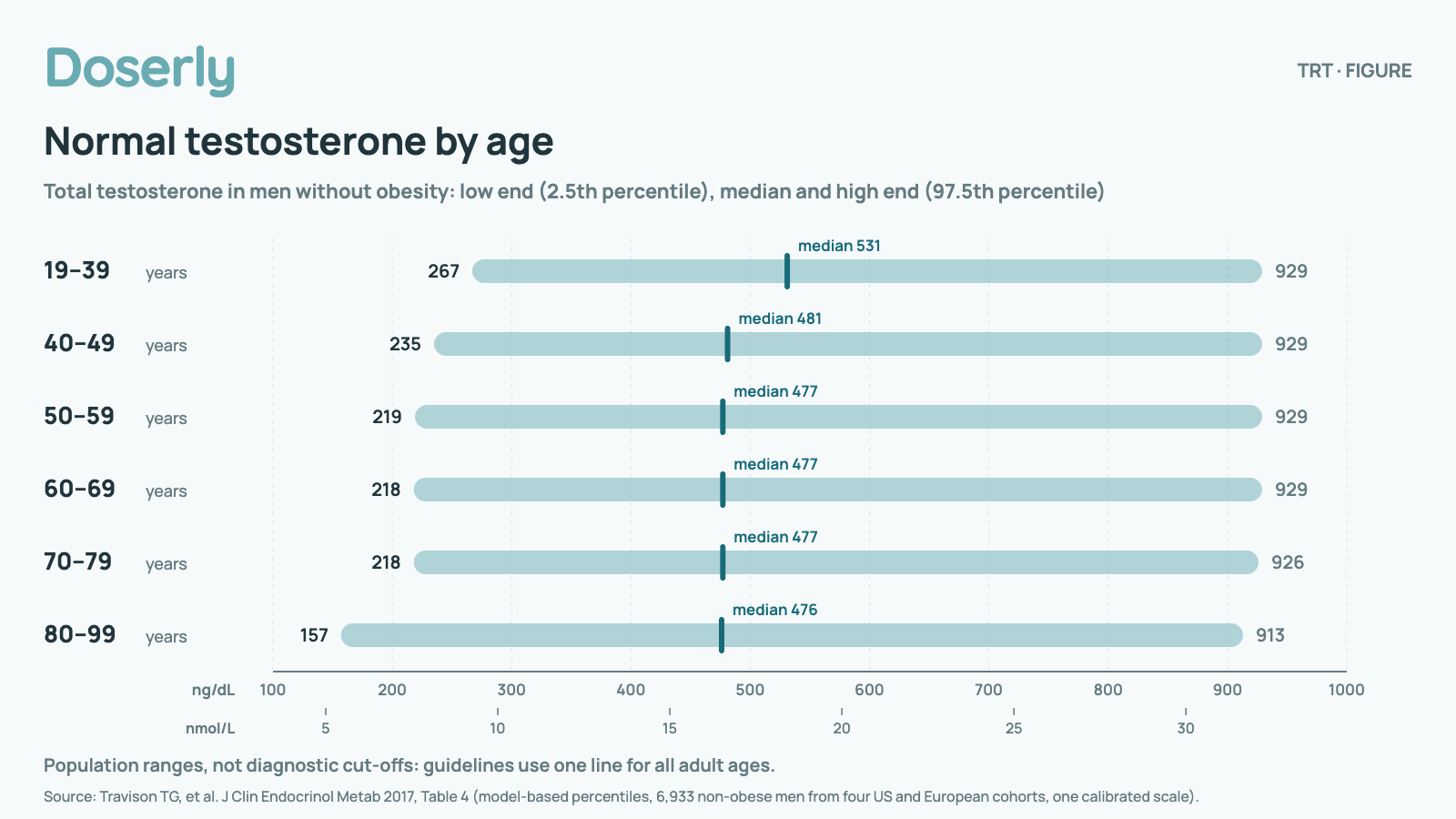
Normal testosterone by age
Total testosterone in men without obesity: low end (2.5th percentile), median and high end (97.5th percentile).
Each bar runs from 100 ng/dL (left) to 1,000 ng/dL (right); the band is the low end to the high end, and the dark tick is the median.
- 19–39 years
- 267 (9.3 nmol/L) to 929 ng/dL; median 531 ng/dL (18.4 nmol/L)
- 40–49 years
- 235 (8.1 nmol/L) to 929 ng/dL; median 481 ng/dL (16.7 nmol/L)
- 50–59 years
- 219 (7.6 nmol/L) to 929 ng/dL; median 477 ng/dL (16.5 nmol/L)
- 60–69 years
- 218 (7.6 nmol/L) to 929 ng/dL; median 477 ng/dL (16.5 nmol/L)
- 70–79 years
- 218 (7.6 nmol/L) to 926 ng/dL; median 477 ng/dL (16.5 nmol/L)
- 80–99 years
- 157 (5.4 nmol/L) to 913 ng/dL; median 476 ng/dL (16.5 nmol/L)
Population ranges, not diagnostic cut-offs: guidelines use one line for all adult ages.
Age ranges are not cut-offs. Guidelines use one line for all adult ages. The Massachusetts Male Aging Study proposed age-specific lower limits (251 ng/dL in the 40s down to 156 ng/dL in the 70s), but no major guideline has adopted them, and the Endocrine Society's 2026 statement says the diagnosis is made the same way at any age. [26], [4]
How should the testosterone blood test be done?
Early in the morning, fasting, when you are well, and repeated on a different day. Each rule has a reason:
- Morning. Testosterone is highest in the morning. In men aged 30–40 it was 20–25% lower at 4 pm than at 8 am, a gap that shrank to about 10% by age 70, and 17 men with an afternoon result under 300 ng/dL were normal on all three morning tests. Guideline windows run from 6–10 am (VA) to before 11 am (EAA); night-shift workers are tested after a normal sleep period. [27], [19], [14], [5]
- Fasting. In one study, a sugary glucose drink lowered average testosterone by 25%, and it was still lower 2 hours later; 10 of 66 men (15%) with normal levels dropped into the low range. The EAU says a non-fasting test can underestimate total testosterone by more than 30%. [28], [5]
- Repeated. In the Endocrine Society's review, 30% of men with a first low result were normal on a repeat test, and two tests in the same man often differ by more than 18–28%. In 96 healthy men aged 55 and older tested four times in a year, only 1 of 25 with a first result under 10 nmol/L stayed under 10 at every later test. [1], [29], [30]
- When you are well. Testosterone fell below normal for a sustained period in 62% of acutely ill men in hospital, so the Endocrine Society advises against testing during or soon after an acute illness or short-term opioid use. [31], [1]
- With a reliable lab. The Endocrine Society's 2026 statement asks for a CDC-certified assay; LC-MS/MS (mass spectrometry) is the most accurate method. [4], [5]
- Without biotin. High-dose biotin supplements can disturb some hormone tests; the Endocrine Society advises stopping them at least 72 hours before LH and FSH tests. [1]
What do free testosterone and SHBG add?
They show how much testosterone is actually available when total testosterone is misleading, which happens when SHBG, the protein that carries most testosterone, is unusually high or low. [1], [5]
- Low SHBG (total testosterone reads low while free may be normal): obesity, type 2 diabetes, glucocorticoid and androgen medicines, an underactive thyroid and some rarer conditions. [1], [5]
- High SHBG (total can look normal while free is low): ageing, HIV, liver disease, an overactive thyroid, some anti-seizure medicines and estrogens. [1], [5]
Obesity is the everyday example: in one study, men with obesity had lower total testosterone than men without (10.5 vs 14.1 nmol/L) but the same calculated free testosterone. In EMAS, men whose total testosterone fell but free stayed normal did not develop new sexual symptoms; only men whose free testosterone also fell did. [32], [33]
When and how. Guidelines measure free testosterone when SHBG is likely to be altered or total testosterone is borderline (roughly 200–400 ng/dL, or 8–12 nmol/L). It should come from equilibrium dialysis, a reference lab method, or be calculated from total testosterone, SHBG and albumin; the two agree closely. "Direct" free testosterone kits are inaccurate, and the free androgen index is not a reliable measure in men. [1], [14], [34]
Free testosterone lines. The EAU uses 220 pmol/L (about 64 pg/mL) with limited evidence behind it, the BSSM 225 pmol/L, and the EAA calls 220 pmol/L not validated. [5], [7], [6], [14]
Are home finger-prick and saliva tests accurate?
Not for a diagnosis. Every guideline in this guide diagnoses low testosterone with a blood sample from a vein, and none uses finger-prick or saliva results. [1], [5], [2]
The one recent validation of a dried-blood-spot method matched venous serum closely in 20 people, but the blood was drawn from a vein and spotted onto cards in the lab, so it did not test real finger-pricks at home. Saliva testosterone has its own reference ranges, and we found no study comparing it with serum at the cut-offs guidelines use. A home test can prompt a proper test; it cannot replace one. [35], [36]
How do doctors find the type and the cause?
The next step after two low morning results is working out where the chain is broken:
- LH and FSH, for everyone. High LH and FSH point to the testes (primary); low or normal LH and FSH point to the brain and pituitary (secondary). [1], [2], [5]
- If secondary: prolactin and iron. A high prolactin can mean a prolactin-making pituitary tumor; the AUA measures prolactin when LH is low or low-normal and refers men with a persistently high result to an endocrinologist. The Endocrine Society adds iron tests to look for iron overload, and other pituitary hormones if needed. [2], [1]
- If primary with very small testes: a chromosome test (karyotype) for Klinefelter syndrome. [1]
- A pituitary MRI in selected men: when total testosterone is under 150 ng/dL with low or low-normal LH, when prolactin stays high, when other pituitary hormones are affected, or with headaches or vision loss (AUA, Endocrine Society). The EAU suggests one in severe secondary cases under 6 nmol/L. [2], [1], [5]
When is a brain scan likely to find something? Mostly when testosterone is very low or prolactin is high. Among 164 men with erectile dysfunction and repeatedly low testosterone, scans found a potentially serious lesion in 11 (6.7%), and the larger tumors were all in men at 104 ng/dL or less. In another 51 men, 3 of the 4 with a small tumor had prolactin more than twice the upper limit of normal. [37], [38]
Where these numbers come from
Each diagnostic row comes from that body's current document: the AUA testosterone deficiency guideline (2018, validity reconfirmed 2024), the Endocrine Society guideline (2018) and its statement of 16 July 2026, the VA recommendations (January 2026), the EAU guidelines (2026 edition), the ICSM 2024 recommendations (published 2025), the BSSM guidelines (2023), the Society for Endocrinology guideline (2022), the CUA guideline (2021), the EAA guideline on functional hypogonadism (2020) and the Endocrine Society of Australia position statement (2016). The Australian row is the Pharmaceutical Benefits Scheme restriction for testosterone undecanoate injection, a subsidy rule rather than a clinical guideline. The label row comes from current US testosterone labels. [2], [1], [4], [19], [5], [20], [6], [21], [22], [14], [23], [24], [3]
The age table comes from the harmonized reference-range study (Table 4, model-based percentiles in 6,933 non-obese men). The nmol/L values in brackets were converted from ng/dL using 1 nmol/L = 28.84 ng/dL and rounded. [25]
Not used: the older International Society for the Study of the Aging Male bands (230 and 350 ng/dL), which have been replaced; a "300–1,000 ng/dL" normal range that circulates online without a current source; and an Androgen Society consensus published in August 2026, because only its abstract was available.
What causes low testosterone?
Anything that damages the testes (primary) or quiets the brain's signal to them (secondary). In middle-aged and older men, the secondary kind is far more common, and it is usually linked to obesity, other illness or medicines rather than a disease of the pituitary. In EMAS, a BMI of 30 or more was strongly linked with secondary low testosterone (relative risk ratio 8.74). [8], [1]
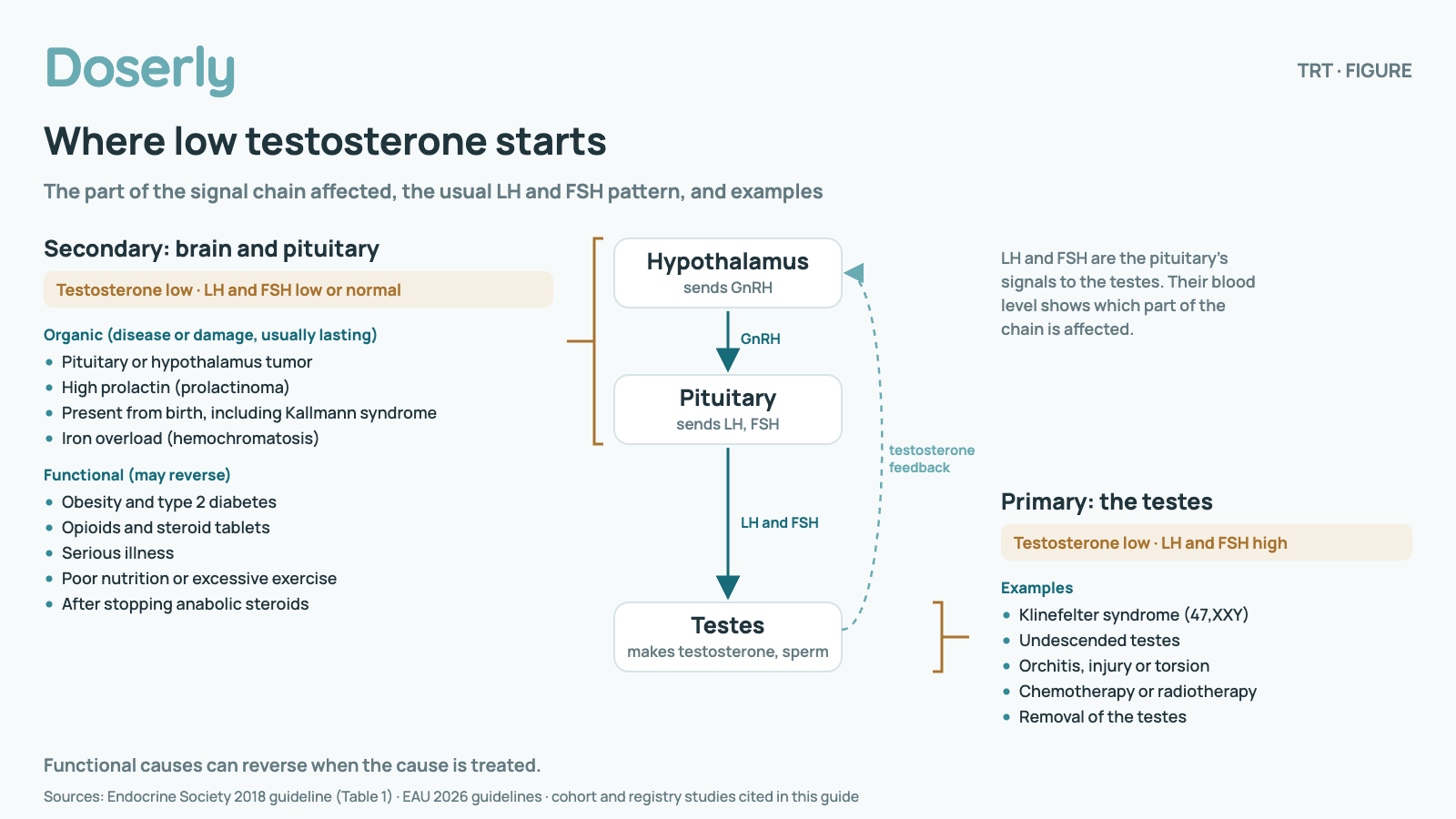
Where low testosterone starts
The chain: hypothalamus (GnRH) → pituitary (LH, FSH) → testes (testosterone, sperm), with testosterone feeding back to turn the signal down.
Secondary: brain and pituitary
Testosterone low · LH and FSH low or normal
Organic (disease or damage, usually lasting)
- Pituitary or hypothalamus tumor
- High prolactin (prolactinoma)
- Present from birth, including Kallmann syndrome
- Iron overload (hemochromatosis)
Functional (may reverse)
- Obesity and type 2 diabetes
- Opioids and steroid tablets
- Serious illness
- Poor nutrition or excessive exercise
- After stopping anabolic steroids
Primary: the testes
Testosterone low · LH and FSH high
Examples
- Klinefelter syndrome (47,XXY)
- Undescended testes
- Orchitis, injury or torsion
- Chemotherapy or radiotherapy
- Removal of the testes
Functional causes can reverse when the cause is treated.
What damages the testes themselves?
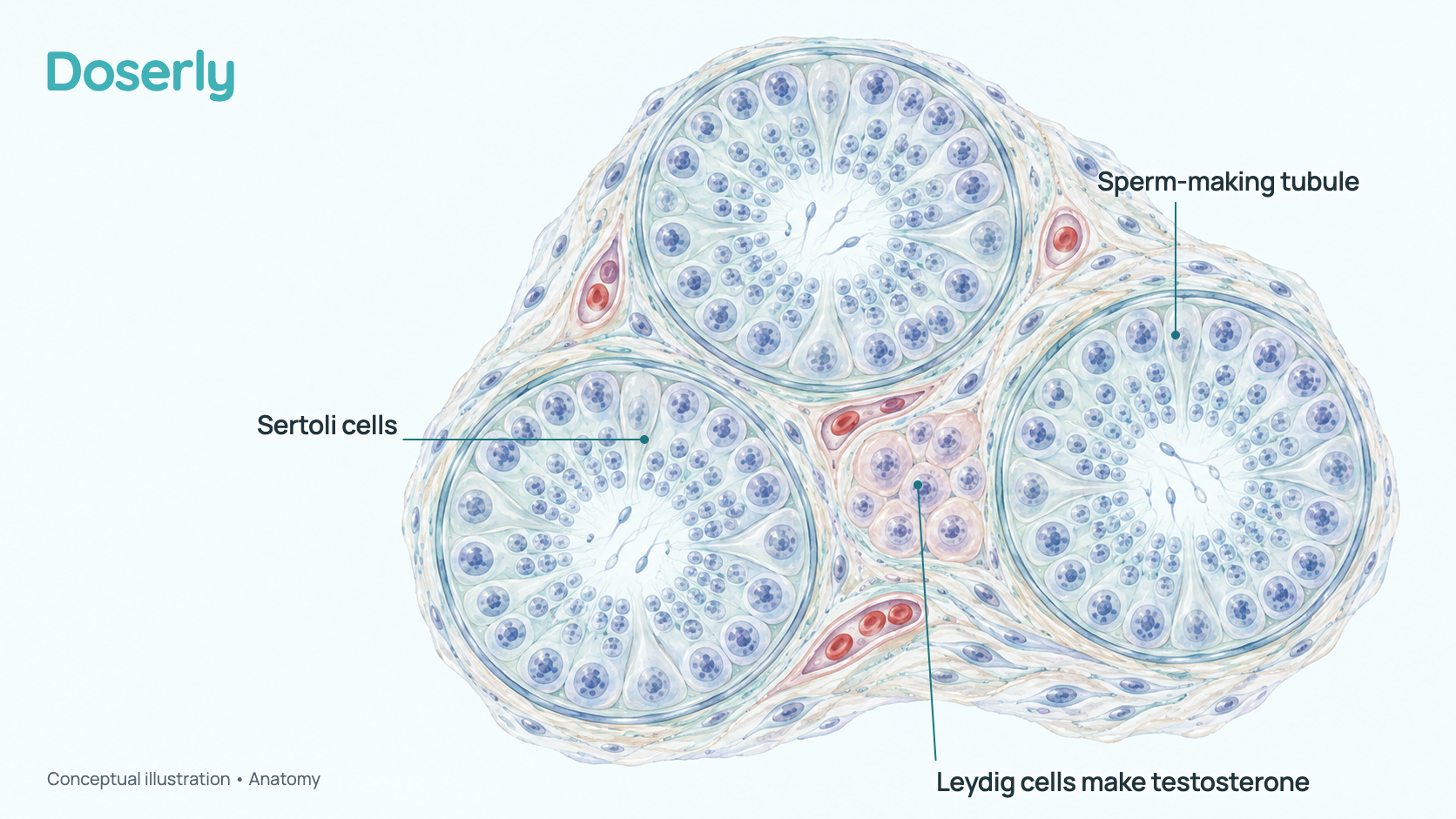
- Klinefelter syndrome (an extra X chromosome, 47,XXY). The most common genetic cause. In a Danish national registry it affected about 153 in 100,000 males (about 1 in 650), but only about 1 in 4 adult men with it had been diagnosed, and fewer than 10% before puberty. [39], [5]
- Other testicular causes: undescended testes, inflammation (orchitis, for example after mumps), injury or twisting (torsion), removal of the testes, myotonic dystrophy (an inherited muscle disease) and ageing. [1]
- Cancer treatment. After testicular cancer, 11% of men treated with surgery alone had low testosterone, against 37% of those who also had chemotherapy and radiotherapy; in survivors followed for decades, it rose from 12% to 41%, against 5% to 11% in similar men without cancer. [40], [41]
- Varicocele (enlarged veins around a testicle). The evidence conflicts: linked with low testosterone in one clinic study, but not in 7,035 young men from the general population. [42], [43]
What switches off the brain's signal?
- Pituitary and hypothalamus disease. Tumors, diseases that infiltrate or damage the area, and pituitary surgery or radiation. [1]
- High prolactin. A prolactin-making pituitary tumor (prolactinoma) switches off the signal to the testes. [1], [38]
- Present from birth. Congenital hypogonadotropic hypogonadism, sometimes with a poor or missing sense of smell (Kallmann syndrome). [1], [2]
- Iron overload (hemochromatosis), mainly when advanced: in 141 men with the inherited form, 9 had low testosterone, 8 of them with cirrhosis. [44], [1]
- Functional causes, which may reverse: obesity, some sleep disorders, serious illness and organ failure, heavy alcohol or marijuana use, poor nutrition or excessive exercise, and some medicines (next section). [1]
Which medicines can lower testosterone?
- Opioid painkillers. In a review of 15 studies (3,250 patients), 63% of men using opioids had low testosterone. The Endocrine Society says nearly all opioids suppress it at doses equal to 30 mg of methadone a day, buprenorphine less so, and since 2016 US opioid labels warn about it. [9], [1], [45], [46]
- Steroid (glucocorticoid) tablets. Testosterone was 33% lower in men on long-term prednisolone tablets (14.5 vs 21.7 nmol/L), but not significantly lower with inhaled steroids. [47]
- Anabolic steroids, after stopping. About 2.5 years after stopping, 27% of former users still had testosterone below 12.1 nmol/L. See TRT vs steroids. [48]
Do not stop a prescribed medicine on your own: opioids and steroid tablets need a supervised plan.
How do weight, diabetes and sleep apnea affect testosterone?
They are the most common everyday drivers, and they often travel together.
- Obesity. In a US primary care study of men aged 45 and older, men with obesity had 2.38 times the odds of a result under 300 ng/dL, and each extra BMI unit went with about 2.9% lower testosterone in a national survey. Part of the drop is lower SHBG; the EAU explains the rest through hormones and inflammatory signals from fat tissue that quiet the brain's signal. [49], [50], [5]
- Weight change. In 2,395 EMAS men followed for 4.4 years, losing weight raised testosterone and gaining weight lowered it. Of the men who developed secondary low testosterone, 42.9% recovered, more often after weight loss (odds ratio 2.24). [51], [52]
- Type 2 diabetes. A third of 103 men with type 2 diabetes had low free testosterone, mostly with low LH and FSH, and 50% of men with both obesity and diabetes did in a larger study. [53], [54]
- Sleep apnea. It is linked with low testosterone, but treating it with CPAP has not been shown to raise testosterone (a pooled change of 1.08 nmol/L, too uncertain to count). Untreated severe sleep apnea is also a reason not to start testosterone. [1], [55]
Is low testosterone just part of ageing?
Partly, but less than most people think. Average testosterone falls slowly with age, and health and weight explain much of the fall.
- How fast it falls. Men aged 40–70 in the Massachusetts Male Aging Study lost about 1.6% of their total testosterone a year. In UK Biobank, total testosterone barely changed over 4.3 years in men aged 40–69, while SHBG rose and free testosterone fell. [56], [57]
- Healthy men keep their levels. The BSSM says over 80% of men keep normal testosterone into old age, and the EAU says obesity and illness drive most of the age-related fall. [6], [5]
- Low readings are not the condition. In a Baltimore study, low readings reached about 20% of men over 60 and 50% over 80. But strictly defined late-onset hypogonadism, with sexual symptoms and low total and free testosterone, affected 2.1% of EMAS men aged 40–79: 0.1% in their 40s rising to 5.1% in their 70s. [58], [7], [6]
Regulators and guidelines disagree about "age-related" low testosterone. US labels still say safety and effectiveness in "age-related hypogonadism", which the FDA describes as low testosterone "without a clear cause", have not been established. In June 2026 the FDA asked makers to remove that limitation, a request not yet in any label as of September 2026. The Endocrine Society's July 2026 statement says the diagnosis is made the same way at any age. See late-onset hypogonadism. [59], [60], [61], [4]
How common is low testosterone?
It depends on the definition: uncommon with symptoms plus low levels, common with a single blood test alone.
| Study | Definition | How many men |
|---|---|---|
| EMAS (3,369 men aged 40–79, Europe) | At least three sexual symptoms plus low total (under 11 nmol/L) and free testosterone | 2.1% |
| BACH (1,475 men, Boston) | Low testosterone plus symptoms | 5.6%; 18.4% of men in their 70s |
| BACH, same men | Total testosterone under 300 ng/dL, symptoms or not | About 24% |
| HIM (2,162 men aged 45 and older, US primary care) | One test under 300 ng/dL, drawn 8 am to noon, in men not already on testosterone | 36.3% (756 of 2,082) |
Many men with a low reading have no symptoms (47.6% of those aged 50 and older in BACH), which is why single-test figures such as "1 in 3 men" overstate the condition. [62]
Is there a "low T epidemic"?
Unsettled. One Massachusetts study found a population-wide fall that age did not explain, and US national surveys showed lower levels in young men in later years, although lab methods had changed; another analysis of the same surveys found little change. [63], [64], [65]
Can young men have low testosterone?
Yes, at any adult age, according to the BSSM. The causes to look for are Klinefelter syndrome, pituitary disease, past anabolic steroid use, opioids, obesity, and severe dieting or overtraining. [6], [39], [48], [1]
It is less common than forums suggest: among 2,130 men aged 18–40 seen for erectile dysfunction, 10.7% had low testosterone, more often with a higher BMI, depression or past cancer. For young men, fertility is usually the deciding issue in treatment (see what if you want children). Testosterone for teenagers, for example for delayed puberty, belongs only in specialist care. [66]
How is low testosterone usually treated?
By treating the cause where possible, and with testosterone therapy (TRT) when low testosterone is confirmed, causes symptoms and children are not planned soon. Men who want children are steered to medicines that keep sperm production going. This section describes the choices clinicians weigh; it is not a personal plan. [4], [5], [2], [1]
| Option | Who it suits, according to guidelines | Effect on fertility | Read more |
|---|---|---|---|
| Treat the cause: weight loss, reviewing opioids or steroid tablets, treating a prolactinoma or other pituitary disease | Functional causes; men with obesity (BMI over 27) and no other cause (Endocrine Society 2026) | Keeps the body's own production | Increasing testosterone naturally, obesity-related hypogonadism |
| GLP-1 weight-loss medicines | Obesity-related low testosterone; the ICSM notes a possible role. Not approved for low testosterone | Keep LH and FSH working | TRT with GLP-1 medicines |
| Testosterone therapy: injections, gel, oral capsules, nasal gel or pellets | Confirmed low testosterone with symptoms, not trying to conceive | Switches off sperm production; it usually, but not always, recovers after stopping | TRT: the definitive guide |
| Clomiphene (a tablet that raises LH and FSH); enclomiphene is similar but not an approved medicine | Secondary low testosterone when fertility matters; clomiphene is used off-label in men, and the AUA lists these tablets as a way to keep fertility | Can keep sperm production going | Clomiphene, enclomiphene |
| hCG, with FSH if needed | Secondary low testosterone when fertility is wanted; the only fertility-sparing option here that is FDA-approved for men | Can restore sperm production in secondary, not primary, low testosterone | hCG |
| Repeat testing and watchful waiting | Borderline or single low results, unclear symptoms | None | TRT blood work |
[4], [5], [20], [3], [2], [67], [68], [1]
Should the cause be treated before starting testosterone?
Most guidelines say yes for functional causes, but they disagree on whether lifestyle change alone should come first.
- Cause first. The EAU strongly recommends improving lifestyle, losing weight, stopping medicines that interfere and treating other illnesses before starting testosterone. The Endocrine Society's 2026 statement calls weight loss typically first-line when obesity (a BMI over 27) is the only cause, and the EAA recommends lifestyle change and weight loss for overweight men with functional low testosterone. [5], [4], [14]
- Both together. The BSSM says current evidence does not support lifestyle change alone as first-line treatment and recommends lifestyle change together with testosterone for men with symptoms. The AUA counsels every man on lifestyle and advises weight-loss programs alongside testosterone for men who are overweight. [6], [2]
How much does weight loss raise testosterone? Less than many hope, unless the loss is large. Pooled studies found rises of about 2.5–2.9 nmol/L (about 70–85 ng/dL) after diet-based weight loss and 7.2–8.7 nmol/L after bariatric surgery. Diet and exercise alone raise it only about 1–2 nmol/L, according to the European urology guideline, and 60–86% of lost weight is regained within three years. [69], [70], [5]
Weight-loss medicines. In a 16-week trial in men with obesity, liraglutide raised testosterone by 2.6 nmol/L with 7.9 kg of weight loss, against 5.9 nmol/L and 0.9 kg with testosterone gel. Reviews of small, short studies found rises of about 2.5–5.2 nmol/L with GLP-1 medicines, which, unlike testosterone, keep LH and FSH working. [71], [72], [73]
Opioids. For men with opioid-related low testosterone who have sexual symptoms and are unlikely to stop opioids, the Endocrine Society suggests considering testosterone. [1]
What does testosterone therapy involve?
Testosterone comes in several forms, each with its own guide:
- Injections: testosterone cypionate, testosterone enanthate (including the Xyosted autoinjector), the long-acting testosterone undecanoate injection (Aveed, Nebido), testosterone propionate and Sustanon 250.
- Skin: testosterone gel (AndroGel, Testim, Testogel, Tostran) and compounded cream.
- By mouth: oral testosterone undecanoate (Jatenzo, Kyzatrex, Tlando).
- Nasal gel: Natesto.
- Implanted pellets: testosterone pellets (Testopel).
Guidelines aim for the middle of the normal range on treatment (the AUA, for example, targets 450–600 ng/dL) and check testosterone and hematocrit at 3–6 months, at 12 months and then yearly. The TRT dosage guide covers doses, and the TRT dose calculator turns a prescribed dose into mL and syringe units. Testosterone for women uses different products and doses; see testosterone therapy for women. [2], [1]
Who should not start testosterone?
The Endocrine Society advises against testosterone for men who:
- plan to have children soon
- have breast or prostate cancer, a lump in the prostate, or a PSA above 4 ng/mL (above 3 ng/mL at high risk) without a urologist's review
- have a high hematocrit (above 48%, or 50% at high altitude, is a reason for caution), untreated severe sleep apnea or severe urinary symptoms
- have uncontrolled heart failure, had a heart attack or stroke in the last 6 months, or have an inherited clotting tendency (thrombophilia)
The AUA suggests holding off when hematocrit is above 50% until the cause is found. US labels do not allow testosterone with known or suspected prostate cancer or male breast cancer; the FDA's June 2026 request to narrow this to prostate cancer that has spread is not yet in the labels. [2], [13], [61]
What if you want children?
Testosterone therapy is the wrong choice while you are trying to conceive, because it switches off the pituitary signals the testes need to make sperm, and the labels warn that reduced fertility may not be reversible in some men. The AUA says not to prescribe it to men trying to conceive, the AUA and ASRM infertility guideline extends that to men interested in future fertility, and the EAU agrees. [3], [2], [74], [5]
Sperm usually comes back after stopping, but slowly. In contraceptive studies of 1,549 healthy men, sperm counts recovered in 67% within 6 months and in all within 24 months; recovery after years of TRT may be slower. [75], [2]
The options depend on the type. In secondary low testosterone, hCG (sometimes with FSH) can restart sperm production; in primary low testosterone it cannot, and the options are donor sperm, adoption, or sperm retrieval for IVF. The AUA allows hCG, clomiphene-type tablets (SERMs) or aromatase inhibitors to keep fertility, noting that only hCG is FDA-approved for men. The tablets are less proven: clomiphene improved sex drive less than testosterone gel in a 2026 review, and enclomiphene was refused approval in the EU in 2018 over unproven benefit and a blood-clot risk. [1], [2], [76], [67]
See TRT and fertility and hCG vs gonadorelin vs enclomiphene.
Should older men with low testosterone be treated?
Only when symptoms and repeated low levels come together, most guidelines say. The Endocrine Society suggests against routinely treating all men aged 65 and older with low levels, the EAU advises against using testosterone for vitality or strength in ageing men, and the American College of Physicians' 2020 guideline (now listed as inactive) suggested treating only sexual problems and reviewing within 12 months. US labels still carry the age-related limitation while the FDA's June 2026 request to remove it is pending (checked September 2026). [1], [5], [77], [61]
Is treatment lifelong?
For organic causes, usually yes. For functional causes, sometimes not. [1], [14]
The UK Society for Endocrinology expects lifelong therapy once the diagnosis is confirmed and rejects time-limited "trials". The AUA suggests discussing stopping 3–6 months in if testosterone is normal but symptoms have not improved, and the EAA says testosterone can be withdrawn after weight loss or when opioids can be stopped or swapped. After stopping, the body's own signal returns slowly: after two years of injections in the T4DM trial, LH and FSH recovered gradually over 12 months. See stopping TRT. [21], [2], [14], [78]
What does testosterone treatment do for low testosterone?
It helps sexual function most, gives small lifts in mood and energy, raises bone density and corrects some anemia. It did not improve memory, and the Testosterone Trials missed their main energy and walking goals. [10], [79], [80]
Most of this comes from two large controlled trials that compared testosterone with a placebo. The Testosterone Trials gave 790 men aged 65 and older with testosterone under 275 ng/dL a year of testosterone gel or placebo; 51,085 men were screened to find them. TRAVERSE randomized 5,204 men aged 45–80 with low testosterone and heart disease or high heart risk to daily testosterone gel or placebo. [79], [81]
| Outcome | What the trials found |
|---|---|
| Sex drive and sexual activity | Improved in the Testosterone Trials and, in 1,161 TRAVERSE men with low sex drive, lasting to 24 months [79], [82] |
| Erections | Improved in the Testosterone Trials, not in TRAVERSE; pooled trial data showed about 2 points on the erectile function score, enough to matter in mild erectile dysfunction [79], [82], [80] |
| Mood | Small improvement in the Testosterone Trials; no effect on persistent low-grade depression in TRAVERSE [79], [83] |
| Energy and walking | No improvement in the Testosterone Trials' own vitality and physical-function trials, although across all three trials 20.5% on testosterone and 12.6% on placebo walked at least 50 m farther in 6 minutes; TRAVERSE found small gains in energy [79], [83] |
| Memory and thinking | No improvement in 493 men with age-related memory problems [84] |
| Bone | Spine bone density rose 7.5% against 0.8% on placebo in 211 men, but fractures were not reduced: in TRAVERSE they occurred in 3.50% on testosterone and 2.46% on placebo [85], [86] |
| Anemia | Among men with unexplained anemia, 58.3% on testosterone and 22.2% on placebo were no longer anemic at 12 months; in TRAVERSE, anemia was corrected at 12 months in 152 of 338 men (45.0%) on gel against 122 of 360 (33.9%) on placebo [87], [88] |
| Body composition | Across 29 trials, about 1.6 kg less fat and 1.6 kg more lean mass, with no change in body weight [89] |
| Diabetes prevention | In T4DM (men with a large waist, testosterone of 14 nmol/L or less and prediabetes or new diabetes; injections, with a lifestyle program in both groups), 55 of 443 (12%) had diabetes at 2 years against 87 of 413 (21%) on placebo; in TRAVERSE (gel, no program), progression was not significantly reduced [90], [91] |
Where the trials disagree. Erections improved in the Testosterone Trials but not in TRAVERSE, and diabetes was prevented in T4DM but not in TRAVERSE. The trials used different men, forms and programs, so neither result cancels the other; the Endocrine Society advises against using testosterone to control blood sugar. [90], [91], [1]
How long it takes. Sex drive tends to improve from about 3 weeks, erections over up to 6 months, and body composition in 12–16 weeks; the Canadian Urological Association expects changes after 3 months or more. See how long TRT takes to work and TRT and sexual health. [92], [22]
What are the risks of low testosterone and of treating it?
Is untreated low testosterone dangerous?
It is linked with a higher risk of death in observational studies, but no study has shown that low testosterone causes those deaths or that treatment prevents them.
- A 2024 analysis pooling individual data from many studies found higher death rates only at quite low levels: below 7.4 nmol/L (213 ng/dL) for death from any cause and below 5.3 nmol/L (153 ng/dL) for heart disease. An earlier review found the studies differed too much to interpret the link firmly. [93], [94]
- In EMAS (2,599 men followed for a median 4.3 years, 147 deaths), the 24 men with severe late-onset hypogonadism died at about 5 times the rate of men without it (hazard ratio 5.5, after adjusting for age, weight, smoking and general health), an association rather than proof of cause. [95]
- In TRAVERSE, deaths were similar: 144 of 2,596 men on testosterone and 148 of 2,602 on placebo (hazard ratio 0.98). [81]
Low testosterone can also go with bone loss and mild anemia. [1]
Is testosterone therapy safe for the heart?
In the largest trial, testosterone gel did not raise the combined risk of heart attack, stroke or death from heart disease compared with placebo, but it did raise some other risks, and it cannot show long-term safety or the safety of injections. TRAVERSE, in about 5,200 men with heart disease or high heart risk:
- Heart attack, stroke or death from heart disease: 7.0% on testosterone and 7.3% on placebo (182 against 190 men; hazard ratio 0.96, with a likely range of 0.78 to 1.17), meeting the trial's safety margin of 1.5. [81]
- More common on testosterone: atrial fibrillation (an irregular heart rhythm) 3.5% against 2.4%, acute kidney injury 2.3% against 1.5%, and pulmonary embolism (a clot in the lungs) 0.9% against 0.5%. [59]
- Fractures: 3.50% against 2.46%. [86]
- Prostate: high-grade prostate cancer in 0.19% against 0.12%, not a significant difference; men with a PSA above 3.0 ng/mL were excluded. [96]
- Limits: it tested only a daily gel; men used it for an average of 21.7 months; about 61% stopped their study gel early; and it enrolled only men at high heart risk. [81], [59]
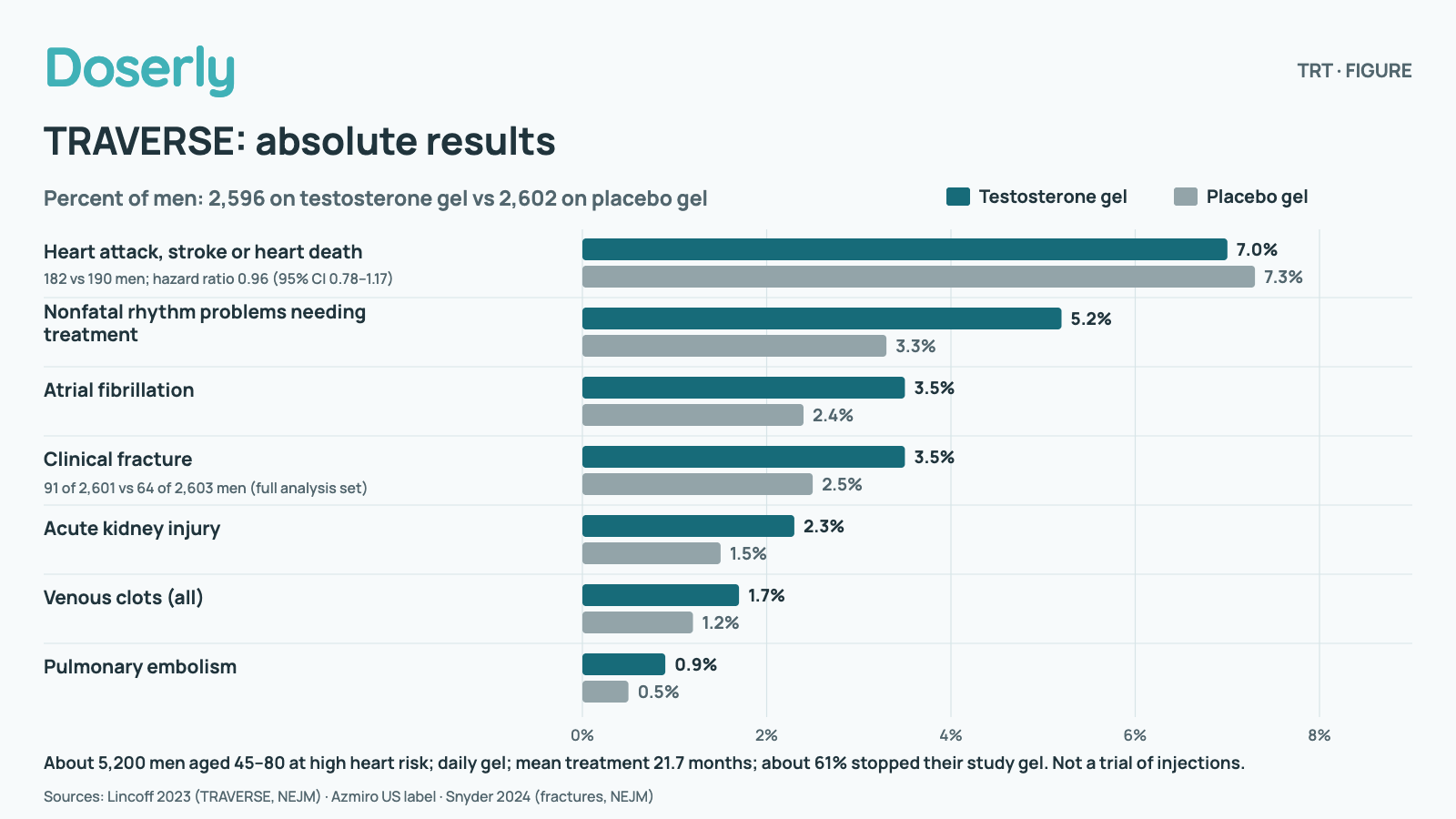
TRAVERSE: absolute results
Testosterone gel (2,596 men)Placebo gel (2,602 men)
- Heart attack, stroke or heart death
- Testosterone 7.0% vs placebo 7.3% (182 vs 190 men; hazard ratio 0.96, 95% CI 0.78–1.17; met the 1.5 safety margin)
- Nonfatal rhythm problems needing treatment
- Testosterone 5.2% vs placebo 3.3%
- Atrial fibrillation
- Testosterone 3.5% vs placebo 2.4%
- Clinical fracture
- Testosterone 3.5% vs placebo 2.5% (91 of 2,601 vs 64 of 2,603 in the full analysis set)
- Acute kidney injury
- Testosterone 2.3% vs placebo 1.5%
- Venous clots (all)
- Testosterone 1.7% vs placebo 1.2%
- Pulmonary embolism
- Testosterone 0.9% vs placebo 0.5%
About 5,200 men aged 45–80 at high heart risk; daily gel; mean treatment 21.7 months; about 61% stopped their study gel. Not a trial of injections.
In February 2025 the FDA added the TRAVERSE results to all testosterone labels and removed boxed-warning language about a higher heart risk, while keeping the age-related limitation and requiring blood-pressure warnings. The remaining US boxed warnings are for Aveed (an oil reaction in the lungs and allergic reactions) and for gels and solutions (transfer to other people by skin contact). See TRT and heart health. [97], [98]
What other risks do guidelines watch?
- Red blood cells. Testosterone raises hematocrit; in T4DM, 106 of 491 men (22%) on testosterone injections passed 54%, against 6 of 484 (1%) on placebo. See hematocrit on TRT. [90]
- Fertility. See what if you want children.
- Sleep apnea. In men with obesity and severe sleep apnea, testosterone injections worsened nighttime oxygen drops at 7 weeks, though not at 18 weeks. [99]
- Prostate, estrogen and blood pressure. See TRT and the prostate, estrogen on TRT and TRT side effects.
Who should be especially cautious?
- Men with any of the conditions under who should not start, including plans for children soon, prostate or breast cancer, a high hematocrit and untreated severe sleep apnea. [1], [2]
- Men taking opioids or steroid tablets, whose low testosterone may be caused by the medicine; do not stop these on your own. [1]
- Drug-tested athletes. Testosterone is prohibited in sport at all times (see legal status). [12]
- Under-18s. Testosterone for teenagers belongs only in specialist care.
- Women. This guide is written for men; see testosterone therapy for women.
Which medicines interact with testosterone?
The US labels list four interactions:
- Insulin and other diabetes medicines. Testosterone can lower blood sugar, so diabetes medicine doses may need to come down. [59]
- Blood thinners taken by mouth, such as warfarin. Testosterone can change their effect, so clotting tests (INR) need closer checks. [59]
- Corticosteroids. Together they can increase fluid retention, a particular concern with heart, kidney or liver disease. [59]
- Medicines that also raise blood pressure, where the effects can add up. [59]
Medicines can also cause low testosterone (opioids and steroid tablets, see above) or change the blood test (high-dose biotin, see the test rules). Bring a complete list, including supplements, to a pharmacist or prescriber. Checked September 2026. [1]
Is testosterone legal, and is it allowed in sport?
Checked September 2026. Rules differ by country and change often.
- United States. Testosterone and its esters are Schedule III controlled substances, prescription only. [11]
- United Kingdom. Testosterone is a Class C controlled drug, in Schedule 4 Part II of the Misuse of Drugs Regulations. [100]
- Canada. Testosterone is a Schedule IV controlled substance. [101]
- Australia. Testosterone is a Schedule 4 prescription-only medicine with extra controls on possession. [102]
- Sport. The World Anti-Doping Agency (WADA) prohibits testosterone at all times. A therapeutic use exemption is granted only for organic low testosterone, not for functional causes such as ageing, obesity, overtraining or past anabolic steroid use; delayed puberty in young athletes is treated as a special case. hCG, clomiphene and aromatase inhibitors are also prohibited at all times, so a drug-tested athlete should check the exemption rules before starting any of these treatments. [12], [103]
For access, cost and coverage, see the country guides for the United States, the United Kingdom, Canada, Australia and Europe.
What do people in public communities report?
Most public posts about low testosterone come before any treatment: men with symptoms, one or two lab results and conflicting advice. The threads below are recent public Reddit discussions, read with their replies; they show what people go through, not how often it happens.
Does a repeat test change the picture?
Often. One man in his 30s had a 5 pm result with low free testosterone; a 9 am repeat two weeks later came back at 910 ng/dL. Another, with diabetes and erection problems, measured 219 and then 310 ng/dL two weeks apart, and his endocrinologist declined treatment. A man in his 20s had two low results, both drawn at 1:20 pm; replies urged a morning repeat before starting the treatment he had been prescribed. [104], [105], [106]
Finger-prick results drew the most doubt: a man training for long runs on a large calorie deficit booked a venous test after a low finger-prick result, and replies pointed at the deficit as much as the result. [107]
What is it like to be "borderline"?
Frustrating, by many accounts. A man in his 30s documented five results under 300 ng/dL over seven years, yet three endocrinologists declined treatment, citing LH and FSH in range among other reasons; replies pointed to his thyroid result and fatty liver. Another had results of 337, 283 and 365 ng/dL with a raised FSH, and his endocrinologist wanted two consecutive results under 300. Others describe years in the grey zone: one man ranged from 324 to 462 ng/dL over six years, and another from 6.8 to 11.9 nmol/L before booking a sleep study. [108], [109], [110], [111]
What causes do people find?
- Pituitary problems. A man in his 30s with a prolactin-making tumor saw prolactin fall from over 200 to 55.8 ng/mL during more than a year of cabergoline, but his testosterone was still 75 ng/dL. Another found a 3 × 2 mm pituitary lesion with normal prolactin. [112], [113]
- Sleep apnea. A man in his 20s whose CPAP reduced dangerous sleepiness at the wheel still saw testosterone fall from 244 to about 122 ng/dL. Another poster started testosterone before learning of their sleep apnea, found their breathing at night worse on it, and stopped; after starting a breathing machine they measured about 400, against 212 before, while still feeling unwell. [114], [115]
- Dieting and training. A man in his 20s lost his sex drive and morning erections during a five-month calorie deficit; his testosterone was 2.8 nmol/L and still 3.8 after he ate more, so his endocrinologist arranged a pituitary scan. Another, at 2.7 nmol/L twice with a clear MRI, was asked about repeated dieting and heavy training. [116], [117]
- Cancer treatment. After losing one testicle and having chemotherapy, a man in his 20s measured 180 ng/dL and booked a fertility appointment first. [118]
- Thyroid and weight. A man with a history of an underactive thyroid and obesity rose from about 7 to 21.9 nmol/L after weight loss and thyroid treatment, and chose monitoring over testosterone. [119]
Weight loss did not always move the number much: one man lost 8.5 kg and went from 12 to 14 nmol/L with unchanged symptoms. [120]
What happens with fertility-sparing tablets?
Numbers often rose more than symptoms improved. On prescribed enclomiphene, one man went from 327 to 991 ng/dL in 38 days, but his fatigue and brain fog stayed and his libido got worse. On clomiphene, another went from 320 to 793 in about four weeks with little change in energy or sleep. A poster whose puberty had been delayed found that hCG raised testosterone but not energy or libido, and later felt much better on testosterone injections. [121], [122], [123]
What do people report after starting testosterone?
Every direction. A man with primary low testosterone described much better mood, thinking and energy six weeks in; replies cautioned that early gains can change. Another's early improvements had largely faded by week nine, and a third found his mood better after three months but his libido and erections still poor. [124], [125], [126]
A man who started at 377 ng/dL, above every guideline line in the table above, improved his physique over a year and a half, but tiredness and low mood persisted with acne and testicular shrinkage, and he began planning a supervised exit. Another had used a testosterone solution for nearly a decade before learning he had no sperm; fertility treatment later allowed him to have a child. [127], [128]
How can you judge a low-testosterone story?
Ask: Was blood drawn in the morning, fasting, from a vein? How many tests, from which lab, and in which units? Were SHBG, free testosterone, LH, FSH and prolactin measured? What was going on at the time: weight change, a calorie deficit, heavy training, poor sleep, illness, opioids or other medicines? And what did the next test, or the next few months, show?
These selected discussions show what people experience and the questions research has not answered. They are not a survey of all men with low testosterone, a success rate or a substitute for the studies above.
What should you track?
Before a diagnosis: your symptoms, and every blood result with its date, time and fasting status. After a diagnosis: what your clinician monitors, usually testosterone and hematocrit at 3–6 months and 12 months, then yearly. Use this summary to prepare questions; it is not a personal testing plan. [1], [2]
| What | Why it matters | Tracking category |
|---|---|---|
| Sexual symptoms (desire, morning erections, erections) | The symptoms most closely tied to low testosterone | Libido; Sexual Function |
| Energy, mood, sleep | Common, with many other causes | Energy Levels; Mood & Wellbeing; Sleep Quality |
| Each testosterone result, with time of draw, fasting or not, lab and units | Morning, fasting, repeated results are the basis of the diagnosis | Blood work |
| SHBG, free testosterone, LH, FSH, prolactin | Show the type, and whether total testosterone misleads | Blood work |
| Weight, waist, snoring and daytime sleepiness | Obesity and sleep apnea are common, reversible drivers | Weight Management; Sleep Quality |
| Medicines and supplements | Opioids and steroid tablets lower testosterone; biotin can distort tests | Other |
| If treated: testosterone, hematocrit, PSA, blood pressure | What guidelines and labels monitor on treatment | Blood work; Blood Pressure |
A single result is one point on a line: the time of day, food, illness and the lab all move the reading, so a trend of morning results drawn under similar conditions says more than any one number. The TRT blood work guide covers monitoring on treatment. [27], [29]
Common questions about low testosterone
What testosterone level is considered low?
Below about 264–300 ng/dL (9.2–10.4 nmol/L) in North American guidelines and 12 nmol/L (about 350 ng/dL) in most European ones, on at least two morning tests and only together with symptoms. [2], [1], [5] See the key numbers.
What is a normal testosterone level for a man my age?
In men without obesity, the median is about 530 ng/dL at 19–39 and about 480 ng/dL from 40 on, while the low end falls from about 267 to 218 ng/dL by the 60s. Guidelines still use one line for all adult ages. [25], [4] See levels by age.
Can you have low testosterone with a "normal" result?
Sometimes. If SHBG is high, total testosterone can look normal while free testosterone is low, so guidelines measure free testosterone when SHBG is altered or the result is borderline. Symptoms with a clearly normal morning level usually point to another cause. [1], [14] See free testosterone and SHBG.
Why does the test have to be in the morning, fasting and repeated?
Because testosterone is highest in the morning, drops after food, and varies from day to day. Afternoon levels were 20–25% lower in men aged 30–40, a glucose drink lowered testosterone by 25%, and 30% of men with one low result were normal on a repeat test. [27], [28], [1] See the test rules.
Does low testosterone cause erectile dysfunction, tiredness or weight gain?
It can contribute to all three, but only the sexual symptoms are closely tied to it. In EMAS, low desire, fewer morning erections and erectile dysfunction were the symptoms linked with low testosterone; tiredness and weight gain have many causes, and obesity itself lowers testosterone. [7], [1], [51] See the symptoms.
Can low testosterone be fixed without TRT?
Sometimes, when the cause is functional. Weight loss raises testosterone by about 2.5 nmol/L after dieting and more after bariatric surgery, and 42.9% of EMAS men with secondary low testosterone recovered, more often after losing weight. Primary low testosterone does not reverse. [70], [52], [1] See treating the cause.
Will treatment affect my fertility?
Yes, testosterone therapy switches off sperm production, and the labels warn that reduced fertility may not be reversible in some men. Men who want children soon are usually offered hCG or clomiphene-type tablets instead, depending on the type of low testosterone. [3], [2], [1] See what if you want children.
Glossary
Plain explanations of the medical, lab and research terms used in this guide. Underlined terms in the text link here.
- Bioavailable testosterone
- Free testosterone plus the testosterone loosely bound to albumin, the share tissues can use easily. It excludes testosterone bound tightly to SHBG.
- Calculated free testosterone
- An estimate of free testosterone worked out from total testosterone, SHBG and albumin with a formula. It agrees closely with equilibrium dialysis.
- Compensated hypogonadism
- Normal testosterone with a high LH, as if the pituitary is working harder to keep testosterone up. Its meaning is unclear, and it is usually watched rather than treated.
- Controlled trial
- A study that compares people who receive a treatment with a similar group who do not, often receiving a placebo instead. Randomly assigning people to each group makes the comparison fairer.
- CPAP
- Continuous positive airway pressure: a bedside machine that blows air through a mask to keep the airway open during sleep. It is the standard treatment for obstructive sleep apnea.
- Equilibrium dialysis
- A reference laboratory method that measures free testosterone directly by separating it from protein-bound testosterone through a membrane.
- Free androgen index (FAI)
- A simple ratio of total testosterone to SHBG. It is not a reliable measure of available testosterone in men.
- Free testosterone
- The small share of testosterone, about 2–4%, that is not attached to any protein in the blood.
- FSH (follicle-stimulating hormone)
- A pituitary hormone that acts on the cells supporting sperm production. Testosterone therapy lowers it.
- GnRH (gonadotropin-releasing hormone)
- The brain signal that tells the pituitary to release LH and FSH. Gonadorelin is a medicine that copies it.
- Gynecomastia
- Growth of breast tissue in men, often tender at first. It is linked to a higher estrogen-to-testosterone balance.
- Hazard ratio
- A measure comparing how often an event happens over time in two groups. A hazard ratio of 1 means no difference; 0.96 means about 4% lower in the first group.
- Hematocrit
- The share of the blood made up of red blood cells. Testosterone raises it, and most guidelines act when it reaches about 54%.
- Hypogonadism
- Low testosterone caused by a problem in the testicles or in the brain and pituitary signals that control them, confirmed with symptoms and repeated morning blood tests.
- Hypothalamus
- A small area at the base of the brain that controls many hormones. It starts the testosterone signal chain by releasing GnRH.
- Karyotype
- A blood test that counts and checks a person's chromosomes. It diagnoses Klinefelter syndrome (47,XXY).
- LC-MS/MS (mass spectrometry)
- Liquid chromatography with tandem mass spectrometry, the most accurate lab method for measuring testosterone.
- Leydig cells
- Cells in the spaces between the testicle's tubules that make testosterone when LH reaches them.
- LH (luteinizing hormone)
- A pituitary hormone that tells the testicles to make testosterone. Testosterone therapy switches it off.
- Pituitary gland
- A pea-sized gland below the brain that releases LH, FSH, prolactin and other hormones.
- Placebo
- A dummy treatment with no active ingredient, used as a comparison in studies.
- Primary hypogonadism
- Low testosterone because the testicles themselves do not work well, even though the pituitary sends plenty of LH and FSH.
- Prolactin and prolactinoma
- Prolactin is a pituitary hormone; too much of it switches off the signal to the testes. A prolactinoma is a usually benign pituitary tumor that makes prolactin.
- Secondary hypogonadism
- Low testosterone because the brain and pituitary send too little LH and FSH to the testicles. Also called hypogonadotropic hypogonadism.
- SERM (selective estrogen receptor modulator)
- A tablet, such as clomiphene, enclomiphene or tamoxifen, that blocks estrogen's feedback in the brain so the pituitary releases more LH and FSH.
- SHBG (sex hormone-binding globulin)
- A blood protein that carries testosterone. Testosterone bound to it is not immediately available to tissues, so SHBG affects how much free testosterone there is.
- Thrombophilia
- An inherited or acquired tendency to form blood clots more easily than normal.
- Total testosterone
- All the testosterone in a blood sample, bound and free together. It is the standard first test for low testosterone.
- TRT (testosterone replacement therapy)
- Prescribed testosterone, by injection, gel or other forms, for men with low testosterone. It switches off the brain's LH and FSH signals.
- WADA
- The World Anti-Doping Agency, which publishes the list of substances banned in sport. Testosterone is banned at all times.
How this guide was researched
This guide is built from a thorough review of the sources cited throughout it: clinical guidelines from 12 medical bodies, product labels, published clinical trials and population studies, and regulatory documents. We also reviewed public online forums where men describe their own low-testosterone tests, causes and treatment decisions.
The guide cites 128 sources, including 59 original studies in people, 13 clinical guidelines and position statements, and 25 public community discussions. Each type of source answers a different question. Guidelines and labels show what clinicians are told to do. Trials and studies show what was measured. Personal accounts show what individual people experienced. Every numbered citation links to its entry below, labeled by source type.
How this guide was made
Research and drafting were AI-assisted. Every cited source was checked against the original, and the guide was reviewed and edited by Doserly before publication. It has not had an independent clinical review, and Doserly does not currently have medical reviewers. Doserly makes a medication and health-tracking app and runs Doserly Academy, both of which are promoted in this guide. Read our editorial policy for how guides are researched, updated and corrected.
This guide is for educational purposes. It summarizes what the reviewed sources report so the research is easier to understand; it is not medical advice. For a deeper dive, or to check any point for yourself, go straight to the cited sources.
Explore the sources
These are the documents cited in this guide. Guidelines, labels, studies, regulators and personal accounts answer different questions. A source being listed does not mean every statement on its page is endorsed.
Showing 128 sources
- 01
Testosterone Therapy in Men With Hypogonadism: An Endocrine Society Clinical Practice Guideline ↗
Clinical practice guideline
Full guideline reviewed.
Detail: Two fasting morning tests; 264 ng/dL harmonized lower limit; symptom tables; organic vs functional causes; 30% normal on repeat; reasons not to start.
- 02
Evaluation and Management of Testosterone Deficiency: AUA Guideline ↗
Clinical guideline (US)
Full guideline reviewed.
Detail: Below 300 ng/dL on two early-morning tests, with symptoms; LH, prolactin and MRI rules; testing of at-risk groups; fertility and target statements.
- 03
Xyosted (testosterone enanthate) subcutaneous autoinjector prescribing information ↗
Product label (US)
Full label reviewed.
Detail: Confirm low testosterone with morning tests on at least two separate days; testosterone can suppress sperm production and reduced fertility may be irreversible.
- 04
Statement on Testosterone Replacement Therapy ↗
Society statement
Full statement reviewed.
Detail: Same diagnosis at any age; two fasting morning tests with a certified assay; common threshold near 300 ng/dL; weight loss first when obesity is the cause.
- 05
EAU Guidelines on Sexual and Reproductive Health, Chapter 3: Male Hypogonadism (2026 edition) ↗
Clinical guideline (Europe)
Full chapter reviewed.
Detail: 12 nmol/L threshold; fasting sample 07:00–10:00, repeated; calculated free testosterone 220 pmol/L; lifestyle and weight first; symptom table.
- 06
The British Society for Sexual Medicine Guidelines on Male Adult Testosterone Deficiency, with Statements for Practice ↗
Clinical guideline (UK)
Full text reviewed.
Detail: Under 12 nmol/L or free testosterone under 225 pmol/L usually needs treatment; 8–14 nmol/L trial; EMAS prevalence by decade; lifestyle alongside testosterone.
- 07
Identification of late-onset hypogonadism in middle-aged and elderly men ↗
Human study (cohort)
Original abstract reviewed.
Detail: EMAS: only three sexual symptoms tracked low testosterone; strict late-onset hypogonadism in 2.1% of men aged 40–79.
- 08
Characteristics of secondary, primary, and compensated hypogonadism in aging men: evidence from the European Male Ageing Study ↗
Human study (cohort)
Original abstract reviewed.
Detail: EMAS: 11.8% secondary, 2.0% primary and 9.5% compensated hypogonadism in men 40–79; BMI 30+ linked to secondary.
- 09
Opioids and Their Endocrine Effects: A Systematic Review and Meta-analysis ↗
Systematic review
Original abstract reviewed.
Detail: Low testosterone in 63% of opioid users (15 studies, 3,250 patients).
- 10
Key Findings on the Efficacy and Safety of Testosterone Therapy from Two Large Randomized Trials ↗
Review
Original abstract reviewed.
Detail: Review of the Testosterone Trials and TRAVERSE: benefits for sexual function and mood, not energy, physical function or thinking.
- 11
21 CFR 1308.13 Schedule III ↗
Law (US)
Current text reviewed.
Detail: Anabolic steroids, including testosterone and its esters, are Schedule III.
- 12
World Anti-Doping Code International Standard: Prohibited List 2026 ↗
Anti-doping rule
Full list reviewed.
Detail: Testosterone is prohibited at all times (S1.1); so are hCG in men (S2.2.1), aromatase inhibitors (S4.1) and clomiphene and other anti-estrogens (S4.2).
- 13
Depo-Testosterone (testosterone cypionate) injection prescribing information ↗
Product label (US)
Full label reviewed.
Detail: Testosterone release is inhibited through feedback on pituitary LH; contraindicated in known or suspected prostate cancer and male breast cancer.
- 14
European Academy of Andrology (EAA) guidelines on investigation, treatment and monitoring of functional hypogonadism in males ↗
Clinical guideline (Europe)
Full text reviewed.
Detail: Functional hypogonadism: two fasting morning tests; free testosterone at 8–12 nmol/L; lifestyle and weight loss first; testosterone may be withdrawn after weight loss.
- 15
Elevated luteinizing hormone despite normal testosterone levels in older men-natural history, risk factors and clinical features ↗
Human study (cohort)
Original abstract reviewed.
Detail: Men with high LH and normal testosterone often reverted but were more likely to develop primary hypogonadism.
- 16
Calculation of free and bound fractions of testosterone and estradiol-17 beta to human plasma proteins at body temperature ↗
Laboratory methods study
Original abstract reviewed.
Detail: About 2% of testosterone is free, 53–55% albumin-bound and 43–45% SHBG-bound.
- 17
Prevalence of androgen deficiency in men with erectile dysfunction ↗
Human study (records)
Original abstract reviewed.
Detail: In 2,794 men with erectile dysfunction: 7%, 23%, 33% and 47% under 200, 300, 346 and 400 ng/dL.
- 18
Validation of a screening questionnaire for androgen deficiency in aging males ↗
Human study
Original abstract reviewed.
Detail: ADAM questionnaire: 88% sensitivity, 60% specificity.
- 19
Evaluation for and Management of Males with Low Testosterone: Recommendations for Use (January 2026) ↗
Clinical recommendations (US)
Full document reviewed.
Detail: 264 ng/dL for certified assays; fasting 6–10 am on at least two occasions; endocrinology referral under 150 ng/dL with low or normal LH and FSH.
- 20
Male hypogonadism: recommendations from the Fifth International Consultation on Sexual Medicine (ICSM 2024) ↗
Clinical recommendations
Full text reviewed.
Detail: 12 nmol/L threshold; fasting morning test 07:00–11:00, repeated; possible role for GLP-1 medicines in obesity.
- 21
Society for Endocrinology guidelines for testosterone replacement therapy in male hypogonadism ↗
Clinical guideline (UK)
Full text reviewed.
Detail: No single cut-off; symptoms more likely under 8 nmol/L; little evidence of benefit above 12 nmol/L; lifelong treatment once confirmed.
- 22
Canadian Urological Association guideline on testosterone deficiency in men: Evidence-based Q&A ↗
Clinical guideline (Canada)
Full text reviewed.
Detail: Under 10 nmol/L with symptoms; morning draw 7–11 am; changes expected after 3 months or more.
- 23
Endocrine Society of Australia position statement on male hypogonadism (part 1): assessment and indications for testosterone therapy ↗
Position statement (Australia)
Full text reviewed.
Detail: No single cut-off; tests 08:00–10:00 with LH and FSH; mass-spectrometry reference intervals; 10% weight loss raises testosterone 2–3 nmol/L.
- 24
PBS item 10205D: testosterone undecanoate 1 g/4 mL injection, restrictions ↗
Subsidy rule (Australia)
Official listing reviewed.
Detail: Subsidy for men 40 and older without a known disorder: under 6 nmol/L, or 6–15 nmol/L with high LH, on two morning samples; specialist involvement.
- 25
Harmonized Reference Ranges for Circulating Testosterone Levels in Men of Four Cohort Studies in the United States and Europe ↗
Human study (pooled cohorts)
Original full text reviewed.
Detail: Harmonized range 264–916 ng/dL in healthy non-obese men aged 19–39; age-specific percentiles in Table 4.
- 26
Normal, bound and nonbound testosterone levels in normally ageing men: results from the Massachusetts Male Ageing Study ↗
Human study (cohort)
Original abstract reviewed.
Detail: Proposed age-specific lower limits of 251, 216, 196 and 156 ng/dL for men in their 40s to 70s.
- 27
The effect of diurnal variation on clinical measurement of serum testosterone and other sex hormone levels in men ↗
Human study
Original abstract reviewed.
Detail: Testosterone 20–25% lower at 4 pm than 8 am in men aged 30–40, about 10% lower at 70.
- 28
Abrupt decrease in serum testosterone levels after an oral glucose load in men: implications for screening for hypogonadism ↗
Human study
Original abstract reviewed.
Detail: A glucose drink lowered average testosterone by 25%; 15% of normal men dipped into the low range.
- 29
Intraindividual variation in levels of serum testosterone and other reproductive and adrenal hormones in men ↗
Human study
Original abstract reviewed.
Detail: Two measurements in the same man often differ by more than 18–28%.
- 30
Variability in total testosterone levels in ageing men with symptoms of androgen deficiency ↗
Human study
Original abstract reviewed.
Detail: Only 1 of 25 men under 10 nmol/L at baseline stayed under 10 nmol/L at every later test.
- 31
Both hyper- and hypogonadotropic hypogonadism occur transiently in acute illness: bio- and immunoactive gonadotropins ↗
Human study
Original abstract reviewed.
Detail: Sustained testosterone suppression in 62% of acutely ill men in hospital.
- 32
The association of obesity with sex hormone-binding globulin is stronger than the association with ageing--implications for the interpretation of total testosterone measurements ↗
Human study (cross-sectional)
Original abstract reviewed.
Detail: SHBG fell about 1.26 nmol/L per BMI unit; obese men had lower total but similar free testosterone.
- 33
Symptomatic androgen deficiency develops only when both total and free testosterone decline in obese men who may have incident biochemical secondary hypogonadism: Prospective results from the EMAS ↗
Human study (cohort)
Original abstract reviewed.
Detail: Only men whose total and free testosterone both fell developed new sexual symptoms.
- 34
A critical evaluation of simple methods for the estimation of free testosterone in serum ↗
Laboratory methods study
Original abstract reviewed.
Detail: Calculated free testosterone matched equilibrium dialysis; direct kits and the free androgen index were unreliable.
- 35
Validation of a Dried Blood Spot Assay for Testosterone Measurement Using Liquid Chromatography-Tandem Mass Spectrometry ↗
Laboratory methods study
Original full text reviewed.
Detail: Dried blood spots from lab-spotted venous blood matched serum (R² 0.9875, 20 people); does not validate home finger-prick kits.
- 36
Salivary testosterone reference intervals for adult women and men ↗
Laboratory methods study
Original abstract reviewed.
Detail: Saliva testosterone reference intervals for adults; no comparison with serum cut-offs.
- 37
Prevalence of hypothalamic-pituitary imaging abnormalities in impotent men with secondary hypogonadism ↗
Human study
Original abstract reviewed.
Detail: Potentially serious pituitary or hypothalamic lesions in 11 of 164 men (6.7%); larger tumors only at 104 ng/dL or less.
- 38
The value of pituitary magnetic resonance imaging in men with hypogonadism ↗
Human study
Original abstract reviewed.
Detail: MRI normal in 38 of 51 men; 3 of 4 small tumors had prolactin over twice normal.
- 39
Prenatal and postnatal prevalence of Klinefelter syndrome: a national registry study ↗
Human study (registry)
Original abstract reviewed.
Detail: Klinefelter syndrome in about 153 per 100,000 males; only about a quarter of adult cases diagnosed.
- 40
Fertility, gonadal and sexual function in survivors of testicular cancer ↗
Human study (cross-sectional)
Original abstract reviewed.
Detail: Low testosterone in 11% after surgery alone and 37% after chemotherapy plus radiotherapy for testicular cancer.
- 41
Biochemical Hypogonadism in Aging Testicular Cancer Survivors: A Clinical Challenge ↗
Human study (cohort)
Original abstract reviewed.
Detail: Biochemical low testosterone rose from 12% to 41% in testicular cancer survivors, 5% to 11% in controls.
- 42
Varicocele is associated with hypogonadism and impaired erectile function: a prospective comparative study ↗
Human study
Original abstract reviewed.
Detail: 45 of 130 clinic patients with varicocele had low testosterone; none of 130 controls.
- 43
Varicocele Is Associated with Impaired Semen Quality and Reproductive Hormone Levels: A Study of 7035 Healthy Young Men from Six European Countries ↗
Human study (cross-sectional)
Original abstract reviewed.
Detail: In 7,035 young men, testosterone did not differ with or without varicocele.
- 44
Hypogonadism in hereditary hemochromatosis ↗
Human study
Original abstract reviewed.
Detail: Low testosterone with low LH and FSH in 9 of 141 men with hemochromatosis; 8 had cirrhosis.
- 45
FDA Drug Safety Communication: FDA warns about several safety issues with opioid pain medicines; requires label changes ↗
Regulator (US)
Full communication reviewed.
Detail: 2016: opioid labels must describe androgen deficiency with long-term use.
- 46
OxyContin (oxycodone) extended-release tablets prescribing information ↗
Product label (US)
Full label reviewed.
Detail: Cases of androgen deficiency have occurred with long-term opioid use.
- 47
Testosterone levels during systemic and inhaled corticosteroid therapy ↗
Human study
Original abstract reviewed.
Detail: Testosterone 33% lower on long-term prednisolone tablets; not significantly lower with inhaled steroids.
- 48
Former Abusers of Anabolic Androgenic Steroids Exhibit Decreased Testosterone Levels and Hypogonadal Symptoms Years after Cessation: A Case-Control Study ↗
Human study
Original abstract reviewed.
Detail: 27% of former anabolic steroid users still under 12.1 nmol/L about 2.5 years after stopping.
- 49
Prevalence of hypogonadism in males aged at least 45 years: the HIM study ↗
Human study (cross-sectional)
Original abstract and full text reviewed.
Detail: HIM: 836 of 2,162 men (38.7%) had low testosterone, including 80 already on testosterone; among untreated men, 756 of 2,082 (36.3%) had one result under 300 ng/dL. Obesity odds ratio 2.38, diabetes 2.09.
- 50
Exploration of the association between serum uric acid and testosterone in adult males: NHANES 2011-2016 ↗
Human study (survey data)
Original abstract reviewed.
Detail: Each BMI unit went with about 2.9% lower testosterone in US men.
- 51
Age-associated changes in hypothalamic-pituitary-testicular function in middle-aged and older men are modified by weight change and lifestyle factors: longitudinal results from the European Male Ageing Study ↗
Human study (cohort)
Original abstract reviewed.
Detail: EMAS: weight loss raised and weight gain lowered testosterone; free testosterone changed only with 15% or more.
- 52
Development of and Recovery from Secondary Hypogonadism in Aging Men: Prospective Results from the EMAS ↗
Human study (cohort)
Original abstract reviewed.
Detail: 42.9% of men with secondary hypogonadism recovered; weight loss predicted recovery (odds ratio 2.24).
- 53
Frequent occurrence of hypogonadotropic hypogonadism in type 2 diabetes ↗
Human study
Original abstract reviewed.
Detail: 33% of 103 men with type 2 diabetes had low free testosterone, mostly with low LH and FSH.
- 54
Testosterone concentrations in diabetic and nondiabetic obese men ↗
Human study (cross-sectional)
Original abstract reviewed.
Detail: Low free testosterone in 50% of obese men with diabetes and 26% of lean men without diabetes.
- 55
Effects of CPAP on Testosterone Levels in Patients With Obstructive Sleep Apnea: A Meta-Analysis Study ↗
Systematic review
Original abstract reviewed.
Detail: CPAP did not significantly change total testosterone (mean difference 1.08 nmol/L, −0.48 to 2.64).
- 56
Age trends in the level of serum testosterone and other hormones in middle-aged men: longitudinal results from the Massachusetts male aging study ↗
Human study (cohort)
Original abstract reviewed.
Detail: Men aged 40–70 lost about 1.6% of total and 2–3% of bioavailable testosterone a year.
- 57
Longitudinal changes in serum testosterone and sex hormone-binding globulin in men aged 40-69 years from the UK Biobank ↗
Human study (cohort)
Original abstract reviewed.
Detail: UK Biobank: total testosterone changed negligibly over 4.3 years while SHBG rose and free testosterone fell.
- 58
Longitudinal effects of aging on serum total and free testosterone levels in healthy men. Baltimore Longitudinal Study of Aging ↗
Human study (cohort)
Original abstract reviewed.
Detail: About 20% of men over 60, 30% over 70 and 50% over 80 had low testosterone readings; average fall 0.124 nmol/L a year.
- 59
Kyzatrex (testosterone undecanoate) capsules prescribing information ↗
Product label (US)
Full label reviewed.
Detail: TRAVERSE class text (atrial fibrillation 3.5% vs 2.4%, acute kidney injury 2.3% vs 1.5%, pulmonary embolism 0.9% vs 0.5%); age-related limitation; drug interactions.
- 60
Testosterone Information ↗
Regulator (US)
Full page reviewed.
Detail: Describes age-related hypogonadism as symptoms with low testosterone without a clear cause; safety and efficacy not established.
- 61
HHS Announces Requested Updates to Testosterone Therapy Product Labels ↗
Regulator (US)
Full announcement reviewed.
Detail: June 2026: FDA requests removal of the age-related limitation and narrowing of the prostate cancer contraindication; requested, not yet in labels.
- 62
Prevalence of symptomatic androgen deficiency in men ↗
Human study (cohort)
Original abstract reviewed.
Detail: BACH: symptomatic low testosterone in 5.6%; about 24% had total testosterone under 300 ng/dL.
- 63
A population-level decline in serum testosterone levels in American men ↗
Human study (cohort)
Original abstract reviewed.
Detail: A substantial age-independent fall in testosterone in one Massachusetts cohort.
- 64
Decline in Serum Testosterone Levels Among Adolescent and Young Adult Men in the USA ↗
Human study (survey data)
Original abstract reviewed.
Detail: Lower average testosterone in young US men in later survey cycles; assays changed between cycles.
- 65
Trends in sex hormone concentrations in US males: 1988-1991 to 1999-2004 ↗
Human study (survey data)
Original abstract reviewed.
Detail: Little change in testosterone between US surveys from 1988–91 and 1999–2004.
- 66
Risk factors for hypogonadism in young men with erectile dysfunction ↗
Human study (records)
Original abstract reviewed.
Detail: 10.7% of 2,130 men aged 18–40 with erectile dysfunction had low testosterone.
- 67
EnCyzix (enclomifene): refusal of the marketing authorisation ↗
Regulator (EU)
Full page reviewed.
Detail: Enclomiphene refused in 2018: symptom benefit not shown and a blood-clot risk.
- 68
Bulk Drug Substances Nominated for Use in Compounding Under Section 503A of the FD&C Act ↗
Regulator (US)
Full list reviewed.
Detail: Enclomiphene citrate is in 503A Category 1 (under evaluation); this is not FDA approval.
- 69
Body weight loss reverts obesity-associated hypogonadotropic hypogonadism: a systematic review and meta-analysis ↗
Meta-analysis
Original abstract reviewed.
Detail: Testosterone rose about 2.9 nmol/L after diet and 8.7 nmol/L after bariatric surgery.
- 70
Meta-analysis and construction of simple-to-use nomograms for approximating testosterone levels gained from weight loss in obese men ↗
Meta-analysis
Original abstract reviewed.
Detail: 44 studies: testosterone rose about 2.5 nmol/L after diet and 7.2 nmol/L after bariatric surgery.
- 71
Effects of liraglutide on obesity-associated functional hypogonadism in men ↗
Randomized controlled trial
Original abstract reviewed.
Detail: Liraglutide raised testosterone 2.6 nmol/L with 7.9 kg weight loss; gel raised it 5.9 nmol/L.
- 72
Effects of Incretin-Based Therapies on Testosterone Levels and Incretin Response in Men with Hypogonadism: A Systematic Literature Review Following PRISMA 2020 Guidelines ↗
Systematic review
Original abstract reviewed.
Detail: GLP-1 medicines and tirzepatide raised total testosterone by about 2.5–5.2 nmol/L in small studies.
- 73
Effects of glucagon-like peptide-1 receptor agonists on male reproductive hormones, semen parameters, and metabolic outcomes: a systematic review ↗
Systematic review
Original abstract reviewed.
Detail: GLP-1 medicines raised total testosterone while keeping LH and FSH working.
- 74
Diagnosis and Treatment of Infertility in Men: AUA/ASRM Guideline (2020; amended 2024) ↗
Clinical guideline (US)
Full guideline reviewed.
Detail: Clinicians should not prescribe testosterone to men interested in current or future fertility.
- 75
Rate, extent, and modifiers of spermatogenic recovery after hormonal male contraception: an integrated analysis ↗
Pooled analysis of human studies
Original abstract reviewed.
Detail: Sperm recovery after hormonal contraception: 67% by 6 months, 100% by 24 months.
- 76
Clomiphene citrate versus testosterone replacement therapy in male hypogonadism: a systematic review of literature and meta-analysis ↗
Systematic review
Original abstract reviewed.
Detail: Clomiphene raised testosterone about as much as testosterone gel but improved libido less.
- 77
Testosterone Treatment in Adult Men With Age-Related Low Testosterone: A Clinical Guideline From the American College of Physicians ↗
Clinical guideline (US, now inactive)
Original abstract reviewed.
Detail: For age-related low testosterone, discuss treatment only for sexual dysfunction and reevaluate within 12 months.
- 78
Recovery of male reproductive endocrine function after ceasing prolonged testosterone undecanoate injections ↗
Randomized controlled trial (follow-up)
Original abstract reviewed.
Detail: After 2 years of undecanoate injections, LH and FSH recovered slowly over 12 months.
- 79
Effects of Testosterone Treatment in Older Men ↗
Randomized controlled trials
Original full text reviewed.
Detail: 790 men 65 and older: sexual function and slight mood gains; no benefit in the vitality or physical-function trials, though across all three trials 20.5% vs 12.6% walked at least 50 m farther.
- 80
Symptomatic benefits of testosterone treatment in patient subgroups: a systematic review, individual participant data meta-analysis, and aggregate data meta-analysis ↗
Individual participant data meta-analysis
Original abstract reviewed.
Detail: About 2 points better erectile function scores; no improvement in depressive symptoms.
- 81
Cardiovascular Safety of Testosterone-Replacement Therapy ↗
Randomized controlled trial
Original abstract reviewed.
Detail: TRAVERSE: major cardiovascular events 7.0% vs 7.3% (hazard ratio 0.96); mean treatment 21.7 months.
- 82
Effect of Testosterone Replacement Therapy on Sexual Function and Hypogonadal Symptoms in Men with Hypogonadism ↗
Randomized controlled trial (substudy)
Original abstract reviewed.
Detail: In men with low libido, sexual activity and desire improved; erectile function did not.
- 83
Depressive Syndromes in Men With Hypogonadism in the TRAVERSE Trial: Response to Testosterone-Replacement Therapy ↗
Randomized controlled trial (substudy)
Original abstract reviewed.
Detail: No improvement in persistent low-grade depression (49 men); small gains in mood and energy in men with depressive symptoms and in all 5,204 men.
- 84
Testosterone Treatment and Cognitive Function in Older Men With Low Testosterone and Age-Associated Memory Impairment ↗
Randomized controlled trial
Original abstract reviewed.
Detail: No improvement in memory or other thinking skills.
- 85
Effect of Testosterone Treatment on Volumetric Bone Density and Strength in Older Men With Low Testosterone: A Controlled Clinical Trial ↗
Randomized controlled trial
Original abstract reviewed.
Detail: Spine bone density up 7.5% vs 0.8% on placebo.
- 86
Testosterone Treatment and Fractures in Men with Hypogonadism ↗
Randomized controlled trial (substudy)
Original abstract reviewed.
Detail: Fractures 3.50% on testosterone vs 2.46% on placebo.
- 87
Association of Testosterone Levels With Anemia in Older Men: A Controlled Clinical Trial ↗
Randomized controlled trial
Original abstract reviewed.
Detail: Unexplained anemia corrected in 58.3% vs 22.2%.
- 88
Efficacy of Testosterone Replacement Therapy in Correcting Anemia in Men With Hypogonadism: A Randomized Clinical Trial ↗
Randomized controlled trial (substudy)
Original abstract reviewed.
Detail: Anemia corrected at 12 months in 152 of 338 (45.0%) on testosterone gel vs 122 of 360 (33.9%) on placebo.
- 89
Effects of testosterone on body composition, bone metabolism and serum lipid profile in middle-aged men: a meta-analysis ↗
Meta-analysis
Original abstract reviewed.
Detail: About 1.6 kg less fat and 1.6 kg more fat-free mass without weight change.
- 90
Testosterone treatment to prevent or revert type 2 diabetes in men enrolled in a lifestyle programme (T4DM): a randomised, double-blind, placebo-controlled, 2-year, phase 3b trial ↗
Randomized controlled trial
Original abstract reviewed.
Detail: Diabetes at 2 years in 55 of 443 (12%) on testosterone injections vs 87 of 413 (21%) on placebo, both with a lifestyle program; hematocrit above 54% in 106 of 491 (22%) vs 6 of 484 (1%).
- 91
Effect of Testosterone on Progression From Prediabetes to Diabetes in Men With Hypogonadism: A Substudy of the TRAVERSE Randomized Clinical Trial ↗
Randomized controlled trial (substudy)
Original abstract reviewed.
Detail: No significant reduction in progression from prediabetes to diabetes.
- 92
Onset of effects of testosterone treatment and time span until maximum effects are achieved ↗
Review
Original abstract reviewed.
Detail: Time courses of testosterone effects, from weeks for sex drive to months for body composition and bone.
- 93
Associations of Testosterone and Related Hormones With All-Cause and Cardiovascular Mortality and Incident Cardiovascular Disease in Men : Individual Participant Data Meta-analyses ↗
Individual participant data meta-analysis
Original abstract reviewed.
Detail: Higher death rates only below 7.4 nmol/L (all causes) and 5.3 nmol/L (cardiovascular).
- 94
Clinical review: Endogenous testosterone and mortality in men: a systematic review and meta-analysis ↗
Systematic review
Original abstract reviewed.
Detail: Low testosterone linked with higher all-cause and cardiovascular death, with large differences between studies.
- 95
Late-onset hypogonadism and mortality in aging men ↗
Human study (cohort)
Original abstract reviewed.
Detail: In 2,599 men (147 deaths over a median 4.3 years), the 24 with severe late-onset hypogonadism had about 5 times the death rate (hazard ratio 5.5); association only.
- 96
Prostate Safety Events During Testosterone Replacement Therapy in Men With Hypogonadism: A Randomized Clinical Trial ↗
Randomized controlled trial (substudy)
Original full text reviewed.
Detail: High-grade prostate cancer 0.19% vs 0.12%, not significant; men with PSA above 3.0 ng/mL excluded.
- 97
FDA issues class-wide labeling changes for testosterone products ↗
Regulator (US)
Full statement reviewed.
Detail: February 2025: TRAVERSE results added to all labels; boxed-warning language on cardiovascular outcomes removed; age limitation kept.
- 98
Aveed (testosterone undecanoate) injection prescribing information ↗
Product label (US)
Full label reviewed.
Detail: Boxed warning for pulmonary oil microembolism and anaphylaxis, with 30 minutes of observation after each injection.
- 99
Effects of testosterone therapy on sleep and breathing in obese men with severe obstructive sleep apnoea: a randomized placebo-controlled trial ↗
Randomized controlled trial
Original abstract reviewed.
Detail: Testosterone worsened nighttime oxygen drops at 7 weeks in obese men with severe sleep apnea, not at 18 weeks.
- 100
Misuse of Drugs Act 1971, Schedule 2, Part III ↗
Law (UK)
Current text reviewed.
Detail: Testosterone is a Class C drug.
- 101
Controlled Drugs and Substances Act (S.C. 1996, c. 19), Schedule IV ↗
Law (Canada)
Current text reviewed.
Detail: Anabolic steroids, including testosterone, are in Schedule IV.
- 102
Therapeutic Goods (Poisons Standard, June 2026) Instrument 2026 ↗
Law (Australia)
Current text reviewed.
Detail: Testosterone is a Schedule 4 prescription-only medicine with Appendix D possession controls.
- 103
TUE Physician Guidelines: Male Hypogonadism, Version 9 ↗
Anti-doping guidance
Full document reviewed.
Detail: Exemptions only for organic hypogonadism, not functional low testosterone; constitutional delayed puberty is a special category.
- 104
Normal T, high SHGB, Low T Symptoms ↗
Community account
Public thread reviewed: opening post and 9 comments.
Detail: An afternoon result with low free testosterone, then a morning repeat two weeks later at 910 ng/dL with high SHBG.
- 105
PCP says Low T, Endo say not so much ↗
Community account
Public thread reviewed: opening post and 2 comments.
Detail: A man with diabetes measured 219 ng/dL, then 310 ng/dL two weeks later; an endocrinologist did not offer treatment.
- 106
25M – Low Testosterone Symptoms, Lab Results, and Considering TRT - Looking for Experiences and Advice ↗
Community account
Public thread reviewed: opening post and 7 comments.
Detail: Two low results, both drawn in the early afternoon; replies urged a morning repeat before starting treatment.
- 107
Low testosterone despite trying every natural remedy- Anyone else have experience of this ↗
Community account
Public thread reviewed: opening post and 45 comments.
Detail: A low finger-prick result during heavy endurance training and a calorie deficit; a venous test was booked.
- 108
Three endocrinologists dismissed Total T of 200 (I'm 34) because 'LH/FSH are in range' and 'you have a kid.' Looking for perspective. ↗
Community account
Public thread reviewed: opening post and 24 comments.
Detail: Five results under 300 over seven years; three endocrinologists declined treatment; fertility plans.
- 109
I can't get treated for hypogonadism. ↗
Community account
Public thread reviewed: opening post and 21 comments.
Detail: Borderline results with a raised FSH and a history of an undescended testicle; the endocrinologist wanted two consecutive low results.
- 110
Borderline low for years, mixed signals ↗
Community account
Public thread reviewed: opening post and 1 comments.
Detail: Total testosterone between 324 and 462 ng/dL over six years with lower libido.
- 111
20M - 5 years of fatigue, brain fog, low libido and no answers. Could borderline testosterone be involved? ↗
Community account
Public thread reviewed: opening post and 18 comments.
Detail: Results from 6.8 to 11.9 nmol/L over time; a sleep study planned before any treatment decision.
- 112
30M with severe secondary hypogonadism despite 1.2 years of cabergoline looking for experiences ↗
Community account
Public thread reviewed: opening post and 9 comments.
Detail: A prolactin-making pituitary tumor on cabergoline: prolactin fell but testosterone stayed very low.
- 113
Found Potential Cause for My Low T ↗
Community account
Public thread reviewed: opening post and 10 comments.
Detail: A small pituitary lesion on MRI with normal prolactin and testosterone around 200–300.
- 114
Very low total T at 22 ↗
Community account
Public thread reviewed: opening post and 27 comments.
Detail: CPAP reduced daytime sleepiness, but testosterone fell from 244 to about 122 ng/dL.
- 115
Low T turned out to be from Obstructive Sleep Apnea , TRT made it explode . Low E2 seems to make it worse . ↗
Community account
Public thread reviewed: opening post and 26 comments.
Detail: Breathing at night worse on testosterone before sleep apnea was found; testosterone higher after stopping and starting a breathing machine.
- 116
Very Low Testosterone aged 25 ↗
Community account
Public thread reviewed: opening post and 20 comments.
Detail: Very low testosterone and LH during and after a long calorie deficit; pituitary imaging arranged.
- 117
Extremely hypogonadal - Clomid ??? 25m - ↗
Community account
Public thread reviewed: opening post and 24 comments.
Detail: Total testosterone 2.7 nmol/L twice with suppressed LH and a clear MRI; replies raised dieting and heavy training.
- 118
Testicle loss (orchiectomy) and hypogonadism ↗
Community account
Public thread reviewed: opening post and 14 comments.
Detail: Low testosterone after removal of one testicle and chemotherapy; a fertility appointment booked.
- 119
Is this functional secondary hypogonadism? ↗
Community account
Public thread reviewed: opening post and 15 comments.
Detail: Low testosterone after poorly controlled hypothyroidism; much higher on retesting after weight loss and thyroid treatment.
- 120
Lost 8.5 kg, optimized everything… hormones barely moved. Still feel like Low T — what would YOU do? ↗
Community account
Public thread reviewed: opening post and 14 comments.
Detail: 8.5 kg weight loss raised total testosterone from 12 to 14 nmol/L; symptoms persisted.
- 121
[UPDATE] 26M Secondary Hypogonadism BLOODWORK HELP ↗
Community account
Public thread reviewed: opening post and 9 comments.
Detail: Enclomiphene raised testosterone and LH within 38 days; fatigue persisted and libido worsened.
- 122
27m, diagnosed with secondary hypogonadism, 3 weeks on clomid. Got some results, but they don't match with my internal feeling. Need a bit of help. ↗
Community account
Public thread reviewed: opening post and 4 comments.
Detail: Weight loss and stopping vaping raised testosterone; clomiphene raised it further with little symptom change.
- 123
HCG Not Working Well for Hypogonadotropic Hypogonadism, Considering TRT ↗
Community account
Public thread reviewed: opening post and 10 comments.
Detail: hCG raised testosterone without symptom relief and caused nipple pain; later felt better on testosterone injections.
- 124
So what now? I feel amazing on TRT. Best I’ve felt since maybe I was a child. I look around and think how may men could be hypogonadal… ↗
Community account
Public thread reviewed: opening post and 86 comments.
Detail: Primary hypogonadism: marked improvement in mood and energy six weeks into treatment.
- 125
Anyone go from feeling okay to feeling really good? Primary hypogonadal ↗
Community account
Public thread reviewed: opening post and 29 comments.
Detail: Early improvements on daily injections faded by week nine.
- 126
27M hypogonadal , on TRT no improvements ↗
Community account
Public thread reviewed: opening post and 11 comments.
Detail: Three months of weekly injections: mood better, libido and erections still poor.
- 127
Coming of TRT - Not hypogonadal ↗
Community account
Public thread reviewed: opening post and 47 comments.
Detail: Started at 377 ng/dL; physique improved but fatigue and low mood persisted; planning a supervised exit.
- 128
Hypogonadism (undertreatment for a decade) ↗
Community account
Public thread reviewed: opening post and 3 comments.
Detail: Years on a topical testosterone before learning of no sperm; fertility treatment later succeeded.
No matching sources
Try a different term or show the full list.