
In this guide
What is hematocrit, and why does it matter on TRT?
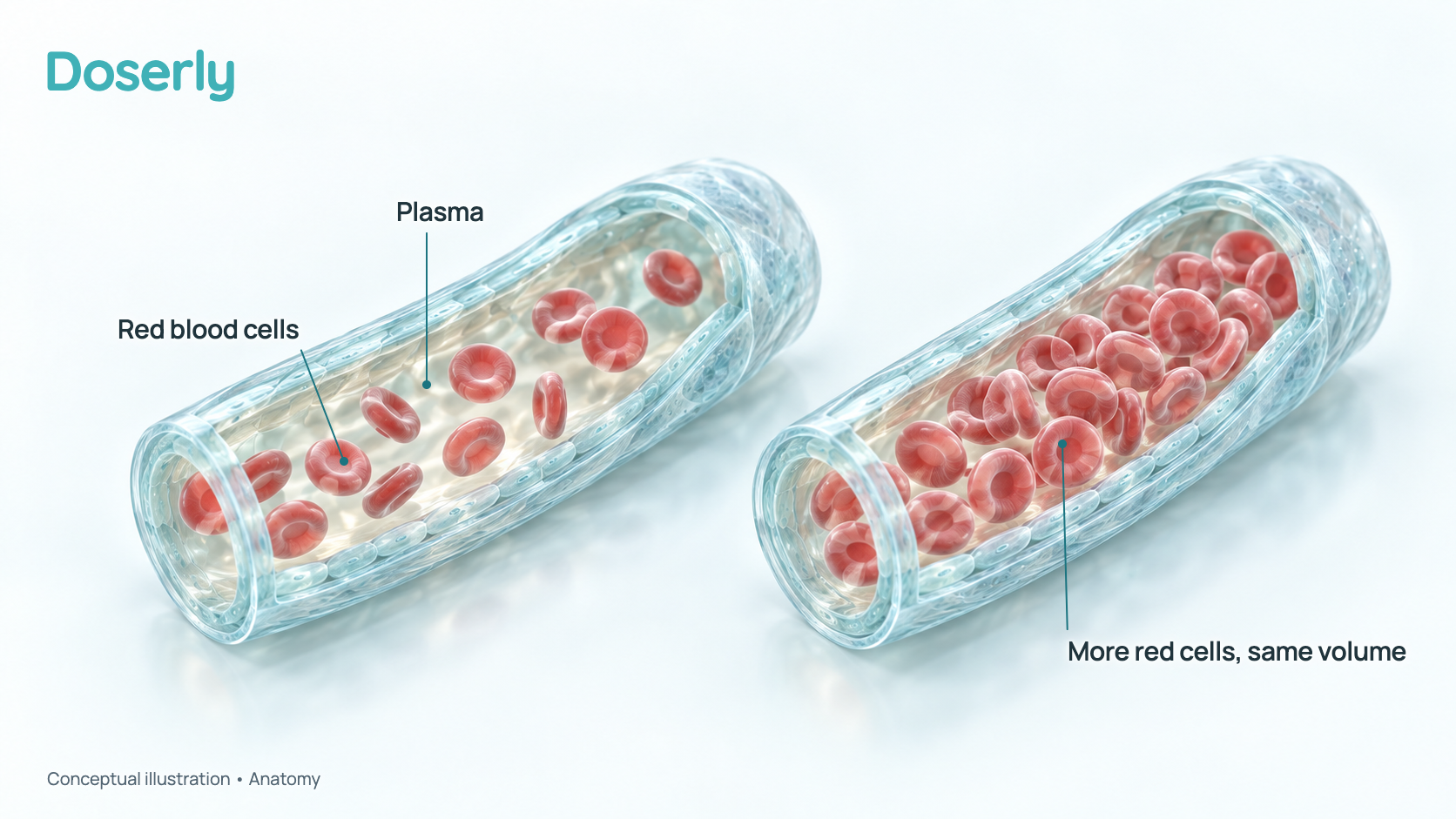
Hematocrit is the share of your blood made up of red blood cells. A result of 45% means red cells take up 45% of a blood sample's volume, and the liquid part (plasma) makes up most of the rest. Testosterone therapy raises hematocrit in most men, and hematocrit is one of the main safety checks guidelines use to decide whether a TRT dose needs changing. [20], [2], [13]
Red blood cells carry oxygen, so a modest rise is usually harmless and can even correct anemia (too few red cells). The concern is that blood with a very high share of red cells is thicker, and in people who do not take testosterone, a higher hematocrit goes with more blood clots. [21], [22]
When red cells climb above the normal range, doctors call it erythrocytosis, or secondary polycythemia. "Secondary" means the cause, here testosterone, sits outside the bone marrow. It is a different condition from polycythemia vera, a bone marrow disease with its own thresholds and treatment. [23], [24]
Hematocrit comes from a standard blood count, usually beside hemoglobin, the oxygen-carrying protein inside red cells. Labs report it as a percentage (45%) or a fraction in liters per liter (0.45 L/L). Normal ranges differ by lab: MedlinePlus gives 37–48% for men, and one UK National Health Service (NHS) laboratory uses 0.40–0.52 L/L (40–52%). Compare your result with your own lab's range. [20], [25], [26]
Hematocrit on TRT: the key numbers
This table shows the hematocrit lines in every major clinical guideline, both before starting treatment and during it. The numbers are what each document says, checked in September 2026.
| Guideline (version, year) | Before starting | On treatment | How often checked | Action at this level |
|---|---|---|---|---|
| AUA, American Urological Association (2018, validity reconfirmed 2024) | Above 50%: consider withholding until the cause is checked | 54% or higher | Every 6–12 months | Lower the dose or pause; if testosterone is high, adjust the dose first; if testosterone is low or normal, refer to a blood specialist (hematologist) |
| Endocrine Society (2018) | Above 48% (above 50% at high altitude): a reason for caution | Above 54% | Before starting, at 3–6 months, at 12 months, then yearly | Stop until it falls to a safe level, check for low oxygen and sleep apnea, restart at a lower dose |
| EAU, European Association of Urology (2026) | 48–50%: a reason for caution; 54% or higher: do not start | Above 54% (its summary table says 54% or higher) | 3, 6 and 12 months, then yearly; for men at higher risk, every 3 months in year one and at least every 6 months after that | Adjust or stop treatment, remove 500 mL of blood if needed, restart at a lower dose once normal and consider a gel |
| BSSM, British Society for Sexual Medicine (2023) | Above 54%: do not start | Above 54% | Before starting, at 3–6 months, at 12 months, then yearly | Lower the dose or switch preparation; consider stopping if it stays high |
| ICSM, International Consultation on Sexual Medicine (2024) | Must be below 54%; 48–50% needs careful evaluation | Keep below 54% | Not specified | Take extra care at high altitude |
| EAA, European Academy of Andrology (2020) | Above 48–50%: do not start without further evaluation | Above 54% | 3–6 months after starting, then yearly | Stop until safe, check for low oxygen and sleep apnea, restart at a lower dose |
| VA, US Department of Veterans Affairs (January 2026) | Above 48%: do not start | Above 51%: adjust the dose. Above 54%: stop | At 3–6 months and at 12 months | Adjust above 51%; stop above 54% |
| Society for Endocrinology, UK (2022) | Not stated | Above 50% (0.50 L/L) | Not stated | Lower a gel dose, lengthen the time between injections or switch to a transdermal form (absorbed through the skin); stop and get urgent blood-specialist advice if it is markedly high |
| CUA, Canadian Urological Association (2021) | Not stated | 55% or higher, if it persists | Before starting, at 3 months, then yearly | Lower the dose, take a break, change the form, or give blood (donation or therapeutic phlebotomy) |
| ESA, Endocrine Society of Australia (2016) | Untreated polycythaemia is a precaution | No number | 3 months after starting, then yearly | Usually lower the dose or frequency; removing blood is rarely needed |
| Product labels (US, UK and Canada) | No number | No number; labels say "elevated" | US gels: before starting, at 3–6 months, then yearly. Xyosted: about every 3 months. Tlando: every 3 months in year one, then every 6 months. Sustanon 250 (UK): every 3 months for a year, then yearly | Stop until it falls; the Xyosted and Tlando labels say to stop for good if it rises again after restarting |
[3], [13], [14], [27], [28], [29], [4], [5], [6], [30], [31], [32], [7], [33], [34]
Most bodies act at 54%: the AUA, the Endocrine Society, the EAU, the BSSM, the ICSM and the EAA, and the large TRAVERSE safety trial used the same line. The exceptions are the VA, which adjusts the dose above 51%, the UK Society for Endocrinology, which acts above 50%, and the CUA, which acts at 55%. Before treatment starts, most bodies become cautious at 48–50%, and the AUA above 50%. [3], [4], [5], [6], [35]
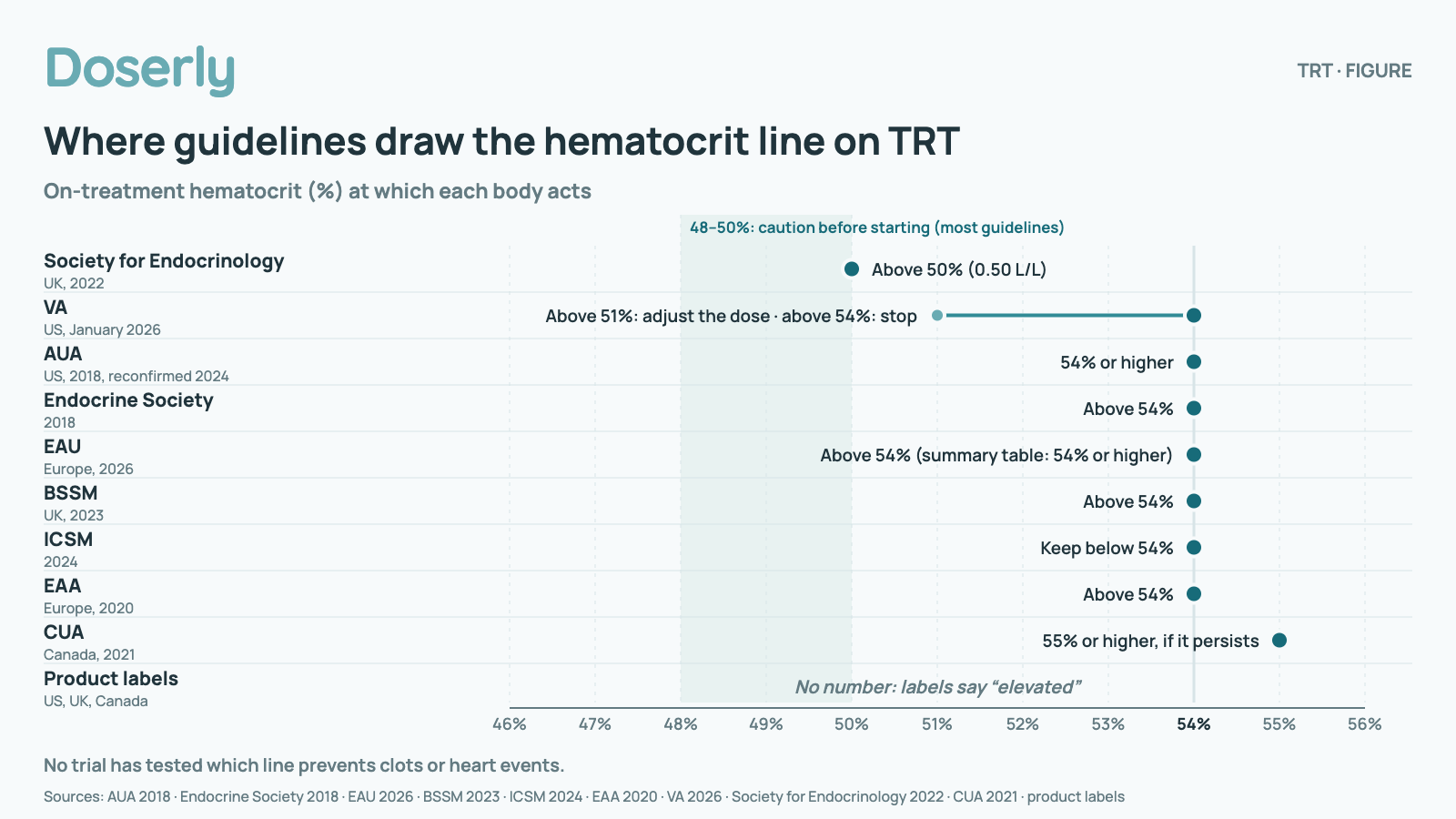
Where guidelines draw the hematocrit line on TRT
On-treatment hematocrit (%) at which each body acts.
Each bar runs from 46% (left) to 56% (right); the shaded part is 48–50%, where most guidelines take care before starting.
- Society for Endocrinology (UK, 2022)
- Above 50% (0.50 L/L)
- VA (US, January 2026)
- Above 51%: adjust the dose · above 54%: stop
- AUA (US, 2018, reconfirmed 2024)
- 54% or higher
- Endocrine Society (2018)
- Above 54%
- EAU (Europe, 2026)
- Above 54% (summary table: 54% or higher)
- BSSM (UK, 2023)
- Above 54%
- ICSM (2024)
- Keep below 54%
- EAA (Europe, 2020)
- Above 54%
- CUA (Canada, 2021)
- 55% or higher, if it persists
- Product labels (US, UK, Canada)
- No number: labels say “elevated”
No trial has tested which line prevents clots or heart events.
Why do guidelines disagree?
Because no trial has tested which line prevents clots or heart problems. Each number is an expert judgment, and no trial has compared outcomes between men kept below 50%, 52% or 54% on testosterone. [16], [36]
The lower numbers you may see online come from other conditions:
- 45% is the treatment target for polycythemia vera. In a trial of 365 people with that marrow disease, keeping hematocrit below 45% cut heart deaths and major clots to 2.7%, compared with 9.8% at 45–50%. That result applies to polycythemia vera, not to TRT. [37]
- 49% is part of the diagnostic criteria for polycythemia vera in men, used together with bone marrow and gene tests. On its own it does not diagnose anything. [24]
- Below 0.55 L/L (55%) is the target the British Society for Haematology suggests for unexplained erythrocytosis, a target its own authors call "arbitrary". The same guideline sets no testosterone-specific target. [23]
How do the units work?
Hematocrit appears as a percentage (54%) or as liters of red cells per liter of blood (0.54 L/L); both mean the same. Hemoglobin appears in grams per deciliter or grams per liter: 18.0 g/dL is 180 g/L. A Canadian blood-donor study treated a hemoglobin of 180 g/L as equal to a hematocrit of 54%, but that is an approximation, so compare hematocrit with hematocrit where you can. [26], [38]
Guidelines also tie hematocrit decisions to your testosterone level, which labs report in ng/dL (US) or nmol/L (most other countries). TRAVERSE, for example, adjusted the gel dose to keep testosterone between 350 and 750 ng/dL (about 12 to 26 nmol/L). The testosterone unit converter switches between the two, and the TRT blood work guide explains when to draw each test. [39]
Where these numbers come from
Each guideline row comes from that body's current document: the AUA testosterone deficiency guideline (published 2018, validity reconfirmed 2024), the Endocrine Society guideline (2018), the EAU guidelines on sexual and reproductive health (2026 edition), the BSSM guidelines (2023), the ICSM 2024 recommendations (published 2025), the EAA guideline (2020), the VA clinical recommendations (January 2026), the Society for Endocrinology guideline (2022), the CUA guideline (2021) and the Endocrine Society of Australia position statement (2016, still current). [3], [13], [14], [27], [28], [29], [4], [5], [6], [30], [31]
The label row comes from the current US labels for AndroGel 1.62% (revised 2025), Xyosted (revised 2025) and Tlando (revised February 2026), and the UK Sustanon 250 summary of product characteristics (2026). We also checked the Jatenzo, Kyzatrex, Aveed, Nebido and Testogel labels: none gives a numeric hematocrit line. [32], [7], [33], [34], [40]
TRAVERSE's rule comes from its deposited protocol, which lowered the gel dose when hematocrit went above 54% and stopped it if hematocrit stayed above 54% on the lowest dose. [35]
Not used: rate ranges such as "5–14% of men" or "3–18%" that circulate online without a traceable source, and a claim that some protocols act at 52% (no guideline does; 52% is a research cut-off used in several studies). A popular rule that hematocrit equals hemoglobin times three has no primary source we could find.
Why does testosterone raise hematocrit?
Testosterone tells the body to make more red blood cells in two ways: it frees up iron for new cells, and it resets the body's sense of how many red cells are "enough". Both effects are measured in people. [41], [42]
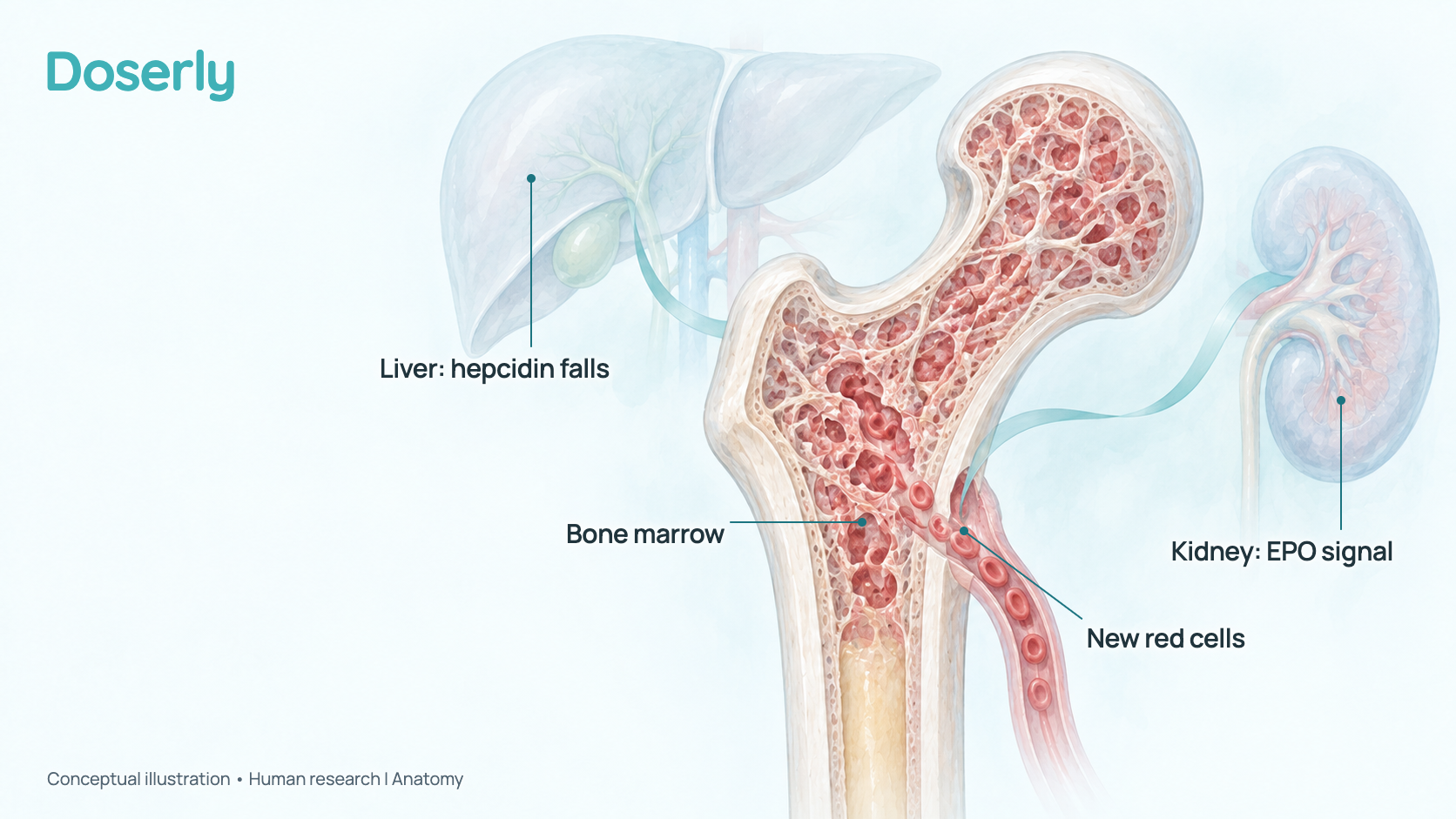
- More iron for red cells. Hepcidin is a hormone made by the liver that controls how much iron reaches the blood. In a study of 109 healthy young and older men given testosterone injections at research doses, hepcidin fell within a week, more so in older men, and the size of the drop at weeks 4 and 8 predicted how far hematocrit rose. The same pattern appeared in a placebo-controlled trial of 34 men with type 2 diabetes and low testosterone: hepcidin fell by 28% and hematocrit rose to 45.3% on average. [41], [43]
- A new "normal" for red cells. Erythropoietin (EPO) is the kidney hormone that tells the bone marrow to make red cells. In a 6-month trial of older men using testosterone gel, EPO rose early and was not switched off even though hemoglobin was higher, as if the body now accepted a higher red-cell level as normal. Ferritin, a measure of stored iron, fell as the iron was used. [42]
- Not through DHT. Testosterone is partly converted to dihydrotestosterone (DHT). In a 12-month trial in 60 older men, blocking that conversion with finasteride did not stop the rise: testosterone injections raised red cells by 9% and hematocrit by 4%, and cut hepcidin by 57%, either way. [44]
- In mice, testosterone switched down the liver's hepcidin gene and switched up the kidney's EPO gene, matching what the human studies suggest. [45]
Why do dose and form matter so much?
More testosterone means a bigger rise. In trials of healthy men given weekly enanthate injections at research doses (not treatment protocols), hematocrit rose in a straight line with the dose, and more in older men than in young men. [46], [47]
The level reached matters too, not just the dose written on the prescription. In 158 men on long-term testosterone pellets, a higher testosterone level just before the next implant (the trough) strongly predicted a hematocrit above 50%, and each extra year of age added about 10% to the odds. [9] Injections at usual doses also tend to push testosterone higher than other forms: in a randomized trial, cypionate injections raised testosterone by an average of 511 ng/dL, against 283 ng/dL for nasal gel. [48]
What else pushes hematocrit up?
Anything that lowers the oxygen reaching your tissues can add to the push, because the kidneys answer low oxygen with more EPO. Smoking, lung disease and living at altitude are the common examples, which is why the Endocrine Society allows a baseline of up to 50% at high altitude and the ICSM advises extra care there. [20], [49], [13], [28]
Some things raise the reading without adding red cells at all. When plasma shrinks, for example from dehydration or the first days at altitude, the same number of red cells takes up a larger share of the sample. On the first day at 2,500 m, plasma volume fell by about 6% and hematocrit rose by about 1.5 points in lowland visitors. [12], [20]
What does the research show?
Testosterone raised hematocrit in trials of nearly every form, most with enanthate or cypionate injections and oral undecanoate. How often it passes 54% varies widely between studies, from about 1 in 100 men to more than 1 in 5, depending on the form, dose, age of the men and length of follow-up. [8], [50], [51]
How much does hematocrit rise on TRT?
About 3 percentage points on average, with a wide spread between people.
| Study | Who and what | Hematocrit result | What it cannot show |
|---|---|---|---|
| Review of 51 studies (meta-analysis, 2010) | Adult men on testosterone in trials, all forms | Average rise of 3.18 points compared with men not on testosterone | Study quality was low to moderate [1] |
| Review of 19 placebo-controlled trials (2005) | 1,084 men aged 45 or older | Men on testosterone had 3.69 times the odds of a hematocrit above 50%; it was the most frequent side effect | Older trials [2] |
| T4DM (controlled trial, 2021) | 1,007 men aged 50–74 with a large waist and low or low-normal testosterone, testosterone undecanoate injections or placebo, plus a lifestyle program, 2 years | Above 54% in 22% on testosterone (106 of 491) vs 1% on placebo (6 of 484) | Long-acting injections only [51] |
| Testosterone Trials (controlled trial, 2016) | 790 men aged 65 or older, testosterone gel or placebo, 1 year | Hemoglobin of 17.5 g/dL or more in 7 men on testosterone and none on placebo | Too few men to judge clot risk [52] |
| TRAVERSE (controlled trial, 2023) | About 5,200 men aged 45–80 at high heart risk, daily testosterone gel or placebo | The gel dose was lowered above 54%; 6 men had the gel stopped because hematocrit stayed above 54% on the lowest dose | The papers reviewed here do not report how many men in total passed 54% [21], [35] |
| Xyosted trials (label data) | Men on weekly subcutaneous (into the fatty layer under the skin) enanthate, up to a year | 55% or more in 12 of 283 men (4.2%) | Short follow-up [7] |
| Xyosted 26-week study | 133 men on the same product | 52% or more in 10 of 133 men (7.5%) | No comparison group [53] |
| Tlando blood pressure study | 138 men on oral testosterone undecanoate, 4 months | Average rise of 3.2 points | No comparison group [54] |
| Single-clinic records (2025) | 247 men, mostly on undecanoate injections, followed a median of 2.9 years | 23% went above 0.50 L/L and 5% above 0.54 L/L | One center, looking back at records [55] |
| Trans men on testosterone (2021) | 1,073 people on gender-affirming testosterone | 11% went above 0.50 L/L and 0.5% above 0.54 L/L | Different population from men with low testosterone [56] |
The share passing 54% varies so much because the studies differ: long-acting injections in T4DM, gel with active dose control in TRAVERSE, older men in the Testosterone Trials, and different follow-up lengths. A 2025 systematic review of drug-caused erythrocytosis found rates as high as 66.7% in some groups of men on prescription testosterone, and higher risk with injections, higher doses and older age. [36]
Which forms of testosterone raise hematocrit the most?
In pooled trials, enanthate or cypionate injections and oral undecanoate raised it most and patches least; in a direct trial, nasal gel caused no significant change. A network meta-analysis of 29 placebo-controlled trials (3,393 men) estimated these average rises compared with placebo:
| Form | Average rise in hematocrit (percentage points) |
|---|---|
| Oral testosterone undecanoate | 4.3 |
| Enanthate or cypionate injections | 4.0 |
| Gel | 3.0 |
| Undecanoate injections (long-acting) | 1.6 |
| Patch | 1.4 |
Only the difference between enanthate or cypionate injections and patches was statistically clear; the others overlapped. [8]
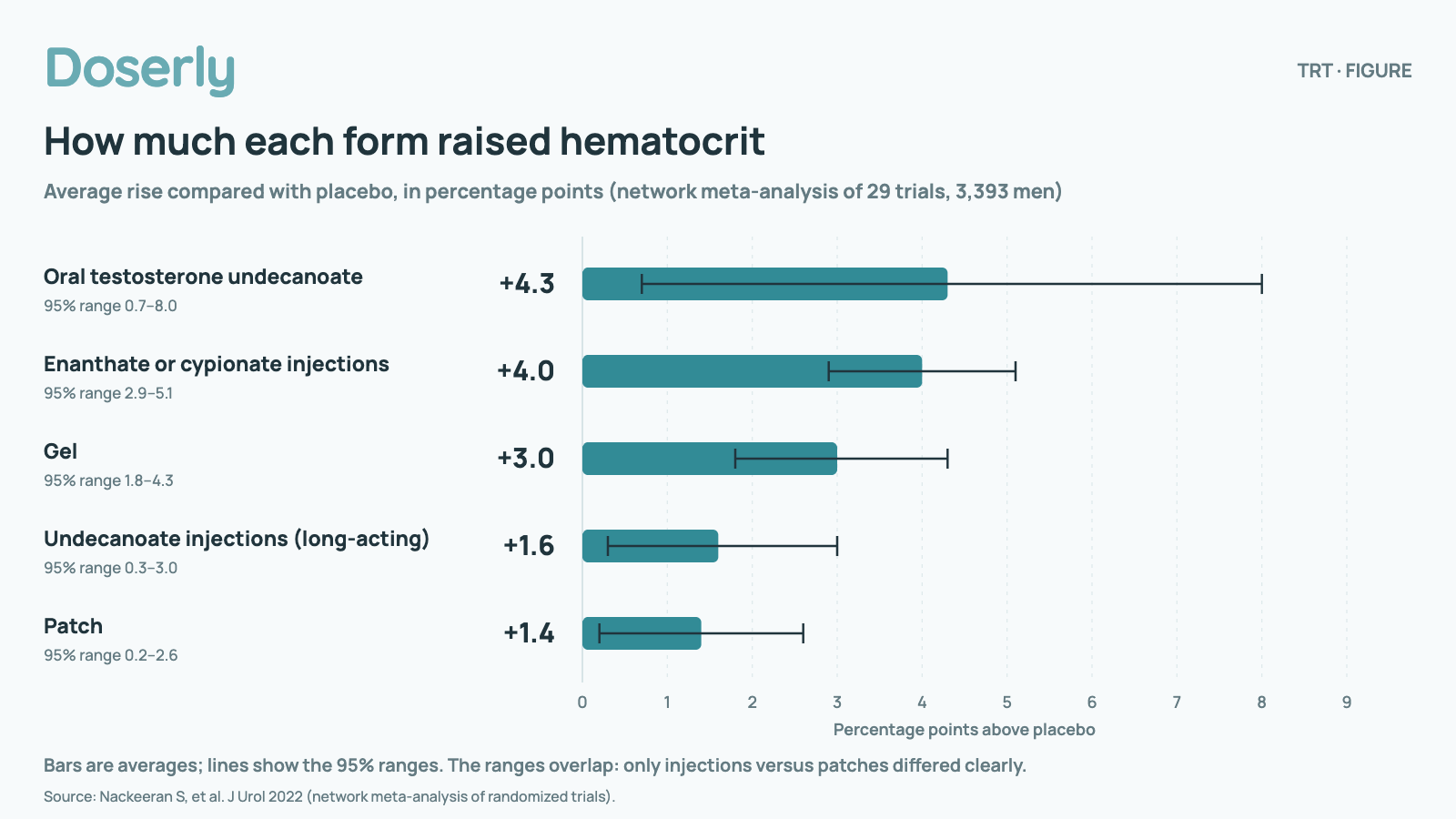
How much each form raised hematocrit
Average rise compared with placebo, in percentage points (network meta-analysis of 29 trials, 3,393 men).
Bars run from 0 to 9 points; the thin line is the 95% range.
- Oral testosterone undecanoate
- +4.3 points (95% range 0.7–8.0)
- Enanthate or cypionate injections
- +4.0 points (95% range 2.9–5.1)
- Gel
- +3.0 points (95% range 1.8–4.3)
- Undecanoate injections (long-acting)
- +1.6 points (95% range 0.3–3.0)
- Patch
- +1.4 points (95% range 0.2–2.6)
The ranges overlap: only injections versus patches differed clearly.
Direct comparisons point the same way:
- Nasal gel versus injections. In a 4-month randomized trial, cypionate 200 mg injected every 2 weeks raised average hematocrit from 42.7% to 46.6%, while nasal testosterone (Natesto) caused no significant change. A third of the men did not finish. [48]
- Matched clinic records. In 78 matched men, hematocrit rose 4.4 points on cypionate injections, 1.7 on pellets and fell 0.8 on nasal gel. [57]
- Clinic records over 3 years. Hematocrit above 50% occurred in 66.7% of men on injections, 35.1% on pellets and 12.8% on gels, although the injection group was younger and the groups were not randomized. [58]
- Pellets. In 97 men, average hematocrit rose from 43.9% to 46.1% after pellet implants, and men who started lower rose more. [59]
The long-acting undecanoate injection is where the evidence conflicts. The meta-analysis put its average rise low (1.6 points), yet in a prospective registry, hematocrit passed 50% in 69 of 304 men starting undecanoate injections against 25 of 498 starting gel after about 6 months, and T4DM, which used the same injection, saw 22% pass 54%. Treat the low average with caution. (A large safety study that relied on doctors reporting side effects listed raised hematocrit in fewer than 1%, but that counts reports, not measurements.) [8], [60], [51], [61]
How fast does hematocrit rise, and how fast does it fall?
It rises over the first 3 to 12 months, and it falls back over about 3 months once testosterone stops.
- Rise. In a 6-month trial of testosterone gel in older men, hematocrit rose 3.59 points by month 3, when it peaked, and was still 2.96 points up at month 6. A review of treatment time courses puts the rise in red cells at about 3 months, with the peak at 9–12 months. In the single-clinic records, 46% of the men whose hematocrit passed 0.46 L/L peaked within the first year. [42], [62], [55]
- Later rises happen too. In one urology practice, the 37 men who had both sleep apnea and a hematocrit of 52% or more reached that level a median of 3 years after starting TRT. In the single-clinic records, the other 54% of men whose hematocrit passed 0.46 L/L peaked after the first year. A normal result in the first year does not rule out a later rise. [10], [55]
- Fall. In the gel trial, hemoglobin and hematocrit were back to normal 3 months after the men stopped. Among men who had used anabolic steroids outside medical care, hematocrit also returned to its starting level within 3 months of the end of a cycle. [42], [63]
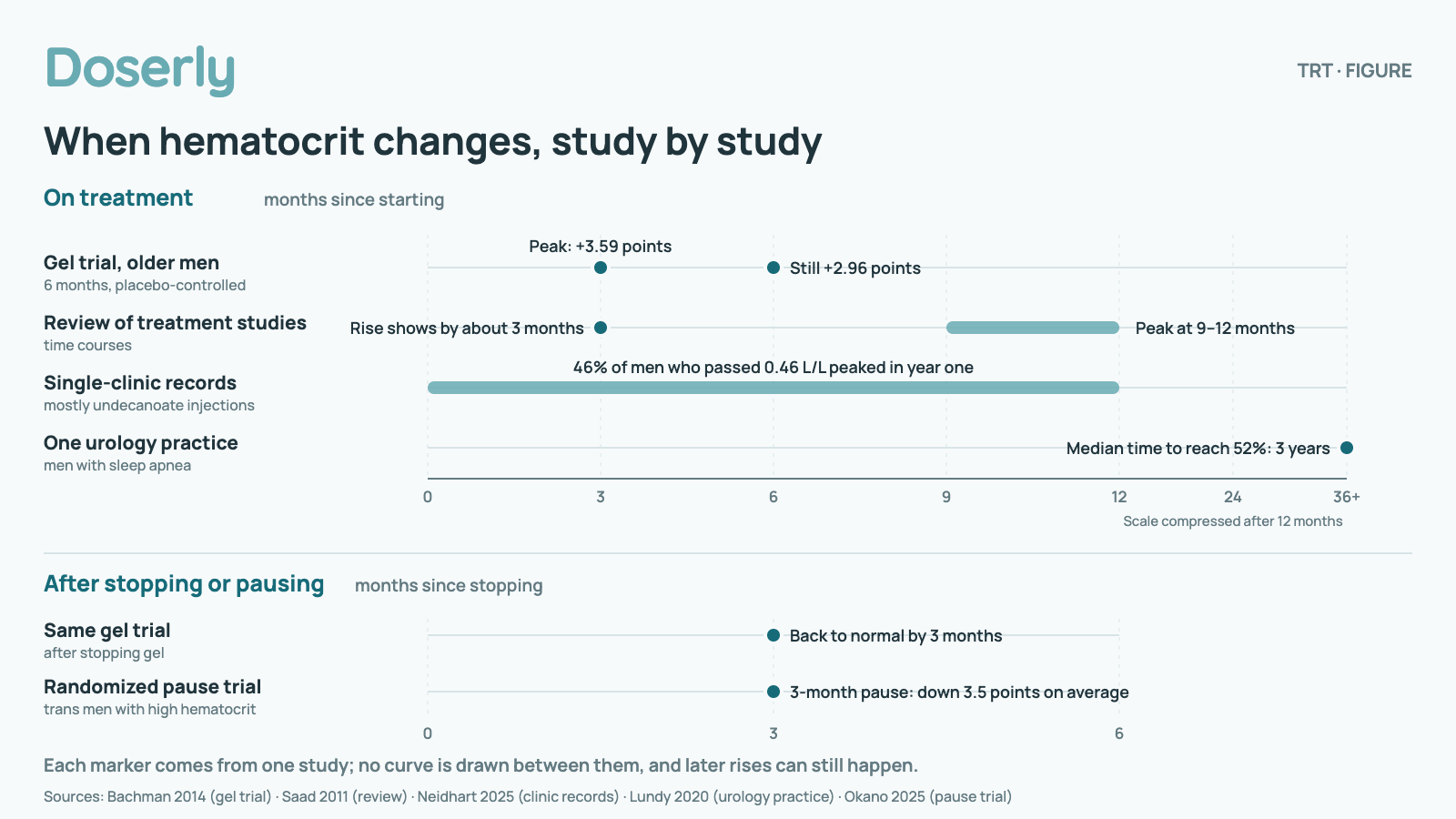
When hematocrit changes, study by study
On treatment
- About 3 months
Gel trial in older men: peak rise of 3.59 points. A review of treatment studies: the rise shows by about 3 months.
- 6 months
Same gel trial: still 2.96 points up.
- 9–12 months
Review of treatment studies: peak.
- First year
Single-clinic records: 46% of men whose hematocrit passed 0.46 L/L peaked in year one.
- Median 3 years
One urology practice, men with sleep apnea: median time to reach 52%.
After stopping or pausing
- 3 months after stopping
Same gel trial: back to normal.
- 3-month pause
Randomized trial in trans men with high hematocrit: down 3.5 points on average.
Each point comes from one study; no curve is drawn between them, and later rises can still happen.
Who is most likely to get a high hematocrit?
The same few factors come up across studies:
- A higher dose or testosterone level, cypionate or enanthate injections, and older age (see why dose and form matter). [46], [9], [8]
- A higher starting hematocrit and a higher body weight. Both predicted erythrocytosis in the single-clinic records. [55]
- Sleep apnea. In 474 men on TRT at one urology practice, 13.1% reached 52%, and men with obstructive sleep apnea had about twice the odds (adjusted odds ratio 2.09). [10] Sleep apnea on its own rarely causes erythrocytosis: in a sleep clinic study of 1,604 people, only 1.6% had it, and low oxygen levels, smoking, alcohol and testosterone use mattered more than apnea severity. [49], [64]
- Smoking. In 1,073 trans men on testosterone, smoking doubled the odds of a hematocrit above 0.50 L/L (odds ratio 2.2); a higher body mass index (odds ratio 3.7), lung conditions (2.5) and undecanoate injections (2.9) also raised the odds. These figures come from trans men, because the evidence in men with low testosterone is thinner; in 158 men on pellets, smoking showed a similar but uncertain effect. [56], [9]
- SGLT2 inhibitors for diabetes. See medicines that raise hematocrit. [11]
Is high hematocrit on TRT dangerous?
Nobody knows for sure. High hematocrit on TRT has been linked with more clots and heart events in records studies, but no trial has shown that it causes them, or that lowering it prevents them. That uncertainty is why guidelines set cautious lines rather than evidence-tested ones. [17], [16]
What points toward harm?
- Men on TRT. In a large US health-records study (cohort study), 5,842 men whose hematocrit reached 52% or more on testosterone were matched with similar men whose hematocrit stayed lower. In the first year, heart attacks, strokes or blood clots occurred in 5.15% of the high-hematocrit group and 3.87% of the others (odds ratio 1.35). As absolute risks, that is about 5 in 100 men against about 4 in 100. Men on testosterone without a high hematocrit did not have more events than untreated men with low testosterone. Records studies cannot rule out other differences between the groups. [17]
- People not on testosterone. In a Norwegian population study of 26,108 people followed for a median of 12.5 years (447 clots), each 5-point rise in hematocrit went with a 25% higher risk of a clot in a vein (venous thromboembolism). In the Framingham study, the top fifth of hematocrit values went with more heart disease and death over 34 years. [22], [65]
- Genetics. In UK Biobank, men whose genes predict higher testosterone had more blood clots, but that study did not test whether hematocrit explained the link. [66]
What points the other way?
- TRAVERSE. Among men with anemia in TRAVERSE, the rise in hematocrit on testosterone was not linked with heart attacks, strokes or cardiovascular death (hazard ratio 0.97, with a likely range of 0.92 to 1.02) or clots (0.94, range 0.84 to 1.05). This analysis covered only men who started with anemia, on gel, with the dose lowered above 54%, so it does not show that high hematocrit is harmless. [21]
- Clot meta-analysis. Pooled randomized trials did not find a clear rise in venous clots with testosterone (odds ratio 1.42, with an uncertainty range from 0.22 to 9.03, too wide to settle the question). [67]
- Trans men. In one clinic, clots occurred in 0.9% of people on testosterone, and 80% of those had erythrocytosis, but without a comparison group this cannot show cause. [68]
What did TRAVERSE show about heart safety overall?
TRAVERSE is the largest trial of testosterone and heart safety, so it matters here even though it did not study hematocrit directly. Heart attack, stroke or cardiovascular death occurred in 7.0% of men on testosterone gel and 7.3% on placebo (hazard ratio 0.96), which met the trial's safety goal. Some problems were more common on testosterone: atrial fibrillation 3.5% vs 2.4%, acute kidney injury 2.3% vs 1.5%, and pulmonary embolism 0.9% vs 0.5%. [39], [32], [69]
Its limits matter: it tested only a daily gel, which the Endocrine Society says causes high hematocrit less often than injections; men used it for an average of 21.7 months; about 61% stopped their study gel early; and it enrolled men already at high heart risk. [39], [13], [69] The TRT and heart health guide covers the trial in full.
Who should be especially cautious?
- Men who already start near the line. A hematocrit of 48–50% or more before treatment is a reason to look for a cause first under most guidelines. [13], [14], [3]
- Men with untreated sleep apnea, lung disease or low oxygen levels, smokers, and men who live at altitude. These raise hematocrit on their own or add to the rise. The Endocrine Society and the VA list untreated severe sleep apnea as a reason not to start. [10], [56], [13], [4]
- Men with a history of blood clots or an inherited clotting disorder (thrombophilia). The Endocrine Society and the VA list thrombophilia as a reason not to start, the VA also lists a past clot without a clear trigger, and the EAU lists a family history of clots as a reason for caution. [13], [4], [14]
- Men taking SGLT2 inhibitors (see the next question). [11]
- Men with a known blood disorder such as polycythemia vera, which needs a hematologist's care. [23]
- Men who donate blood often, because of iron loss (see blood donation). [15]
- Drug-tested athletes. Testosterone is prohibited in sport at all times. [19]
- Under-18s. Testosterone for teenagers belongs only in specialist care.
- Women. This guide is written for men. Testosterone for women uses different doses and products; see testosterone therapy for women.
Which medicines and supplements affect hematocrit?
- SGLT2 inhibitors (such as empagliflozin and dapagliflozin, diabetes and heart medicines). These raise hematocrit on their own: on the US labels, median hematocrit rose 2.8% on empagliflozin while it fell 1.3% on placebo, and mean hematocrit rose 2.30% on dapagliflozin against a 0.33% fall on placebo. In 53,971 US veterans with diabetes, men taking both an SGLT2 inhibitor and testosterone had about 2.5 times the odds of a hematocrit above 54% compared with testosterone alone (adjusted odds ratio 2.49). In a second cohort of 5,235 men with diabetes starting TRT, 113 of 3,146 SGLT2 users (3.6%) passed 54%, against 28 of 2,089 non-users (1.3%). UK testosterone labels now warn about the combination, and an EU safety review in September 2025 recommended adding the warning to all testosterone products. [70], [71], [11], [72], [40], [73]
- Anabolic steroids raise hematocrit too: in men using them outside medical care, it rose by an average of 0.03 L/L (3 points) during a cycle. [63]
- Supplements sold to "thin the blood" have not been tested in men on TRT, and some carry their own risks. See what supplements can and cannot do.
Bring a complete list of what you take, including supplements, to a pharmacist or prescriber. Checked September 2026.
Is testosterone legal, and is it allowed in sport?
Checked September 2026. Rules differ by country and change often.
- United States. Testosterone and its esters are Schedule III controlled substances, prescription only. No proposal to change that has been published. [18]
- United Kingdom. Testosterone is a Class C controlled drug, in Schedule 4 Part II of the Misuse of Drugs Regulations. [74]
- Canada. Testosterone is a Schedule IV controlled substance. [75]
- Australia. Testosterone is a Schedule 4 prescription-only medicine. [76]
- Sport. The World Anti-Doping Agency (WADA) prohibits testosterone at all times, and its 2027 list, published in September 2026, keeps the ban. [19], [77]
What do guidelines say to do about high hematocrit?
Guidelines first check whether the testosterone level is too high, then lower the dose, pause treatment or switch to a form that raises hematocrit less, and look for sleep apnea or low oxygen. Removing blood is a secondary option in some guidelines and discouraged by others. This section describes the choices clinicians weigh; it is not a personal plan. [3], [13], [14], [5]
| Choice | Which guidelines name it | What the evidence shows |
|---|---|---|
| Check the testosterone level first | AUA (adjust the dose if testosterone is high) | Higher levels predict higher hematocrit [9] |
| Lower the dose | AUA, BSSM, CUA, VA, ESA | In a 3-month trial in trans men, halving the dose lowered hematocrit only 0.8 points [78] |
| Pause, then restart lower | Endocrine Society, EAA, EAU, AUA, CUA | The same trial: stopping lowered it 3.5 points in 3 months [78] |
| Switch form | BSSM, EAU (consider a topical form on restarting), Society for Endocrinology, CUA | A gel, patch or nasal gel (the Endocrine Society says high hematocrit is more common with injections than with gels; a pooled analysis of trials found a clear gap only between injections and patches; see the forms; testosterone gel guide) [13], [8], [48] |
| Check for sleep apnea and low oxygen | Endocrine Society, EAA | CPAP lowered hematocrit about 2 points after one night [79] |
| Remove blood | EAU (500 mL if needed), CUA (donation or phlebotomy), ESA (rarely) | Lowers it for weeks; no trial of clots or heart events [15], [16] |
| Refer to a hematologist | AUA (if testosterone is low or normal), Society for Endocrinology (urgently if markedly high) | Looks for causes other than testosterone [23] |
[3], [13], [14], [27], [29], [4], [5], [6], [31]
Is pausing TRT better than lowering the dose?
For bringing the number down quickly, yes, in the one randomized comparison, which was in trans men. Among 43 trans men with hematocrit of 50% or more on cypionate, stopping for 3 months lowered hematocrit by 3.5 points, while halving the dose to 100 mg every 2 weeks lowered it by 0.8 points. In a records study from the same group, a 3-month pause took average hematocrit from 51.57% to 46.34%. [78], [80] The Endocrine Society and the EAA describe stopping until hematocrit falls, then restarting at a lower dose. Symptoms of low testosterone can come back during a pause; the stopping TRT guide covers what happens when testosterone stops. [13], [29]
Do smaller, more frequent injections lower hematocrit?
Possibly, but no study has tested it directly. The only comparison is observational: among men starting below 54%, 1 of 102 men on 100 mg weekly passed 54%, compared with 4 of 51 men on 200 mg every 2 weeks. The weekly total was the same, but the men were not randomized. [50] Going the other way, lengthening cypionate injections from every 14 to every 28 days did not significantly lower hematocrit in trans men. [80] No study has kept the weekly dose exactly the same and simply split it into more injections, so claims that splitting "fixes" hematocrit go beyond the evidence. The TRT dosage guide covers splitting schedules, and the TRT dose calculator shows how a split changes the amount per injection.
Is subcutaneous safer than intramuscular for hematocrit?
The evidence conflicts. In 234 men, weekly subcutaneous enanthate by autoinjector (Xyosted) was linked with lower hematocrit than weekly intramuscular (into a muscle) cypionate at similar testosterone levels, but the route, the ester and the device all differed and the men were not randomized. A 2026 conference abstract of 100 first-time TRT users found no difference in hematocrit between subcutaneous and intramuscular injections. No trial has switched men from one route to the other and measured hematocrit. [81], [82] The injection guide compares the two routes in more detail.
Does treating sleep apnea lower hematocrit?
A little, based on studies outside TRT. In people with obstructive sleep apnea, one night on CPAP (a machine that keeps the airway open with air pressure) lowered hematocrit from 44.0% to 42.4% in one study and from 45.4% to 43.1% in another. Part of that quick change may reflect fluid shifts rather than fewer red cells, and no study has tested CPAP in men on TRT. [79], [83], [10]
Is therapeutic phlebotomy recommended?
Only as a secondary option (see the table above). A 2024 review concluded that evidence for the benefit or safety of phlebotomy for testosterone-induced erythrocytosis is lacking, and warned that the iron loss it causes might itself activate pathways linked with clotting. Australia's blood service does not accept men with secondary polycythaemia for therapeutic donation and says there is no evidence to support it. [16], [84] See blood donation for what one donation does.
How do blood donation, water and lab timing affect hematocrit?
Does donating blood lower hematocrit?
Yes, for several weeks, but it also drains iron, and there is no evidence that it prevents clots or heart problems on TRT. In a randomized trial in healthy, trained men, one 470 mL donation lowered hematocrit by up to 11% of its starting value and halved ferritin, and repeat donations 3 months apart added up. [15], [16]
In men on TRT, donation often does not keep hemoglobin down for long. At Canadian Blood Services, 39 men on TRT had a hemoglobin of 180 g/L or more (about a 54% hematocrit) at 25% of their visits, and 12 of 27 repeat donors (44%) were still that high at later donations. [38] In US blood centers, donors on TRT had higher average hemoglobin than other donors (17.8 vs 15.6 g/dL). [85]
Can you donate blood while on TRT?
Checked September 2026. Each blood service sets its own rules, and they change.
- United States. Federal rules set only minimum levels for male donors (hemoglobin at least 13.0 g/dL or hematocrit at least 39%) and allow whole blood no more than once every 8 weeks, or a double red-cell donation every 16 weeks. The American Red Cross allows whole blood every 56 days and caps donor hemoglobin at 20 g/dL; its eligibility list has no testosterone entry. Vitalant says people who need blood draws for polycythemia caused by TRT can book a regular donation if they are eligible and do not need it more often than every 56 days. [86], [87], [88], [89], [90]
- Canada. Canadian Blood Services says donors taking hormone medicine can give if otherwise eligible, with 56 days between donations for men; Héma-Québec also uses 56 days for men. [91], [92], [93]
- United Kingdom. Men wait at least 12 weeks between whole-blood donations. Check NHS Blood and Transplant's eligibility pages for its current rules on testosterone before booking. [94]
- Australia. Lifeblood accepts donors whose testosterone is prescribed by an Australian doctor, checks hemoglobin before each donation because testosterone can push it above the accepted range, and allows whole blood every 12 weeks. [95], [96]
Therapeutic phlebotomy is different: blood removed on a prescriber's order to treat a condition, which US rules allow more often than these intervals. In the US, blood collected this way must be labeled with the donor's condition unless an approved exception applies. If you need blood removed more often than a normal donation allows, ask your prescriber and the blood service about it. At one US blood center, therapeutic phlebotomies for men on TRT rose to 239 a year before the center stopped offering them; afterwards, 32% of those men kept giving blood as regular volunteer donors. [87], [97]
Does frequent donation cause low iron?
Yes. Iron stores take months to refill: after a 500 mL donation, ferritin had still not recovered after 168 days in donors not given iron. In a trial of 45,263 UK donors, giving blood more often led to lower hemoglobin and ferritin and more donation-related symptoms, including tiredness. [98], [99] Low iron can also make hematocrit look lower than the red-cell count, because iron-poor red cells are smaller, and hematocrit depends on both the number and the size of the cells. [100] Tiredness is not always the iron, though: in iron-deficient donors without anemia, intravenous iron did not improve average fatigue scores. [101] See the iron supplement guide.
Can drinking more water or exercise lower hematocrit?
They change the reading, not the number of red cells. Dehydration shrinks plasma and pushes the reading up, so being well hydrated before a blood test gives a fairer result. In a small study, doubling water intake for a week lowered hematocrit by diluting the blood. Endurance training expands plasma, and 7 weeks of interval running lowered resting hematocrit in young men. Neither removes red cells. [20], [102], [103]
Do grapefruit, nattokinase, IP6 or aspirin lower hematocrit?
We found no study testing any of them in men with testosterone-related erythrocytosis.
- Grapefruit. The only study is a 1988 diet study of 36 people, not on TRT, with no comparison group. Grapefruit also changes how some medicines work, so check your medicine leaflets first. [104], [105]
- Nattokinase. A supplement enzyme sold to "thin" blood. It has no hematocrit data, and one man taking it with aspirin had a bleed in the brain. See the nattokinase guide. [106]
- IP6 (phytate). It blocks iron absorption from food in human studies, but no study has measured hematocrit. [107]
- Aspirin. No study has tested aspirin for testosterone-related erythrocytosis. It is a medicine with bleeding risks and a decision for your prescriber.
Does the timing of the blood test change the result?
A little. Hematocrit follows a daily rhythm, rising and falling by about 1 point (0.01 L/L) over the day. Fingerstick readings do not match a venous blood count: at the high end they read higher than the venous result. Dehydration raises the reading. [108], [109], [12] We found no study measuring how hematocrit changes between the peak and trough of a single injection cycle. A repeat venous test drawn under the same conditions (similar time of day, well hydrated) is the fairest comparison with the last one.
What do people on TRT report about hematocrit?
Public forums are full of men who have just seen one high hematocrit result, and of men who have spent years trying to keep it down. The threads below are recent public Reddit discussions, read with their replies; they show what people experience, not how often it happens.
What does a first high result usually look like?
Usually a number, not a symptom. Many posters feel well and are worried only by the lab report: one man in his 40s on 100 mg a week felt "completely fine" at 56% despite giving blood every 3 months, and another in his 40s felt better than he had in years at 52.2%, with ferritin low, while his doctor proposed cutting his dose from 100 to 60 mg a week. [110], [111] Clinicians' responses in these threads vary widely, from continuing the same dose and rechecking in 4 months at 0.51 L/L to pausing treatment. [112], [113]
Does a repeat test change the picture?
Often. One man whose result was 58% two weeks after donating, on a morning when he had drunk no water, reported 48% on a hydrated retest; another went from 56% to 51% on a retest his doctor ordered after he rehydrated, and a third, whose reading jumped to 53.7% during weeks of inactivity after surgery, was back near 49.5% on a later retest. [114], [113], [115] Others saw no change: one man's reading stayed at 0.51 L/L on two tests, one after drinking a liter of water beforehand. [112]
What do people report after giving blood?
Mixed results, and iron comes up again and again. One man's hematocrit fell from 51% to 43.4% nine days after a donation. [116] Another saw no drop at all three to four days after giving 450 mL, although his earlier test had been six weeks before the donation, while his ferritin fell from 149 to 107. [117] A man in his 50s described one donation taking him from 57% to 52%, only for it to climb back within about three weeks while his ferritin fell from 40 to 23 and he "felt like death". [118]
Several men describe a cycle of feeling worse as their counts climb and better about a week after donating; one stopped TRT after nearly a year of it. [119] Another felt weak, lightheaded and anxious for more than a week after a donation he later decided had not been needed. [120] Long-running accounts end with ferritin in single digits and constant fatigue. [121], [122]
What happened after lowering the dose, pausing or switching?
Results varied, and changes often took months. One man cut from 150 to 100 mg a week and found his hematocrit higher three months later (52.6% to 54.7%). [123] Another dropped from 200 to 140 mg a week, gave blood and split his injections, and hematocrit fell only from 53.6% to 52.1% while his testosterone fell from about 1,200 to 370 ng/dL and he felt much worse. [124] Eight weeks off treatment took one man from 0.54 to 0.51 L/L. [125] A man whose hematocrit went from 40% to 50% in two months on gel stopped it and measured 48% two weeks later. [126]
Some posts credit other changes, but each one changed several things at once. One man reported a fall from 56.5% to 49% in two months after starting a blood-pressure medicine and more cardio together, after a long list of supplements had not helped. [127] Another reported 55.0% falling to 49.2% over four weeks of daily grapefruit juice, but he had also just given blood and switched from injections to gel. [128]
Sleep apnea, altitude and other medicines come up in most long threads: men finding sleep apnea only after hematocrit rose, or booking a sleep study because they snore. [118], [129] One man with no TRT saw hematocrit rise from 48% to 51.5% in two months on enclomiphene, which raised his own testosterone. [130]
What gets in the way of giving blood?
Blood services turned men away for hemoglobin above their limit (19.2 and 20 g/dL in one case, in a man living at about 5,000 feet), for taking finasteride, or for weight-loss medicines, and one man could not find a local service that would accept his prescriber's phlebotomy order. [131], [132], [126], [133] One thread describes drawing blood at home into collection tubes; most replies steered people toward donation or clinician-performed phlebotomy instead. [134]
Are serious problems reported?
Some posts describe serious events, but selected accounts cannot show how often they happen or what caused them. One woman described her husband, on 100 mg a week for five years, having a cardiac event while his hematocrit was in range (48.3%) but his ferritin was 15 after six donations over three years; he also had a high inherited cholesterol marker (lipoprotein(a)) and was being checked for bleeding in the gut, and his doctors had not found the cause. [135] Posts describing chest discomfort or breathlessness drew replies urging prompt medical assessment. [136]
How can you judge a hematocrit story?
Ask: Was the sample drawn from a vein, in the morning, well hydrated? What was hematocrit before TRT? What was the testosterone level, not only the dose? How long ago was the last donation, and what was ferritin? Were sleep apnea, altitude, smoking, weight-loss or diabetes medicines, hCG or other hormones part of the picture? And what did the next test show?
These selected discussions show what people experience and the questions research has not answered. They are not a survey of all men on TRT, a success rate or a substitute for the studies above.
What should you track?
Hematocrit and hemoglobin before starting, at about 3–6 months, at 12 months, then yearly, with more frequent checks on some products and for men at higher risk. Use this summary to prepare questions for your prescriber; it is not a personal testing plan. [13], [14]
| Why it matters | What guidelines and labels say | Tracking category |
|---|---|---|
| Hematocrit and hemoglobin | Most guidelines: before starting, at 3–6 months, at 12 months, then yearly; some labels every 3 months at first (see the key numbers for each body and product) | Blood work |
| Testosterone level | Checked at the same visits; a high level is the first thing to fix if hematocrit rises. Draw it at the time your guideline or label specifies | Blood work |
| Blood pressure | In a 4-month oral testosterone study, the quarter of men with the biggest hematocrit rises (6–14 points) had the biggest rise in systolic blood pressure, 8.3 mm Hg on average | Blood Pressure |
| Sleep | Snoring, pauses in breathing or daytime sleepiness can point to sleep apnea, which doubles the odds of a high hematocrit on TRT | Sleep Quality |
| Iron (ferritin), if you donate | Repeated donations deplete iron; iron stores take months to refill | Blood work |
| New medicines | SGLT2 inhibitors and anabolic steroids add to the rise | Other |
[13], [27], [7], [54], [10], [98], [11]
A single result is one point on a line. Because the time of day, hydration and even the type of sample move the reading, a trend of venous results drawn under similar conditions says more than any one number. The TRT blood work guide covers when to draw each test, and the testosterone level visualizer shows how injection frequency changes the peaks and troughs of testosterone itself. [108], [109]
Common questions about hematocrit on TRT
Is a hematocrit of 52% bad on TRT?
It is above many labs' normal range but below the line most guidelines act on (54%); the VA adjusts the dose above 51% and the Society for Endocrinology acts above 50%. In one records study, men who reached 52% had slightly more heart and clot events in their first year, without proof of cause. It is a reason to review the trend, the testosterone level and possible causes with your prescriber. [4], [5], [17] See the key numbers.
Should you stop TRT if your hematocrit is high?
Not necessarily for good. Above 54%, the Endocrine Society, the EAA and the EAU describe stopping or adjusting until it falls, then restarting at a lower dose; the AUA lowers the dose or pauses, and the BSSM lowers the dose or switches preparation. Stopping lowers hematocrit faster than a dose cut, but symptoms of low testosterone can return. [13], [29], [14], [3], [27], [78] See what guidelines do.
How long does it take for hematocrit to come down?
About 3 months after stopping testosterone. In a gel trial, hematocrit was back to normal 3 months after the men stopped, and in trans men a 3-month pause lowered it by 3.5 points on average. A dose cut works more slowly. A blood donation lowers it for a few weeks, until the body replaces the cells. [42], [78], [15] See how fast it falls.
Is hemoglobin the same as hematocrit?
No, but they move together. Hemoglobin is the oxygen-carrying protein inside red cells (g/dL or g/L); hematocrit is the share of blood volume taken up by red cells (%). Both come from the same blood count. The "multiply hemoglobin by three" rule you may see online has no primary source, so use the hematocrit your lab reports. [26], [20] See the units.
Does high hematocrit on TRT mean I have polycythemia vera?
Usually not. Polycythemia vera is a bone marrow disease diagnosed with marrow and gene tests, not from hematocrit alone. When hematocrit rises on testosterone, testosterone is the usual cause; the AUA suggests a hematologist review when the testosterone level is low or normal, because then another cause is more likely. [24], [23], [3] See what hematocrit is.
Can I lower hematocrit without giving blood?
Guidelines mostly do. Their first steps are checking the testosterone level, lowering the dose, pausing, switching to a form that raises hematocrit less, and treating sleep apnea. Drinking water and exercise change the reading but not the red-cell count, and no supplement has been tested for this. [3], [13], [8], [102] See the practical questions.
Glossary
Plain explanations of the medical, lab and research terms used in this guide. Underlined terms in the text link here.
- Absolute risk
- The share of people who have an event, such as 5.15 out of every 100 men. It is easier to judge than a relative risk, which only says how much higher one group's risk is than another's.
- Anemia
- Too few red blood cells or too little hemoglobin. Testosterone therapy can correct some anemia in men with low testosterone.
- Cohort study (records study)
- A study that follows a group of people, or looks back at their records, without assigning treatments. It can show links but not prove that one thing caused another.
- Conference abstract
- A short summary of a study presented at a medical meeting. It has usually not been fully peer reviewed, so it is weaker evidence than a published paper.
- Controlled trial
- A study that compares people who receive a treatment with a similar group who do not, often receiving a placebo instead. Randomly assigning people to each group makes the comparison fairer.
- CPAP
- Continuous positive airway pressure: a bedside machine that blows air through a mask to keep the airway open during sleep. It is the standard treatment for obstructive sleep apnea.
- EPO (erythropoietin)
- A hormone made mainly by the kidneys that tells the bone marrow to make red blood cells. The body makes more when oxygen is low.
- Erythrocytosis (secondary polycythemia)
- Too many red blood cells, shown by a high hematocrit or hemoglobin. On TRT it is called secondary because the cause, testosterone, is outside the bone marrow.
- Ferritin
- A protein that stores iron. Its blood level is the usual measure of iron stores, and it falls after blood donation and early in testosterone therapy.
- Clinical guideline
- Recommendations written by a medical society or health system, based on its review of the evidence and expert judgment. Different guidelines can reach different conclusions.
- Hazard ratio
- A measure comparing how often an event happens over time in two groups. A hazard ratio of 1 means no difference; 0.96 means about 4% lower in the first group.
- Hematocrit
- The share of the blood made up of red blood cells. Testosterone therapy can raise it, which is why it is checked.
- Hematologist
- A doctor who specializes in blood and bone marrow disorders.
- Hemoglobin
- The iron-containing protein inside red blood cells that carries oxygen. It is measured in grams per deciliter (g/dL) or grams per liter (g/L): 18.0 g/dL equals 180 g/L.
- Hepcidin
- A hormone made by the liver that controls how much iron enters the blood. Testosterone lowers it, making more iron available for new red cells.
- Intramuscular (IM)
- Injected into a muscle. Most testosterone cypionate and enanthate is given this way.
- Product label (prescribing information)
- The official document approved by a medicines regulator for a product, describing its approved uses, doses, warnings and monitoring. In the UK it is called the summary of product characteristics.
- L/L (liters per liter)
- A way of writing hematocrit as a fraction instead of a percentage. 0.54 L/L is the same as 54%.
- Meta-analysis and systematic review
- A systematic review gathers all studies on a question in a planned way. A meta-analysis combines their results statistically. A network meta-analysis compares several treatments at once, even ones never tested head to head.
- Odds ratio
- A measure comparing the odds of an outcome in two groups. An odds ratio of 2 means roughly twice the odds; 1 means no difference.
- Therapeutic phlebotomy (venesection)
- Removing blood on purpose to lower red cells or iron, usually about 500 mL at a time. A blood donation removes a similar amount.
- Placebo
- A dummy treatment with no active ingredient, used as a comparison in studies.
- Plasma
- The liquid part of the blood. When plasma shrinks, for example with dehydration, hematocrit reads higher even though the red cells have not changed.
- Polycythemia vera
- A bone marrow disease, usually caused by a gene change, in which the marrow makes too many red cells on its own. It has its own diagnostic tests and treatment targets and is different from testosterone-related erythrocytosis.
- SGLT2 inhibitor
- A group of diabetes, heart and kidney medicines, such as empagliflozin (Jardiance) and dapagliflozin (Farxiga), that make the kidneys remove sugar in urine. They raise hematocrit on their own.
- Obstructive sleep apnea
- Repeated blocking of the airway during sleep, causing pauses in breathing and drops in oxygen. Loud snoring and daytime sleepiness are common signs.
- Subcutaneous (SC)
- Injected into the fatty layer just under the skin. Xyosted is given this way, and some prescribers use this route for other testosterone injections.
- Thrombophilia
- An inherited or acquired tendency to form blood clots more easily than normal.
- Transdermal
- Absorbed through the skin, as with testosterone gels and patches.
- Trough level
- The lowest blood level of a medicine, just before the next dose or implant.
- TRT (testosterone replacement therapy)
- Prescribed testosterone, by injection, gel or other forms, for men with low testosterone.
- Venous thromboembolism (VTE)
- A blood clot in a vein, usually in the leg (deep vein thrombosis), which can travel to the lungs (pulmonary embolism).
- WADA
- The World Anti-Doping Agency, which publishes the list of substances banned in sport. Testosterone is prohibited at all times.
How this guide was researched
This guide is built from a thorough review of the sources cited throughout it: clinical guidelines from 11 medical bodies, product labels from several countries, published clinical trials and studies, blood-service rules and regulatory documents. We also reviewed public online forums where men on TRT describe their own hematocrit results.
The guide cites 136 sources, including 56 original studies in people, 12 clinical guidelines and position statements, and 27 public community discussions. Each type of source answers a different question. Guidelines and labels show what clinicians are told to do. Trials and studies show what was measured. Personal accounts show what individual people experienced. Every numbered citation links to its entry below, labeled by source type.
How this guide was made
Research and drafting were AI-assisted. Every cited source was checked against the original, and the guide was reviewed and edited by Doserly before publication. It has not had an independent clinical review, and Doserly does not currently have medical reviewers. Doserly makes a medication and health-tracking app and runs Doserly Academy, both of which are promoted in this guide. Read our editorial policy for how guides are researched, updated and corrected.
This guide is for educational purposes. It summarizes what the reviewed sources report so the research is easier to understand; it is not medical advice. For a deeper dive, or to check any point for yourself, go straight to the cited sources.
Explore the sources
These are the documents cited in this guide. Guidelines, labels, studies, blood-service rules and personal accounts answer different questions. A source being listed does not mean every statement on its page is endorsed.
Showing 136 sources
- 01
Clinical review 1: Adverse effects of testosterone therapy in adult men: a systematic review and meta-analysis ↗
Systematic review
Original abstract reviewed.
Detail: On average testosterone adds about 3 hematocrit points.
- 02
Adverse events associated with testosterone replacement in middle-aged and older men: a meta-analysis of randomized, placebo-controlled trials ↗
Systematic review
Original abstract reviewed.
Detail: Hematocrit rise is the most common side effect in trials.
- 03
Evaluation and Management of Testosterone Deficiency: AUA Guideline ↗
Clinical guideline (US)
Full guideline reviewed.
Detail: Hematocrit above 50% before treatment: consider withholding; 54% or higher on treatment: lower the dose or pause, adjust the dose first if testosterone is high, refer to hematology if it is low or normal; check every 6–12 months.
- 04
Evaluation for and Management of Males with Low Testosterone: Recommendations for Use (January 2026) ↗
Clinical recommendations (US)
Full document reviewed.
Detail: Baseline hematocrit above 48% is a contraindication; adjust the dose above 51%, stop above 54%. Lists thrombophilia or unprovoked clots and severe untreated sleep apnea among contraindications.
- 05
Society for Endocrinology guidelines for testosterone replacement therapy in male hypogonadism ↗
Clinical guideline (UK)
Full text reviewed.
Detail: Hematocrit above 0.50: lower a gel dose, lengthen the injection interval or switch to transdermal; stop and seek urgent hematology advice if markedly raised.
- 06
Canadian Urological Association guideline on testosterone deficiency in men: Evidence-based Q&A ↗
Clinical guideline (Canada)
Full text reviewed.
Detail: Persistent hematocrit of 55% or more may be managed by dose reduction, a drug holiday, a change of form or blood donation or phlebotomy; hematocrit at baseline, 3 months, then yearly.
- 07
Xyosted (testosterone enanthate) subcutaneous autoinjector 50, 75, 100 mg/0.5 mL prescribing information ↗
Product label (US)
Full label reviewed.
Detail: Xyosted: hematocrit of 55% or more in 12 of 283 men (4.2%) in trials; check about every 3 months, stop if elevated, and stop permanently if it rises again after restarting. Gives no numeric threshold.
- 08
The Effect of Route of Testosterone on Changes in Hematocrit: A Systematic Review and Bayesian Network Meta-Analysis of Randomized Trials ↗
Systematic review
Original abstract reviewed.
Detail: Network meta-analysis of 29 trials: hematocrit rises of 4.0 (injections), 4.3 (oral undecanoate), 3.0 (gel), 1.6 (undecanoate injection) and 1.4 (patch) points vs placebo.
- 09
Trough serum testosterone predicts the development of polycythemia in hypogonadal men treated for up to 21 years with subcutaneous testosterone pellets ↗
Human study
Original abstract reviewed.
Detail: Higher achieved testosterone predicts polycythemia.
- 10
Obstructive Sleep Apnea Is Associated With Polycythemia in Hypogonadal Men on Testosterone Replacement Therapy ↗
Human study
Original abstract reviewed.
Detail: Sleep apnea roughly doubles the odds of high hematocrit on TRT.
- 11
Increased risk of erythrocytosis in men with type 2 diabetes treated with combined sodium-glucose cotransporter-2 inhibitor and testosterone replacement therapy ↗
Human study (records)
Original abstract reviewed.
Detail: US veterans with diabetes: SGLT2 inhibitor plus testosterone had adjusted odds ratio 2.49 for hematocrit above 54% vs testosterone alone.
- 12
Quantitative model of hematologic and plasma volume responses after ascent and acclimation to moderate to high altitudes ↗
Human study
Original abstract reviewed.
Detail: Less plasma (dehydration, altitude) raises the reading without more red cells.
- 13
Testosterone Therapy in Men With Hypogonadism: An Endocrine Society Clinical Practice Guideline ↗
Clinical guideline
Full guideline reviewed.
Detail: Baseline hematocrit above 48% (50% at altitude) is a relative contraindication; above 54% on treatment, stop until it falls, check for low oxygen and sleep apnea, and restart lower. Lists thrombophilia and untreated severe sleep apnea among reasons not to start.
- 14
EAU Guidelines on Sexual and Reproductive Health, Chapter 3: Male Hypogonadism (2026 edition) ↗
Clinical guideline (Europe)
Full guideline chapter reviewed.
Detail: Baseline 48–50% is a relative and 54% or higher an absolute contraindication; above 54% on treatment, adjust or withdraw, venesection of 500 mL if needed, restart lower and consider a topical form; monitor at 3, 6 and 12 months, then yearly (men at higher risk every 3 months in year one, then at least every 6 months).
- 15
Effect of Repeated Whole Blood Donations on Aerobic Capacity and Hemoglobin Mass in Moderately Trained Male Subjects: A Randomized Controlled Trial ↗
Human trial
Original full text reviewed.
Detail: One donation halves ferritin; repeat donations add up.
- 16
Testosterone therapy-induced erythrocytosis: can phlebotomy be justified? ↗
Review
Original abstract reviewed.
Detail: Evidence for the efficacy or safety of phlebotomy for testosterone-induced erythrocytosis is lacking; phlebotomy depletes iron.
- 17
Secondary Polycythemia in Men Receiving Testosterone Therapy Increases Risk of Major Adverse Cardiovascular Events and Venous Thromboembolism in the First Year of Therapy ↗
Human study (records)
Original abstract reviewed.
Detail: Men whose hematocrit reached 52% or more had heart attack, stroke or clots in 5.15% vs 3.87% in the first year (odds ratio 1.35).
- 18
21 CFR 1308.13(f) Schedule III: anabolic steroids ↗
Regulation (US)
Official text reviewed.
Detail: Lists anabolic steroids, including testosterone and its esters, in Schedule III.
- 19
World Anti-Doping Code International Standard: Prohibited List 2026 ↗
Anti-doping list
Full list reviewed.
Detail: Testosterone is prohibited at all times (S1.1).
- 20
Hematocrit (MedlinePlus Medical Encyclopedia) ↗
Health reference (US)
Official page reviewed.
Detail: Normal male hematocrit per NLM; labs vary.
- 21
Efficacy of Testosterone Replacement Therapy in Correcting Anemia in Men With Hypogonadism: A Randomized Clinical Trial ↗
Human trial
Original full text reviewed.
Detail: TRAVERSE anemia study: 6 men had the gel stopped because hematocrit stayed above 54% on the lowest dose; in men with anemia, hematocrit change was not linked with MACE (HR 0.97) or clots (HR 0.94).
- 22
Hematocrit and risk of venous thromboembolism in a general population. The Tromso study ↗
Human study
Original abstract reviewed.
Detail: In the general population, higher hematocrit goes with more clots.
- 23
A guideline for the management of specific situations in polycythaemia vera and secondary erythrocytosis: A British Society for Haematology Guideline ↗
Clinical guideline (UK)
Official page reviewed.
Detail: Haematology guidance has no TRT target; its idiopathic target is 'arbitrary'.
- 24
International Consensus Classification of Myeloid Neoplasms and Acute Leukemias: integrating morphologic, clinical, and genomic data ↗
Consensus classification
Official page reviewed.
Detail: 49% is a PV screening line, not a TRT action point.
- 25
Haematocrit (Severn Pathology test information) ↗
Laboratory reference (UK)
Official page reviewed.
Detail: A UK lab's male range is 0.40-0.52, showing labs differ.
- 26
Hemoglobin (MedlinePlus Medical Encyclopedia) ↗
Health reference (US)
Official page reviewed.
Detail: Normal male hemoglobin per NLM.
- 27
The British Society for Sexual Medicine Guidelines on Male Adult Testosterone Deficiency, with Statements for Practice ↗
Clinical guideline (UK)
Full text reviewed.
Detail: Monitor hematocrit before treatment, at 3–6 months, at 12 months, then yearly; above 0.54, lower the dose or switch preparation and consider stopping if it stays high.
- 28
Male hypogonadism: recommendations from the Fifth International Consultation on Sexual Medicine (ICSM 2024) ↗
Consensus recommendations
Full text reviewed.
Detail: Hematocrit should stay below 54% before and during treatment, with care at high altitude; a baseline of 48–50% needs careful evaluation.
- 29
European Academy of Andrology (EAA) guidelines on investigation, treatment and monitoring of functional hypogonadism in males (endorsed by the European Society of Endocrinology) ↗
Clinical guideline (Europe)
Full text reviewed.
Detail: Suggests against starting with hematocrit above 48–50% without evaluation; check at 3–6 months, then yearly; above 54%, stop until safe, assess low oxygen and sleep apnea, restart lower.
- 30
Endocrine Society of Australia position statement on male hypogonadism (part 1): assessment and indications for testosterone therapy ↗
Position statement (Australia)
Full text reviewed.
Detail: Part 1: lists untreated polycythaemia among precautions for testosterone treatment.
- 31
Endocrine Society of Australia position statement on male hypogonadism (part 2): treatment and therapeutic considerations ↗
Position statement (Australia)
Full text reviewed.
Detail: Part 2: haematology 3 months after starting, then yearly; polycythaemia is usually managed by lowering the dose or frequency, and venesection is rarely needed.
- 32
AndroGel 1.62% (testosterone gel) pump and packets prescribing information ↗
Product label (US)
Full label reviewed.
Detail: AndroGel 1.62%: check hematocrit before treatment, at 3–6 months, then yearly; reports TRAVERSE: MACE 7.0% vs 7.3%, hazard ratio 0.96.
- 33
Tlando (testosterone undecanoate) oral capsules 112.5 mg prescribing information ↗
Product label (US)
Full label reviewed.
Detail: Tlando: check hematocrit about every 3 months in the first year, then every 6 months.
- 34
Sustanon 250, 250 mg/ml solution for injection (testosterone esters: propionate 30 mg, phenylpropionate 60 mg, isocaproate 60 mg, decanoate 100 mg) SmPC ↗
Product information (UK)
Full SmPC reviewed.
Detail: Sustanon 250: monitor hematocrit at baseline, every 3 months for 12 months, then yearly.
- 35
TRAVERSE study protocol (NCT03518034), Prot_000 ↗
Trial protocol
Original full text reviewed.
Detail: TRAVERSE lowered the dose at Hct above 54%.
- 36
Diagnosis, management, and outcomes of drug-induced erythrocytosis: a systematic review ↗
Systematic review
Original abstract reviewed.
Detail: Drug-induced erythrocytosis: rates up to 66.7% in men on prescription testosterone; higher with injections, higher doses and older age; no consensus on management.
- 37
Cardiovascular events and intensity of treatment in polycythemia vera ↗
Human trial
Original abstract reviewed.
Detail: The 45% target belongs to polycythemia vera, a bone marrow disease.
- 38
Blood donation and testosterone replacement therapy ↗
Human study (records)
Original abstract reviewed.
Detail: Canadian donors on TRT: hemoglobin of 180 g/L or more at 25% of visits; 12 of 27 repeat donors stayed that high.
- 39
Cardiovascular Safety of Testosterone-Replacement Therapy ↗
Human trial
Original abstract reviewed.
Detail: TRAVERSE: heart attack, stroke or cardiovascular death in 7.0% on testosterone gel vs 7.3% on placebo (hazard ratio 0.96); mean treatment 21.7 months.
- 40
Nebido 1000 mg/4 ml solution for injection (testosterone undecanoate) SmPC ↗
Product information (UK)
Full SmPC reviewed.
Detail: Nebido: warns that combining testosterone with SGLT2 inhibitors has been associated with more erythrocytosis; gives no numeric hematocrit threshold.
- 41
Testosterone suppresses hepcidin in men: a potential mechanism for testosterone-induced erythrocytosis ↗
Human trial
Original abstract reviewed.
Detail: Testosterone lowers hepcidin within a week, freeing iron for red cell production.
- 42
Testosterone induces erythrocytosis via increased erythropoietin and suppressed hepcidin: evidence for a new erythropoietin/hemoglobin set point ↗
Human trial
Original full text reviewed.
Detail: Testosterone resets the body's EPO set point; hematocrit peaked at 3 months and was back to normal 3 months after stopping gel.
- 43
Effect of testosterone on hepcidin, ferroportin, ferritin and iron binding capacity in patients with hypogonadotropic hypogonadism and type 2 diabetes ↗
Human trial
Original abstract reviewed.
Detail: Same mechanism in men with diabetes.
- 44
Testosterone alters iron metabolism and stimulates red blood cell production independently of dihydrotestosterone ↗
Human trial
Original abstract reviewed.
Detail: Effect does not depend on DHT.
- 45
Testosterone administration inhibits hepcidin transcription and is associated with increased iron incorporation into red blood cells ↗
Animal study
Original abstract reviewed.
Detail: Mechanism support in mice only.
- 46
Effects of graded doses of testosterone on erythropoiesis in healthy young and older men ↗
Human trial
Original abstract reviewed.
Detail: Higher doses and older age mean bigger hematocrit rises.
- 47
Older men are as responsive as young men to the anabolic effects of graded doses of testosterone on the skeletal muscle ↗
Human trial
Original abstract reviewed.
Detail: Dose-response for hemoglobin in older men (research doses, never a protocol).
- 48
Comparison of Hematocrit Change in Testosterone-deficient Men Treated With Intranasal Testosterone Gel vs Intramuscular Testosterone Cypionate: A Randomized Clinical Trial ↗
Human trial
Original abstract reviewed.
Detail: Cypionate injections raised hematocrit from 42.7% to 46.6% over 4 months; nasal testosterone caused no significant change.
- 49
Does untreated obstructive sleep apnea cause secondary erythrocytosis? ↗
Human study
Original abstract reviewed.
Detail: Sleep apnea alone rarely causes erythrocytosis; low oxygen, smoking and testosterone matter more.
- 50
Comparative assessment of outcomes and adverse effects using two different intramuscular testosterone therapy regimens: 100 mg IM weekly or 200 mg IM biweekly ↗
Human study
Original abstract reviewed.
Detail: Hematocrit above 54% in 1 of 102 men on 100 mg weekly vs 4 of 51 on 200 mg every 2 weeks; not randomized.
- 51
Testosterone treatment to prevent or revert type 2 diabetes in men enrolled in a lifestyle programme (T4DM): a randomised, double-blind, placebo-controlled, 2-year, phase 3b trial ↗
Human trial
Original abstract reviewed.
Detail: T4DM: hematocrit above 54% in 106 of 491 men on testosterone (22%) vs 6 of 484 on placebo (1%) over 2 years.
- 52
Effects of Testosterone Treatment in Older Men ↗
Human trial
Original full text reviewed.
Detail: Testosterone Trials: hemoglobin of 17.5 g/dL or more in 7 men on testosterone gel and none on placebo.
- 53
Safety of a New Subcutaneous Testosterone Enanthate Auto-Injector: Results of a 26-Week Study ↗
Human study
Original abstract reviewed.
Detail: Xyosted 26-week study: hematocrit of 52% or more in 10 of 133 men (7.5%).
- 54
Effects of a Novel Oral Testosterone Undecanoate on Ambulatory Blood Pressure in Hypogonadal Men ↗
Human study
Original abstract reviewed.
Detail: Tlando: hematocrit +3.2 points after 4 months; men with the largest hematocrit rises had systolic blood pressure up 8.3 mm Hg.
- 55
Prevalence and predictive factors of testosterone-induced erythrocytosis: a retrospective single center study ↗
Human study (records)
Original abstract reviewed.
Detail: 247 men, mostly on undecanoate injections: 23% above 0.50 and 5% above 0.54 L/L; higher BMI and baseline hematocrit predicted it.
- 56
Erythrocytosis in a Large Cohort of Trans Men Using Testosterone: A Long-Term Follow-Up Study on Prevalence, Determinants, and Exposure Years ↗
Human study
Original abstract reviewed.
Detail: Smoking and higher BMI raise the odds; most of the rise happens in year one (trans men data).
- 57
Prevalence of secondary erythrocytosis in men receiving testosterone therapy: A matched-cohort analysis of intranasal gel, injections, and pellets ↗
Human study (records)
Original abstract reviewed.
Detail: Matched men: hematocrit +4.4 on cypionate injections, +1.7 on pellets, −0.8 on nasal gel.
- 58
Comparison of the Effects of Testosterone Gels, Injections, and Pellets on Serum Hormones, Erythrocytosis, Lipids, and Prostate-Specific Antigen ↗
Human study (records)
Original abstract reviewed.
Detail: Hematocrit above 50% in 66.7% on injections, 35.1% on pellets and 12.8% on gels; groups not randomized.
- 59
Hematocrit Response and Risk Factors for Significant Hematocrit Elevation with Implantable Testosterone Pellets ↗
Human study
Original abstract reviewed.
Detail: Pellets raised hematocrit about 2 points on average.
- 60
The HEAT-Registry (HEmatopoietic Affection by Testosterone): comparison of a transdermal gel vs long-acting intramuscular testosterone undecanoate in hypogonadal men ↗
Human study
Original abstract reviewed.
Detail: Long-acting undecanoate injections raised hematocrit above 50% more often than gel in this registry.
- 61
IPASS: a study on the tolerability and effectiveness of injectable testosterone undecanoate for the treatment of male hypogonadism in a worldwide sample of 1,438 men ↗
Human study
Original abstract reviewed.
Detail: Reported (not measured) hematocrit adverse reactions were uncommon.
- 62
Onset of effects of testosterone treatment and time span until maximum effects are achieved ↗
Review
Original abstract reviewed.
Detail: Red-cell production rises by 3 months and peaks at 9–12 months on testosterone.
- 63
Prospective study on blood pressure, lipid metabolism and erythrocytosis during and after androgen abuse ↗
Human study
Original abstract reviewed.
Detail: Recovery within about 3 months after stopping (non-medical use).
- 64
Does obstructive sleep apnea increase hematocrit? ↗
Human study
Original abstract reviewed.
Detail: Sleep apnea alone rarely produces polycythemia-range hematocrit.
- 65
Hematocrit and the risk of cardiovascular disease--the Framingham study: a 34-year follow-up ↗
Human study
Original abstract reviewed.
Detail: High natural hematocrit linked with heart disease over 34 years.
- 66
Association of genetically predicted testosterone with thromboembolism, heart failure, and myocardial infarction: mendelian randomisation study in UK Biobank ↗
Human study
Original abstract reviewed.
Detail: Genetically higher testosterone linked with clots; does not test hematocrit.
- 67
Testosterone replacement therapy and vascular thromboembolic events: a systematic review and meta-analysis ↗
Systematic review
Original abstract reviewed.
Detail: Randomized trials: venous clots odds ratio 1.42 (0.22 to 9.03), not significant.
- 68
Erythrocytosis and thromboembolic events in transgender individuals receiving gender-affirming testosterone ↗
Human study
Original abstract reviewed.
Detail: Clots were rare; cannot show high hematocrit caused them.
- 69
KYZATREX (testosterone undecanoate) capsules, prescribing information, section 5 and 6.1 (TRAVERSE class text) ↗
Product label (US)
Full label reviewed.
Detail: Class TRAVERSE text: atrial fibrillation 3.5% vs 2.4%, acute kidney injury 2.3% vs 1.5%, pulmonary embolism 0.9% vs 0.5%; about 61% stopped gel or placebo.
- 70
Jardiance (empagliflozin) prescribing information, section 6.1 Increase in Hematocrit ↗
Product label (US)
Relevant label section reviewed.
Detail: SGLT2 inhibitors raise hematocrit on their own.
- 71
Farxiga (dapagliflozin) prescribing information, section 6.1 Increase in Hematocrit ↗
Product label (US)
Relevant label section reviewed.
Detail: Dapagliflozin label reports a hematocrit rise.
- 72
Secondary Erythrocytosis Among Type 2 Diabetes Mellitus Patients With Hypogonadism Using Sodium-Glucose Cotransporter 2 Inhibitors and Testosterone Replacement Therapy ↗
Human study
Original full text reviewed.
Detail: A second cohort confirms SGLT2 inhibitors add to TRT's hematocrit rise.
- 73
Minutes of the PRAC meeting 1-4 September 2025 (items 6.3.10 and 6.3.11, testosterone PSUSAs) ↗
Regulator minutes (EU)
Original document reviewed.
Detail: Recommended adding an SGLT2-inhibitor interaction (higher hemoglobin and hematocrit) to all testosterone products; benefit-risk unchanged.
- 74
Misuse of Drugs Act 1971, Schedule 2 Part III (Class C drugs) ↗
Law (UK)
Official text reviewed.
Detail: Lists testosterone as a Class C drug.
- 75
Controlled Drugs and Substances Act (S.C. 1996, c. 19): ss. 4, 6 and Schedule IV ↗
Law (Canada)
Official text reviewed.
Detail: Lists testosterone among anabolic steroids in Schedule IV of the Controlled Drugs and Substances Act.
- 76
Therapeutic Goods (Poisons Standard—June 2026) Instrument 2026 (F2026L00633) ↗
Regulation (Australia)
Official text reviewed.
Detail: Poisons Standard: testosterone is a Schedule 4 prescription-only medicine.
- 77
World Anti-Doping Code International Standard: Prohibited List 2027 (and explanatory note) ↗
Anti-doping list
Full list reviewed.
Detail: Keeps testosterone prohibited at all times.
- 78
Effect of 100 mg of testosterone cypionate in trans men with erythrocytosis: a randomized controlled pilot study ↗
Human trial
Original abstract reviewed.
Detail: Pausing lowered hematocrit more than halving the dose over 3 months.
- 79
Decrease in haematocrit with continuous positive airway pressure treatment in obstructive sleep apnoea patients ↗
Human study
Original abstract reviewed.
Detail: CPAP lowers hematocrit a little, starting the first night.
- 80
Comparison of different testosterone formulations discontinuation and dose spacing on hematocrit and testosterone levels in transgender individuals with erythrocytosis ↗
Human study
Original full text reviewed.
Detail: A 3-month pause clearly lowered hematocrit; spacing injections did not significantly.
- 81
Comparison of Outcomes for Hypogonadal Men Treated with Intramuscular Testosterone Cypionate versus Subcutaneous Testosterone Enanthate ↗
Human study
Original abstract reviewed.
Detail: Subcutaneous enanthate autoinjector linked with lower hematocrit than intramuscular cypionate; route, ester and device all differed.
- 82
Comparison of Intramuscular versus Subcutaneous Testosterone Therapy on Hematocrit Levels (NEAUA 2026 poster P31) ↗
Conference abstract
Original full text reviewed.
Detail: A small new study found no hematocrit difference between SC and IM.
- 83
[Effects of nCPAP therapy on the blood picture in patients with obstructive sleep apnea] ↗
Human study
Original abstract reviewed.
Detail: Second study showing an overnight CPAP effect.
- 84
High ferritin: therapeutic venesection (clinical indications) ↗
Blood service guidance (Australia)
Official page reviewed.
Detail: Australia's blood service will not take TRT erythrocytosis as a therapeutic donation.
- 85
The prevalence and demographic determinants of blood donors receiving testosterone replacement therapy at a large USA blood service organization ↗
Human study (records)
Original abstract reviewed.
Detail: US donors on TRT had hemoglobin of 17.8 vs 15.6 g/dL in other donors.
- 86
21 CFR 630.10 General donor eligibility requirements ↗
Regulation (US)
Official page reviewed.
Detail: US donor minimums.
- 87
21 CFR 630.15 Donor eligibility requirements specific to Whole Blood, Red Blood Cells and Plasma collected by apheresis ↗
Regulation (US)
Official page reviewed.
Detail: US federal donation interval and therapeutic phlebotomy labeling rule.
- 88
Whole Blood Donation ↗
Blood service rules (US)
Official page reviewed.
Detail: US whole-blood interval.
- 89
Eligibility Criteria: Alphabetical Listing ↗
Blood service rules (US)
Official page reviewed.
Detail: Red Cross caps donor hemoglobin at 20 g/dL; no TRT entry.
- 90
Hemochromatosis and Testosterone Therapy (HH/TT) eligibility ↗
Blood service rules (US)
Official page reviewed.
Detail: A large US blood service explicitly accepts eligible TRT donors.
- 91
Medications and vaccinations (eligibility) ↗
Blood service rules (Canada)
Official page reviewed.
Detail: Canada: hormone medicines alone do not bar donation.
- 92
Eligibility (donation frequency) ↗
Blood service rules (Canada)
Official page reviewed.
Detail: Canada interval.
- 93
Héma-Québec donor information document (pub-00042) ↗
Blood service rules (Quebec)
Official page reviewed.
Detail: Quebec interval.
- 94
- 95
I'm using testosterone patches or receiving testosterone injections. Can I donate? ↗
Blood service rules (Australia)
Official page reviewed.
Detail: Australia accepts prescribed-testosterone donors if hemoglobin is in range on the day.
- 96
Blood donation essentials ↗
Blood service rules (Australia)
Official page reviewed.
Detail: Australia interval.
- 97
Therapeutic Phlebotomy for Testosterone-Induced Polycythemia ↗
Human study
Original abstract reviewed.
Detail: TRT drove a large share of therapeutic phlebotomy at one US blood center.
- 98
Oral iron supplementation after blood donation: a randomized clinical trial ↗
Human trial
Original abstract reviewed.
Detail: Iron stores take months to refill after a donation.
- 99
Efficiency and safety of varying the frequency of whole blood donation (INTERVAL): a randomised trial of 45 000 donors ↗
Human trial
Original abstract reviewed.
Detail: Donating more often lowers iron and causes more symptoms.
- 100
The red blood cell count and the erythrocyte sedimentation rate in the diagnosis of polycythaemia vera ↗
Human study
Original abstract reviewed.
Detail: Iron deficiency can make hematocrit look lower than the red cell count.
- 101
The effects of intravenous iron supplementation on fatigue and general health in non-anemic blood donors with iron deficiency: a randomized placebo-controlled superiority trial ↗
Human trial
Original abstract reviewed.
Detail: Low ferritin does not always explain fatigue.
- 102
Improved thermoregulation caused by forced water intake in human desert dwellers ↗
Human study
Original abstract reviewed.
Detail: Water dilutes the reading; it does not remove red cells.
- 103
Running interval training and estimated plasma-volume variation ↗
Human study
Original abstract reviewed.
Detail: Training expands plasma and lowers the reading slightly.
- 104
Ingestion of grapefruit lowers elevated hematocrits in human subjects ↗
Human study
Original abstract reviewed.
Detail: The only grapefruit study is small, uncontrolled and not in TRT.
- 105
Grapefruit Juice and Some Drugs Don't Mix ↗
Regulator consumer page (US)
Official page reviewed.
Detail: Grapefruit interacts with some medicines.
- 106
Cerebellar hemorrhage provoked by combined use of nattokinase and aspirin in a patient with cerebral microbleeds ↗
Case report
Original abstract reviewed.
Detail: Bleeding signal with nattokinase plus aspirin.
- 107
Iron absorption from bread in humans: inhibiting effects of cereal fiber, phytate and inositol phosphates with different numbers of phosphate groups ↗
Human study
Original abstract reviewed.
Detail: IP6 blocks iron absorption; no hematocrit evidence.
- 108
Diurnal variation of hematology parameters in healthy young males: the Bispebjerg study of diurnal variations ↗
Human study
Original abstract reviewed.
Detail: Time of day moves hematocrit about 1 point.
- 109
The difference between fingerstick and venous hemoglobin and hematocrit varies by sex and iron stores ↗
Human study
Original abstract reviewed.
Detail: Fingerstick readings are not comparable with a venous blood count.
- 110
Persistent High Hematocrit (56%) on 100mg/wk Split Protocols. Already donating every 3 months. What next? ↗
Community account
Public thread reviewed: opening post and 55 comments.
Detail: On 100 mg a week and donating every three months, hematocrit stayed at 56.0% while the poster felt well.
- 111
100mg/wk - high free T, hematocrit, hemoglobin. low ferritin. ↗
Community account
Public thread reviewed: opening post and 7 comments.
Detail: At four months, the poster felt much better with hematocrit 52.2% and ferritin 23; his doctor proposed lowering the dose.
- 112
Haematocrit rising. Advised to donate Blood, considering Nattokinase. ↗
Community account
Public thread reviewed: opening post and 41 comments.
Detail: Hematocrit rose from 0.48 to 0.51 L/L on two tests; the new clinician continued the same dose with a four-month recheck.
- 113
Hematocrit issue what now ↗
Community account
Public thread reviewed: opening post and 42 comments.
Detail: A 56% result was 51% on a hydrated retest ordered by the poster's clinician, who had first told him to stop.
- 114
Can’t get hematocrit under control ↗
Community account
Public thread reviewed: opening post and 64 comments.
Detail: A 58% result drawn without water two weeks after a donation was 48% on a hydrated retest.
- 115
Donate blood or iron infusion first? ↗
Community account
Public thread reviewed: opening post and 18 comments.
Detail: Hematocrit rose from 50.7 to 53.7 over two weeks of inactivity after surgery, then came back near 49.5 on retest.
- 116
Seeking Advice on Bloodwork Changes (Hematocrit, Hemoglobin, Urea) after donation ↗
Community account
Public thread reviewed: opening post and 9 comments.
Detail: The poster's hematocrit fell from 51% to 43.4% nine days after a blood donation, while his urea rose.
- 117
Blood donation did NOTHING ↗
Community account
Public thread reviewed: opening post and 47 comments.
Detail: Hematocrit was 50 about six weeks before a 450 mL donation and 51 three to four days after it; ferritin fell from 149 to 107.
- 118
hematocrit- what next? ↗
Community account
Public thread reviewed: opening post and 44 comments.
Detail: A man in his 50s, four years on cypionate: one donation lowered hematocrit from 57 to 52, it rose again within about three weeks, and ferritin fell from 40 to 23; moderate positional sleep apnea was found.
- 119
Coming off trt after 2yrs due to hemoglobin/hemocrat levels ↗
Community account
Public thread reviewed: opening post and 56 comments.
Detail: The poster felt worse as hemoglobin rose and better about a week after each donation, then stopped TRT after nearly a year of that cycle.
- 120
Donated blood ten days ago, been lightheaded and anxious ever since. ↗
Community account
Public thread reviewed: opening post and 10 comments.
Detail: After donating about every two months, the poster felt weak, lightheaded and anxious after a donation he later judged unnecessary.
- 121
Desperate for help with managing HCT on testosterone. Massive Hyper-responder ↗
Community account
Public thread reviewed: opening post and 10 comments.
Detail: Repeated donations took ferritin to single digits; a three-month break brought it to 38, and hematocrit was 50.7% two weeks after restarting.
- 122
Cream was supposed to help with Hematocrit levels and hopefully ferritin... ↗
Community account
Public thread reviewed: opening post and 20 comments.
Detail: After years of injections and frequent donations, a switch to cream left hematocrit at 54.8 and ferritin at 9, with daily fatigue.
- 123
Lowered T dose and Hematocrit is even higher now ↗
Community account
Public thread reviewed: opening post and 48 comments.
Detail: Hematocrit rose from 52.6 to 54.7 three months after the weekly dose was cut from 150 to 100 mg.
- 124
Genetics = higher hematocrit? ↗
Community account
Public thread reviewed: opening post and 59 comments.
Detail: A dose cut from 200 to 140 mg a week, a donation and more frequent injections lowered hematocrit only from 53.6 to 52.1, and the poster felt worse.
- 125
High Hemoglobin / Hematocrit ↗
Community account
Public thread reviewed: opening post and 23 comments.
Detail: Eight weeks off enanthate lowered hemoglobin from 181 to 171 g/L and hematocrit from 0.54 to 0.51 L/L.
- 126
Gel spiked my HCT to 50%. Doc suggests 3-month depot shot. Is this a recipe for disaster? ↗
Community account
Public thread reviewed: opening post and 16 comments.
Detail: Hematocrit rose from 40% to 50% after two months on gel and was 48% two weeks after stopping; weight-loss medicine prevented donation.
- 127
33M – Long-term high hematocrit on TRT (finally fixed) ↗
Community account
Public thread reviewed: opening post and 56 comments.
Detail: Hematocrit fell from 56.5% to 49% in two months after a blood-pressure medicine and more cardio were started together.
- 128
Grapefruit and high hematocrit ↗
Community account
Public thread reviewed: opening post and 70 comments.
Detail: Hematocrit fell from 55.0% to 49.2% over four weeks of daily grapefruit juice, just after a donation and a switch from injections to gel.
- 129
Haematocrit 0.51 after 22 weeks on TRT. Would you change anything? ↗
Community account
Public thread reviewed: opening post and 18 comments.
Detail: Hematocrit rose from 0.47 to 0.51 L/L after 22 weeks; the poster has alpha thalassaemia minor, snores and was arranging a sleep study.
- 130
Hyper-responder worried with rising hematocrit (38M) ↗
Community account
Public thread reviewed: opening post and 5 comments.
Detail: On enclomiphene without TRT, hematocrit rose from 48% to 51.5% in two months as testosterone rose.
- 131
Red blood cell count too high ↗
Community account
Public thread reviewed: opening post and 55 comments.
Detail: Living at about 5,000 feet, with hematocrit 51% before TRT, the poster was turned away from donation with hemoglobin of 19.2 and 20.
- 132
Don’t know if this has been mentioned, but if you are looking to give blood for therapeutic reasons with TR you cannot be taking finasteride when you donate. ↗
Community account
Public thread reviewed: opening post and 8 comments.
Detail: A blood center declined a donation because the poster took finasteride.
- 133
Problem with high hematocrit numbers. ↗
Community account
Public thread reviewed: opening post and 44 comments.
Detail: The poster could not find a local service to accept a phlebotomy order at a hematocrit of 52.2.
- 134
Anyone else use vacutainers for blood letting? ↗
Community account
Public thread reviewed: opening post and 42 comments.
Detail: A thread about drawing blood at home into collection tubes; replies mostly preferred donation or clinician-performed phlebotomy.
- 135
cardiac event while on TRT, could poorly-managed ferritin/TRT blood donation/herb-drug interactions/Vitamin D/clotting risks have been to blame? ↗
Community account
Public thread reviewed: opening post and 34 comments.
Detail: A wife describes her husband's cardiac event on TRT with hematocrit 48.3% and ferritin 15 after repeated donations; the cause was not found.
- 136
High hematocrit symptoms ↗
Community account
Public thread reviewed: opening post and 48 comments.
Detail: A poster seven weeks into TRT had chest discomfort and flushing; replies urged prompt assessment, and the symptoms passed.
No matching sources
Try a different term or show the full list.
Updates and corrections
Published September 27, 2026. This is a new guide. It brings together the hematocrit information that was scattered across the earlier TRT guides and corrects several of their statements: not every guideline uses 54% (the VA, the Society for Endocrinology and the CUA differ); the TRAVERSE analysis that found no link between hematocrit and heart events covered only men with anemia; the rise takes months rather than weeks; and splitting injections has not been shown to lower hematocrit at the same weekly dose. Unsourced rate ranges from the earlier guides were removed. The date describes this version, not a fresh check of every source.
Found an error or a relevant study we missed? Report a correction with the guide title, the specific passage and a supporting source if available. Please leave out personal health records. See our editorial policy for how we handle attribution, evidence limits and corrections.