
In this guide
Does TRT affect fertility?
Yes. Testosterone replacement therapy (TRT) switches off the brain signals that tell the testicles to make sperm, so sperm counts fall, often to zero. All forms of testosterone lower these signals, some more than others. For most men it reverses after stopping, but recovery takes months, and guidelines say not to use testosterone while trying to conceive. [7], [6], [16]
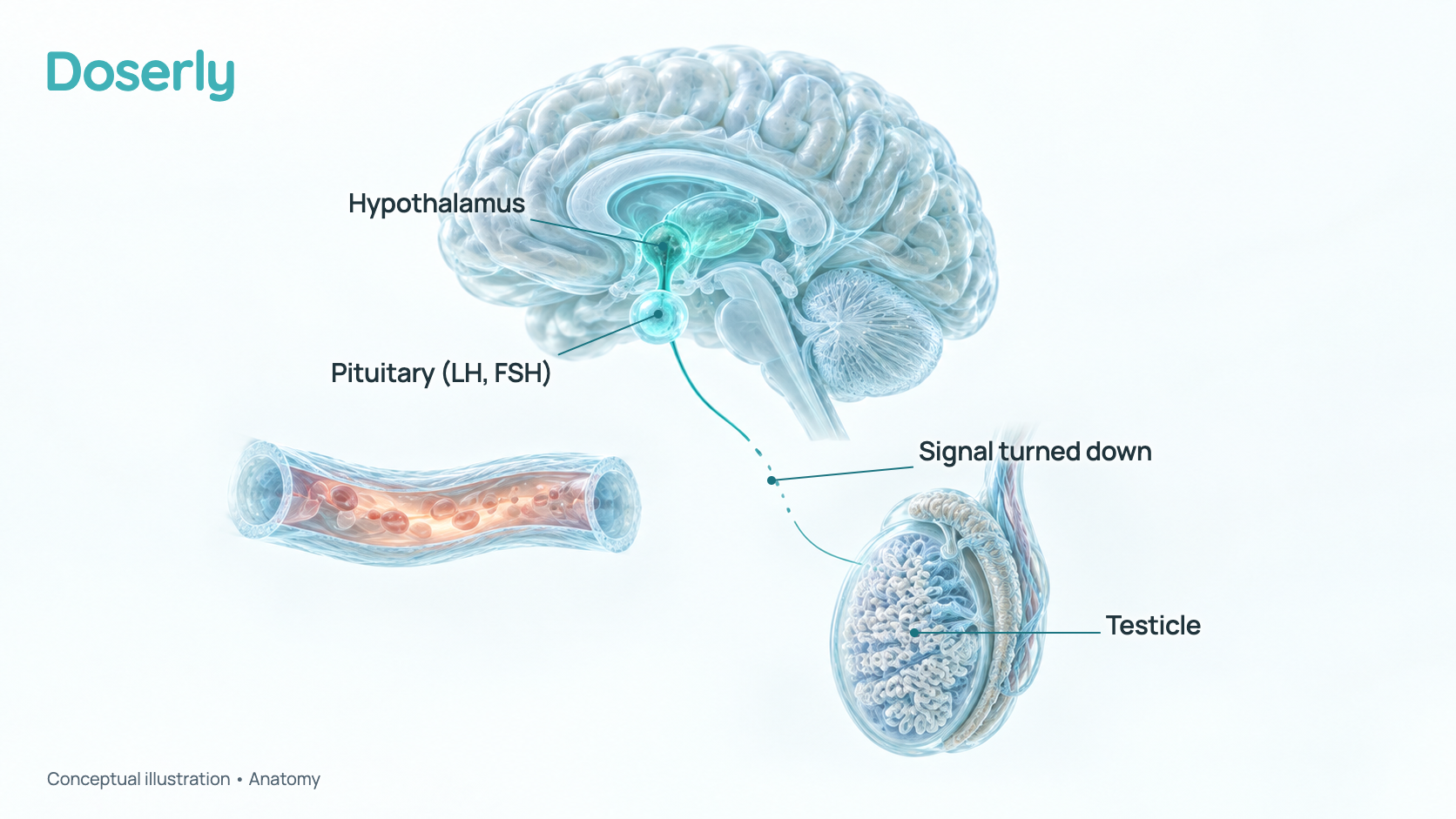
Here is why. The testicles do two jobs: they make testosterone and they make sperm. Both depend on two hormones from the pituitary gland at the base of the brain. LH (luteinizing hormone) tells the testicles' Leydig cells to make testosterone, and FSH (follicle-stimulating hormone) supports the Sertoli cells that nurse developing sperm. Sperm production needs both FSH and a very high testosterone level inside the testicle, about 80 to 100 times the level in the blood. [17], [11]
When testosterone comes from an injection, gel or capsule, the brain senses plenty of it and turns LH and FSH down. The testosterone in your blood can look perfect while the testosterone inside the testicle falls sharply: by 94% within 3 weeks in healthy men given weekly injections. That is why a normal testosterone result says nothing about sperm. [11], [1]
The newer US labels, such as those for Xyosted and AndroGel 1.62%, say: "Reduced fertility is observed in some men taking testosterone replacement therapy. The impact on fertility may be irreversible." The UK label for Testogel describes the suppression as reversible. Most men do recover; the US wording reflects the minority who do not fully recover. [1], [18], [19]
TRT and fertility: the key numbers
This table shows what each major clinical guideline says about testosterone for men who want children, how quickly each expects sperm to return, and which alternatives it names. Checked September 2026.
| Guideline (version, year) | Testosterone when you want children | Recovery after stopping | Alternatives named |
|---|---|---|---|
| AUA, American Urological Association, testosterone deficiency (2018, validity reconfirmed 2024) | Not for men currently trying to conceive (Strong); discuss the effect on sperm with men who want children later | From contraception studies: two-thirds regain sperm within 6 months; 10% not until the second year | Aromatase inhibitors, hCG, SERMs or a combination (Conditional); only hCG is FDA approved in men |
| AUA/ASRM, US male infertility guideline (2020, amended 2024) | Not for men interested in current or future fertility (Clinical Principle); allows it after counselling for children in the more distant future | Most men recover, over months or rarely years; some never fully recover | Aromatase inhibitors, hCG, SERMs or a combination for infertile men with low testosterone (Conditional) |
| Endocrine Society (2018) | Not for men planning fertility in the near term; for men with low LH and FSH, not if children are wanted in the next 6–12 months | No number given | Gonadotropins in secondary hypogonadism; sperm banking if plans are uncertain; clomiphene unproven |
| EAU, European Association of Urology (2026) | Do not use in men wishing to be fathers (Strong) | For men stopping anabolic steroids: sperm usually improves 6–12 months after stopping | Gonadotropins for secondary hypogonadism (Strong); SERMs and aromatase inhibitors off-label, poor evidence |
| BSSM, British Society for Sexual Medicine (2023) | An active desire for children is a main reason not to use it | May take 12 months; infertility after 6–12 months of treatment is reversible in 60–70% of men within 12 months | hCG, off-label SERMs and aromatase inhibitors in secondary deficiency |
| CUA, Canadian Urological Association (2021) | Men who want to keep fertility should avoid testosterone on its own (strong) | No number given | hCG, SERMs (clomiphene, tamoxifen) and aromatase inhibitors off-label; nasal testosterone may suppress less |
| ICSM, International Consultation on Sexual Medicine (2024) | Do not use in men seeking to father children (Strong) | No number given | hCG with a lowered testosterone dose, as off-label practice with little evidence |
| EAA, European Academy of Andrology (2020) | Against testosterone when fertility is desired | No number given | Gonadotropins when fertility is desired in secondary hypogonadism |
| VA, US Department of Veterans Affairs (January 2026) | A desire for future fertility is a reason not to start | Not stated | hCG (specialist only); clomiphene case by case; aromatase inhibitors not generally recommended |
| Society for Endocrinology, UK (2022) | Unsuitable during conception; contraception should still be discussed | For anabolic steroid users, up to 3 years for full recovery | Gonadotropins for men with low LH and FSH |
| ESA, Endocrine Society of Australia (2016) | Desired fertility is a precaution | Not stated | Not detailed |
[6], [7], [2], [8], [20], [21], [22], [23], [24], [25], [17], [26]
Every major guideline says not to use testosterone while trying to conceive. They differ in two places: whether men who want children later may start TRT after counselling (the US infertility guideline allows it; the EAU and EAA say no when fatherhood is wanted), and how fast sperm returns (the AUA says two-thirds within 6 months; the BSSM says 60–70% within 12 months). [7], [8], [24], [6], [21]
Why do guidelines disagree about men who want children later?
Because no study has followed men who start TRT young and try for children years later. The US infertility guideline treats it as an informed choice after counselling; the European guidelines put the risk of slow or incomplete recovery first; the Endocrine Society says not "in the near term", with sperm banking if plans are uncertain. On adding hCG to TRT they also split: the AUA testosterone guideline says doctors may offer it, and the later US infertility guideline says the evidence is too limited (see hCG). [7], [8], [2], [6]
What do semen analysis numbers mean?
A semen analysis is the test that shows sperm production. The World Health Organization (WHO) publishes reference values from men whose partners became pregnant within a year. A result below these limits is not a diagnosis of infertility on its own, and many men below them still father children. [27], [7]
| Measure | Lower reference limit (WHO, 2021) | Median in the same men |
|---|---|---|
| Semen volume | 1.4 mL | 3.0 mL |
| Sperm concentration | 16 million per mL | 66 million per mL |
| Total sperm number | 39 million per sample | 210 million |
| Total motility (sperm moving) | 42% | 64% |
| Progressive motility (moving forward) | 30% | 55% |
| Normal shapes | 4% | 14% |
The total motile count, the number of moving sperm in the whole sample, decides the fertility treatment options: insemination (IUI) usually needs at least 5–10 million, because about half the sperm are lost in preparation, while IVF with ICSI needs only a few. [7]
How to get a fair result. The Endocrine Society advises at least two analyses several weeks apart, each after at least 48 hours without ejaculation (WHO uses 2–7 days). [2], [27]
Units. Sperm counts appear as million per mL (concentration) or million per sample (total). Testosterone appears in ng/dL or nmol/L; the testosterone unit converter switches between them.
Where these numbers come from
Each guideline row comes from that body's current document: the AUA testosterone deficiency guideline (2018, validity reconfirmed 2024), the AUA/ASRM male infertility guideline (2020, amended 2024), the Endocrine Society guideline (2018), the EAU guidelines on sexual and reproductive health (2026 edition, hypogonadism and male infertility chapters), the BSSM guidelines (2023), the CUA guideline (2021), the ICSM 2024 recommendations (published 2025), the EAA guideline (2020), the VA clinical recommendations (January 2026), the Society for Endocrinology guideline (2022) and the Endocrine Society of Australia position statement (2016). England's NICE has no dedicated hypogonadism guideline. [6], [7], [2], [8], [20], [21], [22], [23], [24], [25], [17], [26], [28]
The semen table uses the fifth centiles and medians in Table 8.3 of the WHO laboratory manual, sixth edition (2021). [27]
Statement 42 of the US infertility guideline is a Clinical Principle, not a Strong Recommendation; the Strong (Grade A) statement is the AUA testosterone guideline's, for men currently trying to conceive. Not used: a claim that 10–20% of men never recover after TRT (no study reports such a rate), a claim that every man under 35 should bank sperm before TRT (no guideline says so), and a 74-day figure for sperm production (the measured figure is about 64 days).
How does testosterone switch off sperm production?
Through the hormone chain from brain to testicles, called the HPG axis (hypothalamus, pituitary, gonads). The brain's hypothalamus sends pulses of GnRH, the pituitary answers with LH and FSH, and the testicles answer with testosterone and sperm. Testosterone then feeds back to the brain to slow the chain down. This is established human physiology, and the US labels describe exactly this feedback. [1], [17]
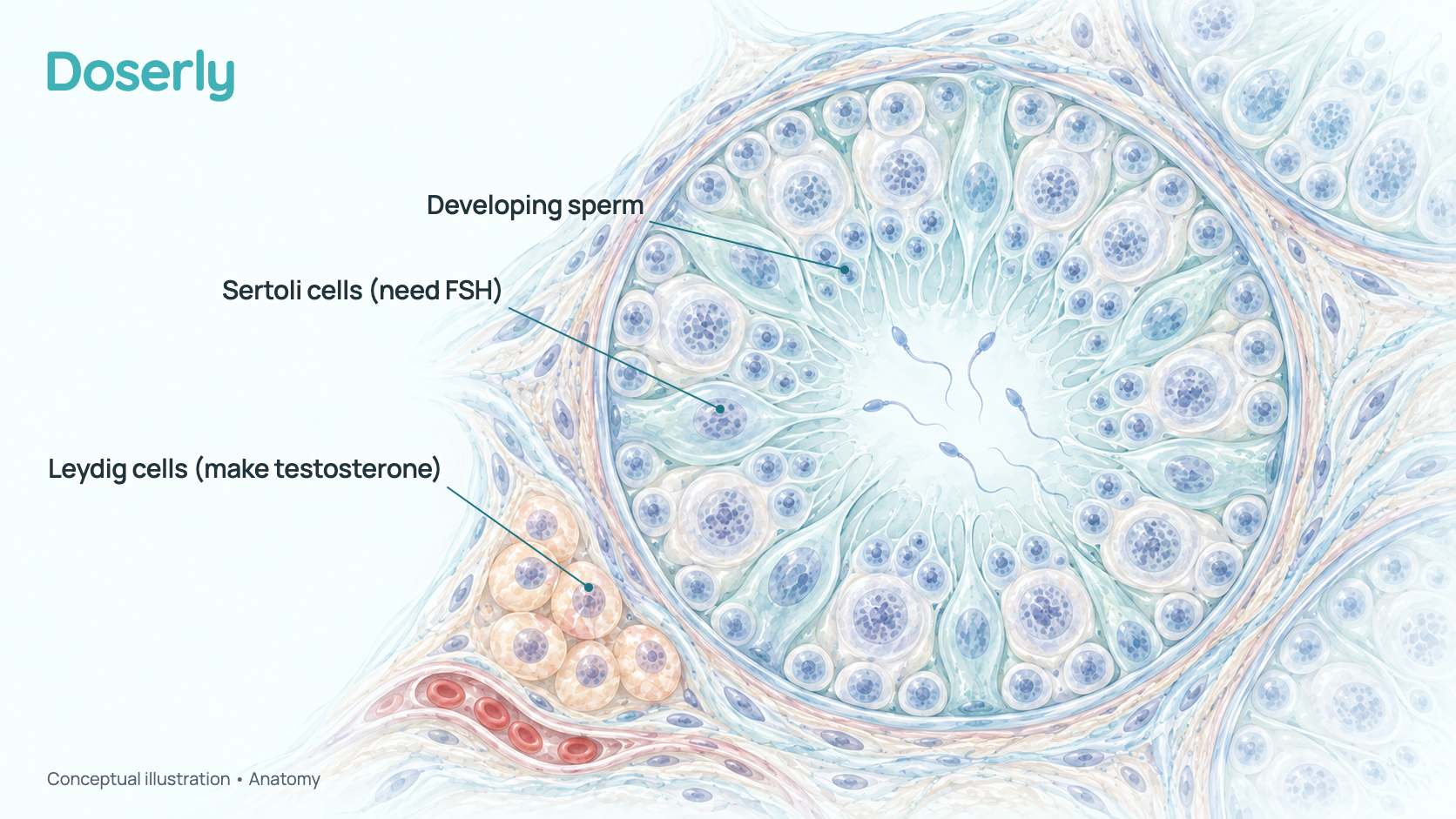
- LH falls first, then testosterone inside the testicle. In a 3-week trial of healthy men given testosterone enanthate 200 mg a week, testosterone inside the testicle fell by 94%, while blood testosterone rose. [11]
- FSH falls too. Without FSH and the high local testosterone, the Sertoli cells cannot support sperm development. The US labels put it this way: at large doses, spermatogenesis may be suppressed through feedback on FSH. [1], [17]
- Sperm take about 64 days to make (spermatogenesis). Studies that labelled new sperm cells found they reached the semen after about 64 days on average (range 42–76 days). That is why a semen analysis shows the effect of any change about 2–3 months later, both when sperm counts fall and when they recover. [29], [30]
- The testicles shrink. In healthy men given enanthate 200 mg weekly for 4 months, testicle volume fell by about 19%; it returned to normal after stopping. No study has measured this in men on usual TRT doses. [31]
Why does the cause of low testosterone matter?
Because it decides what can restore sperm later. In secondary hypogonadism, the brain and pituitary send too little LH and FSH, but the testicles themselves can work, so hormone treatment that replaces the missing signals can start sperm production. In primary hypogonadism, the testicles themselves are the problem, and the Endocrine Society says gonadotropin treatment does not restore fertility; options then include donor sperm, adoption, or IVF using sperm found in the semen or extracted from the testicle. [2], [20] The primary vs secondary hypogonadism guide explains how the two are told apart.
What does the research show?
Testosterone suppresses sperm reliably and, in most men, reversibly. The clearest numbers come from male contraception trials in healthy volunteers, which used research doses. Studies of men on prescribed TRT are smaller, but they point the same way, with slower recovery after long use. [3], [9], [5]
How fast and how completely does testosterone suppress sperm?
Within about 2–3 months in most men. These trials tested testosterone as a male contraceptive in healthy, fertile volunteers, at doses above usual TRT:
| Study | Who and what | Result | What it cannot show |
|---|---|---|---|
| WHO 1990 (contraception study, no comparison group) | 271 healthy men, testosterone enanthate 200 mg weekly | 157 men reached zero sperm, taking 120 days on average; the estimated share by 6 months was 65% | Men on usual TRT doses [4] |
| WHO 1995 (pooled analysis) | 670 healthy men in 10 countries, the same regimen | Below 3 million per mL within 6 months in 95.6% of non-Asian and 98.4% of Asian men; no sperm in 66.7% and 89.2% | Men with low testosterone [3] |
| Ly 2005 (model of WHO data) | Nearly 14,000 semen samples | About 10 weeks on average to fall below 3 million per mL, and 13 weeks to fall below 1 million | Individual timing [32] |
| Gu 2009 (contraception trial) | 1,045 healthy Chinese men, undecanoate injections 500 mg monthly | 4.8% never fell to 1 million per mL or below within 6 months | A marketed Western product [33] |
The research dose of 200 mg a week is higher than most TRT prescriptions, but men on prescribed testosterone can show similar results: at a Canadian infertility clinic, 88.4% of the men using testosterone had no sperm at all while on it, and 12% of them had been prescribed it to treat infertility. [5]
Does the form of testosterone matter?
It changes how strongly LH and FSH are switched off, but no form has been shown to be safe for fertility. A 2021 review of 8 studies (793 men) compared the fall in FSH and LH by form:
| Form | FSH fell by | LH fell by |
|---|---|---|
| Long-acting injections (only 16 men) | 86.3% | 71.8% |
| Daily gels or patches | 60.2% | 59.2% |
| Nasal testosterone (several doses a day) | 37.8% | 47.3% |
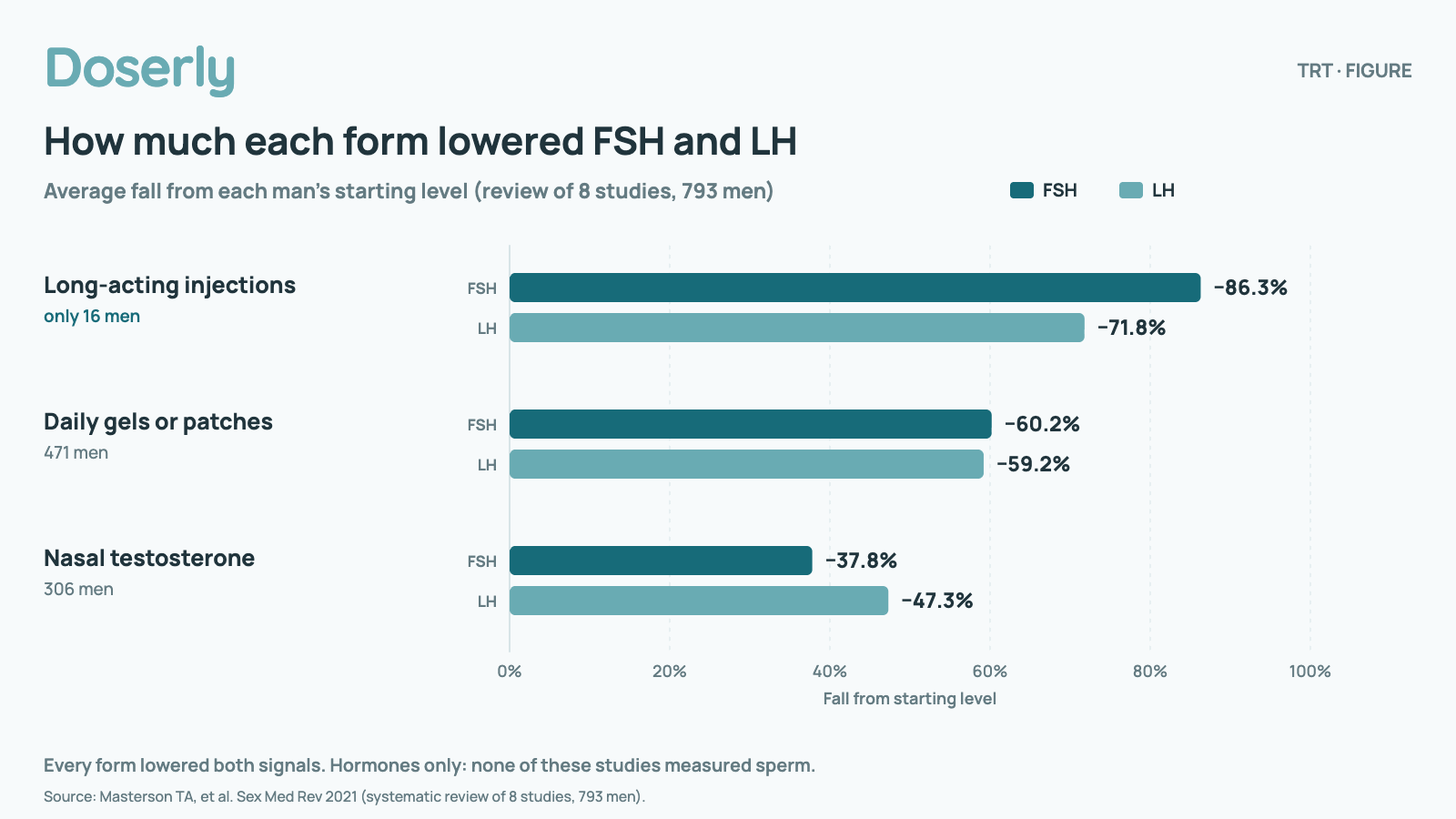
How much each form lowered FSH and LH
Average fall from each man's starting level (review of 8 studies, 793 men).
Bars run from 0% to 100% fall; the darker bar is FSH, the lighter bar is LH.
- Long-acting injections (only 16 men)
- FSH fell 86.3%; LH fell 71.8%
- Daily gels or patches (471 men)
- FSH fell 60.2%; LH fell 59.2%
- Nasal testosterone (306 men)
- FSH fell 37.8%; LH fell 47.3%
Every form lowered both signals. Hormones only: none of these studies measured sperm.
- Nasal testosterone. In a 6-month study of Natesto three times a day, the total motile count stayed above 5 million in 93.9% of men still in the study, but there was no comparison group, only 33 of the 60 men who enrolled were assessed at 6 months, and the registry results list one man whose sperm disappeared and three with severe drops, and a case report describes sperm falling on Natesto. A marker of testosterone inside the testicle fell by 33.3% on nasal testosterone and 65.3% on injections. The US infertility guideline says nasal testosterone should not be used routinely by men trying to conceive. [34], [35], [36], [37], [7]
- Oral testosterone undecanoate. On Jatenzo, LH and FSH fell by about 70%; on Tlando, only 41% of men kept LH and 40% kept FSH in the normal range. The Jatenzo and Tlando studies did not measure sperm, and we found no study of sperm on oral testosterone taken on its own. [38], [39] See oral testosterone.
- Gel. Long-term gel suppresses LH and FSH, and in two trials that compared it with enclomiphene, AndroGel 1.62% markedly reduced sperm production. [40], [41]
"Short-acting" means less suppression on average, not fertility-safe.
How long does sperm take to come back after stopping?
Most men recover within about a year, but it depends on how long and how much testosterone was used, and some take much longer.
| Study | Who | What happened after stopping |
|---|---|---|
| Liu 2006 (pooled contraception trials) | 1,549 healthy men | Back to 20 million per mL in 67% within 6 months, 90% within 12, 96% within 16 and 100% within 24 (median 3.4 months) [9] |
| WHO 1990 | 271 healthy men on weekly enanthate | Median 3.7 months to 20 million per mL and 6.7 months to their own starting count [4] |
| Samplaski 2014 (infertility clinic) | 59 men using testosterone | 65% of those without another cause regained sperm within 6 months [5] |
| Kolettis 2015 (two infertility clinics) | 39 men who stopped testosterone | Median concentration rose from 0 to 6.3 million per mL over a median 4.5 months; 8 (21%) still had no sperm at last follow-up [42] |
| Bang 2013 and Song 2019 (one Korean group) | 8 and 20 men after long-acting or enanthate injections | Normal counts a median 8.5 and 8 months after stopping [10], [43] |
| T4DM follow-up (controlled trial) | Men who stopped 2 years of undecanoate 1,000 mg injections | LH and FSH recovered slowly over 12 months, and full recovery may take longer [44] |
In the pooled contraception trials, older men and Asian men recovered faster, as did men with shorter treatment and shorter-acting preparations. On average, recovery levelled off at about 85% of the men's starting concentration. [9], [32]
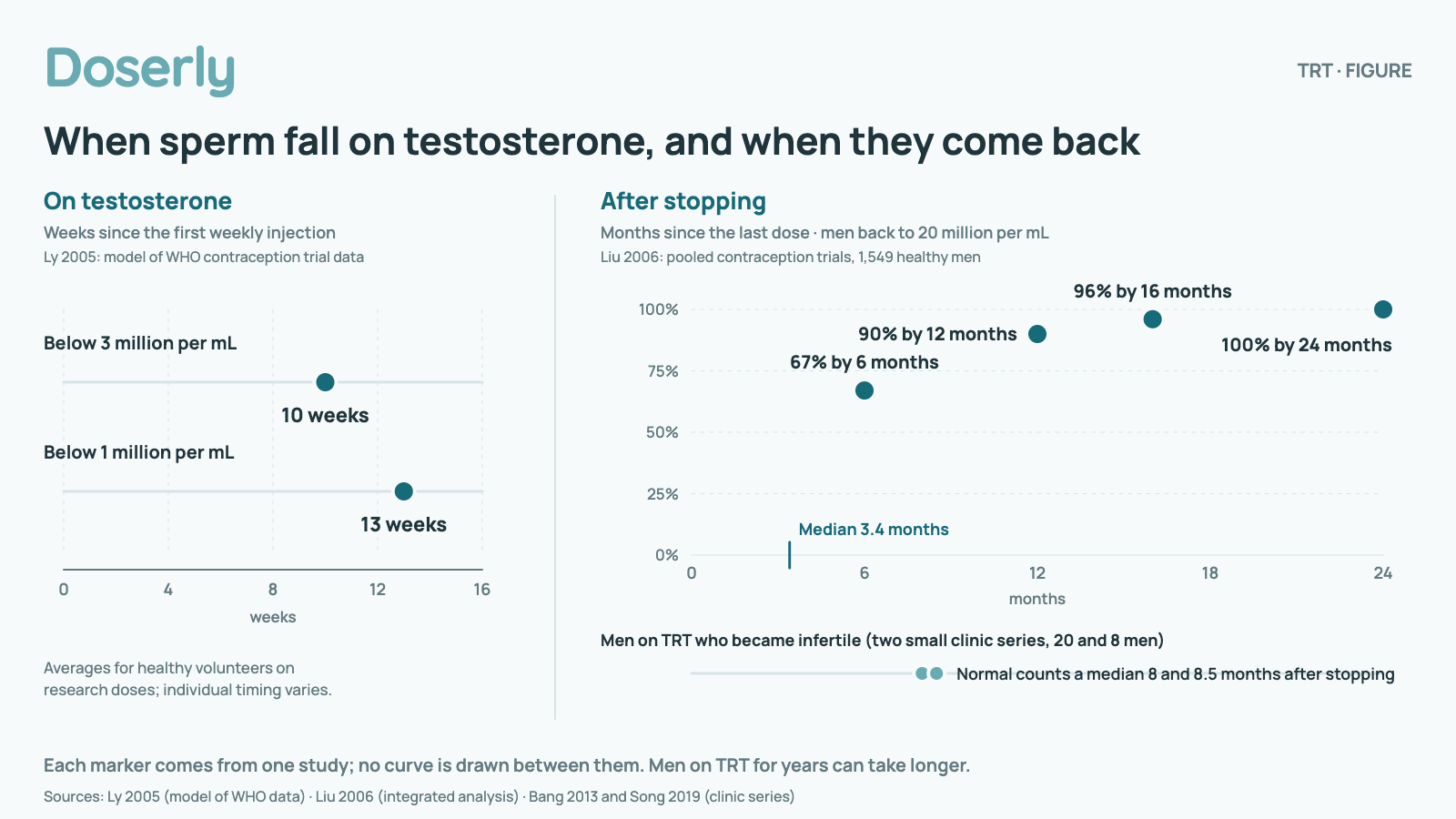
When sperm fall on testosterone, and when they come back
On testosterone
Weeks since the first weekly injection (Ly 2005, model of WHO contraception trial data).
- About 10 weeks
Sperm below 3 million per mL, on average.
- About 13 weeks
Below 1 million per mL, on average.
After stopping
Months since the last dose (Liu 2006, pooled contraception trials, 1,549 healthy men).
- 6 months
67% back to 20 million per mL.
- 12 months
90% back to 20 million per mL.
- 16 months
96% back to 20 million per mL.
- 24 months
100% back to 20 million per mL.
- Median 3.4 months
Half of the men in those trials had recovered by then.
- Median 8 and 8.5 months
Men on TRT who became infertile, in two small clinic series (20 and 8 men): normal counts after stopping.
Each point comes from one study; no curve is drawn between them. Men on TRT for years can take longer.
These are averages, mostly from volunteers who used testosterone for months. Men on TRT for years, or with fertility problems before starting, cannot assume the same timeline; the BSSM notes that about 7% of men may be infertile for other reasons. [21]
Do fertility medicines speed up recovery?
They are widely used, but no randomized trial has compared them with simply stopping and waiting. All the evidence comes from treatment series:
| Study | Who and what | Result | What it cannot show |
|---|---|---|---|
| Wenker 2015 | 49 men with no or almost no sperm after testosterone, given hCG 3,000 IU every other day plus clomiphene, tamoxifen, anastrozole or FSH | 47 (95.9%) regained or improved sperm production, after 4.6 months on average | Whether stopping alone would have done the same [45] |
| Kohn 2017 | 66 men, a median 2 years on testosterone, given hCG 3,000 IU three times a week plus clomiphene or tamoxifen | 70% reached a total motile count above 5 million within 12 months: 64.8% of men with no sperm and 91.7% of those with a few | No untreated group [46] |
| Stocks 2025 | 77 men with previous testosterone use, given hCG 3,000 IU plus FSH 75 IU three times a week | 74% improved, whether or not they stayed on testosterone | No untreated group [47] |
| Kolettis 2015 | 39 men who stopped testosterone | Sperm returned in 16 of 17 untreated men and 15 of 22 treated men; the difference was not significant | Treatment was not randomized [42] |
In the Kohn series, each extra year of age lowered the 12-month chance of recovery by about 1.7 percentage points, and each extra year of testosterone use by about 3.1 points. It was a model built from 66 men, so it describes a trend, not an individual's odds. [46]
Is TRT's effect on fertility permanent?
Usually not, but for some men it may be. Most men regain sperm after stopping, yet the US infertility guideline says some never fully recover and remain infertile or subfertile, and newer US labels say the effect "may be irreversible". No study gives a reliable rate of permanent loss after prescribed TRT. [7], [1], [9]
Is TRT safe if you want children?
Not while you are trying to conceive: every guideline advises against it. For men who want children later, it is a trade-off to plan with a clinician: bank sperm first, choose an alternative that keeps LH and FSH working, or stop in good time. [6], [2], [7]
Can you get someone pregnant while on TRT? Is TRT birth control?
Yes, you can, and no, it is not reliable birth control. Even in the WHO contraception trials, where healthy men were monitored closely, pregnancies happened:
- When men had no sperm at all, there was 1 pregnancy in 1,486 months of use. [4]
- When counts were low but not zero (0.1–3 million per mL), there were 4 pregnancies in 49.5 person-years, a rate of 8.1 per 100 person-years, against none in 230.4 person-years of azoospermia. [48]
- In a trial of monthly undecanoate injections in 1,045 men, 4.8% never suppressed enough and 9 pregnancies occurred. [33]
Men on TRT are not monitored with regular semen tests, so nobody knows whether they are in the "zero" or the "low" group. The Society for Endocrinology says it cannot be assumed that testosterone will cause infertility, and contraception should always be discussed. [17]
Can TRT cause birth defects or miscarriage?
We found no study of babies conceived while the father was on prescribed testosterone, so whether it changes the risk of birth defects or miscarriage is unknown. The known pregnancy risk is different: testosterone gels and solutions carry a US boxed warning because skin contact can pass testosterone to children, and UK labels say pregnant women must avoid contact with the application site. See testosterone gel. [18], [19]
Who should be especially cautious?
- Men trying to conceive now or within about a year. Every guideline advises against starting testosterone. [2], [7]
- Young men and men who may want children later. Fertility plans should be discussed before TRT starts, with a semen analysis first when subfertility is suspected. [6], [17]
- Men with primary hypogonadism. Hormone treatment usually cannot restart sperm production when the testicles themselves are badly damaged. [2], [20]
- Men who have used anabolic steroids. Recovery is slower and less certain: in one study of amateur athletes, 34% still had a low sperm count a year after a cycle began. See TRT vs steroids. [49]
- Men with a pregnant partner or young children at home using a gel, because of skin transfer. [18]
- Drug-tested athletes. Testosterone, hCG and the fertility tablets are all prohibited in sport. [15]
- Under-18s. Testosterone for teenagers, for example for delayed puberty, belongs only in specialist care.
- Women. This guide is written for men. Testosterone for women uses different doses and products; see testosterone therapy for women.
Which medicines and supplements affect sperm?
- Anabolic steroids switch off sperm production the same way, often more strongly. [49]
- Finasteride and dutasteride (for hair loss or an enlarged prostate). In a 1-year trial in 99 healthy men, total sperm count fell by 34.3% on finasteride 5 mg and 28.6% on dutasteride at 26 weeks; the fall was no longer significant at 52 weeks and reversed after stopping. That study used the 5 mg prostate dose of finasteride. [50]
- Opioid painkillers taken long term lower testosterone themselves: total testosterone was below normal in 74% of 54 men on long-acting opioids. [51]
- Supplements have not been shown to protect sperm on TRT (see supplements).
Bring a full list of everything you take, including supplements, to a pharmacist or prescriber. Checked September 2026.
Is testosterone legal, and are fertility medicines allowed in sport?
Checked September 2026. Rules differ by country and change often.
- United States. Testosterone is a Schedule III controlled substance. hCG is an approved prescription medicine (Pregnyl, Novarel, a generic and Ovidrel); since March 23, 2020 it has been regulated as a biologic, so pharmacies cannot compound it. Enclomiphene is not FDA approved (FDA lists it as under evaluation for compounding), and kisspeptin-10 is listed among compounding substances with significant safety risks. [14], [52], [53], [54]
- Canada. Testosterone is a Schedule IV controlled substance. Two hCG products (Pregnyl and a generic) are marketed. [55], [56]
- United Kingdom. Testosterone and hCG are Class C controlled drugs. The two long-standing hCG brands, Pregnyl and Choragon, are discontinued, and hospitals now use an unlicensed imported product. [57], [58]
- Australia. Testosterone is a Schedule 4 prescription-only medicine. Recombinant hCG (Ovidrel) has been subsidised on the PBS for some uses in men since July 1, 2023, prescribed by specialists. [59], [60], [61]
- European Union. The European Medicines Agency refused a marketing authorisation for enclomiphene in 2018. [62]
- Sport. The World Anti-Doping Agency (WADA) prohibits testosterone at all times; hCG, LH, gonadorelin and kisspeptin in men; and aromatase inhibitors and SERMs such as clomiphene and tamoxifen. Its 2027 list, published in September 2026, keeps these bans. [15], [63]
What do guidelines say to do?
Plan before starting, do not start while trying to conceive, and, for men already on TRT who want children, stop with a plan or see a fertility specialist. This section describes the choices clinicians weigh; it is not a personal plan. [6], [7], [2]
| Situation | What guidelines advise | Evidence behind it |
|---|---|---|
| Before starting TRT | Discuss fertility plans; semen analysis when subfertility is suspected; consider sperm banking if plans are uncertain | Guideline consensus [17], [2] |
| Trying to conceive now | Do not use testosterone; for secondary hypogonadism, hCG or other gonadotropins, or off-label SERMs or aromatase inhibitors | Strong across guidelines [6], [8] |
| On TRT and want children later | Stop testosterone ahead of any attempt to conceive; recovery time varies widely | Contraception and clinic studies [6], [9] |
| On TRT and want children soon, or recovery is slow | Specialist treatment with gonadotropins or SERMs | Uncontrolled series [45], [46] |
| No sperm despite treatment | Sperm retrieval from the testicle (micro-TESE) for IVF with ICSI | US infertility guideline (Moderate) [7] |
The AUA testosterone guideline says: "For men already on exogenous testosterone who are planning future reproduction, testosterone cessation should occur in advance of initiation of any effort to conceive." [6]
How do specialists restart sperm production?
For men whose low LH and FSH are the underlying problem, the approved medicines are hCG (acting like LH) and FSH, often in that order. The labels describe schedules for men with pituitary-related hypogonadism, not specifically for recovery after TRT:
| Label (country, revision) | What it describes for men with low LH and FSH | Duration and result in the label |
|---|---|---|
| hCG (Novarel, Pregnyl; US) | 500–1,000 USP units 3 times a week for 3 weeks, then twice a week for 3 weeks; or 4,000 units 3 times a week for 6–9 months, then 2,000 units 3 times a week for 3 months | As listed [64] |
| Gonal-f (FSH; US, 2025) | hCG 1,000–2,250 USP units 2–3 times a week first (may take 3–6 months), then FSH 150 IU 3 times a week with hCG, up to 300 IU | Up to 18 months; sperm of at least 1.5 million per mL in 12 of 26, 5 of 8 and 20 of 25 men with results across its three trials [65] |
| Follistim AQ (FSH; US, 2026) | hCG 1,500 IU twice a week first (up to 3,000 IU), then FSH 450 IU a week with hCG | At least 3–4 months before improvement; responses up to 12 months [66] |
| Menopur (hMG; UK, 2026) | hCG 1,000–2,000 IU 2–3 times a week, then 75–150 IU FSH (with LH activity) 2–3 times a week | At least 3–4 months; in the US, Menopur is labelled only for women [67], [68] |
These are label regimens for a medical condition, not TRT-recovery protocols, and specialists adjust them to each man. Results are encouraging but slow: in a 2026 series of 35 men with pituitary-related azoospermia, sperm appeared in 27 (77%) after a mean of 12 months, and 18 became fathers. The Society for Endocrinology notes that earlier testosterone does not reduce the later response to gonadotropins. [69], [17]
What happens when you stop TRT to try for a baby?
Your own testosterone does not restart straight away. LH and FSH take weeks to months to recover, and after 2 years of long-acting injections in T4DM they were still recovering 12 months later. In between, many men have low testosterone and its symptoms: low energy, low sex drive and low mood. For men stopping anabolic steroids, the Society for Endocrinology notes that no randomized study shows whether hCG or SERMs ease those symptoms. [44], [17]
This is the trade-off many men face: stop and feel worse for a while, or stay on testosterone with a specialist fertility plan. Guidelines give no set waiting time for prescribed TRT. For anabolic steroid users, the EAU suggests waiting 6–12 months after stopping before starting SERMs or gonadotropins, and notes that sperm usually improves within 6–12 months of stopping. [20] The stopping TRT guide covers what happens to symptoms, hormones and blood counts after stopping.
Can you stay on TRT and keep your fertility?
Sometimes, but nothing has been proven to protect it. The most studied approach is adding hCG to testosterone, and the direct evidence is one 3-week hormone study and one small series without a comparison group; larger studies measured hormones only or treated men who had already lost sperm. The US infertility guideline says the evidence is too limited to recommend it. [11], [70], [7]
Does hCG keep you fertile on TRT?
It protects a hormone signal inside the testicle; whether it protects fertility is not proven.
| Study | Who and what | What it found | What it cannot show |
|---|---|---|---|
| Coviello 2005 (controlled trial) | 29 healthy men on testosterone enanthate 200 mg a week, randomized to placebo or hCG 125, 250 or 500 IU every other day for 3 weeks | Testosterone inside the testicle changed by −94% (placebo), −25%, −7% and +26% | Sperm or pregnancies [11] |
| Hsieh 2013 | 26 men on TRT plus hCG 500 IU every other day, about 6 months | No man lost all sperm; partners of 9 men became pregnant | No comparison group [70] |
| Case report 2018 | 1 man on testosterone plus hCG 500 IU twice a week | Almost no sperm despite hCG | How often this happens [71] |
| Clift 2026 | 6,999 UK men, most on TRT plus hCG, usually 500 IU a week | Testosterone rose into range; LH and FSH stayed switched off | Sperm and pregnancy were not measured [72] |
The 2025 international consensus (ICSM) describes hCG with a lowered testosterone dose as an established off-label practice, but notes that no trials have proven it safe or effective. The schedules used, and how IU convert to syringe units, are in the hCG guide. [23]
Do gonadorelin or enclomiphene work alongside TRT?
No study has tested gonadorelin, enclomiphene or kisspeptin for fertility in men who stay on testosterone. Gonadorelin copies GnRH, and enclomiphene also works through the pituitary, which testosterone is already switching off. Kisspeptin acts higher up the chain. None is an approved medicine for this use in the US. The hCG, gonadorelin and enclomiphene comparison sets them side by side. [54]
Is there a form of testosterone that doesn't affect fertility?
No. Nasal testosterone switched off FSH and LH least on average and kept sperm counts in most men in one uncontrolled study, but some men still lost sperm, and the US infertility guideline advises against routine use by men trying to conceive. In a series of 27 men who switched from long-acting TRT to Natesto, all had sperm return, but there was no comparison with simply stopping, and the author disclosed speaker fees from the maker. See how the forms compare. [34], [35], [73], [7]
If a specialist does combine testosterone with hCG or a tablet, each medicine runs on its own days and amounts, and changes to one are easy to lose track of over months of semen tests.
What are the alternatives to TRT for men who want children?
Treatments that raise your own testosterone by stimulating the testicles or the pituitary, instead of replacing it: SERM tablets, hCG on its own, sometimes aromatase inhibitors, and weight loss where weight is the cause. They only work when the testicles can respond, so they usually help little in primary hypogonadism, especially when the testicles are badly damaged. None of the tablets is approved for low testosterone in men. [7], [8], [20]
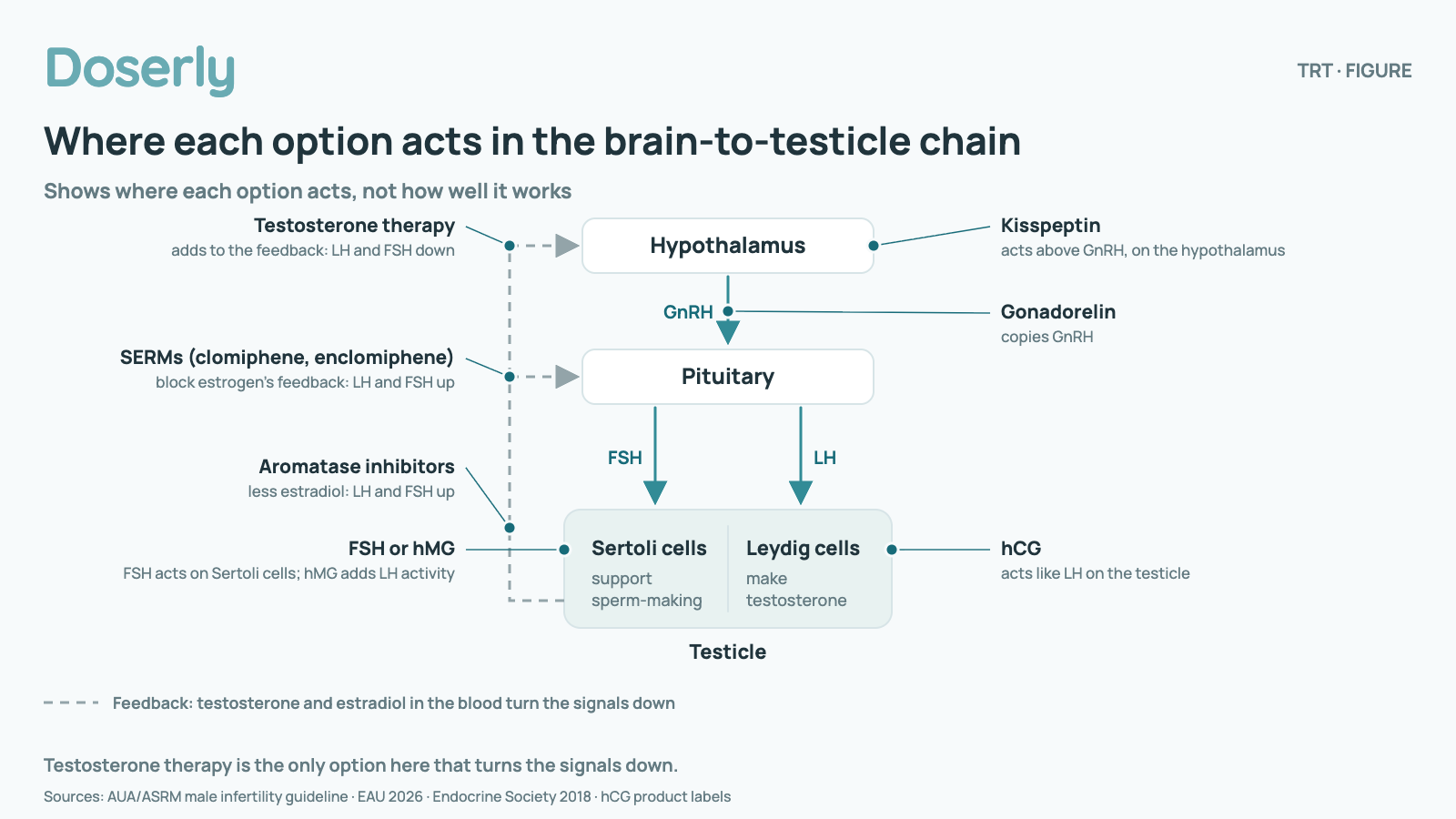
Where each option acts in the brain-to-testicle chain
The chain: hypothalamus → GnRH → pituitary → LH and FSH → testicle (Leydig cells make testosterone; Sertoli cells support sperm-making). Testosterone and estradiol in the blood feed back and turn the signals down.
- Kisspeptin
- Hypothalamus: acts above GnRH
- Gonadorelin
- GnRH signal: copies GnRH
- Testosterone therapy
- Feedback loop: adds to it, so LH and FSH go down
- SERMs (clomiphene, enclomiphene)
- Feedback loop: blocks estrogen's feedback, so LH and FSH go up
- Aromatase inhibitors
- Feedback loop: less estradiol, so LH and FSH go up
- hCG
- Testicle, Leydig cells: acts like LH
- FSH or hMG
- Testicle, Sertoli cells: FSH acts on the Sertoli cells; hMG also has LH activity, so it acts on the Leydig cells too
Shows where each option acts, not how well it works. Testosterone therapy is the only one that turns the signals down.
| Option | How it works | Effect on sperm | Approval for men | Guide |
|---|---|---|---|---|
| Clomiphene | SERM tablet that blocks estrogen's feedback, so the pituitary releases more LH and FSH | Raises LH and FSH; small trials in unexplained low counts | Approved only for ovulation problems in women | Clomiphene [74], [75] |
| Enclomiphene | One of clomiphene's two parts, as a separate tablet | Kept sperm counts normal in trials where gel reduced them | Not approved in the US; refused in the EU in 2018 | Enclomiphene [41] |
| hCG alone | Acts like LH directly on the testicle | Raises testosterone in the testicle; FSH often needed for full sperm production | Approved for men with low LH and FSH | hCG [64] |
| Aromatase inhibitors (anastrozole, letrozole) | Block the conversion of testosterone to estradiol, which also raises LH and FSH | Small, mixed studies | Off-label in men | Anastrozole [76], [77] |
| Weight loss | Removes a common cause of low LH and FSH | Obesity is linked with lower sperm counts | Not applicable | Obesity-related hypogonadism [78] |
Clomiphene or enclomiphene instead of TRT?
Clomiphene raises testosterone about as much as testosterone gel, though in a few small studies sex drive improved less than on TRT. A 2025 meta-analysis of randomized trials found clomiphene or enclomiphene raised total testosterone by about 274 ng/dL (about 9.5 nmol/L) more than placebo, while also raising LH and FSH. A 2026 meta-analysis (11 studies, 1,512 men) found clomiphene raised testosterone about as much as gel; in the 3 studies (199 men) that measured libido, scores were lower on clomiphene than on TRT. [12], [79]
- Clomiphene is approved only for ovulation problems in women; its label says no adequate studies show it works for male infertility and notes reports of testicular tumors and breast growth in men. In 400 men treated long term, 88% of those on it for more than 3 years had normal testosterone and 8% reported side effects such as mood change or blurred vision. The Endocrine Society says its efficacy and safety are not proven in randomized trials. [74], [80], [2]
- Enclomiphene kept sperm concentration normal over 16 weeks in two phase 3 trials, while AndroGel 1.62% markedly reduced it. It is not risk-free for sperm: in two 12-week registry trials, sperm concentration fell by half or more in 14.2% of men on enclomiphene, against 2.6% and 4.3% on placebo. It is not approved in the US or EU, and a 2026 UK position statement does not recommend routine use outside specialist settings. [41], [81], [62], [82]
The EAU notes that SERMs may raise the risk of blood clots and that long-term use of SERMs or aromatase inhibitors can lower bone density. [8]
What about hCG on its own?
It raises testosterone when the testicles can respond: in a randomized trial of 282 men who wanted to preserve fertility, hCG, clomiphene and the combination raised testosterone similarly, and 28 men who switched from TRT to hCG alone kept similar testosterone on average. Full sperm production may also need FSH. [83], [84], [85]
Are aromatase inhibitors used for fertility?
Sometimes, off-label, with limited evidence. Anastrozole raised average sperm concentration from 5.5 to 15.6 million per mL in 25 men with low counts, without a comparison group. In a 2026 randomized trial of 296 men with severe sperm-production failure, letrozole added to vitamins C and E moved more men up a WHO sperm-count category than the vitamins alone (21 of 147, 14.3%, vs 8 of 149, 5.4%), but the other semen measures did not differ between the groups, and lower sex drive was more common (18 vs 8 men). The EAU advises against routine use for unexplained infertility, and a year of anastrozole lowered spine bone density in older men. [76], [77], [20], [86]
Can losing weight restore testosterone?
Often partly, when excess weight is the cause. In a meta-analysis, testosterone rose by about 2.9 nmol/L (84 ng/dL) after a low-calorie diet and 8.7 nmol/L (251 ng/dL) after weight-loss surgery, with bigger losses giving bigger rises. A 2026 review found GLP-1 weight-loss medicines raised testosterone in men with obesity or diabetes while keeping LH and FSH working, unlike TRT. See TRT and GLP-1 medicines. [78], [87]
Should you bank sperm before TRT?
If children might matter to you, it is the most dependable back-up, though frozen sperm cannot guarantee a pregnancy. The Endocrine Society suggests considering sperm banking when fertility plans are uncertain, and the American Society for Reproductive Medicine (ASRM) calls freezing sperm from the semen an established method. No guideline says every man starting TRT must bank sperm. [2], [13]
- How many samples. ASRM and the US infertility guideline advise banking several samples where possible, because each frozen sample is limited and IUI needs more moving sperm than IVF. [13], [7]
- What freezing does. Freezing and thawing loses some moving sperm: in one study, 58% of the moving sperm in samples from men with poorer fertility kept moving after thawing, against 68% in donor samples. [88]
- How long it keeps. Frozen sperm has produced births after about 40 years of storage. In the UK, the law allows storage for up to 55 years if consent is renewed every 10 years, since July 1, 2022. [89], [90]
- How often it is used. Most men never need their banked sperm: in studies of men who banked before cancer treatment, fewer than 10% later used it. [7]
- Cost and funding. There is no official price; clinics set their own fees for freezing and yearly storage, so ask for both in writing. One NHS trust says its funded banking is only for cancer patients, so ask your local fertility service whether banking before TRT is funded. Checked September 2026. [91]
Does TRT shrink your testicles, and do they come back?
Usually yes to both. Testicle volume fell by about 19% in 4 months in healthy men given weekly injections, and returned to normal after stopping. hCG keeps the testicle's own testosterone production going, which is why many men use it for size, but size and semen volume do not show whether sperm are being made; only a semen analysis does. [31], [11]
Do supplements help sperm on TRT?
No supplement has been shown to protect sperm on TRT, and the best trials in men with fertility problems found none that improved live births. In a trial of 2,370 couples, folic acid and zinc did not improve semen quality or live births (404 of 1,185 couples, 34%, vs 416 of 1,185, 35%, on placebo). In a trial of 174 men, an antioxidant blend did not improve semen results, and live births were 15% vs 24% on placebo, a difference that could be chance. The US infertility guideline calls supplements of questionable value. See zinc and CoQ10. [92], [93], [7]
Where can you get hCG or FSH?
Only on prescription, and availability differs by country (checked September 2026). In the US, approved hCG products are available and no shortage is listed, but pharmacies cannot compound it. In the UK, the main brands are discontinued and supply relies on unlicensed imports. Canada has two marketed hCG products, and Australia subsidises recombinant hCG for some men through specialists. See legal status. [53], [94], [58], [56], [60]
What if you used anabolic steroids?
Recovery is usually slower. In the HAARLEM study of 100 amateur athletes, 34% of those assessed still had a total sperm count below 40 million a year after their cycle began, and in another study sperm output took about 14 months on average to recover after stopping. See TRT vs steroids. [49], [95]
What do people on TRT report about fertility?
Public forums are full of men facing the same decision: stay on TRT, stop and wait, or try hCG or tablets. The threads below are public Reddit discussions from 2025 and 2026, read with their replies; they show what people experience, not how often it happens.
What does a semen analysis on TRT usually show?
Often no sperm at all, sometimes quickly. One man whose motile count was 194 million before starting had none after 9 weeks on 150 mg a week, with hCG added only in the last 2 weeks; he had frozen sperm beforehand and decided to stop. [96] Another man had no sperm after about 15 months on 75 then 100 mg a week, with LH and FSH undetectable. [97] A man on TRT for 5 years without hCG found no sperm and asked whether he could rely on that as contraception; most replies warned that one zero result is not birth control. [98] Another man's partner became pregnant after he had been on 120 mg a week for 10 months without hCG, and a home test later showed sperm. [99]
How long did recovery take after stopping?
Anywhere from weeks to many months. One man stopped after about 8 years of non-prescribed testosterone at 500 mg a week, felt rough for 6 months, and had normal semen results around month 10; a pregnancy followed, while replies included men with zero sperm months after stopping. [100] Another, about 2 months off after 2.5 years, had 62 million per mL but low motility, having also lost 70 lb and changed an epilepsy medicine in the same period. [101]
Others were slower. After 6 years of TRT without hCG, one man still had no sperm after about 3 months of hCG with hMG added. [102] Another, after more than 4 years of testosterone and other steroids, saw home sperm tests rise from under 2 million to 6 million over 3 months on hCG, hMG and briefly clomiphene, and his partner's test was positive 102 days after his last injection. [103]
What about staying on TRT with hCG?
Some couples conceived and some men saw no change. One man with a near-absent count added hCG 250 IU twice a week to testosterone 120 mg a week, and a pregnancy followed about 4 months later, though hCG made him tired and irritable. [104] Another, on 180 mg a week with hCG 500 IU twice a week, reported a normal semen analysis after 3 months of hCG; he later described three very early pregnancy losses (chemical pregnancies) and a missed miscarriage whose cause had not been found. [105] A third saw no improvement in his count after 8 weeks of hCG 3,000 IU a week on testosterone 100 mg a week and was about to add FSH. [106]
What do men say about hCG's side effects, cost and supply?
Unwanted effects come up in most hCG threads: tiredness with worse libido and erections on 300 IU three times a week, and bloating, acne, mood swings and weaker erections after 1,000 IU a week was added without changing the testosterone dose. [107], [108] Costs vary: one pharmacy quoted $750 a month for hCG alone after a urologist suggested it, and another about $208 for three months that insurance would not cover. [109], [110] In the UK, one man went without hCG for several months because of a supply problem. [111]
Several threads show why size and volume mislead. After 6 weeks of hCG, one man's testicles grew from 6 to 8.5 mL on ultrasound, but he had no semen result yet, and replies pointed out that size does not show sperm. Another saw more semen volume on hCG, and replies urged a semen analysis. [112], [113]
What happened with tablets instead?
One man whose count fell on TRT was switched by his urologist to clomiphene 25 mg every other day; over 3 to 4 years his count recovered, but libido and erections stayed poor. [109] Another, after 3.5 years of TRT and more than 8 months of trying while tapering with hCG, reported positive home pregnancy tests 5 weeks after starting enclomiphene 25 mg a day; he had no semen analysis to show what changed. [114]
What do men wish they had done before starting?
Test and bank first. A man with a baseline analysis and six frozen vials before TRT planned repeat analyses once on hCG, with IUI and IVF as a back-up. [115] A man on TRT for 2 years had a fertility specialist's office ask him to stop before his first visit, and wished he had frozen sperm first. [116] Others planned a semen analysis and possible freezing before deciding. [117]
How can you judge a fertility story?
Ask: Was there a semen analysis before TRT? Was the result a lab analysis or a home test? What testosterone was used, how much and for how long, and were other steroids involved? Was hCG, FSH or a tablet used, and for how long before the result? Were there fertility problems in either partner, and was the pregnancy confirmed? And what did the next test show?
These selected discussions show what people experience and the questions research has not answered. They are not a survey of all men on TRT, a success rate or a substitute for the studies above.
What should you track?
A semen analysis is the only test that shows sperm production, though on its own it cannot say whether a couple will conceive; hormone tests show whether the signals are working. Use this summary to prepare questions for your clinician; it is not a personal testing plan. [2], [17]
| What | Why it matters | What guidelines and studies describe | Tracking category |
|---|---|---|---|
| Semen analysis | The only direct measure of sperm production | At least two, several weeks apart, after 48 hours or more of abstinence; before TRT if fertility may matter; about every 3 months during treatment to restart sperm | Other (semen result) |
| LH and FSH | Show whether the pituitary signal is switched off or recovering | Switched off on TRT; they rise as your own production restarts | Blood work |
| Testosterone | Shows the blood level, not sperm | Checked at the times your guideline or label specifies; on hCG or clomiphene, first check no sooner than 4 weeks | Blood work |
| Hematocrit | Testosterone and hCG raise red blood cells | See hematocrit on TRT | Blood work |
| How you feel | Symptoms often return while your own production restarts | Energy, sex drive and mood are the usual complaints | Energy, libido, mood |
Because new sperm take about 64 days to reach the semen, a change in treatment shows up on a semen analysis about 2–3 months later, so tests taken sooner can mislead in either direction. The TRT blood work guide covers when to draw each hormone test. [29], [30]
Common questions about TRT and fertility
Will TRT make me infertile?
It very likely lowers your sperm count while you take it, often to zero, but for most men the effect reverses after stopping: in contraception trials, 90% were back to 20 million per mL within 12 months. Some men recover slowly or incompletely, especially after years of use. [4], [9], [7] See the research.
How long after stopping TRT does sperm come back?
Usually 3 to 12 months, sometimes longer. The median was 3.4 months in pooled contraception trials and about 4.5 to 8.5 months in small clinic series of men who had used prescribed testosterone, and some still had no sperm after that. [9], [42], [10], [43] See recovery.
If I've been on TRT for 5 or more years, can I still recover fertility?
Many men do, but it tends to take longer. In the Kohn series of men treated with hCG and a SERM after a median 2 years of testosterone, each extra year of use lowered the chance of recovery within a year by about 3 percentage points. Specialist treatment and, if needed, sperm retrieval for IVF are options when sperm does not return. [46], [7] See what guidelines do.
Does hCG guarantee fertility on TRT?
No. hCG keeps testosterone production going inside the testicle, but no trial has tested whether it preserves sperm or pregnancy rates, a case report describes almost no sperm despite hCG, and the US infertility guideline says the evidence is too limited to recommend it. [11], [70], [71], [7] See staying on TRT.
Does normal testosterone mean normal fertility?
No. On TRT your blood testosterone can be normal or high while testosterone inside the testicle, and with it sperm production, is switched off. Only a semen analysis shows whether sperm are being made. [11], [17] See how it happens.
Is TRT a form of birth control?
No. Pregnancies occurred even in closely monitored contraception trials, and men on TRT do not know whether their count is zero or just low. The Society for Endocrinology says contraception should always be discussed. [48], [33], [17] See contraception.
Should young men worry about TRT and fertility?
Yes, if they may want children. Guidelines say fertility plans should be discussed before starting, and banking sperm first keeps a back-up option. In the contraception trials, older men actually recovered faster, so youth does not guarantee a quick return. [6], [2], [9] See sperm banking.
Glossary
Plain explanations of the medical, lab and research terms used in this guide. Underlined terms in the text link here.
- Aromatase inhibitor
- A medicine, such as anastrozole or letrozole, that blocks the enzyme that turns testosterone into estradiol. It is used off-label in some men with fertility problems.
- Azoospermia
- No sperm at all in a semen sample.
- Cohort study (records study)
- A study that follows a group of people, or looks back at their records, without assigning treatments. It can show links but not prove that one thing caused another.
- Controlled trial
- A study that compares people who receive a treatment with a similar group who do not, often receiving a placebo instead. Randomly assigning people to each group makes the comparison fairer.
- Sperm banking (cryopreservation)
- Freezing semen samples in liquid nitrogen so they can be used later for IUI or IVF. Some moving sperm are lost when a sample is thawed.
- Estradiol
- The main form of estrogen. In men it is made mostly from testosterone, so it rises when testosterone rises.
- FSH (follicle-stimulating hormone)
- A pituitary hormone that acts on the Sertoli cells in the testicles. It is needed for sperm production, and testosterone therapy lowers it.
- GnRH (gonadotropin-releasing hormone)
- The brain signal that tells the pituitary to release LH and FSH. Gonadorelin is a medicine that copies it.
- Clinical guideline
- Recommendations written by a medical society or health system, based on its review of the evidence and expert judgment. Different guidelines can reach different conclusions.
- hCG (human chorionic gonadotropin)
- A hormone medicine that acts like LH on the testicles, so they keep making testosterone even when the pituitary signal is switched off. It is approved for men with low LH and FSH.
- Secondary (hypogonadotropic) hypogonadism
- Low testosterone because the brain and pituitary send too little LH and FSH to the testicles. It can be present from birth or start later. Hormone treatment can often start sperm production.
- hMG (human menopausal gonadotropin)
- A medicine containing FSH and LH activity, purified from urine. It is added to hCG when sperm production needs FSH.
- HPG axis
- The hormone chain from the hypothalamus in the brain to the pituitary gland to the gonads (testicles). Testosterone from outside the body turns it down.
- IUI (intrauterine insemination)
- A fertility treatment that places prepared sperm directly into the womb. It usually needs a total motile count of at least 5–10 million in the sample.
- IVF and ICSI
- In vitro fertilization joins eggs and sperm in a laboratory. With ICSI (intracytoplasmic sperm injection), one sperm is injected into each egg, so very few sperm are needed.
- Leydig cells
- Cells in the spaces between the testicle's tubules that make testosterone when LH or hCG reaches them.
- LH (luteinizing hormone)
- A pituitary hormone that tells the testicles to make testosterone. Testosterone therapy switches it off.
- Micro-TESE
- Microdissection testicular sperm extraction: a surgery that searches the testicle under a microscope for areas making sperm, for use in IVF with ICSI.
- Off-label
- Use of an approved medicine for a condition, group or dose its label does not cover, such as clomiphene in men.
- Oligozoospermia
- A low sperm count. Severe oligozoospermia means very few sperm; contraception trials used below 3 million per mL.
- Pituitary gland
- A pea-sized gland under the brain that releases LH, FSH and other hormones on instructions from the hypothalamus.
- Placebo
- A dummy treatment with no active ingredient, used as a comparison in studies.
- Primary hypogonadism
- Low testosterone because the testicles themselves do not work well, even though the pituitary sends plenty of LH and FSH. Hormone treatment usually cannot restart sperm production.
- Semen analysis
- A lab test of a semen sample that measures volume, sperm concentration, total number, movement (motility) and shape. It is the only direct test of sperm production.
- SERM (selective estrogen receptor modulator)
- A tablet, such as clomiphene, enclomiphene or tamoxifen, that blocks estrogen's feedback in the brain so the pituitary releases more LH and FSH.
- Sertoli cells
- Cells lining the testicle's tubules that support developing sperm. They respond to FSH and to the high testosterone level inside the testicle.
- Spermatogenesis
- The process of making sperm inside the testicles. It takes about 64 days from start to finish.
- Total motile count
- The number of moving sperm in a whole semen sample: volume times concentration times the share that move. Fertility clinics use it to choose between IUI and IVF.
- TRT (testosterone replacement therapy)
- Prescribed testosterone, by injection, gel or other forms, for men with low testosterone. It switches off the brain's LH and FSH signals.
- WADA
- The World Anti-Doping Agency, which publishes the list of substances banned in sport. Testosterone is banned at all times, and hCG in men.
How this guide was researched
This guide is built from a thorough review of the sources cited throughout it: clinical guidelines and position statements from medical societies and health systems, product labels from several countries, male contraception trials, studies of men on prescribed testosterone, fertility treatment series and regulatory documents. We also reviewed public online forums where men on TRT describe their own fertility experiences.
The guide cites 117 sources, including 46 studies and reports in people, 15 clinical guidelines, position statements and committee opinions, and 22 public community discussions. Each type of source answers a different question. Guidelines and labels show what clinicians are told to do. Trials and studies show what was measured. Personal accounts show what individual people experienced. Every numbered citation links to its entry below, labeled by source type.
How this guide was made
Research and drafting were AI-assisted. Every cited source was checked against the original, and the guide was reviewed and edited by Doserly before publication. It has not had an independent clinical review, and Doserly does not currently have medical reviewers. Doserly makes a medication and health-tracking app and runs Doserly Academy, both of which are promoted in this guide. Read our editorial policy for how guides are researched, updated and corrected.
This guide is for educational purposes. It summarizes what the reviewed sources report so the research is easier to understand; it is not medical advice. For a deeper dive, or to check any point for yourself, go straight to the cited sources.
Explore the sources
These are the documents cited in this guide. Guidelines, labels, studies, official pages and personal accounts answer different questions. A source being listed does not mean every statement on its page is endorsed.
Showing 117 sources
- 01
Xyosted (testosterone enanthate) subcutaneous autoinjector 50, 75, 100 mg/0.5 mL prescribing information ↗
Product label (US)
Relevant label sections reviewed.
Detail: Xyosted: spermatogenesis may be suppressed through feedback on the hypothalamic-pituitary-testicular axis; reduced fertility is observed in some men on TRT and may be irreversible.
- 02
Testosterone Therapy in Men With Hypogonadism: An Endocrine Society Clinical Practice Guideline ↗
Clinical guideline
Full guideline reviewed.
Detail: Against testosterone in men planning fertility in the near term; consider sperm banking if plans are uncertain; at least two semen analyses several weeks apart after 48 hours of abstinence; gonadotropins restore fertility in secondary but not primary hypogonadism.
- 03
Rates of testosterone-induced suppression to severe oligozoospermia or azoospermia in two multinational clinical studies ↗
Human trial (pooled)
Original abstract reviewed.
Detail: Weekly 200 mg testosterone enanthate suppressed sperm to below 3 million/mL in about 96-98% of healthy men within 6 months.
- 04
Contraceptive efficacy of testosterone-induced azoospermia in normal men (WHO Task Force) ↗
Human trial
Original abstract reviewed.
Detail: Weekly enanthate 200 mg: 65% of 271 healthy men azoospermic within 6 months (mean 120 days); 1 pregnancy in 1,486 months of azoospermia; median 3.7 months to recover to 20 million/mL.
- 05
Testosterone use in the male infertility population: prescribing patterns and effects on semen and hormonal parameters ↗
Human study (records)
Original abstract reviewed.
Detail: In a Canadian infertility clinic, 88% of men using testosterone had no sperm; about two-thirds recovered within 6 months of stopping.
- 06
Evaluation and Management of Testosterone Deficiency: AUA Guideline ↗
Clinical guideline (US)
Full guideline reviewed.
Detail: Do not prescribe testosterone to men trying to conceive (Strong); from contraception studies, two-thirds recover sperm within 6 months and 10% not until the second year; hCG 250 or 500 IU every other day may be offered alongside testosterone (Conditional).
- 07
Diagnosis and Treatment of Infertility in Men: AUA/ASRM Guideline (2020; Amended 2024) ↗
Clinical guideline (US)
Full guideline reviewed.
Detail: Statement 42: no testosterone for men interested in current or future fertility (Clinical Principle); some men never fully recover; adding hCG to testosterone is too little studied to recommend; nasal testosterone not for routine use when trying to conceive; micro-TESE for non-obstructive azoospermia; supplements of questionable value; fewer than 10% of men who bank sperm later use it.
- 08
EAU Guidelines on Sexual and Reproductive Health, Chapter 3: Male Hypogonadism (2026 edition) ↗
Clinical guideline (Europe)
Full guideline chapter reviewed.
Detail: Do not use testosterone for male infertility or in men wishing to be fathers (Strong); SERMs and aromatase inhibitors are off-label with poor evidence, SERMs may raise clot risk and long use can lower bone density.
- 09
Rate, extent, and modifiers of spermatogenic recovery after hormonal male contraception: an integrated analysis ↗
Human study (pooled analysis)
Original abstract reviewed.
Detail: 1,549 healthy men: sperm back to 20 million/mL in 67% within 6 months, 90% within 12, 96% within 16 and 100% within 24 (median 3.4 months); faster with older age, Asian origin, shorter treatment and shorter-acting preparations.
- 10
Reversible infertility associated with testosterone therapy for symptomatic hypogonadism in infertile couple ↗
Human report (case series)
Original abstract reviewed.
Detail: Eight men made infertile by Nebido injections recovered normal sperm counts a median 8.5 months after stopping.
- 11
Low-dose human chorionic gonadotropin maintains intratesticular testosterone in normal men with testosterone-induced gonadotropin suppression ↗
Human trial (randomized)
Original full text reviewed.
Detail: Testosterone inside the testicle changed by −94% on testosterone alone and −25%, −7% and +26% with hCG 125, 250 or 500 IU every other day over 3 weeks.
- 12
Clomiphene or enclomiphene citrate for the treatment of male hypogonadism: a systematic review and meta-analysis of randomized controlled trials ↗
Systematic review
Original abstract reviewed.
Detail: Randomized trials: clomiphene or enclomiphene raised total testosterone by about 274 ng/dL vs placebo, similar to gel, while raising LH and FSH.
- 13
Fertility preservation in patients with medical indications: a committee opinion (2026) ↗
Committee opinion (US)
Full text reviewed.
Detail: ASRM calls sperm freezing an established method and advises several samples; not TRT-specific.
- 14
21 CFR 1308.13(f) Schedule III: anabolic steroids ↗
Regulation (US)
Official text reviewed.
Detail: Lists anabolic steroids, including testosterone and its esters, in Schedule III.
- 15
World Anti-Doping Code International Standard: Prohibited List 2026 ↗
Anti-doping list
Full list reviewed.
Detail: Testosterone prohibited at all times (S1.1); hCG, LH, gonadorelin and kisspeptin in males (S2.2.1); aromatase inhibitors and SERMs (S4).
- 16
The Effect of Longer-Acting vs Shorter-Acting Testosterone Therapy on Follicle Stimulating Hormone and Luteinizing Hormone ↗
Systematic review
Original abstract reviewed.
Detail: Shorter-acting testosterone lowered FSH and LH less than long-acting injections; sperm outcomes not studied.
- 17
Society for Endocrinology guidelines for testosterone replacement therapy in male hypogonadism ↗
Clinical guideline (UK)
Full text reviewed.
Detail: Testosterone inside the testicle is about 100 times the blood level; it cannot be assumed that testosterone will cause infertility, so contraception should be discussed; semen analysis before testosterone when subfertility is suspected; earlier testosterone does not reduce later response to gonadotropins.
- 18
AndroGel 1.62% (testosterone gel) pump and packets prescribing information ↗
Product label (US)
Relevant label sections reviewed.
Detail: Reduced fertility may be irreversible; boxed warning for secondary exposure of children to testosterone gel.
- 19
Testogel 16.2 mg/g gel (pump) SmPC ↗
Product information (UK)
Relevant SmPC sections reviewed.
Detail: Spermatogenesis may be reversibly suppressed; pregnant women must avoid contact with application sites.
- 20
EAU Guidelines on Sexual and Reproductive Health, Male Infertility chapter (2026) ↗
Clinical guideline (Europe)
Full text reviewed.
Detail: EAU 2026 infertility recommendations on testosterone, gonadotropins, SERMs and aromatase inhibitors.
- 21
The British Society for Sexual Medicine Guidelines on Male Adult Testosterone Deficiency, with Statements for Practice ↗
Clinical guideline (UK)
Full text reviewed.
Detail: An active desire for children is a main contraindication; infertility after 6–12 months of testosterone is reversible in 60–70% of men within 12 months; about 7% of men may be infertile for other reasons.
- 22
Canadian Urological Association guideline on testosterone deficiency in men: Evidence-based Q&A ↗
Clinical guideline (Canada)
Full text reviewed.
Detail: Men who want to keep fertility should avoid testosterone on its own; hCG, SERMs and aromatase inhibitors are off-label alternatives; nasal testosterone may suppress less.
- 23
Male hypogonadism: recommendations from the Fifth International Consultation on Sexual Medicine (ICSM 2024) ↗
Consensus recommendations
Full text reviewed.
Detail: Do not use testosterone in men seeking to father children (Strong); describes hCG with a lowered testosterone dose as off-label practice without trial evidence.
- 24
European Academy of Andrology (EAA) guidelines on investigation, treatment and monitoring of functional hypogonadism in males (endorsed by the European Society of Endocrinology) ↗
Clinical guideline (Europe)
Full text reviewed.
Detail: Recommends against testosterone when fertility is desired; gonadotropins when fertility is desired in secondary hypogonadism.
- 25
Evaluation for and Management of Males with Low Testosterone: Recommendations for Use (January 2026) ↗
Clinical recommendations (US)
Full document reviewed.
Detail: A desire for future fertility is a contraindication; hCG reserved for men with low LH and FSH seeking fertility (specialist only); aromatase inhibitors not generally recommended.
- 26
Endocrine Society of Australia position statement on male hypogonadism (part 1): assessment and indications for testosterone therapy ↗
Position statement (Australia)
Full text reviewed.
Detail: Lists desired fertility among the precautions for testosterone treatment.
- 27
WHO laboratory manual for the examination and processing of human semen, sixth edition ↗
Laboratory manual (WHO)
Full text reviewed.
Detail: WHO reference values for a semen analysis; values below the 5th centile are not a diagnosis of infertility on their own.
- 28
Fertility problems: assessment and treatment (NICE guideline NG257) ↗
Clinical guideline (England)
Full guideline reviewed.
Detail: No dedicated hypogonadism guideline; consider testosterone and gonadotropin testing after two or more abnormal semen analyses.
- 29
Spermatogenesis in man: an estimate of its duration ↗
Human study
Original abstract reviewed.
Detail: Making a sperm cell takes about 64 days.
- 30
A stable isotope-mass spectrometric method for measuring human spermatogenesis kinetics in vivo ↗
Human study
Original abstract reviewed.
Detail: New sperm reach the ejaculate about 64 days after they start forming.
- 31
Effect of testosterone enanthate on testis size ↗
Human study
Original abstract reviewed.
Detail: Testosterone injections shrank testicles by about a sixth to a fifth over 4 months; size returned after stopping.
- 32
Rates of suppression and recovery of human sperm output in testosterone-based hormonal contraceptive regimens ↗
Human study (model)
Original abstract reviewed.
Detail: On weekly enanthate, sperm counts fell below 3 million/mL after about 10 weeks on average and recovered to 20 million/mL about 14 weeks after stopping.
- 33
Multicenter contraceptive efficacy trial of injectable testosterone undecanoate in Chinese men ↗
Human trial
Original abstract reviewed.
Detail: Monthly testosterone undecanoate 500 mg suppressed sperm in about 95% of men; 9 pregnancies still occurred.
- 34
Effect of Natesto on Reproductive Hormones, Semen Parameters and Hypogonadal Symptoms: A Single Center, Open Label, Single Arm Trial ↗
Human study
Original abstract reviewed.
Detail: 6 months of Natesto three times daily: total motile sperm count above 5 million in 93.9% of men evaluated; LH normal in 72.7%; no comparison group.
- 35
Natesto Effects on Testosterone, LH, FSH and Semen Parameters (Miami) ↗
Registered study results
Posted registry results reviewed.
Detail: Registry results for the 6-month Natesto fertility study: 1 of 60 men became azoospermic and 3 severely oligospermic.
- 36
Men Converting from Clomiphene Citrate to Natesto with a Desire to Maintain Spermatogenesis Should Be Followed Closely ↗
Case report
Original abstract reviewed.
Detail: Sperm and LH and FSH fell after a switch from clomiphene to twice-daily Natesto and recovered after the dose was reduced.
- 37
Comparison of Intratesticular Testosterone between Men Receiving Nasal, Intramuscular, and Subcutaneous Pellet Testosterone Therapy ↗
Human study
Original abstract reviewed.
Detail: A marker of testosterone inside the testicle (17-OHP) fell 33.3% on nasal, 65.3% on intramuscular and 44% on pellet testosterone.
- 38
A New Oral Testosterone Undecanoate Formulation Restores Testosterone to Normal Concentrations in Hypogonadal Men ↗
Human trial
Original full text reviewed.
Detail: Oral testosterone undecanoate (Jatenzo) and gel both cut LH and FSH by about 70%.
- 39
A new oral testosterone (TLANDO) treatment regimen without dose titration requirement for male hypogonadism ↗
Human study
Original full text reviewed.
Detail: On oral Tlando, most men's LH and FSH fell below normal.
- 40
Long-term testosterone gel (AndroGel) treatment maintains beneficial effects on sexual function and mood, lean and fat mass, and bone mineral density in hypogonadal men ↗
Human study
Original abstract reviewed.
Detail: Daily gel suppresses FSH and LH over the long term.
- 41
Oral enclomiphene citrate raises testosterone and preserves sperm counts in obese hypogonadal men, unlike topical testosterone: restoration instead of replacement ↗
Human trial
Original abstract reviewed.
Detail: Two phase 3 trials: enclomiphene raised testosterone and kept sperm concentration normal; AndroGel 1.62% markedly reduced it.
- 42
Medical testosterone: an iatrogenic cause of male infertility and a growing problem ↗
Human study (records)
Original abstract reviewed.
Detail: Among 39 men who stopped testosterone, most regained some sperm within about 4.5 months, but 21% had none at last follow-up.
- 43
Misuse of testosterone replacement therapy in men in infertile couples and its influence on infertility treatment ↗
Human report (case series)
Original abstract reviewed.
Detail: Twenty men whose TRT caused infertility regained normal sperm counts a median 8 months after stopping; three IVF cycles were cancelled.
- 44
Recovery of male reproductive endocrine function after ceasing prolonged testosterone undecanoate injections ↗
Human trial (follow-up)
Original abstract reviewed.
Detail: After 2 years of undecanoate injections in T4DM, LH and FSH recovered slowly over 12 months; full recovery may take longer.
- 45
The Use of HCG-Based Combination Therapy for Recovery of Spermatogenesis after Testosterone Use ↗
Human report
Original abstract reviewed.
Detail: 49 men after testosterone given hCG-based combinations: 47 (95.9%) recovered or improved after a mean 4.6 months.
- 46
Age and duration of testosterone therapy predict time to return of sperm count after human chorionic gonadotropin therapy ↗
Human report
Original full text reviewed.
Detail: 66 men given hCG plus clomiphene or tamoxifen after a median 2 years of testosterone: 70% reached a total motile count above 5 million within 12 months; older age and longer use slowed recovery.
- 47
Optimal restoration of spermatogenesis after testosterone therapy using human chorionic gonadotropin and follicle-stimulating hormone ↗
Human report (cohort)
Original abstract reviewed.
Detail: 77 men after testosterone: on hCG 3,000 IU plus FSH 75 IU three times a week, 74% improved, whether or not they stayed on testosterone.
- 48
Contraceptive efficacy of testosterone-induced azoospermia and oligozoospermia in normal men (WHO Task Force) ↗
Human trial
Original abstract reviewed.
Detail: 399 men: 4 pregnancies in 49.5 person-years at 0.1–3 million/mL (8.1 per 100 person-years) vs none in 230.4 person-years of azoospermia.
- 49
Disruption and recovery of testicular function during and after androgen abuse: the HAARLEM study ↗
Human study
Original abstract reviewed.
Detail: HAARLEM: a year after an anabolic steroid cycle began, 34% of men assessed still had a total sperm count below 40 million.
- 50
The effect of 5alpha-reductase inhibition with dutasteride and finasteride on semen parameters and serum hormones in healthy men ↗
Human trial
Original abstract reviewed.
Detail: Finasteride and dutasteride caused mild, reversible falls in sperm count in healthy men.
- 51
Hypogonadism in men consuming sustained-action oral opioids ↗
Human study
Original abstract reviewed.
Detail: Long-acting opioids commonly lower testosterone; a separate cause of low T to consider.
- 52
Notice to Compounders: Changes that affect compounding as of March 23, 2020 ↗
Regulator notice (US)
Official page reviewed.
Detail: From 23 March 2020, hCG is regulated as a biologic and cannot be compounded under sections 503A or 503B.
- 53
List of Approved NDAs for Biological Products That Were Deemed to be BLAs on March 23, 2020 ↗
Regulator list (US)
Official document reviewed.
Detail: Approved hCG products (Pregnyl, Novarel, generic chorionic gonadotropin and Ovidrel) became biologics licences on 23 March 2020.
- 54
Bulk Drug Substances Nominated for Use in Compounding Under Section 503A (categories list) ↗
Regulator list (US)
Official document reviewed.
Detail: Enclomiphene in Category 1 (under evaluation, not approval); kisspeptin-10 in Category 2 (significant safety risks); gonadorelin not in any category.
- 55
Controlled Drugs and Substances Act (S.C. 1996, c. 19): ss. 4, 6 and Schedule IV ↗
Law (Canada)
Official text reviewed.
Detail: Lists testosterone among anabolic steroids in Schedule IV of the Controlled Drugs and Substances Act.
- 56
Drug Product Database: Pregnyl (DIN 02182904) and Chorionic Gonadotropin for Injection USP, Fresenius Kabi (DIN 02247459) ↗
Regulator database (Canada)
Official page reviewed.
Detail: Two hCG products are marketed in Canada (Checked September 2026).
- 57
Misuse of Drugs Act 1971, Schedule 2 Part III (Class C drugs) ↗
Law (UK)
Official text reviewed.
Detail: Lists testosterone and chorionic gonadotrophin (hCG) as Class C drugs.
- 58
North Central London Joint Formulary: Chorionic gonadotrophin ↗
NHS formulary (UK)
Official page reviewed.
Detail: The two long-standing UK hCG brands are discontinued; hospitals use an unlicensed import (Checked September 2026).
- 59
Therapeutic Goods (Poisons Standard—June 2026) Instrument 2026 (F2026L00633) ↗
Regulation (Australia)
Official text reviewed.
Detail: Poisons Standard: testosterone is a Schedule 4 prescription-only medicine.
- 60
Update on PBS Approval for Use of Ovidrel in Males ↗
Professional society notice (Australia)
Official page reviewed.
Detail: In Australia, recombinant hCG (Ovidrel) is PBS-subsidised for some male uses via specialists (Checked September 2026).
- 61
National Health (Listing of Pharmaceutical Benefits) Instrument 2024, Schedule 4 (PBS restrictions) - testosterone circumstances C6324 and C6910 ↗
Regulation (Australia)
Official text reviewed.
Detail: PBS restriction for choriogonadotropin alfa (Ovidrel) in males, prescribed by specialists.
- 62
EnCyzix (enclomifene): refusal of marketing authorisation ↗
Regulator decision (EU)
Official page reviewed.
Detail: Refused a marketing authorisation for enclomiphene (EnCyzix).
- 63
World Anti-Doping Code International Standard: Prohibited List 2027 (and explanatory note) ↗
Anti-doping list
Full list reviewed.
Detail: Keeps testosterone, hCG, gonadorelin, kisspeptin, aromatase inhibitors and SERMs prohibited.
- 64
Novarel (chorionic gonadotropin) for injection 5,000 and 10,000 USP units prescribing information ↗
Product label (US)
Relevant label sections reviewed.
Detail: Two regimens for men with hypogonadotropic hypogonadism: 500–1,000 USP units 3 times a week for 3 weeks then twice a week for 3 weeks, or 4,000 units 3 times a week for 6–9 months then 2,000 units 3 times a week for 3 months.
- 65
GONAL-f (follitropin alfa) for injection, multi-dose, US prescribing information ↗
Product label (US)
Relevant label sections reviewed.
Detail: US label regimen for FSH in men with pituitary hypogonadism.
- 66
FOLLISTIM AQ Cartridge (follitropin beta) US prescribing information ↗
Product label (US)
Relevant label sections reviewed.
Detail: US label regimen for FSH (follitropin beta) in men with pituitary hypogonadism.
- 67
Menopur 600 IU SmPC (UK) ↗
Product information (UK)
Relevant label sections reviewed.
Detail: UK Menopur is labelled for men with pituitary hypogonadism.
- 68
MENOPUR (menotropins for injection) US prescribing information ↗
Product label (US)
Relevant label sections reviewed.
Detail: US Menopur is not labelled for men.
- 69
Fertility Outcomes in Men with Nonobstructive Azoospermia Due to Hypogonadotropic Hypogonadism After Gonadotropin Therapy ↗
Human study (records)
Original abstract reviewed.
Detail: Gonadotropins produced sperm in 77% of men with pituitary-related azoospermia; half became fathers.
- 70
Concomitant intramuscular human chorionic gonadotropin preserves spermatogenesis in men undergoing testosterone replacement therapy ↗
Human report
Original abstract reviewed.
Detail: 26 men on TRT plus hCG 500 IU every other day: none became azoospermic; partners of 9 men became pregnant; no comparison group.
- 71
Azoospermia With Testosterone Therapy Despite Concomitant Intramuscular Human Chorionic Gonadotropin: NYU Case of the Month, July 2018 ↗
Case report
Original full text reviewed.
Detail: One man on testosterone plus hCG had almost no sperm; counts improved after testosterone was stopped and treatment changed.
- 72
Pituitary Axis Impacts and Effectiveness of Clomiphene and Human Chorionic Gonadotropin in Treating Hypogonadism: Cohort Study ↗
Human report (cohort)
Original full text reviewed.
Detail: 6,999 UK men, most on TRT plus hCG: testosterone rose into range while LH and FSH stayed suppressed; sperm and pregnancy were not measured.
- 73
Direct conversion from long-acting testosterone replacement therapy to Natesto allows for spermatogenesis resumption: Proof of concept ↗
Human report (case series)
Original full text reviewed.
Detail: 27 men switched from long-acting TRT to Natesto all had sperm return (10 had none at the start); no comparison with stopping; the author disclosed speaker fees from the maker.
- 74
Clomid (clomiphene citrate) 50 mg tablets prescribing information ↗
Product label (US)
Relevant label sections reviewed.
Detail: Approved for ovulatory dysfunction in women; no adequate studies show effectiveness in male infertility; reports of testicular tumors and gynecomastia in men.
- 75
Clomiphene citrate improves sperm parameters in infertile men with idiopathic oligoasthenozoospermia ↗
Human trial
Original abstract reviewed.
Detail: In a small trial, clomiphene raised sperm counts and testosterone in men with unexplained low counts.
- 76
Aromatase inhibitors for male infertility ↗
Human report
Original abstract reviewed.
Detail: Anastrozole raised sperm concentration in 25 subfertile men with a low testosterone-to-estradiol ratio; no control group.
- 77
Letrozole and Infertility Among Males With Spermatogenic Failure: A Randomized Clinical Trial ↗
Human trial
Original abstract reviewed.
Detail: Letrozole modestly improved sperm-count category in men with severe spermatogenic failure; libido fell more often.
- 78
Body weight loss reverts obesity-associated hypogonadotropic hypogonadism: a systematic review and meta-analysis ↗
Systematic review
Original abstract reviewed.
Detail: Testosterone rose about 2.9 nmol/L after a low-calorie diet and 8.7 nmol/L after bariatric surgery.
- 79
Clomiphene citrate versus testosterone replacement therapy in male hypogonadism: a systematic review of literature and meta-analysis ↗
Systematic review
Original abstract reviewed.
Detail: 11 studies, 1,512 men: clomiphene raised testosterone about as much as gel, but libido improved less than on TRT.
- 80
Long-Term Safety and Efficacy of Clomiphene Citrate for the Treatment of Hypogonadism ↗
Human study
Original abstract reviewed.
Detail: 400 men on clomiphene: 88% of those treated more than 3 years had normal testosterone; 8% had side effects such as mood change, blurred vision or breast tenderness.
- 81
ZA-301: Phase III Study to Evaluate Morning Testosterone Normalization in Men With Secondary Hypogonadism (enclomiphene, posted results) ↗
Registered study results
Posted registry results reviewed.
Detail: ZA-301 and ZA-302 (12 weeks): sperm concentration fell by 50% or more in 14.2% on enclomiphene vs 2.6% and 4.3% on placebo.
- 82
British Society of Sexual Medicine: Position Statement for the Potential Use of Enclomiphene in the Treatment of Male Hypogonadism ↗
Position statement (UK)
Full text reviewed.
Detail: Enclomiphene is unlicensed and not recommended for routine use outside specialist settings.
- 83
Clomiphene citrate and human chorionic gonadotropin are both effective in restoring testosterone in hypogonadism: a short-course randomized study ↗
Human trial
Original abstract reviewed.
Detail: 282 men: clomiphene 50 mg, hCG 5,000 IU twice weekly or both raised testosterone similarly.
- 84
The Safety of Human Chorionic Gonadotropin Monotherapy Among Men With Previous Exogenous Testosterone Use ↗
Human study (records)
Original abstract reviewed.
Detail: Men switched from TRT to hCG alone kept similar testosterone with slightly lower hematocrit.
- 85
Induction of spermatogenesis by recombinant follicle-stimulating hormone (puregon) in hypogonadotropic azoospermic men who failed to respond to human chorionic gonadotropin alone ↗
Human trial
Original abstract reviewed.
Detail: When hCG alone failed, adding FSH produced sperm in about half of men with pituitary hypogonadism.
- 86
Effects of aromatase inhibition on bone mineral density and bone turnover in older men with low testosterone levels ↗
Human trial
Original abstract reviewed.
Detail: Older men with low testosterone: anastrozole 1 mg daily for a year lowered spine bone density compared with placebo.
- 87
Effects of glucagon-like peptide-1 receptor agonists on male reproductive hormones, semen parameters, and metabolic outcomes: a systematic review ↗
Systematic review
Original abstract reviewed.
Detail: GLP-1 medicines raised total testosterone in men with obesity or diabetes while keeping LH and FSH working.
- 88
Impact of cryopreservation on spermatozoa from infertile men: implications for artificial insemination ↗
Laboratory study
Original abstract reviewed.
Detail: Freezing and thawing loses a share of moving sperm, more in men with poorer samples.
- 89
Live births from frozen human semen stored for 40 years ↗
Case report
Original full text reviewed.
Detail: Frozen sperm has produced births after about 40 years of storage.
- 90
Consent to treatment and storage ↗
Regulator guidance (UK)
Official page reviewed.
Detail: UK law allows sperm storage for up to 55 years with 10-yearly consent renewal (Checked September 2026).
- 91
Semen cryopreservation (sperm banking) ↗
NHS service page (UK)
Official page reviewed.
Detail: One NHS trust says its funded sperm banking is only for cancer (oncology) referrals; it does not describe NHS funding elsewhere.
- 92
Effect of Folic Acid and Zinc Supplementation in Men on Semen Quality and Live Birth Among Couples Undergoing Infertility Treatment (FAZST) ↗
Human trial
Original abstract reviewed.
Detail: Folic acid and zinc did not improve semen quality or live births in about 2,400 couples.
- 93
The effect of antioxidants on male factor infertility: the MOXI randomized clinical trial ↗
Human trial
Original abstract reviewed.
Detail: An antioxidant blend did not improve sperm or live births.
- 94
openFDA Drug Shortages dataset (FDA Drug Shortages Database) ↗
Regulator database (US)
Official data reviewed.
Detail: No shortage entry for testosterone, hCG, clomiphene, anastrozole, letrozole or tamoxifen.
- 95
Rate and Extent of Recovery from Reproductive and Cardiac Dysfunction Due to Androgen Abuse in Men ↗
Human study
Original abstract reviewed.
Detail: After stopping androgen abuse, sperm output took about 14 months on average to recover.
- 96
Update on a previous fertility thread ↗
Community account
Public thread reviewed: opening post and 24 comments.
Detail: Motile sperm count fell from 194 million to zero after 9 weeks of testosterone 150 mg a week, with hCG 750 IU a week added for the last 2 weeks; sperm had been frozen beforehand.
- 97
Post TRT and sperm count ↗
Community account
Public thread reviewed: opening post and 27 comments.
Detail: No sperm on a semen analysis after about 15 months of TRT at 75 then 100 mg a week; LH and FSH were undetectable.
- 98
Took a semen analysis after 5 years trt ↗
Community account
Public thread reviewed: opening post and 77 comments.
Detail: Semen analysis after 5 years of TRT without hCG showed no sperm (azoospermia); replies warned against relying on TRT or one result as contraception.
- 99
GF is pregnant, questioning it but don’t want to ruin our relationship ↗
Community account
Public thread reviewed: opening post and 69 comments.
Detail: A partner became pregnant after 10 months on testosterone 120 mg a week without hCG; a later home test showed sperm. Paternity was not tested in the thread.
- 100
I quit testosterone cold turkey after 8 years and somehow fully recovered my fertility ↗
Community account
Public thread reviewed: opening post and 41 comments.
Detail: After about 8 years of non-prescribed testosterone at 500 mg a week and one week of hCG stopped for testicular pain, semen results looked normal around month 10 and a pregnancy followed; replies included men with zero sperm months after stopping.
- 101
Weenies off TRT after 2.5 years for fertility ↗
Community account
Public thread reviewed: opening post and 4 comments.
Detail: About 2 months after the last injection, following 2.5 years of testosterone including a high-dose period, sperm concentration was 62 million/mL with low progressive motility (22%) and normal forms (3%); a 70 lb weight loss and a change of epilepsy medicine happened in the same period.
- 102
3 months on HCG after quitting TRT - still azoospermic. ↗
Community account
Public thread reviewed: opening post and 67 comments.
Detail: Still no sperm on a semen analysis after about 3 months of hCG 1,000 IU three times a week (hMG added after a month), following 6 years of TRT without hCG.
- 103
My fertility journey after 4 + years heavy usage. ↗
Community account
Public thread reviewed: opening post and 7 comments.
Detail: After more than 4 years of testosterone and other anabolic steroids, home sperm tests rose from under 2 million to 6 million over 3 months on hCG, hMG and briefly clomiphene; a pregnancy test was positive 102 days after the last injection.
- 104
Finally got my wife pregnant! ↗
Community account
Public thread reviewed: opening post and 46 comments.
Detail: On testosterone 120 mg a week, a near-absent sperm count was followed by adding hCG 250 IU twice a week without stopping testosterone; a pregnancy followed about 4 months later. The poster felt tired and irritable on hCG.
- 105
TRT and HCG fertility. ↗
Community account
Public thread reviewed: opening post and 65 comments.
Detail: On a testosterone blend 180 mg a week with hCG 500 IU twice a week, a semen analysis after 3 months of hCG was reported as normal; a later comment described three chemical pregnancies and a missed miscarriage, cause not found.
- 106
8 weeks on HCG with no improvement in sperm count ↗
Community account
Public thread reviewed: opening post and 29 comments.
Detail: No improvement in sperm count after 8 weeks of hCG 3,000 IU a week while staying on testosterone cypionate 100 mg a week; recombinant FSH was planned.
- 107
HCG on TRT — worth it or not? ↗
Community account
Public thread reviewed: opening post and 57 comments.
Detail: On hCG 300 IU three times a week with TRT and an aromatase inhibitor, the poster felt more tired, with worse libido and erections, and questioned the cost.
- 108
Issues after adding HCG ↗
Community account
Public thread reviewed: opening post and 30 comments.
Detail: Bloating, acne, mood swings and weaker erections after a urologist added hCG 1,000 IU a week to testosterone 160 mg a week.
- 109
43m - Being treated for male infertility. Doc said ok to switch from Clomid to HCG, but the dose and cost is prohibitive. ↗
Community account
Public thread reviewed: opening post and 38 comments.
Detail: After low sperm counts on TRT, a urologist switched to clomiphene 25 mg every other day; sperm counts recovered over 3 to 4 years but libido and erections stayed poor. hCG was quoted at $750 a month.
- 110
HCG Benefits? Trying to decide whether to take it ↗
Community account
Public thread reviewed: opening post and 48 comments.
Detail: A pharmacy quoted about $208 out of pocket for a three-month hCG supply that insurance would not cover.
- 111
Low hCG dose causing large increase in free T ↗
Community account
Public thread reviewed: opening post and 4 comments.
Detail: In the UK, hCG was unavailable for several months because of a supply problem, and symptoms returned until it was restarted.
- 112
Update 1.5 months of HCG after 6+ years of TRT ↗
Community account
Public thread reviewed: opening post and 19 comments.
Detail: Testicular volume on ultrasound rose from 6 to 8.5 mL after 6 weeks of hCG 1,000 IU every other day, after stopping 6 years of TRT; no semen analysis yet, and replies stressed that size does not show sperm.
- 113
For people who run T for years and get raisins, does HCG ever restore their stuff? ↗
Community account
Public thread reviewed: opening post and 49 comments.
Detail: More ejaculate volume and libido after adding hCG 250 IU to TRT; replies urged a semen analysis because volume and testicle size do not prove fertility.
- 114
TRT, HCG, Enclomiphene and Fertility ↗
Community account
Public thread reviewed: opening post and 13 comments.
Detail: After 3.5 years of TRT without a fertility plan and more than 8 months of trying while tapering with hCG, the poster reported positive home pregnancy tests 5 weeks after starting enclomiphene 25 mg daily; no semen analysis was reported.
- 115
What HCG dosage have you found best for maintaining fertility? ↗
Community account
Public thread reviewed: opening post and 15 comments.
Detail: A man had a semen analysis (194 million motile) and froze six vials before starting TRT, then planned repeat semen analyses on hCG.
- 116
Before even seeing me, fertility specialist wants me to get off TRT ↗
Community account
Public thread reviewed: opening post and 21 comments.
Detail: A fertility specialist's office asked a man on TRT for 2 years to stop before the first visit; he wished he had frozen sperm before starting.
- 117
34M - Need help deciding what to do (Low T symptoms, Fertility concerns) ↗
Community account
Public thread reviewed: opening post and 7 comments.
Detail: Before deciding on TRT, a man hoping for children in 2 to 3 years planned a semen analysis and possible sperm freezing.
No matching sources
Try a different term or show the full list.