
In this guide
What is PE-22-28?
PE-22-28 is a manufactured peptide, a chain of seven amino acids, studied in mice and cells as a possible fast-acting antidepressant. It is designed to block TREK-1, a channel that lets potassium leak out of nerve cells and keeps them quieter. Nobody has given it to a person in any registered or published study, and it is not an approved medicine anywhere we checked. [1], [3], [15]
The name is a map reference. When cells make the protein sortilin, also called neurotensin receptor 3, they cut off a 44-amino-acid piece called its propeptide, or PE. PE-22-28 is positions 22 to 28 of that piece: glycine, valine, serine, tryptophan, glycine, leucine and arginine, written GVSWGLR. [1], [2], [18]
It was not designed from scratch. A French national research laboratory first found that a 17-amino-acid piece of the same propeptide, which it named spadin, had antidepressant-like effects in mice. Spadin broke down quickly in blood, so the team looked at the fragments it broke into and worked back to the shortest piece that still blocked the channel. That is PE-22-28, which the same group also calls mini-spadin: the two names mean the same molecule. [19], [1], [2]
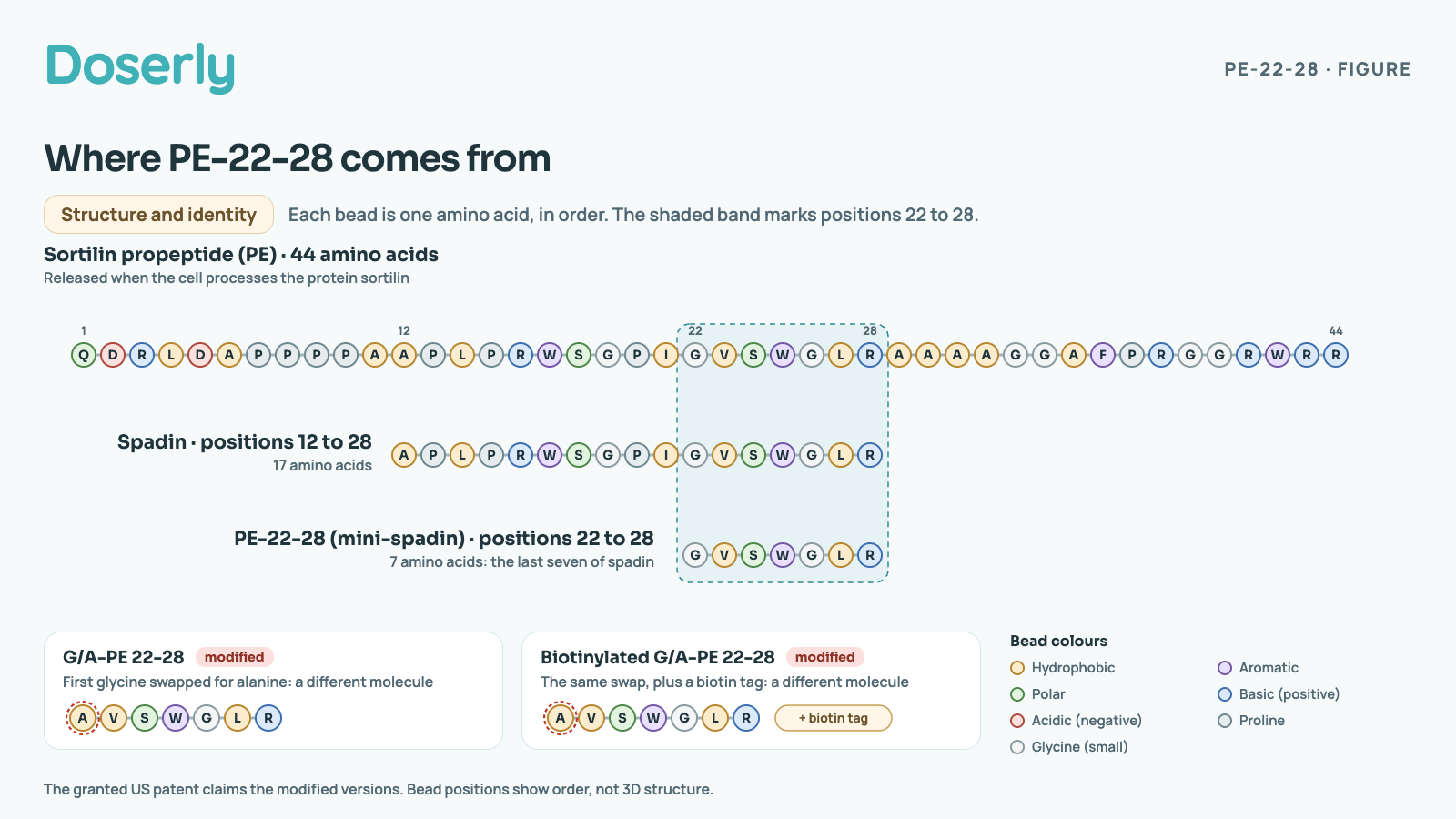
Where PE-22-28 comes from
Each letter is one amino acid, in order.
- Sortilin propeptide (PE) · 44 amino acids
- QDRLDAPPPPAAPLPRWSGPIGVSWGLRAAAAGGAFPRGGRWRR
Released when the cell processes the protein sortilin. Positions 22 to 28 underlined. - Spadin · positions 12 to 28 · 17 amino acids
- APLPRWSGPIGVSWGLR
- PE-22-28 (mini-spadin) · positions 22 to 28 · 7 amino acids
- GVSWGLR (Gly-Val-Ser-Trp-Gly-Leu-Arg): the last seven amino acids of spadin.
- G/A-PE 22-28 · modified
- AVSWGLR: the first glycine swapped for alanine. A different molecule.
- Biotinylated G/A-PE 22-28 · modified
- AVSWGLR plus a biotin tag. A different molecule.
The granted US patent claims the modified versions, not PE-22-28 itself. Bead positions show order, not 3D structure.
Two close relatives cause most of the confusion you will meet online. G/A-PE 22-28 (AVSWGLR) swaps the first glycine for alanine, and a second version adds a biotin tag to that. They are different molecules, they are what the laboratory's granted US patent actually claims, and they carry the long-duration figures that websites attach to PE-22-28. Spadin, the 17-amino-acid parent, is the source of most of the safety claims. The key term for PE-22-28 itself is preclinical: everything known about it comes from dishes and mice. [9], [1], [20]
Typical PE-22-28 Protocols
| Who or what | Amount | How often | How long | What was found or claimed |
|---|---|---|---|---|
| Used in studies | ||||
| People | None | Not applicable | Not applicable | No registered or published study has given PE-22-28 to a person [3], [21] The developers described the programme as preclinical in 2019 |
| Healthy male mice (2017) | 3.0 to 4.0 micrograms per kg, into the abdominal cavity (PE-22-28 and its two modified versions) | Once | Tested 30 minutes later | Less time floating still in a forced-swim test than mice given salt water [1] A behavioural test in mice, not a measure of mood in people |
| Healthy male mice (2017) | 3.0 to 4.0 micrograms per kg, into the abdominal cavity | Once daily | 4 days | About twice as many newborn cells in the hippocampus (1,736 against 899 for PE-22-28); faster escape in a learned-helplessness test [1] Five mice per group for the cell counts |
| Male mice given a stress hormone for 7 weeks to model depression (2017) | 3.0 micrograms per kg, into the abdominal cavity | Once, or once daily | Single dose, or 4 days | Less time floating still than untreated mice, similar to spadin at 100 micrograms per kg; after 4 days, faster approach to food in a novelty test [1] |
| Healthy male mice, swallowed arm (2017) | 1 mg per kg by feeding tube; the paper does not say which version | Once daily | 4 days | Still active in the forced-swim test, at roughly 250 to 330 times the injected amount [1] Not evidence that swallowing it works in people |
| Healthy mice, modified versions only (2017) | 3.2 to 40 micrograms per kg of G/A-PE 22-28 or its biotin-tagged form, into the abdominal cavity | Once | Measured over the next day | The behavioural effect fell by half after 14 to 23 hours [1] Not measured for PE-22-28 itself, and not a blood half-life |
| Mice after an induced stroke, first week (2019) | 0.03 micrograms per kg, into the abdominal cavity, starting 30 minutes after the stroke | Once daily | 7 days | Chosen to open the channel. In separate tests, a single dose shrank the damaged area at 24 hours, and survival was better than with salt water at 24 and 96 hours [7], [22] |
| Mice after an induced stroke, tenfold arm (2019) | 0.3 micrograms per kg, into the abdominal cavity | Not stated | Survival checked at 24 and 96 hours | Less protective than the lower amount, according to the manuscript; the thesis describes it as harmful to survival, reasoning that it blocks the channel [22] 19 mice; the survival figures are only in a figure image, with no statistics in the text |
| Mice after an induced stroke, later phase (2019) | 3 micrograms per kg, into the abdominal cavity | 4 days a week | About 10 weeks | Better movement and memory recovery and less depression-like behaviour than salt water [7] |
| Cells in a dish (2017 to 2021) | 0.01 to 100 nanomolar in the liquid around the cells | Applied once | Minutes to days | Very low concentrations opened TREK-1; higher ones blocked about 55% of the opened current; insulin-making rat cells survived stress better [1], [7], [8] A concentration in a dish is not a dose for a body |
| Website claims | ||||
| Nasal spray, one fixed figure | 400 mcg | Once each morning | 4 weeks | Presented as clinical-team guidance, followed by a break, with no study behind the amount; the figure traces to a 2020 podcast remark [23], [24], [25] |
| Nasal spray, ranges | 100 to 500 mcg | Once or twice daily | 4 to 8 weeks | Two pages, which also describe breaks; one says plainly these are community conventions, not research-derived doses [26], [27] |
| Nasal spray, calculator preset | 300 mcg | Daily | 8 weeks | Labelled by the page as a community protocol [28] |
| Subcutaneous injection, stepped schedule | 50 to 200 mcg | Once daily | 8 to 16 weeks | The same stepped schedule, word for word in places, on four pages [4], [29], [30], [31] |
| Subcutaneous injection, low ranges | 100 to 300 mcg | Once daily | 4 to 8 weeks | Three pages, which also describe breaks; one calculator preset is 150 mcg [26], [27], [28] |
| Subcutaneous injection, higher range | 125 to 600 mcg | Once daily | 2 to 6 weeks | Calls 250 to 400 mcg the "most commonly studied range"; no study has used any amount in people [32] |
| Milligram claims | 0.5 to 2 mg | Daily or every other day | 2 to 4 weeks | Called an investigational human range; no such range exists [33] |
| Milligram claims | 5 to 25 mg | Daily to less often | Not stated | Attributed to research and user reports, with no study named [5] |
Read the units: mcg means micrograms, and 1 mg equals 1,000 mcg. The mouse amounts are micrograms for each kilogram of a mouse's body weight, given into the abdominal cavity, a laboratory route for rodents. The dish amounts are concentrations in the liquid around cells. The website amounts are flat numbers for any adult, by nose or by injection. These are four different kinds of number, and no measurement exists that would let anyone convert between them for this peptide. [1], [7]
Because no dose has been established, this guide does not convert any amount into syringe units and does not describe how to mix, spray or inject the powder. The website rows are shown so you can recognise them, not because any has been found safe or effective. The next chapter explains where they came from. [26], [24]
Mental-health cautions before anything else
PE-22-28 is sought mostly by people with depression, often after antidepressants did not help, and sometimes by people trying to avoid a doctor. That makes these points more important than any number in the table. [34], [35], [36]
- Do not stop or cut back prescribed medicines to try it. Stopping an antidepressant suddenly can cause withdrawal symptoms, and the NHS advises reducing it gradually with a doctor, usually over weeks or months. Stopping a benzodiazepine abruptly can cause withdrawal reactions, including seizures, which the FDA warns can be life-threatening. In one public thread, a person described stopping antidepressants and a benzodiazepine abruptly and spending a month in hospital. [12], [13], [36] In community education groups, members also describe stopping or switching prescribed psychiatric medicines on their own when they start peptides, and a direct question about switching from an SSRI to PE-22-28 went unanswered.
- If you have thoughts of harming yourself, get help now. In the United States and Canada, call or text 988 to reach a free suicide crisis line, open 24 hours a day. Elsewhere, call your local emergency number. [14], [37]
- Combining it with an SSRI or other antidepressant has never been tested in people. The parent peptide raised the firing of serotonin-making nerve cells in mice, which is why people worry about serotonin effects, and the only published combination was spadin plus fluoxetine in mice in a diving experiment. [19], [38]
- People report worsening, not only improvement. Public accounts include marked depression and loss of pleasure within weeks, and dissociation, feeling detached from yourself or your surroundings, that in one account lasted about six months. [11], [10]
- More is not stronger. In cells and in mice, very low amounts opened the target channel and higher amounts blocked it. See how the effect flips. [7], [22]
These amounts come from mouse studies, cell experiments and dosing websites, not from any study in people; the cited references give the full details.
Where these numbers come from
Study rows. The healthy-mouse, stress-hormone and feeding-tube rows come from the 2017 paper that introduced PE-22-28, checked against its full text and figure legends. Its forced-swim and 4-day arms give 3.0 to 4.0 micrograms per kg into the abdominal cavity; the 4-day cell counts are 1,736 for PE-22-28 against 899 for salt water. The feeding-tube text gives 1 mg per kg against 3.0 micrograms per kg injected, while one figure legend gives the injected amount as 100 micrograms per kg, so the ratio is stated as roughly 250 to 330 times and the paper does not say which version was swallowed. The duration row belongs to G/A-PE 22-28 and its biotin-tagged form at 3.2, 4.0, 32 and 40 micrograms per kg; the paper's results section and its discussion pair the 21-hour and 23-hour results with different arms, so the guide gives the range. The stroke rows come from the 2019 paper's abstract and from its full author manuscript, which is printed inside a 2019 doctoral thesis: 0.03 micrograms per kg daily for the first week, then 3 micrograms per kg on 4 days a week. The damaged-area result came from a single 0.03 micrograms per kg injection after a 1-hour stroke, and survival at 24 and 96 hours was compared with a separate group of 19 mice given 0.3 micrograms per kg. The manuscript calls that amount less protective and gives no schedule for it; the thesis chapter calls it harmful, and the survival figures are only in an image. The cell row combines channel recordings in human TREK-1 cells, the stroke paper's dose-response recordings and a 2021 study in rat insulin-making cells at 10 nanomolar. [1], [7], [22], [8]
Website rows. We screened 116 websites that mention PE-22-28 and read the dosing sections of those listed. The 400 mcg nasal figure appears on Peptide Mate as clinical-team guidance, and two 2020 public forum threads attribute it to a clinician speaking on a health podcast, which we did not hear ourselves. The nasal and subcutaneous ranges come from PeptideWiki and PeptideDeck, which give different ranges for different goals; the table keeps each page's own route, frequency and course together. The stepped subcutaneous schedule appears on PeptideDosages, Peptides.id, PeptideDosage.org and Research Protocols with the same week boundaries; the last of these uses a different mixing volume. Biomogging, Peptides Institute and Peptides.wiki are listed separately because their amounts do not match any other page. [23], [24], [25], [26], [27], [28], [4], [29], [30], [31], [32], [33], [5]
What we left out. We did not scale any mouse amount to a person, average the website numbers, combine one page's amount with another page's course, or merge nasal and injected amounts. We left out a page that lists 100 to 500 micrograms per kilogram as a preclinical range, about 30 to 170 times the amounts the mouse papers used, and a page whose dose-response table and intravenous rodent doses do not appear in the papers it cites. Open the searchable source directory [39], [40]
What is PE-22-28 commonly used for?
Almost everyone who looks into PE-22-28 is looking for help with depression: low mood, loss of pleasure, low motivation, and often depression that has not responded to standard medicines. Smaller groups are interested in anxiety, focus and memory, and a few in recovery after a stroke or a head injury. [36], [41], [32], [27]
The appeal rests on one idea: that blocking TREK-1 might relieve depression faster than standard antidepressants, which often take weeks. Mice bred without TREK-1 resisted depression-like behaviour, and PE-22-28 changed behaviour in mice within days. That idea has never been tested in a person. [42], [1], [21]
Everything below is animal or cell research unless it says otherwise. It describes what was measured in mice, rats and dishes. It is not a list of effects in people.
Depression and low mood
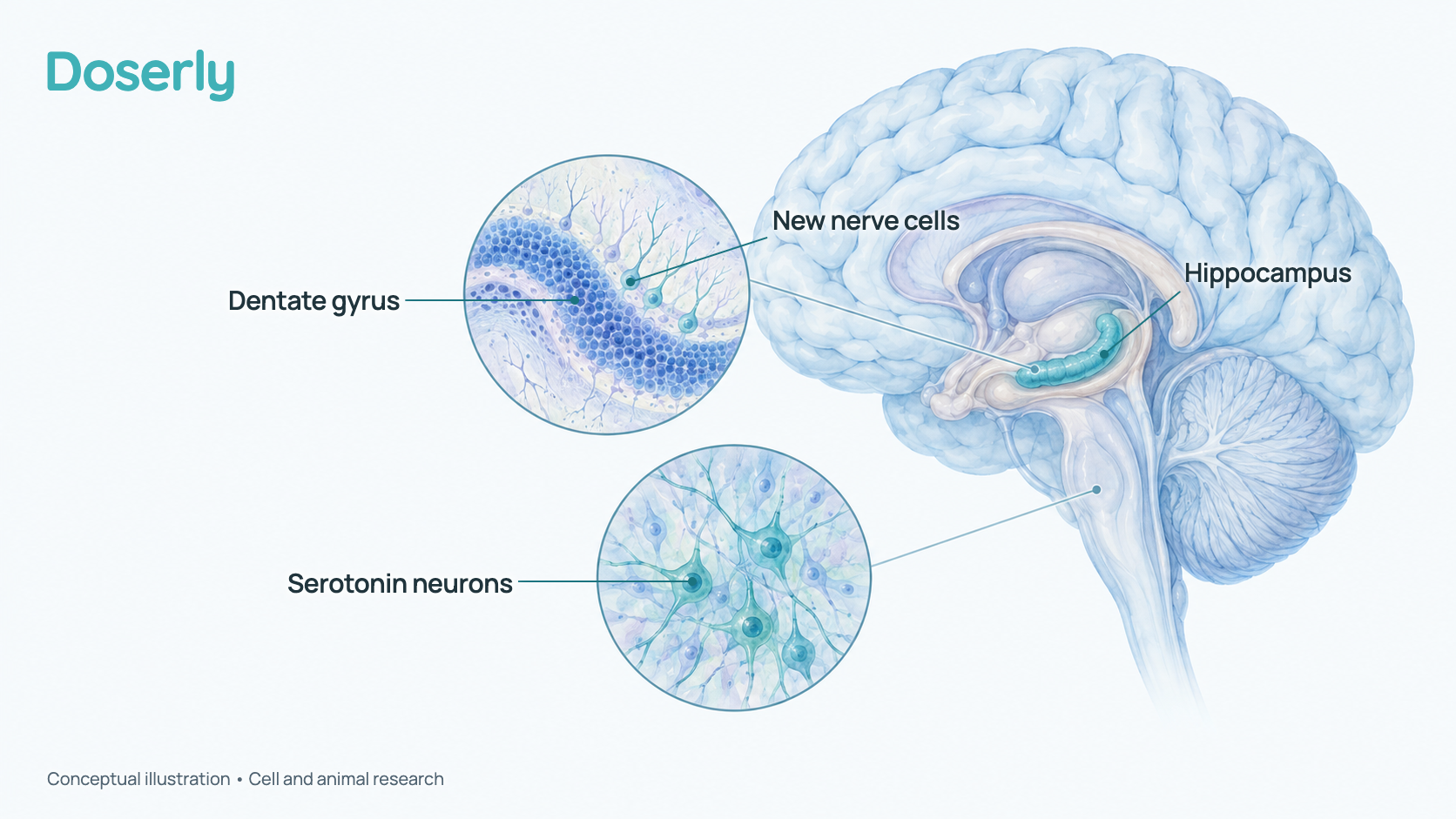
This is the only use PE-22-28 was designed and tested for, and only in mice. A single injection shortened the time healthy mice spent floating still in a forced-swim test, a standard screen for antidepressant drugs. After 4 daily injections, healthy mice escaped faster in a learned-helplessness test, and the number of newborn cells in the hippocampus, a brain region involved in mood and memory, roughly doubled. In mice given a stress hormone for 7 weeks to model depression, it worked about as well as spadin at a far larger amount, and after 4 days these mice approached food faster in an unfamiliar, brightly lit space. [1]
Those are behavioural and cell-count results in young male mice, from the laboratory that made the peptide. No study has measured mood, depression scores or anhedonia (loss of pleasure) in a person taking it. [1], [3]
How fast would it work?
Speed is the claim websites repeat most, and it is a rodent finding. In the 2017 mice, effects appeared after a single injection and after 4 days of injections. An independent Chinese group found that two other TREK-1 blockers, spadin and a compound called SID1900, reversed depression-like behaviour in stressed rats at least a week earlier than the antidepressant fluoxetine. Neither study involved a person, and the independent one did not use PE-22-28. [1], [43]
Anxiety, focus, memory and motivation
None of these was tested for PE-22-28 in any species. Some pages and public posts describe calmer mood, better short-term memory or more drive, and some education materials class it as an anti-anxiety peptide, but the studies measured only depression-like behaviour, brain cell counts, stroke recovery and cell survival. [44], [27], [1], [7], [8]
Recovery after a stroke
In mice given an induced stroke, the developers used PE-22-28 in two steps: a tiny amount each day for the first week, meant to open the channel and protect the brain, then a hundredfold larger amount 4 days a week, meant to block it and prevent depression-like behaviour. Treated mice kept their weight, recovered movement and memory better and showed less depression-like behaviour than untreated mice over about 10 weeks. In a separate survival test, a tenfold larger amount was less protective, and the developers' thesis describes it as harmful. [7], [22]
No stroke study has used PE-22-28 in people. Human work in stroke has only measured the natural propeptide in blood, as described in what we know in people. [45]
Blood sugar and insulin-making cells
In a line of rat insulin-making beta cells grown in a dish, PE-22-28 at 10 nanomolar reduced cell death caused by inflammatory and chemical stress and kept the cells dividing. In mice, blocking the same channel with spadin increased the insulin released in response to glucose. No study has measured blood sugar or insulin after PE-22-28 in an animal or a person, but this matters for anyone taking medicines that lower blood sugar. [8], [46]
See what is known in people or explore the animal and cell research.
Where do PE-22-28 amounts differ, and why?
Because no study has established a human dose, every human-facing number online was built from something else: a podcast remark, a copied page, a vial size or a guess. Knowing which one tells you how much weight to give it.
Why do the amounts differ five-hundredfold?
Because nothing anchors them. The website amounts in the table run from 50 micrograms to 25 milligrams a dose, a five-hundredfold spread, and a few pages go higher by quoting amounts per kilogram. No measurement in people exists to check any of them against. A spread that wide is not a dose range; it is the absence of one. [4], [5], [33]
Where does the 400 microgram nasal figure come from?
From a podcast, as far as anyone can trace it. Two public forum threads from 2020 name a health podcast episode in which a clinician gave 400 micrograms by nasal spray as his figure, and one poster said they would follow it. By 2023 people were repeating the same figure, and today at least one site presents 400 micrograms each morning as clinical-team guidance. No study in any species used that amount or that route. [24], [25], [47], [23]
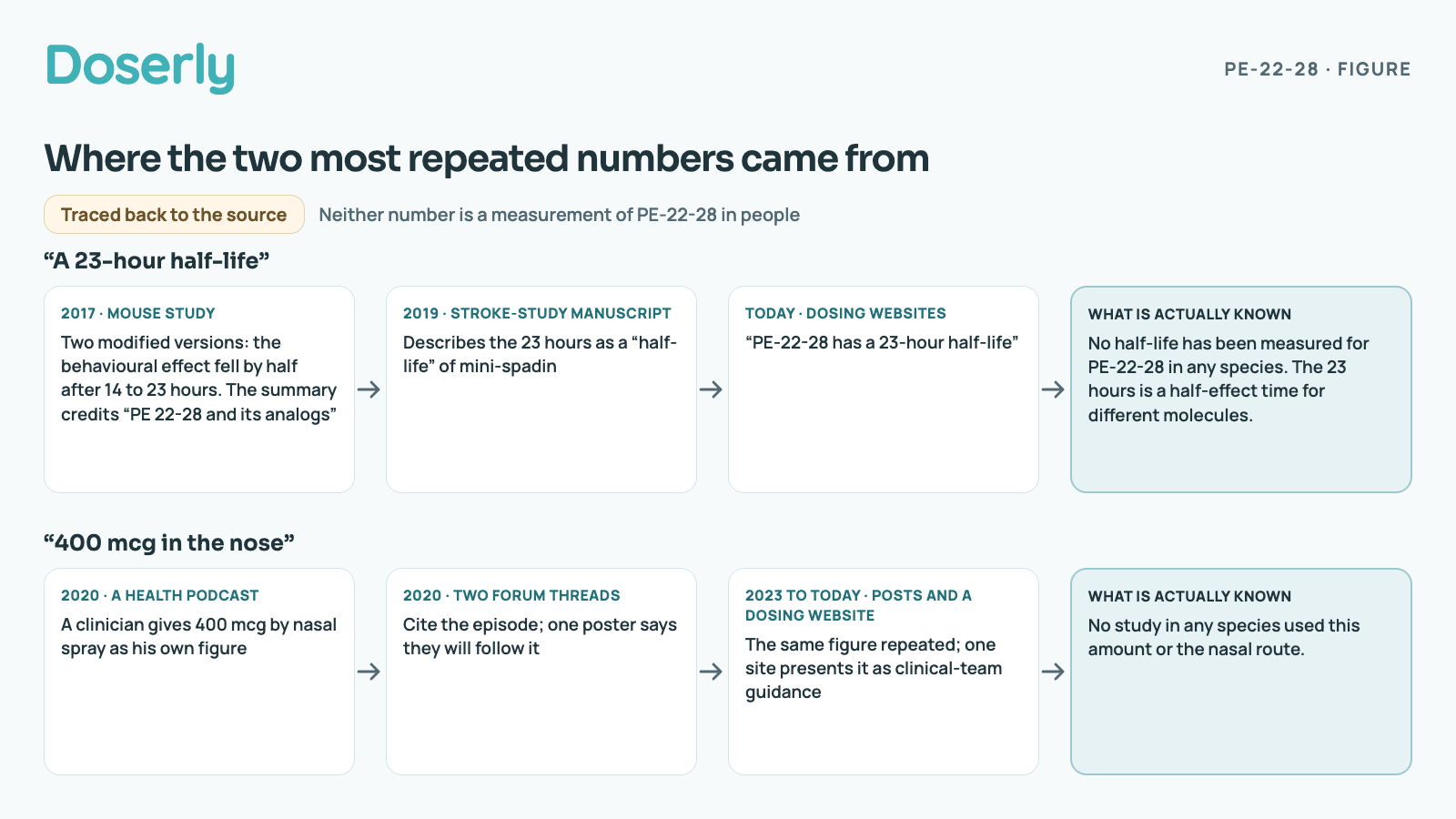
Where the two most repeated numbers came from
Neither number is a measurement of PE-22-28 in people.
“A 23-hour half-life”
- 2017 · mouse study
- Two modified versions: the behavioural effect fell by half after 14 to 23 hours. The summary credits “PE 22-28 and its analogs”
- 2019 · stroke-study manuscript
- Describes the 23 hours as a “half-life” of mini-spadin
- Today · dosing websites
- “PE-22-28 has a 23-hour half-life”
- What is actually known
- No half-life has been measured for PE-22-28 in any species. The 23 hours is a half-effect time for different molecules.
“400 mcg in the nose”
- 2020 · a health podcast
- A clinician gives 400 mcg by nasal spray as his own figure
- 2020 · two forum threads
- Cite the episode; one poster says they will follow it
- 2023 to today · posts and a dosing website
- The same figure repeated; one site presents it as clinical-team guidance
- What is actually known
- No study in any species used this amount or the nasal route.
Both figures travelled from a single early mention to many websites without any new measurement.
Can the mouse amounts be scaled up to a person?
No. The mice received 3 micrograms per kilogram into the abdominal cavity, a route used in rodent laboratories. Converting an animal dose into a human one requires knowing how the substance is absorbed, spread and cleared in both species, and for PE-22-28 none of that has been measured in either. One page lists a preclinical range of 100 to 500 micrograms per kilogram, about 30 to 170 times what the mice actually received, which shows how easily these numbers drift. [1], [39]
Is a bigger amount stronger?
Not for this peptide, and that is the most practically important finding in the research. In channel recordings, concentrations from 0.01 to 10 nanomolar opened TREK-1 more, up to about twice the normal current, and only higher concentrations blocked it. In the stroke mice, a tenfold larger amount was less protective, and the developers' thesis calls it harmful. Almost no dosing page mentions this, and nobody in the public discussions we reviewed did either. [7], [22], [48], [49]
One dosing page says amounts above 600 to 800 micrograms are commonly reported to cause lethargy and a flat mood, the opposite of what people want. It gives no source, and it is a report about websites' users, not a measurement. [27]
Morning or evening, and for how long?
Pages and education materials disagree, and none has data. Several call PE-22-28 stimulating and say to take it only in the morning; some community education groups allow a bedtime dose for night-time anxiety. Stated course lengths and breaks vary from page to page. The mouse studies lasted 4 days, or about 10 weeks in the stroke work, and none tested a break. [26], [32], [23], [4], [1], [7] Members of community education groups describe taking it in the morning, the afternoon or at bedtime, and one group's own materials call it activating in one place and mild enough for the afternoon in another.
Where do the pages get the science wrong?
Check a page's facts before trusting its numbers. Pages we reviewed describe PE-22-28 as derived from Semax, from DSIP, from PACAP, from spinorphin or from galanin, and one says it works through the pain receptor TRPV1 and enkephalins. All of that is wrong: it comes from the sortilin propeptide and acts on a potassium channel. Pages also give its half-life as 24 minutes or 23 hours; neither has been measured. [50], [51], [52], [53], [54], [1], [55]
Posts in community education groups repeat some of these errors and add others. They present human dose ranges and course lengths as if they came from published research, although no human study exists. They describe it as acting on melanocortin receptors, list it as though it were the same peptide as Pinealon, give it a half-life of 2 to 4 hours, or say it lasts three times longer in the body than spadin. The research supports none of these: it acts on a potassium channel, it is a different peptide from Pinealon, and its half-life has never been measured. Some say it works within days, like ketamine; how quickly it works in people has never been tested. One figure is roughly right: in a dish, PE-22-28 blocked the channel at a concentration several hundred times lower than spadin did. That describes a laboratory test, not a smaller or safer dose for a person. See what the channel recordings show.
What happens when you stop PE-22-28?
Nobody knows what happens in people, because nobody has been studied. None of the animal studies measured anything after the last dose: the 4-day mice were examined the next day, and the stroke mice were treated until the end of the study. [1], [7]
Public accounts are thin and point in different directions. One person described strong relief from anhedonia and anxiety that lasted about four days and then stopped working, and another called the relief transient, lasting only as long as you take it. A 2026 poster said it kept working and they had not stopped. Nobody in the archive we reviewed described a withdrawal effect after stopping PE-22-28. Two people described dissociation that continued after stopping, in one case for about six months. [56], [10], [36]
Community education groups show the same spread. One member said the effect lasted about a month after a course ended, another said low moods came back after stopping, and a third could tell when doses were skipped, while another noticed no drop after missing one. A direct question about how long effects last after stopping got no reply, and we saw no member describe a withdrawal effect from PE-22-28 itself.
The stopping that carries a known danger is a different one. People considering PE-22-28 are often trying to come off a prescribed medicine, and stopping antidepressants or benzodiazepines suddenly can cause withdrawal reactions, which for benzodiazepines include seizures. See the mental-health cautions. [12], [13]
Do nasal and injected PE-22-28 behave the same way?
Nobody knows, because neither route has been studied. Websites and public posts use two: intranasal (sprayed into the nose), the older convention, and subcutaneous injection (into the fatty layer under the skin), which became more common in posts from about 2024. No study in any species has given PE-22-28 either way, and no figure exists for how much of either reaches the blood or the brain, its bioavailability. [57], [58], [3], [1]
The mouse work used a third route, intraperitoneal injection (into the abdominal cavity), and one arm used a feeding tube into the stomach, called gavage, at roughly 250 to 330 times the injected amount. That gap is the informative part: whatever is swallowed has to survive digestion. The authors took it as a sign the molecules could one day be given by mouth, but the paper does not say which version was used, and it says nothing about how much reached the brain. [1]
In public posts, people argue that injection is more direct and makes a vial last longer. That is an assumption with no measurement behind it. One page claims 60 percent bioavailability; that figure has no source. [57], [51]
How long does PE-22-28 last in the body?
Nobody knows. No study in any species has measured PE-22-28's half-life, the time for its level in the blood to fall by half, or any other part of its pharmacokinetics. [1], [21]
The figure you will see most is "a 23-hour half-life", and it is wrong twice. The 2017 paper measured how long the forced-swim effect lasted after one injection of the two modified versions, G/A-PE 22-28 and its biotin-tagged form, and reported that the effect fell by half after 14 to 23 hours depending on version and amount. That is a half-effect time in a behavioural test, not a blood level, and it was not measured for PE-22-28. The 2017 paper's own summary already said the action of "PE 22-28 and its analogs" lasted up to 23 hours, and the 2019 stroke manuscript called it a half-life of mini-spadin; both probably helped the error spread. For comparison, the 2017 paper says spadin's effect was gone after about 7 hours. [1], [22], [59]
Of the pages we checked, one explains this correctly. Others give 23 hours, a short blood half-life with an effect lasting over 24 hours, or 24 minutes. [6], [55], [32], [51]
How should PE-22-28 be stored, and how long does it last?
No stability study of PE-22-28 has been published, and there is no approved label. How long it stays usable, before or after mixing, is not established. [60]
The only storage figures that exist come from a laboratory supplier and describe reagent handling: the dry powder sealed and away from moisture for about two years at −80 °C (−112 °F) or one year at −20 °C (−4 °F), and a dissolved solution for six months at −80 °C or one month at −20 °C. Those are freezer conditions for laboratory stock, and the same supplier says it has not independently confirmed the methods it cites. [60]
Dosing pages say to refrigerate the mixed solution and use it within about 30 days, and nobody has measured whether that is true for PE-22-28 in a fridge, a nasal spray bottle or a pocket. A 2022 public question about how long a pre-mixed spray stays intact went unanswered. A "research use only" label also does not tell you what is in the vial; see product quality. [32], [61]
What do we actually know about PE-22-28 in people?
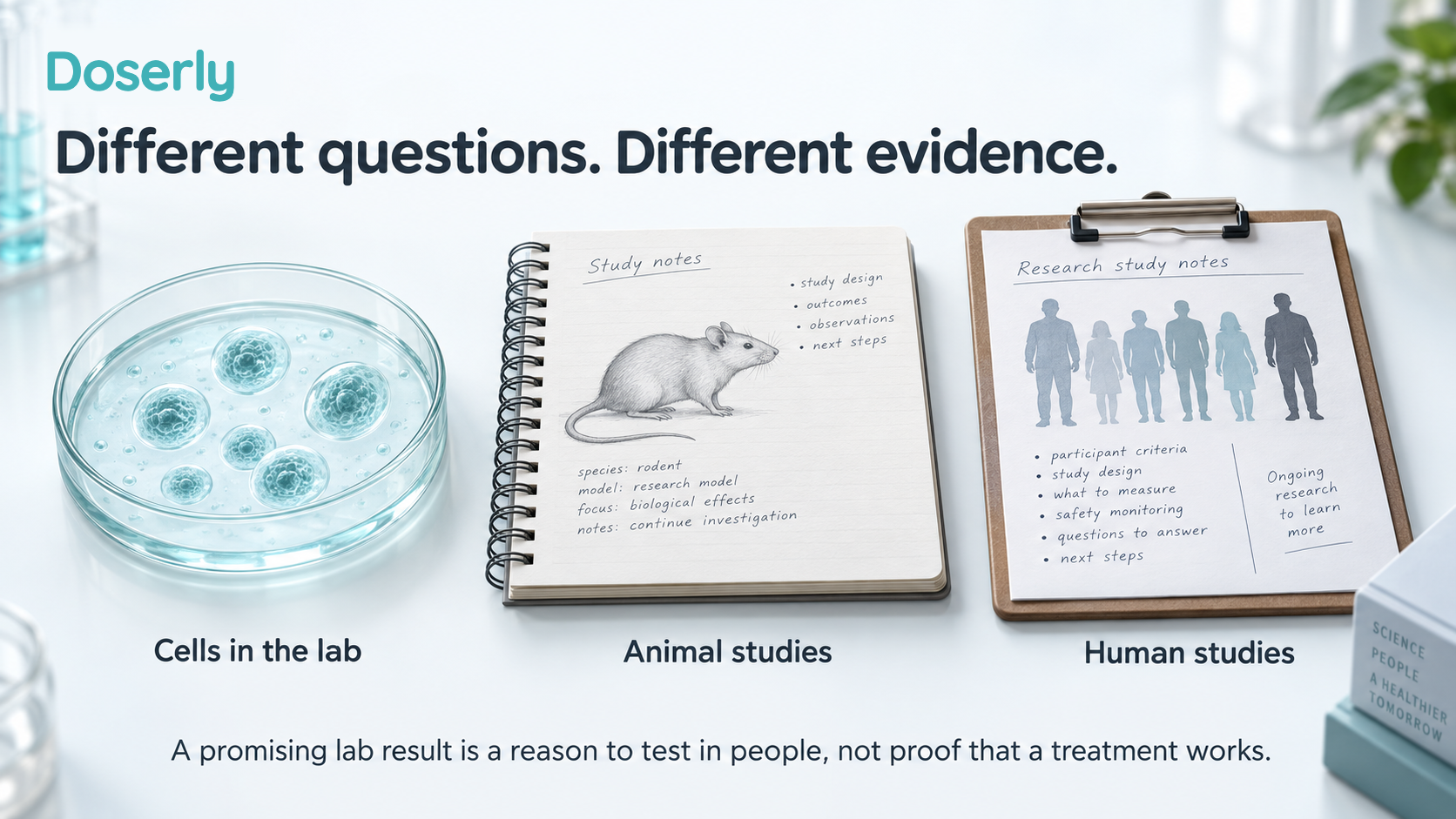
Nothing directly. No person has been given PE-22-28, spadin or any related peptide in a registered or published study. [3]
Has anyone registered a trial?
No. Searches of ClinicalTrials.gov for PE-22-28, PE 22-28, spadin, mini-spadin and the sortilin propeptide returned no study giving any of them. The only related registered study we know of, found through a published paper rather than these searches, is an observational stroke cohort that measured a natural peptide in blood. Other countries' registers were not searched by name, so the accurate statement is that no register we searched holds a trial. [3]
What do the human blood studies show?
Three studies measured the natural 44-amino-acid propeptide in people's blood as a possible marker of depression. Nobody in them received PE-22-28 or anything else. [62], [63], [45]
- Depression, 2017: blood levels were lower in adults with major depression than in people without it, and moved back toward normal with antidepressant treatment. The authors note their samples were small. [62]
- Treatment-resistant depression, 2018: in 45 patients, levels were not lower than in controls at the start. They rose about a month after electroconvulsive therapy, but only in people whose depression improved. [63]
- Stroke, 2025: in 204 stroke patients followed for up to five years, blood levels were linked to depression scores but not anxiety scores. The authors, who include the peptide's developers, suggest spadin could be considered for depression after stroke; that is a suggestion in their discussion, not a result. [45]
The first two disagree on the basic question of whether levels are low in depression. Even if they were, a low level of a natural 44-amino-acid peptide would not show that taking a seven-amino-acid fragment helps. [62], [63]
What happened to the development programme?
The laboratory wrote in 2019 that its goal was to finish preclinical development before starting clinical trials in people. Seven years later no trial is registered. The laboratory's US patent, granted in January 2022, covers the modified G/A version and its biotin-tagged form, not the plain PE-22-28 sold online, and a patent is not an approval or evidence of safety. [21], [3], [9]
Who did the research?
All the PE-22-28 research we found, three papers and a thesis, comes from one French national research laboratory, whose scientists are named inventors on the patent. The same group ran the three human blood studies. No independent laboratory has published original work on PE-22-28 that we could find. Independent groups have worked on spadin and other TREK-1 blockers, and their results do not all agree with the developers', as the mechanism chapter explains. [1], [7], [8], [9], [64], [65]
What would a meaningful human result look like?
It would start with the basics. Before anyone could ask whether PE-22-28 helps depression, a study would need to show what amount people tolerate, what blood levels that produces, and which direction the effect runs at that amount, given the flip seen in cells. None of those measurements exists in any species. A person feeling better, without them, cannot be attributed to the peptide. [7], [3]
How might PE-22-28 work?
The research on how PE-22-28 works comes from cells and mice, mostly from its developers. It explains the design. It does not show that the same thing happens in a person.
The idea: block a brake on nerve cells
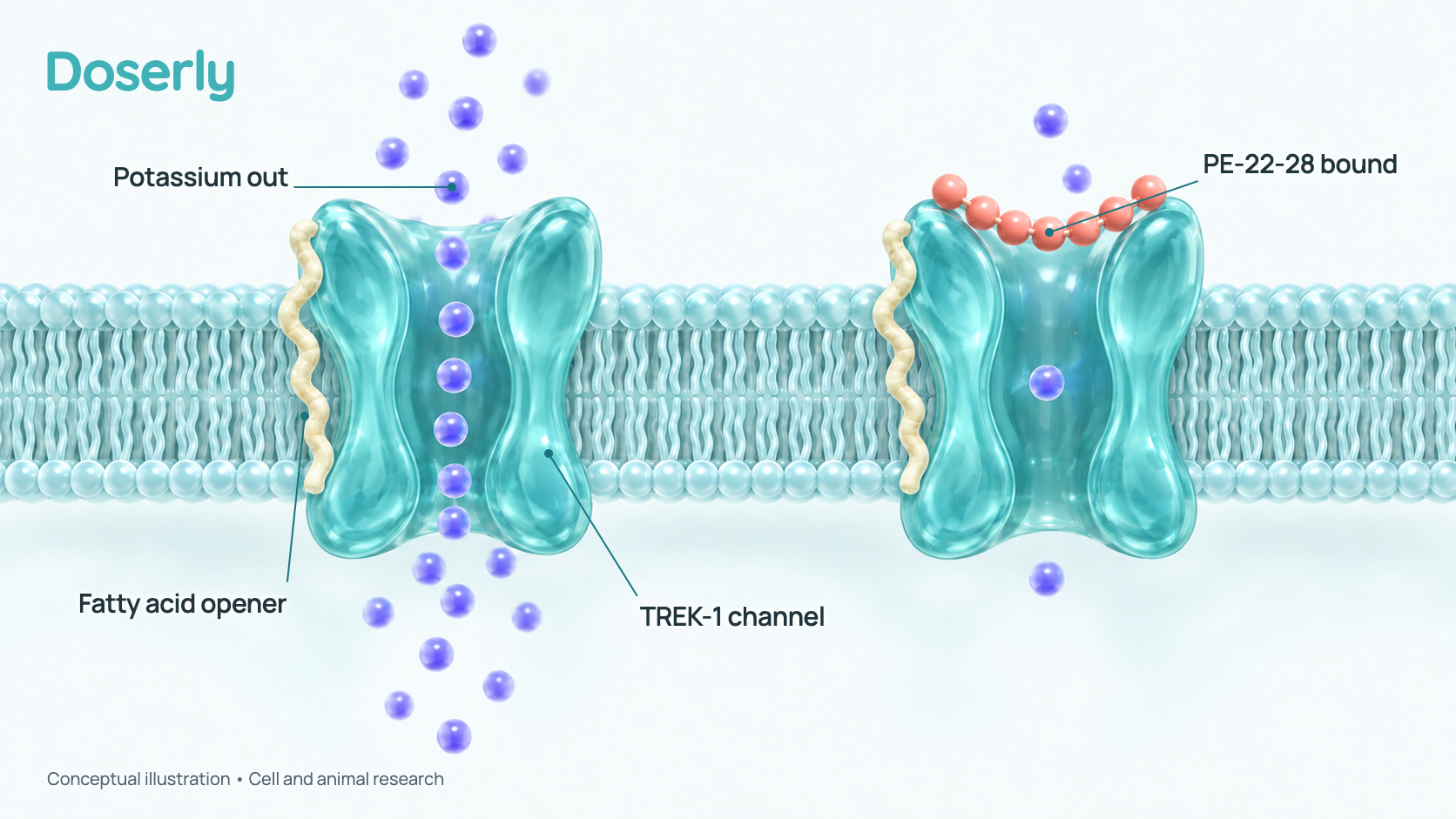
TREK-1 is a potassium channel, a pore in the nerve-cell membrane that lets potassium ions leak out and holds the cell's electrical charge down, like a brake. Mice bred without it resisted depression-like behaviour in five tests, showed stronger serotonin signalling and a blunted stress-hormone response. That finding made TREK-1 a drug target, and spadin and PE-22-28 were developed to block it. Spadin also increased the firing of serotonin-making nerve cells in mice. [42], [19]
What the channel recordings actually show
In human TREK-1 channels made by cultured cells, PE-22-28 reduced the current at a half-maximal concentration of about 0.1 nanomolar, several hundred times lower than spadin's 40 to 60 nanomolar. Three details sit behind that headline. The channel was first opened with arachidonic acid, a fatty acid, before the peptide was added. The block was partial: at 100 nanomolar it cut the opened current by about 55 percent, and the authors describe the direct effect on the resting channel as weak. And it left four related potassium channels, and the heart-rhythm channel hERG, alone at far higher concentrations. [1], [21]
An independent laboratory, testing spadin on mouse channels in frog eggs, found that it did not affect TREK-1 or TREK-2 at rest at all, did not block channels already opened by any of three openers, and only blunted later opening by arachidonic acid. That narrows the simple "TREK-1 blocker" description: the peptides seem to act on one way the channel is switched on, not on the channel as such. It was not a test of PE-22-28. [64]
The effect flips with the amount
In the developers' 2019 recordings, PE-22-28 increased TREK-1 current from 0.01 to 10 nanomolar, peaking at about twice the normal current, and only blocked it at higher concentrations. An independent 2026 review repeats this finding. The stroke study was designed around it, using a tiny amount first to open the channel and protect the brain, then a larger one to block it. [7], [22], [48]
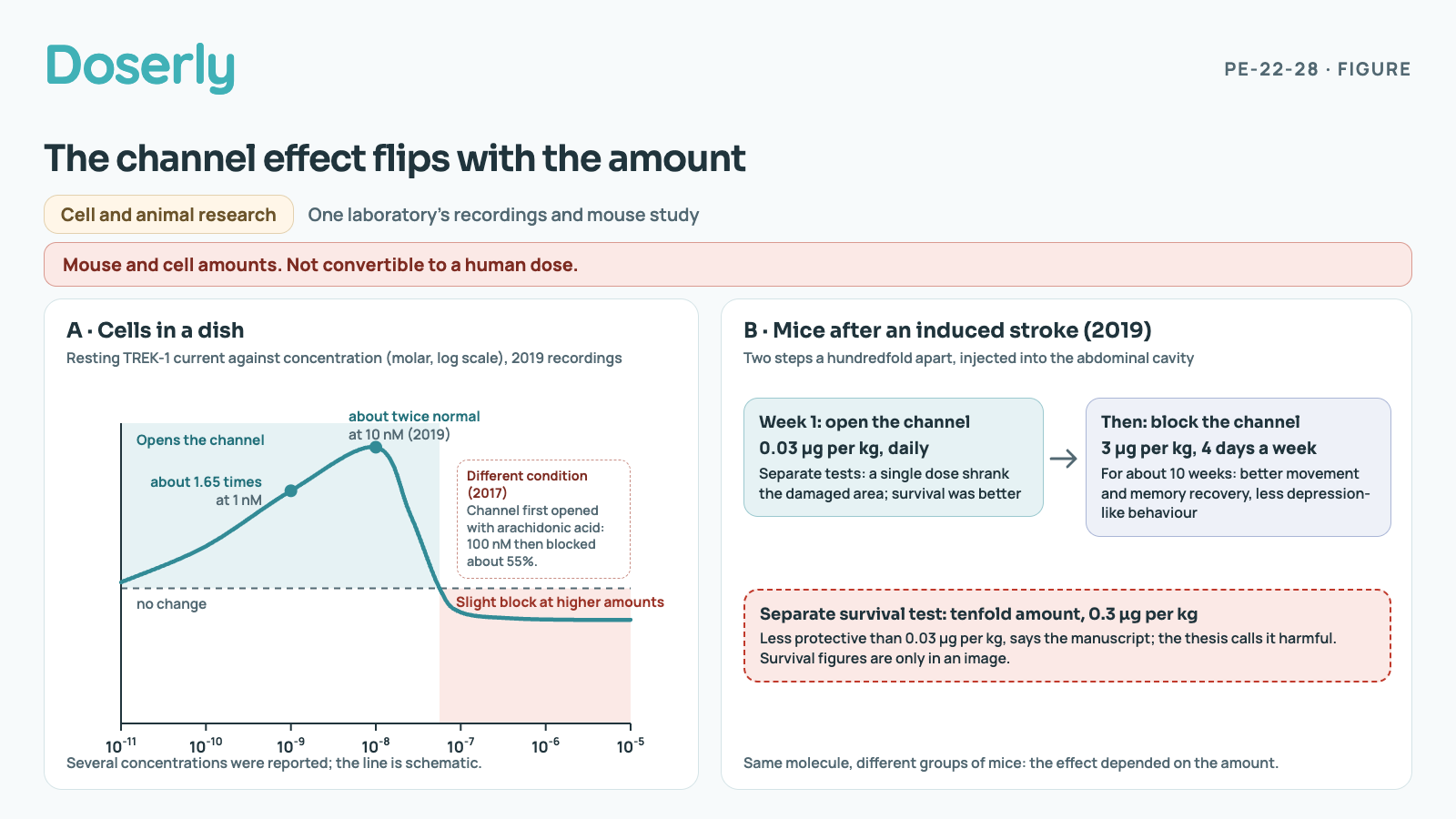
The channel effect flips with the amount
Mouse and cell amounts. Not convertible to a human dose.
A · Cells in a dish
- Very low concentrations (0.01 to 10 nM), resting channel
- Opened TREK-1 more, up to about twice the normal current (2019 recordings). Higher concentrations blocked it slightly.
- A different condition (2017 paper)
- With the channel first opened by arachidonic acid, 100 nM blocked about 55% of the current.
B · Mice after an induced stroke (2019)
- Week 1: 0.03 µg per kg daily
- Meant to open the channel. In separate tests, a single dose shrank the damaged area and survival was better than with salt water.
- Then: 3 µg per kg, 4 days a week
- Meant to block it. Over about 10 weeks, better movement and memory recovery and less depression-like behaviour.
- Separate survival test: 0.3 µg per kg
- Less protective than the lower amount, says the manuscript; the thesis calls it harmful.
Cell and animal research from one laboratory. Not a human dose guide.
Nobody knows what concentration any website amount produces in a human brain, so nobody can say which side of the flip a person would land on.
New nerve cells and connections
After 4 days of injections, mice had about twice as many newborn cells in the hippocampus, and in cultured mouse nerve cells a protein that marks connections between cells, PSD-95, roughly doubled over 36 hours. Standard antidepressants take weeks to produce such changes in mice. Those are markers, counted in mice and dishes; they are not measures of mood, memory or function. [1]
The 4-day counts measured newly dividing cells, not mature working neurons, and the authors note that antidepressants usually raise new-cell formation only after 2 to 4 weeks. So an effect felt within days is hard to explain by new cells alone. This has not been tested. [1]
Why the channel's other jobs matter
TREK-1 is not only a mood switch. Mice bred without it were more prone to seizures and to brain and spinal-cord damage when blood flow was cut off, and more sensitive to painful heat and light touch. An independent study in rats found that injected spadin lowered the pain threshold within half an hour. Blocking the channel is therefore a trade-off, and none of those risks has been measured for PE-22-28. [66], [67], [65]
What are the risks and unanswered questions?
Is PE-22-28 safe?
Nobody knows, and the reasons for caution are specific. It has never been given to a person in a study. It has no toxicology of any kind: no repeated-dose study, no organ examination, no reproductive testing. Its effect on its target reverses with the amount. And people who take it describe worsened depression and lasting dissociation. [3], [1], [7], [10], [11]
What mental-health problems have users reported?
These are the reports that matter most, and they are almost absent from dosing pages. [32], [27]
- Worse depression. One person described becoming markedly more depressed, with loss of pleasure, within a few weeks, while also taking Semax and other compounds; another summed it up as "depressed, flat, awful". [11], [41]
- Dissociation. Two people in the same thread described dissociation, a detached, unreal feeling. One said it began a few hours after their second dose, came with intense visual disturbance called visual snow, and lasted about six months. The other said it began after about a month and was still present a month after stopping. [10]
- Anxiety and agitation. Single reports describe a jittery feeling half an hour after a nasal dose, which did not come back, and a "zingy" feeling in the head with marked anxiety after two weeks, in someone taking many supplements. [68], [69]
Almost every one of these people was also taking something else, most often Semax, and one was having esketamine treatment, so none of these accounts can prove PE-22-28 caused the problem. They are still the most consistent warning signal in the record, and nothing in the research rules them out. [10], [11]
In the community education groups we reviewed, members described fewer problems: headaches in two people, and a little bloating, an overly calm, unfocused feeling or possibly lower energy in single reports, mostly from people taking several compounds together. Nobody there described worse mood, mania or dissociation. That does not cancel the public reports. These groups are built around using peptides and mostly present them favourably, and several months of posts in a few groups say little about rare or delayed harms. Vivid dreams are passed around there as a known side effect, but nobody we read reported having them.
Where does "no side effects" come from?
From a mouse study of spadin, the parent peptide. In mice, spadin did not change pain responses, chemically induced seizures, stroke damage, heart function, two heart-rhythm currents, blood pressure, pulse or blood sugar. For PE-22-28 itself, the only safety-related data are the channel-selectivity tests and the absence of an effect on the hERG channel in cells. [20], [1]
Against that stand the knockout findings on seizures, stroke damage and pain, the independent rat study where spadin increased pain sensitivity, and the stroke study where a tenfold higher amount of PE-22-28 was less protective, which the developers' thesis calls harmful. "No side effects" was never shown for PE-22-28 in any species. [66], [67], [65], [22]
Could it affect blood sugar?
Possibly, in theory. Blocking TREK-1 with spadin raised insulin release in mice, and PE-22-28 protected insulin-making cells in a dish. No study has measured blood sugar after PE-22-28, but anyone taking insulin or other glucose-lowering medicines has a specific reason to raise this with a clinician. [46], [8]
Could product quality change the risk?
Yes. PE-22-28 is sold as a "research use only" powder, and that label gives no assurance of identity, purity or suitability for human use. Health Canada warns that unauthorized peptides can contain too much, too little or none of the active ingredient, unlisted ingredients or contaminants, and may be poorly labelled or stored. The online mix-ups add a further risk: pages that call PE-22-28 a Semax, DSIP or PACAP fragment are describing a different molecule, and nobody in the public discussions we reviewed had tested what was in their vial. [70], [50], [51], [52]
Is PE-22-28 legal? Is it FDA-approved?
Checked September 26, 2026. Rules differ by country and change quickly. A "research use only" label does not make a product legal to sell or safe to use.
United States. PE-22-28 is not approved by the FDA, and no approved product or label turned up in the FDA approval and label databases we searched. We found no entry in the FDA and NIH substance registry, so it appears to have no ingredient identifier. It has not been nominated for pharmacy compounding under section 503A in any of the three categories on the FDA's list updated May 14, 2026. Not being listed does not make it permitted. The developers' patent is not an approval. [15], [18], [71], [9]
Canada. Health Canada's Drug Product Database returns no product for PE-22-28, PE 22-28, spadin or mini-spadin. Health Canada's April 2026 advisory on unauthorized injectable peptide drugs says unauthorized drug products are illegal in Canada, that such products have not been assessed for safety, efficacy and quality, and that "research use only" labelling does not make them legal. It does not name PE-22-28. [16], [70]
Australia. The June 2026 Poisons Standard does not name PE-22-28 or spadin. The Therapeutic Goods Administration's April 2026 safety advisory says unapproved peptide products have not been evaluated for safety, quality or effectiveness, and that buying prescription-only products without a prescription may be unlawful. We did not search the Australian register of therapeutic goods by name. [72], [73]
United Kingdom and European Union. Not checked for this guide.
Is PE-22-28 banned in sport? Does it show up on a drug test?
It is not named on the World Anti-Doping Agency's list, but category S0 bans at all times any drug-like substance that no other section of the list covers and that has no current approval by any government health authority for human therapeutic use, and all S0 substances are Specified Substances. PE-22-28 has no such approval, so tested athletes should treat it as prohibited. The 2027 list, in force from January 1, 2027, adds "peptides" to the S0 examples. This is our reading of the category, not a WADA ruling on this peptide. None of the sources we reviewed describes a test that detects it. [17], [74]
Who should be especially cautious?
Nobody has safety data, because nobody has been studied. For these groups the gaps matter most.
- Anyone taking antidepressants, benzodiazepines, mood stabilisers or other psychiatric medicines. Combinations are untested, and stopping those medicines suddenly is dangerous. [38], [12], [13]
- Anyone with thoughts of self-harm, bipolar disorder or a history of psychosis. Worsened mood and dissociation have been reported, and none of these groups has been studied. [10], [11], [14] In community education groups, people with bipolar disorder or on mood stabilisers were sometimes pointed to PE-22-28 with no caution at all; a few people reporting no problems is not evidence that it is safe for them.
- People with epilepsy or a history of seizures. Mice without TREK-1 were more prone to seizures. [66]
- People who have had a stroke. In the mouse stroke study, the amount changed how well the peptide protected, and the developers describe the higher amount as harmful. [22]
- People taking insulin or other glucose-lowering medicines. Blocking the channel raised insulin release in mice. [46]
- Pregnancy and breastfeeding. Never studied in any species.
- Under 18. Never studied, and this guide is written for adults. It still comes up in community education group threads from parents asking about a teenager's anxiety.
- Competitive athletes. See the anti-doping section above. [17]
Has PE-22-28 been tested alongside other medicines?
No. There is no interaction study in any species, and none in people. What exists is indirect:
- SSRIs and other antidepressants. The only combination in this family is spadin with fluoxetine in mice in a diving experiment, where fewer mice died of decompression sickness. That is not a test of whether the two are safe together in people. Public threads asking about SSRIs get almost no answers. [38], [75], [76], [77] In community education groups the advice conflicts. One educator would not combine it with an antidepressant because of the risk of too much serotonin activity, and one member urged understanding your current treatment before changing anything, while course material recommends it to people whose antidepressants did not help without addressing combinations at all. None of it cites a study.
- Other peptides. PE-22-28 is most often combined with Semax and Selank, and sometimes oxytocin or nootropics; none of these combinations has been studied. [78], [11]
- Glucose-lowering medicines. A theoretical concern from the mouse insulin finding. [46]
Bring a complete list of everything you take to a pharmacist or doctor.
What should be monitored while using PE-22-28?
There is no human dose and no monitoring plan, because there has been no human study. What exists is the list of things researchers measured in mice, plus the risks suggested by the channel's biology. This is background for a conversation with a clinician, not a personal testing plan. [1], [7]
Mood, thoughts of self-harm and dissociation
Thoughts of self-harm need help straight away: call or text 988 in the United States or Canada, or call your local emergency number elsewhere. This is the category with the clearest warning signal, from public reports rather than studies. Changes in mood are worth raising with a clinician early, especially after starting or stopping anything. [11], [10], [14], [37]
Sleep and agitation
Pages call PE-22-28 stimulating and warn against evening doses, and public reports mention jitteriness and anxiety. In Doserly these fall under Sleep Quality and Anxiety. None was measured in a study. [26], [68], [69]
Blood sugar
For people taking insulin or other glucose-lowering medicines, the mouse insulin finding makes blood sugar the one laboratory value with a specific reason to watch. Nobody has measured it after PE-22-28. [46], [8]
What the animal studies tracked
Behaviour in forced-swim, feeding and escape tests; newborn brain-cell counts; body weight, movement, memory, survival and stroke size in the stroke mice. The stroke study found no change in body weight in mice given the peptide without a stroke. No study examined blood tests, organs, heart rhythm or blood pressure after PE-22-28. [1], [7], [22]
What you cannot measure
There is no test of how much PE-22-28 reaches your brain or which way it is moving the channel. The natural propeptide can be measured in blood in research settings, but its link with depression is disputed and it says nothing about a synthetic fragment. [62], [63]
What do people in public communities report?
We read 99 public forum posts and 421 replies about PE-22-28 from 2020 to 2026, in peptide and nootropic discussion groups. We also reviewed discussions in community education groups, where about 30 members describe their own use. These are selected discussions, not a survey, and no product in them was verified.
What do the positive reports look like?
A minority describe a clear change. One 2026 poster described lifted brain fog, restored motivation and emotional tone, and a return to old hobbies and relationships, and said it worked quickly and kept working. Another described a definite lift in mood and fewer ruminations after about four days. Several of these people had already tried standard antidepressants without success. [36], [79], [80]
In community education groups, the commonest positive description is quieter: a lighter mood and small things bothering people less, which several members stress is not a high. Others describe less irritability or less loss of pleasure. A few felt better on the first day, which is hard to separate from expectation, especially when they were starting or stopping other things at the same time.
Does everyone notice a difference?
No. "Subtle" or "nothing" is the commonest outcome. People describe contentment rather than a drastic change, no difference by day six apart from a calm feeling after injecting, or simply that it did not work. One person switching from the antidepressant citalopram was told by another that PE-22-28 is "nothing compared to the strength of citalopram". Several of these trials lasted under a week. [68], [10], [35]
Community education groups show the same pattern. Members describe no effect at all, an effect on the first day only, effects that change from day to day, or help with mild low mood but not severe depression. One long-term user who credited it with helping later needed prescription treatment.
Does it ever make things worse?
Yes, in some accounts, as set out in the risks section: worsened depression and loss of pleasure, and dissociation that continued after stopping. Nearly all of these people were combining it with Semax or other compounds. [11], [10] Members of community education groups mostly reported milder problems, such as headaches, and none reported worse mood; the risks section explains why that does not settle the question.
Who is reaching for it?
Mostly people with long-standing depression, often after bad experiences with standard medicines. One young poster wrote that a doctor was not an option because their family did not accept depression as an illness. Several threads are from people hoping to replace or taper off an SSRI. That is the context in which an untested peptide is being used. [34], [35], [36], [41]
In community education groups, many members use it for low mood or loss of pleasure that they link to a weight-loss drug such as retatrutide, or for irritability and quick anger. Some come to it just after stopping, or while tapering, an antidepressant, and people with bipolar disorder, people on mood stabilisers and parents asking about teenagers are sometimes pointed to it with no caution.
How much are people actually taking?
Mostly the same amounts websites repeat, by nose or injection; see the website rows in the table. One person described feeling tired. People also ask basic questions about turning powder into a nasal spray, and many go unanswered. [47], [79], [58], [61]
Members of community education groups mostly describe the same amounts the websites repeat. One member kept raising the amount well above those figures after feeling little from it. The cell and mouse research shows that a bigger amount is not always stronger, and nobody knows where that turning point would fall in a person. Most members who had tried both routes preferred injection to a nasal spray, though nobody has compared the two in a study. See why a bigger amount is not stronger.
Course and post material in these groups repeats the website amounts without citing a study for them, and some of it claims the amounts come from published research. One course listed a figure several times higher than its own stated maximum, which looks like a unit or copying error. Most of that material presents PE-22-28 as well tolerated, mentions few side effects, and does not mention mood worsening, dissociation or the flip in effect with amount.
What do people combine it with?
Almost always something else: Semax and Selank most often, sometimes oxytocin, methylene blue or other nootropics, and in some cases prescribed antidepressants, esketamine or stimulants. That makes it close to impossible to attribute a good or bad outcome to PE-22-28 alone. [78], [11], [10] In community education groups it is often taken in ready-mixed blends with Semax, Selank and Pinealon, where the amount of each peptide is uncertain and nobody can say which one did what.
How can you judge a story about PE-22-28?
Ask what else the person was taking, how long they used it, whether they came back weeks later, and whether they changed a prescribed medicine at the same time. A mood change within days, while starting several compounds or stopping an antidepressant, has many possible causes. Notice also that nobody in the public forums or the community education groups reported any kind of monitoring or blood tests, and that nobody mentioned the finding that more can reverse the effect. [10], [35], [7]
These selected discussions are not a survey of all users, a response rate or a substitute for controlled studies.
How does PE-22-28 compare with spadin, Semax and Selank?
PE-22-28 is usually discussed next to its parent peptide and the two Russian peptides people most often combine it with. The table shows real differences; no study has compared any of them head to head.
| Compound | What it is | How it is given | Human evidence | Approval status |
|---|---|---|---|---|
| PE-22-28 | A 7-amino-acid fragment of the sortilin propeptide, meant to block TREK-1 | Into the abdominal cavity in mice; nasal spray or subcutaneous injection online, both unstudied | None. No registered or published human study [3] | Not approved anywhere we checked (legal status) |
| Spadin | The 17-amino-acid parent peptide, positions 12 to 28 of the same propeptide | Into a vein or the abdominal cavity in mice | None; only the natural propeptide has been measured in blood [19], [62] | Not approved; not sold as a medicine [15] |
| Semax | A 7-amino-acid peptide based on a fragment of the stress hormone ACTH (see its guide) | Nasal drops | Studied in Russia as licensed nasal drops; see its guide [81] | Registered as a medicine in Russia [81] |
| Selank | A 7-amino-acid peptide sold for anxiety | Nasal drops | Studied in Russia as licensed nasal drops; see its guide [82] | Non-prescription nasal drops in Russia [82] |
Two things stand out. Semax and Selank are registered medicines in Russia with human studies behind their nasal drops, while PE-22-28 and spadin have none. And although all three short peptides are seven amino acids long, they come from unrelated proteins and act in different ways, so the claim that PE-22-28 is a Semax derivative is simply wrong. [81], [82], [50], [1]
Common questions about PE-22-28
Is PE-22-28 the same as spadin or mini-spadin?
It is the same as mini-spadin, not spadin. Mini-spadin is the developers' own name for PE-22-28. Spadin is the longer 17-amino-acid parent peptide, and most of the safety claims attached to PE-22-28 actually come from spadin studies. Watch for G/A-PE 22-28 as well: it is a modified version with a different first amino acid. See what it is. [2], [19], [20], [9]
Can I take PE-22-28 with my SSRI or other antidepressant?
Nobody knows, because it has never been tested. The only combination data are spadin and fluoxetine in mice in a diving experiment, which says nothing about safety in people. Do not stop or cut back your antidepressant to make room for it: the NHS advises reducing antidepressants gradually with a doctor. Bring any plan to your prescriber or pharmacist. See interactions. [38], [12] In community education groups, a direct question about switching from an SSRI to PE-22-28 got no replies, and the only educator who answered directly would not combine them.
Can PE-22-28 replace an antidepressant?
No evidence supports that. Nobody has given it to a person with depression in a study, and public accounts include worsened depression as well as improvement. One person's attempt to replace an SSRI prompted another to call it "nothing compared to" their prescribed medicine. See what we know in people. [3], [11], [35] In community education groups, a long-term user who credited it with helping mild low mood later needed prescription treatment.
Does PE-22-28 have a 23-hour half-life?
No. The 23 hours is how long a behavioural effect took to halve in mice given two modified versions, G/A-PE 22-28 and its biotin-tagged form. PE-22-28's own half-life has never been measured in any species. See how long it lasts. [1], [6]
How long does PE-22-28 take to work?
There is no measured answer in people. In mice, effects appeared 30 minutes after one injection and after 4 days of injections; an independent rat study with other TREK-1 blockers found them faster than fluoxetine. People online report anything from four days to nothing at all. See common uses. [1], [43], [79], [10] In community education groups, reports range from the same day to several weeks, or never; a change on the first day is hard to separate from expectation.
Is PE-22-28 a nasal spray or an injection?
Online it is sold as powder and used both ways, as a home-made nasal spray or a subcutaneous injection. Neither route has been studied in any species; the mice were injected into the abdominal cavity. See routes. [1], [57], [3] In community education groups, most members who tried both preferred injection, which tells you nothing about safety.
Is it legal to buy PE-22-28?
It is sold openly as a "research use only" chemical, which means it is not offered, tested or authorized for use in people. It is not approved in the United States, and Health Canada and Australia's regulator have both warned about unapproved peptide products bought online. See legal status by region. [15], [70], [73]
Glossary
Plain explanations of the route, dosing and research terms used in this guide. Underlined terms in the text link here.
- Adverse event
- A harmful or unwanted medical event reported after someone used a treatment. A report alone does not prove the treatment caused it.
- Amino acid
- A small chemical building block. Chains of amino acids make up peptides and proteins.
- Anhedonia
- Loss of the ability to feel pleasure or interest in things you used to enjoy. It is a core symptom of depression.
- Animal study
- Research in animals such as mice or rats. It shows what a substance does in a living body, but results in people can differ.
- Arachidonic acid
- A fatty acid found in cell membranes that switches the TREK-1 channel on. The PE-22-28 channel tests added it first.
- Benzodiazepine
- A class of prescription medicines, such as diazepam and alprazolam, used for anxiety, sleep and seizures. Stopping them suddenly can cause dangerous withdrawal reactions.
- Beta cell
- A cell in the pancreas that makes and releases insulin, the hormone that lowers blood sugar.
- Bioavailability
- The share of a dose that reaches the bloodstream. It has never been measured for PE-22-28 by any route.
- Cell study (in vitro)
- Research on cells grown in a dish. It gives early clues about biology, but it is far from proof of benefit in people.
- Compounding
- When a pharmacy prepares a customized medicine from individual ingredients. In the US, federal lists control which bulk ingredients pharmacies may use.
- Controlled trial
- A study that compares people who receive a treatment with a similar group who do not, often receiving a placebo instead. None has been run for PE-22-28.
- Course and cycle
- A course is the period of repeated use. A cycle is a course plus a planned break. Neither has been established for PE-22-28.
- Daily total
- All the amounts given in one day, added together. For example, two equal doses a day add up to twice the amount of one dose.
- Dissociation
- Feeling detached from yourself, your body or your surroundings, as if things are unreal or you are watching from outside. It can be distressing and sometimes lasts.
- Dose (amount each time)
- The amount given on one occasion. No human dose of PE-22-28 has been established.
- Electroconvulsive therapy (ECT)
- A hospital treatment for severe depression in which a brief, controlled seizure is triggered under general anaesthesia.
- FDA
- The US Food and Drug Administration, which decides whether medicines can be sold in the United States. It has not approved PE-22-28.
- Forced-swim test
- A mouse or rat test in which less time spent floating still in water is read as an antidepressant-like effect. It screens drugs; it does not measure depression in people.
- Gavage
- Giving a substance straight into an animal's stomach through a feeding tube. One PE-22-28 mouse arm used it.
- Half-effect time
- How long it takes for a measured effect, such as a behaviour change, to fall to half its starting size. It is not the same as a blood half-life.
- Half-life
- The time it takes for the level of a substance in the blood to fall by half. It has never been measured for PE-22-28 in any species.
- hERG channel
- A potassium channel in heart cells that helps set heart rhythm. Drugs that block it can cause dangerous rhythm problems. PE-22-28 did not affect it in cells.
- Hippocampus
- A curved structure deep in the brain involved in memory and mood, where new nerve cells keep forming in adult mice.
- Half-maximal concentration (IC50)
- The concentration of a substance that produces half its maximum blocking effect in a laboratory test. It describes a dish, not a dose.
- Intranasal
- Given into the nose, as drops or a spray, to be absorbed through its lining. PE-22-28 has never been studied by this route.
- Intraperitoneal (IP)
- Injected into the abdominal cavity, the space around the organs in the belly. It is a common laboratory route in rodents and is not used for products like this in people.
- Investigational
- Still being studied and not approved by a regulator to treat any condition. PE-22-28 has not reached the stage of being studied in people.
- Loading phase
- A higher starting amount used in some treatment plans before a lower ongoing amount. None has been established for PE-22-28.
- mcg and mg
- Micrograms and milligrams. 1 mg equals 1,000 mcg. Website amounts for PE-22-28 are written in both, which makes them easy to misread.
- Micrograms per kilogram
- Micrograms of substance for each kilogram of body weight. Mouse study amounts are written this way, and they cannot simply be applied to people.
- Nanomolar (nM)
- A measure of how concentrated a substance is in a liquid. It describes the fluid around cells in a dish and is not a dose for a body.
- Peptide
- A short chain of amino acids. PE-22-28 is a chain of seven.
- Pharmacokinetics
- How the body absorbs, moves, breaks down and removes a substance. No such data exist for PE-22-28 in any species.
- Placebo
- A dummy treatment with no active ingredient, used as a comparison in studies. The mouse studies used salt-water injections this way.
- Potassium channel
- A pore in a cell membrane that lets potassium ions pass. Potassium leaking out keeps a nerve cell's electrical charge low and the cell quieter.
- Preclinical research
- Studies done before research in people: cell studies and animal studies. All PE-22-28 evidence is preclinical.
- Propeptide
- A piece cut off a protein as the cell finishes making it. The sortilin propeptide is 44 amino acids long, and PE-22-28 is positions 22 to 28 of it.
- Research use only
- A label on products sold for laboratory research. It does not mean a product is approved, tested for human use or legal to sell as a medicine.
- Serotonin
- A chemical messenger in the brain and gut involved in mood, sleep and appetite. Many antidepressants, including SSRIs, act on it.
- Sortilin
- A protein that helps sort and move other proteins inside cells. It is also called neurotensin receptor 3.
- Spadin
- A 17-amino-acid piece of the sortilin propeptide, positions 12 to 28, studied in mice as an antidepressant. PE-22-28 is its last seven amino acids.
- SSRI
- Selective serotonin reuptake inhibitor, a widely prescribed type of antidepressant, such as fluoxetine, sertraline or citalopram.
- Subcutaneous (SC)
- Injected into the fatty layer just under the skin. Many online PE-22-28 users inject this way, although no study in any species has tested it.
- Titration
- Adjusting a dose in steps, usually starting lower and increasing. No stepped schedule for PE-22-28 has been tested in any species.
- TREK-1
- A potassium channel in nerve cells and other tissues, also called K2P2.1 and made from the KCNK2 gene. It helps keep nerve cells quiet and protects the brain during seizures and stroke in mice.
- WADA
- The World Anti-Doping Agency, which publishes the list of substances banned in sport.
Explore more of the research
Go deeper into the experiments behind the claims.
Across this guide, the citations include four records on PE-22-28 itself, three papers and a doctoral thesis containing one paper's full manuscript, all from the developers' laboratory; eight studies of spadin and other TREK-1 blockers, at least three of them from independent groups; three mouse studies of the TREK-1 channel's normal roles; and three human studies that measured a natural blood peptide without giving anyone PE-22-28. Registry searches, regulatory pages, dosing websites and personal accounts are counted separately.
Research on PE-22-28 · 3 papers and a thesis
How was PE-22-28 found, and what did it do in mice?
Model: Human TREK-1 channels in cultured cells; cultured mouse nerve cells; young male mice, healthy or given a stress hormone for 7 weeks.
Finding: PE-22-28 reduced the current through arachidonic-acid-opened TREK-1 at about 0.1 nanomolar, about 55 percent at 100 nanomolar, without affecting four related channels or hERG. At 3.0 to 4.0 micrograms per kg into the abdominal cavity it reduced floating time in the forced-swim test, shortened escape time after 4 days, and roughly doubled newborn hippocampal cells; in stress-hormone mice, 4 days also shortened feeding latency. The behavioural effect of the modified versions fell by half after 14 to 23 hours.
Limit: Male mice, small groups, behavioural screening tests, one laboratory. No blood levels, no toxicology.
Stroke recovery in mice
Model: Mice after 30 minutes of blocked blood flow to one side of the brain for the recovery study, followed for about 10 weeks; 1 hour of blocked flow for the survival and damage tests; channel recordings across concentrations.
Finding: The channel effect was biphasic, opening at low concentrations and blocking at higher ones. A tiny daily amount in the first week, then a hundredfold larger one 4 days a week, improved movement, memory and depression-like behaviour. A single tiny dose shrank the damaged area, and survival was better at 24 and 96 hours. A tenfold larger amount was less protective, and the thesis calls it harmful.
Limit: The journal paper is paywalled; its full manuscript was read inside the author's doctoral thesis, where the survival percentages sit in a figure image.
Insulin-making cells
Model: A rat insulin-making cell line in a dish.
Finding: At 10 nanomolar, PE-22-28 reduced cell death from an inflammatory signal and a chemical stressor, switched on survival signals including CREB, and kept cells dividing.
Limit: A cell line only; no animal or human blood-sugar data.
Spadin and other TREK-1 blockers · 8 papers
Where the family started
Model: Mice, including mice without TREK-1; cultured cells.
Finding: Spadin bound TREK-1, blocked it, raised the firing of serotonin-making nerve cells and had antidepressant-like effects in five tests; 4 days of injections into a vein increased new brain cells.
Limit: Same laboratory as PE-22-28.
The 'no side effects' screen
Model: Mice.
Finding: Spadin did not change pain, chemically induced seizures, stroke damage, heart function, two heart-rhythm currents, blood pressure, pulse or blood sugar.
Limit: Abstract only; spadin, not PE-22-28; a screen rather than toxicology.
How long spadin lasts
Model: Mice given spadin and its reversed-sequence versions.
Finding: Spadin's effect fell from full at 1 hour to none at 16 hours after one injection.
Limit: Not PE-22-28.
Insulin release
Model: Mouse insulin-making cells, mouse islets and mice.
Finding: Blocking TREK-1 with spadin raised calcium in beta cells and increased glucose-triggered insulin in mice.
Limit: Spadin; no hypoglycaemia measure.
An independent speed comparison
Model: Rats under chronic mild stress.
Finding: Spadin and a second TREK-1 blocker reversed depression-like behaviour at least a week earlier than fluoxetine.
Limit: Abstract only; not PE-22-28.
An independent channel study
Model: Mouse TREK-1 and TREK-2 in frog eggs.
Finding: Spadin had no effect on resting channels or on channels already opened, and only blunted later opening by arachidonic acid.
Limit: Spadin; a different test system from the developers'.
Pain in prediabetic rats
Model: Rats with prediabetes; sensory nerve cells.
Finding: Injected spadin lowered the pain threshold within half an hour.
Limit: Spadin, local injection, rats.
Spadin with fluoxetine
Model: Mice in a diving and decompression experiment, 280 in total, of which 24 were given both spadin and fluoxetine.
Finding: 4% of the mice given both died of decompression sickness, the lowest of any group, but 42% of that group still failed a grip test for nerve symptoms.
Limit: An unusual model; says nothing about combining these in people.
What TREK-1 does normally · 3 papers
Depression resistance
Model: Mice bred without TREK-1.
Finding: They resisted depression-like behaviour in five models, with stronger serotonin signalling and a blunted stress-hormone response.
Limit: A lifelong genetic change is not the same as a drug.
Brain protection
Model: Mice bred without TREK-1.
Finding: They were more vulnerable to seizures and to brain and spinal-cord damage from blocked blood flow.
Limit: Abstract reviewed.
Pain
Model: Mice bred without TREK-1.
Finding: They were more sensitive to painful heat and light touch, and to pain during inflammation.
Limit: Abstract reviewed.
How this guide was researched
This guide is built from a thorough review of the sources cited throughout it: published scientific studies, a doctoral thesis, trial-registry searches, a patent, regulatory documents and published dosing descriptions. We also reviewed public online forums and community education groups where people describe their own experiences with PE-22-28.
The guide cites 82 sources, including 17 original scientific studies and a doctoral thesis. Each type of source answers a different question. Studies show what researchers measured. Dosing websites show what amounts are being promoted, not what is safe. Personal accounts show what individual people experienced. Every numbered citation links to its entry below, labeled by source type.
How this guide was made
Research and drafting were AI-assisted. Cited sources were checked against their originals, and each source entry notes when only an abstract was available. Where a published paper contradicted a widely repeated claim, we followed the paper. The guide was reviewed and edited by Doserly before publication. It has not had an independent clinical review, and Doserly does not currently have medical reviewers. Doserly makes a medication and health-tracking app and runs Doserly Academy, both of which are promoted in this guide. Read our editorial policy for how guides are researched, updated and corrected.
This guide is for educational purposes. It summarizes what the reviewed sources report so the research is easier to understand; it is not medical advice. For a deeper dive, or to check any point for yourself, go straight to the cited sources.
Explore the sources
These are the documents cited in this guide. Studies, dosing pages and personal accounts answer different questions. A source being listed does not mean every statement on its page is endorsed.
Showing 82 sources
- 01
Shortened Spadin Analogs Display Better TREK-1 Inhibition, In Vivo Stability and Antidepressant Activity ↗
Cell / animal research
Full text reviewed. The founding paper: male mice and cells only.
Disclosure: from the laboratory that developed PE-22-28; its members are named inventors on a patent covering modified versions.
- 02
The Involvement of Sortilin/NTSR3 in Depression as the Progenitor of Spadin and Its Role in the Membrane Expression of TREK-1 ↗
Review
Full text reviewed. Confirms that mini-spadin and PE 22-28 are the same peptide.
Disclosure: from the laboratory that developed PE-22-28; its members are named inventors on a patent covering modified versions.
- 03
ClinicalTrials.gov searches: PE-22-28, PE 22-28, spadin, mini-spadin, TREK-1 and sortilin propeptide ↗
Registry search
No registered study gives PE-22-28 or any related peptide. PE 22-28 returned 27 unrelated records and TREK-1 two unrelated ones. The only related registered study we know of, an observational stroke cohort that measured a blood peptide (NCT01330160), was found through a published paper, not these searches.
- 04
PE-22-28 (10 mg Vial) Dosage Protocol ↗
Protocol source
Page reviewed 26 Sep 2026. Describes practice; not clinical validation. States that no human data exist.
- 05
PE-22-28: Complete Guide ↗
Protocol source
Page reviewed 26 Sep 2026. Describes practice; not clinical validation. Gives 5–25 mg per administration.
- 06
PE-22-28 Guide: Evidence, Sourcing & Protocol Sheet ↗
Protocol source
Page reviewed 26 Sep 2026. Describes practice; not clinical validation. The one page in our sample that explains the 23-hour figure correctly.
- 07
First evidence of protective effects on stroke recovery and post-stroke depression induced by sortilin-derived peptides ↗
Cell / animal research
Original abstract reviewed; the authors' full manuscript was read inside the 2019 doctoral thesis listed separately.
Disclosure: from the laboratory that developed PE-22-28; its members are named inventors on a patent covering modified versions.
- 08
Sortilin-derived peptides promote pancreatic beta-cell survival through CREB signaling pathway ↗
Cell / animal research
Full text reviewed (author version). Rat insulin-producing cell line only.
Disclosure: from the laboratory that developed PE-22-28; its members are named inventors on a patent covering modified versions.
- 09
US Patent 11,220,527 B2: Peptides derived from the propeptide NTSR3 and their use in the treatment of depression ↗
Patent
Full text reviewed. The granted claims cover the modified AVSWGLR version and its biotin-tagged form, not unmodified PE-22-28. A patent is not an approval.
- 10
Has anyone tried these peptides for depression?: PE-22-28, TAK-653, or MIF-1? ↗
Community account
Thread and replies read through a public archive, 26 Sep 2026. Includes two separate accounts of dissociation and follow-ups months later.
- 11
I got realllly depressed on PE-22-28 & Semax ↗
Community account
Thread and replies read through a public archive, 26 Sep 2026. Follow-up in Feb 2025.
- 12
Stopping or coming off antidepressants ↗
Health service guidance
Page reviewed: advises not stopping an antidepressant suddenly and reducing it gradually with a doctor, usually over weeks or months.
- 13
FDA requiring Boxed Warning updated to improve safe use of benzodiazepine drug class ↗
Regulator safety communication
Page reviewed: stopping benzodiazepines abruptly or reducing them too quickly can cause withdrawal reactions, including seizures, which can be life-threatening.
- 14
988 Suicide & Crisis Lifeline ↗
Crisis service
Call, text or chat 988; free, confidential and available 24 hours a day.
- 15
openFDA drug approval and label searches: PE-22-28 and spadin ↗
Regulatory database
No approved product and no label found.
- 16
Health Canada Drug Product Database searches: PE-22-28, PE 22-28, spadin and mini-spadin ↗
Regulatory source
Searched by brand and ingredient name: no product found.
- 17
World Anti-Doping Code International Standard: Prohibited List 2026 ↗
Anti-doping rule
Class S0 (non-approved substances) reviewed: prohibited at all times, all Specified Substances. PE-22-28 is not named.
- 18
PubChem CID 165437303: PE 22-28 ↗
Reference database
Formula, weight, CAS number and sequence reviewed. A search of the FDA and NIH substance registry (GSRS) found no entry for PE-22-28 or its sequence.
- 19
Spadin, a sortilin-derived peptide, targeting rodent TREK-1 channels: a new concept in the antidepressant drug design ↗
Cell / animal research
Full text reviewed. The parent peptide (spadin), not PE-22-28.
Disclosure: from the laboratory that developed PE-22-28; its members are named inventors on a patent covering modified versions.
- 20
Spadin as a new antidepressant: absence of TREK-1-related side effects ↗
Cell / animal research
Original abstract reviewed. The parent peptide (spadin), not PE-22-28.
Disclosure: from the laboratory that developed PE-22-28; its members are named inventors on a patent covering modified versions.
- 21
Fighting against depression with TREK-1 blockers: Past and future. A focus on spadin ↗
Review
Full text reviewed (author version). Not an independent confirmation.
Disclosure: from the laboratory that developed PE-22-28; its members are named inventors on a patent covering modified versions.
- 22
Les effets protecteurs de la spadine et ses analogues dans la récupération motrice et cognitive post-AVC (doctoral thesis) ↗
Cell / animal research
Full text reviewed, including the English manuscript of the stroke study. Survival percentages sit in a figure image and could not be read as text.
Disclosure: from the laboratory that developed PE-22-28; its members are named inventors on a patent covering modified versions.
- 23
PE-22-28 ↗
Protocol source
Page reviewed 26 Sep 2026. Describes practice; not clinical validation. Presents 400 mcg each morning as clinical-team guidance without a study for the amount.
- 24
PE-22-28 Anyone have information about dosage? ↗
Community account
Thread and replies read through a public archive, 26 Sep 2026. A December 2020 reply attributes the 400 mcg nasal figure to a clinician on a health podcast.
- 25
Nootropic Spadin ↗
Community account
Thread and replies read through a public archive, 26 Sep 2026. Starts from a 2020 podcast episode; a reply plans to follow the 400 mcg nasal figure given on it.
- 26
PE-22-28 Dosage Guide: TREK-1 Protocols ↗
Protocol source
Page reviewed 26 Sep 2026. Describes practice; not clinical validation. Says its amounts are community conventions, not research-derived.
- 27
PE-22-28 Peptide: Benefits, Dosage, Side Effects and How It Works for Depression (2026) ↗
Protocol source
Page reviewed 26 Sep 2026. Describes practice; not clinical validation. Its half-life and absorption percentages have no published source.
- 28
PE-22-28 Reconstitution & Dosing Calculator (2026) ↗
Protocol source
Page reviewed 26 Sep 2026. Describes practice; not clinical validation. Labels its 300 mcg nasal and 150 mcg injected presets as community protocols.
- 29
PE-22-28 ↗
Protocol source
Page reviewed 26 Sep 2026. Describes practice; not clinical validation. Same step-up schedule as the PeptideDosages page.
- 30
PE-22-28 Dosage Chart & Titration Schedule ↗
Protocol source
Page reviewed 26 Sep 2026. Describes practice; not clinical validation. Same step-up schedule as the PeptideDosages page.
- 31
PE-22-28 ↗
Protocol source
Page reviewed 26 Sep 2026. Describes practice; not clinical validation. Same step-up schedule, mixed with 2 mL instead of 3 mL.
- 32
PE 22-28 Dosage & Protocol ↗
Protocol source
Page reviewed 26 Sep 2026. Describes practice; not clinical validation. Carries affiliate links to a seller.
- 33
PE-22-28: Research Profile & Guide ↗
Protocol source
Page reviewed 26 Sep 2026. Describes practice; not clinical validation. Presents 0.5–2 mg as an "investigational human range"; no human data exist.
- 34
Wondering if PE-22-28 will work or not ↗
Community account
Thread and replies read through a public archive, 26 Sep 2026.
- 35
Anyone have experience switching from citalopram to PE-22-28? ↗
Community account
Thread and replies read through a public archive, 26 Sep 2026.
- 36
Anyone Use PE-22-28 for Depression? ↗
Community account
Thread and replies read through a public archive, 26 Sep 2026.
- 37
9-8-8: Suicide Crisis Helpline ↗
Crisis service
Call or text 9-8-8, 24 hours a day, every day of the year.
- 38
Fluoxetine Protection in Decompression Sickness in Mice is Enhanced by Blocking TREK-1 Potassium Channel with the "spadin" Antidepressant ↗
Cell / animal research
Full text reviewed. Spadin given with fluoxetine to mice in a diving model; not a human interaction study.
Disclosure: co-authored by members of the laboratory that developed PE-22-28, who are named inventors on a patent covering modified versions.
- 39
PE22-28: Peptide Encyclopedia ↗
Protocol source
Page reviewed 26 Sep 2026. Describes practice; not clinical validation. Lists 100 to 500 micrograms per kilogram as a preclinical range, far above the amounts the mouse papers used.
- 40
PE-22-28 (Spadin Analog): Research Evidence & Safety Profile ↗
Protocol source
Page reviewed 26 Sep 2026. Describes practice; not clinical validation. Its dose-response table and intravenous rodent doses do not appear in the papers it cites; excluded from the table.
- 41
Peptides For Depression and Anxiety? ↗
Community account
Thread and replies read through a public archive, 26 Sep 2026.
- 42
Deletion of the background potassium channel TREK-1 results in a depression-resistant phenotype ↗
Cell / animal research
Original abstract reviewed. Mice bred without TREK-1.
Disclosure: co-authored by researchers later named as inventors on a patent covering modified versions of PE-22-28.
- 43
Comparison of Therapeutic Effects of TREK1 Blockers and Fluoxetine on Chronic Unpredicted Mild Stress Sensitive Rats ↗
Cell / animal research
Original abstract reviewed. An independent laboratory; spadin and another blocker, not PE-22-28.
- 44
Has Anyone Tried the Peptide PE-22-28? ↗
Community account
Thread and replies read through a public archive, 26 Sep 2026.
- 45
Serum sortilin-derived propeptide concentrations as markers of depression in chronic stroke ↗
Human study (observational cohort)
Original abstract reviewed. 204 stroke patients; nobody received PE-22-28.
Disclosure: co-authored by members of the laboratory that developed PE-22-28, who are named inventors on a patent covering modified versions.
- 46
Potentiation of Calcium Influx and Insulin Secretion in Pancreatic Beta Cell by the Specific TREK-1 Blocker Spadin ↗
Cell / animal research
Full text reviewed. The parent peptide (spadin), not PE-22-28.
Disclosure: co-authored by members of the laboratory that developed PE-22-28, who are named inventors on a patent covering modified versions.
- 47
PE-22-28 ↗
Community account
Thread and replies read through a public archive, 26 Sep 2026. First-hand account at 400 mcg once and twice a day.
- 48
TREK-1 in central nervous system diseases ↗
Review
Full text reviewed. An independent review that repeats the low-dose channel-opening finding.
- 49
PE-22-28: Benefits, Dosage & Risks ↗
Protocol source
Page reviewed 26 Sep 2026. Describes practice; not clinical validation. One of three pages in our sample that mention the biphasic dose response.
- 50
Pe-22-28 Peptide Guide ↗
Protocol source
Page reviewed 26 Sep 2026. Describes practice; not clinical validation. Calls PE-22-28 a Semax derivative, which is wrong.
- 51
PE-22-28 Dosage, Half-Life & Protocol Guide ↗
Protocol source
Page reviewed 26 Sep 2026. Describes practice; not clinical validation. Calls PE-22-28 a DSIP fragment with a 24-minute half-life and 60% bioavailability; none of this has a source.
- 52
PE-22-28: Evidence & Safety ↗
Protocol source
Page reviewed 26 Sep 2026. Describes practice; not clinical validation. Also calls PE-22-28 a PACAP-derived peptide, which is wrong.
- 53
PE-22-28 Dosing Protocol: 10 mg Vial ↗
Protocol source
Page reviewed 26 Sep 2026. Describes practice; not clinical validation. Describes PE-22-28 as a spinorphin analogue acting on TRPV1 and enkephalins, which is wrong.
- 54
Any experiences with the peptide PE-22-28? ↗
Community account
Thread and replies read through a public archive, 26 Sep 2026. Quotes an online description that wrongly links the peptide to galanin.
- 55
PE-22-28 Overview, Dosing & Safety ↗
Protocol source
Page reviewed 26 Sep 2026. Describes practice; not clinical validation. Lists a half-life of about 23 hours, which has never been measured.
- 56
Has Anyone Tried The Peptide PE-22-28? ↗
Community account
Thread and replies read through a public archive, 26 Sep 2026.
- 57
Best roa for PE-22-28? ↗
Community account
Thread and replies read through a public archive, 26 Sep 2026.
- 58
Intranasal administration ↗
Community account
Thread and replies read through a public archive, 26 Sep 2026.
- 59
Retroinverso analogs of spadin display increased antidepressant effects ↗
Cell / animal research
Full text reviewed. Spadin and other analogs, not PE-22-28.
Disclosure: from the laboratory that developed PE-22-28; its members are named inventors on a patent covering modified versions.
- 60
PE 22-28 (TREK-1 inhibitor) product page ↗
Laboratory supplier
Reagent storage conditions for laboratory use. The supplier states it has not independently confirmed the cited methods.
- 61
pe 22.28 pre mixed spray stability in solution? ↗
Community account
Thread and replies read through a public archive, 26 Sep 2026. No replies.
- 62
Serum sortilin-derived propeptides concentrations are decreased in major depressive disorder patients ↗
Human study (observational)
Original abstract reviewed. Measured a natural blood peptide; nobody received PE-22-28. Small samples.
Disclosure: co-authored by members of the laboratory that developed PE-22-28, who are named inventors on a patent covering modified versions.
- 63
Increased serum levels of sortilin-derived propeptide after electroconvulsive therapy in treatment-resistant depressed patients ↗
Human study (observational)
Full text reviewed. 45 patients; nobody received PE-22-28.
Disclosure: co-authored by members of the laboratory that developed PE-22-28, who are named inventors on a patent covering modified versions.
- 64
Spadin Selectively Antagonizes Arachidonic Acid Activation of TREK-1 Channels ↗
Cell / animal research
Full text reviewed. An independent laboratory; spadin, not PE-22-28.
- 65
Sortilin-Mediated Inhibition of TREK1/2 Channels in Primary Sensory Neurons Promotes Prediabetic Neuropathic Pain ↗
Cell / animal research
Full text reviewed. An independent laboratory; spadin injected in rats, not PE-22-28.
- 66
TREK-1, a K+ channel involved in neuroprotection and general anesthesia ↗
Cell / animal research
Original abstract reviewed. Mice bred without TREK-1.
Disclosure: co-authored by researchers later named as inventors on a patent covering modified versions of PE-22-28.
- 67
TREK-1, a K+ channel involved in polymodal pain perception ↗
Cell / animal research
Original abstract reviewed. Mice bred without TREK-1.
Disclosure: co-authored by researchers later named as inventors on a patent covering modified versions of PE-22-28.
- 68
Anyone tried PE-22-28 ↗
Community account
Thread and replies read through a public archive, 26 Sep 2026. One person's updates over three weeks.
- 69
PE-22-28 users, what's the longest you've used it and what's your experience? ↗
Community account
Thread and replies read through a public archive, 26 Sep 2026.
- 70
Think twice before injecting peptides bought online: unauthorized products can seriously harm you ↗
Regulatory source
Advisory reviewed: a general warning that says peptides in Canada are generally regulated as prescription drugs. PE-22-28 is not named.
- 71
Bulk Drug Substances Nominated for Use in Compounding Under Section 503A of the FD&C Act ↗
Regulatory source
List text searched, including category 2 (substances that raise significant safety concerns): no PE-22-28, spadin or sortilin entry. Absence from a list is not permission.
- 72
Therapeutic Goods (Poisons Standard - June 2026) Instrument 2026 ↗
Regulatory instrument
Text searched 26 Sep 2026: PE-22-28, spadin and sortilin are not named.
- 73
Understanding your responsibilities when importing, compounding and supplying unapproved peptide products ↗
Regulator advisory
Full text reviewed. Class-level advisory; does not name PE-22-28.
- 74
World Anti-Doping Code International Standard: Prohibited List 2027 ↗
Anti-doping rule
Class S0 reviewed: adds "peptides" to the examples of non-approved substances. PE-22-28 is not named.
- 75
Would PE-22-28 would interact with SSRIs? ↗
Community account
Thread and replies read through a public archive, 26 Sep 2026. No replies.
- 76
PE 22-28 in Combination with an SSRI? ↗
Community account
Thread and replies read through a public archive, 26 Sep 2026. No replies.
- 77
PE-22-28 and ssri use ↗
Community account
Thread and replies read through a public archive, 26 Sep 2026. No replies.
- 78
Semax, Selenk, teosfosfine and PE 22-28. Anyone using this combo? Side effects? ↗
Community account
Thread and replies read through a public archive, 26 Sep 2026.
- 79
Has Anyone Tried the Peptide PE-22-28? ↗
Community account
Thread and replies read through a public archive, 26 Sep 2026.
- 80
Anyone try PE-22-28? ↗
Community account
Thread and replies read through a public archive, 26 Sep 2026. Several first-hand accounts with follow-ups over two months.
- 81
Semax 0.1% nasal drops: drug reference entry ↗
Official product label
Full entry reviewed in Russian for Doserly's Semax guide: dosing by use, contraindications, side effects.
- 82
Selank 0.15% nasal drops: instructions for medical use ↗
Official product label
Russian label reviewed in full for Doserly's Selank guide: non-prescription nasal drops for anxiety states.
No matching sources
Try a different term or show the full list.
Updates and corrections
First published September 26, 2026. This is Doserly's first guide to PE-22-28; there was no earlier page. Because no person has received PE-22-28 in a study, because its effect reverses with the amount, and because public reports describe worsened depression and lasting dissociation, the guide shows study and website amounts with a safety warning instead of a typical protocol. Web search engines were not used during research, so dosing pages were found through known website address patterns, and the UK and EU regulators were not checked. A revision date does not mean every source was rechecked.
To report an error, email a correction with the guide title, the specific passage and a supporting source if available. Please leave out personal health records. See our editorial policy for how we handle attribution, evidence limits and corrections.