
In this guide
What is Dihexa?
Dihexa is a small lab-made molecule, related to a fragment of a blood-pressure hormone, that people take in the hope of sharper memory and focus. It is sold as capsules, nasal sprays, skin solutions and injectable powder. It is not an approved medicine, and no study has tested a Dihexa product in people. [1], [2], [3], [4]
It is often called a peptide, but it is better described as a peptidomimetic: a molecule built to resemble a short chain of amino acids. It contains two amino acids, tyrosine and isoleucine, capped at both ends with six-carbon (hexanoic) groups. Its chemical name is N-hexanoyl-tyrosyl-isoleucyl-(6)-aminohexanoic amide, its formula is C27H44N4O5 and it weighs about 504.7 g/mol. Research codes include PNB-0408 and ATH-1001. [5], [6], [7]
Dihexa came from a Washington State University laboratory that set out to make a stable, brain-active version of angiotensin IV. [7] A 2012 university press release said it was "seven orders of magnitude" more powerful than BDNF (brain-derived neurotrophic factor), a natural growth factor for nerve cells, and that claim still drives much of the interest. The company that licensed Dihexa worked on it from 2011 to 2015, then stopped because it lacked "the appropriate characteristics needed to be a successful therapeutic product." [8], [9]
The company then built fosgonimeton, a version of Dihexa with an added phosphate group so that it dissolves in water and can be injected. Once injected, fosgonimeton quickly turns into Dihexa in the blood. That makes the fosgonimeton trials the only controlled human data on Dihexa as an active substance, but they are not tests of the capsules and sprays people buy. [5], [9], [10], [11], [12]
Dihexa and its injectable prodrug. Fosgonimeton (ATH-1017): Dihexa + a phosphate group. Dissolves in water above 70 mg per mL. Injected under the skin (subcutaneous): 40 or 70 mg once daily in the dementia trials. Phosphate removed in the blood; Dihexa peaks in about 30 minutes. Dihexa in the blood (ATH-1001): Blood level halves in about 1.5 hours (people). Dihexa products sold online: Capsules, sprays, skin solutions, vials. Dissolves in water below 0.05 mg per mL. Poor, variable absorption when swallowed (developer's lab data). Never tested in people. Trials enrolled about 750 people, most with dementia; no memory or daily-function benefit. Not tested in any human study. Only the injected prodrug has been tested in people; the Dihexa products sold online have not. Human blood measurements (Phase 1 trial) and the developer's laboratory data. Conceptual diagram; not to scale.
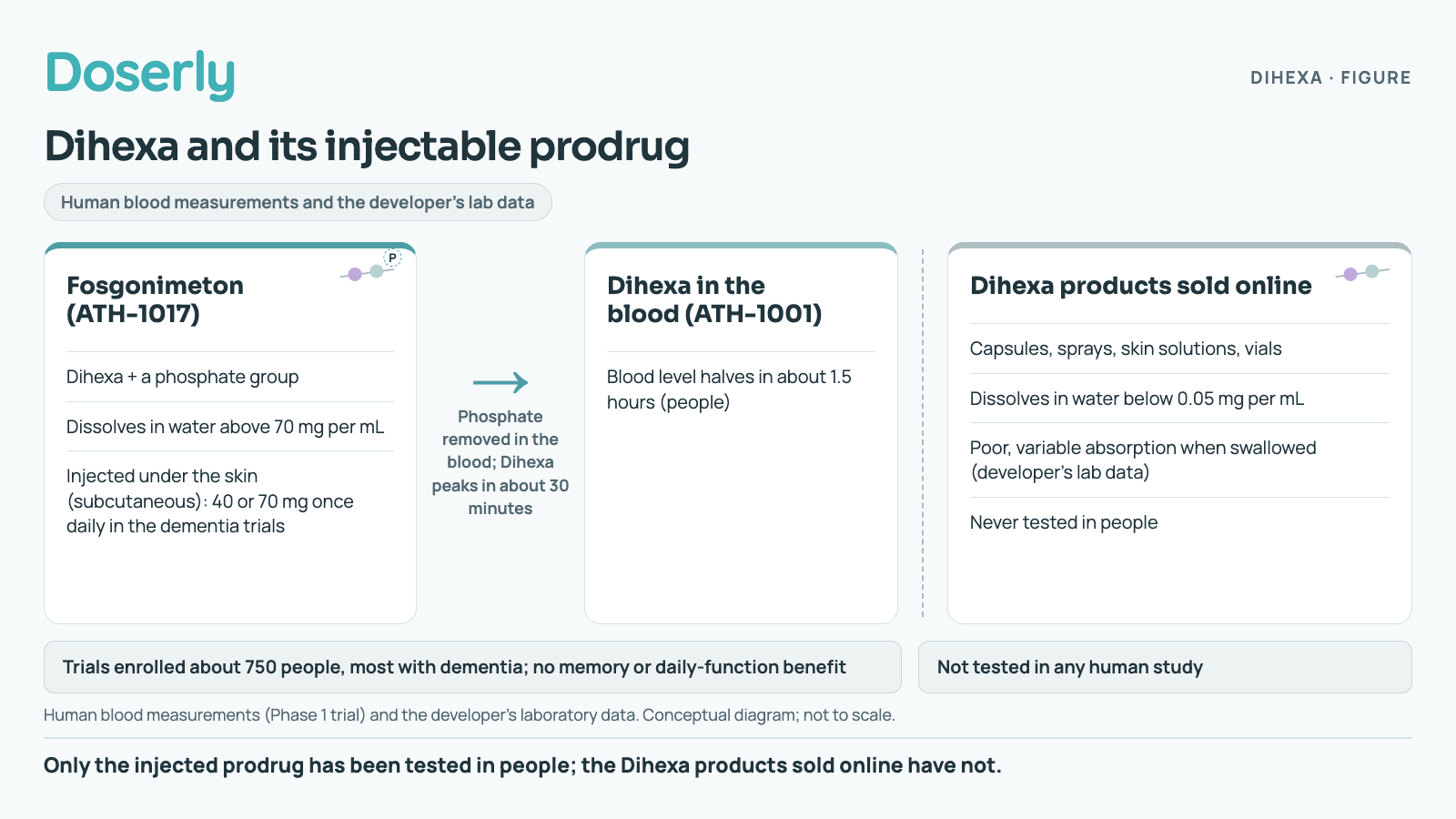
Dihexa and its injectable prodrug
Human blood measurements and the developer's lab data
- Fosgonimeton (ATH-1017)
- Dihexa + a phosphate groupDissolves in water above 70 mg per mLInjected under the skin (subcutaneous): 40 or 70 mg once daily in the dementia trials
→ Phosphate removed in the blood; Dihexa peaks in about 30 minutes
- Dihexa in the blood (ATH-1001)
- Blood level halves in about 1.5 hours (people)
- Dihexa products sold online
- Capsules, sprays, skin solutions, vialsDissolves in water below 0.05 mg per mLPoor, variable absorption when swallowed (developer's lab data)Never tested in people
Trials enrolled about 750 people, most with dementia; no memory or daily-function benefit
Not tested in any human study
Only the injected prodrug has been tested in people; the Dihexa products sold online have not.
Typical Dihexa Protocols
| Example | Amount each time | Frequency | Total per day | Duration |
|---|---|---|---|---|
| Low | 5–10 mg | Once daily | 5–10 mg | 2–4 weeks |
| Mid | 10–20 mg | Once daily | 10–20 mg | 4–8 weeks |
| High | Not stated | Daily | 10–50 mg | 2–4 weeks Short course, followed by at least as long off |
The most common protocol in the reviewed sources is 5–20 mg taken by mouth once a day, for about 2–8 weeks. [1], [14], [15], [16], [17]
- Titration Changing the amount in steps
- The usual approach starts at 5 mg a day and moves toward 10–20 mg a day if the starting amount is tolerated. One page lays out a ladder of 5–10 mg to start, 10–20 mg to maintain and 20–30 mg as an exploratory upper end. A compounding-style page starts lower still: 1 mg a day in week 1, 2 mg in week 2, then 3–5 mg. [15], [17], [18], [2]
Read the units: Dihexa amounts are written in milligrams (mg), not the micrograms (mcg) used for most peptides; 1 mg equals 1,000 mcg. The dose is the amount each time and the daily total adds up a day's doses. The amounts refer to Dihexa itself. A blend capsule's total weight is not its Dihexa content, and nasal-spray amounts are often given per spray in micrograms.
Each row is a complete schedule as published, so its amount and duration belong together: the high example is a shorter course, not a longer one at a higher dose. Low, mid and high are alternatives, not steps to move through. These schedules come from protocol sources rather than clinical trials; the cited references give the full details. [1], [13] No human study has tested any of them, and in a mouse hearing study, the compound identified as Dihexa harmed hearing at every dose tested (see risks). [19]
What people actually report doing. In the public forum threads we reviewed, people mostly describe swallowing 5, 10 or 20 mg capsules, which are the strengths sold. How often they take them varies more than the amount: daily, three times a week, every other day or once a week. A few describe 50 mg a day or more. [20], [21], [22] Community education groups describe the same capsule strengths, a similar spread of schedules and courses of about 30–60 days.
Only the injected prodrug has been dosed in human studies. Fosgonimeton was given by subcutaneous injection (into the fatty layer under the skin): single doses of 2–90 mg and 20–80 mg daily for nine days in the first safety study, then 40 or 70 mg once a day for 26 weeks in the dementia trials. Fosgonimeton milligrams are not Dihexa milligrams, and the dementia trials did not show a benefit. [11], [23], [24]
What amounts do sites give for other routes?
| Route | Amount each time | Frequency | Duration |
|---|---|---|---|
| Sublingual (held under the tongue) | 5–10 mg | Once daily | 2–4 weeks [1] |
| Intranasal (nasal spray) | 1–5 mg | Once daily | 2–4 weeks [1] |
| Intranasal, compounded spray | 0.5–1 mg per nostril (1–2 mg total) | Once daily in the morning | Not stated [2] |
| Transdermal (dissolved in DMSO on the skin) | 5–20 mg | Daily | Not stated [15] |
| Compounded cream, 20 mg per mL | 0.5–1 mL (10–20 mg of Dihexa in the cream) | Once daily | Not stated [25], [26] |
| Subcutaneous injection (into the fatty layer under the skin) | 1–3 mg (5 mg vial) or 1–5 mg (10 mg vial), dissolved in DMSO first | Daily in the morning | Not stated [2] |
| Subcutaneous injection, first-time example | 5–10 mg | Once daily | 2 weeks on, then 2–4 weeks off [27] |
| Subcutaneous injection, general example | 10–20 mg | Once daily in the morning | 2–4 weeks on, then 2–4 weeks off [27] |
These routes are not interchangeable. A cream's stated content is not the amount absorbed, and the injected amounts assume the powder has dissolved, which plain water does not do well (see how Dihexa behaves by route). Some of these injection amounts come from pages that lean on rat experiments, which cannot set a human dose. [27], [12]
What is in Dihexa blends?
Dihexa is also sold mixed with other compounds. The amounts below are what sellers list for each capsule, tablet or bottle. Tesofensine is an unapproved weight-loss drug that acts on serotonin, noradrenaline and dopamine; its risks are covered under interactions.
| Blend | Form | Listed amounts | Directions on the page |
|---|---|---|---|
| Dihexa + tesofensine + BPC-157 (sold as a "brain blend"), first seller | Tablet | Dihexa 10 mg, tesofensine 250 mcg, BPC-157 125 mcg per tablet | One tablet daily; 2 months on, 1 month off [28] |
| Same formula, second seller | Tablet | Dihexa 10 mg, tesofensine 250 mcg, BPC-157 125 mcg per tablet | One tablet in the morning, up to two a day; no course length stated [29] |
| Same formula, third seller | Tablet | Dihexa 10 mg, tesofensine 250 mcg, BPC-157 125 mcg per tablet | Not stated [30] |
| Dihexa + tesofensine | Capsule | Dihexa 5 mg, tesofensine 500 mcg per capsule | Not stated [31], [32] |
| Dihexa + methylene blue + tesofensine | Capsule | Dihexa 5 mg, methylene blue 50 mg, tesofensine 0.5 mg per capsule (one listing) | Not stated [33] |
| Semax + Selank + Dihexa nasal spray | Nasal spray | 5 mg of each per bottle (one seller); 5 mg in total and 50 mcg per spray (another) | Not stated [34], [35] |
| "Limitless" capsules (Dihexa + Selank + Semax + NAD+) | Capsule | Dihexa 2 mg, Selank 0.3 mg, Semax 0.3 mg, NAD+ 100 mg per capsule | Not stated [36] |
| Dihexa + J-147 + noopept | Capsule | 10 mg of each per two-capsule serving | Not stated [37] |
NAD+ (nicotinamide adenine dinucleotide) is a molecule involved in cell energy. J-147 is an experimental compound, and noopept is a lab-made compound sold as a nootropic (a substance used in the hope of better thinking). No study has tested any of these combinations. With two or more active ingredients, a report of feeling better or worse cannot show which one was responsible. Three sellers list the identical tablet formula, so they may share one source. [28], [29], [30]
Where protocols differ: timing, amounts, routes and stopping ↓
Where these numbers come from
The low and mid rows come from reference [1], which lists a beginner and a standard oral schedule with their durations and an equal or longer break. The high row comes from reference [13], which gives a daily range of roughly 10–50 mg by mouth, short cycles of 2–4 weeks and at least as long off; it does not say how many doses the daily total is split into. References [14], [15], [16] and [17] cross-check the recurring 5–20 mg once-daily amount. Matching pages are not independent proof: several repeat the same convention, and none cites a human dose-finding study.
We keep each source's amount, frequency and course length together rather than combining one page's amount with another's duration. Excluded from the typical comparison: a page that describes a different compound (a Russian anti-anxiety peptide) under the Dihexa name [38]; a vendor page that invents a university Phase 1 trial of Dihexa; unit errors such as a printed range of "2 mg-2013 mg" [39]; clinic-style pages with 30–50 mg a day for an Alzheimer's use case [40]; and self-experiments from 2013–2014 with single doses of hundreds of milligrams. The three-ingredient capsule amounts come from one listing that could not be re-checked by hand because the page loads dynamically.
What is Dihexa commonly used for?
Most people who look into Dihexa want a sharper mind: better memory, faster learning, clearer focus or relief from brain fog. A second group is looking for help with something more serious, such as a relative's dementia, recovery after a stroke or head injury, Parkinson's disease or low mood.
What connects these is the hope that Dihexa helps brain cells form new connections. That idea comes from preclinical research: animal studies in rats and cell studies, some of which have since been retracted or flagged. The sections below describe what people hope for and what has actually been tested; they do not establish that Dihexa treats any condition. [7], [41]
Memory, focus and learning
This is the main reason people try it. They describe hoping for quicker recall, easier studying, better word-finding and a clearer head, often for exams, demanding work or learning a language. Many take it alongside other nootropics, such as noopept, Semax or Selank, which makes Dihexa's own part hard to judge. [42], [43], [44]
No study has tested Dihexa for memory or focus in healthy people. The evidence behind the hope is rat maze experiments and nerve cells grown in a dish, described in the mechanism section. [7], [45]
Dementia and Alzheimer's disease
Dihexa was developed with Alzheimer's-type dementia in mind, and caregivers sometimes give it to older relatives. This is the one use that has been tested in people, through the injected prodrug fosgonimeton, and the results were negative: in a 26-week trial of 554 people with mild to moderate Alzheimer's disease, it did not improve memory tests or daily function compared with placebo. [7], [23], [22]
That trial matters for anyone thinking about Dihexa for a relative. It tested the most direct form of the idea, at doses far better controlled than any capsule, and it did not work. People already taking standard dementia medicines did numerically worse on it, as explained under interactions. [23]
Brain injury, concussion and stroke
Some people use it after concussion, repeated head injury or stroke, hoping to rebuild lost function. A 2025 rat study reported better working memory after repeated mild brain injury, but the compound was infused directly into the brain (intracerebroventricular), which is not how any product is used. There are no human studies for these uses. [46], [47]
Parkinson's disease and other brain conditions
Claims that Dihexa "reversed Parkinson's symptoms" trace back to a 2013 review in which its developers described improved movement in rats as "unpublished results"; no peer-reviewed Parkinson's study of Dihexa itself was found. [48] The prodrug was tested in 28 people with dementia linked to Parkinson's disease or Lewy bodies; enrolment ended early and the company reported that it missed its main goal. An independent rat study of a Huntington's-like condition found no protection. [49], [50], [51]
Mood, depression and motivation
A smaller group hopes for better mood, motivation or relief from anhedonia (losing the ability to feel pleasure). Forum reports point both ways: some describe calmer, more resilient moods, while others describe emotional blunting, anxiety or paranoia. No study has tested Dihexa for mood. [52], [22], [53]
Other uses you may come across
Dihexa has also been studied for protecting hearing cells, in rat nerve repair and, in laboratories, as a low-cost stand-in for a growth factor when growing liver-like cells from stem cells. None of these is a human use, and the hearing research ended with a warning sign (see risks). [54], [19], [55], [56]
Where do Dihexa protocols differ?
The amount people take is fairly settled around 5–20 mg. Almost everything around it is disputed: how often, which route, how long, and whether a break is needed. Here is what those differences mean when reading a protocol.
Daily, a few times a week, or weekly?
This is the biggest disagreement. Many pages describe once-daily use; others say two or three times a week or every other day. [1], [57], [58] Community education groups teach several of these schedules at once, from daily use to weekly use, and some educators warn against taking it every day.
The non-daily schedules usually lean on the rat half-life of about 12.7 days, while the human prodrug study found about 1.5 hours (details). Neither number has been linked to how long any effect lasts, so no human evidence supports one schedule over another. [7], [11]
Is a bigger dose stronger?
Not in any way that has been measured. Amounts on protocol pages and in forum accounts run from 1 mg a day to 50 mg a day. In a public forum, one person took 10 mg on five days a week for months, plus several 20 mg doses, and noticed nothing; another took 50 mg a day from the start and described emotional flatness and "tunnel vision". A higher reported amount is not a verified safe ceiling. [2], [20], [22], [40]
Swallowed, under the tongue, on the skin, in the nose or injected?
Sources split into two camps. One treats capsules as the intended route and discourages injection because the powder will not dissolve in water; the other says capsules absorb poorly and prefers the tongue, the skin, the nose or injection. The developer's data support part of each view, and no human data exist for any of these routes (details). [12], [2], [15]
How long, and are breaks needed?
Pages describe courses from 2 weeks to 90 days, and breaks from "equal time off" to 30 days after 90 days on. No study has tested whether a break changes anything. [1], [18], [13]
Where do the sources disagree most?
- Frequency: once daily versus a few times a week, each defended with a half-life from a different species. [1], [57], [7], [11]
- Upper amount: most pages stop at 20 mg a day, while some clinic-style pages reach 50 mg a day and one page describes 20 mg two to three times daily. [40], [59], [13]
- Route: the same page may call Dihexa orally active and also recommend a skin or injection route because swallowing works poorly. [16], [15]
- Inconsistent pages: one page gives both a 2-hour and a 12–13-day half-life; another prints "2 mg-2013 mg"; one describes a different compound entirely. Check what each number refers to. [59], [39], [38]
Why do some sites give a dose per kilogram of body weight?
The rat memory experiments used 1.25–2 mg per kilogram of body weight by mouth. Some pages convert those rat doses into adult amounts with a body-surface formula and use the result to support their own numbers. That conversion does not establish a dose for people: rats and people absorb and clear Dihexa very differently, and the rat paper it relies on is under a notice of concern. [7], [11], [14], [27]
How do milligrams convert to syringe units?
Many people meet "units" on an insulin syringe. A U-100 syringe has 100 units per millilitre, so units measure volume, not an amount of Dihexa. For example, a 10 mg vial mixed into 2 mL of liquid in total gives 5 mg per mL, or 0.05 mg (50 mcg) per unit, so 2 mg would be 40 units. Doserly's reconstitution calculator works this out for any vial and shows each step. [2]
That arithmetic only holds if the powder has fully dissolved when it is mixed (reconstituted). The developer measured Dihexa's solubility in water at less than 50 mcg per mL, so dissolving 10 mg in water alone would take more than 200 mL. Vials mixed with a millilitre or two of water are likely to be a cloudy suspension, and a syringe drawn from it can hold very different amounts. Protocol pages that describe injection dissolve the powder in DMSO first. [12], [15], [2]
Source-by-source comparison
Which pages describe once-daily use?
Unit key: 1 milligram (mg) = 1,000 micrograms (mcg).
DailyVial lists a beginner oral schedule of 5–10 mg once daily for 2–4 weeks and a standard schedule of 10–20 mg once daily for 4–8 weeks, with an equal or longer break. Peptides Insider describes 5–20 mg once daily in 2–4-week blocks. PeptideX gives 8–10 mg once daily as the most quoted amount, within a reported 5–20 mg range and 2–8-week courses. Peptides Know How lists 10–20 mg once daily with no fixed duration. [1], [14], [15], [16]
Which pages describe fewer doses a week?
Ground Truth Peptides describes 5–20 mg one to three times a week for 4–8 weeks, starting at 1–5 mg and holding for 2–4 weeks, then equal time off. Peptides.ID gives 5 mg once daily or every other day for 4–8 weeks, but the same page wrongly lists the prodrug's codes as Dihexa names and cites papers that do not match its claims. [57], [58]
Which pages go highest?
Jay Campbell's 2026 page describes roughly 10–50 mg a day by mouth in 2–4-week cycles; his 2020 page described 8–45 mg daily. MyPeptideMatch gives 10–50 mg daily in general and 30–50 mg daily for an Alzheimer's use case over 12–24 weeks. Milligram lists 10 or 20 mg two to three times daily. Dihexa.co.uk describes 5–10 mg to start, 10–20 mg to maintain and 20–30 mg as an exploratory upper end, taken daily for about 90 days and then stopped for 30. [13], [60], [40], [59], [18]
Where do injection and cream amounts come from?
PeptideWiki lists subcutaneous tiers of 5–10, 10–20 and 20–30 mg once daily alongside rat-dose conversions, and separate goal-based schedules: 5–10 mg daily for 2 weeks then 2–4 weeks off for first-time use, and 10–20 mg daily for 2–4 weeks then 2–4 weeks off for general use. The table above shows those two complete schedules. Peptide Protocol Portal gives 1–3 mg from a 5 mg vial and 1–5 mg from a 10 mg vial, dissolved in DMSO first, and for troches 2.5–5 mg a day after a 1 mg and 2 mg start. Compounding pharmacy sheets list a 10 mg capsule once daily for 30 days, 10 or 20 mg capsules daily, and a 20 mg per mL cream applied as 0.5–1 mL daily. [27], [2], [61], [26], [25]
What did the trials of the prodrug use?
The fosgonimeton trials gave 40 or 70 mg by subcutaneous injection once a day for 26 weeks, from pre-filled syringes. These were tests of an injected prodrug in people with dementia, not a Dihexa protocol, and the main trials did not meet their goals. [24], [23]
What happens when you stop Dihexa?
This has not been studied. No human or animal study has looked for withdrawal effects or a rebound after stopping Dihexa, or tested whether any benefit lasts. Claims that its effects are permanent because it "builds new connections" have no data behind them. [10], [7]
- In the prodrug trials. LIFT-AD scheduled a safety visit four weeks after the last injection for people who did not move into its extension study, but the published results do not report withdrawal effects, rebound or lasting benefit. What they report is people stopping because of side effects: in the largest trial, 10 of 218 on placebo, 24 of 224 on 40 mg and 23 of 107 on 70 mg, mostly because of injection-site reactions. [24], [23]
- In the developer's patent. One passage claims a brain-wave effect was maintained four weeks after stopping. That is patent language, not a published controlled result. [10]
- In community accounts, fading is more common than lasting change. Several people say the effects faded after each course; one describes about a month of feeling "cognitively dull" before returning to normal, and another describes what they called withdrawal after weekly skin use at up to 40 mg alongside many other compounds. A few say benefits lasted months or "a year later". None of these accounts can separate Dihexa from everything else that changed. [62], [43], [63], [64], [65], [66]
Does Dihexa work when swallowed, and how do other routes compare?
What a capsule contains and what reaches the blood are different things. A swallowed substance meets stomach acid, digestive enzymes and the gut wall before any of it can be absorbed. A spray, a skin solution and an injection each start somewhere else. For Dihexa, human blood levels have been measured only after injections of the prodrug fosgonimeton. Dihexa powder sold online can be injected by the same route, but its blood levels, like those of every other Dihexa product, have never been measured in people.
What has been measured for each route. Swallowed capsule or tablet (oral): Developer: breaks down in simulated gut fluids (7.8% and 0.1% left after 1 hour); poor, variable absorption. Rat paper only predicted absorption by computer. Not measured in people. Under the tongue (sublingual): No absorption data in any species. Not measured in people. Nasal spray (intranasal): No absorption data in any species. Not measured in people. On the skin with DMSO (transdermal): No absorption data in any species. Not measured in people. Injected Dihexa powder: Can be injected by the same route as the prodrug, but barely dissolves in water (under 0.05 mg per mL); no human data. Not measured in people. Injected prodrug, fosgonimeton (subcutaneous): Dihexa peaks in about 30 minutes; blood level halves in about 1.5 hours; no build-up over 9 days. Measured in people. Only the injected prodrug has blood measurements in people. Sources: Phase 1 fosgonimeton trial; developer's laboratory data; original rat study (under a notice of concern). Not a ranking of routes.
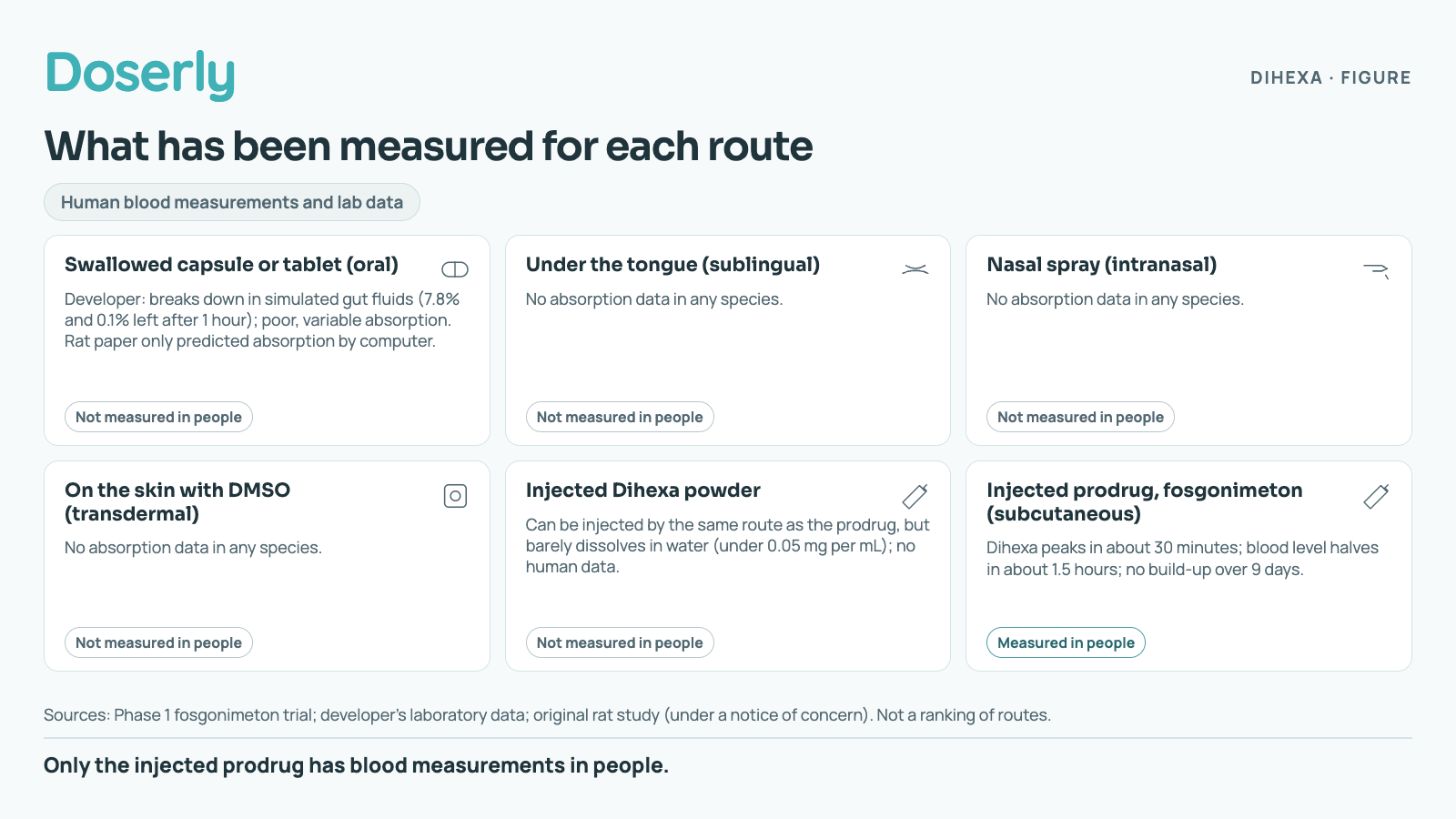
What has been measured for each route
Human blood measurements and lab data
- Swallowed capsule or tablet (oral)
- Developer: breaks down in simulated gut fluids (7.8% and 0.1% left after 1 hour); poor, variable absorption. Rat paper only predicted absorption by computer.Not measured in people
- Under the tongue (sublingual)
- No absorption data in any species.Not measured in people
- Nasal spray (intranasal)
- No absorption data in any species.Not measured in people
- On the skin with DMSO (transdermal)
- No absorption data in any species.Not measured in people
- Injected Dihexa powder
- Can be injected by the same route as the prodrug, but barely dissolves in water (under 0.05 mg per mL); no human data.Not measured in people
- Injected prodrug, fosgonimeton (subcutaneous)
- Dihexa peaks in about 30 minutes; blood level halves in about 1.5 hours; no build-up over 9 days.Measured in people
Only the injected prodrug has blood measurements in people.
Swallowed. The original rat paper called Dihexa "orally active" because rats given it by mouth did better in a maze, but it only predicted oral absorption with a computer model; it did not measure it. The company that later developed Dihexa reported the opposite: in simulated stomach fluid only 7.8% was left after an hour, in simulated intestinal fluid only 0.1%, and it "ultimately has poor oral bioavailability with high variability in exposure." It concluded that Dihexa "is likely not suitable as an oral drug." [7], [12]
Bioavailability is the share of a dose that reaches the blood, one part of pharmacokinetics (how the body absorbs, moves, breaks down and removes a substance). "Poor and variable" means two people taking the same capsule could absorb very different amounts, and that most of it may never be absorbed. No human study has measured Dihexa absorption from a capsule, so the amount is unknown, not zero. [12]
Under the tongue, in the nose or on the skin. No study has measured Dihexa in the blood after sublingual, intranasal or transdermal use. Forum figures such as "1% oral absorption" have no published source. [66], [12]
Injected Dihexa powder. Research vials of Dihexa itself have no human data, and their main problem is physical: the powder barely dissolves in water. That solubility problem is why the developer built fosgonimeton, which dissolves at more than 70 mg per mL. [12]
The injected prodrug. This is the only measured route. After a subcutaneous injection of fosgonimeton, Dihexa appeared in the blood quickly and peaked at about 30 minutes. Levels rose in proportion to the dose and did not build up over nine days of daily injections. There are no human measurements of how much reaches the brain. [11]
How long does Dihexa last in the body?
Half-life is the time it takes for the level in the blood to fall by half. It is not the same as how long an effect lasts, and it can differ hugely between species and routes.
| Measurement | What was found | Where it comes from |
|---|---|---|
| People, after the injected prodrug | Blood level of Dihexa halved in about 1.5 hours | Phase 1 trial of 88 people [11] |
| Rats, intravenous (into a vein) | Halved in about 12.7 days | Original rat paper, under a notice of concern [7] |
| Rats, injected into the abdomen | Halved in about 8.8 days | Same rat paper [7] |
| Rat blood serum in a test tube | About half broken down in 5.6 hours (335 minutes) | Same rat paper [7] |
No study explains the gap between 1.5 hours and 12.7 days. Websites that give Dihexa a 10–13-day human half-life, and forum calculations of about 39 days, are extending the rat number to people without evidence. [7], [11], [59], [66]
Is Dihexa acetate different from Dihexa?
FDA's compounding pages use the name "dihexa acetate". The name normally means the same active molecule paired with acetate, a common salt form for lab-made compounds. Part of a salt's weight is the acetate, so a milligram of a salt form contains less than a milligram of the active molecule; how much less depends on the product, and the cited records do not say. No study compares the two forms in people. [3], [6]
Why is Dihexa mixed with DMSO?
Because it dissolves poorly in water but well in DMSO (dimethyl sulfoxide), a solvent that also passes through skin. Researchers used DMSO to prepare Dihexa for rat injections, and the developer needed pure DMSO for its own animal work. People use DMSO to make skin solutions or to dissolve vials before injection. Forum accounts describe DMSO's strong body odour, itching, burning and skin irritation, which several people gave as their reason for stopping. [7], [12], [67], [68]
How should Dihexa be stored, and how long does it last?
No stability study of any Dihexa product sold online has been published, so storage advice comes from suppliers and protocol pages, not a tested medicine label.
- Powder, before mixing. Protocol pages describe keeping the freeze-dried powder frozen at −20 °C for long-term storage (one claims 24 months), or cool, dry and away from light. In the original research, dry Dihexa was stored at −20 °C. [16], [17], [1], [7]
- After mixing. Pages describe using it within 14 or 28 days when kept in a fridge at 2–8 °C, but one page notes that its "use within about 28 days" figure is a general peptide rule of thumb, "not stability data for dihexa." The same page warns that a 10 mg vial with 1–2 mL of water "probably yields a suspension rather than a true solution." [16], [17], [15]
- Capsules. No published data. Capsule makers list fillers and strengths, but a certificate of purity for one batch does not show how much Dihexa each capsule contains or how long it stays stable.
The only formally stored Dihexa-related product was the trial prodrug: pre-filled 1 mL syringes kept at 2–8 °C at study sites, with room-temperature storage of up to four weeks allowed in the extension study. Those rules apply only to the fosgonimeton syringes, not to Dihexa powder or capsules. [24], [69]
This guide does not cover mixing or injection technique; the Academy note below covers practical handling.
What do we actually know about Dihexa in people?
No study has given a Dihexa product to people. ClinicalTrials.gov lists no trial under "Dihexa" or "PNB-0408". Everything known about Dihexa in the human body comes from the fosgonimeton trials, in which people received the injected prodrug and their blood then contained Dihexa. [4], [5], [11]
Those were proper controlled trials, larger than most peptide research, but they tested one route (a daily injection), mostly older adults with dementia and one question (whether it helped dementia). They cannot tell us what a capsule does in a healthy 30-year-old.
What did the fosgonimeton trials find?
| Trial | Who and what | What researchers reported |
|---|---|---|
| Phase 1, published 2022 | 88 people: healthy young men given single doses of 2–90 mg, healthy older adults given 20–80 mg daily for nine days, and a small group with Alzheimer's disease given 40 mg daily for nine days; all by subcutaneous injection, with placebo comparison | No serious side effects and no maximum tolerated dose found; the related side effects were injection-site pain and itching. Two people left the study, one with a low white-cell count and one with an allergic skin reaction. [11] |
| ACT-AD, 2022 | 77 people with mild to moderate Alzheimer's disease; placebo, 40 mg or 70 mg daily for 26 weeks | Missed its main goal, a brain-wave measure. About 60% were also taking standard dementia medicines, and the company reported that those medicines appeared to weaken the effect. [70], [71] |
| LIFT-AD, 2024 (published 2025) | 554 people with mild to moderate Alzheimer's disease; placebo, 40 mg or 70 mg daily for 26 weeks | No significant difference from placebo in its combined main measure, in memory and thinking tests, or in daily function. [23], [72] |
| SHAPE, 2023 | 28 people with dementia linked to Parkinson's disease or Lewy bodies; placebo, 40 mg or 70 mg daily | Enrolment closed early at 28 people in October 2022, citing study design limits; in December 2023 the company reported that it missed its main goal. [49], [50] |
| Open-label extension | 423 people from the Alzheimer's trials, all given fosgonimeton (open-label, no placebo) | Stopped after LIFT-AD failed. Serious adverse events reported in 54, deaths in 4, injection-site reactions in 213; with no comparison group, causes cannot be assigned. [73] |
A small study of how the body breaks down and removes fosgonimeton enrolled eight healthy men and is marked completed, but no results have been posted. The developer, now named LeonaBio, says it has "paused further development" of fosgonimeton. [74], [75]
What does "no significant difference" mean here?
LIFT-AD's main analysis used the 287 participants who were not taking standard dementia medicines. In that group, people on fosgonimeton scored 0.70 points better than placebo on an 11-part memory and thinking test and 0.67 points better on a daily-activities scale, but differences that small could easily be chance (the p-values were 0.35 and 0.61). The combined main measure differed by −0.08, with a p-value of 0.70. Both groups improved slightly in the first weeks and drifted back toward where they started by week 26. [23]
In plain terms: after six months of daily injections, the people who got the drug were not measurably better off than those given placebo. The authors noted small differences that consistently favoured fosgonimeton, and that is a reason some researchers remain interested, but it is not evidence of a benefit a person would notice. [23]
Does the prodrug trial tell us anything about capsules?
A little, and mostly about safety. The trials describe what happened when older adults had Dihexa in their blood from 40–70 mg injections for 26 weeks: very common injection-site reactions, a rise in one type of white blood cell in some people, more people stopping treatment and a few serious events the investigators suspected were related (see risks). They do not show what a capsule delivers, because absorption by mouth has never been measured in people. [23], [12]
They also do not transfer to groups the trials left out: younger adults, pregnant women, people with cancer in the previous three years, people with liver or kidney disease, and people with seizure disorders. [24], [76]
Was Dihexa research retracted?
Yes, some of it. The research record behind Dihexa has serious integrity problems, and they matter for every claim built on it.
From press release to paused programme. 2011–2015, Research record: Licensing company works on Dihexa, then stops: it lacked 'the appropriate characteristics needed to be a successful therapeutic product'. Oct 2012, Research record: University press release: 'seven orders of magnitude more powerful than BDNF'. Jan 2013, Research record: Original rat paper. Nov 2014, Research record: HGF/MET mechanism paper. Sep 2021, Research record: Journal places notices of concern on four papers, including both. Oct 2021, Research record: Company special committee finds altered images in at least four research papers. 2022, Human trials of the prodrug: Phase 1 published (88 people); ACT-AD misses its main goal (77 people). Dec 2023, Human trials of the prodrug: SHAPE (28 people; closed early Oct 2022) misses main goal. Sep 2024, Human trials of the prodrug: LIFT-AD (554 people) finds no significant benefit; published Dec 2025. Apr 2025, Research record: Mechanism paper and two related papers retracted; original rat paper still under a notice of concern. Aug 2026, Human trials of the prodrug: Developer, now LeonaBio, says fosgonimeton development is paused. Not to time scale. As of August 2026, fosgonimeton development was paused; no Dihexa product has been tested in people. Journal notices, company filings and trial registries. Dates are publication or filing dates.
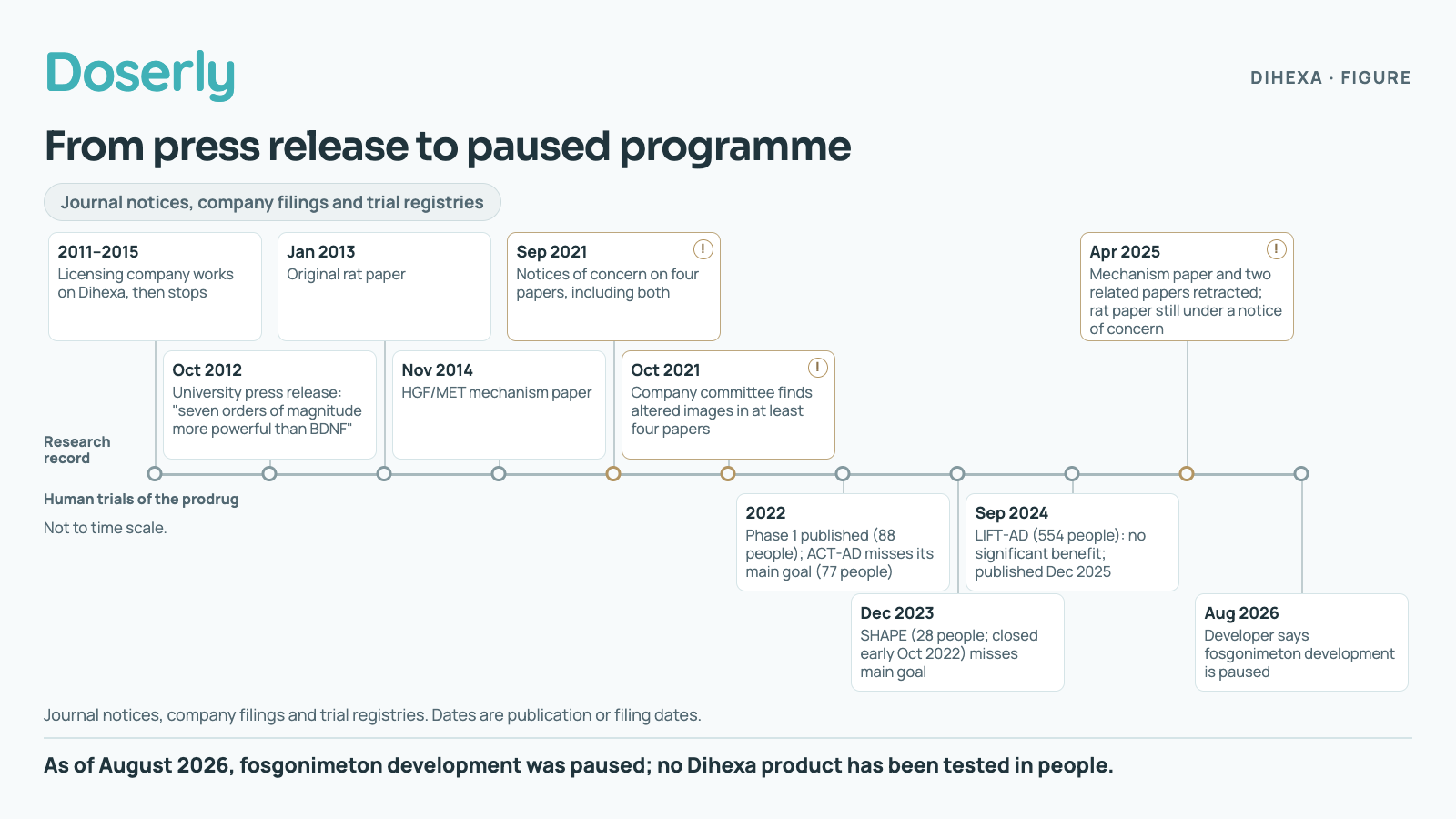
From press release to paused programme
Journal notices, company filings and trial registries
Not to time scale.
- 2011–2015 Research record
- Licensing company works on Dihexa, then stops: it lacked 'the appropriate characteristics needed to be a successful therapeutic product'
- Oct 2012 Research record
- University press release: 'seven orders of magnitude more powerful than BDNF'
- Jan 2013 Research record
- Original rat paper
- Nov 2014 Research record
- HGF/MET mechanism paper
- Sep 2021 Research record
- Journal places notices of concern on four papers, including both
- Oct 2021 Research record
- Company special committee finds altered images in at least four research papers
- 2022 Trials
- Phase 1 published (88 people); ACT-AD misses its main goal (77 people)
- Dec 2023 Trials
- SHAPE (28 people; closed early Oct 2022) misses main goal
- Sep 2024 Trials
- LIFT-AD (554 people) finds no significant benefit; published Dec 2025
- Apr 2025 Research record
- Mechanism paper and two related papers retracted; original rat paper still under a notice of concern
- Aug 2026 Trials
- Developer, now LeonaBio, says fosgonimeton development is paused
As of August 2026, fosgonimeton development was paused; no Dihexa product has been tested in people.
| Paper | What it claimed | Status |
|---|---|---|
| McCoy and colleagues, 2013, the original Dihexa paper | Dihexa works by mouth in rats, reaches the brain, restores maze memory and multiplies nerve-cell connections | Notice of concern since September 2021; not retracted as of September 23, 2026 [7], [77] |
| Benoist and colleagues, 2014, the mechanism paper | Dihexa's effects depend on a growth-factor system called HGF/MET | Retracted April 2025. The notice says a university investigation found "falsified and/or fabricated data" in key figures [78], [41] |
| Kawas and colleagues, 2012 | Related compounds act on the HGF/MET system | Retracted April 2025 [79], [80] |
| Kawas and colleagues, 2011 | Related anti-cancer compounds (not Dihexa) | Retracted April 2025 [81], [82] |
The 2025 retraction notice names the university's investigation and states that two of the authors "were found to be solely responsible." Earlier, in 2021, the company developing fosgonimeton disclosed that a special committee had found its former chief executive "altered images in her 2011 doctoral dissertation and at least four research papers", and that a university patent for Dihexa used images from papers, some of which were altered. [41], [9]
This does not prove every Dihexa result is false. It does mean the central explanation of how Dihexa works is retracted, the founding paper is flagged, and independent confirmation is thin. The "seven orders of magnitude more powerful than BDNF" figure does not appear in the 2013 paper at all; its earliest public source is the 2012 university press release. [7], [8]
How might Dihexa work?
Both main explanations rest largely on work from the laboratory that created Dihexa, and the most cited one has been retracted.
Does Dihexa build new brain connections?
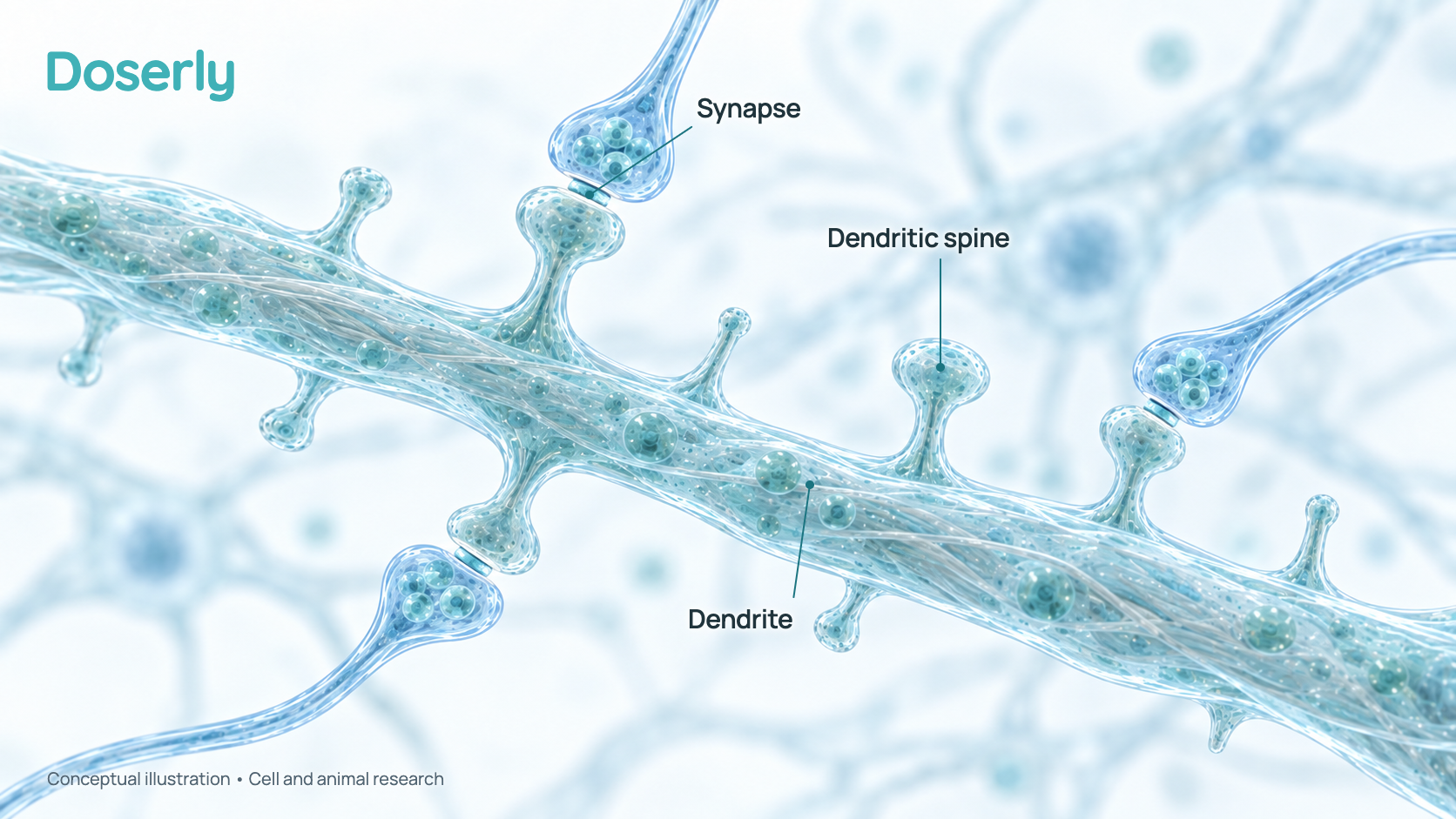
That is the central claim. A synapse is a connection between two nerve cells, and many sit on tiny bumps called dendritic spines. In the 2013 paper, rat hippocampal nerve cells grown in a dish for five days with a vanishingly small concentration of Dihexa (one picomolar, a trillionth of a mole per litre) had about three times as many spines. The same paper reported that rats given Dihexa by mouth performed better in a water maze after a memory-blocking drug, and that aged rats learned faster. [7]
Building connections is synaptogenesis, not neurogenesis (making new nerve cells). Some websites and forum posts call Dihexa "neurogenic"; the studies describe connections, not new cells. All of these findings come from the paper under a notice of concern. [7], [77]
Does it act on the HGF/MET system?
This was the proposed mechanism: that Dihexa binds hepatocyte growth factor (HGF) and strengthens its signal through the MET receptor, a pathway involved in cell growth and repair (HGF/MET). The paper that made this case was retracted in 2025 for falsified or fabricated data, so it can only be described as a retracted claim. [78], [41]
Some support for the pathway comes from elsewhere. The developer reported that fosgonimeton's active form boosted HGF/MET signalling in its own laboratory tests, and a 2025 rat brain-injury study described its compound as an HGF/MET activator. Neither is independent of the pathway's original proponents in every respect, and neither shows the pathway working in human brains. [12], [46]
What about angiotensin IV and PI3K/AKT?
Dihexa was built from angiotensin IV, a fragment of the hormone angiotensin that has been studied for memory in animals since the 1990s; a 2018 systematic review found that angiotensin IV and related compounds improved memory deficits in 8 of 9 animal studies, mostly with injections into the brain. An independent 2021 mouse study linked Dihexa's effects to PI3K/AKT, a cell-survival signalling pathway, and to lower brain inflammation markers. [47], [45]
Is Dihexa 10 million times stronger than BDNF?
No evidence shows that. The figure comes from a 2012 university press release that described a laboratory comparison with BDNF (brain-derived neurotrophic factor, a natural growth factor for nerve cells). No published head-to-head data support it, it is not in the 2013 paper, and a laboratory potency figure would not show how strongly anything acts in a living brain. [8], [7]
What did later animal studies find?
The results are mixed. Some came from independent teams; the hearing study included one of Dihexa's original developers. [45], [51], [19], [46]
- Positive: Alzheimer's-model mice given Dihexa daily for three months did better in a water maze (the paper describes the route both as into the stomach and as into the abdomen), and rats with repeated mild brain injury had better working memory after infusions into the brain.
- Negative: in a rat model of Huntington's disease, Dihexa did not protect against movement or memory problems.
- A warning sign: in a 2023 mouse study of a compound the publisher identifies as Dihexa, it protected inner-ear hair cells in a dish but did not protect living mice from an antibiotic that damages hearing, and it was itself "ototoxic to mice across the dose range tested" (ototoxic means harmful to hearing).
What are the risks and unanswered questions?
Is Dihexa safe?
Its safety as a product has not been established. FDA says it "has not identified any human exposure data on drug products containing dihexa acetate administered via any route" and lacks information on "whether it would cause harm if administered to humans." [3]
The prodrug trials add something FDA's statement does not cover: older adults given daily injections for 26 weeks did not have more serious adverse events overall than those on placebo, although more of them stopped because of side effects. That is limited reassurance; it does not cover capsules, impure products, younger people, longer use or the combinations people actually take. [23], [72]
What side effects have been reported?
In the prodrug trials. Injection-site reactions were by far the most common adverse events: in LIFT-AD, 14.2% of people on placebo, 57.1% on 40 mg and 72.9% on 70 mg, mostly mild to moderate. Some people developed eosinophilia, a rise in eosinophils (white blood cells involved in allergy): 16 of 224 on 40 mg and 8 of 107 on 70 mg, against none of 218 on placebo. The researchers described these rises as temporary, without symptoms and reversible. Serious adverse events were not more common than on placebo (4.9% and 2.8% versus 6.9%), but investigators suspected that five of them were related to fosgonimeton, including two cases of angioedema (deep swelling of the face, lips or throat, often an allergic reaction). No one died during LIFT-AD. [23], [72]
In community accounts. In the threads we reviewed, people most often describe overstimulation, restlessness or edginess, trouble sleeping, headaches, anxiety and sometimes the opposite: sleepiness or emotional flatness. Older forum threads add raised blood pressure, vivid dreams and, with DMSO skin solutions, itching, burning and odour. These are reports, not measured rates, and most involve other compounds taken at the same time. [42], [44], [21], [83], [66], [67]
Could Dihexa affect hearing?
There is one animal warning. In the 2023 mouse study, the compound identified as Dihexa was harmful to hearing at every dose tested in living mice. No human study has checked hearing, including the fosgonimeton trials, so the question is open. [19]
Does Dihexa cause cancer?
Nobody knows. No carcinogenicity study has tested whether Dihexa causes or speeds up tumours, and there are no human data either way. [3]
The concern is theoretical. The HGF/MET pathway that Dihexa was claimed to activate helps many cancers grow and spread, and some cancer drugs work by blocking it. If Dihexa does act on that pathway, that is a reason for caution in people with cancer; but the paper that tied Dihexa to the pathway is retracted, and a related paper that claimed anti-cancer effects for similar compounds is retracted too. The fosgonimeton trials excluded people who had had cancer in the previous three years. [84], [41], [82], [24]
Could product quality change the risk?
Yes. What a bottle claims and what it contains are separate questions, and Dihexa is hard to check. One forum thread reports that a local lab identified a product sold as Dihexa as a different research compound, NSI-189; others doubted their product because it would not dissolve or had no effect. Certificates of analysis, when they exist, show purity for one batch of powder, not the content of each capsule, sterility or stability after mixing. [85], [42], [15]
Supply is also changing. People in community education groups describe several sellers removing Dihexa in 2026. That does not mean it has been scheduled or banned; we found no such listing in the countries checked below.
Is Dihexa legal? Is it FDA-approved?
Checked September 23, 2026. Rules differ by country and change quickly. A "research use only" label does not make a product legal to sell as a medicine or safe to use.
United States. Dihexa is not an FDA-approved medicine. [3]
- Earlier. FDA had placed dihexa acetate in the category of nominated compounding ingredients that may present significant safety risks. [3]
- April 2026. FDA's safety-risk page (content current April 22, 2026) lists dihexa acetate under substances "nominated but withdrawn", with its statement that it has no human exposure data. A separate FDA page (content current April 15, 2026) lists dihexa acetate among substances its Pharmacy Compounding Advisory Committee will discuss for the list of ingredients pharmacies may use, at a meeting to be held "before the end of February 2027". [3], [86]
- May 2026. FDA's list of nominated compounding substances, updated May 14, 2026, does not include dihexa. [87]
- September 2026. No meeting date, briefing document or vote had been posted. A committee vote would be advice, not an FDA decision, and even an ingredient allowed for compounding would not be an FDA-approved medicine. [86]
Canada. Health Canada's Drug Product Database lists no product containing Dihexa or fosgonimeton, so no Dihexa drug is authorized for sale. Health Canada's April 2026 advisory on unauthorized peptide drugs does not name Dihexa, but it states that unauthorized drug products are illegal in Canada and that "For Research Use Only" labelling "does not make these products legal." Dihexa is not named in Canada's controlled-substance law. [88], [89], [90]
Australia. Dihexa is not named in the June 2026 Poisons Standard, and we found no Australian approval or Dihexa-specific notice from the regulator. Not being named does not make it an approved medicine or legal to supply as one. [91]
United Kingdom. We found no Dihexa or fosgonimeton product in the UK medicines regulator's product search. That search shows no approved product; it does not mean selling Dihexa is permitted. [92]
Is Dihexa banned in sport? Does it show up on a drug test?
Treat it as banned. Dihexa is not named on the World Anti-Doping Agency's 2026 or 2027 Prohibited Lists, but category S0 bans, at all times, pharmacological substances not covered elsewhere on the list that have no current government approval for human therapeutic use, including drugs in development or discontinued. Dihexa has no such approval anywhere we checked. Category S2.3 names hepatocyte growth factor and certain growth-factor modulators that affect muscle, tendon or ligament tissue, but it does not name Dihexa. WADA has not published a Dihexa-specific ruling. [93], [94]
The lists give no Dihexa-specific test method or detection window, and the half-life figures earlier in this guide do not answer that question. None of this makes it permitted: a banned substance is an anti-doping violation whether or not a particular test detects it. [93], [94]
Blends add a clearer problem: tesofensine is named on the Prohibited List as a stimulant banned in competition. [93]
Who should be especially cautious?
No trial has tested the safety of Dihexa products in any of these groups. The fosgonimeton trials included older adults with dementia but left out or restricted several of the other groups below, which means they are unstudied, not that harm has been shown. Community discussions show that many people using Dihexa belong to these groups.
- Pregnancy and breastfeeding. The Phase 1 and Alzheimer's trials enrolled only women who could not become pregnant, and no reproductive or breastfeeding study exists. [24], [11]
- A history of cancer. Because of the unresolved HGF/MET question and the lack of any tumour study; the trials excluded cancer in the previous three years. [24]
- Older adults with dementia, stroke or Parkinson's disease, especially when a relative is giving it. A public forum account describes a relative giving it to a parent with dementia, and community education groups discuss similar cases. [22] The trials in dementia found no benefit, and people already on dementia medicines did numerically worse (see interactions). [23]
- Seizures or epilepsy. The trials excluded people taking seizure medicines for seizure control and people with certain seizure histories. [24], [76]
- Liver, kidney or heart problems. The trials excluded significant liver or kidney impairment, prolonged heart-rhythm (QTc) readings and unstable heart disease. [24]
- Mental health conditions. The trials screened for suicidal thoughts during the study, and community accounts include anxiety, paranoia, overstimulation and feeling "hypomanic" (unusually high and driven). [24], [52], [53]
- Under 18, and anyone considering it instead of prescribed ADHD medicine. No study includes young people, and nothing shows Dihexa can replace a prescribed treatment. This guide is written for adults.
- Competitive athletes. See sport rules above. [93]
Has Dihexa been tested alongside other medicines?
Not in any dedicated study. No Dihexa product has been tested with other medicines, and there is no drug-interaction study for Dihexa or fosgonimeton and no published data on which liver enzymes break it down or how it is removed from the body. Some trial participants took fosgonimeton alongside standard dementia medicines, which produced the one uncertain signal below. Otherwise, interactions are "not studied", which is different from "none known". [24], [11], [23], [70]
- Dementia medicines. This is the one interaction-like signal in people. In ACT-AD, the company reported that standard dementia drugs called acetylcholinesterase inhibitors (such as donepezil) appeared to weaken fosgonimeton's effect, and it stopped enrolling people taking them in LIFT-AD. In LIFT-AD's subgroup of 173 people on these drugs, those given fosgonimeton declined slightly more than those on placebo on memory tests (+0.88 points, p=0.33) and daily function (−2.05 points, p=0.08). The differences could be chance, and the trial failed overall, so this is a possible blunting, not a proven harmful interaction. Memantine, another dementia drug, was excluded from the trial. [70], [24], [23]
- Other trial rules. LIFT-AD also excluded seizure medicines taken for seizure control, drugs taken by mouth or injection that moderately or strongly block or speed up a liver enzyme called CYP3A4, supplements taken for memory, and THC (the active compound in cannabis). These were entry rules, not interactions shown to happen. [24]
- Cannabis. Two forum accounts, eleven years apart, describe cannabis feeling much stronger than usual while taking Dihexa. These are personal reports, not a tested interaction. [95], [96]
- Stimulants and ADHD medicines. Some people describe stimulants feeling blunted while on Dihexa, others describe feeling overstimulated, and one person had a panic attack when combining it with modafinil. Nothing has been tested. [97], [98], [99], [21]
- Blood-pressure medicines and cancer drugs. Some websites warn about these because of Dihexa's angiotensin origin or its claimed HGF/MET action. These are theoretical, untested concerns. [16], [100]
- Blends with methylene blue and tesofensine. Methylene blue's US label carries a boxed warning that it "may cause serious or fatal serotonergic syndrome" (serotonin syndrome, a dangerous excess of serotonin) with serotonergic drugs, and says to avoid combining it with common antidepressants that act on serotonin, antidepressants called monoamine oxidase inhibitors, and opioids. Tesofensine itself blocks serotonin reuptake. The three-ingredient capsule has never been studied, but it combines exactly the kinds of drugs that warning describes. Tesofensine also raised heart rate in its trials. [101], [102]
Bring a complete list of everything you take, including supplements and blends, to a pharmacist or doctor.
What should be monitored while using Dihexa?
No regulator has approved Dihexa, so there is no official monitoring plan. What exists is a record of what the fosgonimeton trials measured, which can help you prepare questions for a clinician; it is not a personal testing plan. [24], [11]
What did the trials check?
- Phase 1 tracked heart rhythm (ECG), brain waves (EEG), blood counts, blood chemistry including liver tests, urine, vital signs, a structured suicide-risk questionnaire and physical and neurological examinations. The authors reported no serious adverse events and no clinically relevant findings in most of these tests, but one person had a moderate drop in a type of white blood cell and another had a moderate allergic skin reaction; both left the study. [11]
- The 26-week dementia trials held clinic visits on day 1 and at weeks 2, 6, 12, 16, 20 and 26, with a later safety follow-up. Checks included injection sites, blood pressure lying down and standing, pulse, weight, triple ECG readings with the heart-rhythm measure QTc, blood and urine tests, a suicide-risk questionnaire and the Geriatric Depression Scale; the schedule varied by test. [24], [103]
- What they did not check: the protocols list no hearing tests, and brain imaging was used only to confirm who could join, not repeated during treatment. [24]
Which signals matter, and why?
| Why it matters | What studies measured or found | Tracking category |
|---|---|---|
| Allergy-type blood change | Eosinophilia was reported as an adverse event in about 7% of people on fosgonimeton and none on placebo [23] | Blood work |
| Injection-site reactions | The most common side effect of the injected prodrug, in up to 73% of people [23] | Side Effect Burden; Skin Health |
| Liver and kidney | Checked during the trials; people with impairment were excluded [24] | Blood work |
| Heart and circulation | Blood pressure, pulse and ECG in the trials; raised blood pressure in some forum accounts [24], [66] | Blood Pressure; Heart Rate & Palpitations |
| Mood and suicidal thoughts | Screened during the trials; anxiety and paranoia in community accounts [24], [53] | Mood & Wellbeing; Anxiety; Emotional Regulation |
| Sleep | Not measured in trials; insomnia and sleepiness are common forum complaints [44], [42] | Sleep Quality |
| Hearing | Never measured in people; a mouse study found harm to hearing [19] | Other |
| The goal you care about | Memory, thinking and daily-function scales in the trials [23] | Memory & Cognition; Focus & Mental Clarity; Daily Functioning |
The eosinophil and injection-site findings come from the injected prodrug in older adults. They show what researchers found, not what a capsule will do to you. Discuss with a clinician which, if any, checks make sense for you.
What do people in public communities report?
Public discussions of Dihexa go back to 2012 and range from enthusiastic to disappointed. The most useful accounts say exactly what was taken, what else changed and what happened weeks later. The follow-ups often tell a different story from the first post. [66], [42]
What do the positive reports look like?
Positive reports are usually subtle: clearer or more organised thinking, easier recall or word-finding, faster learning, or calmer moods, often noticed around the second week. One person on 5 mg a day felt "no different at all" but noticed their online chess results improved in week two, while openly doubting the connection. Another credited two courses of about 10 mg with broad gains in memory, maths and motivation, while also studying more and spending more time outdoors. [42], [43]
A caregiver described a mother with early dementia who went from being unable to do crosswords to asking for more puzzle apps, after about two months of Dihexa alongside another supplement and daily brain-training games. There was no clinical assessment, and several things changed at once. [22]
How long did those changes last?
Often not long. A recurring pattern is a striking first course followed by weaker repeats, or benefits that faded after stopping. One person described tolerance at four to five weeks; another reported that gains faded after each of three courses. A smaller number say benefits lasted months after stopping, but they give no way to tell that apart from other changes. [104], [62], [105], [65]
Does everyone notice something?
No. Clear nonresponse comes up often in the threads we reviewed. One person took 10 mg on five days a week for months and several 20 mg doses and noticed nothing; another injected five vials with "absolutely nothing". [20], [42] Community education groups include similar accounts of courses lasting a month or more without a noticeable effect.
Some communities answer nonresponse by saying Dihexa's effects are not meant to be felt and need weeks or learning tasks to show. That explanation makes every outcome look like confirmation, so it cannot be tested.
What unwanted effects come up?
The complaints that come up most in these threads are overstimulation and poor sleep. One person reduced to twice a week because it interfered with sleep; another described racing thoughts and insomnia; others describe headaches lasting days or an intense headache at 5 mg. Some describe the opposite: marked sleepiness within two hours at 8 mg and then 4 mg. [44], [21], [83], [106], [42]
Others describe changes in personality or emotion: emotional flatness at high amounts, feeling unable to relax or switch off from work, anxiety and paranoia, or reduced face recognition alongside more creativity over six months of twice-weekly use. One person had a panic attack combining it with modafinil and noticed visual disturbances. [22], [107], [53], [108], [99]
In the 2013–2014 era of the main forum thread, some people took single doses of hundreds of milligrams; one reported nausea, feeling ill and higher blood pressure after 700 mg. Several people in that thread described raised blood pressure, insomnia or restlessness. [66]
These reports deserve attention, but they cannot show how often an effect happens or whether Dihexa, another compound, the solvent or something else caused it. The risks section covers what the trials measured.
What about combinations?
In the threads we reviewed, Dihexa rarely appears alone. Common partners are noopept, Semax and Selank, NSI-189 (another experimental brain compound), Cerebrolysin (an injectable mixture of peptides from pig brain), and in recent threads weight-loss drugs such as retatrutide alongside many other peptides. Premixed Semax, Selank and Dihexa nasal sprays and a Dihexa, tesofensine and BPC-157 "brain blend" are discussed as single products. One user of a premixed spray planned to leave Dihexa out once the bottle ran out; another, injecting 1 mg daily alongside other peptides, said an earlier oral trial had done nothing. [109], [110], [44], [66]
In community education groups, the people most often discussed as Dihexa users include older adults given it by relatives, people after strokes or with Parkinson's disease, and parents asking whether it could replace a young person's ADHD medicine. Educators in those groups disagree with each other about daily versus intermittent use, and none of the material reviewed mentioned the fosgonimeton trials.
How can you judge a Dihexa story?
Useful questions to ask: What exactly was taken, in what form and how much? Was the product tested? What else was started, stopped or changed, including sleep, study habits, other nootropics and prescription medicines? Was anything measured, or only felt? What happened weeks after stopping? A detailed account that says "I can't tell" is often more informative than a dramatic one; one early forum report of spectacular results was later pointed out to be copied fiction. [66]
These selected discussions help identify questions and experiences that research should examine. They are not a survey of all users, a response rate or a substitute for controlled studies.
How does Dihexa compare with Semax, Selank, Pinealon and tesofensine?
These compounds are sold side by side as "brain" products, and tesofensine is combined with Dihexa in blends. The table compares what each is and how much human evidence exists. The route and schedule column describes labels or protocol sources, not a recommendation.
| Compound | What it is | Route and schedule | Human evidence | Approval and sport status |
|---|---|---|---|---|
| Dihexa (this guide) | Small lab-made molecule derived from angiotensin IV [6], [7] | By mouth, 5–20 mg once daily for 2–8 weeks in protocol sources [1], [14] | No trial of Dihexa products; the injected prodrug failed in trials that enrolled about 750 people, mostly with dementia [23], [11] | Not approved; not named by WADA, but S0 appears to apply [3], [93] |
| Semax | Seven-amino-acid peptide based on a fragment of ACTH, a pituitary hormone [111] | 0.1% nose drops, 2–3 drops per nostril several times a day for short courses (Russian label) [111] | Small Russian studies, such as a 110-person comparison after stroke that does not describe random assignment; brain-scan studies in healthy people [112], [113] | Registered medicine in Russia [111] |
| Selank | Seven-amino-acid peptide based on tuftsin, an immune-system peptide [114] | 2 drops per nostril three times a day for 14 days (Russian label) [114] | Small Russian comparisons with an anti-anxiety drug; the largest found had 62 people [115] | Registered medicine in Russia [114] |
| Pinealon | Three amino acids (glutamic acid, aspartic acid, arginine) [116] | Oral capsules sold as a supplement in Russia [117] | Cell studies and a report from its developers' group comparing people given Pinealon with a usual-care group; no randomized trial found [116], [117] | No medicine approval found |
| Tesofensine | Drug that blocks the reuptake of serotonin, noradrenaline and dopamine [102] | Tablets once daily in obesity trials [102] | Most of the group: a 203-person obesity trial (whose 2008 paper carries a 2013 expression of concern) and a later registered 372-person obesity trial in Mexico [102], [118], [119] | Investigational, no approval found; banned in competition (WADA S6) [120], [93] |
The real differences are in identity and evidence, not proven results. Semax and Selank are Russian medicines with small studies; Pinealon has almost no human research; tesofensine has the most human data but is a stimulant-like drug with heart-rate and sleep effects. Dihexa stands apart as the only one whose most direct human test, through its prodrug, was a large, well-run trial that found no benefit. No study has compared any of these with Dihexa, so the table cannot say which works better. [23], [102]
Methylene blue, the third ingredient in one popular blend, is different again: an approved intravenous antidote for methemoglobinemia (a blood disorder) in the US and EU, whose use for memory is unapproved. [101], [121]
Common questions about Dihexa
Is Dihexa a peptide?
Not quite. It contains two amino acids, but both ends are capped with non-amino-acid groups, so it is usually described as a peptidomimetic, a molecule designed to behave like a small peptide. Websites describing it as a "six-amino-acid peptide" or a "tetrapeptide" are wrong. The distinction matters mostly for chemistry: it dissolves poorly in water and behaves differently from typical injectable peptides. [6], [7], [12] See what Dihexa is.
Is Dihexa the same as fosgonimeton (ATH-1017)?
No, but they are closely linked. Fosgonimeton is Dihexa with an added phosphate group, and the body quickly removes that group, leaving Dihexa in the blood. That is why the fosgonimeton trials are the only controlled human data on Dihexa as an active substance. They still do not test capsules or sprays, and 40 mg of fosgonimeton is not 40 mg of Dihexa. [5], [9], [11] See the human trials.
How long does Dihexa take to work?
There is no reliable answer. Community accounts range from effects within hours, to changes noticed in the second week, to nothing after months, and the controlled trials of the prodrug found no benefit after 26 weeks. A dependable timeline would need a controlled study of the product people use, and none exists. [42], [20], [23] See what people report.
Can Dihexa be taken orally?
It is mostly sold as capsules, but whether enough is absorbed is unknown. The developer found that it breaks down quickly in simulated digestive fluids and has "poor oral bioavailability with high variability in exposure", while the original rat paper reported effects from oral doses. No one has measured Dihexa in human blood after a capsule. [12], [7] See why the route matters.
How long does Dihexa stay in your system?
In people, it has only been measured after the injected prodrug: blood levels halved in about 1.5 hours. The 12-day half-life quoted on many websites comes from rats injected into a vein, in a paper under a notice of concern. Neither figure shows how long an effect lasts or how long a test could detect it. [11], [7] See what half-life does and doesn't tell us.
Can Dihexa replace ADHD medication or dementia treatment?
No evidence supports that. Nothing has tested Dihexa for ADHD, and people in forums describe it as both blunting stimulants and overstimulating alongside them. For dementia, the prodrug did not improve memory or daily function in a large trial, and people already on standard dementia drugs did numerically worse. Changes to prescribed treatment belong with the prescriber. [23], [97], [99] See interactions.
Does Dihexa permanently rewire the brain?
That claim has no evidence behind it. It comes from the idea that new synapses would be permanent, but no human or animal study has tested whether any Dihexa effect lasts after stopping, and forum accounts more often describe benefits fading. [7], [62], [43] See what happens when you stop.
Is it legal to buy Dihexa?
It depends on where you live. It is not an approved medicine in the United States, no product is authorized in Canada, and we found no approval in Australia. A "research use only" label does not make a product legal to sell as a medicine or safe to take. [3], [88], [89] See the dated legal-status summary.
Glossary
Plain explanations of the route, dosing, research and brain terms used in this guide. Underlined terms in the text link here.
- Acetylcholinesterase inhibitor
- A standard medicine for Alzheimer's disease, such as donepezil, that slows the breakdown of acetylcholine, a chemical messenger in the brain.
- Adverse event
- A harmful or unwanted medical event reported after someone used a treatment. A report alone does not prove the treatment caused it.
- Amino acid
- A small chemical building block. Chains of amino acids make up peptides and proteins.
- Angiotensin IV
- A small fragment of angiotensin, a hormone best known for controlling blood pressure. Dihexa was designed from it.
- Animal study
- Research in animals such as rats or mice. It shows what a substance does in a living body, but results in people can differ.
- Bioavailability
- How much of a dose reaches the bloodstream in a usable form. It depends heavily on the route.
- Blend
- A product that combines Dihexa with other compounds, such as tesofensine. The blend's total amount is not its Dihexa amount.
- Carcinogenicity study
- A long-term animal study designed to detect whether a substance can cause cancer. None has been published for Dihexa.
- Cell study (in vitro)
- Research on cells grown in a dish. It gives early clues about biology, but it is far from proof of benefit in people.
- Compounding
- When a pharmacy prepares a customized medicine from individual ingredients. In the US, federal lists control which bulk ingredients pharmacies may use.
- Controlled trial
- A study that compares people who receive a treatment with a similar group who do not, often receiving a placebo instead. Randomly assigning people to each group makes the comparison fairer.
- Course and cycle
- A course is the period of repeated use, such as four weeks. A cycle is a course plus a planned break before any further use.
- Daily total
- All the amounts taken in one day, added together. For example, 10 mg twice daily is a 20 mg daily total.
- Dendritic spine
- A tiny bump on a nerve cell's branches where it receives signals from other nerve cells. Many synapses sit on spines.
- DMSO (dimethyl sulfoxide)
- A solvent that dissolves many substances water cannot and passes through skin. It can irritate skin and cause a strong body odour.
- Dose (amount each time)
- The amount taken on one occasion. A protocol lists both the dose and how often it is taken.
- Eosinophilia
- A raised level of eosinophils, white blood cells involved in allergic reactions. It was seen in some people given fosgonimeton.
- Fosgonimeton (ATH-1017)
- An injectable prodrug of Dihexa: Dihexa with an added phosphate group that the body removes within minutes. It failed in Alzheimer's disease trials.
- Freeze-dried (lyophilized)
- Dried by freezing and removing the water, leaving a powder. Dihexa vials are sold this way.
- Half-life
- The time it takes for the measured level of a substance in the blood to fall by half. It is not the same as how long an effect lasts.
- HGF/MET
- Hepatocyte growth factor (HGF) and its receptor, MET: a signalling system involved in cell growth and repair, and a target of some cancer drugs. The paper tying Dihexa to it was retracted.
- Intracerebroventricular (ICV)
- Given directly into the fluid-filled spaces of the brain through a surgically placed tube. It is used in animal research, not in products people take.
- Intranasal
- Sprayed or dropped into the nose.
- Intravenous (IV)
- Given directly into a vein, so it enters the bloodstream immediately.
- Investigational
- Still being studied and not approved by a regulator, such as the FDA, to treat any condition.
- mcg and mg
- Micrograms and milligrams. 1 mg equals 1,000 mcg. Dihexa amounts are usually written in mg.
- Notice of concern
- A warning a journal attaches to a published paper when there are questions about its data. It is not a retraction, but readers should treat the results with caution.
- Open-label
- A study in which everyone knows they are getting the active treatment, with no placebo group. It cannot separate the treatment's effects from other causes.
- Oral
- Taken by mouth and swallowed, as a capsule, tablet or liquid.
- Ototoxicity
- Harm to the inner ear or hearing caused by a substance.
- Peptide
- A short chain of amino acids.
- Peptidomimetic
- A molecule designed to resemble a small peptide while being more stable. Dihexa has two amino acids with non-amino-acid caps at both ends.
- Pharmacokinetics
- How the body absorbs, moves, breaks down and removes a substance.
- Placebo
- A dummy treatment with no active ingredient, used as a comparison in studies.
- Preclinical research
- Studies done before research in people: cell studies and animal studies.
- Prodrug
- A substance the body converts into the active drug after it is given. Fosgonimeton is a prodrug of Dihexa.
- Reconstitution
- Mixing a freeze-dried powder with a liquid so it can be measured. For Dihexa, water alone dissolves very little.
- Research use only
- A label on products sold for laboratory research. It does not mean a product is approved, tested for human use or legal to sell as a medicine.
- Retraction
- The formal withdrawal of a published paper by the journal, usually because its data or conclusions cannot be trusted.
- Subcutaneous (SC)
- Injected into the fatty layer just under the skin. The fosgonimeton trials used this route.
- Sublingual
- Held under the tongue so it can be absorbed through the lining of the mouth.
- Synapse
- A connection point where one nerve cell passes a signal to another.
- Synaptogenesis
- The formation of new synapses between existing nerve cells. It is different from neurogenesis, the birth of new nerve cells.
- Syringe units
- Markings on an insulin syringe that measure volume. On a U-100 syringe, 100 units equal 1 mL. The amount of drug per unit depends on the vial's concentration.
- Titration
- Adjusting a dose in steps, usually starting lower and increasing if needed.
- Transdermal
- Absorbed through the skin, for example from a cream or a solution applied to the skin.
- WADA
- The World Anti-Doping Agency, which publishes the list of substances banned in sport.
- Withdrawal and rebound
- Withdrawal effects are symptoms caused by stopping a substance. A rebound is a problem returning worse than before after stopping. Neither has been studied for Dihexa.
Explore more of the research
Go deeper into the experiments behind the claims.
Across this guide, the citations include 19 original scientific papers: 13 cell and animal papers (3 of them retracted) and 6 human trial papers. The optional library below explores 9 of the 13 cell and animal papers, grouped by the question they answer. Paper counts are not counts of independent research teams: several studies share authors, and three of the original papers have been retracted. Registry records, reviews, websites and personal accounts are counted separately.
In the route details, intraperitoneal means into the abdominal cavity, intracerebroventricular means into the fluid spaces of the brain, and gavage means given through a tube into the stomach.
Memory models in rats and mice · 3 papers
What did the original rat study test?
Model: Rats given scopolamine, a drug that blocks memory, and separately aged rats, tested in a water maze; rat nerve cells in a dish.
Finding: Oral doses of 2 mg/kg reversed the scopolamine memory deficit, aged rats learned faster, and picomolar Dihexa roughly tripled dendritic spines in cultured nerve cells.
Limit: Groups were small (three male and three female aged rats per group), oral absorption was predicted rather than measured, and the paper has carried a notice of concern since 2021.
Study details and access
Evaluation of metabolically stabilized angiotensin IV analogs as procognitive/antidementia agents.
2013-Jan · Original full text reviewed
Route context: Oral gavage, intraperitoneal and intracerebroventricular arms were separate experiments.
What did the retracted mechanism study claim?
Model: Rats and cultured nerve cells.
Finding: The authors reported that blocking the HGF/MET system cancelled Dihexa's effects.
Limit: Retracted in April 2025 after a university investigation found falsified or fabricated figure data. It cannot be used as evidence.
Study details and access
The procognitive and synaptogenic effects of angiotensin IV-derived peptides are dependent on activation of the hepatocyte growth factor/c-met system.
2014-Nov · Retraction notice full text reviewed
Route context: Oral dosing in rats and exposure in cell culture.
Was the memory effect seen by an independent laboratory?
Model: Male APP/PS1 mice, a genetic model of Alzheimer's disease, treated from six to nine months of age.
Finding: Mice given 1.44 or 2.88 mg/kg daily for three months did better in a water maze, with more of a synapse protein, fewer inflammation markers and activation of PI3K/AKT signalling.
Limit: The methods describe the route both as into the stomach and as into the abdomen. It is a mouse model, not human memory.
Study details and access
AngIV-Analog Dihexa Rescues Cognitive Impairment and Recovers Memory in the APP/PS1 Mouse via the PI3K/AKT Signaling Pathway.
2021-Nov-11 · Original full text reviewed
Route context: Route stated inconsistently in the methods.
Brain injury and neurodegeneration · 2 papers
Did Dihexa protect rats in a Huntington's-like model?
Model: 40 male Wistar rats given 3-nitropropionic acid, a toxin that mimics Huntington's disease, over five weeks.
Finding: Dihexa (tested as PNB-0408) "did not protect rats from the deficits" in movement, memory or weight gain.
Limit: One model and one dosing schedule; a negative result is still informative because it is independent.
Study details and access
Effects of an Angiotensin IV Analog on 3-Nitropropionic Acid-Induced Huntington's Disease-Like Symptoms in Rats.
2024 · Original abstract reviewed
Route context: Intraperitoneal injection.
What about repeated mild brain injury?
Model: Male and female rats with repeated mild traumatic brain injury.
Finding: An HGF/MET activator reported as Dihexa rescued working-memory deficits in a dose-dependent way.
Limit: It was infused into the brain, a route no product uses, and the abstract was the level of access reviewed.
Study details and access
Hepatocyte Growth Factor/MET Activator Rescues Working Memory Deficits after Repeated Mild Traumatic Brain Injury.
2025 · Original abstract reviewed
Route context: Intracerebroventricular infusion.
Nerves and hearing · 3 papers
Can Dihexa help a repaired nerve?
Model: Rats with a cut and repaired sciatic nerve.
Finding: Leg function improved only in the group given stem cells plus Dihexa into the muscle; Dihexa alone given into the body or in a gel did not show the same benefit.
Limit: Small groups of six to eight rats, and one author was among Dihexa's originators.
Study details and access
Stem cell, Granulocyte-Colony Stimulating Factor and/or Dihexa to promote limb function recovery in a rat sciatic nerve damage-repair model.
2021-Nov · Original abstract reviewed
Route context: Systemic injection, local hydrogel and intramuscular arms.
Does it protect hearing cells?
Model: Zebrafish larvae exposed to antibiotics that damage the sensory hair cells used for hearing and balance.
Finding: Dihexa in the water protected hair cells from short exposures to two antibiotics.
Limit: Fish hair cells in a dish-like setting, and the authors included Dihexa's originators.
Study details and access
Hepatocyte growth factor mimetic protects lateral line hair cells from aminoglycoside exposure.
2015 · Original abstract reviewed
Route context: Added to the water around the larvae.
What happened in living mice?
Model: Mouse inner-ear tissue in a dish, then living mice given kanamycin, an antibiotic that damages hearing.
Finding: The compound protected hair cells in a dish but "did not attenuate kanamycin ototoxicity in vivo" and was itself "ototoxic to mice across the dose range tested".
Limit: The compound was tested under the code MM-201, identified as Dihexa by the publisher; hearing has never been checked in people.
Study details and access
Hepatocyte growth factor mimetic confers protection from aminoglycoside-induced hair cell death in vitro.
2023 · Original abstract reviewed
Route context: Tissue culture, then systemic dosing in mice.
Laboratory tools and reviews · 1 paper, 1 review
Why do stem-cell laboratories use Dihexa?
Model: Human stem cells being turned into liver-like cells in a dish.
Finding: Dihexa at about 100 nanomolar was used as a low-cost small-molecule replacement for hepatocyte growth factor in the growth recipe.
Limit: This is a laboratory recipe for cells, not evidence about people taking Dihexa.
Study details and access
Small-molecule-driven hepatocyte differentiation of human pluripotent stem cells.
2015-May-12 · Original full text reviewed
Route context: Added to cell-culture medium.
What does the wider angiotensin IV research show?
Model: A systematic review of animal studies of angiotensin IV and related compounds.
Finding: These compounds improved performance in 8 of 9 studies of memory deficits.
Limit: Most studies gave the compounds directly into the brain, acutely, and a review of animal work is not human evidence.
Study details and access
Cognitive benefits of angiotensin IV and angiotensin-(1-7): A systematic review of experimental studies.
2018-Sep · Original abstract reviewed
Route context: Mostly intracerebroventricular.
How this guide was researched
This guide is built from a thorough review of the sources cited throughout it: published scientific studies, clinical-trial registry records and protocols, regulatory documents, company filings and published protocol descriptions. We also reviewed public online forums and community education groups where people describe their own experiences with Dihexa.
The guide cites 121 sources, including 19 original scientific papers. Each type of source answers a different question. Studies show what researchers measured. Protocol descriptions show how Dihexa is typically used. Personal accounts show what individual people experienced. Every numbered citation links to its entry below, labeled by source type.
How this guide was made
Research and drafting were AI-assisted. Every cited source was checked against the original, and the guide was reviewed and edited by Doserly before publication. It has not had an independent clinical review, and Doserly does not currently have medical reviewers. Doserly makes a medication and health-tracking app and runs Doserly Academy, both of which are promoted in this guide. Read our editorial policy for how guides are researched, updated and corrected.
This guide is for educational purposes. It summarizes what the reviewed sources report so the research is easier to understand; it is not medical advice. For a deeper dive, or to check any point for yourself, go straight to the cited sources.
Explore the sources
These are the documents cited in this guide. Studies, registry records, websites and personal accounts answer different questions. A source being listed does not mean every statement on its page is endorsed.
Showing 121 sources
- 01
- 02
- 03
Certain Bulk Drug Substances for Use in Compounding that May Present Significant Safety Risks ↗
Regulatory source
Original page reviewed. Lists dihexa acetate under substances nominated but withdrawn, with FDA's statement that it has no human exposure data.
- 04
ClinicalTrials.gov search results for "dihexa" and "PNB-0408" ↗
Registry search
No registered study under either name.
- 05
DIHEXA (UNII 9WYX65A5C2): substance record ↗
Regulatory source
Official identity record listing ATH-1001 and PNB-0408, and fosgonimeton as its prodrug. A registry entry is not an approval.
- 06
Dihexa (CID 129010512) ↗
Identity database
Structure, formula C27H44N4O5 and molecular weight 504.7 g/mol.
- 07
Evaluation of metabolically stabilized angiotensin IV analogs as procognitive/antidementia agents ↗
Cell / animal research
Original full text reviewed. Under a notice of concern since September 2021.
- 08
Prospective Alzheimer's drug builds new brain cell connections ↗
Press release
Original release reviewed. Source of the "seven orders of magnitude" comparison with BDNF.
- 09
Athira Pharma, Inc. Form 8-K (report of October 18, 2021) ↗
Company filing
Original filing reviewed: prodrug relationship, earlier Dihexa programme and special committee findings.
- 10
US20250170203A1: Methods of Treating Alzheimer's Disease ↗
Patent
Original patent text reviewed. Patent statements are not trial results.
- 11
Safety, Tolerability, Pharmacokinetics, and Pharmacodynamics of the Positive Modulator of HGF/MET, Fosgonimeton, in Healthy Volunteers and Subjects with Alzheimer's Disease: Randomized, Placebo-Controlled, Double-Blind, Phase I Clinical Trial ↗
Human trial
Original full text reviewed. Tests the injected prodrug; reports Dihexa (ATH-1001) blood levels.
- 12
Fosgonimeton, a Novel Positive Modulator of the HGF/MET System, Promotes Neurotrophic and Procognitive Effects in Models of Dementia ↗
Cell / animal research
Original full text reviewed. Developer's paper; reports Dihexa's solubility, gut-fluid stability and oral bioavailability.
- 13
Dihexa Peptide: The Most Powerful Nootropic You've Never Heard Of ↗
Dosing website
Selected original page sections reviewed.
- 14
Dihexa: Dosage, Benefits & Side Effects (2026) ↗
Dosing website
Selected original page sections reviewed.
- 15
- 16
- 17
Dihexa: Mechanism, Dosage, Research & Where to Buy ↗
Dosing website
Selected original page sections reviewed.
- 18
- 19
Hepatocyte growth factor mimetic confers protection from aminoglycoside-induced hair cell death in vitro ↗
Cell / animal research
Original abstract reviewed. Reports the compound was ototoxic to mice across the doses tested.
- 20
Dihexa/PNB-0408 Experience ↗
Public community
Post and replies reviewed. Personal accounts, not clinical outcomes.
- 21
I used dihexa on and off AMA ↗
Public community
Post and replies reviewed. Personal accounts, not clinical outcomes.
- 22
Day 3 Dihexa (first peptide) ↗
Public community
Post and replies reviewed. Personal accounts, not clinical outcomes.
- 23
Fosgonimeton in mild-to-moderate Alzheimer's disease ↗
Human trial
Original full text reviewed. LIFT-AD, 554 randomized.
- 24
Clinical Study Protocol ATH-1017-AD-0201 (LIFT-AD), Version 8 ↗
Trial protocol
Original protocol reviewed: eligibility, prohibited medicines, visit schedule and drug storage.
- 25
- 26
- 27
Dihexa Dosage Guide ↗
Dosing website
Selected original page sections reviewed. Includes rat-dose conversions.
- 28
- 29
- 30
- 31
Liberty-IV product list (Dihexa/Tesofensine 5 mg/500 mcg) ↗
Product listing
Selected original page sections reviewed.
- 32
Better Health concierge longevity products (Dihexa/Tesofensine capsules) ↗
Product listing
Selected original page sections reviewed.
- 33
Dihexa / Tesofensine / Methylene Blue Capsules (product catalogue) ↗
Product listing
Listing read once by an automated research tool; the page loads dynamically and could not be re-checked by hand.
- 34
- 35
Tri Blend Nasal Spray: Selank + Semax + Dihexa (5 mg) ↗
Product listing
Selected original page sections reviewed.
- 36
- 37
- 38
Dihexa (5 mg Vial) Dosage Protocol ↗
Dosing website
Selected original page sections reviewed. Describes a different compound; excluded from the typical comparison.
- 39
Dihexa Dosing Calculator ↗
Dosing website
Selected original page sections reviewed. Contains a printed range error.
- 40
Dihexa Dosage Guide: How Much Should You Take? (2026) ↗
Dosing website
Selected original page sections reviewed.
- 41
- 42
Dihexa 2 week report. ↗
Public community
Post and replies reviewed. Personal accounts, not clinical outcomes.
- 43
I did 2 cycles of Dihexa. This is what happened to me… ↗
Public community
Post and replies reviewed. Personal accounts, not clinical outcomes.
- 44
Do y'all have experience with Selank, Semax or Dihexa? ↗
Public community
Post and replies reviewed. Personal accounts, not clinical outcomes.
- 45
AngIV-Analog Dihexa Rescues Cognitive Impairment and Recovers Memory in the APP/PS1 Mouse via the PI3K/AKT Signaling Pathway ↗
Cell / animal research
Original full text reviewed. Independent laboratory; route stated inconsistently.
- 46
Hepatocyte Growth Factor/MET Activator Rescues Working Memory Deficits after Repeated Mild Traumatic Brain Injury ↗
Cell / animal research
Original abstract reviewed. Infusion into the brain.
- 47
Cognitive benefits of angiotensin IV and angiotensin-(1-7): A systematic review of experimental studies ↗
Review
Original abstract reviewed. Review of animal studies; not an independent experiment.
- 48
A Role for the Brain RAS in Alzheimer's and Parkinson's Diseases ↗
Review
Original full text reviewed. Describes the rat Parkinson's result as unpublished.
- 49
ATH-1017 in Parkinson's Disease Dementia or Dementia With Lewy Bodies (SHAPE), NCT04831281: results ↗
Registered trial results
Posted results reviewed; enrolment ended early citing study design limitations.
- 50
Athira Pharma Announces Encouraging Results from SHAPE Phase 2 Clinical Trial of Fosgonimeton for the Treatment of Parkinson's Disease Dementia and Dementia with Lewy Bodies ↗
Company release
Original release reviewed. Sponsor summary.
- 51
Effects of an Angiotensin IV Analog on 3-Nitropropionic Acid-Induced Huntington's Disease-Like Symptoms in Rats ↗
Cell / animal research
Original abstract reviewed. Negative result.
- 52
Dihexa consensus? ↗
Public community
Post and replies reviewed. Personal accounts, not clinical outcomes.
- 53
Dihexa results (so far might update) ↗
Public community
Post and replies reviewed. Personal accounts, not clinical outcomes.
- 54
Hepatocyte growth factor mimetic protects lateral line hair cells from aminoglycoside exposure ↗
Cell / animal research
Original abstract reviewed. Zebrafish larvae.
- 55
Stem cell, Granulocyte-Colony Stimulating Factor and/or Dihexa to promote limb function recovery in a rat sciatic nerve damage-repair model: Experimental animal studies ↗
Cell / animal research
Original abstract reviewed.
- 56
Small-molecule-driven hepatocyte differentiation of human pluripotent stem cells ↗
Cell research
Selected original full-text sections reviewed. Uses Dihexa as a growth-factor substitute in cell culture.
- 57
- 58
Dihexa ↗
Dosing website
Selected original page sections reviewed. Lists the prodrug's codes as Dihexa names; several cited papers do not match its claims.
- 59
- 60
- 61
- 62
Dihexa and dextroamphetamine mechanisms ↗
Public community
Post and replies reviewed. Personal accounts, not clinical outcomes.
- 63
Consensus on Dihexa? ↗
Public community
Post and replies reviewed. Personal accounts, not clinical outcomes.
- 64
Most ridiculous memory-boosting research chemical? ↗
Public community
Post and replies reviewed. Personal accounts, not clinical outcomes.
- 65
What to expect and how often take dihexa ↗
Public community
Post and replies reviewed. Personal accounts, not clinical outcomes.
- 66
Dihexa: "it would take 10 million times as much BDNF to get as much new synapse formation as Dihexa." ↗
Public community
All 53 pages reviewed. Personal accounts, not clinical outcomes; the thread title repeats an unverified claim.
- 67
Experiences with different Dihexa administration methods? ↗
Public community
Post and replies reviewed. Personal accounts, not clinical outcomes.
- 68
Dihexa and language learning ↗
Public community
Post and replies reviewed. Personal accounts, not clinical outcomes.
- 69
Clinical Study Protocol ATH-1017-AD-0203: Open-Label Extension, Version 4 ↗
Trial protocol
Original protocol reviewed.
- 70
Athira Pharma Announces Topline Results from ACT-AD Phase 2 Proof of Concept Study of Fosgonimeton in Mild-to-Moderate Alzheimer's Disease ↗
Company filing
Original filed release reviewed. Sponsor summary; efficacy details not peer reviewed.
- 71
ATH-1017 in Subjects With Mild to Moderate Alzheimer's Disease (ACT-AD), NCT04491006: results ↗
Registered trial results
Posted adverse-event tables reviewed.
- 72
ATH-1017 for Treatment of Mild to Moderate Alzheimer's Disease (LIFT-AD), NCT04488419: results ↗
Registered trial results
Posted adverse-event tables reviewed.
- 73
Open Label Study of ATH-1017 for Treatment of Mild to Moderate Alzheimer's Disease, NCT04886063: results ↗
Registered trial results
Posted adverse-event tables reviewed. No comparison group.
- 74
A Study of the Absorption, Metabolism, and Excretion of [14C]-Fosgonimeton (ATH-1017), NCT05511558 ↗
Registered study plan
Completed with 8 participants; no results posted when checked on 23 Sep 2026.
- 75
LeonaBio, Inc. Form 10-Q for the quarterly period ended June 30, 2026 ↗
Company filing
Original filing reviewed. States fosgonimeton development is paused.
- 76
- 77
Notice of Concern: McCoy AT et al. (2013) Evaluation of metabolically stabilized angiotensin IV analogs as procognitive/antidementia agents ↗
Notice of concern
Notice record reviewed.
- 78
The procognitive and synaptogenic effects of angiotensin IV-derived peptides are dependent on activation of the hepatocyte growth factor/c-met system ↗
Cell / animal research (retracted)
Retracted April 2025. Listed for the record, not as evidence.
- 79
Development of angiotensin IV analogs as hepatocyte growth factor/Met modifiers ↗
Cell / animal research (retracted)
Retracted April 2025. Listed for the record, not as evidence.
- 80
Retraction notice to "Development of Angiotensin IV Analogs as Hepatocyte Growth Factor/Met Modifiers" ↗
Retraction notice
Notice record reviewed.
- 81
Mimics of the dimerization domain of hepatocyte growth factor exhibit anti-Met and anticancer activity ↗
Cell / animal research (retracted)
Retracted April 2025. Concerns related compounds, not Dihexa.
- 82
Retraction notice to "Mimics of the Dimerization Domain of Hepatocyte Growth Factor Exhibit Anti-Met and Anticancer Activity" ↗
Retraction notice
Notice record reviewed.
- 83
- 84
An overview of the c-MET signaling pathway ↗
Review
Original abstract reviewed. Background on MET in cancer; says nothing about Dihexa.
- 85
NootropicSource's Dihexa is fake. Lab report confirmed NSI-189 ↗
Public community
Post and replies reviewed. Personal accounts, not clinical outcomes.
- 86
Meeting of the Pharmacy Compounding Advisory Committee (February 2027 meeting) ↗
Regulatory source
Original page reviewed. Dihexa acetate is on the agenda; no date, materials or vote posted.
- 87
Bulk Drug Substances Nominated for Use in Compounding Under Section 503A of the Federal Food, Drug, and Cosmetic Act ↗
Regulatory source
Original PDF reviewed. Dihexa does not appear in any category.
- 88
Drug Product Database: active-ingredient search for dihexa and fosgonimeton ↗
Regulatory source
No product lists either ingredient.
- 89
Think twice before injecting peptides bought online: unauthorized products can seriously harm you ↗
Regulatory source
Original advisory reviewed. General advisory; it does not name Dihexa.
- 90
Controlled Drugs and Substances Act ↗
Regulatory source
Text searched for Dihexa and fosgonimeton; neither is named.
- 91
Therapeutic Goods (Poisons Standard—June 2026) Instrument 2026 ↗
Regulatory source
Text searched for Dihexa and fosgonimeton; neither is named.
- 92
- 93
The 2026 Prohibited List ↗
Regulatory source
Original list reviewed. Dihexa is not named; S0 and S2.3 wording quoted in the guide. Tesofensine is named under S6.
- 94
- 95
WARNING: Dihexa interactions with cannabis? ↗
Public community
Post and replies reviewed. Personal accounts, not clinical outcomes.
- 96
Dihexa and cannabis effects ↗
Public community
Post and replies reviewed. Personal accounts, not clinical outcomes.
- 97
Dihexa + cere 4 week stack ↗
Public community
Post and replies reviewed. Personal accounts, not clinical outcomes.
- 98
Dihexa 4 week Review ↗
Public community
Post and replies reviewed. Personal accounts, not clinical outcomes.
- 99
Has anyone used Dihexa or have any thoughts on it? ↗
Public community
Post and replies reviewed. Personal accounts, not clinical outcomes.
- 100
- 101
PROVAYBLUE (methylene blue) injection, prescribing information ↗
Label
Original label reviewed, including the boxed warning on serotonin syndrome. Covers the intravenous medicine, not oral blends.
- 102
Effect of tesofensine on bodyweight loss, body composition, and quality of life in obese patients: a randomised, double-blind, placebo-controlled trial ↗
Human trial (tesofensine)
Original abstract reviewed. Carries a 2013 expression of concern.
- 103
Clinical Study Protocol ATH-1017-AD-0202 (ACT-AD), Version 3 ↗
Trial protocol
Original protocol reviewed.
- 104
Dihexa is awesome I want to take it forever ↗
Public community
Post and replies reviewed. Personal accounts, not clinical outcomes.
- 105
Has anyone been taking dihexa by dissolving it in coconut oil and swallowing the mix? ↗
Public community
Post and replies reviewed. Personal accounts, not clinical outcomes.
- 106
What should one expect from a dihexa cycle, and what good habits should you focus on while using it to get the most out of it? Also, does it cause headaches? ↗
Public community
Post and replies reviewed. Personal accounts, not clinical outcomes.
- 107
Dihexa actually ruined my ability to casually relax ↗
Public community
Post and replies reviewed. Personal accounts, not clinical outcomes.
- 108
Dihexa 6 months report. ↗
Public community
Post and replies reviewed. Personal accounts, not clinical outcomes.
- 109
Has anyone tried Semax nasal spray before ? This was my experience… ↗
Public community
Post and replies reviewed. Personal accounts, not clinical outcomes.
- 110
New Brain Blend ↗
Public community
Post and replies reviewed. Personal accounts, not clinical outcomes.
- 111
- 112
[The efficacy of semax in the treatment of patients at different stages of ischemic stroke] ↗
Human study (Semax)
Original abstract reviewed. 110 people after stroke, with and without Semax; random assignment not described.
- 113
Functional Connectomic Approach to Studying Selank and Semax Effects ↗
Human study (Semax and Selank)
Original abstract reviewed. Brain-scan study in healthy people; did not test symptoms.
- 114
- 115
Efficacy and possible mechanisms of action of a new peptide anxiolytic selank in the therapy of generalized anxiety disorders and neurasthenia ↗
Human trial (Selank)
Original abstract reviewed. 62 people; randomization method not described.
- 116
Pinealon Increases Cell Viability by Suppression of Free Radical Levels and Activating Proliferative Processes ↗
Cell research (Pinealon)
Original paper PDF reviewed.
- 117
Report on the clinical study of the dietary supplement Pinealon ↗
Human report (Pinealon)
Original report reviewed. Developer-group report, not randomized.
- 118
Expression of concern: effect of tesofensine on bodyweight loss, body composition, and quality of life in obese patients ↗
Expression of concern
Notice record reviewed.
- 119
Clinical study to evaluate the efficacy and safety of Tesofensine on body weight loss and body composition of Mexican patients with obesity (UMIN000054277) ↗
Registered trial results (tesofensine)
Original registry record reviewed: randomized, double-blind, placebo-controlled; 372 enrolled; 24-week results posted. No peer-reviewed paper found.
- 120
- 121
Methylthioninium chloride Proveblue ↗
Regulatory source
Original page reviewed. EU authorization for methemoglobinemia.
No matching sources
Try a different term or show the full list.
Updates and corrections
Updated September 23, 2026. This revision rebuilds the guide to Doserly's definitive-guide standard. It corrects the earlier version's statement that fosgonimeton is a separate compound: fosgonimeton is a prodrug that turns into Dihexa in the blood, so its trials are the only controlled human data on Dihexa as an active substance. It adds the human half-life, the developer's data on poor oral absorption and water solubility, the trial safety results, the dementia-drug subgroup finding, blend listings, storage, monitoring, what happens when people stop, a dated legal-status summary including the pending FDA advisory committee meeting, a comparison with related compounds and community experience. The date describes this revision, not a fresh check of every source.
Found an error or a relevant study we missed? Report a correction with the guide title, the specific passage and a supporting source if available. Please leave out personal health records. See our editorial policy for how we handle attribution, evidence limits and corrections.