
In this guide
What is Pinealon?
Pinealon is a very short lab-made peptide, a chain of three amino acids, that people take hoping to sleep better, think more clearly or protect the brain as they age. It is not an approved medicine anywhere we checked.
The chain is glutamic acid, aspartic acid and arginine, written Glu-Asp-Arg or EDR. It comes from a Russian research program led by Vladimir Khavinson, whose group calls these short peptides bioregulators. The group's 2006 patent describes EDR as a substance that stimulates the regeneration of brain and spinal-cord nerve cells, and lists its formula as C15H26N6O8 with a molecular weight of 418.40. [1], [2], [3]
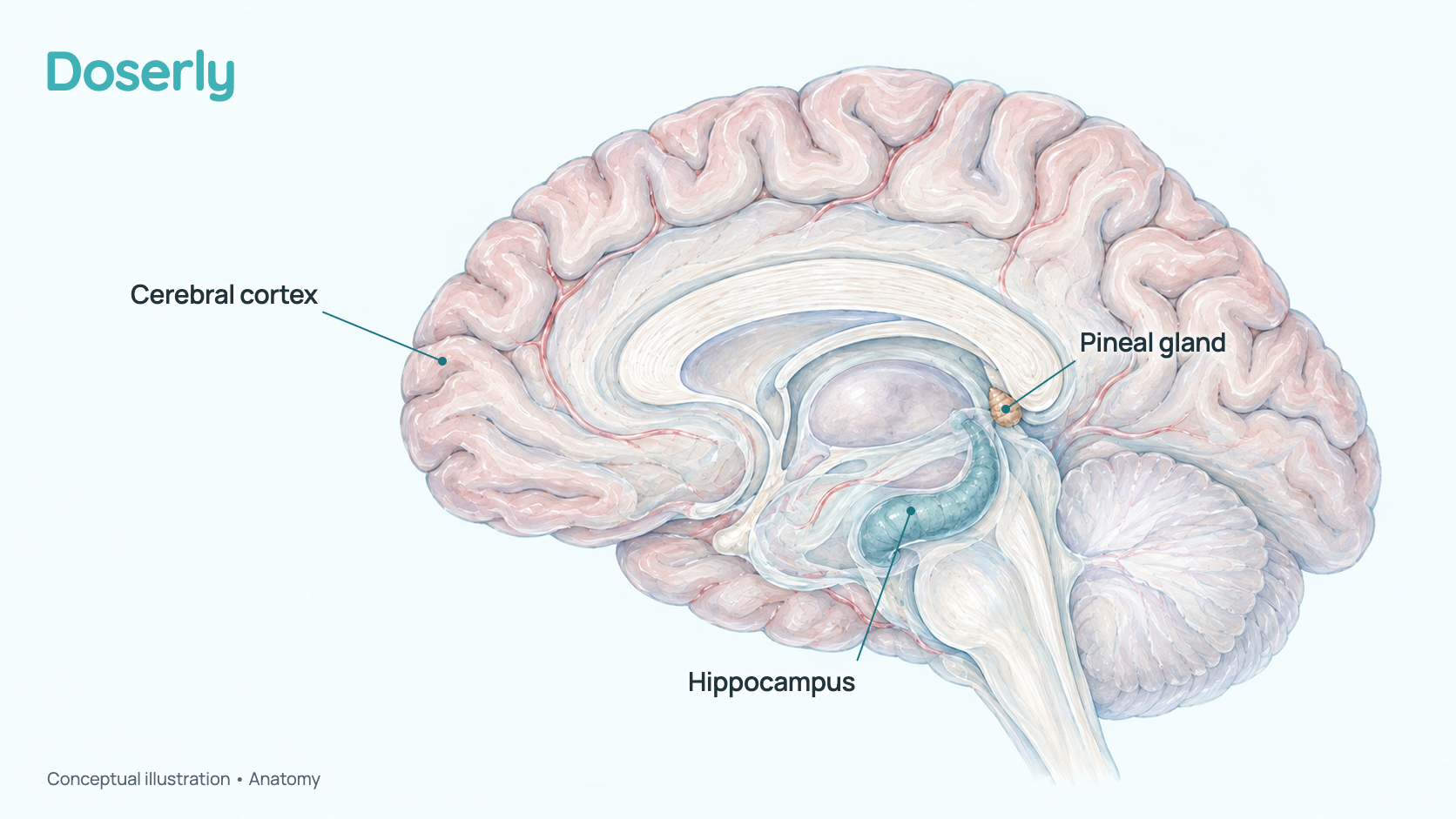
The name is misleading. “Pinealon” sounds like the pineal gland, the small gland that makes melatonin. But the developers describe EDR as a peptide isolated from Cortexin, a Russian medicine made from calf brain cortex, and almost all of its research is on nerve cells. When the same group tested short peptides on pineal tissue, the pineal effects belonged to Epitalon, a different peptide, not to EDR. [4], [5], [6]
The name also covers several different products. In Russia, Pinealon is sold as supplement capsules and as drops placed under the tongue, both listing a “peptide complex AC-5” of the three amino acids. Western sellers offer 10–20 mg vials of powder for injection as “research” chemicals, plus nasal sprays and injection pens. [7], [8], [9], [10], [11]
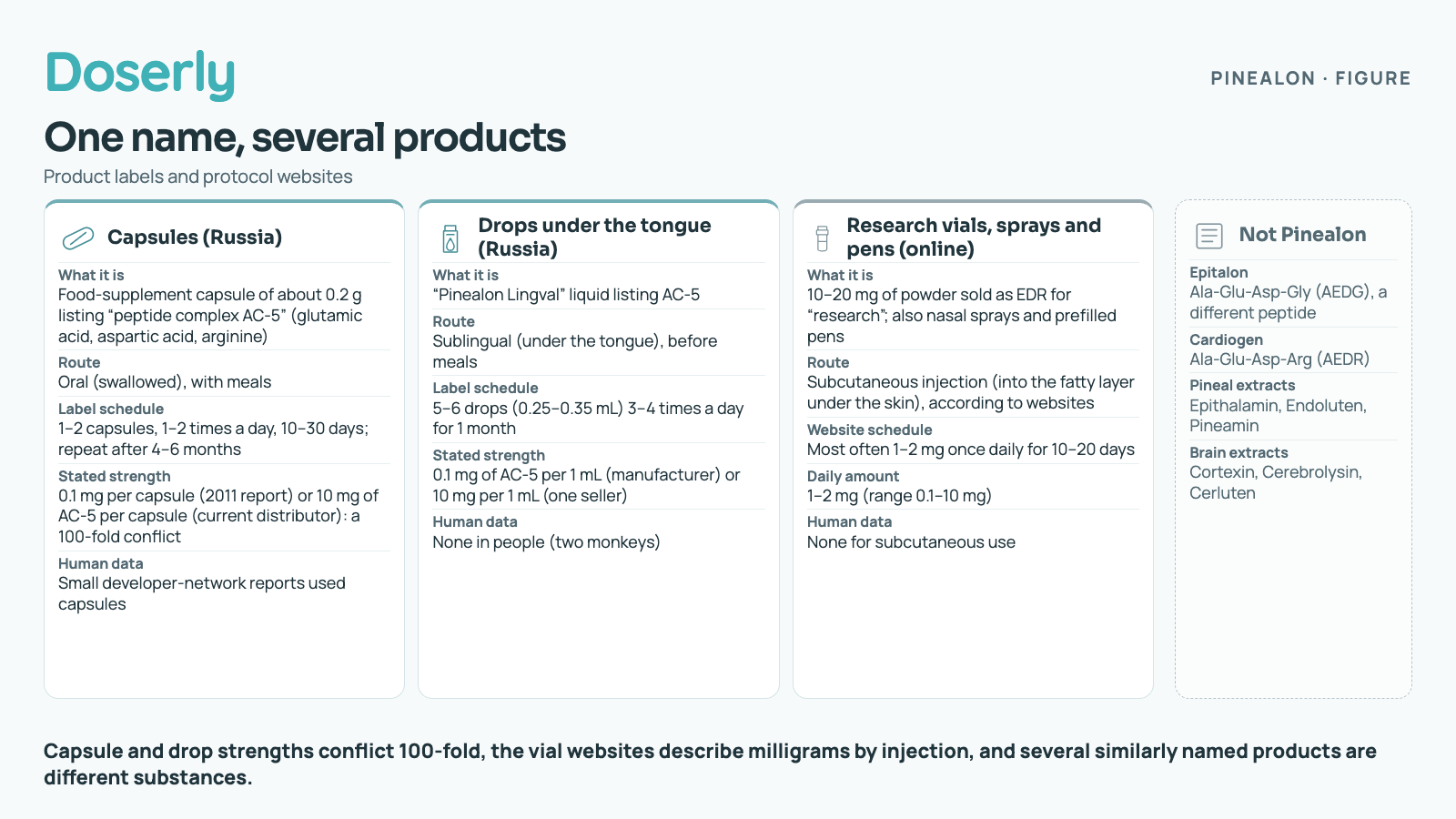
One name, several products
Product labels and protocol websites
- Capsules (Russia)
- What it is: Food-supplement capsule of about 0.2 g listing “peptide complex AC‑5” (glutamic acid, aspartic acid, arginine).Route: Oral (swallowed), with meals.Label schedule: 1–2 capsules, 1–2 times a day, 10–30 days; repeat after 4–6 months.Stated strength: 0.1 mg per capsule (2011 report) or 10 mg of AC‑5 per capsule (current distributor): a 100-fold conflict.Human data: Small developer-network reports used capsules.
- Drops under the tongue (Russia)
- What it is: “Pinealon Lingval” liquid listing AC‑5.Route: Sublingual (under the tongue), before meals.Label schedule: 5–6 drops (0.25–0.35 mL) 3–4 times a day for 1 month.Stated strength: 0.1 mg of AC‑5 per 1 mL (manufacturer) or 10 mg per 1 mL (one seller).Human data: None in people (two monkeys).
- Research vials, sprays and pens (online)
- What it is: 10–20 mg of powder sold as EDR for “research”; also nasal sprays and prefilled pens.Route: Subcutaneous injection (into the fatty layer under the skin), according to websites.Website schedule: Most often 1–2 mg once daily for 10–20 days.Daily amount: 1–2 mg (range 0.1–10 mg).Human data: None for subcutaneous use.
- Not Pinealon
- Epitalon: Ala-Glu-Asp-Gly (AEDG), a different peptide.Cardiogen: Ala-Glu-Asp-Arg (AEDR).Pineal extracts: Epithalamin, Endoluten, Pineamin.Brain extracts: Cortexin, Cerebrolysin, Cerluten.
Capsule and drop strengths conflict 100-fold, the vial websites describe milligrams by injection, and several similarly named products are different substances.
It is easy to confuse with its relatives. Epitalon is Ala-Glu-Asp-Gly (AEDG) and Cardiogen is Ala-Glu-Asp-Arg (AEDR); epithalamin, Endoluten and Pineamin are pineal extracts; Cortexin, Cerebrolysin and Cerluten are brain extracts. None of them is Pinealon, and research on one cannot be counted as research on another. [6], [12], [5]
Typical Pinealon Protocols
| Example | Amount each time | Frequency | Total per day | Duration |
|---|---|---|---|---|
| Low | 0.1–0.3 mg (100–300 mcg) | Once daily | 0.1–0.3 mg | 5–10 days, 1–2 times a year Microgram schedule from a clinic-directory page [13] |
| Mid | 1 mg on days 1–5, 1.5 mg on days 6–14, 2 mg on days 15–20 | Once daily, morning or early afternoon | 1–2 mg | 20 days, repeated every 2–3 months The stepped chart repeated almost word for word on several dosing pages [9] |
| High | 5 mg | Once daily | 5 mg | 20 days, repeated every 6 months From a clinician's conference slides [14] |
The most common protocol in the reviewed sources is 1–2 mg once a day by subcutaneous injection for 10–20 days, repeated every few months. Of 21 injection pages we compared, 7 give 1–2 mg a day as their whole range and 4 more list 1 or 2 mg a day among their options. Four of the 7 copy one stepped chart that starts at 1 mg and ends at 2 mg, and two more give 1–2 mg with small changes. The rest split between microgram schedules (100–500 mcg) and 5–10 mg a day. [9], [15], [16], [17], [18], [19], [20]
- Titration Changing the amount in steps
- The copied mid-row chart starts at 1 mg for five days “to assess tolerance”, then steps to 1.5 mg and 2 mg. Most other pages use one fixed amount. Two pages describe a slow 12-week climb from 200 mcg to 500 mcg a day, which no study supports. [9], [21], [22]
- Breaks and cycles
- A 10–20-day course, then 2–3 months off according to the vial pages, or one or two courses a year according to others. The Russian capsule and drop labels say to repeat after 3–6 or 4–6 months. No page describes continuous use. [9], [15], [13], [7], [8]
- Timing
- Several vial pages say morning or early afternoon, and one notes that earlier timing may reduce sleep disruption. Two templates say evening, reasoning from melatonin, which Pinealon has not been shown to affect. The capsule label says with meals. See morning or evening. [9], [10], [23], [7]
Read the units: mcg means micrograms; 1 mg equals 1,000 mcg. The low row's 0.1 mg is 100 mcg, and the high row's 5 mg is 5,000 mcg, a 50-fold spread between rows. A “course total” is the daily total times the number of days: the mid-row chart adds up to 30.5 mg over 20 days, more than one 20 mg vial. [9]
Each row is a complete schedule from one source, so its amount and duration belong together. Low, mid and high are alternatives, not steps to move through. These schedules come from protocol websites rather than clinical trials, and no study has given people subcutaneous Pinealon; the cited references give the full details.
Cautions for every schedule above:
- Untested amounts. The only injections given to people were a patent series of 1 mcg, 10 mcg or 5 mg into a muscle for 10 days, reported without saying how side effects were checked. Safety in people is not established. [1]
- Heart rate and blood pressure. In a developer-group report, all 5 young wrestlers given the maximum leaflet dose of capsules developed marked rises in heart rate and blood pressure with headache and palpitations within 3–5 days, and their dose was cut. People with heart-rhythm problems or high blood pressure should be especially careful. [24]
- Blood fats. In a study of military veterans, 19 people who took Pinealon capsules alone for 20 days had 79.5% higher triglycerides and 41.4% higher VLDL (very-low-density lipoprotein) cholesterol afterwards. [25]
- Sleep can get worse. Public accounts describe insomnia, early waking or feeling wired, often after evening doses and often alongside Epitalon; some people moved the dose to the morning (see timing). [26], [27], [28]
- Pregnancy, breastfeeding and under-18s. The Russian supplement registration lists pregnancy and breastfeeding as reasons not to use it, and no study has looked at children. [29]
- Prescribed treatment. Do not stop or replace sleep, psychiatric, seizure or other prescribed medicines to try Pinealon. No study has looked for interactions. [30]
- Product and unit errors. Health Canada has seized injectable Pinealon sold without authorization, capsule strengths on product pages disagree 100-fold, and milligrams and micrograms differ 1,000-fold, so check every amount with the reconstitution calculator. [31], [32], [30]
Full risks, legal status and who should be cautious ↓
What about capsules and drops?
| Example | Amount each time | Frequency | Total per day | Duration |
|---|---|---|---|---|
| Low | 1 capsule | Once daily with a meal | 1 capsule | 10–30 days, repeated after 4–6 months Lower end of the label range [7] |
| Mid | 1 capsule | Twice daily with meals | 2 capsules | 10–30 days, repeated after 4–6 months The same two a day (100 mcg each) was used for 2 weeks in a 2012 study of train crews [7], [33] |
| High | 2 capsules | Twice daily with meals | 4 capsules | 10–30 days, repeated after 4–6 months Top of the label range [7] |
The capsule label's usual schedule is 1–2 capsules, 1–2 times a day with meals, for 10–30 days, repeated after 4–6 months. The European distributor gives 1–2 capsules twice a day for a month, repeated after 3–6 months, and the supplement registration gives one month. Seller pages repeat it with small changes, so it is one source copied, not several opinions. [7], [32], [29], [34], [35]
How much peptide is in a capsule is disputed. The developer institute's 2011 report says each capsule or tablet holds 0.100 mg (100 mcg) of active substance, and the 2012 worker study used 100 mcg capsules. The current European listing says 2 or 4 capsules contain 20 or 40 mg of peptide complex AC-5, which is 10 mg per capsule, 100 times more. The whole capsule weighs about 0.2 g (200 mg), and nothing public defines AC-5 as pure EDR. [30], [33], [32], [29]
The 2011 report itself recommended a different schedule: 1–3 capsules 2–3 times a day, 10–15 minutes before meals, for 10–20 days, repeated in 3–6 months. [30]
Drops under the tongue. The Russian “Pinealon Lingval” drops are taken sublingually (under the tongue): 5–6 drops (0.25–0.35 mL), 3–4 times a day, 10–15 minutes before meals, for one month, repeated after 3–6 months. The manufacturer's page says an average daily 1 mL contains 0.1 mg of AC-5; one seller says the same 1 mL holds 10 mg, again a 100-fold difference. [8], [36], [37]
What doses were tested in people?
| Report | Amount each time | Frequency | Total per day | Duration |
|---|---|---|---|---|
| Nervous-system patients, 2005–06 (capsules, before meals) | 1–2 capsules (0.1 mg each, as stated) | 2–3 times daily | 0.2–0.6 mg (as stated) | 10–20 days 42 people, compared with 32 on usual care; the developer institute's report [30] |
| Past head injury, patent series (intramuscular, into a muscle) | 1 mcg, 10 mcg or 5 mg, by severity | Once daily | 0.001–5 mg | 10 days 25 adults aged 31–60; the only injections given to people [1] |
| Older men, 2010 dissertation (capsules) | 1 capsule (strength not stated) | Twice daily | 2 capsules | 30 days 43 men on Pinealon alone, with a multivitamin comparison group [38] |
| Train crews, 2012 (capsules) | 100 mcg | Twice daily | 200 mcg | 2 weeks Number of workers not given in the abstract [33] |
| Judo athletes, 2012 (capsules) | 100 mcg | Once daily for 5 days, twice daily for 5 days, once daily for 5 days | 100–200 mcg | 15 days 18 women, no comparison group [39] |
| Young wrestlers, 2018 monograph (capsules) | Maximum leaflet dose, then 1 capsule | Leaflet schedule, then once daily in the morning | Not stated, then 1 capsule | 15 days All 5 had heart-rate and blood-pressure rises at the maximum dose [24] |
| Military veterans, 2017 dissertation (by mouth) | 200 mg of product (not stated as peptide) | Twice daily with meals | 400 mg of product | 20 days 19 people on Pinealon alone; blood fats rose [25] |
The website injection amounts and the study amounts are far apart. By mouth, the reports used about 0.1–0.6 mg a day as stated. The patent series injected 1 mcg, 10 mcg or 5 mg into a muscle, a 5,000-fold span chosen by how severe each person's condition was; it was not a test of which dose works. The patent's own claim covers 0.01–100 mcg per kg of body weight a day by injection, which for a 70 kg adult tops out at 7 mg. [30], [1], [2]
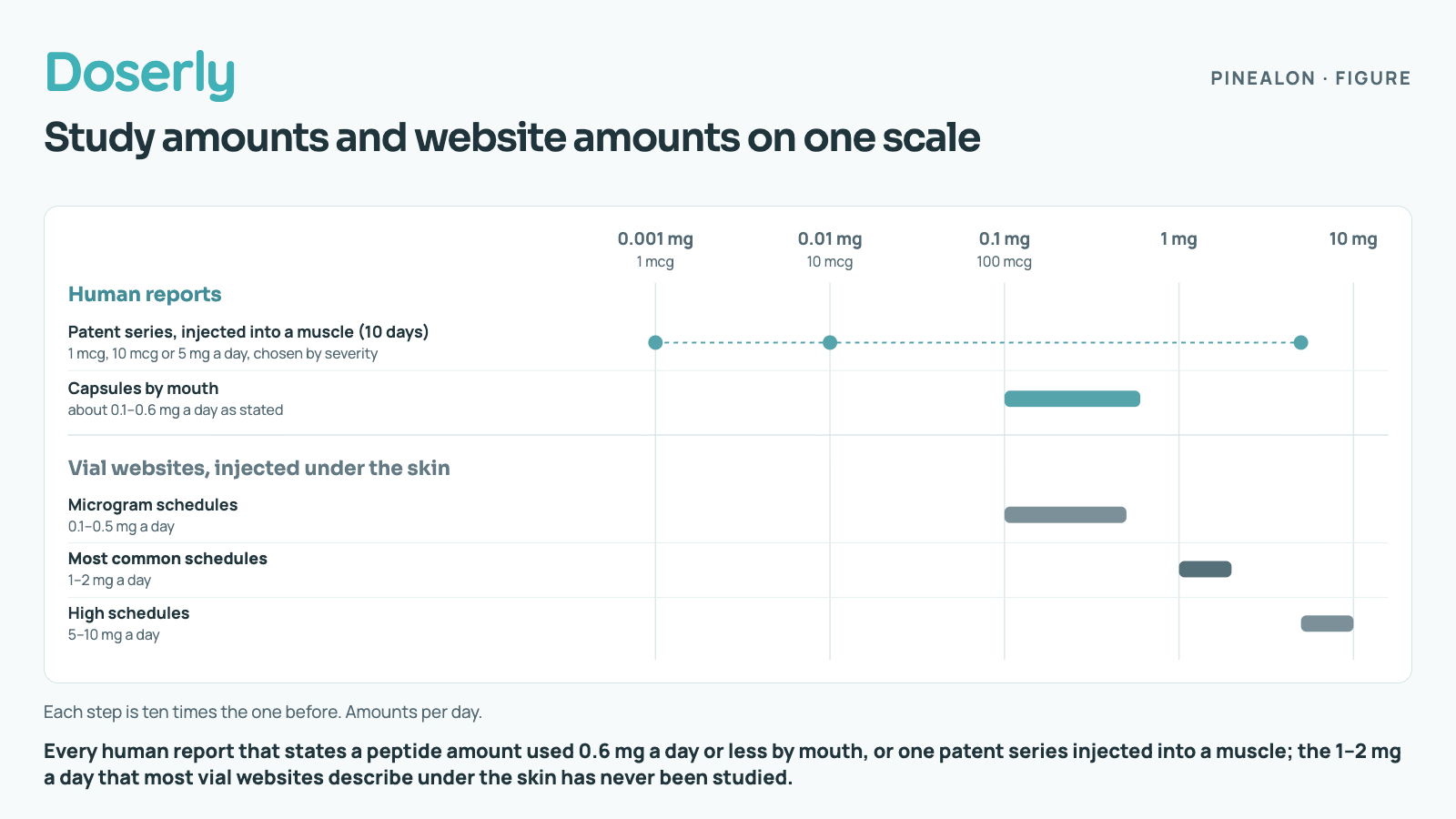
Study amounts and website amounts on one scale
Human reports
- Patent series, injected into a muscle (10 days)
- 1 mcg, 10 mcg or 5 mg a day, chosen by severity.
- Capsules by mouth
- About 0.1–0.6 mg a day as stated.
Vial websites, injected under the skin
- Microgram schedules
- 0.1–0.5 mg a day.
- Most common schedules
- 1–2 mg a day.
- High schedules
- 5–10 mg a day.
Each step is ten times the one before. Amounts per day.
Every human report that states a peptide amount used 0.6 mg a day or less by mouth, or one patent series injected into a muscle; the 1–2 mg a day that most vial websites describe under the skin has never been studied.
In community education groups, most members who give a dose inject 1–2 mg once a day, often starting at 1 mg and moving to 2 mg, for about 10–30 days, with 20 days the most common course, repeated once or twice a year. A smaller group uses 200–500 mcg, and a few use 5–10 mg, borrowing Epitalon's schedules. Educators' own figures range from 100 mcg to 10 mg a day, and one educator's post circulates in two copies giving different amounts. None of them cites a Pinealon dosing study.
Where protocols differ: products, units, course length and timing ↓
Where these numbers come from
The low injection row comes from PeptideClinicLocator (reference [13]): 0.1–0.3 mg (100–300 mcg) per injection, once daily, for 5–10 days, 1–2 times a year. The mid row is PeptideDosages' stepped chart (reference [9]): 1.0 mg on days 1–5, 1.5 mg on days 6–14 and 2.0 mg on days 15–20, once daily, preferably in the morning or early afternoon, repeated every 2–3 months. The high row comes from a clinician's 2024 conference slides (reference [14]): “5 mg SQ x 20 days”, repeated every 6 months.
The same stepped chart appears almost word for word on PeptideDosage.org, Peptide Dosing Protocols and Longeva, and PeptaBase and PeptideFox use 1–2 mg with small changes (references [17], [18], [19], [15], [16]). Those pages share a template, so they are not independent confirmations. Across the 21 injection pages, the low end of each page's range runs from 0.1 to 5 mg (middle value 1 mg) and the high end from 0.3 to 10 mg (middle value 2 mg). Only three pages give one fixed amount (2, 5 and 5 mg).
The capsule rows come from the Russian manufacturer's catalog (reference [7]): 1–2 capsules 1–2 times a day with meals for 10–30 days, repeated after 4–6 months. The study rows come from the full texts of the 2011 manufacturer report, the patent, the 2010 and 2017 dissertations, the 2012 judo study and the 2018 monograph, and from the abstract of the 2012 worker study.
Excluded from the typical comparison: pages claiming 10–20 mg or 100–200 mg of active Pinealon by mouth a day, which appear to confuse vial sizes or capsule weight with peptide content; a page listing 200 mg of peptide per capsule; a 5–10 mg page that calls Pinealon a four-amino-acid peptide; an animal range of 0.1–1 mg per kg; nasal and pen products, covered separately below; and a database that labels Pinealon with Epitalon's sequence. [18], [20], [40], [41], [42], [43]
What is Pinealon commonly used for?
Most people who try Pinealon want better sleep. Others hope for sharper memory and focus, less “brain fog”, protection against brain aging, or recovery after a head injury or stroke. A smaller group uses it for stress, demanding work or sport, or to reset their body clock after shift work or travel. [44], [45], [46], [30]
That mix is itself revealing. The developer's own reports aim at the brain: the 2011 report recommends it after head injury or stroke, for intellectual disorders and to maintain mental performance in older people. Sleep appears only as one of several complaints that became less common. [30] In community education groups, members often give the pineal-sounding name as their reason to expect better sleep. The reports below describe what was measured; they do not establish that Pinealon treats or prevents any condition.
Does Pinealon improve sleep?
It has not been shown to. Sleep is the most common reason people try it, and the least studied. No study has measured sleep in people taking Pinealon with a sleep lab test (polysomnography), a wrist activity monitor or a validated insomnia questionnaire. The only human sleep figure comes from the developer institute's report: among patients with nervous-system conditions, “sleep disturbances” were listed as a complaint by 52.6% before treatment, 26.1% after Pinealon plus usual care and 39.2% after usual care alone. [30] Public accounts range from better sleep to no change to insomnia (see what people report).
Memory, focus and “brain fog”
The developer institute's patients made fewer errors on a proofreading-style attention test after Pinealon (from 16.3 to 9.1 errors) than after usual care (12.5). A 2010 dissertation in older men reported better memory scores on Pinealon compared with before the course. The only independent test, in mice, found a working-memory trend that was not statistically significant. [30], [38], [47]
Recovery after a head injury or stroke
This was the developer's original purpose. The patent describes 25 adults with past head injuries who were given Pinealon or salt-water injections into a muscle for 10 days, and the 2011 report describes 42 patients with head-injury effects, past strokes or vascular brain disease given capsules on top of usual care. Both describe improvement, and both come from the developer's own institute. A figure of 72 patients, repeated in reviews and on dosing pages, could not be traced to any original report (see the human research). [1], [30], [4]
Brain aging, dementia and Alzheimer's disease
Here the evidence is only in cells and animals: mice bred to develop Alzheimer's-like changes, nerve cells in a dish exposed to amyloid (the protein that clumps in Alzheimer's), and nerve cells made from older people's skin cells. No study has tested Pinealon in people with dementia or memory decline. [48], [49], [50] How it might work.
Stress, demanding work and sport
Small developer-network reports gave capsules to train crews, female judo athletes, young wrestlers and their coaches, and, together with another peptide called Crystagen, to rhythmic gymnasts. They describe better fatigue, stress-tolerance or “biological age” scores compared with before, mostly without a comparison group. [33], [39], [24], [51]
Other uses you may come across
Pages and posts also promote Pinealon for resetting the body clock after shift work, for Parkinson's disease, for children with developmental problems, for skin aging and for longevity in general. None has been tested in people. One public review describes a parent giving the capsules to a child, which no study supports. The skin idea comes from rat skin tissue in a dish, and the longevity idea from reviews by the developers. [46], [37], [52], [53], [54]
Where do Pinealon protocols differ?
The capsule label is easy to summarize. The disagreements start when a page mixes up the products, the units or the route. Here is what varies and why it matters.
Capsule, drops or vial: which product is the number for?
Always check this first. The manufacturer's capsules and drops list a “peptide complex AC-5” whose stated strength differs 100-fold between documents, while research vials hold 10–20 mg of powder sold as EDR. “One capsule” and “1 mg” are not comparable (see capsules and drops). [30], [32], [37], [9]
Why do some websites give 10–200 mg a day by mouth?
Two English pages say the standard Russian oral protocol is 10–20 mg of active Pinealon a day, and one gives 100–200 mg a day, using the same line it prints for other bioregulators. A seller lists 200 mg of peptide per capsule. These figures match the capsule's total weight (about 0.2 g, or 200 mg) or vial sizes, not the peptide content in the 2011 report. [18], [20], [40], [41], [30] The 2017 veterans' study also dosed “200 mg” of product twice a day, which is capsule weight rather than a peptide amount. [25]
Micrograms in the studies, milligrams on the vial websites
Every peptide amount stated in a human report is 0.6 mg a day or less by mouth, or a single patent series by injection into a muscle; three capsule reports did not state how much peptide they gave. The vial pages that use 1–10 mg by subcutaneous injection cite no Pinealon study for those amounts, and several claim a clinical origin that could not be traced, such as the developer's clinical studies or a published regimen. [9], [17], [55], [42], [14]
Is the number for one dose or the whole day?
Two capsules twice a day is four capsules for the day. The label's “1–2 capsules, 1–2 times a day” therefore covers 1–4 capsules a day. For the drops, 5–6 drops (0.25–0.35 mL) taken 3–4 times a day adds up to about 0.75–1.4 mL a day, while the same page calls 1 mL the average daily amount. For injections, most pages give a single daily amount, so the dose and the daily total are the same number. [7], [8]
Ten days, twenty or twelve weeks?
Studies used 10 days (patent), 10–20 days (2011 report), 2 weeks (train crews), 15 days (athletes), 20 days (veterans) and 30 days (older men). Labels say 10–30 days or one month. Vial pages mostly say 10–20 days; the stepped chart runs 20 days with an option to 28, and two pages describe 8–12 weeks. [1], [30], [33], [25], [38], [7], [9], [21], [22]
Repeats vary from every 2–3 months to once or twice a year. These are conventions, not results from a trial comparing course lengths; nothing shows that a longer or more frequent course works better.
Morning or evening?
This is the most practical disagreement, and no study has compared timings.
- Labels: capsules with meals, or 10–15 minutes before meals in the 2011 report; drops before meals. The athlete studies gave the capsule in the morning, with a second one around 6 p.m. on some days. [7], [30], [39]
- Vial pages: several say morning or early afternoon. Two templates say evening, to line up with melatonin, but no study shows Pinealon affects melatonin. [9], [10], [23], [20]
- Public accounts: some people report insomnia, early waking or a wired feeling after evening doses and moved the dose to the morning; one said sleep problems persisted whatever the timing, and another, dosing in the morning, still had a racing mind at night during each of three courses; others take it at night and report deeper sleep. [26], [27], [56], [57], [58]
In community education groups, most members who use it for sleep take it in the evening, while many educators advise the morning because they find it stimulating. A minority of members describe insomnia or agitation from evening doses that settled after switching to the morning, and a few describe the opposite: daytime drowsiness or feeling too calm. If evening doses disturb sleep, the morning is the change people most often try.
Nasal sprays, drops under the tongue and pens
Some pages offer ready-made nasal sprays or suggest mixing vial powder with salt water for the nose, and one sells a prefilled injection pen dosed in “clicks” (for example, 0.3 mg as 9 clicks). The amount per spray depends on how the spray was made and on the size of each spray, and no study has measured how much Pinealon is absorbed through the nose. The only study of drops under the tongue was in two monkeys. [10], [11], [59]
In community education groups, some educators describe the nose as the original Russian route. The Russian products are in fact capsules and drops, and the only injections in people went into a muscle. [29], [8], [1]
What about stacks and blends?
Pinealon is most often combined with Epitalon, the pineal peptide from the same program, either on the same days or one course after the other, and less often with DSIP or Selank. [27], [60], [28], [61] In community education groups, Semax also appears in many stacks.
Only the developer's combinations have been studied: Pinealon with Vesugen (a vascular bioregulator) in older men, veterans and older patients, and Pinealon with Crystagen in gymnasts. In the older men, the combination did better than either peptide alone. No study has tested Pinealon with Epitalon, DSIP, Selank or Semax. [38], [25], [62], [51] Stacking also makes it impossible to tell which compound caused a change, good or bad.
How do milligrams convert to syringe units?
Injection pages often give amounts as “units” on an insulin syringe. A U-100 syringe holds 100 units per millilitre, so units measure volume, not an amount of Pinealon. How much Pinealon each unit holds depends on how much water was added to the vial.
For example, a 20 mg vial mixed with 3 mL of water holds about 6.67 mg per mL, so 1 mg is 0.15 mL, or 15 units, and 2 mg is 30 units; this is the example the stepped chart uses. The same 1 mg from a 20 mg vial mixed with 10 mL, as one page suggests, is 50 units. Doserly's reconstitution calculator works this out for any vial and shows each step. [9], [23]
Source-by-source comparison
Capsules and drops
Unit key: 1 milligram (mg) = 1,000 micrograms (mcg). A capsule weighs about 0.2 g (200 mg); the 2011 report says it holds 0.100 mg of active substance.
The manufacturer's Russian catalog: adults 1–2 capsules 1–2 times a day with meals for 10–30 days, repeat course after 4–6 months; it states that no side effects, complications, contraindications or dependence were found. The European distributor: 1–2 capsules twice a day with meals for one month, repeated after 3–6 months, with 2 or 4 capsules said to contain 20 or 40 mg of AC-5. The supplement registration: capsules and tablets of 0.215 g (tablets also 0.08 g), one month, contraindicated in pregnancy and breastfeeding. iPept: 2 capsules each morning 5–10 minutes before meals for 1–3 months. Antiaging Systems: 1–2 capsules 1–2 times a day, 30 minutes before meals, for one month. [7], [32], [29], [63], [34]
Drops: 5–6 drops (0.25–0.35 mL) 3–4 times a day, 10–15 minutes before meals, for one month, repeated after 3–6 months; 1 mL is said to contain 0.1 mg of AC-5. iPept.eu gives 10 drops twice a day and says 1 mL provides 10 mg. One Russian seller says one pack lasts 10 days. [8], [36], [64], [37], [65]
Injections
PeptideDosages, PeptideDosage.org, Peptide Dosing Protocols and Longeva share the stepped 1 → 1.5 → 2 mg, 20-day chart for a 20 mg vial mixed with 3 mL; PeptaBase gives 2 mg a day for 10–20 days (with a 30-day example) and a 2–3 month rest; PeptideFox gives 1–2 mg a day for 10–20 days and adds evening use for sleep. CalcMyPeptide gives 1–2 mg a day for 10 days, 2–4 times a year. Peptide Protocols gives 200 mcg–1 mg once daily, commonly in the morning, for 10–20 days, then 2–3 months off. [9], [17], [18], [19], [15], [16], [20], [10]
Microgram schedules: PeptideClinicLocator gives 100–300 mcg a day for 5–10 days; Peptides.ID and Dosage Peptide give 200 mcg rising to 500 mcg a day over 12 weeks; MyPeptideMatch's chart gives 200 mcg each evening but its text calls 2 mg a day a “Russian” intensive course. A pharmacist-written page separates the 100 mcg oral study dose from its own injection arithmetic and says the repeat interval is untested. [13], [21], [22], [23], [66]
Milligram schedules: the 2024 clinician slides give 5 mg a day for 20 days every 6 months; Peprimo gives 5 mg once daily for 20 days; Peptides Media reports 5–10 mg as community practice, not a studied dose; Professor Peptides and Peptide Database give both 100–300 mcg and 5 mg rows. [14], [67], [68], [69], [55]
Errors found
PeptidesDB calls Pinealon a four-amino-acid peptide and gives 5–10 mg a day. Peptide Reference prints the same 100–200 mg oral line for unrelated bioregulators. RuPharma lists 200 mg of AC-5 per capsule. Peptide Dosing Protocols says published oral reports used 20 mg a day. CalcMyPeptide's chemistry fields do not match EDR. PeptideFox says there are no human trials and then describes a 72-patient trial. The 2024 clinician slides print Epitalon's sequence as AEDR, which is Cardiogen. Peptide Database calls the 72-patient figure a 2015 clinical trial without a traceable original. [42], [40], [41], [18], [20], [16], [14], [55]
What happens when you stop Pinealon?
Very little is known. No study reports withdrawal effects or a rebound, but none was designed to look for them, and most followed people only until the course ended. [30], [1]
- Older men. In the 2010 dissertation, the men were reassessed six months after starting a 30-day course. Lasting improvement in mood and mental state was seen mainly in the group that took Pinealon together with Vesugen, and the author recommended repeat courses every 5–6 months. [38]
- Labels. The capsule and drop labels suggest another course after 3–6 or 4–6 months, without explaining why. [7], [8], [30]
- Public accounts. One person said sleep went back to normal almost immediately after stopping, and night-time mental restlessness they had noticed during three courses ended. Another described insomnia that was still present about a year after a combined Pinealon and Epitalon course. [57], [27]
In community education groups, members split: some describe better sleep or focus that lasted after a course, while others say deeper sleep faded within about a week of stopping, or that only the first course seemed to help.
Do injections, capsules and drops of Pinealon behave the same way?
No one has measured this in any species. An oral capsule has to survive stomach acid and digestive enzymes and then cross the gut wall. Drops held under the tongue are meant to be absorbed through the lining of the mouth, which has not been measured either. A subcutaneous injection skips digestion and is absorbed from the fatty layer under the skin, and an intramuscular injection is absorbed from muscle. Those are different starting points, so a matching amount would not mean a matching exposure, and here the amounts do not even match.
Bioavailability is how much of a dose reaches the blood in a usable form. For Pinealon it is unknown by every route. The developer group's computer-modelling studies predicted that EDR could fit transporter proteins in the gut and elsewhere, such as PEPT1 and LAT1, but a prediction is not a measurement of absorption. [70], [71]
How long does Pinealon last in the body?
Nobody knows. No study has measured its half-life or blood levels in people or animals, and no pharmacokinetic study has been published by any route. [70], [1]
Does Pinealon reach the brain?
Unknown. It is often said to cross the blood-brain barrier (the lining of the brain's blood vessels that keeps many substances out), but no study has measured this. [43] What has been shown is that labeled Pinealon entered the nucleus of human cancer cells in a dish, and that modelling predicts it could fit brain-relevant transporters. [72], [71] The animal studies gave it into the belly cavity or a muscle and measured effects in the brain, which suggests some action but does not show how much, if any, reached brain tissue. [73], [48]
Is every product the same molecule?
Not necessarily. The patent's molecule is H-Glu-Asp-Arg-OH made as an acetate salt, and chemical databases list the same chain. The Russian capsules and drops list a “peptide complex AC-5” without giving the order of the amino acids or showing that it is the assembled chain. One database calls Pinealon a four-amino-acid peptide, and another labels it with Epitalon's sequence. No public independent test shows which molecule, or how much, any product contains. [2], [3], [32], [29], [42]
How should Pinealon be stored, and how long does it last?
It depends on the product. The supplement capsules come with registered storage conditions; for injectable vials, nobody has published a stability test.
- Capsules. The 2022 supplement registration says to keep them dry, away from direct sunlight, at 2–25 °C (36–77 °F), with a shelf life of three years. The 2011 report gave five years. [29], [30]
- Drops. One Russian seller says to keep an opened bottle in the refrigerator for no more than 10 days. [65]
- Vial powder, before mixing. Pages disagree: one says to store the freeze-dried powder at −20 °C (−4 °F) in the dark, another says room temperature is fine. [9], [42]
- After mixing. Once the powder is mixed with liquid (reconstituted), pages say to refrigerate it at 2–8 °C (36–46 °F) and use it within 28–30 days; a prefilled pen seller also says 30 days. None cites a stability test of Pinealon. [21], [13], [42], [11]
The three-year shelf life is the manufacturer's registered statement, and the vial times are website claims. Health Canada warns that unauthorized injectable peptides may not have been made or stored safely, and cold storage cannot tell you what is in a vial (see product quality). [31]
What do we actually know about Pinealon in people?
There are about seven small human reports that include a group taking Pinealon alone, plus three that combined it with other peptides. All come from the developer's institute, its patent or its product, and most are an internal report, a patent example, dissertations or short abstracts rather than full journal articles. None was registered in advance as a controlled trial, none describes hiding who got Pinealon, and none says how side effects were looked for. ClinicalTrials.gov has no Pinealon study. [30], [1], [38], [25], [74]
What did the human reports find?
| Report | What researchers reported | What it cannot establish |
|---|---|---|
| Nervous-system patients, 2005–06 (developer institute report, 2011) | 42 adults aged 35–78 with past head injury, past stroke, vascular brain disease or reduced mental performance took capsules on top of usual care; 32 similar patients had usual care only. A “good” result was recorded in 28 of 42 (66.7%) versus 9 of 32 (28.1%), and complaints and attention-test errors fell more. | Whether Pinealon caused the difference. The report is unpublished, does not describe how patients were assigned, and says there were no side effects without describing how it checked. [30] |
| Past head injury, patent series (2006) | 25 adults were “randomly” divided between Pinealon and salt-water (placebo) injections into a muscle for 10 days. The patent reports a good result in 59.4%, satisfactory in 31.9% and no effect in 8.7%. | Group sizes and blinding are not given, and those percentages cannot be produced from 25 people split into two groups. It is an inventor-reported example, not a peer-reviewed trial. [1] |
| Older men, 2010 dissertation | 170 men averaging about 68–70 years were randomized in blocks to Pinealon (43), Vesugen (45), both (42) or a multivitamin labelled as placebo (40) for 30 days. Memory scores improved on Pinealon compared with before; at six months, lasting change was seen mainly with the combination. | Blinding is not described, the capsule strength is not stated, and many scores were compared. [38] |
| Train crews, 2012 | “Biological age” and adaptation scores improved after 2 weeks. | The abstract gives no numbers, comparison group or side-effect data. [33] |
| Female judo athletes, 2012 | In 18 athletes, fatigue and stress-tolerance scores improved compared with before. | No comparison group; tests were not blinded. [39] |
| Young wrestlers and coaches, 2018 monograph | Performance scores improved against starting values in small subgroups. All 5 given the maximum leaflet dose had marked rises in heart rate and blood pressure with headache and palpitations, and their dose was reduced. | Subgroups of about 5; no comparison group. [24] |
| Military veterans, 2017 dissertation | In 19 people on Pinealon alone, estimated “biological age” fell from 50.6 to 48.3 years, not a significant change. Triglycerides rose 79.5% and VLDL cholesterol 41.4%. | Not randomized, no placebo; the amount of peptide is not stated. [25] |
The combination reports, which cannot show what Pinealon did on its own, gave it with Vesugen to 32 adults aged 41–83 with several chronic illnesses (who showed signs of oxidative stress and fewer blood stem cells), to truck drivers and other workers, and with Crystagen to 12 gymnasts compared with 8 untreated gymnasts. [62], [75], [76], [51]
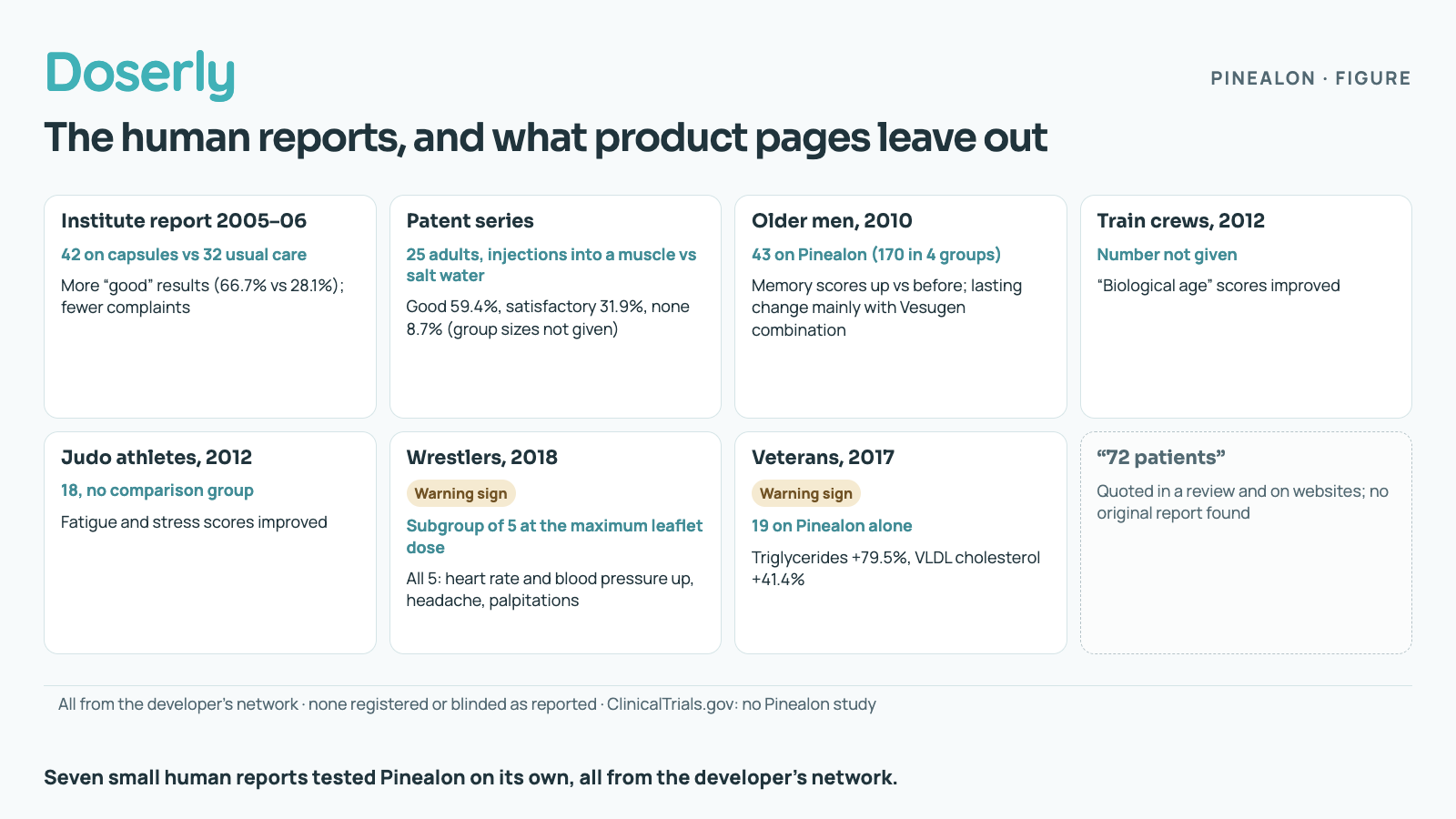
The human reports, and what product pages leave out
- Institute report 2005–06
- 42 on capsules vs 32 usual care.More “good” results (66.7% vs 28.1%); fewer complaints.
- Patent series
- 25 adults, injections into a muscle vs salt water.Good 59.4%, satisfactory 31.9%, none 8.7% (group sizes not given).
- Older men, 2010
- 43 on Pinealon (170 in 4 groups).Memory scores up vs before; lasting change mainly with Vesugen combination.
- Train crews, 2012
- Number not given.“Biological age” scores improved.
- Judo athletes, 2012
- 18, no comparison group.Fatigue and stress scores improved.
- Wrestlers, 2018
- Warning signSubgroup of 5 at the maximum leaflet dose.All 5: heart rate and blood pressure up, headache, palpitations.
- Veterans, 2017
- Warning sign19 on Pinealon alone.Triglycerides +79.5%, VLDL cholesterol +41.4%.
- “72 patients”
- Quoted in a review and on websites; no original report found.
All from the developer's network · none registered or blinded as reported · ClinicalTrials.gov: no Pinealon study
Seven small human reports tested Pinealon on its own, all from the developer's network.
Where does the “72 patients” figure come from?
Many pages, and a 2020 review by the developers, say oral Pinealon plus standard treatment improved memory in 72 patients with head-injury effects. [16], [55], [4] The review cites an earlier review, not a study. [77] The only 72-patient text we found is an undated distributor page describing 72 treated patients and 37 controls, with no reference. [78]
The reports that can be traced are the 42 versus 32 capsule report and the 25-person injection series in the patent. A 2021 paper by the same group calls the patent's 59.4% result an “oral” finding and cites a nerve-cell culture paper for it, another sign that the human figures have drifted as they were copied. [30], [1], [48]
What do these measurements mean?
- Complaint frequencies are the share of patients who said they had a symptom such as headache or poor sleep. They are self-reported and were not collected with a standard questionnaire or blinded. [30]
- The attention test in the 2011 report is a proofreading task: people cross out target letters in a grid, and errors are counted. [30]
- The EEG alpha index: an EEG (electroencephalogram) records the brain's electrical activity, and the alpha index measures a relaxed-alert brain-wave rhythm. The report's Pinealon row prints an impossible starting value (1669.1, copied from another table), so its alpha result cannot be checked. [30]
- “Biological age” in the athlete reports is a formula built from blood pressure, breath-holding time, balance and a self-rated health score. It is an estimate from routine measurements, not a direct measure of aging; a change in blood pressure alone moves the score. [24]
None of the reports measured what matters most over time: diagnosed memory decline, sleep measured objectively, return to work after injury, or side effects collected systematically.
How might Pinealon work?
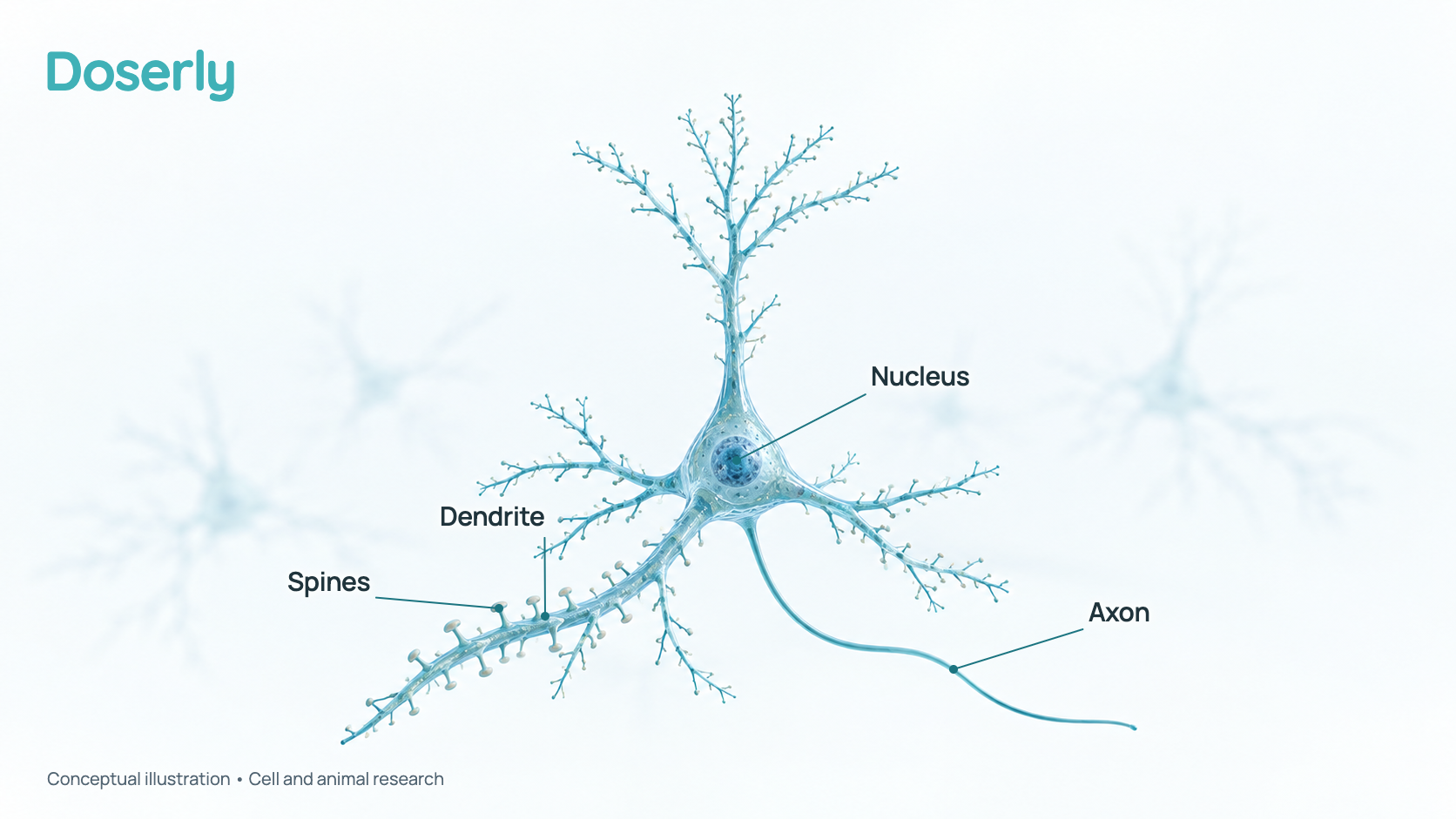
The developers' idea is that very short peptides act as signals that switch particular genes on or off, and that EDR does this in nerve cells, helping them survive stress and keep their connections. The experiments below test pieces of that idea. They are preclinical (in cells, animals and test tubes), and all but one come from one research network.
Oxidative stress and cell survival
In cell studies, Pinealon limited the build-up of reactive oxygen species (unstable, damaging forms of oxygen) and reduced cell death in brain cells, immune cells and a nerve-like cell line under stress. At higher concentrations it also shifted how the cells divided, which the authors took as a sign that it acts on genes. [79] A separate test-tube study found no direct antioxidant activity, only effects on cell membranes and cell death. [80]
Connections between nerve cells
In mouse nerve cells in a dish exposed to amyloid, Pinealon at 200 ng per mL raised the number of mature “mushroom” spines by 71%. In mice bred to develop Alzheimer's-like changes, daily injections into the belly cavity for two months raised spine density in part of the hippocampus by 11%, but did not change the mix of spine types, and a test of how well connections strengthen with use showed only a trend. [49], [48]
In nerve cells made from skin cells of elderly donors, Pinealon increased dendrite branching but did not change mitochondria, lysosomes or two aging markers (p16 and lamin B1). The abstract says it “reduces” oxidative DNA damage, but the full paper reports p = 0.0566, just short of the usual threshold for significance. A 2025 study by the same group found no significant effect on four aging and maturation markers. [50], [81]
Low oxygen and stroke models in rats
In rats exposed to very thin air, Pinealon given into the belly cavity for 5 days let them keep breathing for about 184 seconds versus 72 seconds without it, with 10 rats in each group. In the offspring of pregnant rats with high homocysteine (an amino acid linked to blood-vessel damage) or low oxygen, it was followed by better maze learning and hardier nerve cells, but it did not lower the offspring's homocysteine. [73], [82]
In old rats before the arteries to the brain were clamped, Pinealon improved survival, but it reduced exploring, motivation and movement, and moderately raised caspase-3, an enzyme of programmed cell death. Compared with Cortexin, the brain extract it is said to come from, Pinealon did more for maze learning, while Cortexin did more against oxidative damage and caspase-3. [83], [84], [85]
Serotonin, genes and DNA
In cultures of young rat brain cortex, Pinealon at 20 ng per mL nearly doubled the area of cells staining for serotonin (from 1.20% to 2.32%), but the change in old cultures was not significant. Computer models placed it near a stretch of the serotonin-making gene and in the major groove of DNA, and test-tube experiments showed it binding DNA and histone proteins. [86], [87], [88], [48] None of this shows the peptide reaching genes inside a living brain.
Does it act on the pineal gland or melatonin?
Not in any study we found. In the developer group's own tests on rat pineal tissue in a dish, EDR had no pineal-specific effect; the effects on pineal cells came from Epitalon (AEDG). Their study of melatonin production in pineal cells tested Epitalon and Vilon, not Pinealon. [6], [89] Claims that Pinealon restores the pineal gland or raises melatonin borrow Epitalon's research.
What did the only independent study find?
A 2026 preprint (not yet peer reviewed) from a Spanish team outside the developer's network gave male mice 30 mg per kg into the belly cavity twice a week for 8 weeks, with 5 mice per group. Pinealon showed a trend toward better working memory that was not statistically significant, and no adverse effects on weight, temperature, food intake, grip strength, movement, blood counts or urine. [47]
What are the risks and unanswered questions?
Is Pinealon safe?
Its safety in people has not been established. The product documents say it causes no side effects, but none describes how side effects (adverse events) were collected, and two of the original reports record problems those documents leave out. [30], [24], [25]
The animal safety data are summary statements in the patent: no toxic reactions after single injections up to 5 mg per kg in mice, or after daily injections of up to 1 mg per kg for 90 days in rats and 6 months in guinea pigs, without tables of results. No standard test of whether it damages DNA, affects pregnancy or causes cancer has been published, and no human study lasted longer than 30 days. [2], [38]
What problems have actually been reported?
- Heart rate, blood pressure, headache and palpitations in all 5 young wrestlers given the maximum leaflet dose, within 3–5 days, during and after training. The dose was cut to one capsule a day. [24]
- Higher blood fats in 19 veterans after 20 days: triglycerides up 79.5% and VLDL cholesterol up 41.4%. The author describes the effect on blood fats as somewhat negative. [25]
- Oxidative stress and fewer blood stem cells in 32 adults aged 41–83 with several chronic illnesses, given Pinealon and Vesugen: the authors found “prooxidant activity” and fewer CD34+ cells (the blood-forming stem cells) in the blood. It is not clear which peptide was responsible. [62]
- Less movement in old rats. Old rats given Pinealon before a stroke-like procedure explored and moved less. [83]
- In public accounts: insomnia, early waking or a wired feeling; a “buzzy”, heat-like sensation; more appetite; puffy skin around the eyes after nasal use; and lower libido. Each was reported by one or a few people, often while taking other compounds. [57], [26], [27], [28], [90], [58]
In community education groups, members also describe daytime drowsiness or feeling too calm, and single reports of flushing after a first large dose taken with Epitalon, sore and swollen injection sites, and small weight gain. No published case report of harm from Pinealon was found.
Could Pinealon raise heart rate, blood pressure or blood fats?
It might, and no one has checked properly. Both signals come from small reports without a comparison group in the developer group's own documents, no later study measured these things on purpose, and none of the product pages mentions them. Triglycerides and VLDL cholesterol are blood fats that doctors check because high levels over time are linked to heart and blood-vessel disease. People with high triglycerides, heart disease, high blood pressure or rhythm problems have particular reason to discuss this with a clinician (see monitoring). [24], [25]
Could product quality change the risk?
Yes. The vials are sold as unregulated “research” chemicals, and we found no public, independent test of the identity, purity or sterility of any Pinealon product. The Russian capsules list a peptide complex whose strength differs 100-fold between documents. Health Canada has named injectable Pinealon among unauthorized peptides seized from a Calgary clinic and from an online seller, and warns that such products may cause infections or allergic reactions, may contain ingredients not on the label and may not have been made or stored safely. [91], [31], [32], [30]
In community education groups, members report a batch that was recalled because it contained no active ingredient, a kit that arrived with no vacuum in the vials, and confusion between syringe units and milligrams.
Is Pinealon legal? Is it FDA-approved?
Checked September 24, 2026. Rules differ by country and change quickly. A “research use only” label does not make a product legal to sell or safe to use.
United States. Pinealon is not an FDA-approved medicine: a search of FDA's approved-drug database found no entry. It is not among the substances nominated for pharmacy compounding (list updated May 14, 2026), not on FDA's list of compounding substances that may pose significant safety risks, and not in the compounding regulation's list of allowed bulk substances. The July 2026 compounding advisory meeting reviewed Epitalon and other peptides, not Pinealon. Absence from those lists is neither an approval nor an FDA safety judgment. [92], [93], [94], [95], [96]
Canada. Health Canada named Pinealon in two public advisories about unauthorized injectable peptide drugs: one seized from a Calgary wellness clinic (April 2025) and one seized from and sold by an online company (August 2025). It states that injectable peptides are regulated as prescription drugs in Canada and that selling unauthorized drugs is illegal. [91], [31], [97]
Australia. Pinealon is not named in the June 2026 Poisons Standard, and the Therapeutic Goods Administration's (TGA's) 2026 warnings on unapproved peptides do not name it. The TGA says unapproved peptide products “have not been assessed by the TGA for safety, quality or effectiveness”, and that personal importation is permitted only if products are clearly and accurately labelled. Labelling is one condition, so a well-labelled vial is not automatically legal to import. [98], [99], [100]
United Kingdom. A search of UK government sites, which include the medicines regulator (MHRA), found no record for Pinealon. [101]
Russia. The capsules and tablets are registered as a food supplement (a “source of peptides”), not as a medicine. [29]
Is Pinealon banned in sport? Does it show up on a drug test?
Pinealon is not named on the World Anti-Doping Agency's 2026 list or on the 2027 list that takes effect on January 1, 2027. Category S0 bans at all times any substance “with no current approval by any governmental regulatory health authority for human therapeutic use”, and the 2027 list adds “peptides” to its examples. WADA has not ruled on Pinealon specifically, and a Russian supplement registration is not a medicine approval, so tested athletes should assume S0 can apply. [102], [103]
No published anti-doping test for Pinealon was found, and how long it could be detected is unknown.
Who should be especially cautious?
These groups have no safety data in people. That is a reason for caution, not proof of harm.
- Heart or blood-pressure conditions, including rhythm problems. Because of the wrestlers' heart-rate and blood-pressure rises. [24]
- High triglycerides or other blood-fat problems. Because of the veterans' results. [25]
- Insomnia, anxiety or other mental-health conditions. Some people describe feeling wired or sleeping worse, and it has not been studied in people with these conditions. [27], [28]
- Seizure disorders, Parkinson's disease, dementia, or recent stroke or head injury. These need medical care; the patient reports added Pinealon to usual treatment, never replaced it. [30]
- Pregnancy and breastfeeding. The supplement registration lists both as reasons not to use it. [29]
- Children and teenagers. No study has looked at children, and this guide is written for adults.
- Competitive athletes. See the anti-doping section above. [102]
Has Pinealon been tested alongside other medicines?
Only in the sense that the patients in the 2011 report kept taking their usual treatments, such as drugs for circulation, seizures, mood or brain metabolism; the report says Pinealon can be combined with them but gives no interaction data. Nothing is known about combining it with sleep medicines, antidepressants, blood-pressure or cholesterol medicines, GLP-1 weight-loss medicines or other peptides. [30]
In community education groups, members often take it alongside prescribed sleep or psychiatric medicines, and some ask whether it can replace them; the more careful replies say it cannot and advise keeping prescribed treatment stable. Bring a complete list of everything you take to a pharmacist or doctor.
What should be monitored while using Pinealon?
No regulator has written a monitoring plan for Pinealon. The Russian supplement registration only lists who should not use it, and the injectable vials are sold for laboratory research with no approved label. What exists is a record of what the small reports measured, and two warning signs they recorded. It can help you prepare questions for a clinician; it is not a personal testing plan. [29], [24], [25]
What did the human studies check?
The 2011 report counted complaints and scored an attention test and an EEG. The wrestler report tracked heart rate and blood pressure during and after training, which is how the rises were noticed. The veterans' study measured blood fats, liver enzymes, blood proteins and immune markers, and the polymorbidity study measured CD34+ cells and oxidation in the blood. None described how side effects were looked for. [30], [24], [25], [62]
Which measures matter, and why?
| Why it matters | What studies measured or reported | Tracking category |
|---|---|---|
| Heart-rate and blood-pressure rises at the top label dose | Heart rate and blood pressure during and after exercise; headache and palpitations [24] | Cardiovascular; Tolerability |
| Blood-fat rises | Triglycerides and VLDL cholesterol before and after a 20-day course [25] | Cardiovascular |
| Whether sleep actually changes | Only self-reported complaint counts; no objective sleep measure in any study [30] | Sleep |
| Whether memory or focus changes | Attention-test errors and memory scores before and after [30], [38] | Cognitive Function; Mood & Mental Health |
| Sleep disruption or feeling wired | Not measured in studies; described in public accounts [26], [28] | Sleep; Tolerability |
| Injection problems | Health Canada warns that unauthorized injectable peptides may cause infection or allergic reactions [31] | Tolerability |
In community education groups, the more careful educators advise starting one new compound at a time, recording a baseline, deciding in advance what would count as working, and stopping after two properly measured courses with no change. Nobody in those groups reported checking blood pressure, heart rate or blood fats, so their silence on those risks is not reassurance. Health Canada advises anyone who has used an unauthorized injectable peptide and has health concerns to talk to a health professional and to report side effects. [31]
What do people in public communities report?
Public accounts are mostly about sleep or focus. Most describe injectable vials of unverified content, often taken with Epitalon or other compounds, and almost all outcomes are how people felt or what a sleep tracker showed. [57], [60], [56]
What do the positive reports look like?
The typical positive report is deeper or more restful sleep, more dreams, or feeling sharper, rather than sleeping longer. One person on 1 mg a day by injection described more dreams and better sleep; another, on 1 mg each morning for six weeks, called it “fantastic for mental acuity”; a shift worker said 5 mg each night for 10 days shifted their body clock. A person with years of badly broken sleep after a trauma, taking 2 mg by injection each morning, described vivid dreams and no night-time panic attacks for 10 days, although a single evening dose kept them awake. [44], [45], [46], [56]
Some reports come with numbers from wearables. One person taking Pinealon and Epitalon together for two weeks reported an average sleep score of 83.7 versus 69.8 before, and another on 500 mcg a day noticed nothing until day 11, then saw about 10 more minutes of REM sleep a night, while also starting another peptide the same day. Neither can say which compound did what. [60], [104]
On Russian review sites, capsule users describe a month-long course that helped forgetfulness, or a feeling of clarity from the second day after surgery. [105], [106]
Does everyone notice a difference?
No. One person stepped up from 1 mg to 3 mg over four evenings and saw no consistent change in sleep; another took 3 mg a day for 20 days and reported nothing at all; two Russian capsule reviewers wrote that it had no effect. A person who used a nasal spray for a month and liked it later found injections had very little effect. [107], [108], [106], [58]
In community education groups, a substantial minority of members who described an outcome reported little or no effect, and educators suggest a dose that was too low, an empty or mislabeled product, or a sleep problem caused by something else, such as a GLP-1 medicine, as possible reasons.
Can Pinealon make sleep worse?
Some people say so. One person with a long-standing sleep-timing problem found that anything above 1 mg a day caused insomnia and paused the course; two others, taking Pinealon together with Epitalon to shift their sleep earlier, described severe insomnia or waking up to four hours early, and one said it continued a year later. [26], [27], [28]
These accounts involve other compounds, earlier sleep problems or other changes, so they cannot show that Pinealon caused the problem. But they are consistent with community education groups, where a minority of members describe insomnia or agitation from evening doses. See morning or evening.
What about unwanted effects?
Beyond sleep, public accounts mention a buzzy, heat-like sensation, more appetite, lower libido and puffy skin around the eyes, each from one or a few people (see the risks). No one reported measuring blood pressure, heart rate or blood fats, the problems seen in the original reports. [57], [58], [90]
What do community education groups teach?
Educators mostly present Pinealon as a brain-protection peptide, while members mostly buy it for sleep. Some lessons repeat the idea that it comes from the pineal gland and restores melatonin, which the research does not support. The more careful educators say the evidence is thin, that there is no sleep-lab study, and that Epitalon and Pinealon overlap enough to pick one rather than stack both; others make them a standard pair. The only consistent dosing advice is short courses with months off. Some lessons carry seller links or discount codes.
How can you judge a sleep or focus story?
Ask: What else changed at the same time: another peptide, a new sleep routine, a medicine dose, caffeine or stress? Was sleep measured the same way before and after, and for how long? Is a wearable's “REM” or “sleep score” the same as feeling rested? Which product, how much and at what time of day? What happened weeks after the course ended?
These selected discussions are not a survey of all users, a response rate or a substitute for controlled studies. Several promotional posts link to sellers, and many accounts cover only a few days. [44], [90], [61]
How does Pinealon compare with Epitalon, DSIP and Semax?
Pinealon is most often weighed against Epitalon, its sister peptide from the same program, DSIP, another “sleep peptide”, and Semax, a Russian “brain peptide” sold as a medicine. The table compares what each one is and how much has been tested in people.
| Compound | What it is | How it is taken | How often | Human evidence | Approval status |
|---|---|---|---|---|---|
| Pinealon (this guide) | Three amino acids (Glu-Asp-Arg, EDR) from a Russian research program, linked by its developers to a brain-cortex extract [2], [4] | Capsules and drops by mouth in Russia; websites: subcutaneous injection [7], [9] | Capsules 1–2 times a day for up to a month; websites once daily for 10–20 days [7], [9] | About seven small reports from the developer's network, none registered or blinded [30], [38] | Food supplement in Russia; not an approved medicine; named in two Canadian seizure advisories [29], [31] |
| Epitalon | Four amino acids (Ala-Glu-Asp-Gly, AEDG) from the same program, modeled on a pineal extract [109] | Websites: subcutaneous injection; studies: into a muscle or under the tongue [110], [111] | Websites: 5 mg once daily for 20 days; studies: 10 mcg a day for 10 days [110], [111] | A few small studies from the same network measuring melatonin markers; none measured sleep [109], [111] | Not approved; FDA advisers voted 7 to 4 in July 2026 to add it to the pharmacy compounding list, and FDA had not decided [112] |
| DSIP (emideltide) | Nine amino acids, first found in rabbit blood during sleep experiments [113] | Into a vein in the human studies; nose drops in Russia [114], [115] | Studies: before bed for a few nights; label: 1–3 ampoules a day for 5–10 days [114], [115] | Small sleep studies from the 1980s and 1990s; placebo-controlled ones found little benefit [114], [116] | Not FDA-approved; FDA advisers voted 6 to 7 on compounding in July 2026; nose drops registered in Russia [112], [117] |
| Semax | Seven amino acids based on a fragment of ACTH, a pituitary hormone [118] | 0.1% nose drops [119] | 2–3 drops per nostril 2–4 times a day for 3–14 days, depending on the use (label) [119] | Small Russian patient studies, mostly not randomized [120] | Prescription medicine in Russia; not FDA-approved [119], [118] |
The real differences are in how much has been tested and for what. DSIP is the only one with placebo-controlled sleep studies, and they found little benefit; Epitalon's studies measured melatonin markers and Pinealon's measured complaints and test scores, not sleep. Semax is a registered Russian medicine with small patient studies. No study has compared Pinealon with any of them in people, and combining them has never been tested.
Common questions about Pinealon
Is Pinealon the same as Epitalon?
No. Pinealon is three amino acids (Glu-Asp-Arg), and Epitalon is four (Ala-Glu-Asp-Gly). They come from the same Russian program and are often sold and stacked together, but they are different molecules with different research. The pineal-gland and melatonin findings belong to Epitalon; in the developers' own pineal tissue tests, Pinealon had no pineal-specific effect. [2], [109], [6] See how they compare.
Does Pinealon raise melatonin or work on the pineal gland?
No study shows that. The name suggests it, and some pages say so, but the developers describe Pinealon as a peptide from a brain-cortex extract, and their studies of pineal tissue and melatonin production tested Epitalon and other peptides instead. No human study has measured melatonin on Pinealon. [43], [13], [4], [6], [89] See how it might work.
Is Pinealon a pill or an injection?
Both are sold, and they are different products. The original Russian Pinealon is a supplement capsule or drops under the tongue. Western sellers offer 10–20 mg vials of powder for injection, plus nasal sprays and pens. Almost all human data come from capsules; the only injections in people went into a muscle, and no study has tested subcutaneous injections. [7], [8], [9], [30], [1] See the protocol tables.
Should Pinealon be taken in the morning or at night?
No study has compared timings. Several vial pages say morning or early afternoon; the capsule label says with meals. Many people take it in the evening for sleep, but some report insomnia or feeling wired with evening doses and move it to the morning. [9], [10], [7], [26], [27] In community education groups, a few instead describe daytime drowsiness. See morning or evening.
How long does Pinealon take to work?
There is no reliable answer. The human reports assessed people at the end of courses lasting 10–30 days. Public accounts range from a change on the first night to nothing until day 11 to nothing at all after 20 days, and many of those people were taking other compounds. [30], [38], [121], [104], [108] See what people report.
Does Pinealon improve memory or help after a head injury?
That is what the developer's small reports describe, but it has not been tested independently. After head injuries or strokes, patients given capsules on top of usual care had fewer complaints and made fewer errors on an attention test than patients on usual care alone, in an unpublished report that did not describe how patients were assigned. The only independent study, in mice, found no significant memory effect. [30], [1], [47] See the human research.
Is it legal to buy Pinealon?
It depends on the country and the product. The capsules and drops are sold as a supplement in Russia. Pinealon is not approved as a medicine in the United States, and Health Canada has seized injectable Pinealon and says selling unauthorized drugs is illegal. A “research use only” label does not make a product legal or safe. [29], [92], [31] See the dated legal-status summary.
Is there an established Pinealon dose?
No. No dose-finding study exists. The human reports that state an amount used about 0.1–0.6 mg a day by mouth for 10–30 days, and the patent's injection series chose 1 mcg, 10 mcg or 5 mg by severity rather than testing which amount works. The usual website amount, 1–2 mg a day by subcutaneous injection, has never been studied, and nothing shows that a higher dose or a longer course works better. The top capsule dose on the leaflet is the one that raised heart rate and blood pressure in wrestlers. [30], [1], [9], [24] See the protocol tables.
Glossary
Plain explanations of the route, dosing and research terms used in this guide. Underlined terms in the text link here.
- Adverse event
- A harmful or unwanted medical event reported after someone used a treatment. A report alone does not prove the treatment caused it.
- Amino acid
- A small chemical building block. Chains of amino acids make up peptides and proteins.
- Animal study
- Research in animals such as rats or mice. It shows what a substance does in a living body, but results in people can differ.
- Bioavailability
- How much of a dose reaches the bloodstream in a usable form. It depends heavily on the route. For Pinealon it has not been measured by any route.
- Bioregulator
- The name a Russian research group uses for very short peptides it believes act on particular tissues. It is a research and marketing label, not a regulatory category.
- Cell study (in vitro)
- Research on cells grown in a dish. It gives early clues about biology, but it is far from proof of benefit in people.
- Controlled trial
- A study that compares people who receive a treatment with a similar group who do not, often receiving a placebo instead. Randomly assigning people to each group makes the comparison fairer.
- Course and cycle
- A course is the period of repeated use, such as 20 days. A cycle is a course plus a planned break before any further use.
- Daily total
- All the amounts given in one day, added together. For example, 1 capsule twice daily is a 2-capsule daily total.
- Food supplement
- A product sold as a food additive rather than a medicine. In Russia these are registered with lighter requirements than medicines and do not have to prove they work.
- Dose (amount each time)
- The amount given on one occasion. A protocol lists both the dose and how often it is given.
- Freeze-dried (lyophilized)
- Dried by freezing and removing the water, leaving a powder. Pinealon vials are sold this way and mixed with liquid before injection.
- Half-life
- The time it takes for the measured level of a substance in the blood to fall by half. It is not the same as how long an effect lasts. It has not been measured for Pinealon.
- Intramuscular (IM)
- Injected into a muscle. The patent's human series gave Pinealon this way.
- Investigational
- Still being studied and not approved by a regulator, such as the FDA, to treat any condition.
- mcg and mg
- Micrograms and milligrams. 1 mg equals 1,000 mcg. Pinealon website amounts are usually in mg; the capsules in the human reports were stated in mcg.
- Oral
- Taken by mouth, as a capsule, tablet or liquid.
- Peptide
- A short chain of amino acids. Pinealon is a chain of three, called a tripeptide.
- Pharmacokinetics
- How the body absorbs, moves, breaks down and removes a substance. No such data exist for Pinealon.
- Pineal gland
- A small gland deep in the brain that releases melatonin, mostly at night. Despite its name, Pinealon has not been shown to act on it.
- Placebo
- A dummy treatment with no active ingredient, used as a comparison in studies.
- Polysomnography
- An overnight sleep-lab test that records brain waves, breathing, heart rhythm and movement to measure sleep stages objectively. No Pinealon study has used it.
- Preclinical research
- Studies done before research in people: cell studies, tissue studies and animal studies.
- Reconstitution
- Mixing a freeze-dried powder with a liquid so it can be measured and injected. The amount of liquid sets how much peptide each unit holds.
- Research use only
- A label on products sold for laboratory research. It does not mean a product is approved, tested for human use or legal to sell as a medicine.
- Subcutaneous (SC)
- Injected into the fatty layer just under the skin. This is the route most Pinealon protocol descriptions use, though no human study has tested it.
- Sublingual
- Placed under the tongue to dissolve or be absorbed. The Russian Pinealon drops are taken this way.
- Syringe units
- Markings on an insulin syringe that measure volume. On a U-100 syringe, 100 units equal 1 mL. The amount of drug per unit depends on the vial's concentration.
- Titration
- Adjusting a dose in steps, usually starting lower and increasing if needed.
- Triglycerides and VLDL cholesterol
- Blood fats measured in a standard lipid panel. VLDL stands for very-low-density lipoprotein, a particle that carries triglycerides in the blood. High levels over time are linked to heart and blood-vessel disease.
- WADA
- The World Anti-Doping Agency, which publishes the list of substances banned in sport.
- Withdrawal and rebound
- Withdrawal effects are symptoms caused by stopping a substance. A rebound is a problem returning worse than before after stopping. Neither has been studied for Pinealon.
Explore more of the research
Go deeper into the experiments behind the claims.
Across this guide, the citations include 29 original scientific papers on Pinealon: five small human reports in journals, ten animal studies in rats, mice and monkeys (including one preprint), ten cell and tissue studies, two test-tube studies of DNA and protein binding and two computer-modelling studies. The patent family, the 2011 institute report, the dissertations and the developer group's reviews are counted separately. Paper counts are not counts of independent research teams: all but one come from one research network, and some report the same data more than once.
Nerve cells and other cells in a dish · 9 papers
Does it protect stressed cells?
Model: Rat cerebellar nerve cells, immune cells (neutrophils) and PC12 cells, a nerve-like cell line, under oxidative stress; Pinealon at 10–500 nM.
Finding: Less build-up of reactive oxygen species and less cell death; delayed ERK 1/2 activation; at higher concentrations, a shift in the cell cycle.
Limit: Cells in a dish; the authors' conclusion that it acts on the genome is an inference.
Is it a direct antioxidant?
Model: Test-tube and cell experiments with Pinealon, Vesugen, Vilon and Epitalon.
Finding: No direct antioxidant activity; the peptides stabilized red-cell membranes and reduced the share of dead nerve cells while raising cell oxygen-radical levels.
Limit: Abstract only.
Does it restore spines on nerve cells?
Model: Mouse hippocampal nerve cells exposed to amyloid, a model of Alzheimer's disease; EDR at 200 ng/mL.
Finding: Mature “mushroom” spines rose by 71%, back to normal levels.
Limit: Abstract only; one model.
Does it help Huntington-model nerve cells?
Model: Nerve-cell cultures from YAC128 mice, a Huntington's disease model.
Finding: EDR at 200 ng/mL restored spine numbers; 20 ng/mL did not.
Limit: Published in a journal outside mainstream indexing; cells in a dish.
Does it slow aging in nerve cells made from older people?
Model: Nerve cells made from skin cells of elderly donors; EDR at 10 mcg/mL for 10 days.
Finding: More dendrite branching; no change in mitochondria, lysosomes, p16 or lamin B1; oxidative DNA damage p = 0.0566.
Limit: The abstract describes the DNA-damage result as a reduction; the full text shows it was not significant.
Does it change aging and maturation markers?
Model: Nerve cells made from older donors' skin cells, 2025.
Finding: No significant effect of EDR on TUJ-1, lamin B1, p21 or SA-β-gal.
Limit: A null result from the same group.
Does it raise serotonin?
Model: Brain cortex cell cultures from young and old rats; EDR at 20 ng/mL.
Finding: Serotonin-staining area rose from 1.20% to 2.32% in young cultures; the change in old cultures was not significant.
Limit: Staining area, not measured serotonin release.
Does it act on pineal tissue?
Model: Pineal glands from 3-month-old rats kept alive in a dish, with four short peptides.
Finding: EDR had no pineal-specific effect; Epitalon (AEDG) alone raised the secretion marker, and AEDG and KED raised a growth marker.
Limit: Abstract only.
Does it affect skin tissue?
Model: Skin pieces from young and old rats in a dish, with five tripeptides (EDR was T-33).
Finding: EDR increased cell growth in young-rat skin only.
Limit: Abstract only; tissue in a dish.
Rats and mice · 8 papers, a preprint and the patent
Does it help rats survive low oxygen?
Model: Rats in a low-pressure chamber; Pinealon 10 mcg/kg into the belly cavity daily for 5 days, 10 rats per group; also offspring of pregnant rats exposed to low oxygen.
Finding: Breathing continued for about 184 seconds versus 72 without it; offspring nerve cells were more resistant to stress. Deaths were 10% in both groups.
Limit: Small groups; one research network.
Does it protect offspring from high homocysteine?
Model: Pregnant rats fed extra methionine; Pinealon 10 mcg/kg into the belly cavity for 5 days before.
Finding: Offspring learned a water maze better and their nerve cells had less oxidative damage and cell death; offspring homocysteine was not lowered (10.5 versus 9.8 µM).
Limit: Small offspring groups (4–5 for some measures).
What happens in old rats before a stroke-like procedure?
Model: Old rats given Pinealon or Cortexin before both neck arteries were clamped.
Finding: Better survival, but with Pinealon less exploring, motivation and movement, and a moderate rise in caspase-3.
Limit: Abstract only; doses not given there.
Does it help old rats learn?
Model: Young and old rats given Pinealon or Cortexin; maze learning and caspase-3 in brain regions; low-oxygen and cold-stress models in 18-month-old rats.
Finding: Pinealon helped maze learning more than Cortexin; Cortexin had stronger effects on free radicals and caspase-3; in low oxygen, Pinealon was linked to lower inflammation signals.
Limit: Abstracts only; doses not given there.
Does it protect Alzheimer-model mice?
Model: 5xFAD mice given EDR 400 mcg/kg into the belly cavity daily for 2 months, 10 per group for the connection test.
Finding: Spine density in the hippocampus rose 11% (p = 0.039); spine types did not change; strengthening of connections showed only a trend.
Limit: A 2025 correction changed a figure; the paper also misdescribes the patent's injection result as oral.
What did the independent mouse test find?
Model: Seven-month-old male mice, 30 mg/kg into the belly cavity twice a week for 8 weeks, 5 per group, alongside other longevity compounds.
Finding: A non-significant trend toward better working memory; no adverse effects on weight, temperature, food intake, grip, movement, blood counts or urine.
Limit: A preprint, not peer reviewed; very small groups; the methods also say “30 mg/kg/day”.
What do the patent's animal experiments claim?
Model: Rat brain tissue in a dish; rats with head or spinal-cord injury (10 mcg/kg into a muscle); rats in low oxygen; toxicity tests in mice, rats and guinea pigs.
Finding: Faster recovery of learning and movement after head injury, less nerve damage after spinal injury, lower oxidation markers; no toxic reactions reported up to 5 mg/kg once or 1 mg/kg daily for up to 6 months.
Limit: Inventor data, summary statements without tables; not peer reviewed.
Monkeys, DNA and computer models · 7 papers
Does it help monkeys learn?
Model: Two healthy rhesus macaques, about 13 years old, given Pinealon under the tongue (0.1 mg/mL, volume not stated) for 10 days.
Finding: Better performance on a visual task compared with before.
Limit: Two animals, no comparison group, amount unknown.
Does it enter cell nuclei?
Model: Human cancer (HeLa) cells with fluorescent-labeled peptides.
Finding: Labeled Pinealon appeared in the cytoplasm, nucleus and nucleolus, and quenched fluorescence of DNA pieces in a sequence-dependent way.
Limit: A labeled peptide in a dish; entering a cell nucleus is not gene control in the brain.
Does it bind DNA and histones?
Model: Test-tube spectroscopy, NMR and molecular dynamics; wheat histone proteins.
Finding: EDR partly entered DNA's major groove, helped by magnesium; it bound wheat histones.
Limit: Test tube and plant proteins.
Where would it dock on genes?
Model: Computer docking to DNA and to histone H1.3.
Finding: Predicted binding near genes such as CASP3, APOE, SOD2, PPARA and PPARG, and to a histone near the Fkbp1b gene.
Limit: Computer predictions only.
Could transporters carry it into cells?
Model: Computer models of LAT and PEPT transporter proteins with 26 short peptides.
Finding: EDR scored as able to fit several transporters.
Limit: A prediction; no absorption or brain entry was measured.
How this guide was researched
This guide is built from a thorough review of the sources cited throughout it: published scientific studies, patents, an institute report, dissertations, trial-registry searches, regulatory documents, product labels and published protocol descriptions. We also reviewed public online forums, Russian review sites and community education groups, where people describe their own experiences with Pinealon.
The guide cites 125 sources, including 35 original scientific papers. Each type of source answers a different question. Studies show what researchers measured. Protocol descriptions show how Pinealon is typically used. Personal accounts show what individual people experienced. Every numbered citation links to its entry below, labeled by source type.
How this guide was made
Research and drafting were AI-assisted. Every cited source was checked against the original, and the guide was reviewed and edited by Doserly before publication. It has not had an independent clinical review, and Doserly does not currently have medical reviewers. Doserly makes a medication and health-tracking app and runs Doserly Academy, both of which are promoted in this guide. Read our editorial policy for how guides are researched, updated and corrected.
This guide is for educational purposes. It summarizes what the reviewed sources report so the research is easier to understand; it is not medical advice. For a deeper dive, or to check any point for yourself, go straight to the cited sources.
Explore the sources
These are the documents cited in this guide. Studies, product labels, website advice and personal accounts answer different questions. A source being listed does not mean every statement on its page is endorsed.
Showing 125 sources
- 01
Пептид, стимулирующий регенерацию нейронов центральной нервной системы, фармацевтическая композиция на его основе и способ ее применения (Peptide stimulating regeneration of central nervous system neurons; RU2301678C1) ↗
Patent (human example and animal data)
Full text of the Russian original reviewed.
Result detail: Claims H-Glu-Asp-Arg-OH at 0.01–100 mcg/kg by injection at least once daily. Example 8: 25 adults aged 31–60 with past head injury “randomly” split between EDR and salt-water injections into a muscle once daily for 10 days, at 1 mcg, 10 mcg or 5 mg by severity; good result 59.4%, satisfactory 31.9%, none 8.7%; “no negative effect”. Group sizes, blinding and side-effect methods not given. Inventor data, not peer reviewed.
- 02
Peptide substance stimulating regeneration of central nervous system neurons, pharmaceutical composition on its base, and the method of its application (WO2007139431A1; same family as RU2301678, EP2024388 and US8524674) ↗
Patent (animal data and identity)
Full text reviewed.
Result detail: Example 1 gives H-Glu-Asp-Arg-OH, C15H26N6O8, molecular weight 418.40 without the ion pair, made as the acetate. Toxicity (summary statements only): 72 mice given single injections of 1–5 mg/kg; 65 rats for 90 days and 84 guinea pigs for 6 months at 1 mcg/kg–1 mg/kg; no toxic reactions “at more than 5000 times” the therapeutic dose. Rat head-injury, spinal-injury and low-oxygen examples; rat cortex tissue grew 37% more at 10 ng/mL.
- 03
Pinealon (PubChem compound CID 10273502) ↗
Chemical database
Record checked: Glu-Asp-Arg, C15H26N6O8. An identifier database, not evidence of effect.
- 04
EDR Peptide: Possible Mechanism of Gene Expression and Protein Synthesis Regulation Involved in the Pathogenesis of Alzheimer’s Disease ↗
Review (developer group)
Full text reviewed.
Limitation: Describes EDR as “a tripeptide isolated from the polypeptide neuroprotective drug Cortexin”. Its statement that oral Pinealon helped 72 patients with head-injury effects cites another review, not an original study; no original 72-patient report was found.
- 05
[Epigenetic Mechanisms of Peptide-Driven Regulation and Neuroprotective Protein FKBP1b] ↗
Computer-modelling study (developer group)
Original abstract reviewed: describes Cortexin as a calf cerebral-cortex polypeptide complex and EDR as one of two short peptides derived from it; modelling predicts binding to histone H1.3 near the Fkbp1b gene.
- 06
Effect of short peptides on expression of signaling molecules in organotypic pineal cell culture ↗
Tissue-culture study
Original abstract reviewed: in rat pineal tissue, Ala-Glu-Asp-Gly (Epitalon) alone stimulated the secretion marker; Glu-Asp-Arg had no pineal-specific effect.
- 07
Пинеалон: пептид для мозга (Pinealon: peptide for the brain) ↗
Product label
Page checked (Russian): adults 1–2 capsules 1–2 times daily with meals; 10–30 days; repeat course after 4–6 months; peptide complex AC-5. Source of the capsule rows.
- 08
Пинеалон лингвал: описание (Pinealon Lingval drops) ↗
Product label
Page checked (Russian): 5–6 drops (0.25–0.35 mL) under the tongue 3–4 times daily, 10–15 minutes before meals, for 1 month, repeated after 3–6 months; average daily 1 mL contains 0.1 mg of AC-5.
- 09
Pinealon Dosage Chart – 20 mg Vial Protocol ↗
Protocol source
Page checked; source of the mid injection row: 1.0 mg days 1–5, 1.5 mg days 6–14, 2.0 mg days 15–20, once daily, preferably morning or early afternoon; cycles of 10–20 days (option to 28), repeated every 2–3 months; 20 mg vial plus 3 mL (1 mg = 15 units); powder at −20 °C, mixed at 2–8 °C.
- 10
Pinealon Peptide: Benefits, Dosage, Nasal & SubQ Protocol ↗
Protocol source
Page checked: 200 mcg–1 mg once daily, commonly morning (“Earlier timing may reduce sleep disruption”), 10–20 days then 2–3 months off; a nasal template mixing 10 mg into 5 mL of salt water.
- 11
Buy Pinealon Peptide Online in South Africa ↗
Product page
Page checked: prefilled pen at 0.3 mg (9 clicks), 0.5 mg or 1 mg each morning; nasal spray four sprays a day; keep pens refrigerated and use within 30 days.
- 12
Tetrapeptide H-Ala-Glu-Asp-Arg-OH stimulates expression of cytoskeletal and nuclear matrix proteins ↗
Cell study (Cardiogen, not Pinealon)
Original abstract reviewed; cited only to show Cardiogen’s sequence (AEDR). An earlier dosing audit wrongly counted it as a Pinealon study.
- 13
Pinealon Dosage (2026): Typical Protocols & Timing ↗
Protocol source
Page checked; source of the low injection row: 0.1–0.3 mg (100–300 mcg) once daily for 5–10 days, 1–2 times a year; refrigerate after mixing and use within 30 days.
- 14
The Fountain of Youth Peptide: Epitalon (conference slides including Pinealon dosing) ↗
Protocol source (clinician presentation)
Slides checked; source of the high injection row: “Use 5 mg SQ x 20 days … repeat every 6 months”. The same slides print Epitalon’s sequence as AEDR.
- 15
Pinealon Protocol - Dosing & Research ↗
Protocol source
Page checked: 2 mg once daily, morning preferred; 10–20-day courses (30-day example); 2–3 month rest.
- 16
Pinealon for Neuroprotection ↗
Protocol source
Page checked: 1–2 mg a day by injection for 10–20 days, morning for focus or evening for sleep; also says there are no human trials and then describes a 72-patient trial.
- 17
Pinealon Dosage Chart, Schedule & Reconstitution Protocol ↗
Protocol source
Page checked: the same 1.0 / 1.5 / 2.0 mg stepped chart and 15 / 22.5 / 30-unit arithmetic as the mid-row source.
- 18
Pinealon Peptide Dosing Guide: Protocol, Reconstitution & Cycle (2026) ↗
Protocol source
Page checked: the same stepped injection chart; also claims published oral reports used 20 mg a day, which conflicts with the 0.100 mg capsules.
- 19
Pinealon dosing schedule ↗
Protocol source
Page checked: the same 1.0 / 1.5 / 2.0 mg, 20-day chart, labelled as a generalized public-source reference.
- 20
Pinealon Dosing Guide - Half-Life, Reconstitution & Protocol ↗
Protocol source
Page checked: 1–2 mg a day by injection for 10 days, 2–4 times a year; also an unsupported 10–20 mg oral row “in the evening to align with pineal melatonin synthesis”; chemistry fields do not match EDR.
- 21
Pinealon Research, Dosing & Protocols ↗
Protocol source
Page checked: 200 mcg rising to 500 mcg once daily over 12 weeks; mixed solution at 2–8 °C, use within 28 days.
- 22
Pinealon Peptide 20mg Dosage Chart Per Day & Cycle Length ↗
Protocol source
Page checked: 200, 300, 400, then 500 mcg once daily in two-week steps through week 12.
- 23
Pinealon Dosing Protocol: 20 mg Vial ↗
Protocol source
Page checked: 200 mcg each evening “to support pineal melatonin synthesis timing”, with a 20 mg vial mixed in 10 mL (200 mcg = 10 units); its text also calls 2 mg a day a Russian intensive course.
- 24
Молекулярно-клеточные механизмы пептидной регуляции (Molecular and cellular mechanisms of peptide regulation; monograph, section 6.1.3 on Pinealon in wrestlers) ↗
Human report (monograph)
Section 6.1.3 read in full (Russian).
Result detail: Young wrestlers and older coaches in anxiety-based subgroups took Pinealon capsules for 15 days. In one subgroup of 5 given “the maximum dose according to the leaflet”, all 5 had marked rises in heart rate and blood pressure during and after training within 3–5 days, with headache and palpitations; the dose was cut to 1 capsule once daily. Other subgroups used 100 mcg capsules on a 5+5+5-day schedule. No comparison group.
- 25
Dissertation on geroprotective methods in combat veterans (oral Vesugen and Pinealon, carbon-dioxide baths, hyperbaric oxygen and massage) ↗
Human study (not randomized)
Full text reviewed (Russian).
Result detail: 19 veterans took Pinealon alone, 200 mg of product by mouth twice daily with meals for 20 days (peptide content not stated). Estimated biological age 50.6 to 48.3 years (p>0.05). Triglycerides rose 79.5% and VLDL cholesterol 41.4% (p<0.001); the author describes a “somewhat negative” effect on blood fats. No placebo.
- 26
1 Week Anecdotal Pinealon Experience: Curious about others experiences with sleep phase impacts ↗
Community account
Thread read (some replies not archived): delayed sleep phase; sharper thinking but insomnia above 1 mg a day across different timings; paused; also using melatonin and semaglutide.
- 27
Epitalon & Pinealon induced insomnia/circadian shift: Is there a way back? ↗
Community account
Thread read: 1 mg Pinealon for 10 days with N-acetyl Epitalon, started in the evening; severe insomnia, still present about a year later; recent cannabis cessation.
- 28
Your advice is NEEDED! Bad reaction to Epitalon/Pinealon. ↗
Community account
Thread read: 1 mg each of Epitalon and Pinealon for two weeks; waking up to four hours early and worse long-standing insomnia; later tried DSIP.
- 29
ПИНЕАЛОН® state registration certificate for a food supplement, RU.77.99.88.003.R.004071.11.22 ↗
Supplement registration
Certificate copy reviewed (Russian): food supplement (source of peptides), tablets of 0.215 g or 0.08 g and capsules of 0.215 g; 1–2 tablets or capsules 1–2 times a day for one month; contraindications individual intolerance, pregnancy and breastfeeding; store dry, away from direct sunlight, at 2–25 °C; shelf life 3 years. Not checked against the live register.
- 30
Report on the results of clinical studies of the biologically active food supplement Pinealon® (in: Clinical researches of Cytomaxes and Cytogens; English edition, with the Russian original “Отчет о результатах клинического изучения биологически активной добавки к пище Пинеалон®”) ↗
Human report (unpublished)
Full text reviewed in English and Russian; the Russian original is a separate PDF on the same manufacturer site
Limitation: 42 patients aged 35–78 (past head injury, past stroke, vascular brain disease, reduced mental performance) took 1–2 capsules (stated 0.100 mg active substance each) 2–3 times daily before meals for 10–20 days with usual care, versus 32 on usual care. Good result 66.7% versus 28.1%. Allocation not described; “no negative effect” without a method; the alpha-index table prints a value copied from another table. Recommends 1–3 capsules 2–3 times daily 10–15 minutes before meals for 10–20 days, repeated in 3–6 months; Russian original gives a 5-year shelf life.
- 31
Unauthorized injectable peptide drugs seized and sold by Canada Peptide may pose serious health risks ↗
Regulator
Advisory checked; Pinealon is listed among the seized products; states that injectable peptides are regulated as prescription drugs and that selling unauthorized drugs is illegal.
- 32
Pinealon N60 (Pinealon: Khavinson Peptide Products) ↗
Product label
Page checked: peptide complex AC-5 (arginine, glutamic acid, aspartic acid); “2 or 4 capsules contains 20 mg or 40 mg of peptide complex AC-5”; 1–2 capsules twice daily with meals for 1 month, repeated after 3–6 months; capsules of 0.215 g.
- 33
[Analysis of some parameters of biological age and adaptation possibilities of workers of locomotive brigades] ↗
Human report
Original abstract reviewed: train-crew workers took 1 capsule “containing 100 mkg of Pinealon” twice daily for two weeks; biological-age and adaptation indices improved. Numbers and comparison group not given.
- 34
Pinealon® Brain Cell Bioregulator ↗
Product page
Page checked: 1–2 capsules 1–2 times daily, 30 minutes before meals, for 1 month, repeated after 4–6 months.
- 35
Pinealon® Brain Peptide Capsules ↗
Product page
Page checked: 1–2 capsules 1–2 times a day during meals.
- 36
Pinealon lingual (Khavinson Peptide Products) ↗
Product label
Page checked: 5–6 drops under the tongue 3–4 times daily, 10–15 minutes before meals, for 1 month, repeated after 3–6 months.
- 37
PINEALON® lingual - Peptide complex for The Brain ↗
Product page
Page checked: 10 drops twice daily; “The recommended average daily dosage is 1 ml, providing 10 mg of active substance”, 100 times the manufacturer’s figure.
- 38
Коррекция психоэмоционального состояния цереброактивными пептидами у мужчин пожилого возраста (Correction of the psycho-emotional state with brain-active peptides in older men; dissertation abstract) ↗
Human study (randomized, dissertation)
Full text of the dissertation abstract reviewed (Russian).
Limitation: 170 older men block-randomized to Pinealon (43), Vesugen (45), both (42) or a multivitamin called placebo (40), 1 capsule twice daily for 30 days; capsule strength not stated; blinding and side-effect monitoring not described. Lasting change at 6 months mainly in the combination group.
- 39
Влияние Пинеалона на резервные возможности организма высококвалифицированных спортсменов (Effect of Pinealon on the reserve capacity of elite athletes) ↗
Human report (before and after)
Full text reviewed (Russian): 18 female judo athletes; 100 mcg capsule each morning for 5 days, morning and evening for 5 days, morning for 5 days; fatigue and stress-tolerance scores improved compared with before. No comparison group; side effects not reported.
- 40
Pinealon (Glu-Asp-Arg): Dosage, Half-Life & Research ↗
Protocol source
Page checked: “Fixed dose: 100-200 mg oral daily for 10-30 day cycles”, the same line used for unrelated bioregulators. Excluded from the comparison.
- 41
PINEALON® for brain, 200 mg/cap, 60 caps/pack ↗
Product page
Page checked: lists “Peptide complex AC-5 … 200 mg/cap”, which appears to be the capsule weight rather than peptide content. Excluded from the comparison.
- 42
Pinealon: Research Reference ↗
Protocol source
Page checked: calls Pinealon a “tetrapeptide”; 5–10 mg a day for 10 days; powder at room temperature, mixed solution refrigerated up to 30 days. Excluded from the comparison because of the identity error.
- 43
Pinealon - Guide to Peptide ↗
Product page
Page checked: “0.1 to 1 mg per kilogram” for animal studies, not tied to a named experiment; excluded from the comparison.
- 44
Pinealon experience ↗
Community account
Thread read: 1 mg a day by injection; more dreams and better sleep. The post also promotes sellers.
- 45
Pinealon protocol ↗
Community account
Thread read: 1 mg each morning for six weeks, described as “Fantastic for mental acuity.”
- 46
Pinealon ↗
Community account
Thread read: a shift worker used 5 mg by injection nightly for 10 days and described a changed body clock.
- 47
Short-Term Performance Assay Identifies Functional Benefits and Early Toxicity of Longevity Interventions in Mice ↗
Animal study (independent preprint)
Full text reviewed.
Limitation: Not peer reviewed. Seven-month-old male mice, 5 per group; Pinealon 30 mg/kg into the belly cavity twice a week for 8 weeks (the methods also say “30 mg/kg/day”). Non-significant working-memory trend; no adverse effects on the monitored measures. The only experiment found outside the developer network; the authors declare competing interests.
- 48
Neuroprotective Effects of Tripeptides-Epigenetic Regulators in Mouse Model of Alzheimer’s Disease ↗
Animal and modelling study
Full text reviewed.
Limitation: 5xFAD mice given EDR 400 mcg/kg into the belly cavity daily for 2 months; hippocampal spine density +11% (p = 0.039) with no change in spine types; connection strengthening only a trend. Docking to promoters of CASP3, APOE, SOD2, PPARA, PPARG and others. Calls the patent’s 59.4% injection result “oral”.
- 49
Tripeptides Restore the Number of Neuronal Spines under Conditions of In Vitro Modeled Alzheimer’s Disease ↗
Cell study
Original abstract reviewed: EDR 200 ng/mL raised mushroom spines by 71% in mouse hippocampal neurons exposed to amyloid.
- 50
Short Peptides Protect Fibroblast-Derived Induced Neurons from Age-Related Changes ↗
Cell study
Full text reviewed.
Limitation: EDR 10 mcg/mL daily for 10 days in nerve cells made from elderly donors’ skin cells. Dendrite branching rose; mitochondria, lysosomes, p16 and lamin B1 unchanged. The abstract says EDR “reduces oxidative DNA damage”, but the full text reports p = 0.0566. The Methods list “AEDR” where the rest of the paper says AEDG.
- 51
Методика повышения резервных возможностей организма спортсменов высокой квалификации (Method for increasing the reserve capacity of elite athletes; rhythmic gymnastics) ↗
Human report (combination)
Full text reviewed (Russian): 12 gymnasts took Pinealon plus Crystagen capsules (1 of each twice daily with meals for 20 days) versus 8 untreated; gene-activity markers rose. Pinealon’s own effect cannot be separated.
- 52
Отзыв: БАД Peptides «Пинеалон» (review of Pinealon capsules) ↗
Community account
Review read (Russian): a parent giving the capsule contents to a child; no outcome yet.
- 53
Effect of bioregulatory tripeptides on the culture of skin cells from young and old rats ↗
Tissue-culture study
Original abstract reviewed: T-33 (Glu-Asp-Arg) stimulated cell growth in young-rat skin pieces; in old-rat skin only another tripeptide did.
- 54
Short Peptides and Telomere Length Regulator Hormone Irisin ↗
Review (developer group)
Original abstract reviewed; proposes that Glu-Asp-Arg modulates life span through irisin. Not an experiment in people.
- 55
Pinealon Overview, Dosing & Safety ↗
Protocol source
Page checked: 5 mg or 100–300 mcg a day by injection, or 0.2 mg twice daily by mouth; labels a 72-patient report a “2015 clinical trial” without a traceable original.
- 56
Pinealon - any experience with it ↗
Community accounts
Thread read: separate accounts, including an oral user who woke more with bedtime use and a person on 2 mg each morning for 10 days describing fewer night-time panic attacks.
- 57
20 MG Pinealon Experience ↗
Community account
Thread and author follow-ups read: 1 mg rising to 2 mg a day, morning injections, alongside tirzepatide; racing mind at night during three courses that ended on stopping; a buzzy sensation and more appetite.
- 58
Intranasal Pinealon Experiences ↗
Community account
Thread read (some replies not archived): 6 mg by nasal spray five times a week for a month with many supplements; deeper sleep and lower libido; later injections had very little effect.
- 59
The Influence of the Pinealon Tripeptide on the Rehabilitation of Cognitive Functions in the Rhesus Macaques ↗
Animal study (monkeys)
Full text reviewed: two healthy rhesus macaques; 0.1 mg/mL under the tongue daily for 10 days (volume not stated); before-and-after only.
- 60
Epitalon & Pinealon - 2 week data ↗
Community account
Thread read: 1 mg Pinealon plus 0.5 mg Epitalon daily; average sleep score 69.8 before and 83.7 since, on a wearable; both started together.
- 61
Pinealon: The Russian Peptide That Upgrades Your Sleep, Protects Your Brain, and Has Been Hidden From the West for 40 Years ↗
Promotional article with a personal account
Article read: 200 mcg a day by injection alongside Epitalon and Selank; sales-style framing.
- 62
[Effect of synthetic peptides on aging of patients with chronic polymorbidity and organic brain syndrome of the central nervous system in remission] ↗
Human report (Pinealon and Vesugen)
Original abstract reviewed: 32 people aged 41–83; “prooxidant activity” by chemiluminescence and a fall in CD34+ blood-forming cells; Vesugen had the stronger anti-aging effect. The abstract does not separate the two peptides’ results or give doses.
- 63
Pinealon® brain booster 60 capsules ↗
Product page
Page checked: 2 capsules each morning 5–10 minutes before meals for 1–3 months; capsules of 0.20 g.
- 64
Pinealon® Sublingual Drops – Brain Cell Peptide Lingual Bioregulator ↗
Product page
Page checked: 5–6 drops 3–4 times a day; 1 mL contains 0.1 mg of AC-5.
- 65
Пинеалон лингвал (Pinealon Lingval) ↗
Product page
Page checked (Russian): 5–6 drops 3–4 times a day before meals; one pack lasts 10 days; after opening keep refrigerated for no more than 10 days.
- 66
Pinealon Dosage: Cycle Length & What to Expect (2026) ↗
Protocol source
Page checked: separates the 100 mcg oral study dose from its own 200–500 mcg injection arithmetic and says the repeat interval is untested.
- 67
Pinealon · ≥ 99.0% ↗
Protocol source
Page checked: “Typical dose 5 mg once daily” for 20 days; store at 2–8 °C away from light.
- 68
Pinealon Evidence Summary ↗
Review website
Page checked: reports the 0.100 mg capsules and labels 5–10 mg by injection as community practice, not a studied dose.
- 69
Pinealon - Peptide Research Guide ↗
Protocol source
Page checked (search-rendered text): 100 mcg a day in its overview, 5 mg a day for 20 days and 100–300 mcg rows elsewhere.
- 70
Transport of Biologically Active Ultrashort Peptides Using POT and LAT Carriers ↗
Review and modelling (developer group)
Full text reviewed: transporter-docking predictions for short peptides including EDR; no absorption measured.
- 71
Feasibility of Transport of 26 Biologically Active Ultrashort Peptides via LAT and PEPT Family Transporters ↗
Computer-modelling study
Full text reviewed: docking scores for EDR with LAT and PEPT transporters; a prediction, not a measurement.
- 72
Penetration of short fluorescence-labeled peptides into the nucleus in HeLa cells and in vitro specific interaction of the peptides with deoxyribooligonucleotides and DNA ↗
Cell and test-tube study
Original abstract reviewed: labeled Pinealon reached the cytoplasm, nucleus and nucleolus of HeLa cells.
- 73
Regulatory peptides protect brain neurons from hypoxia in vivo ↗
Animal study
Full text reviewed.
Result detail: Rats given 10 mcg/kg into the belly cavity daily for 5 days (10 per group) kept breathing for 184 ± 30 seconds in a low-pressure chamber versus 72 ± 10 seconds; deaths 10% in both groups. Offspring of rats exposed to low oxygen in pregnancy had hardier nerve cells. The paper misprints Epitalon as “Ala-Glu-Asp-Arg”.
- 74
ClinicalTrials.gov searches for pinealon, pinealone, Glu-Asp-Arg, EDR peptide, Khavinson, peptide bioregulator and Cytogen ↗
Registry search
Searched through the registry’s API: no Pinealon study; the sequence and “EDR” searches return only unrelated matches.
- 75
[The peptide correction of neurotic disorders among professional truck-drivers] ↗
Human report (combination)
Original abstract reviewed: a survey of 150 truck drivers and 150 metalworkers, with peptide bioregulators used for correction; no separate Pinealon group.
- 76
[Assessment of work ability index in evaluation of small peptides geroprotective effect] ↗
Human report (combination)
Original abstract reviewed: combined short peptides in workers exposed to occupational hazards; no separate Pinealon group or numbers.
- 77
[Neuroprotective effects of peptides bioregulators in people of various age] ↗
Review (developer group)
Original abstract reviewed: a review of Cortexin, Cerebrolysin, Semax, Cortagen and Pinealon; it is the source the 2020 review cites for the 72-patient figure, and its abstract gives no study methods. Full text could not be opened.
- 78
ПИНЕАЛОН (Pinealon) product page with a clinical-study summary ↗
Promotional page
Page read (Russian): describes 72 patients given 2 capsules twice daily with meals for 20–30 days plus usual care versus 37 controls, with no date, authors or reference. The only 72-patient text found; it does not match the 42 versus 32 report.
- 79
Pinealon increases cell viability by suppression of free radical levels and activating proliferative processes ↗
Cell study
Abstract and developer-hosted full text reviewed: cerebellar granule cells, neutrophils and PC12 cells at 10–500 nM; less reactive oxygen build-up and cell death; delayed ERK 1/2 activation; cell-cycle shift at higher concentrations.
- 80
[Biological activity of regulatory peptides in model experiments in vitro] ↗
Cell and test-tube study
Original abstract reviewed: no direct antioxidant activity; membrane stabilization and fewer dead nerve cells.
- 81
The Influence of Short Peptides on Cell Senescence and Neuronal Differentiation ↗
Cell study
Full text reviewed: no significant effect of EDR on TUJ-1, lamin B1, p21 or SA-β-gal.
- 82
Pinealon protects the rat offspring from prenatal hyperhomocysteinemia ↗
Animal study
Full text reviewed: 10 mcg/kg into the belly cavity for 5 days before methionine loading in pregnant rats; offspring learned a maze better and had less nerve-cell oxidative damage, but offspring homocysteine was not lowered (10.5 versus 9.8 µM).
- 83
[Effects of introduction of short peptides before carotid artery occlusion on behaviour and caspase-3 activity in the brain of old rats] ↗
Animal study
Original abstract reviewed: better survival, but with Pinealon less exploring, motivation and movement, and moderately higher caspase-3.
- 84
[Effect of peptide geroprotectors on the navigation system learning and caspase-3 in brain structures in rats of different age] ↗
Animal study
Original abstract reviewed: Pinealon helped maze learning in young and old rats more than Cortexin.
- 85
[Pinealon and Cortexin influence on behavior and neurochemical processes in 18-month aged rats within hypoxia and hypothermia] ↗
Animal study
Original abstract reviewed: Cortexin had stronger effects than Pinealon on free-radical processes and caspase-3.
- 86
Short peptides stimulate serotonin expression in cells of brain cortex ↗
Cell study
Abstract and developer-hosted full text reviewed: EDR 20 ng/mL raised the serotonin-staining area from 1.20% to 2.32% in young rat cortex cultures; the change in old cultures was not significant; docking to the tryptophan hydroxylase gene.
- 87
Role of Mono- and Divalent Ions in Peptide Glu-Asp-Arg-DNA Interaction ↗
Test-tube and modelling study
Original abstract reviewed: EDR partly entered DNA’s major groove; magnesium promoted the interaction.
- 88
Interaction of short peptides with FITC-labeled wheat histones and their complexes with deoxyribooligonucleotides ↗
Test-tube study
Original abstract reviewed: short peptides including EDR bound wheat histone proteins.
- 89
Molecular cellular mechanisms of peptide regulation of melatonin synthesis in pinealocyte culture ↗
Cell study (Epitalon and Vilon)
Original abstract reviewed: tested Epitalon and Vilon on melatonin-making pineal cells; Pinealon was not tested.
- 90
Pinealon Improves Cognition and Performance in Healthy Adults ↗
Community discussion
Thread read (some replies not archived): a promotional post linking a seller; a separate reply described puffy, swollen skin around the eyes after several days of nasal use.
- 91
Unauthorized injectable peptide drugs seized from Optimum Wellness Centre in Calgary, Alberta may pose serious health risks ↗
Regulator
Advisory checked; Pinealon is listed among the seized products; states that most injectable peptides are regulated as prescription drugs in Canada.
- 92
Drugs@FDA search (openFDA): pinealon and pinealone ↗
Regulator search
No approved product under either name (brand and generic name fields).
- 93
Bulk Drug Substances Nominated for Use in Compounding Under Section 503A of the FD&C Act (Categories 1–3) ↗
Regulator
Document searched; Pinealon and Glu-Asp-Arg not listed.
- 94
Certain Bulk Drug Substances for Use in Compounding that May Present Significant Safety Risks ↗
Regulator
Page searched; Pinealon not listed.
- 95
21 CFR 216.23: Bulk drug substances that can be used to compound drug products in accordance with section 503A ↗
Regulation
Checked; a full-text eCFR search and a Federal Register search for “pinealon” return no results.
- 96
July 23–24, 2026 Meeting of the Pharmacy Compounding Advisory Committee ↗
Regulator
Meeting page checked: the substances discussed included emideltide (DSIP), Semax and Epitalon; Pinealon was not on the agenda.
- 97
Health Canada Recalls and safety alerts search: pinealon ↗
Regulator search
Two results, the April 2025 and August 2025 advisories.
- 98
Therapeutic Goods (Poisons Standard—June 2026) Instrument 2026 (F2026L00633) ↗
Regulator
Full instrument text searched; no entry for Pinealon or Glu-Asp-Arg.
- 99
Understanding your responsibilities when importing, compounding and supplying unapproved peptide products ↗
Regulator
Page checked (archived copy, July 2026): unapproved peptide products “have not been assessed by the TGA for safety, quality or effectiveness”. Does not name Pinealon.
- 100
TGA warning on the risks of importing unapproved peptide products ↗
Regulator
Page checked (archived copy, July 2026): personal importation is permitted only if goods are clearly and accurately labelled. Does not name Pinealon.
- 101
GOV.UK search: pinealon and pinealone ↗
Regulator search
Search API returned no results for either spelling.
- 102
World Anti-Doping Code International Standard: Prohibited List 2026 ↗
Sport rules
Document reviewed; Pinealon not named; category S0 quoted.
- 103
World Anti-Doping Code International Standard: Prohibited List 2027 ↗
Sport rules
Document reviewed; Pinealon not named; S0 examples now include “peptides”.
- 104
Pinealon ↗
Community account
Thread read: 500 mcg a day; nothing noticed until day 11, then about 10 more minutes of REM sleep on wearables; started KPV the same day.
- 105
Мозг надо поддерживать (review of Pinealon) ↗
Community account
Summary on the category page read (the review page did not load): a month-long course for forgetfulness, “there is a result”.
- 106
Customer reviews of Pinealon capsules (three reviews cited) ↗
Community accounts
Page read (Russian): two reviewers reported no effect; one reported clarity from the second day while recovering from surgery.
- 107
Pinealon for sleep – my short experience (no noticeable effect) ↗
Community account
Thread read: four evening injections stepping from 1 mg to 3 mg; no consistent change in sleep on a wearable.
- 108
Epitalon and Pinealon stack together for sleep? ↗
Community account
Thread read: 3 mg of Pinealon for 20 days with no effect on long-standing insomnia, after other sleep peptides.
- 109
FDA Evaluation of Epitalon-Related Bulk Drug Substances: Epitalon (Free Base) and Epitalon Acetate (Pharmacy Compounding Advisory Committee briefing document) ↗
Regulator (Epitalon)
Full document reviewed for Doserly’s Epitalon guide (comparison section): Epitalon is Ala-Glu-Asp-Gly, modeled on the pineal extract epithalamin; three human studies found, none in insomnia.
- 110
Epitalon Dosage Chart – Epithalon Protocol ↗
Protocol source (Epitalon)
Page checked for Doserly’s Epitalon guide (comparison section): 5 mg once daily for 20 days, then 4–6 months off.
- 111
[Normalizing effect of the pineal gland peptides on the daily melatonin rhythm in old monkeys and elderly people] ↗
Human study (Epitalon)
Full Russian text reviewed for Doserly’s Epitalon guide (comparison section): Epitalon 10 mcg into a muscle daily for 10 days; night melatonin measured, not sleep.
- 112
Pharmacy Compounding Advisory Committee, July 24, 2026 (official FDA livestream recording) ↗
Regulator (meeting recording)
Voting segments reviewed for Doserly’s Epitalon guide (comparison section): 7 yes, 4 no, 1 abstention for each form of Epitalon; 6 yes, 7 no, 1 abstention for each form of emideltide (DSIP). Not certified minutes.
- 113
FDA briefing document: emideltide-related bulk drug substances ↗
Regulator (DSIP)
Reviewed for Doserly’s DSIP guide (comparison section): emideltide is a nine-amino-acid peptide first isolated from rabbit blood in sleep research.
- 114
Study of delta sleep-inducing peptide efficacy in improving sleep on short-term administration to chronic insomniacs ↗
Human trial (DSIP)
Original abstract reviewed (comparison section): double-blind crossover with placebo over four nights, 25 nmol/kg into a vein; improvement “of little clinical significance”.
- 115
Deltaran (Дельтаран): instructions for medical use, 2026 registration ↗
Official product label (DSIP)
Read in Russian for Doserly’s DSIP guide (comparison section): nose drops; dosing, storage and non-prescription status.
- 116
Effects of delta sleep-inducing peptide on sleep of chronic insomniac patients. A double-blind study ↗
Human trial (DSIP)
Original abstract reviewed (comparison section): 16 people with chronic insomnia; weak effects.
- 117
Deltaran (Дельтаран): State Register of Medicines entry, registration of 31 July 2026 ↗
Drug registration record (DSIP)
Register entry read for Doserly’s DSIP guide (comparison section).
- 118
FDA briefing document: Semax-related bulk drug substances ↗
Regulator (Semax)
Reviewed for Doserly’s Semax guide (comparison section): identity as a seven-amino-acid fragment-based peptide; not an approved drug in the US.
- 119
Semax 0.1% nasal drops (Семакс, капли назальные 0.1%): drug reference entry ↗
Official product label (Semax)
Reviewed in Russian for Doserly’s Semax guide (comparison section): dosing by use, reproducing the official instructions.
- 120
Semax in prevention of disease progress and development of exacerbations in patients with cerebrovascular insufficiency ↗
Human study (Semax, not randomized)
Full text reviewed in Russian for Doserly’s Semax guide (comparison section).
- 121
OMG Pinealon!!! ↗
Community account
Thread read: first 1 mg nasal dose at night alongside low-dose quetiapine (a prescription medicine), with strong alertness reported the next morning; short follow-up only.
- 122
Neuroprotective Effect of EDR Peptide in Mouse Model of Huntington’s Disease ↗
Cell study
Full text reviewed: YAC128 mouse nerve-cell cultures; 200 ng/mL restored spines, 20 ng/mL did not. Journal outside mainstream indexing.
- 123
[Investigation of antihypoxic properties of short peptides] ↗
Animal study
Original abstract reviewed: of four short peptides, Pinealon had the strongest effect against low oxygen in rats.
- 124
[Regulation of content of cytokines in blood serum and of caspase-3 activity in brains of old rats in model of sharp hypoxic hypoxia with Cortexin and Pinealon] ↗
Animal study
Original abstract reviewed: in old rats under acute low oxygen, the authors link Pinealon to lower inflammation signals.
- 125
Correction: Khavinson et al. Neuroprotective Effects of Tripeptides-Epigenetic Regulators in Mouse Model of Alzheimer’s Disease ↗
Correction notice
Record checked: a published correction to the 2021 mouse paper.
No matching sources
Try a different term or show the full list.
Updates and corrections
Updated September 24, 2026. This is a full rewrite of Doserly's Pinealon guide. It corrects the earlier statement that reviews describe a 72-patient trial: no original 72-patient report could be found, and the traceable human data are a 42 versus 32 capsule report and a 25-person injection series. It adds the heart-rate, blood-pressure and blood-fat findings from the original reports, explains that Pinealon has not been shown to act on the pineal gland, widens the online injection range (0.1–10 mg a day), separates capsules, drops and vials, and adds dated legal status, storage, monitoring, stopping, a comparison table and a searchable source list. The date describes this revision, not a fresh check of every source.
Found an error or a relevant study we missed? Report a correction with the guide title, the specific passage and a supporting source if available. Please leave out personal health records. See our editorial policy for how we handle attribution, evidence limits and corrections.